The sound of the fetal monitor changed. Until that moment, Marcos Almeida had believed there were only two possibilities left in his life. Either his wife would survive, or she wouldn’t. Either their unborn son would live, or he wouldn’t. But when the nurse called urgently for the obstetric team, he realized there was a third possibility. He could lose them both.
Again. “What’s happening?” he asked. The nurse was already moving toward the emergency room. “Mr. Almeida, please stay here. The doctors need to assess your wife and baby immediately.” “But Miguel’s heartbeat—” “We know. They’re responding.” The doors swung shut. Marcos stood in the corridor with his hands hanging uselessly at his sides. Only an hour earlier, he’d been inside the Vila Alpina Crematorium in São Paulo, leaning over his wife’s open coffin to say goodbye.
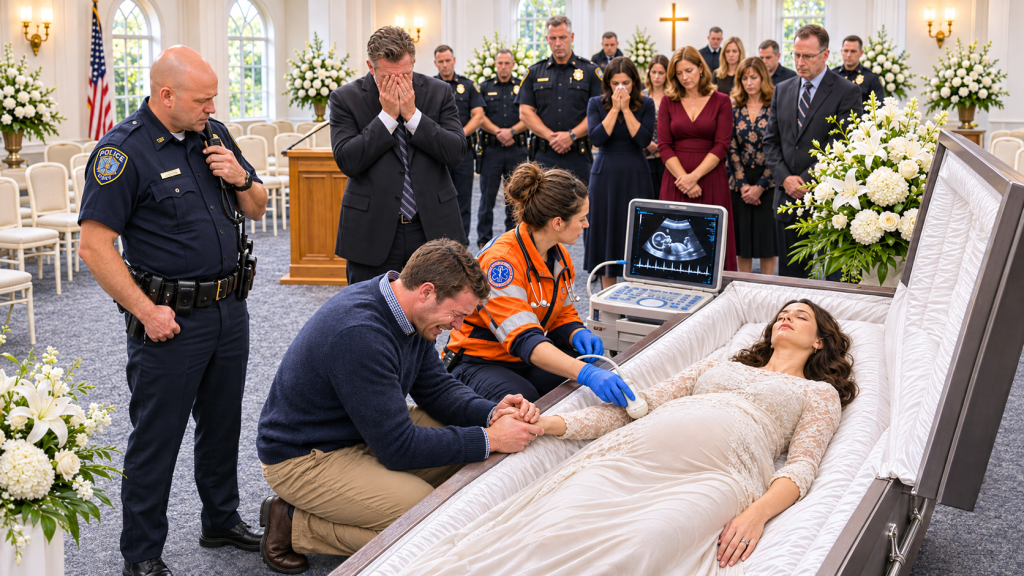
He’d seen something move beneath the fabric covering her stomach. He’d demanded that the ceremony stop. And against every expectation, emergency responders had detected signs of life. Now Ana Clara was somewhere beyond those doors, surrounded by physicians trying to determine how a pregnant woman could have been declared dead while still showing signs of circulation. And Marcos was standing in the same terrible place where he’d stood after the accident.
Waiting.
Praying.
Unable to do anything for the people he loved most.
Then a woman’s voice came from behind him.
“Mr. Almeida?”
He turned.
A police investigator in a dark jacket approached, accompanied by a uniformed officer.
“My name is Detective Helena Duarte. I need to ask you some questions.”
Marcos looked toward the emergency room.
“Not now.”
“I understand.”
“No, you don’t.”
His voice cracked.
“My wife was about to be cremated. My son might be dying. And her brother just ran away after receiving a message saying she wasn’t supposed to wake up.”
Helena’s expression tightened.
“That’s exactly why I need to understand what you saw.”
Marcos closed his eyes.
He wanted to refuse.
He wanted to sit on the floor and wait for a doctor to come out.
But somewhere inside him, beneath the fear and exhaustion, another feeling had begun to grow.
Anger.
Because whatever had happened to Ana Clara was no longer something he could accept without questions.
He looked at the detective.
“Then ask.”
The first question was about Gustavo.
“Gustavo Ribeiro,” Marcos said. “Ana Clara’s younger brother.”
“How old is he?”
“Thirty-four.”
“Do you know why he was at the hospital?”
“He came to the crematorium with the rest of the family.”
Helena shook her head.
“I mean today. Before you arrived here.”
Marcos stared at her.
“What?”
“We’re reviewing who contacted the hospital and what arrangements were made. We need to establish whether he had prior contact with any of the people involved.”
Marcos felt his stomach tighten.
“Gustavo told us the funeral arrangements had been taken care of.”
“Who told you that?”
“His mother said Gustavo had helped. I was barely functioning after the accident. I signed paperwork someone put in front of me. I don’t even remember all of it.”
Helena made a note.
“Did Gustavo have a financial relationship with your wife?”
Marcos almost laughed.
“A financial relationship?”
He ran a hand through his hair.
“Ana Clara lent him money constantly.”
“How much?”
“I don’t know. Thousands of reais over the years. Maybe more.”
“Did she ever ask him to repay it?”
“Sometimes. They argued about it.”
He paused.
Then remembered something.
“The morning of the accident, Ana Clara said she was meeting Gustavo.”
Helena looked up.
“Where?”
“She didn’t say. She sent me a message.”
He pulled out his phone with trembling fingers and opened the conversation.
There it was.
Gustavo needs to talk. Please don’t worry.
The last message Ana Clara had ever sent him.
Marcos held out the phone.
Helena examined the screen.
“May we preserve a copy of that message as part of the investigation?”
He nodded.
“Yes.”
Then his voice broke.
“Just tell me something.”
“What?”
“Do you think somebody tried to kill her?”
The detective held his gaze.
“We have circumstances that require a serious investigation. I’m not going to tell you we know more than we do.”
Marcos looked toward the closed doors.
“But we will follow the evidence,” she continued.
He nodded.
It was the only answer she could honestly give.
A few minutes later, the doors opened.
A doctor wearing blue surgical scrubs approached.
“Mr. Almeida?”
Marcos stood so quickly that his knees nearly gave way.
“Yes.”
“I’m Dr. Camila Nogueira, the obstetrician coordinating your wife’s care.”
“Is my son alive?”
The doctor nodded.
“At this moment, yes.”
Marcos covered his mouth.
She continued carefully.
“Your wife’s condition is critical. She’s showing signs of profound physiological compromise, including low body temperature and the effects of medications that require further investigation. Her circulation is weak but present.”
He stared at her.
“How could anyone think she was dead?”
“We’re reviewing the information available. I can’t yet explain the earlier determination.”
She paused.
“The immediate concern is that Miguel’s heart rate has fallen repeatedly. We believe he may not be receiving enough oxygen.”
Marcos gripped the back of a chair.
“What can you do?”
“We’re preparing for an emergency delivery. The neonatal intensive care team is ready.”
His face went white.
“But he’s only seven months.”
“He’s premature. He’ll need specialized care, and there are substantial risks. But remaining in the pregnancy may be more dangerous for him now.”
Marcos stared at her.
“And Ana Clara?”
“The critical-care team is working to stabilize her. The obstetric and anesthesiology teams are coordinating closely. We’re taking steps to protect both patients.”
He swallowed.
“Can I see her?”
“Not before we proceed. We need to act quickly.”
Marcos felt tears streaming down his face.
“Please save them.”
Dr. Nogueira’s expression softened.
“We’ll do everything medically appropriate.”
Then she turned and hurried back through the doors.
Marcos sank into a chair.
For the first time since he’d noticed the movement inside the coffin, he allowed himself to imagine what might happen if Miguel survived.
The baby’s room at home was almost ready.
Ana Clara had chosen pale blue curtains.
There was a white crib against the wall and a little wooden rocking horse beside the dresser.
She’d spent an entire afternoon arranging tiny socks by color.
Marcos had laughed at her.
“He’s going to outgrow half of these before he learns how to put them on.”
Ana Clara had smiled.
“Then I’ll enjoy them while I can.”
Now he couldn’t stop thinking about that room.
How it might remain empty.
How the little clothes might never be worn.
He leaned forward and buried his face in his hands.
“Please,” he whispered.
He didn’t know whether he was speaking to God, Ana Clara, or the son he hadn’t yet met.
“Please don’t leave me alone.”
At the other end of the corridor, Detective Duarte received a call.
She listened carefully.
Then stepped away from the waiting area.
The information coming through her phone concerned the reported accident on Rodovia dos Imigrantes.
Traffic investigators had reviewed photographs of Ana Clara’s damaged car.
The vehicle had struck a roadside barrier during heavy rain.
That part was genuine.
But the available images didn’t tell the entire story.
According to the initial report, Ana Clara had been found alone in the car.
Yet fresh examination of the scene photographs revealed something unusual.
The front passenger seat appeared to have been moved backward.
The passenger-side floor mat was displaced.
And a technician had identified marks suggesting the passenger door might have been opened after the collision.
None of those details proved another person had been present.
But they raised questions.
Then came another fact.
A nearby service station had preserved a short segment of surveillance footage.
The recording appeared to show Ana Clara’s car turning toward the highway entrance.
A dark SUV followed less than a minute later.
Investigators were working to establish whether the vehicles were connected.
Helena thanked the caller.
Then looked back toward the waiting room.
Gustavo’s frightened expression was beginning to make more sense.
At 4:46 that afternoon, a neonatal specialist approached Marcos.
“Mr. Almeida?”
He stood.
The doctor’s expression was serious.
But not hopeless.
“Your son has been delivered.”
Marcos froze.
For a second, he couldn’t understand the words.
“He’s here?”
“Yes.”
His knees weakened.
The doctor guided him toward a chair.
“Miguel is extremely premature and required immediate respiratory assistance. He’s receiving care in our neonatal intensive care unit.”
Marcos covered his mouth.
“Is he breathing?”
“He’s being supported by specialized equipment. His condition is serious, and we need to watch him closely.”
Tears streamed down Marcos’s face.
“But he’s alive?”
The doctor nodded.
“He’s alive.”
Marcos began sobbing.
He couldn’t stop.
He’d gone to the crematorium believing he’d lost both his wife and son.
Now Miguel was alive.
Fragile.
Fighting.
But alive.
The doctor allowed him a moment.
Then added, “We can arrange for you to see him when the team is ready.”
Marcos nodded repeatedly.
“Please.”
Miguel was smaller than anything Marcos had imagined.
The baby lay inside a transparent incubator, surrounded by tubing, sensors, and the gentle electronic sounds of the neonatal unit.
A tiny knitted cap covered his head.
His chest rose with the help of respiratory support.
His skin was delicate.
His fingers were so small that Marcos could barely believe they belonged to a human being.
A nurse stood beside him.
“This is your son.”
Marcos approached slowly.
His breath caught.
“Miguel.”
The baby moved one hand.
A tiny motion.
Almost nothing.
But Marcos recognized that movement.
It was the same stubborn little life he’d seen beneath Ana Clara’s dress.
He pressed his palm gently against the outside of the incubator.
“Hello, son.”
His voice broke.
“I’m your dad.”
The nurse handed him a tissue.
Marcos laughed through tears.
“I know you don’t understand any of this.”
He looked at the tiny face.
“But your mother and I have been waiting for you.”
Miguel shifted slightly.
Marcos wiped his cheeks.
“And I promise you something.”
He leaned closer.
“I’ll be here.”
He stayed beside the incubator until a nurse gently reminded him that he needed food and rest.
He didn’t want to leave.
But then he remembered Ana Clara.
“How’s my wife?”
The nurse’s expression softened.
“The critical-care team is still treating her. Someone will update you as soon as possible.”
Marcos nodded.
He looked down at Miguel one more time.
“I’ll be back, little man.”
Then he walked toward the intensive care waiting area.
He had a son.
His wife was alive.
And somewhere in São Paulo, Gustavo was running from the truth.
Ana Clara’s mother, Helena Ribeiro, arrived at the hospital just before evening.
Her face was swollen from crying.
She’d left the crematorium in a state of shock and spent the afternoon trying to understand how her daughter could have been transported to a hospital alive.
When she saw Marcos, she rushed toward him.
“Where is she?”
He stood.
“She’s in intensive care.”
Helena covered her mouth.
“And Miguel?”
“He’s been born.”
Her knees almost buckled.
Marcos caught her.
“He’s alive, Dona Helena.”
She began crying.
“My grandson?”
He nodded.
“He’s very premature. They’re helping him breathe.”
Helena crossed herself repeatedly.
Then looked at Marcos.
“Can I see him?”
“When the nurses say it’s possible.”
She gripped his hand.
“Thank you.”
He almost told her not to thank him.
He hadn’t performed the surgery.
He hadn’t saved Miguel.
He’d only noticed a movement and refused to let it be dismissed.
But then he remembered the coffin.
The paperwork.
The ceremony that had been minutes from proceeding.
And he understood that sometimes asking one more question could change everything.
After they sat down, Marcos told Helena about Gustavo.
Her expression changed.
“What about my son?”
“He ran when the detective tried to speak with him.”
She frowned.
“Why would he run?”
“I don’t know.”
Marcos hesitated.
“Did Gustavo borrow money from Ana Clara recently?”
Helena looked down.
“He asked her for help.”
“How much?”
“I don’t know.”
He studied her face.
“Dona Helena.”
She began crying again.
“Marcos, please. I’ve had enough terrible news.”
His voice softened.
“I know. But if Gustavo was involved in something that hurt Ana Clara, we need to understand.”
She wiped her cheeks.
Then whispered, “There was an argument last week.”
Marcos straightened.
“About what?”
“Money. Ana Clara discovered that Gustavo had used her name in a business arrangement.”
His stomach tightened.
“What arrangement?”
Helena shook her head.
“I don’t understand those things. She said he had signed something he shouldn’t have.”
Marcos stared at her.
“Did she say what?”
Helena lowered her eyes.
“She said she’d go to the police if he didn’t correct it.”
For several seconds, Marcos couldn’t speak.
Then he looked toward the intensive care doors.
Ana Clara had been preparing for motherhood.
She’d been folding baby clothes.
Taking prenatal vitamins.
Planning the future.
And somewhere in those same days, she’d also been trying to stop her brother from using her identity in a financial scheme.
Marcos felt anger rise.
Not because Gustavo was necessarily responsible for the accident.
But because there was now a reason to investigate his actions.
A reason that had nothing to do with grief.
Detective Duarte returned later that evening.
She asked Marcos whether he could speak privately.
He glanced toward Helena.
The older woman nodded.
“Go. I’ll stay here.”
In a small consultation room, the detective placed a folder on the table.
“We’ve confirmed that your wife contacted an attorney shortly before the accident.”
Marcos stared.
“An attorney?”
“Yes.”
“Why?”
“She requested advice concerning a business document bearing her signature. The attorney is reviewing what he can disclose through the appropriate legal process.”
Marcos closed his eyes.
He remembered Ana Clara sitting at the dining table several nights before the accident.
She’d been looking at something on her laptop.
When he asked what was wrong, she’d said, “It’s Gustavo again.”
He’d offered to help.
She smiled and told him she’d handle it.
Now he wished he’d insisted on listening.
But then he caught himself.
Ana Clara was an adult.
She hadn’t owed him every detail of a problem she was investigating.
Whatever happened next, responsibility belonged to whoever had harmed her.
Not to the husband who hadn’t guessed what was coming.
Helena continued.
“We’ve also found something concerning the medical paperwork.”
Marcos leaned forward.
“What?”
“The death declaration in the funeral documentation doesn’t match the available hospital records.”
He stared at her.
“The paramedics said there was a discrepancy.”
“Yes. The timestamp is inconsistent, and the identification and certification trail is incomplete.”
“Does that mean someone forged it?”
“We’re investigating whether documents were altered or improperly issued. We haven’t completed that determination.”
Marcos swallowed.
“Then how did my wife get into a coffin?”
The detective looked at him carefully.
“That’s one of the central questions.”
He leaned back.
The room seemed to tilt.
He’d been so overwhelmed by the news that Ana Clara was alive that he hadn’t yet allowed himself to consider the full horror of what had happened.
Someone had prepared her for a funeral.
Someone had accepted paperwork stating she was dead.
Someone had arranged to move her to a crematorium.
And she’d still had circulation.
Marcos covered his face.
“Whoever did this could have killed her.”
The detective didn’t answer.
She didn’t need to.
By the next morning, the police had located Gustavo.
He hadn’t gone home.
He hadn’t contacted his mother.
And he hadn’t returned any of Marcos’s calls.
Investigators found him at a roadside hotel outside São Paulo after following several leads, including information connected to his vehicle.
He agreed to speak with officers before asking for an attorney.
At first, he claimed he’d fled the hospital because he was frightened.
He said he’d been overwhelmed by the possibility that Ana Clara was alive.
Then investigators asked about the message on his phone.
She wasn’t supposed to wake up.
His explanation changed.
He claimed it was a cruel joke sent by a business associate.
When officers asked the associate’s name, Gustavo hesitated.
Eventually, he identified a man called Renato Farias.
Renato had worked with Gustavo on several property and equipment transactions.
He also had a relationship with someone employed by a private medical transport service.
The connections didn’t establish what had happened.
But they gave investigators something specific to examine.
Meanwhile, Ana Clara remained in intensive care.
Marcos learned that she had significant injuries from the collision, including a head injury, and had experienced severe physiological instability.
Her doctors were investigating what medications she’d received, when they’d been administered, and how her condition had been documented before the funeral transfer.
The phrase medications requiring investigation frightened him.
He imagined someone deliberately poisoning her.
But her physicians cautioned against conclusions.
Some medicines were routinely used in emergency treatment.
Others could cause prolonged sedation under certain circumstances.
And incomplete records made the sequence difficult to reconstruct.
A toxicology review and medical-record investigation were underway.
Marcos understood that until the facts were established, imagining a crime from every unexplained detail could make the nightmare worse.
He tried to focus on what he knew.
Ana Clara was alive.
Miguel was alive.
And both needed him.
On the second evening, a nurse told Marcos he could spend a short time beside his wife.
He entered the intensive care room quietly.
Ana Clara lay beneath a white sheet, surrounded by equipment.
Her face was swollen.
A small dressing covered part of her forehead.
She was receiving respiratory support, and her care team was monitoring her closely.
Marcos approached the bed.
For a moment, he couldn’t move.
He’d seen her in a coffin.
He’d kissed her forehead, believing it would be the last time.
Now he could see the gentle movement of her chest with assisted breathing.
He sat down.
“Hi, my love.”
His voice trembled.
“It’s me.”
He reached for her hand.
The nurse helped him find a safe place to hold it without disturbing the equipment.
Marcos carefully wrapped his fingers around hers.
“I don’t know whether you can hear me.”
Tears filled his eyes.
“But Miguel is here.”
He laughed softly through his tears.
“He’s early. Very early. Apparently, he inherited your impatience.”
He waited.
Ana Clara didn’t respond.
He leaned closer.
“He’s tiny, Ana. Smaller than my hand, it feels like.”
His voice broke.
“But he’s fighting.”
Marcos pressed his lips together.
“And I need you to fight too.”
He stayed until the nurse asked him to leave.
At the doorway, he turned back.
“I love you.”
He hesitated.
Then added, “And I’m sorry I didn’t know you were in trouble.”
He stopped.
The apology felt familiar.
Too familiar.
He’d spent every hour since the accident imagining things he could have done differently.
He could have driven her.
Asked more questions.
Insisted on accompanying her.
But he knew Ana Clara would have hated hearing him blame himself for somebody else’s wrongdoing.
He looked at her one last time.
“No,” he whispered.
“I’m not going to make this about what I failed to guess.”
His voice steadied.
“I’m going to be here when you wake up.”
Then he left.
Three days later, Detective Duarte asked him to come to the police station.
The meeting took place in a plain room with beige walls and a large table.
Helena was accompanied by a prosecutor who was overseeing parts of the investigation.
They explained that the inquiry had developed along two connected lines.
The first concerned the accident and possible financial crimes.
The second concerned Ana Clara’s medical transfer and the false documentation that had led to the crematorium.
Marcos sat very still.
Then Helena placed a copy of an agreement on the table.
“Have you seen this document?”
He examined it.
It appeared to authorize Ana Clara to guarantee a large loan associated with Gustavo’s company.
The amount was almost two million reais.
Marcos stared at the signature.
“Ana Clara never told me about this.”
“Did she have any business relationship with Gustavo’s company?”
“No. She was an accountant, but she didn’t work for him.”
Helena nodded.
“Her attorney has provided relevant information through the proper channels. She had discovered a document carrying what she believed was an unauthorized signature.”
Marcos felt anger rise.
“Gustavo used her name?”
“That’s one of the allegations being investigated.”
The prosecutor explained that the document might have been intended to secure financing for a business already struggling with debt.
Ana Clara had demanded an explanation.
She’d also indicated that she would report any unauthorized use of her identity.
The day of the accident, she’d arranged to meet Gustavo.
Marcos stared at the papers.
“She was trying to protect us.”
Helena looked at him.
“She appears to have been trying to establish what had happened and prevent further misuse of her information.”
He nodded slowly.
It was important to him that they didn’t turn his wife into a reckless heroine chasing danger.
She was a woman trying to resolve a serious problem.
She had the right to do that without being hurt.
Then Helena showed him a photograph.
The dark SUV from the surveillance footage.
Its license plate had been identified.
The vehicle was registered to Renato Farias.
Marcos looked up.
“Was Renato following Ana Clara?”
“We’ve confirmed his vehicle was on the same route. Additional footage and records place him near the accident scene.”
“And Gustavo?”
Helena took a breath.
“We have evidence indicating Gustavo was with Renato earlier that day. We’re still reconstructing their movements.”
Marcos gripped the edge of the table.
“What happened to my wife?”
The detective’s expression remained serious.
“We believe the collision was followed by events that were not accurately reflected in the original reports.”
She explained that investigators had identified evidence suggesting another vehicle stopped near Ana Clara’s car.
People approached it.
The passenger door was opened.
And there were discrepancies between the first emergency notification and the later transport records.
None of those facts alone established who caused the collision.
But they contradicted the story Marcos had originally been told.
“Ana Clara wasn’t simply found alone after losing control,” Helena said.
Marcos stared at her.
Then whispered, “They were there.”
“We have evidence placing people connected to the investigation near the scene.”
His eyes filled.
“And they didn’t help her?”
The detective paused.
“That’s part of what we’re examining.”
The most disturbing evidence concerned the medical transport.
After the accident, Ana Clara had been taken to a small private emergency facility.
There she received treatment for her injuries.
Records showed that she had initially arrived with signs of circulation.
Her condition then deteriorated dramatically.
A death declaration was produced.
But investigators found serious irregularities in the underlying documentation.
One physician’s name appeared on a form that the physician denied signing.
A transport authorization contained a timestamp inconsistent with the actual vehicle movements.
And an employee of a contracted service had accessed records outside his normal duties.
That employee had connections to Renato.
The prosecutor explained that the evidence was being examined to determine whether documents had been falsified and whether anyone knowingly arranged an improper transfer while Ana Clara’s medical condition remained uncertain.
Marcos stared.
“How did nobody check?”
Helena answered quietly.
“That failure is part of the investigation. There should have been clear, reliable medical certification before any funeral arrangements proceeded.”
He covered his face.
He’d trusted the people who told him his wife was dead.
He’d signed forms while barely able to stand.
And he’d almost signed the final authorization for her cremation.
He thought about the coffin.
The polished wood.
The white dress.
The tiny movement beneath the fabric.
Then he began shaking.
The detective offered him water.
He couldn’t drink it.
“Was Gustavo trying to kill her?” Marcos whispered.
The prosecutor looked at him.
“We have evidence supporting serious allegations, but intent and individual responsibility must be established through investigation and legal proceedings.”
Marcos nodded.
He understood the distinction.
The truth mattered too much to replace with a convenient story.
Even now.
Especially now.
But one question remained.
“Who sent the message saying she wasn’t supposed to wake up?”
Helena exchanged a glance with the prosecutor.
“We’ve identified the sender as Renato.”
Marcos felt his stomach tighten.
“Why would he say that?”
“That is one of the questions investigators are putting to the people involved.”
She paused.
“We also know the message was sent after word circulated that the cremation had been stopped.”
Marcos stared at the table.
Renato had known.
Somehow, he’d known that Ana Clara waking up would threaten whatever had been concealed.
That night, Marcos returned to the hospital and sat beside Miguel’s incubator.
His son was still receiving respiratory support.
The neonatologist explained that his condition remained serious, but he had shown some encouraging progress.
There were no promises.
No guarantees.
Just one small improvement after another.
Marcos placed his hand gently against the incubator.
“Hey, little man.”
Miguel moved his fingers.
Marcos smiled through tears.
“Your mother is still fighting.”
He looked at the tiny face.
“And you’re fighting too.”
For a moment, the hospital sounds seemed to fade.
He remembered the night he and Ana Clara learned she was pregnant.
She’d walked into the kitchen holding a test behind her back.
Marcos was washing dishes.
“Close your eyes,” she’d said.
He laughed.
“Why?”
“Just do it.”
She placed the test in his palm.
When he opened his eyes and saw the result, he’d stared at it for nearly a minute.
Then he picked her up and spun her around the kitchen.
She laughed so hard she cried.
“Put me down, Marcos!”
He’d kissed her.
Then knelt and pressed his forehead against her stomach.
“Hello in there.”
At the time, the baby was too small to hear him.
But now Miguel was here.
And Marcos had another chance to say those words.
“Hello in there, son.”
By the end of the first week, Ana Clara began showing more consistent neurological responses.
The doctors remained cautious.
Her injuries were serious.
She’d experienced profound physiological stress.
And the path toward recovery was uncertain.
But one afternoon, when a nurse asked her to squeeze a hand, she appeared to respond.
The team repeated the assessment.
Then documented the finding.
Marcos received the news while visiting Miguel.
He stared at the nurse.
“She moved?”
“She responded during the examination.”
His eyes filled.
“Does that mean she’s waking up?”
“It may be an encouraging sign. The doctors will continue assessing her.”
He nodded.
He’d learned to respect careful language.
May.
Possible.
Encouraging.
Words he’d once found frustrating now sounded beautiful.
Because every one of them left room for hope.
Two days later, Marcos was sitting beside Ana Clara when her eyelids moved.
At first, he thought he’d imagined it.
He leaned closer.
“Ana?”
Her eyes opened slightly.
Not fully.
Just enough to reveal a narrow glimpse of the eyes he knew better than his own.
Marcos stopped breathing.
“My love?”
Her gaze moved without focusing.
He reached for the nurse call button.
A nurse came immediately.
Marcos stepped back while the team assessed her.
Ana Clara remained confused and weak.
She couldn’t speak clearly.
But she opened her eyes again.
And when Marcos returned to her bedside, he saw something extraordinary.
She looked toward him.
“Mar…” she whispered.
His knees weakened.
“Yes.”
Tears streamed down his cheeks.
“It’s me.”
She blinked slowly.
He took her hand.
“I’m here.”
Her lips moved.
He leaned closer.
“What, my love?”
Her voice was barely audible.
“Baby?”
Marcos covered his mouth.
He had imagined this moment a hundred times.
Yet hearing that single word nearly brought him to his knees.
He moved closer.
“Miguel is alive.”
Tears slipped from the corners of Ana Clara’s eyes.
“He’s early,” Marcos whispered. “He’s in the neonatal unit. The doctors are taking care of him.”
Her fingers tightened faintly around his.
Marcos smiled through tears.
“He’s waiting for you.”
The recovery wasn’t immediate.
Ana Clara couldn’t sit up and hold her son the next morning.
She needed continued medical care.
Therapy.
Rest.
And repeated assessments of the injuries she’d sustained.
There were days when she seemed stronger.
And days when she was exhausted after only a few minutes of conversation.
Sometimes she became confused about the order of events.
Sometimes she struggled to remember what had happened before the accident.
Her doctors explained that recovery from serious brain injury and critical illness could be uneven.
Marcos tried not to ask too much.
He wanted answers about Gustavo.
About the accident.
About the false medical records.
But his wife was still learning how to regain strength.
Her healing mattered more than satisfying his questions.
One morning, Ana Clara asked for her mother.
Dona Helena entered the room carrying a small photograph of Miguel.
The older woman stopped beside the bed.
Then began crying.
“My daughter.”
Ana Clara smiled weakly.
“Mãe.”
Helena bent down and kissed her forehead.
For a long moment, neither could speak.
Then Ana Clara looked at the photograph.
“He’s beautiful.”
Her mother nodded.
“He is.”
Ana Clara touched the image with one finger.
“Can I see him?”
Marcos moved closer.
“As soon as the doctors say it’s safe, we’ll arrange it.”
She nodded.
Then looked at her mother.
“Where’s Gustavo?”
The room became silent.
Helena lowered her eyes.
Marcos felt his chest tighten.
Ana Clara looked between them.
“What happened?”
He sat beside her.
“There’s an investigation.”
Her expression changed.
“Gustavo?”
Marcos nodded gently.
“We don’t know everything yet.”
She closed her eyes.
Then whispered, “I told him to stop.”
Over the next several days, Ana Clara spoke with medical professionals and, when she was well enough, investigators.
Her recollections emerged gradually.
Some details were clear.
Others remained fragmented.
She remembered discovering that Gustavo had used her name in a financing application.
She remembered confronting him by telephone.
She remembered agreeing to meet him near a highway service area because he claimed he could bring the paperwork and correct the problem.
She’d intended to leave after speaking with him.
But Renato appeared.
That surprised her.
She hadn’t expected Gustavo to bring anyone else.
She recalled an argument.
Gustavo insisted the financing would save his company.
Ana Clara told him that she couldn’t allow her signature to be used without permission.
Renato became angry.
He accused her of ruining a business arrangement.
She returned to her car.
Then she remembered a dark vehicle following her onto the highway.
Heavy rain.
Headlights in her mirror.
A horn.
A sudden maneuver.
And the barrier coming toward her.
After that, her memories were incomplete.
She recalled voices.
A man saying they needed to move quickly.
Someone mentioning a hospital.
Then almost nothing.
Her account did not establish every event.
But it provided investigators with firsthand information that could be compared against the physical evidence.
When Marcos learned what she remembered, he felt a rage so strong that he had to leave the hospital room.
He walked outside and stood beneath a gray afternoon sky.
Traffic moved along the avenue.
A man pushed a stroller past the hospital entrance.
Two nurses laughed quietly while waiting for a rideshare.
Ordinary people lived ordinary lives.
And Marcos wanted to shout.
Because Ana Clara had nearly died.
Miguel had nearly died.
And the people responsible for the wrongdoing surrounding the accident had carried on with their plans while he prepared a funeral.
He took out his phone.
Gustavo’s number was still saved.
For one terrible moment, Marcos wanted to call and scream at him.
Then he looked through the glass doors toward the hospital.
Ana Clara was alive.
Miguel was alive.
And the investigation was moving forward.
He put the phone away.
He wouldn’t risk making his wife’s recovery harder by turning his anger into another disaster.
The next development came weeks later.
Investigators had obtained additional footage from a road-management camera near the accident location.
The images didn’t show every moment clearly.
Rain obscured portions of the scene.
But investigators could see the dark SUV following Ana Clara’s vehicle.
The sequence showed the vehicles moving dangerously close before Ana Clara lost control.
After the collision, the SUV stopped.
Two people got out.
And the footage showed activity near the damaged car before emergency personnel arrived.
The evidence helped investigators reconstruct the sequence.
It also contradicted Gustavo’s early suggestion that he’d had no contact with Ana Clara after their meeting.
He and Renato faced further questioning through their attorneys.
As more records were collected, investigators uncovered messages about the disputed financing and the need to prevent Ana Clara from reporting it.
A message from Renato referred to ensuring she “couldn’t interfere.”
Another discussed controlling the information that reached Marcos.
The most serious concern remained the medical transfer.
Investigators found evidence that Renato had contacted a transport employee connected to the private facility.
That employee had participated in arrangements supported by false or unreliable paperwork.
The exact responsibility of each person would be determined through the legal process.
But the pattern was no longer a collection of unrelated mistakes.
There was evidence of coordinated conduct designed to conceal what had happened after the collision.
The message that Marcos had glimpsed on Gustavo’s phone became important evidence.
She wasn’t supposed to wake up.
Investigators determined that Renato had sent it after receiving news that Ana Clara had shown signs of life at the crematorium.
In later proceedings, prosecutors argued that the message reflected knowledge that the improper medical transfer might be exposed.
The defense disputed that interpretation.
The case required examination of the full conversation, not simply one sentence.
Marcos understood that.
But he couldn’t forget what he’d seen.
Nor could he forget Gustavo trying to run.
Eventually, Gustavo asked through his attorney whether he could send a letter to Ana Clara.
Marcos didn’t know what to say.
He wanted to throw it away.
To tell Gustavo he’d lost the right to speak to his sister forever.
But Ana Clara was recovering.
She could make her own decisions.
When he told her about the request, she remained quiet for a long time.
Then she asked, “Do you think I should read it?”
Marcos sat beside her.
“I think that’s your decision.”
She looked at him.
“Do you hate him?”
Marcos took a breath.
“I’m angry. More angry than I’ve ever been.”
She nodded.
“So am I.”
He reached for her hand.
“I don’t want you to feel you owe him forgiveness because he’s your brother.”
Her eyes filled.
“I know.”
She thought for a while.
Then whispered, “Not yet.”
Marcos nodded.
He informed the appropriate people that she wasn’t ready to receive a letter.
And that was the end of the conversation for the time being.
No argument.
No pressure.
Just a boundary.
For the first time since the accident, Ana Clara was allowed to decide what happened next.
Miguel spent almost three months in the neonatal intensive care unit.
During that time, Marcos learned a kind of patience he had never known before.
He learned to celebrate tiny changes.
A little more weight.
A reduction in respiratory support.
A reassuring examination.
An afternoon when Miguel tolerated feeding better than the day before.
He learned the names of nurses who sat beside incubators through the night.
He learned that premature babies could make progress and still encounter setbacks.
And he learned that hope didn’t have to mean pretending everything was certain.
One morning, the neonatal team told him Miguel was ready for a carefully supervised period of skin-to-skin contact.
Marcos sat in a reclining chair.
The nurse helped settle the baby safely against his chest.
Miguel was still small.
His movements were delicate.
But he was warm.
Real.
Alive.
Marcos looked down at him.
“Hello, son.”
His voice trembled.
“I’ve waited a long time for this.”
Miguel rested quietly against him.
And for the first time since the nightmare began, Marcos felt his body relax.
He didn’t think about Gustavo.
Or the financial documents.
Or the crematorium.
He thought only about his son’s warmth against his heart.
Ana Clara’s first visit to the neonatal unit happened several weeks into her recovery.
She arrived in a wheelchair with a therapist accompanying her.
Marcos stood beside Miguel’s incubator.
When he saw his wife, he began crying.
Ana Clara looked toward the baby.
Her face changed.
“Oh, Marcos.”
He knelt beside her.
“That’s him.”
She covered her mouth.
“That’s our boy?”
Marcos nodded.
“Our Miguel.”
The nurse explained what the baby needed and helped Ana Clara touch him safely.
Ana Clara extended one trembling finger.
Miguel’s tiny hand curled around it.
She began sobbing.
“My baby.”
Marcos placed a hand on her shoulder.
For a long moment, nobody spoke.
Then Ana Clara whispered, “I thought I’d never see him.”
Marcos kissed her hair.
“You’re here.”
She looked at him.
“And you found us.”
His eyes filled.
“I almost didn’t.”
She shook her head.
“But you did.”
The criminal investigation continued after Ana Clara left intensive care.
The authorities pursued allegations involving the financial documents, the dangerous events surrounding the collision, and the falsification or improper use of medical records.
Renato and the transport employee faced serious scrutiny over their roles.
Gustavo’s conduct was examined separately, including what he’d known, what he’d done, and his actions after the accident.
The private facility and the professional bodies responsible for medical oversight reviewed how Ana Clara’s condition had been documented and how the transfer was allowed to proceed.
There were disciplinary proceedings, criminal allegations, and legal disputes.
Not every allegation was resolved at once.
Not every person involved accepted responsibility.
The investigation had to distinguish deliberate acts from serious professional failures.
But the central facts were no longer in doubt.
Ana Clara had been alive.
She had been transferred under profoundly improper circumstances.
And the documentation used to support her funeral arrangements had been unreliable.
Marcos and Ana Clara retained independent legal representation, cooperated with the investigators, and sought appropriate accountability.
They did not turn the case into a public spectacle.
Their greatest concern was protecting Ana Clara’s recovery and Miguel’s future.
One evening, when Ana Clara was strong enough to sit on the balcony of their apartment, she asked Marcos to bring her the folder containing photographs of Miguel.
He sat beside her.
The sun was setting over São Paulo.
Traffic hummed far below.
Ana Clara slowly turned the pages.
There was Miguel inside the incubator.
Miguel with his tiny hand against Marcos’s finger.
Miguel wearing the knitted blue cap her mother had made.
Then she reached the first photograph of Marcos holding him against his chest.
She smiled.
“You look terrified.”
Marcos laughed.
“I was.”
She looked at him.
“You still are.”
He smiled sadly.
“Sometimes.”
She closed the folder.
Then took his hand.
“I don’t remember everything that happened.”
“I know.”
“But I remember being afraid.”
His chest tightened.
She looked toward the sky.
“And I remember thinking I might never come home.”
Marcos squeezed her fingers.
Ana Clara turned toward him.
“Do you know what hurts most?”
He shook his head.
“That Gustavo knew how much we wanted this baby.”
Her eyes filled.
“He knew how long we’d waited.”
Marcos moved closer.
She began crying.
“I was trying to stop him from making another terrible mistake. I never imagined he’d let things go so far.”
Marcos held her.
For a long time, they sat quietly.
Then Ana Clara whispered, “I don’t know if I can forgive him.”
Marcos kissed her forehead.
“You don’t have to decide.”
When Miguel finally came home, Ana Clara stood beside the apartment door holding a little blue blanket.
Her recovery was still continuing.
She needed therapy and follow-up appointments.
Some days she became tired more quickly than before.
And the doctors had explained that certain effects of her injuries might require ongoing attention.
But she was home.
Marcos carried Miguel in his infant car seat, carefully following the discharge instructions.
The baby had grown stronger.
He still needed appropriate medical follow-up, and his parents knew that leaving the hospital didn’t mean every concern had disappeared.
But the homecoming was real.
Marcos stepped through the doorway.
Ana Clara began crying.
“Welcome home, my little love.”
Miguel stirred beneath his blanket.
Marcos smiled.
He remembered the last time he’d stood in that hallway before the accident.
Ana Clara had been arranging baby clothes.
The crib wasn’t assembled.
There were unopened boxes beside the nursery door.
He’d promised to finish everything over the weekend.
Now the crib stood ready.
The curtains were hung.
And the child they’d almost lost was finally home.
That night, after Miguel fell asleep, Marcos found Ana Clara standing in the nursery.
She was looking at the rocking chair.
“Are you all right?” he asked.
She nodded.
Then shook her head.
“I don’t know.”
He moved beside her.
“What’s wrong?”
She looked toward the crib.
“For a while, I thought I’d missed his birth forever.”
Marcos swallowed.
“You were there, Ana.”
“But I wasn’t awake.”
Her voice broke.
“I didn’t hear his first cry. I didn’t get to hold him when he was born.”
He took her hand.
“I know.”
She began crying.
“So much happened without me.”
Marcos wrapped his arms around her.
“I’m sorry.”
She leaned against him.
For a long moment, they stood quietly.
Then he whispered, “I can’t give you those first minutes back.”
She nodded.
“But I can tell you about them. And we have all the photographs. And there are so many moments still ahead.”
Ana Clara looked toward Miguel.
He moved one tiny hand in his sleep.
She smiled through tears.
“Yes.”
Marcos kissed her forehead.
“So many.”
A year after the interrupted cremation, Marcos and Ana Clara returned to the place where their lives had nearly ended.
Not the crematorium.
Not the private clinic.
They went to the maternity hospital.
Miguel had a scheduled follow-up appointment.
He was a curious little boy who loved reaching for bright objects and laughing whenever his father made ridiculous faces.
His doctors continued to monitor his development because he’d been born very prematurely.
But that afternoon, the family received encouraging news about his progress.
When they left, Marcos carried Miguel while Ana Clara walked beside him.
Outside the hospital, she stopped.
“Marcos?”
He turned.
“Yes?”
“Do you remember the last thing you said to me before the accident?”
He thought for a moment.
“I said I’d pick up dinner.”
She smiled.
“And I told you not to forget dessert.”
He laughed.
“You did.”
Her eyes filled.
“We thought we had so much time.”
Marcos took her hand.
“I know.”
She looked at Miguel.
Then back at her husband.
“We still have time.”
He nodded.
“Yes.”
She squeezed his fingers.
“And I don’t want to spend all of it being afraid.”
Marcos smiled.
“Neither do I.”
The following Sunday, the family gathered for lunch.
Dona Helena brought homemade rice and beans.
Ana Clara’s aunt arrived with a cake.
Miguel sat in his high chair, banging a spoon against the tray.
Marcos laughed.
“He’s going to be a drummer.”
Ana Clara shook her head.
“Or a construction worker.”
Her mother smiled.
“Or maybe he’ll become a doctor.”
Miguel dropped the spoon.
Everyone laughed.
For a moment, the kitchen was filled with the ordinary sounds of family life.
Dishes.
Conversation.
A baby demanding attention.
Marcos looked around the table.
A year earlier, he’d believed those sounds would never fill his home again.
Now they surrounded him.
And he felt something he hadn’t expected after so much suffering.
Peace.
Not because every question had been answered.
Not because the legal proceedings were finished.
And not because everyone who’d caused harm had apologized.
Peace because his wife was sitting beside him.
His son was reaching for his hand.
And for the first time in a long while, the future felt like something they could welcome instead of fear.
Later that evening, Ana Clara found Marcos standing in Miguel’s doorway.
He was watching their son sleep.
She moved beside him.
“You’re doing it again.”
He smiled.
“What?”
“Checking on him every five minutes.”
Marcos laughed softly.
“Only every ten.”
She rested her head against his shoulder.
For a while, they watched Miguel’s chest rise and fall.
Then Ana Clara whispered, “Do you ever think about that day?”
Marcos knew which day she meant.
The coffin.
The funeral.
The faint movement.
The desperate call for help.
“Yes,” he answered.
“Every day?”
He nodded.
“Most days.”
She took his hand.
“What do you remember most?”
Marcos thought about it.
He remembered the cold funeral room.
The polished wood.
The terrible silence.
He remembered the paramedic confirming a fetal heartbeat.
The hospital doors closing.
The first glimpse of Miguel inside the incubator.
Then he looked at Ana Clara.
“I remember almost saying goodbye.”
Her eyes filled.
He continued.
“And I remember realizing I couldn’t accept that something was wrong without asking someone to check.”
She squeezed his hand.
Marcos looked toward the crib.
“I couldn’t save you by myself. The doctors and nurses did the medical work. And even they couldn’t promise what would happen.”
He swallowed.
“But I could speak up when I noticed something.”
Ana Clara leaned closer.
“And you did.”
My name is Marcos Almeida.
For a few terrible days, I believed I’d lost my wife and the son we hadn’t yet met.
I stood beside a coffin and tried to find the courage to say goodbye.
Then I noticed a faint movement.
I refused to ignore it.
Emergency responders confirmed signs of life, and physicians fought to give Ana Clara and Miguel the care they urgently needed.
What followed exposed a deeply disturbing chain of financial deception, suspicious conduct surrounding a collision, and serious failures in medical documentation and transfer procedures.
The investigation didn’t erase our suffering.
It didn’t restore the pregnancy we should have been able to enjoy in peace.
And it didn’t return the hours when I believed everything I loved had vanished.
But it established that there were questions worth asking.
And that those questions deserved answers.
Sometimes I look at Miguel and wonder whether he’ll ever understand the story of his birth.
One day, when he’s old enough, Ana Clara and I will tell him.
Not as a frightening tale meant to make him feel responsible for our happiness.
Not as a story about how he owes us anything because he survived.
But as part of his history.
We’ll tell him that he arrived early.
That he needed extraordinary medical care.
That many people worked hard to help him.
And that his mother loved him long before she had the chance to hold him.
We’ll also tell him that life can change without warning.
That the truth matters.
And that when something seems wrong, asking for help can be an act of courage.
Last night, Miguel woke crying just after midnight.
Marcos reached his crib first.
He lifted the baby gently and held him against his shoulder.
Ana Clara appeared in the doorway, sleepy and smiling.
“Is he hungry?”
“I think he just wants company.”
She laughed.
“Like his father.”
Marcos smiled.
Miguel settled against him.
For a while, the three of them stood in the nursery beneath the soft glow of a night-light.
Ana Clara rested a hand against her son’s back.
Marcos looked at his wife.
Then at the little boy between them.
A year earlier, he’d stood in a funeral room believing he would never feel this warmth again.
Now he could hear Ana Clara breathing beside him.
He could feel Miguel’s tiny fingers gripping his shirt.
And he understood something that would remain with him for the rest of his life.
Love cannot guarantee that tragedy will never find us. But love can give us the courage to question what is wrong, seek the truth, and keep showing up for those who need us.
Marcos kissed his son’s forehead.
Ana Clara slipped her arm around his waist.
And together, they carried Miguel back toward his crib.
Not toward a perfect future.
Not toward a life without difficult memories.
But toward a future that was finally theirs to live.


