For a moment, the entire countryside seemed to fall silent. The wind stopped moving through the dry corn stalks. The gravel beneath my boots felt strangely unsteady. And the man I’d trusted with my life stood beside his pickup, looking at me as though he’d just been caught holding a secret he could no longer carry. “What did you say?” I whispered.
Dale swallowed. His brother Vern stood six feet away, clutching a yellowed envelope with our names nowhere on the outside except Dale’s. Kinley moved closer to me. “Dad?” Dale looked at our daughter. Then at the cardboard box resting on the gravel. Domino’s name was written across the bottom in her careful handwriting.
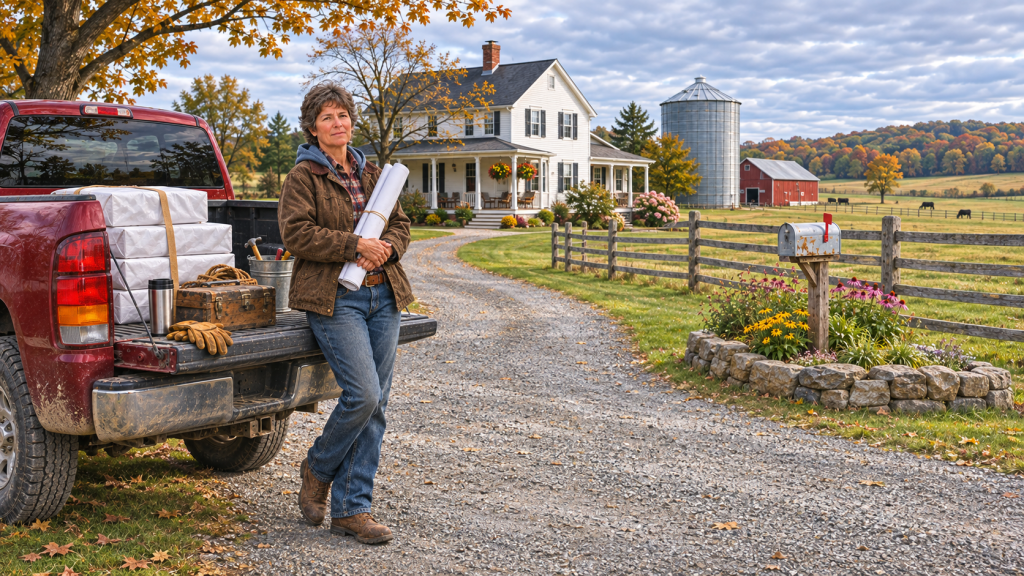
And suddenly, the quiet anger I’d felt since that Saturday morning became something much heavier. “Jill,” Dale said, “let’s go home and talk.” I shook my head. “No.” He closed his eyes. “Please.” “You just told me your father made you promise to hide something from me. Vern shot Kinley’s steer. Now he’s standing here with an envelope about our property, and you want me to drive home and wait for another explanation?”
Dale said nothing.
I looked at the envelope.
“Give it to me.”
Vern tightened his grip.
“It’s addressed to Dale.”
“Then give it to Dale.”
My voice was quiet.
But both brothers heard something in it that made them stop arguing.
Vern handed the envelope to his brother.
Dale stared at it.
Then he turned it over.
The paper had faded to the color of old straw.
A name was written in blue ink across the front.
Dale Mercer.
Below it were four words.
When the time comes.
Dale’s face changed.
He whispered, “Dad.”
Then he looked at me.
And for the first time in nearly twenty years of marriage, I saw fear in my husband’s eyes that had nothing to do with weather, cattle, or money.
It was the fear of a man who knew the truth was finally catching up with him.
My name is Jill Mercer.
I’m forty-six years old, and I’ve spent most of my life believing that the most important things on a farm are trust, hard work, and knowing where the fence lines belong.
I married Dale when I was twenty-six.
He was a quiet man with strong hands, a patient heart, and an almost unreasonable devotion to his family’s land.
His father, Walter Mercer, had farmed the same stretch of ground for decades.
After Walter retired, Dale took over much of the daily work.
Vern, Dale’s older brother, farmed the adjoining property.
The two men had grown up fishing the same creek, riding the same tractors, and helping their father through harvests that sometimes barely covered the bills.
By the time I entered the family, they were already different men.
Dale believed that if something needed fixing, you got up early and fixed it.
Vern believed that if something went wrong, somebody else had probably caused it.
But I never imagined their differences would end with a dead steer beside our fence.
Or with a secret that had been waiting seventeen years to surface.
“Open it,” I told Dale.
He looked at Kinley.
She stood beside me, her eyes swollen from crying.
She’d been quiet since we’d arrived at Vern’s driveway.
I knew she was listening to every word.
Dale took a breath.
Then carefully unfolded the letter.
There were three pages inside.
The first was written in Walter’s familiar handwriting.
The second was a photocopy of an old survey sketch.
The third appeared to be a statement signed by both brothers.
Dale read the first paragraph silently.
Then his shoulders sagged.
“Jill,” he whispered, “I need to explain something.”
I shook my head.
“Read it.”
He looked at me.
“Please.”
“Out loud, Dale.”
He swallowed.
Then began.
Dale, if you’re reading this, I hope you and Vern have finally found the sense to do what I should have made you do years ago.
His voice trembled.
The south boundary was never supposed to become a reason for brothers to hate each other.
I made mistakes when I divided the farm. I let pride and impatience turn an agreement into something neither of you wanted to discuss honestly.
Dale stopped.
Vern looked toward his cornfield.
I waited.
“Keep reading.”
Dale lowered his eyes.
The strip along the west side of Vern’s cornfield belongs with the home farm under the recorded property description. I told Vern he could use it while he needed the acreage, but I never completed a transfer.
I also know that Jill contributed money toward paying down the home farm’s mortgage when she married Dale.
My breath caught.
I looked at Dale.
He couldn’t meet my eyes.
He continued reading.
That contribution helped save ground that otherwise might have been lost. Both my sons know this.
The paper trembled in his hands.
I don’t want her treated like a visitor on land she helped preserve.
I felt the blood drain from my face.
Because suddenly, I understood that the secret wasn’t simply about a fence.
It was about me.
When I married Dale, I had inherited forty-two thousand dollars from my grandmother.
It was the only substantial inheritance I’d ever received.
My grandmother had worked as a school secretary for thirty-eight years.
She lived modestly.
Saved carefully.
And left me enough money to make a meaningful start in life.
I could have used it for a house.
A college fund.
Or a small business.
Instead, Dale and I used much of it to reduce debt on the home farm during a difficult period.
I remembered sitting at our kitchen table, signing paperwork while Dale promised we were building a future together.
I didn’t regret helping.
But I’d always believed the transaction was understood and respected.
I hadn’t known Walter had written a letter specifically acknowledging my contribution.
And I certainly hadn’t known that both his sons had kept it from me.
“Why?” I whispered.
Dale looked up.
“Jill—”
“Why did you hide this?”
His eyes filled.
“Because Dad asked us not to fight over it while he was alive.”
I stared at him.
“That’s not what I asked.”
He lowered the letter.
I stepped closer.
“Did you know your father believed I had a right to be included in decisions about that boundary?”
Dale nodded.
“Yes.”
“And you never told me?”
He closed his eyes.
“No.”
I looked at Vern.
“And you?”
Vern stared at the gravel.
“I knew.”
The word felt like a stone dropping into deep water.
All these years, I’d been walking that fence, helping repair it, and discussing pasture plans without knowing there was a dispute behind it.
My husband had chosen silence.
His brother had chosen resentment.
And my daughter had paid for it with the animal she loved.
Kinley spoke suddenly.
“Did Grandpa Walter know about Domino?”
We all turned.
Her voice was small.
“Kinley,” Dale said softly, “Grandpa died before Domino was born.”
She shook her head.
“I know.”
Tears filled her eyes.
“I mean, would he have let Uncle Vern shoot him over a fence?”
Dale’s face crumpled.
“No, sweetheart.”
She looked at Vern.
“Then why did you?”
He opened his mouth.
Closed it.
Then finally whispered, “I was angry.”
Kinley stared at him.
“Domino wasn’t angry.”
Nobody moved.
She continued.
“He didn’t know you were fighting about land.”
Vern lowered his head.
“He didn’t know anything about your argument,” she said. “He just knew where his grass was.”
Tears slipped down her cheeks.
I put an arm around her.
Vern looked as though he’d been struck.
But this time, there was no rifle in his hands.
No excuse about corn.
No fence he could blame.
Only a thirteen-year-old girl asking a question he couldn’t answer.
We went home without resolving anything.
I didn’t leave the box of beef on Vern’s porch.
He asked me to take it back.
I looked at him.
“That box is yours.”
He stared at Domino’s name.
“I don’t deserve it.”
I took a breath.
“That wasn’t why I brought it.”
He lowered his eyes.
“Then why?”
I thought about the five other households along our road.
The neighbors who’d accepted Domino’s beef without making a spectacle of our grief.
The way Kinley had written his name beneath each box because she didn’t want him forgotten.
“Because sharing what we have is how I was raised,” I said. “And I don’t want your choices to determine what kind of person I become.”
Vern began crying.
I didn’t comfort him.
He bent down, lifted the box, and carried it toward his house.
Kinley watched quietly.
Then climbed into our pickup.
Dale followed in his truck.
And I drove home wondering whether a marriage could survive a secret that had been sitting between two brothers for seventeen years.
That evening, Kinley went straight to the barn.
I found her sitting on the wooden feed chest beside Domino’s empty stall.
His old halter hung from a nail.
The red feed bucket was still in the corner.
Kinley held a photograph in her hands.
It showed Domino as a calf.
His nose was wet.
His ears were enormous.
And Kinley was smiling as she held a bottle nearly as big as his head.
I sat beside her.
For several minutes, neither of us spoke.
Then she whispered, “Mom?”
“Yes, sweetheart?”
“Was it wrong to give Uncle Vern the beef?”
I looked at her.
“No.”
She stared at the photograph.
“Then why does it feel wrong?”
My heart tightened.
“Because sharing something doesn’t mean you’ve forgiven how it was taken from you.”
She thought about that.
“Do I have to forgive him?”
I shook my head.
“No.”
Her eyes filled.
“Everybody at church says forgiveness is important.”
“It is,” I said gently. “But forgiveness isn’t something people get to demand from you because they’re uncomfortable with your sadness.”
She looked up.
“You can be kind without pretending what happened was okay.”
A tear slipped down her cheek.
“Even to Uncle Vern?”
“Even to him.”
She leaned against me.
And I held her in the stall where she’d spent so many mornings feeding a calf who had trusted her completely.
After Kinley went to bed, Dale found me in the kitchen.
The yellowed envelope lay between us.
He stood near the doorway.
“Can we talk?”
I looked at him.
“Sit down.”
He took the chair opposite me.
For a while, we listened to the refrigerator humming.
Then I asked, “What else don’t I know?”
Dale stared at his hands.
“Nothing like this.”
I waited.
He sighed.
“Jill, I should have told you about the boundary years ago.”
“Yes.”
“I thought keeping quiet would protect the family.”
I shook my head.
“It protected the argument from being resolved.”
He looked up.
“And it kept me from understanding something that affected our home.”
His eyes filled.
“I know.”
I opened the letter.
“Your father wrote that my inheritance helped save the farm.”
Dale nodded.
“It did.”
“Then why did you let Vern keep acting as though I didn’t belong here?”
Dale flinched.
I continued.
“Do you remember when he told me I was just the woman who married into the Mercer name?”
Dale closed his eyes.
“Yes.”
“And you told me to ignore him.”
“I remember.”
I swallowed.
“All these years, I thought you were simply avoiding conflict. Now I know you were avoiding a conversation you owed me.”
He began crying.
For nearly twenty years, I’d watched my husband face blizzards, equipment breakdowns, and failed harvests without losing his composure.
Seeing him cry didn’t soften the truth.
But it reminded me that the man sitting across from me was more than his worst decision.
“Dale,” I said quietly, “I love you.”
He looked up.
“But I need to trust you with the truth, even when the truth is uncomfortable.”
He nodded.
“I know.”
Then he told me what had happened seventeen years earlier.
Walter had been recovering from a serious illness.
The farm was struggling.
Vern wanted to expand his corn acreage.
Dale wanted to preserve the grazing land near our home.
Their father suggested that Vern could use a narrow strip along the boundary until the brothers settled on a permanent arrangement.
But the arrangement had never been properly completed.
The recorded property documents and the old survey placed the strip on the home farm side.
Walter knew that.
So did both sons.
Yet Vern continued cultivating close to the fence as though the ground belonged to him.
Dale didn’t challenge him.
He believed the arrangement was temporary.
Then Walter died.
And the brothers simply continued doing what they’d been doing.
Over time, Vern began speaking about the strip as though he’d inherited it outright.
Dale knew better.
But rather than risk a family fight, he kept quiet.
I stared at him.
“So you let the disagreement grow.”
He nodded.
“And when Vern claimed Domino was in his corn?”
Dale’s face tightened.
“I knew the fence was on the home farm boundary.”
“Did you know Vern was angry enough to shoot an animal?”
“No.”
I believed him.
But I was still furious.
Because silence hadn’t prevented the conflict.
It had only allowed it to grow until something living paid the price.
The following morning, Dale placed the entire envelope on the kitchen table.
“I want you to read everything,” he said.
I looked at him.
“Even the parts you don’t want me to see?”
He nodded.
“Especially those.”
After he left to feed the cattle, I unfolded Walter’s letter again.
The first page was about the disputed boundary.
The second contained something I hadn’t noticed while standing in Vern’s driveway.
A paragraph about money.
Vern knows that the twenty-four thousand dollars I advanced him was a loan, not an inheritance distribution. He has never repaid it. I was wrong to let him believe he could settle that obligation by claiming ground that wasn’t his to claim.
I stared at the words.
Twenty-four thousand dollars.
A loan.
And a strip of land that wasn’t his.
My hands began trembling.
Beneath the letter was a photocopy of a handwritten ledger.
Several entries were marked with dates.
There were notations about cattle purchases, seed, equipment repairs, and advances to Vern.
Near the bottom was a line in Walter’s handwriting.
Balance to be accounted for before any final division.
Then a note.
Jill’s contribution to the home farm must not be forgotten.
I looked through the remaining papers.
The last page was a statement signed by Walter, Dale, and Vern acknowledging that the boundary remained unresolved and that the earlier financial advances had to be reviewed before any settlement.
I couldn’t tell whether the papers created enforceable obligations.
I wasn’t a lawyer.
And seventeen years had passed.
But I could see why Vern had hidden them.
His version of the story had always been simple.
Dale had taken more than his fair share of the farm.
Vern had been cheated.
And I was the outsider who had somehow benefited from everything.
Yet Walter’s own records suggested a far more complicated history.
Vern had received substantial financial help.
Dale had known about it.
And both brothers had allowed resentment to take the place of an honest accounting.
That afternoon, I drove to see Marge Hansen.
Marge lived two farms east of us.
She’d known Walter since before Dale and I were married.
When I knocked, she opened the door holding a dish towel.
“Jill, honey.”
She looked at my face.
“Come in.”
Her kitchen smelled like cinnamon and fresh coffee.
I sat at the same table where I’d eaten countless slices of pie while delivering mail.
Marge poured coffee without asking.
Then sat opposite me.
“How’s Kinley?”
I looked down.
“She’s hurting.”
Marge nodded.
“Of course she is.”
I took a breath.
“Marge, can I ask you something about Walter?”
She studied me.
“Go ahead.”
“Did he ever talk to you about the boundary between Dale and Vern?”
Her expression changed.
She set down her cup.
“Oh, Jill.”
My stomach tightened.
“What?”
She looked toward the window.
“That boundary has been troubling those boys for longer than they care to admit.”
I waited.
Marge continued.
“Your father-in-law knew Vern believed he deserved the larger share. He also knew Dale was the one who stayed and worked through the difficult years.”
I nodded.
“He tried to be fair.”
“Yes.”
She paused.
“But fair doesn’t always mean everyone gets what they want.”
I looked down at my hands.
Then Marge said something unexpected.
“Walter was proud of you.”
I looked up.
“What?”
She smiled sadly.
“He used to tell my husband that you were the best thing that happened to that farm.”
My throat tightened.
She continued.
“He said you knew how to stretch a dollar, and you never complained when work needed doing.”
Tears gathered in my eyes.
I’d spent years feeling like I was tolerated rather than welcomed by my husband’s family.
Marge reached across the table.
“He knew what you contributed, Jill.”
I wiped my cheeks.
“Then why did nobody ever say anything?”
She sighed.
“Sometimes families mistake silence for peace.”
On my way home, I stopped beside the pasture.
The fence still stood straight.
The wires were tight.
Nothing had changed since the morning Domino was shot.
Except everything.
I climbed out of the pickup and walked toward the place where we’d found him.
The grass was flattened.
A few dried leaves had gathered against the bottom wire.
I stood quietly.
I’d raised cattle before.
I knew animals weren’t promises of permanence.
Domino had been scheduled for processing in two weeks.
His meat was meant to feed our family through winter.
But that didn’t make the way he died meaningless.
Kinley had loved that steer.
And she’d expected those final two weeks to be ordinary.
She’d planned to brush him.
Feed him apples.
Take photographs with him before the scheduled butchering.
She’d wanted a chance to say goodbye in her own way.
Vern had taken that choice from her.
He’d also created an immediate animal-welfare and food-safety concern by shooting livestock without coordinating with the owner or processor.
We’d been fortunate that Arnold had been available, that the animal could be handled promptly, and that the meat locker had evaluated whether the carcass was suitable for processing under the applicable requirements.
I hadn’t wanted anything wasted.
But as I stood beside the fence, I realized that sharing the beef hadn’t settled what mattered.
It had prevented bitterness from swallowing that first terrible week.
Now it was time to face the truth.
That evening, I told Dale I wanted an independent survey.
He nodded immediately.
“I’ll arrange it.”
I shook my head.
“We’ll arrange it together.”
He looked at me.
“You’re right.”
“And I want an attorney to review Walter’s papers and the current deed records.”
“Okay.”
I took a breath.
“There’s something else.”
He waited.
“I want to make a report about Domino.”
His face tightened.
For a moment, I thought he’d argue.
Instead, he asked, “Because Vern shot him?”
“Yes.”
He looked toward the window.
I continued.
“I didn’t call law enforcement that morning because I was afraid of what it would do to the family. But the family is already divided, Dale. And I don’t want Vern thinking he can shoot another animal whenever he’s angry about the fence.”
Dale nodded slowly.
“I understand.”
I swallowed.
“I’m not looking for revenge.”
“I know.”
“But I want an accurate record of what happened.”
He reached across the table and took my hand.
“Then I’ll go with you.”
The next morning, we contacted the county sheriff’s office.
We explained that Vern had shot our steer near the boundary and that the animal appeared to have been on our side of the fence.
We provided photographs, the processing records, and the information we had about the location of the animal.
We also explained that the property boundary was disputed and that an independent survey was being arranged.
The deputy who spoke with us didn’t promise charges.
He explained that the circumstances would need to be investigated, including the location of the animal, the property records, applicable livestock laws, and what Vern had believed when he fired.
That was fair.
I didn’t want anyone punished based solely on my anger.
I wanted the facts established.
When we returned home, Dale looked at me.
“How do you feel?”
I considered the question.
“Sad.”
He nodded.
“But I don’t regret making the report.”
He squeezed my hand.
“Neither do I.”
Vern reacted badly.
He called Dale that evening.
I could hear his voice through the phone.
“You sent the sheriff after me?”
Dale stood beside the kitchen counter.
“We reported what happened.”
“I’m your brother!”
“I know.”
“You let your wife do this?”
Dale’s expression changed.
He looked at me.
Then said calmly, “Jill didn’t make this decision alone. We discussed it together.”
Vern began shouting.
Dale listened for a moment.
Then said, “You shot Kinley’s steer. We can’t pretend it didn’t happen.”
The line went silent.
Then Vern said, “You know what Dad promised me.”
Dale closed his eyes.
“Dad’s promises don’t change where the property boundary is recorded. We need to resolve it properly.”
Vern hung up.
Dale stared at the phone.
Then turned toward me.
“That was the first time I’ve ever told him no without apologizing afterward.”
I smiled sadly.
“How does it feel?”
He thought about it.
“Terrible.”
I laughed softly.
Then he added, “And overdue.”
Kinley began avoiding the pasture.
She still helped with chores.
Still fed the other animals.
Still went to school.
But she wouldn’t walk toward Domino’s empty stall.
One evening, I found her sitting at the dining table with a notebook open.
She was writing something.
When she noticed me, she closed it quickly.
“What are you working on?” I asked.
“Nothing.”
I smiled.
“That looks like a lot of nothing.”
She hesitated.
Then slid the notebook toward me.
At the top of the page she’d written:
Things I Remember About Domino.
Beneath it were little stories.
He used to lick the side of my jacket.
He liked the blue bucket better than the red one.
When he was little, he would run after me if I walked away before he finished drinking.
He didn’t like loud noises.
My throat tightened.
Then I reached the last line.
He trusted me to keep him safe.
I sat beside her.
“Kinley.”
Her eyes filled.
“I couldn’t.”
I put my arm around her.
“Sweetheart, you weren’t there.”
She shook her head.
“But I was supposed to take care of him.”
I held her close.
“You did take care of him.”
She began crying.
“Not enough.”
I gently turned her toward me.
“Listen to me. Loving an animal doesn’t mean you can control everything that happens to it. You gave Domino a good life. You fed him when he was too small to eat on his own. You kept him warm. You made sure he was healthy. None of what happened was because you failed him.”
She cried harder.
I held her until she was ready to breathe steadily again.
Then she whispered, “I don’t want to forget him.”
I brushed the hair from her face.
“Then we won’t.”
The surveyor arrived in early November.
His name was Paul Jensen.
He’d worked in the county for almost thirty years and had no relationship with either side of our family.
He reviewed the legal descriptions and available survey records, examined the relevant monuments, and scheduled the fieldwork needed to establish the boundary.
Vern watched from his yard.
Dale stood beside me.
Neither brother spoke.
When Paul finished the initial fieldwork, he explained that he would prepare a proper survey based on the records and field evidence.
He wasn’t there to determine who had morally deserved what.
He was there to identify the property line.
That distinction mattered.
A week later, we received the completed survey.
The line corresponded with the recorded description of the home farm.
The fence was located on our side of the disputed cultivated strip, rather than giving Vern ownership of it.
Domino’s documented location was also on our side of the boundary.
The survey didn’t answer every possible legal question about historical use or property rights.
But it undermined Vern’s claim that the steer had crossed into his cornfield.
Dale sat at the kitchen table studying the map.
Then whispered, “He knew.”
I looked at him.
“He knew where Dad put that line.”
Dale nodded.
“And he shot Domino anyway.”
The sheriff’s office continued its investigation.
Vern was interviewed.
The deputy reviewed the photographs, statements, survey information, and other evidence.
The matter was referred for a determination of whether charges were appropriate under the relevant law.
I was advised that the investigation would have to consider all the circumstances, including Vern’s account, the property’s legal status, and the way the animal had been shot.
I didn’t try to influence the process.
I didn’t post accusations online.
And I didn’t turn every neighbor into a witness to our family dispute.
But I refused to withdraw my truthful account simply because Vern was related to my husband.
He’d made a choice.
Now he had to live with the consequences of having that choice examined.
The attorney who reviewed Walter’s papers was a woman named Margaret Ellis.
She explained that the old letter and ledger could be important evidence of Walter’s intentions and the brothers’ historical understanding, but they weren’t substitutes for recorded deeds, estate records, or a court’s determination.
She also explained that the age of the documents, the terms of any agreement, and the estate’s prior administration could affect whether the old debt had any legal significance.
We listened carefully.
Dale asked whether Vern could simply claim the strip because he’d farmed near it for years.
Margaret answered that long-term land-use claims were fact-specific and would require careful examination under state law. She cautioned us not to assume that either side could resolve ownership by pointing to a family letter.
I nodded.
I hadn’t come to her office looking for someone to declare me the winner.
I wanted to know what was true.
Then Margaret looked at me.
“Mrs. Mercer, there’s another issue you mentioned.”
I straightened.
“Yes?”
“Your inheritance contribution to the farm.”
My stomach tightened.
She continued.
“Do you have records of the funds you contributed when you married?”
I thought for a moment.
“I might.”
“Then preserve them. We should review the ownership and financial documents so you understand exactly what your legal interests are.”
Dale looked at me.
For once, he didn’t ask me to let it go.
He reached for my hand beneath the table.
That night, I searched through old boxes in our upstairs closet.
I found tax returns.
Insurance documents.
Photographs from our wedding.
And eventually, a folder containing records from the year we married.
There was a bank statement showing the transfer of my grandmother’s inheritance.
A receipt related to the farm mortgage.
And a letter from Dale thanking me for helping us keep the property.
I’d forgotten he wrote it.
I sat on the bedroom floor and unfolded the paper.
Jill, I know you didn’t have to use your grandmother’s money this way. I promise I’ll never forget what you’ve done for our future.
The words made me cry.
Because Dale had forgotten.
Not the money.
He remembered the money.
He’d forgotten the promise to make sure I was treated like a full partner in the life we’d built.
He found me sitting on the floor.
When he saw the letter, his eyes filled.
“I wrote that.”
I nodded.
He sat beside me.
For a while, neither of us spoke.
Then he whispered, “I’m sorry I made you feel like you had to prove you belonged here.”
I looked at him.
“I never needed your father to give me permission to belong.”
He nodded.
“I know.”
“I needed my husband to stand beside me.”
Tears rolled down his cheeks.
“I’m here now.”
I took a breath.
“Then stay here. Even when it’s difficult.”
He nodded.
“I will.”
The first snowfall came in late November.
It covered the corn stubble, softened the edges of the gravel road, and turned the pasture into a wide white field.
Kinley stood beside the kitchen window watching it fall.
“Mom?”
I looked up from the stove.
“Yes?”
“Do you think Domino would’ve liked the snow?”
I smiled.
“He liked everything that came with something to eat.”
She laughed softly.
“He would’ve pushed his nose into it.”
“Probably.”
She looked toward the barn.
Then said, “I want to make something for him.”
“What kind of something?”
She hesitated.
“A sign.”
I turned off the burner.
“Tell me.”
She opened her notebook.
On a fresh page she’d sketched a small wooden marker.
At the top was Domino’s name.
Beneath it she’d written:
He was cared for. He was remembered.
My throat tightened.
I looked at her.
“That’s beautiful.”
She smiled uncertainly.
“Could Dad help me make it?”
“Of course.”
That weekend, Dale took her into the workshop.
They selected a piece of cedar, sanded the edges, and carefully transferred Kinley’s lettering onto the wood.
I watched through the open doorway as my husband showed our daughter how to use the tools.
For a few hours, the painful months seemed to loosen their grip.
They weren’t talking about Vern.
Or the boundary.
Or the investigation.
They were making something together.
And sometimes that was how healing began.
Not with a grand speech.
But with a father holding a board steady while his daughter painted the name of an animal she loved.
Vern came to our house on a Sunday afternoon in December.
He didn’t call first.
I saw his truck turn into the driveway while I was washing dishes.
Dale was in the machine shed.
Kinley was upstairs.
I stepped onto the porch.
Vern climbed out holding a manila folder.
He stopped beside his truck.
“Jill.”
“Vern.”
For several seconds, neither spoke.
Then he said, “I want to apologize.”
I waited.
He looked toward the pasture.
“I’ve been angry about that land for years.”
“I know.”
He swallowed.
“I told myself Dale had cheated me. I kept saying Dad promised me more.”
I watched him carefully.
Vern continued.
“When I saw Domino near the fence, I was already furious about something else. I’d been arguing with Dale about the boundary. I saw the steer and decided I had a reason to act.”
My chest tightened.
“Did you see him cross?”
Vern lowered his eyes.
“No.”
I felt tears rising.
For months, I’d wanted to hear those words.
Now that he said them, they didn’t bring relief.
They only made Domino’s death feel more senseless.
Vern continued.
“I knew he was on your side.”
I closed my eyes.
“And you shot him.”
“Yes.”
He began crying.
“I told myself I’d been protecting the corn. But I wasn’t. I wanted to hurt Dale.”
I looked at him.
“And you hurt Kinley.”
His shoulders shook.
“I know.”
For a moment, I wanted to scream at him.
To ask what kind of man shoots an animal because he’s angry at his brother.
To tell him about Kinley crying beside an empty stall.
About the photographs she’d stopped looking at.
About the little wooden sign she’d painted.
Instead, I asked one question.
“Why are you telling me this now?”
Vern wiped his face.
“Because I’m tired of lying.”
He held out the folder.
Inside were copies of additional records from Walter’s old farm accounts.
Vern had been reviewing his father’s papers with an attorney.
The documents included entries related to the advances Walter had made him.
He’d also written a statement acknowledging that he had no factual basis for claiming Domino had entered his cornfield.
“I’ve given the same information to the deputy,” Vern said.
I looked up.
He nodded.
“I told him what happened.”
My chest tightened.
“Do you understand that telling the truth doesn’t erase what you did?”
“Yes.”
“And it doesn’t guarantee this will end without consequences.”
“I know.”
He looked toward our house.
“Could I speak to Kinley?”
I shook my head.
“Not today.”
His face fell.
I continued.
“She’s thirteen, Vern. She’s been carrying this for months. I’m not going to ask her to make you feel better.”
He nodded slowly.
“All right.”
“If she wants to talk to you someday, we’ll discuss it with her.”
He wiped his cheeks.
“I understand.”
Then he looked down.
“I still have the box of beef.”
I stared at him.
“What?”
“I haven’t opened it.”
For a moment, I couldn’t speak.
Then he whispered, “It’s in my freezer. Domino’s name is still on it.”
After Vern left, Dale came into the kitchen.
He looked at my face.
“What happened?”
I told him.
Everything.
The admission.
The apology.
The documents.
The box of beef still sitting untouched in Vern’s freezer.
Dale stood silently for a long time.
Then he sat down.
“I don’t know what to do with that,” he whispered.
I pulled out a chair.
“Neither do I.”
He looked toward the window.
“He’s my brother.”
“I know.”
“I remember teaching him to ride a bicycle.”
I smiled sadly.
“And I remember him helping Dad pull a calf during a snowstorm.”
Dale nodded.
“He wasn’t always like this.”
I reached for his hand.
“People can have good memories together and still be responsible for terrible choices.”
His eyes filled.
“I know.”
He looked down.
“Do you think we’ll ever be a family again?”
I thought about the question.
Then answered carefully.
“We’re still a family, Dale. The question is what kind of family we’re willing to be.”
In the months that followed, the legal issues moved toward resolution.
The property records and survey established the boundary used for our farm’s ownership and operations, and the brothers formalized an agreement concerning access and future use with legal assistance.
The older financial documents were reviewed separately.
Some issues could no longer be resolved simply by producing a seventeen-year-old ledger.
Other matters were addressed through an accounting and a written settlement between the brothers.
I insisted on one thing.
Nothing would be settled through another private handshake that excluded me.
Dale agreed.
We reviewed the terms together.
We asked questions.
And we made sure the arrangements were documented properly.
As part of the broader resolution, Vern agreed to pay compensation for Domino’s wrongful shooting and to cover certain related costs.
The livestock incident had also been reviewed through the appropriate authorities.
The consequences were handled through the applicable legal process rather than a family bargain designed to conceal what happened.
Vern didn’t get to decide that his apology made everything disappear.
Neither did we.
We let the process take its course.
When the compensation arrived, I placed the check on the kitchen table.
Kinley looked at it.
“What’s that?”
I sat beside her.
“Money Uncle Vern agreed to pay because of what happened to Domino.”
She stared at the check.
Then looked at me.
“Does that mean he’s sorry?”
“He says he is.”
She thought about that.
“Does the money mean I have to forgive him?”
I shook my head.
“No.”
Her eyes filled.
“Then I don’t want it.”
I took her hand.
“You don’t have to decide today.”
She looked toward the barn.
After a while, she whispered, “Could we use some of it to help other animals?”
My chest tightened.
“What do you mean?”
She opened her notebook.
There were pages of ideas.
A small fund to help local youth purchase feed for bottle calves.
Supplies for a livestock-care educational program.
A donation to an animal rescue that accepted farm animals.
She looked at me uncertainly.
“I know Domino was going to be butchered. I understand that.”
I nodded.
“But he was still alive. And he still deserved to be treated properly.”
I put my arm around her.
“Yes, sweetheart.”
She looked down.
“I want something good to come from what happened.”
I kissed her hair.
“Then we’ll find a way.”
The following spring, Kinley presented a project at her local youth agriculture club.
She called it The Domino Care Fund.
It began modestly.
We used a portion of the compensation money, with Kinley’s agreement, to purchase bottle-feeding supplies and feed vouchers for young people learning to raise orphaned calves.
We worked with the club leaders to make sure the assistance was practical and properly managed.
Kinley spoke about early mornings.
Responsibility.
Good animal care.
And the importance of treating livestock humanely, even when animals were being raised for food.
She didn’t turn Domino into a fairy tale.
She knew he was a steer.
She knew we’d planned to butcher him.
But she also knew that raising an animal for food carried responsibilities that didn’t disappear simply because the animal’s life would eventually end.
When she finished speaking, the room was quiet.
Then people began clapping.
I watched my daughter stand at the front of the room.
Her shoulders were straight.
Her voice had been steady.
And I realized she was learning something I hadn’t understood until much later in life.
You can tell the truth about pain without allowing pain to become your entire story.
One evening in May, Dale and I walked the fence together.
The pasture was turning green.
Birds moved through the trees near the creek.
The repaired boundary markers were visible where the surveyor had placed them.
We stopped beside the spot where Domino had fallen.
Kinley’s wooden sign stood nearby, set in a sheltered place where it wouldn’t interfere with farm work.
Dale looked at it.
Then at me.
“Jill?”
“Yes?”
“I’m sorry.”
I turned.
He swallowed.
“Not just about the boundary. I’m sorry I spent so many years asking you to keep the peace when I should’ve helped tell the truth.”
My eyes filled.
He continued.
“You came into this family and gave everything you had to building a life with me. I should’ve made sure you never felt like a stranger here.”
I took a breath.
“I never wanted to come between you and Vern.”
“I know.”
“I just wanted you to stand beside me.”
He nodded.
“I’m trying to do that now.”
I looked toward the barn.
There had been hard conversations since the envelope appeared.
About money.
About marriage.
About the ways we’d allowed family expectations to decide what we were willing to say aloud.
We weren’t suddenly perfect.
But Dale had begun listening instead of retreating into silence.
He’d begun discussing decisions with me before making them.
And when Vern called to complain about the new boundary agreement, Dale no longer asked me to be quiet for the sake of keeping everyone comfortable.
He answered honestly.
That mattered.
I squeezed his hand.
“I can see you’re trying.”
He smiled sadly.
“Thank you.”
Kinley eventually decided she wanted to speak with Vern.
It happened almost a year after Domino died.
We didn’t arrange the conversation as a surprise.
We asked her what she wanted.
Where she would feel comfortable.
And whether she preferred that Dale and I remain nearby.
She chose our kitchen table.
Vern arrived carrying nothing.
No presents.
No money.
No flowers.
Just himself.
He sat opposite Kinley.
For a moment, neither spoke.
Then Vern said, “I’m sorry about Domino.”
Kinley looked at him.
“Why did you shoot him?”
Vern swallowed.
“Because I was angry and made a cruel decision.”
She stared at him.
“At Domino?”
“No.”
“Then why him?”
Vern’s eyes filled.
“Because I wanted to hurt your dad. I let my anger make me do something wrong.”
Kinley looked down at her hands.
For a long time, the only sound was the ticking kitchen clock.
Then she whispered, “I was going to take one more picture with him.”
Vern began crying.
“I know.”
“No,” she said softly. “You didn’t know.”
He looked up.
She continued.
“You didn’t ask.”
Vern nodded.
“You’re right.”
Kinley wiped her cheeks.
“I don’t want to hate you forever.”
His face crumpled.
“But I’m still mad.”
He swallowed.
“I understand.”
She looked at him.
“I don’t know when I won’t be.”
Vern nodded again.
“That’s okay.”
And for the first time, I believed he truly understood what an apology was supposed to mean.
Not getting immediate forgiveness.
Not escaping discomfort.
But accepting that someone had been hurt, and allowing them to tell the truth about it.
That autumn, Dale, Kinley, and I stood beside the pasture as the sun went down.
A new group of cattle grazed near the far fence.
Kinley had begun helping with another bottle calf that spring.
She named him Copper.
He was smaller than Domino had been at the same age, with a reddish coat and an unfortunate habit of knocking over his feed bucket.
“He’s trouble,” Dale said.
Kinley laughed.
“He’s spirited.”
I smiled.
“That’s one word for it.”
Copper wandered toward us, hoping somebody had brought food.
Kinley reached out and scratched his forehead.
For a moment, I watched her.
The girl who’d cried beside Domino’s empty stall was laughing again.
She hadn’t forgotten him.
She never would.
But she had made room in her heart to care for another animal.
And I thought about how easily I could have let bitterness change our family.
How easily I could have taught Kinley that kindness was weakness.
Or that keeping peace meant accepting whatever someone else did.
Instead, we had learned something more difficult.
Kindness doesn’t require silence.
Forgiveness doesn’t eliminate accountability.
And protecting a family sometimes means refusing to hide what is hurting it.
My name is Jill Mercer.
I was the woman who carried a box of beef to the man who shot my daughter’s steer.
Some people thought I was foolish.
Others thought I was trying to shame him.
Neither was true.
I simply didn’t want Domino’s death to turn our entire road into a place where neighbors stopped speaking and children inherited arguments they didn’t understand.
But I learned that sharing a meal and telling the truth are not opposites.
I could offer Vern a box of beef.
And still insist that what he’d done was wrong.
I could love my husband.
And still hold him responsible for keeping a painful secret.
I could value family.
And still refuse to let family loyalty become an excuse for cruelty.
Last Sunday, I walked out to the pasture just before sunset.
Kinley was standing beside Domino’s wooden sign.
Copper grazed nearby.
She heard my footsteps and turned.
“Mom?”
“Yes?”
“Do you think people can change?”
I looked toward the distant farmhouse where Vern lived.
His truck was parked beside the barn.
The cornfield beyond it shimmered in the golden light.
I thought about Walter’s letter.
The old boundary.
The secrets.
The rifle shot.
And all the difficult conversations that followed.
“Yes,” I said. “But they have to decide to change, and then show it through what they do.”
Kinley nodded.
She looked at Domino’s sign.
Then whispered, “I still miss him.”
I put an arm around her.
“I know, sweetheart.”
We stood together as the sun slipped behind the trees.
A breeze moved through the grass.
Copper lifted his head, decided we had nothing interesting to offer, and wandered back toward the herd.
Kinley laughed softly.
Then she leaned against me.
“I think Domino would’ve liked him.”
I smiled.
“I think so too.”
And for a little while, we watched the animals graze on land whose boundaries were finally clear.
Not every wound had healed.
Not every relationship had returned to what it once was.
But there were no more hidden letters between brothers.
No more arguments disguised as promises.
And no more pretending that silence was the same thing as peace.
Because Domino had taught us something I would carry for the rest of my life.
You can refuse to let hatred take root in your heart without allowing the people who hurt you to escape responsibility.
Sometimes the strongest thing a family can do is stop protecting its secrets and start protecting one another.
And sometimes, the smallest act of generosity is only the beginning of a much larger journey toward the truth.


