For a moment, nobody in that VFW hall moved. Not Garland. Not Bonnie. Not his three sons. Not even Samuel, who was still holding the microphone. All I could hear was the little electric hum from the ceiling fans and the faint clatter of dishes coming from the kitchen. Leon stood beside me, looking at the floor. “Mama,” he said again, “those doctors didn’t tell Garland you couldn’t have children.”
I stared at him. “Son, what are you talking about?” He swallowed. “They told him something else.” I looked across the room. Garland Hatchett was gripping the back of a folding chair as though the whole building had started rocking. That was the first thing I noticed. Not surprise. Not confusion. Fear. Forty-two years earlier, he’d stood in our little kitchen in Indianola with his duffel bag and told me I couldn’t give him a real family.
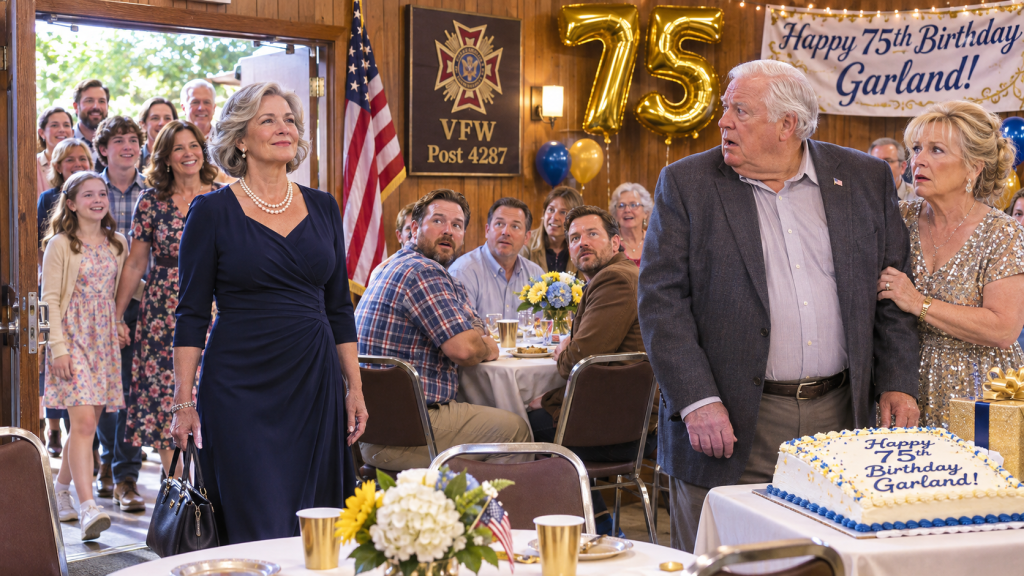
Now he looked like a man who’d spent four decades waiting for a certain knock at the door. “Leon,” I said quietly, “look at me.” He raised his eyes. “Where did you get that information?” He took a breath. “From the old medical correspondence we requested last summer. The records office located a letter from your doctor.” I remembered that. Leon had been helping me organize my papers after a minor surgery. He’d asked whether I wanted him to request some of my older medical records because I’d mentioned never knowing exactly what the doctors had found back in 1984.
I’d signed the authorization myself.
We hadn’t expected anything useful to survive.
“Why didn’t you tell me?” I asked.
His face crumpled.
“Because I wanted to make sure I understood it. And because I didn’t know how to tell you something that might hurt you.”
I looked at him for a long moment.
“Baby, I’m sixty-five years old. There’s not much left anybody can say that’ll kill me.”
He gave a shaky laugh.
Then reached into his jacket.
He unfolded a sheet of paper.
And Garland spoke.
“Don’t.”
Just one word.
But it carried across that entire room.
Leon stopped.
I turned toward my former husband.
“Don’t what, Garland?”
His mouth opened.
Nothing came out.
Bonnie looked from him to me.
“Garland, what’s going on?”
He stared at the floor.
And suddenly, standing beneath those gold birthday balloons, I remembered something I’d spent forty-two years trying to forget.
The doctor had asked Garland to stay behind.
I’d waited in the parking lot.
When he came out, his face was pale.
I asked what the doctor had said.
And he’d told me, “Nothing you don’t already know.”
Three weeks later, he left.
I looked back at Leon.
“Read it.”
My name is Della Mae Carter.
I’ve lived in Mississippi my whole life.
I’ve buried both my parents, survived a marriage that didn’t survive me, and raised enough children to know that nothing good comes from forcing a frightened person to speak before they’re ready.
But I also know there are times when the truth has waited quite long enough.
Leon unfolded the letter.
It was dated March 19, 1984.
The paper was a copy, but I recognized the physician’s name.
Dr. Thomas Aldridge.
He’d been one of the doctors we visited when Garland and I couldn’t conceive.
Leon looked at me.
“Mama, this was addressed to you. The clinic’s records show it was returned undelivered after your address changed. The surviving copy was in your file.”
I nodded.
“Go on.”
He cleared his throat.
“The letter says that your examination and testing had not identified a clear cause of infertility on your side.”
I blinked.
He continued.
“It says Dr. Aldridge had recommended further evaluation for both spouses. And it mentions an abnormal result from Garland’s semen analysis that required follow-up.”
A strange silence settled over the room.
I heard Bonnie draw in her breath.
Leon looked up.
“That’s not proof you would have gotten pregnant, Mama. The doctor made that clear. But it is proof they hadn’t established that you were the reason you couldn’t.”
My fingers went numb.
For forty-two years, I’d carried the belief that my body had failed my marriage.
I’d lived with it so long that sometimes I forgot it was there.
Like an old scar beneath your clothes.
You don’t think about it every morning.
But it’s still part of how you see yourself.
I looked at Garland.
“Did you know?”
He didn’t answer.
“Garland.”
His chin trembled.
“Did you know those tests showed a problem with you?”
Bonnie stood very still.
Then Garland whispered, “Yes.”
I felt something shift inside me.
Not relief.
Not yet.
Something deeper.
Something that had been buried so long it took me a moment to recognize it.
Grief.
One of Garland’s sons, a tall man with a reddish beard, stepped forward.
“Dad?”
Garland didn’t look at him.
The son tried again.
“What is she talking about?”
Bonnie reached for Garland’s arm.
He pulled it away.
I watched the movement.
And suddenly I understood that this wasn’t simply a man frightened of being embarrassed at his birthday party.
It was a man watching a story he’d told his family begin to fall apart.
I took the paper from Leon.
My hands were shaking.
I read the paragraph myself.
The words were clinical.
Careful.
There was no grand declaration that I was fertile or Garland was not.
No promise that we’d ever have conceived a child together.
Only the plain fact that the tests had not supported the certainty with which Garland had blamed me.
That uncertainty had been enough for a responsible doctor.
It hadn’t been enough for my husband.
I looked at him.
“You told me both doctors said it was my fault.”
Garland closed his eyes.
“I know.”
“You said there was no point trying anymore.”
He nodded.
“And you left because you wanted children.”
His shoulders sagged.
“Yes.”
I held the paper against my chest.
“Why didn’t you tell me the truth?”
He looked at me then.
For the first time since I’d walked through the door, I saw the man I used to know.
Not the birthday boy in the expensive sport coat.
Not the husband with three sons standing beside him.
Just Garland.
A frightened young man who had been handed a piece of information he didn’t know how to bear.
He whispered, “I was ashamed.”
I looked at him.
“And you decided I should be ashamed instead.”
He began crying.
That was when I knew I wasn’t going to spend the rest of the party standing there while an old man cried over a choice he’d had forty-two years to correct.
I turned toward Samuel.
“Son, give that microphone back.”
Samuel studied my face.
“Yes, ma’am.”
He handed it to the bewildered announcer.
Then I looked at Ernestine, who had finally come through the door after hearing enough commotion to abandon the radio.
She stood near the entrance, her purse hanging from one shoulder.
“Well,” she said softly, “looks like I picked a fine time to come inside.”
I almost laughed.
Then I looked around the room.
At my eleven grown children.
At the three sons who’d come to celebrate Garland.
At Bonnie, standing beside a man whose past she might not have known.
And at the white paper-covered tables where people were waiting for somebody to say what happened next.
I took a breath.
“Garland, this is your birthday. We’re not turning it into a courtroom.”
He looked up hopefully.
Then I continued.
“But you and I will have a conversation before I leave. A truthful one.”
His face fell.
I turned to my children.
“Now, who wants something to eat?”
Samuel laughed first.
Then Ruth.
Then everybody seemed to exhale at once.
A few people clapped awkwardly.
Somebody turned the music back up.
The announcer announced that the brisket was ready, which was probably the wisest thing that man said all afternoon.
And just like that, life started moving again.
People lined up for food.
Children darted between chairs.
Somebody complained there wasn’t enough sweet tea.
The cake remained untouched beneath a plastic cover.
My children gathered around me.
Not all of them were children anymore, of course.
Samuel had grandchildren of his own.
Ruth had been running a nursing home outside Jackson for seventeen years.
Leon worked as a county records specialist.
His twin, Lionel, repaired agricultural equipment and could take apart a tractor engine faster than most people could locate the hood.
There was Patricia, a school principal.
Calvin, a truck driver.
Mabel, a nurse.
Tyrone, who owned a little tire shop.
Joanie, a hairdresser.
Walter, a retired postal worker.
And Denise, the youngest, who still called me every Wednesday to ask how many tomatoes I’d picked.
Eleven people.
Eleven lives that had passed through my little house in Sunflower County and left it larger than they’d found it.
Not all were legally adopted.
Not all had lived with me for the same number of years.
Some had arrived for a few weeks and stayed for years.
Others had gone back to relatives, then returned every Thanksgiving because they said my cornbread was better.
A few came to me so frightened that the first thing they learned was how to sleep through the night.
Some were angry.
Some were shy.
Some had never had a birthday cake.
And every one of them had taught me something I hadn’t known about love.
But if you want to understand why eleven grown people followed me into a stranger’s birthday party, you have to understand what happened in the spring of 1985.
A woman named Lucille Baxter called me on a Thursday.
I was thirty-six then.
Garland had been gone almost a year.
I’d moved into a small rented house with two bedrooms, one bathroom, and a kitchen where the cabinet doors never quite closed.
I drove a school bus.
I planted tomatoes.
And I spent most evenings sitting alone with a television I wasn’t watching.
Lucille worked with children who needed temporary homes.
She’d known my mother through church.
“Della,” she said, “you ever thought about fostering?”
I laughed.
“Lucille, I can barely keep my own washing machine running.”
“That wasn’t my question.”
I looked at the telephone.
“What kind of child?”
“A boy.”
“How old?”
“Seventeen.”
I went quiet.
Lucille continued.
“He’s been through several placements. He’s had a hard time. He needs somewhere steady until we can sort out a longer-term plan.”
I rubbed my forehead.
“Seventeen’s practically grown.”
“He’s still somebody’s child.”
That sentence settled into me.
I looked around my empty kitchen.
Then asked, “What’s his name?”
“Samuel.”
Three days later, a skinny boy with worn-out shoes stepped onto my porch carrying a grocery bag of clothes.
He looked at the living room.
Then at me.
“How long I gotta stay?”
I smiled.
“Don’t know yet.”
He frowned.
“You got rules?”
“Plenty.”
He sighed.
I pointed toward the kitchen.
“First rule is you wash your hands before supper. Second is you tell me if you’re going somewhere. Third is nobody gets hit in this house.”
Samuel looked at me.
“That’s all?”
I thought for a moment.
“Fourth is you don’t put wet towels on the bed.”
He stared.
Then laughed.
It was the first sound of genuine happiness I’d heard in my house in nearly a year.
And I knew, before he’d even unpacked his grocery bag, that something in my life had changed.
Samuel stayed long enough to finish school.
Then he found work.
Then he left.
And I thought that was the end of my first experience raising somebody else’s child.
Until Thanksgiving.
He appeared on my porch holding a paper bag.
Inside was a pie he’d bought at the grocery store.
“I didn’t know if you had company,” he said.
I looked at him.
“Well, I do now.”
He stood there awkwardly.
Then whispered, “Can I call you Mama?”
I felt my throat close.
“Son, I thought you’d never ask.”
After that, there were more children.
A pair of twins who’d been sleeping in their aunt’s crowded living room.
A little girl who wouldn’t speak above a whisper.
A boy who kept food in his pockets because he was afraid it would run out.
Another who told me he didn’t need anyone because everyone always left.
I didn’t fix every problem.
Goodness knows I made mistakes.
Sometimes I lost my temper.
Sometimes I cried in the pantry because there were too many bills and not enough money.
Sometimes the system moved a child before any of us were ready.
And sometimes love wasn’t enough to make a difficult situation simple.
But I learned that family wasn’t one particular kind of arrangement.
It was showing up.
Again and again.
When somebody had a fever.
When they failed a test.
When they graduated.
When they got their heart broken.
When they needed someone to answer a telephone at two in the morning.
My house wasn’t fancy.
The porch sagged.
The plumbing made noises like a sick mule.
But at Christmas, there were stockings.
At birthdays, there was cake.
And when a child sat down at my table, I never asked whether we shared blood before I passed the potatoes.
At Garland’s birthday party, Samuel stood beside me with a paper plate piled high enough to embarrass a man twice his size.
“Mama,” he said, “you ought to eat.”
“I’ll eat when people quit staring.”
He looked around.
“Then you might starve.”
I gave him a look.
He grinned.
There was that same boy who’d arrived on my porch forty-one years earlier.
Just with gray in his beard and better shoes.
Across the room, Garland’s sons were speaking quietly together.
Bonnie had disappeared into the kitchen.
Garland sat alone beneath the gold balloons.
Every so often, he looked over at me.
I pretended not to notice.
Ruth pulled up a chair.
“You all right, Mama?”
I considered lying.
Then remembered what we’d just learned about lies.
“No, baby. Not particularly.”
She took my hand.
“Do you want to leave?”
I looked around at the people I’d brought.
Leon and Lionel were arguing about whether the brisket needed more pepper.
Joanie was showing Denise pictures of her newest grandbaby.
Walter was helping an elderly guest carry a plate.
Patricia had somehow found herself directing the dessert line, because school principals never really stop managing crowds.
I smiled.
“Not yet.”
Ruth followed my gaze.
Then said, “You know, we didn’t come because you needed us to prove something.”
I turned toward her.
“We came because you called.”
My eyes filled.
She squeezed my hand.
“That’s what family does.”
I covered her fingers with mine.
And for a moment, that was enough.
It was Garland’s middle son who approached me first.
He was a broad-shouldered man in his forties, wearing a pale blue shirt with the sleeves rolled up.
“Mrs. Carter?”
I looked up.
“Yes?”
He held out his hand.
“I’m Michael Hatchett.”
I shook it.
“Nice to meet you, Michael.”
He hesitated.
“Would you mind if I sat down?”
“You’re the birthday boy’s son. I reckon you’re entitled to a chair.”
He smiled faintly.
Then sat opposite me.
For a moment, neither spoke.
Finally, he said, “Dad told us you two had been married.”
I nodded.
“He did?”
“Yes, ma’am.”
“What else did he tell you?”
Michael looked uncomfortable.
“He said you wanted different things.”
I studied him.
“That’s one way of putting it.”
He glanced toward his father.
“He said you didn’t want children.”
I felt a small, familiar sting.
Then I looked at Michael.
“Is that what he told you?”
Michael nodded.
“Yes, ma’am.”
I put down my fork.
For forty-two years, Garland had been telling people I couldn’t have children.
Apparently, somewhere along the way, he’d decided that wasn’t a flattering enough story.
Now he was saying I hadn’t wanted them.
I almost admired the man’s dedication to avoiding responsibility.
Almost.
“Michael,” I said, “I wanted children so badly that I spent five years believing something was wrong with me when I couldn’t have them.”
His expression changed.
“I didn’t know.”
“You weren’t supposed to.”
He looked down.
Then asked something that surprised me.
“Did Dad ever come back?”
I stared at him.
“Come back where?”
“To apologize.”
I thought about the decades.
The silent birthdays.
The holidays.
The years I raised children he’d never asked about.
“No,” I said. “He never did.”
Michael sat very still.
Then whispered, “I’m sorry.”
I studied his face.
There was something honest about the apology.
Not the sort people offer because they’re expected to.
The sort that comes from discovering someone you love has caused pain you never knew existed.
I reached across the table.
“Michael, you didn’t do anything to me.”
He nodded.
“But I think Dad did.”
I looked toward Garland.
“Yes, son.”
Then I smiled sadly.
“He surely did.”
Michael stayed a little longer.
He told me about his wife and their two daughters.
He worked as a maintenance supervisor at a hospital.
His oldest was applying to college.
His youngest played softball and apparently had the same stubborn streak as her grandfather.
I listened.
Then asked, “How old are your brothers?”
“David’s fifty. I’m forty-six. Paul’s forty-three.”
I did the arithmetic.
Garland had married Bonnie a few years after our divorce.
David had been a child when they met.
Michael and Paul were born later.
That meant Garland’s youngest sons had come along despite the abnormal fertility tests in 1984.
I wondered whether he’d undergone treatment.
Whether the earlier test results had changed.
Whether he and Bonnie had struggled as we had.
But I didn’t ask.
A doctor’s warning about fertility isn’t a prophecy.
Bodies aren’t simple machines.
And a man with an abnormal result at thirty-three can still become a father later.
The important thing was never whether Garland could produce a child.
It was that he’d blamed me for something the doctors hadn’t established.
Michael stood.
Then turned back.
“Mrs. Carter?”
“Yes?”
“David isn’t Dad’s biological son.”
I nodded, unsurprised.
Michael continued.
“Bonnie had him before they married. Dad adopted him when he was little.”
I looked at him.
“Then he’s your father’s son.”
Michael smiled.
“Yes, ma’am.”
I held his gaze.
“Don’t ever let anybody tell you different.”
His smile faded slightly.
Then he nodded.
“I won’t.”
He walked away.
And I sat there thinking about the strange turns life takes.
Garland had left me because he wanted a real family.
Then he’d raised a child who wasn’t born to him.
He’d learned what love could build without blood.
And somehow, he’d still allowed the story he told about me to stand.
Bonnie came to my table shortly afterward.
She’d taken off the sequined jacket she wore when I arrived.
Without it, she looked smaller.
She was probably sixty-eight or sixty-nine.
Her blond hair was carefully curled, and her lipstick had worn away at the corners.
She stopped beside my chair.
“Della, can we speak?”
Samuel looked up.
I gave him a little shake of my head.
He understood.
“Sure, Bonnie.”
She sat down.
For a moment, she stared at her hands.
Then she said, “I wrote the message on your invitation.”
I nodded.
“I know.”
Her eyes filled.
“I shouldn’t have.”
“No, ma’am.”
She took a shaky breath.
“I thought you were coming here to embarrass Garland.”
I raised an eyebrow.
“After forty-two years, I was sitting home minding my tomatoes. Your invitation came to me.”
She looked away.
“I know.”
“Then why write it?”
Bonnie swallowed.
“Because I was jealous.”
That surprised me.
“Of what?”
She looked toward Garland.
“He kept your wedding photograph.”
I stared at her.
Bonnie continued.
“I found it years ago in an envelope with some old papers. He told me he didn’t remember putting it there.”
I said nothing.
“Sometimes when we’d argue, he’d get quiet and say he didn’t want to make another mistake.”
She wiped her cheek.
“I always thought he was talking about you.”
I looked at her.
“He might’ve been.”
Bonnie shook her head.
“I took that feeling out on you.”
Her voice broke.
“And I shouldn’t have.”
I folded my hands.
“Bonnie, you don’t owe me affection.”
She looked up.
“But you do owe people basic decency, especially when you know next to nothing about them.”
She nodded.
“I know.”
I looked around the hall.
“You’ve got a good-looking family.”
Her eyes filled.
“Thank you.”
“I hope you appreciate them.”
Bonnie gave a sad laugh.
“I do.”
Then she looked at my children.
“They all call you Mama?”
I nodded.
“Most of them. Walter calls me Miss Della when he’s teasing.”
She smiled faintly.
“How many did you raise?”
“More than eleven came through my house over the years. Eleven could make it today.”
Bonnie stared.
“Goodness.”
I looked toward Samuel.
“Goodness is right. I don’t know how I kept my sanity.”
She laughed.
A real laugh this time.
Then her face grew serious.
“Della, I wish I’d known.”
I looked at her.
“Known what?”
“Who you actually were.”
I thought about that.
Then said, “You could’ve asked.”
Bonnie nodded slowly.
“Yes.”
She was about to leave when David approached.
He was the oldest of Garland’s sons.
Tall.
Broad through the shoulders.
Silver at his temples.
He looked uncomfortable.
“Mom?”
Bonnie turned.
“Yes?”
“Could I speak to Mrs. Carter?”
She nodded and stood.
David waited until she was gone.
Then sat down.
“I hope I’m not disturbing you.”
I smiled.
“Son, at this point I believe half the building’s fixing to come talk to me.”
He gave a nervous laugh.
Then looked at me seriously.
“Michael told me what you said.”
“About what?”
“About me being Dad’s son.”
I nodded.
“Well, you are.”
David stared at his hands.
“When I was little, kids used to tell me Garland wasn’t my real father.”
I watched him.
“He always told me they were wrong.”
I smiled.
“He was right.”
David swallowed.
“He adopted me when I was six.”
I nodded.
“He helped me learn to ride a bicycle. Took me fishing. Came to every ball game.”
His eyes filled.
“He never made me feel different from Michael and Paul.”
I felt something move in my chest.
There was the Garland I’d once loved.
A man capable of loving a child who wasn’t biologically his.
A man who knew, from experience, that raising a child could make a family.
And yet he’d left me with the word real burning in my memory.
David looked at me.
“I don’t know why he said those things to you.”
I smiled sadly.
“Neither do I, son.”
He hesitated.
“Can I ask you something?”
“Go ahead.”
“Did you hate him?”
I thought about it.
For years, I’d hated the sound of pickup trucks starting in the morning.
I’d hated the sight of a man carrying a duffel bag.
I’d hated Valentine’s Day because Garland had proposed to me on one.
Then life became too full to hold on to all that hatred.
“No,” I said finally.
David looked surprised.
“I was angry with him. And I grieved what we lost.”
I paused.
“But hate takes up a mighty lot of room. Eventually, I needed that space for other things.”
He stared at me.
Then smiled.
“I think I understand.”
I patted his hand.
“Good.”
It was nearly three o’clock when Garland finally approached.
The cake had been cut.
Some guests were leaving.
My children were helping Ernestine gather the leftover food because Ernestine never went anywhere without bringing home enough to feed a church committee.
Garland stood beside my chair.
“Della.”
I looked up.
“Garland.”
He hesitated.
“Could we talk somewhere quiet?”
I considered him.
Then nodded toward the little hallway beside the kitchen.
“Over there is fine.”
Leon started to follow.
I touched his arm.
“I’ll be all right.”
He looked doubtful.
I smiled.
“Son, I’ve handled teenagers with worse tempers than this man. I can manage one conversation.”
Leon chuckled.
But he stayed close enough to see the hallway.
Garland and I walked toward a small alcove where the hall stored extra chairs.
There was a photograph on the wall of VFW members from the 1970s.
A clock ticked above it.
Garland stood across from me.
For a long time, neither of us spoke.
Then he whispered, “You look good, Della.”
I laughed.
“Garland, if you’re going to start lying again, we’re done before we’ve begun.”
He smiled sadly.
Then lowered his head.
“I’m sorry.”
I waited.
“For leaving you the way I did.”
I folded my arms.
“And?”
He looked up.
“For making you believe it was your fault.”
“And?”
His face tightened.
“For not telling you what the doctor said.”
I nodded.
“Keep going.”
Garland stared at me.
Then his eyes filled.
“For being a coward.”
I let the silence sit between us.
Forty-two years.
And finally, he was using the right word.
He began talking.
Really talking.
Not the way he’d talked when we were married, with his jaw tight and his mind already made up.
He spoke like a man emptying a box he’d kept sealed for decades.
When we first struggled to conceive, he said, he blamed the timing.
Then the stress of work.
Then the doctors.
But when Dr. Aldridge told him his semen analysis had shown a possible male-factor fertility problem, something in him broke.
“My daddy would’ve laughed at me,” Garland whispered.
I remembered his father.
A hard man.
A man who measured his sons by how much land they owned, how loudly they spoke, and how many children they fathered.
Garland continued.
“He always said a man who couldn’t make a family wasn’t much of a man.”
I watched him.
“So you made me the problem.”
He nodded.
“I couldn’t stand the thought of people knowing.”
I took a breath.
“Garland, the doctor said more testing was needed.”
“I know.”
“That wasn’t a verdict against you.”
“I know that now.”
I stared at him.
“You knew enough then not to tell me the truth.”
He looked down.
“Yes.”
I waited.
He continued.
“When I left, I told myself I was doing us both a favor. That if I started over, maybe things would be different.”
I thought about the winter I’d cried in the bus barn.
The nights I sat awake wondering whether another man would ever want me.
The shame I’d carried into the grocery store when someone asked why Garland had left.
“Different for you,” I said quietly.
Garland closed his eyes.
“Yes.”
I looked toward the doorway.
“Did Bonnie know?”
He shook his head.
“Not all of it.”
I stared at him.
“What did she know?”
“That we’d struggled to have children. That the marriage ended.”
“And you told her I didn’t want a family.”
He nodded.
“Eventually.”
I felt the old wound stir.
“Why?”
Garland began crying.
“Because she asked why I never went back. I didn’t know how to admit I’d left you over something that wasn’t your fault.”
I looked at him for a long moment.
Then whispered, “So you made up a story where I didn’t want you.”
He nodded.
“Yes.”
I turned away.
Because there was only so much truth a person could hear in one afternoon without needing to sit down.
Garland reached toward me.
“Della—”
I stepped back.
He lowered his hand.
For a while, we stood beside that old photograph of men in uniform, listening to people carry dishes through the hall.
Then I asked him something I’d wondered about for decades.
“Did you ever think about coming to see me?”
His eyes filled.
“Yes.”
“When?”
“After Samuel came to live with you.”
I turned.
“You knew about Samuel?”
Garland nodded.
“I heard through somebody from Indianola.”
I stared at him.
He continued.
“Then I heard about the twins. And later, other children.”
My throat tightened.
“You knew I was raising children?”
“Some of it.”
I looked at him.
“And you never called?”
He shook his head.
“I didn’t think you’d want to hear from me.”
I felt tears rising.
“Garland, I spent years believing I’d failed you because I couldn’t be a mother.”
He looked down.
“And all that time, you knew I’d become one.”
His voice broke.
“Yes.”
I swallowed.
“Did it make you uncomfortable?”
He stared at the floor.
Then whispered, “It made me realize how wrong I’d been.”
I waited.
“But I didn’t know how to say it.”
I gave a tired laugh.
“Apparently, that’s been your trouble for forty-two years.”
He nodded.
Then looked toward the main hall.
“I saw Samuel with you today. The way he reached for your chair before you sat down.”
I smiled despite myself.
“Samuel’s always been mannerly when he remembers.”
Garland’s eyes filled.
“And Ruth kept checking whether you needed anything.”
I nodded.
“They worry too much.”
He shook his head.
“No. They love you.”
I looked at him.
He took a trembling breath.
“I thought having children would prove something about me.”
His voice broke.
“But watching yours today, I realized you gave them what I was trying to prove I had.”
I stood very still.
Then asked, “What’s that?”
He looked at me.
“A home.”
I could have made him feel smaller.
Lord knows, the opportunity was there.
I could have reminded him that the little rented house he’d once dismissed as beneath him had held more laughter than any expensive home I’d ever visited.
I could have told him about Samuel’s first graduation.
About Ruth coming home from nursing school and crying in my arms because she’d passed her licensing examination.
About the twins buying me a refrigerator when mine finally gave out.
About the Thanksgiving Denise arrived with her first baby and placed that tiny girl in my arms.
I could have told him how my children came back when my mother died, when I needed surgery, and when a storm knocked a tree across my roof.
I could have spent the next hour listing all the ways my life had become rich after he left.
But standing there, I realized I didn’t need him to understand every single one.
He hadn’t been present for those years.
They belonged to the people who were.
“Garland,” I said, “you need to tell Bonnie and your sons the truth.”
He nodded.
“I will.”
“Not because I want to embarrass you.”
“I know.”
“Because they’re entitled to know the man they love as he actually is. Not some spotless picture you’ve painted.”
He swallowed.
“You’re right.”
I took a breath.
“And you need to understand something else.”
He looked up.
“I forgive you for what I can. But I won’t pretend it didn’t happen.”
Tears rolled down his cheeks.
“I wouldn’t ask you to.”
“You already did. For forty-two years, your silence asked me to carry it.”
He lowered his head.
Then whispered, “I’m sorry, Della.”
This time, I believed he meant it.
But believing an apology doesn’t require you to hand somebody back the years they lost.
I nodded.
Then walked toward the hall.
When I came out, Ernestine was waiting with a foil-covered plate.
“Well?”
I raised an eyebrow.
“Well what?”
“Did you get your forty-two years’ worth of answers?”
“Some.”
She studied my face.
“Enough?”
I thought about that.
Then shook my head.
“Enough for today.”
She nodded.
Then handed me the plate.
“Brisket.”
I looked at her.
“Ernestine, I just had an emotional confrontation.”
“Which is why you need to eat.”
I laughed.
She grinned.
“You haven’t eaten enough to keep a bird alive.”
I took the plate.
Then she reached into her purse and pulled out a handkerchief.
My mother’s handkerchief.
White cotton with little blue flowers.
Ernestine had kept it for years.
She handed it to me without a word.
I pressed it against my eyes.
And for a moment, I missed my mother so fiercely that it almost brought me to my knees.
Mama had been the one who told me, after Garland left, that I wasn’t less of a woman because I hadn’t had a baby.
I’d believed she was trying to comfort me.
Now I wondered how much she understood that I didn’t.
I looked toward the hallway where Garland still stood.
Then back at Ernestine.
“Mama would’ve been furious with him.”
Ernestine snorted.
“Mama would’ve chased him down the road with a broom.”
I laughed so hard I started crying again.
And suddenly we were both standing there, two old sisters holding each other up beneath gold balloons, laughing about a woman who’d been gone nearly twenty years.
Just as we were preparing to leave, I heard someone call my name.
“Della?”
I turned.
It was Bonnie.
Garland stood a little behind her.
His three sons were nearby.
Bonnie approached carefully.
“There’s something I’d like to say.”
I waited.
She looked at my children, then back at me.
“I invited you because I wanted you to feel small.”
The honesty surprised me.
She swallowed.
“I thought if you saw our sons and grandchildren, you’d understand what Garland had built after leaving you.”
I looked at her.
She continued.
“I didn’t understand that you had built something beautiful too.”
Her eyes filled.
“I was cruel. And I was wrong.”
I nodded slowly.
“Thank you for saying that.”
Bonnie looked at Garland.
Then at her sons.
“And I didn’t know the whole truth about his first marriage.”
David stepped forward.
He looked at me.
“Mrs. Carter, Dad told us what he did.”
I glanced at Garland.
He nodded.
“I told them.”
Michael’s jaw was tight.
Paul, the youngest, looked upset.
But David approached me.
He held out his hand.
“Thank you for being kind to us today.”
I shook it.
“You’re welcome, son.”
He hesitated.
Then said, “Dad taught me that family is about who shows up. That’s what he always said when people asked about me being adopted.”
I felt a strange tenderness.
David continued.
“I wish he’d understood that when he was married to you.”
Garland began crying.
Nobody rushed to comfort him.
Not because they didn’t love him.
But because there are moments when a person needs to sit with the weight of what they’ve done.
I looked at David.
“So do I.”
Then Samuel appeared beside me.
“Mama, everybody’s waiting.”
I glanced toward the door.
My children had gathered near the entrance.
Leon stood beside Lionel.
Ruth held my coat.
Denise had a bag of leftover cake.
Calvin was checking whether Walter needed help with his cane.
All eleven.
Just as they’d promised.
I looked at Garland one final time.
He stood beside Bonnie and their sons.
It was a real family.
Not because the children shared his blood.
Not because they lived in a particular house.
Not because somebody had printed their names on a gold birthday invitation.
It was a real family because people had chosen to care for each other through years of ordinary life.
Just like mine.
“Happy birthday, Garland,” I said.
He looked at me.
“Thank you, Della.”
Then, with his voice trembling, he added, “I’m glad you came.”
I smiled faintly.
“So am I.”
And I meant it.
Not because he’d finally apologized.
Not because I’d been vindicated in front of a roomful of strangers.
But because I’d walked into that hall carrying a question I’d lived with for forty-two years.
And I was walking out knowing it had never been mine to answer alone.
On the way home, Ernestine stopped for gas in Grenada again.
She went inside to buy a coffee.
I stayed in the car.
The evening sky was turning the color of ripe peaches, and a few birds were settling on the power lines.
My telephone rang.
It was Samuel.
“Mama, you all right?”
I smiled.
“Son, you saw me twenty minutes ago.”
“That wasn’t my question.”
I looked out the window.
Then answered honestly.
“I think I am.”
He went quiet.
“Mama?”
“Yes?”
“I hope you know we weren’t trying to make him feel bad.”
My eyes filled.
“I know.”
“We just wanted him to see you.”
I swallowed.
“Why?”
Samuel seemed surprised by the question.
Then he laughed softly.
“Because you’re our mama.”
I pressed the telephone against my ear.
He continued.
“When I was seventeen, I didn’t have anybody who wanted me at their table. You gave me a place to sit.”
I looked down.
“And every time I came back, that place was still there.”
Tears slipped down my face.
Samuel’s voice trembled.
“You taught us that family wasn’t something we had to qualify for.”
I couldn’t answer.
Then he said, “We weren’t showing him what he missed, Mama. We were showing you what you made possible.”
That night, I took off my navy dress and hung it carefully in the closet.
I put my mother’s pearls back in their little velvet box.
Then I went to the hall closet.
Behind the vacuum was the box of Christmas stockings.
I carried it into the living room.
There was Samuel’s, with a crooked green S I’d sewn myself.
Ruth’s had a little silver bell.
The twins had matching red stockings, though Lionel had long ago insisted his was slightly larger.
Patricia’s had a tiny embroidered schoolhouse.
And there were others, each with a name and a story.
Some had been replaced over the years.
Some were faded.
A few had repairs where the seams had come loose.
I laid them across the couch.
Eleven stockings.
Eleven names.
Eleven people who still came home in one way or another.
I thought about Garland standing in our kitchen in 1984.
I want a real family.
For decades, I’d heard those words as a verdict against me.
Now I saw them for what they were.
The words of a frightened young man who confused fatherhood with proving his own worth.
He’d wanted children.
I’d wanted children too.
Neither desire had been wrong.
The cruelty was in telling me I was less deserving of love because our marriage hadn’t produced a baby.
And the greater cruelty was letting me believe a medical certainty that hadn’t existed.
I didn’t know whether a different doctor, another treatment, or more time would have changed our lives.
Nobody could know that.
But I knew what had happened after he left.
My life hadn’t ended.
It had opened.
Three months later, another letter came in the mail.
Plain envelope this time.
No gold lettering.
No birthday balloons.
It was from Garland.
He wrote that he’d begun speaking more honestly with Bonnie and their sons.
He said they were still working through the hurt and the questions.
He apologized again for what he’d done.
He also wrote something I hadn’t expected.
I spent forty-two years thinking that admitting my shame would make me smaller. I didn’t understand that keeping you blamed for it was what made me small.
I read the sentence twice.
Then folded the letter.
I didn’t write back.
There was nothing left I needed Garland to give me.
Not another explanation.
Not a promise.
Not even forgiveness for my anger.
I had spent enough of my life waiting for that man to tell me who I was.
On Christmas Eve, my landline rang at exactly four.
Samuel called first.
Then Ruth.
Then Denise.
And before the evening was over, I had heard from every one of my children.
Some were coming for Christmas dinner.
Others were spending the holiday with their own families.
All promised to visit when they could.
I stood in the kitchen with my telephone pressed against my ear, looking at the long table we’d squeezed into the dining room years earlier.
There were extra chairs stacked beside the wall.
A casserole in the oven.
Sweet potatoes cooling on the counter.
And stockings hanging across the mantel.
Ernestine came in carrying a bowl of green beans.
“How many coming tomorrow?” she asked.
I checked my little notebook.
“Seventeen, counting the grandchildren.”
She shook her head.
“Della Mae, you never did learn when to stop feeding people.”
I smiled.
“Never saw the benefit.”
She laughed.
Then looked around the room.
“You know what I keep thinking about?”
“What?”
“That birthday invitation.”
I smiled faintly.
“So do I.”
Ernestine set down the green beans.
“That woman wanted you to come see what a real family looked like.”
I glanced at the stockings.
At the photographs covering my wall.
At the little handprints some of the grandchildren had left on the refrigerator.
Then I looked at my sister.
“Well,” I said, “I reckon I did.”
She raised an eyebrow.
I smiled.
“I saw two.”
I’m Della Mae Carter.
I’m sixty-five years old.
I’ve driven school buses, raised children, planted tomatoes, buried people I loved, and survived things I once thought would break me forever.
I never gave birth.
That is one truth about my life.
It is not the whole truth.
I’ve held children through nightmares.
Sat through graduations.
Paid for school supplies.
Helped with homework.
Waited through surgeries.
Danced at weddings.
And answered late-night telephone calls from people who needed to hear their mother’s voice.
Somebody once told me I couldn’t give a man a real family.
Forty-two years later, I walked into his birthday party with eleven people who could tell him otherwise.
But the greatest gift that afternoon wasn’t watching Garland realize what he’d lost.
It was realizing that I no longer needed him to recognize what I’d gained.
Because family isn’t always made in the way we imagine.
Sometimes it arrives on a Thursday afternoon wearing shoes two sizes too big.
Sometimes it comes carrying a grocery-store pie.
Sometimes it comes back after years away and asks whether there’s room for one more chair.
And sometimes, when you’re standing in a crowded room wondering whether your life has mattered, it opens the door behind you.
Again.
And again.
And again.
Until you understand that you were never standing alone.


