The name at the bottom of the foundation letter made my fingers go numb. Eleanor Whitcomb. I hadn’t seen that name in twenty years. Not since the night my daughter and her husband died. Not since a police officer stood on my porch in the rain and told me that my little girl, Rebecca, would never come home again. Not since I learned that the woman who’d been driving the other car had survived. And now, there it was. Her signature.
Beneath it, written in blue ink, were nine words that made my heart feel as though it had stopped. Tell Margaret the truth about the accident before she thanks me. Kevin was still standing in front of me, holding out his hand. Around us, hundreds of people were applauding. A woman in the next row was crying into a tissue. Someone behind me whispered, “What a wonderful grandson.”
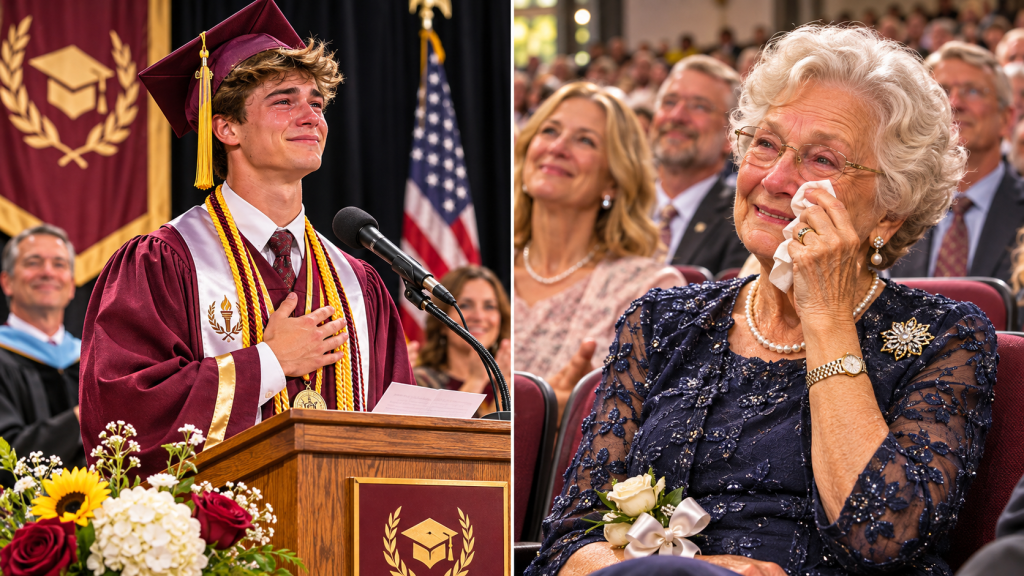
But I couldn’t hear them properly anymore. I was staring at that signature. Eleanor Whitcomb. The woman I’d spent twenty years trying not to think about. Kevin noticed my expression. “Grandma?” I looked up. His graduation cap had slipped slightly to one side. His eyes were red. He looked so much like his mother that, for one painful second, I could almost imagine Rebecca standing there instead.
“Where did you get this?” I whispered.
He glanced at the letter.
“From the foundation.”
My voice trembled.
“Did you meet the woman who signed it?”
Kevin hesitated.
“Yes.”
The auditorium seemed to tilt.
“When?”
“Three days ago.”
I gripped the arms of my chair.
“Kevin, do you know who Eleanor Whitcomb is?”
His expression changed.
“I know she was involved in the accident.”
I closed my eyes.
He continued softly.
“And I know she wants to talk to you.”
For twenty years, I’d imagined what I might say if I ever stood face-to-face with that woman.
I’d rehearsed angry words while washing dishes.
I’d imagined asking why my daughter had to die at twenty-eight.
I’d wondered whether Eleanor remembered the little boy who’d been left without parents.
But I’d never imagined meeting her because my grandson had secretly asked for help with my medical bills.
I looked at Kevin.
“Sweetheart, I need to sit down.”
He immediately knelt again.
“Grandma, are you feeling sick?”
I shook my head.
“No, baby.”
But my hands wouldn’t stop trembling.
He took the letter gently from me.
“We don’t have to talk about it here.”
I stared at him.
“You knew she was connected to the accident?”
He nodded.
“Yes.”
“And you didn’t tell me?”
His eyes filled.
“I wanted to understand what happened before I brought it to you.”
I looked toward the stage.
A faculty member was waiting near the steps, trying politely to signal that the ceremony needed to continue.
My grandson had crossed an auditorium to tell the world that I was his family.
Now the past was standing between us like a door neither of us knew how to open.
I took his hand.
“Go finish your graduation, sweetheart.”
He looked worried.
“Grandma—”
“I promise I’ll still be here.”
His face softened.
He squeezed my fingers.
Then he stood.
Before returning to the stage, he bent down and kissed my forehead.
“I love you.”
I held his hand for one more second.
“I love you too, Kevin.”
He walked away.
And I sat in that crowded auditorium, surrounded by strangers, trying to understand why the woman connected to my greatest loss had suddenly appeared inside my grandson’s greatest triumph.
My name is Margaret Ellis.
I’m seventy-eight years old.
I’ve lived in the same little house in western Pennsylvania for thirty-seven years.
The porch needs painting.
The kitchen floor creaks near the refrigerator.
And the rosebush beside my front steps still blooms every June, even though I’ve threatened to dig it up at least a dozen times.
My husband, Henry, planted it for our twenty-fifth wedding anniversary.
He died two years later.
After that, I thought I’d experienced the deepest grief a person could survive.
Then came the accident.
Rebecca was my only daughter.
She had her father’s dark eyes and my unfortunate habit of worrying about things long before they happened.
She married a kind young man named Thomas, who taught middle-school science and never seemed to mind that my daughter talked through entire movies.
When Kevin was born, they brought him straight from the hospital to my house.
Rebecca placed him in my arms and laughed.
“Mom, you look terrified.”
“I am terrified.”
“Why?”
“Because he’s so little.”
She kissed my cheek.
“Then hold him close.”
For four years, I watched them build a life together.
Birthday parties.
Family dinners.
Trips to the park.
Thomas teaching Kevin how to tie his shoes.
Rebecca singing to him while folding laundry.
Then, one rainy October evening, they went out to pick up medicine for Kevin, who had a fever.
They never made it home.
The accident happened at an intersection outside town.
According to the report I received at the time, another vehicle entered the intersection against the traffic signal.
Rebecca and Thomas were struck broadside.
Thomas died before the ambulance arrived.
Rebecca died at the hospital.
The other driver survived with injuries.
Her name was Eleanor Whitcomb.
I remember standing in the hospital hallway while a doctor explained what had happened.
I remember asking whether there had been a mistake.
I remember thinking that if I could just get through the next few minutes, somebody would tell me Rebecca was alive.
Nobody did.
Two days later, I sat beside Kevin on our living room couch and tried to explain that Mommy and Daddy weren’t coming home.
He was four years old.
He asked whether he’d done something wrong.
I told him no.
He asked whether they were angry with him.
I held him so tightly he complained that I was squeezing his dinosaur.
Then he whispered something I still remember.
“Who will make my pancakes?”
I started crying.
Because grief doesn’t arrive only in grand, terrible questions.
Sometimes it comes in the voice of a little boy wondering who will cook breakfast.
“I will, sweetheart.”
He looked at me.
“Every day?”
I kissed his forehead.
“Every day you want them.”
And somehow, that was how our new life began.
One breakfast at a time.
I was fifty-eight when Kevin came to live with me.
There were people who worried I was too old.
Some were well-meaning.
Others had opinions they were far too eager to share.
“You should think about your health, Margaret.”
“Raising a child at your age is difficult.”
“Wouldn’t he be better off with a younger family?”
I listened politely.
Then I went home and made Kevin’s lunch for kindergarten.
It wasn’t that I believed love could solve everything.
I knew I was older than most of the mothers at school.
I knew money would be tight.
I knew there were things Kevin would miss.
But I also knew that he had already lost the two people who meant the most to him.
He wasn’t going to lose his home with me because somebody thought I had too many gray hairs.
I took a second job cleaning offices after my shift at the grocery store.
I learned how to help with homework I’d forgotten decades earlier.
I sat through Little League games.
School concerts.
Parent-teacher conferences.
And terrible science projects that involved far more glitter than any respectable experiment should require.
Some nights, I came home so tired that I could barely take off my shoes.
Kevin would be waiting on the couch.
A blanket beside him.
A cartoon playing softly on the television.
He’d lift one corner of the blanket and say, “Grandma, I saved you the warm spot.”
I’d sit beside him.
He’d lean against me.
And for a few minutes, the exhaustion disappeared.
I never told him how often that little ritual kept me going.
He thought he was saving a warm place on the couch.
He was saving a place in the world where I still wanted to be.
After graduation, Kevin found me near the auditorium exit.
I was standing beside a row of windows, holding the little bouquet I’d brought.
He rushed over.
“Grandma, I’m sorry.”
I looked at him.
“For what?”
“For making you worry this past month.”
My throat tightened.
He swallowed.
“I know I hurt you.”
I stared at his face.
For four years, Kevin had called me almost every evening.
Then, without warning, he’d told me he didn’t want to speak to me anymore.
I’d spent weeks wondering whether I’d become a burden to him.
Whether he was ashamed of the grandmother who raised him.
Whether I’d done something so terrible he couldn’t bear to tell me.
“Kevin,” I whispered, “why did you say you didn’t want to talk to me?”
He lowered his eyes.
“Because I was angry.”
“About the money?”
He nodded.
“And the surgery.”
I looked away.
The surgery.
I’d spent nearly two years dealing with worsening pain in my hip.
I told Kevin it was arthritis.
Which was true.
But I hadn’t told him how much it affected me.
I hadn’t told him that my doctor had recommended evaluating surgical treatment after conservative measures stopped helping.
And I certainly hadn’t told him how many times I’d postponed appointments because I was worried about expenses and recovery arrangements.
“I thought I could manage,” I said.
Kevin’s eyes filled.
“Grandma, you couldn’t walk through the grocery store without stopping to sit down.”
I smiled weakly.
“Those stores are getting awfully large.”
He didn’t laugh.
Instead, he took my hand.
“You don’t have to make jokes about everything.”
I looked at him.
His voice broke.
“I was scared.”
I swallowed.
“Of losing me?”
He nodded.
The pain on his face took me straight back twenty years.
A little boy asking whether Mommy and Daddy were ever coming home.
I pulled him close.
“Oh, sweetheart.”
He began crying against my shoulder.
And for a moment, graduation disappeared.
There was only a grandmother and the boy she’d raised, both terrified of losing the other.
We went to lunch at a little restaurant near campus.
Kevin wore his graduation gown over the back of his chair.
His diploma folder lay beside the salt shaker.
A waitress congratulated him.
He thanked her.
Then he looked at me.
“Grandma, there’s something else.”
I put down my fork.
“About Eleanor?”
He nodded.
I took a breath.
“Tell me.”
He opened his backpack.
Inside was another folder.
Not the one from the stage.
This one was blue.
He placed it between us.
“I started looking into the accident when I was trying to understand some of the old paperwork.”
I frowned.
“What paperwork?”
“The insurance records you kept in the hallway cabinet.”
My heart tightened.
“Why were you looking through those?”
Kevin lowered his eyes.
“Because I was trying to figure out how much money you’d spent on me.”
I stared at him.
He continued.
“I found your college payment receipts and a letter about your retirement account. Then I found the box with Mom and Dad’s accident records.”
I leaned back.
For twenty years, that box had sat behind winter blankets.
I’d opened it only a handful of times.
The last time had been when Kevin needed copies of his parents’ death certificates for a scholarship application.
“I didn’t mean to go through things that were private,” he said.
I looked at him.
“Those papers concern you too.”
He nodded.
“That’s what I thought.”
He hesitated.
“Grandma, why didn’t you ever tell me that there was a legal settlement after the accident?”
I felt a familiar ache.
“Because you were four. And later, I didn’t want every conversation about your parents to become a conversation about money.”
He looked down.
“Was there money?”
“Yes.”
“Where did it go?”
I took a breath.
“Some of it went into a protected account for you. The arrangements were reviewed when you were little. Other funds paid expenses connected with the accident and your parents’ estate.”
Kevin nodded slowly.
“Did you use my money to raise me?”
I shook my head.
“Your funds were handled under the rules that applied to them. I used what help was properly available, and I paid for plenty of things myself.”
His eyes filled.
“Why?”
I looked at him.
“Because I was your grandmother.”
He swallowed.
“But you didn’t have to work yourself sick.”
I reached across the table.
“Kevin, I made choices. Some were wise. Some weren’t. But you weren’t a debt I was paying.”
He stared at me.
Then whispered, “I know that now.”
I looked at the blue folder.
“Where does Eleanor come into this?”
Kevin opened it.
“After I found the accident records, I tried to understand who she was.”
He took a breath.
“I found out she had a charitable foundation.”
I looked at him.
He continued.
“She and her husband established it years ago. It helps older adults with medical expenses and mobility problems.”
I frowned.
“And you applied?”
“Yes.”
“Using her foundation?”
He nodded.
“I didn’t know at first that she was the same Eleanor Whitcomb.”
I stared.
“How could you not know?”
“Her husband’s name was listed on most of the public information. When I contacted the organization, an administrator explained that Mrs. Whitcomb reviewed some applications personally.”
I looked at him.
“And then?”
“She recognized our names.”
My hands grew cold.
Kevin swallowed.
“She asked to meet me.”
I stared at my grandson.
“And you went?”
“Yes.”
“Alone?”
“No. A counselor from the university helped me arrange it, and I met her in the foundation office.”
I closed my eyes.
He continued softly.
“Grandma, she told me something that wasn’t in the accident report you kept.”
I looked up.
“What?”
Kevin’s eyes filled.
“She said she wasn’t the only person responsible for what happened that night.”
The restaurant seemed to grow quiet around us.
I stared at him.
“What do you mean?”
Kevin took a breath.
“She said there was something wrong with the traffic signal.”
I shook my head.
“The police said she ran a red light.”
“I know.”
He turned a page.
“But Grandma, the original investigation was more complicated than the summary you received.”
I felt my chest tighten.
“How complicated?”
Kevin hesitated.
Then whispered, “The signal had been reported as malfunctioning earlier that evening.”
I looked down at the blue folder.
And for the first time in twenty years, I wondered whether the story I’d told myself about Rebecca and Thomas’s deaths had ever been complete.
I stared at Kevin for so long that he reached across the table and touched my wrist.
“Grandma?”
I shook my head.
“The light was broken?”
“That’s what the maintenance records suggest. There’d been complaints about it before the accident.”
I looked at the folder.
“Then why wasn’t that in the police report?”
Kevin turned a page toward me.
“It was mentioned in the supplemental investigation. The report in your box was only the initial summary.”
I frowned.
I remembered receiving a thick envelope from the attorney who handled the legal matters after the collision.
I remembered signing documents.
Listening to explanations.
Trying to follow discussions about insurance coverage and responsibility.
But my mind had been somewhere else.
With Rebecca’s empty bedroom.
Thomas’s winter coat hanging behind their back door.
And Kevin, who’d begun crying every time someone left the house because he was afraid they wouldn’t return.
“Grandma, can I show you something?”
I nodded.
Kevin opened the folder.
Inside were copies of correspondence from an engineering firm, a city maintenance report, and a newspaper clipping.
He pointed to the first page.
“A driver reported that the traffic signal was cycling incorrectly during heavy rain.”
I read the description.
The intersection had experienced an electrical problem.
One direction occasionally received a green indication before the conflicting approach had fully returned to red.
The fault was intermittent.
By the time technicians inspected the signal, it sometimes appeared to be working normally.
I looked at Kevin.
“Are you telling me both drivers might have thought they had the right of way?”
He nodded.
“That’s one possibility investigators considered. But they couldn’t reconstruct exactly what each driver saw.”
I sat back.
For twenty years, I’d believed Eleanor had simply ignored a red light.
Now I was looking at evidence that something more complicated might have happened.
“But why didn’t anybody tell me?” I whispered.
Kevin’s expression softened.
“Grandma, they did send information to the lawyer. I found some of it in the later correspondence.”
I closed my eyes.
That made it worse in a different way.
Not because someone had deliberately hidden everything.
But because the truth had been there, somewhere inside a mountain of paperwork I’d been too brokenhearted to understand.
Kevin continued.
“The settlement documents included claims involving the driver and the entity responsible for maintaining the intersection. The final agreement resolved the civil claims without everybody admitting fault.”
I stared at him.
“You understand all this?”
He smiled sadly.
“I spent a lot of time asking questions.”
I looked at the papers.
Then asked the question that had been sitting in my throat.
“Does this mean Eleanor didn’t cause the accident?”
Kevin took a breath.
“No. It means the evidence doesn’t support the simple story we’ve repeated all these years. Nobody can say exactly what would have happened without the signal problem.”
He looked at me carefully.
“And Eleanor still feels responsible for decisions she made that night.”
I closed my eyes.
For twenty years, I’d wanted one clear answer to the question of why my daughter died.
Now my grandson was showing me that grief had turned an uncertain chain of events into one terrible, simple sentence.
That woman killed my daughter.
Maybe reality had always been more complicated.
Maybe it always would be.
I picked up the newspaper clipping.
The headline was from the year after the accident.
It described a review of traffic-signal maintenance procedures following several serious crashes.
Our intersection was mentioned.
I stared at the photograph.
The road looked exactly as I remembered it.
A traffic light.
Wet pavement.
A corner store that had since been demolished.
There was nothing remarkable about it.
Nothing that explained how a family could be destroyed in a few seconds.
I folded the clipping.
“Kevin, does Eleanor want me to forgive her?”
He shook his head.
“She said she wasn’t entitled to ask.”
I looked up.
“Then why does she want to see me?”
His eyes filled.
“Because she has something of Mom’s.”
My breath caught.
“What?”
Kevin hesitated.
“A letter.”
I stared at him.
“Rebecca wrote her a letter?”
“No.”
He swallowed.
“Mom wrote it to you.”
For several seconds, I couldn’t understand the words.
My daughter had been dead for twenty years.
I knew the sound of her voice only because I still had a few old home videos.
I knew her handwriting because I’d saved every birthday card she ever gave me.
And now Kevin was saying that a letter she’d written to me was sitting somewhere in another woman’s possession.
“How?” I whispered.
Kevin took a breath.
“She found it among some personal belongings returned after the accident. It had been placed with items from the car when the property was sorted out.”
I stared.
“Why would Eleanor have Rebecca’s belongings?”
“She said there was confusion when the cars were cleared and the personal effects were handled. A sealed envelope ended up with documents her attorney received. She didn’t realize what it was until later.”
I shook my head.
“Why didn’t she return it?”
Kevin’s expression changed.
“She tried.”
I looked at him.
“What?”
“She said she mailed it to you years ago.”
My stomach tightened.
“Kevin, I never received a letter.”
“I know.”
He looked down.
“It was returned.”
I stared at him.
“Then why not try again?”
Kevin was quiet.
Finally, he said, “She was afraid contacting you would reopen everything. And after a while, she felt ashamed that she’d waited so long.”
I pressed my fingers against my eyes.
That explanation didn’t make the delay acceptable.
Twenty years was a long time to keep something that belonged to a grieving mother.
But I was beginning to see how fear could become a habit.
How one year of silence became five.
Then ten.
Then twenty.
And how the passage of time made an overdue conversation harder rather than easier.
I looked at Kevin.
“Have you read it?”
He shook his head.
“No.”
I stared at him.
“Why?”
His eyes filled.
“Because it’s addressed to you.”
We sat quietly while the waitress cleared our plates.
The graduation crowds outside were thinning.
I could hear car doors closing and young people calling goodbye to each other.
Kevin watched me carefully.
“Grandma, I didn’t know whether I should tell you everything before graduation.”
I looked at him.
“Is that why you stopped speaking to me?”
He lowered his head.
“Partly.”
I waited.
He took a breath.
“When I found out how much you’d given up, I was furious.”
“At me?”
“Yes.”
His voice broke.
“I thought you’d decided your health didn’t matter as long as I finished college.”
I looked down.
He continued.
“Then I found the accident papers. I realized there were things about Mom and Dad I’d never understood.”
He swallowed.
“I started wondering whether my whole childhood was built around sacrifices you never told me about.”
My throat tightened.
“Kevin—”
“I know now that was unfair.”
He wiped his face.
“But at the time, I couldn’t separate being grateful from feeling guilty.”
I studied him.
“And you thought telling me you didn’t want to talk anymore would help?”
He shook his head.
“No.”
He began crying.
“That’s the part I’m most ashamed of.”
I reached for his hand.
He continued.
“I was trying to arrange the medical assistance and get the records together. I told myself I needed distance until I had answers.”
He looked at me.
“But I knew you’d worry. And I said something cruel because I was upset.”
A tear rolled down his cheek.
“Grandma, you never deserved that.”
I felt my own eyes fill.
“Sweetheart, you frightened me terribly.”
He nodded.
“I know.”
“For a month, I thought I’d lost you.”
His face crumpled.
“I’m sorry.”
I held his hand.
“Next time you’re angry with me, tell me you’re angry. Ask for time if you need it. But don’t tell me you don’t want me in your life unless that’s what you truly mean.”
He nodded.
“I promise.”
I smiled sadly.
“And I need to learn to tell you when I’m struggling, instead of pretending I’m made of cast iron.”
Kevin gave a wet little laugh.
“You are pretty stubborn.”
I squeezed his hand.
“That trait runs in the family.”
The appointment confirmation he’d shown me onstage was for a consultation with an orthopedic surgeon.
Not an operation already booked.
Kevin had arranged transportation and contacted a patient-assistance program after learning that I’d been postponing care.
The foundation’s letter described financial assistance that could help with treatment-related costs that weren’t otherwise covered.
It didn’t guarantee that I needed surgery.
It didn’t replace medical advice.
And it didn’t mean Eleanor had purchased the right to speak with me.
Those distinctions mattered.
I wanted to understand them before I decided what to accept.
“Kevin,” I said, “what exactly did Eleanor agree to pay?”
He opened the folder.
“The foundation approved assistance for eligible costs after insurance and other coverage are reviewed. Transportation, recovery equipment, and some out-of-pocket expenses.”
I nodded.
“And she didn’t ask for anything in return?”
“No.”
He looked at me.
“She actually said the assistance shouldn’t depend on whether you agree to meet her.”
I considered that.
“That’s important.”
Kevin nodded.
“Grandma, I didn’t want you thinking I traded your forgiveness for a hospital bill.”
I looked at him.
“I know you wouldn’t.”
He smiled faintly.
Then whispered, “I was just scared I was going to lose you too.”
I pulled him close.
For a moment, I remembered him at four years old, curled beneath the blanket on our couch.
A child who’d learned that people could leave without warning.
Now he was twenty-four, holding a college diploma and trying to make the world safer for the grandmother who’d raised him.
I’d spent years teaching him how to stand on his own.
I hadn’t realized he’d grown old enough to worry about holding me up.
Three days after graduation, Eleanor Whitcomb called my house.
My landline rang at half past four.
I was sitting beside the window sorting photographs for Kevin’s graduation album.
When I answered, the woman on the other end spoke gently.
“Mrs. Ellis?”
“Yes.”
“My name is Eleanor Whitcomb.”
I closed my eyes.
There are voices you imagine hearing for so long that the real sound seems wrong.
I’d always pictured Eleanor as cold.
Hard.
A woman who spoke carelessly because she’d never understood what she’d taken from me.
Instead, she sounded tired.
Old.
Afraid.
“I understand you know who I am,” she said.
“I do.”
A pause followed.
Then she whispered, “I don’t know how to begin.”
I looked at Rebecca’s graduation photograph on my table.
“Neither do I.”
Eleanor took a shaky breath.
“I owe you an apology.”
I said nothing.
“For the accident. For the years afterward. And for keeping something that should have been returned to you.”
My fingers tightened around the receiver.
“The letter.”
“Yes.”
I swallowed.
“Do you still have it?”
“I do.”
“Is it sealed?”
There was a pause.
“The original envelope was opened when the belongings were sorted, but I never read the letter inside.”
I closed my eyes.
For some reason, that mattered.
The thought that Rebecca’s words had remained unread by a stranger for twenty years.
Waiting.
“Will you send it to me?”
“Of course.”
I hesitated.
Then said, “No. I’d like to collect it myself.”
Eleanor went quiet.
“Are you certain?”
I looked toward my front door.
Toward the rosebush Henry had planted.
Toward the road I’d driven every day while rebuilding a life from grief.
“No,” I answered.
“But I think it’s time.”
We met the following Friday in a quiet room at the community center near Eleanor’s home.
Kevin drove me.
He offered to come inside.
I told him to wait nearby.
“This is something I need to do myself.”
He nodded.
Then squeezed my hand.
“I’ll be right here.”
Eleanor was already seated when I entered.
She stood slowly.
She was about my age.
Her white hair was pinned neatly at the back of her head.
She wore a plain navy dress and low shoes.
There was a cane beside her chair.
For a moment, I was startled by how ordinary she looked.
I’d spent two decades imagining the woman connected to my daughter’s death.
But the person in front of me was simply an aging woman with trembling hands.
“Margaret,” she whispered.
I stopped a few feet away.
“Eleanor.”
Her eyes filled.
“Thank you for coming.”
I looked at the envelope on the table.
“Is that Rebecca’s letter?”
She nodded.
“Yes.”
I stepped closer.
The envelope was cream-colored.
My daughter’s handwriting stretched across the front.
Mom.
Just three letters.
One word.
I knew that handwriting.
I would have known it anywhere.
My knees weakened.
Eleanor moved toward me instinctively.
I raised my hand.
She stopped.
“I’m all right.”
I wasn’t.
Not really.
But I needed to stand there for another moment.
To look at that envelope.
To understand that my daughter’s hand had once held it.
Then I sat down.
Eleanor didn’t begin with an explanation.
She waited while I looked at the letter.
Finally, I asked, “What happened that night?”
Her eyes filled.
“I was driving home from the hospital.”
I looked up.
“My husband had undergone emergency surgery earlier that evening. I was frightened, exhausted, and trying to reach my sister.”
She swallowed.
“It was raining heavily.”
I remembered the rain.
The way it had rattled against my windows while Kevin slept upstairs.
Eleanor continued.
“As I approached the intersection, I saw a green signal.”
I sat very still.
“You’re certain?”
She hesitated.
“I believed I saw green. That’s what I told investigators. But I was tired, and afterward I couldn’t swear that my memory was perfect.”
I nodded slowly.
She continued.
“The next thing I remember is seeing headlights to my right. I braked. There was a terrible sound.”
Her voice broke.
“I woke up in the hospital.”
I looked at her.
“Did you know my daughter and son-in-law had died?”
She began crying.
“Not immediately. When I learned, I asked the nurse to repeat it because I couldn’t understand.”
I swallowed.
Eleanor wiped her cheeks.
“I remember thinking there had to be something I could do.”
She looked at me.
“But there wasn’t.”
I stared at my hands.
For twenty years, I’d imagined Eleanor had driven away from the crash and continued living without a second thought.
Now I was hearing that she’d spent much of her life looking back.
It didn’t restore Rebecca.
It didn’t absolve Eleanor of whatever responsibility belonged to her.
But it changed the shape of the woman I’d imagined.
“Why didn’t you contact me?” I asked.
Eleanor looked down.
“My attorney advised that communications about the accident should go through the legal process while the claims were being resolved.”
I nodded.
“That makes sense at first.”
“Yes.”
She swallowed.
“But after the settlement, I was afraid.”
I looked at her.
“Afraid of me?”
She nodded.
“I thought you would hate me.”
I considered that.
“For a long time, I did.”
Eleanor closed her eyes.
“I understand.”
I leaned forward.
“But you still had my daughter’s letter.”
Tears slipped down her cheeks.
“Yes.”
“You could have given it to the attorney. Or sent it by a method that required confirmation.”
She nodded.
“I should have.”
“Instead, you kept it for twenty years.”
Her voice broke.
“Yes.”
I waited.
Eleanor took a trembling breath.
“Every year I told myself I’d send it. Then another year passed, and I became more ashamed.”
I looked down at the envelope.
“I lost twenty years of knowing what my daughter wrote to me.”
Eleanor began crying harder.
“I know.”
I took a breath.
“No, Eleanor. You know what happened. You don’t know what it was like living it.”
She nodded.
“You’re right.”
For a long while, neither spoke.
Then she whispered, “I am sorry, Margaret.”
I believed her.
But belief couldn’t return the time.
I finally picked up the envelope.
My hands shook as I unfolded the paper.
It was a short letter.
Rebecca had written it on stationery from a little shop near her house.
The ink was blue.
I remembered buying her that pen for Christmas.
I began reading.
Mom,
I’ve been meaning to tell you something, but every time I try, you change the subject and ask whether we’ve eaten enough.
Despite everything, I laughed.
Rebecca had always teased me about feeding people.
I continued.
Thomas says I’ve inherited your ability to worry about everyone except myself.
My eyes filled.
I want you to know how grateful I am that Kevin has you. Sometimes I watch him run into your arms and think about how lucky he is.
A tear fell onto the page.
You’ve spent so much of your life taking care of everybody. I hope someday you’ll let us take care of you too.
I covered my mouth.
The words blurred.
Eleanor sat quietly across from me.
I wiped my cheeks and kept reading.
We’re taking Kevin camping this summer if the weather cooperates. He says he wants to sleep in a tent, but I’m fairly sure he’ll last twenty minutes before asking for his own bed.
I laughed through my tears.
Then came the final lines.
I hope you know you’re not just the person I call when I need help. You’re the person I want to tell things to when something wonderful happens.
Love you always,
Rebecca.
I pressed the letter against my chest.
For twenty years, I’d thought I had exhausted every memory of my daughter.
Every birthday.
Every laugh.
Every time she’d said she loved me.
Then suddenly, there was another.
Not a memory recovered.
A message she’d written with her own hand.
A little piece of an ordinary afternoon that had waited through two decades of grief to reach me.
I bent forward and began sobbing.
Eleanor didn’t touch me.
She didn’t interrupt.
She simply waited.
Eventually, I wiped my face with the handkerchief I’d brought.
“She was wonderful,” I whispered.
Eleanor nodded.
“Kevin told me.”
I looked up.
“Did he tell you about her?”
“Yes.”
Her eyes filled.
“He told me she sang while she cooked. That she collected old postcards. That she wanted him to learn to swim before he started school.”
I smiled through my tears.
“That sounds like Rebecca.”
Eleanor swallowed.
“He also told me about Thomas. About how he taught science and loved terrible jokes.”
I laughed softly.
“He was dreadful at jokes.”
For a moment, I could almost see my son-in-law standing in our kitchen, grinning while Rebecca rolled her eyes.
Then I looked at Eleanor.
“Why did you create the foundation?”
She considered the question.
“My husband and I had already supported a few local charities. After the accident, I struggled to find a way to live with what had happened.”
I waited.
“When he recovered from his surgery, we decided to expand our giving. Over time, the foundation began helping older adults who couldn’t manage treatment-related costs.”
I nodded.
“Was that because of Rebecca and Thomas?”
Eleanor looked down.
“Partly. It was because I understood how quickly one event could change a family’s life.”
She paused.
“But I don’t want to pretend charitable work makes up for their deaths.”
I studied her face.
“Good.”
She nodded.
“It doesn’t.”
We sat quietly.
Then she said, “The assistance for your care was reviewed through the foundation’s program. Kevin provided the information, and the committee approved it under the program’s criteria.”
I looked at her.
“So you didn’t personally pay to make me forgive you.”
Eleanor shook her head.
“No.”
Her eyes filled.
“And you don’t owe me a meeting, a thank-you, or forgiveness because of it.”
I took a breath.
For the first time since I’d seen her name on that letter, some of the tension in my shoulders eased.
“I appreciate that.”
Before I left, Eleanor handed me a small photograph.
It showed the intersection years after the accident.
There were new traffic signals.
Improved lighting.
And a sign warning drivers to slow down during heavy rain.
“I thought you might want to know the intersection was changed,” she said.
I looked at the picture.
“Kevin showed me the maintenance records.”
She nodded.
“I hoped he would.”
I studied her.
“Do you believe you were responsible?”
Eleanor took a long breath.
“I believe I was one of the drivers involved in a collision that killed two people. I believe the signal problem was significant. I also believe I was exhausted and should have considered whether I was fit to drive.”
Her voice trembled.
“I’ve asked myself a thousand times whether something I did differently would have saved them.”
I looked down.
“Have you found an answer?”
She shook her head.
“No.”
Neither had I.
That was the hardest truth of all.
No answer would be enough to make the accident unhappen.
I stood.
Eleanor rose too.
For a moment, we faced each other.
Then she whispered, “Margaret, I don’t expect forgiveness.”
I looked at Rebecca’s letter in my hand.
“I don’t know what forgiveness looks like for me yet.”
Eleanor nodded.
“That’s fair.”
I took a breath.
“But I don’t want to spend whatever years I have left hating you.”
Her eyes filled.
I continued.
“Not because I think everything is settled. Not because the loss was small. But because Rebecca would have hated seeing me spend the rest of my life trapped in that intersection.”
Eleanor covered her mouth.
I stepped toward the door.
Then turned back.
“Thank you for returning the letter.”
She nodded.
“You’re welcome.”
I walked out.
Kevin was waiting beside the car.
He took one look at my face and opened his arms.
And I went straight into them.
The first thing Kevin asked was whether I was all right.
I held up Rebecca’s letter.
“She wrote to me.”
His eyes filled.
“Can I read it?”
I nodded.
“Of course.”
We sat in the car while he read.
He smiled at the part about camping.
Then laughed.
“Mom was right. I hate sleeping in tents.”
I looked at him.
“You’ve never been camping.”
“Exactly. I know myself.”
I laughed.
Then he reached the last paragraph.
His expression changed.
He looked at me.
“Grandma.”
“What is it?”
He tapped the sentence about Rebecca wanting us to take care of each other.
“That’s what I was trying to do.”
My throat tightened.
“I know, sweetheart.”
He shook his head.
“But I did it badly.”
I looked at him.
He continued.
“I scared you because I was scared. I thought if I handled everything secretly, I could protect you from worrying.”
I smiled sadly.
“Sounds familiar.”
He nodded.
“Yeah.”
For a moment, we both laughed.
Then Kevin took my hand.
“Maybe we both have to stop deciding what the other person can handle.”
I squeezed his fingers.
“That’s a mighty sensible thing to say for somebody who still leaves wet towels on the bathroom floor.”
He laughed.
Then hugged me again.
I kept the orthopedic appointment.
Not because Kevin arranged it.
Not because Eleanor’s foundation offered assistance.
But because, for the first time in years, I admitted that I needed help.
The surgeon reviewed my imaging, examined my hip, and discussed the available treatment options.
We talked about the benefits and risks of surgery, the work recovery would require, and what might happen if I continued postponing care.
I asked questions.
A lot of them.
Kevin sat beside me taking notes.
At one point, the doctor smiled.
“Mrs. Ellis, you have a very attentive grandson.”
I looked at Kevin.
“He’s always been nosy.”
He grinned.
“Learned from the best.”
After discussing the options and considering my health, I decided to proceed with hip replacement surgery.
The date was scheduled for later that summer.
I didn’t pretend I wasn’t frightened.
I was seventy-eight.
I’d had friends who recovered beautifully from operations and others who experienced complications.
I understood that no procedure came with guarantees.
But I also understood that avoiding every risk wasn’t the same as living well.
And I wanted to walk through the grocery store without searching for a chair.
I wanted to tend my roses.
I wanted to stand in my kitchen long enough to make Kevin’s favorite oatmeal cookies.
Most importantly, I wanted to stop acting as though asking for care made me less capable of giving it.
The night before surgery, Kevin came over with groceries.
He’d accepted a job offer from an engineering firm about an hour away.
His graduation diploma was already framed, though he hadn’t decided where to hang it.
He put the groceries away.
Then sat beside me on the couch.
“Grandma?”
“Yes?”
“Are you nervous?”
I considered lying.
Then smiled.
“Terrified.”
He looked surprised.
I continued.
“But I’m doing it anyway.”
Kevin took my hand.
“I’m going to be here when you wake up.”
I squeezed his fingers.
“Good.”
He looked toward the old blanket folded across the armrest.
The same one he’d slept beneath when he was little.
Then he stood and spread it over my legs.
I smiled.
“What are you doing?”
He sat beside me.
“Saving you the warm spot.”
My eyes filled.
I leaned against him.
For a long time, we sat quietly.
Twenty years earlier, I’d been the one coming home exhausted.
Now the little boy who used to wait beneath that blanket was a grown man holding my hand before surgery.
Life had not returned what it took from us.
But it had given us a way to care for one another through what remained.
The operation went ahead as planned.
My recovery required patience.
Physical therapy.
Follow-up appointments.
More rest than I wanted.
And a great deal of listening to people who insisted I couldn’t do everything myself.
Kevin took leave from work to help during the first part of my recovery.
A neighbor brought soup.
A friend from church drove me to an appointment.
And my sister-in-law, Patricia, appeared one afternoon with enough casseroles to feed a marching band.
I complained about all the fuss.
Kevin told me I sounded exactly like I had when he was twelve and refused to wear a winter coat.
“Grandma,” he said, “sometimes people know what’s good for you.”
I gave him a look.
He grinned.
And I let him bring me another cup of tea.
One afternoon, while we were sorting photographs for a family album, Kevin found a picture of himself at five years old.
He was standing beside me in our backyard.
His jeans were muddy.
His hair stuck up in every direction.
And he was holding a tomato almost as large as his head.
He laughed.
“I remember that.”
I smiled.
“You insisted you’d grown the biggest tomato in Pennsylvania.”
“Hadn’t I?”
“Not even close.”
He laughed again.
Then looked at me.
“Grandma, can I ask you something?”
“Of course.”
“Did you ever wish you hadn’t taken me in?”
The question caught me completely off guard.
I turned toward him.
“What?”
He looked uncomfortable.
“I mean, you were fifty-eight. You’d already raised Mom. Grandpa was gone. You could’ve retired, traveled, done whatever you wanted.”
I stared at him.
He continued.
“Instead, you spent twenty years worrying about me.”
I took his hand.
“Kevin, I won’t pretend those years were easy.”
He nodded.
“There were nights I was exhausted. Times I was frightened about money. Days I wished your mother were here to tell me what to do.”
My eyes filled.
“But I never wished you away.”
He swallowed.
“Not once?”
“Not once.”
I smiled.
“Sometimes I wished you’d stop leaving your shoes in the hallway.”
He laughed through his tears.
“And I certainly wished you’d learn how to put dishes in the sink.”
He covered his face, laughing.
“But no, sweetheart. I never regretted being your grandmother.”
I looked at the photograph.
“Your mother and father should have been here to raise you. That’s the truth. And I would have given anything for that to have happened.”
My voice trembled.
“But after they died, having you in my life wasn’t a burden. You were someone I loved. Someone I was lucky enough to watch grow.”
Kevin began crying.
I pulled him close.
“And if I had to choose again, knowing everything I know now, I’d open that front door and welcome you home every single time.”
By autumn, I was walking more comfortably with the help of physical therapy.
I could tend a few flowers.
Make breakfast.
And take short walks through the neighborhood.
Kevin visited every Sunday.
Sometimes he brought groceries.
Sometimes he brought takeout.
Sometimes he just came to sit with me and complain about work.
I loved those visits.
But I also encouraged him to build a life of his own.
He’d spent so much of his childhood worrying about losing me.
I didn’t want him to spend his adulthood afraid to leave my side.
One Sunday, he mentioned a young woman from work.
Her name was Hannah.
She liked hiking, old movies, and dogs.
I smiled.
“Sounds promising.”
He rolled his eyes.
“Grandma.”
“What?”
“Don’t start.”
I laughed.
Then asked whether she liked oatmeal cookies.
He gave me a suspicious look.
“Why?”
“Because someday you’re going to bring her here, and I like to be prepared.”
He shook his head.
But he was smiling.
Eleanor sent one letter after our meeting.
Not a request for friendship.
Not another explanation.
Just a short note saying she hoped my treatment had gone well.
I answered.
I told her my recovery was progressing.
I thanked the foundation for the assistance it had provided through its program.
And I wished her peace.
We didn’t become close friends.
I think that would have been too simple an ending for something so painful.
But I no longer woke each morning carrying the same anger.
I thought of Eleanor as a woman whose life had become tangled with mine through a terrible event neither of us could undo.
There was responsibility.
Regret.
Uncertainty.
And grief.
I didn’t have to erase any of those things to loosen my grip on hatred.
On the first anniversary of Kevin’s graduation, he came home carrying a small wooden frame.
“What’s that?” I asked.
He smiled.
“Open it.”
Inside was a photograph from the ceremony.
It showed Kevin kneeling in front of me.
His graduation gown pooled around him.
I was holding my little grocery-store bouquet.
Both of us were crying.
Below the photograph was a small engraved plate.
It read:
Margaret Ellis — My First Teacher, My Safest Home, My Forever Family.
I stared at it.
Then began crying.
Kevin sat beside me.
“Grandma, you know I meant what I said onstage, right?”
I looked at him.
“What part?”
“That my diploma belongs to you too.”
I shook my head.
“No, sweetheart. You earned that diploma.”
He smiled.
“Maybe.”
Then he looked at the photograph.
“But you taught me how to keep going.”
I squeezed his hand.
“And you taught me something too.”
He raised an eyebrow.
“What?”
I smiled through tears.
“That I don’t have to do everything alone.”
He laughed.
“Only took twenty years.”
I swatted his arm.
“Watch your mouth.”
He hugged me.
And for a moment, the years seemed to fold together.
The four-year-old boy who’d saved me a warm place on the couch.
The frightened child who’d asked who would make his pancakes.
The college student who’d called nearly every evening.
The young man who’d broken my heart with a month of silence.
And the graduate who’d crossed an auditorium to tell me I deserved to be cared for.
All of them were Kevin.
My grandson.
My family.
My greatest unexpected blessing.
I’m Margaret Ellis.
I’m seventy-eight years old.
I raised a little boy after a terrible accident took his parents.
For twenty years, I tried to protect him from every hardship I could.
I worked.
Saved.
Sacrificed.
And sometimes hid my own pain because I believed that was what love required.
Then, one month before college graduation, he stopped speaking to me.
I thought I’d lost him.
Instead, he was trying, clumsily and desperately, to save me from the same kind of loss that had shaped his childhood.
What happened at graduation didn’t heal every wound.
The truth about the accident brought more questions than answers.
The letter from Rebecca gave me a gift I could never have imagined.
And the medical care I’d postponed reminded me that even the strongest people need others to hold them up.
But the greatest lesson was simpler than all of that.
Love isn’t measured only by what we sacrifice for someone. It’s also measured by whether we trust them enough to share our fears, our needs, and the truth.
I spent twenty years being Kevin’s safe place.
Now he’s old enough to offer me one too.
And that’s not a loss of independence.
It’s the beautiful, ordinary way love grows when we’re fortunate enough to have more years together.
Last Sunday, Kevin came by with Hannah.
She was lovely.
Warm.
A little shy.
And she brought a small potted rose because Kevin had told her I liked gardening.
I welcomed her into the house.
Made coffee.
And served oatmeal cookies.
After lunch, Kevin went into the kitchen to wash the dishes.
Hannah followed him.
I watched them from the doorway.
They were laughing about something.
Kevin handed her a towel.
She nudged him with her elbow.
He smiled at her in a way that reminded me of Thomas looking at Rebecca.
For a moment, the resemblance hurt.
Then something gentler took its place.
Hope.
I looked toward the living room.
On the wall hung Kevin’s graduation photograph.
Beside it, I’d framed a copy of Rebecca’s letter.
Not the whole thing.
Just the final lines.
You’re the person I want to tell things to when something wonderful happens.
I touched the frame.
“Well, baby girl,” I whispered, “something wonderful is happening.”
From the kitchen, Kevin called, “Grandma! You coming?”
I turned.
“Coming, sweetheart.”
And as I walked toward the laughter, I knew that Rebecca and Thomas would always be missed.
Nothing could change that.
But our family hadn’t ended on that rainy October night.
It had continued through bedtime stories, scraped knees, report cards, graduation ceremonies, hospital appointments, Sunday dinners, and the stubborn love of a grandmother and grandson who refused to let grief have the final word.
There would be more difficult days.
More worries.
More goodbyes.
But there would also be birthdays, ordinary afternoons, unexpected joys, and warm places saved on the couch.
And I intended to be there for as many of them as life allowed.


