I recognized Clara’s handwriting before I even touched the envelope. Forty-nine years ago, she’d written our wedding invitations in that same careful script. Thirty-eight years of marriage had filled our house with little notes written in blue ink. Don’t forget your lunch. Pick up milk. I love you, stubborn man. And now, eleven years after I’d left the home we’d built together, her handwriting was staring back at me from the kitchen table of my mountain lodge.
For Harrison, when Garrett finally tells you what he’s done. My son stood across from me, pale and silent. Tiffany was gripping the back of a chair. My attorney, Miriam, waited beside the window. And Elena Ruiz, the woman who had helped me rebuild my life, stood close enough to catch me if my legs gave way. I was seventy-six years old. I’d survived the death of my wife, the betrayal of my only son, and eleven winters in the northern mountains.
But nothing had prepared me to open a letter from the woman I’d buried. “Where did you find this?” I whispered. Elena’s eyes filled. “In the old document chest you brought from the camper. We were sorting the papers for the trust archives. It was tucked inside Clara’s notebook.” I stared at the envelope. “Why didn’t you give it to me sooner?” “Because I only found it yesterday.” I swallowed. The envelope wasn’t sealed with glue.
Its flap had been folded carefully beneath itself.
I opened it.
Inside was a single sheet of pale stationery.
And when I began reading, the room seemed to disappear around me.
My dearest Harrison,
If you’re reading this because Garrett has finally admitted something painful, I want you to remember one thing before you decide what to do.
You were his father before you were ever his provider.
My eyes filled.
I lowered the letter.
Garrett looked away.
I forced myself to continue.
I’ve watched our boy grow into a man who loves being admired. Sometimes he confuses being successful with being important, and being given something with being loved.
I’ve worried that we made too many excuses for him.
A tear slipped down my cheek.
I know how much you want to give him the world. But promise me you won’t give him your peace just to keep him happy.
My hands began trembling.
Then I reached the final paragraph.
If he disappoints you, remember that loving him doesn’t mean surrendering everything you’ve built. Tell him the truth. Give him the chance to become better. But never let him convince you that your life is worth less than his wishes.
I love you beyond all these ordinary days.
Clara.
I pressed the paper against my chest.
For eleven years, I’d wondered whether my wife would have been ashamed of the way things ended between our son and me.
Now, through a letter she’d written while she was still alive, I had my answer.
Clara had seen the warning signs long before I did.
And somehow, I’d spent a decade believing that protecting myself meant failing her.
Garrett spoke first.
“Mom wrote that?”
His voice sounded smaller than I’d ever heard it.
I looked up.
“Yes.”
He stared at the envelope.
“When?”
I examined the date beneath her signature.
It had been written fourteen years earlier, during the winter Clara was undergoing treatment for the illness that eventually took her life.
I remembered those months.
The appointments.
The medication.
The nights we sat together while the wind rattled the windows.
She’d started writing letters to people she loved.
Little notes for birthdays she worried she might miss.
Advice for grandchildren she hoped someday to meet.
And apparently, one letter for me.
“She was worried about you,” I said.
Garrett’s expression tightened.
“She always worried.”
“She loved you.”
He looked down.
For a moment, I wanted to hand him the letter.
To let him read it.
To see whether his mother’s words might reach somewhere my own never had.
But then I remembered why he was standing in my kitchen.
The moving truck.
The foreclosure notice.
The documents he wanted me to sign.
And the little black leather case containing Clara’s wedding ring.
I looked at it on the table.
“Garrett, where did you get your mother’s ring?”
He swallowed.
“I kept it when you moved out.”
I stared at him.
“You told me you didn’t know where it was.”
He nodded.
“I know.”
“Eleven years ago, I searched every box I owned.”
His eyes filled.
I took a breath.
“Did you have it all that time?”
“Yes.”
I looked down at the small gold band.
Clara’s ring.
The ring I’d slipped onto her finger when we married.
The ring she’d worn while raising our son, caring for our home, and standing beside me through forty-five years of work.
Garrett had kept it hidden.
And he’d brought it to my house as something to bargain with.
“Why?” I asked.
He looked ashamed.
“I thought you’d want it back badly enough to help us.”
My throat tightened.
“Help you?”
He nodded.
“With the debt.”
I stared at him.
“Son, that’s not help. That’s using your dead mother’s wedding ring to pressure your father.”
Garrett began crying.
And for the first time that day, I didn’t feel tempted to comfort him.
My name is Harrison Callahan.
I’m seventy-six years old, and I spent most of my working life building houses for other people.
Not ordinary houses, either.
Heavy timber-frame homes.
The sort with beams so thick you need machinery to lift them.
Homes built to survive snow, wind, time, and whatever weather the mountains decide to send.
I used to tell my apprentices that a good frame should outlast the man who built it.
But I learned something late in life.
A house can be stronger than the family living inside it.
Clara and I were married for thirty-eight years.
We raised one son.
We worked hard.
Saved carefully.
And believed that by the time we retired, we’d have enough money to enjoy the years we’d spent earning.
I thought the hardest thing I’d ever face would be losing Clara.
Then Garrett showed me that grief isn’t always caused by death.
Sometimes it’s caused by someone who’s still alive.
Someone you’ve loved since the day they were born.
Someone who knows exactly where your heart is weakest.
And chooses to press there.
Eleven years earlier, when Garrett told me to get my own place, I was sixty-five.
I’d sold the home Clara and I owned near the river.
I’d handed Garrett and Tiffany the entire $640,000 from the sale.
No written loan agreement.
No recorded ownership interest in their new house.
Just a father’s trust in his son.
Garrett had promised me a private suite.
A comfortable place to grow old.
A home where we could look after one another.
Instead, I ended up sleeping in an unfinished basement.
The mattress smelled damp.
The concrete floor turned bitterly cold in winter.
And whenever guests came over, Tiffany asked me to stay downstairs.
At first, I told myself it was temporary.
Then I told myself they were busy.
Then I told myself I shouldn’t complain because they were letting me stay.
It took me months to admit the truth.
I had paid for the house.
But I wasn’t welcome in it.
The night Garrett demanded my truck, something finally broke.
I’d bought that Ford F-350 with my own retirement savings.
It was the truck Clara and I had dreamed about owning.
A beautiful bronze King Ranch with heated seats and enough power to pull a loaded trailer through the mountains.
Garrett wanted me to sign it over to him.
When I refused, he told me to leave.
So I did.
I packed my clothes, picked up Clara’s photograph, and drove north.
I didn’t have a grand plan.
I had a truck, some tools, a little money I hadn’t given away, and more pride than sense.
But I also had forty-five years of experience.
And in the mountains, experience still mattered.
My first winter in the valley nearly defeated me.
I’d bought forty-five acres of raw land at a price I could manage with my remaining resources.
The property was beautiful.
But beauty doesn’t keep you warm.
I lived in a camper that leaked around two windows.
The heater failed during a snowstorm.
My knees hurt.
My hands ached.
And one morning, I woke to find the water line frozen solid.
I’d spent my life building homes worth hundreds of thousands of dollars.
Now I was standing outside a camper, trying to thaw a pipe with numb fingers.
That’s when Elena Ruiz appeared.
She drove up in a battered green pickup carrying a portable heater, two thermoses, and enough determination to run a small country.
“You’re Callahan?” she shouted.
I looked up.
“Depends who’s asking.”
She laughed.
“Elena Ruiz. My uncle said there’s an old fool camping up here who thinks he can survive winter without asking for help.”
I stared at her.
“Your uncle?”
“Miguel. You repaired the roof on his barn last month.”
I remembered him.
A rancher in his seventies who’d paid me in cash and insisted I take home half a dozen jars of peach preserves.
Elena continued.
“He says you do good work.”
I looked at the heater.
“And?”
“And I’m tired of hearing about you freezing to death before spring.”
I almost smiled.
“That’s a warm welcome.”
She gave me a look.
“Save the jokes. Let’s fix your plumbing.”
Elena was fifty-three then.
She’d spent twenty years working in property management and construction administration.
Her husband had died young.
She’d raised two daughters, cared for her aging uncle, and helped keep the family ranch operating through several difficult years.
She had no patience for self-pity.
And very little patience for me.
When I told her I didn’t need help, she pointed at the frozen pipe.
“Your camper disagrees.”
When I insisted I could pay her back, she said, “Then build something useful.”
I took her words seriously.
That spring, I repaired a historic barn outside the valley.
Then restored a timber porch on a century-old ranch house.
The owners recommended me to their neighbors.
More work followed.
Soon I had enough contracts to hire two younger carpenters.
Then four.
Then eight.
Elena helped with scheduling, permits, records, and negotiations.
She knew how to deal with clients who wanted perfection but didn’t understand the cost of good materials.
I knew how to build.
Together, we built a business.
Over time, the projects grew larger.
We restored mountain lodges.
Repaired historic buildings.
Built timber homes designed to endure harsh winters.
The business became profitable.
We reinvested carefully.
Bought equipment only when we could justify it.
And refused contracts that promised impressive photographs but impossible deadlines.
Some wealthy clients began requesting our work years in advance.
That was how my mountain estate came into existence.
Not through a lottery.
Not through an inheritance.
Through years of labor, careful investment, and a partnership I never expected to find.
Elena and I eventually married.
Quietly.
At a little chapel near the valley.
Her daughters attended.
So did Miguel, a few of our employees, and the neighbors who’d helped me survive my first winter.
I wore a dark suit.
Elena wore a pale blue dress.
There were wildflowers on the altar.
And when I slipped a ring onto her finger, I cried.
Not because I’d forgotten Clara.
I hadn’t.
But because I’d finally understood that loving someone again didn’t diminish the love I’d once known.
Elena understood that.
She never asked me to hide Clara’s photograph.
Never objected when I spoke about my first marriage.
And never treated my grief as competition.
She simply made room for it.
For years, I’d believed the best part of my life was behind me.
Elena taught me that a person could honor the past without living entirely inside it.
We were married seven years before Garrett appeared at the lodge.
And my son didn’t even know she existed.
Not because I’d hidden her deliberately.
But because he’d spent eleven years refusing to learn anything about my life.
Garrett looked at Elena across the kitchen.
“You’re his wife?”
She nodded.
“Yes.”
His expression changed.
“Since when?”
“Seven years ago.”
He stared at me.
“You got married and didn’t tell me?”
I looked at him.
“Garrett, you blocked my number.”
He opened his mouth.
Nothing came out.
I continued.
“I sent letters during the first year. Birthday cards. A Christmas card. One letter telling you where I was living.”
His face tightened.
“I never got them.”
“Some were returned. The others disappeared into your mailbox. I can’t tell you what happened after that.”
Tiffany looked toward Garrett.
“Letters?”
He ignored her.
I took a breath.
“After a while, I stopped sending them. You knew how to reach me through old acquaintances if you wanted to.”
Garrett looked at the floor.
Then his eyes moved toward Elena.
“And the property?”
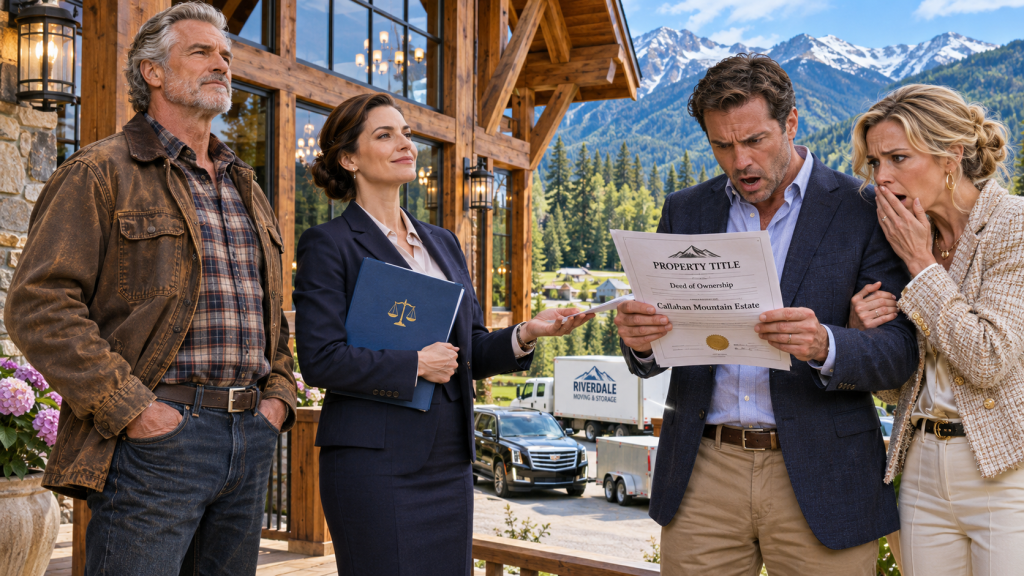
Miriam, my attorney, stepped forward.
“Perhaps I should explain that.”
She opened the blue folder.
The recorded title identified the owner as the Clara Callahan Legacy Trust.
The trust had been established after Elena and I began discussing how to preserve the land and use part of the property for a woodworking education program.
It wasn’t something I’d created in anticipation of Garrett arriving.
It had been part of our estate and charitable planning for years.
Elena was the acting trustee under the trust documents.
I retained defined rights to occupy and use the residence during my lifetime, along with other protections set out in the arrangement.
The property was subject to the trust’s terms.
And after the appropriate future events, its charitable purpose would support a woodworking school for veterans and others rebuilding their lives through skilled trades.
Garrett listened with increasing disbelief.
“So you put everything into a charity?”
I shook my head.
“No. The estate is one part of the life Elena and I built. Our business has its own structure. We have savings, obligations, employees, and plans. But this land isn’t yours to claim.”
He stared at me.
“I’m your only son.”
“I know.”
“Doesn’t that mean anything?”
My chest tightened.
“It has always meant something.”
I looked directly at him.
“But being my son doesn’t give you ownership of a house you didn’t help build.”
Garrett leaned back against the counter.
And for the first time, he seemed to understand that the papers weren’t a bluff.
Tiffany broke the silence.
“Where are we supposed to go?”
Her voice sounded sharp, but underneath it I heard fear.
I looked at her.
“Where were you planning to go before you found out about this house?”
She crossed her arms.
“We sold everything.”
Miriam glanced at the foreclosure notice that had fallen from Tiffany’s handbag.
“Mrs. Callahan, the documents we’ve reviewed suggest your previous property was already subject to foreclosure proceedings.”
Tiffany’s face flushed.
Garrett looked furious.
“Why are you digging into our finances?”
“Because,” Miriam answered, “you arrived with documents asking Harrison to transfer authority over his finances and property interests. We needed to understand what you were asking him to sign.”
She opened the packet Garrett had pushed across my kitchen table.
Three yellow tabs still marked the pages.
One document was a broad financial power of attorney.
Another purported to authorize access to investment accounts and certain business records.
The third was a proposed agreement assigning management authority over assets that Garrett believed I personally controlled.
None of them had been signed.
None had become effective merely because Garrett had placed them in front of me.
And even a valid power of attorney wouldn’t have made him the owner of trust property he had no authority to control.
Miriam pointed to a paragraph.
“This provision is especially concerning. It attempts to permit substantial transfers and transactions for Garrett’s benefit.”
Tiffany looked at the paper.
“I thought those were medical forms.”
I stared at her.
“You were standing behind my chair when he told me they were routine healthcare documents.”
Her eyes filled.
“That’s what he told me too.”
Garrett turned.
“Tiffany, don’t.”
She looked at him.
“You said your dad wanted us to manage things.”
“I said he needed help.”
I felt anger rising.
“Garrett, I haven’t asked you to manage anything.”
He looked toward me.
“You’re seventy-six, Dad.”
I stood straighter.
“And?”
His mouth tightened.
“People your age need support.”
I took a breath.
“Sometimes we do. That doesn’t mean we’re incapable of making our own decisions.”
Miriam added calmly, “Harrison has legal representation and established estate planning. There is no basis for treating his age alone as proof of incapacity.”
Garrett looked away.
I watched him.
Eleven years earlier, he’d told me to get my own place like a grown man.
Now he was standing inside that place, arguing that I was too old to control it.
The contradiction would have been funny if it hadn’t been so ugly.
Elena placed the notarized statement from Tiffany’s mother on the table.
Tiffany stared at it.
“My mother?”
Elena nodded.
“She contacted Miriam after learning Garrett intended to obtain signatures from Harrison.”
Tiffany’s face changed.
“Why would she do that?”
Miriam answered.
“Because she was concerned that financial desperation might lead to improper pressure.”
Garrett gave a bitter laugh.
“So now everyone’s against me.”
I looked at him.
“No, son. People are trying to keep you from making things worse.”
He shook his head.
“You don’t understand what we’re facing.”
“Then tell me.”
He stared at the floor.
I waited.
Finally, he said, “The business is gone.”
I felt my stomach tighten.
Garrett had operated a small construction supply company for several years.
I’d heard about it through old acquaintances.
He sold specialty hardware and materials to local contractors.
I’d always hoped he might build something steady.
“What happened?” I asked.
He rubbed his face.
“Contracts dried up. We took out financing to expand the warehouse. Then one of our biggest customers failed.”
I nodded slowly.
“And?”
“We couldn’t keep up.”
Tiffany began crying.
“There were loans, Harrison. More than I knew about.”
Garrett looked toward her.
“Not now.”
She shook her head.
“Yes, now.”
Her voice trembled.
“You told me we were selling the house because you wanted a fresh start. I didn’t know the bank had already begun foreclosure.”
I watched her.
She continued.
“And you told me your father wanted us to come live with him.”
Garrett closed his eyes.
Tiffany looked at me.
“He said you’d been asking him to move here.”
I stared at my son.
Eleven years.
Not one birthday call.
Not one Christmas.
Not one visit.
Yet he’d told his wife I’d invited them into my home.
“Garrett,” I said, “is that true?”
He didn’t answer.
I took a breath.
“Did you tell Tiffany I wanted you to move in?”
He whispered, “Yes.”
I looked away.
There was only so much disappointment a father could carry before it stopped feeling sharp and began feeling heavy.
Miriam continued reviewing the documents.
The financial recovery department that had been calling Garrett was collecting on a defaulted business obligation.
Other creditors were pursuing separate debts.
The foreclosure notice involved their home.
But Garrett had also been telling people he expected an inheritance from me.
He’d apparently believed that if he could obtain broad financial authority, he’d have access to funds or property interests sufficient to negotiate with his creditors.
The problem was that he had built that plan on assumptions.
He assumed I was rich.
He assumed I was alone.
He assumed I’d be grateful to have him back.
And he assumed the guilt of losing my only son would make me sign anything he put in front of me.
Garrett finally looked at Miriam.
“What happens if Dad signs those papers?”
She answered carefully.
“That would depend on the documents’ legal validity and the authority actually granted. But the packet contains provisions that could expose Harrison’s personal finances to serious risk. It would not give you ownership of trust property simply because you want it.”
He stared.
“So it wouldn’t even solve the problem?”
“Not in the way you appear to have imagined.”
I watched my son’s face.
For the first time, he looked less angry than lost.
His plan hadn’t merely failed.
It had never rested on a realistic understanding of what I owned.
Then I remembered the security recording.
“Miriam,” I said, “there’s something else.”
She nodded.
“I know.”
Garrett looked up.
“What?”
I turned toward him.
“The night before you brought me those papers, the workshop camera recorded you and Tiffany discussing them outside the bunkhouse.”
His face went pale.
Tiffany covered her mouth.
I continued.
“I heard you say that once I signed, everything would be settled.”
Garrett looked away.
“And I saw you take something heavy from your pocket.”
He swallowed.
Tiffany whispered, “Garrett.”
He didn’t move.
I looked at him.
“What was it?”
For a long moment, he said nothing.
Then he reached slowly into his coat.
I stiffened.
Miriam raised her hand.
“Please keep your hands visible and move carefully.”
Garrett stopped.
Then he withdrew a small metal object.
A folding pocketknife.
He placed it on the table.
I stared at it.
It was an old carpenter’s knife.
The handle was worn.
The blade was closed.
I recognized it.
I’d given it to him for his eighteenth birthday.
He’d carried it for years.
“Why did you bring that?” I asked.
He looked ashamed.
“I always carry it.”
I studied him.
“Then why show it to Tiffany when she asked what you’d do if I refused?”
His face crumpled.
He whispered, “I wanted her to think I could make you listen.”
The words chilled me more than the knife itself.
“You were willing to frighten me.”
He nodded.
“I didn’t actually plan to use it.”
I took a breath.
“I hope that’s true.”
Miriam stepped forward.
“Regardless of intent, Harrison has every reason to take the situation seriously. The knife will remain on the table, and no one is going to pressure him into signing anything.”
Outside, the deputy stood near the vehicles.
He’d come because I’d asked for a peaceful, witnessed departure.
Not because I wanted my son arrested.
But because I no longer trusted what desperation might make him do.
I looked at Garrett.
“Son, I taught you how to handle that knife when you were eighteen.”
His eyes filled.
“I remember.”
“I told you a tool becomes dangerous when you use it for the wrong purpose.”
He nodded.
I looked at the knife.
“Seems you forgot that lesson.”
Tiffany sat down.
She looked exhausted.
Without the designer clothes and the expensive jewelry I’d remembered, she seemed almost unrecognizable.
Her eyes were swollen.
Her hands shook.
“Harrison,” she whispered, “I know you don’t owe us anything.”
I waited.
“But we genuinely have nowhere to put all our things.”
I looked toward the moving van.
A professional crew was waiting outside.
I had arranged for a separate vehicle because I didn’t want Garrett and Tiffany settling into my property while we argued about ownership.
But I wasn’t going to pretend I enjoyed seeing them frightened.
I’d spent years living in a camper.
I knew what it felt like to wake up without a place that belonged to you.
“Are you asking for a place to sleep,” I said, “or for me to pay your debts?”
Tiffany wiped her face.
“A place to sleep.”
I nodded slowly.
“I offered you forty-eight hours in the bunkhouse. That offer still stands, provided you respect the rules and leave when the time is up.”
She looked relieved.
Garrett stared at me.
“Two days?”
“Yes.”
“Dad, we can’t find an apartment in two days.”
“I understand.”
“Then what are we supposed to do?”
I took a breath.
“Use the time to contact your relatives, explore short-term housing, and speak with someone who can help you make a realistic debt plan.”
He looked furious.
“You’re really throwing your own son out?”
I felt a familiar pain.
Then I remembered the basement.
The single lightbulb.
The stained mattress.
The sound of laughter through the ceiling while I sat in the dark.
“Garrett,” I said quietly, “I’m not locking you in a basement.”
He went still.
“I’m giving you a warm place for two nights and the opportunity to arrange somewhere else.”
His face crumpled.
“That isn’t the same as making you homeless.”
He turned away.
For a moment, I thought the conversation was finished.
Then he whispered, “I thought you’d be happy to see me.”
I stared at him.
“Garrett, I would have been happy to hear from you eleven years ago.”
He closed his eyes.
“Or ten years ago.”
I continued.
“Or five.”
My throat tightened.
“Or last Christmas.”
He began crying.
I stepped closer.
“You didn’t need a moving truck to come see your father.”
His shoulders shook.
“You could have called.”
I paused.
“You could have written.”
He wiped his face.
“You could have asked whether I was alive.”
Garrett looked at me.
And for the first time, I saw the child he used to be.
The little boy who followed me around construction sites wearing a yellow plastic helmet.
The teenager who wanted to learn how to build cabinets.
The young man who cried when Clara became ill.
Somewhere along the way, he’d become a stranger.
But I remembered every version of him.
That’s the cruelty of loving a child who hurts you.
You don’t stop seeing who they were simply because you can finally see who they’ve become.
“I missed you,” I whispered.
Garrett began sobbing.
I nodded.
“I missed you every year.”
He stepped toward me.
For a moment, I thought he might embrace me.
Then he looked toward the documents.
“And you’ll still let us lose everything?”
I stopped.
There it was again.
The old confusion.
Love meant money.
Forgiveness meant property.
Family meant surrender.
I stepped back.
“Garrett, you haven’t heard me.”
His face tightened.
I shook my head.
“You can have a relationship with me without owning anything I have.”
He stared at me.
“But you cannot take ownership of my life and call it love.”
After that, the room fell quiet.
The movers waited outside.
Elena stood near the kitchen counter.
Miriam gathered the unsigned documents.
And Garrett looked at the photograph of Clara hanging beside the fireplace.
For years, I’d kept that photograph in every place I’d lived.
The camper.
My first little cabin.
The office above the workshop.
And finally, this lodge.
Clara was standing in our old garden, laughing because I’d tried to grow roses and somehow managed to produce mostly weeds.
Garrett studied the photograph.
“She looks happy.”
I nodded.
“She was.”
He wiped his cheeks.
“I miss her.”
“So do I.”
He stared at her face.
Then whispered, “Do you think she would’ve forgiven me?”
I considered the question.
“I think your mother would have loved you.”
He looked at me.
“That doesn’t answer it.”
“No.”
I took a breath.
“Because forgiveness doesn’t mean pretending a thing never happened.”
He looked down.
“She might have forgiven you. She might also have insisted you put right what you could.”
I looked at Clara’s letter.
“And I think she would’ve expected you to become the kind of man who didn’t need to keep asking for forgiveness for the same behavior.”
Garrett began crying again.
This time, I put a hand on his shoulder.
Not because everything was settled.
Not because I trusted him.
But because I was still his father.
And I didn’t have to stop being his father to protect myself.
The moving company helped Garrett and Tiffany take their belongings to a secure storage facility.
The service wasn’t free.
I agreed to cover one limited move into storage, paid directly to the provider, because I wanted the situation resolved without anyone dumping furniture beside a mountain road.
I made clear it wasn’t an open-ended promise.
Garrett complained that I could easily afford to pay their debts.
I told him wealth wasn’t the question.
The question was whether paying everything again would help him take responsibility or simply postpone the day he’d have to face what he’d done.
Elena arranged for them to receive information about nearby short-term accommodations and financial counseling services.
Tiffany called her mother.
Her mother agreed to speak with them about temporary housing once they returned home.
It wasn’t the luxurious future Garrett had imagined when he drove up my gravel driveway.
But it was a beginning.
And it was one that didn’t require me to surrender my home.
That evening, I sat on the porch with Elena.
The moving truck was gone.
The deputy had left after confirming the situation was calm.
Garrett and Tiffany were in the bunkhouse.
The mountains glowed orange beneath the setting sun.
I held Clara’s wedding ring in my palm.
After eleven years, the gold was still smooth where her finger had worn it.
Elena sat beside me.
“How are you feeling?”
I looked toward the valley.
“Old.”
She smiled.
“You’re seventy-six, Harrison. You’re entitled.”
I laughed softly.
Then my eyes filled.
“I thought seeing Garrett again would make me happy.”
Elena waited.
“I used to imagine him driving up the road with a birthday cake. Or arriving with a photograph of a grandchild. Or just standing on the porch saying he missed me.”
My voice broke.
“I didn’t imagine a moving truck.”
Elena took my hand.
“I know.”
I looked at Clara’s ring.
“Part of me still wants to give him whatever he asks for.”
She nodded.
“Of course.”
“Even after everything.”
“He’s your son.”
I turned toward her.
“Does that make me foolish?”
She shook her head.
“No. It makes you a father.”
She paused.
“But loving somebody and trusting them with your finances are two different decisions.”
I stared at her.
She continued.
“You don’t have to prove your love by putting yourself in danger.”
I looked toward the bunkhouse.
“And if he never speaks to me again?”
Elena squeezed my hand.
“Then you’ll grieve that. But you won’t have to grieve losing your home because you were afraid to say no.”
I closed my eyes.
For a long time, we sat quietly.
Then I took Clara’s ring inside.
I placed it in a small wooden box I’d made years earlier.
Beside it lay her wedding photograph and a dried rose from our garden.
For the first time since I’d left Garrett’s house, those things were together again.
The following morning, Garrett came to the workshop.
He stood in the doorway while I was sanding a walnut tabletop.
I switched off the machine.
“Morning.”
He looked at the tools.
“Morning, Dad.”
For a moment, his expression softened.
“Smells like the old shop.”
I smiled faintly.
“Sawdust doesn’t change much.”
He walked toward a workbench.
There were chisels arranged in a wooden rack.
Clamps hanging along the wall.
A framed photograph of the first timber house Clara and I had built together.
Garrett touched the edge of the frame.
“I remember that place.”
I nodded.
“You were twelve.”
He smiled.
“You let me help carry the boards.”
“I let you carry the short ones.”
He laughed.
Then grew quiet.
“Dad, could I ask you something?”
I put down the sandpaper.
“Go ahead.”
“If I wanted to work again, would you help me?”
I studied him.
“What kind of help?”
He hesitated.
“Maybe a job.”
My chest tightened.
For a moment, I saw an opportunity.
A way to bring him back into my life.
A way to spend mornings together doing the work I’d once hoped to pass on to him.
But I also knew I couldn’t let longing make the decision for me.
“Our company has hiring procedures,” I said. “People are hired based on their skills, references, and ability to do the work.”
Garrett looked disappointed.
“So I can’t just come work with you?”
“You can apply for a position when there’s an opening.”
He stared at me.
“I’m your son.”
“I know.”
I took a breath.
“But the people who work here depend on this business. Their wages support families. I won’t risk that to repair my feelings.”
He looked down.
I continued.
“If you want to rebuild a relationship with me, you don’t need to be on my payroll.”
Garrett was silent.
Then he nodded slowly.
“Okay.”
It wasn’t the answer he wanted.
But it was the first time he’d accepted one without immediately trying to change it.
On the second day, Garrett and Tiffany prepared to leave.
They’d arranged temporary accommodation with Tiffany’s mother while they worked through their financial problems.
Garrett loaded the last suitcase into their SUV.
Then he came up the porch steps.
I was standing beside Elena.
For a moment, none of us spoke.
Finally, he said, “Dad, I don’t expect you to believe me.”
I waited.
“But I’m sorry.”
He swallowed.
“For the basement.”
My chest tightened.
“For the truck.”
He looked down.
“For taking Mom’s ring.”
His voice broke.
“And for showing up here because I thought you had money.”
I watched him carefully.
He continued.
“I told myself you owed me something because you were my father.”
He shook his head.
“But you already gave me more than I deserved.”
I took a breath.
“Garrett, don’t turn this into another story about what you deserve.”
He looked confused.
“You were my son. I wanted to help you. That wasn’t wrong.”
My voice trembled.
“What was wrong was the way you treated me after I helped.”
He nodded.
“I know.”
I looked toward the SUV.
“Now you have a chance to do something different.”
He swallowed.
“Do you think I can?”
I studied him.
“I think you can try.”
His eyes filled.
I stepped forward.
Then, slowly, I hugged my son.
He clung to me.
For several seconds, I could feel him crying against my shoulder.
And I cried too.
Not because the damage had disappeared.
But because there was still a part of me that remembered holding him when he was a newborn.
I let myself love that part of him.
Without making another promise I couldn’t safely keep.
Garrett drove away that afternoon.
This time, I didn’t stand on the porch wondering whether I’d been abandoned.
I watched until the SUV disappeared around the bend.
Then I went back inside.
There was a table to finish.
A foundation meeting the following week.
And a group of veterans arriving the next month for the first woodworking workshop in our new training building.
Life didn’t stop because Garrett had left.
And that realization brought me more peace than I expected.
Over the following months, I heard from him occasionally.
At first, the messages were awkward.
Hope you’re doing okay.
Got some work this week.
The weather looks bad up there. Stay warm.
I answered.
Sometimes briefly.
Sometimes with photographs of the shop.
I didn’t offer money.
He didn’t ask.
Then one afternoon, he called.
“Dad?”
“Yes, son?”
“I started meeting with a financial counselor.”
I leaned back in my chair.
“Good.”
He hesitated.
“Tiffany and I made a budget.”
I smiled faintly.
“That’s a useful thing.”
He gave a tired laugh.
“Wish I’d learned it twenty years ago.”
I thought about all the times Clara and I had tried to talk to him about money.
“You can learn it now.”
There was a pause.
Then he said, “I got a regular job at a fabrication shop.”
I smiled.
“How’s that going?”
“Hard work.”
“Most good work is.”
He laughed.
Then grew serious.
“Dad, I know none of this fixes what I did.”
I looked toward Clara’s photograph.
“No.”
He took a breath.
“But I wanted you to know I’m trying.”
I nodded.
“I’m glad you told me.”
A year passed.
Garrett didn’t become a different man overnight.
There were setbacks.
Financial problems.
Difficult conversations with creditors.
And stretches when he disappeared for a few weeks because he was ashamed to admit things hadn’t gone well.
But slowly, the calls became more regular.
He stopped asking what the estate was worth.
Stopped mentioning inheritance.
And began asking about my work.
He remembered the names of Elena’s daughters.
Asked how the woodworking school was progressing.
And one Sunday, he called simply to tell me he’d seen a beautiful old timber barn and thought of me.
It was an ordinary conversation.
No demands.
No hidden purpose.
Just a son speaking to his father.
When we hung up, I sat quietly for a long time.
Then I smiled.
Because for the first time in twelve years, I felt I’d heard from Garrett rather than from his problems.
The woodworking school opened the following autumn.
We called it the Clara Callahan Workshop for New Beginnings.
Elena suggested the name.
I cried when I first saw it carved into the cedar sign outside the training building.
The program offered practical woodworking instruction, mentoring, and opportunities for veterans transitioning into civilian careers.
We started small.
Six students.
Two instructors.
A workshop filled with donated hand tools, well-maintained equipment, and the smell of freshly cut pine.
I taught the first class myself.
I stood in front of six people, some younger than my grandchildren might have been, and explained how to select timber.
“Wood has a grain,” I told them. “You have to learn to work with it. If you force it the wrong way, it splits.”
One man raised his hand.
“What if it’s already split?”
I looked at the board in front of me.
“Depends how badly.”
He smiled.
I continued.
“Sometimes you can repair it. Sometimes you use it for something smaller. And sometimes you accept that it can’t carry the weight you originally planned.”
I paused.
“But that doesn’t mean the whole tree was worthless.”
The room went quiet.
I thought about my son.
My marriage to Clara.
My first winter in the camper.
And the home I’d built after believing I’d lost everything.
Then I picked up a piece of cedar.
“Now,” I said, “let’s make something useful.”
On my seventy-eighth birthday, Garrett came to visit.
Not with a moving truck.
Not with legal papers.
Not with demands.
He arrived driving a modest used pickup.
Tiffany came with him.
They brought a homemade cake and a small wooden box.
Garrett had made it himself.
The joints weren’t perfect.
One corner was slightly uneven.
But he’d sanded it carefully and finished it with walnut oil.
I opened the lid.
Inside was a photograph.
Clara holding Garrett as a baby.
I stared at it.
“Where did you find this?”
He smiled faintly.
“In one of the old family albums.”
My eyes filled.
Garrett looked nervous.
“I thought you might want it.”
I ran my thumb along the edge of the picture.
Then looked at him.
“Thank you, son.”
He nodded.
For a while, we sat on the porch looking toward the mountains.
Then Garrett asked, “Dad, do you ever regret leaving that night?”
I considered the question.
I remembered the basement.
The truck.
The cold drive north.
The camper.
The years of silence.
Then I thought about Elena.
The lodge.
The workshop.
The people whose lives had become part of mine.
“No,” I said.
Garrett looked down.
I continued.
“I regret that we reached the point where I had to leave. But I don’t regret protecting what was left of my life.”
He nodded slowly.
Then whispered, “I’m glad you found a good place.”
I looked toward the mountains.
“So am I.”
I’m Harrison Callahan.
I’m seventy-eight years old now.
I spent forty-five years building homes.
And for a long time, I believed that if I gave my son enough, he would understand how much I loved him.
I gave him money.
A house.
Opportunities.
And every excuse I could find when his choices hurt me.
But love without boundaries nearly cost me everything.
When Garrett told me to get my own place, I thought my life was over.
Instead, I drove into the mountains and discovered that even an old man with a broken heart could begin again.
I built a business.
Found people who valued my work.
Married a woman who loved me for who I was.
And helped create a place where others could rebuild their lives.
Eleven years later, my son returned expecting to inherit everything.
He discovered something he hadn’t imagined.
The estate wasn’t waiting for him.
It belonged to a trust created to preserve the land and serve a purpose beyond my lifetime.
But that wasn’t the greatest surprise.
The greatest surprise was that I still loved him.
And that, for the first time, I could love him without surrendering myself.
Last night, I sat beside Elena on our porch.
The valley was quiet.
A little snow had begun gathering along the railing.
Inside the house, Clara’s photograph stood beside the wooden box Garrett had made.
The photograph didn’t make me sad the way it once had.
It reminded me of the life I’d been fortunate enough to share with her.
Elena reached for my hand.
“Happy here?” she asked.
I looked at the mountains.
At the workshop lights glowing in the distance.
At the home we’d built together.
Then I smiled.
“Very.”
She leaned against my shoulder.
For a while, neither of us spoke.
Then my phone rang.
Garrett.
I answered.
“Hello, son.”
“Hey, Dad. Just checking on you. Heard there’s snow coming.”
I looked at Elena.
She smiled.
“Got plenty of firewood,” I told him.
He laughed.
“Figured you would.”
We talked for a few minutes.
About his work.
About the weather.
About an old truck he was helping repair.
Then he said, “Love you, Dad.”
My throat tightened.
“Love you too, Garrett.”
When the call ended, I stayed on the porch.
I thought about the night he’d told me to leave.
How I’d driven away believing I’d lost my only family.
How frightened I’d been.
How angry.
How alone.
And how much life had still been waiting for me.
A home isn’t measured by its price, and love isn’t proven by how much someone can take from you. A true home is the place where your dignity is safe, your presence is welcome, and your future still belongs to you.
I used to think leaving my son meant losing everything.
Now I know better.
Sometimes the door that closes behind you is the very door that allows you to find your way home.