Thomas reached for my wrist. I stepped back before his fingers could close around it. For twenty-two years, that simple gesture had been enough to silence me. A touch beneath a restaurant table. A warning glance across a crowded room. The quiet pressure of his hand on my shoulder whenever I asked a question he didn’t want to answer. But something had changed. I was no longer afraid of embarrassing him. I was afraid of what might happen if I continued protecting him. “Rose,” he whispered, “please. We can talk about this at home.”
I looked at the document glowing on my phone. An expense report submitted in Thomas’s name. A resort invoice. A client entertainment charge. And an electronic authorization carrying my name. My signature. Except I had never approved it. I looked into my husband’s eyes. “How did my signature get on this?” His face drained of color. “Not here.” “Then answer me somewhere else.” “Rose—” “Did you use my signature without permission?” He glanced toward the guests.
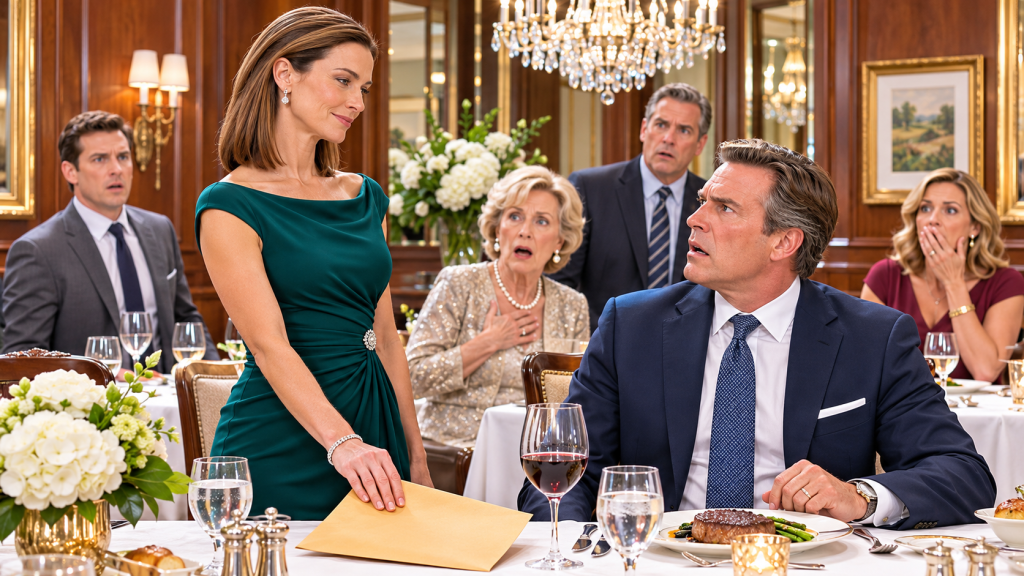
His mother, Brenda, was watching us with an expression of irritated disbelief. Mike had stopped pretending to examine his napkin. David, Thomas’s regional vice president, sat completely still. And the restaurant manager was waiting politely near the door, apparently wishing he could disappear. Thomas lowered his voice. “You’re making this into something it isn’t.” I felt a strange calm settle over me. “Then it should be easy to explain.” His jaw tightened. “You’re enjoying this.” I almost laughed. Enjoying it? I’d spent four days preparing to confront the man who’d betrayed our marriage, taken money from our joint savings, and planned to wait for my quarterly bonus before abandoning me.
I’d stood outside this dining room holding a birthday cake while he called me a pig.
I’d listened to his friends laugh.
And now I was discovering that my financial identity might have been used to authorize something I knew nothing about.
There was nothing enjoyable about it.
But there was one thing I no longer intended to do.
Pretend.
I slipped my phone into my handbag.
“Sarah will handle the documents.”
Thomas swallowed.
“Who’s Sarah?”
“My attorney.”
He looked at the envelope still lying beside the restaurant check.
For the first time that evening, my husband seemed to understand that the woman he’d spent twenty-two years underestimating had finally stopped accepting his explanations.
“Rose,” he whispered, “you can’t do this.”
I picked up my handbag.
“I already have.”
Then I walked out of the dining room.
And this time, I didn’t turn around.
My name is Rose Whitmore.
I’m fifty-three years old, and I run a corporate accounting firm in Charlotte, North Carolina.
I’ve spent most of my adult life working with numbers.
Financial records.
Contracts.
Budget forecasts.
Expense reports.
Audit trails.
I’ve always believed numbers tell a story, although sometimes people work very hard to make that story difficult to read.
My husband, Thomas, was excellent at telling stories.
He could make a struggling sales quarter sound like a remarkable achievement.
He could describe an expensive purchase as a sensible investment.
He could convince a room full of people that he was the driving force behind a successful household.
And for years, I’d helped maintain that illusion.
I paid the bills.
Managed our investments.
Remembered birthdays.
Organized family holidays.
And made sure our beautiful home in Myers Park remained the kind of place Thomas could invite clients to without worrying about a single detail.
I didn’t resent contributing more financially.
Marriage wasn’t supposed to be a competition.
What I resented, eventually, was discovering that my generosity had become something Thomas believed he was entitled to exploit.
And that my trust had become an opportunity.
Outside the restaurant, the evening air was cool.
Cars moved along the street beneath the city lights.
A couple passed me laughing, their hands intertwined.
I remembered when Thomas and I used to walk that way.
When we were newly married, we lived in a tiny apartment with a leaking bathroom faucet and a kitchen barely large enough for two people.
Thomas worked in sales.
I was building my accounting career.
We ate inexpensive pasta, argued about which movie to rent, and dreamed about owning a house with a garden.
He used to leave little notes in my briefcase.
Go get them, Rosie.
Proud of you.
Dinner’s on me tonight.
I had kept those notes for years.
Sometimes I wondered when the man who wrote them had disappeared.
Or whether he’d simply learned to say whatever made me feel loved.
My phone rang.
Sarah.
I answered immediately.
“Rose?”
“I’m outside.”
“Are you alone?”
“Yes.”
“Good.”
Her voice was steady.
“Are you safe?”
I looked toward the restaurant doors.
“Yes. Thomas is still inside.”
“All right. Don’t confront him further about the expense report. We need to verify its source, the authorization process, and whether it was submitted through a system you had access to.”
I nodded.
“How did Paul find it?”
“During the financial review, he noticed a reimbursement transaction connected to a business expense account. We requested clarification through the appropriate channels, and the document came into our possession this afternoon.”
I swallowed.
“And my signature?”
“It appears on the report. But appearance isn’t proof of authorization.”
I appreciated that.
Sarah never told me what I wanted to hear simply because I was upset.
She told me what could be established.
And what still needed investigation.
“Rose,” she continued, “we should meet tomorrow morning. There may be more.”
My stomach tightened.
“How much more?”
She hesitated.
“Enough that we need to be methodical.”
I closed my eyes.
“All right.”
Then she asked, “Did the card situation go as expected?”
I looked back at the restaurant.
“Yes.”
The Platinum card Thomas carried was no longer active.
I’d reported the physical card compromised and arranged for a replacement after discussing the account with the issuer. His attempt to use the old card had failed.
The restaurant wasn’t responsible for our marriage.
Neither were its employees.
And I wasn’t interested in leaving a business unpaid because my husband had behaved disgracefully.
Before leaving, I’d quietly made arrangements with the manager to cover my own food and the cake through a separate payment method. Thomas and the guests were responsible for settling the rest of the bill they’d ordered.
I didn’t know exactly how they’d divide it.
I didn’t care.
Sarah exhaled.
“Go home somewhere you feel comfortable. Don’t make any major decisions tonight.”
I looked up at the illuminated buildings.
“Sarah?”
“Yes?”
“I think I’ve spent twenty-two years making decisions that were comfortable for Thomas.”
She was silent.
Then she said gently, “Then perhaps it’s time to make some that are right for you.”
I didn’t go to our house.
Instead, I drove to my sister’s apartment in SouthPark.
Her name was Claire.
She was fifty-eight, a retired school principal with silver-streaked hair, an excellent sense of humor, and a talent for recognizing trouble before anyone else noticed it.
She opened the door wearing pajamas and holding a mug of tea.
She took one look at me.
“Well.”
I tried to smile.
“Hello to you too.”
Claire stepped aside.
“Come in.”
I walked through the doorway.
She locked the door behind me.
Then asked, “Did you finally tell him?”
I nodded.
Her expression softened.
“Oh, Rosie.”
And suddenly, the tears came.
I stood in my sister’s entryway, still wearing the dress I’d chosen for my husband’s birthday, and cried until I could barely breathe.
Claire held me.
She didn’t ask why I’d stayed so long.
Didn’t tell me she had warned me.
Didn’t say I should have known better.
She simply held me while twenty-two years of memories seemed to break apart inside my chest.
When I finally stopped, she guided me toward the kitchen.
“Sit.”
I obeyed.
She placed a mug of tea in front of me.
“Now,” she said, “tell me everything.”
I began with the resort receipt.
Then the missing twelve thousand dollars.
Jessica.
The apartment.
The messages about my quarterly bonus.
The birthday dinner.
The joke at my expense.
And the expense report carrying my disputed signature.
By the time I finished, Claire’s tea had gone cold.
She stared at the table.
Then whispered, “He was planning to take your bonus before filing for divorce?”
I nodded.
Claire closed her eyes.
For several seconds, she didn’t speak.
Then she said, “I’m going to ask you something.”
I looked up.
“All right.”
“Do you still love him?”
I stared at her.
The question hurt more than I expected.
Because the answer wasn’t simple.
“I love the man I thought he was.”
Claire nodded slowly.
I wiped my cheeks.
“But I don’t know if that man still exists.”
She reached across the table.
“Then you don’t have to figure that out tonight.”
Thomas called seventeen times before midnight.
He left six voicemails.
The first was angry.
“Rose, this was completely unnecessary. You embarrassed me in front of my colleagues.”
The second was defensive.
“You misunderstood what you heard. People were joking.”
The third was pleading.
“Come home. We can work this out.”
By the fourth, his voice had changed.
“Rose, please. David is asking questions, and I need to know what you’ve told people.”
I stared at the message.
There it was again.
Not Are you all right?
Not I’m sorry I hurt you.
Not even I want to understand why you’re leaving.
He wanted to know what I’d told people.
He was frightened of the story escaping his control.
I saved the voicemails.
Then silenced my phone.
Claire brought me a blanket and showed me to the guest room.
I lay awake for hours.
Not thinking about Jessica.
Not even thinking about Thomas.
I was thinking about how strange it felt to be somewhere nobody expected me to take care of everything.
For the first time in years, the dishes in the kitchen weren’t mine to wash.
The laundry wasn’t mine to fold.
The mortgage wasn’t mine to remember before breakfast.
I was simply a woman lying beneath a clean blanket in her sister’s guest room.
And although my marriage was collapsing, there was something almost peaceful about that.
At nine the following morning, I sat in Sarah’s office.
Paul, the forensic accountant, joined us with a folder thick enough to make my stomach tighten.
Sarah closed the conference room door.
“Before we begin,” she said, “I need you to understand something.”
I nodded.
“Financial misconduct allegations are serious. We’re going to separate what the records prove from what we suspect.”
“Of course.”
Paul opened the folder.
“The Asheville expense report is only one transaction.”
I felt cold.
“How many are there?”
He hesitated.
“We’ve identified at least eleven reimbursements that require further review.”
I stared at him.
“Eleven?”
He nodded.
“Several involve hospitality expenses, travel, or purported client meetings.”
Sarah slid a page toward me.
I recognized the name of Thomas’s employer.
And beneath it, a list of dates and amounts.
Four hundred and eighty dollars.
Nine hundred and twenty.
One thousand six hundred.
Two thousand three hundred.
Each supposedly related to business development.
Paul pointed to three entries.
“These appear connected to trips or purchases that may have benefited Jessica.”
I looked at the dates.
One was our twentieth wedding anniversary.
I remembered it clearly.
Thomas had told me he couldn’t come home because a major client had flown into town unexpectedly.
I’d eaten dinner alone.
He’d sent flowers the next morning.
I touched the date.
“That night,” I whispered.
Sarah looked at me.
“What about it?”
I swallowed.
“That was our anniversary.”
Nobody spoke.
I stared at the expense amount.
One thousand eight hundred dollars.
I’d spent that evening in our kitchen, eating leftover chicken while staring at a vase of flowers I’d bought myself.
And Thomas might have been spending company money on someone else.
I closed my eyes.
Sometimes the discovery that a marriage has been dishonest doesn’t arrive as one enormous revelation.
Sometimes it arrives as a date on a page.
A restaurant charge.
A remembered disappointment that suddenly acquires a different meaning.
Paul continued reviewing the documents.
The twelve-thousand-dollar apartment payment was supported by the executed lease I’d found.
The funds had left our joint savings.
And the landlord’s records identified Thomas as the primary tenant and Jessica as an approved occupant.
There was no evidence of a legitimate retirement investment.
That explanation had been invented.
Sarah explained that the money transfer would be addressed in the divorce proceedings, including whether any part of it should be accounted for as marital funds used for a nonmarital purpose.
She was careful not to promise that every dollar would automatically be returned to me.
But she assured me we would document it.
Then Paul brought out another report.
“This is where the situation becomes more complicated.”
My stomach tightened.
He pointed to a column marked Authorization.
“My signature,” I said.
“An electronic image resembling your signature,” he corrected gently.
I looked at him.
He continued.
“It appears on several internal approval forms. We’re examining whether the image was copied, whether the approvals were genuine, and who had access to the relevant accounts.”
I stared at the page.
“Thomas had access to an old scan of my signature.”
Sarah looked up.
“Where?”
“On our home computer. Years ago, I scanned a signed form while refinancing a property.”
Paul made a note.
“That’s useful to know.”
I swallowed.
“Could he have used it?”
“Possibly. We need evidence before reaching a conclusion.”
I nodded.
For twenty-two years, I’d believed Thomas knew me better than anyone.
Now I wondered whether he’d studied my habits well enough to exploit them.
Then Paul turned another page.
“There’s something else.”
I looked up.
He slid a document across the table.
It was a vendor registration form.
A company name appeared at the top.
Blue Ridge Strategic Consulting LLC.
I frowned.
“I’ve never heard of that.”
Paul nodded.
“The company was formed approximately eighteen months ago.”
“By whom?”
He pointed to the registration details.
Thomas’s name appeared.
So did another.
Mike Sullivan.
The friend who had joked about me outside the restaurant.
The same Mike who had supposedly introduced Thomas to a private real estate investment.
I stared at the document.
“What does this company do?”
“According to its registration, business consulting.”
I looked at Paul.
“And according to its financial records?”
He paused.
“That’s what we’re trying to establish.”
Sarah folded her hands.
“Rose, we have indications that payments connected to Thomas’s employer may have been directed toward this company. We don’t yet know whether those were legitimate transactions.”
I felt my heart pounding.
“Does his employer know?”
“Some concerns have been brought to its attention through appropriate channels, but we aren’t going to make accusations beyond the evidence.”
I looked down.
Thomas had told me he was building an empire.
I had imagined that meant promotions, investments, and the beautiful house we’d worked so hard to afford.
Now I was staring at a consulting company I’d never heard of, connected to a man who’d helped my husband laugh at me.
“How much money?” I whispered.
Paul hesitated.
“Potentially substantial. But we need the underlying records before giving you a reliable number.”
I leaned back.
For the first time since discovering Jessica, I felt something deeper than heartbreak.
I felt frightened.
Because the lies might extend far beyond my marriage.
And if Thomas had used my name or signature in business records, I needed to know whether he’d placed me at risk.
Three days later, Thomas came to Claire’s apartment.
He stood outside holding a bouquet of white roses.
They were my favorite flowers.
He knew that.
He’d always known the small details that made me happy.
The problem was that he’d also learned to use those details whenever he wanted me to stop asking difficult questions.
Claire answered the door.
“Thomas.”
He straightened his jacket.
“Hello, Claire. Is Rose here?”
“She is.”
“I’d like to speak with my wife.”
Claire looked at him.
“That depends on whether she wants to speak with you.”
I heard the conversation from the kitchen.
For a moment, I considered staying where I was.
Then I walked toward the door.
“It’s all right, Claire.”
Thomas looked at me.
His expression changed.
For the first time in years, I wasn’t wearing makeup.
My hair was tied back.
I had on jeans and an old blue sweater.
There was no carefully arranged version of me standing before him.
Only Rose.
He held out the flowers.
“These are for you.”
I looked at them.
Then back at him.
“Why are you here?”
He lowered the bouquet.
“Because we need to talk.”
“About what?”
“Our marriage.”
I folded my arms.
“All right.”
He glanced toward Claire.
“Privately?”
I considered that.
Then said, “We can speak on the porch.”
Claire gave me a small nod before returning to the kitchen.
Thomas followed me outside.
The afternoon was cool.
A neighbor was walking a golden retriever along the sidewalk.
Somewhere nearby, a lawn mower hummed.
Ordinary sounds.
An ordinary afternoon.
Yet the man standing beside me had become almost unrecognizable.
Thomas looked at the ground.
“I made mistakes.”
I waited.
“Terrible mistakes.”
“Yes.”
He swallowed.
“But twenty-two years have to count for something.”
I stared at him.
“They do.”
His eyes filled with hope.
Then I continued.
“That’s why what you did hurts so much.”
He looked away.
“I never stopped caring about you.”
My chest tightened.
“Thomas, you told another woman you were waiting for my bonus before filing for divorce.”
He rubbed his face.
“I was confused.”
“Confused?”
“Jessica made me feel young again.”
I looked at him.
He continued.
“I was turning fifty-five. Work had become stressful. Everything felt predictable.”
I nodded slowly.
“So you decided to spend our savings on another woman’s apartment.”
His expression tightened.
“You’re making it sound calculated.”
I looked directly at him.
“Was it not calculated?”
He said nothing.
I took a breath.
“You arranged a lease. You transferred twelve thousand dollars. You planned the timing of your divorce around money I was expecting to earn.”
Thomas closed his eyes.
“Rose—”
“And you invited twenty people to a birthday dinner you expected me to finance while you laughed about me behind my back.”
His face reddened.
“That was a joke.”
I stared at him.
“Then explain why it was funny.”
He opened his mouth.
Nothing came out.
I waited.
Finally, he whispered, “It wasn’t.”
I nodded.
“No. It wasn’t.”
Then I asked the question I’d been saving.
“What’s Blue Ridge Strategic Consulting?”
Thomas went still.
For one moment, he looked as though I’d struck him.
“Where did you hear that name?”
I studied him.
“Is it your company?”
He looked away.
“Partly.”
“With Mike Sullivan?”
He nodded.
“What does it do?”
“Consulting.”
“For whom?”
He didn’t answer.
I felt cold.
“Thomas.”
He rubbed his forehead.
“Rose, you’re mixing things that have nothing to do with our marriage.”
I stared at him.
“If your business activities involve my name, my signature, or money belonging to our marriage, then they absolutely concern me.”
His eyes narrowed.
“What exactly have you seen?”
I took a breath.
“Enough to know I need independent advice.”
Thomas stepped closer.
“Listen to me. If you start asking questions about Mike’s business, you could cause problems for a lot of people.”
My pulse quickened.
“Is that a warning?”
He looked startled.
“No.”
“Because it sounded like one.”
He lowered his voice.
“Some financial arrangements are complicated. You know that better than anyone.”
I stared at him.
“I also know that legitimate arrangements can withstand scrutiny.”
His expression hardened.
“You’re determined to destroy everything.”
I shook my head.
“No, Thomas. I’m determined to find out what belongs to me and what has been done using my name.”
He looked at the flowers in his hand.
For a moment, he seemed much older.
Then he whispered, “You’ll regret this.”
I stepped backward.
“I’ve already spent years regretting things I refused to confront.”
I opened the door.
“Our attorneys can communicate from now on.”
Thomas stared at me.
“You’re really ending our marriage?”
Tears filled my eyes.
I looked at the man I’d once loved enough to build an entire life around.
“No,” I whispered.
“You made choices that destroyed the trust our marriage depended on. I’m finally accepting what those choices mean.”
Then I went inside.
Claire locked the door after he left.
She found me standing in the hallway, crying.
She didn’t say anything.
She just put her arms around me.
A week later, David contacted Sarah.
He wanted to speak with us.
Thomas’s regional vice president had been at the birthday dinner.
He’d heard the remarks about Jessica.
He’d watched Thomas’s confidence vanish when the old credit card was declined.
And apparently, that evening had caused him to reconsider several things he’d been told.
We met in a conference room at Sarah’s office.
David arrived carrying a leather briefcase.
He looked uncomfortable.
“Rose,” he began, “I owe you an apology.”
I folded my hands.
“For what?”
“For sitting there while Thomas spoke about you that way.”
His cheeks reddened.
“I should have said something.”
I studied him.
“Yes. You should have.”
He nodded.
Then opened his briefcase.
“But that’s not the only reason I’m here.”
Sarah leaned forward.
David explained that Thomas had recommended Blue Ridge Strategic Consulting as a vendor to his employer.
He had presented the firm as an independent consultancy capable of helping with regional sales research and client development.
David had approved an initial engagement after the procurement department completed its ordinary review.
But he hadn’t known Thomas held an ownership interest in the company.
I stared at him.
“Was he required to disclose that?”
“Yes.”
David looked ashamed.
“His position came with conflict-of-interest obligations.”
Paul, who had joined the meeting, asked several questions about the approval process.
David answered carefully.
Then he said something that made the room go quiet.
“After the dinner, I asked our compliance team to review the Blue Ridge contract.”
My heart tightened.
“What did they find?”
David looked toward Sarah.
“The company had received payments for services whose supporting records were incomplete or inconsistent.”
Paul leaned forward.
“Do you have an estimate?”
David hesitated.
“Approximately ninety-six thousand dollars is under review.”
I stared at him.
Ninety-six thousand.
My husband had spent years complaining that I was too cautious with money.
And now a company connected to him and Mike was under scrutiny for payments that might not have been justified.
David continued.
“The company is conducting its own investigation. I’m not here to tell you anyone has been found guilty of anything.”
Sarah nodded.
“Understood.”
“But there is another issue.”
I felt my stomach tighten.
David opened a folder.
“Some of the vendor records identify Rose’s accounting firm as an external financial reviewer.”
For several seconds, I couldn’t speak.
Then I whispered, “What?”
He pushed the document toward me.
There was my company name.
My business address.
And a statement implying that certain financial information had been independently reviewed.
I stared at the page.
“I’ve never done work for Blue Ridge.”
Sarah looked at me.
“You’re certain?”
“Absolutely.”
I glanced at Paul.
“I’ve never approved an engagement, issued a report, or received payment from that company.”
David nodded grimly.
“That’s why we wanted to verify it.”
A terrible realization settled over me.
Thomas hadn’t merely used my personal reputation to make himself look successful.
Someone had apparently tried to lend credibility to business paperwork by invoking the professional name I’d spent decades building.
And that frightened me far more than losing a marriage.
Because my firm employed twelve people.
Twelve people with mortgages.
Families.
Children.
Futures.
I wouldn’t allow their livelihoods to be endangered by documents I hadn’t authorized.
Sarah touched my arm.
“Rose, we’ll handle this carefully.”
I nodded.
But I could barely hear her.
For twenty-two years, Thomas had benefited from my work.
Now I feared he’d tried to use its reputation too.
The investigation took months.
There were document requests.
Interviews.
Account reviews.
Meetings with attorneys.
And more nights than I care to remember spent staring at the ceiling.
My own firm cooperated in verifying that it had not undertaken the work attributed to it.
We examined our client records, engagement procedures, and the signature samples on file.
An independent review supported my position that the purported authorization was not genuine.
The employer’s inquiry separately examined the consulting contract, the payments, Thomas’s conflict disclosures, and Mike’s role.
I couldn’t control that investigation.
Nor could I make its findings arrive any faster.
Eventually, Thomas’s employer determined that he’d violated company policies concerning conflicts of interest and expense reporting.
His employment was terminated.
Mike’s consulting arrangement also came under scrutiny, and the company pursued recovery of disputed payments through the appropriate process.
The records were referred for additional review where necessary.
I didn’t celebrate.
I understood the seriousness of the findings.
But I also understood that every allegation deserved to be handled through evidence and lawful procedures, not through gossip or a vindictive public spectacle.
My own financial interests were addressed through the divorce.
The business matters belonged to the people and institutions responsible for them.
That distinction helped me remain grounded.
I wanted accountability.
Not revenge.
Then Jessica called.
It was a rainy Tuesday afternoon.
I was sitting in my office when my assistant, Marianne, appeared at the door.
“Rose, there’s a woman on the phone who says she needs to speak with you.”
I looked up.
“Who?”
“Jessica.”
My stomach tightened.
For a moment, I considered refusing the call.
Then I nodded.
“Put her through.”
I picked up the receiver.
“Hello?”
A young woman’s voice answered.
“Mrs. Whitmore?”
“Yes.”
“This is Jessica Palmer.”
I closed my eyes.
“I know.”
She hesitated.
“I don’t expect you to want to talk to me.”
“Then why are you calling?”
Her voice trembled.
“Because I found something.”
I stared at the rain streaking my office window.
“What?”
“Documents in Thomas’s apartment.”
My chest tightened.
“What kind of documents?”
She swallowed.
“Copies of your financial information.”
I went still.
Jessica continued.
“Account statements. Tax documents. A spreadsheet with your expected bonuses.”
I gripped the telephone.
Then she said, “There’s also a file about your company’s clients.”
My pulse quickened.
“Don’t send those documents to me.”
She sounded startled.
“What?”
“Some may contain confidential information. Please don’t email or circulate them. I’ll have my attorney contact you about how to preserve anything relevant safely.”
There was a pause.
Then she whispered, “All right.”
I took a breath.
“Jessica, why are you telling me this?”
Her voice broke.
“Because he lied to me too.”
I closed my eyes.
“He told me your marriage had been over for years.”
I said nothing.
“He said you lived separate lives. That you only stayed married for financial reasons.”
I stared at the wall.
Jessica began crying.
“He told me you knew about us.”
My chest tightened.
“Apparently, he told both of us what he thought we would believe.”
She sniffled.
“There’s something else.”
I waited.
“He asked me to sign a statement saying you had given him permission to use your card and financial information.”
My stomach turned.
“Did you?”
“No.”
Her voice trembled.
“I refused.”
I sat silently.
Then she whispered, “I’m sorry, Rose.”
I looked toward the rain.
For months, I’d imagined Jessica as a faceless symbol of everything Thomas had taken from me.
But the person on the telephone sounded frightened, ashamed, and very young.
I wasn’t ready to forgive her.
I wasn’t sure I ever would be.
But I was no longer interested in competing with her over a man who had deceived us both.
“Tell the truth to your own attorney,” I said quietly. “And let the proper process take its course.”
She began crying again.
“Thank you for listening.”
When the call ended, I sat for a long time.
Then I contacted Sarah.
There were still documents to protect.
Still questions to answer.
But one thing had become clear.
Thomas hadn’t simply lied when he needed to escape consequences.
He had built entire relationships out of different versions of the truth.
And the people who believed him had been living in separate stories, never realizing how carefully he’d kept them apart.
Our divorce was finalized the following spring.
It took longer than I’d hoped.
Financial disclosure was complicated by the business matters, the disputed expenditures, and questions concerning the funds transferred from our joint savings.
Sarah worked carefully.
Paul prepared detailed analyses.
Thomas retained his own counsel.
And eventually, through negotiated agreements and the court process, we reached a resolution.
I kept my accounting firm.
The marital property was divided under the applicable legal rules and the terms approved in the proceedings.
The twelve-thousand-dollar apartment payment and other documented expenditures were considered in the financial settlement.
My quarterly bonus had been deposited into an account in my name, as Sarah had advised, while remaining subject to any lawful disclosure and division requirements.
I hadn’t hidden it.
I’d simply stopped giving Thomas unrestricted access to money he had already announced he intended to exploit.
The house in Myers Park was sold.
That hurt more than I expected.
I’d chosen the kitchen tiles.
Planted the roses.
Spent years turning empty rooms into a home.
But by the end, every hallway seemed to contain a memory I no longer wanted to live inside.
The day the movers arrived, I stood in the living room and looked around.
There was a faint rectangle on the wall where our wedding photograph had hung.
For twenty-two years, that picture had greeted everyone who entered.
Thomas and Rose.
Young.
Smiling.
Certain they knew what forever meant.
I took one final look.
Then closed the door.
I moved into a townhouse with a small garden and a sunny breakfast nook.
It wasn’t as impressive as the old house.
That was one of the things I liked best about it.
There was no enormous dining room to prepare for guests who admired Thomas more than they knew me.
No expensive driveway.
No pressure to make every holiday look like a magazine photograph.
Just a comfortable place where I could breathe.
Claire helped me unpack.
On the first evening, we ordered Chinese food and ate it sitting on the floor because the dining table hadn’t arrived.
She looked around.
“What do you think?”
I smiled.
“I think Samuel would have called this a fresh start.”
Claire raised an eyebrow.
“Samuel?”
“Our father.”
She laughed.
“Probably. Although he’d also ask why you didn’t hire better movers.”
I burst out laughing.
Then, unexpectedly, I began crying.
Claire leaned over.
“Rose?”
I shook my head.
“I’m all right.”
She studied me.
“Are you?”
I looked around the room.
There were boxes everywhere.
The curtains weren’t hung.
My shoes were somewhere in a suitcase.
And for the first time in months, nobody was asking me for money or demanding an explanation.
“Yes,” I whispered.
“I think I finally am.”
The hardest part of leaving Thomas wasn’t the financial settlement.
It was mourning the life I’d believed we had.
I missed little things.
The familiar sound of his car entering the driveway.
The way he used to make coffee on Sunday mornings.
Our old jokes.
The traditions we’d built.
Sometimes I woke reaching toward the empty side of the bed.
Sometimes I remembered a happy afternoon and felt guilty for missing him.
My therapist helped me understand that grief wasn’t proof I’d made the wrong decision.
I could miss the good moments without denying the harm.
I could acknowledge that Thomas had once made me happy without pretending his later choices were acceptable.
And I could move forward without requiring every memory to become ugly.
One afternoon, I found a box of old letters.
Inside were the notes he’d written during our early marriage.
Proud of you, Rosie.
Go get them.
Love you always.
I sat on the bedroom floor reading them.
Then I placed them back inside the box.
I didn’t burn them.
I didn’t display them.
I put them on a high shelf.
They belonged to a chapter of my life.
But they no longer had to dictate the next one.
Nearly a year after the birthday dinner, Thomas sent me a letter.
It arrived through the attorneys because I’d asked that our communication remain limited.
I wasn’t expecting much.
Perhaps another explanation.
Another attempt to tell me I’d misunderstood.
But the letter was different.
Rose,
I spent years telling myself that because you were successful, you didn’t need anything from me.
I convinced myself your independence meant you couldn’t be hurt.
Then I used that lie to justify things I knew were wrong.
I betrayed you. I spent money dishonestly. I misrepresented our marriage. I used your reputation when I had no right to.
And I humiliated you in front of people whose approval mattered more to me than your dignity.
I’m sorry.
I know an apology doesn’t undo any of it. I don’t expect another chance.
I only wanted you to know that I finally understand why you walked away.
I read it twice.
Then folded it carefully.
For a long time, I sat beside the window.
I didn’t know whether Thomas truly understood everything he’d done.
I didn’t know what his future would look like.
I hoped he’d take responsibility.
I hoped he’d become a better man.
But I no longer needed to supervise his transformation.
His life was his responsibility.
Mine was mine.
And that was enough.
My accounting firm continued growing.
The independent review of the disputed documents helped establish that the firm had not authorized the work attributed to it.
We strengthened our approval procedures and documentation controls.
My employees stayed.
Our clients remained.
And eventually, the frightening months of uncertainty became something we could talk about without feeling the floor move beneath us.
One Friday afternoon, Marianne entered my office holding a bottle of sparkling cider.
I looked up.
“What’s this?”
She smiled.
“We finished the quarter.”
I laughed.
“I noticed.”
“And we exceeded our projections.”
“I noticed that too.”
She stepped closer.
“Rose, the team wanted me to tell you something.”
I put down my pen.
“What?”
She smiled.
“We know it’s been a difficult year.”
My throat tightened.
“And we appreciate how hard you worked to protect the company.”
I looked at her.
Marianne continued.
“You didn’t let what happened at home make you forget the people who depend on this business.”
My eyes filled.
I thought about the twelve people who’d worked beside me through months of uncertainty.
People who’d brought me coffee when I looked exhausted.
Who’d respected my privacy.
Who’d continued doing excellent work while I struggled to keep my personal life from overwhelming everything else.
“Thank you,” I whispered.
Marianne smiled.
“Now come celebrate with us.”
I laughed.
“Right now?”
“Right now.”
For once, I didn’t check my calendar.
I didn’t worry whether Thomas needed dinner.
I didn’t wonder whether the house was clean.
I stood.
And went.
That evening, twelve colleagues gathered around a small table at a restaurant near our office.
There was laughter.
Good food.
A ridiculous toast from Paul, who declared that the greatest mystery in accounting was why anyone voluntarily attended budget meetings.
We laughed until our cheeks hurt.
At one point, Marianne raised her glass.
“To Rose.”
Everyone turned.
My face warmed.
She smiled.
“For building a company where people matter.”
My throat tightened.
The others raised their glasses.
“To Rose.”
I looked around the table.
At the people who knew my work.
Respected my judgment.
And didn’t need me to make myself smaller so they could feel important.
I thought about Thomas’s birthday dinner.
The cruelty behind the door.
The laughter.
The credit card.
The manila envelope.
Then I looked at the faces around me.
And realized something extraordinary.
I hadn’t lost my place at the table.
I’d simply been sitting at the wrong one.
Today, I’m fifty-five.
The same age Thomas was on the birthday that changed our lives.
I live in a beautiful little townhouse.
I still run my accounting firm.
I travel occasionally with Claire.
I take long walks in the evenings.
And I’ve started painting again, something I abandoned years ago because there never seemed to be enough time.
Last month, I finished a painting of the Charlotte skyline at sunset.
It wasn’t perfect.
The buildings leaned slightly.
The colors weren’t quite right.
But I loved it.
I hung it above my fireplace.
Not because anyone else would admire it.
Because I made it.
Because it was mine.
And because there is a special kind of happiness in doing something simply because it brings you joy.
Sometimes people ask whether I regret what happened at Thomas’s birthday dinner.
I tell them I regret a great many things.
I regret the years I ignored small warning signs.
I regret apologizing when I had done nothing wrong.
I regret believing that keeping a marriage peaceful meant never asking questions that might upset my husband.
And I regret that a relationship I once treasured ended in betrayal.
But I don’t regret walking away.
I don’t regret protecting my finances through lawful means.
I don’t regret asking professionals to investigate documents bearing my name.
And I don’t regret refusing to pay for a celebration where my dignity was treated as a joke.
Because that night, I finally understood something.
You cannot build a loving marriage by sacrificing your self-respect to preserve someone else’s comfort.
Love requires honesty.
Respect.
Responsibility.
And the willingness to see another person as an equal.
Without those things, even twenty-two years of marriage can become a beautifully decorated room where one person feels terribly alone.
Last Sunday, Claire came over for dinner.
We cooked pasta.
Opened a bottle of sparkling water.
And sat outside beneath the warm evening sky.
At one point, she looked at me and smiled.
“Do you remember the night you showed up at my door?”
I laughed softly.
“How could I forget?”
“You looked as though the world had ended.”
I stared at the garden.
“For a while, I thought it had.”
Claire reached for my hand.
“And now?”
I considered the question.
Then smiled.
“Now I think it was the beginning.”
She squeezed my fingers.
We sat quietly for a moment.
Then she asked, “Are you happy, Rosie?”
I looked around.
At the roses blooming near the fence.
The painting visible through the living room window.
The little home I’d made for myself.
The sister who’d never stopped loving me.
And the future that no longer depended on whether somebody else chose to treat me well.
“Yes,” I whispered.
“I really am.”
Claire smiled.
“Good.”
Then she raised her glass.
“To new chapters.”
I lifted mine.
“To new chapters.”
And as the sun disappeared behind the trees, I remembered the birthday cake I’d carried into that restaurant.
The envelope in my handbag.
The look on Thomas’s face when he realized I knew the truth.
For years, I’d thought that moment was when my life fell apart.
Now I knew better.
It was the moment I stopped letting someone else decide what my life was worth.
And the woman who walked out of that restaurant had finally begun walking toward herself.