The signature looked like mine. That was the first thing that frightened me. Not Faron’s face turning the color of an overripe tomato. Not his fishing buddies suddenly finding the ceiling of the boat tent fascinating. Not even his mother, Earline, standing behind him with a salon receipt clenched so tightly that the paper had begun to crumple. It was my name. Angela Mott. Written on a financing application for a fifteen-hundred-dollar down payment toward a used bass boat. Except I hadn’t signed it.
I hadn’t agreed to buy a boat. And as of four days earlier, Faron wasn’t even my husband anymore. I stared at the paper in the salesman’s hand. “Where did you get that?” The salesman, a thin man named Dennis according to the badge on his shirt, looked uncomfortable. “Sir submitted the application online before coming to the show. This is the printed copy.” I turned toward Faron. He was staring at the ground. “Faron.”
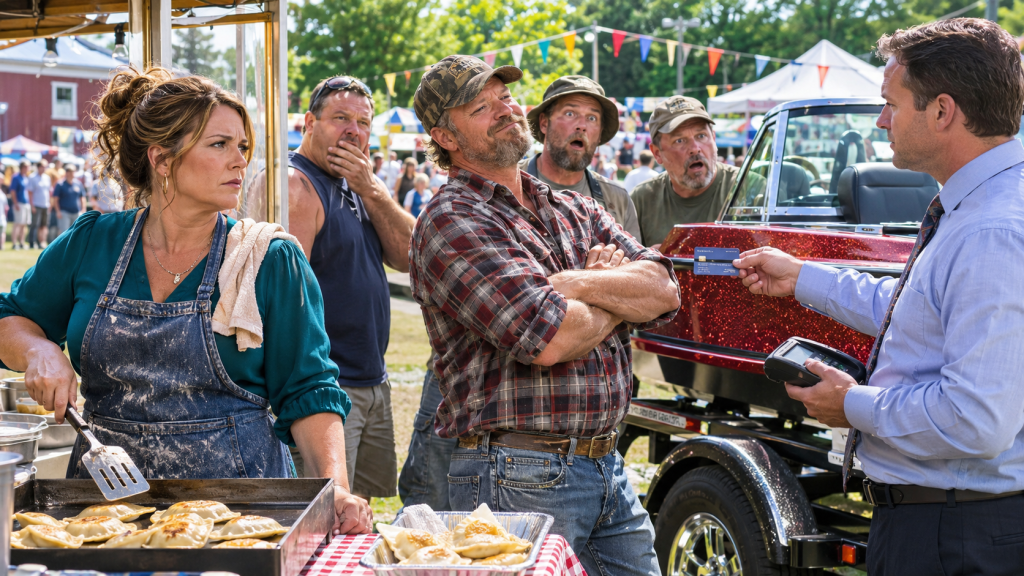
He didn’t answer. “Did you put my name on that application?” He rubbed the back of his neck. “Ange, don’t make a scene.” I almost laughed. For eleven years, that had been his favorite sentence whenever I caught him doing something he couldn’t explain. Don’t make a scene. Don’t embarrass me. Don’t act like money is everything. And when all else failed, he’d tell me I was too sensitive. But the crowd around the boat tent had gone quiet, and I was tired of being the only person expected to protect my ex-husband’s dignity.
“Did you use my name?”
Faron looked toward Dennis.
“She’s still my wife.”
I swallowed.
“No, Faron.”
My voice was steady.
“We got divorced on Tuesday.”
One of his buddies let out a low whistle.
Faron shot him a furious look.
Dennis glanced between us.
“Ma’am, if you didn’t authorize this application, we need to stop the transaction and document your concern.”
I nodded.
“That’s exactly what I want.”
Faron stepped forward.
“Hold on. Nobody’s stealing anything.”
Peg moved beside me.
Her apron was dusted with flour, and she still had a spatula in one hand.
“Then explaining it ought to be easy,” she said.
Faron glared at her.
“Stay out of this, Peg.”
She raised an eyebrow.
“You’re standing in front of my food booth threatening my cook. I’m exactly where I need to be.”
Earline pushed between them.
“Angela, you’re behaving like a stranger.”
I looked at the woman whose hair appointments I’d paid for every Friday for eleven years.
“Maybe that’s because you never bothered to know me.”
For one brief second, she looked genuinely wounded.
Then her expression hardened.
“You’ve always been selfish.”
I stared at her.
Eleven years.
Eleven years of paying for gas, groceries, hair appointments, and things I couldn’t even remember.
Eighty thousand dollars, give or take.
And I was selfish because I’d stopped.
I turned back toward Dennis.
“Can I have a copy of that application?”
He nodded.
“I’ll get our finance manager. We should preserve the original record.”
Faron’s face changed.
“There’s no need for that.”
But Dennis was already walking away.
And for the first time in eleven years, my ex-husband couldn’t make a problem disappear by telling me to keep quiet.
My name is Angela Mott.
I’m forty-nine years old, and I’ve worked the grill at Peg’s Diner in Kittanning, Pennsylvania, for twenty-two years.
I know exactly how long it takes to get a fried egg right.
I know which regulars want their toast barely browned and which ones want it nearly black.
I can make my mother’s potato-and-cheese pierogi without measuring a single ingredient.
And after two decades standing over hot metal, I can tell when a piece of bacon is ready just by listening to it.
People sometimes think being a diner cook is simple work.
They should try doing it for twelve hours while three waitresses are calling orders, somebody wants pancakes at eleven thirty, and the coffee machine decides to break.
I’ve worked hard all my life.
I never minded that.
What I minded was discovering how easily hard work could become something other people felt entitled to spend.
Faron and I married when I was thirty-eight.
Back then, he had a body shop.
He came home smelling like motor oil and peppermint gum.
He’d pick me up after the late shift, and we’d sit in his truck eating coconut cream pie from one paper plate.
I loved him.
I loved the way he sang along with the radio even though he couldn’t carry a tune.
I loved how he remembered my mother’s birthday.
I loved how he once spent an entire Sunday fixing the kitchen faucet because he didn’t want me paying a plumber.
When his business failed, I believed we were facing a temporary setback.
He asked to use my credit cards until things improved.
So I added him as an authorized user.
Then his mother.
And somewhere between one emergency and the next, temporary help became the entire foundation of our household.
I kept paying.
They kept spending.
And I kept telling myself that love meant being patient.
Until the day our divorce became final.
Until Earline laughed on the courthouse steps and said I’d still pay for her hair.
Until Faron laughed with her.
And something inside me finally understood that neither of them saw my generosity as a gift anymore.
They saw it as an obligation.
Dennis returned with a woman carrying a clipboard.
She introduced herself as Carla, the dealership’s finance manager.
She examined the application and asked whether we could step aside to discuss it.
I agreed.
Faron didn’t.
“You’re blowing this completely out of proportion,” he complained.
Carla looked at him calmly.
“Sir, the person named on this financing application disputes having authorized it. We cannot proceed as though that concern doesn’t exist.”
Faron’s mouth tightened.
Mike, one of his fishing buddies, shifted uncomfortably.
“Faron, maybe just leave it.”
Faron turned on him.
“Nobody asked you.”
Mike raised both hands.
“Suit yourself.”
Carla showed me the page.
My name appeared as a co-applicant.
My address was correct.
My approximate income had been entered.
And the signature looked like an electronic reproduction of one I’d used years earlier.
Underneath was a statement about authorizing a credit inquiry.
I felt cold.
“Was anything submitted to a lender?”
Carla checked her notes.
“An application was transmitted through our financing platform. I can’t tell you from this page alone what inquiries or other actions occurred, but we’ll stop any further processing here and preserve the records.”
I nodded.
“Thank you.”
She looked at me.
“You may want to review your credit reports and speak with the appropriate authorities if you believe your identity was used without permission.”
“I will.”
Faron groaned.
“Seriously, Angela?”
I looked at him.
“What?”
“You’d call the police over a boat?”
I stared at his face.
“Faron, I worked eleven years paying your bills. I don’t owe you one more dollar, and I certainly don’t owe you my name on a loan.”
His eyes narrowed.
“You know what your problem is?”
I almost smiled.
“I’m sure you’re going to tell me.”
“You think because you have a job, you’re better than everybody.”
I shook my head.
“No.”
Then I said something I wished I’d understood a decade earlier.
“I think because I have a job, I should get to decide what happens to my paycheck.”
Peg made a small sound beside me.
It might have been approval.
It might have been a laugh.
Either way, it gave me the courage to continue.
“And because the account is mine, I get to decide who uses it.”
Faron looked at me as if I’d started speaking another language.
Then he turned and walked away.
Earline hurried after him.
His fishing buddies followed more slowly.
And I stood beneath the boat tent holding a copy of the application, feeling as if I’d stepped into a life I didn’t recognize.
When I returned to the pierogi stand, Peg handed me a bottle of water.
“Drink.”
I obeyed.
She studied my face.
“You okay?”
I nodded.
Then shook my head.
“I don’t know.”
She took the spatula from my hand.
“Go sit down.”
“Peg, the lunch rush—”
“Angela.”
I stopped.
She pointed toward a folding chair behind the booth.
“Twenty-two years, and you still think this diner will collapse if you take ten minutes.”
I smiled weakly.
“Maybe it will.”
“Then I’ll charge admission to the rubble.”
I laughed.
It surprised me.
The laughter came out tangled with tears.
Peg sat beside me.
For a moment, we watched people pass beneath the bright canvas tents.
Children carried bags of popcorn.
Men examined fishing rods.
A little boy tugged on his father’s sleeve beside a display of life jackets.
Ordinary life continued.
And I was sitting on a folding chair trying to understand how my ex-husband had almost put me on a boat loan without my knowledge.
Peg leaned closer.
“Ange, I’m going to ask you something.”
I looked at her.
“Did he ever have access to your personal paperwork?”
I thought about the house.
The filing cabinet in the spare bedroom.
The drawer where I kept tax documents and old bank statements.
“Yes.”
She nodded.
“Then don’t assume this is the only thing you need to check.”
My stomach tightened.
“Peg—”
“I’m not saying there’s more.”
She touched my hand.
“I’m saying you’ve got to find out.”
I stared at the bustling fairground.
And suddenly, I remembered a conversation from two months earlier.
Faron had asked whether I still kept my old pay stubs.
He’d said a friend was helping him apply for a loan to restart the body shop.
At the time, I’d barely listened.
Now I wondered whether that conversation had been the beginning of something I didn’t know about.
I called my lawyer on Monday morning.
Her name was Diane Mercer.
She’d handled the divorce, and she’d warned me repeatedly that leaving Faron as an authorized user on my accounts wasn’t something I had to continue.
She listened while I described the county sports show.
When I finished, she was silent for a moment.
Then she said, “Angela, I’m glad the dealership stopped the transaction.”
I looked down at the documents spread across my kitchen table.
“Can they make me pay?”
“Not simply because your name appears on a disputed application. We need to verify exactly what was submitted, whether any account was opened, and what records exist.”
I nodded.
“What should I do?”
“First, preserve everything. Second, review your credit reports. Third, dispute any unauthorized inquiries or accounts through the appropriate channels. And if your signature was used without permission, you can make a formal report.”
I took notes.
Then asked something I’d been afraid to ask.
“Was I wrong to close the cards?”
Diane sounded surprised.
“Why would you think that?”
“Faron said I was being vindictive.”
She paused.
“Angela, you were the account holder. You had every right to stop allowing authorized users to make new charges, subject to the account agreements and any divorce obligations.”
I closed my eyes.
“Okay.”
She continued.
“But remember, closing an account doesn’t erase balances you already owe. We need to make sure you understand what remains on each account and that the issuers have accurately processed the changes.”
“I paid those balances.”
“Then keep the confirmation records.”
I stared at the kitchen clock.
For eleven years, I’d paid every bill because I was afraid of what would happen if I stopped.
Now I’d finally stopped, and I was discovering how much there was to untangle.
Before we hung up, Diane said something that stayed with me.
“Angela, the goal isn’t to punish Faron.”
I swallowed.
“I know.”
“The goal is to protect yourself and establish exactly what happened.”
I looked toward my mother’s recipe box above the kitchen counter.
“That’s all I want.”
The credit reports arrived that afternoon.
I sat at my kitchen table with my glasses on and a yellow highlighter in my hand.
Most of the information was familiar.
The mortgage.
The credit cards.
An old car loan I’d paid off years earlier.
Then I noticed something.
A hard inquiry from a financing company I didn’t recognize.
Dated two months before the divorce.
My stomach tightened.
I checked the other reports.
There was another inquiry.
Different lender.
Same month.
I stared at the dates.
Then opened my bank statements.
No new loan appeared in my own accounts.
That was encouraging.
But the inquiries were enough to make me call Diane again.
She asked me to send copies securely.
Then she arranged a meeting.
At her office the next day, she explained that an inquiry alone didn’t establish that a loan had been issued or that Faron had committed a particular offense.
But the pattern deserved investigation.
We discussed identity-theft reporting, credit freezes, and steps to prevent further applications.
She also advised me to inspect any records I could lawfully obtain related to the dealerships and lenders involved.
I nodded through everything.
Then looked at her.
“Diane, why would he keep doing this after the divorce?”
She folded her hands.
“Angela, I can’t tell you what he was thinking.”
I looked down.
“But I can tell you this: you don’t need to understand his motives before protecting yourself.”
That sentence settled somewhere deep inside me.
For years, I’d wasted time trying to understand why Faron needed another purchase.
Another trip.
Another chance.
Another month.
Maybe he was stressed.
Maybe he’d lost his confidence after the body shop failed.
Maybe he was ashamed.
Maybe he was simply used to getting what he wanted.
I’d spent eleven years searching for explanations.
And the explanations had never paid a single bill.
Three days later, Earline appeared at the diner.
She marched through the door wearing a purple cardigan and the expression of a woman who believed everyone in the room was required to listen.
Peg was standing at the register.
I was behind the grill.
Earline stopped in the middle of the dining room.
“Angela!”
Every head turned.
I took a slow breath.
“Morning, Earline.”
She slammed a folded statement onto the counter.
“My salon account is overdue.”
I looked at it.
“I’m sorry to hear that.”
She blinked.
“Sorry?”
“Yes.”
“That’s all you have to say?”
I turned a pancake.
“What would you like me to say?”
She looked outraged.
“I’ve been going to the same woman for twenty years. I have a standing appointment. You can’t just leave me embarrassed like that.”
I looked up.
“Earline, you can keep the appointment. You just have to pay for it.”
Her cheeks reddened.
“After everything I did for you!”
I set down the spatula.
“What did you do for me?”
She opened her mouth.
Then closed it.
Peg leaned against the counter.
“I’m curious too.”
Earline glared at her.
“This is family business.”
Peg smiled politely.
“Then why are you discussing it in my dining room?”
A few customers chuckled.
Earline looked around, apparently realizing she wasn’t receiving the sympathy she’d expected.
Then she lowered her voice.
“Angela, you know Faron’s having a hard time.”
I felt something old and familiar stir inside me.
Guilt.
For eleven years, those words had opened my wallet.
Faron’s having a hard time.
Earline’s having a hard time.
Just until things settle down.
I took a breath.
“Then he’ll need to make a plan.”
She stared.
“He’s your husband.”
“No, Earline.”
I held her gaze.
“He’s my ex-husband.”
For a moment, she looked stunned.
Then her face hardened.
“You’ve changed.”
I nodded.
“Yes.”
I waited.
And when she said nothing more, I turned back to the grill.
That afternoon, Peg found me in the storage room counting bags of flour.
“You know what I think?” she asked.
I smiled faintly.
“Usually.”
“I think Earline came in here expecting you to apologize.”
I nodded.
“Probably.”
Peg leaned against the doorway.
“And when you didn’t, she had no idea what to do.”
I laughed softly.
Then I looked down.
“Peg, do you think I was foolish?”
She frowned.
“For what?”
“Paying everything for so long.”
Peg was quiet.
Then she said, “I think you were trying to keep a marriage together.”
I swallowed.
“Maybe.”
“And I think Faron got comfortable letting you do all the keeping.”
Tears filled my eyes.
Peg stepped closer.
“Ange, you can regret a decision without deciding you’re a fool for making it.”
I looked at her.
She continued.
“You loved somebody. You helped when he needed it. Those aren’t terrible qualities.”
I wiped my cheeks.
“But you learned that help without limits can turn into something else.”
I nodded.
Peg squeezed my shoulder.
“Now you’re setting the limits.”
Then she grinned.
“And if you ever start paying that man’s bait bills again, I’m going to hit you with a frozen pierogi.”
I burst out laughing.
And for the first time that week, I felt like myself.
The next surprise came from somebody I hadn’t expected.
One of Faron’s fishing buddies.
His name was Kenny Daugherty.
I’d known him for years.
He was a quiet man who worked at a tire shop outside town, raised two daughters, and usually stayed out of other people’s arguments.
He’d been standing beside the red bass boat when Faron’s card was declined.
That Friday, Kenny came into the diner alone.
He ordered coffee and a slice of coconut cream pie.
I carried it to his table.
“Here you go.”
He looked up.
“Thanks, Ange.”
Something about his expression made me pause.
“Everything all right?”
He glanced toward the other customers.
“Could I talk to you for a minute?”
I sat across from him.
Kenny folded his hands.
“I’ve been thinking about what happened at the sports show.”
My stomach tightened.
“All right.”
He looked ashamed.
“I laughed when Faron pulled that card out.”
I remembered.
All three of his buddies had been slapping him on the back.
“Yes,” I said.
Kenny lowered his eyes.
“I thought he was buying the boat with his own money.”
I nodded.
“He told us he’d come into some cash.”
My chest tightened.
“What cash?”
Kenny hesitated.
“He said he had a settlement coming from the divorce.”
I stared at him.
“There wasn’t any settlement payment to him.”
Kenny looked uncomfortable.
“That’s what I figured afterward.”
He rubbed his forehead.
“There’s something else.”
I waited.
“About two months ago, he asked whether I knew anyone who could help arrange financing for a boat.”
My stomach tightened.
“He said he and you were buying it together.”
I stared.
Kenny continued.
“He told me you’d agreed to be on the paperwork because your credit was better.”
My hands grew cold.
“Did he show you anything?”
Kenny nodded.
“A photograph on his phone. Something with your signature.”
I closed my eyes.
“Did you know it wasn’t mine?”
“No.”
He looked genuinely distressed.
“Ange, I didn’t know any of this.”
I took a breath.
“Thank you for telling me.”
Kenny swallowed.
“Faron’s been saying you’re trying to ruin him.”
I looked toward the window.
“And what do you think?”
He considered the question.
Then said quietly, “I think he spent a long time living on money somebody else earned, and he’s angry because that arrangement ended.”
For several seconds, I couldn’t speak.
Then I smiled sadly.
“That’s about right.”
Kenny reached for his wallet.
“I also want to pay you for something.”
I frowned.
“What?”
“All those times we went fishing and Faron said he was buying lunch.”
I looked at him.
“Kenny—”
“Just listen.”
He pulled out several bills.
“He used to say the food was on him. Now I’m wondering whose card he was using.”
I stared at the money.
Then gently pushed it back.
“Kenny, you didn’t know.”
He looked uncertain.
“And I appreciate you coming here.”
He nodded.
Then whispered, “I’m sorry we laughed.”
I felt my eyes fill.
“Thank you.”
After he left, I stood behind the counter for a long time.
Kenny hadn’t changed the past.
He hadn’t returned eleven years of money.
But he’d done something important.
He’d seen what happened and decided not to remain silent.
The review of Faron’s financing activity took several weeks.
The dealership preserved its application records.
I provided a statement describing what I had and hadn’t authorized.
I placed freezes on my credit files and disputed the inquiries I believed were connected to applications I hadn’t approved.
Diane helped me understand which documents needed to be reviewed and what additional information might be available through formal processes.
One of the earlier inquiries turned out to be associated with an application that had not resulted in an opened account.
The other required further investigation.
The boat application itself had not produced financing.
That was a relief.
But the unauthorized use of my personal information remained serious.
The records showed that a signature image resembling mine had been uploaded with the application.
There were also communications from an email account associated with Faron.
I didn’t assume those facts settled every question.
I wanted the appropriate people to determine what happened.
Eventually, investigators interviewed Faron about the application.
I cooperated.
And then I stepped back.
I had spent eleven years solving his problems.
I wasn’t going to spend another eleven managing the consequences of his decisions.
One rainy Monday afternoon, Faron called me.
I hadn’t blocked his number because Diane advised me to preserve any relevant communications while matters were being reviewed.
But I rarely answered.
That afternoon, for reasons I still can’t explain, I picked up.
“Hello?”
“Ange.”
His voice sounded tired.
“Hello, Faron.”
There was a long silence.
Then he said, “They’re asking questions about the boat.”
I leaned against my kitchen counter.
“That doesn’t surprise me.”
He sighed.
“Angela, I didn’t mean to hurt you.”
I looked toward my mother’s recipe box.
“Then why did you use my name?”
He hesitated.
“I thought you’d help me.”
I closed my eyes.
“Did you ask?”
Silence.
“Faron, did you ask me to take on that loan?”
“No.”
I swallowed.
“Did I sign anything?”
“No.”
“And did you know my cards were closed?”
He exhaled.
“Not until the show.”
I stared at the wall.
For years, I’d wanted him to admit things plainly.
Now he finally was.
And somehow, it didn’t make me feel better.
Faron continued.
“I thought you’d get over being mad.”
My chest tightened.
“Why?”
He paused.
“Because you always did.”
I closed my eyes.
Those four words nearly undid me.
Because you always did.
Whenever he spent too much, I forgave him.
Whenever he promised to find work and didn’t, I waited.
Whenever Earline complained about needing something, I paid.
And whenever I became angry, Faron assumed I would eventually calm down and resume taking care of everything.
I took a slow breath.
“Faron, I wasn’t angry when I closed the cards.”
He sounded confused.
“Then why’d you do it?”
“Because we were divorced.”
He said nothing.
“And because I no longer agreed to pay your expenses.”
His voice tightened.
“After eleven years, you can just cut me off?”
I stared at the rain.
“No.”
I swallowed.
“After eleven years, I finally understood I had to.”
Faron began crying.
I hadn’t heard him cry since the day his body shop closed.
For a moment, my heart responded the way it always had.
I wanted to comfort him.
Tell him we’d figure something out.
Offer a little money to help him through the month.
That old instinct was so familiar it felt like reaching for a pan handle on the grill.
Something I could do without thinking.
But I stopped.
“Faron, are you working?”
He sniffled.
“Not much.”
“Have you looked for steady work?”
He hesitated.
“I’ve made some calls.”
I nodded.
“Then keep making them.”
He went silent.
“Angela, Mom’s struggling.”
My chest tightened.
“She has an income of her own.”
“Not enough.”
“Then she needs to review her budget.”
He sighed.
“You’ve gotten cold.”
I looked down at my hands.
They were rough from years of work.
Small burns dotted my fingers.
The knuckles ached when the weather changed.
They were the hands that had cooked thousands of meals, washed countless dishes, and signed eighty thousand dollars’ worth of credit card payments over eleven years.
“No, Faron,” I whispered.
“I’ve gotten tired.”
He began crying again.
I took a breath.
“I hope you find work. I hope you get your finances sorted out. I hope you build a life you’re proud of.”
His voice cracked.
“But I can’t build it for you.”
There was a long silence.
Then he whispered, “You really mean that.”
“Yes.”
He exhaled.
“Okay, Ange.”
And the call ended.
That evening, I made pierogi.
Not for the diner.
Not for Peg.
For myself.
I pulled my mother’s recipe box from the shelf above the grill at home.
The cards were yellowed and soft around the edges.
There were little grease marks beside the measurements.
Mom had written notes in blue ink.
Add more onion if they’re for company.
Don’t overwork the dough.
Angela likes extra butter.
I smiled.
My mother had died eight years earlier.
She hadn’t lived to see my marriage end.
But I sometimes wondered what she’d think of the choices I’d made.
She was a practical woman.
She worked in a laundry before finding a job in a school cafeteria.
She raised three children and never complained about the long hours.
But she also believed a woman deserved respect.
When I was little, she’d sometimes say, “You can share your supper, Angie. But don’t let somebody take your plate and tell you to be grateful.”
I’d forgotten those words for a while.
Now they returned as I rolled out the dough.
I filled each little circle with potato and cheese.
Pressed the edges.
Dropped them into boiling water.
Then browned them in butter with onions.
The kitchen smelled like childhood.
I sat at my small table with a plate of pierogi and a glass of iced tea.
No one complained that dinner was late.
No one asked whether I’d bought beer.
No one demanded that I put another expense on my credit card.
For the first time in years, the meal I’d worked to prepare was simply mine to enjoy.
I ate slowly.
And when I finished, I cried.
Not because I was lonely.
Because I hadn’t realized how peaceful a kitchen could be.
The financial changes weren’t immediately easy.
Closing two cards and replacing another meant keeping careful track of automatic payments.
I had to update utility accounts, review subscriptions, and make sure no legitimate bills were missed.
I checked the credit reports again after the disputes were processed.
I kept copies of every bank confirmation.
And I started a notebook.
On the cover, I wrote:
ANGELA’S MONEY.
Inside, I listed what I earned.
What I spent.
What I saved.
For eleven years, I’d made detailed budgets for a household where two other people ignored every limit.
Now I made one for myself.
The first month, I was surprised by how much money remained.
Not a fortune.
I still had a house payment.
Groceries.
Insurance.
Car maintenance.
And the ordinary expenses that come with living.
But the constant extra charges were gone.
There was no casino bus.
No Friday salon appointment.
No surprise fishing equipment.
No gas purchases from places I’d never visited.
At the end of that month, I transferred four hundred dollars into savings.
I stared at the confirmation screen.
Then smiled.
Four hundred dollars.
Money I could keep.
Money I might use to repair my porch.
Take a trip.
Or simply leave untouched for a day when I needed it.
It felt like the beginning of something enormous.
In September, Peg called me into her office.
She had a small room behind the diner with a desk, a filing cabinet, and a calendar from the local hardware store.
When I entered, she was sitting beside a stack of invoices.
“Close the door, Ange.”
I frowned.
“Am I in trouble?”
Peg laughed.
“After twenty-two years? If I wanted to fire you, I’d have to learn how to cook.”
I smiled.
“What’s going on?”
She pushed a folder toward me.
“I’ve been looking at our catering numbers.”
I sat down.
Peg continued.
“The pierogi table at the county show made more money than it ever has.”
I raised an eyebrow.
“Even with all that excitement?”
She grinned.
“Apparently, drama makes people hungry.”
I laughed.
Then she grew serious.
“People keep asking whether we sell your mother’s pierogi by the dozen.”
My heart tightened.
“They do?”
“Every week.”
I looked at her.
Peg continued.
“I think we should start taking orders.”
I stared.
“For what?”
“For frozen pierogi. Family packs. Holiday orders. Maybe a few local events.”
I shook my head.
“Peg, I already work enough hours.”
She nodded.
“That’s why I don’t want you doing it on your own time for nothing.”
I looked up.
She slid a proposal toward me.
“I want to set up a small, properly priced product line through the diner. You’d oversee the recipe and production, and we’d agree on extra compensation and hours you can actually manage.”
I stared at the paper.
For years, my mother’s recipe had simply been something I made because people liked it.
Something I gave away.
Something that reminded me of home.
Now Peg was asking whether it might become a business opportunity.
A real one.
With a plan.
An agreement.
And fair pay.
I felt tears gathering.
“Peg, I don’t know what to say.”
She smiled.
“Say you’ll think about it.”
I laughed.
“All right.”
Then she reached across the desk.
“And Ange?”
“Yeah?”
“This time, make sure you get paid for your work.”
I smiled through my tears.
“That’s something I’m learning.”
We launched the pierogi orders before Thanksgiving.
Peg insisted on starting small.
We tested the packaging, checked the costs, and made sure the diner had the proper arrangements to prepare and sell the additional food safely.
I helped calculate the price.
That part nearly made me laugh.
For years, I’d worked myself to exhaustion and then handed my money to Faron without asking what anything really cost.
Now I was sitting at Peg’s desk calculating the value of flour, potatoes, cheese, butter, labor, and time.
“Don’t forget the onions,” Peg said.
I smiled.
“Never.”
“And don’t forget yourself.”
I looked up.
She tapped the labor column.
“Your time belongs in there too.”
My throat tightened.
She was right.
My time mattered.
My effort mattered.
The years I’d spent working over a hot grill mattered.
And for the first time, I wasn’t ashamed to put a value on them.
The first weekend, we sold thirty-two packages.
By Christmas, we had more orders than we’d expected.
People bought them for family dinners, church gatherings, and holiday celebrations.
An older woman named Mrs. Kowalski came in one afternoon and asked whether the recipe was Polish.
“My mother’s,” I told her.
She smiled.
“Then I’m sure they’re made with love.”
I looked toward the kitchen.
“They are.”
And suddenly I wished Mom could see me.
Not because the business was making me rich.
It wasn’t.
But because something she’d taught me had become part of my future.
Something nobody could take away by swiping a credit card.
The situation with Faron eventually reached a formal resolution.
The disputed financing records were investigated, and the matter proceeded through the appropriate legal channels.
Faron acknowledged submitting applications that contained information and authorization he had no right to provide.
The exact consequences were determined by the people responsible for reviewing the evidence and applying the law.
No boat loan was left in my name.
The unauthorized credit inquiries were addressed through the credit reporting dispute process.
And Diane helped me confirm that the divorce settlement and the credit account records were being handled separately and properly.
I didn’t spend my evenings imagining ways to humiliate Faron.
I didn’t celebrate when he faced consequences.
I simply wanted my financial identity back.
There was a difference.
A big one.
One afternoon, several months after the county sports show, I received a letter from Earline.
It arrived in a plain white envelope.
Her handwriting was familiar.
I’d seen it on birthday cards, grocery lists, and little notes asking me to pick up one thing or another.
For a moment, I considered setting it aside.
Then I opened it.
Angela,
I know you probably don’t want to hear from me.
I’ve been angry with you because things have been difficult since you stopped paying for everything.
I almost laughed.
At least she was beginning with the truth.
I continued.
I didn’t understand how much you were doing for us. I knew you paid for things, but I never added it all up.
When my salon appointment was canceled, I was embarrassed. I blamed you because that was easier than admitting I had allowed myself to depend on your money.
My eyes filled.
Then came the sentence that surprised me.
You were good to my son, and I didn’t treat you with the kindness you deserved.
I sat quietly.
Earline had never said anything like that to me.
Not once in eleven years.
I continued reading.
I’ve started going to a less expensive salon, and I only go when I’ve saved enough. I know that sounds small, but I’m trying to understand how to live within what I have.
I’m sorry for laughing at you on the courthouse steps.
I hope you have a good life.
Earline.
I folded the letter carefully.
For a long time, I stared at it.
Then I put it in a drawer.
I didn’t call her.
I didn’t invite her back into my life.
But I appreciated that she’d finally recognized something she’d refused to see before.
And perhaps that was enough.
Faron came into the diner one last time the following spring.
It was a quiet Tuesday afternoon.
Peg was in the office.
I was wiping down the grill.
When the bell above the door rang, I looked up.
There he stood.
His fishing shirt was faded.
His face was thinner.
He looked older than he had at the courthouse.
“Hey, Ange.”
I set down the cloth.
“Hello, Faron.”
He walked toward the counter.
“Can I get a coffee?”
“Of course.”
I poured a cup.
He paid for it himself.
That small act felt strangely significant.
He sat at the counter and stared into the coffee.
For a while, neither of us spoke.
Then he looked up.
“I got a job.”
I nodded.
“That’s good.”
“At a repair shop outside town.”
“Doing bodywork?”
“Some. Mostly estimates and parts orders.”
I smiled faintly.
“Sounds like something you know.”
He nodded.
Then grew quiet.
“Mom says you’re selling your pierogi now.”
“Yes.”
He looked toward the freezer display.
“She says they’re good.”
I almost laughed.
“She’s eaten them for eleven years.”
Faron smiled sadly.
“I know.”
A long silence followed.
Then he whispered, “I was awful to you, Ange.”
I looked at him.
He continued.
“I kept thinking the cards were just there. Like the electric bill. Like the water.”
My throat tightened.
“You knew somebody was paying them.”
He nodded.
“I did.”
His eyes filled.
“I just didn’t want to think about how much it was costing you.”
I stared at him.
For years, I’d wanted him to say those words.
Now they arrived after the marriage had ended, after the accounts were closed, after I’d begun building a different life.
I felt sadness.
But not regret.
“Thank you for acknowledging it,” I said.
He wiped his eyes.
“Do you think we could ever start over?”
The question hung between us.
For a moment, I remembered the truck.
The coconut cream pie.
The radio.
The man who once waited outside the diner because he couldn’t stand the thought of me walking home alone.
I loved that memory.
But a memory wasn’t a marriage.
And missing the person Faron used to be didn’t mean I wanted to return to the life we’d built afterward.
I shook my head gently.
“No, Faron.”
His face fell.
“I’m sorry.”
I looked at him.
“I hope you become someone you’re proud of.”
He swallowed.
“But I need to keep moving forward.”
He nodded.
Then stood.
At the door, he turned.
“Ange?”
“Yes?”
“Your mom would be proud of you.”
My eyes filled.
“Thank you.”
He left without asking for anything.
And that was the last time we spoke.
A year has passed since the divorce.
I’m fifty now.
I still work at Peg’s Diner.
I still make the breakfast rush.
Still know exactly how much pepper Mr. Hensley wants on his eggs.
And every Friday, I still make my mother’s pierogi.
But my life is different.
The cards are mine.
The money is mine.
The decisions are mine.
I paid off the remaining balances I’d been carrying.
I built an emergency savings account.
I repaired the porch steps.
And last month, I took three days off and drove to a little cabin near the Allegheny National Forest.
Just me.
A suitcase.
A book I’d been meaning to read.
And a cooler filled with food I actually wanted to eat.
On the second morning, I sat outside watching sunlight move across the trees.
There was no one asking me to buy gas.
No one complaining that the fishing bait cost too much.
No one expecting me to pay for something simply because I always had.
I drank my coffee slowly.
Then I opened my book.
It was such a small thing.
Such an ordinary morning.
And yet I remember feeling richer than I ever had while earning money for three people.
Sometimes people ask whether closing those credit cards was revenge.
I tell them no.
Revenge would have meant spending my days trying to make Faron suffer.
I didn’t want that.
I wanted to stop suffering myself.
I wanted to stop working twelve-hour shifts while other people treated my paycheck like an endless supply of money they deserved.
I wanted to stop feeling guilty for buying myself a new pair of shoes.
I wanted to stop apologizing because I couldn’t afford somebody else’s entertainment.
And I wanted to remember who I had been before loving Faron became the same thing as paying for him.
That was all.
Last Friday, Peg closed the diner early after a particularly busy week.
We sat at the counter with two slices of coconut cream pie.
She pushed one toward me.
“On the house.”
I laughed.
“Peg, I work here.”
“So?”
I took a bite.
The taste brought back a thousand memories.
Faron’s truck.
The radio.
Our younger faces reflected in the windshield.
For a moment, I felt a familiar ache.
Peg noticed.
“You all right?”
I nodded.
“Just remembering something.”
She smiled gently.
“Good memories?”
“Some.”
She waited.
Then asked, “And now?”
I looked around the diner.
At the grill I’d worked for twenty-two years.
At my mother’s recipe box sitting on the shelf.
At the freezer where packages of pierogi waited for customers.
At the woman who’d defended me without hesitation when Faron threatened my reputation.
And I smiled.
“Now I’m making new ones.”
Peg raised her coffee cup.
“To new memories.”
I lifted mine.
“To new memories.”
We clinked our cups.
And laughed.
That night, I went home and opened the little notebook where I keep track of my money.
I added up the savings I’d managed to put away over the past year.
Then I turned to the first page.
At the top, in my handwriting, were three simple words.
Angela’s money. Angela’s choices.
I ran my finger beneath them.
For eleven years, I had believed being a loving wife meant paying whenever Faron or Earline needed something.
But love wasn’t supposed to be a bill that came due every Friday.
It wasn’t supposed to require silence when someone took advantage of you.
And it certainly wasn’t supposed to leave you frightened of saying no.
I closed the notebook.
Then I looked toward my mother’s recipe box.
I remembered what she’d always told me.
You can share your supper, Angie. But don’t let somebody take your plate and tell you to be grateful.
I smiled.
It had taken me a long time to understand.
But I finally did.
Kindness is something you choose to give. It stops being kindness when someone decides they’re entitled to take it.
That night, I went to bed in a quiet house.
The bills were paid.
The doors were locked.
There was coconut cream pie in the refrigerator.
And nobody was waiting for me to hand over my credit card.
For the first time in eleven years, I wasn’t somebody else’s financial safety net.
I was simply Angela.
A cook.
A daughter who still cherished her mother’s recipes.
A woman who had loved, lost, learned, and begun again.
And I was finally living on my own terms.