Mike was halfway to the door when David spoke. “Michael, sit down.” Three words. Quietly spoken. But they stopped the entire room. My husband’s best friend turned around, his face pale beneath the chandelier lights. “David, I think there’s been a misunderstanding.” David held up the invoice. “Then you can help me understand it.” Thomas reached for his water glass. His hand was shaking so badly that the ice rattled against the crystal.
I watched him. Twenty-two years of marriage. Twenty-two years of believing I knew the man sitting beside me. And yet, at that moment, he looked like a complete stranger. David studied the paper. “Blue Ridge Strategic Consulting,” he read aloud. Mike swallowed. “That’s my company.” David looked up sharply. “Your company?” Mike nodded. “An outside consulting business.” David glanced toward Thomas. “Since when has your department been hiring outside consultants without going through procurement?” Thomas opened his mouth.
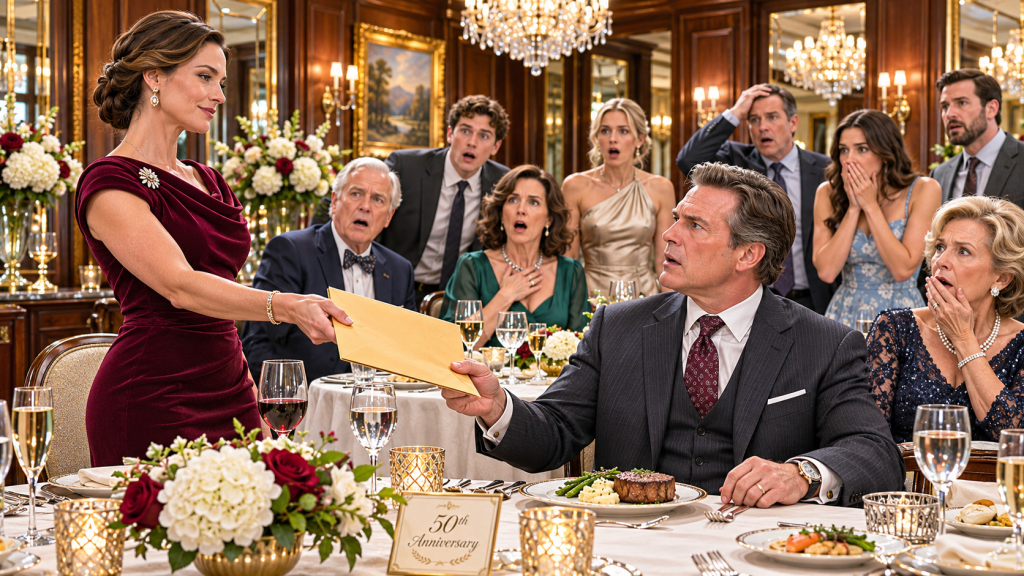
Nothing came out. I sat perfectly still. My custom bourbon pecan birthday cake remained in the center of the table, half eaten. Around us, twenty guests watched what was supposed to be a magnificent birthday celebration turn into something none of them had anticipated. Brenda, my mother-in-law, finally broke the silence. “This is ridiculous. Rose is doing this deliberately because she’s jealous of a younger woman.” I looked at her. “Brenda, your son has been using our savings to pay for an apartment with Jessica.” Her expression hardened.
“That’s between a husband and wife.”
I nodded.
“Exactly. Which is why it’s unfortunate that your son discussed it with twenty people before I entered the room.”
Nobody laughed.
David placed the invoice on the table.
Then he looked directly at me.
“Rose, did your accounting firm authorize this?”
I felt every eye turn in my direction.
I took a slow breath.
“No.”
Thomas’s face went completely white.
I continued.
“I have never approved consulting fees for Blue Ridge Strategic Consulting. I have never contracted with that company on behalf of my firm. And I did not sign the authorization printed on that page.”
David studied the signature again.
Then he looked at Thomas.
“Did you know this document existed?”
My husband stared at his plate.
“David, this isn’t the appropriate place.”
David’s voice remained controlled.
“Then Monday morning will be.”
He folded the invoice carefully.
“But there will be an internal review before anyone draws conclusions.”
I nodded.
That was the first sensible thing anyone had said in that room for nearly an hour.
Because although I had discovered enough to know something was terribly wrong, I wasn’t interested in turning suspicion into a public verdict.
I wanted the truth.
All of it.
And I wanted the people responsible to face it through the proper channels.
My name is Rose Whitmore.
I’m fifty-three years old, and I own a corporate accounting firm in Charlotte, North Carolina.
For most of my adult life, I’ve made a living helping businesses understand what their financial records are actually saying.
Numbers have always comforted me.
Not because they are simple.
They aren’t.
But because a properly documented transaction leaves a trail.
Money enters somewhere.
Money leaves somewhere.
And when the explanations don’t match the records, there’s usually a reason.
What I’d never understood was how easily I could recognize dishonesty in a business ledger while refusing to see it in my own marriage.
Thomas and I had been married for twenty-two years.
We lived in a beautiful house in Myers Park.
He drove an expensive sedan.
He wore custom-tailored suits.
He liked fine restaurants and the admiration of important people.
I worked long hours building my company.
And for years, I convinced myself our different priorities complemented one another.
He enjoyed the social side of success.
I enjoyed the work that made success possible.
But somewhere along the way, our marriage became a performance.
Thomas played the successful husband.
I paid for the scenery.
That evening, watching his friends avert their eyes while the restaurant manager waited for payment, I finally understood how much of our life together had been built around keeping him comfortable.
David turned toward the restaurant manager.
“Please prepare separate statements for anything that can reasonably be divided. I’ll speak with you about arranging payment of the remaining balance.”
Thomas looked up.
“David, you don’t have to—”
“I’m not offering to pay for you, Thomas.”
David’s tone was firm.
“I’m making sure this establishment isn’t left dealing with a private dispute it had nothing to do with.”
I looked at the manager.
He appeared relieved that somebody was addressing the bill.
I felt a small pang of sympathy.
He and his staff had worked hard all evening.
They hadn’t known about Jessica.
Or the stolen savings.
Or the suspicious invoice.
They had simply prepared an expensive dinner because a customer had requested it.
The last thing I wanted was for innocent employees to lose wages or gratuities because my husband had mistaken access to my credit card for unlimited money.
Sarah and I had discussed that possibility.
I reached into my handbag and placed a separate card on the table.
“I’d like to cover the service gratuity associated with my own guests and any agreed costs properly attributable to me,” I told the manager. “Please keep those charges separate.”
Thomas stared at me.
For a moment, he seemed hopeful.
Then I continued.
“But I will not authorize the full birthday dinner on my account.”
His expression collapsed.
The manager nodded professionally.
“Of course, ma’am. We’ll work through the details.”
David turned toward the guests.
“I think we should conclude the evening.”
Chairs began moving.
Wineglasses were abandoned.
People reached for coats and handbags.
The grand birthday party Thomas had demanded was ending not with applause, but with uncomfortable silence.
Brenda stood beside my chair.
“Rose.”
I looked up.
She was wearing emerald earrings I’d bought her for Christmas two years earlier.
“Yes?”
Her lips tightened.
“You’ve destroyed my son’s birthday.”
I stared at her.
For twenty-two years, I’d tried to earn Brenda’s affection.
I’d hosted holidays.
Paid for family vacations.
Arranged birthday celebrations.
Taken meals to her house when she was ill.
And listened while she praised Thomas for accomplishments she knew very little about.
Now she was standing beside me, accusing me of ruining a party where her son had mocked me publicly and bragged about leaving me for another woman.
I folded my napkin.
“Brenda, your son made his choices.”
She leaned closer.
“A decent wife doesn’t humiliate her husband in front of his colleagues.”
I looked directly into her eyes.
“A decent husband doesn’t ask his wife to finance a celebration where he plans to announce his intention to take her money and abandon her.”
Her cheeks flushed.
“Marriage requires forgiveness.”
I nodded.
“It also requires honesty.”
She opened her mouth.
Then stopped.
I stood carefully.
“Good evening, Brenda.”
For the first time in twenty-two years, I walked away from my mother-in-law without wondering whether she approved.
Thomas caught up with me near the restaurant entrance.
“Rose, wait.”
I kept walking.
He stepped in front of me.
“Please.”
I stopped.
Around us, the restaurant continued its quiet Saturday-night rhythm.
A hostess checked reservations.
A couple laughed near the bar.
Someone opened the front door, letting in a rush of cool evening air.
I looked at my husband.
“What?”
His eyes were bright with anger.
“Do you have any idea what you’ve done?”
I stared.
“Yes.”
“You embarrassed me in front of my boss.”
I took a breath.
“Thomas, you embarrassed yourself.”
He rubbed his forehead.
“Whatever you heard before dinner, you misunderstood.”
I almost laughed.
“Which part?”
He looked confused.
“The part where you called me a pig?”
His expression changed.
“Rose—”
“Or the part where you discussed your girlfriend?”
He glanced toward the dining room.
I continued.
“Perhaps it was the part where you explained you’d wait for my forty-two-thousand-dollar bonus before filing for divorce.”
He went still.
His face drained of color.
For several seconds, neither of us spoke.
Then he whispered, “You saw my messages.”
I nodded.
“Yes.”
He stared at me.
For the first time that evening, I saw genuine fear.
Not because he’d hurt me.
Because he finally understood how much I knew.
Thomas reached for my arm.
I stepped back.
“Don’t.”
He lowered his hand.
“Rose, let’s go home and talk.”
I shook my head.
“I’m not going home with you tonight.”
His expression tightened.
“Where are you going?”
“Somewhere I can think.”
He glanced toward the parking area.
“You’re being dramatic.”
The words were familiar.
So familiar that I almost smiled.
Whenever I questioned a suspicious charge, I was dramatic.
Whenever I asked him to contribute fairly, I was controlling.
Whenever I challenged a decision he’d made without consulting me, I was overreacting.
But I wasn’t going to argue about those labels anymore.
“Thomas, my attorney will communicate with yours about the separation.”
His eyes widened.
“You can’t be serious.”
“I am.”
He lowered his voice.
“What about the house?”
I stared at him.
Even now.
Even after everything.
His first concern was the house.
Not the marriage.
Not the pain he’d caused.
The assets.
“We’ll address the property through the proper legal process,” I said.
He swallowed.
“And my car?”
I looked at him.
“Thomas, I’m not discussing the division of property outside a restaurant.”
He began breathing rapidly.
Then he said something that confirmed every terrible suspicion I’d been carrying.
“Rose, you don’t understand how much trouble this could cause me.”
I looked at him for a long moment.
“Actually, Thomas, I think I’m only beginning to understand.”
Then I walked outside.
Sarah was waiting in her car.
I’d asked her earlier whether she could meet me afterward.
She stepped out when she saw me.
“Rose?”
I walked toward her.
For four days, I’d remained composed.
I’d organized documents.
Consulted professionals.
Prepared financial records.
Made decisions.
Even while listening to Thomas ridicule me through the dining room door, I’d managed to hold my emotions together.
But when Sarah opened her arms, something inside me gave way.
I began crying.
Not delicate tears.
Not the kind that slip silently down a cheek.
I cried so hard I couldn’t speak.
Sarah hugged me.
She didn’t tell me to be strong.
Didn’t remind me that everything would work out.
She simply held me while twenty-two years of disappointment finally found somewhere to go.
After a while, I pulled away.
“I’m sorry.”
Sarah shook her head.
“Don’t apologize.”
I wiped my cheeks.
“I thought I was prepared.”
“You were.”
I looked at her.
She continued.
“Being prepared doesn’t mean it won’t hurt.”
I closed my eyes.
Then whispered, “I loved him.”
Sarah’s expression softened.
“I know.”
I looked toward the restaurant.
“He was cruel to me.”
She nodded.
“Yes.”
I took a shaky breath.
“And I still remember the man he used to be.”
Sarah opened the car door.
“Of course you do.”
For a moment, I stood beneath the parking lot lights.
Then I got into the car.
And as we drove away, I realized the marriage I’d spent half my adult life trying to protect was ending.
Not because of one humiliating birthday dinner.
But because the dinner had finally made it impossible to keep pretending.
I stayed with my younger sister, Claire, that night.
She lived in a quiet neighborhood outside Charlotte, in a small house with pale blue shutters and a garden full of lavender.
Claire was five years younger than me.
She’d never married, and she’d always had a way of seeing through my attempts to make everything sound better than it was.
When I arrived, she was standing in the doorway wearing pajamas and holding two mugs of tea.
She took one look at me.
“Oh, Rosie.”
I began crying again.
She wrapped her arms around me.
For years, she’d gently questioned whether Thomas was treating me fairly.
I’d defended him every time.
He was stressed.
His job was demanding.
He’d been raised differently.
He didn’t realize how his comments sounded.
Claire listened.
Then she’d say, “I just want you to be happy.”
I always insisted I was.
That night, sitting at her kitchen table, I finally admitted the truth.
“I haven’t been happy for a long time.”
Claire took my hand.
“I know.”
I stared at her.
“Why didn’t you say something?”
She smiled sadly.
“I did.”
My throat tightened.
She continued.
“But you weren’t ready to hear it.”
I looked down.
She was right.
Sometimes the people who love us can recognize our pain long before we’re willing to name it.
The next morning, Sarah called.
She’d already begun preparing the necessary legal filings and discussing how to protect my interests without violating any financial obligations or court requirements.
She reminded me that while I could redirect future earnings into an account I controlled, marital assets and debts still needed to be handled properly.
There would be disclosures.
Documentation.
Negotiations.
And possibly court proceedings.
I appreciated her clarity.
I wasn’t interested in hiding assets or manipulating financial records.
I’d spent my career insisting that people tell the truth about money.
I wasn’t going to abandon that principle because my marriage was ending.
Sarah also wanted to discuss the suspicious invoice.
“Rose, did you bring the original?”
“No. David retained the copy he picked up.”
“Do you have another?”
“Yes. Paul preserved the document and the supporting records.”
Sarah paused.
“Good.”
I looked toward Claire’s garden.
She continued.
“I want you to understand that we need to separate several issues.”
I took notes.
“The divorce is one matter. The apparent use of your firm’s name and signature is another. And whatever Thomas and Mike may have done in connection with Thomas’s employer belongs to a separate investigation.”
I nodded.
“We shouldn’t confuse them.”
“Exactly.”
She took a breath.
“We’ll preserve evidence, notify the appropriate parties, and let the facts determine what happens.”
I looked down at my wedding ring.
It was still on my finger.
For a moment, I turned it gently.
Then I slipped it off.
I placed it beside my coffee cup.
And felt a grief so sharp it seemed impossible that the world outside could still be peaceful.
Monday morning arrived with a phone call from David.
I was sitting in my office when my receptionist transferred him.
“Rose, I’m sorry to bother you.”
“You’re not bothering me.”
His voice sounded tired.
“I wanted you to know we’ve initiated an internal review.”
I nodded.
“All right.”
He continued.
“We’re examining consulting payments associated with Blue Ridge Strategic Consulting and the documents used to authorize them.”
I looked toward the framed certificates on my office wall.
“My firm has never provided approval for those transactions.”
“I understand.”
David hesitated.
“Would you be willing to provide a formal statement confirming that?”
“Through the appropriate channels, yes.”
He sounded relieved.
“Thank you.”
Then he said something that made my stomach tighten.
“Rose, there’s another document.”
I sat straighter.
“What kind?”
“An authorization letter dated eight months ago.”
My pulse quickened.
“It appears to carry your firm’s letterhead.”
I closed my eyes.
David continued.
“And your signature.”
For several seconds, I couldn’t speak.
Then I whispered, “Eight months ago?”
“Yes.”
I looked toward the financial records on my desk.
That was before I’d discovered Jessica.
Before the Asheville receipt.
Before the twelve thousand dollars disappeared.
Before I’d begun suspecting Thomas of anything more serious than careless spending.
David’s voice became cautious.
“Rose, I don’t want to speculate before the review is complete.”
“I understand.”
“But if you didn’t authorize this letter, someone may have been using your firm’s identity for some time.”
I gripped the telephone.
“Please have your legal team contact Sarah.”
“Of course.”
After we hung up, I sat motionless.
I’d believed the worst part of Thomas’s betrayal was that he’d fallen in love with another woman.
Now I was discovering that he might have placed my professional reputation at risk as well.
And unlike a broken marriage, a damaged business reputation could affect dozens of people who had done nothing wrong.
My accounting firm employed twenty-three people.
Some had been with me for more than a decade.
There was Karen, my operations director, who’d helped me move from our first little office into the larger building we occupied now.
Marcus, a senior accountant who had three children and always brought homemade cookies to the holiday party.
Jenna, a recent graduate who was studying for her CPA exams while caring for her grandmother.
And Paul, our forensic accounting specialist, whose patience with complicated records seemed almost supernatural.
These people trusted me.
Our clients trusted us.
And someone appeared to have used our name to create documents we never approved.
I called Karen into my office.
She sat across from me.
“Rose, what’s wrong?”
I took a breath.
“There’s a potential unauthorized use of our firm’s letterhead and signature.”
Her expression changed.
“What?”
I explained what I could without sharing information that needed to remain confidential.
She listened carefully.
Then asked, “What do you need?”
I looked at her.
“An internal review of our document controls. Access logs, signature templates, approval procedures, and any records associated with outside consulting engagements.”
Karen nodded.
“Understood.”
I continued.
“We also need to preserve relevant records and make sure nobody deletes or alters anything.”
She made notes.
Then looked up.
“Rose, are you okay?”
I almost laughed.
It seemed such a strange question in the middle of a business discussion.
But Karen wasn’t simply asking whether I could finish the work.
She was asking whether the woman she’d known for fifteen years was holding together.
I swallowed.
“I’m trying.”
Her expression softened.
She reached across the desk.
“Then let us help with the business side.”
My eyes filled.
“Thank you.”
She smiled.
“You’ve spent years taking care of this team. We can take care of a few things while you handle your life.”
For the first time that morning, I felt less alone.
Paul began comparing the documents.
He examined the letterhead.
The signatures.
The dates.
The formatting.
The supposed approval references.
And the consulting invoices themselves.
Three days later, he came into my office carrying a folder.
“Rose, I found something.”
I looked up.
“What?”
He placed two documents side by side.
One was a genuine authorization I’d signed for a client project nearly two years earlier.
The other was the questionable letter associated with Blue Ridge Strategic Consulting.
I studied them.
At first glance, the signatures appeared identical.
Then Paul pointed toward a tiny irregularity in the lower curve of the letter R.
“See that?”
I leaned closer.
There was a small gap.
Almost invisible.
I nodded.
“That’s present in both signatures.”
He turned the pages.
“Along with the same slight compression around the second letter.”
My stomach tightened.
“What does that mean?”
Paul looked at me.
“It strongly suggests the questionable signature was copied from the earlier document rather than signed independently.”
I stared at the pages.
Then he showed me something else.
The original document had been included in a digital presentation I’d prepared for a charity fundraising committee.
Thomas had attended that event.
I’d sent him a copy of the presentation afterward.
My chest went cold.
“He had access to this.”
Paul nodded.
“Yes.”
I looked at him.
“Can we prove he used it?”
“Not from this comparison alone.”
I appreciated his caution.
Paul continued.
“But it gives us a specific source to examine, and it means the resemblance isn’t merely coincidental.”
I leaned back.
For a moment, I remembered Thomas standing beside me at that fundraiser.
Smiling.
Shaking hands.
Telling people how proud he was of his wife’s successful accounting firm.
I’d believed he was celebrating me.
Now I wondered whether he’d been noticing how useful my professional identity might be.
The corporate review produced more troubling information.
Blue Ridge Strategic Consulting had received several payments from Thomas’s employer over the preceding year.
The total was substantial.
The invoices described services related to regional market analysis, client development, and contract strategy.
Some services might have been legitimate.
Others lacked convincing documentation.
And several approval records carried my firm’s name as though we’d independently verified the consulting work.
We hadn’t.
The internal investigators also examined whether Thomas had disclosed his personal relationship with Mike, who controlled the consulting business.
That relationship mattered because procurement and conflict-of-interest policies generally required certain connections to be disclosed.
David kept me informed only about matters directly relevant to my firm.
He was careful not to share confidential employee information or conclusions before the review was complete.
I respected that.
Meanwhile, Sarah helped me provide formal confirmation that my firm hadn’t approved the disputed documents.
I felt angry.
Frightened.
And deeply embarrassed that my husband’s conduct had become entangled with my professional life.
But Paul reminded me of something important.
“Rose, somebody using your firm’s name without permission doesn’t mean your firm participated.”
I nodded.
“I know.”
He looked at me.
“Then let the records show the difference.”
That became our approach.
Documentation.
Transparency.
And patience.
Thomas began calling constantly.
At first, he left angry messages.
“You’ve ruined my reputation.”
“You’ve turned David against me.”
“You’ve made everything worse than it needed to be.”
Then his tone changed.
“Rose, please call me.”
“We can work this out.”
“Twenty-two years have to mean something.”
I saved the messages and forwarded anything relevant to Sarah.
I didn’t respond to insults.
But one evening, while I was staying with Claire, Thomas sent a message that stopped me.
Jessica left.
I stared at the screen.
A moment later, another arrived.
She says she didn’t know things were this bad.
I looked down.
For months, Thomas had been planning a new life with a younger woman.
He’d used money from our joint savings to help furnish an apartment.
He’d bragged about her to his friends.
He’d waited for my bonus because he believed it would make leaving more financially convenient.
And now, apparently, the relationship he’d risked everything for was collapsing under the weight of the truth.
I felt no satisfaction.
Only exhaustion.
Then another message appeared.
Can I come see you?
I took a breath.
And replied with one sentence.
Please arrange any necessary discussion through our attorneys.
He didn’t answer.
For the first time in years, I didn’t feel compelled to fill the silence.
Jessica contacted me a week later.
Her message was short.
Rose, I know you probably don’t want to hear from me, but I owe you an apology.
I stared at it.
For several minutes, I considered ignoring her.
Then she sent another.
Thomas told me you were separated and only staying in the same house while sorting out finances. I know now that wasn’t true.
I closed my eyes.
It didn’t erase her choices.
She’d known enough about my existence to recognize that Thomas’s birthday celebration was being paid for by his wife.
But I also recognized that Thomas had apparently been dishonest with more than one person.
Jessica continued.
I ended things when I learned what was happening. I’m sorry I participated in something that hurt you.
I read the message twice.
Then typed a brief response.
Thank you for acknowledging it. I hope you make better choices in the future.
I didn’t ask to meet.
Didn’t demand details.
Didn’t try to make her feel the pain I’d felt.
I had enough to rebuild without spending my energy competing with a woman who no longer belonged in my life.
The next twist arrived from Brenda.
She appeared at my office on a rainy Thursday afternoon.
My receptionist called upstairs.
“Rose, your mother-in-law is here.”
I closed my eyes.
For a moment, I considered refusing to see her.
Then I took a breath.
“Send her up.”
Brenda entered wearing a dark coat and carrying a leather handbag.
She looked smaller than I remembered.
Her hair was neatly arranged.
Her lipstick was perfect.
But there were dark circles beneath her eyes.
She sat across from me without waiting to be invited.
“Rose.”
“Brenda.”
For several seconds, neither of us spoke.
Then she said, “Thomas is in trouble.”
I nodded.
“I’m aware.”
Her eyes filled.
“His company has suspended him while they investigate.”
I remained quiet.
She continued.
“He says he could lose his job.”
I looked down.
“That may happen.”
Brenda leaned forward.
“Can’t you speak to David?”
I stared at her.
“What would you like me to say?”
“Tell him this was all a misunderstanding.”
My chest tightened.
“Brenda, someone used my firm’s name and signature on documents I didn’t authorize.”
She looked away.
I continued.
“An independent review needs to determine what happened.”
She began crying.
“Thomas is my son.”
I nodded.
“I know.”
“He’s made mistakes.”
I looked at her.
“Yes.”
She reached for a tissue.
“But surely twenty-two years of marriage means you should protect him.”
I stared at her for a long moment.
Then asked quietly, “Brenda, where was that concern for our marriage when Thomas was laughing about leaving me for Jessica?”
Her face changed.
I continued.
“Where was your concern when he said he planned to wait for my bonus?”
She looked down.
“And where was your concern when you laughed while he called me a pig?”
Brenda covered her mouth.
For the first time, she seemed unable to find an answer.
After a long silence, Brenda whispered, “I was wrong.”
The words surprised me.
I sat back.
She began crying.
“I thought if Thomas was unhappy, it must be because you were too focused on work.”
I stared at her.
She continued.
“He told me you barely spent time together.”
My throat tightened.
“He told you that?”
She nodded.
“He said you cared more about your firm than your marriage.”
I looked toward the window.
I thought about the dinners I’d cooked after twelve-hour days.
The holidays I’d organized.
The mortgage payments.
The family celebrations.
The countless times I’d moved my schedule around Thomas’s preferences.
And how easily he’d reduced all of it to the claim that I didn’t care.
Brenda’s voice broke.
“I believed him.”
I swallowed.
“You wanted to believe him.”
She looked up.
Her eyes filled.
“Yes.”
For a moment, I felt a strange sadness.
Brenda had spent years treating Thomas as though he were incapable of wrongdoing.
Whenever he disappointed someone, she searched for an explanation that placed the blame elsewhere.
A difficult boss.
An unreasonable client.
A demanding wife.
Now the consequences were reaching him, and she didn’t know how to respond.
I took a breath.
“Brenda, loving your son doesn’t require pretending he’s innocent.”
She began crying harder.
I continued.
“If Thomas has done nothing wrong, the evidence should support that. If he’s made serious mistakes, he needs to face them.”
She nodded slowly.
Then whispered, “I don’t know how to help him.”
I looked at her.
“Encourage him to tell the truth.”
She stared.
“That’s where he needs to begin.”
Brenda left without asking me for another favor.
I watched her walk toward the elevator.
For twenty-two years, I’d believed I needed her approval.
Now I understood that I could be respectful without being responsible for how she felt about me.
When the elevator doors closed, I returned to my desk.
And for the first time in weeks, I opened a file unrelated to Thomas.
A client needed help with a financial restructuring.
There were complicated reports.
Questions about projected revenue.
A difficult but solvable problem.
I worked until six.
Then I closed my laptop and drove to Claire’s house.
She was preparing dinner.
“How was your day?”
I smiled tiredly.
“Busy.”
She looked at me.
“Good busy?”
I considered that.
Then nodded.
“Actually, yes.”
She grinned.
“Wonderful. Set the table.”
I laughed.
For years, I’d come home from work and immediately begun managing Thomas’s needs.
Now I was standing in my sister’s kitchen setting two plates.
It felt like the beginning of a different life.
Three months after Thomas’s birthday dinner, the corporate investigation reached a significant conclusion.
David called Sarah first.
The company had identified serious breaches of its procurement and conflict-of-interest policies.
The review found that Thomas had helped direct consulting work toward Mike’s company without making the required disclosures.
There were also approvals supported by documents that my firm hadn’t issued.
The evidence concerning the copied signature had been referred for further professional and legal review.
Thomas’s employment was terminated.
Mike’s consulting arrangement was ended.
The company began examining which payments, if any, could be recovered through the appropriate processes.
I didn’t receive confidential details about every finding.
Nor did I expect to.
But I was formally informed that my firm had been cleared of involvement in the unauthorized approvals based on the evidence reviewed.
I read the letter three times.
Then I called Paul into my office.
He stood beside my desk while I handed it to him.
His expression softened as he read.
“Rose.”
I nodded.
He looked up.
“That’s good news.”
Tears filled my eyes.
“Yes.”
For months, I’d worried that something Thomas had done could damage everything I’d spent years building.
Now we had written confirmation supporting what I knew.
My firm hadn’t approved those documents.
Our employees hadn’t participated.
Our records had helped establish the truth.
Paul smiled.
“You know what your father used to tell you?”
I looked up.
Paul had known my late father through the accounting practice we’d worked at years earlier.
I shook my head.
“He said a reputation isn’t built by never facing a difficult question. It’s built by how you answer it.”
My throat tightened.
I smiled through my tears.
“He did say that.”
Paul nodded.
“And you answered it.”
Thomas’s termination did not settle every issue.
The disputed documents remained subject to appropriate review.
There were financial questions to resolve.
And our divorce was still proceeding.
But the shape of the situation had changed.
Thomas could no longer claim the company had simply misunderstood him.
Mike could no longer pretend their consulting arrangement had nothing to do with their friendship.
And I no longer felt obligated to protect Thomas from questions he should have answered honestly months earlier.
One afternoon, Sarah called with an update.
“Rose, we’ve received more complete financial disclosures.”
I sat straighter.
“And?”
She hesitated.
“There are debts Thomas hadn’t previously mentioned.”
My stomach tightened.
“What kind?”
Personal credit balances.
A financing arrangement related to his vehicle.
And additional expenses associated with the apartment he’d leased with Jessica.
I closed my eyes.
“How much?”
Sarah gave me the figures.
They were significant enough to affect the financial negotiations.
I stared at the wall.
For years, Thomas had enjoyed telling people we were building an empire.
Now I was discovering just how much of that empire consisted of expenses he expected somebody else to cover.
Sarah continued.
“We’ll review the documentation carefully. Some debts may be marital, others may be treated differently depending on the facts and applicable law.”
I nodded.
“I understand.”
She paused.
“Rose, you may be tempted to settle quickly just to be finished.”
I looked down at my hands.
She was right.
“Please don’t agree to terms before we understand the full financial picture.”
I took a breath.
“All right.”
And for once, I gave myself permission not to solve everything immediately.
The house became one of our most difficult decisions.
We’d lived there for seventeen years.
It was where we’d hosted Thanksgiving dinners.
Celebrated anniversaries.
Watched snow fall through the tall front windows.
And planted the rosebushes Thomas once bought me for our tenth wedding anniversary.
For a long time, I’d believed I would grow old there.
But after the separation, the house felt different.
Too large.
Too quiet.
Too full of memories I wasn’t sure I wanted to keep living inside.
During mediation, we examined its value, the mortgage balance, and the options available.
I could have explored keeping it.
Thomas could have sought an arrangement that allowed him to remain.
Or we could sell it and address the proceeds through our overall settlement.
After reviewing the financial consequences, I decided I didn’t want the house.
Not because Thomas deserved it.
Not because I was running away.
Because I wanted a home that reflected the life I was choosing.
We eventually reached an agreement to sell it, with the proceeds handled as part of the negotiated division of property.
The process wasn’t simple.
There were disagreements.
Appraisals.
Documentation.
And moments when I wondered whether we would ever finish.
But Sarah kept reminding me that fairness required patience.
I listened.
The final time I visited the Myers Park house before the sale, I went alone.
The furniture had been moved.
The closets were empty.
Sunlight stretched across the hardwood floors.
I walked slowly through the rooms.
The dining room where I’d hosted so many dinners.
The kitchen where I’d prepared meals after long days.
The bedroom where I’d once believed Thomas and I would grow old together.
I stopped beside the living room window.
Outside, the rosebushes were blooming.
I remembered planting them.
Thomas had stood beside me holding the shovel.
He’d joked that I was going to make the yard look like a botanical garden.
We’d laughed.
Kissed.
Talked about the future.
For a moment, I could almost see us there.
Younger.
Hopeful.
Certain.
I began crying.
Not because I wanted him back.
Because the woman I had been deserved to mourn the future she’d imagined.
I sat on the floor of the empty living room.
And I let myself grieve.
Twenty-two years couldn’t be reduced to a dishonest birthday speech.
There had been good days.
Real affection.
Memories I would always carry.
But good memories didn’t erase what happened later.
And the existence of love in the past wasn’t enough to make a painful marriage healthy in the present.
After a while, I stood.
I took one last look around.
Then I locked the front door and left the keys with the real estate agent.
The divorce was finalized several months later.
By then, Thomas and I had reached a documented financial settlement.
The division of assets and debts reflected the applicable legal process and the evidence available.
The twelve thousand dollars transferred from our joint savings, along with other disputed spending, had been addressed during negotiations rather than simply ignored.
My bonus had been accounted for appropriately.
The house had sold.
And the remaining financial questions concerning Thomas’s former employer were being handled separately.
I walked out of the courthouse carrying a thin folder.
No celebration.
No dramatic speech.
No desire to humiliate anyone.
Just the quiet understanding that a chapter of my life had ended.
Sarah stood beside me.
“How are you feeling?”
I looked toward the courthouse steps.
“Strange.”
She smiled gently.
“That’s understandable.”
I took a breath.
“Twenty-two years.”
She nodded.
“Yes.”
I looked down at the folder.
“And it ends with a signature.”
Sarah’s expression softened.
“A legal marriage can end with a signature. Everything you lived through doesn’t disappear with it.”
My eyes filled.
I smiled sadly.
“No.”
She squeezed my shoulder.
“But you get to decide what comes next.”
I looked toward the bright afternoon sky.
And for the first time in months, the future didn’t frighten me quite so much.
Thomas asked to speak with me once after the divorce.
We met in a quiet café during the afternoon.
He looked older.
His expensive suit was gone.
He wore a plain blue shirt and had dark circles beneath his eyes.
For several minutes, we spoke about practical matters.
Then he looked at me.
“Rose, I owe you an apology.”
I said nothing.
He swallowed.
“I was cruel.”
I nodded.
“Yes.”
He stared at his coffee.
“I got so caught up in wanting people to think I was successful that I stopped caring how I treated you.”
My chest tightened.
He continued.
“I used to feel proud when people knew you owned your firm.”
I looked down.
“Then I started feeling like your success made me look smaller.”
I raised my eyes.
Thomas swallowed.
“Instead of dealing with that, I acted like your work didn’t matter.”
Tears gathered.
“And when Jessica started paying attention to me, I liked feeling important.”
He shook his head.
“I convinced myself I deserved a different life.”
For a moment, he looked utterly defeated.
Then he whispered, “But I didn’t deserve to take your money or your dignity to get it.”
I stared at him.
Those were words I’d wanted to hear for years.
But hearing them now didn’t change my decision.
“Thank you for acknowledging that,” I said.
His eyes filled.
“Do you think you could ever forgive me?”
I looked toward the window.
For a long time, I considered the question.
Then I answered honestly.
“I hope I can let go of the anger.”
He nodded.
“But forgiveness doesn’t mean returning to the marriage.”
His expression tightened.
“I know.”
I took a breath.
“Thomas, I spent years trying to make our lives work. I gave you chances to be honest with me.”
His eyes filled.
“And when you decided to leave, you planned to take what you could before telling me.”
He looked down.
I swallowed.
“I can’t build another future with someone who treated my trust that way.”
For several seconds, neither of us spoke.
Then he whispered, “I understand.”
I stood.
“Take care of yourself, Thomas.”
He nodded.
“You too, Rose.”
And I walked away.
This time, I didn’t look back.
A year after the birthday dinner, my life looked almost nothing like the one I’d left behind.
I moved into a beautiful townhouse with large windows, a small garden, and a sunny kitchen.
It wasn’t as grand as our old house.
But every room felt peaceful.
I chose the furniture.
Painted the walls.
Bought books I’d always wanted to read.
And planted white roses beside the front steps.
Claire helped me move.
On the first evening, we sat on the floor eating Chinese takeout because the dining table hadn’t arrived.
She lifted her paper cup.
“To your new home.”
I smiled.
“To new beginnings.”
We tapped our cups together.
Then Claire looked at me.
“Are you happy?”
I considered the question.
For years, whenever anyone asked whether I was happy, I’d answered automatically.
Of course.
But this time, I didn’t need to pretend.
I looked around my little home.
At the unpacked boxes.
The evening light.
The quiet rooms.
And the sister who’d loved me enough to tell me the truth even when I wasn’t ready to hear it.
“Yes,” I whispered.
“I think I really am.”
My accounting firm continued growing.
Karen took on more responsibility.
Paul expanded our forensic accounting services.
Jenna passed her final professional examination and earned her certification.
We celebrated with cake in the conference room.
During that gathering, I looked around at the people who’d supported me through one of the hardest years of my life.
They hadn’t asked for explanations I wasn’t ready to give.
They hadn’t treated my divorce as gossip.
They had simply done their work, protected our clients, and reminded me that the company I’d built was stronger than one person’s attempt to misuse its name.
I raised a glass.
“To the team.”
Everyone smiled.
Then I added, “And to doing things the right way, even when the right way is difficult.”
Paul lifted his glass.
“I’ll drink to that.”
We laughed.
And for the first time in a long while, I felt proud without wishing Thomas were standing beside me to witness it.
My success belonged to me.
It always had.
On my fifty-fourth birthday, Claire surprised me with dinner.
Nothing extravagant.
A small restaurant.
Six close friends.
Fresh flowers.
And a chocolate cake with a single candle.
I laughed when I saw it.
“One candle?”
Claire grinned.
“I figured fifty-four might set off the fire alarm.”
Everyone laughed.
I sat among people who cared about me.
People who didn’t need me to pay for an expensive performance.
People who asked about my work because they were interested.
People who listened when I spoke.
And when the waiter brought the bill, we each paid our agreed share without drama.
I smiled at the simplicity of it.
Afterward, Claire drove me home.
As we pulled into my driveway, she asked, “Do you ever think about Thomas’s birthday dinner?”
I looked toward the roses blooming beside the front steps.
“Sometimes.”
She nodded.
“Does it still hurt?”
I considered that.
“Yes.”
Then I smiled.
“But not the same way.”
Claire looked at me.
I continued.
“At first, I remembered the laughter. The things he said. How humiliated I felt.”
My throat tightened.
“Now I remember something else.”
“What?”
I looked toward my front door.
“The moment I realized I didn’t have to keep paying for a life where I wasn’t respected.”
Claire’s eyes filled.
She reached for my hand.
“I’m proud of you, Rosie.”
I smiled.
“Thank you.”
Sometimes people ask whether I regret what happened at the restaurant.
I tell them I regret many things.
I regret ignoring the warning signs.
I regret explaining away Thomas’s behavior.
I regret believing that paying the bills, organizing celebrations, and keeping everyone comfortable would somehow guarantee that I was loved.
And I regret spending so many years trying to prove my worth to people who had already decided my generosity was something they were entitled to.
But I don’t regret protecting myself.
I don’t regret asking questions.
And I don’t regret refusing to let my financial future become the price of somebody else’s dishonesty.
Because I learned something that took me twenty-two years to understand.
Love should never require you to surrender your dignity, and generosity should never become permission for someone to take advantage of your trust.
A marriage is supposed to be a partnership.
Not a performance.
Not a competition.
And certainly not an arrangement where one person does the work while the other takes the applause.
Last Sunday, I was sitting in my garden when my phone rang.
It was Sarah.
“Rose, I hope I’m not interrupting.”
I smiled.
“Not at all.”
She had called to let me know that the remaining matter involving the unauthorized use of my firm’s identity had reached a resolution that required no further action from me beyond maintaining the records we’d already preserved.
I thanked her.
Then we spoke for a few minutes about ordinary things.
Her children.
My garden.
An upcoming charity event.
Before hanging up, Sarah said, “Rose?”
“Yes?”
“Do you remember what you told me before Thomas’s birthday dinner?”
I smiled faintly.
“‘Do it’?”
She laughed.
“Before that.”
I thought for a moment.
Then I remembered.
I’d been sitting across from her in the office, frightened about the future.
I’d asked whether starting over at fifty-three meant I’d failed.
Sarah’s answer had stayed with me.
Ending something that hurts you isn’t failure.
I smiled.
“I remember.”
Sarah’s voice softened.
“How do you feel now?”
I looked around my garden.
The roses were beginning to bloom.
The afternoon sunlight touched the windows of the home I’d chosen for myself.
And inside, my desk held plans for a business I was still excited to run.
“I feel free,” I whispered.
After we hung up, I sat quietly for a while.
Then I went inside and opened the small wooden box where I’d placed my wedding ring.
I held it in my palm.
For twenty-two years, that ring had represented promises I believed would last forever.
Some had been kept.
Others had been broken.
But the woman who’d worn it hadn’t disappeared.
She was still here.
Older.
Wiser.
Perhaps a little more cautious.
But also stronger than she’d ever imagined.
I placed the ring back in the box.
Closed the lid.
And returned to the garden.
The night Thomas celebrated his birthday, he believed he was preparing to begin a new life without me. He never imagined that I was the one about to discover how beautiful a life without him could become.
I breathed in the scent of the roses.
And smiled.
For the first time in years, I wasn’t trying to prove I deserved a place in somebody else’s life.
I was finally living my own.


