The light in my father’s office was still burning. That was the first thing I noticed. Not Ryan’s terrified expression. Not Chloe’s sudden silence. Not even the way Colonel Nathan Hayes straightened beside me when Stratix Defense Systems’ general counsel mentioned the missing research notebooks. It was that small rectangle of yellow light shining through the window at the far end of the house. The office where my father kept his tax records, family photographs, and important documents.
The office I’d entered countless times as a child, usually to ask for something and be told he was too busy. And the office where, nine months earlier, I’d briefly stored several boxes containing my late husband’s personal belongings. Including his research notebooks. I looked at Ryan. He was standing on the porch with one hand gripping the railing. His face had turned an unnatural shade of gray. “Ryan,” I said quietly, “what did you do?” He opened his mouth. Nothing came out. My sister Chloe glanced from him to me.
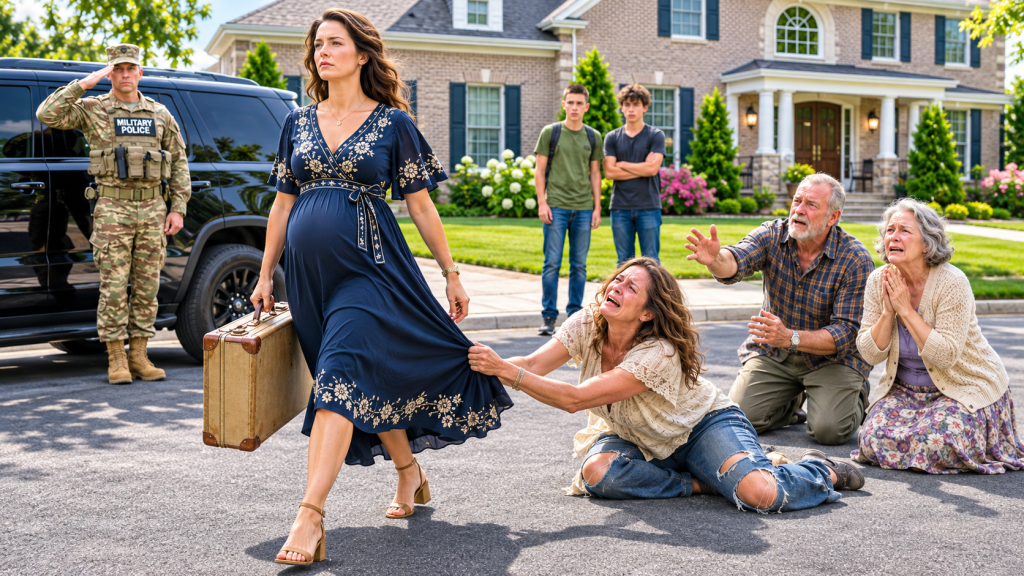
“Ryan?” He swallowed. “This is ridiculous.” His voice sounded strained. “Nobody stole anything.” I felt my daughter move beneath my ribs. A strong little kick. I rested one hand on my stomach. “Then why has someone submitted Daniel’s research as property belonging to your company?” Ryan looked toward the SUVs. “That isn’t what happened.” Colonel Hayes didn’t move. He simply said, “Mr. Whitmore, nobody here is asking you to explain classified technical information. Mrs. Carter is asking about personal property and documents associated with her husband’s work.”
Ryan’s eyes darted toward my father.
It was a tiny movement.
Barely noticeable.
But I saw it.
So did Chloe.
She turned sharply.
“Dad?”
My father stared at the concrete driveway.
And in that moment, I understood that whatever Ryan had done, he hadn’t necessarily done it alone.
The Thanksgiving morning air was bitterly cold.
I was seven months pregnant, wearing two sweaters beneath my coat, and standing outside a garage where my family had expected me to sleep on a rusted folding cot.
A few hours earlier, I had thought the worst humiliation of my life was being told to leave my bedroom because Ryan needed a private office.
Now I was looking at a possible attempt to take ownership of the technology I’d spent nine months developing.
Technology inspired by the work of my husband, Daniel Carter.
A Marine who had died during an operation where a catastrophic communications failure had contributed to the loss of several lives.
Daniel had believed that better communications could improve the chances of bringing service members home.
Before his death, he’d spent years studying the problem.
He kept notebooks filled with ideas, diagrams, questions, and observations.
After I lost him, those notebooks became some of my most precious possessions.
For weeks, I could barely bear to touch them.
The handwriting hurt too much.
The little arrows he drew between thoughts.
The dates he scribbled in the margins.
The notes that began with phrases like, Ask someone smarter than me about this.
Then one night, when grief had made sleep impossible, I opened the first notebook.
And discovered a question that changed my life.
What if the communication network could recognize a failing connection and maintain a safe, authorized alternative before the team became isolated?
I was a software engineer.
I understood what he was imagining.
I also understood how much work would be required to turn that idea into something practical, reliable, and suitable for responsible testing.
Daniel’s notebooks weren’t finished designs.
They weren’t a defense contract.
They weren’t proof that he had invented every part of the system.
They were the beginning of a vision.
And I had spent nine months building on that vision with engineers, researchers, security specialists, and legal advisers.
Now Project Orion had been acquired by Stratix Defense Systems.
The agreement was worth eighteen million six hundred thousand dollars in its stated combination of payments and equity compensation, subject to the contract’s conditions.
It was more money than I’d ever imagined earning.
But standing in that driveway, I wasn’t thinking about the money.
I was thinking about Daniel’s handwriting.
And the possibility that someone inside my own family had tried to profit from it.
Evelyn Shaw remained on the secure phone connection.
“Mrs. Carter, are you still there?”
“Yes.”
I steadied my voice.
“Tell me exactly what you’ve found.”
Evelyn was Stratix’s general counsel.
She was careful, precise, and not easily rattled.
I’d worked with her during the acquisition review.
She’d spent weeks examining intellectual-property records, ownership documentation, software contributions, and the rights associated with Daniel’s original materials.
If she sounded concerned, I knew there was a reason.
“A third party submitted a purported assignment of rights involving Project Orion,” she said. “The company is registered under the name Whitmore Strategic Innovations.”
My stomach tightened.
Ryan’s surname was Whitmore.
Chloe glanced at her husband.
He stared at the driveway.
Evelyn continued.
“The submission includes an electronic signature attributed to you, along with copies of research notebooks described as company-owned technical assets.”
I swallowed.
“I never signed an assignment to Ryan.”
“I understand.”
“Has anything been transferred?”
“Not on the records we’ve verified. We flagged the claim during our final review because it conflicts with your documented ownership and development history.”
I closed my eyes.
Relief washed through me.
Not because the situation was harmless.
Because someone had noticed before the dispute could disrupt the transaction further.
Evelyn continued.
“We need to preserve the records, notify the appropriate parties, and determine how these materials were obtained. I recommend that you make no statements about the underlying technology to anyone outside the authorized review.”
“Understood.”
Colonel Hayes glanced toward me.
I nodded to show that I’d heard.
Then Evelyn added, “There’s another reason we called.”
My pulse quickened.
“What?”
“The submitted materials include photographs of pages that appear to come from Daniel’s original notebooks.”
I looked toward my father’s office.
“Photographs?”
“Yes.”
“Not scans of documents I gave anyone?”
“Based on the preliminary comparison, they appear to be photographs of physical pages.”
My throat tightened.
I remembered those notebooks.
The dark blue covers.
The corners softened by years of handling.
One had a coffee stain on the back because Daniel had once balanced it beside a mug while we were talking.
I whispered, “I know where they were kept.”
Evelyn paused.
“Then please discuss that with your attorney. Do not confront anyone physically or attempt to recover materials through force.”
I nodded.
“All right.”
The call ended.
For several seconds, nobody spoke.
Then my father finally looked up.
And whispered, “I thought Ryan was helping.”
My name is Amelia Carter.
I’m thirty-two years old.
Nine months before that Thanksgiving morning, I became a widow.
Seven months before it, I learned that the embryo Daniel and I had preserved before his final deployment had resulted in the pregnancy we had dreamed of for years.
And less than twelve hours before Colonel Hayes arrived, I had been told that I no longer deserved a warm bedroom in the house my husband had purchased for my parents.
I’d spent those months trying to survive grief while preparing to become a mother.
I hadn’t realized that the people closest to me were watching my life with an entirely different calculation.
They believed Daniel’s death had left me helpless.
They thought I had no meaningful income.
They assumed the hours I spent working on my laptop were simply a distraction.
And because I’d rarely argued with them, they mistook my silence for weakness.
But silence had become the only way I could finish something important without enduring their ridicule.
Now the quiet work was finished.
And everything they’d assumed about me was falling apart.
“Dad,” I said, “what did Ryan ask you to do?”
My father looked toward Chloe.
She folded her arms.
“Nobody needs to answer questions in the driveway.”
I turned toward her.
“Chloe, someone used my name on documents I never approved.”
She looked away.
I continued.
“And those documents appear to include Daniel’s notebooks.”
Ryan stepped forward.
“Amelia, you’re misunderstanding the situation.”
I looked directly at him.
“Then explain it.”
He swallowed.
“I’ve been speaking with people in the defense technology industry.”
I waited.
“Contacts who might help commercialize the research.”
I felt my hands turn cold.
“Without telling me?”
He looked irritated.
“You’ve been sitting on something valuable for months.”
I stared at him.
“Sitting on it?”
His cheeks reddened.
“You know what I mean.”
“No,” I said. “I don’t.”
I took a breath.
“I spent nine months working with qualified specialists, establishing ownership, developing software, and completing security and legal reviews.”
Ryan’s mouth tightened.
I continued.
“Exactly what part of that would you call sitting around?”
He looked toward Colonel Hayes.
“Look, this is a family business matter.”
The colonel’s expression remained unreadable.
“Then it’s best handled by the family’s legal representatives,” he answered.
Ryan went quiet.
I looked toward Dad.
“Did you give him Daniel’s notebooks?”
My father swallowed.
“I showed him a box.”
My heart tightened.
“What box?”
“The one you left in my study after the funeral.”
I closed my eyes.
That box had contained old photographs, Daniel’s personal letters, and three early research notebooks.
I’d moved the later development records to secure storage months earlier.
But I’d left the original notebooks at my parents’ house because I thought they were safe there.
I whispered, “Why?”
Dad’s voice shook.
“Ryan said he wanted to understand what you were doing.”
I looked at him.
“And you let him?”
He nodded.
“He said he knew people who could help.”
My throat tightened.
“Dad, you spent months telling me my project was imaginary.”
He looked down.
I continued.
“Why were you willing to show my husband’s private research to someone who never asked my permission?”
My father couldn’t answer.
And I realized something heartbreaking.
He hadn’t respected my work enough to ask me what it was.
But he’d respected Ryan’s confidence enough to hand him Daniel’s notebooks.
Chloe suddenly turned toward her husband.
“Ryan, tell me you didn’t take anything.”
He looked annoyed.
“I didn’t steal anything.”
I watched him carefully.
“Did you photograph the notebooks?”
He hesitated.
“I reviewed them.”
“Did you photograph them?”
He looked toward the road.
“Some pages.”
Chloe gasped.
“Ryan!”
He snapped, “I was exploring opportunities!”
I felt something inside me go still.
There it was.
Not an innocent misunderstanding.
Not a harmless conversation.
He had photographed Daniel’s notebooks without my permission and attempted to present the resulting materials as assets connected to his own company.
I took a slow breath.
“And the electronic signature?”
His face hardened.
“That was a preliminary document.”
“Did I sign it?”
He said nothing.
“Ryan.”
He rubbed his jaw.
“The system generated a signature block.”
I stared at him.
“Did you authorize that block to represent my approval?”
His expression changed.
I took another breath.
“Because I never gave you permission.”
He looked away.
Then muttered, “You’re making this sound worse than it is.”
For a moment, I almost laughed.
My entire family had spent months telling me I was dramatic.
Too emotional.
Too sensitive.
Too consumed by grief.
Now Ryan was attempting to reduce a potentially serious unauthorized intellectual-property claim to a minor paperwork issue.
I looked at Colonel Hayes.
“I’d like to leave now.”
He nodded.
“Of course, Mrs. Carter.”
Then he glanced at the garage.
“And I’d like to make sure you’re transported somewhere warm and comfortable.”
My throat tightened.
“Thank you.”
He spoke gently.
“Daniel would have wanted you and the baby cared for.”
For the first time that morning, I began to cry.
Colonel Hayes had known Daniel for years.
He’d attended our wedding.
He’d been at the hospital when I received the official notification of Daniel’s death.
And he’d stood beside me at the military funeral, his face rigid with grief.
During the months that followed, he’d checked on me occasionally.
He never demanded that I stop crying.
Never suggested I should be over Daniel.
Never treated my pain as an inconvenience.
When I began working on Orion, he helped me find the appropriate professional contacts for reviewing ideas that might have defense applications, while reminding me to respect security, contracting, and intellectual-property requirements.
His role wasn’t to hand me a government contract.
He couldn’t do that.
The acquisition was a commercial agreement with Stratix, subject to its own reviews and conditions.
But he believed in the reason I was working.
Because he’d seen what failed communication could cost.
Now he stood beside the rusted cot where I’d spent the night.
For a long moment, he said nothing.
Then he turned toward my parents.
“Did you know she was sleeping here?”
Mom began crying.
“It was only supposed to be temporary.”
The colonel looked at the stained blanket.
Then at the unheated concrete walls.
“She’s seven months pregnant.”
Dad stared at his shoes.
Ryan looked irritated.
Chloe clutched her little dog.
Nobody answered.
Colonel Hayes took a slow breath.
Then turned back to me.
“Amelia, would you like help collecting any essential belongings?”
I nodded.
“My medical bag and a few things upstairs.”
“All right.”
He looked toward one of the accompanying personnel.
“Please help with the luggage if Mrs. Carter wishes.”
Then he faced my family again.
“She doesn’t need to explain her departure. She’s asked to leave, and we’re going to help her do that.”
His voice wasn’t threatening.
It didn’t need to be.
For the first time, someone had recognized that I deserved care without asking whether I’d earned it.
Mom followed me toward the house.
“Amelia, please.”
I stopped beside the front steps.
She was wearing the same pale blue bathrobe she’d worn when she told me Ryan’s need for privacy was more important than my comfort.
Her eyes were wet.
“Sweetheart, we didn’t know about your contract.”
I looked at her.
The words landed like another insult.
“You didn’t know I was successful,” I said.
She flinched.
I continued.
“But you knew I was pregnant.”
Her mouth opened.
Nothing came out.
“You knew I had lost Daniel.”
Tears slipped down her cheeks.
“You knew the garage was cold.”
She began crying harder.
“And none of those things were enough to make you care.”
“Amelia—”
I shook my head.
“Would you have given me my bedroom back if those SUVs hadn’t arrived?”
She stared at me.
For a moment, I wanted her to say yes.
I wanted to hear that my mother had been about to knock on the garage door with a blanket, apologize, and tell me to come inside.
But she couldn’t say it.
And her silence answered the question.
I walked past her.
Upstairs, my bedroom looked exactly as I’d left it.
Except Ryan’s laptop was sitting on my desk.
His expensive briefcase rested beside the window.
And a stack of printed reports had been placed on top of Daniel’s framed photograph.
I stared at the picture.
It had been taken six months before his death.
Daniel stood on a windswept beach, smiling as though the entire world belonged to him.
His hair was longer than regulations usually allowed because he was on leave.
One arm rested around my shoulders.
I was laughing at something he’d said.
I couldn’t remember the joke anymore.
That detail hurt.
I could remember the shape of his hand.
The warmth of his kiss.
The sound of his boots coming through the front door.
But I couldn’t remember every word he’d spoken.
Grief had taught me that losing someone wasn’t one loss.
It was a thousand small losses, arriving at unexpected moments.
I picked up the photograph.
Then moved Ryan’s papers away.
My husband’s picture didn’t belong beneath another man’s business plans.
I placed it carefully inside my suitcase.
Beside the dog tags.
Beside the tiny knitted blanket I’d bought for our daughter.
Then I opened the dresser and collected a few more belongings.
Mom stood in the doorway.
“Where will you go?”
I looked at her.
“Somewhere safe.”
She began crying.
“But this is your home.”
I closed the suitcase.
“No, Mom.”
I looked around the room.
“This was a place where I hoped I could recover from losing my husband.”
My voice broke.
“But you never let me grieve without making me feel guilty for it.”
She covered her mouth.
I swallowed.
“I don’t want our daughter growing up believing she has to earn a warm bed by being useful.”
Mom began sobbing.
I picked up the suitcase.
“And I don’t want her learning that women should accept cruelty because it comes from family.”
I walked toward the door.
For once, my mother stepped aside.
Downstairs, Dad was waiting beside the kitchen.
He looked older than he had an hour earlier.
“Amelia.”
I stopped.
He held out a small cardboard box.
My breath caught.
Daniel’s notebooks.
All three.
The dark blue covers were familiar.
So was the coffee stain on the last one.
I reached for them.
But before I touched the box, I looked at Dad.
“Have these been outside the house?”
He shook his head.
“Not that I know of.”
“Did Ryan make copies?”
Dad lowered his eyes.
“He took pictures.”
I nodded.
“Did anyone else see them?”
He hesitated.
“I don’t know.”
I took a breath.
“Then Rebecca and Evelyn will need to establish what happened.”
Dad frowned.
“Who’s Rebecca?”
“My personal attorney.”
His expression changed.
“You hired a lawyer?”
I stared at him.
“Dad, someone is claiming rights to technology I developed and using my signature without permission.”
He looked away.
I continued.
“What did you expect me to do?”
He whispered, “I thought we could solve this as a family.”
I felt a familiar ache.
For months, I’d begged my family to treat me kindly.
Now that the consequences might affect them, they wanted family unity.
I looked at the notebooks.
“Daniel was family too.”
Dad swallowed.
I continued.
“He paid for this house. He helped with your medical bills. He supported Chloe through law school.”
My voice trembled.
“And when he died, you acted as though his sacrifices had disappeared with him.”
Dad began crying.
I took the box.
Then said quietly, “You don’t get to call this a family matter only when you need protection from the consequences.”
Outside, Chloe stood beside Ryan.
They were arguing.
I could hear her voice before I reached the porch.
“You told me you were applying for a consulting position!”
Ryan shook his head.
“I was trying to build something!”
“Using Amelia’s work?”
He glanced toward me.
“She wasn’t doing anything with it when I started.”
I stopped walking.
That statement told me more than he intended.
“Ryan,” I said, “when did you start?”
He froze.
Chloe turned.
“Answer her.”
He clenched his jaw.
“Months ago.”
My stomach tightened.
“How many months?”
He looked away.
“Five.”
I stared at him.
Five months.
That meant he’d started investigating Daniel’s notebooks while I was still struggling through the early months of pregnancy.
While I was attending medical appointments alone.
While I was working late into the night because grief wouldn’t let me sleep.
I took a breath.
“Did you know I was developing Orion?”
He shrugged.
“You were always talking about some software project.”
I stared at him.
“You never asked to see it.”
“I didn’t think you’d gotten very far.”
My voice became very quiet.
“Yet you thought the notebooks were valuable enough to show potential business partners.”
He said nothing.
I nodded slowly.
“And you thought my signature would make the opportunity more convincing.”
His eyes shifted toward Chloe.
She stared at him.
“Ryan, did you use Amelia’s name?”
He snapped, “It was a letter of intent!”
“Did she agree to it?”
He went silent.
For the first time, my sister looked genuinely frightened.
Not by the SUVs.
Not by the contract value.
But by the possibility that the man she’d defended had been deceiving her.
Colonel Hayes approached.
“Mrs. Carter, transportation is ready.”
I nodded.
Then looked at Chloe.
She was standing very still.
Her expensive silk pajamas looked absurd in the cold November wind.
For a moment, I remembered when we were children.
She used to crawl into my bed during thunderstorms.
I would hold her hand until she fell asleep.
I helped with homework.
Defended her when classmates were unkind.
Told her she could do anything.
Somewhere along the way, she’d begun believing that my role as her older sister meant I was supposed to keep giving without expecting anything in return.
I looked at her.
“Chloe, I hope you find out the truth.”
Her eyes filled.
“Amelia—”
“But you need to understand something.”
She swallowed.
“I don’t owe you access to Daniel’s work, my company, or my money.”
Her face reddened.
I continued.
“And I don’t owe your husband my bedroom.”
She began crying.
I turned toward the SUV.
Then Ryan shouted, “You think you’re better than us now?”
I stopped.
For a moment, the driveway fell silent.
I turned slowly.
“No, Ryan.”
My voice was steady.
“I thought I deserved a little kindness before any of this happened.”
He stared.
“And I still believe that.”
Then I walked away.
The inside of the SUV was warm.
That alone nearly made me cry.
A soft blanket had been folded across the seat.
A bottle of water waited beside me.
Colonel Hayes sat in front while another member of the team handled the driving.
The vehicles had arrived as part of a coordinated business visit to the Stratix facility, with the company handling the approved transportation arrangements.
Some of the accompanying personnel were there for official liaison or event duties; others were part of the company’s security and transport arrangements.
It wasn’t a military operation against my family.
Nobody was arresting anyone.
Nobody was using government authority to settle a private dispute.
The difference mattered to me.
Daniel had believed service meant responsibility.
He would have hated seeing his uniform used as a threat.
As the vehicles pulled away, I looked back through the window.
Mom stood on the porch.
Dad beside her.
Chloe near the steps.
Ryan farther away, staring at his phone.
For a moment, I felt the familiar temptation to turn around.
To explain.
To comfort them.
To make everything easier.
Then my daughter kicked.
I rested my palm against my stomach.
And whispered, “We’re going to be okay.”
The first place we went wasn’t the Stratix facility.
It was a medical clinic.
Colonel Hayes had noticed how pale I looked and asked whether I’d been feeling well.
I admitted that I’d spent the night shivering and had experienced worsening back discomfort.
He insisted on helping me arrange a medical assessment before the scheduled business meetings.
The clinician asked about my symptoms and pregnancy.
She checked me carefully, evaluated the baby’s condition, and gave me guidance about rest and warning signs that would require urgent care.
Fortunately, there was no indication of an immediate obstetric emergency.
But she made it clear that sleeping in an unheated garage while heavily pregnant was not an acceptable recovery environment.
I lay on the examination bed, listening to my daughter’s heartbeat.
Fast.
Steady.
Beautiful.
Tears slipped down my cheeks.
For months, I’d been afraid something would happen to her.
Afraid I wouldn’t be enough without Daniel.
Afraid that loving her as fiercely as I did couldn’t make up for the father she’d never meet.
The clinician handed me a tissue.
“She’s doing well right now.”
I nodded.
Then whispered, “Thank you.”
For the first time that morning, I believed we might truly be safe.
By late afternoon, I was settled into a comfortable apartment Stratix had arranged as temporary housing during the transition to my new position.
It had two bedrooms.
A small kitchen.
A living room with wide windows.
And heat.
Actual, reliable heat.
I stood beside the thermostat and stared at it.
Twenty-four hours earlier, I’d been lying on a rusted cot, trying to make a thin blanket cover my swollen stomach.
Now I was in a warm apartment with my husband’s dog tags resting on a bedside table.
The contrast was so overwhelming that I began crying.
Not because of the luxury.
There was nothing extravagant about the apartment.
It was clean, quiet, and comfortable.
I cried because nobody had demanded that I earn the right to rest.
A knock sounded at the door.
Colonel Hayes stood outside with two grocery bags.
“I thought you might need something to eat.”
I stared at him.
He held up a loaf of bread.
“Nothing complicated. Soup, fruit, and enough supplies to get through tomorrow.”
I smiled through my tears.
“Colonel, you didn’t have to do that.”
He looked at me.
“Amelia, you’ve had a difficult day.”
My throat tightened.
He continued.
“And Daniel would never forgive me if I let you start your first evening here with an empty refrigerator.”
I laughed.
Then began crying again.
He set the bags on the counter.
For a moment, he looked toward the dog tags.
His expression changed.
“I miss him too.”
I stared at him.
I’d been surrounded by people who wanted me to stop talking about Daniel.
Now someone was admitting he still grieved him.
I whispered, “Sometimes I feel like I’m the only person who remembers.”
Colonel Hayes shook his head.
“You’re not.”
He took a slow breath.
“Not a day goes by that somebody from his unit doesn’t think about him.”
I covered my mouth.
Then he said something that stayed with me.
“Daniel’s life was more than the way it ended.”
I nodded through my tears.
“Yes.”
“And what you’re doing with Orion means his ideas may continue helping people. But you don’t have to carry his entire legacy alone.”
I began sobbing.
For the first time in nine months, someone had given me permission to be both proud and exhausted.
Both hopeful and devastated.
A grieving wife.
And a woman building something new.
The following Monday, I met Evelyn Shaw in person.
She was waiting in a conference room with two intellectual-property attorneys and a senior engineer who had worked on Orion’s review.
There were no cameras.
No celebration.
No dramatic announcement.
Just professionals examining a complicated problem.
Evelyn began by explaining what the submitted paperwork did and didn’t establish.
“A purported assignment doesn’t automatically make someone the owner of your intellectual property,” she said.
I nodded.
“But it can create disputes?”
“Yes. Especially if another party relies on it or submits it in connection with a financing or licensing transaction.”
She opened a folder.
“We’re reviewing the source of the electronic signature, the circumstances in which the notebooks were copied, and any representations Whitmore Strategic Innovations made to third parties.”
My hands tightened.
“Could this affect the acquisition?”
Evelyn looked at me.
“It may require additional verification and documentation. But the agreement was approved based on the rights and development history already examined. We’re not going to assume a third party’s unsupported claim is valid.”
I exhaled.
She continued.
“We also need to distinguish Daniel’s personal research from anything that may have been created within his official duties and from the software you and your team developed afterward.”
I nodded.
That distinction had been central to our negotiations from the beginning.
Daniel had worked in an environment where information rights, confidentiality, and security restrictions mattered.
His notebooks had helped inspire Orion.
But the platform I developed had to stand on independently documented engineering work, lawful contributions, and properly cleared information.
We had spent months establishing that history.
I wasn’t going to abandon those standards now.
Evelyn looked at me.
“Amelia, we can protect your rights without rushing to accuse someone of crimes before the evidence is complete.”
I took a breath.
“That’s what I want.”
She nodded.
Then added, “There’s something else you should see.”
She handed me a page.
At the top was a date.
Five months earlier.
The same period Ryan claimed he’d begun exploring opportunities.
The document appeared to describe a consulting arrangement between Whitmore Strategic Innovations and an intermediary named Calvin Mercer.
I frowned.
“Who is Calvin Mercer?”
Evelyn paused.
“That’s what we’re trying to establish.”
Under the agreement was a description of proposed services.
Identification and commercialization of proprietary military communications research.
I stared.
Then I noticed the fee.
Eight hundred thousand dollars.
Not paid.
Not necessarily owed.
But proposed as compensation if Ryan’s company succeeded in securing certain technology rights.
My stomach turned.
Ryan hadn’t simply been curious about Daniel’s notebooks.
He had been trying to make a business out of them.
And he’d apparently expected to receive an enormous payment if he could convince someone he controlled the rights.
That evening, Chloe called.
I almost ignored her.
Then I answered.
“Amelia?”
Her voice was trembling.
“Hello, Chloe.”
She began crying immediately.
“I’m sorry.”
I closed my eyes.
I didn’t speak.
She continued.
“I didn’t know about the documents.”
I took a breath.
“Did you know Ryan was trying to sell access to Daniel’s research?”
She hesitated.
“I knew he was speaking with people about a consulting opportunity.”
I looked toward the window.
“Did you tell him where the notebooks were?”
Silence.
My chest tightened.
“Chloe.”
Her voice broke.
“Yes.”
I closed my eyes.
For several seconds, I couldn’t breathe.
My sister continued.
“I told him Dad had some of Daniel’s old things in his office.”
I stared at the wall.
“He said he wanted to see whether Daniel had left anything commercially useful.”
My throat tightened.
“And you thought that was acceptable?”
She began sobbing.
“I thought if he found something valuable, maybe he could help you.”
I shook my head.
“Chloe, you told me to sleep in a freezing garage because he needed an office.”
She cried harder.
“I know.”
I swallowed.
“You mocked me for spending time on my computer. You said I was wasting my life.”
Her voice broke.
“I know.”
“And now you’re telling me you thought your husband was trying to help me?”
She couldn’t answer.
I closed my eyes.
For a long time, I’d loved my sister so fiercely that I made excuses for her.
But that evening, I was tired of inventing kind explanations for unkind behavior.
“Chloe,” I said quietly, “I need some space.”
She sniffled.
“Please don’t cut me off.”
I looked toward Daniel’s photograph.
“I need to know that I can trust the people around me.”
She began crying again.
“And right now, I don’t trust you.”
Then I ended the call.
The next surprise came from a place I hadn’t expected.
A letter.
Not from Ryan.
Not from Chloe.
Not from my parents.
From Daniel.
Colonel Hayes called me late one afternoon, about ten days after Thanksgiving.
“Amelia, do you have a moment?”
“Of course.”
He hesitated.
“I’ve been speaking with someone who served with Daniel. He recently found a personal letter Daniel left in a packet of belongings during his final deployment.”
My heart stopped.
“A letter?”
“Addressed to you.”
I gripped the phone.
“Why am I only hearing about it now?”
“The packet was among personal effects that required sorting and verification. It wasn’t part of his official records, and the person who found it wanted to make certain it reached the right place.”
I closed my eyes.
“Can I have it?”
“Yes.”
My voice broke.
“Please.”
The envelope arrived two days later.
My name was written across the front.
Amelia.
Daniel’s handwriting.
I sat on the edge of my bed, staring at it.
For a long time, I couldn’t bring myself to open it.
I’d spent nine months wishing for one more conversation.
One more embrace.
One more chance to hear him say he’d be home soon.
Now I was holding words he’d written before his death.
Words he never expected would become his final message.
I opened the envelope carefully.
Inside were two pages.
My beautiful Amelia,
If you’re reading this, either I’ve finally remembered to mail it, or one of the guys has gotten tired of me carrying it around.
I laughed through my tears.
That sounded exactly like Daniel.
He continued.
I know you’ve been worried about our decision to preserve embryos before this deployment.
I know we can’t control what happens next.
But I want you to understand something.
Whatever the future brings, you have already given me more love than I knew a person could receive.
My hands began trembling.
I think about the children we might have someday.
I imagine a little girl with your eyes, running through the house while you try to convince me not to teach her how to climb everything.
I began sobbing.
Our daughter.
He’d imagined a daughter.
He couldn’t possibly have known that months after his death, one of our preserved embryos would become the little girl now moving beneath my heart.
I pressed the letter against my chest.
Then kept reading.
If we have a daughter, I hope she’s brave like you.
Not the kind of brave that never cries.
The kind that keeps loving even when life becomes difficult.
I hope she knows that being strong doesn’t mean accepting less kindness than she deserves.
Tears blurred the page.
And Amelia, promise me something.
Don’t spend your life making yourself smaller so other people feel comfortable.
I covered my mouth.
For months, my family had done exactly that.
Made me feel small.
Unimportant.
Unreasonable for needing a warm bedroom.
Daniel’s words continued.
You are the smartest person I know.
If anyone ever makes you doubt that, remember that I was lucky enough to be loved by you.
And about those communication ideas we keep talking about—maybe one day we’ll build something useful together.
But even if we never do, you’ve already made my life extraordinary.
Love always,
Daniel.
I read the final line again.
Then again.
For a long time, I sat alone, crying.
Not because the letter erased my grief.
Because it reminded me that the life we’d shared had been real.
And that the love Daniel gave me didn’t disappear when he died.
As the weeks passed, the investigation into Ryan’s documents became clearer.
The electronic signature attributed to me had been generated through an account associated with his company.
Records indicated that Ryan had presented materials to Calvin Mercer as though Whitmore Strategic Innovations possessed rights it had not established.
Further review of the messages showed that Ryan had been told to provide proof of ownership before any binding transaction could proceed.
Instead of obtaining my authorization, he’d produced paperwork suggesting it already existed.
He maintained that the documents were preliminary and that he never intended to complete a transfer without speaking to me.
His explanation didn’t change the fact that he’d used my name without permission.
The matter was addressed through counsel and the appropriate formal channels.
No valid transfer of Orion’s rights to Ryan’s company was established.
The purported assignment was rejected, and the third parties involved were notified that they couldn’t rely on it.
There were still consequences for Ryan.
His proposed consulting opportunity collapsed.
He incurred significant legal expenses.
And the professional relationships he’d hoped to establish were damaged by the discrepancies in his representations.
But I didn’t celebrate his difficulties.
I simply wanted Daniel’s work, my own contributions, and the rights of everyone involved to be respected.
I wanted to move forward without another family member treating my life as something available for their use.
Project Orion’s acquisition proceeded after additional verification and contractual steps.
The eighteen-million-six-hundred-thousand-dollar headline value wasn’t a suitcase of cash.
Some compensation was payable according to the acquisition terms.
Some consisted of equity.
Other amounts depended on milestones, performance, and the continuing requirements of the agreement.
My personal taxes and financial planning would also matter.
I understood all of that.
The contract changed my financial future, but it didn’t erase the responsibility that came with managing it.
I worked with independent financial advisers to establish a long-term plan for myself and my daughter.
I also accepted the Chief Technology Officer position at Stratix.
That role frightened me more than I admitted.
I’d led technical projects before.
But I had never imagined managing technology development for a company operating at that scale.
At my first leadership meeting, I sat at the head of a conference table surrounded by engineers and executives.
For a moment, I thought about my family mocking me for working on my laptop.
Then I opened my presentation.
And began explaining our development priorities.
Not as Daniel’s widow.
Not as the pregnant woman who’d been forced into a garage.
As Amelia Carter.
An engineer.
A founder.
A leader who had earned the right to be in the room.
The most emotional day came when we held a small remembrance gathering for Daniel and the other service members lost during the operation.
The event wasn’t a celebration of Orion’s commercial value.
It was an acknowledgment of the people whose lives had inspired our work.
Several families attended.
Colonel Hayes spoke briefly.
He reminded everyone that technology alone couldn’t eliminate the risks of military service.
But he expressed hope that responsible advances could improve communication and reduce preventable failures.
I stood near the back of the room with my hand resting on my stomach.
Then the mother of one of Daniel’s fallen teammates approached.
Her name was Patricia.
She’d lost her son, Andrew, in the same operation.
I recognized her from the memorial service.
For a moment, neither of us spoke.
Then she took my hand.
“Amelia, I heard about what you’ve been working on.”
My throat tightened.
I nodded.
She looked toward Daniel’s photograph.
“Andrew used to talk about your husband.”
My eyes filled.
“He said Daniel never stopped looking for a better way to do things.”
I began crying.
Patricia squeezed my hand.
“I know nothing can bring our boys back.”
I nodded.
She continued.
“But if something they learned can help another family avoid receiving that terrible knock on the door, I think they would be proud.”
I covered my mouth.
For months, I’d felt as though I were carrying Daniel’s unfinished dream alone.
Now I realized I wasn’t.
There were other families.
Other memories.
Other people who wanted those losses to mean more than a date on a memorial.
I hugged Patricia.
And whispered, “I’ll do everything I can.”
My parents contacted me several times during those months.
At first, their messages were filled with confusion.
They asked where I was living.
Whether I was really a company executive.
Whether the contract was worth as much as they’d heard.
Then the tone shifted.
Mom began apologizing for the garage.
Dad admitted that he should never have shown Daniel’s notebooks to Ryan.
I listened.
But I didn’t immediately invite them back into my life.
I had spent too many years accepting small apologies followed by the same old behavior.
This time, I needed more than words.
I needed to see whether they could respect me when they weren’t receiving anything from me.
One afternoon, Dad called.
“Amelia?”
“Hello, Dad.”
His voice was quiet.
“I’ve been thinking about Thanksgiving.”
I looked toward the window.
“All right.”
He swallowed.
“I can’t stop seeing that cot.”
My throat tightened.
He continued.
“I walked past it the night before. I knew how cold the garage was.”
I closed my eyes.
“And I did nothing.”
For several seconds, neither of us spoke.
Then he whispered, “I was wrong.”
I took a breath.
“Yes, Dad.”
His voice broke.
“I spent months telling myself you needed to stop grieving and become useful again.”
Tears gathered.
“But your husband had just died. And you were carrying his baby.”
I wiped my eyes.
He continued.
“I should have been helping you.”
I looked down.
“I needed you.”
He began crying.
“I know.”
My voice trembled.
“Not because I was successful. Not because I had money. Because I was your daughter.”
Dad sobbed.
“I know, sweetheart.”
I closed my eyes.
For a moment, I wanted to forgive everything.
To pretend the garage had never happened.
To make the pain disappear.
But healing wasn’t the same as forgetting.
“Dad,” I whispered, “I hope we can build a better relationship someday.”
He took a shaky breath.
“Me too.”
“But it will take time.”
“I understand.”
I looked at Daniel’s photograph.
“And I need you to respect that.”
He nodded, though he couldn’t see me.
“I will.”
Chloe’s apology came later.
She and Ryan had separated while they addressed their marriage and the consequences of his business decisions.
She didn’t ask me for money.
Didn’t ask me to fix the legal problems.
Didn’t request a job at Stratix.
Instead, she sent a letter.
Amelia,
I treated your grief like an inconvenience because I didn’t want to make room for it.
I told myself Ryan’s work mattered more than yours because I was jealous of how determined you were, even when you were hurting.
Then I found out what you’d accomplished, and I realized how little I actually knew about my own sister.
I don’t expect you to forgive me because you’re successful.
I hope someday you’ll forgive me because I finally understand how cruel I was.
I read the letter twice.
Then placed it beside Daniel’s.
I wasn’t ready to invite Chloe into my home.
But I sent a brief reply.
Thank you for acknowledging what happened. I hope you continue taking responsibility for your own choices.
It was a small step.
And small steps were all I was willing to take.
My daughter arrived on a rainy February morning.
Her name was Eleanor Grace Carter.
Eleanor, because Daniel had once told me that if we had a daughter, he wanted her to have a name that sounded strong and gentle at the same time.
Grace, because I believed we’d been given something precious after a season of terrible loss.
I held her against my chest while the hospital room glowed with soft morning light.
She had tiny fingers.
Dark hair.
And the most beautiful little mouth I’d ever seen.
When she opened her eyes, I began crying.
“Hello, sweetheart.”
Her hand moved against my skin.
I kissed her forehead.
“I’m your mommy.”
For a moment, I thought about Daniel.
How desperately he’d wanted to be a father.
How he’d imagined teaching our children to swim, build things, and ask questions.
I looked at Eleanor.
Then whispered, “Your daddy loved you before he ever met you.”
My tears fell onto the blanket.
“But I’m going to tell you all about him.”
Colonel Hayes visited later that afternoon.
He brought a small stuffed bear wearing a miniature Marine Corps T-shirt.
When he entered the room, he stopped beside the bed.
For a moment, he couldn’t speak.
Then he looked at Eleanor.
His eyes filled.
“Well,” he whispered, “hello there.”
I smiled.
“Would you like to hold her?”
He nodded.
I carefully placed her in his arms.
The decorated colonel who had stood beside me on the worst days of my life looked utterly overwhelmed by a newborn weighing less than eight pounds.
Eleanor yawned.
He laughed softly.
“Your father would’ve been completely useless around you.”
I smiled through my tears.
“He would’ve been wonderful.”
Hayes nodded.
“Yes.”
His voice broke.
“He would have.”
For a moment, we stood together in the quiet hospital room, remembering Daniel.
Then Hayes looked at me.
“Amelia, you’ve done something remarkable.”
I shook my head.
“I had help.”
He nodded.
“Good people usually do.”
I smiled.
He continued.
“But don’t forget that you were the one who kept going.”
I looked down at my daughter.
For the first time in a long while, I felt that the life ahead of me might hold more happiness than sorrow.
Not because I would ever stop missing Daniel.
But because love had given me something worth moving toward.
Today, Eleanor is nearly two years old.
She loves picture books, strawberries, and pulling every folded towel out of the laundry basket.
She laughs when I sing badly.
She points toward Daniel’s photograph and says, “Daddy.”
And whenever I show her the little model helicopter he kept on his desk, she reaches for it with both hands.
I tell her stories about him.
About the time he burned pancakes because he was too busy talking.
About how he always stopped to help stranded drivers.
About the way he kissed my forehead whenever I was worried.
I tell her that he was brave.
But I also tell her that bravery isn’t simply wearing a uniform or facing danger.
Sometimes bravery means admitting you’re afraid.
Sometimes it means asking for help.
And sometimes it means walking away from people who refuse to treat you with kindness.
Stratix continues developing Project Orion through its established technical, testing, and approval processes.
There are still challenges.
Difficult engineering questions.
Regulatory requirements.
Long meetings.
Occasional setbacks.
But I’m proud of the work we’re doing.
And every time I see Daniel’s original notebooks safely preserved beside the development records, I remember where it began.
A Marine who wanted better communication for the people serving beside him.
A widow who refused to let his ideas disappear.
And a daughter who finally learned that her worth wasn’t determined by her family’s approval.
My relationship with my parents remains cautious.
We speak occasionally.
They’ve met Eleanor during visits arranged on terms that respect her well-being and my boundaries.
My mother has apologized without asking me to forget.
My father has begun showing genuine interest in my work without suggesting he deserves any part of it.
Chloe and I are rebuilding our relationship slowly.
I haven’t forgotten Thanksgiving.
I don’t intend to.
Some experiences teach lessons we need to remember.
But I no longer spend my days wishing my family could become the people I needed them to be.
I focus instead on the people who have consistently shown up.
Friends.
Colleagues.
The families connected to Daniel’s service.
And the beautiful little girl who calls me Mommy.
Last Thanksgiving, I invited a few close friends to my home.
Colonel Hayes attended.
So did Patricia, Andrew’s mother, and several people who’d helped with Orion.
We cooked together.
Laughed.
Shared stories.
And made room at the table for memories of the people we missed.
Nobody complained that I hadn’t done enough.
Nobody demanded that I surrender my bedroom.
Nobody treated my grief as an inconvenience.
After dinner, I carried Eleanor onto the porch.
The evening air was cool.
She rested her head against my shoulder.
Inside, I could hear laughter.
Warmth spilled from the windows.
I looked toward the stars.
Then touched the dog tags hanging beneath my sweater.
“Daniel,” I whispered, “I wish you could see her.”
Eleanor shifted in my arms.
I kissed her hair.
“She’s wonderful.”
For a moment, I allowed myself to imagine him standing beside us.
His arm around my shoulders.
His familiar smile.
His voice saying we had done all right.
Tears gathered.
But this time, they weren’t only tears of grief.
They were tears of gratitude.
For the life we’d shared.
For the daughter we’d dreamed of.
For the people who’d helped me survive.
And for the strength I’d discovered when everything familiar fell apart.
I often think about the woman I was on that Thanksgiving morning.
Seven months pregnant.
Cold.
Grieving.
Sitting on a filthy folding cot in an unheated garage.
Trying to convince her unborn daughter that everything would be okay.
My family thought I was helpless.
They assumed losing Daniel had left me with nothing.
But they were wrong about what made me valuable.
It wasn’t the eighteen-million-dollar contract.
It wasn’t my position at Stratix.
It wasn’t the black SUVs or the colonel’s salute.
Those things may have changed how my family looked at me.
But they didn’t change who I was.
I deserved kindness before I became wealthy. I deserved respect before I became successful. And I deserved a warm, safe place to sleep simply because I was a human being who needed care.
That’s the lesson I want Eleanor to learn.
Not that money makes people worthy.
Not that success is the best revenge.
But that no one should have to accomplish something extraordinary to receive ordinary compassion.
I looked down at my daughter.
She was nearly asleep.
Her tiny fingers were wrapped around mine.
And I whispered the promise I’d made in the garage nearly two years earlier.
“It’s okay, sweetheart. Mommy’s going to figure this out.”
Only now, I didn’t have to wonder whether I could keep that promise.
We were home.
We were safe.
And we were surrounded by people who loved us without conditions.
I kissed Eleanor’s forehead and carried her inside.
Behind us, the November wind moved through the trees.
Ahead of us waited a warm house, an open table, and a life filled with possibilities.
For the first time since Daniel’s death, I wasn’t merely surviving.
I was living.
And I knew he would have been proud.


