The photograph stayed on my phone screen long after I stopped breathing normally. My mother’s hand. My missing emergency allergy injector. And beneath it, a piece of paper supposedly proving I had surrendered my inheritance. I enlarged the picture until the edges became blurry. The injector was unmistakable. A small scratch ran across its protective case, just below the label. I’d made that scratch three months earlier when I accidentally dropped it against the metal leg of my kitchen table.
I remembered being irritated with myself. Now that tiny mark seemed more important than anything in the photograph. “Fred,” I whispered. He leaned closer. “What?” I pointed toward the reflection in the glass tabletop. “That’s mine.” His expression changed. “Are you certain?” I nodded. “Look at the scratch.” He studied the image. Then closed his eyes. For several seconds, neither of us spoke. Finally, he whispered, “Christy, we need to give this to the investigator.” I nodded.
My hands were shaking so violently that I could barely hold the phone. Across the kitchen, my best friend Kelly stood beside the printer, watching us. She’d spent the morning helping organize the messages my sister Michaela had sent after the baby shower. Now she looked pale. “Christy, sit down.” I shook my head. “I can’t.” Fred gently took my hand. “Please. Something in his voice made me obey. I lowered myself into a chair. Then looked at the photograph again. My mother had spent my entire life telling people how difficult it was to have a daughter with severe allergies.
She called herself careful.
Protective.
A mother who had sacrificed everything to keep me safe.
And now I was looking at evidence suggesting she’d been holding my emergency medication while my sister offered me a dessert containing walnuts.
I pressed my hands against my face.
“Why?”
Nobody answered.
I began crying.
Not because I was frightened of dying.
Although I was.
Not because I’d nearly eaten the tart.
Although the thought made my stomach twist.
I cried because I finally understood that the people I’d spent thirty-four years trusting might have been deliberately turning my vulnerability into a weapon.
And all of it seemed connected to my grandmother’s inheritance.
My name is Christy Danforth.
I’m thirty-four years old, a clinical pharmacist, and someone who has lived with a severe tree nut allergy since childhood.
I know how quickly an allergic reaction can become life-threatening.
I know why prescribed epinephrine auto-injectors must remain accessible.
I know that even a seemingly small exposure can be dangerous.
But professional knowledge doesn’t prepare you for discovering that your own family may have intentionally placed you at risk.
That requires a different kind of understanding.
One I never wanted to develop.
My husband, Fred, had always taken my allergy seriously.
Before we married, he learned how to recognize signs of anaphylaxis and how to use my prescribed emergency medication.
He checked restaurant menus with me.
He understood cross-contact.
And he never made me feel embarrassed for asking whether something was safe.
Once, shortly after our engagement, he said something I still remember.
“Christy, you don’t need to apologize for wanting to stay alive.”
I’d laughed.
At the time, it sounded almost ridiculous.
Now, sitting in our kitchen with a photograph of my mother holding my missing injector, I realized how often I’d been made to feel that protecting myself was inconvenient.
My sister Michaela called me dramatic.
Mom called me overly cautious.
Whenever I questioned an ingredient, somebody rolled their eyes.
Yet they also insisted that nobody knew my condition better than family.
That contradiction had followed me since childhood.
And on the morning after the baby shower, it finally became impossible to ignore.
Kelly pulled out the chair beside me.
“Christy, what do you want to do first?”
I looked up.
Her voice was calm.
Not because she wasn’t frightened.
Because she knew I needed someone who could think clearly while I struggled to breathe through my emotions.
“Call Rachel,” I whispered.
Rachel Donovan was the attorney Fred and I had contacted after Gregory Ashby explained what was happening with my grandmother’s estate.
She’d agreed to represent me independently.
I didn’t want anyone connected to the disputed inheritance making decisions for me.
Gregory had been handling estate matters.
He could provide records and explain the existing proceedings.
But I needed someone whose responsibility was to protect my interests.
Fred made the call.
Rachel answered almost immediately.
After hearing about the photograph, she asked us to preserve the original message, image, metadata where available, and the complete conversation.
She also instructed us not to alter the files or attempt to recover the missing injectors ourselves.
“The investigators need to understand exactly where the evidence came from,” she explained.
I took notes.
Then asked, “Does this prove my mother took them?”
Rachel paused.
“It may be important evidence, especially if the injector can be identified. But we need to be careful about what the image actually establishes.”
I swallowed.
“It shows her holding it.”
“Yes. And that matters.”
I closed my eyes.
She continued.
“But we still need to determine when the photograph was taken, how the injector came into her possession, and what happened afterward.”
I nodded slowly.
I appreciated her caution.
Because I didn’t want to accuse my mother of something based only on anger.
I wanted the truth established.
And whatever that truth turned out to be, I wanted to be certain it couldn’t be dismissed as a family misunderstanding.
That afternoon, we went to Rachel’s office.
Gregory Ashby joined us by video call.
He was a silver-haired attorney in his early sixties, with a patient manner that reminded me of my grandfather.
He’d known my grandmother for nearly twenty years.
Her name was Eleanor Whitfield.
She died the previous spring at eighty-three.
I loved her desperately.
She lived in a little white cottage near a wooded lake, about forty minutes outside Columbus.
The house had a wraparound porch, green shutters, and a garden full of peonies.
When I was a child, she taught me how to plant vegetables.
How to identify birds.
And how to bake apple pie without turning the kitchen into a disaster.
Because of my allergy, she was meticulous about ingredients.
She kept separate utensils for foods she knew were safe for me.
She read labels carefully.
And she never treated my medical needs as something embarrassing.
When I was sixteen, she told me something I didn’t fully understand until years later.
“Christy, people who love you should want you safe, even when keeping you safe requires a little extra effort.”
I remembered smiling.
“Grandma, everybody knows that.”
She’d looked at me gently.
“I hope you never have to learn otherwise.”
I thought of those words as Gregory began explaining the inheritance.
“Your grandmother created a trust several years before her death,” he said.
I nodded.
“She told me she’d made arrangements.”
“Yes.”
He looked toward Rachel.
“The trust contains the cottage, certain investment accounts, and other assets.”
My stomach tightened.
“How much?”
Gregory paused.
“The approximate current value of the trust assets is just over two million dollars, subject to expenses, taxes, and market changes.”
I stared at him.
Two million dollars.
I’d known Grandma was comfortable.
But I’d never imagined she had that much.
Gregory continued.
“Under the governing documents, you’re the principal beneficiary of the trust. The cottage is intended to remain available for your use, and the remaining assets are to be administered according to the trust’s terms.”
I swallowed.
“Why me?”
His expression softened.
“Your grandmother left a personal letter explaining some of her wishes.”
I felt tears gathering.
Then Gregory added something that made my chest tighten.
“Your mother and Michaela were not excluded entirely. Eleanor made separate provisions for them.”
I stared.
“She did?”
“Yes.”
I looked down.
So this wasn’t simply a case of Grandma choosing me and leaving everyone else nothing.
She had provided for all of us.
But the largest part of the estate arrangements involved me.
I took a slow breath.
“And Mom wants control?”
Gregory nodded.
“She has petitioned for authority to manage the trust on the theory that you lack the capacity to handle your affairs.”
I stared at him.
“I’m a pharmacist.”
“I understand.”
“I manage medication safety in a clinical environment.”
“Yes.”
“I pay my bills. I own my home with Fred. I’ve never had a legal finding that I lack capacity.”
Gregory’s expression softened.
“Those facts are relevant.”
I shook my head.
“And their evidence is that I have allergies?”
Rachel leaned forward.
“Christy, an allergy does not establish incapacity. Any legal petition must be evaluated under the applicable standards and supported by appropriate evidence.”
I nodded.
My hands were still trembling.
Then Gregory said, “Unfortunately, the petition contains additional claims.”
I looked up.
“What claims?”
He glanced at his notes.
“That you’ve experienced confusion, impaired judgment, and episodes of emotional instability.”
For a moment, I couldn’t speak.
Then I whispered, “Who said that?”
Gregory’s face tightened.
“Your mother and Michaela.”
Rachel asked Gregory to describe the relevant deadline.
He explained that Friday’s scheduled proceeding involved objections to the pending request and a review of several disputed documents.
It wasn’t a magic moment when my mother automatically acquired control if I failed to appear.
A court would still need to consider the evidence and the applicable legal standards.
But my participation mattered.
And the petitioners had apparently hoped I would be absent.
That possibility made the walnut tart feel even more sinister.
Michaela had insisted I eat it.
My emergency injectors had disappeared.
And my mother had been exchanging messages about keeping me away from Gregory before Friday.
I looked toward Fred.
His jaw was clenched.
Then I asked Gregory something that had been troubling me.
“Why didn’t I receive your messages?”
He hesitated.
“We sent several letters to the address your mother provided.”
I frowned.
“Which address?”
He read it aloud.
My parents’ house.
I stared.
“I haven’t lived there in twelve years.”
Gregory looked deeply troubled.
“Your mother indicated that it was your preferred mailing address for estate correspondence.”
I shook my head.
“No.”
He continued.
“We also attempted telephone contact using a number listed in the earlier file.”
I felt cold.
“What number?”
It was an old number I’d stopped using years earlier.
Gregory sighed.
“That explains some of the difficulty.”
Rachel made a note.
Then looked at him.
“Please provide the contact history and relevant records through the appropriate process.”
He nodded.
“Of course.”
I sat back.
For months, my mother had apparently been receiving or controlling information about an inheritance intended for me.
And when I finally came close to discovering it, she and my sister were connected to a plan involving a dessert they knew could harm me.
The pieces were beginning to fit.
But one question remained.
Why would they go so far?
The answer came when Gregory showed us another document.
It was a preliminary proposal concerning the cottage.
The property was located near land being considered for a private residential development.
A company called Willow Creek Estates had expressed interest in purchasing several nearby parcels.
Including Grandma’s cottage.
I stared at the offer.
The proposed price was considerably higher than the property’s earlier valuation.
“Mom wants to sell it?”
Gregory nodded.
“She has indicated that a sale would be financially prudent.”
I looked down.
Grandma’s cottage.
The garden.
The porch where she used to read.
The little kitchen where she’d taught me how to bake safely.
My throat tightened.
“Grandma wanted me to keep it.”
Gregory looked at me.
“The trust documents contain provisions reflecting her wish that the property remain available to you.”
I swallowed.
“Then Mom can’t simply sell it because she wants the money.”
Rachel answered carefully.
“Anyone exercising authority over trust assets would have fiduciary obligations and would be bound by the governing terms and applicable law.”
I nodded.
Gregory continued.
“Your mother proposed that she and Michaela take over management and consider the sale as part of a larger restructuring.”
I felt sick.
They weren’t merely fighting about who received an inheritance.
They were trying to gain control over a property my grandmother had wanted me to enjoy.
And they were using my medical condition as the reason I supposedly couldn’t make decisions about it myself.
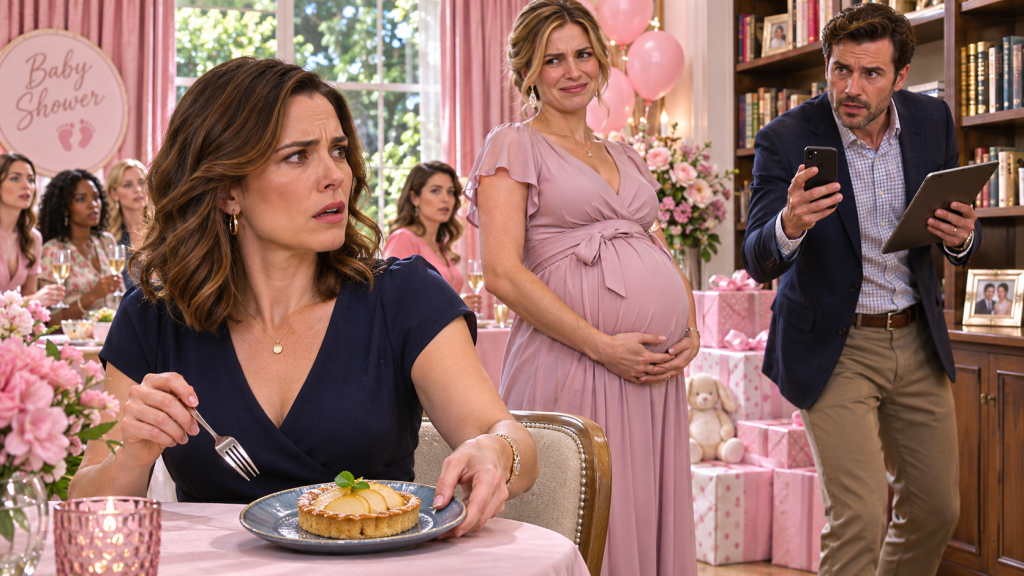
I thought of Michaela’s baby shower.
The pink decorations.
The smiling guests.
The blue ceramic plate.
The tiny paper flag in the tart.
Suddenly, the entire afternoon seemed staged.
I covered my face.
Then whispered, “They wanted to make me look incapable.”
Fred reached for my hand.
I looked at him.
“And they were willing to risk my life to do it.”
No one contradicted me.
But Rachel gently reminded us that proving intent would require evidence beyond the apparent sequence.
I nodded.
She was right.
I could recognize how terrifying the pattern appeared without pretending I already knew every fact.
That evening, I went home and sat on the bedroom floor.
Fred found me holding an old photograph.
It showed Grandma Eleanor standing beside me at my pharmacy school graduation.
She was wearing a lavender jacket.
I was smiling so widely that my cheeks hurt.
On the back, she’d written:
To my brilliant girl. Never let anyone convince you that taking care of yourself is selfish.
Fred sat beside me.
For a while, neither of us spoke.
Then I whispered, “What if she knew?”
He looked at me.
“What?”
“What if Grandma knew Mom and Michaela were doing things like this?”
Fred took a slow breath.
“Maybe she suspected something.”
I stared at the photograph.
The cookie tins.
The missing injector during the camping trip.
The wedding caterer’s changed instructions.
For years, I’d accepted explanations.
Accidents.
Misunderstandings.
Carelessness.
But I was beginning to wonder whether my grandmother had noticed patterns that I refused to see.
I turned toward Fred.
“Do you remember what you asked me before our wedding?”
He nodded slowly.
“How many times the same mistake could happen before it stopped being a mistake.”
I began crying.
He wrapped his arms around me.
“I’m sorry,” I whispered.
He pulled back.
“For what?”
“For not listening.”
His expression softened.
“Christy, you loved your family.”
I looked down.
He continued.
“And trusting people you love isn’t something you need to apologize for.”
I pressed my forehead against his shoulder.
For the first time in days, I let myself cry without trying to understand anything.
I was safe.
But I was grieving something I hadn’t realized could die.
The belief that my mother and sister would never deliberately put me in danger.
Wednesday morning brought the laboratory’s formal report.
The tart contained detectable walnut proteins.
The laboratory documented its methods, findings, and the condition of the sample as received.
Because I’d handled the dessert myself before taking it to the laboratory, Rachel was careful about how the result should be described.
The testing supported the presence of walnut material in the sample.
The messages were additional evidence that Michaela knew about it.
But establishing exactly when and how the walnuts entered the dessert required further investigation.
I understood the distinction.
Still, seeing the words on official paper made my hands shake.
I remembered Michaela standing beside me.
Smiling.
Insisting that the bakery had prepared something special.
I remembered the tiny blue plate.
The way she’d watched my fork.
And her irritated expression when I left without eating.
I placed the report beside her messages.
Then stared at both.
My sister had known what a severe reaction could do to me.
She’d seen it herself.
When I was fourteen, I accidentally ate a dessert containing walnuts at a school event.
Within minutes, I developed severe symptoms and needed emergency treatment.
Michaela was eleven.
She sat beside my hospital bed afterward, crying because she thought I might die.
I remembered holding her hand.
“It’s okay,” I’d whispered.
She promised she’d always help keep me safe.
Twenty years later, that same sister had personally handed me a walnut-containing tart while my emergency medication was missing.
I began crying.
Some promises don’t merely get broken.
They become painful reminders of the person you thought someone was.
Rachel arranged for the laboratory report and relevant messages to be provided to the investigator handling my complaint.
Fred and I gave detailed statements about what we’d observed.
We explained how the iPad notifications appeared, how Fred preserved screenshots, and how I discovered the missing injectors.
We also provided information about the photograph Michaela sent.
The investigator, Detective Marisol Vega, listened carefully.
She was in her early forties, with a composed manner and thoughtful eyes.
When I finished speaking, she asked, “Christy, did anyone else have access to your purse during the shower?”
I considered the question.
“It was hanging in the hallway. Several people passed through.”
She nodded.
“Did you see your mother remove the injectors?”
“No.”
“Did you see Michaela remove them?”
“No.”
I felt frustrated.
“But the messages say where they were hidden.”
Detective Vega nodded.
“That’s important. We’ll examine the original communications and any corroborating evidence.”
She looked at my hands.
They were trembling.
Then she said gently, “You don’t have to prove the entire case in this room.”
My eyes filled.
I looked down.
“We’ll investigate the facts. Your responsibility is to tell us what happened and preserve what you have.”
I nodded.
Then asked, “Should I call my mother?”
“No. I recommend you avoid direct confrontation while we’re establishing the evidence. If she contacts you, preserve the communication and let us know.”
Fred squeezed my hand.
I took a breath.
For years, my instinct whenever something went wrong with my family was to call Mom and ask for an explanation.
Now, for the first time, I was learning that some questions needed to be answered somewhere other than the family dining table.
On Thursday morning, Terrence called.
Michaela’s husband.
Until the baby shower, I’d always liked him.
He was gentle, hardworking, and unusually patient with my sister’s tendency to dominate conversations.
He worked as a project manager for a construction company.
He loved children.
And when Michaela became pregnant after years of fertility treatment, I’d never seen anyone look happier.
But on the afternoon of the shower, Fred had shown him something on the family iPad.
Something that turned his face white.
I’d been too overwhelmed to ask what happened afterward.
Now he was calling me.
“Christy?”
“Hello, Terrence.”
His voice sounded exhausted.
“Can we talk?”
I hesitated.
“About what?”
“Michaela.”
My chest tightened.
“Terrence, I can’t discuss the investigation directly.”
“I understand.”
He swallowed.
“I’ve spoken with an attorney about my own situation. I also want to give the investigator information.”
I sat straighter.
“What information?”
He hesitated.
“I found a folder in our home office.”
My heart began pounding.
“What kind of folder?”
“Copies of documents about your grandmother’s trust.”
I closed my eyes.
He continued.
“There’s an email chain between Michaela and your mother. It discusses the cottage, the Friday hearing, and something called a medical incident.”
My stomach turned.
I gripped the phone.
“Terrence, please preserve everything and contact Detective Vega or Rachel directly. Don’t send me documents you may not have authority to share.”
He exhaled.
“I will.”
Then he whispered, “Christy, I’m sorry.”
My eyes filled.
He continued.
“I knew Michaela was angry about the inheritance. I thought it was a family disagreement.”
I swallowed.
“I never imagined she’d do something like this.”
For a moment, neither of us spoke.
Then I asked quietly, “Is she all right?”
Terrence sounded surprised.
“Who?”
“Michaela.”
He sighed.
“She’s frightened.”
I looked down.
Then asked the question that had been sitting in my chest since the shower.
“And the baby?”
His voice softened.
“The baby’s doing well.”
I closed my eyes.
Relief and sadness washed through me at once.
My niece hadn’t been born yet.
She hadn’t chosen any of this.
And whatever happened between the adults, I didn’t want an innocent child to suffer.
Friday morning, Fred and I arrived at the courthouse early.
Rachel met us near the entrance.
She wore a navy suit and carried a thick folder.
“How are you feeling?”
I took a breath.
“Nervous.”
She nodded.
“That’s understandable.”
I looked toward the courthouse doors.
“Do you think they’ll believe me?”
Rachel studied my face.
“Christy, the purpose of this proceeding is to evaluate evidence and the pending requests under the law.”
I nodded.
“We have your employment records, medical information, declarations, and documentation showing that you’ve been independently managing your affairs.”
I looked down.
“And Gregory has provided the trust records.”
“Yes.”
She touched my arm.
“Remember, you aren’t required to demonstrate that you never need help. Needing medical care or assistance is not the same as lacking decision-making capacity.”
My throat tightened.
For years, my mother had made me feel that my allergy was proof I couldn’t be trusted to handle ordinary life.
Now someone was saying clearly what I’d always known.
I had a serious medical condition.
But I was not incapable.
I was not helpless.
And I did not need someone else making every decision for me.
We entered the courtroom shortly before nine.
Mom was sitting beside her attorney.
Michaela sat on her other side, one hand resting on her pregnant belly.
When she saw me, her eyes widened.
Mom looked down.
Neither approached.
I sat beside Fred.
Rachel opened her folder.
For a moment, I studied my sister.
She wore a pale pink maternity dress.
Her hair was arranged carefully.
She looked like the same woman who’d smiled for photographs at her baby shower.
I wondered whether she remembered the tart.
Whether she thought about what might have happened if Fred hadn’t seen the messages.
Whether she regretted anything.
Then Michaela looked toward me.
Her expression hardened.
And I realized I might never receive the answers I wanted from her.
The hearing began.
Rachel presented my opposition to the petition, supported by records and sworn statements.
My employer confirmed my ongoing professional responsibilities.
Relevant financial documentation showed that Fred and I managed our household affairs.
My medical information established that I lived with a severe allergy, not a condition that automatically deprived me of capacity.
Gregory provided the court with records concerning the trust and the attempts to contact me.
The judge listened carefully.
Then questioned the basis for the allegations.
I sat still.
My heart hammered.
Mom’s attorney argued that the family had concerns about my judgment and ability to handle substantial assets.
Rachel responded that concern alone wasn’t enough.
The court needed evidence satisfying the applicable legal standard.
And the petitioners’ claims had to be examined critically, particularly in light of disputed documentation and the conflict of interest surrounding control of the trust.
At one point, the judge asked why correspondence had been directed to an address I no longer used.
Mom’s attorney offered an explanation about family assistance with communications.
But the answer didn’t resolve the problem.
I watched my mother lower her eyes.
For the first time, she wasn’t sitting across a kitchen table where she could end the discussion by calling me ungrateful.
She had to answer questions.
And the answers mattered.
The result didn’t arrive with a dramatic speech.
The judge declined to grant my mother the authority she’d requested on the evidence presented and addressed the procedural status of the disputed documents and trust matters.
Any remaining issues would have to proceed through the appropriate process, with my interests independently represented.
I remained the person responsible for my own decisions.
The trust administration would continue under its governing terms and lawful oversight.
When Rachel explained the immediate outcome outside the courtroom, I began crying.
Fred wrapped his arms around me.
“It’s okay,” he whispered.
I shook my head.
“I know.”
Then I laughed through my tears.
“I know.”
For months, my mother had apparently been telling people I couldn’t manage my own life.
That morning, I’d walked into court and spoken for myself.
I hadn’t needed to prove I was invulnerable.
I hadn’t needed to pretend my allergy was insignificant.
I had simply been allowed to be who I was.
A competent adult with a serious medical condition.
A woman entitled to make her own decisions.
And a granddaughter who had the right to know what her grandmother had left her.
Mom approached us near the hallway.
“Christy.”
Fred stepped closer, but I gently touched his arm.
“It’s all right.”
My mother looked exhausted.
Her hands trembled around her handbag.
“Can we talk?”
I took a breath.
“Not about the investigation.”
She closed her eyes.
“Sweetheart, this has gotten completely out of hand.”
My stomach tightened.
I looked at her.
“You and Michaela asked a court to give you control over my inheritance.”
Her eyes filled.
“We were worried about you.”
I stared.
“Mom, I have a job, a home, and a husband who respects me.”
She looked away.
I continued.
“You told the court that my allergy made me unable to manage property.”
She began crying.
“Christy—”
“And I received a dessert containing walnuts after both my emergency injectors disappeared.”
Her expression changed.
For a moment, I thought she might finally tell me the truth.
Instead, she whispered, “You don’t understand everything.”
I took a slow breath.
“Then explain it to your attorney and the investigators.”
She began sobbing.
I looked at her.
The woman who’d taught me to tie my shoes.
Held my hand crossing streets.
And brushed my hair before school.
I loved her.
Some part of me always would.
But love was no longer enough to make me feel safe beside her.
I stepped back.
“Mom, I need you to stay away from me while this is being investigated.”
Her face crumpled.
“Christy, I’m your mother.”
Tears filled my eyes.
“I know.”
Then I whispered, “That’s what makes this so terrible.”
Fred took my hand.
And we walked away.
Three weeks later, Detective Vega called with an update.
She couldn’t share every detail of the ongoing investigation.
But she confirmed that investigators had obtained additional information concerning the messages, the missing medication, and the preparation of the dessert.
The bakery’s records showed that Michaela had originally discussed a separate tart for me.
But the order details had changed.
The final preparation instructions did not support her claim that the dessert was guaranteed nut-free.
The bakery cooperated in explaining what had been requested and what its employees understood.
The evidence also raised questions about the handling of my purse at the shower.
Most importantly, the messages recovered through the appropriate investigative process supported what Fred had seen on the iPad.
They weren’t an imaginary conversation.
They weren’t a misunderstood joke about dessert.
They concerned walnuts, the location of my injectors, and plans connected to Friday’s estate proceeding.
I listened with tears running down my face.
When Detective Vega finished, I asked, “Did Mom admit anything?”
She paused.
“I can’t discuss the details of interviews at this stage.”
I nodded.
Then whispered, “All right.”
She continued.
“Christy, please maintain your safety precautions and avoid direct contact with anyone involved unless advised otherwise.”
“I will.”
After hanging up, I sat silently for a long time.
I had wanted proof because part of me hoped the messages might somehow be explained away.
Now the investigation was making that hope harder to hold.
And the more I understood, the more I grieved.
Terrence separated from Michaela shortly afterward.
He told Fred that he needed time to understand how his wife could have been involved in something so dangerous.
The pregnancy complicated every decision.
He wanted to support his unborn daughter.
He also wanted to protect her.
And he was struggling with the knowledge that the woman he loved might have deliberately endangered her own sister.
I didn’t tell him what to do.
I understood enough about betrayal to know that outsiders rarely have simple answers.
But when he called to apologize again, I told him something important.
“Terrence, whatever happens between you and Michaela, please make sure your daughter grows up knowing that safety isn’t something she has to earn.”
He was quiet.
Then whispered, “I will.”
Over the following months, the legal matters unfolded through separate processes.
The estate dispute moved forward under the governing trust documents and court oversight.
The suspected tampering and related conduct were evaluated through the appropriate criminal investigation.
I provided evidence and statements when requested.
I didn’t attempt to decide guilt or punishment myself.
Nor did I pretend that every frightening coincidence had been conclusively explained.
But the established evidence was serious.
The walnut-containing tart.
The messages.
The missing injectors.
The disputed documents.
And the attempt to characterize my medical condition as proof that I couldn’t manage an inheritance.
Ultimately, prosecutors pursued charges supported by the evidence against Michaela and our mother.
Both had legal representation and the opportunity to respond.
The proceedings were painful.
There were hearings.
Negotiations.
And consequences I never imagined seeing members of my family face.
I won’t pretend it brought me happiness.
It didn’t.
Watching my mother and sister become the subjects of criminal proceedings was one of the most heartbreaking experiences of my life.
But I also knew that if I had eaten the tart, I might not have been alive to tell anyone what happened.
That truth mattered.
Accountability wasn’t the same as revenge.
It was recognition that putting another person’s life at risk cannot be excused simply because the person responsible is family.
The trust dispute also revealed another painful detail.
My grandmother had amended her estate plan after learning that Mom and Michaela were pressuring her to change the ownership arrangements for the cottage.
Gregory showed me the records documenting the amendment.
Grandma had met privately with independent counsel.
She’d confirmed her wishes.
And she’d expressed concern that I might be pressured into surrendering property intended for me.
When I read those words, I began crying.
“She knew?”
Gregory looked at me gently.
“She knew there was tension over the property.”
I stared at the documents.
He continued.
“She wanted the arrangements to reflect her own decisions rather than pressure from anyone else.”
I swallowed.
For years, I’d believed Grandma’s affection for me was simply one of the warmest parts of my life.
Now I understood that she’d also been trying to protect my independence.
I asked Gregory whether he had the personal letter he’d mentioned.
He nodded.
Then handed me an envelope.
Across the front, in Grandma’s familiar handwriting, were two words.
My Christy.
I held it carefully.
For several seconds, I couldn’t bring myself to open it.
Then I unfolded the paper.
My darling girl,
If you’re reading this, I hope you’re sitting somewhere peaceful.
I have left you the cottage because it has always been a place where you could simply be yourself.
You have spent too much of your life feeling that your needs are a burden.
They aren’t.
I covered my mouth.
Tears began slipping onto the page.
I have watched you become a thoughtful, capable woman.
You have worked hard, loved generously, and chosen a profession devoted to helping people.
But I worry that you sometimes forget you deserve the same care you give others.
I wiped my eyes.
Please never confuse someone’s willingness to criticize you with proof that they know you better than you know yourself.
And never allow the people who love you to make you feel ashamed of protecting your health.
My hands trembled.
Then came the sentence that finally broke me.
You are not difficult to love, Christy. You never were.
I began sobbing.
Fred moved beside me and wrapped an arm around my shoulders.
I pressed the letter against my chest.
For thirty-four years, I’d heard jokes about my allergy.
Complaints about accommodations.
Remarks about how much effort it took to keep me safe.
But Grandma had seen something different.
She’d seen a child who deserved kindness.
And she’d never stopped seeing her that way.
Fred and I visited the cottage the following weekend.
The driveway was covered with fallen leaves.
The green shutters needed repainting.
And the porch steps creaked when I climbed them.
But the moment I opened the front door, I felt something inside me soften.
The house smelled faintly of cedar and old books.
Sunlight streamed through the lace curtains.
Grandma’s favorite chair stood beside the window.
A faded yellow quilt lay folded across its back.
I walked into the kitchen.
The old wooden table was still there.
So was the little blue ceramic bowl Grandma used for strawberries.
I touched its edge.
Then began crying.
Fred stood beside me.
“Are you okay?”
I nodded through my tears.
“I think so.”
He looked around.
“It’s beautiful.”
I smiled.
“She loved this place.”
I walked toward the refrigerator.
A small note remained attached with a magnet shaped like a sunflower.
Grandma’s handwriting.
Remember to buy apples.
I laughed through my tears.
Such an ordinary reminder.
Yet it brought her back so clearly that I could almost hear her calling from the garden.
I sat at the table.
Fred joined me.
For a long while, we said nothing.
Then I whispered, “I want to keep it.”
He looked at me.
“The cottage?”
I nodded.
“I know there are expenses. Maintenance. Taxes. Repairs.”
He smiled.
“We’ll make a plan.”
I looked down.
“I don’t want anyone to turn it into a reason for another fight.”
Fred took my hand.
“Then we’ll make decisions based on what you want and what we can responsibly manage.”
I smiled.
For years, my family had acted as though my medical condition meant I couldn’t be trusted with ordinary decisions.
Now I was sitting beside someone who didn’t need to control me to care about me.
And that difference meant everything.
By the following spring, the cottage had become my favorite place to spend weekends.
Fred helped repair the porch.
Kelly came over one Saturday to repaint the shutters.
Patricia, our longtime neighbor, brought flowers for the garden.
We planted peonies where Grandma had always grown them.
I purchased new kitchen supplies and made sure the house was stocked with food I could safely eat.
It wasn’t a grand renovation.
I didn’t want to turn the cottage into something unrecognizable.
I wanted to preserve the warmth that had always lived there.
One afternoon, while Fred was fixing a loose stair, I found an old photograph album in Grandma’s bedroom.
Inside were pictures of family birthdays.
Summer picnics.
Christmas mornings.
And one photograph of Michaela and me as little girls.
We were standing in Grandma’s garden.
I was ten.
Michaela was seven.
She had her arm around my waist, and we were both laughing.
I stared at the picture.
For a moment, I could almost remember that afternoon.
The sunshine.
The smell of roses.
My sister begging me to push her on the garden swing.
I began crying.
Fred found me sitting on the bed.
“Christy?”
I showed him the photograph.
He sat beside me.
“I miss who we used to be,” I whispered.
He nodded.
“I know.”
I looked down.
“Does that make sense?”
“Of course.”
I swallowed.
“I don’t want to go back to the way things were. I don’t feel safe with her.”
He waited.
“But I still miss having a sister.”
Fred took my hand.
“You can mourn the relationship without returning to it.”
I leaned against him.
And for the first time, I stopped feeling guilty about missing someone who had hurt me.
Months later, Terrence called to tell me his daughter had been born.
A healthy baby girl.
He named her Lily.
I sat on the edge of our bed, crying while he described her tiny fingers and dark hair.
“She’s beautiful, Christy.”
I smiled through my tears.
“I’m glad.”
He hesitated.
“I know things are complicated.”
I took a breath.
“Yes.”
He continued.
“But I wanted you to know she’s here.”
“Thank you.”
For a moment, neither of us spoke.
Then I whispered, “Please give her a kiss from me.”
Terrence’s voice broke.
“I will.”
I didn’t rush into a relationship with my niece.
The circumstances involving her mother remained complicated, and I wanted any future contact to be healthy, lawful, and centered on the child’s well-being.
But knowing Lily was safe filled me with relief.
She hadn’t chosen the family she’d been born into.
Neither had I.
And I hoped her life would be gentler than the one her mother and I had known.
As time passed, I continued receiving support from Fred, Kelly, and a counselor who helped me process what had happened.
Some days were easier than others.
Sometimes I could laugh at work, enjoy dinner, and forget the investigation for several hours.
Other days, an ordinary sound or smell would bring everything back.
A plate set on a table.
A bakery box.
The sight of a blue ceramic dish.
For a while, I had trouble accepting food prepared by anyone outside my household.
I knew those reactions were connected to fear rather than evidence that every person was dangerous.
But knowing that didn’t make the feelings disappear immediately.
With professional support, patience, and consistent safety practices, I gradually regained confidence.
I didn’t stop taking my allergy seriously.
I continued carrying my prescribed emergency medication and following medical advice.
But I began learning that vigilance didn’t have to consume every part of my life.
I could protect myself without surrendering every joyful experience.
My relationship with my mother and Michaela remained distant.
The legal proceedings and their consequences altered our family permanently.
I didn’t pretend otherwise.
There were relatives who believed I should forgive everything because we shared blood.
Others supported me.
A few tried to persuade me to stop cooperating with the investigation.
I refused.
I wasn’t responsible for protecting anyone from the consequences of evidence they had created through their own actions.
Eventually, I stopped discussing the matter with relatives who treated my safety as less important than the family’s reputation.
I didn’t send angry messages.
Didn’t make public speeches.
Didn’t spend hours trying to convince everyone that I deserved to be believed.
The records spoke for themselves.
And I had a life to live.
On the anniversary of Grandma Eleanor’s death, Fred and I went to the cottage.
We brought flowers.
A photograph of her.
And the letter she’d left me.
That afternoon, we sat together on the porch while sunlight filtered through the trees.
Fred handed me a cup of tea.
“Thinking about her?”
I smiled.
“Always.”
He sat beside me.
For a while, we watched birds moving through the garden.
Then I said, “You know what hurts most?”
He turned toward me.
“What?”
“Grandma knew I felt difficult to love.”
My voice trembled.
“She knew because I probably said it without realizing how terrible it sounded.”
Fred took my hand.
I looked down.
“All those years, Mom made my allergy seem like a burden.”
He squeezed my fingers.
“And Grandma spent those same years making sure I knew I deserved to be safe.”
I smiled sadly.
“Yes.”
Fred leaned closer.
“She sounds like a remarkable woman.”
I looked toward the garden.
“She was.”
Then I opened her letter.
Read the last line.
And whispered it aloud.
“You are not difficult to love, Christy. You never were.”
Tears slipped down my cheeks.
But this time, they didn’t feel entirely sad.
They felt like something inside me was finally healing.
Today, nearly two years have passed since Michaela’s baby shower.
The cottage is still mine under the arrangements Grandma made.
Fred and I spend weekends there whenever we can.
Kelly visits often.
Patricia brings her grandchildren to see the garden.
And sometimes I sit in Grandma’s old chair with a book, listening to the wind move through the trees.
My work as a clinical pharmacist continues to give me purpose.
I care deeply about helping patients understand their medications, recognize risks, and feel comfortable asking questions.
But my experiences have changed the way I think about safety.
I used to believe that people who loved you would naturally protect you.
Now I understand that love must be demonstrated through actions.
Through honesty.
Respect.
And the willingness to take another person’s needs seriously.
A family relationship doesn’t automatically make someone safe.
And setting boundaries doesn’t make someone cruel.
Last Sunday, Fred and I were preparing dinner at the cottage.
He stood beside the kitchen counter chopping vegetables.
I was setting the table.
The windows were open.
Warm evening air carried the scent of peonies into the room.
Fred glanced at me.
“Christy?”
“Yes?”
He smiled.
“Remember that first Thanksgiving we spent with your grandmother?”
I laughed.
“How could I forget?”
He grinned.
“I offered to help make dessert, and she handed me an apple peeler like I was applying for a job.”
I laughed harder.
“She said you had to prove yourself.”
Fred nodded solemnly.
“And apparently I failed.”
“You peeled half the apples with the skin still attached.”
He shook his head.
“Your grandmother was a tough supervisor.”
I smiled.
For a moment, I could almost hear Grandma laughing beside us.
Then Fred came closer.
He wrapped his arms around me.
“You okay?”
I looked around the kitchen.
At the clean counters.
The open windows.
The familiar blue bowl filled with strawberries.
And the man who had noticed danger from across a crowded room because something about the situation didn’t feel right.
I nodded.
“Yes.”
He kissed my forehead.
“Good.”
I looked up at him.
“Fred?”
“Yes?”
“Thank you for that message.”
His expression softened.
He knew exactly which message I meant.
Put the plate down. Don’t eat anything she hands you.
He held me closer.
“I’d send it a thousand times if I had to.”
My eyes filled.
I rested my head against his chest.
And listened to his heartbeat.
Sometimes I wonder what would have happened if Fred hadn’t been standing near that bookshelf.
If Michaela hadn’t asked him to fix the speaker.
If those notifications hadn’t appeared on the iPad.
If I’d taken one bite before reading his warning.
I don’t allow myself to live inside those questions anymore.
But I remember what they taught me.
That a person’s vulnerability should never be used against them.
That trust does not excuse dangerous behavior.
And that the people who truly love us should never make us feel ashamed for protecting our own lives.
An inheritance can be lost and rebuilt. Property can be repaired. Money can be earned again. But a human life is irreplaceable, and no family secret is worth risking one.
Grandma left me a cottage and a trust.
But her greatest gift wasn’t financial.
It was the certainty that I had always deserved safety, dignity, and love.
I looked toward her photograph on the mantel.
Then smiled.
“Thank you, Grandma.”
Outside, the sun was setting behind the trees.
Fred called from the kitchen.
“Dinner’s ready!”
I laughed softly.
And walked toward the table.
A table where nobody pressured me to eat something unsafe.
Where my questions were respected.
Where love was expressed through care rather than control.
For the first time in years, I wasn’t wondering what I had to do to deserve my place.
I knew I belonged.
And I knew I was safe.


