For a moment, the entire auditorium seemed to disappear. I could still hear the applause. I could still feel my grandson’s arms around me. But his final words echoed louder than everything else. “The person who signed them is sitting in this auditorium.” I stared at Kevin. His graduation cap had slipped slightly to one side, and tears were still shining on his cheeks. “Who?” I whispered. He swallowed. “Grandma, please don’t turn around too quickly.”
My heart began pounding. “Kevin, you’re frightening me.” “I know.” He took both my hands. “And I’m sorry. I should have told you before today. I wanted to make things right, but I didn’t understand how much I was hurting you.” I looked into the face of the little boy I’d raised. For twenty years, I’d watched him grow from a frightened child who cried for his parents into a thoughtful young man with a future stretching before him. Yet somehow, in the last month, he’d become a stranger. Now he was kneeling in front of me, holding a bank notice, speaking about a signature I didn’t understand.
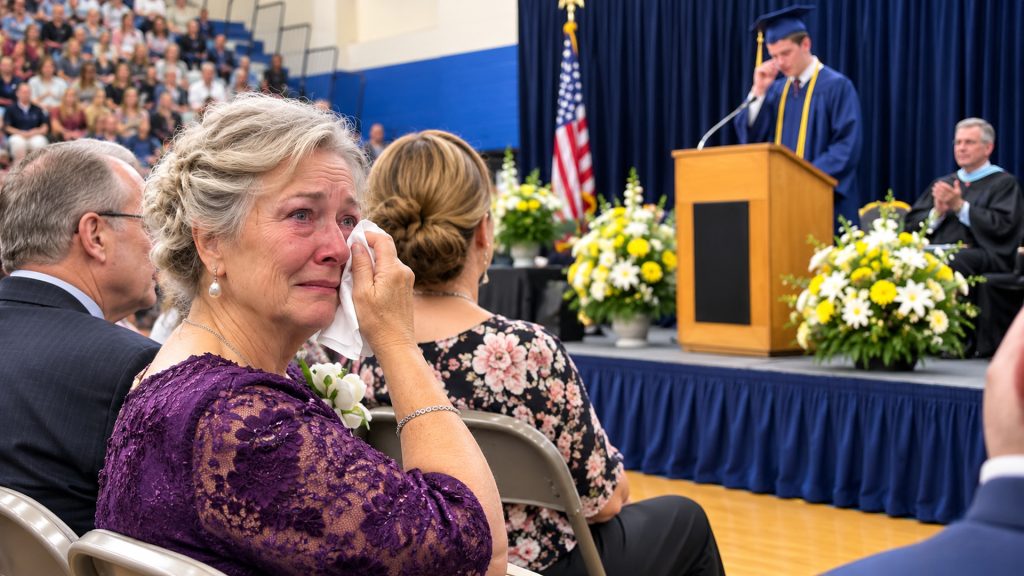
I felt dizzy. “Sweetheart,” I whispered, “just tell me.” He glanced over my shoulder. Then his expression hardened. “Aunt Elaine.” I stopped breathing. My daughter. My only surviving child. A woman I hadn’t spoken to properly in almost six years. I turned slowly. There, three rows behind me, sat Elaine. She wore a cream-colored blazer and a bright red scarf. Her dark hair had been cut shorter than I remembered. Her face was pale. And when our eyes met, she looked away. I gripped the armrest. “What is she doing here?” Kevin stood. “She came because she knew I was graduating.”
I looked at him.
“Did you invite her?”
He hesitated.
“Not exactly.”
Before I could ask another question, an usher approached.
“Mr. Ellis? They’re waiting for you to return to the stage.”
Kevin looked toward the platform.
Then back at me.
The auditorium had grown quiet.
Hundreds of people were watching.
He squeezed my hands.
“Grandma, I need you to know something before anything else happens.”
Tears slipped down his cheeks.
“I love you.”
My throat tightened.
“I love you too, sweetheart.”
“And I’m going to tell you everything.”
He leaned forward and kissed my forehead.
Then he turned toward the stage.
I watched him walk away.
Behind me, someone moved.
I knew without looking that Elaine was getting up.
And for the first time in twenty years of raising Kevin, I was afraid the family I’d fought so hard to protect was about to break apart again.
My name is Margaret Ellis.
I was seventy-eight years old on the day my grandson graduated from college.
Twenty years earlier, a terrible automobile accident had taken my son Michael and his wife, Sarah.
Kevin was four.
I remember the night the police came to my door as clearly as if it happened yesterday.
It was raining.
I’d just finished washing dishes.
The kitchen window was fogged with steam.
When I opened the door and saw the two officers standing beneath the porch light, I knew something terrible had happened before either of them spoke.
For months afterward, I moved through life in a kind of numbness.
My husband had already been gone for seven years.
Michael was my youngest child.
And suddenly, the little boy who used to run into my arms during Sunday dinners had lost both of his parents.
I took Kevin home.
There was never any real question about it.
People told me I was too old.
That I should consider a younger family.
That raising a grieving four-year-old alone would destroy whatever peaceful retirement I’d imagined.
But I looked at that child, with his mother’s brown eyes and his father’s crooked smile, and I couldn’t imagine sending him away.
He needed a home.
I had one.
He needed someone to stay.
And I could do that.
So I became his grandmother, his guardian, his cook, his homework helper, and the person who checked beneath his bed when nightmares convinced him something terrible was hiding there.
Sometimes, after I’d tucked him in, he’d call me back.
“Grandma?”
“Yes, sweetheart?”
“Are you going to disappear too?”
Those were the hardest nights.
I’d sit on the edge of his bed and hold his hand.
“No, Kevin. I’m right here.”
Then he’d whisper, “Promise?”
And I’d answer, “I promise I’ll do everything I can to be here for you.”
I learned not to make promises no human being could guarantee.
But I also learned that a frightened child needs more than honesty.
He needs someone who stays.
Elaine was forty-one when her brother died.
She had a good job in real estate, a comfortable apartment, and a life she liked to describe as carefully planned.
At the funeral, she held Kevin for a few minutes and told me she’d help however she could.
I believed her.
But once the flowers disappeared and the sympathy cards stopped arriving, her visits became rare.
She said Kevin needed stability.
She said I was better with children.
She said her career demanded too much traveling.
I didn’t argue.
There was little time for arguing when I had a four-year-old who wouldn’t sleep unless the hallway light stayed on.
Over the years, Elaine remembered some birthdays and forgot others.
Occasionally she brought expensive gifts.
But she seldom stayed long enough to watch Kevin open them.
When he was eleven, he waited beside the living room window for three hours because she’d promised to take him to a baseball game.
She never came.
That evening, he asked me whether he’d done something wrong.
I held him while he cried.
“No, sweetheart.”
“But Aunt Elaine said she’d be here.”
“I know.”
“Then why didn’t she come?”
I couldn’t answer.
How do you explain to a child that some adults love the idea of family more than the responsibility of showing up?
So I made him hot chocolate.
And the following weekend, I took him to a baseball game myself.
We sat in the inexpensive seats high above the field.
He cheered until his voice was hoarse.
And when our team lost, he grinned and said, “Next time we’ll bring them better luck.”
That was Kevin.
He kept finding reasons to hope.
Even when the adults around him disappointed him.
When Kevin was accepted into college, I thought my heart might burst with pride.
He had worked hard.
Studied late.
Helped neighbors with their computers.
Taken part-time jobs when his schedule allowed.
And somehow managed to become the kind of young man who held doors open for strangers and remembered the names of elderly people at church.
He received a generous scholarship.
It didn’t cover absolutely everything, but it made college possible.
I still remember the day the acceptance letter arrived.
Kevin ran into the kitchen waving it.
“Grandma! I got in!”
I dropped the dish towel.
He wrapped his arms around me and lifted me a few inches off the floor.
I laughed so hard that I began crying.
“Put me down before you break your grandmother!”
He laughed.
Then he held the letter between us.
“I’m going to make you proud.”
I cupped his face.
“Sweetheart, you already have.”
He shook his head.
“No. I mean really proud.”
I smiled.
“Then you’ll have to work very hard, because you’ve set a high standard.”
He laughed.
And for a moment, I could almost see his father standing behind him.
Same smile.
Same excitement.
Same hopeful eyes.
The trouble began during Kevin’s second year at college.
He developed a serious illness that required hospitalization and several weeks of recovery.
He survived, thank goodness, but he missed important coursework and had to reduce his academic load.
His scholarship had renewal requirements.
Despite his efforts to appeal and explain the circumstances, he lost a substantial portion of the funding for the following year.
He called me one evening, trying unsuccessfully to sound calm.
“Grandma, I think I may have to leave school.”
I sat down.
“Why?”
He explained.
The tuition.
The unpaid balance.
The possibility that he couldn’t register for the next semester.
His voice broke.
“I’m sorry.”
I gripped the phone.
“What are you apologizing for?”
“I got sick.”
“Kevin, you didn’t choose that.”
He was quiet.
Then he whispered, “I should’ve worked harder after I got better.”
My heart broke.
“Sweetheart, you were recovering.”
He swallowed.
“I don’t want you worrying about this.”
I looked around my little kitchen.
At the curtains I’d sewn myself.
The old refrigerator.
The table where Kevin had done homework for fourteen years.
“Let me think about it,” I said.
“Grandma—”
“Let me think.”
After the call, I sat alone for a long time.
Then I opened the drawer where I kept my financial records.
I’d spent years putting aside small amounts of money.
Not much.
A few thousand here.
A little more there.
I’d planned to use it for emergencies during retirement.
But the cost of helping Kevin remain enrolled was more than my savings could cover.
Eventually, I met with my bank.
I refinanced the small remaining mortgage on my house and borrowed additional funds against its equity.
I understood that it was a serious decision.
I signed the legitimate loan documents.
I knew the payments would be difficult.
But I believed that with careful budgeting and part-time work, I could manage them.
And for a while, I did.
I never told Kevin the full story.
He believed I’d found additional educational assistance.
Looking back, I know that was a mistake.
I’d spent so many years protecting him from hardship that I’d forgotten he was becoming an adult.
I should have allowed him to understand our circumstances.
I should have trusted him enough to share the truth.
But all I could see was that frightened little boy asking whether I would disappear too.
And I wanted, more than anything, to keep one more frightening thing out of his life.
A year after the refinancing, Elaine called.
It was an ordinary Tuesday afternoon.
I was folding laundry when the phone rang.
“Mom?”
I nearly dropped the towel.
“Elaine?”
“Hi. How are you?”
I sat down.
We exchanged awkward pleasantries.
Then she asked about the house.
“Are you still living in the same place?”
“Of course.”
“Do you ever think about selling?”
I frowned.
“Why would I?”
“It’s a lot of house for one person.”
“Kevin still comes home during breaks.”
She sighed.
“Mom, you’re getting older.”
“I’m aware of that.”
She laughed.
“Don’t be sensitive. I’m just saying you ought to plan ahead.”
I didn’t like the direction of the conversation.
Then she mentioned something that made me uneasy.
“Have you reviewed your estate documents recently?”
I hesitated.
“Not recently.”
“You should. Especially with Kevin in college.”
I looked toward the window.
“Why?”
“Because he’s young. And you’re not exactly getting younger.”
I swallowed my irritation.
“Elaine, if you’re worried about me, you’re welcome to visit.”
She went quiet.
Then changed the subject.
A few weeks later, she arrived unexpectedly with a folder of papers.
She told me it contained information about senior financial planning.
I agreed to look through it.
We sat at the kitchen table while she talked about beneficiary designations, powers of attorney, and the importance of having someone who could handle paperwork if I became ill.
Some of what she said was sensible.
I was getting older.
I did need to review my plans.
But when she suggested naming herself as my financial agent, I hesitated.
“Elaine, we hardly see each other.”
She looked offended.
“I’m your daughter.”
“I know.”
“Who else would you trust?”
I thought about Kevin.
Then about my friend Ruth Miller, who had helped me with practical matters for years.
“I’ll speak with an attorney before deciding.”
Elaine frowned.
“Mom, you don’t need to pay some lawyer to tell you your daughter can help.”
I closed the folder.
“I’d feel better getting independent advice.”
She left angry.
And for several months, I heard nothing from her.
I believed the matter was over.
I didn’t realize it was just beginning.
Back in the auditorium, Kevin finished his graduation address.
He spoke about gratitude.
About the people who make sacrifices without expecting applause.
About professors who notice students struggling.
About friends who carry one another through difficult years.
And about the danger of mistaking independence for refusing help.
Then he said something I will never forget.
“Sometimes we think growing up means proving we no longer need the people who raised us. But maturity also means recognizing that those people have needs of their own.”
My eyes filled again.
He looked toward the back of the auditorium.
Toward me.
“Today, I want to dedicate my graduation to the woman who taught me that love is an action.”
He paused.
“Grandma, I hope you know that everything good I accomplish will always carry a little of what you gave me.”
People applauded.
I pressed my hand against my mouth.
I wanted to stand.
To run toward him.
To tell him that he didn’t owe me any great achievement.
That all I’d ever wanted was for him to grow into a decent, happy man.
But the words wouldn’t come.
I simply cried.
When he returned to his seat onstage, I glanced behind me.
Elaine was gone.
Her empty chair stood beside the aisle.
The bright red scarf had disappeared.
And something about that made my stomach tighten.
After the ceremony, I waited near the auditorium doors.
Families streamed past carrying flowers and balloons.
Young people in graduation gowns embraced parents, grandparents, and friends.
Everywhere I looked, someone was laughing.
I stood holding my little bouquet, feeling as though my happiness and terror had become tangled together.
Then Kevin appeared.
“Grandma!”
He hurried toward me.
I barely had time to open my arms before he wrapped me in a hug.
For several seconds, I held him as tightly as I had when he was little.
“You graduated,” I whispered.
He laughed through his tears.
“I did.”
I pulled back and touched his cheek.
“I’m so proud of you.”
His face crumpled.
“I’m sorry, Grandma.”
I shook my head.
“Not here, sweetheart. Not right now.”
He swallowed.
“But I have so much to explain.”
I looked toward the people taking photographs beneath a banner.
“Then we’ll find somewhere quiet.”
He nodded.
Before we left, I gave him the flowers.
He stared at the little bouquet of yellow and white carnations.
“You brought these for me?”
“Of course.”
He smiled sadly.
“They’re beautiful.”
Then he reached into his graduation gown and removed a small folded piece of paper.
“Will you keep this?”
I opened it.
It was a photograph taken when he was four.
He was sitting on my lap in the living room, wearing an oversized sweater.
My hair was darker.
My face was younger.
Kevin had one little hand pressed against my cheek.
On the back, in his handwriting, were six words.
You never let go. Neither will I.
I began crying again.
He hugged me.
And for a moment, the frightening questions about Elaine, the bank, and the mysterious signature faded into the background.
My grandson was in my arms.
He was healthy.
He had graduated.
And after a month of silence, he was speaking to me again.
That was enough to make the world feel bearable.
We went to a small diner about ten minutes from campus.
It was nearly empty.
Kevin ordered grilled cheese and tomato soup.
I ordered tea, though I knew I probably wouldn’t drink it.
We sat in a booth beside the window.
For a while, neither of us spoke.
Then Kevin placed a folder on the table.
“Grandma, I need to tell you something.”
I looked at him.
“All right.”
He took a breath.
“A month ago, Aunt Elaine contacted me.”
My stomach tightened.
“What did she want?”
“She said she was worried about you.”
I stared.
Kevin continued.
“She told me you’d been taking on debt, working too much, and refusing to accept help.”
I looked down.
“Some of that is true.”
He nodded.
“I know.”
Then he swallowed.
“But she said something else.”
“What?”
“She said you weren’t handling your finances properly anymore.”
My heart sank.
Kevin looked ashamed.
“She showed me copies of loan statements and said there were irregularities.”
I stared at the folder.
“Did you believe her?”
He hesitated.
“At first, I didn’t know what to believe.”
I swallowed.
He continued.
“Then she said the bank might take the house.”
I felt a cold wave of fear.
“Kevin—”
“Grandma, I found the refinance papers when I came home during spring break.”
I closed my eyes.
“Under the sewing machine?”
He nodded.
“I was looking for an old photograph for a graduation project. The drawer was open.”
My hands tightened.
“I saw the loan amount.”
He stared at me.
“And I realized what you’d done.”
I looked toward the window.
He whispered, “You borrowed money so I could stay in school.”
I nodded.
He began crying.
“Grandma, why didn’t you tell me?”
I looked at him.
“Because I didn’t want you to worry.”
He wiped his eyes.
“But I should’ve known.”
I reached across the table.
“Maybe.”
He looked up.
I took his hand.
“But that’s something we can talk about without blaming each other.”
His expression crumpled.
“You’re being kind to me when I don’t deserve it.”
I shook my head.
“Kevin, we’re going to have to learn how to talk about difficult things. That doesn’t mean either of us stops deserving kindness.”
He squeezed my hand.
Then took another breath.
“There’s more.”
After discovering the refinance, Kevin had contacted the bank to ask general questions about how mortgage statements worked.
Because he wasn’t an authorized borrower, the bank couldn’t disclose my private account information to him.
But Elaine had already given him copies of several documents.
He compared them with the papers he’d found at home.
And noticed something unusual.
There appeared to be a supplemental authorization associated with an increase in the amount owed under the home-equity arrangement.
It wasn’t part of the transaction I’d knowingly completed.
The document named Elaine as someone authorized to act on my behalf.
Beneath her name was a signature.
Hers.
I stared at Kevin.
“She signed as my agent?”
He nodded.
“That’s what it says.”
I shook my head.
“But I never gave her that authority.”
“I know.”
My voice trembled.
“I told her I wanted to speak with my own attorney.”
Kevin lowered his eyes.
“Grandma, there’s a document claiming you appointed her.”
I felt my stomach turn.
“What document?”
He opened the folder.
Inside was a copy of a purported durable power of attorney.
It bore my printed name.
My address.
And a signature that resembled mine.
But I had never signed it.
I stared at the page.
“That’s not my signature.”
Kevin nodded.
“I was afraid you’d say that.”
My hands began trembling.
He continued.
“The bank has already been notified about the dispute. They haven’t decided what happened, but they’ve flagged the documents and are reviewing the additional transaction.”
I took a slow breath.
“How did you find out?”
His eyes filled.
“Because Elaine asked me to help her.”
I stared.
“What?”
He swallowed.
“She wanted me to tell you she was only trying to protect the house.”
I felt my chest tighten.
“Protect it from what?”
Kevin hesitated.
“Grandma, she wanted you to sign a new authorization making her responsible for your finances.”
I stared at him.
For years, Elaine had shown little interest in caring for Kevin or visiting me.
Now, suddenly, she wanted access to my financial affairs.
And there was a document suggesting she’d already been acting as though she had it.
I felt sick.
“Why didn’t you tell me?” I asked.
Kevin looked down.
For a long moment, he said nothing.
Then his voice broke.
“Because I was ashamed.”
I watched him.
He continued.
“When I found out about the refinance, I felt like every good thing in my life had cost you something.”
My eyes filled.
“Kevin—”
He shook his head.
“Please let me finish.”
I nodded.
He took a shaky breath.
“I thought about you coming home exhausted from work. About the times you told me you weren’t hungry so I could have the last piece of chicken.”
I closed my eyes.
“About the winter you wore that old coat with the broken zipper.”
Tears slid down my face.
“About how you said you didn’t mind missing vacations.”
His voice trembled.
“And I realized you had been giving things up for years while I just kept taking.”
I reached for him.
“Sweetheart, you were a child.”
“I know.”
He wiped his face.
“But I wasn’t a child anymore.”
I squeezed his hand.
He continued.
“Then Elaine told me you were hiding financial problems because you were too embarrassed to admit you needed help.”
My heart tightened.
“She said that?”
He nodded.
“And I became angry.”
I looked at him.
“At me?”
“Yes.”
The honesty hurt.
But I was grateful for it.
He swallowed.
“I thought you should’ve trusted me. I thought you were still treating me like a little boy who couldn’t handle bad news.”
I nodded slowly.
“That part is fair.”
He looked surprised.
I continued.
“I should have told you more.”
He began crying.
“But I had no right to punish you by disappearing.”
I squeezed his fingers.
“No, sweetheart. You didn’t.”
He lowered his head.
“When I told you to stop calling, I thought I needed time to fix everything without making you worry.”
I looked at him.
“But you made me worry more.”
He nodded.
“I know.”
His voice cracked.
“Then you sent the cookies.”
I felt tears gathering.
“I remembered those were your favorites.”
He covered his face.
“I saw the package, and I couldn’t even open it.”
I took a breath.
“Why?”
“Because I knew you’d made them while wondering whether I still loved you.”
The words broke something inside me.
I began sobbing.
Kevin moved around the table and sat beside me.
“I’m so sorry, Grandma.”
I held him.
For a long time, neither of us spoke.
Then I whispered, “You can be angry with me, sweetheart. You can tell me when I’ve made a mistake.”
He nodded against my shoulder.
“But please don’t make me think I’ve lost you.”
He began crying harder.
“I won’t.”
I held his face between my hands.
“Promise me you’ll talk to me, even when it’s difficult.”
“I promise.”
And this time, we both understood that promises required more than loving words.
They required showing up.
Kevin explained that after he stopped speaking to me, he’d contacted one of his professors, Dr. Helen Brooks.
She knew he’d been struggling with family worries while finishing his degree.
When he admitted that I had refinanced my home to keep him in school, she encouraged him to seek professional guidance rather than attempt to solve the problem secretly.
She also helped him find information about a university-affiliated emergency support program that sometimes assisted students and their families during serious financial hardship.
The assistance wasn’t automatic.
Kevin had to provide documentation.
He had to explain his circumstances.
And the money available was limited.
Eventually, he received a combination of emergency support and assistance from an independent charitable foundation connected with the university.
Part of that assistance could be applied toward verified overdue housing expenses affecting his family.
It didn’t erase my mortgage.
But it provided enough to address several past-due payments and create breathing room while the bank reviewed the disputed transactions.
Kevin had also accepted a salaried position with a local engineering company.
He’d signed his employment agreement two weeks before graduation.
“I start in July,” he told me.
I smiled through my tears.
“That’s wonderful.”
He shook his head.
“Grandma, I want to help with the mortgage.”
I took a breath.
“We’ll discuss what makes sense.”
He looked disappointed.
“I can afford it.”
“Maybe. But I don’t want you taking on obligations you haven’t planned for.”
He smiled sadly.
“You’re still protecting me.”
I shook my head.
“No, sweetheart. I’m trying to teach both of us something.”
“What?”
“That helping someone doesn’t mean sacrificing your entire future.”
He looked at me.
I continued.
“And that applies to you as much as it applies to me.”
For the first time that afternoon, he smiled without sadness.
Then I asked the question I’d been avoiding.
“Why was Elaine at graduation?”
Kevin’s expression changed.
He opened another section of the folder.
“I told her I was going to speak with a lawyer about the documents.”
I stared at him.
“How did she react?”
“She was furious.”
My chest tightened.
“She said I was ungrateful. That she was the only one trying to keep you from losing the house.”
I shook my head.
Kevin continued.
“Then she asked whether you’d been having memory problems.”
I felt cold.
“What?”
“She said if you weren’t managing your affairs properly, somebody might need to step in.”
I closed my eyes.
My own daughter.
The woman I’d raised.
The woman I’d invited into my kitchen to discuss responsible financial planning.
Now she was suggesting that I might no longer be competent to manage my life.
Kevin took my hand.
“I told her I didn’t believe that.”
I looked at him.
“Thank you.”
He shook his head.
“Then she said something that frightened me.”
“What?”
“She said if you refused to sign the new documents, the bank might become less patient.”
I stared.
Kevin continued.
“I didn’t know whether she was warning me or threatening me.”
I took a breath.
“So you contacted someone?”
He nodded.
“Dr. Brooks introduced me to a legal aid referral service. They couldn’t represent me in your mortgage dispute, because it’s your account. But they helped me understand why I needed to bring the documents to you and your own attorney.”
I exhaled.
“Good.”
He looked ashamed.
“I should’ve done that weeks ago.”
“Yes,” I said gently. “But you did it now.”
He swallowed.
“Elaine called yesterday. She said she was coming to graduation because she wanted to speak with you afterward.”
My heart tightened.
“About signing the papers?”
He nodded.
“I think so.”
I looked toward the window.
And realized my daughter hadn’t come to watch her nephew graduate.
At least, that wasn’t her only reason.
She had come because she believed the occasion might give her access to me.
The same mother she’d visited so rarely.
The same house she’d insisted I ought to sell.
And the same finances she’d apparently been trying to control.
That evening, Kevin drove me home.
He carried my flowers inside.
Set his graduation cap on the kitchen table.
Then stood in the doorway for a long moment.
“Grandma?”
I turned.
“Yes, sweetheart?”
He looked around the house.
The old clock above the refrigerator.
The faded curtains.
The framed photographs lining the hallway.
“I didn’t realize how much I missed this place.”
My eyes filled.
“Neither did I realize how much I missed hearing you say that.”
He smiled sadly.
Then walked toward the couch.
He sat down beneath the old knitted blanket.
The same blanket he’d used as a child.
For a moment, he looked so much like the little boy I’d raised that my chest tightened.
Then he patted the cushion beside him.
“Grandma, come sit.”
I laughed through my tears.
“You’re taking up all the room.”
He shifted.
“I saved you a warm place.”
I stopped.
Twenty years disappeared.
I was fifty-eight again.
Standing in the doorway after a long shift.
And a four-year-old boy was looking up at me from the couch, offering the only thing he had.
A warm place beside him.
I sat down.
Kevin wrapped the blanket around both of us.
And we cried.
Not because every problem was solved.
But because we had found our way back to one another.
On Monday morning, I called an attorney.
Her name was Rebecca Lawson.
She specialized in property disputes and financial exploitation involving older adults.
Kevin came with me to the appointment, but I made it clear that I wanted to speak for myself.
Rebecca respected that.
She listened while I explained the legitimate refinancing, Elaine’s visit, the documents Kevin had found, and the additional transaction I hadn’t authorized.
Then she examined the papers.
“Mrs. Ellis, let’s separate the issues,” she said.
I nodded.
“The original refinancing appears to be a loan you knowingly entered into. You remain responsible for that obligation.”
“I understand.”
“But the later authorization and additional borrowing are disputed.”
I leaned forward.
“Can I lose my house because of something I didn’t sign?”
She answered carefully.
“We need to review the complete loan history, the purported power of attorney, and any transaction records. The bank has begun looking into the matter, but we should make sure your objections are properly documented.”
Kevin squeezed my hand.
Rebecca continued.
“We’ll also discuss how to protect your financial affairs going forward. That includes reviewing access to your accounts and arranging estate planning documents that reflect your wishes.”
I took a breath.
“Can my daughter force me to give her control?”
“Not simply because she’s your daughter. Any authority she claims must have a lawful basis.”
I closed my eyes.
For the first time since graduation, I felt that the questions had answers.
Not easy answers.
But real ones.
Over the following weeks, the bank investigated.
Rebecca obtained relevant records through the appropriate procedures.
The additional documents included an authorization bearing my purported signature and naming Elaine as an agent.
There were also records of a further advance connected to the home-equity arrangement.
I had never requested that advance.
I hadn’t received the proceeds.
And I had never knowingly appointed Elaine to act on my behalf.
Eventually, the bank traced the disputed funds to an account associated with a small real estate investment business in which Elaine held an interest.
I stared at the report.
My daughter had been involved in a business I barely knew existed.
And that business had apparently received money connected to my home.
The bank’s investigation found serious irregularities in the documents.
With Rebecca’s assistance, I formally disputed the unauthorized advance and the purported authority used to request it.
The bank ultimately agreed to remove the disputed amount and associated charges from my obligation, subject to the documented resolution of the claim.
The legitimate refinancing remained.
So did the payments I’d missed.
But the additional debt that had frightened Kevin was no longer being treated as mine under the resolution.
I cried when Rebecca explained it.
“Does that mean we can keep the house?”
She smiled gently.
“It means we’ve addressed the disputed portion. Now we need to make a sustainable plan for the legitimate loan.”
I nodded.
For years, I’d tried to solve every problem by working harder.
Taking another shift.
Skipping another purchase.
Pretending exhaustion didn’t matter.
Now I understood that responsibility sometimes meant asking for qualified help before circumstances became desperate.
Elaine’s attorney contacted Rebecca after the bank’s findings.
There were discussions about the disputed documents, the movement of funds, and the legal consequences.
The matter was also referred for appropriate review concerning the use of my signature and the claimed financial authority.
I cooperated when necessary.
I didn’t exaggerate what had happened.
And I didn’t ask anyone to overlook evidence simply because Elaine was my daughter.
The most painful conversation came several months later.
Elaine requested a meeting.
Rebecca helped arrange it in a neutral office.
I agreed only after careful thought.
Kevin offered to come.
But I shook my head.
“This is something I need to do.”
He looked worried.
“Grandma—”
I touched his cheek.
“I won’t be alone. Rebecca will be there.”
He nodded.
Then hugged me.
“Call when you’re finished.”
“I will.”
Elaine looked smaller than I remembered.
She sat across from me in a plain gray sweater, her hands folded tightly.
For a moment, neither of us spoke.
Then she whispered, “Mom.”
I looked at her.
“Hello, Elaine.”
Her eyes filled.
“I don’t know where to begin.”
I took a slow breath.
“Begin with the truth.”
She lowered her head.
After a long silence, she admitted that her real estate venture had been struggling financially.
A development project had fallen apart.
Money she’d expected never arrived.
She had debts she couldn’t easily pay.
And instead of telling me, she’d convinced herself that my house represented a resource the family ought to use.
My stomach tightened.
“You thought my house belonged to you?”
She shook her head.
“Not exactly.”
“Then what?”
She began crying.
“I thought you weren’t using its value.”
For a moment, I couldn’t speak.
Then I whispered, “Elaine, I was living in it.”
Her face crumpled.
“I know.”
“No,” I said gently. “I don’t think you did.”
Tears slipped down my cheeks.
“That house is where I raised you and Michael. It’s where I held Kevin when he cried for his parents.”
She covered her mouth.
“It’s where I worked two jobs to keep the lights on.”
My voice trembled.
“And you looked at it and saw money.”
Elaine began sobbing.
“I’m sorry.”
I looked down.
I had wanted those words for months.
But hearing them didn’t erase the damage.
“Why didn’t you ask me for help?”
She wiped her face.
“Because I knew you would say no.”
I stared at her.
That answer hurt more than any excuse.
She hadn’t acted because she believed I would agree.
She’d acted because she knew I wouldn’t.
Elaine admitted that she’d used information from the financial planning documents she’d brought to my house to support her claim of authority.
She said she’d told herself the money would be replaced before I noticed.
But the project never recovered.
And when the bank began asking questions, she panicked.
She’d approached Kevin hoping he would persuade me to sign paperwork that might make the situation appear legitimate.
Instead, Kevin had begun investigating.
I looked at her.
“Did you come to graduation to pressure me?”
She nodded slowly.
“Yes.”
My eyes filled.
“Elaine, your nephew had just finished college.”
She looked down.
“That day should have been about him.”
“I know.”
I shook my head.
“Your brother died twenty years ago. Kevin spent most of his childhood wondering why people he loved didn’t come when they promised.”
She began crying.
“And you came to the most important day of his young life because you wanted me to sign papers.”
Her shoulders shook.
I took a breath.
“I don’t understand how we got here.”
Elaine whispered, “Neither do I.”
I looked at her for a long moment.
Then said quietly, “I love you. But I cannot trust you with my finances or my home.”
She nodded through her tears.
“I understand.”
“And I won’t protect you from the consequences of what happened.”
Her voice broke.
“I know.”
I stood.
For a moment, she looked as though she wanted to hug me.
But she stayed seated.
And I walked away.
The months that followed weren’t easy.
Elaine faced financial and legal consequences connected to the disputed transactions.
Her business underwent a difficult restructuring, and she had to address obligations she’d tried to conceal.
The appropriate authorities handled the questions concerning the documents.
I was not responsible for deciding her punishment.
I was responsible for protecting myself and telling the truth.
Kevin and I worked with a financial counselor to build a realistic household plan.
We reviewed the remaining mortgage.
Calculated what I could reasonably afford.
And discussed how much assistance he could offer without jeopardizing his own independence.
He wanted to take over every payment immediately.
I refused.
Not because I didn’t appreciate him.
Because I recognized the same dangerous instinct I’d carried for twenty years.
The belief that love required one person to give up everything.
Instead, we agreed on a modest contribution toward shared expenses while he lived with me after graduation.
He would build his savings.
I would reduce my working hours gradually.
And together, we’d maintain the house without treating either person’s future as expendable.
It wasn’t dramatic.
There were no enormous checks.
No miraculous disappearance of every debt.
Just a plan.
And for the first time in years, that felt like enough.
Kevin’s new job suited him.
He worked with a team developing systems for improving energy efficiency in public buildings.
He was proud of his work.
And I was proud of him.
But my favorite part of his new life wasn’t his salary.
It was the way he began calling me during his lunch breaks.
Sometimes he told me about difficult projects.
Sometimes he complained about traffic.
Sometimes he asked whether I’d remembered to take my afternoon walk.
One evening, he came home carrying groceries.
“Grandma, I bought chicken.”
I looked up from my knitting.
“Wonderful.”
“And vegetables.”
“Even better.”
He grinned.
“And cookies.”
I laughed.
“What kind?”
“Oatmeal.”
My eyes filled.
He set the bag down.
“I thought maybe we could bake some together.”
For a moment, I remembered the package I’d mailed to his college apartment.
The one that came back unopened.
Then I smiled.
“I’d like that very much.”
One year after his graduation, Kevin surprised me again.
Not with money.
Not with a grand announcement.
With a small wooden picture frame.
Inside was his graduation photograph.
He stood in his gown, smiling beside me.
My little bouquet of carnations was visible in his hand.
Beneath the photograph, he’d placed a handwritten note.
For every time you showed up when I needed you, thank you.
I read it slowly.
Then looked at him.
“Sweetheart, this is beautiful.”
He smiled.
“There’s something on the back.”
I turned the frame over.
Another note.
Now it’s my turn to show up for you.
My eyes filled.
Kevin took my hand.
“Grandma, I know you spent twenty years telling me I was your whole world.”
I smiled through my tears.
“You were.”
He nodded.
“But I want you to have a world of your own too.”
I laughed softly.
“What do you mean?”
He grinned.
“I signed you up for information about that gardening club you’ve been talking about.”
I stared at him.
“The one at the community center?”
“Yes.”
I began laughing.
“Kevin, those people are serious gardeners.”
He smiled.
“So are you.”
I shook my head.
“They probably know far more than I do.”
He leaned closer.
“Grandma, you’ve kept roses alive through twenty winters. I think you’ll manage.”
I laughed until tears ran down my cheeks.
Then hugged him.
Because he’d finally understood something I’d spent a lifetime forgetting.
I wasn’t only his grandmother.
I was Margaret.
A woman who loved gardening, old movies, church potlucks, and quiet mornings with tea.
A woman who had dreams before she became responsible for raising a little boy.
And a woman who still deserved to enjoy the years ahead.
Today, Kevin is twenty-five.
He’s building a career.
Saving money.
And slowly becoming comfortable with the idea that he can love me without taking responsibility for every difficulty in my life.
I am seventy-nine.
I still live in our little house.
The mortgage isn’t completely paid off.
But it is manageable.
I work fewer hours now.
I attend the gardening club twice a month.
And sometimes, when the weather is beautiful, I sit on the porch without feeling guilty that I haven’t done something productive.
Elaine and I remain in limited contact.
Our relationship has changed permanently.
I hope she continues taking responsibility for her choices.
I hope she finds a healthier way to live.
But I no longer confuse being her mother with surrendering my boundaries.
Kevin understands that too.
He doesn’t pressure me to forgive faster than I’m ready.
And I don’t pressure him to rebuild a relationship with an aunt who disappointed him.
We’ve learned that love cannot be demanded.
It has to be lived.
Last Sunday, Kevin came home after spending the afternoon with friends.
He found me sitting on the couch with the old knitted blanket across my knees.
“Grandma?”
I looked up.
“Yes, sweetheart?”
He smiled.
“Mind if I sit?”
I moved aside.
“Of course not.”
He sat beside me.
For a while, we watched an old movie.
Then he leaned his head against my shoulder.
It made me laugh.
“Kevin, you’re much too big for that now.”
He grinned.
“You’re the one who told me I’d always be your little boy.”
I smiled.
“That’s true.”
He took my hand.
For a moment, neither of us spoke.
Then he whispered, “Grandma, are you happy?”
The question surprised me.
I looked around our living room.
At the photographs.
The flowers on the windowsill.
The graduation frame on the mantel.
At the young man beside me who had once been a frightened child and was now becoming someone his parents would have been proud to know.
I thought about the years of exhaustion.
The sacrifices.
The fear of losing the house.
The pain of being shut out.
And the day my grandson walked across an auditorium to kneel before me.
Then I smiled.
“Yes, sweetheart.”
He looked at me.
“Really?”
I nodded.
“Really.”
He squeezed my hand.
And I realized happiness didn’t mean everything had turned out exactly as I’d hoped.
It meant there was still love in my life.
Still purpose.
Still laughter.
Still time to enjoy what I’d worked so hard to protect.
Sometimes I think about that graduation ceremony.
The moment Kevin approached the microphone.
The moment he admitted he’d hurt me.
The moment he knelt beside my chair and told me the truth.
I remember the people crying around us.
The applause.
The flowers trembling in my hands.
But what I remember most isn’t the crowd.
It’s the sound of his voice when he said he was sorry.
Because real love isn’t proven by never making mistakes.
It’s proven by the willingness to acknowledge them, repair what can be repaired, and choose kindness afterward.
I spent twenty years teaching Kevin how to become a good man.
And on his graduation day, he taught me something I desperately needed to learn.
The people we love are worth sacrificing for, but love should never require us to disappear.
I had given Kevin my time.
My strength.
My savings.
And more years of work than I’d ever expected.
I would never regret raising him.
Not for a single moment.
But now I understood that my life mattered too.
And the greatest gift I could give my grandson wasn’t another sacrifice.
It was showing him how to build a future in which both of us could thrive.
That evening, Kevin stood up to make tea.
“Want some, Grandma?”
“Yes, please.”
He walked toward the kitchen.
Then stopped and looked back.
“Grandma?”
“Yes?”
He smiled.
“Remember when I used to wait on the couch until you got home from work?”
I laughed softly.
“How could I forget?”
He grinned.
“I used to tell you I’d saved a warm place.”
My eyes filled.
“Yes, sweetheart.”
He looked around the living room.
Then back at me.
“Well, don’t get too comfortable without me.”
I laughed.
“Why?”
“Because I’m coming back in five minutes.”
I smiled.
“And?”
He grinned.
“Save me a warm place.”
I pulled the blanket over the empty cushion beside me.
And waited.
Not with the fear that he might disappear.
But with the quiet certainty that he knew where home was.
When he returned, we sat together beneath the old blanket, drinking tea and watching the evening light fade beyond the windows.
For twenty years, I’d believed my greatest achievement was making sure Kevin had somewhere safe to belong.
Now I understood something even more beautiful.
We had given that gift to each other.
And at last, we both knew we deserved it.


