The moment I saw my mother’s handwriting on that envelope, I forgot how to breathe. For five years, I had believed I understood the two greatest heartbreaks of my life. First, I had lost my mother. Six months later, I had lost my marriage. I thought those tragedies were separate. One had come from illness and death. The other had come from betrayal. But now, standing beside my former husband’s hospital bed, I was beginning to realize that the two might have been connected in ways I never imagined. My mother had been gone for more than five years.
Yet there was her handwriting. The familiar slant of her letters. The little curl she always put beneath the last letter of someone’s name. Across the envelope, she’d written: For Daniel. When the time comes to tell Claire the truth. I stared at those words. Then looked at Miriam. “What does that mean?” Miriam lowered her eyes. “Claire, I think you should read it.” My hands trembled. Daniel lay against his pillows, his face pale and exhausted. His left hand rested awkwardly on the blanket. When he saw the envelope, he closed his eyes.
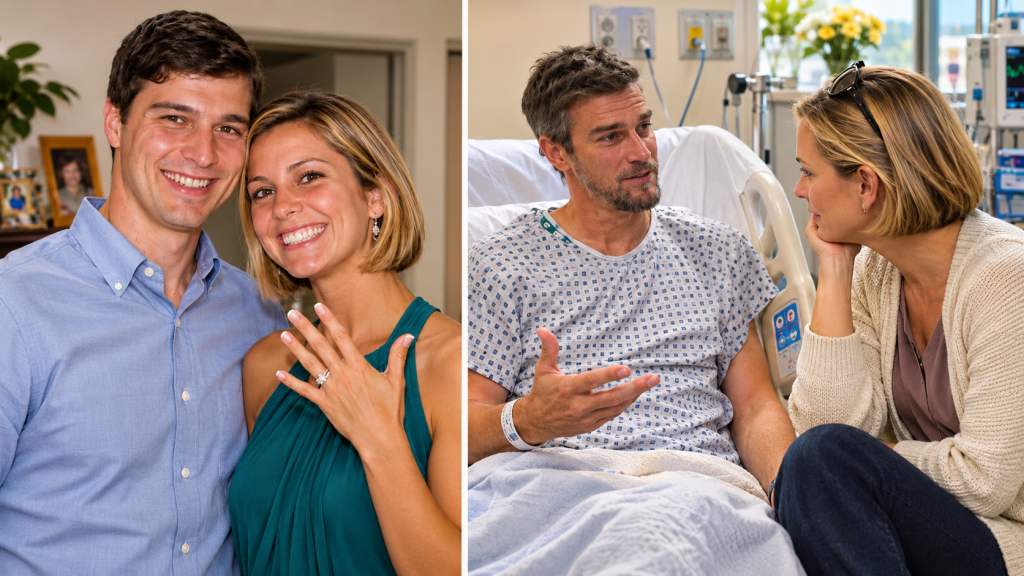
“Please,” he whispered. I looked at him. “Please what?” His voice cracked. “Don’t hate your mother for this.” Something inside me tightened. “Daniel, my mother has been dead for five years. Why would I hate her?” He couldn’t answer. I slowly opened the envelope. Inside was a folded sheet of pale blue stationery. The paper smelled faintly of the lavender sachets my mother used to keep in her drawers. And for one extraordinary moment, I was back in her kitchen, watching her pour tea while she reminded me to wear a coat.
I unfolded the letter.
Then began reading.
Dear Daniel,
I know you’ve been frightened by what is happening to your body.
I saw your hand shaking at dinner. I noticed how difficult it was for you to fasten Josh’s coat. And I heard you tell Claire you were only tired.
My eyes filled.
I won’t pretend to understand what the doctors may eventually tell you. But I do understand fear.
I have spent enough years loving this family to recognize when someone is trying to carry something terrible alone.
I glanced at Daniel.
He was crying silently.
I continued.
There is something I need you to remember.
My daughter is stronger than you think.
She has spent her life caring for people she loves, but that doesn’t mean her heart is made of glass.
If you are sick, tell her.
If you are frightened, tell her.
If the future becomes difficult, let the two of you decide what to do together.
My vision blurred.
Then I reached the final paragraph.
Daniel, love is not protecting someone from the truth by taking away their choices.
Love is trusting them enough to face the truth beside you.
Please don’t make the mistake of confusing sacrifice with kindness.
With love,
Margaret.
I lowered the paper.
For several seconds, the only sound in the room was the soft rhythm of the medical equipment beside Daniel’s bed.
Then I whispered, “She knew.”
Daniel nodded weakly.
“She suspected something was wrong.”
I stared at him.
“And she told you to tell me.”
Tears slid down his cheeks.
“Yes.”
I looked at the letter again.
My mother had recognized his fear before I had.
She’d seen the shaking hands.
The strange movements.
The things he’d blamed on exhaustion.
And she’d asked him to trust me.
Instead, he’d done exactly what she warned him not to do.
I sank into the chair.
“Daniel,” I whispered, “why didn’t you listen to her?”
He covered his face with his trembling hand.
And began to sob.
My name is Claire Bennett.
I was forty-three years old when Daniel confessed to an affair that never happened.
We had been married for fourteen years.
We had two beautiful children.
Emma, our eldest, was fourteen when our marriage ended.
Josh was seven.
We lived in a comfortable house with a garden Daniel loved and a kitchen that always seemed to smell like coffee or something baking.
Our life wasn’t perfect.
We argued about bills.
Forgot appointments.
Disagreed about whose turn it was to take the trash out.
But I believed we were happy.
Daniel worked as a project manager for a small construction company.
I was an administrative coordinator at a community college.
We weren’t wealthy, but we had enough.
We took family vacations when we could afford them.
Attended the children’s school performances.
And spent Saturday mornings drinking coffee while the kids argued over television programs.
Daniel was the kind of father who built elaborate blanket forts in the living room.
He let Emma paint his fingernails when she was little.
He taught Josh how to ride a bicycle.
And every year on our anniversary, he brought me yellow roses because I’d carried them at our wedding.
I remember looking at him one evening while he helped Josh with homework.
And thinking how fortunate I was.
I didn’t know then that he had begun visiting doctors.
I didn’t know he’d been experiencing tremors and stiffness.
I didn’t know that ordinary tasks were becoming strangely difficult.
And I certainly didn’t know he was beginning to fear the future more than anything he’d ever faced.
Six months after my mother’s death, Daniel told me he’d been having an affair.
He sat at our kitchen table.
Looked at me.
And destroyed fourteen years of marriage with a sentence.
I’ve been seeing someone else.
I believed him.
Because I couldn’t imagine why a husband would invent something so cruel.
Back in the hospital, Miriam took the chair near the window.
She had always been quieter than Daniel.
Even as children, he was the one who laughed loudly and made friends easily.
Miriam listened.
Observed.
Remembered.
After our divorce, she gradually disappeared from my life too.
At the time, I thought she was choosing her brother.
Now I wondered how much she had known.
I turned toward her.
“Did you know the affair was a lie?”
Her eyes filled.
“Yes.”
My stomach tightened.
“All five years?”
She nodded.
I looked away.
For a moment, I couldn’t speak.
Then I whispered, “You let me believe he cheated.”
Miriam began crying.
“I did.”
I stared at her.
“You watched Emma become furious with her father. You watched Josh ask why Daddy didn’t love us enough to stay.”
She covered her mouth.
“And you said nothing.”
“I’m sorry, Claire.”
I shook my head.
“Why?”
She looked toward Daniel.
“He made me promise.”
I felt anger rise through my grief.
“He made you promise?”
Miriam nodded.
“He said if you knew about his condition, you’d abandon everything to care for him.”
I looked at Daniel.
His eyes were closed.
Miriam continued.
“He was terrified you’d give up your job, your plans, and your independence.”
My voice trembled.
“So he gave up our marriage instead?”
Miriam couldn’t answer.
I looked down at my mother’s letter.
“How could either of you think that was better?”
Daniel opened his eyes.
“Claire.”
I turned toward him.
His voice was barely audible.
“It wasn’t better.”
He swallowed.
“I know that now.”
For a long time, I sat without speaking.
I wanted to scream.
I wanted to demand every detail.
I wanted to know how many nights I’d cried over something that had never happened.
How many times Emma had stared at her father’s empty chair and wondered what another woman had offered that his own family couldn’t.
How many birthdays Josh had spent hoping his dad would stay longer.
And I wanted to know why Daniel had decided that my love was something he needed to escape rather than trust.
Finally, I asked, “When did the doctors tell you?”
Daniel looked toward the folder.
“About three weeks before I confessed.”
I nodded slowly.
“And what did they say?”
He took a shaky breath.
“Young-onset Parkinson’s disease.”
I looked down.
As part of my work at the community college, I’d encountered people living with chronic neurological conditions.
I knew Parkinson’s could affect movement, coordination, sleep, mood, and many other aspects of life.
I also knew the course varied considerably from one person to another.
Some people lived active lives for many years.
Others developed more significant limitations.
It wasn’t a diagnosis that automatically meant someone was dying.
But Daniel had heard those words and imagined the worst.
He continued.
“My hand had been shaking for months. Sometimes I couldn’t button my shirt. Sometimes my left leg felt like it belonged to somebody else.”
Tears gathered in his eyes.
“I was scared.”
I swallowed.
“Why didn’t you tell me?”
He stared at the blanket.
“Because of your mother.”
I went still.
“What?”
His voice broke.
“Because I’d watched you care for her.”
My mother had spent her final year receiving treatment for cancer.
During those months, I worked during the day and visited her most evenings.
There were appointments.
Medications.
Phone calls.
Nights when she was frightened.
Nights when I cried in my car before driving home because I didn’t want the children to see how exhausted I was.
Daniel helped.
He cooked.
Managed homework.
Took Emma to school activities.
Read to Josh at bedtime.
I remembered believing we were doing what married people were supposed to do.
Helping each other through something painful.
Now Daniel looked at me with tears in his eyes.
“I watched you become so tired you could barely stand.”
I swallowed.
“That was because Mom was dying.”
He nodded.
“I know.”
He continued.
“And then I started having symptoms.”
His voice trembled.
“I imagined you doing it all again.”
I stared at him.
“Daniel—”
“I imagined you working all day, coming home to take care of the kids, and then taking care of me.”
He looked down.
“I pictured you spending the rest of your life watching me lose the ability to do things for myself.”
I closed my eyes.
“And you decided I wouldn’t want that.”
He nodded.
“No.”
He hesitated.
“I decided you would want it.”
I opened my eyes.
He continued.
“That’s what terrified me.”
His voice broke.
“You would’ve stayed. You would’ve told me we could handle it. And you would’ve given up everything to prove it.”
I stared at him.
There was such desperate love in his explanation.
And such terrible selfishness.
He’d been afraid of becoming a burden.
So he’d made himself the person who caused us pain instead.
I took a slow breath.
“Daniel, you didn’t protect me from suffering.”
Tears slid down his cheeks.
“You gave me a different kind.”
He began sobbing.
I continued.
“And you made Emma and Josh suffer too.”
He nodded.
“I know.”
I looked toward the window.
For the first time in five years, I understood why my husband had left.
But understanding wasn’t forgiveness.
Not yet.
Perhaps not for a very long time.
The next surprise came when Miriam explained why the letters had never been delivered.
Daniel had written them over the years.
Birthday letters.
Christmas letters.
Messages for Emma’s graduation.
Notes for Josh when he started middle school.
He’d written a letter for me every anniversary, even after the divorce.
Most remained sealed.
He’d asked Miriam to keep them because he feared he wouldn’t be able to write as easily in the future.
But he refused to send them.
“He thought it would confuse the children,” Miriam explained.
I stared at her.
“Confuse them?”
She nodded.
“He was afraid they’d ask questions.”
I looked toward Daniel.
“And you didn’t want to answer.”
His face tightened.
“No.”
I thought about Emma.
At fourteen, she’d adored her father.
She’d learned to bake bread with him.
They watched old movies together.
They could argue passionately about music and laugh about it five minutes later.
After the divorce, something inside her changed.
She stopped asking him to attend school events.
When he sent birthday gifts, she sometimes left them unopened.
At seventeen, she told me she never wanted to marry.
“People always leave,” she’d said.
I remembered holding her while she cried.
And now I knew her father had allowed her to believe his love had been replaced by another woman.
My throat tightened.
“Those letters belonged to the children,” I whispered.
Daniel closed his eyes.
“I know.”
I looked at Miriam.
“And you kept them.”
She began crying.
“Yes.”
I stood slowly.
“Then both of you need to understand something.”
They looked at me.
“Secrets don’t become loving just because the people keeping them are frightened.”
Neither answered.
I picked up my mother’s letter.
Then said quietly, “I need some time.”
I drove home after sunset.
The streets were wet from an afternoon rain.
Traffic lights reflected across the pavement.
I remember stopping at a red light and looking at my hands on the steering wheel.
They were trembling.
Not because I was cold.
Because the world had shifted beneath me.
For five years, I had carried the shame of being replaced.
I’d wondered whether I was too tired.
Too distracted.
Too ordinary.
I’d remembered every argument Daniel and I ever had and searched it for evidence that I’d somehow driven him away.
Now I knew there had never been another woman.
But that knowledge didn’t restore the years we’d lost.
If anything, it made them hurt more.
Because there had been a chance to face the diagnosis together.
There had been a chance to talk.
To grieve.
To seek medical guidance.
To adapt.
To decide what our marriage could become.
Instead, Daniel had chosen for both of us.
And I’d been left to mourn a betrayal that existed only because he wanted me to believe in it.
When I arrived home, Emma’s car was in the driveway.
She was nineteen now and studying to become a teacher.
Josh was twelve.
They were both in the kitchen when I walked inside.
Emma looked up.
“Mom?”
I stopped in the doorway.
Her expression changed.
“What happened?”
I stared at my children.
And realized the hardest conversation of my life was still ahead of me.
I had spent five years trying to explain Daniel’s absence without making my children feel responsible.
Now I had to explain that the reason I’d given them wasn’t true.
Emma stood beside the kitchen counter holding a mug of tea.
Josh sat at the table, working on a science assignment.
He looked up when I didn’t answer his sister.
“Mom? Are you crying?”
I hadn’t realized I was.
I put my handbag down.
“Both of you, could you sit with me for a minute?”
Emma’s expression tightened.
“Is Dad okay?”
I looked at her.
That question surprised me.
For years, she’d claimed not to care whether Daniel was happy, lonely, or sick.
But her first thought was still about him.
“He’s in the hospital,” I said.
Josh immediately stood.
“What happened?”
“He’s receiving treatment and being assessed for some health problems. I saw him today.”
Emma put down her mug.
“Why didn’t anyone tell us?”
I pulled out a chair.
“Because your father asked to speak with me first.”
Her face hardened.
“Of course he did.”
I swallowed.
“Emma, there’s something important you both need to know.”
My daughter folded her arms.
I could see the fourteen-year-old girl she’d once been.
The one who stood in the hallway while Daniel carried his suitcase downstairs.
The one who asked him whether he loved another woman more than us.
The one who never received an answer that made sense.
I took a breath.
“Your father told me today that he never had an affair.”
Emma stared at me.
Then gave a short, disbelieving laugh.
“What?”
Josh looked confused.
“But that’s why you got divorced.”
“I know.”
Emma shook her head.
“No. He told you himself.”
“Yes.”
She stepped backward.
“Then he’s lying now.”
I reached for her hand.
She pulled away.
“Emma, listen to me.”
“No, Mom. He doesn’t get to rewrite what happened just because he’s sick.”
I let her words settle.
“You’re right that he doesn’t get to erase what happened.”
Her expression faltered.
“But I’ve seen medical records. He was diagnosed with Parkinson’s disease shortly before we separated.”
Josh looked up.
“What’s Parkinson’s?”
I explained as simply as I could.
That it was a neurological condition that affected movement and could have other symptoms.
That treatment could help.
That experiences varied.
And that we needed more information about Daniel’s current health before making assumptions.
Josh’s eyes filled.
“Is Dad going to die?”
The question broke my heart.
I moved beside him and took his hands.
“Everybody dies someday, sweetheart. But Parkinson’s doesn’t mean your dad is about to die. He’s in the hospital because he needs care, and we’re going to find out what the doctors recommend.”
He nodded slowly.
Then whispered, “Why didn’t he tell us?”
I closed my eyes.
“Because he was frightened.”
Emma let out a bitter laugh.
“So he abandoned us instead?”
I looked at her.
“He made a terrible decision.”
Her eyes filled.
“He made us think he loved somebody else.”
“Yes.”
She began crying.
“And you believed him.”
I swallowed.
“Yes.”
She stared at me.
“Why?”
The question hurt.
But I understood why she asked.
“Because he said it directly to me, and I couldn’t imagine he would invent something like that.”
Emma covered her face.
For a long time, we sat together.
Then Josh whispered, “Did Dad stop loving us?”
I pulled him into my arms.
“No, sweetheart.”
His voice broke.
“Then why did he leave?”
I kissed his forehead.
“Because he made choices that hurt us. That’s something he’ll have to explain himself.”
Emma didn’t want to visit the hospital that night.
She went upstairs, closed her bedroom door, and asked to be left alone.
I respected that.
Josh wanted to go immediately.
I told him we would arrange a visit once I’d spoken with Daniel’s medical team and made sure the timing was appropriate.
Later, I found Emma sitting on her bed, looking at an old photograph.
It showed Daniel holding her at a school fair.
She was about ten.
He had a painted butterfly on one cheek because she’d convinced him to let the face-painting booth decorate him.
I sat beside her.
For a while, she didn’t speak.
Then she whispered, “I hated him.”
My throat tightened.
“I know.”
“I thought he chose somebody else.”
I nodded.
She wiped her eyes.
“I thought he looked at us and decided we weren’t worth staying for.”
I reached for her hand.
This time, she let me take it.
“And now he’s saying he did it because he loved us?”
I took a breath.
“That’s how he explains his decision. But loving someone doesn’t make every choice we make on their behalf right.”
She looked at me.
“I don’t know whether I can forgive him.”
I squeezed her fingers.
“You don’t have to decide tonight.”
Her voice broke.
“I don’t even know whether I want to see him.”
“That’s your decision too.”
She stared at the photograph.
Then asked, “Are you going to marry him again?”
I almost laughed, though nothing was funny.
“Emma, I found out the truth this afternoon.”
She nodded.
“I know.”
I touched her cheek.
“I don’t know what happens next. And I won’t make a decision about our future before we’ve all had time to understand what happened.”
Her eyes filled.
“Promise?”
“Promise.”
Then she leaned against me.
And for the first time in years, she cried about her father without trying to hide it.
The following morning, I called Daniel’s hospital.
With his permission, the care team arranged a conversation about his condition.
The neurologist was a woman named Dr. Anita Rao.
She explained that Daniel had been living with Parkinson’s for approximately five years.
He’d responded to some treatments, but had also experienced periods of worsening movement, fatigue, and difficulty managing daily activities.
His recent hospitalization followed a combination of medication problems, dehydration, and an infection that had significantly weakened him.
He’d also been struggling with mobility and had fallen at home.
That explained the bruises I’d seen.
I listened carefully.
Then asked, “Is he dying?”
Dr. Rao looked at me.
“His condition requires serious management, but we shouldn’t confuse this hospitalization with a declaration that his life is ending.”
I exhaled.
She continued.
“Our immediate priorities are treating the illness that brought him here, reviewing his medication schedule, improving his strength and mobility, and determining what support he needs afterward.”
I nodded.
She explained that the team would also assess whether he might benefit from advanced treatment options, depending on his individual symptoms and overall health.
Nothing was guaranteed.
But there were possibilities.
I looked toward Daniel.
He was sitting quietly in the hospital chair.
His left hand rested against his knee.
“Why didn’t you tell your family?” Dr. Rao asked him gently.
He lowered his eyes.
“I didn’t want them to see me like this.”
She considered that.
Then answered, “People living with chronic illness often worry about becoming a burden. Those feelings are important, and we can arrange appropriate emotional support.”
Daniel nodded.
“But avoiding help can sometimes make the practical problems more dangerous.”
His eyes filled.
I looked at him.
For five years, he’d been trying to manage everything alone.
Now his body had finally made that impossible.
And I realized the tragedy wasn’t simply that he’d hidden his illness from me.
It was that he’d treated needing care as something shameful.
Something worse than being hated.
After the appointment, Daniel and I sat together.
The room was quiet.
Sunlight fell across the floor.
I looked at him.
“Did you ever consider telling the children?”
He nodded.
“Every day.”
I swallowed.
“Then why didn’t you?”
He stared at his hands.
“At first, I thought I could tell them once everything settled.”
I waited.
“Then I realized there wasn’t going to be a day when the diagnosis stopped being true.”
His voice broke.
“And the longer I waited, the harder it became.”
I took a breath.
“Daniel, you attended Emma’s school performances.”
He nodded.
“You watched Josh grow up.”
Tears slid down his cheeks.
“You knew they thought you’d left for another woman.”
“I know.”
I leaned forward.
“How did you live with that?”
He closed his eyes.
“Badly.”
For a moment, neither of us spoke.
Then he whispered, “There were nights I sat in my apartment looking at their photographs and wondered whether telling the truth would make them hate me even more.”
I felt my throat tighten.
“Did you ever think they might simply have wanted their father?”
He began crying.
I continued.
“Not a perfect father. Not a healthy father. Just you.”
He covered his face.
“I thought I could protect them from watching me change.”
I shook my head.
“But they were already watching you disappear.”
His shoulders shook.
And for once, he didn’t try to defend himself.
Miriam arrived just before lunch.
She carried another folder.
I felt my stomach tighten when I saw it.
“More secrets?”
She gave a sad little smile.
“Not exactly.”
Inside were records from the years after the divorce.
Daniel had been working for as long as he could.
As his symptoms worsened, he’d gradually reduced his hours and eventually left his position.
He’d applied for available assistance and received treatment through his insurance and medical providers.
He’d also used much of the savings he’d retained after the divorce to cover expenses.
I looked at the figures.
He hadn’t been living comfortably.
His apartment was small because that was what he could afford.
The furniture was secondhand.
He’d sold his newer car and purchased an older one with easier controls.
He’d spent money on medications, therapy, transportation, and practical help.
I felt tears gathering.
But then I noticed another document.
A signed authorization naming Miriam as his healthcare agent if he became unable to make certain decisions.
I looked at her.
“You’ve been handling his appointments?”
She nodded.
“As much as he’d let me.”
My chest tightened.
“Why didn’t you tell me?”
Her eyes filled.
“Because I was afraid of losing him if I broke my promise.”
I stared at her.
She swallowed.
“Claire, I know that doesn’t make it right.”
I looked down.
She continued.
“I thought I was respecting his wishes. But after a while, I realized I was helping him stay isolated.”
For the first time, there was no attempt to justify what had happened.
Just an acknowledgment.
And I appreciated it more than another elaborate explanation.
“Miriam,” I said quietly, “you don’t need to stop being his sister.”
She looked at me.
“But you do need to stop helping him hide from the people he loves.”
She began crying.
“I know.”
Two days later, Josh visited his father.
Emma wasn’t ready.
I made sure Daniel understood that before we arrived.
He nodded.
“I won’t pressure her.”
Josh carried a small drawing he’d made at school.
It showed the four of us standing beneath a tree.
I wondered whether he understood how much the picture might mean.
When we entered, Daniel tried to stand.
His movement was slow and awkward.
Josh hurried forward.
“Dad, you don’t have to get up.”
Daniel stopped.
Then sat back down.
His eyes filled.
“Hey, buddy.”
Josh approached cautiously.
“Hi, Dad.”
For several seconds, neither moved.
Then Josh put the drawing on the bed.
“I made this.”
Daniel looked at it.
His expression crumpled.
“Is that us?”
Josh nodded.
“Before.”
Daniel closed his eyes.
Tears slipped down his cheeks.
“I’m sorry.”
Josh looked at him.
“Mom says you were scared.”
Daniel nodded.
“I was.”
My son swallowed.
“Were you scared we’d have to help you?”
Daniel looked down.
“Yes.”
Josh considered that.
Then said something so simple that I felt my heart break.
“Dad, you helped me when I couldn’t do stuff.”
Daniel looked up.
“When I was little, you tied my shoes.”
His voice trembled.
“And you taught me to ride my bike.”
Daniel began crying.
Josh continued.
“So why couldn’t we help you?”
For a long moment, Daniel couldn’t speak.
Then he whispered, “I should have let you.”
Josh stepped closer.
And hugged his father.
I turned toward the window because I couldn’t bear to watch without crying.
Emma came a week later.
She arrived carrying nothing.
No flowers.
No card.
Just the anger she’d held for five years.
Daniel was sitting in a chair when she entered.
His face lit up.
“Em.”
She stopped.
“Don’t.”
His expression changed.
She swallowed.
“Don’t act like nothing happened.”
He nodded slowly.
“You’re right.”
She stood near the doorway.
For a moment, she looked younger than nineteen.
Almost fourteen again.
Then she said, “I thought you cheated on Mom.”
Tears filled Daniel’s eyes.
“I know.”
“I thought you wanted a different family.”
He closed his eyes.
“I know.”
Her voice rose.
“Do you have any idea what that did to us?”
Daniel nodded weakly.
“Not completely. But I know it hurt you.”
Emma began crying.
“You missed so much.”
His face crumpled.
“I know.”
“You missed my sixteenth birthday dinner.”
He lowered his head.
“Yes.”
“You left before the end of my graduation party.”
His voice broke.
“I was having trouble walking that day.”
Emma stopped.
For a moment, she looked shaken.
Then she whispered, “You could have told me.”
He nodded.
“I should have.”
She wiped her face.
“You could have said you were sick. You could have let me be sad about that instead of thinking you didn’t love us.”
Daniel began sobbing.
Emma stood trembling.
Then she asked the question I’d been afraid she’d ask.
“Did you ever think about how selfish your lie was?”
Daniel looked directly at her.
“Yes.”
His voice was rough.
“And you’re right.”
She began crying harder.
He continued.
“I told myself I was protecting you. But I was protecting myself from having to be vulnerable.”
I felt my chest tighten.
He took a shaky breath.
“I was afraid you’d see me become weaker. I was afraid you’d pity me. I was afraid I’d disappoint you.”
Emma looked down.
He whispered, “And instead, I disappointed you in a way you never deserved.”
Silence filled the room.
Then he said, “I’m sorry, Emma. I cannot give those years back.”
She looked at him.
“I don’t know whether I forgive you.”
Daniel nodded.
“You don’t have to.”
She stood there for a long moment.
Then slowly pulled a chair beside his bed.
“Tell me about your illness,” she said.
He began crying again.
And for the first time in five years, father and daughter had an honest conversation.
That evening, I returned home alone.
I went into the kitchen.
The same kitchen where Daniel had confessed to an affair.
The same table where he’d told me he loved somebody else.
I sat in the chair I’d occupied that night.
For a long time, I stared at the empty seat across from me.
Then I began crying.
Not the furious tears I’d shed when we divorced.
Not the confused tears I’d shed in the hospital.
These were quieter.
They were tears for the ordinary evenings we’d lost.
The birthdays.
The conversations.
The nights when one of us might have reached for the other’s hand and said, “I’m afraid.”
I thought about my mother’s letter.
Love is trusting them enough to face the truth beside you.
She’d understood something Daniel hadn’t.
And something I was only now beginning to understand myself.
Love doesn’t mean we can protect one another from every painful thing.
Sometimes love means allowing another person to know the truth, even when that truth frightens us.
I looked toward the photograph of my mother on the shelf.
Then whispered, “I wish you’d been here, Mom.”
For a moment, I could almost hear her answer.
You know what to do, Claire.
But I didn’t.
Not yet.
And for once, I was willing to admit that.
Daniel was discharged from the hospital after several weeks.
He didn’t return immediately to his old apartment.
The medical team recommended rehabilitation and a careful assessment of what assistance he needed to remain safe.
He worked with physical and occupational therapists.
His medication regimen was reviewed.
A social worker helped him examine housing options, available services, and financial resources.
Miriam remained involved.
So did I, but only to the extent I chose.
That distinction mattered.
For years, Daniel had decided what sacrifices I was allowed to make.
Now I was making my own decisions.
I attended some appointments because I wanted to understand his condition.
I helped Emma and Josh communicate with him.
And occasionally, I brought dinner when visiting.
But I didn’t abandon my job.
I didn’t move him into our house.
And I didn’t make promises about a future I hadn’t yet decided I wanted.
One afternoon, Daniel noticed how carefully I was managing those boundaries.
“Claire?”
I looked up.
“Yes?”
He hesitated.
“You’re different.”
I smiled sadly.
“Five years will do that.”
He nodded.
“I know.”
Then he whispered, “I think I expected you to take over everything.”
I stared at him.
He looked embarrassed.
“Not because I wanted you to. Because that’s what you always did.”
I considered that.
Then said, “I used to think loving someone meant proving I could handle everything.”
He nodded.
“And now?”
I looked toward the window.
“Now I think loving someone also means knowing when to ask for help.”
Daniel’s eyes filled.
“I wish I’d understood that.”
“So do I.”
The letters became another part of our healing.
We didn’t open them all at once.
Emma asked to read hers privately.
Josh wanted me beside him.
And I waited several months before opening the letters addressed to me.
The first one was dated on what would have been our fifteenth wedding anniversary.
Daniel had written:
Claire, I don’t know whether you still remember this date. I remember every one.
Today I walked past the florist where I bought your wedding bouquet. They had yellow roses in the window.
I wanted to buy them for you.
Then I remembered that I’d chosen a life where sending flowers might only hurt you.
I stopped reading.
Tears slipped down my cheeks.
For five years, I’d believed Daniel had forgotten our anniversary.
Instead, he’d remembered every year.
But remembering wasn’t enough.
He’d loved me silently while allowing me to believe I was unloved.
I folded the letter.
Then placed it beside my mother’s.
For the first time, I could see both sides of the tragedy.
His fear.
His love.
His terrible choice.
And the consequences that love alone couldn’t repair.
One evening, Daniel called me.
His voice was stronger than it had been in the hospital.
“Claire?”
“Hello.”
“Could I ask you something?”
“Of course.”
He hesitated.
“Do you think we’ll ever get back what we had?”
I looked around my living room.
At the photographs of our children.
At the curtains I’d chosen after the divorce.
At the home I’d spent five years learning to manage without him.
Then I answered.
“No, Daniel.”
There was a long silence.
I continued.
“We can’t go back to being the people we were.”
His voice broke.
“I understand.”
I took a breath.
“But that doesn’t mean there can’t be something good ahead.”
He was quiet.
Then whispered, “What would that look like?”
I smiled sadly.
“I don’t know yet.”
And that was the truth.
I wasn’t ready to call him my husband again.
I wasn’t ready to pretend the divorce had been a misunderstanding.
It hadn’t.
It had been the result of a deliberate lie.
But I could imagine friendship.
Shared holidays.
Honest conversations.
The possibility of affection that didn’t require pretending we were still married.
And perhaps, someday, something more.
Not because he was sick.
Not because I felt obligated.
But because we both wanted it.
The following spring, Emma completed another year of college.
Josh celebrated his thirteenth birthday.
And Daniel attended both occasions.
This time, he stayed.
At Josh’s birthday party, he sat in a comfortable chair near the patio while the children played games.
His movements were slower.
Occasionally he needed assistance.
But he was there.
When Josh brought out the cake, Daniel began singing with everyone else.
His voice shook.
Emma glanced at him.
Then smiled.
It was a small moment.
No dramatic reconciliation.
No grand announcement.
But I watched our children laugh with their father.
And realized that honesty was giving them something we’d been missing for years.
The chance to know him as he actually was.
Not the unfaithful husband he’d pretended to be.
Not the helpless patient he’d feared becoming.
Just Daniel.
A loving, imperfect man living with a difficult condition and trying to take responsibility for a devastating mistake.
That summer, Daniel and I began meeting for coffee once a week.
We chose a little café near the park.
The first few visits were awkward.
We talked about the children.
The weather.
His therapy appointments.
Ordinary things.
Then, slowly, we began talking about ourselves.
About what we’d missed.
About the decisions we regretted.
About the ways we’d changed.
One afternoon, he looked at me across the table.
“Claire, I’ve been thinking about your mother’s letter.”
I smiled sadly.
“So have I.”
He took a slow breath.
“She saw what I was doing before I did.”
I nodded.
“She knew you were frightened.”
He looked down.
“And she knew I was about to make a terrible mistake.”
I reached for my cup.
“She asked you to trust me.”
His eyes filled.
“I should have.”
I considered his words.
Then said, “Daniel, I need you to understand something.”
He looked up.
“I might have chosen to stay married.”
He nodded.
“I know.”
“I might have chosen to help you through every appointment and every difficult day.”
Tears gathered in his eyes.
“But I also might have needed assistance. I might have been frightened. We might have argued.”
He listened.
“We would have made imperfect decisions together.”
My voice softened.
“And that would’ve been better than five years of pretending the truth didn’t exist.”
He began crying.
“Yes.”
I squeezed his hand.
“Please don’t spend the rest of your life trying to prove you were protecting me.”
He looked at me.
“Spend it being honest.”
He nodded.
“I will.”
Nearly two years have passed since that hospital visit.
Daniel still lives with Parkinson’s disease.
There are good days and difficult days.
His treatment plan continues to be adjusted according to his needs.
Some tasks remain challenging.
Other things have improved with rehabilitation, medication management, and practical support.
There are no miraculous cures.
No promises that the future will always be easy.
But there is care.
There is planning.
And there are people who know the truth.
Emma visits him regularly.
Josh calls after school.
Miriam no longer keeps medical secrets from us on his behalf.
And Daniel has learned to tell people when he needs help.
Sometimes he still struggles with that.
Old fears don’t disappear simply because someone recognizes them.
But he’s trying.
And we’ve learned that trying, consistently and honestly, matters.
Last month, Daniel invited me to dinner.
Not at a restaurant.
At his new, more accessible apartment.
He’d arranged the meal with help from Miriam and prepared the parts he could manage comfortably.
When I arrived, there were yellow roses on the table.
I stopped in the doorway.
Daniel looked embarrassed.
“I remembered you still liked them.”
I smiled.
“I do.”
He took a slow breath.
“Claire, I don’t know whether I have any right to ask this.”
I looked at him.
“Ask what?”
He held out his hand.
“Would you dance with me?”
My eyes filled.
For a moment, I remembered our wedding.
The music.
The yellow roses.
The man who’d whispered that he couldn’t wait to grow old beside me.
We hadn’t grown old the way we’d imagined.
Life had changed us.
Grief had changed us.
And fear had nearly destroyed everything we’d built.
But Daniel stood before me now, asking rather than deciding.
I took his hand.
“Yes.”
We didn’t dance the way we used to.
There were no quick turns.
No graceful steps.
We moved slowly beside the dining table while soft music played.
His hand trembled against mine.
His movements were careful.
But his eyes never left my face.
After a while, he whispered, “I’m sorry I wasted so much time.”
Tears slid down my cheeks.
I looked at him.
“We can’t get those years back.”
He nodded.
“I know.”
I squeezed his hand.
“But we can stop wasting the time we have now.”
His face crumpled.
And he rested his forehead against mine.
I don’t know whether Daniel and I will ever remarry.
We haven’t made that decision.
For now, we are two people learning to trust each other again.
We attend family celebrations.
Spend time together.
Talk about the future.
And occasionally hold hands while walking through the park.
We are not pretending the past didn’t happen.
We’re building something different from what we had before.
Something that allows room for honesty, boundaries, forgiveness, and uncertainty.
I’ve also learned to stop measuring love by how much suffering I can endure.
I can care about Daniel without becoming responsible for every part of his life.
I can support our children without hiding difficult truths.
And I can forgive slowly, without pretending that forgiveness erases consequences.
Last Sunday, Emma and Josh came over for dinner.
Daniel joined us.
Emma helped prepare the vegetables.
Josh set the table.
And Daniel sat nearby, telling an embarrassing story about the time he tried to repair our washing machine and flooded the laundry room.
The children laughed.
I laughed too.
For a moment, our house felt like it had fourteen years earlier.
Then I realized something.
It didn’t need to.
We weren’t the same family we had been.
We had scars.
Memories.
Years we couldn’t recover.
But we also had something precious.
The opportunity to know one another truthfully.
After dinner, Josh asked Daniel to help him plan a school project.
Emma showed me photographs from her latest college event.
And I stood in the kitchen watching them, feeling a quiet gratitude I’d almost forgotten was possible.
Later, Daniel approached me.
“Claire?”
“Yes?”
He looked toward the children.
“Thank you.”
I smiled.
“For what?”
“For letting me be part of their lives again.”
I took a breath.
“Daniel, they needed you.”
His eyes filled.
“And you needed them.”
He nodded.
Then he whispered, “And I needed to stop being afraid of that.”
That night, after everyone left, I opened the drawer where I kept my mother’s letter.
The paper was beginning to soften along the folds.
I read the final paragraph again.
Love is not protecting someone from the truth by taking away their choices.
Love is trusting them enough to face the truth beside you.
I smiled through my tears.
For years, I’d thought my marriage ended because my husband loved another woman.
Then I learned it ended because he feared the suffering he imagined love would bring.
Neither explanation could undo the pain.
But the truth gave us a chance to heal without another lie standing between us.
I placed the letter back in its envelope.
Then looked toward the family photographs on the mantel.
Daniel had thought he was setting me free.
But freedom isn’t something we give another person by making their decisions for them.
Real love offers honesty, respect, and the dignity of choosing whether to stay.
Five years were lost.
I would always grieve them.
But I no longer wanted to spend the rest of my life mourning only what could have been.
There were still birthdays ahead.
Conversations.
Ordinary afternoons.
Family dinners.
And perhaps, if life allowed it, more slow dances beside a table covered in yellow roses.
I turned off the kitchen light.
Then paused at the doorway.
For the first time in years, I wasn’t waiting for another confession to explain my past.
I knew the truth.
And whatever happened next, I would be part of choosing it.


