For several seconds, I couldn’t stop staring at the words written on the back of our daughter’s drawing. Before she learns why. Four little words. And somehow, they frightened me more than everything Gideon had already told me. I looked from the drawing to my husband. “Owen,” I whispered, “what does this mean?” He lowered his eyes. His blue scrubs hung loosely from his shoulders. The man who had once carried our daughter on his back through crowded amusement parks now seemed barely strong enough to stand.
I held up the paper. “Why did you write this?” His lips trembled. “Because I was trying to figure out how to tell Sophie.” My chest tightened. “Tell her what?” He glanced toward Gideon. His friend stood quietly beside the doorway. Then Owen whispered, “That I might not be here for her next birthday.” The lunch bag slipped from my fingers. Gideon caught it before it hit the floor. I barely noticed. All I could see was my husband. The man I’d loved for eleven years. The father of our eight-year-old daughter. The surgeon who’d spent his adult life trying to keep other families from receiving terrible news.
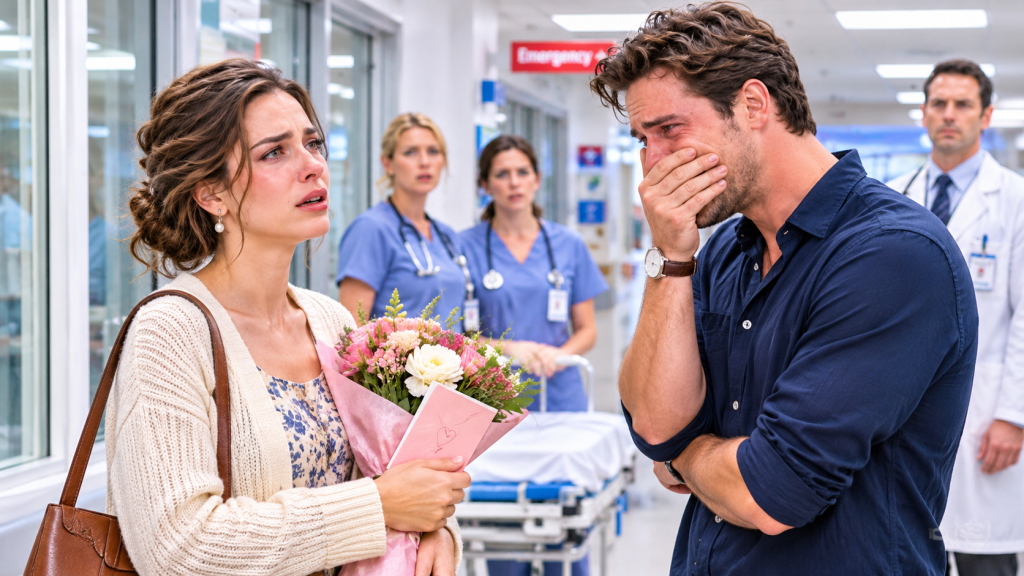
Now he was standing in front of me, carrying a truth he had been too frightened to tell his own. I shook my head. “No.” Owen’s eyes filled. “Sweetheart—” “No, you don’t get to say something like that and then look away.” My voice broke. “You don’t get to tell me you have leukemia and that you might die without explaining what’s happening.” He tried to speak, but his face crumpled. For a moment, he looked nothing like the confident surgeon I knew. He looked like a frightened man who had finally run out of places to hide. “I’m sorry,” he whispered. I began crying. “Then tell me everything.” He reached toward me.
This time, I took his hand.
And for the first time in nearly a year, my husband stopped pretending he was fine.
My name is Evelyn Carter.
I was thirty-eight years old when I discovered my husband had been secretly receiving treatment for leukemia.
Owen was forty-one.
We had been married for eleven years, and I believed I knew almost everything about him.
I knew he hated mushrooms.
I knew he couldn’t fall asleep without checking the front door twice.
I knew he loved old jazz records and always cried during the ending of the same Christmas movie.
I knew the scar above his eyebrow came from falling off his bicycle when he was nine.
And I knew that when our daughter Sophie was born, he held her against his chest and whispered, “I’ve done some important things in my life, little girl, but nothing as important as becoming your daddy.”
For years, we were happy.
Not the kind of happiness people post in photographs.
The real kind.
Messy.
Ordinary.
Full of forgotten groceries, mismatched socks, and arguments about who’d left the lights on downstairs.
Owen was a surgeon at St. Catherine’s Medical Center.
His work was demanding, but he loved it.
I worked as a high school librarian, which meant my days were filled with teenagers, overdue books, and more questions than anyone could possibly answer.
Our schedules weren’t always easy.
But we made time for one another.
Sunday breakfasts.
Walks after dinner.
Friday movie nights with Sophie.
And one evening every month when Owen and I went somewhere without our daughter, even if it was only to the little diner on Maple Street.
Then, almost a year before my hospital visit, everything began changing.
At first, the changes were small.
Owen stopped eating breakfast.
He complained about being tired.
He began bruising easily, though he blamed it on bumping into equipment at work.
Sometimes he had a fever and insisted it was nothing.
He grew pale.
He lost weight.
But whenever I asked whether he was feeling all right, he smiled.
“Long week, sweetheart.”
I believed him.
Because he was a doctor.
Because I trusted him.
And because sometimes the people closest to us become the people whose explanations we question the least.
Gideon helped Owen back into the hospital chair.
I sat opposite him, gripping the drawing.
“Start at the beginning,” I said.
Owen nodded.
“Eleven months ago, I started feeling exhausted all the time.”
I swallowed.
“I remember.”
He looked down.
“I thought I was overworking. Then I started getting infections I couldn’t shake.”
His voice trembled.
“One morning, I nearly fainted in an operating room.”
I stared at him.
“What?”
“Gideon noticed I wasn’t well. He insisted I get checked.”
I looked toward his colleague.
Gideon nodded.
“The preliminary blood tests showed abnormalities. Further testing confirmed leukemia.”
I turned back to Owen.
“And you didn’t tell me?”
Tears filled his eyes.
“At first, I was going to.”
“What happened?”
He took a shaky breath.
“I needed time to understand it myself.”
I nodded slowly.
I could understand that.
A few hours.
A few days.
Perhaps even a short period to gather information before sharing frightening news.
But eleven months?
I stared at him.
“And then?”
He closed his eyes.
“Then the treatment began.”
I felt something twist inside my chest.
“While you were telling me you were working?”
He nodded.
“Yes.”
I looked at his thin arms.
The bruises.
The exhaustion.
The hollow cheeks.
I remembered all those nights I’d put his dinner in the refrigerator.
All those mornings I’d found him sleeping on the couch because he’d come home too tired to climb the stairs.
I remembered being angry.
Feeling neglected.
Wondering whether he’d stopped loving me.
And while I’d been worrying about our marriage, my husband had been fighting a disease I didn’t even know he had.
I began crying.
“Oh, Owen.”
He reached toward me.
“I’m sorry.”
I pulled my hand away.
“Don’t.”
His expression collapsed.
I took a trembling breath.
“I’m not saying I don’t love you. I’m saying I can’t bear hearing you apologize when I don’t even understand what you’ve done.”
He nodded.
I wiped my face.
“Keep talking.”
Owen explained that the diagnosis was acute myeloid leukemia, a cancer affecting the blood and bone marrow.
He’d undergone treatment through the hematology-oncology team.
There had been an initial period when the leukemia responded.
Then the disease returned.
More treatment followed.
More hospital visits.
More uncertainty.
He had been able to continue some nonclinical work early on, but the worsening illness and treatment made operating unsafe.
He eventually stopped performing surgery.
That was another surprise.
For months, he’d left the house in his hospital scrubs with his badge clipped to his pocket.
I’d pictured him standing beneath bright operating-room lights, saving lives.
Instead, he’d often been sitting in infusion rooms or lying in hospital beds.
I looked at Gideon.
“Did everyone here know?”
He hesitated.
“Only the people who needed to know for his care and employment arrangements, and a few colleagues he told personally. Many staff members didn’t know the details.”
I nodded.
That made sense.
Owen was entitled to medical privacy.
But I couldn’t stop thinking about how he’d used that privacy to build a wall between us.
I turned toward him.
“You let me believe you were choosing work over our family.”
His eyes filled.
“I know.”
“You missed Thanksgiving.”
He lowered his head.
“I was hospitalized with a fever.”
“Our anniversary?”
“Treatment.”
“Sophie’s birthday?”
His face crumpled.
“I was too unwell to come home safely.”
I stared at him.
“She waited by the window for two hours.”
He began crying.
“I know.”
“She wore the blue dress you bought her.”
His shoulders shook.
“Please, Evelyn.”
“And when she finally went to bed, she asked whether you still liked being her daddy.”
Owen covered his face.
I stopped.
Not because I’d finished.
Because I couldn’t bear to keep speaking.
For a long time, we cried without touching.
When Owen finally looked up, he whispered, “I thought I was doing the right thing.”
I stared at him.
“How?”
He swallowed.
“Your father died when you were twenty-six.”
My chest tightened.
I knew where he was going.
My father had suffered a long illness.
During his final months, I’d spent nearly every available hour helping my mother care for him.
I loved my father dearly.
But watching him decline had changed me.
For years afterward, the smell of antiseptic could send me straight back to the hospital corridor where I’d said goodbye.
Owen knew that.
He’d held me through the nightmares.
He’d listened when I said I never wanted to experience that helplessness again.
Now he looked at me.
“You told me once that watching someone you love suffer was worse than suffering yourself.”
I swallowed.
“I said that after Dad died.”
He nodded.
“I remembered.”
I closed my eyes.
He continued.
“When the doctors told me I had leukemia, all I could think about was what you’d been through with your father.”
His voice broke.
“I couldn’t bear the thought of putting you through it again.”
I stared at him.
“So you decided to suffer alone.”
He nodded.
“And leave me wondering whether you loved me.”
Tears ran down his face.
“I didn’t think you’d ever believe that.”
I gave a broken laugh.
“Owen, you stopped coming home.”
He looked down.
“You stopped talking to me.”
He nodded.
“You missed our daughter’s birthday and wouldn’t explain why.”
His shoulders shook.
I leaned forward.
“What exactly did you think I was supposed to believe?”
For a moment, he couldn’t answer.
Then he whispered, “I wasn’t thinking clearly.”
I shook my head.
“No.”
He looked at me.
“You were frightened. And I understand being frightened.”
My voice cracked.
“But you made decisions for all three of us.”
He began sobbing.
“You decided I couldn’t handle the truth. You decided Sophie shouldn’t know. You decided our marriage would survive everything you refused to say.”
He covered his eyes.
I wiped my cheeks.
“And now I’m standing here wondering how much time we’ve lost.”
Gideon quietly excused himself to give us privacy.
Before leaving, he looked at Owen.
“Remember what we discussed.”
Owen nodded.
The words caught my attention.
“What did you discuss?”
Gideon hesitated.
Owen answered before he could.
“My next treatment.”
I turned toward him.
“What about it?”
He took a breath.
“The team wants to evaluate me for a stem cell transplant.”
I stared at him.
“Is that good?”
“It might offer a chance of longer-term disease control, depending on how things respond. But it carries serious risks.”
I swallowed.
“And what are the alternatives?”
“We’re still discussing them.”
His eyes filled.
“There’s no guarantee.”
I looked down at my hands.
For months, Owen had faced treatment decisions without me knowing they existed.
Now I was learning about possibilities and dangers all at once.
I was frightened.
But beneath that fear was something else.
Anger.
Because he had mistaken my inability to control the outcome for an inability to face the truth.
I looked at him.
“Are you asking me to make the decision?”
He shook his head.
“No.”
“Good.”
He looked surprised.
I continued.
“Because it’s your body, Owen. Your treatment. You’re the one who has to weigh what the doctors tell you.”
I reached for his hand.
“But I want to know what’s happening. I want us to talk. I want to be allowed to be your wife.”
His face crumpled.
“I don’t deserve you.”
I shook my head.
“Don’t say that.”
He looked at me.
“Then what should I say?”
I squeezed his hand.
“The truth.”
He began crying again.
Before I left the room that afternoon, I picked up Sophie’s drawing.
The three figures stood beneath a bright yellow sun.
She’d made herself the tallest.
Owen was wearing his surgical mask.
I had a ridiculous purple dress.
There was a big red heart above us.
I looked at the writing on the back.
Before she learns why.
“Owen,” I whispered, “why did you keep this?”
His expression softened.
“She drew it at school.”
“I know. I remember putting it on the refrigerator.”
He nodded.
“One morning, I took it with me.”
I stared at him.
“Why?”
His eyes filled.
“Because I’d just been told the leukemia had come back.”
I swallowed.
He continued.
“I kept looking at that picture and wondering how to explain why Daddy wasn’t home.”
I looked down.
“So you wrote those words.”
He nodded.
“I meant to write her a letter.”
My eyes filled.
“Did you?”
He looked away.
“Yes.”
I stared at him.
“Where is it?”
He hesitated.
Then glanced toward a small cabinet beside the hospital bed.
“There are several.”
A chill moved through me.
“Several?”
He nodded.
“One for every birthday I might miss.”
My heart broke.
But before I could respond, he added something even worse.
“And one for the day she asks why I didn’t fight harder to stay.”
I stared at him.
Then whispered, “Owen, what aren’t you telling me now?”
He closed his eyes.
For a moment, I thought he was going to retreat behind another excuse.
Instead, he whispered, “The doctors have been asking me whether I still want to continue aggressive treatment.”
I felt the air leave my lungs.
“And?”
He looked at me with unbearable sadness.
“I told them I wasn’t sure.”
I drove home with Owen’s uneaten lunch beside me.
The apple pie sat untouched inside its container.
The little handwritten note had become damp where tears had fallen across it.
You don’t have to take care of everyone. Let me have a turn.
I’d written those words believing my husband needed a break from work.
I hadn’t known how desperately he needed permission to stop pretending he was invincible.
When I reached our house, Sophie’s bicycle lay on its side near the front steps.
Her pink helmet rested beside it.
Through the window, I could see her sitting at the dining table with her grandmother, Margaret, who had come over to help while I was at the hospital.
Sophie looked up when I opened the door.
“Mommy!”
She ran toward me.
I knelt and held her tightly.
“Hello, sweetheart.”
She pulled back.
“Did Daddy like his lunch?”
I stared at her.
Then looked toward the bag in my hand.
My throat closed.
“Sweetheart, Daddy wasn’t feeling very well today.”
Her expression changed.
“Is he sick?”
I swallowed.
There it was.
The question Owen had been avoiding for almost a year.
I looked at my daughter.
Then remembered the promise I’d made in the hospital.
No more lies.
I took her hand.
“Yes, Sophie.”
Her eyes widened.
“Very sick?”
I glanced toward my mother-in-law.
Margaret stood quietly near the table.
She looked concerned, but she didn’t interrupt.
I turned back to Sophie.
“Daddy has an illness that affects his blood. He’s been getting treatment at the hospital.”
My daughter stared at me.
For several seconds, she didn’t speak.
Then she whispered, “Is that why he missed my birthday?”
Tears filled my eyes.
“Yes, sweetheart.”
Her lower lip trembled.
I pulled her close.
“Oh, baby.”
She began crying.
And I realized that the truth might hurt her.
But at least now she would know that her father’s absence had never meant he loved her less.
Sophie cried for nearly twenty minutes.
Not loudly.
Not the way she’d cried when she fell from her bicycle or lost her favorite stuffed rabbit.
She cried quietly, with her face pressed into my shoulder.
Every few minutes, she’d ask another question.
“Does Daddy hurt?”
“Sometimes he’s uncomfortable, sweetheart. His doctors are helping him.”
“Can he come home?”
“We’re hoping he can when it’s safe.”
“Did I make him sick?”
That question struck me like a blow.
I pulled back and looked directly into her eyes.
“No, Sophie. Absolutely not.”
She sniffled.
“Because I got mad when he missed my birthday.”
I shook my head.
“Being angry doesn’t make someone sick. Nothing you said or did caused Daddy’s illness.”
Her eyes filled again.
“Then why didn’t he tell me?”
I took a breath.
“Because he was scared, and he made a mistake about how to handle that fear.”
She considered my answer.
Then whispered, “Daddy gets scared?”
I smiled sadly.
“Everybody does, sweetheart.”
She looked surprised.
Even at eight, Sophie thought of her father as someone who could fix almost anything.
Broken toys.
Loose cabinet doors.
Scraped knees.
For years, he’d been the man who caught her when she jumped into swimming pools and carried her through thunderstorms because she was afraid of lightning.
I wondered whether learning that he was frightened would change how she saw him.
Then she asked something that made me realize children often understand love more clearly than adults.
“Can I tell him I’m scared too?”
I began crying.
“Yes, baby.”
She wrapped her arms around me.
“Then maybe we can be scared together.”
Margaret stayed after Sophie went to bed.
She was sixty-eight, a retired elementary school teacher with silver hair and a habit of folding dish towels into impossibly neat rectangles.
She’d always treated me like a daughter.
When Owen and I married, she gave us a handwritten cookbook containing recipes from three generations of her family.
On the inside cover, she’d written:
The best meals are the ones that bring people back to the table.
That night, she stood beside the kitchen sink while I told her everything.
The leukemia.
The treatments.
The missed holidays.
The possibility of a transplant.
And the letters Owen had written for Sophie.
By the time I finished, she was crying.
“My boy,” she whispered.
I stared at her.
“You didn’t know?”
She shook her head.
“No.”
Then she looked toward the stairs.
“He told me he’d been taking extra shifts.”
I closed my eyes.
“That’s what he told me.”
Margaret gripped the edge of the counter.
“I asked him last month why he looked so thin. He said he’d been working too hard.”
Tears slipped down her cheeks.
“I told him he needed to slow down.”
She covered her face.
“I didn’t know.”
I reached for her.
She leaned against me and cried.
For a while, we stood together in the kitchen.
Two women who loved the same man.
Both discovering he’d been suffering behind a locked door neither of us knew existed.
Then Margaret whispered, “He’s always been like this.”
I pulled back.
“What do you mean?”
She wiped her face.
“When he was little, he’d hide injuries because he didn’t want anyone to worry.”
I looked at her.
“Once, when he was ten, he broke his wrist falling out of a tree. He came home and insisted he’d only bumped it.”
Despite everything, I almost smiled.
“That sounds like Owen.”
Margaret nodded.
“His father had been ill that year, and Owen didn’t want me to have another problem.”
She looked down.
“I used to praise him for being so brave.”
Her voice broke.
“Maybe I should have taught him that brave people ask for help too.”
I squeezed her hand.
“Margaret, you didn’t cause this.”
She nodded, though her eyes remained sad.
Then she looked toward Sophie’s bedroom.
“But we can make sure she learns something different.”
I followed her gaze.
“Yes.”
And that became our first promise.
Whatever happened with Owen, Sophie would never be taught that loving people meant hiding the truth from them.
The next morning, I returned to the hospital.
This time, I didn’t bring a surprise lunch.
I brought a notebook.
A pen.
And a list of questions.
Owen was sitting upright when I entered.
His eyes widened.
“Evelyn?”
I placed my handbag on the chair.
“Good morning.”
He looked uncertain.
“How’s Sophie?”
I took a breath.
“She knows you’re sick.”
His expression changed.
I watched pain move across his face.
“She does?”
I nodded.
“She asked why you missed her birthday.”
He closed his eyes.
“What did you say?”
“The truth.”
He lowered his head.
I sat beside him.
“And she wants to see you.”
His eyes filled.
“Does she?”
“Yes.”
A tear slipped down his cheek.
I continued.
“But before that happens, we need to speak with her carefully. We’ll ask the team what kind of visit is suitable and how to explain things in a way she can understand.”
He nodded.
Then whispered, “Is she angry?”
I thought about my daughter crying against my shoulder.
“She’s frightened.”
Owen covered his face.
I reached for his hand.
“And she loves you.”
He began sobbing.
For the first time since our marriage began, I watched my husband cry without attempting to stop him.
I didn’t tell him to be strong.
I didn’t say everything would be fine.
I simply sat beside him.
And let him be a human being.
Later that morning, we met with Dr. Lena Patel, the hematologist overseeing Owen’s treatment.
With Owen’s permission, she explained his situation.
The leukemia had returned after initial treatment.
His medical team was assessing whether additional therapy could bring the disease into sufficient control for a stem cell transplant.
The procedure might offer a chance of durable remission.
But it carried significant risks, including serious infection, graft-versus-host disease, and complications that could threaten his life.
There were also other treatment and supportive-care options to discuss.
I wrote everything down.
Then asked, “Is he refusing treatment?”
Dr. Patel glanced toward Owen.
“He’s expressed uncertainty about continuing intensive therapy.”
I looked at my husband.
He stared at his hands.
The doctor continued.
“That’s a decision we need to explore carefully. We want to understand his goals, how he’s weighing the potential benefits and risks, and whether symptoms such as depression or fear are affecting his ability to consider his options.”
I nodded.
“Could he still recover?”
She answered cautiously.
“Some patients with relapsed leukemia achieve another remission and proceed to transplant. Others don’t respond as hoped. I can’t promise an outcome.”
I swallowed.
“But there is still a possibility.”
“Yes.”
I looked at Owen.
He seemed almost ashamed.
I felt anger stirring.
Not because he’d considered stopping treatment.
He had every right to discuss the burdens of continuing.
But because he’d been trying to make that decision while hiding the very people who could help him understand what mattered most to him.
I turned toward Dr. Patel.
“Can we arrange for someone to help us talk through all of this?”
She nodded.
“We can involve our counseling and palliative-care teams. Palliative care can help with symptoms, emotional distress, and decision-making alongside disease-directed treatment.”
I squeezed Owen’s hand.
He looked up.
And for the first time, I saw something other than exhaustion in his eyes.
Not certainty.
Not even hope exactly.
But the possibility that he didn’t have to carry every decision alone.
That afternoon, Gideon came to see me in the family waiting room.
He held two cups of coffee.
He placed one on the table beside me.
“Thought you might need this.”
I smiled weakly.
“Thank you.”
He sat down.
For a while, we watched people move through the corridor.
Then I asked, “How long have you known?”
He looked down.
“Since the beginning.”
I nodded.
“And you never told me.”
He took a slow breath.
“Evelyn, I wanted to. More than once.”
I stared at him.
He continued.
“Owen was my friend, but he was also a patient with a right to privacy. I couldn’t disclose his diagnosis without permission.”
I looked toward the floor.
“I understand that part.”
He nodded.
“But I kept urging him to tell you.”
My eyes filled.
“Did he ever explain why he wouldn’t?”
Gideon’s expression saddened.
“He said he was trying to give you another ordinary year.”
I gave a bitter laugh.
“Ordinary?”
He looked down.
“Our marriage was falling apart.”
Gideon nodded.
“I know.”
I stared at him.
“Did he know?”
Gideon hesitated.
Then answered quietly.
“I don’t think he understood how much his secrecy was hurting you.”
I closed my eyes.
For months, Owen had been so focused on shielding us from the future that he hadn’t noticed what he was doing to the present.
Gideon continued.
“There’s something else I think you should know.”
My stomach tightened.
I turned toward him.
“What?”
He hesitated.
“Last winter, Owen asked me to help him arrange a family portrait.”
I frowned.
“A portrait?”
Gideon nodded.
“He said he wanted a photograph of the three of you.”
I stared at him.
“He already has hundreds.”
“That’s what I told him.”
Gideon swallowed.
“But he said he wanted one taken after you knew the truth.”
My breath caught.
“He was planning to tell us?”
“Yes.”
I looked at him.
“When?”
Gideon’s eyes filled.
“At Christmas.”
My chest tightened.
I remembered Christmas.
Owen had promised to be home by noon.
Sophie had arranged three stockings above the fireplace.
I’d bought him a new watch.
But he never came.
At seven that evening, he’d called to say he was needed at the hospital.
I’d been furious.
I hadn’t spoken to him for most of the next day.
Now Gideon looked at me.
“He’d written down what he wanted to say.”
Tears gathered in my eyes.
“But that morning, his blood counts were dangerously low, and he developed a serious infection. He was admitted for treatment.”
I covered my mouth.
Gideon continued.
“He asked me to tell you he was working.”
I looked away.
“And you did?”
He shook his head.
“No. He called you himself.”
I thought about the call.
The faint sound of hospital equipment in the background.
The strain in Owen’s voice.
The way he’d apologized before hanging up.
I’d believed he was exhausted from another emergency operation.
I began crying.
Gideon’s voice softened.
“He was going to tell you, Evelyn.”
I wiped my face.
“But he didn’t.”
Gideon nodded.
“No.”
We sat quietly.
Then he said, “I think the idea of telling you became more frightening to him every time he postponed it.”
I looked toward the corridor.
“And now?”
Gideon sighed.
“Now he has to learn that fear doesn’t become smaller simply because you hide it.”
Two days later, Sophie visited her father.
We prepared her beforehand.
A child-life specialist helped explain what she might see.
We told her that Owen looked thinner, that some equipment might be nearby, and that she didn’t need to touch anything she found frightening.
She could ask questions.
She could take breaks.
And she could decide how close she wanted to sit.
Sophie listened carefully.
Then asked whether she could bring her stuffed bunny, Juniper.
“Of course,” I said.
She hugged Juniper tightly.
“Then I think I’m ready.”
When we entered Owen’s room, he was sitting in a chair beside the window.
He’d put on a clean sweater.
His hair was much thinner than before.
He looked nervous.
Sophie stopped in the doorway.
For a moment, she stared.
Then whispered, “Daddy?”
Owen’s eyes filled.
“Hi, sweetheart.”
She looked at his face.
“You’re really skinny.”
He laughed softly through his tears.
“I know.”
She stepped closer.
“Does it hurt?”
“Some things are uncomfortable, but the doctors are helping me.”
She nodded.
Then looked at me.
I smiled encouragingly.
Sophie approached her father.
“Can I hug you?”
His face crumpled.
“Of course.”
She wrapped her arms around him gently.
Owen closed his eyes.
I watched his shoulders shake.
For a long time, neither spoke.
Then Sophie whispered against his sweater, “I thought you forgot my birthday.”
Owen began sobbing.
“Oh, sweetheart.”
She pulled back.
“Did you?”
He shook his head.
“Never.”
Her lip trembled.
“Then why didn’t you come?”
He took a shaky breath.
“Because I was receiving treatment, and I wasn’t well enough to be home.”
Sophie studied him.
“You could have told me.”
Tears ran down his face.
“Yes.”
She looked down.
“I was really sad.”
Owen swallowed.
“I know.”
“And Mommy was sad too.”
He glanced toward me.
I nodded.
Sophie continued.
“I thought maybe you liked the hospital more than us.”
Owen covered his mouth.
When he could speak, he whispered, “Nothing in the world is more important to me than you and Mommy.”
She considered that.
Then asked, “Then why didn’t you tell us the truth?”
Owen took her little hands.
“Because I was scared and made a bad decision.”
She stared at him.
“Grown-ups make bad decisions?”
He laughed weakly.
“Sometimes very bad ones.”
She nodded thoughtfully.
Then said, “Next time, can you just tell us?”
His face crumpled.
“I promise I’ll try my very best.”
I watched him.
And realized that promise, modest as it sounded, mattered more than any dramatic declaration.
Before we left, Sophie reached into her backpack.
She pulled out a folded piece of paper.
“Daddy, I made you something.”
Owen smiled.
“What is it?”
She unfolded the paper.
It was another drawing.
Three figures stood beneath a yellow sun.
But this time, the figures weren’t all smiling.
One lay in a hospital bed.
One held a book.
The smallest stood between them holding both their hands.
Above them, Sophie had written:
Families can be scared together.
Owen stared at the drawing.
His eyes filled.
“Where did you learn that?”
Sophie shrugged.
“Mommy said everybody gets scared.”
She looked at him.
“And Grandma said being brave doesn’t mean hiding it.”
Owen began crying.
Sophie carefully placed the drawing in his lap.
Then said, “You can keep this one too.”
He nodded.
“Thank you, sweetheart.”
She smiled.
“But you have to come home when the doctors say it’s okay.”
Owen looked at her.
“I’ll do everything I can to get well enough to come home safely.”
She seemed satisfied.
Then she leaned toward him.
“And Daddy?”
“Yes?”
“Even if you can’t do surgery anymore, you’re still my daddy.”
He began sobbing.
And I realized our daughter had given him something no doctor could prescribe.
The certainty that his value to us had never depended on what he was strong enough to do.
The weeks that followed were difficult.
Owen continued meeting with his medical team.
There were further tests.
Treatment discussions.
And days when he felt overwhelmed.
At one point, he told me he was frightened that trying another intensive treatment would mean spending whatever time he had left inside a hospital.
I listened.
Then asked what the doctors had explained about the possibilities.
We reviewed the information together.
We asked questions.
We talked about what mattered most to him.
Time with Sophie.
Comfort.
Being mentally present.
The possibility of returning to meaningful activities.
And the desire to pursue treatment if it offered a reasonable chance of benefit consistent with his goals.
Sometimes we disagreed.
Sometimes we cried.
But we no longer pretended disagreement meant disloyalty.
Eventually, after considering his options with the medical team, Owen chose to proceed with further treatment and transplant evaluation.
He also began meeting with a counselor.
Not because his fear was wrong.
Because his fear had become something he couldn’t manage safely by himself.
For the first time in months, he allowed others to help without apologizing for needing them.
One evening, while Owen rested, I opened the small cabinet beside his hospital bed.
He’d given me permission to take home the letters he’d written for Sophie.
There were twelve envelopes.
One for her ninth birthday.
Another for her tenth.
Then eleven.
Twelve.
Thirteen.
All the way to her twentieth.
I sat beside the bed, staring at them.
Each had been written because Owen feared he might not be there to celebrate.
I held one against my chest.
He watched me quietly.
“Are you angry?”
I looked up.
“No.”
His eyes filled.
“Then why are you crying?”
I took a breath.
“Because you were preparing to miss her entire childhood.”
He looked down.
“I was afraid.”
I nodded.
“I know.”
He swallowed.
“I wanted her to have something from me.”
I touched the envelopes.
“That’s beautiful, Owen.”
He looked surprised.
I continued.
“But you don’t have to spend all your remaining strength writing goodbye letters.”
His expression changed.
I leaned closer.
“You can write ordinary letters too.”
He stared at me.
“Ordinary?”
I nodded.
“Tell her about your favorite childhood memories. The first time you saw snow. The day you learned to swim. The terrible haircut you had when you were twelve.”
He laughed through tears.
“That haircut was unfortunate.”
I smiled.
“Very.”
I squeezed his hand.
“Give her stories about who you are, not only messages about who you’ll be if you’re gone.”
His eyes filled.
“That sounds better.”
I nodded.
“And we can make them together.”
For a long moment, he looked at me.
Then whispered, “I’d like that.”
The next surprise came from Margaret.
She visited one Saturday carrying a wooden box.
It was old, with brass hinges and a small faded label.
She placed it on the hospital table.
“Owen, I found something.”
He frowned.
“What is it?”
She opened the box.
Inside were photographs, handwritten notes, and a collection of envelopes.
I recognized the handwriting on several.
Owen’s father.
Henry Carter.
He’d died when Owen was seventeen.
Margaret lifted one envelope.
“Your father wrote these during his final illness.”
Owen stared at her.
“What?”
She nodded.
“He asked me to keep them until I thought you’d be ready.”
I looked at her.
Owen’s face had gone pale.
“You never told me.”
Margaret’s eyes filled.
“I know.”
For a moment, I saw the familiar pain of another hidden truth.
But Margaret continued before Owen could speak.
“And I was wrong to decide on my own when you should see them.”
She took his hand.
“I kept telling myself I was protecting you from grief.”
Owen stared at the letters.
Tears gathered in his eyes.
She whispered, “I think I was afraid of facing it with you.”
The room fell silent.
I understood then that Owen had learned his terrible habit somewhere.
Not through cruelty.
Through a family tradition of hiding pain because nobody wanted to burden anyone else.
Margaret wiped her cheeks.
“I don’t want us doing that anymore.”
Owen began crying.
He opened the first letter.
And for several minutes, he read silently.
Then he looked toward the ceiling, tears slipping down his face.
“What does it say?” I asked softly.
He handed me the page.
Near the bottom, Henry had written:
My son, if there is one thing I hope you remember, it’s this: being loved is not a debt you must repay by never needing anything.
I looked at Owen.
He was crying so hard he could barely speak.
Margaret held him.
And in that hospital room, three generations of fear finally began losing their grip.
Owen’s next months were the hardest our family had ever faced.
The additional treatment was exhausting.
Some days he could barely manage a conversation.
Other days, he felt strong enough to sit beside the window, play a board game with Sophie, or laugh at one of Gideon’s terrible jokes.
We learned to celebrate ordinary victories.
A meal he could enjoy.
An afternoon without a fever.
A walk down the hospital corridor.
A night when he slept peacefully.
Eventually, his doctors told us that the leukemia had responded sufficiently for the transplant team to move forward with their plan.
An unrelated donor had been identified through a registry.
I remember the day we received that news.
Owen sat beside me, his hands trembling.
Dr. Patel explained what came next.
The preparation.
The risks.
The lengthy recovery.
The possibility of complications.
She was careful not to promise a cure.
I appreciated that.
We’d spent too long living behind comforting statements that concealed difficult truths.
When she finished, Owen looked at me.
“Are you scared?”
I nodded.
“Terrified.”
His eyes filled.
“Me too.”
I reached for his hand.
For the first time, neither of us tried to make the other feel better with promises we couldn’t guarantee.
We simply sat together.
And that was enough.
The transplant went ahead.
Afterward came a long period of monitoring and recovery.
There were complications.
A serious infection.
Days of nausea and weakness.
Times when the doctors had to adjust medications.
And one frightening night when Owen developed a high fever and required urgent assessment.
I remember sitting outside his room while the medical team worked.
Gideon found me there.
He sat beside me without speaking.
After a while, I whispered, “I thought I was prepared.”
He looked at me gently.
“No one can be prepared for every frightening moment.”
I began crying.
“Sometimes I wish I didn’t know how serious this is.”
Gideon remained quiet.
Then I shook my head.
“No.”
He looked at me.
“I don’t mean that.”
He nodded.
I wiped my face.
“Even when the truth hurts, I’d rather be here.”
His expression softened.
“Then be here.”
I looked toward Owen’s room.
“And let the rest be something we face one day at a time.”
During those months, Sophie changed too.
She was still an ordinary eight-year-old girl.
She loved glitter pens.
Hated broccoli.
And believed the family dog understood every word she said.
But she also began asking questions that showed how much she was thinking.
“Will Daddy’s hair grow back?”
“Can people with cancer laugh?”
“Do doctors get scared when they’re sick?”
We answered honestly, using explanations she could understand.
Sometimes we didn’t know the answers.
And when we didn’t, we said so.
We also made sure she had ordinary childhood days that weren’t organized around the hospital.
She went to school.
Attended birthday parties.
Played soccer.
Spent afternoons with friends.
Margaret helped when I needed to attend appointments.
A counselor at school made sure Sophie had someone to talk to outside the family.
We didn’t expect her to become brave enough to carry adult worries.
She was a child.
And she deserved to remain one.
One afternoon, when Owen was well enough for a longer visit, Sophie brought a small notebook.
She climbed into the chair beside his bed.
“Daddy?”
He smiled.
“Yes, sweetheart?”
“I have questions.”
He laughed.
“Should I be nervous?”
She nodded seriously.
“Maybe.”
I smiled from the doorway.
She opened her notebook.
“What’s your favorite dinosaur?”
Owen blinked.
“What?”
She frowned.
“It’s an important question.”
He considered it.
“Triceratops.”
She wrote it down.
“Favorite ice cream?”
“Chocolate.”
“Favorite thing about Mommy?”
Owen looked toward me.
His eyes softened.
“Everything.”
Sophie sighed dramatically.
“Daddy, you have to pick one.”
He smiled.
“All right. I love that she notices when people need kindness.”
My throat tightened.
Sophie wrote carefully.
Then looked up.
“What’s your favorite thing about me?”
Owen’s face crumpled.
He reached for her hand.
“That you are exactly who you are.”
She considered that.
Then smiled.
“That’s a good answer.”
Afterward, she explained why she was making the notebook.
“So if you forget things when you’re tired, I can remind you.”
Owen began crying.
I looked away.
Because our little girl was doing what he’d refused to let us do for nearly a year.
She was helping him.
Not because she owed him.
But because she loved him.
A year after I walked into St. Catherine’s carrying apple pie, Owen was home.
He was not the same man he’d been before his illness.
His strength was limited.
He needed regular medical follow-up.
There were lingering treatment effects and ongoing uncertainties.
But his latest evaluations showed no detectable leukemia, and his medical team continued monitoring him closely.
We knew remission wasn’t a guarantee about the future.
Yet it was something precious.
Time.
Not promised forever.
But available to us now.
Owen no longer performed surgery.
That loss hurt him.
For years, he’d defined himself through his work.
He’d loved the operating room.
The precision.
The responsibility.
The privilege of helping patients through life-changing moments.
At first, he struggled to imagine who he might be without it.
Then Gideon suggested that, if his health allowed, he could help with occasional teaching and mentoring.
Owen began participating in limited educational activities after discussing what was appropriate with his care team.
He discovered that he still had something valuable to give.
Experience.
Knowledge.
Patience.
And perhaps, after everything he’d endured, a deeper understanding of what it meant to be frightened in a hospital bed.
One evening, he returned from a short teaching session and sat beside me on the couch.
“I think I helped somebody today.”
I smiled.
“You’ve helped plenty of people.”
He looked down.
“But this was different.”
I waited.
“A young doctor told me she was afraid of admitting she didn’t know something.”
He smiled sadly.
“I told her asking for help is part of doing the job well.”
My eyes filled.
“That sounds like good advice.”
He looked at me.
“Wish I’d taken it myself.”
I leaned against his shoulder.
“You’re taking it now.”
Our twelfth wedding anniversary arrived on a rainy Thursday.
We didn’t go to a fancy restaurant.
We didn’t exchange expensive gifts.
We stayed home.
Sophie spent the evening with Margaret, and Owen arranged dinner from the little Italian restaurant where we’d had our first date.
He set the table with candles.
Placed two glasses beside our plates.
And brought out a small dish containing a slice of apple pie.
I laughed when I saw it.
“Owen.”
He smiled.
“Remember?”
My eyes filled.
“How could I forget?”
He reached across the table.
“I’ve been wanting to tell you something.”
I squeezed his hand.
“All right.”
He took a slow breath.
“I used to think being a good husband meant protecting you from everything difficult.”
I smiled sadly.
“I know.”
He nodded.
“But all I really did was make you feel alone.”
Tears gathered in my eyes.
He continued.
“I can’t give you back the holidays I missed. Or the nights you cried. Or the months I made you wonder whether I still loved you.”
I shook my head.
“Owen—”
“Please.”
I went quiet.
He swallowed.
“I need to say it.”
I nodded.
He looked directly into my eyes.
“I’m sorry I made decisions about your life without asking you. I’m sorry I let fear become dishonesty. And I’m sorry I forgot that marriage means trusting someone with the parts of yourself you’re most afraid to show.”
Tears slipped down my cheeks.
He squeezed my hand.
“I don’t know what the future holds.”
I nodded.
“Neither do I.”
“But I know I don’t want to spend another day pretending I can face it alone.”
I leaned forward.
“Then don’t.”
He began crying.
I wrapped my arms around him.
And for a long time, we held each other beside the candlelit table.
There is something I wish people understood about forgiveness.
It isn’t the moment pain disappears.
It isn’t pretending that something terrible never happened.
And it isn’t an obligation to trust immediately simply because someone has apologized.
Forgiveness, for me, came slowly.
Through conversations.
Through difficult nights.
Through watching Owen tell the truth even when it frightened him.
Through seeing him accept help without making me feel guilty for offering it.
Some days, I still remembered all those untouched dinners.
The lonely holidays.
The disappointment in Sophie’s eyes when her father didn’t come home.
And I felt angry.
I told Owen when that happened.
He listened.
He didn’t demand that I stop.
And little by little, the anger no longer needed to carry the whole story.
There was room for sadness.
Room for relief.
Room for love.
And, eventually, room for joy.
Last Tuesday, almost eighteen months after that first hospital visit, I found Owen in Sophie’s bedroom.
He was sitting on the edge of her bed, holding the drawing he’d kept beside him throughout treatment.
Three figures beneath a yellow sun.
The paper was worn.
The corners had softened.
I stood in the doorway.
“Everything okay?”
He looked up.
His eyes were wet.
“Yes.”
I stepped inside.
“What’s wrong?”
He smiled.
“Nothing, really.”
I sat beside him.
He turned the drawing over.
The words were still there.
Before she learns why.
I touched the handwriting.
“I remember this.”
He nodded.
“I’ve been thinking about it.”
I looked at him.
He took a breath.
“I wrote those words because I thought Sophie needed to be prepared to lose me.”
My throat tightened.
He continued.
“But I never understood what she needed most.”
I squeezed his hand.
“What was that?”
He looked toward the doorway.
“To know that whatever happened, I loved her enough to be honest.”
My eyes filled.
He reached for a pen on the bedside table.
Then hesitated.
“Do you think I can write something underneath?”
I smiled.
“It’s your drawing.”
He carefully turned the paper over.
Beneath the old words, he wrote:
Now she knows why.
Then he paused.
And added:
And she knows she was always loved.
I covered my mouth.
Owen began crying.
I leaned against him.
For a long time, neither of us spoke.
That evening, Sophie climbed into bed with a book.
Owen sat beside her.
I stood near the doorway watching them.
She looked up.
“Daddy?”
“Yes, sweetheart?”
“Will you read the next chapter?”
He smiled.
“Of course.”
She snuggled beneath the blanket.
Then said, “I’m glad you’re home.”
His eyes filled.
“So am I.”
She studied his face.
“Are you still scared sometimes?”
Owen nodded.
“Yes.”
She took his hand.
“Me too.”
He squeezed her fingers.
Then she smiled.
“But we’re together.”
Owen looked toward me.
I smiled through my tears.
“Yes,” he whispered. “We are.”
He opened the book and began reading.
His voice was softer than it used to be.
Sometimes he paused to catch his breath.
But Sophie didn’t seem to mind.
She leaned against his shoulder, listening as though there was nowhere else in the world she’d rather be.
And I stood in that doorway thinking about the woman I’d been eighteen months earlier.
The woman who believed her husband was choosing his hospital over his family.
The woman who carried apple pie through the corridors, hoping twenty minutes together might repair the distance between them.
I couldn’t change the months of secrecy.
I couldn’t guarantee how many healthy years lay ahead.
But I could recognize what we’d learned.
Love isn’t measured by how successfully we hide our pain from the people who care about us. Sometimes its greatest expression is the courage to say, “I’m frightened. Will you stay beside me?”
That night, Owen finished the chapter and kissed Sophie’s forehead.
She closed her eyes.
“Good night, Daddy.”
“Good night, sweetheart.”
Then she whispered the words that once seemed too ordinary to appreciate.
“See you in the morning.”
Owen looked at me.
His eyes filled.
He brushed a curl away from her face.
“That’s the plan, baby.”
And together, we turned off the light.
Not knowing everything tomorrow might bring.
But no longer afraid to face it honestly.