I stared at the second message until the letters blurred. “Your husband wasn’t the only person who signed.” For eight years, I had believed one of my sons was dead. I had visited an empty grave, whispered prayers into the darkness, and imagined a tiny coffin I had never been permitted to see. Now, only a few feet away, that same child was sitting beside his brother. Alive. Breathing. Waiting for someone to explain why the adults in his life had built an entire world out of lies. My fingers trembled as I tried calling the unknown number. It rang once. Then someone answered. “Laura?” The voice belonged to a woman.
Older. Familiar. But I couldn’t place it. “Who is this?” A long silence followed. Then she whispered, “You need to get the original hospital records before Mark has them destroyed.” “Who are you?” “Someone who should have spoken eight years ago.” “Then speak now!” My voice rose sharply enough that Evelyn looked toward me. The woman on the telephone began crying. “I was there when your babies were born.” My heart pounded. “Were you a nurse?” “No.” “Then who?”
She hesitated. “I was the hospital’s records administrator. My name is Margaret Bell.” The name stirred something in my memory. I had seen it before. On documents Mark brought home after the delivery. Documents I had signed while exhausted, grieving, and barely able to stand. “What did you sign?” I whispered. Margaret’s breathing became unsteady. “Not everything they told you.” Then the line disconnected. I immediately called back. No answer. I stood motionless in the principal’s office, clutching my phone. Evelyn watched me. “Laura, what happened?” I turned toward her. “Who is Margaret Bell?”
The color drained from her face.
For one terrible moment, I thought she might faint.
“Where did you hear that name?”
“She just called me.”
Evelyn covered her mouth.
“Oh, God.”
I stepped closer.
“What did she do?”
Evelyn looked toward the window separating us from the boys.
Then she whispered, “Margaret was the only person who tried to stop the transfer.”
The principal, Mrs. Henderson, offered us an empty conference room.
I asked that Cole and Stefan remain with the school counselor until the adults could speak calmly.
Neither boy deserved to overhear another frightening argument.
Before leaving the office, I knelt beside Cole.
His cheek was red, and a small scrape marked his chin.
“Mom, am I in trouble?”
I shook my head.
“No, sweetheart.”
He looked toward Stefan.
“Then why is everybody crying?”
I struggled to answer.
Because your brother is alive.
Because your father lied.
Because the world you know has changed in the time it takes to open a door.
Instead, I took his hands.
“Something very important has come up, and I need to understand it before I explain it to you.”
Cole frowned.
“Is it about Stefan?”
“Yes.”
He glanced at the other boy.
Stefan sat quietly, staring at the floor.
For the first time, I noticed how small he looked.
His shoulders were hunched as though he expected to be blamed for something.
I wanted to embrace him.
But he didn’t know me.
And despite the terrible longing burning inside my chest, I understood that he wasn’t simply the baby I had lost.
He was an eight-year-old boy with memories, fears, favorite foods, and a mother who had raised him.
I couldn’t walk into his life and expect him to understand why a stranger suddenly wanted to hold him.
So I smiled gently.
“Stefan?”
He looked up.
“Yes?”
“I’m glad you’re okay.”
He studied my face.
Then he whispered, “You look like the lady in the picture.”
“What picture?”
He hesitated.
“The one I found in Mom’s old box.”
Evelyn turned away.
“What was I doing in the picture?” I asked.
Stefan’s voice was barely audible.
“You were holding two babies.”
I pressed a hand against my mouth.
For eight years, I had been told I never held both my sons together.
And somewhere, hidden in another woman’s house, there was proof that I had.
Once the boys were with the counselor, Evelyn sat across from me in the conference room.
Mrs. Henderson remained nearby.
I asked Evelyn to tell me everything, beginning with the night of the delivery.
She folded her hands.
“Your labor was complicated. Both babies were born prematurely. Cole was stronger, but Stefan needed additional respiratory support.”
I listened without moving.
“After the delivery, you had serious bleeding. The medical team worked to stabilize you, and you were sedated during part of your recovery.”
“I remember waking up two days later.”
Evelyn nodded.
“Both boys were alive then.”
The words struck me with such force that I pressed my palms against the table.
Both boys were alive.
When Mark told me one had died, both of my children were breathing.
“Where was Stefan?”
“In neonatal intensive care.”
“Did you see him?”
“Yes.”
“Was he getting better?”
She nodded slowly.
“He was improving.”
I closed my eyes.
I remembered lying in my hospital bed, clutching Mark’s hand.
“Did he suffer?” I had asked.
Mark had kissed my forehead.
“He went peacefully, Laura.”
I had believed him.
I had thanked him for being strong enough to handle the arrangements.
The memory made me physically ill.
Evelyn continued.
“Mark approached me after the first day. He said you were psychologically unstable and that your doctor believed learning both children had survived would endanger your recovery.”
I stared at her.
“That doesn’t even make sense.”
“I know that now.”
“You were a nurse.”
Her eyes filled.
“I was. And I should have questioned him more carefully.”
I leaned forward.
“Why didn’t you?”
She swallowed.
“Because Mark didn’t just ask me to care for Stefan. He offered to help me keep him.”
Silence filled the room.
I could hear the clock ticking above the door.
“Explain,” I whispered.
Evelyn looked down.
“I had been trying to adopt for years. My husband and I couldn’t have children. Then he died, and the adoption agency closed my application. I was devastated.”
Her voice cracked.
“Mark knew. He had heard me discussing it with another nurse.”
“And he offered you my baby?”
“He told me you had agreed to an emergency private adoption because Stefan’s care would be expensive. He said you wanted Cole to have a stable beginning.”
I stared at her.
“You believed that?”
She shook her head.
“Not completely.”
“Then why did you take him?”
Tears rolled down her face.
“Because I wanted a child so badly that I convinced myself the questions didn’t matter.”
I looked away.
There are admissions so terrible that anger seems too small a response.
She had wanted to become a mother.
I had already become one.
And she had accepted a child whose mother lay unconscious in another room.
“Who signed the paperwork?” I asked.
Evelyn wiped her cheeks.
“Mark signed documents as Stefan’s father. There was also a consent form that appeared to have your signature.”
“I never agreed.”
“I know.”
“Then who signed it?”
She looked toward the door.
“Margaret Bell discovered inconsistencies in the paperwork. She argued that the hospital couldn’t release Stefan without direct verification of your consent.”
“And?”
“Mark told the administrators that your condition made communication impossible. He produced a letter supposedly written by a physician.”
I felt cold.
“Which physician?”
“Dr. Raymond Pierce.”
I remembered the name.
He was the obstetrician who had supervised my delivery.
He had retired three years afterward.
I had sent him a Christmas card every year until he moved away.
He had answered only once.
A brief handwritten message.
I hope you and your family find peace.
At the time, I thought it was kindness.
Now I wondered whether he had been asking forgiveness without having the courage to explain why.
“Did Dr. Pierce know?”
Evelyn hesitated.
“I don’t know what he knew. I only know that his name appeared on the letter.”
“Was it authentic?”
“I never saw him sign it.”
I took a slow breath.
“And Margaret?”
“She refused to process the paperwork at first.”
“What changed?”
Evelyn began shaking.
“She was suspended after Mark complained that she was interfering with your family’s medical decisions. The transfer was completed while she was away.”
I stared at her.
“Who approved it?”
“I never knew who made the final decision.”
I thought about the unknown message.
Your husband wasn’t the only person who signed.
Suddenly, I understood why Margaret had called.
She knew something about that approval.
Something the others had spent eight years hiding.
I left the school that afternoon with Cole beside me and a heart full of questions.
Stefan remained with Evelyn while the school arranged appropriate support.
Before we parted, he approached me hesitantly.
“Mrs. Bennett?”
I knelt.
“Yes, Stefan?”
“Are you Cole’s mom?”
“Yes.”
He twisted the hem of his shirt.
“Do you think we’re really brothers?”
I felt tears gather.
“I think there’s a very important truth we need to find out.”
He studied me.
“I wasn’t lying.”
I shook my head.
“I believe you were telling us what you knew.”
He glanced toward Cole.
“Everybody thought I was being mean.”
My chest ached.
“I know.”
He looked down.
“Cole hit me because I called him my brother.”
Cole flushed.
“Because you kept saying it!”
I placed a hand on my son’s shoulder.
“Cole, we’re going to talk about that.”
Stefan stepped backward.
“It’s okay.”
“No,” I said gently. “You both deserve to be treated kindly, even when you’re upset.”
The boys looked at each other.
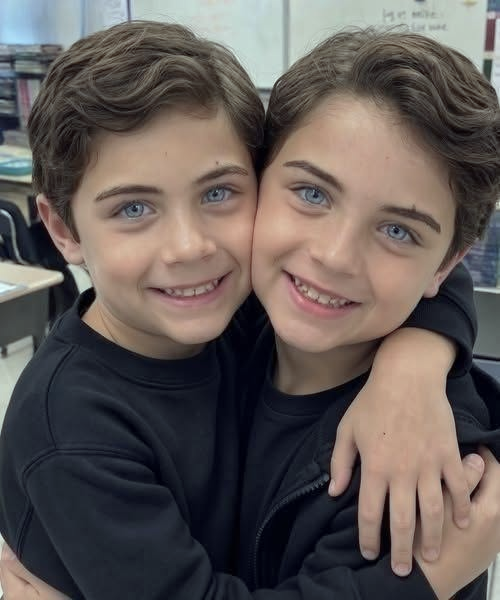
They were astonishingly alike.
Not identical in every detail, but close enough that I could see how the resemblance had troubled Stefan long before it troubled me.
Cole broke the silence.
“Why is your hair so dark?”
Stefan shrugged.
“My mom says I got it from my dad.”
I felt another sharp pain.
From the same father who had told me Stefan was dead.
Cole frowned.
“That’s weird.”
Stefan nodded.
“Yeah.”
For one fleeting moment, they looked like ordinary children again.
Confused.
Curious.
Almost amused.
Then Evelyn called Stefan toward her.
He turned to leave.
But before he reached the door, he looked back.
“Mrs. Bennett?”
“Yes?”
“Can I see you again?”
The question nearly broke me.
I forced a smile.
“I hope so, sweetheart.”
Mark was home when we arrived.
His car stood in the driveway.
I had called him three times, but he hadn’t answered.
Cole went upstairs after I told him I needed to speak privately with his father.
I waited until I heard his bedroom door close.
Then I walked into the kitchen.
Mark stood beside the counter, holding a glass of water.
He looked at me.
“Laura.”
I said nothing.
He lowered the glass.
“I can explain.”
I almost laughed.
For eight years, I had imagined the day I might finally stop blaming myself for losing one of my babies.
I had never imagined that day would begin with my husband asking for permission to explain why our child was still alive.
“Is Stefan our son?”
Mark’s face crumpled.
He didn’t answer.
He didn’t have to.
I stepped backward.
“Oh, God.”
“Laura, please.”
“Is he?”
“Yes.”
The word seemed to tear through the kitchen.
I gripped the back of a chair.
“And you told me he died.”
Mark covered his face.
“I thought I was doing what was best.”
I stared at him.
“What was best?”
“Your condition was serious. We didn’t know whether you’d recover fully. Both babies needed care, and the hospital bills were growing.”
I felt rage rise in my chest.
“So you gave one away?”
His eyes filled.
“It wasn’t that simple.”
“Then make it simple, Mark. Tell me why I buried a child who was alive.”
He sank into a chair.
“Stefan was struggling. The doctors weren’t certain what his long-term needs would be.”
“And?”
“I was terrified.”
“Of what?”
“Losing everything.”
I stared at him.
“Everything?”
“Our savings. The house. Your health. I thought if we brought home two medically fragile babies, we wouldn’t survive it.”
I shook my head.
“You didn’t get to decide that alone.”
“I know.”
“No,” I whispered. “You don’t know.”
He looked up.
“Laura—”
“You watched me cry over an empty grave.”
His mouth trembled.
“You held me while I begged God to tell me why my baby had died.”
He began sobbing.
“And you knew he was alive.”
“I was going to tell you.”
“When?”
He couldn’t answer.
“When he turned one? Five? When he graduated? When he got married?”
“Laura, please.”
I leaned toward him.
“You didn’t protect me from losing a son. You made me lose him.”
Mark tried to reach for my hand.
I stepped away.
“Don’t.”
He lowered his arm.
“I never stopped loving you.”
I stared at him.
“Love doesn’t look like this.”
He began crying harder.
But I felt strangely calm.
The kind of calm that arrives when a truth is so enormous that ordinary emotion cannot contain it.
“Did you visit Stefan?”
Mark nodded.
“How often?”
“Sometimes.”
“How often, Mark?”
“Birthdays. A few holidays. I helped with expenses.”
I closed my eyes.
While I lit candles beside an empty grave, Mark had been taking presents to our living child.
While Cole blew out birthday candles, his brother celebrated somewhere else.
While I grieved, Mark maintained two separate versions of fatherhood.
“Did Evelyn know you were married to me?”
“Yes.”
“Did she know I thought Stefan was dead?”
He hesitated.
“Eventually.”
I stared at him.
“And neither of you told me?”
Mark lowered his head.
“No.”
I turned toward the staircase.
Suddenly, I couldn’t bear the thought of Cole sleeping under the same roof as a lie that had shaped his entire existence.
I took my phone from my pocket and called my sister, Rachel.
She answered immediately.
“Laura? Everything okay?”
“No.”
My voice broke for the first time.
“Rachel, I need you to come get Cole.”
“What’s happened?”
“Please. Just come.”
She heard something in my voice.
“I’ll be there in ten minutes.”
I ended the call.
Then I looked at Mark.
“I want you to leave.”
He stared.
“Laura—”
“Not forever. Not as a final decision tonight. But I cannot sit across from you while you keep trying to make this sound like a mistake.”
He stood slowly.
“Where am I supposed to go?”
I looked at him.
“For eight years, I thought one of our sons had nowhere to come home to.”
My voice remained steady.
“You can find somewhere to sleep.”
That night, after Rachel took Cole to her house, I sat alone in the nursery we had converted into a storage room.
There were boxes filled with baby blankets.
A wooden rocking chair.
Old toys.
A tiny blue sweater my mother had knitted before the boys were born.
Two sweaters, actually.
I had kept only one.
Mark told me the other had been placed with Stefan’s belongings before the cremation.
I opened the box beneath the window.
Inside was the memory book I had made during pregnancy.
Two ultrasound photographs.
Two names written in blue ink.
Cole Alexander.
Stefan Michael.
I had chosen the names with Mark during a rainy Sunday afternoon.
He wanted strong names.
I wanted names that sounded gentle when spoken aloud.
We had laughed and argued until we settled on both.
I touched Stefan’s name.
“Where were you, sweetheart?” I whispered.
Then I corrected myself.
I knew where he had been.
He had been alive.
He had been learning to walk.
Losing his first tooth.
Starting school.
Celebrating birthdays.
And every time he reached another milestone, there had been a woman beside him who knew his biological mother existed but had never told her.
I wanted to hate Evelyn.
But I remembered Stefan’s face when he called her Mom.
Whatever she had done, she was part of his world.
I couldn’t heal my own wound by tearing apart his.
That realization made the situation even more painful.
There was no simple villain whose punishment would restore what had been stolen.
There were people who had made terrible choices.
And two innocent boys who would now have to live with the consequences.
At seven the following morning, Margaret Bell called again.
This time, she didn’t hide her number.
“Laura, I’m sorry I hung up yesterday.”
“Where are you?”
“In town.”
“Why did you contact me now?”
She hesitated.
“Because I heard about the boys at school.”
I sat upright.
“How?”
“My granddaughter attends the same school. She told me two boys who looked alike had been fighting because one claimed they were brothers.”
I closed my eyes.
“She came home talking about it, and something inside me knew.”
Margaret’s voice trembled.
“I had wondered for eight years whether you’d ever discovered the truth.”
“Then why didn’t you tell me?”
“I tried.”
I froze.
“What?”
“I wrote to you after I left the hospital. Twice.”
“I never received anything.”
“I suspected that.”
My heart pounded.
“Why?”
“Because Mark contacted me after the first letter and warned me to stay away from his family.”
I stared at the wall.
“Did you keep copies?”
“Yes.”
“Margaret, I need to see everything.”
“I know.”
She gave me an address.
It was a small house on the other side of town.
“I’ll be here,” she said.
Before ending the call, I asked one final question.
“Who else signed the papers?”
Margaret went silent.
Then she whispered a name.
“Your mother.”
For several seconds, I couldn’t breathe.
My mother.
The woman who had held me while I mourned Stefan.
The woman who had helped me choose flowers for his memorial.
The woman who had told me that God sometimes took children home before their mothers were ready.
“That’s impossible,” I whispered.
Margaret began crying.
“I wish it were.”
My mother, Helen, was seventy-four.
She lived fifteen minutes away in the house where I grew up.
For eight years, she had visited every Sunday.
She baked Cole’s birthday cakes.
She helped with homework.
She gave me advice when I felt overwhelmed.
And every year, on the anniversary of Stefan’s supposed death, she accompanied me to the cemetery.
I couldn’t reconcile that woman with the name Margaret had whispered.
I drove to Margaret’s house first.
She met me at the door with a thick folder.
She looked older than I remembered.
Her hair was white, her shoulders slightly stooped, and her hands trembled as she handed me the documents.
“I’ve kept these because I always believed someone would eventually need them.”
We sat at her dining table.
She opened the folder.
There were hospital forms.
Copies of correspondence.
Internal notes.
And a document bearing my mother’s signature.
Helen Parker.
I stared.
“What did she sign?”
Margaret pointed toward a paragraph.
“She signed as someone who had supposedly witnessed your consent.”
I shook my head.
“But I was unconscious.”
“Yes.”
“Did she know that?”
Margaret nodded.
“According to the records, she was present when the document was prepared.”
My stomach twisted.
“Why would my mother do that?”
Margaret’s eyes filled.
“I can’t tell you what she was thinking.”
I studied the paper.
There were two signatures beneath the consent section.
One was Mark’s.
The other appeared to be mine.
I recognized the shape of the letters.
But something was wrong.
The signature looked almost too careful.
As though someone had practiced it.
“This isn’t mine.”
Margaret nodded.
“I questioned it.”
“Then why was the transfer allowed?”
She took a deep breath.
“The document was presented to the person responsible for authorizing the arrangement. My objections were overruled. I was removed from the case.”
“By whom?”
She handed me another page.
Dr. Raymond Pierce.
His name appeared beside a notation supporting the transfer.
I stared at it.
The truth was beginning to form.
Mark.
Evelyn.
My mother.
A doctor.
And a forged signature.
This was no longer a misunderstanding.
It was an organized deception.
I left Margaret’s house with copies of the records and drove directly to my mother’s.
She was in the garden when I arrived.
Her favorite roses were blooming beside the fence.
She looked up and smiled.
“Laura! What a surprise.”
I stood at the gate.
“Mom, I need to ask you something.”
She noticed my expression.
Her smile faded.
“What’s wrong?”
I held up the documents.
“Did you sign paperwork giving Stefan away?”
The watering can slipped from her hand.
Water spilled across the path.
She stared at me.
For a moment, she looked as though she might deny everything.
Then her shoulders dropped.
“Oh, Laura.”
I stepped backward.
“No.”
She began crying.
“Sweetheart—”
“No!”
The word escaped like a scream.
“You knew?”
She covered her face.
I looked at the woman who had taught me to tell the truth.
The woman who punished me for lying about a broken lamp when I was seven.
The woman who once said honesty was the foundation of every family.
“You knew Stefan was alive?”
She nodded.
My knees weakened.
I grabbed the gate.
“Why?”
She began shaking.
“Because I thought I was saving you.”
I stared at her.
“Saving me from what?”
She took a step toward me.
“You nearly died, Laura. You were so weak. Mark was beside himself. The doctors said you needed rest, and Stefan was very sick.”
“That was not your decision!”
“I know.”
“Then why did you sign?”
She began sobbing.
“Mark told me you might die if you woke up and learned you had two sick babies to care for.”
I shook my head.
“Did a doctor tell you that?”
She hesitated.
“No.”
I looked away.
“He told you.”
“Yes.”
“And you believed him?”
“I was terrified of losing you.”
I thought about Stefan.
An infant fighting to breathe.
A baby who needed his mother.
And I thought about my own mother, standing beside a form that would separate us.
“You were so afraid of losing your daughter,” I whispered, “that you helped me lose my son.”
She cried harder.
“I’ve regretted it every day.”
I looked at her.
“Then why didn’t you tell me?”
Her silence was answer enough.
Because after the first lie, the truth had become too expensive.
Because admitting what she’d done meant risking my love.
Because the longer she waited, the more terrible the confession became.
And because, for eight years, protecting herself had been easier than protecting me.
I did not let my mother embrace me.
I left the garden and sat in my car.
My hands shook so violently that I couldn’t start the engine.
For several minutes, I stared through the windshield.
I had lost my husband that morning.
Now I had lost the mother I thought I knew.
But perhaps the most painful discovery was realizing that I had never truly lost Stefan.
He had been taken from me.
There was a difference.
Death is a cruelty we cannot negotiate with.
But this had been a decision.
A decision made by people who claimed to love me.
I called Rachel.
She answered on the first ring.
“Laura?”
“Did you know?”
A long silence followed.
My heart sank.
“Rachel?”
“No,” she whispered. “I swear I didn’t.”
I started crying.
She continued.
“Mom called me last night. She was hysterical. She said something terrible was going to come out.”
I closed my eyes.
“It’s Stefan.”
“What?”
“He’s alive.”
Rachel made a small sound.
Then she began sobbing.
“Oh, Laura.”
For years, Rachel had been the person who stood beside me at the cemetery.
She had helped me through the worst days.
And now, finally, there was someone whose grief seemed as honest as mine.
“Come home,” she said.
I wiped my face.
“I can’t. Not yet.”
“Where are you?”
“Outside Mom’s house.”
Rachel went quiet.
Then she said, “Laura, don’t make any decisions while you’re sitting there alone. Let me come get you.”
I looked toward the garden.
My mother was standing near the gate.
She looked smaller than I had ever seen her.
But I couldn’t go back.
Not yet.
“I’m okay,” I whispered.
It wasn’t true.
But I was beginning to understand that being okay wasn’t the same as being able to continue.
And somehow, I had to continue.
For Cole.
For Stefan.
For the eight years neither of them could ever get back.
The next two weeks became a blur of attorneys, documents, meetings, and questions.
I hired an attorney named Sarah Mitchell, who specialized in family law and cases involving disputed parentage.
She listened without interrupting as I told her everything.
When I finished, she folded her hands.
“Laura, we need to establish the facts carefully.”
“I know he’s my son.”
“I understand why you believe that. The resemblance and the documents are significant. But we need proper testing and a review of the legal records.”
I nodded.
“What happens to Stefan?”
“That depends on his current legal status and the findings. We should make his safety and emotional well-being central to every step.”
I swallowed.
“Will Evelyn lose him?”
Sarah paused.
“It’s too early to say. We need to understand the legal arrangement and whether it was valid. We also need to remember that Stefan has an established relationship with her.”
I looked down.
“I don’t want to destroy his life.”
“Then that should guide how we proceed.”
She arranged for a formal review of the documents and discussed appropriate genetic testing through legal channels.
I contacted the hospital.
They referred the matter to their legal and compliance departments.
An investigation began.
Authorities were also notified because the documents suggested possible forgery and serious misconduct.
But the process moved slowly.
Every day felt unbearable.
I wanted to run to Stefan.
To hold him.
To tell him he had a mother who had never stopped loving him.
Instead, I had to respect the fact that he was a child whose world was already turning upside down.
The DNA results arrived on a Thursday afternoon.
I was sitting in Sarah’s office when she placed the report in front of me.
My hands trembled.
“Do you want me to explain it?” she asked.
I nodded.
“The testing confirms that Stefan is your biological son.”
I closed my eyes.
For eight years, I had begged for certainty.
Now it sat on a sheet of paper.
Stefan was mine.
Cole’s twin.
The baby whose tiny heartbeat I had watched on an ultrasound screen.
The child I had mourned.
Alive.
I covered my face.
Sarah gave me a moment.
When I finally looked up, she asked gently, “How are you feeling?”
I laughed through my tears.
“How does someone feel when a grave opens and the person inside walks out?”
She didn’t answer.
There was no answer.
I looked at the report again.
Then I whispered, “I want to see him.”
Sarah nodded.
“We’ll work toward a safe, appropriate arrangement.”
I pressed the paper against my chest.
For the first time in eight years, I allowed myself to imagine a future with both of my sons.
Not because the past could be repaired.
But because the future had not yet been written.
Cole learned the truth before I had planned to tell him.
He came downstairs one evening while Rachel and I were discussing the DNA results.
He stopped in the doorway.
“What do you mean Stefan is Mom’s son?”
I turned.
“Cole—”
His face went pale.
“Is he really my brother?”
I approached him slowly.
“Yes, sweetheart.”
He stepped backward.
“No.”
I stopped.
“You and Stefan are twins.”
He shook his head.
“No! You said my brother died!”
Tears filled my eyes.
“That’s what I believed.”
He stared at me.
“Then why didn’t you know?”
The question pierced me.
Because I trusted your father.
Because I trusted your grandmother.
Because the people I loved had built a lie so carefully that I never imagined questioning it.
“I was told something that wasn’t true,” I explained. “And I didn’t find out until now.”
Cole began crying.
“Does that mean Dad lied?”
I knelt beside him.
“Yes.”
His expression crumpled.
“Why would he do that?”
“I don’t know how he convinced himself it was right. But none of this was your fault, and none of it was Stefan’s.”
He wiped his face angrily.
“I hit him.”
“I know.”
“He kept saying we were brothers, and I hit him.”
I took his hands.
“You can apologize.”
He looked at me.
“Will he hate me?”
“I don’t think so.”
Cole began crying harder.
I held him.
After a while, he whispered, “Mom?”
“Yes?”
“Does this mean you love him more because you lost him?”
My heart broke.
I pulled back so he could see my face.
“Cole, love isn’t a cake that gets smaller when another person takes a piece.”
He sniffled.
“What?”
I smiled through tears.
“Loving Stefan doesn’t take anything away from how much I love you.”
He considered that.
Then he whispered, “Can we be brothers for real now?”
I kissed his forehead.
“We can begin learning how.”
The first planned meeting between the boys took place in a family counselor’s office.
I was nervous.
Cole held a small paper bag.
Inside was a toy car he had chosen for Stefan.
“It’s the same one I have,” he explained. “So they’ll match.”
When Stefan entered, he looked uncertain.
Evelyn stood beside him.
Her eyes were red.
I felt a wave of anger when I saw her.
But I reminded myself that the boys mattered more than my desire to confront her.
The counselor invited everyone to sit.
Cole looked at Stefan.
Stefan looked back.
For several seconds, neither spoke.
Then Cole pushed the bag toward him.
“This is for you.”
Stefan opened it.
His eyes widened.
“Really?”
Cole nodded.
“I have the blue one.”
Stefan smiled.
“Mine’s red.”
“Yeah.”
Another silence followed.
Then Cole whispered, “I’m sorry I hit you.”
Stefan shrugged.
“I’m sorry I kept bothering you.”
Cole shook his head.
“You were right.”
Stefan stared at him.
“About what?”
Cole swallowed.
“Being brothers.”
Stefan’s eyes filled.
For a moment, I thought he might cry.
Instead, he smiled.
“I told you.”
Cole laughed.
It was a small laugh.
But it changed the room.
Then Stefan reached into his pocket and pulled out two little bracelets made from blue and green string.
“I made these,” he said.
He handed one to Cole.
Cole slipped it onto his wrist.
“What are they for?”
Stefan smiled shyly.
“So we know we’re brothers even when we’re not together.”
I turned away.
My tears were falling too quickly to hide.
Over the following months, the boys began spending time together under a carefully arranged plan.
At first, there were short visits.
Then afternoons.
Eventually, when the adults involved agreed it was appropriate, the boys spent longer stretches together.
They discovered that they both hated mushrooms.
Both loved dinosaurs.
Both slept with one foot outside the blanket.
Both had a habit of humming when concentrating.
But they were also different.
Cole was loud and fearless.
Stefan was thoughtful and cautious.
Cole loved soccer.
Stefan preferred drawing.
Cole asked questions before anyone finished speaking.
Stefan listened until he had decided what he wanted to say.
Watching them together taught me something important.
They were twins.
But they were not two halves of the same person.
They were two complete children who deserved to be known individually.
One afternoon, while they were building a cardboard castle in the living room, Stefan looked up.
“Laura?”
I smiled.
“Yes?”
He hesitated.
“Can I ask you something?”
“Of course.”
“Did you really think I died?”
My breath caught.
“Yes, sweetheart.”
He stared at the cardboard tower.
“Were you sad?”
I knelt beside him.
“Very.”
“How long?”
I looked into his gray eyes.
“Every day for a very long time.”
He considered that.
Then he whispered, “I didn’t know you were missing me.”
I reached toward him, stopping before touching his shoulder.
“Would it be okay if I hugged you?”
He nodded.
I wrapped my arms around him.
He felt warm and real.
No longer a photograph.
No longer a name on a memorial.
My son.
After a few moments, he whispered, “I’m glad you found me.”
I closed my eyes.
“So am I, sweetheart.”
The investigation uncovered more than I had expected.
The hospital determined that serious failures had occurred in the handling of Stefan’s records and discharge.
Documents had been accepted without adequate verification.
Questions raised by Margaret Bell had not been properly addressed.
And the supposed physician’s letter contained information inconsistent with the original medical notes.
Investigators also examined the signatures and the role of the individuals involved.
Mark eventually admitted through his attorney that he had knowingly participated in obtaining false consent documents.
My mother acknowledged signing as a witness despite not witnessing any consent from me.
Evelyn admitted she had recognized serious concerns about the arrangement and had failed to disclose them.
Dr. Pierce’s role remained subject to further examination.
Legal consequences followed through a process far more complicated than I had imagined.
I learned that even when the truth is clear, accountability can take months or years.
And that no court judgment can return a stolen childhood.
I separated from Mark.
Later, I filed for divorce.
He asked me once whether I could ever forgive him.
We were sitting across from each other in Sarah’s office.
He looked exhausted.
“Laura,” he whispered, “I made the worst mistake of my life.”
I looked at him.
“No, Mark. A mistake is forgetting an anniversary. A mistake is making a terrible decision in a moment of panic.”
His eyes filled.
“What you did was a decision you repeated every morning for eight years.”
He lowered his head.
“I know.”
I took a slow breath.
“I hope you become a better father. The boys deserve that.”
He looked up.
“Can you forgive me?”
I considered the question.
“I don’t know.”
Tears slipped down his face.
“But whether I forgive you or not, I cannot be your wife again.”
He closed his eyes.
And for the first time, I walked away without feeling responsible for comforting him.
My relationship with my mother was more complicated.
For months, I couldn’t speak to her.
She sent letters.
I read some.
Others remained unopened.
In one, she wrote:
I was so afraid of losing you that I made a choice no mother should ever make. I thought I could protect you from pain, but I became the person who caused it.
I sat with that sentence for a long time.
Then, one afternoon, I agreed to meet her.
We sat in the garden where she had once taught me to plant flowers.
She looked smaller.
Older.
Her hands trembled around her cup of tea.
“Laura,” she whispered, “I know I don’t deserve your forgiveness.”
I looked at her.
“Mom, I need you to understand something.”
She nodded.
“I didn’t need you to make my life easy.”
Tears filled her eyes.
“I needed you to stand beside me when it was hard.”
She began crying.
“I know.”
“You taught me to be honest.”
“I know.”
“And then you helped everyone lie to me.”
Her shoulders shook.
I waited until she looked up.
“I don’t know what our relationship will become,” I said. “But I won’t pretend this didn’t happen.”
She nodded slowly.
“I understand.”
For the first time, she did not ask me to forget.
It wasn’t reconciliation.
But it was a beginning of honesty.
The hardest question concerned Evelyn.
She had raised Stefan for eight years.
She knew the stories he liked before bed, the foods he refused to eat, and how to calm him when thunderstorms frightened him.
She loved him.
But she had also helped separate him from me.
I struggled with those two truths.
I wanted Stefan home.
I wanted him to wake up in the bedroom beside Cole’s.
I wanted to make up for every missing birthday.
But children are not possessions that can be returned to their rightful owners without regard for their feelings.
Stefan loved Evelyn.
And suddenly removing her from his life without support would have caused him another profound loss.
So I listened to the professionals helping us.
The disputed adoption and custody arrangements were reviewed, and Stefan’s living situation changed through a carefully supported legal process.
Eventually, both boys were able to live with me.
Evelyn’s future contact with Stefan was handled through the appropriate legal and therapeutic arrangements, taking his welfare and the findings of the investigation into account.
It wasn’t easy.
Stefan sometimes cried for Evelyn.
I held him.
I didn’t tell him to stop loving her.
I told him he was allowed to miss her.
Because I understood something that the adults responsible for his separation had forgotten.
A child’s love should never become a battlefield where adults compete to win.
One evening, nearly a year after the fight at school, I stood outside the boys’ bedroom.
The door was slightly open.
I could hear them whispering.
“Cole?”
“Yeah?”
“Do you think we would have been friends if we weren’t brothers?”
Cole thought about it.
“Probably.”
“Even after I annoyed you?”
“You still annoy me.”
Stefan laughed.
“Shut up.”
“You shut up.”
They both giggled.
Then Stefan became quiet.
“Cole?”
“What?”
“Do you think Mom loves us the same?”
I held my breath.
Cole answered without hesitation.
“Yeah.”
“How do you know?”
“Because she checks on both of us when we’re sleeping.”
A long silence followed.
Then Stefan whispered, “She does?”
“Every night.”
I covered my mouth.
Cole continued.
“She fixes your blanket first because you kick it off. Then she fixes mine.”
Stefan laughed softly.
“I didn’t know.”
“Well, now you do.”
I stepped away from the doorway.
For a moment, I leaned against the hallway wall and cried.
Not because of what I had lost.
But because of what was finally growing.
Trust.
Belonging.
A childhood that neither boy had to earn.
On their ninth birthday, I threw a party in the backyard.
There were balloons.
A chocolate cake.
Two sets of candles.
Rachel brought presents.
Friends from school ran across the grass.
Stefan and Cole wore matching blue shirts because they had insisted on choosing them together.
When it was time for the cake, I stood behind them.
“Ready?” I asked.
Cole grinned.
“Three, two, one!”
They blew out the candles together.
Everyone cheered.
Stefan turned toward me.
“Mom?”
I froze.
It was the first time he had called me that without hesitation.
“Yes, sweetheart?”
He smiled.
“Can we have another piece?”
I laughed through tears.
“Of course.”
Cole rolled his eyes.
“He’s going to eat the whole cake.”
Stefan grinned.
“Because it’s my birthday.”
“It’s mine too!”
They began arguing cheerfully.
I watched them.
Two boys.
Two different personalities.
One shared beginning.
And a future neither of them had to face alone.
That evening, after the guests left, I found an old photograph in the memory box I had carried through eight years of grief.
It showed me in the hospital shortly after delivery.
I was pale.
Exhausted.
But smiling.
And in my arms were two tiny babies wrapped in blue blankets.
Margaret Bell had helped recover the photograph from archived materials.
For years, I had believed that moment never happened.
Now I could see it.
I had held both my sons.
Even if I couldn’t remember.
Even if the memory had been stolen from me.
For a few moments, I cried for the young mother in that photograph.
She looked so happy.
So trusting.
She had no idea what was about to happen.
Then I heard footsteps.
Stefan stood in the doorway.
“Mom?”
I looked up.
“Yes?”
He approached slowly.
“Is that us?”
I nodded.
He studied the photograph.
“That’s me?”
“Yes.”
“And Cole?”
“Yes.”
He smiled.
“We were really little.”
I laughed softly.
“Very little.”
He touched the picture.
“Were you happy?”
I looked into his eyes.
“Happier than I can explain.”
He climbed onto the sofa beside me.
Then he rested his head against my shoulder.
“Are you happy now?”
I wrapped my arm around him.
I thought about the betrayal.
The grief.
The court hearings.
The years I would never recover.
Then I thought about Cole laughing in the next room.
About Stefan’s small hand resting in mine.
About the family we were slowly learning to become.
“Yes,” I whispered.
“I am.”
He smiled.
“Good.”
Then he closed his eyes.
A few minutes later, Cole appeared with his blanket.
“Hey! Why are you cuddling without me?”
I laughed.
“Come here.”
He climbed onto my other side.
And there we sat.
One mother.
Two sons.
Three hearts that had been separated by lies but were finally learning how to belong together.
I used to believe the worst thing that could happen to a mother was losing a child.
Now I knew there was another kind of pain.
Believing your child was gone while he was living somewhere in the world, wondering why you had never come.
But I had also learned that the truth, however painful, could open a door that fear had kept locked for years.
I couldn’t give Stefan back the first eight years of his life.
I couldn’t erase the memories of the people who raised him.
I couldn’t make Cole forget the confusion of discovering he had a brother.
And I couldn’t become the same woman I had been before I walked into that principal’s office.
But I could give both boys something their childhood had been denied.
A mother who told them the truth.
A home where love wasn’t conditional.
And a future where nobody had to disappear to make someone else’s life easier.
That night, before putting the boys to bed, I stood in the hallway and watched them arguing over which dinosaur was stronger.
Cole insisted it was Tyrannosaurus rex.
Stefan argued fiercely for Spinosaurus.
Their voices echoed through the house.
I smiled.
For eight years, I had prayed to hear the laughter of two sons.
Now it filled every corner.
And for the first time, I no longer felt the need to imagine what might have been.
Because the children I had dreamed of were finally home.
I switched off the hallway light.
Then, from their bedroom, two voices called together.
“Goodnight, Mom!”
I closed my eyes.
And answered with the words I had waited eight years to say.
“Goodnight, my beautiful boys. I love you both.”


