My father’s face filled the laptop screen. For one impossible second, I forgot he was dead. There he sat in the leather chair beside his hospital window, wearing the blue cardigan I had bought him three Christmases earlier. His hair had thinned, and the skin beneath his eyes looked almost transparent, but his gaze was steady. I knew that gaze. It was the one he used when studying a difficult decision, when he had already considered every possible argument and knew exactly what he intended to say.
Wade stopped breathing beside me. Aunt Rhonda gripped the back of Dad’s desk chair. Judith pressed the play button. “Reagan,” Dad began, “if you’re watching this, then Judith has decided the time has come for you to know why I made the arrangements I did.” He paused to catch his breath. “I wish I could have told you everything myself. But I have spent too many years choosing the wrong moments to say the important things.” My throat tightened.
On the screen, Dad looked away toward the hospital window. “You probably believe I was disappointed when you became a pilot. I let you believe that. And that is one of the greatest failures of my life.” I covered my mouth. Wade shifted uncomfortably. Dad continued. “I didn’t want you to abandon flying because I needed someone to take over my business. I wanted you to build a life that belonged to you. I only wish I’d known how to tell you that without sounding as though I was pushing you away.” He gave a faint smile. “Your mother always said I could negotiate a million-dollar contract but couldn’t explain what was inside my own heart.”
Tears slipped down my cheeks.
Mom had died when I was sixteen.
Afterward, Dad buried himself in work, Wade began helping at the company, and I discovered that the sky was the only place where grief seemed to loosen its grip.
Dad leaned toward the camera.
“Now, about your brother.”
Wade straightened.
“I loved Wade. I still do. But love doesn’t require a father to ignore what his son has done.”
His expression hardened.
“Over the past eighteen months, I discovered irregular payments, unauthorized contracts, and substantial sums leaving accounts belonging to Holloway Woodland Retreats.”
Rhonda made a small sound.
Dad continued.
“Some of those transactions carry Wade’s approval. Others bear Rhonda’s signature. I have preserved the records, and independent professionals are examining them.”
Wade shook his head.
“This is ridiculous.”
Judith raised one hand.
“Let him finish.”
On the screen, Dad drew a painful breath.
“But the financial losses are not the only reason I changed my estate plan.”
He looked directly into the camera.
“The real reason concerns what happened at Pine Hollow Lodge on October seventeenth.”
Wade’s face turned gray.
I remembered the date.
Dad had been hospitalized after what Wade described as a minor fall at one of the retreat properties.
Three weeks later, his health deteriorated sharply.
I had accepted the explanation because Dad was seventy-one and had struggled with heart problems for years.
Now, watching my brother’s expression, I realized there was something about that day I had never been told.
Dad’s voice dropped.
“Reagan, your brother didn’t simply mismanage my company. He made a decision that nearly cost an innocent person their life.”
The room went completely silent.
Then Dad said something I would never forget.
“And when I tried to stop him, he told me that by the time I understood what was happening, it would already be too late.”
The video ended abruptly.
For several seconds, nobody moved.
I stared at the black screen.
Then I turned toward Wade.
“What happened at Pine Hollow Lodge?”
He opened his mouth.
Nothing came out.
“Wade.”
He looked toward Judith.
“Dad wasn’t thinking clearly toward the end.”
Judith closed the laptop halfway.
“The recording was made during a period when his treating physicians had documented that he was capable of understanding and communicating his decisions.”
“That’s your opinion.”
“No,” Judith replied. “It’s supported by the medical assessment obtained for his estate planning.”
Rhonda stepped forward.
“Your father was under tremendous stress. He wasn’t himself.”
I looked at her.
“Then why are you both so frightened?”
She stiffened.
“We’re not frightened.”
“Your hands are shaking.”
Rhonda immediately folded them.
Wade shoved his father’s keys into his pocket.
“I don’t have to explain company matters to someone who spent thirteen years flying airplanes instead of helping build the business.”
The words landed exactly where he intended.
For years, I had carried the guilt of leaving Ohio.
Dad had founded Holloway Woodland Retreats with a single cabin and a stretch of forest outside Logan. By the time I graduated high school, he owned six vacation properties and employed nearly forty people.
Wade joined the company at twenty-one.
I left at nineteen.
He attended business meetings.
I attended flight school.
He learned about timber permits and property management.
I learned to read weather radar and land heavy aircraft in crosswinds.
Our lives had moved in opposite directions.
But looking at him now, I understood something I hadn’t understood before.
Wade had mistaken remaining physically close to Dad for earning the right to possess everything Dad owned.
“I didn’t ask you to explain how to run a resort,” I said.
My voice was surprisingly steady.
“I asked what happened on October seventeenth.”
Wade stared at me.
Then he said, “A maintenance employee got hurt. Dad overreacted.”
Judith looked at him.
“An employee nearly died.”
I turned toward her.
“What employee?”
She opened another folder.
“His name is Luis Mendoza. He was the facilities supervisor at Pine Hollow Lodge.”
I frowned.
I remembered Luis.
He had worked for Dad for more than fifteen years.
He was a quiet man with gentle eyes who always brought homemade tamales to the company Christmas party.
“What happened to him?”
Judith looked toward Wade.
“I think your brother should answer that.”
Wade’s jaw tightened.
“He fell from a maintenance platform.”
“Why?”
“Because he wasn’t following procedures.”
Judith withdrew a photograph.
It showed a wooden observation deck overlooking a steep valley.
Several boards had broken away.
Below them was a frightening drop.
“Luis was injured while attempting to close this deck after repeated warnings that its supports were deteriorating.”
I stared at the photograph.
“Repeated warnings?”
Judith nodded.
“Three written maintenance reports. Two requests for emergency repairs. And an independent structural assessment recommending immediate closure.”
I turned toward Wade.
“Did you know?”
He looked away.
The answer was written across his face.
Judith asked Wade and Rhonda to remain while she explained the estate documents.
She reminded everyone that the property would still pass through the required administration and legal processes. Dad’s will named me as the principal beneficiary, but it did not give me permission to ignore creditors, corporate obligations, or anyone else’s lawful rights.
I appreciated the distinction.
The last thing I wanted was to become the kind of person who mistook inheritance for immunity.
Dad had left me the family residence, the Hocking Hills acreage, and his majority ownership interest in Holloway Woodland Retreats.
The estimated total value was $9.5 million.
But much of that value was tied up in property and business assets.
It wasn’t $9.5 million sitting in a bank account.
There were employees to pay, loans to review, maintenance obligations to honor, and accounts that might have been compromised.
Wade had retained certain interests of his own.
Dad hadn’t stripped him of everything.
Yet Wade seemed unable to hear anything beyond the words that placed control outside his reach.
“This can be challenged,” he said.
Judith nodded.
“You have the right to seek legal advice.”
“Dad promised me the company.”
“I can’t speak to every conversation you had with him,” Judith replied. “I can tell you what his executed estate documents provide.”
Rhonda slammed her palm against the desk.
“He wouldn’t have done this without Reagan manipulating him!”
I almost laughed.
I had spoken to Dad fewer than twenty times that year.
My final visit lasted just forty minutes.
He had been sitting in bed, exhausted, staring at the rain against his hospital window.
I asked whether he needed anything.
He shook his head.
Then he said, “Are you still flying?”
“Yes, Dad.”
“Then keep flying.”
I had driven home believing those were the words of a father who couldn’t think of anything meaningful to say to his daughter.
Now I wondered whether they had meant something else.
Judith turned toward Rhonda.
“Reagan had no knowledge of the revised estate arrangements until this morning.”
“Convenient,” Rhonda muttered.
I looked at her.
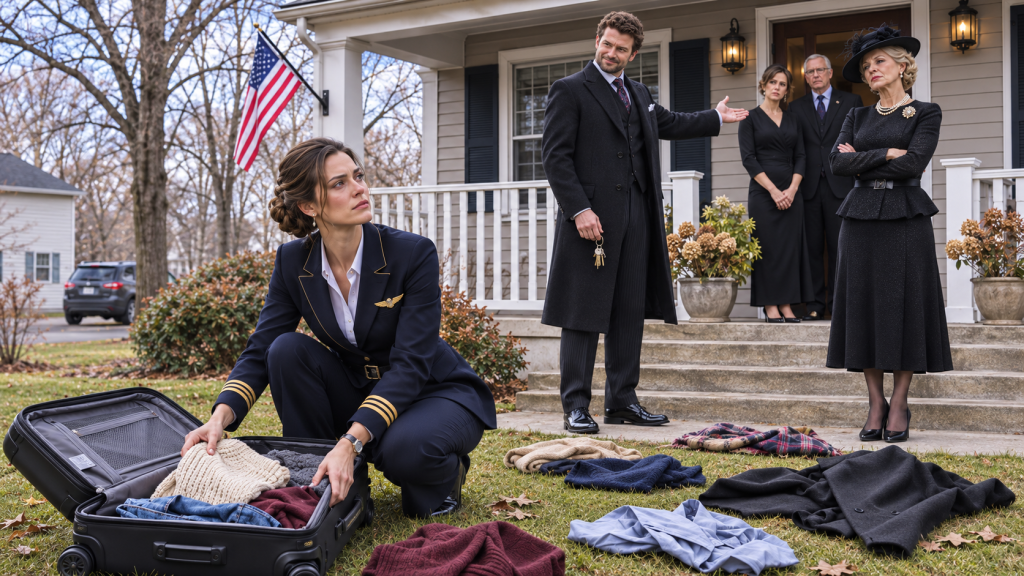
“Aunt Rhonda, you watched Wade throw my clothes onto the lawn before Dad had been buried for three hours.”
She lifted her chin.
“He was grieving.”
“So was I.”
For once, she had no answer.
Judith closed the folder.
“There is one more matter we must address today.”
She reached into her briefcase and removed a sealed envelope.
Across the front, in Dad’s handwriting, were five words.
For Reagan. Open in private.
I took the envelope but didn’t open it.
Not there.
Not with Wade staring at me as though I had stolen something from him.
Not with Rhonda looking for a way to turn every sentence into another accusation.
I slipped it into my suitcase.
Then I looked at Judith.
“What happens now?”
“I’ll arrange a detailed review of the estate and coordinate with the appropriate representatives for the company. We also need to secure records and prevent unauthorized transactions while the relevant legal authority is established.”
Wade gave a harsh laugh.
“Good luck running a hospitality company from thirty thousand feet.”
I looked at him.
“I haven’t agreed to run it.”
He blinked.
“What?”
“Dad left me ownership. That doesn’t mean I have to replace him at his desk tomorrow.”
Rhonda opened her mouth.
I continued before she could speak.
“And it doesn’t mean I’m going to throw away my career to prove something to either of you.”
Judith watched me carefully.
Wade’s expression twisted.
“So you’ll sell everything?”
“I haven’t decided.”
“Of course you haven’t. You don’t know what any of it means.”
I felt the old urge to defend myself.
To explain the years of training.
The examinations.
The nights flying cargo through storms while people slept peacefully in their beds.
But suddenly, I was tired of proving that my life mattered.
“You’re right about one thing,” I said. “I don’t know everything about Dad’s company.”
Wade looked triumphant.
Then I added, “That’s why I’m going to ask people who do.”
His expression changed.
I picked up my suitcase.
Judith handed me a business card with the number of a security consultant she trusted.
“For now, I recommend that you stay somewhere comfortable and allow the property access arrangements to be handled properly.”
I nodded.
Then I walked toward the front door.
Dad’s jacket still hung beside it.
I stopped.
It was a brown canvas coat with a frayed collar.
He had worn it for years while walking the retreat grounds.
I touched the sleeve.
For a moment, I could smell cedarwood and the faint trace of the peppermint candies he always carried.
My chest tightened.
I wanted him to step into the hallway.
To tell us all to stop arguing.
To explain why he had left me a business I had never asked for.
But the house remained silent.
I took my suitcase and walked outside.
My scattered clothes were still on the lawn.
I gathered the final sweater.
Then I drove away.
At the hotel, I placed Dad’s envelope on the bed.
I had spent the afternoon answering messages from people who somehow already knew about the will.
Some offered congratulations.
Others expressed shock.
A few asked whether I would be selling the retreat properties.
One distant cousin wrote that Wade deserved compensation for his years of sacrifice.
I deleted the message without replying.
Then I sat by the window and opened the envelope.
Inside were three handwritten pages.
The first sentence made me cry.
Reagan, I am proud of you.
I read it again.
Slowly.
For thirteen years, I had wanted to hear those words.
I had imagined them after passing my commercial pilot examination.
After my first cargo flight.
After becoming a captain.
After landing safely through a severe winter storm in Chicago.
Every accomplishment had been followed by the same quiet disappointment.
Dad never seemed particularly interested.
He asked whether I was still flying.
Then told me to continue.
Now, written in the unmistakable slant of his handwriting, were the words I had spent my adult life waiting for.
I am proud of you.
The letter continued.
When your mother died, I became frightened of losing you too. I thought if I could keep you close, I could protect you from the world.
But the day you told me you wanted to fly, I saw something in your face I hadn’t seen since your mother was alive.
You looked toward the future without fear.
I wanted to tell you to go. Instead, I said something foolish about responsibility.
I remembered that argument.
I was nineteen.
Dad stood in the kitchen holding the brochure for the aviation academy.
“Flying isn’t a stable future, Reagan.”
“It is for me.”
“You could have a place here.”
“I don’t want your place. I want mine.”
He had looked wounded.
I thought he was angry.
Now I understood he had been afraid.
I kept reading.
Wade stayed because he wanted what I had built. You left because you wanted to build something of your own.
Neither choice was wrong.
But somewhere along the way, Wade began believing that loyalty gave him the right to control other people.
I ignored too many warning signs because I was grateful he remained.
My tears fell onto the paper.
I am leaving you the company not because you know how to run it, but because I trust you to recognize what you don’t know.
You have spent your career learning that other people’s lives depend on your judgment. You understand checklists, accountability, and the importance of listening when someone says something isn’t safe.
That is what Holloway Woodland Retreats needs now.
I lowered the letter.
For the first time, my career and Dad’s business no longer seemed like separate worlds.
They were connected by something more important than buildings or airplanes.
Responsibility.
The letter ended with a request.
Please meet with Luis Mendoza before making any decision about the company.
And Reagan, whatever happens between you and Wade, don’t let the money become more important than the truth.
I love you.
Dad.
I pressed the letter against my chest and cried until the afternoon light disappeared.
Luis Mendoza lived in a small house outside Lancaster.
Judith arranged the meeting after confirming he was willing to speak with me.
I arrived the following morning carrying a notebook.
His wife, Ana, opened the door.
She recognized me immediately.
“Miss Reagan.”
“Please. Just Reagan.”
She gave me a tired smile.
“Your father always spoke about you.”
I stared at her.
“He did?”
“All the time.”
Something inside me shifted.
She led me into the living room.
Luis sat in a recliner beside the window.
His left leg was supported by a brace, and a cane leaned against the chair.
He tried to stand.
I hurried forward.
“Please don’t.”
He smiled faintly.
“You look like your mother.”
The words nearly undid me.
I sat opposite him.
“I came because Dad asked me to.”
Luis looked down.
“I figured he might.”
I took out my notebook.
“Will you tell me what happened?”
He was quiet for a long moment.
Then he began.
The observation deck at Pine Hollow Lodge had been showing signs of deterioration for nearly a year.
Luis reported the problem repeatedly.
At first, Wade approved minor repairs.
Then the company began experiencing cash-flow problems.
Projects were delayed.
Vendors complained about unpaid invoices.
Wade told employees to postpone nonessential expenses.
“But the deck wasn’t nonessential,” Luis said.
I nodded.
“It was a safety issue.”
“Exactly.”
He shifted painfully in his chair.
“After the independent inspection recommended closing it, I put warning signs across the entrance.”
“What happened?”
“Wade ordered them removed.”
I stared at him.
“Why?”
“He said we had a wedding party arriving, and the deck was one of the property’s main attractions.”
My stomach tightened.
“Did you refuse?”
“Yes.”
Luis looked toward the window.
“The next morning, I found the signs gone. I went out to secure the area myself.”
He paused.
“One of the supports gave way while I was moving a barrier. I fell.”
I looked at the brace on his leg.
“How far?”
“About twelve feet onto the lower service path.”
Ana wiped her eyes.
“He fractured his pelvis and suffered a head injury,” she said.
Luis continued.
“Your father came to the hospital.”
“What did he say?”
“He apologized.”
My throat tightened.
Luis looked directly at me.
“He said he had trusted the wrong people with important decisions.”
I remained at Luis’s house for nearly two hours.
He told me about the employees who had been afraid to challenge Wade.
Managers were warned that complaints could cost them their jobs.
Maintenance requests were delayed.
Invoices were marked paid even when vendors hadn’t received money.
At one property, a heating system had been patched repeatedly instead of replaced.
At another, emergency lighting had failed during a storm.
Every story made me feel sicker.
I had imagined Dad’s company as a collection of beautiful cabins where families escaped the noise of city life.
I had never considered how many people depended on the decisions made behind those quiet wooden walls.
“What did Dad do after your accident?” I asked.
Luis looked at Ana.
“He began investigating.”
“He fired Wade?”
“No. Not immediately.”
“Why not?”
“Because Wade was his son.”
The answer hurt.
Luis continued.
“Your father wanted to understand whether the failures were incompetence, financial pressure, or deliberate misconduct. He brought in an outside accountant.”
I remembered Judith mentioning an audit.
“What happened next?”
Luis hesitated.
“Wade found out.”
“And?”
“He confronted your father at Pine Hollow.”
My pulse quickened.
“Was that when Dad fell?”
Luis looked surprised.
“You know about that?”
“Only what Wade told me.”
Ana sat beside her husband.
Luis took a breath.
“Your father came to inspect the deck repairs after I was hurt. Wade met him there. They argued near the administration building.”
“About the money?”
“Yes.”
“What happened?”
“Your father became unsteady. He collapsed while walking toward his car.”
I closed my eyes.
“Did Wade help him?”
Luis hesitated.
“Another employee called for emergency assistance. Wade was there, but I can’t tell you everything he did.”
I nodded.
The distinction mattered.
I was furious with my brother, but I didn’t want to invent crimes to make that anger feel justified.
Then Luis said something unexpected.
“Your father visited me again before his final hospitalization.”
I looked up.
“What did he say?”
“He asked whether I would be willing to help you understand the company.”
I stared at him.
“Me?”
Luis nodded.
“He said you would probably refuse to listen to people who treated you like a princess who’d inherited a kingdom.”
Despite everything, I laughed.
“That sounds like Dad.”
“He said you needed facts, not flattery.”
I smiled through tears.
Then Luis reached toward the side table.
He picked up a small envelope.
“Your father left this for you.”
Inside was a photograph.
Dad stood beside Luis at the opening of the original Pine Hollow cabin, nearly twenty years earlier.
On the back, Dad had written:
Never forget the people who built the thing everyone else calls yours.
I held the photograph carefully.
And for the first time, I understood why Dad had wanted me to meet Luis.
The financial audit arrived the following week.
Judith arranged a meeting with the independent accountant, Elaine Porter.
She was a direct woman in her fifties who seemed entirely unimpressed by the Holloway name.
I liked her immediately.
She spread several reports across the conference table.
“The company has valuable real estate and a recognizable brand,” she began. “But there are serious financial and operational problems.”
“How serious?”
“Serious enough that ownership value should not be confused with available cash.”
I nodded.
She explained that several properties remained profitable.
Others were struggling with deferred maintenance and excessive borrowing.
The audit identified payments to consulting companies that appeared to have provided little or no legitimate service.
Some companies were connected to individuals associated with Rhonda.
One was registered using a mailing address belonging to an old acquaintance of Wade.
The combined questionable payments exceeded $600,000.
I stared at the number.
“Six hundred thousand dollars?”
“More than that, potentially. We’re still reviewing the records.”
I looked at Judith.
“Did Dad know?”
“He knew enough to become concerned.”
Elaine continued.
“Wade approved many of the transactions. Rhonda signed supporting invoices or payment requests on several.”
I thought about Aunt Rhonda standing on the porch, laughing as my clothes blew across the lawn.
She had been so certain she knew exactly how much power she held.
“Where did the money go?” I asked.
Elaine folded her hands.
“Some appears to have covered personal expenditures. Other transfers require further investigation.”
“Can it be recovered?”
“Possibly some of it. That will depend on the evidence, available assets, and legal proceedings.”
I leaned back.
For years, I had imagined Wade as the responsible child.
The one who stayed.
The one who sacrificed.
The one who helped Dad build the company while I pursued my career.
Now I was seeing something far more complicated.
Wade had given years of his life to the business.
But he had also begun treating its resources as though they were his private reward for staying.
I looked at Elaine.
“What would you do first?”
She answered without hesitation.
“Stop the financial leakage. Preserve the records. Address the safety risks. Then decide whether the business has a viable future.”
I took out my notebook.
It sounded remarkably like what I would do when faced with a serious mechanical warning before takeoff.
Identify the problem.
Secure the system.
Follow the evidence.
Never let pride overrule safety.
I met with the company’s managers the following Monday.
The meeting took place in Dad’s old office at headquarters.
I arrived without my pilot’s uniform.
Just dark trousers, a white blouse, and the same gold wings pinned discreetly to my jacket.
Eleven employees sat around the conference table.
Some looked nervous.
Others appeared skeptical.
I understood why.
They had spent years taking instructions from Wade.
Now his younger sister, a cargo pilot who had barely attended a company gathering in a decade, was asking them to trust her.
I stood at the end of the table.
“I know some of you are wondering what I intend to do.”
No one spoke.
“I’m not here to pretend I know more about hospitality than you do.”
A few people exchanged glances.
“I know how to fly a cargo aircraft. I know how to lead a crew, evaluate risk, and make decisions when the cost of a mistake can be catastrophic.”
I paused.
“But I don’t know how to manage a woodland resort.”
A woman near the window raised her eyebrows.
I continued.
“So I’m going to ask questions. I’m going to listen. And when someone tells me something is unsafe, I intend to take it seriously.”
Luis’s words echoed in my mind.
One of the property managers, a woman named Denise, raised her hand.
“Does this mean we can finally submit repair requests without getting punished?”
The question struck me harder than any financial report.
“Yes,” I said.
She looked uncertain.
“Even if the repairs are expensive?”
“Especially if they’re necessary for safety.”
Another employee leaned forward.
“What about the people who reported problems before?”
I considered the question.
“We’ll review the past complaints and establish a process that doesn’t depend on whether a manager likes the person reporting them.”
For a moment, the room remained silent.
Then Denise nodded.
“Your father would have wanted that.”
My throat tightened.
“I hope so.”
Two weeks later, I received an unexpected visitor.
Wade.
He appeared outside Dad’s office carrying a cardboard box.
His face was pale.
He had lost weight.
For a moment, he looked less like the man who had thrown my clothes onto the lawn and more like the boy who used to teach me how to climb the oak tree behind our house.
“Can we talk?” he asked.
I looked at the box.
“What’s that?”
“Some of Dad’s files.”
I hesitated.
“Come in.”
He placed the box on the desk.
Neither of us sat.
Finally, Wade said, “I didn’t know Dad had changed the will until the funeral.”
“I believe that.”
He looked surprised.
I continued.
“But you had no right to throw me out.”
His jaw tightened.
“I was angry.”
“So was I.”
He stared at the floor.
Then he whispered, “I spent my entire adult life trying to make him proud.”
The words struck something inside me.
I thought of Dad’s letter.
The way I’d spent thirteen years longing for the same thing.
“Wade,” I said, “I wanted that too.”
He looked up.
“You got it.”
I shook my head.
“I didn’t know I had it until after he died.”
For a moment, he seemed genuinely confused.
Then he sat down.
“Dad used to talk about you.”
I stared at him.
“What?”
“Every time you got promoted. Every time you flew somewhere new. Every time you passed another certification.”
My chest tightened.
“He did?”
Wade laughed bitterly.
“He’d tell customers, ‘My daughter’s a pilot.’ Then he’d ask whether I’d fixed the reservation system.”
I sat opposite him.
For the first time, I saw our childhood from his side.
I had spent years believing Dad valued Wade more because Wade stayed.
Wade had spent those same years believing Dad admired me more because I left.
We had both been waiting for the same father to say the same words.
And neither of us had known how to ask.
Wade opened the cardboard box.
Inside were old invoices, property photographs, and a small spiral notebook.
“Dad kept this in his private office.”
I picked it up.
The first pages contained ordinary notes.
Repair estimates.
Employee names.
Meeting reminders.
Then I reached a section marked with a red tab.
There were entries about suspicious payments.
Dates.
Amounts.
Company names.
Beside several, Dad had written the same question.
Who approved?
I looked at Wade.
“Why are you giving me this?”
He swallowed.
“Because Rhonda told me to destroy it.”
I stared at him.
“She what?”
“She said Dad had become paranoid. She said the notebook would be used to make us both look guilty.”
My stomach tightened.
“Did you destroy anything?”
He looked away.
“Some papers.”
I closed my eyes.
“Wade.”
“I know.”
“Did you preserve copies?”
“Not all of them.”
I looked at him.
“Then you need to tell the investigators exactly what you destroyed.”
He nodded.
For several seconds, neither of us spoke.
Then he said, “You think I stole everything.”
“I think the records show you approved payments that shouldn’t have been approved.”
He stared at his hands.
“Rhonda handled most of the vendor relationships.”
“That doesn’t remove your responsibility.”
“I know.”
“Do you?”
His eyes filled.
He looked toward the photograph of Dad on the wall.
“I thought if the company got bigger, he’d finally see me.”
I felt a painful ache.
Wade continued.
“Rhonda kept saying Dad was old-fashioned. That we were leaving money on the table. That I deserved more after everything I’d done.”
I studied him.
“And you believed her?”
“At first, yes.”
“What about later?”
He looked down.
“Later, I didn’t want to admit how much trouble we were in.”
I thought of the damaged observation deck.
The injured employee.
The unpaid vendors.
The accounts slowly draining.
All because my brother had been too proud to admit that he was losing control.
Then Wade told me something I hadn’t expected.
He had discovered that Rhonda was planning to sell a portion of the Hocking Hills acreage to a private developer.
The land included a ridge Dad had refused to develop for years.
It overlooked a protected stream and contained some of the oldest trees on the property.
Rhonda had found an interested buyer.
The proposed sale could have generated several million dollars.
But there was a problem.
Dad hadn’t approved it.
“Rhonda told me he’d come around,” Wade said.
I stared at him.
“Did you sign anything?”
“A preliminary agreement. Nothing final.”
“Without Dad’s approval?”
Wade closed his eyes.
“Yes.”
My anger returned.
“Wade, those weren’t your assets to sell.”
“I know.”
I stood and walked toward the window.
Dad had loved that ridge.
When I was little, he took me there on Sunday mornings.
We would sit on a fallen log while he pointed out different birds.
Once, I asked why he didn’t build cabins near the overlook.
He smiled.
“Because not everything beautiful needs to make money, Reagan.”
I remembered the exact words.
And now I learned Rhonda had tried to sell that same land.
I turned back toward Wade.
“Does Judith know?”
He shook his head.
“She needs to.”
He looked frightened.
“Will I be charged?”
“I don’t know.”
“Reagan—”
“I can’t promise to protect you from the consequences of what you did.”
He looked away.
I continued.
“But I can promise I won’t invent things you didn’t do.”
He nodded slowly.
For a moment, we were quiet.
Then Wade whispered, “I’m sorry about the lawn.”
I looked at him.
The apology felt very small compared with everything that had happened.
But it was the first honest thing he’d said to me in years.
“Thank you,” I answered.
I didn’t tell him I forgave him.
Not yet.
The following month brought the most unexpected discovery of all.
Judith called me late on a Thursday afternoon.
“Reagan, I need you to come to my office.”
I was scheduled to fly to Denver the next morning.
“Can it wait until Monday?”
“I’d prefer not.”
Something in her voice concerned me.
I drove over.
Judith greeted me with a sealed folder.
“During the review of your father’s records, we located correspondence concerning your mother.”
I froze.
“Mom?”
“Yes.”
I stared at the folder.
Mom had died sixteen years earlier after a long illness.
I hadn’t expected to hear anything new about her.
Judith opened the documents.
“Your parents established a conservation arrangement many years ago concerning part of the Hocking Hills property.”
I frowned.
“What kind of arrangement?”
“A conservation easement protecting a substantial section of the woodland from certain types of development.”
I sat forward.
“The ridge?”
Judith nodded.
“The very one Rhonda was considering selling.”
My heart pounded.
“Does that mean it couldn’t be developed?”
“Any buyer would have to respect the recorded restrictions. The proposed transaction raises serious questions about what was represented to the purchaser.”
I looked down.
Mom had been a biology teacher.
She loved wildflowers and birds.
She used to bring home injured animals and nurse them until they were strong enough to return outside.
Of course she had wanted to protect the land.
Judith continued.
“There’s also a letter from her.”
My breath caught.
She handed me a yellowed envelope.
Across the front was written:
For Reagan, when she’s ready to understand why the woods matter.
My hands trembled.
I opened it carefully.
Mom’s handwriting filled two pages.
She wrote about the years when Dad’s company consisted of one cabin and a muddy access road.
She wrote about the sacrifices they made.
The nights Dad worked until dawn.
The mornings she graded papers while feeding Wade and me breakfast.
Then she wrote something that made me stop.
Reagan, you were always the child who looked toward the sky. Wade looked toward the house, the land, and the things he could hold in his hands.
I hope neither of you ever mistakes a different dream for a lesser one.
I began crying.
Judith waited quietly.
The final paragraph read:
If one day the woods become yours to protect, remember that ownership is temporary. We borrow the land from the people who came before us and hold it in trust for those who haven’t arrived yet.
Keep a place where the trees are taller than our ambitions.
Love, Mom.
I pressed the letter against my heart.
For the first time since Dad’s funeral, I understood that the inheritance wasn’t simply his final decision.
It was also part of a promise he had made to my mother.
I returned to Hocking Hills the next morning.
Not to attend a meeting.
Not to inspect a property.
Not to argue with Wade.
I went to the ridge.
The November trees had lost most of their leaves. The ground was damp, and the air smelled of rain and cedar.
I followed the narrow trail Dad had shown me when I was seven.
For years, I had thought the path belonged to childhood.
Now I understood that it belonged to something larger.
At the overlook, I sat on the same fallen log where Dad once taught me to recognize the call of a red-tailed hawk.
Far below, the valley stretched between wooded hills.
A river shone faintly in the distance.
I took Mom’s letter from my jacket.
Then Dad’s.
I placed them beside each other.
Two people who had loved me.
Two people who had struggled, sacrificed, made mistakes, and tried to build something that would outlast them.
For years, I thought Dad wanted me to become someone else.
I thought his silence was disappointment.
I thought every clipped telephone conversation meant I had failed him.
But perhaps silence had simply been the language of a man who never learned how to express love.
I looked toward the sky.
A small aircraft crossed high above the valley, leaving a thin white trail.
I smiled.
“I’m still flying, Dad.”
The words caught in my throat.
“And I’m going to take care of what you left.”
I stood.
For the first time, that promise didn’t feel like surrendering my own future.
It felt like accepting responsibility without abandoning myself.
The next six months were difficult.
There were legal proceedings.
Financial reviews.
Negotiations with lenders.
Repairs that cost more than I imagined.
And mornings when I woke in a hotel room wondering why Dad had trusted me with something so complicated.
But I remembered what he’d written.
I trust you to recognize what you don’t know.
So I hired people who did.
Elaine helped establish stronger financial controls.
Denise was promoted to oversee daily retreat operations.
An independent engineering firm inspected every guest structure and major outdoor feature.
We temporarily closed two properties while urgent safety work was completed.
The company lost revenue during those closures.
Some customers complained.
A few investors questioned my decisions.
But I refused to reopen anything before the professionals responsible for safety approved it.
When a manager warned me that delaying a large wedding booking would cost nearly forty thousand dollars, I answered with the same words I used before every flight.
“If something isn’t safe, we don’t proceed.”
He looked at me for a moment.
Then nodded.
The financial investigation continued.
Rhonda retained an attorney.
Wade cooperated with investigators after receiving legal advice.
The records established that improper payments had been made, although responsibility varied from transaction to transaction.
Rhonda eventually entered a civil settlement requiring repayment of funds associated with certain transactions.
Separate legal consequences followed where the evidence supported them.
Wade also faced financial liability connected to his approvals and failures of oversight.
The company recovered only part of the money.
But the bleeding stopped.
More importantly, the employees began trusting that reporting a problem would no longer threaten their jobs.
Luis Mendoza became an adviser to our maintenance and safety team.
He couldn’t return to his former physical duties.
His injuries had changed his life permanently.
But he knew the properties better than almost anyone.
I asked him to help us develop a system for reporting hazards directly to management.
He looked surprised.
“You want me involved?”
“Yes.”
“After everything?”
“Especially after everything.”
His eyes filled.
Then he smiled.
“Your dad would like that.”
I thought about the photograph of them standing outside the first cabin.
“I hope so.”
A few months later, we established a safety fund dedicated to repairs, training, and emergency preparedness.
I also worked with our advisers on an appropriate settlement concerning Luis’s injuries.
It didn’t erase what happened.
Money couldn’t return the months of pain or uncertainty his family endured.
But acknowledging harm was better than pretending it hadn’t occurred.
At the company gathering that spring, Luis stood beside me while we announced the new procedures.
When the employees applauded, he looked embarrassed.
Afterward, he whispered, “You didn’t have to do this.”
I shook my head.
“Yes, we did.”
Wade and I didn’t become close overnight.
For a long time, our conversations remained awkward.
Some days he was defensive.
Other days he seemed genuinely ashamed.
He took a job with a smaller hospitality company after his involvement in Holloway Woodland Retreats ended.
The salary was modest compared with what he once earned.
He had no executive title.
No private office.
No company vehicle.
For the first time in his adult life, he had to prove himself without relying on the Holloway name.
One evening, nearly a year after Dad’s death, he called me.
“Reagan?”
“Hi, Wade.”
“Can I ask you something?”
“Sure.”
He hesitated.
“Do you think Dad hated me?”
I closed my eyes.
“No.”
“How can you be sure?”
“Because he told me he loved you.”
Wade’s breathing changed.
“He did?”
“Yes.”
A long silence followed.
Then he whispered, “I wish he’d said it to me.”
I looked toward Dad’s photograph on my desk.
“I wish he’d said a lot of things to both of us.”
Wade began crying.
I let him.
Then he said, “I thought staying meant I was the better child.”
My throat tightened.
“And I thought leaving meant I was the worse one.”
He gave a broken laugh.
“We were both idiots.”
I smiled faintly.
“Maybe.”
For the first time in years, we spoke without competing for a father’s approval.
It was not forgiveness.
Not yet.
But it was a conversation.
And sometimes that is where families begin repairing what pride has broken.
The second anniversary of Dad’s death approached quietly.
By then, Holloway Woodland Retreats had stabilized.
The repaired properties reopened.
Guest bookings improved.
The company was still recovering financially, but operations had become safer and more transparent.
I continued flying cargo.
I arranged my schedule carefully and delegated operational decisions to qualified managers.
Some people thought I should give up aviation.
Others thought I should sell the business.
But I had learned that inheriting something didn’t mean allowing it to consume my identity.
Dad had trusted me because I knew how to build a life beyond his company.
I intended to honor that trust.
We also completed the conservation work needed to protect the ridge.
Rhonda’s proposed land deal never went forward.
The restrictions Mom and Dad had established remained in force.
And one bright autumn morning, we unveiled a small wooden sign near the trail entrance.
HOLLOWAY FAMILY CONSERVATION TRAIL
Dedicated to Eleanor and Thomas Holloway, who believed some things are worth protecting simply because they are beautiful.
Luis attended with his family.
Denise brought several employees.
Judith stood beside the path, smiling.
And to my surprise, Wade arrived too.
He wore an ordinary brown jacket and stood quietly at the back.
After the ceremony, he approached me.
“I remember Mom bringing us here,” he said.
I nodded.
“She used to make us identify the trees.”
“You were terrible at it.”
I laughed.
“You were worse.”
He smiled.
Then his expression grew serious.
“Reagan, I owe you more than an apology.”
I waited.
“I treated you like an outsider because I was afraid Dad loved you more.”
My chest tightened.
“I never wanted to take anything from you, Wade.”
“I know that now.”
He looked toward the new sign.
“I thought the company was the only thing that made me worth something.”
I studied him.
“And now?”
He took a slow breath.
“Now I’m trying to figure out who I am without it.”
I nodded.
“That’s worth figuring out.”
He looked at me.
“Will you ever forgive me?”
I thought about the lawn.
The suitcase.
The humiliation on the day we buried our father.
Then I thought about the years before that.
The little boy who taught me to ride a bicycle.
The brother who held my hand at Mom’s funeral.
The young man who had wanted so badly to make Dad proud that he lost sight of everything else.
“I don’t know if we’ll ever be exactly what we were,” I said.
Wade nodded.
“I understand.”
“But I’d like us to try becoming something better.”
His eyes filled.
He stepped forward.
And for the first time in years, I hugged my brother.
Later that afternoon, after everyone had left, I remained on the ridge.
The sun dipped toward the horizon.
Gold light filtered through the trees.
I took the little gold wings from my jacket and held them in my palm.
For years, I had worn them as proof that I had chosen my own path.
That I had become someone beyond the limits of my father’s expectations.
Now I understood that Dad had seen something in those wings I hadn’t.
Not rebellion.
Not rejection.
Courage.
The courage to leave a familiar place.
The courage to accept responsibility.
The courage to admit when something was wrong.
And the courage to return without surrendering the person I had become.
My phone vibrated.
A message from Judith.
“Your father would be proud of what you’ve accomplished.”
I smiled through tears.
Then I opened the notes application and typed a message I would never send.
“Dad, I finally understand why you told me to keep flying.
“You weren’t telling me to stay away.
“You were telling me not to lose myself.
“I wish we’d understood each other sooner.
“I wish we’d said the important things while you were still here.
“But I know now.
“And I promise I’ll spend the rest of my life remembering.”
I put the phone away.
Above the ridge, a hawk circled slowly against the evening sky.
For a moment, I imagined Dad beside me.
His hands in the pockets of his brown jacket.
His eyes following the bird.
His familiar voice asking whether I was still flying.
I smiled.
“Yes, Dad,” I whispered.
“I am.”
That winter, I received an invitation to speak at a local aviation training program.
The organizers wanted me to discuss leadership under pressure.
I almost declined.
Public speaking had never been my favorite responsibility.
But something about the invitation felt important.
Standing before a room filled with young pilots, I told them about checklists, weather decisions, and the importance of admitting uncertainty.
Then I told them a story.
Not about a difficult landing.
Not about an engine problem.
About a father who built a business and a daughter who believed she had disappointed him.
I didn’t share the private details of the estate.
Those belonged to my family.
But I explained how easily people confuse silence with rejection and responsibility with control.
“When you’re in command of an aircraft,” I told the students, “your job isn’t to pretend you’re the smartest person in the cockpit.”
I looked around the room.
“Your job is to make sure everyone gets home safely.”
A young woman near the front raised her hand.
“What if someone thinks asking for help means you’re weak?”
I smiled.
“Then I hope you remember that the strongest leaders know when to listen.”
Afterward, she approached me.
She was nineteen.
The same age I had been when I told Dad I wanted to fly.
“My family thinks aviation is too risky,” she admitted.
I smiled gently.
“Have you talked with them about why it matters to you?”
She nodded.
“They don’t understand.”
“Sometimes people need time.”
She looked discouraged.
I continued.
“But don’t confuse their fear with proof that your dream is wrong.”
Her eyes brightened.
“Thank you.”
As she walked away, I thought about Dad.
And for the first time, I wished I could tell him that the legacy he left me had nothing to do with $9.5 million.
It was the ability to recognize courage in someone else.
On the third anniversary of Dad’s death, Wade and I visited his grave together.
It was a cold November morning.
The cemetery was quiet.
I wore my pilot’s uniform because I had a flight scheduled later that afternoon.
Wade noticed my wings.
For a moment, I remembered the funeral.
His sharp voice.
“You couldn’t wear black?”
This time, he smiled.
“Still flying?”
I laughed softly.
“Still flying.”
He looked at Dad’s headstone.
Then he said, “I think he’d be happy about that.”
We placed fresh flowers beside the grave.
For several minutes, neither of us spoke.
Then Wade reached into his coat pocket.
He withdrew a small object.
Dad’s old keys.
The same keys he had spun around his finger on the porch.
The same keys that fell to the study floor when Judith revealed the audit.
“I found these while cleaning out my apartment,” Wade said.
He held them out.
“I think they belong with you.”
I looked at them.
Then shook my head.
“Keep them.”
He stared.
“What?”
“Keep them, Wade.”
“But the house—”
“Those keys don’t open anything anymore. The locks were changed long ago.”
He looked confused.
I smiled.
“Maybe they’ll remind you of where we came from.”
His eyes filled.
He closed his hand around them.
Then he looked toward Dad’s grave.
“I’m sorry,” he whispered.
I wasn’t sure whether he was speaking to me or to our father.
Perhaps both.
I put my arm around his shoulders.
For a moment, we stood together as brother and sister.
Not rivals.
Not heirs fighting over an estate.
Just two children who had loved the same complicated man.
Years earlier, I believed the worst thing my father could do was leave me out of his life’s work.
Then, on the day of his funeral, my brother threw my belongings onto the grass and declared that I no longer belonged in our family home.
I thought I was losing everything.
Instead, that day forced me to discover what I had truly inherited.
Not merely a house.
Not land.
Not a company worth millions.
I inherited the responsibility to protect people who trusted the Holloway name.
I inherited the chance to preserve the woods my mother loved.
I inherited an understanding of my father that neither of us had managed to find while he was alive.
And, eventually, I regained a brother I had almost lost to resentment.
The money mattered.
Of course it did.
It paid for repairs.
Protected jobs.
Helped injured employees.
Preserved land that might otherwise have been destroyed.
But money alone could never have given those things meaning.
That required choices.
Sometimes difficult ones.
Sometimes expensive ones.
Sometimes choices that meant admitting people we loved had done something wrong.
I learned that loyalty isn’t measured by how long you remain in one place.
It is measured by how responsibly you treat the things and people entrusted to you.
And I learned that leaving home doesn’t necessarily mean abandoning it.
Sometimes you have to travel far enough to become the person who can finally understand where you began.
When I reached the airport that afternoon, the sky was clear.
I walked across the tarmac toward my aircraft.
The familiar smell of jet fuel filled the air.
My boots struck the pavement with the steady rhythm I had known for more than a decade.
Before climbing into the cockpit, I paused.
I touched the gold wings above my uniform pocket.
Then I looked toward the wide blue horizon.
Dad’s final words returned to me.
Are you still flying?
Then keep flying.
I smiled.
Because at last, I understood.
He hadn’t been asking whether I would ever come home.
He had been reminding me that my home was never supposed to become a prison.
My dreams were not an insult to his legacy.
They were part of it.
And as our aircraft rose into the afternoon sunlight, I thought about the house in Columbus, the forests in Hocking Hills, and the people who had helped us rebuild something worth preserving.
For the first time, I wasn’t flying away from my father’s expectations.
I was flying with the knowledge that he had believed in me all along.
The inheritance had changed my circumstances.
But the truth had changed my life.
And that was the gift no one could ever take away.


