The brass key lay in my palm, cold and unexpectedly heavy. For a moment, I couldn’t bring myself to move. My brother stood beside me in the hallway, clutching the red wooden train as though it were the last surviving piece of his childhood. His face had gone pale. “Claire,” he whispered, “what does she mean, the person Mom was protecting?”
I looked at Mrs. Alvarez. The elderly woman had lived across the hall from our mother for almost twelve years. She was the kind of neighbor who brought homemade soup when someone was sick and remembered everyone’s birthday without writing it down. Now she looked as though she had been carrying a terrible secret. “Please,” I said. “Tell us.”
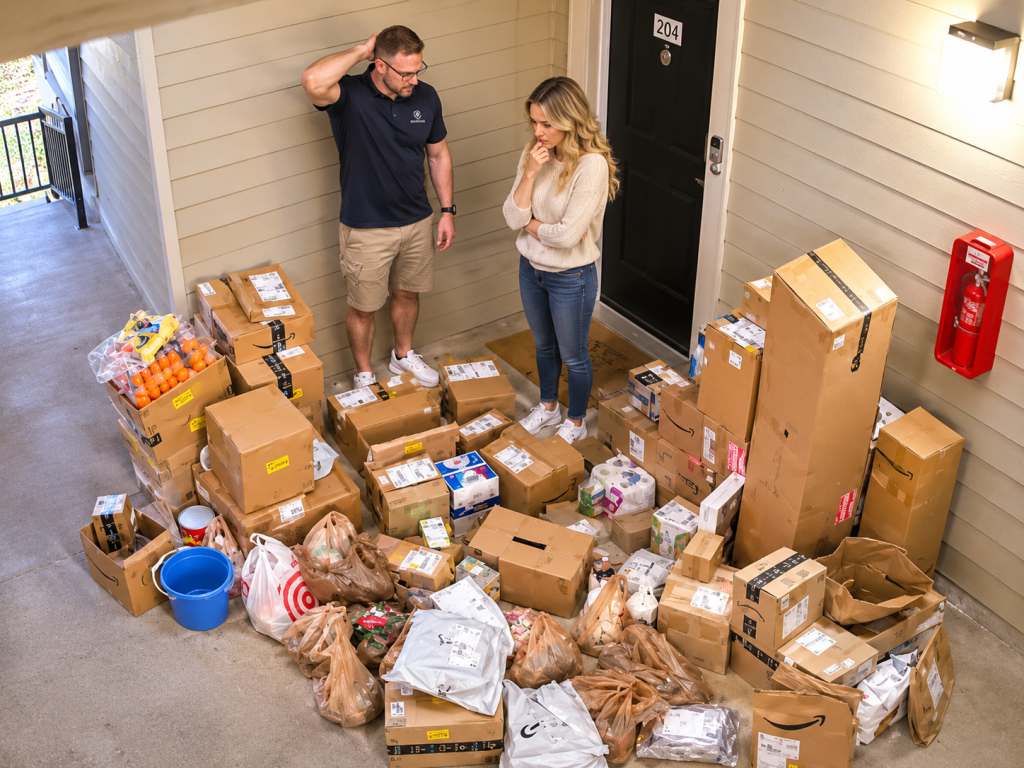
Mrs. Alvarez lowered her eyes. “Your mother asked me to let you discover it yourselves.” Ben gave a bitter laugh. “Of course she did.” I turned toward him. “Ben—” “No, Claire. Think about it. Dad disappears when I’m eight. Mom spends the next twenty years refusing to explain why. Now she’s gone, and we’re supposed to solve some mystery with cardboard boxes and a key?” His voice broke. “Why couldn’t she just tell us the truth?” Mrs. Alvarez began crying. “Because sometimes people make one terrible decision out of love, and afterward they become too frightened to admit they were wrong.”
The words settled between us.
I looked down at the key.
“Where’s the room?”
Mrs. Alvarez pointed toward the stairwell.
“Basement level. Behind the laundry room. There’s a green door.”
Ben began walking before she finished speaking.
I followed him down the narrow staircase.
The building smelled of detergent, old paint, and the faint dampness of concrete.
At the bottom, we passed two washing machines and a row of storage lockers.
Then I saw it.
A green wooden door.
There was no apartment number.
Only a small brass plaque screwed into the center.
It read:
FOR THE THINGS WE STILL HAVE TIME TO MAKE RIGHT.
I stopped breathing.
The phrase was unmistakably Mom’s.
She had said something similar throughout our childhood.
Whenever Ben and I fought, whenever I broke something or forgot a promise, she’d tell us that making a mistake wasn’t the end of the story.
“What matters,” she’d say, “is what you do while there’s still time to make things right.”
Ben stared at the plaque.
Then looked at me.
“Open it.”
My hand trembled as I slipped the key into the lock.
It turned easily.
I pushed the door inward.
And the moment the overhead light flickered on, my brother began to cry.
The room was larger than I expected.
One wall was covered with shelves.
Another held a wooden workbench, neatly arranged tools, and jars filled with screws, buttons, ribbon, and tiny pieces of painted wood.
A faded blue armchair stood beside a window well.
There was an old radio, a sewing machine, and a little table covered with envelopes.
But what stopped us both was the wall directly opposite the door.
It was covered in photographs.
Pictures of children.
Graduations.
Weddings.
Newborn babies.
Family reunions.
And beneath the photographs were twenty-eight small brass hooks.
Most held handwritten tags.
Some were marked with names.
Others carried dates.
One said:
Claire — birthday.
Another:
Benjamin — when he’s ready.
Farther along the wall, I saw tags labeled Mrs. Alvarez, Miriam, Joshua, and The children at St. Anne’s.
I turned slowly.
“What is this place?”
Mrs. Alvarez had followed us downstairs.
She stood in the doorway, wiping her eyes.
“Your mother called it her promise room.”
Ben stared at the workbench.
“Mom didn’t build things.”
Mrs. Alvarez hesitated.
“No. But someone else did.”
I looked toward the table.
There was a framed photograph resting beside a wooden music box.
I picked it up.
A man with silver hair stood outside a small workshop, holding a carved rocking horse.
He wore a blue flannel shirt.
His face was lined.
His shoulders were slightly rounded.
But his eyes were unmistakable.
I knew those eyes.
I’d seen them in our childhood photographs.
In the mirror.
And every time my brother smiled.
“Ben,” I whispered.
He turned.
I held out the picture.
His mouth opened.
Then closed.
For several seconds, he simply stared.
Finally, he whispered a name I hadn’t heard him say aloud in years.
“Dad?”
Our father had been thirty-six when he disappeared.
His name was Thomas Whitaker.
He repaired furniture and built cabinets for a living. In our oldest family photographs, his hands were almost always dusty with sawdust.
I remembered sitting on his shoulders at county fairs.
I remembered the smell of varnish on his clothes.
And I remembered the little wooden birds he carved for our bedroom windows.
Then one November morning, he was gone.
Mom told us Dad needed to live somewhere else.
She said it was an adult problem.
That he loved us.
That we hadn’t done anything wrong.
But she never told us where he’d gone.
At first, Ben waited for him every Friday.
He’d sit by the living room window, holding that red wooden train, convinced Dad would return before dinner.
Then Fridays became ordinary days.
The train disappeared into a closet.
And Ben stopped asking.
By the time he was a teenager, he had turned his grief into anger.
Whenever someone mentioned fathers, his expression hardened.
He refused to attend school events where parents were invited.
Once, at sixteen, he got into a fight because another boy called him fatherless.
Mom cried that night.
But she still didn’t tell him the truth.
Now, twenty years later, we were standing in a basement room that appeared to contain evidence that our father had remained part of her life.
Ben reached for the photograph.
His fingers trembled.
“Where is he?”
Mrs. Alvarez didn’t answer immediately.
I turned toward her.
“Please.”
She looked at Ben.
“Your father is alive.”
My brother staggered backward.
I caught his arm.
“What?”
Mrs. Alvarez nodded through her tears.
“He lives about forty minutes from here.”
Ben began shaking his head.
“No.”
I held his hand.
“Ben.”
“No. That’s impossible.”
He looked at Mrs. Alvarez.
“He’s alive?”
“Yes.”
“And Mom knew?”
The elderly woman nodded.
Ben let out a sound I’d never heard from him.
Half sob.
Half broken laugh.
Then he sat down on the concrete floor.
“All these years,” he whispered.
I knelt beside him.
He stared at the photograph.
“All these years, I thought he didn’t want me.”
I wanted to ask Mrs. Alvarez a hundred questions.
Why hadn’t Dad contacted us?
Why had Mom kept him secret?
Why were they still communicating?
And why had our mother chosen to reveal everything through packages she would never live to see us open?
But Ben was crying so hard he could barely breathe.
I wrapped my arms around him.
For a long time, we stayed there.
My brother had always been the strong one.
When Mom became ill, he drove her to appointments.
When her kitchen sink broke, he fixed it.
When I called him crying after my divorce, he came over with groceries and stayed until I could laugh again.
He rarely talked about his own pain.
Now, surrounded by photographs and unfinished promises, he finally let it out.
“I waited for him,” he whispered.
“I know.”
“Every birthday.”
I held him tighter.
“Every Christmas, Claire.”
Tears streamed down my face.
“He never came.”
Mrs. Alvarez quietly closed the door to give us privacy.
After a while, Ben pulled away.
He wiped his face with his sleeve.
Then looked around the room.
“Why would Mom do this?”
I stared at the photograph.
“I don’t know.”
He shook his head.
“She was the best mother anyone could ask for.”
I nodded.
“She was.”
“But she lied to us.”
The words hurt.
Because they were true.
Our mother had loved us fiercely.
She worked long hours.
Made birthday cakes from scratch.
Helped with homework even when she was exhausted.
Stayed beside our beds when we were sick.
But love didn’t erase the fact that she’d hidden something enormous from us.
I took his hand.
“Maybe we need to find out why.”
Ben looked toward the wooden table.
There was an envelope resting beside the photograph.
Across the front, in Mom’s handwriting, were the words:
For my children. Before you decide whether to forgive me.
I reached for it.
Ben stopped me.
“Wait.”
I looked at him.
“What?”
His eyes were full of tears.
“Whatever it says, promise we won’t let it turn us against each other.”
My throat tightened.
I squeezed his hand.
“I promise.”
Then I opened the envelope.
The letter was six pages long.
Mom’s handwriting began neatly, but the final pages showed the trembling lines we’d noticed during her last months.
I took a breath and began reading aloud.
My beautiful Claire and Benjamin,
If you’re reading this, it means the time I was afraid of has finally come.
I always wanted to tell you the truth while I could still hold your hands.
But every year, I found another reason to wait.
At first, I told myself you were too young.
Then I told myself you were doing well and shouldn’t be upset.
Later, I was ashamed that I’d waited so long.
I paused.
Ben sat beside me, staring at the floor.
I continued.
Your father didn’t leave because he stopped loving you.
He left because I asked him to.
But that sentence alone isn’t enough. You deserve to understand why.
I swallowed.
When Benjamin was seven, your father began drinking heavily.
My brother looked up.
I kept reading.
It started after his workshop closed. He’d lost the business his father helped him build, and he was ashamed.
He tried to hide it from us.
I tried to hide it from you.
At first, I believed I could help him.
Then the drinking became worse.
I remembered fragments.
The smell of beer in the garage.
Mom whispering on the telephone.
Dad sleeping on the sofa in the afternoon.
I had never understood those memories.
One winter evening, Thomas drove home after drinking. He struck a fence and narrowly missed a pedestrian.
My stomach tightened.
No one was seriously hurt, but I realized how close we had come to tragedy.
He promised to stop.
For several weeks, he did.
I glanced toward Ben.
His face was pale.
Then he began drinking again.
The night I asked him to leave, he was supposed to collect Benjamin from a birthday party.
Ben went completely still.
I looked at him.
“Do you remember?”
He shook his head.
“Not clearly.”
I continued.
Thomas had been drinking. He wanted to drive anyway.
I took his keys.
We argued.
And for the first time, I understood that love wasn’t enough to keep our children safe.
My voice broke.
I told him he could not remain in our home unless he received treatment and demonstrated that we could trust him.
He cried.
He begged.
And then he left.
I lowered the letter.
For a moment, nobody spoke.
Then Ben whispered, “She was protecting us.”
I nodded through my tears.
“Yes.”
But there were still four pages left.
And I could already feel that the hardest truth was yet to come.
I continued reading.
Your father entered a treatment program three weeks after leaving.
The first year was difficult. He relapsed. He tried again.
Eventually, he began rebuilding his life.
He found work at a furniture restoration shop. He attended support meetings. He learned to live without alcohol.
For a long time, I didn’t know whether his recovery would last.
I told him I needed stability before we could discuss involving you again.
I paused.
Ben was listening intently.
After three years, he had maintained his recovery and wanted to see you.
And this is where I must tell you something I’m ashamed of.
My throat tightened.
I was afraid.
You were doing well in school.
Claire, you had stopped having nightmares.
Benjamin, you’d finally begun laughing without checking the front window.
I convinced myself that bringing your father back would destroy the peace we’d worked so hard to rebuild.
Tears blurred the page.
So I asked him to wait.
He agreed, but not because he no longer loved you.
He wrote letters.
He sent birthday cards.
He made gifts.
And I kept them.
Ben’s breath caught.
I looked at the shelves.
The boxes.
The workbench.
The photographs.
Suddenly, the room seemed unbearably full.
I told myself I would give everything to you when the moment was right.
But the right moment never arrived because I was too afraid to choose one.
I stopped reading.
Ben stood abruptly.
He walked toward the wall and stared at the hooks.
“Twenty years,” he whispered.
I looked at him.
He turned toward me.
“She kept the letters for twenty years?”
I swallowed.
“Some of them.”
He laughed bitterly.
“She let me believe he abandoned me.”
I couldn’t answer.
He looked at the photograph of Dad.
“And he let me believe it too.”
That truth hung between us.
Mom had made a painful decision to protect us when we were children.
But later, both our parents had allowed fear and shame to become a silence that lasted far too long.
I returned to the letter.
The next sentence nearly broke me.
I know protecting you when you were little does not excuse keeping the truth from you when you were grown.
I made a necessary decision once, then used it to justify years of unnecessary silence.
I am deeply sorry.
Ben covered his eyes.
And I kept reading.
Thomas knew he could contact you himself once you became adults.
He chose not to.
He told me he didn’t want to arrive in your lives unexpectedly after so many years. I think he was also ashamed and afraid you’d reject him.
That was his decision, and he must answer for it himself.
I cannot ask you to forgive either of us.
I can only tell you that you were never unwanted.
Not for one day.
I stopped to wipe my eyes.
Then I continued.
Five years ago, your father and I began working together on a small project.
He was repairing furniture for families who couldn’t afford replacements. I was collecting clothing, books, and household items for people starting over.
At first, we worked separately.
Then we realized we could help more people together.
Mrs. Alvarez let us use the basement room with the building manager’s permission.
We called it the Promise Room.
I looked around.
The workbench.
The shelves.
The photographs.
This wasn’t simply a hiding place for old family secrets.
It was where two people who had hurt one another were trying, imperfectly, to do something worthwhile with the years they had left.
There are twenty-eight packages because there are twenty-eight promises I wanted to keep.
Some belong to you.
Others belong to people whose lives crossed mine when they needed kindness.
Please don’t feel responsible for finishing everything.
I’ve left instructions and funds for the gifts and deliveries.
But if you choose to help, perhaps you’ll understand something about the woman I became after my mistakes.
My eyes filled again.
Then I reached the final paragraph.
I wanted you to remember me as your mother, not as someone who was always right.
I was frightened.
I was stubborn.
I loved you more than anything.
And sometimes I confused loving you with protecting you from truths you deserved to know.
I’m sorry.
If you decide to meet your father, there is an address beneath this letter.
If you decide not to, that is your right.
Whatever you choose, please don’t spend the rest of your lives waiting for an apology from someone who is no longer here.
Live.
Love.
Make mistakes.
And tell the truth sooner than I did.
All my love,
Mom.
I lowered the pages.
Neither of us spoke.
The basement light hummed above us.
Somewhere upstairs, a washing machine began spinning.
Ben sat on the floor beside the old wooden train.
Then he whispered, “I don’t know whether to be angry with her.”
I stared at the letter.
“I think we can be angry and still love her.”
He looked toward me.
“Can we?”
My eyes filled.
“I hope so.”
We spent the next hour exploring the room.
Every shelf seemed to contain another piece of Mom’s life.
There were envelopes labeled with names I recognized.
Mrs. Patterson, who lived on the third floor.
Mr. Ellis, the retired school custodian.
Miriam Lopez, a young mother Mom had helped during a difficult pregnancy.
Others were unfamiliar.
Beside each name was a carefully wrapped package and a handwritten note.
Some gifts were simple.
A repaired lamp.
A blanket.
A set of children’s books.
A wooden jewelry box.
Others were deeply personal.
One contained a graduation photograph mounted in a frame.
Another held an old recipe book with pages lovingly restored.
I opened a small package addressed to Mrs. Alvarez, with the elderly woman’s permission when she returned downstairs.
Inside was a ceramic teapot painted with blue flowers.
Mrs. Alvarez pressed a hand against her mouth.
“Oh, Margaret.”
Our mother’s name was Margaret.
Hearing someone say it with such affection made my heart ache.
“Do you know why she chose this?” I asked.
Mrs. Alvarez nodded through tears.
“When my husband died, I broke our favorite teapot while cleaning. It was the one we used every Sunday.”
She touched the delicate handle.
“Your mother remembered.”
Ben looked around.
“She remembered everybody.”
Mrs. Alvarez smiled sadly.
“Your mother had a wonderful memory for other people’s joys and sorrows.”
Then she glanced toward Mom’s letter.
“But even wonderful people can struggle to face their own mistakes.”
I looked at the package in her hands.
“Did you know about Dad?”
She nodded.
“Yes.”
“For how long?”
“Since your mother asked me to help with this room.”
I felt a sharp flash of resentment.
“You could have told us.”
She lowered her eyes.
“I know.”
Ben looked at her.
“Why didn’t you?”
“Because I promised your mother I’d let her explain.”
He shook his head.
“And then she died.”
Tears slipped down Mrs. Alvarez’s cheeks.
“Yes.”
For a moment, I wanted to blame her.
It would have been easier to turn all the pain toward the person standing in front of me.
But Mrs. Alvarez hadn’t created the separation.
She had simply agreed to keep a secret that wasn’t hers.
Still, I couldn’t pretend the silence hadn’t hurt us.
“I wish someone had told us sooner,” I whispered.
She nodded.
“So do I.”
We returned upstairs with several boxes.
The apartment door opened after a little struggle, just as it always had.
Mom had complained about the lock for years.
Ben used to promise he’d replace it.
Now there was no longer anyone to complain.
The familiar smell hit me immediately.
Lavender soap.
Old books.
And the faint sweetness of the cinnamon tea Mom drank every evening.
Her slippers stood beside the sofa.
A cardigan hung over the chair near the window.
On the kitchen counter sat a grocery list.
Milk.
Bread.
Apples.
Tea.
Ordinary things.
Things she’d expected to need.
I stood staring at the list until Ben gently took it from my hands.
“Claire.”
I shook my head.
“She was supposed to come home.”
He wrapped an arm around me.
“I know.”
We cried together in the kitchen.
Then we made tea in Mom’s favorite mugs and sat at the small table.
For a while, neither of us touched the remaining boxes.
Finally, Ben looked toward the hallway.
“We should open some of them.”
I nodded.
“Together?”
“Together.”
The first package was addressed to him.
Inside was a beautifully made wooden toolbox.
His initials were carved into the lid.
B.W.
When he opened it, he found a set of carefully restored hand tools.
Beneath them lay a note from Mom.
Benjamin, you always wanted to build things with your father. I hope these tools remind you that the ability to make something beautiful was always inside you, even when he wasn’t there to teach you.
Ben ran his hand across the wood.
Then he turned the box over.
On the underside was a small maker’s mark.
T. WHITAKER — HANDMADE WITH LOVE.
My brother stared at it.
Then began crying again.
“He made this.”
I nodded.
“Yes.”
Ben lifted one of the tools.
“He knew I became a carpenter?”
I thought about the photographs downstairs.
“He must have.”
My brother worked as a carpenter and general contractor.
He loved building things.
He said the smell of fresh wood made him feel peaceful, although he never knew why.
Now I wondered whether some part of him had been searching for a connection he couldn’t remember clearly.
He closed the toolbox.
Then whispered, “I want to meet him.”
I wasn’t sure I was ready.
Unlike Ben, I remembered more of Dad.
I remembered his laugh.
The way he whistled while washing dishes.
The smell of coffee when he came into my bedroom to wake me for school.
But I also remembered the arguments.
The sound of a glass breaking.
Mom’s frightened expression on the night she took his car keys.
I’d been ten.
Old enough to notice something was wrong.
Too young to understand what it meant.
For years, I buried those memories because I thought remembering them was disloyal.
Now I realized they mattered.
Dad had loved us.
But he had also struggled in ways that made him unsafe.
Mom had been right to protect us.
And yet, after he recovered, there had been years when both adults could have made different choices.
I looked at Ben.
“What if he disappoints us again?”
He stared at the toolbox.
“Then at least we’ll know.”
I swallowed.
“What if he’s everything we’ve been missing?”
Ben looked up.
His eyes filled.
“Then we’ll be angry about the years we lost.”
I reached across the table.
He took my hand.
“Claire,” he whispered, “I spent twenty years imagining what I’d say if I ever saw him.”
“What would you say?”
He gave a sad laugh.
“I used to think I’d tell him I didn’t need him.”
I looked at him.
“And now?”
He stared at the red train sitting beside his toolbox.
“Now I think I just want to ask why he didn’t come.”
We called the number written beneath Mom’s letter.
It rang four times.
Then a man’s voice answered.
“Whitaker Woodworks.”
I froze.
It was a deep voice.
Older than the one I remembered.
But there was something familiar in it.
“Hello?”
I couldn’t speak.
Ben reached for my hand.
I closed my eyes.
“Is this Thomas Whitaker?”
“Yes.”
I swallowed.
“My name is Claire.”
Silence.
Then I heard a sharp intake of breath.
“Claire?”
Tears ran down my face.
“Yes.”
For several seconds, neither of us spoke.
Then the man whispered, “Oh, sweetheart.”
I pressed a hand against my mouth.
The last time I’d heard my father call me that, I was ten years old.
He sounded as though he were crying.
“Is Ben with you?”
I looked at my brother.
“Yes.”
A pause.
Then the voice trembled.
“Is he all right?”
Ben leaned toward the phone.
“I don’t know.”
The silence that followed felt enormous.
Finally, Dad whispered, “Benjamin.”
My brother closed his eyes.
“Why didn’t you come back?”
No greeting.
No small talk.
Just the question he’d been carrying since childhood.
On the other end of the line, our father began crying.
“I should have,” he whispered.
Ben gripped the edge of the table.
“Then why didn’t you?”
“Because I was ashamed.”
“That isn’t good enough.”
“I know.”
My brother’s tears fell silently.
“You made me think I wasn’t worth coming back for.”
Dad made a broken sound.
“Ben, you were always worth coming back for.”
“Then you should’ve come.”
A long silence followed.
Then Dad said the only thing he could have said honestly.
“Yes.”
Ben covered his face.
I took the phone.
“Dad, Mom is gone.”
“I know,” he whispered. “Mrs. Alvarez told me.”
My eyes filled.
“We found the room.”
He was quiet.
Then he said, “I wondered whether you ever would.”
I closed my eyes.
“Can we come see you?”
His voice broke.
“Yes.”
Then, after a pause, he added, “Only if you want to. I won’t ask you to forgive me.”
I looked toward Ben.
He nodded.
And together, we decided to meet the man we’d spent most of our lives believing had abandoned us.
Thomas Whitaker lived in a small white house beside a woodworking shop.
There were no expensive cars.
No grand entrance.
Just a gravel driveway, a vegetable garden, and a weathered wooden sign hanging from two chains.
WHITAKER RESTORATION & REPAIR
As we pulled into the driveway, my heart pounded.
Ben stared straight ahead.
Neither of us spoke.
Then the workshop door opened.
A silver-haired man stepped outside.
He wore jeans, work boots, and a blue flannel shirt.
His hands were dusty with sawdust.
For a moment, I saw him as he had been twenty years earlier.
Standing in our old kitchen.
Helping me tie my shoes.
Holding Ben’s hand as we crossed the street.
Then the memory faded, and I saw the elderly man in front of us.
His face was lined.
His shoulders were stooped.
But his eyes were the same.
He approached slowly.
Then stopped several feet from the car.
He didn’t rush forward.
Didn’t demand a hug.
Didn’t pretend the years between us could be erased with one emotional reunion.
He simply stood there, crying.
“Claire,” he whispered.
I stepped out of the car.
My knees felt weak.
“Hi, Dad.”
His face crumpled.
I had thought I might feel anger.
Or relief.
Or nothing at all.
Instead, I felt everything at once.
Grief for the little girl who had waited.
Resentment toward the man who hadn’t returned.
And a fierce, bewildering tenderness for the father whose face I still recognized.
He looked toward Ben.
My brother slowly got out.
For several seconds, the two men stared at one another.
Dad’s eyes moved across Ben’s face.
His broad shoulders.
His calloused hands.
The lines around his mouth.
“You look like my father,” he whispered.
Ben swallowed.
“I barely remember him.”
Dad nodded.
“I know.”
Then Ben reached into the car.
He brought out the red wooden train.
Dad stared at it.
His hands began trembling.
“You kept it.”
Ben’s voice broke.
“Mom did.”
Dad looked down.
“I made that for your seventh birthday.”
Ben nodded.
“You did.”
His eyes filled.
Then he asked, “Why didn’t you come to my eighth?”
Dad covered his mouth.
And the years between them seemed to break open.
We sat in the workshop for almost four hours.
Dad made coffee.
Then forgot he’d made it.
He tried to offer biscuits but couldn’t remember where he’d put them.
His nervousness was almost painful to watch.
Finally, Ben said, “Dad, sit down.”
Thomas obeyed.
My brother looked at him.
“I don’t want another explanation about shame. I want to know what happened.”
Dad folded his hands.
Then began speaking.
He told us about the drinking.
The failed business.
The fear of not being able to provide for his family.
How he convinced himself alcohol helped him sleep.
How one drink became several.
How he began hiding bottles in the garage.
“I knew your mother was frightened,” he said.
His eyes filled.
“But I kept telling myself I had everything under control.”
He looked at me.
“I remember the night she took my keys.”
I nodded.
“So do I.”
His face crumpled.
“I was furious. I accused her of humiliating me.”
He swallowed.
“She was trying to keep me from hurting someone.”
I watched him carefully.
“Why didn’t you get help before it got that bad?”
He shook his head.
“I was proud. And frightened. And I didn’t want to admit I couldn’t stop on my own.”
Ben stared at the workbench.
“What happened after you left?”
“I stayed with a friend. Then I entered treatment.”
“Did it work?”
“Not immediately.”
Dad looked ashamed.
“I drank again after several months.”
Ben’s expression tightened.
“Then what?”
“I went back to treatment. I found people who helped me understand that recovery wasn’t a promise I made once. It was something I had to practice every day.”
He looked at us.
“I’ve been sober for seventeen years.”
I nodded slowly.
“That matters.”
Dad swallowed.
“But it doesn’t erase what happened before.”
Ben looked up.
“And after you got better?”
Thomas lowered his eyes.
“I asked your mother whether I could see you.”
“She said no?”
“At first.”
“And then?”
Dad hesitated.
“She said she needed more time.”
Ben’s expression hardened.
“So you gave her twenty years?”
Our father looked at him.
“No.”
He took a shaky breath.
“I gave her several years. Then I gave myself excuses.”
The honesty surprised me.
He continued.
“I told myself you were doing well. I told myself I shouldn’t arrive unexpectedly and confuse you. I told myself your mother knew what was best.”
His eyes filled.
“But the truth is, I was afraid you’d look at me and see the man I used to be.”
Ben stood abruptly.
“And what did you think I saw when you never came?”
Dad began crying.
“I know.”
“No, you don’t!”
Ben’s voice echoed through the workshop.
“You don’t know what it was like when the other kids talked about their dads.”
I stood, but my brother raised his hand.
He needed to finish.
“You don’t know what it was like to graduate without you.”
Dad lowered his head.
“You don’t know what it was like to get married and wonder whether you’d even remember my face!”
A tear slipped down Dad’s cheek.
“I wanted to be there.”
Ben laughed bitterly.
“Then you should have been.”
Thomas nodded.
“Yes.”
For a moment, the only sound was my brother’s uneven breathing.
Then Dad whispered, “I was wrong.”
Ben stared at him.
“I know I can’t give you back those years,” Dad continued. “But if you ever decide there’s room for me in your life now, I’ll be grateful for whatever time you’re willing to share.”
Ben wiped his face.
Then walked outside.
I watched him go.
Dad looked devastated.
I sat beside him.
“Give him time.”
He nodded.
“I will.”
Then I looked at my father.
“And Dad?”
“Yes?”
“You need to understand that we might never forgive all of it.”
He closed his eyes.
“I understand.”
I took a breath.
“But we came here.”
He looked at me.
I smiled through tears.
“That’s something.”
Before we left, Dad showed us a cabinet near the back of the workshop.
Inside were wooden toys.
Little trains.
Rocking horses.
Birdhouses.
Miniature furniture.
There were dozens of them.
Some had dates engraved on the bottom.
Others carried names.
He opened a drawer and removed a photograph.
It showed Ben at his wedding.
My brother’s expression changed.
“Where did you get that?”
Dad swallowed.
“Your mother sent it to me.”
Ben stared at him.
“You saw pictures of my wedding?”
Dad nodded.
“Yes.”
My brother looked away.
I could almost see what he was thinking.
We had spent years missing Dad.
Meanwhile, he had been watching pieces of our lives from a distance.
Dad seemed to understand.
“I know it wasn’t the same as being there.”
“No,” Ben whispered. “It wasn’t.”
Then Dad showed me another photograph.
It was from my college graduation.
I stood beside Mom, wearing a black gown and smiling proudly.
Dad’s fingers trembled.
“She sent me this one too.”
I looked at the photograph.
“You knew I graduated?”
He nodded.
“I was so proud.”
I began crying.
“For years, I wondered whether you’d care.”
His face crumpled.
“Claire, I cared about every part of your life.”
I looked at him.
“Then I wish you’d told me.”
He nodded.
“So do I.”
There were no easy answers.
No magical reunion that made the lost years disappear.
But for the first time, we were having a conversation that should have happened long ago.
And sometimes, beginnings are less beautiful than people imagine.
Sometimes they are awkward.
Painful.
Filled with tears and questions.
But they are beginnings nonetheless.
Over the next several weeks, Ben and I slowly returned to Mom’s apartment.
We didn’t rush.
Some days, we packed two boxes and went home.
Other days, we stayed for hours, reading letters and remembering the ordinary details of her life.
We found recipes written on scraps of paper.
Photographs tucked inside old books.
Birthday cards she’d saved from our childhood.
And a small notebook containing the names of people she wanted to help.
Each page began with the same question.
What would make this person’s life a little easier?
Beside Mrs. Alvarez’s name, she’d written:
Replace the teapot. She misses Sunday mornings with Rafael.
Beside Miriam Lopez:
Warm blankets for the twins. She never asks for anything.
Beside Joshua Reed:
New tools for his apprenticeship. He reminds me of Benjamin.
I stared at that sentence.
Mom had helped a young man learn a trade because he reminded her of my brother.
Perhaps she was trying to make up for the opportunities Ben had lost.
Perhaps she simply understood how much dignity people found in being able to support themselves.
Either way, every note revealed something about the woman we’d known.
And something we hadn’t.
One afternoon, we opened a package addressed to a woman named Evelyn Carter.
Inside was a carefully repaired music box.
A note explained that Evelyn had lost her daughter years earlier and that the music box was one of the few possessions she still had from childhood.
Mom had asked Dad to restore it.
I wound the little key.
A gentle melody filled the kitchen.
Ben stood beside me, listening.
Then he whispered, “They were working together.”
I nodded.
“Helping people.”
He looked toward Mom’s photograph on the refrigerator.
“For years.”
I took his hand.
“Maybe it was the one way they knew how to stay connected.”
Ben sighed.
“I wish they’d spent some of that courage telling us the truth.”
I looked at him.
“So do I.”
The twenty-eighth package was the smallest.
We found it tucked behind a stack of old linens in Mom’s bedroom closet.
It was wrapped in plain brown paper.
Across the front were two words.
For us.
Ben sat beside me on Mom’s bed.
“Who’s us?”
I shook my head.
“I don’t know.”
Inside was a small wooden box.
Its lid was carved with two birds perched on a flowering branch.
Beneath it were three letters.
One for me.
One for Ben.
And one for Dad.
There was also a photograph.
It showed our parents standing outside the basement Promise Room.
Mom wore her favorite blue cardigan.
Dad stood beside her holding a wooden birdhouse.
They were smiling.
Not like a couple pretending nothing difficult had ever happened.
But like two people who had learned to stand beside their history without allowing it to define everything they became.
I turned the photograph over.
Mom had written:
We could not give our children a perfect family. But perhaps we can still leave them something honest.
I pressed the photograph against my chest.
Ben opened his letter first.
He read silently.
Then tears began running down his face.
He handed it to me.
My dear Benjamin,
I know I cannot ask you to understand every choice I made.
When you were little, I wanted to keep you safe. Later, I wanted to keep you happy.
Somewhere between those two things, I forgot that you had the right to know your own story.
I’m sorry.
You are not the little boy waiting by the window anymore.
You are a man who builds homes, loves his family, and has become everything I hoped you would be.
If you decide to know your father, I hope you do it because you want to, not because I asked.
And if you decide you cannot forgive him, I will understand that too.
You owe neither of us forgiveness.
You owe yourself a life that isn’t controlled by the hurt we caused.
Love, Mom.
Ben folded the letter.
Then whispered, “She finally said it.”
I looked at him.
“What?”
“That I didn’t have to forgive anyone just because they were family.”
I squeezed his hand.
For years, Mom had taught us kindness.
But perhaps her final lesson was that kindness and honesty had to exist together.
My letter contained a different memory.
Mom wrote about the summer I turned twelve.
I’d entered a school baking contest and cried when my cake collapsed.
She reminded me that I wanted to throw it away.
Instead, she’d helped me turn the broken layers into a trifle.
We didn’t win.
But everyone ate it.
And afterward, Mom laughed so hard she had to sit down.
Claire, you’ve always tried to make everything right for everyone.
I know you will be tempted to organize the packages, forgive your father, comfort your brother, and make everyone feel better.
But sweetheart, you’re allowed to grieve too.
You’re allowed to be angry.
You’re allowed to need help.
Please don’t turn my final wishes into another responsibility you must carry perfectly.
I began crying.
Mom had known me.
Even when she struggled to tell the truth about herself, she understood my heart.
The final paragraph was almost too much to bear.
When your birthday comes, make the pancakes.
Use the blue bowl.
Put too much cinnamon in the batter, just as we always did.
And if you cry, let yourself cry.
Love doesn’t disappear because the person who gave it to us is gone.
Sometimes it simply finds a new place to live.
I pressed the letter to my heart.
Then looked at Ben.
“I think we should finish the promises.”
He studied me.
“Are you sure?”
I smiled through tears.
“Not because we have to.”
I looked toward Mom’s photograph.
“Because I want to.”
We invited Dad to help.
At first, Ben was hesitant.
He was still angry.
Some days, he called Dad and spoke for an hour.
Other days, he didn’t want to talk at all.
Thomas respected the distance.
He didn’t demand constant reassurance.
He didn’t arrive unexpectedly.
He simply answered when we called and kept the commitments he made.
One Saturday, Ben invited him to the Promise Room.
Dad arrived carrying a wooden toolbox.
He stood in the doorway for a long time.
Then he looked around.
His eyes filled.
“Margaret kept everything.”
I nodded.
“Almost everything.”
He walked toward the workbench and touched the edge.
“She used to sit over there while I worked.”
He pointed toward the blue armchair.
“She’d read letters from people who needed something repaired or replaced. Then she’d tell me what she thought we could do.”
Ben watched him.
“Did you two ever get back together?”
Dad shook his head.
“No.”
“Why not?”
Thomas considered the question.
“Because she no longer trusted me as a husband. And eventually, I understood that she didn’t have to.”
He looked around the room.
“But we found a way to work together.”
I nodded.
“And you never told us.”
His expression grew sad.
“No.”
Ben looked toward the hooks.
“Mom made mistakes.”
Dad nodded.
“She did.”
Then my brother looked directly at him.
“So did you.”
Thomas lowered his head.
“More than I can count.”
Ben was silent for a moment.
Then he picked up the wooden toolbox Dad had made for him.
“I’ve been thinking about something.”
Dad looked up.
“What?”
“I can’t give you back the little boy who waited by the window.”
Tears filled Thomas’s eyes.
“I know.”
“And I’m not ready to call everything forgiven.”
Dad nodded.
“I understand.”
Ben took a breath.
“But there’s a set of shelves in this room that needs fixing.”
Thomas looked toward the crooked shelving unit.
Then back at my brother.
Ben’s mouth trembled.
“I thought maybe we could work on it together.”
Our father began crying.
“I’d like that very much.”
And for the first time, I watched my brother and father stand side by side at a workbench.
Not as the man and little boy they’d once been.
But as two adults beginning something neither of them knew how to build.
The work took several weekends.
Ben brought his own tools.
Dad brought materials.
Sometimes they laughed.
Sometimes their conversations became painful.
Once, Ben asked why Dad hadn’t attended his graduation.
Thomas answered honestly.
Because he’d been ashamed.
Because he was afraid.
Because he’d convinced himself that staying away was kinder.
Ben listened.
Then told him that wasn’t enough.
Dad agreed.
There was no dramatic embrace that afternoon.
But the following Saturday, Ben returned.
I watched their relationship change through small gestures.
Dad remembering how Ben liked his coffee.
Ben asking about an unfamiliar woodworking technique.
Thomas showing him the way his father had taught him to repair dovetail joints.
They were learning each other slowly.
And that was all either of them could reasonably ask.
Meanwhile, the packages began finding their way to the people Mom had named.
Mrs. Patterson cried when we gave her the restored photograph of her late husband.
Miriam hugged us when she opened the blankets Mom had knitted for her twins.
Joshua stared at his new tools for several minutes before whispering that nobody had ever believed in him enough to buy something so useful.
Every delivery revealed another story.
Another quiet act of love Mom had performed without expecting recognition.
By the time we reached the final package, Ben and I understood something we hadn’t seen when we first opened her apartment door.
Our mother hadn’t spent her last months shopping.
She’d spent them remembering.
Every person.
Every promise.
Every kindness she still hoped to give.
And perhaps, beneath all those gifts, she had been searching for the courage to leave us the truth.
My birthday arrived three weeks after we discovered the packages.
For the first time in my life, Mom wasn’t there to call me at seven in the morning.
She always called at seven.
Even after I moved away.
Even after I got married.
Even on mornings when I told her I wanted to sleep late.
She’d sing the same off-key birthday song and remind me that the day I was born had been the happiest day of her life.
That morning, I woke before sunrise.
For a moment, I reached for my phone.
Then I remembered.
There would be no call.
No familiar voice.
No laughing complaint that I was getting older while she somehow remained twenty-nine.
I sat on the edge of my bed and cried.
Then I walked into the kitchen.
The blue ceramic bowl sat on the counter.
Mom’s birthday letter lay beside it.
I opened the cupboard and took out flour, eggs, milk, and cinnamon.
My hands trembled as I began mixing the batter.
I remembered being six years old, standing on a chair beside Mom.
She’d let me stir even though I always spilled flour across the counter.
“Cooking isn’t supposed to be perfect,” she’d say. “It’s supposed to be made with love.”
I smiled through my tears.
Then the doorbell rang.
Ben stood outside carrying a small bouquet of sunflowers.
Behind him stood Dad.
He held a paper bag.
I stared at them.
“What are you doing here?”
Ben grinned.
“Birthday breakfast.”
My eyes filled.
Dad looked nervous.
“Your mother told me how much you loved pancakes.”
I stepped aside.
“Come in.”
They entered the kitchen.
Ben noticed the blue bowl.
His smile softened.
“You started without us.”
I laughed through tears.
“I couldn’t wait.”
Dad placed the paper bag on the table.
Inside was a little wooden bird.
Its wings were painted blue.
He looked at me.
“I made you one like this when you were eight.”
I remembered.
It had hung beside my bedroom window until the string broke.
“I loved that bird,” I whispered.
Dad smiled through tears.
“I know.”
For a moment, I looked at the two men standing in my kitchen.
My brother.
My father.
Both carrying years of grief.
Both trying to find a way forward.
I had no idea what our family would look like five years from now.
Perhaps there would be more difficult conversations.
More tears.
More memories we’d need to reconsider.
Forgiveness might come slowly.
Some wounds might never disappear completely.
But for that morning, we were together.
And that was enough.
We made pancakes.
We used too much cinnamon.
Ben burned the first batch.
Dad insisted the second needed more butter.
I complained that both of them were interfering.
And for a few precious minutes, the kitchen filled with laughter.
Real laughter.
The kind that doesn’t erase sadness but makes room for joy beside it.
When we finally sat down, Ben raised his coffee mug.
“To Mom.”
Dad lowered his head.
I smiled through tears.
“To Mom.”
Then Ben looked at the blue bowl.
“And to telling the truth before we run out of time.”
Our father nodded.
“Yes.”
I looked around the table.
Three people.
One empty chair.
And a lifetime of love that hadn’t always known how to express itself wisely.
I thought about the twenty-eight packages.
How frightened I’d been when I first saw them outside Mom’s door.
How I assumed they were meaningless purchases.
How that first blue bowl had opened a story none of us expected.
Mom hadn’t left us a fortune.
She hadn’t left a grand mansion or an expensive collection.
She’d left us ordinary things.
A mixing bowl.
A wooden train.
Letters.
Tools.
Promises.
And the uncomfortable truth that people can love us deeply and still make mistakes that hurt us.
The greatest gift she left wasn’t the chance to pretend our family had always been perfect.
It was the chance to stop pretending.
To ask questions.
To acknowledge the past.
And to build whatever future we could, with honesty instead of silence.
After breakfast, I washed the blue bowl carefully and placed it on the kitchen shelf.
It would never be the original bowl from my childhood.
That one had broken years ago.
But this one could hold new memories.
And perhaps that was what healing meant.
Not pretending nothing had ever shattered.
Not trying to recover every piece of the past.
But learning that something beautiful could still be made from what remained.
I looked toward the window.
The morning sunlight spilled across the table.
Ben and Dad were laughing about the burned pancakes.
And for a moment, I could almost hear Mom’s voice.
“Don’t forget to eat, sweetheart.”
I smiled.
“I won’t, Mom,” I whispered.
Because even though she was gone, her love was still here.
In the bowl.
In the letters.
In the room downstairs.
In the people she’d helped.
And in the fragile, imperfect family finally learning how to speak honestly to one another.
Sometimes the greatest inheritance isn’t what someone leaves behind. It’s the truth that allows those still living to begin again.


