For five years, I had believed my husband died peacefully in his sleep. I had repeated that sentence so often that it had become part of my identity. Henry passed away from a heart attack. He never woke up. At least he didn’t suffer. Those words had carried me through the funeral, the empty holidays, and the terrible mornings when I reached across our bed before remembering he wasn’t there. Now my daughter was lying in a hospital bed, barely strong enough to whisper, telling me there was a recording that might change everything I knew about his death.
I gripped the railing beside her. “Emily,” I whispered, “what happened to your father?” Tears slipped down her cheeks. “Mom, I’m sorry.” I shook my head. “Sweetheart, you have nothing to apologize for.” She closed her eyes. “I should’ve told you when I first found the files.” “Tell me now.” She opened her mouth, but Rebecca gently stepped forward. “Margaret, we need to be careful. Emily has just regained consciousness after a serious brain injury. Her doctors need to determine how much questioning she can tolerate.”
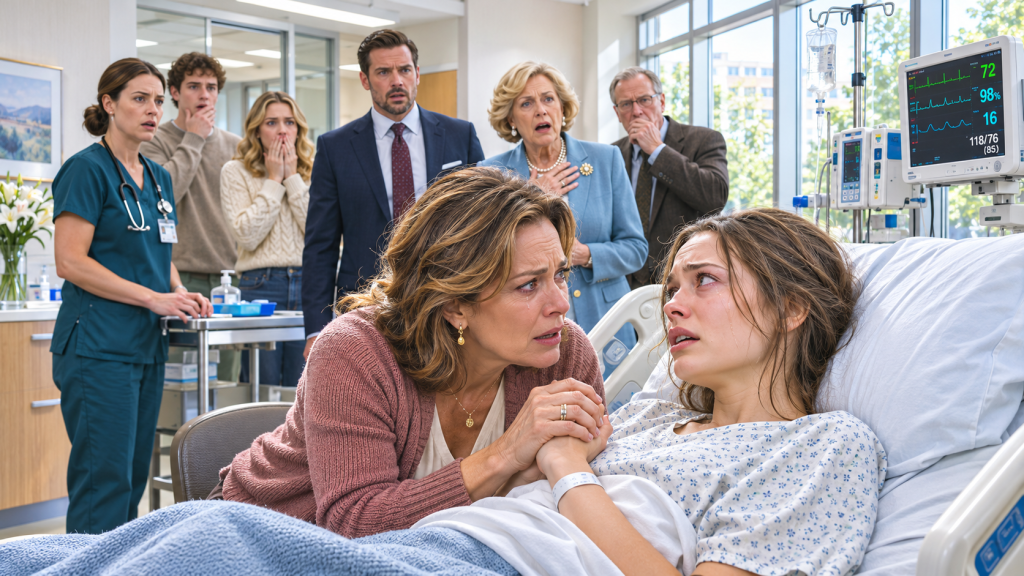
I looked at my daughter. Her face was pale, her lips dry, and every word seemed to require enormous effort. For four months, I’d prayed to hear her voice. Now I was so desperate for answers that I was forgetting how fragile she remained. I leaned down and kissed her forehead. “You don’t have to tell me everything tonight.” Emily’s fingers tightened around mine. “Don’t let Daniel take the painting.” My heart lurched. “I won’t.” “And Mom?” “Yes, baby?” Her eyes filled again. “Dad didn’t know I was investigating.” I stared at her.
“What do you mean?”
“He left me something before he died. I didn’t understand it until four months ago.”
Then her breathing grew uneven.
The nurse immediately checked her monitors.
“Mrs. Whitmore needs to rest.”
I nodded, though leaving her felt impossible.
As I stepped toward the door, Emily whispered one final sentence.
“Ask Rebecca about the scholarship fund.”
Rebecca stopped moving.
For one brief second, something changed in her expression.
Not confusion.
Recognition.
I looked at my former colleague.
“Rebecca?”
She swallowed.
“Margaret, there’s something I should have told you years ago.”
We moved into a small family consultation room down the corridor.
I sat opposite Rebecca while Detective Samuel Lawson remained near the door.
Through the window, I could see the hospital parking lot glittering beneath the midnight rain.
Rebecca folded her hands.
“Do you remember the Whitmore Family Education Foundation?”
I frowned.
“Daniel’s family charity?”
She nodded.
“It funds scholarships, school programs, and educational grants.”
“I know. Emily helped organize one of its fundraising dinners.”
Rebecca watched me carefully.
“Your husband was involved with it too.”
I stared at her.
“Henry?”
“Yes.”
I shook my head.
“Henry was a retired engineer. He donated to a few charities, but he never mentioned working with the Whitmores.”
Rebecca opened her briefcase.
Inside was a faded photograph.
My husband stood beside a group of volunteers outside a community center.
He wore his favorite brown jacket.
In his hands was a large cardboard check.
I recognized his familiar smile immediately.
For one painful moment, I forgot everything except how much I missed him.
Then I noticed the amount written on the check.
$250,000.
I looked up.
“Where did he get that kind of money?”
Rebecca hesitated.
“Your husband inherited a minority interest in a commercial property from his older sister. When the property was sold, he received a substantial distribution.”
I stared at her.
I knew about his sister’s estate.
But Henry had always told me there wasn’t much left after expenses.
“He donated it?”
“Part of it. He also helped establish an independently administered scholarship fund.”
My throat tightened.
“Why didn’t he tell me?”
Rebecca looked down.
“I don’t know.”
The answer hurt because it reminded me that even loving marriages contain things we don’t fully understand.
But Henry wasn’t someone who hid large financial decisions casually.
He used to consult me about buying a new lawn mower.
Something didn’t fit.
“What happened to the fund?” I asked.
Rebecca took a slow breath.
“Five years ago, your husband contacted an investigator about discrepancies in the scholarship accounts.”
My stomach dropped.
“What discrepancies?”
“Money was being transferred to consulting businesses that appeared to provide little or no legitimate service.”
I stared at her.
“And Daniel’s family controlled the foundation?”
“Patricia Whitmore chaired its board. Daniel oversaw certain financial arrangements.”
The room seemed to tilt.
I remembered Patricia’s cold laughter beside Emily’s hospital bed.
Daniel’s impatience when I asked questions.
The way they treated my daughter as though she were an inconvenient business obligation.
“Are you saying they stole Henry’s donation?”
Rebecca answered carefully.
“I’m saying the funds were subject to transactions that raised serious concerns. Your husband believed someone was diverting money.”
I pressed my hands against my mouth.
“And then he died.”
Rebecca nodded.
I stared at her.
“Did you know about this when he died?”
Her eyes filled.
“Yes.”
My chair scraped against the floor as I stood.
“And you never told me?”
“Margaret—”
“Five years, Rebecca!”
My voice cracked.
“For five years, you watched me grieve my husband without telling me he was investigating these people!”
Rebecca lowered her head.
“I know.”
“Why?”
She looked up.
“Because the inquiry was confidential, and after Henry died there wasn’t enough evidence to substantiate the allegations. I should have found a way to tell you what I could.”
I felt tears spill down my face.
“You were my friend.”
“I still am.”
I shook my head.
“Then you should have trusted me with the truth.”
For a moment, nobody spoke.
Then Rebecca whispered, “You’re right.”
I spent the rest of that night sitting alone in the hospital chapel.
The room was small, with wooden benches and a stained-glass window depicting a sunrise.
I wasn’t especially religious.
But after four months of praying for my daughter, I had begun finding comfort in places where silence was allowed.
I sat beneath the colored light and thought about Henry.
We’d been married thirty-eight years.
He was the kind of man who repaired broken appliances long after replacing them would have been easier.
He loved crossword puzzles.
He planted tomatoes every spring.
He remembered every anniversary, even when I forgot.
When Emily was little, he made up bedtime stories about a brave girl who sailed across the ocean in a boat built from moonlight.
He always made the girl clever.
Never helpless.
“She’s your daughter,” he’d tell me. “She’s going to know how to find her way.”
And now our daughter had nearly died after discovering something her father had apparently tried to expose years earlier.
I closed my eyes.
The evening before Henry died, we’d argued.
Not a terrible argument.
Just an ordinary disagreement.
He had missed dinner because of a meeting and returned home looking exhausted.
I asked why he was working so much when we’d both finally retired.
He snapped that some things were more important than dinner.
I was hurt.
We went to bed without resolving it.
The following morning, I found him unresponsive.
The emergency responders tried to save him.
But it was too late.
For five years, I’d carried the small wound of that unfinished argument.
Now I wondered what meeting had kept him away that evening.
And whether his last difficult hours had been connected to the same people who now seemed terrified of Emily’s recovery.
I bent my head.
“Henry,” I whispered, “what were you trying to tell me?”
There was no answer.
Only the quiet hum of the building.
Then my phone vibrated.
A message from an unfamiliar number.
Mrs. Bennett, I worked for the Whitmores five years ago. Your husband was not alone on the night he died.
I stared at the screen.
A second message arrived.
I kept something because I was afraid. Now Emily is awake, and I cannot stay silent anymore.
The sender identified herself as Rosa Delgado.
She said she had worked as the Whitmore family’s housekeeper for nearly nine years before leaving abruptly.
I remembered Rosa.
She was a gentle woman who always greeted Emily with genuine affection.
At family gatherings, she carried trays of food through the mansion while Patricia barely acknowledged her.
Then one Christmas, Rosa disappeared.
Daniel told us she’d found another job.
I hadn’t thought much about it.
Now I called her.
She answered immediately.
“Mrs. Bennett?”
“Yes.”
Her breathing was uneven.
“I’m so sorry about Emily.”
I closed my eyes.
“What do you know?”
Rosa hesitated.
“Not over the telephone.”
“Then tell me where we can meet.”
She gave me the address of a small church office on the south side of town.
Before ending the call, she whispered something that made my blood run cold.
“Your husband came to the Whitmore mansion the night before he died.”
I gripped the phone.
“Are you certain?”
“Yes.”
“He was supposed to be meeting someone about the scholarship accounts.”
“He met Daniel and Patricia.”
I stopped breathing.
“What happened?”
Rosa began crying.
“I heard shouting. Then I heard something fall.”
My hand trembled.
“Rosa, what fell?”
Her voice dropped to a whisper.
“I don’t know. But when I opened the study door, your husband was sitting on the floor, holding his chest.”
For a moment, the world seemed to disappear.
Henry had come home late that night.
Pale.
Exhausted.
He told me he was fine.
I remembered how he’d gripped the kitchen counter before walking upstairs.
I’d asked whether he needed a doctor.
He said no.
Now I wondered whether he’d been hiding the worst moments of that evening from me.
“Did anyone call an ambulance?” I whispered.
Rosa was silent.
Then she answered.
“No.”
By morning, Rebecca had arranged for Rosa to give her account to the investigators.
I was present for a separate conversation afterward, with Rosa’s permission.
She looked older than I remembered.
Her dark hair was streaked with gray, and her hands trembled as she held a cup of tea.
“I’m sorry,” she said before I’d even sat down.
I took the chair opposite her.
“Please tell me what happened.”
Rosa closed her eyes.
“Mr. Bennett arrived just after seven. He was carrying a brown folder.”
I recognized it immediately.
Henry had a favorite leather document folder.
I found it empty after his death and assumed he’d already filed away its contents.
Rosa continued.
“Mrs. Whitmore told me to stay out of the study.”
“Did Henry seem frightened?”
“At first, no. He was angry.”
I nodded.
Rosa looked at me.
“He kept saying the scholarship money belonged to children who needed it.”
My throat tightened.
“He said Patricia had no right to move it into private companies.”
I stared at her.
“What did Patricia say?”
Rosa swallowed.
“She told him he didn’t understand how wealthy families managed charitable assets.”
I felt a bitter flash of anger.
Henry had spent his entire career solving complex engineering problems.
He wasn’t easily confused by financial paperwork.
Rosa continued.
“Then Mr. Daniel started shouting.”
“What did he say?”
“He told your husband that if he went to the authorities, Emily would suffer.”
My breath caught.
“Emily?”
Rosa nodded.
“He said she had signed financial documents connected to the foundation.”
I stared.
“Had she?”
“I don’t know. But Mr. Bennett said Daniel was lying.”
I pressed my hands together.
Then Rosa looked down.
“A few minutes later, I heard a heavy noise.”
Her eyes filled.
“When I opened the door, Mr. Bennett was on the floor.”
I leaned forward.
“Was he conscious?”
“Yes. He was holding his chest and breathing badly.”
“What did they do?”
“Daniel told me to get out.”
I felt cold.
“Did you call for help?”
“I reached for my phone, but Mrs. Whitmore said he was having a panic attack and didn’t need an ambulance.”
My chest tightened.
“Rosa, he had a heart attack the following morning.”
She began crying.
“I know.”
I stared at her.
“Why didn’t you call anyway?”
She covered her face.
“Because I was afraid of losing my job. My husband was sick. I had two children.”
She sobbed.
“I’ve asked myself that question every day for five years.”
I wanted to scream.
I wanted to tell her that fear wasn’t an excuse.
That Henry might still be alive if someone had called for help.
But then I looked at Rosa.
She was crying so hard she could barely breathe.
And I realized that the people who create fear often depend on others becoming too frightened to do the right thing.
I took a slow breath.
“What happened after that?”
Rosa wiped her eyes.
“Mr. Bennett stood up. Daniel helped him to a chair. After a while, he insisted on going home.”
I closed my eyes.
“He told me nothing.”
Rosa nodded sadly.
“Mrs. Whitmore ordered me not to discuss the meeting.”
“Did you obey?”
“For a long time.”
She reached into her handbag.
Then placed a small envelope on the table.
“Until I found this while cleaning the study.”
Inside was a memory card.
I stared at it.
“What is that?”
Rosa swallowed.
“Mr. Bennett had placed a small recording device on the bookshelf before the meeting. He must have forgotten it when he became ill.”
My heart hammered.
“And you kept it?”
She nodded.
“I was frightened they’d destroy it.”
I reached toward the envelope.
Then stopped.
After twenty-seven years investigating financial crimes, I knew what needed to happen.
The original evidence belonged in the hands of the investigators, with its history carefully documented.
I looked at Rosa.
“Thank you for finally telling the truth.”
She began crying again.
“I should have done it sooner.”
I didn’t disagree.
But I also knew that what mattered now was making sure the truth could no longer be buried.
Two days later, Emily asked for me again.
Her recovery was painfully slow.
Some mornings, she could remember details clearly.
Other mornings, she struggled to finish a sentence.
The neurologist explained that progress after a serious brain injury wasn’t always steady. Fatigue, confusion, and gaps in memory could make even ordinary conversations exhausting.
I stopped expecting every visit to bring another revelation.
Sometimes I simply brushed her hair.
Sometimes I read from the same novel we’d started four months earlier.
Sometimes I held her hand while she slept.
One afternoon, she looked at me and whispered, “Mom, did you find Rosa?”
I nearly dropped the book.
“Yes.”
Her eyes filled.
“Good.”
I leaned closer.
“Emily, did you know she had evidence about Dad?”
She nodded faintly.
“Found her name in the old files.”
I waited.
“Then she called me.”
“When?”
“Two weeks before the stairs.”
I felt a chill.
Emily closed her eyes.
“She said she was afraid.”
I stroked her hand.
“You don’t have to continue if you’re tired.”
She shook her head.
“I need you to understand.”
I nodded.
She took a slow breath.
“Daniel was transferring scholarship money into businesses controlled by Patricia.”
I felt my stomach tighten.
“How did you discover it?”
“An auditor asked me to review a suspicious account.”
Emily swallowed.
“One company shared an address with Daniel’s private investment office.”
I stared at her.
“Did you confront him?”
“Not at first.”
She looked toward the window.
“I thought there had to be an explanation.”
I remembered the way she’d defended her husband during their early marriage.
Daniel was charming.
Generous.
Successful.
He bought Emily beautiful jewelry and took her to expensive restaurants.
I had always worried that his family’s money came with expectations.
But Emily insisted Daniel treated her as an equal.
Now she looked at me through exhausted eyes.
“I found Dad’s name in the foundation records.”
My heart tightened.
“His donation?”
She nodded.
“More than that.”
I waited.
“Dad filed a complaint five years ago.”
I stared.
“The complaint was closed after he died.”
Emily’s lips trembled.
“Mom, somebody changed the supporting documents.”
My investigator’s instincts sharpened.
“Do you know who?”
She looked at me.
“Daniel approved the revised records.”
I sat perfectly still.
Then Emily whispered, “The safe contains the originals.”
The painting of the woman in blue was well known in the Whitmore mansion.
It hung above the fireplace in Daniel’s private study.
The portrait showed a pale woman standing beside a garden window, wearing a blue silk dress and holding a small silver locket.
Patricia always claimed it depicted an ancestor.
She told visitors the painting was worth more than most people’s houses.
I never liked it.
Something about the woman’s expression seemed sorrowful.
Emily once joked that the portrait looked like someone who knew too many family secrets.
Now I understood why she’d remembered it.
The investigators obtained the necessary legal authority to search the mansion and examine the study.
I did not accompany them.
Rebecca made that clear.
“Margaret, your place is with Emily. Let the investigators do their work.”
She was right.
I’d spent twenty-seven years examining financial crimes.
I understood the importance of preserving evidence properly.
But I was also a mother.
And the thought of Daniel or Patricia destroying whatever Emily had discovered made every hour feel unbearable.
The search took place on a rainy Tuesday morning.
I waited at the hospital.
At eleven seventeen, Rebecca called.
“They found the safe.”
I closed my eyes.
“Was anything inside?”
“Yes.”
My heart hammered.
“Rebecca.”
“There were original account statements, ownership records, correspondence, and digital storage devices. The contents are being examined.”
I gripped the phone.
“And the recording?”
“We found a storage device described in a document inside the safe. We haven’t established its contents yet.”
I looked toward Emily’s room.
“Does Daniel know?”
“His attorney has been notified of the search. Please don’t contact him.”
I nodded.
Then Rebecca said something that made me stop breathing.
“Margaret, one of the documents includes Henry’s signature.”
I closed my eyes.
“What kind of document?”
“A written statement concerning the scholarship fund, dated the evening before his death.”
Tears streamed down my face.
Henry had not been imagining things.
He’d been collecting evidence.
And apparently, he’d tried to leave a record before going home for the last time.
The digital recordings were reviewed by investigators.
Several days passed before Rebecca could share what had been established.
During that time, I barely slept.
I visited Emily.
Went home.
Looked through Henry’s old papers.
Then returned to the hospital.
Each night, I dreamed about the evening before he died.
I saw him standing in our kitchen.
His face pale.
One hand gripping the counter.
I heard myself asking whether he wanted dinner.
He shook his head.
“Not tonight, Margaret.”
I remembered being irritated.
I thought he’d forgotten our plans.
I didn’t know he’d been frightened.
I didn’t know he’d been threatened.
And I didn’t know that the following morning, I would lose him forever.
On Friday afternoon, Rebecca asked me to meet her.
She had a recording of a conversation from the Whitmore study, shared through the authorized investigative process.
“Before you listen,” she said, “I want you to understand that this establishes what was said, not necessarily every event or its cause.”
I nodded.
Then she pressed play.
Henry’s voice filled the room.
“If those payments were legitimate, Patricia, why were the invoices altered?”
My chest tightened.
I pressed a hand against my mouth.
It had been five years since I’d heard his voice.
Not on an old birthday video.
Not through a distant memory.
But speaking with the steady determination I remembered so well.
Patricia answered.
“You’re making a very serious accusation.”
Henry replied, “Then show me the supporting contracts.”
Daniel’s voice followed.
“Henry, please. Emily doesn’t need this kind of trouble.”
My stomach turned.
Henry spoke sharply.
“Leave my daughter out of this.”
There was a rustling sound.
Then Patricia said, “People your age shouldn’t get themselves worked up over matters they don’t understand.”
Henry answered, “I understand that scholarship money is missing.”
Another pause.
Then Daniel spoke.
“You have no idea what you’re risking.”
Henry’s voice grew louder.
“Are you threatening me?”
A chair scraped.
Someone shouted.
Then came a heavy sound.
Henry gasped.
For several seconds, there was confusion.
I heard Rosa’s voice in the background.
“Mr. Bennett? Are you all right?”
Daniel snapped, “Get out!”
My hands began shaking.
Then I heard Henry struggling to breathe.
Rosa said, “Someone should call an ambulance.”
Patricia answered.
“No. He needs to calm down.”
Henry’s voice was faint.
“My chest…”
The room went silent.
I gripped the edge of the table.
Rosa spoke again.
“Please, he’s sick.”
Daniel said, “Mother, we need to call someone.”
Patricia answered.
“Not while he’s accusing us of theft. Think about what this will look like.”
I stared at Rebecca.
She let the recording continue.
Then Henry spoke.
Barely a whisper.
“Emily…”
A long silence followed.
The next sounds were footsteps and a door opening.
The recording ended several minutes later.
I sat perfectly still.
For five years, I’d believed my husband died without warning.
Now I knew he’d suffered a frightening episode hours earlier while two people worried more about their reputation than his medical needs.
I began sobbing.
Rebecca moved beside me.
“Margaret.”
I shook my head.
“He needed help.”
She took my hand.
“I know.”
“They should have called.”
Her eyes filled.
“Yes.”
I stared at the silent recording device.
Then whispered, “Does this prove they killed him?”
Rebecca answered carefully.
“No. It is evidence of what happened during that meeting, including the delay in seeking help. Medical experts and investigators will need to assess what conclusions can responsibly be drawn about his death.”
I closed my eyes.
I wanted certainty.
I wanted one clear explanation.
One person to blame.
One sentence that could make five years of grief finally make sense.
But the truth was more painful than that.
Henry’s death was real.
The threats were real.
The failure to seek prompt help was real.
And whether that delay caused or contributed to his death remained a question that required evidence, not anger.
Still, I knew something I’d never known before.
My husband had spent his final evening trying to protect children who needed scholarships.
And my daughter had nearly lost her life trying to finish what he started.
The financial investigation uncovered a much larger scheme than Emily initially suspected.
The Whitmore Family Education Foundation had received millions of dollars in donations over several years.
Some funds had been used appropriately.
Scholarships were awarded.
School programs received grants.
Public events were held.
But beneath the legitimate activity lay a network of consulting contracts and payments to companies connected to Patricia and Daniel.
The investigators identified unsupported invoices, misleading descriptions of services, and transfers that did not match the foundation’s charitable purpose.
The suspected improper transactions totaled more than $2.4 million.
Among them were payments linked to an investment company controlled indirectly by Patricia.
Another company had provided consulting invoices using an address associated with Daniel’s office.
Emily’s work had helped connect the records.
She had noticed matching payment amounts, repeated vendor descriptions, and dates that didn’t align with the services supposedly performed.
But the most important evidence wasn’t financial.
It was the recording associated with the night of her injury.
Investigators recovered video from a camera installed in the mansion’s study.
The camera itself was ordinary.
Daniel used it to monitor the room because he kept valuable documents there.
Emily apparently knew about the device.
But Daniel believed he controlled the recordings.
What he didn’t realize was that an older backup system still retained copies of certain events.
Emily had found the backup information while reviewing the foundation records.
The recovered footage showed her entering the study on the night of the fall.
She carried her phone and a folder.
Daniel stood beside the fireplace.
There was no sound in the first portion.
Then the audio resumed.
Emily’s voice was clear.
“I know what happened to the scholarship money.”
Daniel responded.
“Emily, you don’t understand.”
She placed the folder on the desk.
“I understand enough.”
He stepped toward her.
She backed away.
Then she said something that made my heart ache.
“My father tried to stop you.”
Daniel’s voice rose.
“Your father should have stayed out of it.”
I covered my mouth as Rebecca described the next moments.
Emily turned toward the door.
Daniel grabbed her arm.
She pulled away.
He tried to take her phone.
During the struggle, he shoved her backward.
She stumbled through the open study doorway and lost her balance near the top of the staircase.
The camera captured only part of the landing.
But it showed enough.
Emily fell backward.
There was a terrible crashing sound.
Then silence.
Daniel stood frozen.
For several seconds, he didn’t move.
Then he went to the desk.
He picked up the telephone.
The emergency call records confirmed that he contacted emergency services from the study.
But he told the dispatcher something that wasn’t true.
He said he’d found Emily unconscious after she slipped on the stairs.
He didn’t mention grabbing her.
He didn’t mention the argument.
He didn’t mention the folder.
And when investigators reviewed the footage, they saw him remove documents from the desk before going toward his injured wife.
I listened without speaking.
For four months, that man had stood beside Emily’s hospital bed and mocked me for talking to her.
He had watched me pray.
Watched me cry.
Watched me hold my daughter’s hand.
And he’d known that the story he told everyone about her accident was false.
The day Daniel was arrested, I was sitting beside Emily.
She had begun speaking in full sentences again.
Her recovery was still uncertain, and she faced months of rehabilitation, but she could remember more of what happened.
When Rebecca called, I stepped into the hallway.
“The authorities have taken Daniel into custody,” she said.
I closed my eyes.
“And Patricia?”
“She has been charged in connection with the financial investigation. Other aspects of the case are still being reviewed.”
I leaned against the wall.
For a moment, I expected to feel triumphant.
Instead, I felt old.
Exhausted.
And terribly sad.
I thought about the young man who had once asked for my daughter’s hand in marriage.
Daniel had brought flowers to our house.
He’d spoken about building a family.
He promised to love Emily through sickness and health.
Now she was lying in a hospital bed because of violence that followed a confrontation over money.
I looked through the doorway.
Emily was watching television with a nurse.
She laughed softly at something on the screen.
I hadn’t heard that sound in four months.
Suddenly, the arrest mattered less than the fact that she was alive to hear about it.
I returned to her bedside.
She looked at me.
“Mom?”
“Yes, sweetheart?”
“Was that Rebecca?”
I nodded.
She studied my face.
“What happened?”
I took her hand.
“Daniel has been arrested.”
Her expression changed.
For a long moment, she stared at the ceiling.
Then tears slipped down her cheeks.
I leaned closer.
“Emily?”
She swallowed.
“I loved him.”
My heart broke.
“I know.”
She closed her eyes.
“I really loved him, Mom.”
I held her hand.
“You can grieve the person you thought he was.”
She began crying harder.
“And still protect yourself from the person he became.”
For a long time, we sat together.
Then Emily whispered, “I want a divorce.”
I squeezed her hand.
“Then we’ll find a way to help you do that safely.”
The months that followed were nothing like the dramatic endings people imagine.
There was no single day when everything became easy.
Emily struggled with headaches, fatigue, and difficulty concentrating.
Some days, she remembered details clearly.
Other days, she became frustrated because ordinary words seemed to disappear just as she tried to speak them.
Her rehabilitation team worked patiently with her.
Physical therapy helped her regain strength and balance.
Occupational therapy helped her relearn tasks she once performed without thinking.
Speech and cognitive specialists helped her rebuild communication and confidence.
I attended appointments when she wanted me there.
But I also learned something important.
My daughter didn’t need me making every decision.
She needed me respecting the decisions she was still capable of making.
One afternoon, she became upset when I reached for her coat.
“Mom, I can do it.”
I stopped.
She looked ashamed.
“I’m sorry.”
I shook my head.
“No, sweetheart. You’re right.”
She slowly buttoned the coat herself.
It took longer than it once would have.
But when she finished, she smiled.
And I realized that loving her through recovery meant celebrating independence, not just protecting her from difficulty.
We took walks in the hospital garden.
Read books together.
Made plans for the day she’d return home.
Some days, we talked about Henry.
Other days, neither of us could bear to mention him.
And sometimes, when grief became too heavy, we simply sat together beneath the afternoon sun.
Alive.
Together.
With more time than we’d once believed possible.
The investigation into Henry’s death was reopened.
Medical experts reviewed the available records, the emergency response from the morning he died, and the newly recovered evidence of his illness at the Whitmore mansion the previous evening.
They established that Henry had experienced symptoms warranting urgent medical attention.
But after five years, they could not determine with certainty whether treatment that night would have prevented his death.
I hated hearing those words.
I wanted someone to tell me that if Rosa had called an ambulance, Henry would still be alive.
I wanted to believe there had been one moment when everything could have been changed.
But medicine couldn’t offer that certainty.
What the evidence did establish was that Patricia and Daniel had prioritized concealing a financial dispute while Henry was visibly unwell.
And that truth was painful enough.
The criminal and civil proceedings concerning the financial scheme continued.
Patricia was eventually held accountable for significant fraudulent transactions connected to the foundation.
Daniel faced consequences for his role in the financial misconduct and for the violence against Emily.
The exact penalties were determined through the legal process.
Neither family wealth nor expensive attorneys could erase the authenticated records.
The foundation came under independent oversight, and steps were taken to recover misused money and restore its charitable work.
Several delayed scholarship awards were eventually funded.
When I learned that, I went to the cemetery.
I sat beside Henry’s grave and cried.
“You did it,” I whispered.
Then I corrected myself.
“No. Emily did.”
I smiled through tears.
“You would have been so proud of her.”
The wind moved through the grass.
And for the first time since hearing the recording, I felt something other than anger when I thought about my husband’s final days.
I felt pride.
He had tried to protect something meaningful.
And our daughter had carried that courage forward.
Almost a year after waking from her coma, Emily came home.
Not to the mansion.
She wanted nothing to do with the house where she’d nearly died.
Instead, she rented a small cottage near the river, twenty minutes from my home.
It had white shutters, a blue front door, and a little garden filled with lavender.
The first time she walked inside, she stood in the living room for several minutes.
Then she turned toward me.
“It’s small.”
I smiled.
“Compared with the mansion?”
She nodded.
“Very small.”
I laughed.
She looked around.
Then a slow smile appeared.
“I love it.”
I helped her arrange the furniture.
Her friends brought meals.
A neighbor offered to help with the garden.
And Ben, her cousin, built a wooden bookshelf for the living room.
There were difficult days.
Emily sometimes became exhausted after simple tasks.
She needed continued medical care and rehabilitation.
But every week, she reclaimed another part of her life.
One afternoon, she asked me to bring over a box of photographs.
We sat at her kitchen table looking through pictures from her childhood.
In one photograph, Henry stood behind her bicycle, teaching her how to ride.
Emily stared at it for a long time.
“I remember that day.”
I smiled.
“You fell three times.”
She laughed.
“Four.”
I looked at her.
“You remember?”
She nodded.
“Dad told me I could quit if I wanted.”
Tears filled her eyes.
“But he said falling didn’t mean I’d never learn to ride.”
I took her hand.
Emily looked down at the picture.
“I think he was teaching me more than bicycles.”
My throat tightened.
“I think so too.”
Six months later, Emily received an invitation to attend a scholarship ceremony.
The education foundation had been reorganized under independent leadership.
New financial controls were in place.
And several students who had waited for assistance were finally receiving their awards.
The organizers wanted to recognize Henry’s efforts to protect the fund.
Emily asked me to accompany her.
We sat near the front of a modest auditorium.
There were no extravagant decorations.
No towering flower arrangements.
No expensive banquet.
Just students, families, educators, and people celebrating the opportunity to continue learning.
One young woman stepped onto the stage.
Her name was Olivia.
She was eighteen, with dark curls and a trembling smile.
She explained that her father had died when she was fourteen and that her mother worked long hours to support the family.
For years, Olivia had worried she wouldn’t be able to afford college.
Then she received the scholarship.
“I don’t know who made this possible,” she said, her voice shaking.
“But I want them to know that I’m going to become a nurse.”
The audience applauded.
Olivia began crying.
“I want to help people the way somebody helped me.”
Beside me, Emily covered her mouth.
Tears ran down her cheeks.
I took her hand.
And in that moment, I understood why Henry had refused to remain silent.
Money could purchase beautiful houses.
Expensive cars.
Private vacations.
But it could also purchase textbooks.
Tuition.
Transportation.
A chance for a young woman to become the person she’d dreamed of being.
The difference was never the money itself.
It was what people chose to do with it.
After the ceremony, Olivia approached us.
“Are you Mrs. Bennett?”
I smiled.
“Yes.”
She hesitated.
“I wanted to thank you for what your husband did.”
My eyes filled.
“You never met him.”
She shook her head.
“No.”
Then she smiled.
“But I think he must have been a good man.”
I swallowed.
“He tried to be.”
Olivia looked at Emily.
“And you’re his daughter?”
Emily nodded.
“Yes.”
The young woman reached for her hand.
“Thank you for helping make the scholarships possible.”
Emily began crying.
Olivia looked startled.
“I’m sorry. Did I say something wrong?”
Emily shook her head.
“No.”
She smiled through tears.
“You said exactly what I needed to hear.”
I watched them embrace.
And for the first time, the past no longer felt like a locked room full of unanswered questions.
It felt like something we could honor without allowing it to control every remaining day.
Two years after Emily woke from her coma, we returned to the hospital.
Not for an emergency.
Not because she was unconscious.
But because the hospital had invited former patients and families to a gathering celebrating recovery, rehabilitation, and the medical teams who cared for them.
Emily walked beside me through the familiar corridor.
Her steps were careful.
Her balance wasn’t perfect.
And she still had days when fatigue made ordinary life difficult.
But she was walking.
Smiling.
Talking.
Living.
We stopped outside the room where she’d spent four months.
The door was open.
A nurse was changing the sheets.
Emily stood quietly.
“Mom?”
“Yes, sweetheart?”
“Were you really here every day?”
My eyes filled.
“Every day I could be.”
She looked toward the bed.
“Did you talk to me?”
I smiled.
“All the time.”
“What did you say?”
I laughed softly.
“Everything.”
She turned toward me.
“Everything?”
“I told you about the garden. About the neighbors. About the ridiculous things your father used to do.”
Emily smiled.
“What else?”
I took her hand.
“I told you that you were loved.”
Her eyes filled.
“Even when I couldn’t answer?”
“Especially then.”
She looked at the room again.
Then whispered, “I remember something.”
My heart quickened.
“What?”
“Your voice.”
I stared at her.
Emily closed her eyes.
“I don’t remember everything from those months. But sometimes I remember hearing you read.”
A tear slipped down my cheek.
“And I remember someone holding my hand.”
I couldn’t speak.
She turned toward me.
“I think it was you.”
I pulled her into my arms.
For four months, Daniel and Patricia had laughed at me for talking to someone they believed couldn’t hear.
They called me foolish.
Delusional.
Unable to accept reality.
But I’d never needed proof that Emily understood every word.
I had spoken because she was my daughter.
Because love shouldn’t disappear when someone cannot answer.
And because sometimes, the most important thing we can give another person is the comfort of knowing they aren’t alone.
That evening, Emily came to my house for dinner.
We made Henry’s favorite chicken casserole.
She insisted on helping.
I let her chop the vegetables while I prepared the sauce.
We laughed when she accused me of adding too much salt.
I told her she sounded exactly like her father.
She smiled.
Then, while we were setting the table, she looked toward the old photograph hanging above the fireplace.
Henry stood beside us in our backyard.
We were all laughing.
It had been taken seven years earlier.
Before the financial investigation.
Before his death.
Before Emily married Daniel.
Before everything changed.
“Mom,” she whispered, “do you think Dad knew how much we loved him?”
I looked at the picture.
“Yes.”
She nodded.
“I hope so.”
I placed my hand over hers.
“I think he knew.”
We stood quietly for a moment.
Then Emily smiled.
“Come on. Dinner’s getting cold.”
I laughed.
And together, we carried the plates to the table.
Later that night, after Emily went home, I sat beside the window with Henry’s photograph in my lap.
I thought about the years I’d spent believing I could recognize every kind of deception.
Twenty-seven years investigating financial crimes had taught me to follow records, question inconsistencies, and never assume powerful people were telling the truth.
But none of that experience had prepared me for what happened inside my own family.
I hadn’t recognized Daniel’s cruelty soon enough.
I hadn’t known what Henry was investigating.
And I couldn’t protect Emily from every danger.
For a long time, those thoughts tormented me.
Then I remembered something Henry once said.
“Margaret, you can’t live everyone’s life for them. All you can do is love them, teach them, and be there when they need you.”
I smiled through tears.
That was what I’d done.
For four months, I’d sat beside my daughter.
I’d brushed her hair.
Read her books.
Held her hand.
And refused to let anyone convince me that her silence made her less deserving of love.
When she finally opened her eyes, she gave me the truth.
But the greatest miracle wasn’t the exposure of Daniel and Patricia.
It was that Emily had another chance to live.
Another chance to laugh.
To make mistakes.
To build a home.
To love again, if she chose.
And to become someone beyond the suffering she’d endured.
I looked at Henry’s photograph.
“We got through it,” I whispered.
Then I corrected myself.
“We’re still getting through it.”
Because healing isn’t one beautiful ending.
It’s a thousand ordinary mornings when we choose to keep living.
I placed the photograph on the shelf and turned off the light.
The house was quiet.
Outside, the moon shone above the garden Henry had planted.
And for the first time in years, I felt a peace that didn’t depend on every question having an answer.
The truth can expose those who betray us, but love gives us the strength to survive what the truth reveals.
Daniel and Patricia had believed money could protect their secrets.
They thought an unconscious woman could never speak.
They thought a grieving mother would eventually stop asking questions.
They were wrong.
Because my daughter’s voice returned.
The evidence survived.
And the love they mocked became the very thing that helped us endure.
I closed my eyes.
Somewhere across town, Emily was sleeping in a home she’d chosen for herself.
Safe.
Free.
And finally living a future that belonged to her.


