For a moment, the only sound was the lake moving gently against the dock. My attorney, Caroline Hayes, stood beside her car, holding a thick folder against her chest. Nathan stared at her as though she’d just announced something impossible. Brooke looked from Caroline to me, her lips tightening. I glanced down at the fishing lure in my hand. It was one Ellen had carved twenty years earlier, a small wooden fish painted green and gold. I’d brought it to the porch that morning because working on something she’d made helped me think.
Now I gripped it so tightly that the tiny metal hook pressed against my palm. “What loan?” I asked. Caroline looked at Nathan. “Would you like to explain, or should I?” My son’s face turned pale. “Dad, don’t listen to her. She’s making it sound worse than it is.” Caroline opened the folder. “The lender was given documents identifying this property as collateral for a business loan.” I stared at her. “How much?” She hesitated. “One hundred and eighty thousand dollars.” The number seemed to hang in the morning air.
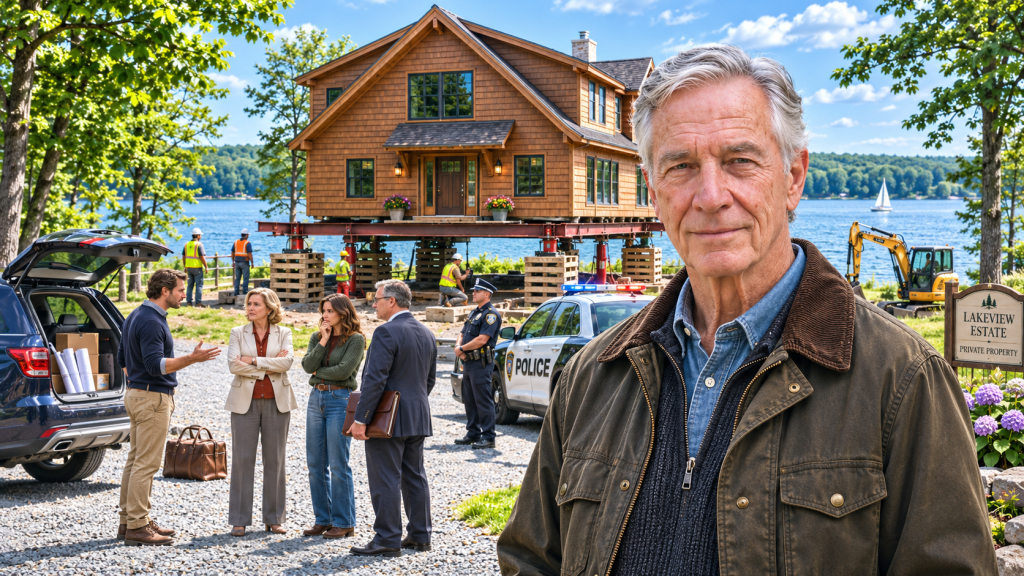
One hundred and eighty thousand dollars. Ellen and I had spent two decades saving to build this house. We had skipped vacations. Driven used cars. Worked weekends. Painted every railing ourselves. And now my son had apparently tried to use it to secure a debt I knew nothing about. I turned toward Nathan. “Tell me she’s mistaken.” He swallowed. “Dad, it’s temporary.” My heart sank. Those three words told me everything. Temporary. As though theft became less serious when the person responsible planned to correct it later.
As though dishonesty was acceptable if the liar expected a happy ending.
I looked at Brooke.
She folded her arms.
“Nathan, you don’t have to explain our finances to him.”
I almost laughed.
“Your finances?”
My voice sounded unfamiliar.
“This is my house.”
Brooke rolled her eyes.
“Technically.”
Caroline stepped forward.
“Legally, Walter owns the property. And any lender claiming a security interest will have to establish that the documents were validly executed.”
I looked at my son.
“Did you forge my signature again?”
He stared at the gravel.
“Nathan.”
He finally looked up.
“We were going to tell you.”
I felt a cold emptiness settle inside me.
“When?”
He didn’t answer.
“After the wedding guests arrived? After you collected their money? Or after someone tried to take the house?”
Brooke stepped toward me.
“You’re being dramatic.”
I turned to face her.
“Ellen died believing this place would remain a home for our family. You turned it into a business without permission and used my name to borrow money.”
Her expression hardened.
“Your wife isn’t here to care about any of this.”
Everything inside me went still.
Nathan looked horrified.
“Brooke.”
But she wasn’t finished.
“Someone has to say it. You’re clinging to a bunch of old memories while the rest of us are trying to build a future.”
I looked toward the blue front door Ellen had painted herself.
Then back at my daughter-in-law.
“Those memories,” I said quietly, “are the reason you ever had a place to come for Christmas.”
Caroline asked Nathan and Brooke to remain outside while we spoke privately.
My son protested.
“Dad, she’s turning you against us!”
I shook my head.
“No, Nathan. You did that yourself.”
He looked as though I’d struck him.
I turned and followed Caroline into the house.
The familiar scent of pine and lemon furniture polish greeted me.
Sunlight spilled across the wooden floorboards.
Ellen’s quilt lay folded over the arm of her favorite chair.
I remembered the last time she’d sat there.
Her body had become painfully thin from treatment, but she’d insisted on watching the sunset.
“Promise me something, Walter,” she’d whispered.
“Anything.”
“Don’t let this place become a museum after I’m gone.”
I’d laughed through tears.
“I don’t think you’re going anywhere.”
She squeezed my hand.
“Listen to me.”
So I had.
“Let people laugh here,” she said. “Let them eat too much and stay up late talking. Let children run along the dock.”
Then she smiled.
“But make sure they know they’re welcome because someone loves them, not because someone can profit from them.”
At the time, I’d thought she was simply telling me not to shut the world out after her death.
Now her words seemed painfully precise.
Caroline placed the folder on the kitchen table.
“Walter, I need you to understand something important.”
I sat down.
She continued.
“The lender has produced a copy of an agreement that appears to contain your signature and an acknowledgment supposedly completed before a notary.”
I stared at her.
“I never signed anything.”
“I believe you. But we need to establish that formally.”
She turned the document toward me.
My name appeared at the bottom.
Walter Bennett.
The handwriting resembled mine more closely than the signature Brooke had used on the rental authorization.
That frightened me.
Then I saw the date.
October 14.
My birthday.
I looked up.
“Caroline, I know exactly where I was that day.”
She leaned forward.
“Tell me.”
“I was in the hospital having cataract surgery.”
Her eyes sharpened.
“Do you have records?”
“Of course.”
I stood.
“June drove me there. She picked me up afterward. I spent the rest of the day at home, wearing that ridiculous plastic eye shield.”
Caroline nodded.
“That’s significant.”
I looked at the document again.
“Why would Nathan choose my birthday?”
She studied the page.
“Perhaps he thought the date would appear memorable or legitimate. We shouldn’t guess until we establish who prepared it.”
I pressed a hand against my forehead.
Then a terrible realization struck.
“Caroline, was this loan approved?”
Her expression grew serious.
“Funds were apparently disbursed. But the legal status of the purported security interest is being disputed.”
I swallowed.
“Could I lose the house?”
She didn’t offer false comfort.
“We’re taking immediate steps to protect your ownership and challenge the fraudulent documents. I can’t promise a result before the evidence is examined.”
I nodded slowly.
After years repairing engines and woodworking equipment, I understood that some problems couldn’t be solved by pretending the damage wasn’t there.
You had to identify it.
Contain it.
Then repair what could be repaired.
I took a breath.
“What do you need from me?”
The lender’s records revealed that the loan had been obtained through a company called Bluewater Hospitality Ventures.
Nathan and Brooke were listed as its managers.
The company had been registered eight months earlier.
I had never heard of it.
Caroline showed me its website.
There was my lake house.
The blue door.
The dock.
The stone fireplace Ellen had insisted on building.
Even the little wooden sign above the kitchen window.
ELLEN’S PLACE.
They’d used her name.
Not merely the building.
Not merely the land.
Her name.
I stared at the screen.
Brooke had apparently promoted the property as a luxury retreat for weddings, corporate events, and extended vacations.
The website described it as a family-owned estate operated by the next generation.
There were testimonials.
Photographs.
Booking packages.
Even a polished story about how the business had been inspired by a beloved woman who wanted everyone to enjoy the lake.
I felt sick.
“They turned her memory into advertising.”
Caroline nodded.
“That’s one of the concerns we’re documenting.”
I scrolled farther.
The wedding package included catering coordination, floral arrangements, guest parking, lakeside seating, and overnight accommodations.
Then I noticed something that made me stop.
The photographs of the interior were recent.
The curtains had been changed.
The kitchen shelves rearranged.
A new wine refrigerator stood beside Ellen’s old oak cabinet.
I looked at Caroline.
“They’ve been inside.”
She studied the screen.
“Apparently.”
“Without telling me.”
I clicked another photograph.
Ellen’s bedroom had been transformed into what the listing called a honeymoon suite.
Her handmade quilt was displayed across the bed.
The sight made my throat close.
That quilt had taken Ellen almost a year to finish.
She’d sewn it during chemotherapy, sometimes managing only a few stitches before exhaustion forced her to stop.
Each square represented a summer we’d spent together.
I remembered her telling me that if she couldn’t have more years, she wanted to leave something that remembered the years we already had.
And Brooke had photographed it as part of a rental package.
I closed the laptop.
For the first time that morning, I felt my anger begin to overpower my grief.
Caroline noticed.
“Walter.”
I looked up.
“Don’t make a decision while you’re this upset.”
I took a slow breath.
“What would Ellen have done?”
Caroline smiled sadly.
“From what you’ve told me, she would’ve been generous with the guests and firm with anyone who betrayed her trust.”
I looked toward the quilt.
Then nodded.
“That sounds like her.”
When we returned outside, Nathan was sitting on the stone wall beside the driveway.
Brooke stood near the van, speaking sharply into her phone.
She stopped when she saw us.
“Well?”
I looked at her.
“Well what?”
“Are you finally going to be reasonable?”
I stared.
She continued.
“The guests are arriving tomorrow. We’ve already committed to the event.”
Caroline stepped forward.
“The rental platform has been notified that the property was listed without the owner’s authorization. You may not represent that you have permission to use this house.”
Brooke’s face flushed.
“Do you understand how much money we’re going to lose?”
I looked at Nathan.
“Answer something for me.”
He raised his eyes.
“What?”
“Did you know about the wedding when you told me you were taking the house for thirty days?”
He hesitated.
“Yes.”
“And the other reservations?”
He nodded.
I swallowed.
“Were you ever planning to ask me?”
He looked away.
Brooke snapped, “We knew he’d say no!”
I turned toward her.
“That’s correct.”
She threw up her hands.
“Then what were we supposed to do?”
I looked at my son.
He knew the answer.
He’d known it from the beginning.
“You were supposed to respect my decision.”
Nathan rubbed his face.
“Dad, we needed the money.”
“For what?”
He glanced toward Brooke.
She looked away.
I waited.
Finally, he whispered, “The business.”
“What business?”
“The company.”
I shook my head.
“Nathan, you have a job. Brooke has a job. Why would you borrow one hundred and eighty thousand dollars against a house that belongs to me?”
He closed his eyes.
“We made some bad investments.”
Brooke turned sharply.
“Nathan, stop talking.”
But he continued.
“We thought we could recover the losses by running events here.”
My stomach sank.
“How much did you lose?”
He didn’t answer.
I took a step closer.
“How much?”
Brooke shoved her phone into her handbag.
“This conversation is over.”
Caroline looked at her.
“It may be over for you today. But the financial records will still need to be examined.”
Brooke’s face hardened.
“You think you can intimidate us because you’re a lawyer?”
Caroline remained calm.
“No. I’m explaining that the documents and transactions have consequences.”
Nathan began crying.
That was when I realized the shouting outside my house wasn’t the sound of people whose plans had been interrupted.
It was the sound of people whose lies were finally running out of places to hide.
That afternoon, the wedding bride called me.
Her name was Sophie.
She sounded young, frightened, and terribly embarrassed.
“Mr. Bennett?”
“Yes.”
“I’m so sorry to bother you. Your attorney gave me your number and said you had agreed I could call.”
I sat at the kitchen table.
“Of course, Sophie.”
She hesitated.
“I don’t really know how to ask this.”
“Go ahead.”
“Is it true that the wedding venue wasn’t theirs to rent?”
I closed my eyes.
“Yes.”
A long silence followed.
Then she began crying.
“My fiancé and I saved for three years.”
My throat tightened.
“I understand.”
“We wanted a small wedding by the water. My grandmother grew up near this lake.”
I looked through the window toward the dock.
Sophie continued.
“My dad died last spring. He was supposed to walk me down the aisle.”
I felt something twist inside me.
“I’m sorry.”
She took a shaky breath.
“My grandmother said getting married near the lake would make it feel like Dad was there.”
I stared at Ellen’s quilt.
For a moment, grief connected us across the telephone.
Two strangers.
Both trying to honor someone we’d lost.
“I heard you offered us the afternoon,” Sophie whispered.
“Yes.”
“Are you sure?”
I took a slow breath.
“The booking company had no right to promise my property. But you didn’t know that.”
She began crying again.
“I don’t want to cause you any trouble.”
“You won’t.”
I looked toward the water.
“My wife loved weddings. She would’ve wanted the place filled with people celebrating something good.”
Sophie was silent.
Then she whispered, “Thank you.”
I smiled sadly.
“There are conditions. We need a licensed event coordinator, appropriate insurance, and arrangements that respect the property. Caroline is helping coordinate those details.”
“Of course.”
“And Sophie?”
“Yes?”
“Don’t let what happened with the booking destroy the day you and your fiancé have been waiting for.”
She began crying.
“I’ll try.”
After we hung up, I sat quietly.
Then I walked into Ellen’s bedroom.
I looked at the quilt.
For the first time since discovering the rental listing, I understood something.
Nathan and Brooke had treated generosity as weakness.
But generosity wasn’t the problem.
The problem was that they’d mistaken my willingness to share something precious for permission to take it.
There was a difference.
And Ellen had always known it.
The wedding went ahead on Saturday.
Not because Nathan and Brooke suddenly became honest.
Not because the missing money was recovered.
And certainly not because I had forgiven what they’d done.
It went ahead because a young couple had already endured enough disappointment, and I refused to let their wedding become another casualty of someone else’s greed.
June helped coordinate parking with the neighboring property owners.
Caroline verified the event arrangements.
An insured coordinator brought chairs, flowers, and a simple white arch.
The catering company worked directly with Sophie and her fiancé, Liam, to establish what could still be provided.
Several relatives contributed food, decorations, and transportation.
It wasn’t the elaborate luxury event Brooke had advertised.
It was smaller.
Simpler.
And, according to Sophie, more beautiful than anything she’d imagined.
I stood near the kitchen window as the guests began arriving.
Women in summer dresses walked along the gravel path.
Children chased one another beneath the pine trees.
Someone laughed near the dock.
For the first time in four years, the house sounded like it had when Ellen was alive.
I thought the noise might hurt.
Instead, it made my chest ache with something unexpectedly tender.
Then June came into the kitchen carrying a small vase of white daisies.
“You look nervous,” she said.
I smiled.
“This is the first wedding I’ve hosted.”
She glanced around.
“Ellen would have been in her element.”
I laughed softly.
“She’d have reorganized every chair three times.”
“Four.”
We both smiled.
June placed the daisies on the table.
Then she looked at me.
“Walter, you know you didn’t have to do this.”
I nodded.
“I know.”
“Then why?”
I looked toward the dock.
“Because Ellen didn’t ask me to protect this house from people.”
I paused.
“She asked me to protect what it meant.”
June squeezed my shoulder.
Then she left to help the coordinator.
The ceremony began at four.
The sky was clear.
The lake shimmered beneath the afternoon sun.
Sophie walked toward the dock holding her grandmother’s arm.
Her wedding dress was simple, with delicate lace sleeves and tiny pearls sewn along the neckline.
She carried a bouquet of wildflowers.
Liam waited beside the white arch.
When he saw her, he began crying.
I stood near the back.
For a moment, I remembered Ellen walking toward me on our wedding day.
She’d been twenty-four.
Nervous.
Laughing.
Absolutely determined to carry a bouquet of yellow roses even though her mother insisted white flowers were more traditional.
“I’m marrying you,” she’d whispered afterward. “Not a flower arrangement.”
I’d loved her from that moment until her last breath.
And I knew I would love her for the rest of mine.
As Sophie and Liam exchanged their vows, I looked toward the empty chair the coordinator had placed in the front row.
A small framed photograph rested on it.
Sophie’s father.
Beside it was a single white rose.
I felt tears fill my eyes.
She’d found a way to honor someone who couldn’t be there.
Just as I was trying to honor Ellen.
After the ceremony, Sophie came to find me.
She was still holding her bouquet.
“Mr. Bennett?”
I smiled.
“Congratulations.”
She took my hands.
“I don’t know how to thank you.”
“You already did.”
She looked confused.
I gestured toward the lake.
“You brought laughter back here.”
Her eyes filled.
Then she hugged me.
I hadn’t expected it.
For a moment, I stood awkwardly with my hands at my sides.
Then I hugged her back.
And beneath the bright summer sky, I cried for my wife and smiled for a young couple beginning the life we’d once begun ourselves.
That evening, after the guests left, I walked along the dock.
The water was calm.
A few petals floated near the shore.
June joined me carrying two mugs of tea.
She handed one to me.
“Beautiful wedding.”
I nodded.
“Yes.”
She looked toward the house.
“Ellen would’ve loved it.”
I smiled.
“I think so.”
We stood quietly.
Then June said, “Walter, there’s something I haven’t told you.”
I turned.
She looked uncomfortable.
“It’s about Nathan.”
My stomach tightened.
“What about him?”
She took a slow breath.
“About six months ago, I saw him here with two men.”
I stared at her.
“At the lake house?”
She nodded.
“They were taking photographs. Measuring the driveway. Looking at the shoreline.”
I felt cold.
“Did you ask what they were doing?”
“Yes. Nathan said he was helping you arrange improvements.”
I closed my eyes.
“I never asked him to.”
June looked ashamed.
“I should’ve called you.”
I shook my head.
“You didn’t know.”
She hesitated.
“One of the men asked about road access for larger vehicles. The other was taking notes about the dock.”
I stared across the water.
It hadn’t been a casual visit.
Nathan was apparently presenting the property as a commercial venture long before I knew he had rented it to strangers.
“Do you remember the men?”
June nodded.
“One of them gave me a business card in case construction vehicles needed access near my driveway.”
She reached into her pocket.
“I kept it.”
I took the card.
Graham Porter — Commercial Property Appraisals.
Below the name was an office telephone number.
My heart pounded.
“June, can I keep this?”
“Of course.”
I looked toward the house.
The wedding flowers were still visible through the windows.
For one brief afternoon, the property had been filled with joy.
Now another piece of Nathan’s deception had surfaced.
I put the card in my pocket.
Then said quietly, “I think this is going to get worse before it gets better.”
Caroline contacted Graham Porter the following Monday.
With his permission, she obtained information about why he’d visited the property.
The answer was devastating.
He had been asked to prepare a preliminary assessment of the lake house as part of Bluewater Hospitality Ventures’ financing plan.
But the original request hadn’t described a single cottage being used for occasional vacations.
It described a proposed luxury event destination.
The plans included expanding the parking area, replacing the dock, installing outdoor structures, and converting part of the shoreline into an event lawn.
I stared at the drawings Caroline placed before me.
They showed Ellen’s vegetable garden removed.
The old willow tree cut down.
The workshop demolished to make room for guest parking.
I felt something inside me break.
Ellen had planted that willow the summer Nathan turned ten.
She insisted it would grow tall enough for our future grandchildren to sit beneath.
The workshop had been mine for twenty years.
It was where I’d repaired fishing rods, built furniture, and spent my first lonely winter after her death.
In Brooke’s business plan, it was simply an obstacle.
I looked at Caroline.
“They were going to tear down my workshop.”
She nodded.
“That appears in the proposal.”
“And the willow?”
“It’s marked for removal.”
I sat back.
“Did Nathan approve this?”
His name appeared on the plans as the project representative.
I stared at the signature.
For a moment, I remembered a different Nathan.
A little boy sitting beside me in that workshop.
Holding a hammer too large for his hands.
Begging me to let him drive one more nail.
He used to call the willow tree Mom’s giant umbrella.
Now he’d apparently agreed to cut it down.
I looked at Caroline.
“Why didn’t he just ask me whether I wanted to sell?”
She considered the question.
“Perhaps because he knew the answer.”
I closed my eyes.
“No.”
Then I opened them again.
“He knew.”
The bigger surprise came from the loan documents.
The lender had begun reviewing the disputed property authorization, and Caroline had requested information about the notarial acknowledgment.
The name belonged to a woman called Melissa Crane.
I didn’t recognize it.
But June did.
When Caroline showed her the name, she immediately frowned.
“That’s Brooke’s cousin.”
I stared.
“What?”
June nodded.
“Melissa used to visit them. She works at an administrative services office.”
Caroline’s expression became serious.
“That relationship will need to be verified along with the circumstances of the acknowledgment.”
I felt sick.
The documents had been designed to appear legitimate.
Not because I’d signed them.
But because the people preparing them knew exactly what details might make someone believe I had.
A date.
A signature.
A formal acknowledgment.
The appearance of ordinary paperwork.
I thought about how easily I’d trusted Nathan with a spare key.
How often I’d asked him to collect my mail when I was away.
How many times I’d given him access to paperwork because he was my son.
Then I remembered something else.
Last summer, Nathan had offered to help organize my estate documents.
“Dad, you should let us digitize everything,” he’d said.
I’d declined.
But he’d spent an afternoon in my office while I was repairing the kitchen sink.
At the time, I thought nothing of it.
Now I wondered what he’d copied.
I called Caroline.
She listened.
Then said, “Don’t assume every document was accessed, Walter. We’ll review what was provided and when.”
I nodded.
But my voice trembled.
“He didn’t just take advantage of an opportunity.”
Caroline was quiet.
Then I whispered, “He planned around my trust.”
Two weeks later, Nathan called.
It was nearly ten at night.
I was sitting in my workshop sanding a wooden picture frame.
His name appeared on my phone.
I watched it ring.
Then answered.
“Hello, Nathan.”
For a moment, he said nothing.
Then I heard him crying.
“Dad.”
I closed my eyes.
“What happened?”
“Brooke left.”
I set down the sandpaper.
“What do you mean?”
“She packed her things this afternoon.”
I waited.
“She said she wasn’t going down for something I did.”
I stared at the workbench.
“Did?”
He gave a broken laugh.
“She says the whole business was my idea.”
I thought about Brooke’s messages.
The listing.
The forged authorization.
Her demands about the refrigerator and cleaning service.
I knew better than to accept either spouse’s version without evidence.
“Was it?”
Nathan was silent.
Then he whispered, “Not all of it.”
I took a slow breath.
“Tell me what happened.”
He began speaking.
Slowly at first.
Then in a rush.
Bluewater Hospitality Ventures had begun as a legitimate idea.
Nathan and Brooke wanted to manage vacation rentals.
They rented a small condo for short stays through an authorized agreement.
The first few months went well.
Then they borrowed money to expand.
They signed a lease on another property.
Purchased furniture.
Spent thousands on advertising.
Bookings slowed.
Expenses rose.
Their business partner withdrew.
Then came a private investment opportunity that promised quick returns.
Nathan put in the last of their savings.
The investment failed.
They were left with debts and no reliable way to repay them.
“Brooke said we needed one big event property,” he whispered.
I stared at my hands.
“And you chose my house.”
He began crying.
“We thought you wouldn’t notice.”
I looked toward Ellen’s fishing lure.
“Then why ask for thirty days?”
“Because the rentals were supposed to cover the loan payments.”
I closed my eyes.
“You used my home as collateral before you knew whether the rental income would be enough.”
“Yes.”
“And you never asked.”
“No.”
I waited.
Then he whispered, “I thought once we made the money back, I could remove the lien and you’d never know.”
The words struck me harder than the shouting in the driveway.
He hadn’t believed he was doing something harmless.
He’d believed he could conceal it.
I looked toward the window.
“Was my house the only property you used?”
Nathan went silent.
My heart began pounding.
“Nathan?”
He started crying harder.
And I knew there was more.
“Dad, I need to tell you something about Mom’s jewelry.”
For a moment, I couldn’t understand the words.
“What jewelry?”
He hesitated.
“The things you kept in the cedar box.”
My stomach dropped.
After Ellen died, I’d placed several of her belongings in a cedar chest in our bedroom.
Her wedding necklace.
A gold bracelet her mother had given her.
A small pair of pearl earrings.
And a silver locket containing a photograph of Nathan as a baby.
They weren’t enormously valuable.
But they were priceless to me.
“What about them?”
Nathan’s voice trembled.
“I borrowed them.”
I gripped the edge of the workbench.
“Borrowed?”
“I needed collateral for a short-term loan.”
My throat tightened.
“Nathan, where are they?”
He began crying.
“At a pawnshop.”
I couldn’t speak.
He rushed on.
“I was going to get them back.”
“Where?”
He gave me the name and address.
I wrote it down.
Then stared at the paper.
For a long time, neither of us said anything.
Finally, I asked, “Did you take them from my house?”
“Yes.”
“When?”
“Last spring.”
I closed my eyes.
I’d wondered why the cedar chest seemed slightly rearranged when I opened it on our anniversary.
I’d assumed I had forgotten how I’d left things.
Now I knew.
My son had entered my home and taken pieces of his mother’s memory.
Not because he wanted to remember her.
But because he wanted money.
I heard him whisper, “Dad, please say something.”
I swallowed.
“Do you remember the night your mother gave you that silver locket to hold?”
There was silence.
“You were six. You’d broken your arm falling off your bicycle. She let you hold it while the doctor put on your cast because you were frightened.”
Nathan began sobbing.
“I remember.”
“She told you that when you were scared, you could hold something that reminded you people loved you.”
I looked down at my hands.
“And you took it to a pawnshop.”
His sobbing grew louder.
I closed my eyes.
For the first time in my life, I couldn’t find anything comforting to say to my son.
“I need to go, Nathan.”
“Dad, wait.”
I swallowed.
“I love you.”
He began crying harder.
“But love doesn’t mean I can keep pretending you’re not hurting people.”
Then I ended the call.
I sat in the workshop until dawn.
The next morning, Caroline helped me establish how to recover Ellen’s jewelry through the proper process.
The pawnshop had records of the transaction.
Nathan had used his own identification.
I was able to identify the pieces and provide photographs establishing their history.
Some items were recovered.
Others required additional steps.
For several days, I was terrified the locket had already been sold.
Then Caroline called.
“Walter, we found it.”
I sat down so suddenly the chair creaked beneath me.
“The locket?”
“Yes.”
My eyes filled.
“Is it damaged?”
“From what I understand, it’s intact.”
I began crying.
I hadn’t cried so hard since Ellen’s funeral.
Not because of the silver.
Not because of its monetary value.
But because that little locket held a photograph of our son before he learned to lie to us.
A photograph taken when his world was small enough to fit inside his mother’s arms.
When I finally held it again, I opened the tiny clasp.
There was Nathan at six months old.
Round cheeks.
Dark hair.
A smile that looked exactly like Ellen’s.
On the opposite side was a photograph of us standing outside the unfinished lake house.
I touched the images with my thumb.
Then whispered, “I’m sorry, Ellen.”
For a moment, I felt as though I’d failed her.
I’d trusted our son.
Given him access to the house.
Believed his promises.
And now her belongings had been taken.
But as I stared at the locket, I remembered the woman I’d married.
Ellen had never believed that loving someone meant controlling their choices.
She believed in kindness.
In boundaries.
And in taking responsibility when you were wrong.
I closed the locket.
Then made a decision.
I would not spend the rest of my life punishing myself for Nathan’s choices.
And I would not allow him to use my love as a reason to avoid their consequences.
The legal proceedings took longer than I expected.
There were interviews.
Document reviews.
Discussions with the lender.
And uncomfortable meetings in Caroline’s office where I had to explain, again and again, that the signatures weren’t mine.
The hospital records confirmed where I’d been on the date of the supposed loan authorization.
June provided a statement about driving me to surgery.
The notarial acknowledgment came under scrutiny.
The rental platform supplied records connected to the unauthorized listing.
And the financial investigation established that substantial amounts had moved through Bluewater Hospitality Ventures.
Eventually, the lender released its claimed security interest after the disputed transaction was resolved.
My ownership of the lake house remained intact.
Nathan and Brooke faced legal consequences for the fraudulent documents, financial transactions, and property-related misconduct.
The people who had paid for bookings were given access to the appropriate refund and claims processes.
Some losses were recovered quickly.
Others took longer.
Nathan accepted responsibility for his role instead of continuing to insist that everything had been Brooke’s idea.
Brooke contested several allegations, and the proceedings concerning her actions followed their own course.
I didn’t attend every hearing.
Caroline handled the matters that required legal attention.
I attended the ones where my testimony was necessary.
Because I had finally learned that I didn’t need to spend every waking moment managing problems Nathan had created.
Six months after the wedding, Nathan asked to meet me.
I agreed to see him in a public café.
When he arrived, I barely recognized him.
He’d lost weight.
His clothes were wrinkled.
The easy confidence he’d carried for years had disappeared.
He sat opposite me.
“Hi, Dad.”
I nodded.
“Hello, Nathan.”
He stared at his coffee.
For several minutes, neither of us spoke.
Then he reached into his coat pocket and removed a folded piece of paper.
“I wrote something.”
I looked at him.
“Okay.”
He unfolded it.
His hands shook.
“I kept trying to apologize, but every time I started, I found myself explaining why I did it.”
He swallowed.
“And I realized that was the problem.”
I listened.
He looked down at the page.
“I stole from you.”
His voice broke.
“I forged your signature. I used your house to borrow money. I rented it to strangers without permission.”
He wiped his eyes.
“And I took Mom’s jewelry.”
I felt my chest tighten.
Nathan continued.
“I told myself I was going to fix everything before you found out. But that didn’t make it an accident.”
He looked at me.
“I knew you would say no. That’s why I hid it.”
I sat quietly.
Then he whispered, “I think I started believing I deserved things because I was your son.”
I looked down.
He continued.
“Mom and you worked for everything you had. I watched you do it.”
Tears filled his eyes.
“And somewhere along the way, I convinced myself that because I’d grown up enjoying the lake house, it belonged to me too.”
I swallowed.
Nathan shook his head.
“It didn’t.”
For the first time since the driveway confrontation, I heard him speak without trying to turn his choices into somebody else’s responsibility.
He folded the letter.
Then whispered, “I’m sorry, Dad.”
I looked at him for a long time.
“I believe you’re sorry.”
Hope flickered across his face.
Then I continued.
“But trust won’t come back because you apologized once.”
He lowered his eyes.
“I know.”
“And I can’t give you unrestricted access to the house again.”
He nodded.
“I understand.”
I took a breath.
“I love you, Nathan.”
His face crumpled.
“But if we rebuild our relationship, it has to begin with honesty. Not money. Not property. And not the expectation that I’ll rescue you from consequences you created.”
He began crying.
“I understand.”
I looked at him.
“Then start there.”
Over the following year, Nathan slowly changed his life.
He found steady employment.
He began making payments toward his obligations.
He attended counseling to address the decisions that had led him into debt and dishonesty.
He stopped asking me for money.
At first, our conversations were awkward.
We spoke about the weather.
His work.
Small repairs around his apartment.
Sometimes I wondered whether we’d ever feel like father and son again.
But I stopped trying to force closeness.
Trust was something Nathan had to rebuild through consistent behavior.
One afternoon, he called.
“Dad, I found something.”
My stomach tightened.
“What?”
“A photograph.”
He paused.
“Of Mom.”
I smiled sadly.
“What photograph?”
“The summer we finished the dock.”
I remembered.
Ellen had insisted on painting the final railing herself.
Nathan had been twelve.
We’d spent the whole afternoon laughing because she accidentally got blue paint on both our shoes.
Nathan’s voice softened.
“She looks so happy.”
I swallowed.
“She was.”
He was quiet.
Then he said, “I think I forgot how much that place meant to her.”
I looked toward the lake.
“You forgot that it meant something to anyone besides you.”
A long silence followed.
Then he whispered, “You’re right.”
For once, there was no argument.
And that felt like a beginning.
The following spring, I invited Nathan to visit the lake house.
Not for a month.
Not for a weekend.
Just one afternoon.
He arrived carrying a small wooden box.
I met him outside.
He looked toward the blue front door.
“It’s good to see it again.”
I nodded.
“Yes.”
We walked toward the dock.
The willow tree had begun growing new leaves.
The workshop was still standing.
The garden needed weeding, but Ellen’s roses had survived another winter.
Nathan stopped beneath the willow.
Then opened the wooden box.
Inside was a fishing lure.
Hand-carved.
Painted green and gold.
I stared at it.
He looked embarrassed.
“I remember Mom teaching me to paint these.”
I picked it up.
It wasn’t perfect.
The paint was uneven.
The shape slightly crooked.
But it was beautiful.
Nathan swallowed.
“I know I can’t replace anything I took.”
I looked at him.
“No.”
He nodded.
“But I wanted to make something instead of taking something.”
My eyes filled.
For a long time, I studied the little wooden fish.
Then I smiled.
“Your mother would’ve liked this.”
Nathan began crying.
We stood beneath the willow tree, both remembering a woman who had loved us in different ways.
Finally, he whispered, “Do you think she’ll ever forgive me?”
I looked toward the water.
“I can’t speak for your mother.”
He nodded.
“But I know she’d want you to become a better man.”
Nathan wiped his eyes.
“I want that too.”
I placed a hand on his shoulder.
“Then keep doing the work.”
That summer, I made one final change to the lake house.
With Caroline’s help, I arranged the property and its future management so that Ellen’s wishes could be honored without leaving me vulnerable to someone else’s demands.
I kept control of the house during my lifetime.
I established clear rules for guests.
And I created a modest annual tradition.
Every August, one carefully organized community gathering would take place at the lake.
No secret bookings.
No unauthorized businesses.
No promises made in my name.
Just an afternoon for people who could use a little joy.
The first gathering was for families supported by a local grief organization.
Children played games on the lawn.
Parents shared lunch beneath the trees.
Volunteers helped with activities.
And several people who had recently lost loved ones sat quietly by the water, finding comfort in one another’s company.
June helped serve lemonade.
Sophie and Liam returned as volunteers.
Nathan came for part of the afternoon, after asking in advance.
He helped carry chairs and clean up afterward.
Nobody treated him as the owner.
He didn’t behave like one.
And that mattered more to me than any grand apology.
Near sunset, a little girl approached me while I was sitting beside the dock.
“Are you Mr. Walter?”
I smiled.
“Yes.”
She pointed toward the house.
“Did you build that?”
“My wife and I did.”
She looked impressed.
“It’s pretty.”
I laughed.
“Thank you.”
Then she asked, “Where’s your wife?”
I looked toward the blue front door.
For a moment, my throat tightened.
“She passed away.”
The little girl’s expression softened.
“Oh.”
She thought for a moment.
Then asked, “Do you miss her?”
I smiled sadly.
“Every day.”
She looked toward the house again.
Then said something so simple that it took my breath away.
“Maybe she would be happy that people still come here.”
Tears filled my eyes.
I nodded.
“I think she would.”
That evening, after the last guests departed, I sat alone on the porch.
The lake glowed beneath the setting sun.
A gentle breeze moved through the trees.
Inside the house, Ellen’s quilt lay folded over her favorite chair.
Her fishing lures hung above the workshop table.
Her roses bloomed beside the porch.
And her blue front door stood exactly where she’d wanted it.
I thought about the morning Nathan demanded thirty days at the property.
The laughter.
The entitlement.
The forged documents.
The loan.
The wedding.
The jewelry.
All the things that had nearly destroyed our family.
For a long time, I’d believed that loving my son meant helping him whenever he needed something.
But I’d learned a harder truth.
Sometimes love means refusing.
Sometimes it means allowing someone to face consequences.
And sometimes it means protecting what matters, even when the person threatening it is someone you’ve loved since the day they were born.
I looked toward the dock.
Ellen had never wanted this place locked away from the world.
She wanted children to laugh here.
Friends to gather.
Families to make memories.
But she also believed that generosity should be freely given.
Not demanded.
Not stolen.
And never obtained through lies.
I reached into my pocket and removed the fishing lure Nathan had made.
I turned it slowly between my fingers.
It wasn’t perfect.
Neither was my son.
Neither was I.
But I hoped that, with time, we might learn to build something honest from what remained.
I placed the lure beside Ellen’s photograph.
Then whispered, “I kept my promise.”
The room was silent.
But outside, laughter seemed to linger in the evening air.
And I knew that the house was exactly what she’d always wanted it to be.
A place where love was welcome.
Where memories were honored.
And where nobody had to surrender their dignity to prove they cared.
Because family isn’t entitled to everything we own. Family is supposed to respect everything we hold dear.
And sometimes, the strongest way to honor someone we’ve lost is to protect the love they left behind.


