➡️ PART 3 ➡️
Brittany stood beside the Christmas table with her hands trembling, staring at her mother as though Debbie had just betrayed her. “Mom, please,” she whispered again. Debbie didn’t look away. “No, Brittany. You’ve spent enough time letting other people pay for your mistakes.” My son Kyle sat at the end of the table, staring into his coffee. I looked from one face to another.
Ron was still holding the statement showing the forty-eight hundred dollars I’d given Kyle for truck repairs. My granddaughter Lucy had stopped eating her candy cane. Her little brother Mason looked confused. I could feel Christmas slipping away from us, becoming something those children might remember with tears instead of laughter.
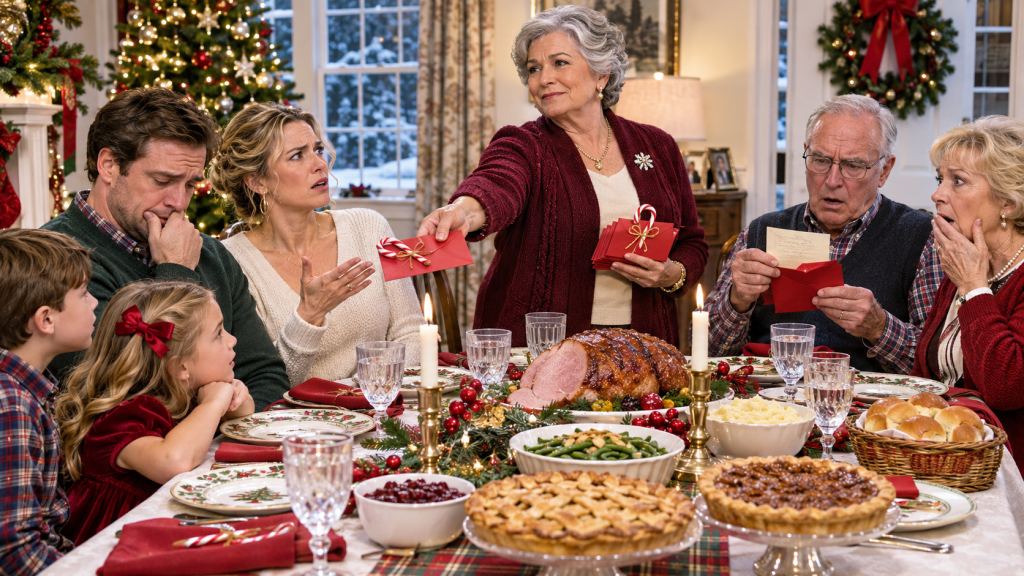
“Lucy, sweetheart,” I said gently, “why don’t you take Mason into the living room and turn on that Christmas movie?” She looked at her father. “Is everybody mad?” My heart tightened. “No, baby. The grown-ups just need to talk about something important.” She hesitated, then took Mason’s hand. When they disappeared down the hallway, I turned back toward Brittany. “All right, honey. Tell me what happened.”
Brittany pressed her lips together. Kyle finally looked up. “Mom, the money wasn’t for the truck.” I nodded slowly. “I think I’ve figured that much out.” He rubbed his forehead. “We were behind on some payments.” “What payments?” He glanced toward Brittany. She closed her eyes. Then Debbie spoke. “The credit cards, Georgia. That’s where your money went.”
I looked at her.
“How do you know?”
Debbie’s face crumpled.
“Because Brittany called me crying that same week. She said they’d received a final notice on one of the accounts.”
Ron turned sharply.
“You never told me that.”
Debbie wiped her cheeks.
“I didn’t know how bad things were.”
I looked at Kyle.
“Son, why didn’t you just tell me?”
He swallowed.
“Because you’d already helped us so much.”
For a moment, I almost felt sorry for him.
Then I remembered the Thanksgiving table.
The forty-five-dollar charge.
The way he’d stared at his mashed potatoes while his wife handed me that little card.
“You weren’t too embarrassed to take the money,” I said quietly. “You were only embarrassed to tell me what it was for.”
Kyle lowered his head.
And I watched tears fall onto his Christmas napkin.
I hadn’t intended to spend Christmas discussing money.
I’d spent the morning rolling out pie dough, humming the old hymns Hal used to sing while carving the turkey.
I’d wrapped presents for the children.
I’d put on the little gold earrings Hal gave me for our thirtieth anniversary.
And I’d told myself the red envelopes would settle something small.
The phone bills.
The truck insurance.
The expectation that Grandma would always quietly pay.
But now I was looking at a family whose problems went deeper than I’d imagined.
Ron slowly lowered the statement.
“Brittany, how much credit card debt are we talking about?”
She stared at her hands.
“Daddy, it’s Christmas.”
“I know what day it is.”
“Can’t we discuss this later?”
Ron shook his head.
“You’ve been discussing your problems later for years. Tell us the amount.”
Kyle closed his eyes.
“Thirty-eight thousand.”
Debbie gasped.
Ron stared at him.
“Thirty-eight thousand dollars?”
Kyle nodded.
My stomach tightened.
I’d worked thirty-one years behind a deli counter.
I knew what thirty-eight thousand dollars represented.
Early mornings.
Sore feet.
Skipped vacations.
Years of packing lunches instead of buying them.
And now my son was drowning beneath that amount while pretending everything was wonderful.
“How did it get that bad?” I asked.
Brittany began crying.
“The house needed repairs. The kids needed things. Kyle’s income wasn’t steady after he lost his job.”
Ron leaned forward.
“And the new patio furniture?”
Brittany looked away.
“The vacation last summer?” Debbie asked.
Silence.
“The matching designer handbags you bought yourself and your sister?” Ron continued.
Brittany suddenly snapped.
“Are we supposed to live like poor people forever?”
The words rang through the dining room.
I stared at her.
Then I looked toward the kitchen where my two homemade pies waited beneath clean dish towels.
I’d worn the same winter coat for eleven years.
Not because I couldn’t afford another one.
Because the one I owned still kept me warm.
I thought about Hal repairing our old washing machine instead of buying a new one.
I thought about the Christmases when we’d saved all year to afford a bicycle for Kyle.
And I understood something painful.
Brittany wasn’t simply afraid of being poor.
She was afraid of looking poor.
There’s a difference.
And that difference can ruin a family.
Ron pushed his chair away from the table.
“I’m going outside.”
Debbie caught his sleeve.
“Ron.”
He looked at her.
“I need some air before I say something I can’t take back.”
He walked toward the back door.
A moment later, it closed behind him.
Brittany covered her face.
Kyle stared at me.
“Mom, I know you’re disappointed.”
I folded my hands.
“Yes, son. I am.”
He swallowed.
“But we didn’t mean to hurt you.”
I thought carefully before answering.
“Kyle, hurting someone doesn’t always require planning it.”
He looked confused.
I continued.
“Sometimes it happens because you’re so busy protecting what you want that you stop noticing what you’re taking from other people.”
His eyes filled.
I reached into my purse and removed the little Thanksgiving receipt.
Georgia.
Turkey, sides, dessert.
$45.
PAID.
I laid it beside his plate.
“Do you know why I kept this?”
He shook his head.
“Because for the first time in my life, somebody in my own family made me feel like a customer.”
Brittany looked up sharply.
“Georgia, I already told you we were trying to split expenses.”
I nodded.
“Then why didn’t your parents pay?”
She hesitated.
“They helped clean up.”
“I brought homemade noodles, two pies, and rolls.”
She stared at me.
“And I was going to wash dishes too.”
Brittany looked down.
I continued.
“Forty-five dollars didn’t break my heart, honey. Being treated like I mattered less than everyone else did.”
Her face crumpled.
For the first time that evening, she didn’t argue.
After a while, Debbie went outside to check on Ron.
That left me alone with Kyle and Brittany.
My son rubbed his face.
“Mom, I need to tell you something else.”
I felt my stomach tighten.
“What is it?”
He glanced toward the hallway.
“Brittany doesn’t know everything.”
She turned sharply.
“What does that mean?”
Kyle swallowed.
“The loan.”
Brittany stared at him.
“What loan?”
He closed his eyes.
I suddenly felt cold.
“Kyle, what have you done?”
He pulled a folded document from his jacket pocket.
His hands shook as he unfolded it.
“I borrowed money last February.”
“How much?”
He looked at me.
“Twenty-five thousand dollars.”
Brittany stood so quickly her chair scraped against the floor.
“Kyle!”
He wouldn’t look at her.
“I was trying to consolidate the credit cards.”
She stared at him.
“You told me the debt was almost paid off!”
“I know.”
“Where did the twenty-five thousand go?”
Kyle started crying.
“Some paid the cards. The rest went toward catching up on the mortgage.”
I felt my heart pounding.
“Son, how far behind are you?”
He hesitated.
Then whispered, “Four months.”
Brittany covered her mouth.
For a moment, I thought she might faint.
“Our house?”
Kyle nodded.
“Our house.”
I stared toward the living room.
My grandchildren were laughing at something on television.
They had no idea their parents were struggling to keep the roof over their heads.
And that hurt more than anything else.
“Why didn’t you tell Brittany?” I asked.
Kyle began sobbing.
“Because every time I tried, she said we needed to keep things normal for the kids.”
Brittany shook her head.
“You should’ve told me!”
He looked at her.
“And you would’ve stopped spending?”
She went silent.
For several moments, they stared at each other.
I realized they were two frightened people who’d become so committed to pretending everything was fine that they’d stopped telling each other the truth.
And when a marriage loses honesty, money isn’t the only thing that disappears.
Ron came back inside ten minutes later.
His face was pale.
Debbie followed him.
He looked at Kyle.
“There’s something I want to ask you.”
Kyle nodded weakly.
“Did you use anybody else’s name to get that loan?”
My son froze.
I felt my heart stop.
“Kyle?”
He stared at the table.
Ron took a breath.
“I received a letter from a lender last month. I didn’t recognize the account, so I thought they’d made a mistake.”
He reached into his pocket.
“Today, looking at Georgia’s statement, I noticed something.”
He unfolded a page.
“The lender’s name is the same.”
Brittany whispered, “Daddy?”
Ron looked at Kyle.
“Am I listed as a guarantor?”
Kyle began trembling.
For a moment, nobody spoke.
Then he whispered, “Yes.”
Debbie gasped.
Ron closed his eyes.
“Did I agree to that?”
Kyle shook his head.
“No.”
The silence that followed felt endless.
Ron lowered himself into a chair.
“You used my name?”
Kyle started crying.
“I thought I’d pay it back before anyone found out.”
I stared at my son.
He had been so desperate to preserve his image that he’d crossed a line I never imagined him crossing.
Ron looked toward Debbie.
“Twenty-eight years I’ve worked at that company. Never missed a mortgage payment. Never borrowed money without knowing how I’d repay it.”
His voice cracked.
“And now my own family has put my name on something I didn’t authorize.”
Brittany reached for him.
“Daddy, please.”
He pulled his hand away.
“No, sweetheart. We need to stop calling dishonesty a family emergency.”
I drove home that evening with both pies untouched in their carriers.
Nobody had felt much like dessert.
The streets were quiet.
Christmas lights glowed against the winter darkness.
When I reached my little brick house, I sat in the driveway for several minutes.
I thought about Kyle at six years old, standing beside me at Kroger while I finished my shift.
He’d hold my hand and tell everybody I made the best sandwiches in Ohio.
I remembered his first bicycle.
His high school graduation.
The day he married Brittany.
The afternoon he placed Lucy in my arms and whispered, “Mom, you’re a grandma.”
I’d loved that boy through every stage of his life.
But tonight, I was frightened of the man he’d become.
Inside, I hung my coat beside Hal’s old denim jacket.
I still kept it there.
Some people thought that was foolish.
But sometimes, after a difficult day, I’d touch the sleeve and remember how safe I used to feel.
I sat at the kitchen table.
Then I began crying.
Not angry tears.
Not the hot kind that make a person want to shout.
These were quieter.
The tears of a mother realizing that loving her child wouldn’t always mean she could save him.
I looked toward Hal’s photograph.
“Oh, honey,” I whispered. “What do I do now?”
Of course, the picture didn’t answer.
But I remembered something he’d told Kyle when he was seventeen.
“Son, the truth can make a mess of one day. A lie can make a mess of your whole life.”
I closed my eyes.
Then I reached for my telephone.
I called my sister Dot.
Dot answered on the second ring.
“Georgia Ann, how’d the Christmas envelopes go?”
I laughed through my tears.
“Not exactly how I planned.”
I told her everything.
The phone bills.
The forty-eight hundred dollars.
The credit cards.
The mortgage.
And the loan carrying Ron’s name.
By the time I finished, Dot was completely silent.
Then she whispered, “Lord have mercy.”
I nodded.
“That’s about where I am too.”
She hesitated.
“Georgia, you need to protect yourself.”
“I know.”
“Don’t let Kyle convince you to fix all this with your savings.”
I stared at the kitchen wall.
For years, I’d been proud that Hal and I left each other financially secure.
We’d worked hard.
Paid off our house.
Saved carefully.
We’d planned to leave something for our children and grandchildren.
But now I wondered whether Kyle had begun thinking of those savings as money he already owned.
Dot continued.
“Your boy needs help. But not the kind you can write a check for.”
I wiped my cheeks.
“Then what kind?”
“The kind that makes him face what he’s done.”
I sat quietly.
Then I whispered, “I don’t know if I can watch him suffer.”
Dot’s voice softened.
“Georgia, sometimes loving somebody means refusing to help them keep hurting themselves.”
I looked toward Hal’s photograph.
And something inside me knew she was right.
Two days after Christmas, Kyle came to my house.
He looked exhausted.
His eyes were swollen.
His shirt was wrinkled.
He stood on my porch holding a paper bag.
“Mom, I brought cinnamon rolls.”
I almost smiled.
That boy knew my weaknesses.
I stepped aside.
“Come in.”
We sat at the kitchen table.
For several minutes, neither of us spoke.
Then Kyle whispered, “Ron talked to an attorney.”
I nodded.
“He should.”
Kyle looked surprised.
“You’re not mad at him?”
“No, son.”
He stared at his hands.
“I’m scared.”
I reached across the table.
“I know.”
He swallowed.
“Brittany says we’re going to lose everything.”
I looked at him.
“You might lose some things.”
His eyes filled.
“But losing a house isn’t the same as losing your life.”
He began crying.
“I didn’t want the kids growing up thinking I was a failure.”
My heart tightened.
“Kyle, children don’t need expensive furniture to believe their father is successful.”
He looked at me.
“They need a father who tells the truth.”
He lowered his head.
For a long time, we sat quietly.
Then he whispered, “Mom, there’s something else.”
I felt a terrible heaviness settle over me.
“How much more is there, son?”
He reached into his jacket.
And placed a folded bank statement on the table.
I looked at the name printed across the top.
Harold and Georgia Miller Family Trust.
My heart began pounding.
Hal and I had created that trust years earlier to protect our savings and provide for our family after we were gone.
Kyle was named as a future beneficiary.
But he wasn’t authorized to use the trust funds while I was alive.
I looked at my son.
“Why do you have this?”
He stared at the table.
“Mom, remember when Dad died and I helped sort through the paperwork?”
I nodded.
He swallowed.
“I kept some copies.”
My hands grew cold.
“Why?”
He began crying.
“Last year, when things got really bad, Brittany found a company willing to lend us money.”
I stared at him.
“What does that have to do with the trust?”
He couldn’t meet my eyes.
“They said they could give me an advance against my inheritance.”
For a moment, I couldn’t breathe.
“Inheritance?”
He nodded.
“Money I’d receive someday.”
I looked down at Hal’s name.
The man who’d spent decades working overtime.
The man who taught our son the value of a dollar.
The man who’d believed savings were something you protected, not something you gambled away.
“How much did you borrow?” I whispered.
Kyle covered his face.
“Forty thousand dollars.”
I stared at him.
“Forty thousand?”
He nodded miserably.
“And they want repayment soon.”
My throat tightened.
“Kyle, I’m still alive.”
He began sobbing.
“I know, Mom.”
“Then why are you borrowing against money you might never receive?”
He couldn’t answer.
And suddenly, I understood how far things had gone.
It wasn’t only the debts.
It wasn’t only the lies.
My son had begun treating my future death as part of his financial plan.
I stood and walked toward the window.
Outside, the maple tree Hal planted forty years earlier stood bare against the gray sky.
I remembered watching him dig that hole.
He’d been young then.
Strong.
Full of plans.
He’d looked up at me and said, “One day, we’ll sit under this tree when we’re old.”
We had.
For many summers.
Until the cancer came.
I touched the window glass.
Behind me, Kyle was crying.
“Mom, I’m sorry.”
I closed my eyes.
I’d heard those words before.
After the first loan.
After the second.
After Thanksgiving.
After Christmas.
But apologies without change were beginning to sound like bills that never got paid.
I turned toward him.
“Kyle, does Brittany know exactly what you signed?”
He hesitated.
Then nodded.
“She found the company.”
I felt my stomach tighten.
“And what did they tell her?”
“That the trust would cover the loan once the money became available.”
I stared at him.
“Available when?”
He looked away.
“Kyle?”
He whispered, “After you pass away.”
The words felt like a knife turning slowly.
I loved my son.
But for the first time in my life, I was afraid of what my love had allowed him to expect.
I sat down carefully.
“Son, I want you to leave the paperwork with me.”
He nodded.
“I’m calling Mr. Wallace tomorrow.”
His face changed.
“Our family attorney?”
“Yes.”
He swallowed.
“Mom, please don’t make this worse.”
I looked directly at him.
“I didn’t make this worse, Kyle.”
He lowered his eyes.
“And I can’t keep making it easier.”
That evening, after Kyle left, I opened the trust folder Hal and I had kept in our bedroom closet.
Inside were our wills.
Insurance documents.
Bank statements.
And a letter Hal had written shortly before he died.
I’d read it many times.
But that evening, one paragraph seemed to speak directly to me.
“Georgia, don’t spend the rest of your life worrying whether everybody else has enough. You’ve already given our family everything you could. Now make sure there’s something left for you.”
I pressed the letter against my chest.
For seven years, I’d tried to honor Hal by keeping the family together.
But perhaps I’d misunderstood what he wanted.
He hadn’t spent his life saving so I could become afraid of telling our son no.
He’d saved because he wanted me to be secure.
To enjoy retirement.
To live without fear.
And to help our grandchildren because I wanted to, not because anyone demanded it.
I wiped my eyes.
Then I placed the letter beside the loan paperwork.
For the first time, I understood that protecting myself wasn’t a betrayal of my family.
It was honoring the life Hal and I had built.
The next morning, I called Mr. Wallace.
He’d helped us prepare our trust years earlier.
When I explained what Kyle had done, his voice became serious.
“Georgia, don’t sign anything related to that loan.”
“I won’t.”
“And don’t promise repayment.”
“I haven’t.”
He paused.
“Can you bring me the documents?”
“Yes.”
“Good. We’ll review exactly what Kyle assigned and whether anyone made representations about your authority or willingness to distribute trust funds.”
My stomach tightened.
“Could they take my money?”
“Not simply because Kyle promised something he didn’t control. But we need to examine the agreement and make sure your interests are protected.”
I nodded.
Then he asked something unexpected.
“Georgia, has anyone contacted you asking for an early distribution?”
I frowned.
“No.”
He was quiet.
Then said, “I received an inquiry last week.”
My heart began pounding.
“From whom?”
“Someone claiming to represent Kyle’s household.”
I stared at the telephone.
“What did they want?”
“They asked what documentation would be required if you wished to release money from the trust before your death.”
My fingers tightened around the receiver.
“I never asked for that.”
“I understand.”
I swallowed.
“Who called?”
There was a pause.
Then Mr. Wallace answered.
“Brittany.”
I closed my eyes.
Of course.
The woman who charged me forty-five dollars for Thanksgiving dinner had apparently begun investigating how to access the savings Hal and I spent our lives building.
But Mr. Wallace wasn’t finished.
“Georgia, there’s something else.”
My heart pounded.
“What?”
“She claimed you were becoming forgetful and might need help managing financial decisions.”
I stared at the wall.
“Forgetful?”
“Yes.”
My hands began trembling.
I was sixty-eight years old.
I still balanced my checkbook.
Remembered every birthday.
Paid every bill on time.
And could tell you the price of sliced ham down to the ounce.
Yet my daughter-in-law was telling people I couldn’t manage my own money.
I felt something cold settle inside me.
“Mr. Wallace,” I said slowly, “I want to see everything she’s submitted.”
He hesitated.
“That’s why I wanted to speak with you.”
My stomach tightened.
“Why?”
“Georgia, yesterday my office received a proposed authorization bearing your name.”
I stopped breathing.
“What authorization?”
“A document requesting that Kyle be permitted to act on certain financial matters involving the trust.”
I stared at Hal’s photograph.
“I didn’t sign anything.”
Mr. Wallace’s voice became very careful.
“I suspected as much.”
My heart hammered.
“Then whose signature is on it?”
He paused.
“Yours.”
I nearly dropped the telephone.
Before I could answer, a car pulled into my driveway.
I looked through the kitchen window.
Brittany stepped out carrying a thick white envelope.
She marched toward my front door.
Then I heard her knock.
Three sharp knocks.
“Georgia!” she called. “We need to talk about what Hal left behind!”
I stood perfectly still.
The telephone trembled in my hand.
And for the first time, I understood that the forty-five-dollar Thanksgiving plate hadn’t simply exposed a family disagreement.
It had uncovered a plan involving my savings, my husband’s legacy, and a future my son and daughter-in-law seemed determined to control.
Mr. Wallace spoke again.
“Georgia, are you there?”
I swallowed.
“Yes.”
“Please listen carefully. There’s one more detail about that authorization.”
I gripped the telephone.
“What detail?”
His voice dropped.
“The signature was dated three days before Thanksgiving.”
I stared toward the front door.
Three days before Brittany handed me that little index card.
Three days before she demanded forty-five dollars.
Three days before she smiled and told me everybody had to pay their fair share.
And suddenly, I wondered whether that Thanksgiving charge had been more than ordinary disrespect.
Maybe it had been a test.
A way to see whether I’d protest.
Whether I’d question things.
Whether I’d finally stand up for myself.
Outside, Brittany knocked again.
“Georgia, open the door!”
I looked at Hal’s letter lying beside the trust papers.
Then I whispered into the telephone.
“Mr. Wallace, I think there’s something my family has been planning for a long time.”
His answer made my blood run cold.
“Georgia, based on the documents I’ve received, I think we need to investigate exactly that.”


