➡️ PART 3 ➡️
I stared at my sixteen-year-old nephew, wondering how much more horror one family could hide behind a perfectly ordinary Fourth of July celebration. Sam stood beside the ambulance, his phone trembling in his hands. “Aunt Gwen,” he whispered, “I recorded Grandpa talking to Uncle Rhett before they took Winnie.”
My father stood several feet away, his face suddenly pale. “Samuel,” he said sharply, “you need to stop making accusations.” Sam didn’t look at him. Instead, he looked at me. “I didn’t know anything bad was going to happen. I was just recording everybody at the barbecue.” I reached for his hand. “Sweetheart, you haven’t done anything wrong.” Behind us, a paramedic was checking Winnie’s breathing.
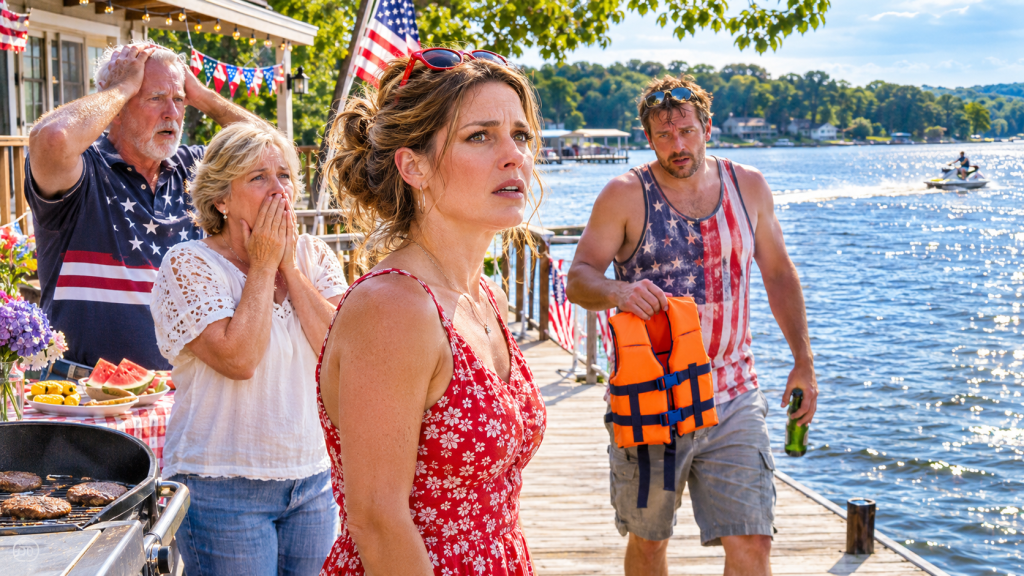
My little girl lay beneath a silver emergency blanket, her wet curls spread across the pillow. She looked so small. So terribly fragile. Seven years of birthday parties, bedtime stories, scraped knees, and whispered secrets had nearly disappeared beneath the surface of that lake. And my family was still worried about protecting Rhett. The deputy stepped closer.
“Ma’am, we need to get your daughter to the hospital. We can review the recording while she’s receiving care.” I nodded. “I’m going with her.” Then I turned toward Sam. “Please show them everything.” He swallowed. “I will.” As I climbed into the ambulance, Winnie reached for my fingers. “Mommy?” I leaned close. “Yes, baby?” “Are you mad at me?” The question nearly destroyed me.
I brushed a wet curl from her forehead.
“Oh, sweetheart. No. Never.”
Her eyes filled.
“Uncle Rhett said you would be.”
I felt something cold settle inside my chest.
“Why would he say that?”
She looked frightened.
“Because I wasn’t supposed to fall.”
I held her hand tighter.
And as the ambulance doors closed, I realized that my brother hadn’t simply made one reckless decision.
He had made my daughter believe she was responsible for almost drowning.
At the hospital, everything moved quickly.
Nurses brought warm blankets.
A doctor examined Winnie’s breathing and listened carefully to her chest.
They monitored her oxygen levels and watched for complications from inhaling lake water.
I stood beside her bed, still wearing my damp Fourth of July clothes.
My hands shook whenever I tried to smooth her blanket.
The doctor, a woman named Dr. Ramirez, spoke gently.
“Winnie is alert, and her current examination is reassuring. But because of what happened, we want to observe her carefully.”
I nodded.
“Whatever she needs.”
Winnie looked toward me.
“Mommy, can we go home?”
I kissed her forehead.
“As soon as the doctors say it’s safe.”
She closed her eyes.
Then she whispered, “I don’t want to go back to Grandpa’s lake.”
My throat tightened.
“You don’t have to, baby.”
She opened her eyes again.
“Ever?”
I looked at my daughter.
And I understood that the place where she’d once caught fireflies and roasted marshmallows had become somewhere she associated with terror.
“Not unless you want to,” I promised.
She nodded.
Then she fell asleep holding my hand.
I sat beside her and finally let myself cry.
Not loudly.
Just the silent, exhausted tears of a mother who had spent an afternoon believing she might have to bury her child.
At eight that evening, a deputy named Harris arrived.
He explained that investigators were reviewing the videos Sam had provided.
Then he asked whether I felt comfortable discussing what happened.
I looked toward Winnie.
She was sleeping peacefully.
“Yes,” I answered. “I want you to know everything.”
I described the barbecue.
Rhett’s drinking.
My parents dismissing my concerns.
The empty chair.
The jet ski.
The moment I watched my daughter fly into the lake.
And the way Rhett returned holding her life jacket.
Deputy Harris took careful notes.
Then he asked, “Did you personally observe your brother stop or return to where she fell?”
“No.”
“Did he tell you he’d helped her?”
I shook my head.
“He laughed and said she could swim.”
The deputy’s expression tightened.
I continued.
“My father grabbed my arm when I tried calling for help. He told me not to get Rhett arrested.”
Harris looked up.
“Did he physically prevent you from calling?”
“He tried. I pulled away and gave my phone to Sam.”
The deputy nodded.
Then he said, “There is something in your nephew’s recording I think you should know about.”
My stomach tightened.
“What?”
He hesitated.
“Your father appears to have encouraged Rhett to take Winnie onto the lake despite knowing he’d been drinking.”
I closed my eyes.
“And there’s more?” I whispered.
“Yes.”
My heart pounded.
“The recording suggests they were discussing you before the ride.”
I stared at him.
“What were they saying?”
He paused.
Then spoke carefully.
“Your father said you needed to learn that you couldn’t control everyone in the family.”
For a moment, I couldn’t breathe.
Control.
That was what my father called it whenever I refused to let Rhett endanger my daughter.
I’d been the difficult child for as long as I could remember.
Not because I caused trouble.
But because I questioned it.
When Rhett wrecked Dad’s truck at seventeen, I asked why he was allowed to drive again the next morning.
When he was arrested for drunk driving the first time, I refused to lend him money for his attorney.
When he borrowed from our mother and never repaid her, I suggested she stop giving him cash.
Every time, Dad said the same thing.
“Gwen, family takes care of family.”
But somehow, family always meant protecting Rhett.
Never protecting the people he hurt.
After Winnie was born, I’d tried to keep the peace.
I attended holidays.
Brought casseroles.
Sent birthday cards.
And quietly refused to leave my daughter alone with my brother.
My parents called me dramatic.
Rhett called me judgmental.
But I’d never imagined they would deliberately ignore my safety rules to prove a point.
I looked at Deputy Harris.
“Did my father tell Rhett to take the life jacket off?”
He shook his head.
“We’re still reviewing the recording. I don’t want to tell you something we haven’t established.”
I appreciated his honesty.
Then he added, “Your nephew also recorded some conversation after Rhett returned.”
I swallowed.
“What conversation?”
The deputy looked at me.
“Your father appears to have told Rhett not to admit he’d been drinking.”
My hands went cold.
My daughter was missing in the water.
And my father had apparently been coaching my brother about what to say.
After the deputy left, I went into the hospital bathroom.
I locked the door.
Then I leaned against the sink and cried until my legs felt weak.
For thirty-eight years, I’d wanted my father to be proud of me.
I’d been a good student.
Worked my way through college.
Built a career.
Bought my own house.
Raised my daughter after my marriage ended.
And still, I was the daughter who caused problems because I wouldn’t excuse Rhett.
I stared at myself in the mirror.
My eyes were red.
My face looked older than it had that morning.
Then I remembered something Winnie said when she was five.
“Mommy, why does Grandpa always make you sad?”
I’d laughed and told her families sometimes disagreed.
But little children notice more than adults realize.
She’d seen the way Dad interrupted me.
The way Mom dismissed my concerns.
The way Rhett mocked my parenting.
And she’d watched me smile through it.
Because I thought protecting her meant avoiding arguments.
Now I understood.
Sometimes protecting your child means allowing the argument.
Sometimes it means being called ungrateful.
Sometimes it means walking away from people whose approval you’ve spent your whole life trying to earn.
I dried my face.
Then I returned to Winnie’s bedside.
At ten thirty, Sam called.
“Aunt Gwen?”
His voice shook.
“Hey, sweetheart.”
“Is Winnie okay?”
“The doctors are watching her, but she’s doing better.”
He exhaled.
“Thank God.”
I sat down.
“Sam, I need to thank you.”
He was quiet.
“If you hadn’t called for help and shown the deputy those videos, we might not know what happened.”
His voice cracked.
“I should’ve stopped Uncle Rhett.”
My heart tightened.
“No, honey.”
“I saw him drinking. I heard Grandpa talking to him.”
“Sam, you’re sixteen. The adults were responsible for keeping Winnie safe.”
He began crying.
“I was scared to say anything.”
I closed my eyes.
Because I knew exactly what he meant.
In our family, disagreeing with my father could turn an ordinary afternoon into a battlefield.
Sam had grown up learning that silence was easier.
Just as I had.
“Sweetheart,” I whispered, “you spoke when it mattered.”
He sniffled.
“Grandpa’s furious with me.”
I felt anger rise.
“Has he threatened you?”
“He said I betrayed the family.”
I took a slow breath.
“Sam, telling the truth isn’t betrayal.”
He was quiet.
Then he whispered, “Aunt Gwen, there’s something else I didn’t tell the police yet.”
My stomach tightened.
“What?”
He hesitated.
“I found another recording on my phone.”
I sat straighter.
“Another one?”
“Yes. From before the jet ski ride.”
My heart began pounding.
“What does it show?”
He swallowed.
“Grandpa giving Uncle Rhett money.”
I frowned.
“Money?”
Sam nodded, though I couldn’t see him.
“And I heard Grandpa say something about making sure you learned your lesson.”
The following morning, I met with Deputy Harris again.
This time Sam came with his mother, my older sister, Denise.
Denise looked exhausted.
She was forty-two, four years older than me.
Unlike our parents, she’d always been willing to question Rhett’s behavior.
But she’d usually done so quietly.
Now she stood beside her son with her shoulders straight.
“Gwen,” she whispered, “I’m sorry.”
I hugged her.
“You didn’t do this.”
She shook her head.
“I’ve spent years staying quiet so Mom and Dad wouldn’t get angry.”
I looked at her.
“So have I.”
Her eyes filled.
Then she whispered, “Not anymore.”
Sam handed his phone to the deputy.
We watched the recording.
The video was shaky.
Sam had been filming the dock decorations, apparently trying to capture the Fourth of July atmosphere.
My father’s voice came from somewhere off camera.
“Rhett, take Winnie for a ride.”
My stomach tightened.
Then Rhett laughed.
“Gwen will have a fit.”
Dad answered.
“Let her. She’s been acting like you’re dangerous ever since those arrests.”
I felt tears rise.
Rhett said something about Winnie being scared of deep water.
Dad laughed.
“Then show her there’s nothing to be afraid of.”
The camera shifted.
I could see my father handing Rhett several folded bills.
Then he said something that made my heart stop.
“Make it a memorable ride. Maybe Gwen will finally understand she can’t order everybody around.”
I stared at the screen.
Denise covered her mouth.
Sam looked down.
The deputy paused the recording.
For a moment, nobody spoke.
Then I whispered, “He paid him?”
Deputy Harris answered carefully.
“The money is visible. We’ll need to determine what it was for and what your father intended.”
I nodded.
But my heart already knew one terrible thing.
My father had encouraged a drinking man to take my frightened little girl onto the lake to challenge my authority.
Whatever he’d meant to happen, he’d put his pride ahead of her safety.
Denise drove me back to the hospital.
Neither of us spoke for several minutes.
Then she gripped the steering wheel.
“Gwen, there’s something you should know.”
I looked at her.
“What?”
“Dad’s been telling everyone you want to destroy Rhett’s life.”
I stared through the windshield.
“Winnie nearly drowned.”
“I know.”
“He left her in the lake.”
“I know.”
My voice broke.
“And Dad thinks I’m the problem?”
Denise wiped her eyes.
“He’s been making excuses for Rhett since we were children.”
I looked at her.
She continued.
“Remember when Rhett broke your bicycle?”
I almost laughed.
Of all the memories.
I was eleven.
Rhett was eight.
He’d taken my new bicycle without asking and crashed it into a fence.
Dad told me I shouldn’t have left it where Rhett could reach it.
I’d cried for hours.
Not because of the bicycle.
Because I’d been punished for somebody else’s mistake.
Denise glanced at me.
“That’s what this family has always done.”
I nodded slowly.
“Rhett breaks something. Everybody else has to pretend it wasn’t broken.”
Her eyes filled.
“But this time it was Winnie.”
I looked toward the hospital in the distance.
“And this time,” I whispered, “I’m not pretending.”
Winnie was sitting up when I returned.
A nurse had brought her a coloring book.
She smiled when she saw me.
“Mommy!”
I hurried to her bedside.
“Hello, my brave girl.”
She held up a picture.
It showed a yellow butterfly flying over blue water.
“I made this for you.”
I swallowed.
“It’s beautiful.”
She pointed toward the butterfly.
“That’s me.”
I looked at her.
“Why is it you?”
She smiled faintly.
“Because butterflies don’t sink.”
My eyes filled.
I kissed her forehead.
Then she looked serious.
“Mommy, can I tell you something?”
“Anything, sweetheart.”
She glanced toward the door.
“I didn’t want to get Uncle Rhett in trouble.”
My chest tightened.
“Winnie, you didn’t get anybody in trouble.”
She looked down.
“He told me you would be mad if I told you about the video.”
I brushed her hair away from her face.
“Baby, grown-ups are responsible for their own choices.”
She nodded slowly.
Then she whispered, “Grandpa told me before we left that I should stop being a scaredy-cat.”
I felt my stomach drop.
“What did he say?”
She swallowed.
“He said if I was brave, you’d stop treating Uncle Rhett like a baby.”
I closed my eyes.
Even my daughter had been pulled into the family argument.
Her fear had been treated as something shameful.
Her safety had become a test of loyalty.
I looked at her.
“Winnie, being brave doesn’t mean doing something dangerous because somebody tells you to.”
She thought about that.
Then asked, “Was I brave when I held on to the yellow cushion?”
I smiled through my tears.
“Yes, sweetheart.”
“Even though I was scared?”
I pulled her close.
“Especially because you were scared.”
That afternoon, the doctors said Winnie’s condition remained reassuring.
They continued monitoring her and explained what symptoms would require immediate medical attention after discharge.
I listened carefully.
For the first time since the lake, I began believing we might actually go home together.
But the damage to our family was far from finished.
At four fifteen, my mother appeared outside Winnie’s hospital room.
She carried a stuffed animal and wore the worried expression she’d perfected during every family disagreement.
“Gwen,” she whispered.
I stepped into the hallway.
“Mom.”
Her eyes filled.
“How’s Winnie?”
“She’s improving.”
Mom pressed a hand against her chest.
“Thank heaven.”
I waited.
Then she said, “Your father is beside himself.”
I stared at her.
“About Winnie?”
She hesitated.
“About what’s happening to Rhett.”
Something inside me went still.
My mother continued.
“The police have been asking so many questions. Rhett’s attorney says this could become very serious.”
I looked at her.
“It is serious.”
She reached for my hand.
“Gwen, we’re all upset. But surely you don’t want your brother’s future ruined over one mistake.”
I stepped back.
“One mistake?”
She began crying.
“He never meant for Winnie to get hurt.”
I felt tears rising.
“Mom, he took a seven-year-old child onto deep water after drinking. He removed her life jacket. He left her behind when she fell.”
My voice shook.
“And Dad tried to stop me from calling for help.”
She looked away.
I continued.
“What if I hadn’t found her?”
Mom covered her face.
“Don’t say that.”
“But I have to think about it. I was the one swimming toward an empty stretch of lake wondering whether my daughter was already gone.”
She began sobbing.
I took a breath.
“Mom, you can love Rhett. You can worry about him. But if you can’t understand why Winnie comes first, then you cannot be part of her recovery.”
She stared at me.
“Are you keeping my granddaughter from me?”
I looked at her.
“I’m protecting her.”
My mother left without seeing Winnie.
I returned to the room, where my daughter was coloring another butterfly.
She looked up.
“Was that Grandma?”
I nodded.
“Yes, sweetheart.”
“Is she coming in?”
I sat beside her.
“Not today.”
Winnie looked thoughtful.
Then she asked, “Is Grandma mad because I told what happened?”
My heart broke all over again.
I held her hand.
“No, baby. And even if a grown-up is upset, that doesn’t mean you did anything wrong.”
She nodded.
Then she picked up a purple crayon.
“Mommy?”
“Yes?”
“Can we go somewhere different next Fourth of July?”
I smiled sadly.
“Anywhere you want.”
She thought for a moment.
“Maybe the mountains.”
I kissed her forehead.
“The mountains sound wonderful.”
That evening, Deputy Harris called with an update.
Rhett had been taken into custody while investigators continued examining the circumstances of the incident and the available evidence.
My father’s conduct was also being reviewed.
The deputy explained that the precise charges and legal outcomes would depend on the evidence and the decisions of the appropriate authorities.
I listened.
Then I thanked him.
When I hung up, I didn’t feel happy.
I didn’t feel victorious.
I felt exhausted.
Because somewhere inside me was still the little girl who wished her father would say he was sorry.
Who wished her brother would become somebody safe.
Who wished our family could gather around a barbecue without somebody getting hurt.
But wishing had never protected Winnie.
And I couldn’t build her future around hoping dangerous people would eventually behave differently.
Two days later, Winnie was discharged.
I brought her home with careful instructions from the hospital.
Denise had stocked our refrigerator.
Sam had placed a basket of coloring books and stuffed animals beside Winnie’s bed.
And my neighbor, Mrs. Palmer, had left a homemade chicken casserole on the porch.
For the first time in days, I felt surrounded by kindness that didn’t demand anything in return.
Winnie climbed into bed and hugged her stuffed rabbit.
“Mommy?”
I sat beside her.
“Yes, sweetheart?”
“Can you stay until I fall asleep?”
I smiled.
“Of course.”
She took my hand.
Then whispered, “I thought you wouldn’t find me.”
My chest tightened.
I brushed her hair gently.
“I was looking for you, baby.”
“I know.”
She closed her eyes.
Then she whispered, “I remembered what you said.”
“What did I say?”
“Find something that floats. Hold on. Mommy will come.”
Tears rolled down my cheeks.
I kissed her forehead.
“You did exactly the right thing.”
She smiled sleepily.
Then she asked one last question.
“Mommy, why did Uncle Rhett leave me?”
I froze.
How do you explain betrayal to a seven-year-old?
How do you tell a child that someone trusted with her safety chose himself instead?
I took a slow breath.
“Sweetheart, Uncle Rhett made a very wrong decision. It was never because of anything you did.”
She nodded.
Then closed her eyes.
A few minutes later, she was asleep.
I stayed beside her for nearly an hour.
Listening to her breathing.
Watching her chest rise and fall.
Thanking God for every ordinary breath.
The next morning, Denise arrived carrying a folder.
She looked troubled.
“Gwen, we need to talk.”
My stomach tightened.
“What happened?”
She sat at the kitchen table.
“Sam found something while helping Dad’s neighbor move some Fourth of July decorations.”
I frowned.
“What?”
“A small waterproof action camera.”
I stared at her.
“From the jet ski?”
She nodded.
“Rhett had mounted it near the handlebars.”
My heart began pounding.
Winnie had told me he’d been recording.
But the phone mentioned in her account hadn’t been recovered.
Denise placed the camera on the table.
“Sam remembered seeing Rhett attach it before the ride. The neighbor found it in a storage bin near the dock after somebody moved the equipment.”
I stared at the little black device.
“Have you told the police?”
“Yes. They’re collecting it today. We haven’t opened any recordings.”
I nodded.
That was the right thing to do.
Then Denise reached into her folder.
“But there’s something else.”
My heart tightened.
“What?”
She handed me a printed photograph.
It showed Rhett and my father standing beside the jet ski earlier that afternoon.
Between them was the yellow flotation cushion Winnie had clung to.
I stared at it.
“Where did you get this?”
“Sam took it before the ride.”
I looked closer.
My father was holding the cushion.
And Rhett was pointing toward the jet ski.
I felt my breath catch.
The cushion hadn’t simply appeared by chance.
Someone had handled it before Winnie was taken onto the lake.
Denise looked at me.
“Gwen, I don’t know what this means. Maybe nothing. But I think the investigators need to see it.”
I nodded slowly.
Then she said something that made my blood turn cold.
“There’s writing on the back of the cushion.”
I looked up.
“What writing?”
She swallowed.
“Sam says it’s Dad’s handwriting.”
My heart hammered.
“What does it say?”
Denise stared at me.
Then whispered:
“Lesson number one: Stop being afraid.”
I sat perfectly still.
The yellow cushion.
The money Dad handed Rhett.
The words about teaching me a lesson.
And now a message written in my father’s own handwriting.
For a moment, I couldn’t speak.
Then Denise took my hand.
“Gwen, there’s one more thing Sam heard on the video.”
My stomach tightened.
“What?”
She hesitated.
“Dad told Rhett the ride was supposed to scare Winnie just enough to prove you were overprotective.”
I stared at her.
Outside my kitchen window, the summer sun shone over the quiet neighborhood.
Children rode bicycles along the sidewalk.
Somewhere, a lawn mower hummed.
The world looked perfectly ordinary.
But my entire understanding of my family had changed.
This hadn’t simply been one reckless afternoon.
My father had encouraged a dangerous demonstration involving my little girl.
And my brother had carried it out.
Whatever they’d intended, Winnie had nearly paid for it with her life.
I looked toward my daughter’s bedroom.
She was still sleeping.
Safe.
Warm.
Alive.
Then I turned back to Denise.
“Tell Sam to preserve everything,” I whispered. “And make sure the investigators receive that photograph.”
She nodded.
I took a breath.
“And Denise?”
“Yes?”
I looked directly at her.
“From this moment forward, nobody in that family gets near Winnie unless I know she’s safe.”
My sister squeezed my hand.
“I understand.”
I walked toward the hallway.
Then my phone rang.
An unfamiliar number.
I answered.
“Hello?”
A man’s voice spoke.
“Mrs. Delgado? This is Detective Morrison. We need to discuss the camera recovered near your parents’ dock.”
My heart stopped.
“Have you reviewed it?”
There was a pause.
“Yes, ma’am.”
I gripped the telephone.
“What did you find?”
His voice grew serious.
“Mrs. Delgado, the recording shows something that doesn’t match your brother’s original explanation.”
I couldn’t breathe.
“What?”
The detective hesitated.
Then said the words that made the room spin.
“After Winnie fell, Rhett did turn back toward her.”
I froze.
“But he didn’t rescue her?”
“No, ma’am.”
My hands began trembling.
“Then what did he do?”
There was a long silence.
Then Detective Morrison answered.
“He stopped beside her, removed the life jacket from the water, and said something directly to her before riding away.”
I covered my mouth.
My beautiful little girl had been close enough for him to help.
Close enough to see him.
Close enough to believe her uncle was coming back.
“What did he say?” I whispered.
The detective took a breath.
“Mrs. Delgado, I think you should hear the recording yourself.”
And at that moment, I knew the truth about that Fourth of July was even darker than I’d imagined.
Because my daughter hadn’t simply been abandoned after an accident.
Someone had looked directly at her while she struggled in the water.
And deliberately chosen to leave.


