➡️ PART 3 ➡️
For a moment, I forgot how to breathe. I stood outside the pediatric intensive care unit with my phone pressed against my ear, staring through the glass at the little boy who had spent the past three days fighting to recover from surgery. Caleb’s dinosaur blanket was tucked beneath his chin. His stuffed triceratops rested beside his pillow.
And somewhere across town, my mother and sister had apparently been trying to get their hands on money intended for him. Money I hadn’t even known existed. “Mrs. Whitaker?” the bank manager asked gently. I swallowed. “I’m here.” “My name is Daniel Mercer. I understand this is an extraordinarily difficult time, but I believe you should speak with an attorney before making any decisions.”
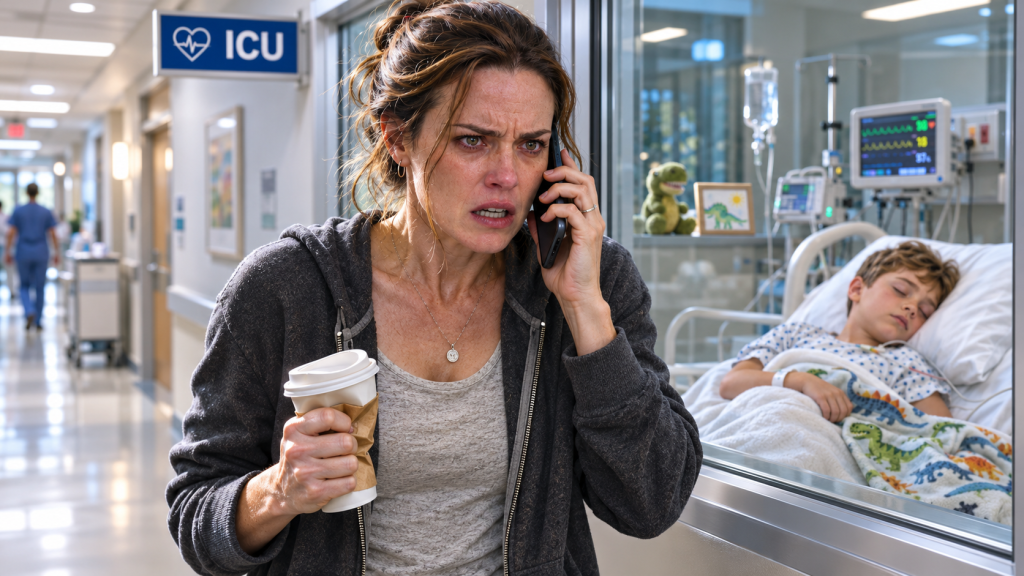
I pressed my hand against the wall. “Mr. Mercer, are you saying my father left Caleb an inheritance?” He hesitated. “I’m saying our records reference a trust established by your father. We need to verify the documents and determine who has authority over it.” My eyes filled. Dad had been dead for four years.
He’d never been wealthy. At least, that was what my mother always told me. He worked as a civil engineer, drove the same pickup truck for fifteen years, and repaired broken appliances instead of replacing them. When he died, Patricia told Vanessa and me that his medical bills had consumed nearly everything. I had believed her.
Because she was my mother.
And because grief makes you desperate to believe the people standing beside you.
Now I wasn’t sure what to believe.
I returned to Caleb’s bedside.
His nurse, Melissa, was adjusting an IV line.
She looked up immediately.
“Are you okay?”
I opened my mouth.
Nothing came out.
Melissa stepped closer.
“Hey. Sit down for a minute.”
I sank into the vinyl chair.
Then the tears came.
Not graceful tears.
Not the quiet ones I’d learned to hide from Caleb.
These were the kind that shook my shoulders and made breathing difficult.
Melissa crouched beside me.
“Is it Caleb?”
I shook my head.
“No. He’s okay. I mean, he’s still recovering, but…”
I couldn’t finish.
She placed a box of tissues beside me.
“Then whatever it is, you don’t have to carry it standing up.”
That simple kindness nearly broke me.
Three days earlier, I’d asked my mother to come sit with me during her grandson’s surgery.
She couldn’t manage that.
But a nurse who had known me for forty-eight hours was willing to stop and make sure I wasn’t falling apart.
I looked toward Caleb.
“Can I leave him for a little while?”
Melissa nodded.
“We’ll help you make a plan. His medical team will continue caring for him, and we can arrange for the hospital social worker to meet with you.”
I wiped my face.
“Thank you.”
She smiled gently.
“That’s what we’re here for.”
By ten that morning, I had spoken with an attorney named Rebecca Lawson.
She specialized in estate disputes and financial exploitation.
I explained the messages.
The frozen accounts.
The attempted withdrawals.
And the mysterious trust.
Rebecca listened without interrupting.
Then she asked, “Did your mother have legal authority to act on any of your accounts?”
“She was an authorized user on one account. Not all of them.”
“And Caleb’s medical savings account?”
“No.”
“Did you ever sign documents appointing her to manage his money?”
“Absolutely not.”
Rebecca paused.
“Then we need to separate the legitimate permissions you gave her from the authority she’s claiming now.”
I nodded.
She continued.
“Preserve the messages, the payment records, and the information the bank has provided. We’ll request the trust documents and review the signatures.”
My hands trembled.
“Can she take Caleb’s money?”
“Not simply because she claims she has authority. The bank has stopped the disputed transaction, and we’ll work to establish who is legally entitled to act.”
I closed my eyes.
Relief washed through me.
Then Rebecca said something unexpected.
“There’s another question I want you to consider.”
“What?”
“Who sent you the photograph of your father’s signature?”
I stared at my phone.
The unknown number.
The four words.
ASK ABOUT THE TRUST.
“I don’t know.”
Rebecca’s voice became serious.
“Then let’s find out.”
At eleven thirty, I received another message from the unknown number.
Your father tried to protect you. Please don’t let Patricia tell you otherwise.
My heart pounded.
I typed a reply.
Who is this?
Three minutes passed.
Then another message appeared.
Someone who should have spoken sooner.
I stared at the screen.
Tell me your name.
This time, the reply came almost immediately.
Elaine Foster.
I froze.
Elaine Foster.
My father’s younger sister.
Aunt Elaine.
I hadn’t seen her since Dad’s funeral.
Patricia told me afterward that Elaine had caused an argument about the estate and wasn’t welcome around our family anymore.
I remembered Elaine standing at the cemetery, crying beside my father’s grave.
She’d tried to speak to me.
But Mom pulled me away.
I stared at the name.
Then called her.
She answered on the second ring.
“Hello?”
“Aunt Elaine?”
A breath caught on the other end.
“Oh, sweetheart.”
My eyes filled.
“Why are you texting me about Dad’s trust?”
She was quiet.
Then whispered, “Because your mother knows exactly what it is.”
Elaine arrived at the hospital shortly after noon.
She was sixty-eight now, with silver hair tucked behind her ears and the same warm brown eyes as my father.
When she saw me standing near the elevators, her face crumpled.
“Oh, honey.”
She opened her arms.
I stepped into them.
And for the first time since Caleb’s surgery, I let someone hold me without pretending I was fine.
Elaine smelled faintly of lavender soap.
It reminded me of childhood visits to my grandmother’s house.
“I’m sorry,” she whispered.
I pulled away.
“For what?”
“For believing there would be a better time to tell you the truth.”
My stomach tightened.
“About the trust?”
She nodded.
I led her to a quiet consultation room near the ICU.
We sat across from each other.
Then Elaine opened her handbag and removed a worn blue folder.
Across the front, in my father’s handwriting, were three words.
For My Girls.
I began crying before she even opened it.
“Your father established a trust shortly after Caleb was born,” Elaine said.
I stared at her.
“Why?”
She smiled sadly.
“Because he adored that little boy.”
My throat tightened.
Dad used to call Caleb his miracle.
Whenever I visited, he’d sit on the floor building towers of wooden blocks, pretending to be amazed when Caleb knocked them over.
He kept a photograph of Caleb in his wallet.
He told strangers about his grandson at grocery stores.
I swallowed.
“How much money?”
Elaine hesitated.
“The original trust included savings and proceeds from a life insurance policy.”
I stared at her.
“How much?”
“Approximately one hundred and sixty thousand dollars was allocated for Caleb’s benefit when your father died.”
I felt the room tilt.
One hundred and sixty thousand dollars.
Money intended for my son.
Money that could help pay for his treatment, education, and future.
Money I had never known existed.
I shook my head.
“Mom said Dad left almost nothing.”
Elaine looked down.
“I know.”
“Was she lying?”
Elaine took a slow breath.
“She knew the trust existed. I can show you the correspondence.”
I pressed my hands against my knees.
For years, I’d worked overtime to build Caleb’s medical savings.
I’d skipped vacations.
Driven an aging car.
Turned down invitations because paying for groceries and insurance mattered more.
And all that time, my father had tried to leave something behind for his grandson.
Something my mother apparently preferred I never learn about.
Elaine opened the folder.
Inside were copies of trust documents, letters, and financial statements.
She pointed toward a paragraph.
“Your father named an independent professional trustee to administer the money.”
I frowned.
“Who?”
“Richard Sullivan, an attorney who handled some of your father’s estate planning.”
I looked at the document.
“And what was Mom’s role?”
“None as trustee.”
Relief washed through me.
Elaine continued.
“She was informed of the trust because she was involved in settling other parts of your father’s estate.”
I stared at her.
“Then how could she try to withdraw anything?”
Elaine shook her head.
“That’s what needs investigating.”
She turned another page.
“This is a letter your father wrote shortly before he died.”
My hands began trembling.
Elaine passed it to me.
The handwriting was unmistakable.
Sweetheart,
If you’re reading this, I hope Caleb is growing into the kind, curious boy I know he’ll become.
Tears blurred the words.
I can’t promise I’ll always be here to help you, but I want you to know that loving your child is the most important work you’ll ever do.
I covered my mouth.
Then continued.
I’ve arranged something for Caleb’s future. It’s not meant to replace your hard work or make your decisions for you. It’s simply my way of standing beside you both, even when I can’t be there in person.
I began sobbing.
My father had known.
Somehow, he’d known how lonely life could become without him.
Elaine waited until I could breathe again.
Then she said, “There’s a reason I didn’t tell you sooner.”
I looked up.
“Mom?”
She nodded.
“After your father died, Patricia told me you were struggling emotionally and didn’t want to discuss financial matters.”
I stared at her.
“She said that?”
“Yes.”
Elaine swallowed.
“She claimed the independent trustee would contact you when it was appropriate.”
I shook my head.
“Nobody contacted me.”
Elaine looked devastated.
“I began asking questions about eighteen months ago.”
“And?”
“Patricia became furious. She accused me of interfering.”
I remembered the funeral.
The way Mom steered me away from Elaine.
The way she dismissed Dad’s sister as selfish and greedy.
I looked down.
“Why didn’t you call me directly?”
Elaine’s eyes filled.
“I should have.”
Her voice broke.
“I let Patricia convince me that contacting you would make your grief worse.”
I took a slow breath.
Aunt Elaine wasn’t the person who had demanded wedding-dress money while my son lay in intensive care.
But her silence had still cost us time.
I looked at her.
“I wish you’d told me.”
She nodded.
“I know.”
Then she whispered, “I’m telling you now because your mother has begun trying to change something she has no right to change.”
My stomach tightened.
“What?”
Elaine looked toward the folder.
“The trust’s payment instructions.”
That afternoon, Rebecca joined us by video call.
Elaine explained what she knew.
Rebecca examined the available documents.
Then asked, “Have you spoken with Richard Sullivan recently?”
Elaine nodded.
“Yesterday.”
“And?”
“He said he’d received a request for an emergency distribution, supposedly to cover Caleb’s medical expenses.”
My heart pounded.
“From whom?”
Elaine looked at me.
“Patricia.”
I closed my eyes.
Rebecca leaned forward.
“Did the trustee approve it?”
“No. He requested verification.”
I released a shaky breath.
Elaine continued.
“Your mother claimed you were overwhelmed by Caleb’s condition and had authorized her to handle payments.”
I stared at the floor.
Three days.
For three days, I’d been sitting beside my son’s hospital bed, praying he would survive.
And while I did, my mother had apparently been telling people I couldn’t manage my own affairs.
Rebecca asked, “Did Patricia provide a written authorization?”
Elaine nodded.
“A copy.”
My stomach tightened.
“Signed by me?”
Elaine’s eyes filled.
“Yes.”
I closed my eyes.
There it was again.
Another document.
Another signature.
Another attempt to turn my trust into someone else’s opportunity.
Rebecca spoke carefully.
“We need the trustee to preserve the request and any supporting correspondence. We’ll also need to verify which institution holds the trust assets and what procedures apply.”
I nodded.
She continued.
“Do not assume the signatures are authentic simply because they appear on documents. We’ll examine them.”
Then she turned toward me.
“Have you ever signed an authorization allowing your mother to receive Caleb’s trust distributions?”
“No.”
“Have you ever asked her to manage his medical expenses?”
“No.”
Rebecca nodded.
“Good. We’ll document that.”
Elaine wiped her eyes.
Then said, “There’s something else.”
I looked at her.
“What?”
“Your father added a special provision shortly before he died.”
My heart tightened.
“What provision?”
Elaine opened another page.
“It directed the trustee to give particular consideration to Caleb’s medical needs if he ever became seriously ill.”
I stared at her.
Dad had died before Caleb’s health problems became apparent.
Before the specialists.
Before the diagnosis.
Before the surgery that nearly broke me.
I swallowed.
“He couldn’t have known.”
Elaine shook her head.
“No.”
Then she smiled through tears.
“He simply wanted to make sure his grandson would be protected, whatever happened.”
I covered my face.
For the first time since the surgery, grief and gratitude became impossible to separate.
That evening, I returned to Caleb’s room.
He was awake.
His eyes were tired.
But when he saw me, he smiled.
“Mom?”
I leaned close.
“Hi, buddy.”
“Did Aunt Vanessa come?”
The question struck like a small knife.
I brushed his hair away from his forehead.
“No, sweetheart.”
He looked down.
“Oh.”
I swallowed.
“But somebody else came.”
He looked up.
“Who?”
“Great-Aunt Elaine.”
His eyes widened.
“Grandpa’s sister?”
I nodded.
“She brought something Grandpa left for you.”
Caleb looked toward his stuffed triceratops.
“Is it a toy?”
I smiled through tears.
“No, buddy. It’s something to help take care of you.”
He thought about that.
Then whispered, “Grandpa still loves me?”
My throat closed.
I kissed his forehead.
“More than you could ever imagine.”
Caleb smiled faintly.
Then closed his eyes.
And I sat beside him, holding his hand, feeling the weight of everything my father had tried to protect.
The next morning, Patricia arrived at the hospital.
She wore a cream-colored coat and carried an expensive handbag.
Vanessa followed behind her.
My sister’s engagement ring flashed beneath the fluorescent lights.
Neither carried flowers.
Neither asked the receptionist about Caleb’s condition.
They came straight toward me.
“Finally,” Patricia snapped.
I stood outside Caleb’s room.
“Mom.”
She folded her arms.
“Have you lost your mind?”
I took a breath.
“What are you talking about?”
“You froze the accounts!”
Vanessa stepped forward.
“My bridal appointment is tomorrow!”
I stared at her.
“Caleb is recovering from major surgery.”
She waved a hand.
“And we’re all sorry about that, but my wedding is in six weeks.”
I felt something inside me go very still.
For years, I’d swallowed insults because I wanted Caleb to grow up with grandparents and an aunt.
Now I was beginning to understand the cost of that hope.
I looked at my mother.
“Did you come to see him?”
Patricia hesitated.
“Of course.”
I waited.
She looked toward Vanessa.
Then back at me.
“But first, we need to resolve this financial nonsense.”
I took out my phone.
Opened the message demanding five thousand dollars.
And held it toward them.
“Mom, you threatened to empty my account while Caleb was in intensive care.”
Patricia rolled her eyes.
“I was upset.”
“You were upset about a dress.”
Vanessa crossed her arms.
“It was a once-in-a-lifetime purchase.”
I stared at her.
“My son’s surgery was a once-in-a-lifetime emergency.”
She looked away.
I continued.
“You didn’t visit.”
Patricia sighed.
“You know hospitals make me anxious.”
I nodded slowly.
“And yet you had no trouble going to the bank.”
Her face changed.
For a moment, I saw panic.
Then anger.
“Who told you?”
I looked directly at her.
“The bank.”
She went pale.
Vanessa grabbed her arm.
“Mom, let’s go.”
But I wasn’t finished.
“Did you submit documents claiming you could manage Caleb’s trust?”
Patricia froze.
The hallway seemed to grow silent.
Then she whispered, “Who told you about that?”
I felt my heart break.
Not because she denied it.
But because she didn’t.
Rebecca arrived twenty minutes later.
I’d called her before Patricia and Vanessa came upstairs.
She stood beside me.
“Mrs. Whitaker, I’m Rebecca Lawson. I represent your daughter.”
Patricia’s expression hardened.
“A lawyer? Seriously?”
Rebecca remained calm.
“We’re reviewing the disputed account activity and trust documents.”
Vanessa looked frightened.
“What trust?”
I turned toward her.
“Grandpa left money for Caleb.”
Her eyes widened.
“How much?”
I stared at her.
That was her first question.
Not why Mom had hidden it.
Not whether Caleb’s treatment could be helped.
How much?
I took a breath.
“Enough that you don’t need to concern yourself with it.”
Vanessa’s face reddened.
Patricia stepped forward.
“That money belongs to the family!”
Rebecca spoke gently but firmly.
“The trust assets must be administered according to the governing documents and applicable law. Family relationships alone do not create a right to withdraw them.”
Patricia looked furious.
“He was my husband!”
I swallowed.
“And Caleb was his grandson.”
For several seconds, nobody spoke.
Then I said quietly, “Dad wanted that money to protect him.”
Patricia’s eyes filled.
“And what about me?”
I stared at her.
“What about you?”
She began crying.
“I was married to that man for thirty-eight years!”
I nodded.
“I know.”
“And he left money for a child instead of making sure I was comfortable!”
The words hung between us.
Then, slowly, I understood.
This wasn’t simply about Vanessa’s wedding dress.
It wasn’t even about the frozen accounts.
My mother had been angry about Dad’s decision for years.
And now Caleb’s medical emergency had given her an excuse to try to reach money she believed should have been hers.
Rebecca suggested we continue the conversation away from the pediatric unit.
Patricia refused.
Then a nurse approached.
“Excuse me, this is a critical care area. We need to keep voices down.”
I looked toward Caleb’s room.
He was sleeping.
His little chest rose and fell beneath the blanket.
I turned back toward my mother.
“This conversation is over.”
Patricia stared at me.
“You can’t treat me like this.”
I took a breath.
“Mom, you came to my son’s hospital because you wanted money.”
She began crying harder.
I continued.
“You haven’t asked how his surgery went.”
For the first time, she looked toward the room.
Then she whispered, “Is he all right?”
I felt tears rising.
“He’s alive.”
My voice broke.
“And right now, that is the most important thing in the world to me.”
Vanessa looked down.
Patricia opened her mouth.
Then closed it.
I stepped aside.
“If you want to see him, you’ll need to respect the hospital’s rules and my boundaries. But you are not going to discuss money beside his bed.”
Rebecca remained beside me.
After a long moment, Patricia turned and walked toward the elevators.
Vanessa followed.
Neither entered Caleb’s room.
That evening, Richard Sullivan, the trustee, called.
His voice was calm and professional.
“Mrs. Whitaker, I’ve reviewed the circumstances with your attorney.”
I sat beside Caleb’s bed.
“Thank you.”
He continued.
“Your father’s trust remains intact. No disputed distribution has been approved.”
Relief washed over me.
I closed my eyes.
“Thank God.”
Then he paused.
“But there is a matter we need to discuss.”
My stomach tightened.
“What?”
“We’ve located earlier correspondence involving your mother.”
I frowned.
“Earlier?”
“Yes.”
“How much earlier?”
He hesitated.
“Nearly three years.”
I stared at the wall.
Caleb had been four then.
Healthy.
Full of energy.
Still small enough to fall asleep on Grandpa’s old recliner.
Richard continued.
“Your mother submitted a request claiming you had agreed to redirect part of the trust’s funds toward family expenses.”
My heart pounded.
“What family expenses?”
He paused.
“Wedding-related savings, household obligations, and reimbursement for assistance allegedly provided to you.”
I felt sick.
Vanessa had only become engaged eight months earlier.
How could wedding expenses have appeared in a request three years ago?
I swallowed.
“Mr. Sullivan, are you sure?”
“Yes.”
Then he said something that made my hands go cold.
“Mrs. Whitaker, the request wasn’t submitted under your mother’s name.”
I stared at the phone.
“What?”
“It was submitted using your identity.”
For several seconds, I couldn’t speak.
Then Richard continued.
“The attached authorization bears your signature, and the contact information directs correspondence to an email address we now believe was not controlled by you.”
I looked toward Caleb.
My son slept peacefully.
Unaware of the storm gathering around him.
I took a shaky breath.
“Whose email address was it?”
Richard paused.
“We’re still verifying ownership.”
Then he added, “But the recovery telephone number on the account belongs to someone you know.”
My heart pounded.
“Who?”
He hesitated.
“Your sister, Vanessa.”
I closed my eyes.
For years, I’d believed Mom was the one taking advantage of me while Vanessa simply accepted the benefits.
Now I wondered whether my sister had been involved from the beginning.
Then Richard said something else.
Something that made the room seem to tilt.
“Mrs. Whitaker, there’s another document in the file. A letter from your father, dated three weeks before he died.”
My breath caught.
“What does it say?”
Richard’s voice softened.
“He instructed us to contact you personally if anyone ever attempted to redirect Caleb’s inheritance.”
Tears filled my eyes.
“And?”
There was a pause.
Then he whispered, “He also explained why he didn’t trust your mother or your sister with the money.”
I stared toward the hospital window.
Outside, evening lights flickered across the parking lot.
Inside, Caleb’s monitor continued its gentle rhythm.
I tightened my hand around his.
Then whispered, “Please tell me.”
Richard took a slow breath.
“Your father discovered something before he died, Mrs. Whitaker. Something your mother has spent four years trying to keep from you.”


