➡️ PART 3 ➡️
For forty-one years, Christmas morning had been the happiest morning of my life. But standing in my living room, surrounded by frightened grandchildren, embarrassed relatives, and a daughter who suddenly couldn’t meet my eyes, I realized this Christmas might change our family forever.
Melissa held her phone so tightly that her knuckles turned white. “Mom,” she whispered, “there’s something I haven’t told you about the house.” I stared at her. “What about my house?” Her husband, Greg, turned sharply. “Melissa, don’t.” She looked at him. “I can’t keep doing this.” His father, Richard, stepped into the living room. “This isn’t the time for another emotional discussion.”
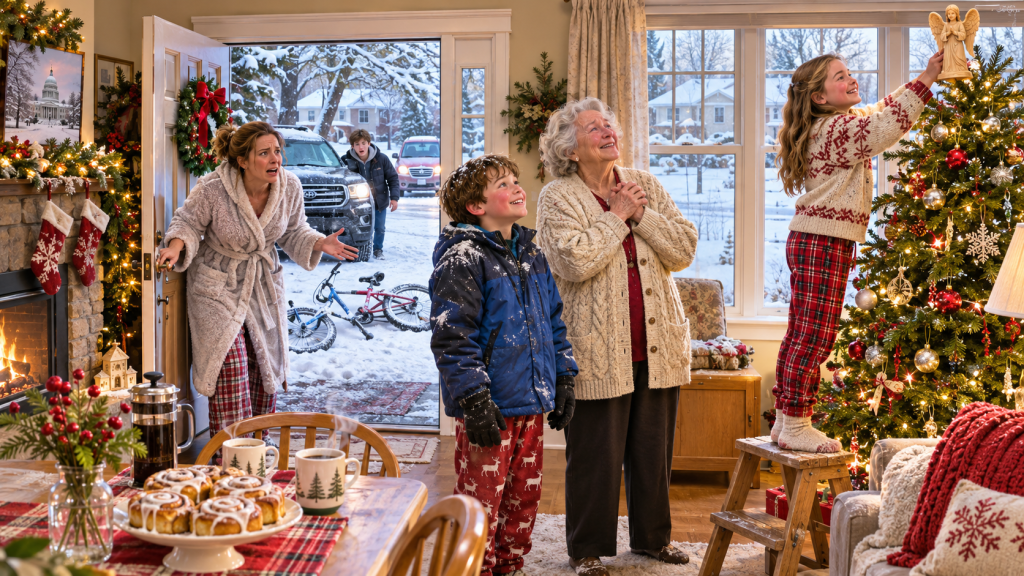
I glanced toward the three children. Caleb stood beside the fireplace, holding his letter. Hannah remained near the Christmas tree. And Leo was carefully licking icing from his fingers, blissfully unaware that the adults around him were standing at the edge of something ugly. I took a breath. “Children, take your cinnamon rolls into the kitchen.” Hannah opened her mouth. “Grandma—”
“I promise we’ll talk about Christmas. But first, the grown-ups need a few minutes.” She nodded reluctantly. Caleb guided his younger siblings toward the kitchen. When they were safely out of earshot, I turned back toward Melissa. “Now,” I said quietly, “tell me.” Melissa unlocked her phone. She opened an email and handed it to me. The subject line read: Preliminary Property Valuation — 1847 Willow Lane. My address. My home. The house where I’d raised Melissa.
The house where my husband, Robert, had died.
The house where forty-one Christmas trees had stood beside the same living room window.
I stared at the message.
“Why is someone valuing my property?”
Melissa began crying.
“Mom, please don’t get upset.”
I looked up.
“Then explain why someone is discussing my house without me.”
Greg rubbed his forehead.
“It’s not what you think.”
I turned toward him.
“Then what is it?”
He hesitated.
His father answered instead.
“We were simply exploring options.”
I stared at Richard.
“Options for whom?”
He folded his arms.
“For the family’s future.”
Something inside me grew very still.
At seventy-two, I’d learned that when someone began discussing your future without including you, they usually had plans that benefited themselves.
I handed the phone back to Melissa.
“Whose idea was this?”
She looked toward Greg.
He looked toward his father.
And suddenly, I understood that the Christmas invitation I’d never received was only one part of a much larger conversation.
“Mom,” Melissa began, “Greg’s parents have been talking about moving closer.”
I nodded slowly.
“And?”
“They’re thinking about selling their place.”
I waited.
She swallowed.
“And we thought maybe your house could be part of a solution.”
I stared at her.
“What solution?”
Greg spoke quickly.
“You’re living alone in a four-bedroom house.”
I felt my chest tighten.
“I’m aware.”
He continued.
“The stairs are steep. The property taxes keep increasing. It’s a lot for one person.”
I looked around the room.
The staircase had never seemed especially steep to me.
I still carried laundry upstairs.
Still maintained the garden.
Still shoveled the front walkway when the snow wasn’t too heavy.
And when something needed professional attention, I hired someone.
“What exactly are you proposing?” I asked.
Greg hesitated.
His father answered.
“You sell this house and move into something smaller.”
I stared at him.
“And where would I go?”
Melissa wiped her cheeks.
“We found a senior apartment community.”
For a moment, I couldn’t speak.
Then I asked, “Did you visit it?”
She nodded.
“Yes.”
“Without me?”
Another nod.
I looked toward the kitchen doorway.
The scent of cinnamon drifted through the house.
Behind it, I could hear Leo laughing at something his brother said.
And I realized the adults had been planning to rearrange my life while the children were simply wondering why Grandma wasn’t coming to Christmas dinner.
“Why wasn’t I told?” I asked.
Greg sighed.
“Because you get emotional about this house.”
I looked at him.
“Of course I’m emotional about my home.”
He shook his head.
“That’s exactly what I mean.”
I felt anger rise.
But I kept my voice steady.
“Greg, loving a house doesn’t mean I’m incapable of making decisions about it.”
His father gave a dismissive laugh.
“At your age, practicality should come before sentiment.”
I turned toward Richard.
“With respect, this is not your property.”
His expression hardened.
“I was only trying to help.”
I nodded.
“Then you should have asked whether I needed help.”
A heavy silence settled over the room.
Melissa began crying again.
“Mom, we weren’t trying to hurt you.”
I looked at my daughter.
“Then why did you tell the children I wanted to spend Christmas alone?”
Her face crumpled.
“I thought it would be easier.”
“For whom?”
She couldn’t answer.
I looked toward the old wooden angel at the top of the tree.
Robert had carved its wings forty years earlier.
Hannah had placed it on the top branch every Christmas since she was three.
That small tradition had survived illnesses, job losses, family arguments, and my husband’s death.
Yet somewhere along the way, the adults had decided it was inconvenient.
I turned toward Greg.
“Did you tell Melissa not to invite me?”
He hesitated.
“We wanted a smaller gathering.”
I raised my eyebrows.
“Your parents were invited.”
He looked away.
I continued.
“Your children were invited.”
“Of course.”
“And your wife was invited.”
He frowned.
“What’s your point?”
I took a breath.
“My point is that you called it immediate family while excluding one member of the family.”
Richard stepped forward.
“This is becoming ridiculous.”
I looked at him.
“No, Richard. What’s ridiculous is planning the sale of a woman’s home while complaining that she might have feelings about it.”
His face flushed.
For the first time that morning, he had nothing to say.
Melissa sat down on the sofa.
“Mom, there’s another reason we started looking at houses.”
I studied her.
“What reason?”
She glanced toward Greg.
He lowered his head.
“The mortgage,” she whispered.
I frowned.
“Whose mortgage?”
She looked down.
“Ours.”
My stomach tightened.
Greg rubbed his forehead.
“We refinanced last year.”
I waited.
“And?”
“The payments increased.”
I looked toward Melissa.
“How much?”
She hesitated.
“Enough that we’ve been struggling.”
I sat down slowly.
My daughter and her husband had always appeared financially comfortable.
They drove new vehicles.
Took expensive vacations.
And remodeled their kitchen two summers earlier.
They had never mentioned serious financial problems.
I looked toward Greg.
“Why does your mortgage involve my house?”
He hesitated.
Then his father spoke.
“Because selling this property could free up enough money to help everyone.”
I stared at him.
“Everyone?”
He nodded.
“Melissa and Greg could stabilize their finances. My wife and I could relocate nearby. And you could have a smaller home without all this maintenance.”
I took a slow breath.
“And how would the money be divided?”
Nobody answered.
That silence told me more than any explanation could have.
I stood.
“Let me make something clear.”
Every adult looked toward me.
“My husband and I worked for thirty-two years to pay off this house.”
My voice trembled.
“Robert worked overtime at the printing plant. I taught second grade and took summer tutoring jobs.”
I looked toward the photograph of my husband on the mantel.
“We skipped vacations. We repaired things instead of replacing them. We saved.”
My eyes filled.
“And when Robert died, this house became the place where I could still feel close to him.”
Melissa began crying.
I continued.
“That doesn’t mean I’ll never sell it. One day, I may decide it’s too much.”
I looked directly at Greg.
“But that decision belongs to me.”
His father crossed his arms.
“Families are supposed to help one another.”
I nodded.
“They are.”
Then I said quietly, “Helping isn’t the same as taking control.”
A small voice came from the kitchen doorway.
“Grandma?”
I turned.
Leo stood holding a half-eaten cinnamon roll.
“Can I have another one?”
I smiled.
“Of course, sweetheart.”
He glanced toward the adults.
“Why is everybody sad?”
My throat tightened.
Melissa quickly wiped her face.
“Nothing, honey.”
Leo frowned.
“That’s not true.”
For a moment, nobody spoke.
Then I crouched slightly.
“The grown-ups are discussing something complicated. Nobody is angry with you.”
He nodded.
“Okay.”
Then he looked toward Greg.
“Dad, are we still having Christmas?”
Greg’s expression softened.
“Yes, buddy.”
Leo smiled.
“Good. Because Grandma’s rolls taste better than the ones from the store.”
I laughed through tears.
“Go on, sweetheart.”
He hurried back into the kitchen.
And for a moment, the room remembered what Christmas was supposed to feel like.
I invited everyone to sit down.
Even Richard and his wife, Patricia.
Not because I approved of what had happened.
But because I refused to let an argument become the only memory my grandchildren carried from that morning.
We gathered around the dining table.
I brought out coffee.
Melissa helped me arrange the cinnamon rolls.
The children returned cautiously.
Hannah looked at her mother.
“Are you mad at Grandma?”
Melissa shook her head.
“No, honey.”
Hannah frowned.
“Then why didn’t you want her at Christmas?”
My daughter looked down.
For several seconds, she couldn’t speak.
Then she whispered, “I made a mistake.”
Hannah’s expression softened.
“Can you fix it?”
I watched Melissa carefully.
She looked toward me.
Then back at her daughter.
“I hope so.”
I swallowed.
Because that answer was more honest than anything she’d said all morning.
After breakfast, Greg’s parents announced they were leaving.
Richard stood near the doorway, clearly dissatisfied.
“I still think everyone is overreacting.”
I walked toward him.
“Richard, I hope you and Patricia have a lovely Christmas.”
He looked surprised.
Then nodded stiffly.
“Thank you.”
I continued.
“But I need you to understand something.”
His expression tightened.
“My home is not available for financial planning discussions unless I invite them.”
Patricia looked away.
Richard frowned.
“I was only offering advice.”
I nodded.
“Then consider it declined.”
He opened his mouth.
But Patricia touched his arm.
“Let’s go, Richard.”
They left without further argument.
I closed the door behind them.
And felt an unexpected lightness settle over the house.
Melissa and Greg remained.
The children had moved into the living room to examine their stockings.
I hadn’t expected visitors, but I’d kept the small handmade stockings hanging beside the fireplace.
Each one had a name embroidered across the front.
Caleb.
Hannah.
Leo.
Melissa watched them quietly.
Then turned toward me.
“Mom, I’m sorry.”
I nodded.
“I hear you.”
She swallowed.
“But?”
I took a breath.
“But I need to understand why you let this go so far.”
Her eyes filled.
She sat down beside me.
“Greg’s been worried about money.”
I nodded.
“He kept saying we needed a plan.”
I waited.
“Then his father suggested your house.”
My chest tightened.
“And you agreed?”
She looked down.
“At first, I said no.”
I studied her.
“Then what changed?”
She began crying.
“They kept saying you were getting older. That it wasn’t fair to leave such a valuable property sitting there while we struggled.”
I closed my eyes.
Valuable property.
Sitting there.
As though my home were an unused bank account.
As though the woman living inside it didn’t count.
“Melissa,” I said gently, “did you believe them?”
She hesitated.
“Part of me did.”
My heart tightened.
I nodded slowly.
“Thank you for being honest.”
She looked up.
“I kept telling myself we’d give you a nice apartment.”
I swallowed.
“And you thought that made it acceptable?”
She shook her head.
“Not anymore.”
I looked toward the window.
Snow fell softly across the front yard.
The bicycles had been moved into the garage.
I thought about Hannah and Leo riding through the freezing morning because they’d believed their grandmother needed them.
Their loyalty had been sincere.
But their journey had also frightened their parents, and rightly so.
I turned toward Melissa.
“Your children should never feel responsible for fixing adult disagreements.”
She nodded.
“I know.”
“And they must never ride through snow without telling you.”
She began crying.
“I was terrified when I realized they were gone.”
I reached for her hand.
“I understand.”
Then I added, “But you also need to understand why they thought they had to come.”
Later that afternoon, after the children were settled with a Christmas movie, Melissa helped me wash dishes.
For a while, we worked silently.
Then she whispered, “Mom, do you remember when Dad died?”
My hands paused.
“Of course.”
She looked down.
“I remember you standing in this kitchen after everyone left.”
My throat tightened.
“You were holding his coffee mug.”
I nodded.
She continued.
“I wanted to help, but I didn’t know what to say.”
I stared toward the window.
“I didn’t know what to say either.”
Melissa wiped her cheeks.
“I think I’ve been afraid of losing you ever since.”
I looked at her.
“Then why would you push me away?”
She began crying.
“Because Greg kept saying we needed to make decisions before something happened.”
I took a breath.
“Melissa, preparing for the future isn’t wrong.”
She nodded.
“But deciding what I need without asking me is.”
Her shoulders shook.
I continued.
“If you’re worried about my health, ask me. If you’re worried about the house, talk to me. Don’t invent a story for the children and arrange my life behind my back.”
She nodded through tears.
“I know.”
That evening, after everyone finally went home, I sat alone beside the Christmas tree.
The wooden angel glowed softly above me.
The house smelled of cinnamon and pine.
For the first time all day, there was silence.
I should have felt relieved.
Instead, I felt exhausted.
I loved Melissa.
I loved her children.
And despite everything, I wanted her marriage to survive its financial difficulties.
But I couldn’t rescue them by surrendering my home.
I wasn’t going to spend my remaining years making myself smaller so everyone else could feel secure.
I picked up Robert’s photograph.
His familiar smile looked back at me.
“You’d know what to say,” I whispered.
Then I laughed softly.
Actually, he probably wouldn’t.
Robert had never been especially good at emotional conversations.
He’d have made coffee, rubbed his forehead, and told everyone to stop being foolish.
I smiled through tears.
Then whispered, “I miss you.”
Two days after Christmas, I called my longtime attorney, Margaret Ellis.
She had helped Robert and me with estate planning years earlier.
I explained what had happened.
She listened carefully.
Then asked, “Have you signed anything recently concerning the property?”
“No.”
“Have you given anyone authority to sell or refinance it?”
“No.”
“Have you shared financial account access with Melissa or Greg?”
I hesitated.
“Melissa knows where some of my paperwork is kept.”
Margaret nodded.
“Then let’s review your estate documents and make sure everything remains consistent with your wishes.”
I took a breath.
“Do you think I’m being paranoid?”
She answered immediately.
“No. You’re being careful.”
My eyes filled.
Margaret continued.
“Families can discuss future plans without wrongdoing. But no one should assume they can make decisions about your assets merely because they’re related to you.”
I nodded.
“That’s exactly how I feel.”
She suggested we meet the following week.
I agreed.
At the appointment, Margaret reviewed my will, financial arrangements, and property records.
Everything appeared properly documented.
The house remained titled in my name.
No transfer had been completed.
No one had acquired authority to sell it.
I felt relieved.
Then Margaret noticed something.
She opened a folder containing recent correspondence I’d brought from home.
“Where did this come from?”
I frowned.
“What?”
She held up a letter.
It was from a local real estate agency.
A preliminary request for information concerning my property.
I stared at it.
“I didn’t request that.”
Margaret looked at the date.
December eighteenth.
Two days before Melissa sent the text excluding me from Christmas.
My stomach tightened.
“Does that mean someone tried to sell my house?”
Margaret shook her head.
“Not necessarily. It appears to be an inquiry, not a completed transaction. But we should determine who submitted it.”
I nodded.
She studied the document.
Then pointed toward the contact information.
“Do you recognize this email address?”
I leaned forward.
It belonged to Greg.
My hands began trembling.
I stared at Margaret.
“Greg contacted a real estate agency about my house?”
She nodded carefully.
“That’s what this correspondence indicates.”
My throat tightened.
“Without asking me?”
“We’ll need to verify what he requested and what information the agency provided.”
I closed my eyes.
For several seconds, I couldn’t speak.
Then I whispered, “He told me they were only exploring options.”
Margaret folded her hands.
“Perhaps he considers this part of exploring options. But you’re entitled to know what was discussed about your property.”
I nodded.
She continued.
“And Janet—”
I looked up.
She smiled gently.
“I’m sorry. I mean, Mrs. Whitcomb.”
I laughed weakly.
“After forty years, you can still call me Evelyn.”
Margaret smiled.
“Evelyn, there’s another document I’d like you to see.”
My stomach tightened.
“What?”
She placed a second page on the desk.
It was a draft authorization form.
The document purported to grant permission for someone to obtain financial and property information on my behalf.
My name appeared at the top.
Below it was a signature.
Not a completed notarized authorization.
Not a recorded deed.
But a draft containing handwriting that looked disturbingly similar to mine.
I stared at it.
“Margaret, I didn’t sign that.”
Her expression grew serious.
“Then we need to understand how it was created.”
That evening, I called Melissa.
She answered immediately.
“Mom?”
I took a breath.
“Were you aware Greg contacted a real estate agency about my house?”
Silence.
Then she whispered, “What?”
My heart tightened.
“An inquiry was submitted on December eighteenth.”
She didn’t answer.
I continued.
“There’s also a draft authorization with a signature that looks like mine.”
Melissa gasped.
“Mom, I didn’t know about that.”
I closed my eyes.
“Are you sure?”
“Yes.”
Her voice began trembling.
“Greg told me he was just getting estimates.”
I swallowed.
“Then he needs to explain what he submitted.”
Melissa was quiet.
Then whispered, “Mom, there’s something else.”
My chest tightened.
“What?”
She began crying.
“Greg’s financial problems are worse than he admitted.”
I looked toward the Christmas tree.
The wooden angel remained on the top branch.
“And?”
Melissa took a shaking breath.
“He’s behind on more than the mortgage.”
I closed my eyes.
“How much?”
She hesitated.
“Mom, I found a letter from a private lender.”
My heart began pounding.
“What letter?”
Her voice broke.
“Greg applied for a loan using your house as part of the proposed security.”
For a moment, I couldn’t breathe.
I stared toward the empty fireplace.
The house Robert and I had spent thirty-two years paying off.
The home where we’d raised our daughter.
The place that held forty-one Christmas mornings.
And somewhere, my son-in-law had apparently been discussing it as collateral for money I hadn’t agreed to borrow.
I took a slow breath.
“Melissa, did the lender approve anything?”
She began crying harder.
“I don’t know.”
I looked toward Margaret’s business card on the table.
Then said quietly, “Don’t sign anything. Don’t promise anyone anything. And bring every document you have to my attorney.”
Melissa swallowed.
“Okay.”
Before ending the call, she whispered something that made my entire body go cold.
“Mom, I think Greg’s father already knew.”
I stared toward the window.
Outside, snow began falling again.
And suddenly, I understood that Christmas hadn’t been disrupted because my grandchildren rode their bicycles to see me.
It had been disrupted long before that.
By adults who had begun treating my home as an answer to problems they hadn’t dared explain.
I looked toward the wooden angel.
Then whispered, “Robert, I wish you were here.”
But the house was quiet.
And for the first time since my husband’s death, I knew I would have to defend the home we’d built together.
Not with anger.
Not with revenge.
But with the one thing nobody had thought an old woman would demand.
The truth.


