➡️ PART 3 ➡️
For nearly sixty years, I had trusted my husband with my heart. For forty-six years, we had shared a home, raised our son, survived financial troubles, and learned how to grow older together. When Harold died in 2019, I thought the hardest thing I would ever endure was learning to live without him.
But standing beneath the old maple tree at the cemetery, watching my son turn pale beside a backhoe, I realized grief could take more than one form. Sometimes you grieve someone who has died. And sometimes you grieve someone who is standing right in front of you. The funeral director, Mr. Collins, held another document in his trembling hands.
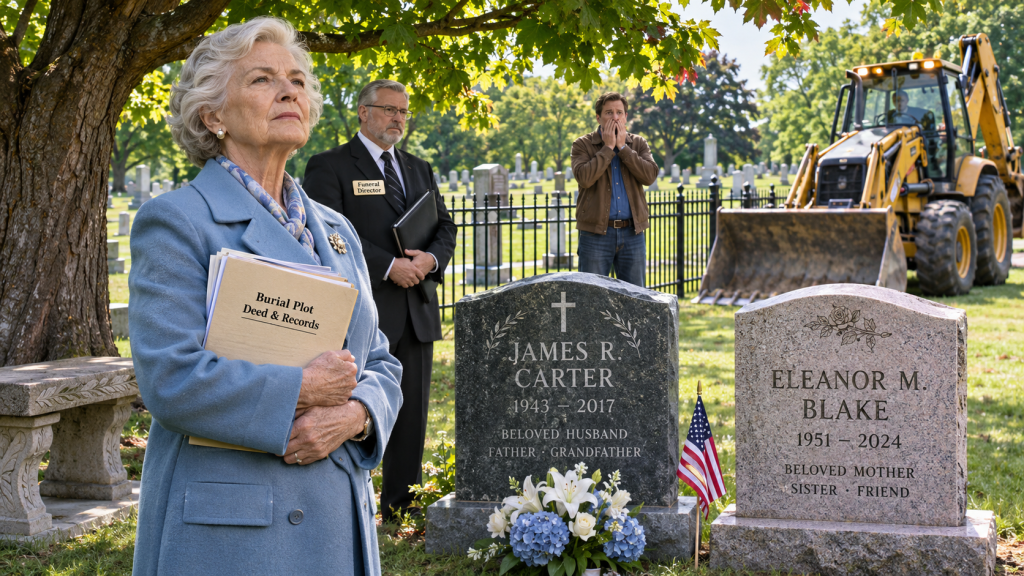
“Mrs. Avery,” he said gently, “I think you should sit down before reading this.” I looked toward Harold’s headstone. His name was carved into the granite beneath a simple inscription. Beloved Husband. Faithful Friend. Forever Remembered. I had chosen every word. Now I wondered how many other decisions concerning my husband’s memory had been made without my knowledge.
“Please,” I said, “show me.” Mr. Collins hesitated. Then handed me the paper. At the top were the words: Request for Modification of Prepaid Burial Arrangements. My stomach tightened. Below that appeared Harold’s name. And mine. I slowly began reading. The form requested the cancellation of the remaining companion burial arrangements associated with our original cemetery purchase.
It also directed any refundable funds to an account I didn’t recognize.
I stared at the account information.
Then looked toward Daniel.
“Whose account is this?”
He didn’t answer.
Jenny turned toward him.
“Daniel?”
My son stared at the ground.
And in that terrible silence, I knew the missing thirty-two thousand dollars was only part of what he’d been hiding.
Mr. Collins guided me toward the stone bench beneath the maple.
I sat carefully.
My heart had begun racing, and I knew better than to ignore the warning.
I took the medication and water I carried in my handbag, then waited until my breathing steadied.
Jenny stood a few feet away, tears streaming down her cheeks.
Daniel remained near the iron fence.
He looked like a frightened boy who had broken something valuable and hoped someone else would repair it.
Only this time, the thing he’d broken wasn’t a window.
It was trust.
I looked at the documents again.
“Daniel, did you withdraw money from your father’s funeral account?”
He rubbed his forehead.
“Mom, I was going to replace it.”
I closed my eyes.
Those six words.
The same words he’d used when he borrowed money for a car.
When he missed payments on a business loan.
When he took money from his college savings for a vacation and promised his father he’d put it back.
I was going to replace it.
Harold had believed him more times than I could count.
So had I.
But promises were not payments.
And this time, Daniel had used our preparations for death as though they were another emergency fund.
Jenny stepped forward.
“What exactly did you do?”
Daniel looked at her.
“Jenny, please.”
She shook her head.
“No. You told me the money for Mom’s burial came from your savings.”
He swallowed.
“It did, partly.”
“Partly?”
She stared at him.
“Daniel, what does that mean?”
He looked toward me.
I said nothing.
Finally, he whispered, “I used some of Dad’s prepaid account.”
Jenny covered her mouth.
“You used your dead father’s funeral money to bury my mother?”
His shoulders collapsed.
“I didn’t know what else to do.”
I looked toward Harold’s grave.
For years, my husband had worked extra shifts at the railroad maintenance depot.
He saved for retirement, repaired our own appliances, and insisted on keeping every important receipt in a metal filing cabinet.
We bought our cemetery plots in 1979 because Harold believed planning ahead was an act of kindness.
He used to say, “The last thing I want is for you to worry about money when you’re already grieving.”
Now Daniel had turned that kindness into something he could spend.
Mr. Collins spoke gently.
“Mrs. Avery, I should clarify something important.”
I turned toward him.
“The thirty-two-thousand-dollar figure appears in the administrator’s accounting as a requested distribution and adjustment, but we haven’t established that the full amount was actually released.”
I nodded slowly.
“So we don’t know exactly how much he received?”
“Not yet.”
I looked at Daniel.
He avoided my eyes.
Mr. Collins continued.
“The cemetery has preserved the records. Your attorney has already requested a formal accounting.”
I nodded.
“Thank you.”
He hesitated.
“There’s also a discrepancy involving the document that was used to support the transfer.”
My stomach tightened.
“What discrepancy?”
He looked toward Daniel.
“The signature supposedly belonging to you was witnessed on a date when the cemetery records show you were hospitalized.”
For a moment, I couldn’t speak.
I remembered that hospitalization.
February 2024.
My cardiologist had admitted me after an episode of dangerously irregular heart rhythm.
I spent three nights under observation.
Daniel had visited once.
He brought a small bouquet of carnations and asked whether I’d remembered to pay my property taxes.
I had been grateful he came.
Now I wondered whether he had visited to see me or to find out how long I would be away from home.
“Daniel,” I whispered, “did you sign my name?”
His expression crumpled.
“Mom—”
“Did you?”
He looked toward Jenny.
Then toward the workers waiting respectfully beside the equipment.
Finally, he nodded.
“Yes.”
I closed my eyes.
The answer was barely audible.
But it seemed to echo through the entire cemetery.
Jenny made a small, broken sound.
“You forged your mother’s signature?”
Daniel began crying.
“I didn’t think it would hurt anyone.”
I looked up.
“Didn’t hurt anyone?”
My voice was quiet.
So quiet that he finally stopped crying and listened.
“Your father and I chose this place forty-five years before you sold it.”
I gestured toward the maple.
“We stood right here when we were young enough to believe growing old together would be easy.”
Tears filled my eyes.
“We planned to be buried side by side because we wanted whoever came to visit us to know we had shared a life.”
My throat tightened.
“And you took that from me for four thousand dollars.”
Daniel stared at the ground.
I whispered, “You knew exactly what that place meant.”
The funeral director quietly informed us that the supervised reinterment was ready to proceed.
The necessary authorizations had been reviewed through the court process.
Patricia’s family had been notified.
And the cemetery had arranged for a respectful transfer to the replacement plot.
I stood slowly.
Jenny turned toward me.
“Mrs. Avery, I know Daniel was wrong.”
Her voice trembled.
“But that’s still my mother.”
I looked at her.
“I know, Jenny.”
She wiped her cheeks.
“I feel like I’m losing her all over again.”
My heart softened.
For the first time that morning, I saw not the daughter-in-law who had benefited from my son’s betrayal, but another woman grieving her mother.
I reached for her hand.
“Patricia deserved better than this too.”
Jenny began crying.
“I didn’t know.”
I studied her face.
For months, I’d assumed she must have known about the plot.
Now I wasn’t certain.
“Did Daniel tell you how he obtained it?”
She shook her head.
“He said you’d offered it.”
My chest tightened.
“What?”
Jenny nodded through tears.
“He said you wanted Mom buried near Harold because our families were so close.”
I looked toward Daniel.
He stared at the grass.
Another lie.
Another piece of my generosity invented without my permission.
I turned back toward Jenny.
“I never offered the plot.”
She covered her mouth.
“I believe you.”
Her voice broke.
“I wish I’d asked.”
We stood together beneath the maple.
Two women whose grief had been manipulated by the same man.
When the cemetery workers began their solemn task, I stepped away and gave Jenny privacy.
I didn’t watch the entire process.
There was no satisfaction in it.
No triumph.
No pleasure in seeing another family’s resting place disturbed.
I had insisted on restoring my burial rights because they mattered deeply to me.
But I also understood that Patricia Walsh had done nothing wrong.
She hadn’t stolen my grave.
She hadn’t signed the paperwork.
She hadn’t asked to become part of a family dispute.
Her remains deserved dignity.
So did Harold’s.
And so did mine.
After the reinterment was completed, Jenny walked toward me.
Her eyes were swollen.
“Mom is in the new section now,” she whispered.
I nodded.
“Is it a peaceful place?”
She looked surprised.
Then gave a small smile.
“There are flowering trees nearby.”
“That’s good.”
She hesitated.
“I think she’d like it.”
I squeezed her hand.
“I hope she would.”
For a moment, we stood in silence.
Then Jenny whispered, “I’m sorry I shouted at you.”
I shook my head.
“You were frightened and grieving.”
She began crying again.
“I didn’t understand what Daniel had done.”
I looked toward my son.
He stood alone near the fence.
For years, Harold and I had rescued him from uncomfortable consequences.
But this time, I couldn’t rescue him without betraying myself.
My attorney, Rebecca Sloan, met me at home later that afternoon.
She had handled the court petition concerning the burial plot and arranged the legal review of the disputed transfer.
We sat at my dining table.
The same oak table Harold had refinished by hand.
Rebecca placed several folders in front of me.
“Mrs. Avery, we need to discuss the power of attorney.”
I nodded.
“I revoked it.”
“Yes. We’ve documented the revocation and sent notice to the relevant institutions. We also need to identify every transaction Daniel may have undertaken while acting under that authority.”
I swallowed.
“How many?”
“We don’t know yet.”
She opened the first folder.
“There’s the cemetery transfer.”
I nodded.
“The funeral account adjustment.”
“Yes.”
“And a transaction involving your home equity account.”
My hands went cold.
I stared at her.
“My what?”
Rebecca looked concerned.
“Mrs. Avery, did you authorize Daniel to open or modify a home equity line of credit?”
I shook my head.
“No.”
She turned another page.
“Then we need to investigate this immediately.”
Harold and I had paid off our house years earlier.
It was a small brick ranch with a screened porch, a vegetable garden, and a narrow driveway Harold insisted on shoveling himself.
We’d celebrated the final mortgage payment with takeout Chinese food and a bottle of sparkling cider.
Harold framed the paid-off mortgage statement as a joke.
For years, it hung in his workshop beside photographs of our son.
I looked at Rebecca.
“Daniel couldn’t have borrowed against my house without telling me.”
She answered carefully.
“Depending on the authority granted and the lender’s requirements, an agent may have certain powers involving property. But that doesn’t mean every transaction would have been authorized or proper.”
I swallowed.
“How much?”
She looked down.
“An initial record suggests a credit line with a limit of eighty thousand dollars.”
My heart began pounding.
“Eighty thousand?”
“Yes.”
I pressed my hand against my chest.
Rebecca immediately leaned forward.
“Mrs. Avery, are you feeling all right?”
I nodded after a moment.
“Just give me a little time.”
She waited.
I breathed slowly until the dizziness passed.
Then whispered, “Please tell me he didn’t take eighty thousand dollars.”
Rebecca’s expression softened.
“We haven’t established the outstanding balance.”
I closed my eyes.
The cemetery plot.
The funeral money.
And now my home.
Every place Harold had tried to make safe for me seemed to have become another opportunity for Daniel.
The following morning, Rebecca arranged a meeting with the lender.
I attended with her.
The branch manager reviewed the relevant records and explained that a home equity application had been submitted the previous year.
It listed me as the borrower.
Daniel appeared as the person acting under power of attorney.
The application included copies of financial documents and an authorization form.
I stared at the page.
“Did I sign this?”
The manager looked down.
“The paperwork reflects a signature attributed to you.”
I shook my head.
“I didn’t sign it.”
Rebecca immediately asked that the original records be preserved and the transaction formally disputed.
The manager confirmed that the account would be reviewed.
Then he showed us the transaction history.
A total of forty-six thousand dollars had been advanced.
My stomach tightened.
“Where did it go?”
He pointed toward the payment records.
Several transfers led to an account associated with Daniel.
Others went to a business I didn’t recognize.
I stared at the name.
Walsh Family Services LLC.
Jenny’s maiden name.
My throat tightened.
“Rebecca, what is that company?”
She shook her head.
“We’ll need to find out.”
That evening, I called Jenny.
She answered immediately.
“Mrs. Avery?”
I took a breath.
“Jenny, do you know a business called Walsh Family Services?”
Silence.
Then she whispered, “Why?”
My stomach tightened.
“Because money from a credit line involving my house appears to have gone there.”
She didn’t answer.
“Jenny?”
Her breathing became uneven.
“That was Daniel’s company.”
I frowned.
“Daniel’s?”
“Yes.”
I sat down.
“Why does it have your family name?”
Jenny began crying.
“Because he said it would help us qualify for certain contracts.”
I stared at the wall.
“What contracts?”
She hesitated.
“Home maintenance services. Property management. Things like that.”
I closed my eyes.
Another business.
Another venture.
Another plan my son had kept hidden while assuring me everything was fine.
Jenny whispered, “Mrs. Avery, I didn’t know he was using your house.”
I swallowed.
“I believe we need to understand exactly what happened.”
She began crying harder.
Then said something unexpected.
“There’s another account.”
My heart tightened.
“What account?”
“Daniel opened it in my mother’s name before she died.”
I stared toward the window.
“Patricia’s?”
Jenny nodded.
“He said it was for funeral expenses.”
I swallowed.
“And?”
Her voice broke.
“I found statements after the burial. There were transfers I didn’t recognize.”
I closed my eyes.
The room seemed suddenly too quiet.
“Jenny, do you still have those statements?”
“Yes.”
“Please don’t throw anything away.”
“I won’t.”
Then she whispered, “Mrs. Avery, I’m starting to think Daniel was hiding things from all of us.”
Two days later, Jenny came to my house.
She brought a folder.
Inside were bank statements, payment confirmations, and old correspondence.
We sat at the dining table while Rebecca joined us by telephone.
Jenny explained that Daniel had helped Patricia manage certain bills during the final months of her illness.
Patricia had been grateful.
Daniel had seemed attentive.
He drove her to appointments.
Picked up prescriptions.
And offered to organize paperwork.
I knew that side of my son.
He could be charming and generous.
He knew how to make people feel cared for.
But somewhere along the way, he’d begun confusing other people’s trust with permission to control their money.
Jenny opened the statements.
Several transactions required explanation.
Some appeared to be legitimate funeral expenses.
Others were payments to Daniel’s business.
Rebecca cautioned that we needed to verify ownership, authorization, and purpose before reaching conclusions.
Jenny nodded.
“I understand.”
Then she looked toward me.
“Mrs. Avery, I think Mom trusted Daniel the same way you did.”
Tears filled my eyes.
“I think you’re right.”
The more records we examined, the more questions appeared.
Daniel’s business had struggled financially.
He had borrowed money from multiple sources.
Some expenses were ordinary.
Others were poorly documented.
And his records mixed personal spending with business transactions in ways that made the accounting difficult to untangle.
Rebecca explained that separate professionals would need to review the different matters.
My property and accounts.
Patricia’s estate.
The cemetery transfer.
And Daniel’s business obligations.
I listened carefully.
I didn’t want rumors.
I didn’t want vengeance.
I wanted facts.
At seventy-eight, with a failing heart, I couldn’t afford to spend what time I had left fighting over every unkind word.
But I could insist that the truth be established.
Daniel called on Sunday evening.
It was the first Sunday I’d missed visiting Harold’s grave in years.
I had spent the afternoon resting after my cardiologist reminded me that emotional stress could worsen my condition.
When Daniel’s name appeared on my phone, I hesitated.
Then answered.
“Hello.”
“Mom?”
His voice sounded small.
“Yes, Daniel.”
He swallowed.
“Jenny told me about the bank records.”
I closed my eyes.
“I know.”
He began crying.
“Mom, I never meant for any of this to happen.”
I looked toward Harold’s photograph.
“Then tell me why it did.”
He was quiet.
For several seconds, all I heard was his breathing.
Then he whispered, “I was drowning.”
My throat tightened.
“In what?”
“Debt.”
I stared toward the window.
“How much?”
He hesitated.
“More than I can repay right now.”
I closed my eyes.
“Daniel, why didn’t you come to me?”
He began crying harder.
“Because I knew you’d say no.”
The words struck me with terrible clarity.
He hadn’t misunderstood my wishes.
He had anticipated them.
And decided they didn’t matter.
I took a slow breath.
“Daniel, I would have helped you understand your options.”
He sobbed.
“I know.”
“I might have helped you find a financial counselor.”
“Yes.”
“But I would not have given you permission to sell my burial plot or use my house as collateral.”
He was silent.
“And that’s why you didn’t ask.”
His voice broke.
“Yes.”
I felt tears rolling down my cheeks.
For years, I’d told myself that my son made mistakes because life was difficult.
Now I understood that he’d also learned something from the way Harold and I always rescued him.
He had learned to expect forgiveness before admitting what he’d done.
He had learned that our love would absorb the consequences.
And perhaps, without realizing it, we’d taught him that the word no was something he could simply work around.
I wiped my cheeks.
“Daniel, I love you.”
He cried harder.
“But loving you doesn’t mean I can allow this to continue.”
There was a long silence.
Then he whispered, “Mom, there’s something you need to know about Dad’s account.”
My stomach tightened.
“What?”
“The money wasn’t all spent.”
I sat upright.
“What do you mean?”
He took a shaky breath.
“Some of it went into a separate investment account.”
I closed my eyes.
“Whose name?”
He hesitated.
Then whispered, “Yours.”
My heart began pounding.
“Daniel, I never opened an investment account.”
“I know.”
I stared at the wall.
He continued.
“I opened it using the power of attorney.”
My hands began trembling.
“Why?”
“I thought I could earn enough to replace what I’d taken.”
I closed my eyes.
Another plan.
Another secret.
Another attempt to repair wrongdoing with a decision made without my permission.
“Daniel, what happened to the investment?”
He was silent.
“Daniel?”
His voice broke.
“Mom, I lost most of it.”
I felt cold.
“How much?”
He began sobbing.
Then whispered, “There’s something else. I used the remaining money to make a payment on a property.”
I stared toward Harold’s photograph.
“What property?”
He hesitated.
Then said something that made me grip the arm of my chair.
“The cemetery.”
For several seconds, I couldn’t speak.
“What about the cemetery?”
Daniel took a shaking breath.
“Mom, there’s another burial plot involved. One that Dad bought years ago.”
My heart began pounding.
“Harold bought another plot?”
Daniel whispered, “Yes.”
I looked toward the window.
The maple leaves moved gently in the evening breeze.
And suddenly, I wondered whether there was something about my husband’s final plans that even I had never known.
“Where is it?” I asked.
Daniel began crying again.
“Mom, that’s the problem.”
I closed my eyes.
“What problem?”
His voice became barely audible.
“Dad didn’t buy it for himself.”
A terrible silence followed.
Then Daniel whispered the name written on the original deed.
And I realized that the mystery surrounding Harold’s final wishes was far from over.