➡️ PART 3 ➡️
For forty-two years, I had believed the worst thing Arthur Pendelton ever did was leave me because I couldn’t give him children. I was twenty-three years old when he stood in our kitchen in Corsicana, holding a duffel bag, and told me he wanted a real family.
Those words stayed with me longer than the marriage. They followed me into the bus barn where I cried during my lunch breaks. They followed me home to an empty house. And they sat beside me every Christmas until a little boy named Daniel came through my front door wearing a coat two sizes too big.
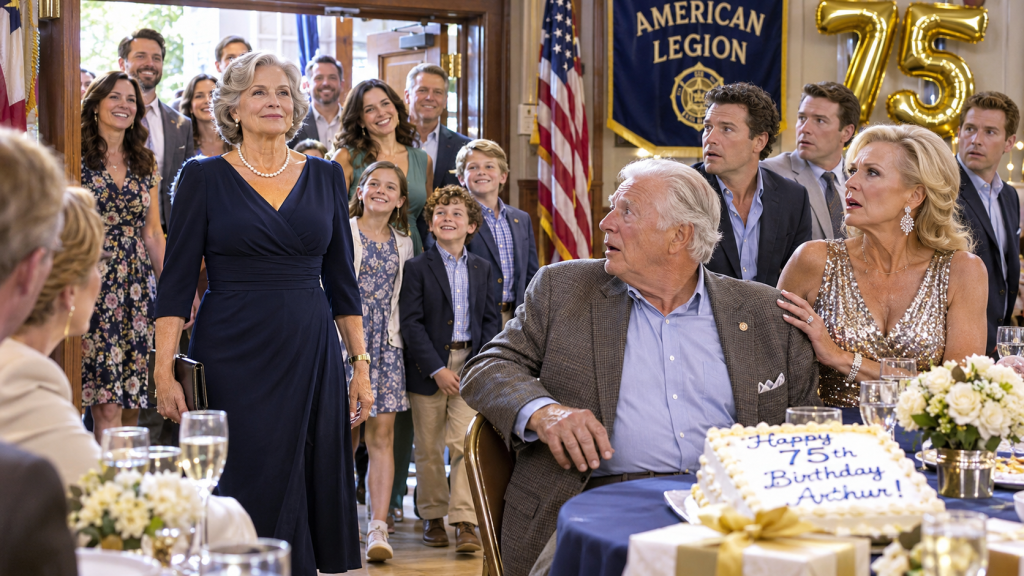
After that, I stopped counting the children I couldn’t have and started loving the ones who needed me. But standing in the American Legion hall in Waco, watching Arthur’s oldest son hold up a yellowed letter, I realized there might have been another reason my husband left. Seven words. Written in Arthur’s own handwriting.
Martha must never learn about the baby. I stared at the paper. The room seemed to tilt. Arthur’s wife, Clara, reached for the letter again. “Michael, give that to me.” But Michael stepped back. “No, Mom.” His voice was quiet. And somehow, that made it more powerful. “I think we’ve kept enough secrets.” I have never liked making scenes. Thirty-six years driving a school bus teaches you that raising your voice doesn’t always make children listen.
Sometimes you get better results by turning off the engine and waiting.
So I stood there.
In my navy dress.
Wearing my mother’s pearls.
With eleven people behind me who had once called my house their first safe place.
And I waited.
Arthur stared at his son.
“Michael, this is neither the time nor the place.”
Michael looked toward him.
“Then when is?”
The room fell silent.
He continued.
“You told us Martha didn’t want children.”
Arthur swallowed.
“You don’t understand.”
Michael shook his head.
“Then explain it.”
I could hear the air conditioner rattling above the buffet table.
Somebody had left the microphone switched on.
A little feedback squealed through the speakers.
Nobody laughed.
Not anymore.
Clara finally stepped forward.
“This is supposed to be your father’s birthday.”
I looked at her.
“Yes, ma’am. I noticed the balloons.”
A few people shifted uncomfortably.
I continued.
“I didn’t come here looking for trouble.”
Clara’s expression tightened.
“You brought eleven people.”
I nodded.
“They’re my family.”
She glanced toward Daniel.
Then Ruth.
Then Marcus.
And all the others standing behind me.
“Well, you certainly made your point.”
I looked at her.
“Actually, I haven’t said much at all.”
That was the truth.
My children had introduced themselves.
Arthur’s son had produced the letter.
And now everyone seemed to be waiting for me to become the angry woman Clara had probably expected.
But anger wasn’t what I felt.
Not yet.
Mostly, I felt twenty-three again.
And terribly tired.
Michael approached me.
“Mrs. Martha?”
I smiled faintly.
“Martha is fine.”
He swallowed.
“I’m sorry to do this in front of everybody.”
I looked at the letter.
“Where did you find that?”
He hesitated.
“In Mom’s old cedar chest.”
Clara closed her eyes.
Michael continued.
“She asked me to help move some things out of the attic last month.”
He unfolded another page.
“There were letters from Dad, old photographs, and some documents.”
Arthur gripped the edge of a chair.
“Michael.”
His son looked at him.
“Dad, I’m fifty-one years old. I’m not a little boy anymore.”
I felt my chest tighten.
Fifty-one.
Arthur had three grown sons.
And this was the first time I’d ever stood in a room with them.
Michael looked toward me again.
“I didn’t know who you were until I found the letters.”
I nodded slowly.
“And what did they tell you?”
His eyes filled.
“That my father was still married to you when he started seeing my mother.”
The words landed quietly.
But they landed hard.
I looked toward Arthur.
He stared at the floor.
I had suspected there might have been another woman.
A man doesn’t always leave a five-year marriage with a packed duffel bag unless he’s already imagined somewhere else to go.
But suspecting something is different from hearing it spoken aloud.
Especially forty-two years later.
I swallowed.
“Arthur?”
He finally looked at me.
His face had gone gray.
“Martha, I never wanted to hurt you.”
I almost laughed.
Not because it was funny.
But because I remembered standing at the kitchen sink after he left, staring at the two coffee cups I’d washed that morning.
One mine.
One his.
And wondering whether he would ever come back for the second.
“You managed it anyway,” I said.
Ruth moved beside me.
“Mama, do you want to sit down?”
I shook my head.
“Not yet, honey.”
She squeezed my hand.
Ruth had come to live with me when she was thirteen.
She was nearly forty now, a nurse with three children and a laugh that could fill a church fellowship hall.
When she was little, she used to sleep with her bedroom light on.
She told me darkness made her remember places she didn’t want to remember.
I never forced her to turn it off.
Now she stood beside me, ready to protect the woman who had once protected her.
That nearly undid me.
But I held on.
Michael unfolded the letter.
“Would you like to read it?”
I looked at his face.
There was no triumph there.
Only sorrow.
“Yes,” I said.
“I believe I would.”
The letter was dated several months before my divorce became final.
Arthur had written it to Clara.
The opening lines were ordinary enough.
He missed her.
He wished they could spend more time together.
He was tired of explaining himself.
Then came the sentence that made my hands tremble.
I know the baby changes everything.
I stopped reading.
Looked toward Clara.
Then returned to the page.
I will leave Martha, but she must never learn about the baby until everything is settled.
I felt the room disappear.
The balloons.
The cake.
The rows of folding chairs.
All of it seemed to move far away.
Arthur hadn’t simply left because I couldn’t give him children.
He had already begun another family.
He had told me I wasn’t enough while he was preparing to become a father with someone else.
I lowered the page.
For forty-two years, I’d carried the shame of being unable to conceive.
And now I discovered that Arthur had used that sorrow to hide his own betrayal.
“Why?” I asked.
Arthur looked up.
His eyes filled.
“Martha—”
“No.”
I shook my head.
“Just answer me.”
He swallowed.
“Why did you tell me you wanted a real family?”
He looked toward Clara.
Then back at me.
“Because I didn’t know how else to explain leaving.”
I stared at him.
“You could have told the truth.”
He lowered his head.
“I was ashamed.”
I felt something tighten behind my ribs.
“You were ashamed?”
Arthur began crying.
I looked at him for a long moment.
Then said quietly, “I spent forty-two years thinking I was the one who should be ashamed.”
He covered his face.
And for the first time that afternoon, nobody tried to defend him.
Daniel stepped beside me.
He was the first child I’d taken into my home.
He arrived at eight years old with a paper bag of clothes and a habit of apologizing whenever he needed something.
Now he was a judge.
Tall.
Gray at the temples.
And still the boy who called me every Sunday afternoon.
“Mama,” he said gently, “you don’t have to stay.”
I looked at him.
“I know.”
He nodded.
“We can leave.”
I glanced toward the door.
My eleven children stood nearby.
Some holding their spouses’ hands.
Some with tears in their eyes.
All waiting for me.
I could have walked out.
And part of me wanted to.
But another part understood that leaving now would mean carrying home a question I’d never allowed myself to ask.
What else had Arthur lied about?
I turned toward Michael.
“Is there anything else in those letters?”
His expression changed.
And that was answer enough.
Michael looked toward his brothers.
His middle brother, Stephen, was standing beside the buffet table.
The youngest, Paul, sat with his elbows on his knees.
Neither looked particularly happy.
Michael took a breath.
“There’s something about the divorce.”
Arthur immediately stood.
“That’s enough.”
Michael turned toward him.
“No, Dad.”
His voice broke.
“It’s been enough for forty-two years.”
Clara began crying.
“Michael, please.”
He looked at her.
“Mom, you told us he was divorced before you met.”
She lowered her eyes.
“And you told us Martha refused to have children.”
Nobody spoke.
Michael continued.
“But these letters say something different.”
He turned toward me.
“Martha, did you ever receive a settlement when you and Dad divorced?”
I frowned.
“A settlement?”
He nodded.
“Money. Property. Anything?”
I shook my head.
“Arthur took the pickup and his tools. I kept the house because it belonged to my grandmother.”
Michael looked down.
His expression became troubled.
I swallowed.
“Why do you ask?”
Arthur stared at the floor.
Michael opened another page.
“Because there’s a letter about a savings account.”
My stomach tightened.
“What savings account?”
Arthur looked toward me.
“Martha, please.”
I kept my eyes on Michael.
He continued.
“It says Dad withdrew money before the divorce.”
I stared at him.
Arthur and I had saved carefully during our marriage.
We weren’t wealthy.
He worked at a machine shop.
I drove a school bus and took extra cleaning jobs in the summer.
We kept our savings in a small joint account.
I remembered checking the balance shortly before Arthur left.
There had been nearly twelve thousand dollars.
A great deal of money in 1984.
Enough that I’d imagined we might someday afford another round of fertility treatment, or perhaps begin the process of adopting a child.
After Arthur left, the account was nearly empty.
He told me the money had gone toward household bills and debts.
I hadn’t questioned him.
I was too heartbroken.
And I was twenty-three years old.
I thought a man who had shared my bed for five years wouldn’t lie to me about our savings.
Now I wasn’t so certain.
Michael unfolded the letter carefully.
“It says he moved eleven thousand dollars into an account under Mom’s name.”
Clara covered her mouth.
I stared at Arthur.
“Eleven thousand?”
He didn’t answer.
I took a slow breath.
“Arthur, was that our money?”
His eyes filled.
“Yes.”
The word struck harder than I expected.
I remembered the winter after he left.
The broken heater.
The groceries I bought with coins saved in a coffee can.
The nights I ate toast because I wanted enough money for gasoline to get to work.
And all the while, Arthur had taken nearly everything we’d saved.
I looked toward Clara.
“Did you know?”
She began crying.
“I knew he gave me money.”
I waited.
“I didn’t know where it came from.”
I studied her.
I couldn’t tell whether she was telling the truth.
And for once, I didn’t feel responsible for deciding immediately.
I sat down.
My knees had finally had enough.
Ruth brought me a glass of water.
Daniel stood beside my chair.
Marcus moved one of the folding tables so I had room.
It struck me as funny, in a painful sort of way.
Arthur had spent his life bragging about his three sons.
And now the children I’d raised were quietly looking after me while the family he’d chosen struggled to explain itself.
Clara sat across from me.
“Martha, I’m sorry.”
I looked at her.
She swallowed.
“I know you don’t believe me.”
I took a sip of water.
“Clara, you’ve had forty-two years to tell me the truth.”
Her eyes filled.
“I know.”
“And two weeks ago, you wrote on that invitation that I should come see what a real family looks like.”
She closed her eyes.
I continued.
“Why?”
For several seconds, she couldn’t speak.
Then whispered, “Because I was jealous.”
I stared at her.
“Jealous of what?”
Clara wiped her cheeks.
“Arthur used to talk about you.”
My chest tightened.
“What?”
She nodded miserably.
“Not often. But sometimes.”
I waited.
“He’d mention the school bus. Your tomato garden. The way you always remembered everybody’s birthday.”
My eyes filled.
She continued.
“And over the years, I heard people talking about the children you raised.”
I looked toward Daniel.
Then back at her.
“People knew about them?”
Clara nodded.
“Yes.”
She swallowed.
“Your sister Beatrice still knows people around Waco. Word travels.”
I almost smiled.
That sounded like Beatrice.
Clara continued.
“When Michael started asking questions about the letters, I was angry.”
I frowned.
“With me?”
She nodded.
“I thought if you came here and saw our family, he’d understand that his father’s life turned out well.”
I stared at her.
“You wanted to prove Arthur made the right decision?”
Her face crumpled.
“Yes.”
I leaned back.
For forty-two years, this woman had believed she needed to win a competition I hadn’t known we were having.
And the prize was a man who had lied to both of us.
Michael spoke quietly.
“Mom, you didn’t have to prove anything.”
Clara looked toward him.
He continued.
“We’re your sons. We love you.”
Her eyes filled.
“But that doesn’t mean Dad was right about Martha.”
Stephen stepped forward.
He had been quiet through most of the conversation.
Now he looked toward me.
“Martha, I’m sorry.”
I nodded.
“You don’t owe me an apology, honey.”
He swallowed.
“I believed what Dad told us.”
I smiled sadly.
“That wasn’t your doing.”
Paul approached next.
He looked younger than his brothers, though he was a grown man with children of his own.
He held out his hand.
“I’d like to meet you properly.”
I took it.
“I’m Martha.”
He smiled faintly.
“I know.”
Then he looked toward Daniel.
“And I guess we’d all better learn each other’s names.”
For the first time that afternoon, something gentle moved through the room.
Not forgiveness.
Not yet.
Just the possibility that the next generation might do better than the last.
I looked toward my children.
Eleven people.
Eleven different stories.
Daniel, who had come to me at eight and stayed until college.
Ruth, who arrived with a suitcase that held more fear than clothes.
Marcus, who learned to repair engines beside me because he said machines made more sense than people.
And eight others who had found their way through my doorway over thirty-six years.
Some had lived with me for a few months.
Some for years.
Some had other families they loved too.
But every one of them had kept a place for me in their lives.
I hadn’t given birth to them.
I hadn’t needed to.
I had loved them.
And they had loved me back.
I turned toward Arthur.
“You wanted a real family.”
He looked up.
I gestured toward the people standing behind me.
“So did I.”
His eyes filled.
“The difference is, I didn’t think someone had to share my blood to belong.”
Arthur began crying again.
“Martha, I never knew…”
I stopped him.
“You never asked.”
He lowered his head.
“You could have.”
For several seconds, nobody spoke.
Then I looked toward the birthday cake.
A great big sheet cake with blue icing and seventy-five candles still waiting to be lit.
I almost laughed.
Here we were, a room full of grown people, surrounded by balloons and brisket, and nobody knew what to do next.
So I did what I’d done for thirty-six years when a bus full of children got restless.
I stood.
Straightened my dress.
And said, “Well, somebody ought to eat that cake.”
A nervous laugh moved through the room.
I looked toward Michael.
“It’s your father’s birthday. You don’t have to cancel the whole thing because the truth finally showed up.”
Michael smiled through tears.
Then he nodded.
I didn’t stay long.
Long enough for a slice of cake.
Long enough to speak with Arthur’s sons.
And long enough to let Clara know I wasn’t interested in arguing about which of us had the better family.
Before leaving, Arthur approached me.
He looked smaller than I remembered.
Maybe old age had done that.
Or maybe I’d finally stopped seeing him through the eyes of the young woman he abandoned.
“Martha,” he whispered, “could we talk privately sometime?”
I considered him.
Then nodded.
“Maybe.”
His eyes filled.
“There’s more I need to tell you.”
I felt tired.
“Arthur, you’ve already had forty-two years.”
He lowered his head.
“I know.”
I took a breath.
“Then another day won’t hurt.”
Outside, Beatrice was still sitting in her car.
The radio was playing an old country song.
She rolled down the window when she saw us.
“Well?”
I climbed into the passenger seat.
My children gathered around their cars behind us.
Beatrice studied my face.
“Lord have mercy. What happened?”
I looked toward the American Legion hall.
Then back at her.
“Arthur had some explaining to do.”
She raised an eyebrow.
“That man always did.”
I laughed.
And then, unexpectedly, I began crying.
Beatrice reached across the seat and took my hand.
“Oh, Martha.”
I shook my head.
“I’m all right.”
She squeezed my fingers.
“No, you’re not.”
I looked toward the parking lot.
Daniel was helping Ruth buckle her granddaughter into a car seat.
Marcus was laughing with two of the others.
My family.
All of them.
And suddenly, I understood how much of my life I’d spent trying to prove Arthur wrong.
Even when I thought I’d stopped caring.
We drove home slowly.
The highway stretched ahead beneath a pale Texas sunset.
Beatrice didn’t ask too many questions.
That’s one of the things I love about my sister.
She can talk for an hour about the price of tomatoes, but when something truly matters, she knows how to be quiet.
Halfway home, she finally spoke.
“Martha?”
“Yes?”
“You know none of what Arthur did changes what you built.”
I stared through the windshield.
“I know.”
She nodded.
“Good.”
Then she added, “Because I’d hate to have to turn this car around and remind him.”
I laughed so hard I nearly cried again.
Two days later, Michael called.
He had gotten my number from Beatrice.
I answered on the landline.
“Hello?”
“Martha?”
“Yes?”
“It’s Michael Pendelton.”
I smiled faintly.
“Hello, Michael.”
He hesitated.
“I wanted to apologize for what happened at the party.”
I looked toward my kitchen window.
“Son, you didn’t cause that.”
He swallowed.
“I know.”
Then he continued.
“But there’s something else.”
My stomach tightened.
“What?”
“After you left, Dad finally told us why he never corrected the stories about you.”
I sat down.
“I’m listening.”
Michael took a breath.
“He said he didn’t want us asking questions about the divorce.”
I nodded slowly.
“That much was obvious.”
Michael hesitated.
Then whispered, “Martha, there’s another document in the cedar chest.”
My fingers tightened around the receiver.
“What kind of document?”
He swallowed.
“Something Dad kept from the year he left you.”
I closed my eyes.
“Michael, I don’t know if I can take another surprise.”
His voice softened.
“I understand.”
Then he said something that made me sit upright.
“It’s a letter from a lawyer.”
I frowned.
“What lawyer?”
“Someone in Dallas. It was addressed to both you and Dad.”
My heart began pounding.
I remembered the fertility doctors.
The appointments.
The tests.
The way Arthur always insisted on speaking to the physicians alone.
I swallowed.
“What does it say?”
Michael paused.
“Martha, I think you need to see it yourself.”
I stared toward the kitchen window.
Then he added quietly, “Dad told us you couldn’t have children because the doctors said something was wrong with you.”
My chest tightened.
“Yes.”
Michael took a slow breath.
“Well, this letter says something different.”
For several seconds, I couldn’t speak.
Then I whispered, “Different how?”
Michael’s voice broke.
“Martha, according to the records Dad kept, the medical results were never as simple as he told you.”
I gripped the receiver.
Forty-two years.
Forty-two years of believing my body had failed.
Forty-two years of carrying a shame I never should have been made to feel.
I stared at the wall.
Then Michael said the words that made everything inside me go still.
“Martha, the letter says the doctors recommended additional testing for Arthur, but he refused. They never concluded you were the reason you couldn’t conceive.”
I closed my eyes.
And suddenly, I remembered something from our last appointment in Dallas.
The doctor had asked Arthur to stay behind.
I’d waited in the hallway.
When Arthur finally came out, he looked angry.
He told me there was nothing more to discuss.
I believed him.
I believed everything he said.
Until he left.
I sat at my kitchen table long after the call ended.
The late afternoon sun moved slowly across the floor.
My landline sat beside me.
The same old telephone that rang every Sunday.
I looked toward the hall closet.
Behind the vacuum cleaner was the box of Christmas stockings I’d counted before Arthur’s party.
Eleven stockings.
One for each child who had found a place in my home.
Then I thought about Arthur’s words.
You can’t give me a real family.
And I began to cry.
Not because I regretted the life I’d lived.
I didn’t.
Not for one moment.
But because a young woman had spent decades believing something terrible about herself.
And the man who planted that belief had apparently known the truth was far less certain.
I wiped my cheeks.
Then reached for the telephone.
I called Beatrice.
“Hello?”
“Bea?”
“Yes, honey?”
I took a breath.
“I think there’s one more thing Arthur owes me.”
My sister was quiet.
Then she said, “What do you need?”
I looked toward the window.
For forty-two years, I’d been afraid of what the truth might do to me.
Now I was beginning to understand something.
The truth wasn’t what had hurt me.
The lies had.
I swallowed.
“I need to see that letter.”
Beatrice didn’t hesitate.
“Then we’ll go get it.”
And as I set down the receiver, I realized that Arthur’s seventy-fifth birthday had given me something I never expected.
Not an apology.
Not revenge.
But the possibility of finally learning why a man who claimed he wanted a real family had spent forty-two years making me believe I wasn’t worthy of one.