➡️ PART 3 ➡️
For most of my life, I had believed there were two kinds of heartbreak. The kind that came when someone you loved stopped loving you. eAnd the kind that came when you discovered they had never loved you the way you imagined. But sitting in David Allen’s office, with my ex-husband’s final letter trembling between my fingers, I discovered a third kind.
The heartbreak of realizing that the story you had been grieving might never have been the truth. Across the mahogany table, my twin sister, Beatrice, stood with one hand gripping her expensive black purse. Our parents sat beside her. My mother was crying. My father looked furious. And the attorney who had represented Arthur Jensen for nearly fifteen years was holding a folder containing evidence that apparently connected my sister to messages I had believed came from my husband.
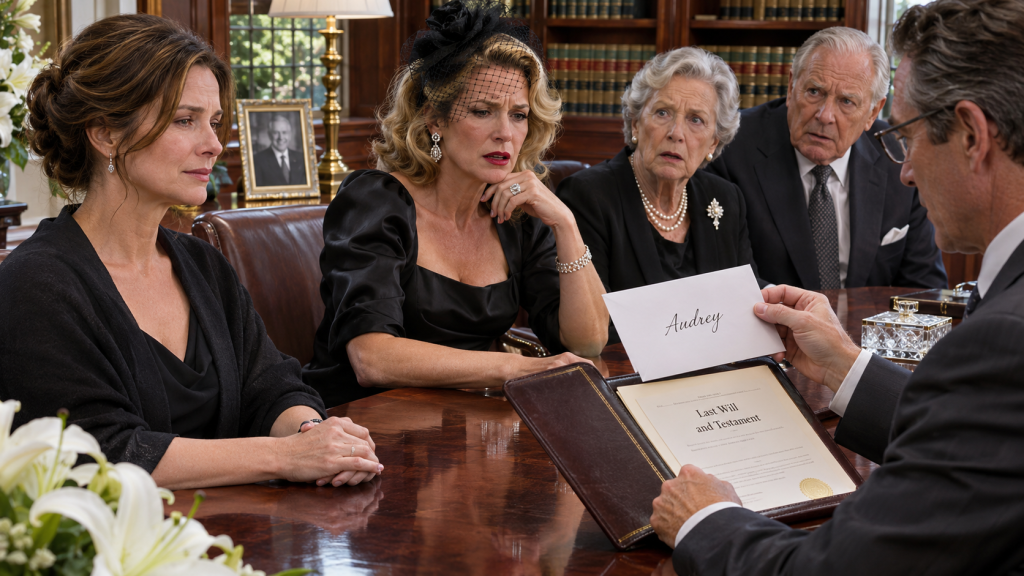
David looked toward Beatrice. “Please sit down.” She lifted her chin. “I don’t have to tolerate these accusations.” David’s expression remained calm. “No one is asking you to admit anything. But the documents need to be reviewed.” Beatrice glanced toward our parents. “Daddy, are you going to let him speak to me like this?” My father immediately leaned forward.
“This is turning into an attack on my daughter.” I looked at him. For thirty-five years, I had watched my parents defend Beatrice before asking what had happened. Now, even with Arthur’s name on the documents in front of us, nothing had changed. I took a slow breath. “Dad, I’m your daughter too.”
The room went silent.
My father stared at me.
For a moment, he looked genuinely surprised.
As though the possibility that I might expect his support had never occurred to him.
Then he frowned.
“Audrey, this isn’t about taking sides.”
I glanced toward Beatrice.
She was standing beside my mother, who had already reached for her hand.
“Then perhaps everyone could stop deciding who’s innocent before we hear what happened.”
David nodded.
“That would be helpful.”
Beatrice sat down reluctantly.
Her expression hardened.
“Fine. Show us whatever nonsense Arthur paid someone to invent.”
I looked at my sister.
Six days.
She had been married to Arthur for six days when he died.
She’d entered his life believing she was about to inherit a fortune.
And now she looked more frightened of losing the money than she had at his memorial.
That realization hurt more than I expected.
Not because I wanted Arthur’s wealth.
But because I had loved the man whose death she seemed to be treating like a disappointing business transaction.
David opened the folder.
“The investigator was retained after Arthur received information suggesting someone had impersonated him through an electronic messaging account.”
I felt my stomach tighten.
I remembered the messages.
They had arrived shortly before Arthur asked for a divorce.
Cold.
Cruel.
Nothing like the man I’d married.
You’re holding me back.
I regret wasting ten years.
You were never the woman I really wanted.
I’d cried over those words until I was physically sick.
When I confronted Arthur, he’d stared at the screen.
Then said quietly, “Maybe it’s better if you believe that.”
I had thought he was confirming them.
Now I wondered whether he’d been trying to avoid answering a question he couldn’t bear.
David slid a report across the table.
“The investigator obtained account registration details and other supporting records.”
I looked down.
The account had been created using a secondary email address associated with Beatrice.
My chest tightened.
Then I saw a payment receipt.
A prepaid telephone service.
Purchased using a card linked to an account in my sister’s name.
I stared at her.
“Beatrice?”
She folded her arms.
“That doesn’t prove I wrote anything.”
David nodded.
“Not by itself.”
He turned another page.
“But the account activity and additional correspondence raise serious questions.”
I looked toward the report.
There were screenshots.
Dates.
Messages.
Records showing when the account had been accessed.
Then I saw something that made my stomach drop.
A draft message.
One that had never been sent.
It read:
Once Audrey believes Arthur hates her, she’ll stop fighting for the marriage.
I covered my mouth.
For several seconds, I couldn’t speak.
Beatrice stared at the table.
My mother whispered, “Oh, sweetheart.”
I couldn’t tell which daughter she meant.
David continued carefully.
“The investigator found a copy of this draft in material provided by a third party. Its origin has been documented, but any disputed conclusions would require appropriate verification.”
I nodded mechanically.
I wasn’t interested in pretending a report automatically proved every accusation.
But the words were devastating.
Someone had apparently wanted me to believe Arthur hated me.
Someone had understood that I would rather walk away quietly than force a man to stay.
And someone had used that knowledge against me.
I looked at Beatrice.
“Did you send those messages?”
Her face reddened.
“You always think everything is about you.”
I stared at her.
“They were sent to me.”
She rolled her eyes.
“Oh, please.”
I swallowed.
“Did you write them?”
She looked toward Dad.
Then whispered, “Arthur wanted the divorce anyway.”
The room became silent.
I felt something inside me go cold.
“That wasn’t my question.”
Beatrice’s eyes filled.
For a moment, I saw the little girl who used to stand beside me in matching dresses while our mother praised her smile and reminded me to stand straighter.
Then she whispered, “I was trying to make things easier.”
My heart sank.
“Easier for whom?”
She didn’t answer.
David quietly asked whether I wanted a break.
I shook my head.
“No.”
My voice sounded unfamiliar.
“I’ve spent four months wondering why my husband stopped loving me.”
I swallowed.
“I think I can sit through another few minutes.”
He nodded.
Then I turned toward Beatrice.
“Did Arthur know?”
Her expression changed.
I waited.
“Did he know you were sending messages pretending to be him?”
She looked down.
“I don’t know what he knew.”
David spoke.
“According to the available correspondence, Arthur became aware of the impersonation after the divorce proceedings had begun.”
I closed my eyes.
After.
Not before.
I remembered the way Arthur had withdrawn from me.
The late nights.
The short conversations.
The way he’d stopped sitting beside me on the couch.
There had been cruelty in that distance.
But perhaps there had also been something else.
Fear.
Illness.
And a decision he’d made without allowing me to understand it.
David reached for the medical report.
“Arthur received his diagnosis several months before the divorce.”
I looked down.
The document described a serious medical condition.
One that required specialized treatment.
The prognosis was uncertain.
I read the dates carefully.
Arthur had learned he was ill before he began withdrawing from our marriage.
I swallowed.
“Did he know he was dying?”
David answered gently.
“He knew his condition was serious. The report doesn’t establish that he knew precisely what would happen or when.”
I nodded.
That mattered.
I didn’t want the truth dressed up into a romantic story if the evidence didn’t support it.
I wanted to know what Arthur had actually been thinking.
I looked toward the letter in my hands.
Then began reading again.
Audrey, I was frightened.
My throat tightened.
I had spent years building businesses and convincing myself I could solve anything if I worked hard enough.
I wiped my eyes.
Then a doctor told me there were things money couldn’t control.
The room faded around me.
I could almost hear Arthur speaking.
His familiar voice.
Warm.
A little amused.
The voice that used to ask whether I wanted more coffee.
The voice that told me stories about his childhood while we sat beneath the oak trees in our backyard.
I continued reading.
I convinced myself that leaving you would spare you the worst parts of what might happen.
My eyes filled.
I thought if you hated me, you would begin again without feeling responsible for taking care of me.
I stopped.
For several seconds, I couldn’t breathe.
Then I whispered, “Oh, Arthur.”
David waited quietly.
I continued.
That was cowardly. You deserved the right to choose whether to stay beside me.
Tears rolled down my cheeks.
I made that choice for you.
I pressed the letter against my chest.
Because that was the truth.
Arthur hadn’t protected me by leaving.
He had taken away my ability to love him through his illness.
He had decided that my devotion would become a burden.
And he’d mistaken secrecy for kindness.
My mother began crying.
“Audrey, perhaps he thought he was doing the right thing.”
I looked toward her.
“Maybe he did.”
She nodded.
Then I continued.
“But he was wrong.”
The room went quiet.
I took a breath.
“I would have stayed.”
My voice broke.
“I would have gone to appointments. Held his hand. Sat beside his hospital bed.”
I looked toward the letter.
“We spent ten years building a life together.”
Tears fell onto the paper.
“And he didn’t even ask whether I wanted to fight for him.”
For a long moment, nobody spoke.
Then David said quietly, “Arthur acknowledged that in the remainder of his letter.”
I nodded.
I wanted to keep reading.
But I needed to know one thing first.
“Why did he marry Beatrice?”
Beatrice sat upright.
Finally, a question she seemed eager to answer.
“Because he loved me.”
I looked at her.
She lifted her chin.
“He chose me.”
David remained silent.
I waited.
Then I asked him, “What did Arthur tell you?”
He folded his hands.
“Arthur didn’t provide a complete explanation of his personal reasons for marrying Beatrice.”
Beatrice smiled triumphantly.
Then David continued.
“However, he left correspondence expressing serious doubts about that decision.”
Her smile vanished.
I stared at him.
“What correspondence?”
David opened another folder.
There was a handwritten note dated shortly before the wedding.
Arthur had written:
I have made an unforgivable mess of the lives of two sisters.
My chest tightened.
The note continued.
I allowed Beatrice to believe a future with me was possible, even after I understood what she had done.
I looked toward my sister.
Her face had gone pale.
Then David read the final sentence.
I am no longer certain whether she wants me or the life she believes I own.
Beatrice slammed her hand against the table.
“He had no right to write that!”
Everyone turned toward her.
For several seconds, nobody spoke.
Then Harold—no, David—quietly closed the folder.
I stared at Beatrice.
She was shaking.
Not with grief.
With anger.
I took a breath.
“Did Arthur know about the messages before he married you?”
She looked away.
“That’s between me and Arthur.”
I swallowed.
“He’s dead, Beatrice.”
Her eyes filled.
I continued.
“And I deserve to understand why my marriage ended.”
She shook her head.
“You always wanted everything explained.”
I stared at her.
“No.”
My voice broke.
“I wanted honesty.”
My father suddenly stood.
“This meeting has become ridiculous.”
David looked up.
“Mr. Bennett, we still have estate matters to address.”
Dad frowned.
“My daughter was legally married to Arthur.”
He gestured toward Beatrice.
“She should receive what’s hers.”
I felt something tighten in my chest.
There it was again.
The same familiar pattern.
Beatrice wanted something.
Our parents defended her.
And I was expected to understand.
I looked toward Dad.
“Do you know what Arthur left me?”
He hesitated.
I continued.
“No. Neither do I.”
I glanced toward David.
“But perhaps we should let the attorney explain before deciding what anyone deserves.”
My father sat down.
For the first time in my life, he looked embarrassed.
David turned to the estate documents.
He explained that the enormous fortune Beatrice expected was not held entirely in Arthur’s personal name.
Years earlier, Arthur had placed substantial business holdings into a trust.
The trust had its own governing documents.
And the beneficiaries were determined by those documents rather than automatically by the identity of Arthur’s spouse at death.
I listened carefully.
I had never paid much attention to Arthur’s family wealth.
We lived comfortably.
But our happiest memories were ordinary.
Painting the kitchen.
Planting tomatoes.
Eating breakfast at the diner.
I knew he had significant holdings.
I didn’t know the details.
David continued.
“The trust names Audrey as a principal beneficiary.”
Beatrice stared at him.
“That can’t be right.”
He nodded.
“The trust documents were validly executed. Arthur later confirmed the arrangement following the divorce.”
My stomach tightened.
“Why?”
David looked toward me.
“He wrote that he wanted to ensure your financial security regardless of what happened to him.”
I closed my eyes.
Then whispered, “He already gave me more than enough in the divorce.”
David nodded.
“He was aware of that.”
Beatrice leaned forward.
“How much?”
David looked toward her.
“The trust’s holdings are substantial, but we need to distinguish trust assets from the probate estate and complete the necessary valuation and administration.”
She frowned.
“Everyone said Arthur was worth four hundred million dollars.”
David answered carefully.
“That figure reflects estimates of business and trust interests. It doesn’t mean four hundred million dollars belonged to him personally or passes automatically to his most recent spouse.”
Beatrice’s face tightened.
“But I was his wife.”
“Yes.”
“Then I have rights.”
David nodded.
“You may have certain rights concerning his probate estate and marital property. Those must be reviewed under applicable law. Nothing discussed today eliminates lawful spousal claims.”
I noticed Beatrice relax slightly.
She seemed to hear only the possibility of receiving something.
I heard something else.
Arthur had built a complicated estate.
And his death had left questions that could take months, perhaps years, to settle.
I didn’t want a fortune.
I wanted my husband back.
Then David explained another provision.
The trust directed that a portion of its annual income be used for charitable purposes.
Education.
Medical assistance.
Support for children facing hardship.
I looked up.
“Arthur chose those?”
David nodded.
“He developed the charitable provisions several years ago.”
My eyes filled.
That sounded like him.
Arthur had always quietly paid for school supplies when children in my classroom needed them.
He’d sponsor field trips without asking for recognition.
And once, when a student’s family couldn’t afford winter coats, he arranged for a local store to provide them.
I’d loved that part of him.
The part that believed wealth should make other people’s lives easier.
David continued.
“Arthur also expressed a desire for Audrey to have a role in overseeing the charitable distributions, subject to the trust’s governance provisions.”
I stared at him.
“Me?”
He nodded.
“He believed your experience as a teacher would make you particularly thoughtful about the needs of children.”
My throat tightened.
Then I began crying.
Because even after everything, Arthur had remembered what mattered most to me.
Beatrice crossed her arms.
“So she gets the money and I get nothing?”
David looked toward her.
“I haven’t said that.”
She frowned.
“Then what do I receive?”
He opened another document.
“Arthur made certain provisions concerning his personal property and the administration of outstanding obligations.”
Beatrice leaned forward eagerly.
I looked away.
I couldn’t bear watching her turn my husband’s death into a shopping list.
David continued explaining the difference between personal assets, business interests, trust property, and possible spousal claims.
There would need to be valuations.
Accountings.
Review of marital agreements, if any existed.
And potentially court proceedings if interested parties disagreed.
I listened carefully.
The process would not be simple.
But it would be handled properly.
After the meeting, I stepped outside.
The Dallas afternoon was bright.
Cars moved along the street.
People walked past carrying coffee and shopping bags.
The world continued as though nothing extraordinary had happened.
I stood beside the building and tried to breathe.
Ten years of marriage.
Four months of divorce.
Six days of Arthur being married to my sister.
And now a letter that changed the meaning of everything I’d believed.
I heard footsteps.
David approached.
“Audrey?”
I looked toward him.
“Yes?”
“Are you all right?”
I almost laughed.
Then shook my head.
“No.”
His expression softened.
“I understand.”
I swallowed.
“Can I ask you something?”
“Of course.”
“Did Arthur ever regret leaving me?”
David looked toward the street.
Then back at me.
“He spoke about that regret more than once.”
My eyes filled.
I whispered, “Why didn’t he come back?”
David hesitated.
“That’s something his letters may help explain better than I can.”
I drove home slowly.
The bungalow still stood beneath the oak trees.
Arthur had transferred it to me during the divorce.
I’d considered selling it.
But every time I walked through the rooms, I remembered something beautiful.
Sunday mornings.
The crooked bookshelf.
The tomatoes in the backyard.
The first Christmas we’d spent there.
I parked in the driveway.
Then sat behind the wheel.
For four months, I’d tried to turn the house into a place where Arthur had never lived.
I’d packed away his photographs.
Removed his favorite coffee mug.
Changed the bedroom curtains.
But now, holding his letter, I realized I didn’t want to erase him.
I wanted to remember the truth.
All of it.
The kindness.
The betrayal.
The love.
The cowardice.
Because Arthur had been capable of both tenderness and terrible mistakes.
And I couldn’t heal by pretending either part hadn’t existed.
That evening, I opened the rest of his letter.
My hands trembled.
Audrey, there is something I need you to know about Beatrice.
I stopped breathing.
The letter continued.
I knew she had been trying to interfere in our marriage before the divorce.
My stomach tightened.
I discovered the messages too late to prevent the damage they caused.
Tears filled my eyes.
But I also discovered something else.
I stared at the words.
Then continued.
She had been asking questions about my assets, my insurance, and the trust long before I agreed to marry her.
My chest tightened.
I thought about Beatrice’s expensive wedding photographs.
The champagne.
The captions.
The way she smiled in the attorney’s office before David opened the folder.
I swallowed.
Then read the next sentence.
I told myself I could manage the situation, but I underestimated how far she was willing to go.
For several seconds, I couldn’t speak.
Then I read the final paragraph on that page.
If anything happens to me, please ask David about the financial authorization Beatrice tried to obtain shortly before the wedding.
I sat completely still.
Financial authorization?
I turned the page.
Arthur had written:
I refused to sign it. But the version later submitted to my financial office bears a signature that looks like mine.
My heart began pounding.
I stared at the words.
Arthur had suspected someone was using his signature without permission.
And he’d known about it before he died.
The next morning, I called David.
He answered immediately.
“Audrey?”
“Yes.”
My voice trembled.
“I read the rest of Arthur’s letter.”
There was a pause.
“I’m glad.”
I swallowed.
“He mentioned a financial authorization.”
David became quiet.
“Yes.”
I sat down.
“What was it?”
He took a breath.
“A document purporting to give Beatrice authority to communicate with certain financial institutions and direct limited transactions on Arthur’s behalf.”
My stomach tightened.
“Did he sign it?”
“He disputed the signature.”
I closed my eyes.
“Was it used?”
“An attempt was made to submit it. The institutions involved were notified of the dispute, and further action was restricted pending review.”
Relief washed through me.
Then David continued.
“The matter remains under examination.”
I nodded.
I didn’t want to assume Beatrice had forged anything without proper evidence.
But the possibility was frightening.
Then David said something I hadn’t expected.
“Audrey, there’s another reason Arthur wanted you to receive that letter.”
My heart tightened.
“What?”
He hesitated.
“Shortly before his death, he asked me to arrange a meeting with you.”
I stared at the wall.
“What kind of meeting?”
“He wanted to explain the divorce.”
My eyes filled.
“Then why didn’t he?”
David took a slow breath.
“He was admitted to the hospital before we could finalize a time.”
I covered my mouth.
Arthur had been planning to tell me.
After four months of silence.
After the marriage to Beatrice.
After everything.
He’d finally been ready to explain.
And then he died.
I sat at the kitchen table for a long time.
The same table where Arthur had told me he wanted a divorce.
The same table where Beatrice had walked in wearing a red dress.
The same table where I’d spent so many evenings wondering why the man I loved had stopped wanting me.
Now I understood that he had never been honest about his reasons.
He was ill.
Afraid.
Ashamed.
And trapped in decisions he’d made while trying to control what everyone else knew.
I looked toward his photograph.
Then whispered, “You should have trusted me.”
Tears rolled down my cheeks.
“We were supposed to face things together.”
For the first time, I allowed myself to be angry with him and still love him.
Both feelings were true.
That afternoon, my mother called.
“Audrey?”
“Yes, Mom.”
Her voice sounded strained.
“Beatrice is very upset.”
I closed my eyes.
“I imagine she is.”
“She thinks Arthur’s attorney is trying to cheat her.”
I took a breath.
“David is explaining the estate documents.”
Mom sighed.
“You know your sister has always been emotional.”
I stared toward the window.
“And I’ve always been expected to understand.”
She was quiet.
I continued.
“Mom, Arthur died.”
Her voice softened.
“I know.”
“I loved him for ten years.”
Tears filled my eyes.
“And all you’ve called to discuss is how Beatrice feels.”
For several seconds, she didn’t answer.
Then whispered, “Audrey…”
I swallowed.
“I need you to hear me.”
She was silent.
“I lost someone I loved. I learned my marriage ended because of secrets I didn’t understand. And now I’m trying to grieve while everyone argues about money.”
My voice broke.
“I need a mother too.”
The line went quiet.
Then I heard her crying.
Not the dramatic sobbing she usually offered when Beatrice was disappointed.
Something smaller.
More uncertain.
“Audrey,” she whispered, “I’m sorry.”
I closed my eyes.
For thirty-five years, I’d wanted those words.
But now they felt incomplete.
I took a breath.
“Thank you.”
Then I added, “I need some distance from all of this.”
She didn’t argue.
For once, she simply said, “I understand.”
I hoped she did.
Three days later, David asked me to return to his office.
Not for another family meeting.
Just the two of us.
When I arrived, he placed a slim folder on the table.
“Arthur asked that this remain private until you had read his letters.”
I stared at it.
“What is it?”
David opened the folder.
Inside was a series of handwritten notes.
Arthur’s handwriting.
Dates.
Medical appointments.
Thoughts he’d apparently written during the months before his death.
I read the first entry.
I told Audrey I wanted a divorce today. She looked at me as though I’d taken the floor out from under her.
My throat tightened.
The next sentence broke me.
I wanted to hold her. Instead, I walked away.
I covered my mouth.
David waited quietly.
I turned the page.
Another entry.
Beatrice says Audrey will recover. I don’t believe her. I know Audrey. She’ll blame herself.
Tears rolled down my cheeks.
Then I read the final line.
And she’s right to hate me for allowing it.
I sat back.
For several seconds, I couldn’t speak.
Then I asked, “Why did he write these?”
David answered gently.
“Arthur said he wanted a record of the choices he’d made, in case he didn’t have the opportunity to explain them himself.”
I looked down.
The notes weren’t an excuse.
They didn’t make the divorce less cruel.
But they showed that Arthur had understood how deeply he hurt me.
And that understanding mattered.
I turned another page.
Then stopped.
Near the bottom was a handwritten entry dated shortly before Arthur’s wedding to Beatrice.
I have learned something about the transactions Beatrice has been discussing with my financial staff.
My stomach tightened.
The next sentence read:
She believes the trust becomes hers when we marry.
I stared at David.
He nodded slowly.
Then I continued.
She doesn’t know that the trust’s governing documents were established long before this marriage.
I swallowed.
And she doesn’t know I’ve already asked David to preserve the records of every request she makes concerning my accounts.
My heart began pounding.
Arthur had been watching.
Not because he wanted revenge.
But because he no longer trusted the person he was about to marry.
I looked toward David.
“Why did he go through with the wedding?”
David sighed.
“I asked him that.”
I waited.
“He said he felt responsible for the expectations he’d allowed Beatrice to develop.”
I stared at him.
“That isn’t a reason to marry someone.”
David nodded.
“No.”
I looked down.
Arthur had made so many decisions based on guilt and fear.
He left me because he feared being ill.
He stayed involved with Beatrice because he felt responsible for what he’d promised.
And he tried to protect his estate through documents rather than confronting the people around him directly.
I loved him.
But I couldn’t pretend he’d been wise.
Then David turned to the final page.
“Audrey, there’s one last matter.”
My stomach tightened.
“What?”
He placed a sealed envelope on the table.
It was smaller than the first.
My name appeared on the front.
And beneath it, Arthur had written three words.
For our children.
I stared at the envelope.
For several seconds, I couldn’t breathe.
Arthur and I had tried for children.
We’d never succeeded.
There were no children from our marriage.
I looked at David.
“What does this mean?”
His expression softened.
“Arthur asked me to preserve certain documents concerning a program he began several years ago.”
I swallowed.
“What program?”
David hesitated.
“A private educational fund.”
I frowned.
“For whom?”
He took a slow breath.
“For children connected to your years as a teacher.”
My eyes filled.
Arthur had quietly supported children in my classroom for years.
School supplies.
Clothing.
Field trips.
But I had never known he’d established an educational fund.
David continued.
“He called it the Audrey Jensen Children’s Opportunity Fund.”
I covered my mouth.
For several seconds, I couldn’t speak.
Then he said something that made my heart stop.
“Audrey, there are already twelve children listed as beneficiaries.”
I stared at him.
“Twelve?”
He nodded.
“And Arthur left individual letters for each of them.”
I looked toward the envelope.
Then toward the photograph of Arthur on David’s desk.
For ten years, we’d dreamed of becoming parents.
We never had a child of our own.
But apparently, Arthur had quietly built something in our names for children who needed help.
I began crying.
Not because the money mattered.
But because it revealed a part of Arthur I recognized.
The man who bought school supplies without asking for credit.
The man who believed children deserved opportunities their families couldn’t always afford.
The man I’d loved before fear and secrecy destroyed our marriage.
I looked toward David.
“Can I meet them?”
He smiled gently.
“That would depend on the children’s families and the program’s arrangements.”
I nodded.
“Of course.”
Then he added something unexpected.
“Several of them have already written letters expressing gratitude.”
My eyes filled.
“May I read them?”
David opened the folder.
He handed me the first.
It was written in careful handwriting.
Dear Mr. and Mrs. Jensen, thank you for helping me go to college. I want to become a teacher someday.
I covered my mouth.
The room blurred.
Then I read another.
Thank you for believing someone like me deserves a chance.
And another.
I don’t know you, but you’ve changed my life.
Tears streamed down my cheeks.
For months, I’d believed Arthur had erased our marriage.
Now I was discovering that, even while making terrible choices, he had preserved something we’d once dreamed of doing together.
That evening, I returned home carrying Arthur’s letters.
I sat beneath the oak tree in our backyard.
The tomato plants were beginning to flower.
The air was warm.
And somewhere nearby, a bird was singing.
I looked toward the house.
Our bungalow.
Our crooked bookshelves.
Our memories.
Then I opened the final envelope.
Inside was one handwritten page.
Audrey, if you are reading this, it means I failed to tell you the truth while I was alive.
My throat tightened.
I cannot ask you to forgive me. I cannot undo the hurt I caused.
I wiped my eyes.
But I hope you will remember that our life together was real, even when my final choices made it seem otherwise.
I closed my eyes.
Then continued.
I loved you. I was frightened. And I made decisions that hurt the person who mattered most to me.
My chest ached.
Then came the final lines.
If you choose to help the children through the fund, do it because it brings you joy, not because you owe me anything.
You have spent your life caring for others. Please remember that you deserve a life of your own.
I pressed the letter against my heart.
And cried.
Several weeks later, I received a call from David.
His voice was serious.
“Audrey, there’s been a development concerning the disputed financial authorization.”
My stomach tightened.
“What happened?”
“The institution has completed its preliminary review.”
I sat down.
“And?”
He paused.
“The records indicate the document was submitted through an account associated with Beatrice.”
My heart pounded.
“Does that mean she forged it?”
“We can’t conclude that from the submission record alone. Further examination is necessary.”
I nodded.
Then David added, “However, the institution has preserved correspondence that may clarify who prepared it.”
I swallowed.
“What correspondence?”
He hesitated.
“Messages involving Beatrice and someone who previously worked in Arthur’s financial office.”
My chest tightened.
“Who?”
David took a breath.
“A former assistant named Lauren Pierce.”
I frowned.
I’d heard the name before.
Lauren had worked for Arthur several years earlier.
She left suddenly.
Arthur never explained why.
David continued.
“Lauren has agreed to provide information.”
My heart began pounding.
“About the authorization?”
“Yes.”
Then he added something that made me grip the edge of the table.
“And about the circumstances surrounding Arthur’s final weeks.”
For several seconds, I couldn’t speak.
Then I whispered, “What does she know?”
David paused.
“Audrey, Lauren says she witnessed an argument between Arthur and Beatrice shortly before the wedding.”
My stomach tightened.
“About what?”
There was a long silence.
Then David answered quietly.
“About the trust, the disputed signature, and a document Beatrice wanted Arthur to sign before the ceremony.”
I closed my eyes.
“What document?”
He hesitated.
“A proposed agreement that would have changed how certain assets were managed.”
I swallowed.
“Did Arthur sign it?”
“No.”
Relief washed through me.
Then David continued.
“But Lauren says Beatrice became extremely upset when he refused.”
I stared toward the backyard.
My heart pounded.
Then David said one final thing.
“Lauren also says Arthur told her he was considering postponing the wedding.”
I froze.
Postponing?
But Arthur had married Beatrice.
Six days before his death.
I looked toward the letters spread across my kitchen table.
Then whispered, “Why didn’t he?”
David’s voice softened.
“That’s what we’re trying to understand.”
And suddenly, the questions surrounding Arthur’s final days seemed far from finished.
Because my sister had believed marriage would give her four hundred million dollars.
Arthur had already taken steps to protect the trust.
And someone had apparently tried to obtain financial authority he refused to grant.
I closed my eyes.
For the first time since his death, I wondered whether the most important secret Arthur left behind wasn’t hidden in the will at all.
It might be hidden in the days between the wedding and the night he died.