➡️ PART 3 ➡️
I stood in that office staring at the message on Julia’s phone.
Anyone who brings up the tip issue at the opening will lose shifts next week. Mom has approved this.
My son’s name was above it.
The message had been sent at 6:13 that morning.
Less than five hours before he’d stood outside smiling for photographs beside the patio he’d built with money that wasn’t his.
I looked at Julia.
“How many people received this?”
“All six of us who work the dining room.”
“Did anybody lose hours?”
She hesitated.
“Not yet. But Melissa asked about her tips in April, and her schedule got smaller afterward.”
My stomach tightened.
“Why didn’t somebody tell me sooner?”
Julia looked down.
“Miss Evelyn, you were recovering from surgery. Owen kept saying you didn’t want to be bothered.”
I closed my eyes.
She continued.
“And then he said the diner wasn’t making enough money. We were scared if we complained, we’d lose our jobs.”
I thought about Julia’s two boys.
One was thirteen.
The other was ten.
She’d spent eleven years coming into my diner before seven every morning.
She’d worked through snowstorms, holiday rushes, and the terrible months after Frank died.
And she’d been afraid to tell me somebody was taking her money.
“Julia, look at me.”
She lifted her eyes.
“You will not lose a single shift for coming to me.”
Her face crumpled.
“I didn’t want to cause trouble.”
“You didn’t cause this.”
Owen turned away.
I looked at him.
“Give me the administrator password.”
He stared at me.
“What?”
“For the payment system. And the payroll software.”
“Mom, don’t overreact.”
I held out my hand.
“Now.”
He hesitated, then wrote the passwords on a piece of paper.
I asked him to leave the office.
He looked shocked.
“You want me to go home?”
“I want you away from the accounts until I understand what you’ve done.”
His jaw tightened.
“After everything I did for this place?”
I stared at him.
“Owen, you forged my signature and threatened my employees.”
He looked at the floor.
Then he walked out.
I heard the back door close behind him.
For several minutes, I sat quietly while Julia stood beside the desk.
Finally, she whispered, “I’m sorry this happened on opening day.”
I looked at her.
“Sweetheart, I’m glad it happened before another day passed.”
That afternoon, I called our accountant, Mrs. Keller.
She’d handled the diner’s books for twelve years.
I explained what we’d discovered.
There was a long silence.
Then she asked whether Owen had access to all the payment records.
I said yes.
She told me to preserve the reports immediately and arrange for an independent review.
By closing time, we’d exported the transaction records and suspended Owen’s administrative access.
We also stopped the diversion of card tips.
I gathered the employees in the dining room after the last customer left.
Six servers stood beside the tables.
Some looked frightened.
Others looked angry.
I couldn’t blame them.
I took a breath.
“There’s something I need to tell you.”
Nobody spoke.
“I learned today that customer tips have not been distributed properly for several months.”
Julia was staring at the floor.
I continued.
“I did not approve that arrangement. I never signed the notice you were given.”
Melissa, who’d worked with us for three years, began crying.
“So we’re getting our money?”
I looked at her.
“Yes. We’re going to reconstruct the records and determine exactly what each person is owed.”
She wiped her face.
“All of it?”
“All of it.”
A younger server named Tyler raised his hand.
“Miss Evelyn, what if the diner can’t afford it?”
I looked around at them.
Some of these people had worked for me longer than they’d known their spouses.
They’d helped keep the diner open during storms.
They’d stayed late when somebody called in sick.
They’d brought casseroles when Frank died.
They deserved better than another excuse about money.
“That is not your problem to solve,” I told him.
“You did the work. Customers left you those tips. You shouldn’t have to give them up because somebody wanted a new patio.”
Nobody clapped.
Nobody cheered.
Melissa just sat down and started crying harder.
And somehow, that was worse.
Because I could see how long they’d been waiting for someone to take them seriously.
The following Monday, Mrs. Keller arrived with a payroll specialist.
We spent hours reviewing the payment records.
The system showed which tips customers had added to their card transactions.
The employees’ time records showed who’d been working each shift.
There were some questions about shared tables and tip-pooling arrangements, so we needed to reconstruct the allocations carefully.
But one thing was clear.
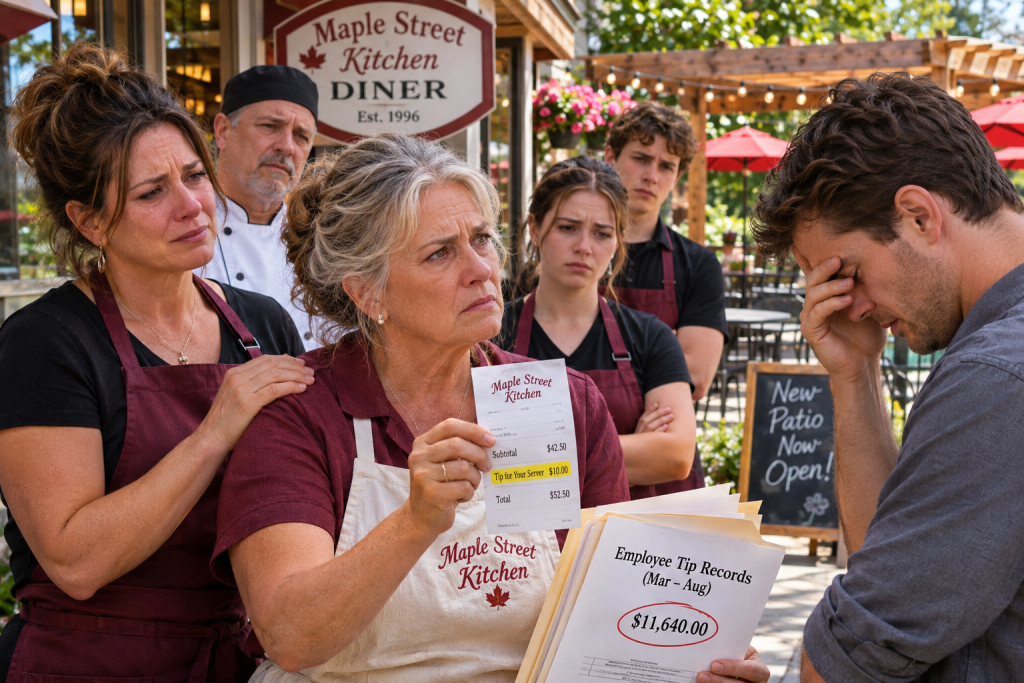
The $11,640 in Julia’s folder wasn’t imaginary.
Those amounts had been collected from customers and improperly treated as restaurant revenue instead of being distributed to the eligible employees.
The records also showed when Owen had changed the payment settings.
March 3.
Three weeks after my shoulder surgery.
I remembered that day.
I’d been sitting at home with an ice pack, watching an old movie and feeling guilty that I couldn’t help in the kitchen.
Owen had called around noon.
He told me sales were improving and that I should stop worrying.
I’d thanked him.
Now I wondered whether he’d been standing in that very office, changing the way our employees were paid.
Mrs. Keller looked exhausted by the time we finished.
“Evelyn, you need to speak with an employment attorney and your payroll provider about correcting these records.”
I nodded.
“I will.”
“And we’ll need to determine what additional payroll or tax corrections are required.”
I looked at the figures.
“How quickly can we pay them?”
She hesitated.
“That depends on the cash available.”
We reviewed the account balance.
The patio had cost far more than I’d realized.
There was a legitimate equipment financing arrangement, just as Owen had claimed.
But he’d also used money from the diner’s operating account.
Including the diverted tips.
He’d ordered an expensive espresso machine, new patio furniture, decorative lighting, and landscaping.
Some invoices had already been paid.
Others were coming due.
Our business wasn’t bankrupt.
But paying everything immediately would put pressure on our cash reserves.
I looked at Mrs. Keller.
“What would Frank have done?”
She smiled sadly.
“Probably the same thing you’re thinking.”
I looked down at the report.
Frank had always told me there were two kinds of bills you never delayed if you could possibly help it.
The money you owed your workers.
And the money you owed the people who supplied your food.
Everything else could wait.
I asked Mrs. Keller to help me prioritize the payments and arrange the necessary corrections.
Then I called the supplier who’d delivered the new espresso machine.
We discussed whether it could be returned or resold.
After that, I canceled two planned patio improvements that hadn’t been installed.
The decorative heaters could wait.
So could the outdoor speakers.
I didn’t need music playing over twelve tables while my employees were missing money from their paychecks.
That evening, Owen came to my house.
He looked tired.
His wife, Paige, had called me earlier to say he was upset.
I hadn’t explained everything to her.
That was his responsibility.
He sat at my kitchen table while I made coffee.
For a while, neither of us spoke.
Then he looked at the photograph of Frank on the refrigerator.
“Dad would have hated that patio, wouldn’t he?”
I turned around.
“Why do you say that?”
“He always said people came for the food, not the decorations.”
I smiled faintly.
“He also said nobody should have to eat meatloaf under a leaking roof.”
Owen laughed once.
Then his expression changed.
“Mom, I wanted to prove I could make this place bigger.”
I sat across from him.
“Why?”
He stared at his hands.
“Because everybody still talks about Dad.”
I felt my chest tighten.
He continued.
“Customers come in and tell me how Frank remembered their birthdays. How he made the best meatloaf. How he knew everybody’s name.”
I nodded.
“People loved your father.”
“I know.”
His voice broke.
“But sometimes I feel like I’m thirty-seven years old and still just Frank’s boy.”
I looked at him for a long moment.
Then I said, “Owen, you didn’t need to compete with your father.”
He wiped his eyes.
“I wanted people to see what I could build.”
I took a breath.
“Then you should have built something honest.”
He looked away.
I continued.
“Your father would’ve been proud if you’d improved the diner. He would’ve been proud if you’d opened a second location someday.”
Owen nodded.
“But he would’ve been heartbroken to learn you’d done it by taking money from the people who helped us keep this place alive.”
My son began crying.
I reached across the table and took his hand.
But I didn’t tell him everything would be okay.
Because I still had six employees waiting for money they’d earned.
And I still had to protect a business that carried both my husband’s name and mine.
The next morning, Mrs. Keller called with the final reconciliation.
We had confirmed the unpaid tips and identified the individual amounts.
The payroll corrections were being prepared.
Then she told me what I’d been afraid to hear.
“Evelyn, even after postponing those purchases, we need more available cash to settle everything promptly and cover the bills due this month.”
I looked toward the framed photograph of Frank beside my kitchen window.
For twenty-eight years, we’d put almost everything we had into that diner.
Now I had to decide how much of my own financial security I was willing to use to make right something my son had done.
And for the first time since Frank died, I wished desperately that he were sitting beside me to help make that decision.