➡️ PART 4 — THE FINAL PART ➡️
Beth came inside with me.
I made tea while she sat at the kitchen table.
For a while, neither of us mentioned the concert.
She asked whether I’d decided what to do with my retirement.
I joked that I’d probably spend the first month sleeping until eight.
She smiled.
Then she reached into her handbag.
Inside was an old folded program.
The paper had yellowed.
Across the top were the words Eighth Grade Winter Concert.
I recognized the school immediately.
Beth opened it carefully.
There was a list of songs.
Names of students.
A little note from the music teacher thanking parents for supporting the program.
And on the back, in blue pen, was a drawing of two seats.
One had DAD written beneath it.
The other said MOM.
I stared at the paper.
Beth smiled sadly.
“I drew that the night before.”
My throat tightened.
“I wanted to know where to look when I came onstage.”
She smoothed the creases.
“Dad always sat near the aisle because of his bad knee. So I marked his seat. And yours.”
I couldn’t speak.
She continued.
“When the curtain opened, I looked straight at the second row.”
Tears filled her eyes.
“Dad was there.”
I nodded.
“But the chair beside him was empty.”
I closed my eyes.
I’d spent twenty-four years remembering how angry Beth had been when I got home.
I hadn’t thought about what she’d felt standing on that stage.
Looking for me.
Finding an empty chair.
“I’m sorry,” I whispered.
She nodded.
“I know.”
I reached for her hand.
“Beth, I should have explained more carefully that night.”
She looked at me.
“I couldn’t tell you another child’s private circumstances. But I could have told you that somebody was in danger and needed help. I could have made sure you understood that missing your concert didn’t mean it wasn’t important.”
Her eyes filled.
I continued.
“And I should have found a way to make it up to you.”
She shook her head.
“Mom, you didn’t know what was going to happen.”
“No. But I knew you were hurt.”
She looked down.
For a moment, neither of us spoke.
Then she said something I wasn’t expecting.
“I stopped singing after eighth grade.”
I stared at her.
“What?”
She nodded.
“I tried out for choir the following year, but I quit after a few weeks.”
I remembered that.
She’d told me she wanted to spend more time playing volleyball.
I’d believed her.
“Why didn’t you tell me?”
She wiped her cheeks.
“Because every time I thought about performing, I remembered looking for you.”
I felt my heart break.
“Beth…”
She shook her head gently.
“I know it sounds silly.”
“No.”
I squeezed her hand.
“It doesn’t.”
She stared at the program.
“For years, I thought you cared more about the children on your bus than you cared about me.”
I looked down.
“I know.”
“But today, when Caleb showed us that lunchbox, I finally understood something.”
I waited.
“You weren’t choosing him instead of me.”
Her voice trembled.
“You were trying to help a frightened little boy and his sister. You couldn’t just drive away.”
I nodded.
She continued.
“I still wish you’d been at my concert.”
I started crying.
“Me too.”
“But I’m not angry about it the way I used to be.”
I reached across the table.
She stood and came around to hug me.
And for the first time, we spoke about that night without one of us becoming defensive.
I didn’t tell her she should’ve understood.
She didn’t tell me I should’ve abandoned a child who needed help.
We simply admitted that something painful had happened.
And we’d both carried it much longer than we needed to.
After a while, Beth pulled away and smiled.
“Well, there’s something else.”
I laughed through my tears.
“Good grief. What now?”
She reached for her phone.
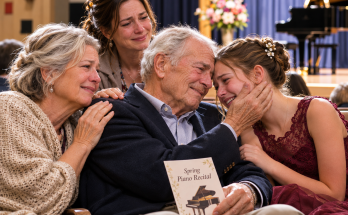
“Remember how my daughter Lily has been taking piano lessons?”
I nodded.
Lily was ten.
A bright little girl who loved animals, strawberry ice cream, and playing songs for anyone who would listen.
“She’s got a recital next month.”
I smiled.
“That’s wonderful.”
Beth looked at me.
“She asked whether Grandma Diane could come.”
I felt my throat tighten.
“Of course I’ll come.”
Beth smiled.
“She says she wants you in the second row.”
I covered my mouth.
The second row.
Twenty-four years later.
Another little girl.
Another concert.
And another chance to show up.
I hugged Beth again.
“I’ll be there.”
She laughed.
“I know, Mom.”
Over the following weeks, Caleb and Mia stayed in touch.
Caleb sent me photographs of his family.
His little boy Sam was fascinated by school buses.
He’d never ridden one yet, but he had a yellow toy bus he carried everywhere.
One afternoon, Caleb called and asked whether I’d like to come for lunch with his family and Aunt Joanne.
I said yes.
We met at a little restaurant outside Dayton.
Aunt Joanne was seventy-three.
She had silver hair, bright blue eyes, and the kind of voice that made you sit up straight even when she was joking.
When she saw me, she stood and took both my hands.
“So you’re Diane.”
I smiled.
“That’s me.”
She looked at Caleb and Mia.
“These two have been talking about you for years.”
I laughed.
“They were a lot smaller when I last saw Caleb.”
Aunt Joanne smiled.
“Well, they grew.”
We sat together for nearly three hours.
Caleb’s son climbed onto his father’s lap and asked for french fries.
Mia told me about her students.
Aunt Joanne told stories about raising two frightened children who didn’t always know whether they were allowed to be happy.
She said the first few months had been difficult.
Caleb used to wake up whenever he heard a car in the driveway.
Mia kept asking whether she had to pack her clothes before bedtime.
“They thought every good thing was temporary,” she said.
I felt my eyes fill.
“What changed?”
Aunt Joanne smiled at her niece and nephew.
“Time. Patience. A lot of ordinary days.”
She looked at me.
“And eventually, they realized nobody was sending them away.”
I nodded.
That was something I understood.
Sometimes love isn’t a dramatic rescue.
Sometimes it’s a packed lunch.
A clean bedroom.
A familiar voice saying good morning.
Somebody who comes home when they say they will.
I thought about Beth.
About all the ordinary mornings I’d driven her to school before I left for my route.
The lunches I’d made.
The homework I’d helped with.
The nights I’d stayed awake when she was sick.
I’d been there for so much of her childhood.
But I’d missed one important moment.
And that moment had mattered.
I was learning that two things could be true.
I’d done the right thing by Caleb.
And I’d hurt my daughter.
Understanding one didn’t erase the other.
After lunch, Aunt Joanne walked me to my car.
She took my hand.
“Can I tell you something?”
“Of course.”
“When Caleb first came to live with me, he was frightened of speaking up.”
I looked at her.
“He thought if he told adults something was wrong, he’d get somebody in trouble.”
My chest tightened.
She continued.
“But after a while, he started telling me when he was scared or needed help.”
She smiled.
“And when I asked what changed, he said, ‘The bus driver listened, even when I thought she wouldn’t.'”
I covered my mouth.
Aunt Joanne squeezed my hand.
“You didn’t fix everything that day. Nobody could’ve.”
I nodded.
“But you helped him understand that asking for help was worth trying.”
I couldn’t speak.
She hugged me.
And for the first time, I stopped wondering whether I’d done enough.
I had done what I could.
Other people had done their part.
And two children had been given a chance to grow up somewhere safe.
Sometimes that was what helping looked like.
Not solving somebody’s entire life.
Just making sure the right people knew they needed help.
A month later, Lily’s piano recital arrived.
Beth picked me up that afternoon.
I wore a navy-blue dress and the little silver necklace Pete gave me on our thirtieth anniversary.
I brought a small bouquet of pink flowers.
When we reached the school auditorium, Beth led me down the aisle.
Second row.
Two seats near the center.
She pointed.
“Right here, Mom.”
I sat down.
She sat beside me.
For a moment, we looked at the empty stage.
Then Beth reached for my hand.
I squeezed hers.
When Lily came out, she spotted us immediately.
Her face lit up.
She waved.
I waved back.
Then she sat at the piano.
Her feet barely reached the pedals.
She looked terribly serious.
I smiled.
She began playing.
It wasn’t perfect.
She missed a note.
Then another.
But she kept going.
And when she finished, I stood and applauded until my hands hurt.
Beth was crying beside me.
I looked at her.
She smiled through her tears.
“I know,” she whispered.
I put my arm around her.
After the recital, Lily ran toward us.
“Grandma! Did you hear me?”
I knelt and hugged her.
“Every single note, sweetheart.”
She grinned.
“Even when I messed up?”
“Especially then.”
She laughed.
Then she took my hand.
“Will you come next time?”
I smiled.
“Wouldn’t miss it.”
That evening, when I got home, I placed Lily’s program on my kitchen table.
Beside it was the letter Mia had written nineteen years earlier.
Two pieces of paper.
Two children.
Two moments separated by twenty-four years.
One reminded me of a little boy brave enough to ask for help.
The other reminded me that the people closest to us sometimes need to know they’re just as important.
I don’t regret stopping that school bus.
Not for a second.
If I could go back, I’d still call dispatch.
I’d still make sure Caleb was safe.
I’d still ask the authorities to check on his sister.
But I’d also go home afterward, sit beside my daughter, and tell her how sorry I was that I’d missed something important.
I’d make sure she knew she hadn’t become less important to me because another child needed help.
I couldn’t change that day.
But I could learn from it.
Last week, Caleb sent me another photograph.
He was standing beside Mia and Aunt Joanne.
His little boy Sam was holding the old green lunchbox.
Underneath the picture, Caleb had written:
My son asked why I keep this old thing. I told him it reminds me that when you’re scared, it’s okay to ask somebody for help. And when somebody asks you, you should listen.
I printed the picture.
Then I placed it beside the photograph of Pete on my mantel.
I thought about the millions of miles I’d driven in that yellow bus.
The winter mornings.
The forgotten backpacks.
The children who waved goodbye.
And the ones who climbed aboard quietly because home wasn’t always an easy place to be.
For thirty-one years, I thought my job was to get children to school and bring them home.
I didn’t know that, for one little boy, the most important thing I ever did was refuse to leave him somewhere he was afraid to go.
I missed my daughter’s eighth-grade concert because a frightened nine-year-old boy needed help. She carried that hurt for twenty-four years, until the boy returned as a grown man and told us what happened. If you were my daughter, would knowing the truth make it easier to forgive—or would missing such an important moment still hurt?