
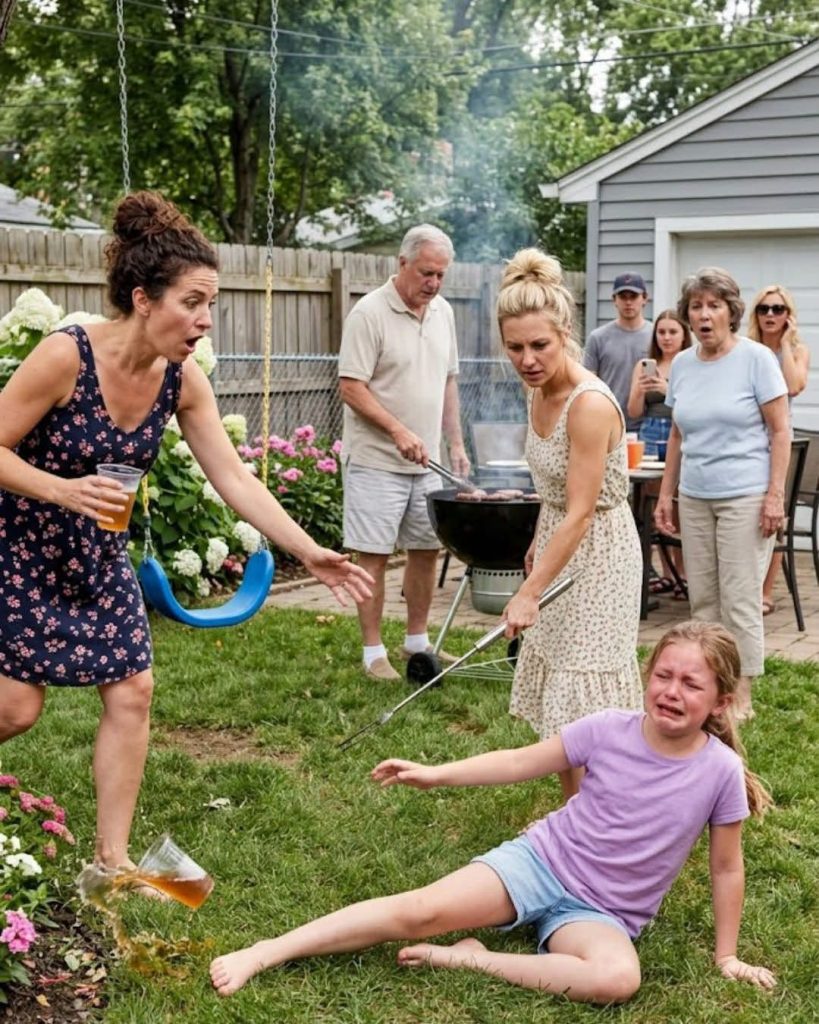
My sister broke my 9-year-old daughter’s leg with a steel roasting skewer at a family barbecue. My parents only said, “She deserved it.” I wanted to file to take away their grandparent rights. They laughed. Months later… It started the way ugly family stories usually do: small enough for everyone to pretend it was nothing.
Smoke rolled across my parents’ backyard, carrying the smell of charcoal, burger grease, and cheap beer. The July heat clung to my skin, and the cicadas behind the chain-link fence were so loud that every laugh around the patio table sounded sharp.
I was standing near the flower beds when I realized I had not heard Lily’s voice in several minutes.
Lily was nine—sunburned across the nose, loud and happy whenever her cousins were around, and still young enough to believe adults only raised their voices when something needed fixing. She had been pushing a younger cousin on the plastic swing beside my mother’s hydrangeas.
Now the swing was moving by itself.
I searched the pool, the driveway, and the grill where my father kept flipping burgers. Then I saw Lily in the strip of shade beside the shed.
My sister Carla stood over her in a pale summer dress, gripping a long steel roasting skewer from the fire pit.
She was too close. Too still. Too pleased with herself.
Then Lily flinched.
Her first sound nearly disappeared beneath the music. Her second cry cut through the entire backyard.
I dropped my beer and ran.
By the time I reached them, Lily was on the grass clutching her right leg. Her freckles stood out against a face that had gone pale, and her leg was bent at an angle that made my stomach turn.
Carla was still holding the skewer.
She did not look frightened or sorry. She looked annoyed.
“What the hell did you do?” I screamed as I dropped beside my daughter.
Carla brushed her hair away from her cheek. “She was being disrespectful. You really need to teach her manners, Naomi.”
“She is nine.”
“She talked back to me,” Carla said, as though that explained everything. “Completely unacceptable.”
Lily’s fingers dug into my wrist. “Mom, it hurts.”
“I know, baby. I know.”
I was terrified to move her. Her skin was hot from the sun, but her fingers were cold.
The backyard finally went still. Forks stopped halfway to mouths. A paper plate sagged in someone’s hand. One of Carla’s friends lowered her phone, but not completely. The red recording dot was still glowing.
My mother hurried across the patio stones wearing the tight expression she always used whenever she thought I was embarrassing her.
“What is going on?”
“Carla hit Lily with that,” I said, pointing toward the skewer. “She can’t move her leg.”
My mother looked at Lily, then at Carla—and softened in the wrong direction.
“Carla, sweetheart, what happened?”
Carla sighed. “She mouthed off. I corrected her. I barely touched her.”
“Barely touched her? Look at her leg!”
My mother released the same disappointed breath I had heard my entire life. “Naomi, please don’t start. You have always been dramatic.”
My father did not even turn away from the grill.
“Kids exaggerate,” he said. “If she was out of line, somebody had to correct her.”
For one terrible second, I imagined ripping the skewer from Carla’s hand and throwing it into the pool. But rage would not stabilize Lily’s leg or bring help any faster.
So I swallowed it.
At 4:17 p.m., I called 911 and told the dispatcher my daughter had been assaulted at a family barbecue.
At 4:19 p.m., I repeated the address because my father kept talking over me.
At 4:22 p.m., I photographed the steel skewer still in Carla’s hand before my mother could make her hide it.
“You are ruining this family,” my mother hissed.
I looked down at Lily curled into herself on the lawn, and something inside me became very quiet.
“No,” I said. “You already did.”
By 4:31 p.m., the sirens were close enough for everyone to hear. Carla’s smug expression tightened for the first time that afternoon. My father stepped toward the side gate as though he could stop what was coming.
Then my mother leaned close to my ear.
“If you file anything against us, Naomi, you will regret it,” she whispered. “Grandparents have rights too.”
That was when I understood this would not end at the hospital.
The ambulance lights washed red across the fence. The small American flag in my mother’s porch planter snapped once in the hot wind.
The paramedics opened the gate—and before they could reach Lily, my father planted himself directly in their path..
PART 2
My father held one greasy hand against the gate and told the paramedics there had been a misunderstanding.
Behind him, Lily cried out again.
The lead paramedic did not argue. He looked past my father, saw my daughter’s leg, and ordered him to move. When Dad hesitated, two neighbors who had come outside because of the sirens stopped beside the fence and watched.
That was enough. My father stepped aside.
The paramedics knelt beside Lily while I answered their questions. Her name. Her age. Where she hurt. Whether she had hit her head. Whether anyone had moved her since the injury.
Carla interrupted twice to insist she had only been disciplining Lily.
Then the friend with the phone finally spoke.
“That isn’t what happened,” she said.
Carla turned toward her so fast the steel skewer scraped against a lawn chair.
The woman’s hand was shaking, but she kept the phone raised. The recording had never stopped. It showed Carla following Lily behind the shed, the argument beginning, and the moment Lily screamed.
My mother told her to delete it because it was a private family matter.
The woman looked at Lily on the ground and shook her head.
“Not anymore.”
One paramedic asked me whether I wanted law enforcement notified. My parents stared at me as though the correct answer had already been decided years ago.
I looked at Carla’s skewer, my mother’s furious face, and my father standing beside the grill as if protecting his hamburger mattered more than protecting his granddaughter.
Then I gave the paramedic my answer.
Before the ambulance doors closed, Carla’s friend reached through them and placed her phone in my hand.
On the screen was a second clip I had not known she recorded—one that began several minutes before Lily was hurt.
As the ambulance crew prepared to close the doors, Carla’s friend leaned in and pressed her phone into my palm. A video was already cued up—not the clip of Lily screaming, but footage from several minutes earlier.
I looked at the screen, then at the woman standing outside the ambulance.
“Watch it,” she said.
Her voice shook.
The doors closed before I could answer.
Lily was strapped securely beside me, her face pale and damp, one hand locked around two of my fingers while a paramedic checked her again.
I wanted to put the phone away.
I wanted to spend the ride telling my daughter that everything would be okay, even though I did not yet know what “okay” was going to look like.
But Carla’s friend had not handed me that phone for comfort.
She had handed it to me because she was scared someone would make the truth disappear.
So I pressed play.
The video started with nothing dramatic.
A lawn chair filled half the frame. Someone laughed near the grill. My father’s spatula scraped against metal, and Lily’s younger cousin ran past carrying a plastic cup.
Then Carla entered the shot.
She was holding the steel roasting skewer before she ever walked behind the shed.
That mattered.
In the backyard, she had told everyone she had picked it up because Lily was being disrespectful and that she had barely touched her.
The recording showed something different.
Carla had already taken the skewer from beside the fire pit while Lily was still pushing her cousin on the swing.
She stood there for a few seconds watching Lily.
Then my mother walked into the edge of the frame.
Their voices were faint, but clear enough.
Carla complained that Lily had ignored her when she told the kids to stay away from the flower beds.
My mother answered, “Then make her listen.”
Carla asked, “And when Naomi throws a fit?”
My mother glanced toward the other side of the yard.
“She always throws a fit.”
The video shifted as the woman recording moved her hand.
Then my father’s voice came from somewhere near the grill.
“Just don’t turn it into a whole production.”
I stopped the clip.
My fingers had gone numb around the phone.
The paramedic across from me noticed my face and asked whether I felt faint.
“No.”
I looked at Lily.
She had her eyes closed, but she was awake.
Her little thumb moved against my knuckle.
I pressed play again.
The next part showed Carla crossing the yard after Lily.
Lily stepped into the strip of shade beside the shed.
Carla followed.
The camera did not catch every word, but it caught enough.
Carla told Lily to apologize.
Lily said she had not done anything.
Carla told her not to talk back.
Lily tried to walk around her.
Carla moved in front of her.
Then Lily said something I would remember long after the fracture healed.
“I want my mom.”
Carla answered, “Your mom isn’t the boss of everyone.”
The camera jerked sideways.
A second later came Lily’s scream.
I shut the video off.
That was the moment the story my family had spent years telling about me finally broke apart in my own head.
I had always been “dramatic.”
I was “too sensitive.”
I “made things bigger than they were.”
Those labels had followed me from childhood into adulthood so quietly that I had started checking my own reactions before I checked anyone else’s behavior.
Was I overreacting?
Was I being unfair?
Was I making trouble?
My nine-year-old daughter was riding beside me with a badly injured leg because adults in my family had counted on me asking those questions.
I stopped asking them.
At the hospital, everything became fluorescent light, paperwork, clipped voices, and waiting.
A staff member cut away part of Lily’s clothing so her leg could be examined without unnecessary movement.
Imaging confirmed the fracture.
Hearing the medical language did something the backyard shouting had not.
It made the injury feel permanent enough to write down.
Lily cried when they repositioned her.
I held her hand.
She apologized to me.
“Mom, I’m sorry.”
I bent close because I thought I had misheard her.
“For what?”
“For making everybody mad.”
That sentence hurt differently.
“No,” I said. “You did not cause this.”
She looked at me carefully, as if she needed to know whether I really meant it.
“I talked back.”
“You are allowed to disagree with an adult.”
She swallowed.
“Even Aunt Carla?”
“Even Aunt Carla.”
She asked if Grandma was mad at her.
She asked if Grandpa was mad at her.
She asked if the barbecue was ruined because of her.
I answered each question the same way: what happened was the responsibility of the adults who chose it, not the child who got hurt.
Later, while Lily rested, I watched both videos again with the sound turned low.
I saved the original file exactly as it had been recorded.
I saved a second copy so it could not vanish with one broken phone.
I saved every message my parents sent me that evening without replying to any of them.
Then I stopped trying to convince my family to see what was directly in front of them.
My mother’s first message said Carla had “lost her temper for a second.”
Her next message blamed Lily.
Her third blamed me.
By midnight, the story had already changed four times.
Carla had barely touched Lily.
Then Lily had stumbled.
Then Carla had only tried to stop her from running.
Then I had supposedly frightened everyone by calling 911 instead of handling things privately.
My father sent one message.
You should have kept family business in the family.
I stared at that sentence for a long time.
Then I placed the phone face down and went back to Lily’s bedside.
An officer came to speak with me after the hospital documented Lily’s condition.
I gave a plain account.
No speeches.
No family history from twenty years ago.
I described where I had been standing, where I found Lily, what Carla held, what my parents said, when I called for help, and what happened at the gate.
Then I showed the recordings.
The officer watched the shorter clip first.
Then the earlier one.
He watched part of it twice.
When he finished, he asked whether the woman who recorded it would be willing to give her own account.
“She already said she would,” I told him.
For the first time since the sirens entered my parents’ street, I understood why Carla’s friend had kept filming even after my mother ordered her to delete it.
She had seen the same thing I had spent years being trained not to trust: the difference between an explanation and what actually happened.
By morning, I had one priority.
Lily would not be alone with any of them again.
Not Carla.
Not my mother.
Not my father.
When my mother called, I let it ring.
When she called again, I let it ring again.
On the fifth call, I answered because I needed to know whether she was contacting me about something practical involving Lily.
She was not.
“You have made this into a nightmare,” she said.
I looked at my daughter sleeping beneath a thin hospital blanket.
“No.”
“Carla made a mistake.”
“She broke Lily’s leg.”
“She did not mean to.”
“You were there.”
My mother went quiet for half a second.
Then she used the sentence that finally ended any temptation I had to soften the boundary.
“She deserved to be corrected.”
I asked her to repeat it.
She did.
“She deserved it.”
I did not argue.
I ended the call.
Family titles are not permission slips.
For most of my life, my parents had treated forgiveness like a tax collected by whoever caused the least public embarrassment.
Someone could humiliate you, frighten you, insult you, or hurt you, and the real emergency began only when you refused to smile afterward.
I had participated in that system longer than I wanted to admit.
Lily would not.
The first weeks after the barbecue were painfully ordinary.
That surprised me.
There was no dramatic music accompanying the hard parts.
There were medication schedules, follow-up visits, pillows arranged under Lily’s leg, cups of water left within reach, missed summer plans, and careful trips from the couch to the bathroom.
There was a backpack I packed even though school was still weeks away because Lily wanted to know whether she would be able to carry it when classes started.
There was a night when she woke up crying because she dreamed Carla was standing beside her bed holding the skewer.
There was a morning when she asked whether I would be mad if she never wanted to see Grandma again.
“I won’t be mad.”
“Even on Christmas?”
“Even then.”
That answer seemed to give her more relief than anything else I had said.
Meanwhile, my parents moved from anger to bargaining.
My father offered to pay some of Lily’s expenses if I agreed to “stop escalating things.”
I declined.
My mother mailed a card addressed directly to Lily.
I opened it before giving it to her because, after what had happened, unsupervised contact was over.
The card did not say, I’m sorry I failed to protect you.
It said, Families make mistakes.
Inside was a longer handwritten note telling Lily that adults sometimes had to make “hard choices” when children were disrespectful.
I photographed it.
Then I put it in the same folder as the messages and the copies of the videos.
I did not give it to Lily.
A few days later, my father left a voicemail saying I could not simply erase grandparents from a child’s life.
My mother followed with another threat about grandparents having rights.
This time, I did not panic.
I got advice.
I was careful not to assume that a family title automatically meant anything legally, one way or the other, and I learned that any dispute over contact would turn on facts, circumstances, and whatever rules applied where we lived.
So I focused on facts.
The injury.
The recordings.
The threat at the barbecue.
My father blocking emergency responders.
My mother’s messages.
The card to Lily.
The fact that neither grandparent had once asked Lily what she needed before demanding access to her.
When I told my parents I was prepared to formally oppose any attempt to force contact, they laughed.
Not metaphorically.
They actually laughed during the call.
My father said I was wasting money.
My mother said no judge would keep loving grandparents away from their granddaughter because of “one misunderstanding.”
I almost corrected her.
Then I remembered the videos.
“Okay,” I said.
That bothered her more than an argument would have.
Months passed.
Lily’s leg healed slowly.
At first she hated the sight of the backyard whenever we drove past a house with a grill going.
Then she hated herself for hating it.
So we stopped forcing normal.
If she wanted to leave somewhere, we left.
If she wanted to talk, I listened.
If she did not, I packed her lunch, checked her school things, and let routine do some of the work words could not.
Her body improved before her trust did.
That made sense.
A bone can heal without deciding whether the people who hurt you are sorry.
The family pressure did not disappear.
Relatives called me privately and said my parents were devastated.
One aunt asked whether keeping Lily away was “too permanent.”
A cousin suggested I should allow supervised visits so everyone could move forward.
I asked each person one question.
“Did they tell you my father tried to block the paramedics?”
Usually, the answer was no.
Then I asked another.
“Did they tell you there is video?”
Again, usually no.
The version circulating through the family had turned my parents into helpless grandparents punished for Carla’s behavior.
It left out the gate.
It left out my mother defending Carla.
It left out my father saying someone had to correct Lily.
It left out the threat whispered into my ear while my daughter lay injured on the lawn.
Most of all, it left out the second recording.
Eventually, the dispute over contact became formal enough that the evidence mattered more than the family group chat.
My parents arrived convinced the argument would be about whether I was angry with them.
I was not interested in proving anger.
I was interested in proving chronology.
What happened first.
What each person knew.
What they did when Lily cried.
What they did when help arrived.
What they said afterward.
My mother described the barbecue as chaotic.
My father described Carla’s action as sudden.
Both said they had been focused on getting Lily help.
Then the recordings were reviewed.
The first clip showed Carla standing over Lily holding the skewer.
It showed Lily’s condition.
It showed the adults’ reactions.
It captured enough of the immediate aftermath to make “misunderstanding” a difficult word to defend.
But the earlier clip changed the center of the argument.
My parents had spent months framing themselves as shocked bystanders who reacted badly under stress.
The earlier recording showed my mother talking with Carla before the injury.
It showed my father within earshot.
It showed Carla already holding the skewer before she followed Lily behind the shed.
Most damaging of all, it preserved the casual tone.
There had been no emergency yet.
No chaos.
No screaming.
They had time to make different choices.
They did not.
My mother tried to explain that “make her listen” was ordinary family language.
Maybe it was.
That was not the point.
The point was that her later claim—that she knew nothing until Lily screamed—did not fit what had been recorded.
My father tried to minimize his comment about not making a production out of it.
Again, the recording did not need him to confess to anything dramatic.
It only needed to show that the family’s polished version was unreliable.
Then my mother made the mistake I think she had been making my entire life.
She assumed confidence could substitute for credibility.
She said Lily had always been difficult when she was overtired.
I felt my hands tighten under the table.
But I stayed quiet.
She said I encouraged disrespect.
I stayed quiet.
She said children needed consequences.
Still quiet.
Then she said, “None of this would have happened if Naomi taught Lily not to challenge adults.”
There it was.
Not remorse.
Not confusion.
The same belief from the backyard, months later, after the hospital, after the fracture, after every opportunity to reconsider.
The issue was no longer whether my mother had chosen terrible words in a moment of panic.
She still believed Lily’s behavior was the real cause of what happened to Lily.
My father reached toward her as though he wanted her to stop talking.
For once, she did not take the hint.
She added, “We love our granddaughter.”
I believed that she believed that.
But love that requires a child to accept blame for an adult hurting her is not safe just because someone calls it love.
When I was finally asked what outcome I wanted, I did not ask for revenge.
I did not ask anyone to humiliate my parents.
I asked for Lily to be protected from contact she did not want and from adults who still would not acknowledge why she needed protection.
That distinction mattered to me.
I was not trying to win my childhood retroactively.
I was parenting the child in front of me.
My parents did not get the forced access they had expected.
There was no movie-style celebration afterward.
No applause.
No dramatic speech in the hallway.
I sat in my car for several minutes before turning the key because my hands were trembling too badly to drive.
Then I called the person watching Lily.
“How is she?”
“Doing homework.”
I laughed once, unexpectedly.
Homework.
After months of recordings, arguments, medical appointments, threats, and paperwork, my daughter was sitting at a table complaining about math.
It sounded wonderful.
Carla’s situation remained separate from my parents’ fight over access, and I stopped using her consequences as a measure of whether Lily was healing.
That was important.
Lily did not need an adult relative to suffer a certain amount before she was allowed to feel safe.
She needed control returned to her life in ordinary pieces.
Which chair she wanted at the table.
Whether she wanted the bedroom door open at night.
Whether she wanted to attend a family gathering.
Whether she wanted to answer a card.
Whether she wanted to talk about the barbecue at all.
One afternoon, months after she no longer needed help getting around, Lily found the folder where I kept copies of the relevant records.
She did not open it.
She only asked what it was.
“Things I needed to keep,” I said.
“Because of Aunt Carla?”
“And because I wanted adults to tell the truth about what happened.”
She thought about that.
Then she asked, “Do I have to watch the video?”
“No.”
“Ever?”
“No.”
She nodded and pushed the folder back toward me.
That was the moment I understood what the phone in the ambulance had become.
For months, it had felt like a weapon against a lie.
For Lily, it did not have to become anything at all.
She did not owe the evidence her attention simply because the evidence protected her.
I put the folder away.
The following weekend, Lily asked if we could eat outside.
Nothing fancy.
Burgers, chips, cut fruit, and lemonade on our own small patio.
I hesitated when I carried the tray toward the door.
She noticed.
“Mom?”
“I’m good.”
She studied me with the same expression she had used in the hospital when she was deciding whether she could trust my answer.
Then she opened the door herself.
Outside, the evening was warm.
A lawn mower buzzed somewhere down the block, and someone nearby was grilling.
Lily sat down, reached for a chip, and started telling me a story about a girl in her class who had accidentally submitted the wrong homework page.
Halfway through, she laughed so hard she had to put her lemonade down.
I did not tell her how much that sound meant to me.
I just listened.
My parents had once warned me that keeping them away would destroy our family.
What actually happened was quieter.
The part of the family that depended on Lily accepting fear as respect stopped having access to her.
The rest became smaller, more ordinary, and safer.
And the phone that once arrived in my hand carrying the proof of the worst afternoon of Lily’s childhood eventually went back to being what a phone should be: something that rang, something that took pictures, something that did not decide who belonged in my daughter’s life.
Lily got to decide that part for herself.
THE END STORIES! THANK YOU FOR READING GOOD LUCK !❤️
Related Posts


