On the first night in the beach house I bought on my own, my mother said, “Your sister has a real family—you don’t,” and sent a moving truck to empty my rooms. I calmly told her ten o’clock was perfect,

because the county worker reviewing two children’s placement was already scheduled to be standing in my living room when they arrived.
“Pack the master bedroom,” my mother said.
Joyce Williams spoke as casually as if she were reminding me to take the trash outside.
“Kristen has a real family, Vicky. You don’t.”
Then my father took the phone.
“Four bedrooms for one childless woman is ridiculous,” Dennis said. “Your sister needs the space.”
Thirty seconds later, Kristen texted me.
Truck at ten. Don’t make this awkward. Just clear out.
I stood in the kitchen of my new home in Emerald Isle, North Carolina, staring at those words while the Atlantic rolled beyond the dunes.
Down the hallway were two freshly painted bedrooms.
One had a star-shaped lamp.
The other had a window seat overlooking the water.
Two wooden name signs waited on a shelf.
Lily.
Owen.
My family knew absolutely nothing about those children.
They assumed I had bought the four-bedroom house for myself using eleven years of nursing income and savings.
They also apparently believed anything owned by an unmarried woman could simply be handed over to someone with a “real family.”
Kristen was thirty-six, married to Todd, and had two children.
Her problems had always become family emergencies.
When her car was nearly repossessed, I sent $9,000.
At Christmas, Mom told everyone that she and Dad had rescued Kristen.
My money became their generosity.
When my parents needed somewhere to stay, I let them use my condo for four months.
They rearranged everything and even gave Kristen a duplicate key.
When I asked for it back, Mom said, “We’re family. Why are you acting strange?”
In our family, boundaries were treated like personal insults.
That was why I changed the beach-house locks before moving in.
Kristen had already visited once while I was away.
My neighbor saw her peering through the windows and measuring the yard.
When I confronted her, she said, “I was checking what we’re working with.”
We.
She had never asked whether she could move in.
They had simply decided that four bedrooms should belong to the daughter who already had children.
What they didn’t know was that those bedrooms weren’t for me.
Months earlier, my twenty-eight-year-old cousin Amanda had died in an accident, leaving behind eight-year-old Lily and five-year-old Owen.
Amanda herself had grown up in foster care after my aunt Carol died.
When Amanda was fifteen, I tried to take her in.
My mother interfered.
Joyce told the county I was grieving, unstable, and unfit to raise her while promising that the family would take care of Amanda instead.
They never did.
Amanda remained in the system until she aged out.
After her death, Lily and Owen entered foster care too.
Nobody in my immediate family even bothered to ask their names.
I discovered Owen by chance when he came into my pediatric unit with an asthma flare.
Once I recognized his name, I disclosed our relationship and stepped away from his care.
By the following morning, I had contacted the county.
“I’m a relative. I want to be considered for both children.”
The process took months.
Background checks.
Supervised visits.
Financial reviews.
Interviews.
Home inspections.
I welcomed every part of it.
I also gave caseworker Diane Prescott the statement my mother had signed fourteen years earlier.
If Joyce tried interfering again, I wanted the truth already documented.
The final home visit was scheduled for ten o’clock the morning after I moved in.
Then Kristen announced her moving truck would arrive at exactly the same time.
I replied:
Ten is perfect.
That night, I opened an old letter from my grandmother Ruth, who died in 2019.
One sentence had been underlined.
I read it three times before placing the letter beside my mother’s old statement.
Then I walked down the hallway and hung the wooden signs.
Lily on the left.
Owen on the right.
At 9:45 the next morning, Diane arrived carrying her county folder.
She checked the smoke alarms.
Water temperature.
Locked cleaning supplies.
When she reached the bedrooms, she stopped beneath the children’s names.
At 9:55, a white moving truck pulled into my driveway.
Dad’s sedan followed.
“They’re here,” I told Diane.
She quietly stood beside the bookshelf and opened her folder.
Mom walked inside without knocking.
Dad followed.
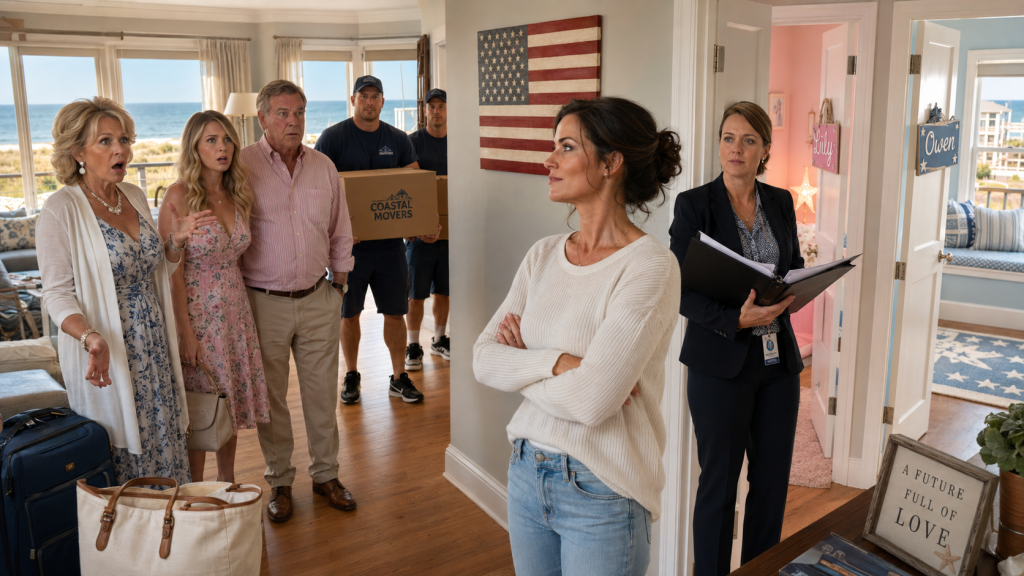
Kristen entered staring at her phone while Todd and two movers carried boxes behind them.
Mom pointed down the hallway.
“The big bedroom first. Everything goes into the garage. Kristen’s family is moving in this weekend.”
One mover looked at me.
“Ma’am?”
Before I could answer, Kristen headed toward the children’s rooms.
She stopped outside Owen’s door.
“What is this?”
She reached toward the drawing taped underneath his name.
“Whatever it is, it goes,” she called. “Put it in the garage.”
I crossed the room.
Her fingers caught the corner of Owen’s picture.
“Take your hand off my child’s door,” I said.
Kristen froze.
Mom slowly turned toward me.
“Your WHAT?”
That was when Diane stepped out from beside the bookshelf.
She closed the county folder in her hands and calmly introduced herself.
The color disappeared from my mother’s face.
Because Diane already knew Joyce’s name.
And the first document she pulled from that folder was the statement my mother had signed fourteen years earlier—the one that had helped keep Amanda in foster care.
But that wasn’t the paper that finally silenced my family.
I reached for Grandma Ruth’s old letter.
And when Dad saw the sentence underlined across the bottom, he sat down without saying a word.
PART 2
My father lowered himself onto the living room sofa so suddenly that the cushions sighed beneath him. He hadn’t even read the entire letter yet. He had only recognized the handwriting. “That’s Mom’s…” he whispered. The room, moments earlier filled with the scraping of moving boxes and Kristen’s impatient instructions, became unnaturally quiet. Even the two movers stopped in the hallway. Diane didn’t interrupt. She simply watched, county folder held against her chest, allowing the family to reveal itself without saying another word. I unfolded the yellowed paper carefully. The edges were soft from being opened so many times over the years. “I think everyone should hear this,” I said. My mother’s jaw tightened.
PART 3
“Vicky, this is ridiculous. We’re discussing the house.”
“No,” Diane replied calmly. “We’re discussing whether this home is a safe environment for two children. Everything happening right now is relevant.”
Mom looked at the woman as though she’d forgotten she existed.
I began reading.
Kristen rolled her eyes.
“Oh my God.”
But Dad didn’t move.
I continued.
My mother’s face drained of color.
“That’s not true.”
I didn’t stop reading.
Diane quietly opened her folder.
“I have the matching county affidavit,” she said.
She placed two papers side by side on the dining table.
One was Grandma’s handwritten letter.
The other was my mother’s signed statement from fourteen years ago.
Same names.
Same date.
Completely opposite stories.
The movers exchanged awkward glances.
Todd suddenly found the floor fascinating.
Kristen crossed her arms.
“So what? That was years ago.”
Diane looked directly at her.
“It became relevant yesterday when your mother entered my office insisting your sister wasn’t emotionally capable of adopting children.”
I blinked.
“You what?”
Mom inhaled sharply.
“I was protecting those kids.”
“No,” Diane answered. “You attempted to influence an active placement investigation.”
My father finally looked up.
“Joyce… you went to the county?”
She didn’t answer.
Diane continued.
“She requested that Ms. Williams be removed from consideration because she’s unmarried and, quote, obsessed with replacing lost family.”
Every word felt like cold water.
Mom had done it again.
Fourteen years later.
The exact same lie.
Only this time, she hadn’t realized the county already possessed her previous statement.
Dad buried his face in his hands.
“Oh my God…”
The silence broke when little Emma, Kristen’s ten-year-old daughter, wandered through the front door.
“Nana?”
She stopped when she saw everyone standing frozen.
Behind her came Jacob, seven years old, holding a plastic shovel from the beach.
“Mom,” he whispered, “why are those men taking Aunt Vicky’s stuff?”
Nobody answered.
Emma noticed the two bedroom doors.
“Who are Lily and Owen?”
Kristen spoke too quickly.
“Nobody. They’re changing the names.”
I knelt beside Emma.
“They’re your cousins.”
She frowned.
“I have cousins?”
“Yes.”
“Where do they live?”
I looked at Diane before answering.
“Right now, they’re waiting for a family.”
Emma thought about that with the brutal honesty children possess.
“Then why are we taking their rooms?”
Kristen’s cheeks turned crimson.
“Emma, that’s enough.”
But the girl wasn’t finished.
“If they don’t have a family… shouldn’t they stay here?”
No adult in the room had a better question.
The movers quietly set their boxes down.
One cleared his throat.
“Ma’am,” he said to Kristen, “our work order says we’re moving into this address.”
He looked uncomfortable.
“We’re not getting involved in… whatever this is.”
Todd finally spoke.
“Maybe we should leave.”
Kristen spun toward him.
“Excuse me?”
He rubbed the back of his neck.
“You told me Vicky agreed.”
“She was going to.”
“No,” I said.
“I never did.”
He stared at his wife for several long seconds.
“You said it was already settled.”
Kristen didn’t answer.
For the first time in their marriage, I watched Todd realize that the story he’d been told wasn’t true.
Diane asked if she could continue the inspection.
“Yes,” I said.
She walked into the kitchen while my family remained standing awkwardly in the living room.
She tested cabinet locks and emergency supplies as though chaos weren’t unfolding twenty feet away.
That professionalism somehow made everything feel even more real.
After several minutes, she returned with a small smile.
“The home exceeds every safety requirement.”
My heart pounded.
“This isn’t the final approval,” she reminded me. “But I will be recommending placement.”
Tears burned behind my eyes.
Mom stepped forward.
“You can’t give children to someone who tears families apart.”
Diane answered without emotion.
“Ms. Williams, attempting to evict a homeowner from her own house during an adoption review is one of the most concerning displays of family instability I’ve witnessed.”
Dad closed his eyes.
“Joyce… stop.”
She looked at him in disbelief.
“You’re taking her side?”
He stood slowly.
“No.”
His voice cracked.
“I’m finally refusing to take yours.”
He walked to the children’s hallway.
His fingers brushed the little wooden sign that read Owen.
“I remember Amanda making birdhouses with Mom,” he said quietly.
“She couldn’t have been older than eleven.”
I had never heard him voluntarily say Amanda’s name.
“I should’ve helped her,” he whispered.
“You should have,” I replied.
He nodded.
“I know.”
It wasn’t forgiveness.
It was simply the first honest sentence he’d spoken in years.
Kristen grabbed her purse angrily.
“This is unbelievable.”
She marched toward the front door.
As she passed Emma, the little girl asked, “Are we still moving here?”
Kristen stopped.
For a split second, she looked almost embarrassed.
Then she walked outside without answering.
Todd sighed deeply before following her.
The movers apologized to me individually.
One even said, “Good luck with the kids.”
Then they climbed back into the truck.
By 10:42, the driveway was empty except for my father’s sedan.
Mom stood alone in the foyer.
She looked smaller somehow.
Not weaker.
Just… exposed.
Before leaving, she turned toward me.
“You’re choosing strangers over your sister.”
I shook my head.
“No.”
I looked down the hallway toward the two bedrooms.
“I’m choosing the children our family already abandoned once.”
She had no reply.
She walked out, closing the door behind her.
For the first time since buying the beach house, the house felt truly mine.
Diane gathered her folder.
“I’ll call you tomorrow,” she said gently.
“One more thing.”
She smiled toward the empty bedrooms.
“I think Lily is going to love that window seat.”
After she left, I stood alone in the hallway.
Sunlight poured across the floorboards.
Two empty bedrooms waited.
Not empty for long.
PART 4
I sat down on the hallway floor between the two bedrooms, staring at the wooden signs I had hung with trembling hands only two days earlier.
“The placement committee approved your recommendation,” Diane said. “If everything goes smoothly today, Lily and Owen can come home this afternoon.”
Home.
Not foster home.
Not temporary placement.
Home.
I covered my mouth as tears spilled down my face.
For a long moment, neither of us spoke.
Then Diane laughed softly.
“I had a feeling you’d cry.”
“I’ve been waiting fourteen years to hear that sentence,” I whispered.
By noon, the house looked completely different.
I baked chocolate chip cookies because Amanda once told me they made every place smell safe.
I filled the refrigerator with strawberry yogurt, apple slices, and dinosaur-shaped chicken nuggets after memorizing Owen’s favorite foods from the foster parent’s notes.
Lily’s bookshelf held chapter books, colored pencils, and a small journal with a blue cover.
Inside the first page I wrote only one sentence:
No one in our family had ever given children privacy.
I wanted these two to know it existed.
At 2:58, I saw Diane’s county SUV pull into the driveway.
Behind it came another vehicle belonging to the foster parents who had cared for the children during the past five months.
My heartbeat became almost painful.
The front door opened.
Owen stepped inside first, clutching an inhaler and a stuffed dinosaur missing one eye.
He looked exactly like Amanda around the eyes.
Lily followed quietly with a backpack almost as large as she was.
She didn’t smile.
She simply observed everything.
Children who have been moved too many times learn to inspect a house before believing it.
“Hi,” I said gently.
“I’m Vicky.”
Owen nodded.
“You’re the nurse.”
I smiled.
“I was.”
He looked around.
“Do we have to leave again?”
The question shattered me.
I knelt so we were eye level.
“I can’t promise life will always be perfect.”
His little shoulders dropped.
“But I can promise nobody is secretly packing your room.”
He walked straight into my arms.
Lily didn’t hug me.
Instead, she wandered slowly down the hallway.
She stopped in front of the bedroom with her name.
Her fingers traced the wooden letters.
“You made this?”
“I did.”
She opened the door.
The ocean glittered outside the window.
For nearly a minute she said nothing.
Then she asked, almost suspiciously, “Can I put my things in the closet?”
“Yes.”
“All of them?”
“Yes.”
“And nobody else gets this room?”
“No one.”
She nodded once.
Only then did she quietly whisper, “Okay.”
That single word felt larger than any celebration.
The first week wasn’t magical.
Owen woke screaming from nightmares three nights in a row.
Lily hid granola bars under her mattress because she had learned food sometimes disappeared.
When I found them, I didn’t throw them away.
I bought a small basket.
“This is your snack basket,” I told her. “Nobody will touch it.”
She stared at me before asking, “Even if I’m bad?”
“There isn’t a rule in this house that says food disappears because someone makes a mistake.”
She cried so hard she couldn’t answer.
Healing, I learned, sounded a lot like crying.
Two weeks later, school started.
The secretary introduced me as their guardian.
Owen proudly corrected her.
“She’s our aunt.”
Technically, cousin once removed.
Emotionally, aunt fit perfectly.
Lily joined the reading club.
Owen discovered he loved collecting seashells more than cartoons.
Every evening we walked the beach together carrying little buckets.
He insisted every unusual shell belonged to Amanda because, according to him, “Mom probably sends them.”
I never argued with hope.
Meanwhile, my family unraveled.
Todd moved into a rental with the children after discovering Kristen had hidden nearly $40,000 of debt.
The “emergency move” had never been about needing bedrooms.
Their own home was entering foreclosure.
My parents had known.
Instead of helping responsibly, they had decided my house was the solution.
Dad called three times before I answered.
When I finally did, he didn’t ask about the beach house.
He asked about Lily.
“She likes drawing,” I told him.
He chuckled softly.
“So did Amanda.”
It was the first conversation we’d ever had that wasn’t about Kristen.
Mom never called.
Not once.
October arrived with cooler mornings and quieter beaches.
One Saturday, Lily asked if we could visit the cemetery.
She carried two sunflowers.
Amanda’s grave overlooked a line of pine trees.
Owen placed three tiny shells beside the headstone.
“We found these,” he announced proudly.
Lily knelt silently.
After several minutes she looked at me.
“Did Mom know you wanted us?”
I swallowed hard.
“Yes.”
“How?”
I reached into my purse.
Inside was Amanda’s final birthday card to me from three years earlier.
I had carried it ever since she died.
I handed it to Lily.
Amanda’s handwriting danced across the page.
Lily read it twice.
Then she folded the card carefully and hugged me with both arms.
It was her first hug.
Christmas came exactly one year after the phone call that had nearly stolen everything.
The beach house glowed with white lights.
Owen insisted the tree needed twelve candy canes because “even numbers are lucky.”
Lily baked cookies while pretending not to notice flour on her nose.
There was a knock at the door.
Dad stood outside holding a small wooden box.
“I made something,” he said nervously.
Inside were two hand-carved ornaments.
A star with Lily engraved across it.
A tiny lighthouse reading Owen.
“I don’t expect forgiveness,” he said quietly.
“I just hoped… maybe they’d have these.”
I looked back toward the kitchen where two children were laughing.
Then I stepped aside.
“You can come in for cocoa.”
It wasn’t reconciliation.
It was a beginning.
Later that night, after everyone had gone home, Owen fell asleep against my shoulder while Lily read beside the fireplace.
I unfolded Grandma Ruth’s letter one last time.
The underlined sentence at the bottom still made my eyes sting.
I looked around the beach house.
Four bedrooms.
Every one of them exactly where it belonged.
PART 5
Six months later, the courthouse looked nothing like the hospitals where I had spent most of my adult life.
It smelled of polished wood and old paper instead of antiseptic.
Lily wore a pale yellow dress she had picked herself. Owen insisted on wearing a tiny navy tie because, in his words, “Important days need ties.”
Diane met us outside the courtroom with the same warm smile she had carried into my beach house on that unforgettable morning.
“Well,” she said, looking at the children, “are you ready?”
Owen grabbed my hand.
Lily answered first.
“We already are.”
The judge’s final question
The hearing lasted less than thirty minutes.
Background reports.
Financial stability.
School records.
Every document that had taken months to collect sat neatly inside one thick file.
Then the judge closed it.
He looked over his glasses at Lily.
“Do you know why everyone is here today?”
She nodded.
“So nobody can send us away anymore.”
The courtroom became completely silent.
The judge smiled gently before turning to Owen.
“And what would you like to call Victoria after today?”
Owen looked at me, thinking very seriously.
“I know she’s really my cousin,” he said, “but… can I keep calling her Aunt Vicky?”
I laughed through tears.
“I hope you do forever.”
The judge signed the final order.
With one stroke of his pen, Lily and Owen officially became my children.
Not by birth.
By law.
By love.
By choice.
An unexpected visitor
As we walked out of the courthouse, someone stood near the front steps.
My mother.
She looked older than I remembered.
Her hair had more gray, and the confidence she had always worn like jewelry seemed to have disappeared.
She held a wrapped box.
“I’m not here to fight,” she said quietly.
Dad stood several feet behind her, saying nothing.
I looked at Lily and Owen.
“It’s your choice,” I told them. “You can go to the car with Diane, or you can stay.”
Lily surprised me.
“I want to stay.”
Owen squeezed my hand but nodded.
Mom slowly approached.
“I know I can’t undo what I did,” she whispered. “Not to Amanda. Not to you.”
She handed the box to Lily.
“You don’t have to open it now.”
Lily accepted it politely.
Mom turned toward me.
“I spent years believing family was something you earned by getting married and having children. I was wrong.”
I waited.
“I lost one granddaughter because of my pride,” she continued, her voice breaking. “I almost lost these two before they ever had a chance.”
For the first time in my life, my mother apologized without adding an excuse.
I didn’t hug her.
Some wounds need truth before they ever reach forgiveness.
But I nodded.
“That’s a start.”
The beach house in summer
By July, the beach house was full of life.
The star-shaped lamp still glowed in Lily’s room.
Owen’s windowsill had become a museum of seashells, smooth stones, and feathers he insisted were “treasures.”
One afternoon we finally opened Grandma Ruth’s cedar chest that had been sitting untouched in the attic.
Inside were dozens of family photographs.
Lily held up one faded picture.
“Is this Mom?”
Amanda was sixteen, smiling despite everything the world had already taken from her.
“Yes,” I said.
Lily framed it herself and placed it on her bookshelf.
Not in sadness.
In belonging.
The last letter
That evening, I added one final letter to the family box where I kept Grandma Ruth’s note and Amanda’s birthday card.
It was addressed to Lily and Owen for the day they became adults.
I sealed the envelope and tucked it away.
Outside, the ocean rolled steadily against the shore.
Lily and Owen raced across the sand, laughing as the waves chased their feet.
For years, my parents had insisted I didn’t have a real family.
Standing on that beach, listening to two children call out, “Aunt Vicky, hurry up!” before correcting themselves with giggles—“Mom, come on!”—I realized how wonderfully wrong they had been.
The beach house had never been too big.
It had simply been waiting for the right people to come home.
THE END STORIES! THANK YOU FOR READING GOOD LUCK !❤️
Related Posts