“I came home without warning after four years in Canada and found my wife with a shaved head, painfully thin and struggling alone in the backyard. My mother said she had brought this punishment upon herself. I didn’t yell. I announced that I had just received a million-dollar settlement… and let my family’s greed trigger the trap.
PART 1
“”That bald woman shouldn’t let herself be seen when we have company!””
I heard my brother Godfrey yelling before I even walked through the door.
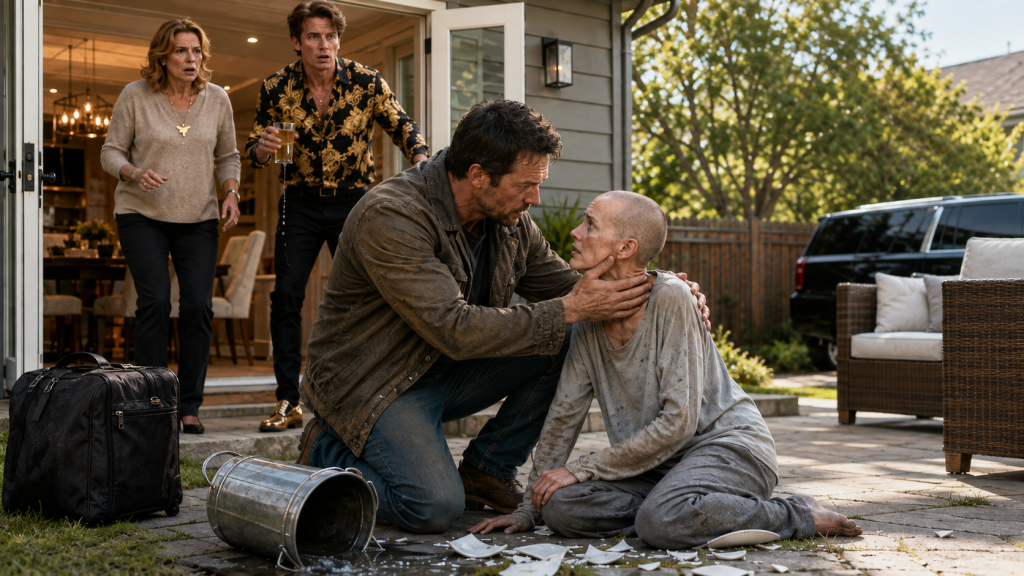
In the backyard, Phedra was on her knees gathering pieces of a broken plate with her bare hands. Her head was shaved. Her cheekbones looked hollow. A bucket of dirty water sat beside her feet.
“”Pick up the pieces properly, Phedra,”” my mother, Selina, called from the living room. “”If someone cuts themselves, I’m taking it out of your food.””
I stopped behind the fence with my suitcase still in my hand.
No one knew I was home.
A shutdown at the metalworking shop in Calgary had given us several unexpected weeks off. My coworkers went to visit family. I bought a ticket that same night because I wanted to surprise my wife.
For four years, I’d worked twelve-hour shifts, eaten reheated meals in a shop that smelled like burnt metal, and spent winters that cracked my lips. Every month, I sent between two and three thousand dollars to Selina’s bank account.
The money was supposed to finish the house, build our future, and take care of Phedra while I was gone. Altogether, I’d sent almost a hundred thousand dollars, plus a bonus every December.
I never questioned it.
I trusted my mother. I trusted Godfrey. Most of all, I believed my wife was safe.
During our video calls, Phedra always said, “”I’m fine, my love. Don’t worry.””
Then, a few months ago, she stopped turning on her camera. Bad internet, she said. An old phone. She was tired.
Now I knew why.
Phedra tried to stand, but her legs buckled. Godfrey came outside in new designer clothes holding a glass of scotch.
“”Hurry up. We still need the dinner plates.””
“”I feel dizzy,”” Phedra whispered. “”I barely ate yesterday.””
Godfrey laughed. “”With everything you stole, you should be able to buy yourself a feast.””
Every part of me wanted to charge through that door.
But years around failing machines had taught me something: when something starts breaking down, listen before you touch it. The noise tells you where the failure began.
So I listened.
Phedra begged to call me. Selina came into the backyard wearing the gold hummingbird necklace I’d given Phedra for our fifth anniversary.
“”He has the right to know I’m sick,”” Phedra said.
“”You’re not going to worry him,”” Selina answered. “”He’s working to get us ahead, not carry the burden of your drama.””
Phedra said the doctor wanted her to continue treatment.
Selina dismissed the doctors, then said the sentence that made my stomach turn.
“”My son sends the money to my account. That means I decide how it gets used.””
Phedra pointed out the new SUV, Godfrey’s newly opened auto shop, and the remodeled house. Then she said she had been staying in the storage shed.
“”I just want to finish my treatment,”” she whispered.
Selina crossed her arms. “”You should have thought about that before getting sick.””
I pushed the door open.
My suitcase hit the floor.
Godfrey dropped his glass. Selina grabbed her chest. Phedra stared at me as if I were a ghost.
“”Damian…””
I crossed the yard and knelt beside my wife. She felt much weaker than I remembered and smelled faintly of bleach, medicine, and damp clothes.
“”I’m back, honey.””
She kept repeating my name.
Selina immediately insisted things weren’t what they looked like. She accused Phedra of becoming unbearable after getting sick, demanding money, breaking things, even stealing jewelry.
I looked directly at the hummingbird pendant around my mother’s neck.
“”Like that one?””
Selina covered it with her hand.
Phedra told me she’d tried to sell the necklace to pay for a doctor’s visit, and Selina had taken it.
Then I asked the question nobody wanted to answer.
“”What illness does she have?””
Phedra touched her chest.
“”Cancer.””
Eleven months.
For eleven months, I’d been sending money while my wife was sick.
Selina argued that treatment was expensive and there were no guarantees. But everywhere I looked, my money was visible: new floors, a massive TV, leather furniture, granite countertops, the SUV outside, Godfrey’s top-of-the-line phone.
Phedra had broken sandals and a six-year-old blouse.
“”How much of my money did you use for her treatment?””
Selina finally admitted they had paid for a few visits.
Phedra corrected her.
Two.
Two visits in eleven months.
I helped Phedra stand and said we were going to the hospital.
Selina blocked the door.
She accused me of disappearing for four years and coming back to treat my own family like criminals. I rolled up my sleeve and showed her the burn scars and cuts from years in the shop.
“”I worked entire nights. I slept in a room with four other guys. I spent two Christmases completely alone so you wouldn’t lack a single thing here.””
“”And we didn’t,”” Selina said.
I looked at Phedra.
“”She did.””
Godfrey blamed me for leaving. Selina said Phedra had brought everything on herself.
Phedra held tightly to my shirt, waiting for me to explode.
I didn’t.
Instead, I reached into my pocket and pulled out my phone..
PART 2: THE MILLION-DOLLAR LIE
I looked at the phone in my hand.
Then at my mother.
Then at Godfrey.
For the first time since I walked through the gate, neither of them seemed certain what I was going to do.
Phedra was still holding the back of my shirt.
Her fingers were weak.
Too weak.
I could feel them trembling through the fabric.
Every instinct inside me wanted to shout.
To break something.
To grab my brother by the collar and ask him how a man could drink imported scotch while his sister-in-law slept in a storage shed.
I wanted to tear the necklace from my mother’s neck.
I wanted to ask how she could look at the woman I loved, see illness eating away at her body, and still decide granite countertops mattered more.
But anger would give them something useful.
A distraction.
A way to turn this into a family fight.
A son who lost his temper.
A brother who came home aggressive.
A husband blinded by guilt.
No.
I had spent too many years around hot steel to forget what happens when you touch something before it cools.
You get burned.
So I smiled.
Selina’s expression changed.
She knew that smile.
I had worn it as a boy when I was about to do something she had not expected.
“What?” she asked.
I unlocked my phone.
“Nothing.”
Godfrey frowned.
“You’ve been standing there acting like some judge.”
I looked at him.
“I’m tired.”
He gave a short laugh.
“Then go rest.”
Phedra’s grip tightened.
I felt her panic immediately.
She thought I was going to leave her there.
That hurt worse than anything Selina had said.
I turned and placed my hand over hers.
“We’re still going to the hospital.”
Her eyes filled.
“Okay.”
Then I looked back at my family.
“But first, I have something to tell you.”
Godfrey’s attention sharpened.
Selina folded her arms.
“What?”
I leaned against the table as casually as I could.
“The shutdown in Calgary wasn’t the only reason I came home.”
Nobody moved.
I watched their faces.
Godfrey tried to look uninterested.
My mother failed completely.
“What happened?” she asked.
I glanced at Phedra.
She looked confused.
Good.
She did not know what I was doing.
That meant her reaction would be real.
I lowered my voice.
“There was an accident at the shop nine months ago.”
Selina’s hand flew to her chest.
“Were you hurt?”
Interesting.
For one second, she sounded like my mother again.
I almost hated that.
“Yes.”
Phedra stepped closer.
“What accident?”
I looked at her.
“Not now, love.”
Her brow furrowed.
I continued.
“A pressure line failed. Three of us were injured.”
Godfrey stared at the scars on my arm.
“You never said anything.”
“I didn’t want anyone worried.”
That sentence came out colder than I intended.
Because Phedra had done the same thing.
Except she had not hidden cancer because she wanted to.
She had been silenced.
I kept going.
“The company settled.”
Selina’s eyes narrowed.
“What kind of settlement?”
There it was.
Not how badly were you hurt.
Not are you okay now.
How much.
I almost smiled again.
“A large one.”
Godfrey put his glass down.
“How large?”
I let the silence sit.
Then I said it.
“One million dollars.”
The backyard went completely still.
Even Phedra stared at me.
Selina’s lips parted.
Godfrey actually laughed.
“No.”
I looked at him.
“Yes.”
“One million Canadian?”
“After conversion, close enough.”
Selina pulled out a chair and sat down.
“My God.”
There was reverence in her voice.
The same woman who had told my sick wife treatment was too expensive suddenly looked like she had just heard a prayer answered.
Godfrey whistled.
“That changes things.”
I turned toward him.
“Does it?”
“Of course it does.”
He stepped closer.
“You could expand the shop.”
“Whose shop?”
He hesitated.
“Mine.”
I nodded.
Naturally.
Selina suddenly remembered Phedra existed.
She smiled at her.
Too warmly.
Too quickly.
“Oh, sweetheart.”
Phedra stiffened.
I almost laughed.
Ten minutes earlier she was “that bald woman.”
Now she was sweetheart.
Selina reached toward her.
“We’ll get you the best doctors.”
Phedra stepped back.
My mother’s hand stopped in the air.
I watched that moment carefully.
Phedra had spent months obeying.
Months being blamed.
Months apologizing for needing medicine.
And now, for the first time, she moved away.
A tiny step.
But it mattered.
Selina recovered.
“You see?” she said to me. “This is what I mean. I’ve always wanted her treated. We just didn’t have the money.”
I looked around the house.
The new SUV gleamed beyond the gate.
Godfrey’s gold watch flashed in the sun.
The oversized television was visible through the sliding doors.
I nodded slowly.
“Right.”
My mother heard the sarcasm.
Her face tightened.
But she swallowed it.
One million dollars was apparently worth tolerating disrespect.
Godfrey pulled a chair closer.
“So where is the money?”
Phedra looked at me sharply.
I could feel a question in her eyes.
I ignored it for now.
“Not released yet.”
Both their faces changed.
Barely.
But enough.
“When?” Selina asked.
“Soon.”
“How soon?”
“The final documents need signatures.”
Godfrey nodded like he understood legal settlements.
“What kind of documents?”
“Beneficiary confirmations. Tax forms. Identity verification.”
My mother leaned forward.
“Beneficiary?”
I almost admired how quickly greed sharpened her hearing.
“Yes.”
“What beneficiary?”
“In case anything happens to me before the settlement closes.”
Godfrey laughed.
“Nothing’s going to happen.”
“Probably not.”
I looked down at my phone.
“But lawyers like paperwork.”
Selina nodded.
“Of course.”
Then she smiled.
“And naturally, you’ll list family.”
I looked at Phedra.
She was watching me now.
Really watching.
She knew me better than anyone in that house.
She knew I never announced money.
She knew I hated discussing finances publicly.
And slowly, something changed in her eyes.
Understanding.
Not complete.
But enough.
She lowered her gaze.
Good.
I turned back to Selina.
“I haven’t decided.”
Her smile disappeared.
“What do you mean?”
“I mean I haven’t signed.”
“Well, who else would you list?”
I shrugged.
“Phedra.”
Godfrey scoffed.
My entire body tightened.
“What?”
He realized too late.
“Nothing.”
“No. Say it.”
He looked away.
“I just mean with her condition…”
Selina jumped in quickly.
“Godfrey means paperwork could become complicated.”
I stared at both of them.
My wife stood beside me, barely strong enough to stay upright.
And already they were calculating the inconvenience of her survival.
I felt something inside me go cold again.
Not anger.
Decision.
I helped Phedra into a chair.
“We’re leaving in five minutes.”
Selina stood.
“To the hospital?”
“Yes.”
“I’ll come.”
“No.”
Her face fell.
“I’m her mother-in-law.”
“You were her landlord ten minutes ago.”
“Damian.”
“No.”
My voice stayed quiet.
That made her angrier than shouting would have.
“You don’t know what happened while you were gone.”
“You’re right.”
I pulled Phedra’s old bag from beneath a chair.
“That’s why I’m going to find out.”
Godfrey crossed his arms.
“You think doctors will fix everything because you suddenly have money?”
“No.”
I looked at him.
“But I know one thing money can fix.”
“What?”
“Distance.”
His face changed.
I turned away before he could answer.
As I helped Phedra toward the gate, Selina called after me.
“Damian.”
I stopped.
She lowered her voice.
“You should be careful who you trust with that settlement.”
I turned.
“Why?”
She looked at Phedra.
“Because sick people get desperate.”
Phedra flinched.
I saw it.
That tiny movement.
Like a dog expecting a hand to strike.
That was the moment I understood something I had not been ready to admit.
What I saw today was not new.
My family had trained fear into her.
Not with one dramatic act.
With hundreds of small ones.
Food withheld.
Medicine delayed.
Accusations.
Insults.
Shame.
Theft.
Isolation.
Every day teaching her that survival depended on keeping them pleased.
I walked back toward my mother.
Slowly.
She actually stepped backward.
I stopped inches away.
“Say something like that about my wife again.”
She swallowed.
“And what?”
I looked directly into her eyes.
“You’ll find out.”
Then I turned.
That was the only threat I allowed myself.
Because the rest was going to happen on paper.
The hospital smelled like disinfectant, plastic, and coffee.
I hated it immediately.
Phedra became quieter the moment we walked inside.
Not nervous.
Ashamed.
That bothered me.
When the nurse asked when she had last seen her oncologist, Phedra stared at the floor.
“Almost four months ago.”
The nurse looked up.
“Why so long?”
Phedra’s mouth opened.
Nothing came out.
I answered.
“Money was withheld from her.”
The nurse looked at me.
Then at Phedra.
“By whom?”
Phedra touched my wrist.
“Damian.”
I understood.
Not here.
Not yet.
I let it go.
The next four hours showed me how much damage silence had done.
Phedra had breast cancer.
Stage three when diagnosed.
Potentially treatable.
Aggressive, but not hopeless.
She had started chemotherapy.
Then appointments stopped.
Medication schedules became inconsistent.
One prescription had not been filled for almost two months.
Her blood counts were poor.
She was severely anemic.
Malnourished.
Dehydrated.
The doctor said those words while looking at me.
Not accusing me.
But every one felt like an accusation anyway.
Malnourished.
My wife.
While I sent three thousand dollars every month.
I sat beside her bed.
She was asleep.
A thin blanket covered her chest.
Without the house.
Without Selina’s voice.
Without Godfrey laughing.
She looked even smaller.
I held her hand.
Her wedding ring was loose around her finger.
Too loose.
I stared at it until my eyes burned.
Ryan.
No.
Wrong life.
Wrong grief.
This was Phedra.
Alive.
Still here.
That mattered.
I bent forward and pressed her hand against my forehead.
“I’m sorry.”
She stirred.
Her eyes opened.
“You came back.”
Her voice was barely above a whisper.
“I should have come sooner.”
“You didn’t know.”
“I should have known.”
“How?”
I looked at her.
“I’m your husband.”
“You were working.”
“That’s not an excuse.”
She turned her face toward me.
“Damian.”
I stopped.
“You trusted them.”
The words came without judgment.
That somehow made them worse.
I looked down.
“Yes.”
She squeezed my fingers weakly.
“I trusted them too.”
For the first time that day, I cried.
Quietly.
Not because I was embarrassed.
Because I had been holding everything with both hands and suddenly did not have enough strength.
Phedra touched my face.
“I thought you forgot me.”
My chest broke.
“What?”
She looked toward the window.
“When the money stopped coming for treatment.”
“It never stopped.”
Her eyes moved back to mine.
“What?”
“I sent it every month.”
She stared.
“All of it?”
“Yes.”
“How much?”
“Two to three thousand.”
Her lips parted.
“And December bonuses.”
She covered her mouth.
A tear slipped down her temple.
“They told me you reduced it.”
My stomach tightened.
“What did they say?”
“That Canada was expensive.”
“That you had debts.”
“That you said I needed to stop wasting money on private doctors.”
I stood so quickly the chair scraped the floor.
Phedra grabbed my wrist.
“Please.”
I stopped.
She was afraid of what I might do.
Again.
That hurt.
I sat back down.
“They lied.”
“I know now.”
“They lied using my name.”
“Yes.”
I closed my eyes.
“How long did you sleep in the shed?”
Silence.
“Phedra.”
“Six months.”
I stopped breathing.
“Six?”
She nodded.
“Why?”
“They said I contaminated the guest room.”
“What?”
“Because of the chemotherapy.”
I stared at her.
“They said the smell made people uncomfortable.”
I could not speak.
She continued softly.
“They moved my mattress outside after I got sick on the rug.”
My hands curled into fists.
“I cleaned it.”
Her voice became smaller.
“I offered to pay for the rug.”
“You were sick.”
“I know.”
“You were being poisoned by chemotherapy to stay alive.”
“I know.”
“And they made you apologize for a rug?”
She began crying.
That answered enough.
I leaned forward and pulled her against me.
Carefully.
She buried her face in my chest.
I held her the way I should have been holding her for eleven months.
“I’m here now.”
She started shaking.
“I know.”
“No.”
I tightened my arms.
“I’m here now.”
For the first time, I meant more than presence.
I meant no one was deciding for her anymore.
No one was spending her medicine money.
No one was taking her jewelry.
No one was putting her in a shed.
No one.
When she fell asleep again, I stepped into the hallway.
Then I called a man named Marcus Vale.
Not related.
Just an accountant I had met in Calgary through one of the shop supervisors.
He specialized in fraud investigations.
I told him everything.
Then I called an attorney.
Then the bank.
The account I sent money into was in Selina’s name.
That was my mistake.
Four years earlier, it had seemed easier.
She handled household bills.
I worked long shifts.
She promised to keep records.
I never asked to see them.
Now I asked.
Every transfer.
Every withdrawal.
Every wire.
Every debit purchase.
Everything.
By evening, my phone contained enough information to make my hands shake.
Over four years, I had sent just under one hundred and eighteen thousand dollars.
Not ninety.
More.
Godfrey’s auto shop had received forty-three thousand.
The SUV?
Thirty-two.
Home renovations?
Twenty-six.
Casino charges in Selina’s name?
Eleven.
Phedra’s medical expenses?
Less than three thousand.
I stared at that number for a long time.
Less than three thousand.
In eleven months.
I called Ethan—
No.
Again.
Different story.
I called Marcus.
“Can we prove diversion?”
“Depends what they told you the money was for.”
“I have texts.”
“Send them.”
I did.
Messages from Selina.
Phedra’s treatment is expensive this month.
Transfer sent.
The doctor ordered another test.
Transfer sent.
She needs special food.
Transfer sent.
Special food.
I remembered that one.
I sent fifteen hundred dollars that week.
Phedra told me she had eaten rice and tea for three days.
Marcus called back.
“Damian.”
“Yes?”
“This is not just family irresponsibility.”
My jaw tightened.
“What is it?”
“Potential fraud.”
I looked through the glass wall at my wife sleeping.
“Good.”
He paused.
“Good?”
“Yes.”
“Why?”
“Because I’m done arguing about morality.”
My voice went cold.
“I want numbers.”
He understood.
“Then give me forty-eight hours.”
“No.”
I looked at the clock.
“Give me what you can tonight.”
We worked until midnight.
At 12:16, my mother called.
I let it ring.
Then again.
Again.
Godfrey texted.
We need to talk about the settlement.
I almost laughed.
Not Phedra.
Not hospital.
Settlement.
Another message.
Mom says you should put the money somewhere safe before your wife wastes it.
I took a screenshot.
Saved it.
Then replied for the first time.
Family meeting tomorrow. 10 a.m. Don’t make plans.
Godfrey responded instantly.
At home?
I stared at the word.
Home.
Interesting.
Yes.
Then I called Phedra’s doctor.
She would remain admitted overnight.
That was good.
She needed treatment.
Fluids.
Tests.
Nutrition.
More importantly, she needed one night where nobody shouted at her.
I stayed beside her until dawn.
At 6:30, she woke.
“You’re leaving?”
“Two hours.”
Her eyes sharpened.
“Why?”
“I need to handle something.”
She looked afraid.
“Don’t fight them.”
“I won’t.”
“Promise.”
I smiled.
“That depends what you mean by fight.”
“Damian.”
“No violence.”
Her shoulders relaxed.
“No shouting if I can avoid it.”
She studied me.
“You’re planning something.”
“I am.”
“What?”
I kissed her forehead.
“The first honest family meeting we’ve had in years.”
At 9:58, I walked through my mother’s front door.
Godfrey was already in the living room.
Fresh shirt.
Gold chain.
Nervous energy.
Selina had prepared coffee.
Cake.
Cake.
I almost laughed.
Yesterday, Phedra barely deserved food.
Today, there was cake because I was a millionaire.
“Where is she?” Selina asked.
“At the hospital.”
Her face tightened.
“All night?”
“Yes.”
“That’s going to be expensive.”
I looked at her.
“She’s receiving treatment.”
“I understand that, but—”
“No.”
I set my phone on the table.
“No more discussions about whether keeping my wife alive is expensive.”
Selina stopped.
Godfrey leaned forward.
“So the settlement.”
There it was.
I sat down.
“What about it?”
“You said there are documents.”
“Yes.”
My mother smiled.
“We’ve been thinking.”
“I’m sure.”
“It would be wise to keep the money inside the family.”
I nodded slowly.
“What do you suggest?”
She visibly relaxed.
This was what she wanted.
The old Damian.
The son who asked.
The one who wanted approval.
Selina began.
“Your brother’s business is growing.”
Godfrey sat straighter.
“We could open a second location.”
“Of course.”
“And the house needs the upstairs finished.”
I looked toward the marble staircase that had not existed four years ago.
“Obviously.”
She continued.
“We should also buy land.”
“We?”
Selina smiled.
“For all of us.”
“Who would own it?”
She hesitated.
“Family.”
I leaned back.
“What does that mean?”
Godfrey interrupted.
“Don’t complicate this.”
I looked at him.
“I like ownership questions.”
He frowned.
Selina continued carefully.
“The settlement should be placed somewhere you can’t make emotional decisions.”
I nearly laughed.
“Like?”
“A family trust.”
There it was.
“And who manages it?”
She looked offended that I asked.
“Well, initially, me.”
I nodded.
“Of course.”
Godfrey added,
“And maybe me as co-manager.”
“Phedra?”
Selina’s mouth tightened.
“What about her?”
“Does she manage anything?”
“That would be irresponsible.”
“Because?”
Her voice lowered.
“She’s sick.”
I stared at her.
“So illness makes her incompetent?”
“I didn’t say that.”
“You just did.”
Godfrey stood.
“Why are we talking about her?”
I looked at him.
“Because she’s my wife.”
He scoffed.
“You barely lived with her for four years.”
I smiled.
“Sit down.”
Something in my voice made him do it.
Selina looked between us.
I opened my phone.
Then I said,
“I’ve made a decision.”
Both leaned forward.
I almost felt sorry for them.
Almost.
“The settlement isn’t one million dollars.”
Their faces changed.
Selina blinked.
“What?”
Godfrey frowned.
“You lied?”
“Yes.”
“How much is it?”
I let the silence stretch.
Then smiled.
“There is no settlement.”
The room went dead.
Godfrey stared.
Selina looked genuinely confused.
“What are you talking about?”
“There was an accident.”
I rolled up my sleeve.
“The scars are real.”
I lowered it again.
“But the company never paid me one million dollars.”
Godfrey stood.
“You played us?”
“Yes.”
My mother’s face turned red.
“Why?”
I unlocked my phone.
“Because yesterday, when my wife was on her knees picking broken glass while starving, you had explanations.”
I placed the phone on the table.
“When I said one million dollars, you had solutions.”
Neither spoke.
I continued.
“Suddenly treatment mattered.”
I looked at Selina.
“Suddenly she was sweetheart.”
Then Godfrey.
“Suddenly you wanted expansion.”
My voice hardened.
“I wanted to see whether greed would make you tell the truth faster than guilt ever could.”
Selina slapped the table.
“You manipulated us!”
I laughed.
The irony was almost too much.
“I manipulated you?”
“Yes!”
“For less than twenty-four hours.”
My voice shook.
“You used my wife for eleven months.”
Silence.
I opened the first bank record.
“One hundred and eighteen thousand dollars.”
Godfrey looked at the page.
“What?”
“That’s what I sent over four years.”
Selina’s face changed.
I placed another sheet down.
“Forty-three thousand into Godfrey’s shop.”
Another.
“Thirty-two thousand for the SUV.”
Another.
“Twenty-six thousand in renovations.”
Another.
“Eleven thousand in gambling.”
My mother went still.
Godfrey turned toward her.
“Gambling?”
She ignored him.
I put down the final page.
“Two thousand eight hundred and sixty dollars for Phedra’s documented medical care.”
Neither moved.
I looked at them.
“That’s what her life was worth to you.”
Selina recovered first.
“We spent more in cash.”
“Receipts?”
“I don’t keep every receipt.”
“Doctor names?”
Silence.
“Pharmacy records?”
Nothing.
“Hospital invoices?”
Nothing.
Godfrey pointed at me.
“You sent money to Mom. Once money changes hands—”
I laughed.
“No.”
He stopped.
“No?”
“I have messages.”
I opened them.
Read aloud.
“Phedra’s treatment is expensive this month.”
Selina went pale.
“Another test.”
Another transfer.
“Special food.”
Another.
“Medication changed.”
Another.
Each lie tied to money.
Each transfer documented.
My mother stood.
“You’re accusing me of stealing.”
“No.”
I looked at her.
“My accountant is.”
The room changed.
Godfrey froze.
Selina’s mouth opened.
I continued.
“And my attorney.”
She sat back down.
“You called a lawyer?”
“Yes.”
“This is family.”
“Not anymore.”
Her face broke.
I did not enjoy that.
I thought I would.
For months, maybe years, I imagined what it would feel like to finally make someone who hurt me understand.
But pain is not satisfying when it appears on the face of someone who raised you.
It is just pain.
Still necessary.
Still painful.
Godfrey laughed nervously.
“You can’t prove anything.”
I looked at him.
“Your shop registration lists the startup funds as a family loan.”
He stopped.
“Whose family loan?”
Silence.
“Mine?”
His eyes shifted.
There.
Another failure noise.
I kept listening.
“I never signed a loan agreement.”
No answer.
“So whose signature is on it?”
Selina whispered,
“Godfrey.”
He snapped,
“Shut up.”
I smiled.
There it was.
I had not even known there was a signature.
But now I did.
Greed triggered the trap.
Fear sprung it.
I leaned back.
“Thank you.”
Godfrey stared.
“For what?”
“For answering.”
He realized too late.
“You tricked me.”
“Yes.”
I picked up my phone.
“And you just did it again.”
Selina stood.
“Damian, stop this.”
I looked at her.
“No.”
Her voice broke.
“I am your mother.”
“And she is my wife.”
“I raised you.”
“And I trusted you.”
“I sacrificed for you.”
“So did she.”
I stood.
“But when I was cold in Canada, Phedra never asked me for anything.”
My voice trembled.
“She wore broken sandals so you could drive an SUV.”
“She slept in a shed so Godfrey could open a shop.”
“She went hungry while you remodeled a kitchen.”
I looked around the room.
“And you did all of it with my hands.”
Selina began crying.
Real tears.
Maybe for herself.
Maybe for what she had done.
I did not know.
“I thought you wanted us comfortable.”
“I wanted you safe.”
“There’s a difference.”
She looked down.
I walked toward her.
Then I reached for the gold hummingbird necklace.
She flinched.
I did not rip it away.
I simply held out my palm.
“Take it off.”
Her hand covered the pendant.
“Damian.”
“Take it off.”
Tears slid down her face.
Slowly, she unclasped it.
Placed it in my hand.
The tiny hummingbird felt warm from her skin.
I stared at it.
Ryan—
No.
Phedra.
Our fifth anniversary.
I had mailed it from Calgary because I could not get leave.
She called me crying when she opened it.
She told me she wore it every day because it felt like carrying something from me.
My mother had taken even that.
I closed my fist.
“Thank you.”
Godfrey stood.
“What happens now?”
I looked at him.
“Your shop finances are being reviewed.”
His face drained.
“You can’t take my business.”
“I’m not.”
I moved toward the door.
“If it was built honestly, you keep it.”
“And if not?”
I looked back.
“Then maybe you should start praying your paperwork is cleaner than your conscience.”
Selina called after me.
“Where are you going?”
“To my wife.”
“What about us?”
I stopped.
There it was.
For four years, that question controlled me.
What about us?
What about your brother?
What about your mother?
What about family?
I turned.
“For once?”
My voice softened.
“You’re going to take care of yourselves.”
I left.
Three days later, Phedra restarted treatment.
Not because I had a million dollars.
Because I still had money.
Savings.
My next pay.
Insurance coverage I had never known how to activate from abroad.
An emergency veteran support fund.
People helped.
That surprised me most.
I had spent years believing I needed to carry everyone alone.
The hospital social worker helped with one form.
My union helped with another.
A former supervisor arranged temporary housing near treatment.
A doctor reduced fees.
A nurse connected us with nutrition support.
One person did not save us.
A dozen people each carried something small.
That was what real family felt like.
Not one exhausted man funding everyone.
Not one sick woman paying for her illness with shame.
People carrying together.
Phedra gained four pounds in the first month.
Then six.
Her treatment was difficult.
There were bad days.
Terrible days.
Days when she could not keep water down.
Days when she told me she was tired of fighting.
I did not tell her to be strong.
I sat beside her.
Sometimes strength is overrated.
Sometimes love means allowing someone to say,
“I’m tired.”
Without turning it into surrender.
The investigation into my family took longer.
Godfrey had used a forged version of my signature to secure part of his business financing.
Selina had diverted money intended for Phedra.
Not every bad act became criminal.
Some were simply cruel.
Others had consequences.
The auto shop was sold to repay debt.
The SUV went next.
The designer clothes disappeared.
The granite countertops remained.
Funny.
Of everything my money bought, those countertops lasted longest.
Selina called me often at first.
I answered once.
“Damian.”
“Yes?”
“I made mistakes.”
I looked across the room.
Phedra was sleeping.
A scarf covered her head.
Her skin looked stronger now.
“What do you want me to say?”
“I want my son.”
That hurt.
Because part of me wanted my mother too.
The woman from before.
The one who packed my lunches.
The one who cried when I left for Canada.
The woman I believed would protect my wife like a daughter.
Maybe both women had always existed.
I just preferred one.
“I’m here.”
“No.”
She cried.
“You know what I mean.”
“Yes.”
I did.
“But I can’t return to the way things were.”
“I’ll change.”
“I hope you do.”
“For you?”
I looked at Phedra.
“No.”
“For yourself.”
There was silence.
Then Selina whispered,
“Will she ever forgive me?”
I closed my eyes.
“That’s not yours to ask yet.”
She cried harder.
I stayed on the phone.
Not as rescuer.
Not as banker.
Just a son hearing his mother cry.
When the call ended, I did not send money.
That was progress.
Six months after I returned home, Phedra rang the hospital bell marking the end of her first major treatment cycle.
Her hair had begun growing back.
Soft.
Short.
She hated it.
I loved it.
She stood beside the bell in a blue dress.
Still thinner than before.
But stronger.
Alive.
She looked at me.
“Ready?”
I smiled.
“Do it.”
She rang the bell.
Once.
Twice.
Three times.
The sound echoed down the hallway.
Nurses clapped.
Someone cheered.
Phedra cried.
So did I.
Later, outside the hospital, she touched the hummingbird necklace resting against her collarbone.
I had returned it to her the day she came home.
She looked at me.
“Do you remember what you said when you gave me this?”
I frowned.
“No.”
“You said hummingbirds survive because they never stop moving.”
I laughed softly.
“That sounds dramatic.”
“You were dramatic.”
“I was in love.”
“You still are.”
I looked at her.
“Yes.”
She took my hand.
“Good.”
We walked slowly toward the car.
Not the SUV.
That was gone.
An old sedan.
The air conditioner barely worked.
I had never been happier to own something ordinary.
Before we reached it, Phedra stopped.
“Damian.”
“Yes?”
“Was there really no settlement?”
I smiled.
“No million dollars.”
She shook her head.
“You’re terrible.”
“It worked.”
“It did.”
Then she became serious.
“What if they had treated me kindly after you announced it?”
I looked at her.
“That would have hurt more.”
“Why?”
“Because then I’d know for certain they were capable of kindness the entire time.”
She looked down.
“They were.”
I knew what she meant.
They were capable.
They just did not think she was worth the effort until money appeared.
I squeezed her hand.
“Then I’m glad I came home.”
She looked at me.
“Even after everything?”
“Yes.”
I glanced back at the hospital.
“Because I finally heard the machine breaking.”
She smiled faintly.
“And?”
I looked toward the road ahead.
“And this time, I stopped it before it destroyed everything.”
For four years, I believed distance was the price of building a future.
I thought if I worked hard enough, sent enough money, sacrificed enough sleep, one day I would come home to a finished house and a safe wife.
Instead, I came home to granite countertops.
A shiny SUV.
A profitable shop.
A mother wearing stolen jewelry.
And the woman I loved sleeping in a shed.
I had mistaken provision for protection.
They are not the same.
Money sent from far away cannot hug someone.
It cannot notice weight loss.
It cannot hear fear through a turned-off camera.
It cannot ask why a woman suddenly stops smiling.
I learned that too late.
But not completely too late.
Phedra was still beside me.
Still holding my hand.
Still alive.
That was enough.
The million dollars never existed.
But the trap did.
And in the end, my family’s greed did not expose how rich I was.
It exposed what they had become when they thought I was.
By the time they understood that, the money I had spent years sending them had stopped.
The lies had stopped.
The access had stopped.
And for the first time since I boarded that plane to Canada four years earlier—
my wife and I finally began building the future all that money was supposed to buy.
PART 3: THE FAMILY I CHOSE TO SAVE
For a long time after Phedra finished that first treatment cycle, I thought the hardest part was over.
I was wrong.
Surviving the truth was one thing.
Living after it was another.
The day we left the hospital, Phedra sat beside me in the passenger seat with both hands folded in her lap.
The hummingbird necklace rested against her collarbone.
Her hair had grown back just enough to form a soft shadow over her head.
Every few minutes, she touched it without realizing.
I noticed.
I noticed everything now.
That was the difference.
Before Canada, before the lies, before I came home and found her kneeling in the dirt, I had believed love could survive on intention.
I love you.
I miss you.
I’m doing this for us.
I thought those sentences could cover distance.
They could not.
Words are not shelter unless someone is there to make them true.
We drove for almost twenty minutes before Phedra spoke.
“Where are we going?”
I glanced at her.
“Home.”
Her body stiffened.
It happened instantly.
So small most people would miss it.
I did not.
“What?”
she whispered.
I knew exactly what she had heard.
Not our home.
That house.
Selina’s house.
The kitchen.
The shed.
The backyard.
Broken plates.
Dirty water.
A place where every room had taught her to be afraid.
I shook my head.
“Not there.”
She looked at me.
“Then where?”
I turned onto a quiet road lined with jacaranda trees.
A few minutes later, I stopped in front of a small white house with a blue metal roof.
Nothing fancy.
Two bedrooms.
A narrow porch.
A lemon tree near the fence.
Phedra stared through the windshield.
“What is this?”
“Ours.”
She turned slowly.
“What?”
“I rented it for a year.”
Her mouth opened.
“Damian.”
“There’s no marble.”
I smiled.
“No giant television.”
“No SUV.”
“No designer furniture.”
I looked toward the porch.
“But there are locks nobody else has keys to.”
Her eyes filled immediately.
I continued.
“There’s a bedroom.”
“A real one.”
“A kitchen.”
“Your own bathroom.”
“And the landlord said we can paint if we want.”
She covered her mouth.
I reached across the console.
“Phedra.”
Tears spilled down her face.
“You rented this for us?”
“Yes.”
“Why didn’t you tell me?”
“Because I wanted one surprise in my life that didn’t end with someone stealing something.”
She laughed through tears.
It was a small sound.
Weak.
But it was hers.
I had missed it.
God, I had missed it.
When we stepped inside, the house smelled like fresh paint and empty rooms.
Our furniture consisted of one mattress.
A table.
Two chairs.
A used couch Marcus had helped me find.
That was it.
Phedra walked through every room slowly.
She opened cabinets.
Touched windows.
Checked the locks twice.
I pretended not to notice.
Then she reached the bedroom.
On the bed, I had placed one thing.
Her old yellow blanket.
The one she used before I left for Canada.
I found it folded inside a plastic bin in Selina’s storage room.
Phedra stopped in the doorway.
Her shoulders began shaking.
“Where did you get that?”
“Godfrey had it with old cleaning rags.”
Her face broke.
I hated saying it.
But she deserved truth.
I picked up the blanket.
“I washed it.”
She took it from me.
Pressed it to her chest.
Then sat on the mattress and cried.
I sat beside her.
Neither of us said anything.
Sometimes comfort does not need language.
I put my arm around her.
She leaned against me.
For almost ten minutes, she cried into that old blanket.
Then she whispered,
“I used to dream about this.”
“What?”
“A door.”
I looked at her.
“What kind?”
“A door I could close.”
My chest tightened.
She stared at the floor.
“At Selina’s house, even when I slept in the shed, someone could come in.”
“Godfrey.”
“Your mother.”
“Sometimes the neighbor woman.”
“I had nowhere that was mine.”
She rubbed the blanket between her fingers.
“I used to imagine a room where I could shut the door and know nobody would open it.”
I looked toward the bedroom entrance.
Then stood.
Walked over.
Closed the door.
Turned the lock.
Click.
Phedra looked at me.
I stayed beside it.
“Locked.”
Her eyes filled again.
“Only us.”
I put the key on the bedside table.
“Only us.”
That night, we slept on a mattress without a bed frame.
The ceiling fan made a clicking noise.
A dog barked three houses away.
The refrigerator hummed too loudly.
It was the most peaceful night I had slept in years.
At 2:13 in the morning, I woke because Phedra was crying.
I sat up immediately.
“What’s wrong?”
She wiped her face.
“Nothing.”
“Phedra.”
“I had a dream.”
“What happened?”
She stared into the darkness.
“I was back in the shed.”
I felt my chest tighten.
“I could hear your voice outside.”
“But the door wouldn’t open.”
I reached for her.
She moved into my arms.
“I knew you were there.”
Her breath shook.
“But I couldn’t get to you.”
I held her tighter.
“I’m here now.”
“I know.”
She said it quickly.
Then softer,
“I know.”
Healing did not erase what happened.
That was another thing I learned.
You can remove someone from danger without removing the danger from inside them.
For months, Phedra woke when doors slammed.
She hid food.
Not much.
Crackers.
Bread.
Sometimes fruit.
The first time I found two rolls wrapped in paper beneath her pillow, I stared at them.
She came into the room and saw my face.
Her own expression changed immediately.
“I’m sorry.”
Those words destroyed me.
“Why are you apologizing?”
“I didn’t mean to waste it.”
“Phedra.”
“I’ll put it back.”
I took the bread from her.
She flinched.
Not from me.
From memory.
I sat on the edge of the bed.
Then placed the rolls back beneath the pillow.
She stared.
“You can keep them there.”
“What?”
“You can put food anywhere you want.”
“Damian.”
“I mean it.”
I stood.
“If we have bread in every drawer by tomorrow, I’ll buy more bread.”
Her eyes filled.
“You don’t understand.”
“Yes.”
I shook my head.
“I don’t.”
“And I’m not going to pretend I do.”
I touched her hand.
“But I’m going to learn.”
That became our new marriage.
Learning.
Learning how to talk again.
Learning how much damage silence could hide.
Learning that Phedra saying, “I’m fine,” might mean exactly the opposite.
Learning that me saying, “I’m doing this for us,” meant nothing if I never asked what “us” needed.
I started therapy.
Phedra did too.
Separate at first.
Then together.
I hated the first session.
Absolutely hated it.
The therapist asked me why I believed sending money made me a good husband.
I became defensive.
“I was supporting my family.”
She nodded.
“Financially.”
“Yes.”
“What about emotionally?”
I looked away.
“I called.”
“How often?”
“Three times a week.”
“With video?”
“Most of the time.”
“And when the video stopped?”
I said nothing.
The therapist waited.
That silence was worse than accusation.
“I believed the internet was bad.”
“Why?”
“Because she told me.”
“Did the explanation fit the pattern?”
I looked at Phedra.
She was staring at her hands.
“No.”
The therapist asked,
“Then why did you accept it?”
I swallowed.
“Because believing it meant I could keep working.”
Phedra looked at me.
There it was.
The truth I hated.
If I asked harder questions, I might have had to come home.
If I came home, the money stopped.
And somewhere along the line, I had started believing the money was the most important thing I offered.
I turned toward Phedra.
“I’m sorry.”
She shook her head.
“We both survived by pretending.”
That sentence stayed with me.
We both survived by pretending.
She pretended she was fine.
I pretended money was enough.
Selina pretended theft was responsibility.
Godfrey pretended entitlement was family.
Eventually, pretending became the structure holding all of us together.
Once it collapsed, we had to decide which relationships were worth rebuilding from the ground.
Godfrey was the first to disappear.
After the auto shop was investigated, he stopped answering my calls.
Not that I made many.
His business financing had been built partly on false paperwork and money taken from transfers meant for Phedra.
The bank seized equipment.
Creditors followed.
The sign with his name came down six months after I returned.
One afternoon, I happened to drive past the building.
The windows were empty.
No cars.
No polished reception desk.
No proud banner.
Just faded letters where the business name had once been.
I expected satisfaction.
Instead, I felt tired.
There was a time when I would have done anything for Godfrey.
When we were kids, I broke my wrist fighting three boys who cornered him after school.
When our father left, I became the closest thing he had to one.
Maybe that was part of the problem.
I had spent so long protecting people that none of them learned what consequences felt like.
He eventually called.
Almost nine months after I came home.
“Damian.”
I recognized his voice immediately.
But it sounded different.
Smaller.
“Godfrey.”
Silence.
Then,
“I need help.”
Of course.
I closed my eyes.
“What kind?”
“My landlord is throwing me out.”
“How much?”
He hesitated.
“Two months’ rent.”
The old reflex rose inside me.
How much?
Where do I send it?
Then I looked across the living room.
Phedra was sitting at the table filling out paperwork for a part-time counseling program she wanted to join when her strength improved.
Her hair had grown into tight curls.
She looked healthier.
Still fragile sometimes.
But alive.
I thought of all the times Godfrey ate expensive food while she went hungry.
“Damian?”
“I’m here.”
“Can you send it?”
“No.”
Silence.
“What?”
“No.”
He laughed once.
Not because it was funny.
Because he did not understand.
“You have money.”
“That’s not the point.”
“You’re my brother.”
“I know.”
“So help me.”
I stood and walked outside.
The evening air felt cool.
“Godfrey, I will help you find a job.”
Silence.
“I will help you make a budget.”
Silence.
“I will send you the phone number of a housing assistance program.”
His breathing changed.
“But I will not send money.”
“You’re punishing me.”
“No.”
“Yes, you are.”
“I’m giving you something nobody gave you before.”
“What?”
“Responsibility.”
He swore.
I let him.
Then he said,
“You think you’re better than everyone because you went to Canada.”
I laughed softly.
“No.”
“I think I was worse than everyone in one particular way.”
“What?”
“I kept rescuing you.”
He hung up.
I did not call back.
Two weeks later, he took a job managing inventory at a hardware store.
I learned that from Selina.
She called less often too.
At first, she left long messages.
Crying.
Defending herself.
Explaining.
Then apologizing.
Then defending herself again.
Real remorse rarely arrives clean.
It comes mixed with pride.
Fear.
Self-pity.
And old habits.
For almost a year, I refused to let her near Phedra.
Not because Phedra demanded it.
Because Phedra did not have the strength to decide under pressure.
Selina once appeared outside our rental unannounced.
She held a bag of food.
Phedra saw her through the curtain and immediately began shaking.
I walked outside.
Closed the door behind me.
My mother smiled weakly.
“I brought soup.”
“You need to leave.”
Her face fell.
“Damian.”
“You cannot come here without asking.”
“I’m your mother.”
“That is not a key.”
The sentence surprised both of us.
She looked toward the house.
“I just want to see her.”
“No.”
“I want to apologize.”
“No.”
Tears filled her eyes.
“How long are you going to punish me?”
I stared at her.
There it was again.
Her suffering.
Her timetable.
Her need for forgiveness.
“You still don’t understand.”
“I said I’m sorry.”
“Sorry is not a door handle.”
She stopped.
“You don’t get to say it and walk back inside.”
I pointed toward the gate.
“You taught my wife to fear footsteps.”
Her face crumpled.
“You made her sleep beside cleaning chemicals.”
“I didn’t know how sick she—”
“Stop.”
My voice rose for the first time.
She went silent.
“You knew she was sick.”
Tears filled my eyes.
“You knew she was hungry.”
“You knew she needed treatment.”
“You knew I was sending money.”
Each sentence made her look smaller.
“You knew.”
I stepped closer.
“And you chose countertops.”
She started crying.
“I was ashamed.”
“Good.”
That came out harder than I intended.
But I did not take it back.
“You should be.”
She wiped her face.
“Will you ever forgive me?”
I looked at the house.
Through the window, I could see Phedra sitting on the couch.
Waiting.
Watching the door.
“I don’t know.”
Selina nodded slowly.
Then she left.
A year passed.
Then another.
Phedra’s cancer went into remission.
The day the doctor said the word, she stared at him.
“What?”
He smiled.
“Your scans show no evidence of active disease.”
Phedra blinked.
I squeezed her hand so hard she laughed.
Then cried.
Then I cried.
The doctor had to repeat himself twice because neither of us could process the sentence.
No evidence of active disease.
Not cured.
Not a guarantee.
But remission.
A word that sounded like sunlight.
Outside the hospital, Phedra stood under a jacaranda tree.
Purple flowers had fallen across the pavement.
She tilted her face toward the sky.
“What do you want to do?”
I asked.
She looked at me.
“What do you mean?”
“Today.”
She smiled.
“Eat.”
I laughed.
“What?”
“I’m hungry.”
Those two words almost brought me to my knees.
I’m hungry.
There had been months when hunger meant fear.
When food had been controlled.
Counted.
Threatened.
Now she said it like a normal person.
Like life.
“What do you want?”
She thought carefully.
“Fried chicken.”
“Done.”
“And cake.”
“Absolutely.”
“And ice cream.”
“You’re getting ambitious.”
She smiled.
“I almost died.”
“Good point.”
We bought too much food.
Sat in a park.
Ate until Phedra complained her stomach hurt.
Then she lay on the grass with her head in my lap.
I touched her hair.
Longer now.
Soft.
She looked up at me.
“Do you regret Canada?”
The question caught me.
“Yes.”
Her eyes changed.
I continued.
“And no.”
She frowned.
“That’s cheating.”
“I regret staying that long.”
“I regret not asking questions.”
“I regret missing what was happening.”
I looked toward the trees.
“But Canada also taught me I could survive hard things.”
I looked back at her.
“And coming home taught me why surviving them matters.”
She touched my face.
“I used to hate Canada.”
“I know.”
“I thought it stole you.”
My throat tightened.
“Now?”
She smiled sadly.
“Now I think we both gave too much power to distance.”
I nodded.
She was right.
Distance did not betray us.
People did.
Including me, in ways I had to accept.
We eventually bought that small rental house.
Not the remodeled family house.
That house was sold after Selina’s financial problems caught up with her.
She moved into a modest apartment.
For the first time in decades, she had to live within her means.
The day our landlord offered to sell us the little white house, Phedra cried.
“You want it?”
I asked.
She walked to the bedroom.
Opened the door.
Closed it.
Turned the lock.
Click.
Then smiled.
“Yes.”
So we bought it.
No marble.
No enormous television.
No designer furniture.
But the deed had both our names.
I insisted.
Phedra laughed.
“You’re being dramatic.”
“Probably.”
I handed her the papers.
“But nobody will ever tell you this house is not yours.”
Her eyes filled.
She signed.
Two years after I returned home, Selina asked for one supervised meeting with Phedra.
Not at our house.
Phedra chose a café.
Public.
Neutral.
I sat beside her.
Selina arrived wearing simple clothes.
No gold.
No hummingbird necklace.
That belonged where it should.
Against Phedra’s chest.
My mother sat across from us.
For several minutes, nobody spoke.
Then Selina looked at Phedra.
“I don’t expect forgiveness.”
Good start.
Phedra stayed silent.
Selina continued.
“I used Damian’s money.”
“I used your illness.”
“I blamed you because admitting what I did would have meant admitting what kind of woman I became.”
Her voice broke.
“I was angry when you got sick.”
Phedra’s eyebrows tightened.
“Why?”
Selina looked down.
“Because illness changed the plan.”
I felt disgust rise.
But Phedra touched my hand.
Let her speak.
Selina continued.
“Damian’s money was supposed to finish the house.”
“Help Godfrey.”
“Make life easier.”
She began crying.
“When you got sick, every dollar spent on you felt like something I was losing.”
Phedra stared at her.
“That is horrible.”
Selina nodded.
“Yes.”
No excuse.
No defense.
Just yes.
Something in the air changed.
Not forgiveness.
Truth.
Phedra asked,
“Did you really think I stole from you?”
Selina looked ashamed.
“No.”
Phedra’s mouth trembled.
“Then why did you say it?”
“To make Godfrey stop questioning why I was taking your things.”
I closed my eyes.
Phedra nodded slowly.
Then asked the hardest question.
“Did you think I was going to die?”
Selina began sobbing.
“Yes.”
The café seemed to disappear.
Phedra’s face turned still.
“And that made it easier?”
Selina could barely speak.
“Yes.”
I wanted to get up.
Leave.
Break something.
But Phedra stayed.
So I stayed.
After a long silence, my wife said,
“I don’t forgive you.”
Selina nodded.
“I understand.”
“But I wanted to hear you admit it.”
Selina wiped her face.
“I’m sorry.”
Phedra stood.
“So am I.”
Then we left.
Outside, I asked,
“Are you okay?”
She took a long breath.
“No.”
I nodded.
“Okay.”
Then she looked at me.
“But I think I will be.”
That became enough.
Godfrey took longer.
He apologized eventually.
Badly at first.
Then better.
He never returned to running a business.
Maybe that was good.
He became good at inventory management.
Then warehouse supervision.
He learned to live on a salary.
Imagine that.
He and I never became close again.
But we became honest.
Sometimes that is the better relationship.
Years passed.
Cancer did not return.
Every annual scan terrified us.
Every clear result felt like another borrowed year.
Phedra trained as a patient advocate.
The first time she told me, I laughed.
“You?”
She frowned.
“What’s funny?”
“You used to hate hospitals.”
“I still do.”
“Then why work around them?”
Her expression softened.
“Because sometimes sick people need one person who believes them.”
That ended the joke.
She began helping women navigate treatment.
Insurance.
Family pressure.
Transportation.
Food programs.
Sometimes she sat beside patients who had nobody else.
I watched her turn the worst year of her life into a hand extended toward strangers.
That was Phedra.
Not weak.
Never weak.
Just exhausted for too long.
My life changed too.
I never returned to four-year contracts.
I went back to Calgary once.
Short-term.
Six months.
Phedra came with me for the first month.
We saw snow together.
She hated it.
I laughed when she stepped outside and immediately turned around.
“You lived in this?”
“For years.”
“You’re insane.”
“Probably.”
I showed her the metalworking shop.
The room where I used to eat.
The apartment where four men shared one kitchen.
The bus stop where I stood at 5:00 in the morning in temperatures cold enough to hurt my lungs.
She touched the burn scars on my arm.
“I thought you were forgetting me here.”
I looked around.
“I was trying to earn my way back to you.”
She smiled sadly.
“You didn’t have to.”
“I know that now.”
On our last evening in Calgary, we stood near the river.
Phedra slipped her hand into mine.
“Do you remember the million dollars?”
I laughed.
“Unfortunately.”
“You scared me.”
“I scared myself.”
“Did you know they would react like that?”
I shook my head.
“No.”
“What if they didn’t?”
“I don’t know.”
She looked at me.
“Really?”
“Really.”
I watched the water.
“I think part of me wanted to be wrong.”
She squeezed my hand.
“That’s the saddest part.”
She was right.
The lie was never about proving my family was greedy.
It was about giving them one final chance not to be.
They failed.
Sometimes truth hurts most when you already suspected it.
We flew home two days later.
The little white house looked almost ridiculous after Canada.
Tiny.
Warm.
Our lemon tree had finally started producing fruit.
Phedra hung her coat behind the door.
I carried in the bags.
No one yelled.
No one demanded money.
No one told anyone where they were allowed to stand.
Ordinary.
Peaceful.
Ours.
On our tenth wedding anniversary, I bought Phedra another necklace.
Nothing expensive.
A small silver key.
She laughed when she opened it.
“A key?”
“Yes.”
“To what?”
I looked around.
“Everything.”
She rolled her eyes.
“That is extremely dramatic.”
“I’ve gotten worse.”
She put it around her neck beside the hummingbird.
Then kissed me.
Later that evening, we sat on the porch.
No guests.
No party.
Just tea.
The sun setting.
Phedra leaned against my shoulder.
“What do you think would have happened if you hadn’t come home that day?”
I hated that question.
For years, I refused to answer it.
That night, I did.
“I think I would have lost you.”
She was quiet.
“So do I.”
My throat tightened.
Then she added,
“But you did come home.”
I looked at her.
“Yes.”
“And you listened before you touched the machine.”
I smiled.
“You remember that?”
“You’ve told the story a hundred times.”
“I have not.”
“Damian.”
“Fine.”
She laughed.
Then became serious.
“What did you hear?”
I looked at the woman beside me.
Healthy.
Alive.
Hair brushing her shoulders.
Hummingbird at her neck.
A silver key beside it.
“I heard where everything had broken.”
She waited.
“And what did you fix?”
I thought about Selina.
Godfrey.
The money.
The house.
The cancer.
Canada.
All the things I spent years believing I could repair.
Then I shook my head.
“Not them.”
Phedra looked at me.
“I fixed my part.”
Her eyes softened.
“That’s enough.”
And finally—
after years of trying to save everyone—
I understood.
That was enough.
My mother did not become perfect.
My brother did not become the man I wished he had been.
The money never came back completely.
The years Phedra lost could not be returned.
Nothing erased the shed.
Nothing erased the hunger.
Nothing erased the eleven months she fought cancer while believing her husband had decided treatment was too expensive.
There was no magical ending where apologies fixed everything.
But there was an ending where truth changed what came next.
Selina learned that being a mother did not guarantee access.
Godfrey learned that being a brother did not guarantee rescue.
I learned that being a husband meant more than providing money.
And Phedra learned that needing help had never made her a burden.
The million-dollar settlement was never real.
But the freedom it revealed was.
Because when I told my family I had money, they showed me exactly who they were.
When I told them I had none—
they showed me what they had loved.
And when everything was over, I finally understood something I wish I had known before I ever boarded that plane for Canada.
Family is not the person who says,
“You owe me because we share blood.”
Family is the person who notices when you stop turning on the camera.
The person who asks why.
The person who comes home.
The person who listens.
The person who stays when there is nothing left to gain.
I spent four years sending money home because I thought I was building a future.
In the end, the future was never the remodeled house.
It was not the SUV.
Not Godfrey’s business.
Not my mother’s comfort.
It was a tiny white house with a noisy refrigerator.
A lemon tree.
A bedroom door that locked.
A woman who survived.
And two people sitting on a porch, learning how to belong to each other again.
Phedra rested her head against me.
The evening air was warm.
Somewhere down the street, children were laughing.
She touched the silver key at her neck.
“Damian?”
“Yes?”
“You know what the best part is?”
“What?”
She smiled.
“No one else has a key.”
I laughed.
Then kissed her forehead.
“Exactly.”
And for the first time in years, I did not think about money.
I did not think about Canada.
I did not think about the family I had failed to save.
I looked at the woman beside me.
At the house behind us.
At the life still in front of us.
And I finally understood that I had come home believing I needed to rescue Phedra.
But in the end, she had rescued something in me too.
She taught me that love without boundaries becomes sacrifice.
That sacrifice without choice becomes exploitation.
And that forgiveness does not require reopening the same door someone once used to hurt you.
So we kept ours locked at night.
Not from fear.
Not from bitterness.
But because peace deserves protection too.
And every morning when that door opened—
it opened because we chose it.
Not because anyone demanded a key.
THE END STORIES! THANK YOU FOR READING GOOD LUCK !❤️
Related Posts