My 10-year-old daughter bought new glasses for an elderly school custodian with her own savings — the next day, the principal called and said, “Ma’am, a police officer is looking for your daughter.” My 10-year-old daughter, Ariel, is a quiet girl, but she has a huge heart. If she sees someone in trouble, she’ll do everything she can to help.

I gave Ariel some money to take to school every day. Just in case she wanted to buy herself a little treat or something extra besides the lunch I packed for her.
One day, while I was cleaning her room, I noticed a small box where she’d been saving all that money.
I didn’t say anything. I figured maybe she was saving up for a toy, a tablet, or something else she wanted.
But about a week later, I noticed the box was open and all the money was gone.
When I asked Ariel what she’d spent it on, she lowered her eyes and said:
“Mom, I was saving that money to buy new glasses for Mrs. Grunwald. Hers were broken, and she even had them taped together.”
I went pale.
Mrs. Grunwald was a sweet elderly woman who worked as a custodian at Ariel’s school. I knew who she was, but I had no idea things were that difficult for her.
I couldn’t have been prouder of Ariel, so I hugged her and simply told her that next time, she could come directly to me and ask for help.
I thought that was the end of the story.
I was wrong.
The next day, Ariel went to school. Everything seemed completely normal that morning.
But by lunchtime, the school principal called me.
Her voice was trembling.
“Ma’am, please come to the school immediately. There’s a police officer here looking for your daughter. Something happened.”
My hands started shaking.
I barely hung up before rushing straight to the school.
When I arrived, I went directly to the principal’s office.
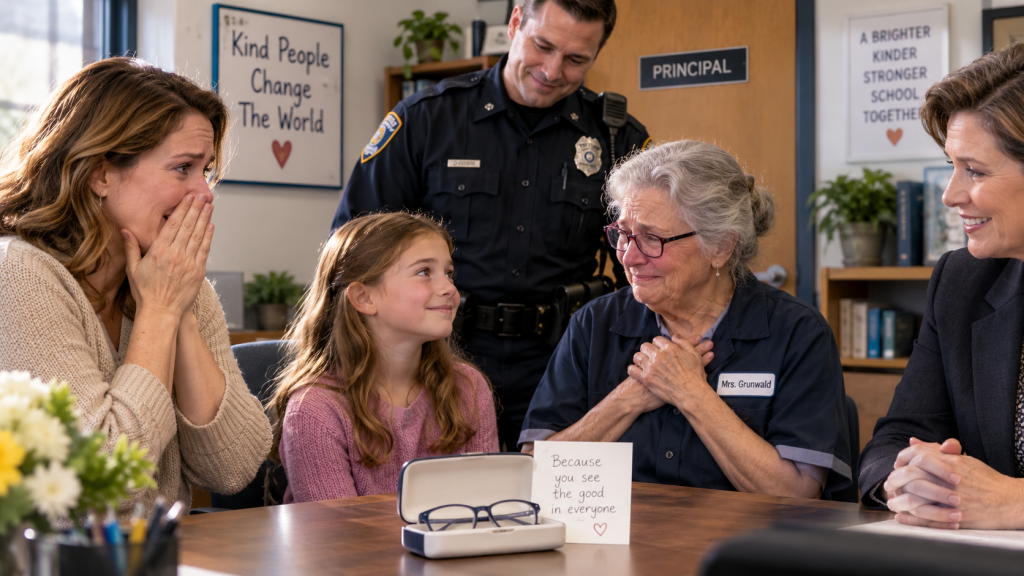
Ariel was sitting there, red as a tomato.
I asked the principal and the police officer what was going on. Mrs. Grunwald was standing beside him.
The officer let out a breath and said:
“Ma’am, do you have any idea what your daughter did for Mrs. Grunwald? Please, sit down. We need to talk.”
By the time the officer finished speaking, I wanted the ground to swallow me whole.
PART 2 — THE WOMAN MY DAUGHTER HAD BEEN SEEING ALL ALONG
The police officer pulled out the chair across from me.
“Please sit down.”
That sentence did not help.
Parents do not hear the words police officer, your child, and please sit down in the same morning without imagining every terrible possibility the mind can manufacture.
I grabbed Ariel’s shoulder.
“Is she in trouble?”
The officer’s expression changed immediately.
“No.”
I stared at him.
“No?”
“Absolutely not.”
He looked embarrassed.
“I probably should have led with that.”
The principal, Mrs. Delaney, exhaled so sharply that I realized she had been holding her breath too.
Ariel sat beside Mrs. Grunwald with her cheeks burning crimson.
Mrs. Grunwald was wearing new glasses.
Blue frames.
Simple.
Pretty.
And for the first time since I had known her, there was no tape wrapped around the bridge.
The officer looked toward her.
Then back at me.
“My name is Daniel Grunwald.”
I frowned.
Then understood.
“You’re…”
“Her son.”
Mrs. Grunwald lowered her eyes.
For some reason, that surprised me almost as much as everything else.
Daniel removed his cap.
“I’m a patrol sergeant with the county.”
He looked at Ariel.
“And I came here because my mother called me last night for the first time in almost eleven months.”
Mrs. Grunwald whispered:
“Daniel.”
He looked at her.
“I’m not embarrassing you.”
“You’re wearing a police uniform in an elementary school.”
“Fair.”
Ariel covered her mouth to hide a smile.
So did I.
The terror inside me loosened by half an inch.
Daniel continued.
“My mother called because she had something she needed to tell me.”
He looked directly at Ariel.
“About your daughter.”
I turned toward her.
Ariel stared at her shoes.
“Ariel?”
She whispered:
“I only bought the glasses.”
Mrs. Grunwald reached over and squeezed her hand.
Daniel’s face softened.
“That’s not exactly all you did.”
My stomach tightened again.
“What else did she do?”
He leaned forward.
“Your daughter has apparently been sharing her lunch with my mother for almost two months.”
I went completely still.
Slowly, I turned toward Ariel.
“What?”
Her face reddened even more.
“I didn’t share all of it.”
That was her defense.
Not denial.
Portion control.
“Ariel.”
“She liked the apple slices.”
Mrs. Grunwald closed her eyes.
I stared at my daughter.
Suddenly several arguments from the previous two months rearranged themselves in my memory.
Why are you asking for two granola bars?
You never finish your sandwich anymore.
If you’re going to waste fruit, I’m not packing extra.
Ariel had always said she was hungry later.
I assumed she was trading snacks with friends.
Or throwing food away.
I had actually lectured her about waste.
Now I wanted the carpet beneath Mrs. Delaney’s desk to open and swallow me whole.
Daniel continued carefully.
“My mother has been having a difficult year.”
Mrs. Grunwald immediately said:
“I’m managing.”
Daniel looked at her.
“You were eating saltine crackers for lunch.”
“They’re food.”
“They’re something served beside food.”
Mrs. Grunwald gave him a look that explained exactly where he had learned his stubbornness.
Ariel whispered:
“She likes peanut-butter crackers better.”
Daniel looked at her.
“You see?”
His mother sighed.
“Apparently my diet has become a committee matter.”
I looked at Mrs. Grunwald.
“Why didn’t you tell anyone?”
She gave me a small, embarrassed smile.
“What would I say?”
That question hurt.
As though difficulty required an invitation before it could be spoken.
Mrs. Delaney moved closer.
“You could have told me.”
Mrs. Grunwald’s expression changed.
“I work for you.”
“That doesn’t mean you stop being a person when you clock in.”
Mrs. Grunwald looked away.
The room became quiet.
Daniel rubbed one hand over his face.
“My stepfather, Harold, died last year.”
Mrs. Grunwald stared at him.
“Daniel.”
“It matters.”
She looked tired.
Then nodded.
Daniel continued.
Harold Grunwald had been married to his mother for thirty-two years.
He had been a machinist.
A good man, according to Daniel.
Stubborn.
Proud.
Bad knees.
Terrible singer.
The kind of man who refused to go to a doctor until refusing became more difficult than going.
By the time he was diagnosed with cancer, there were already more appointments than good days.
Mrs. Grunwald stopped taking extra time for herself.
Then Harold died.
The medical bills were not the only problem.
There were funeral expenses.
A car repair.
Rent increases.
And months when life seemed determined to charge her for remaining alive.
She picked up extra evening shifts at the school.
Cut groceries.
Cancelled things she considered unnecessary.
Including an eye appointment.
Including replacing glasses held together with clear tape.
“I was not starving.”
Mrs. Grunwald said.
Daniel looked at her.
“Nobody said starving.”
“I could buy food.”
“Then why didn’t you?”
She did not answer.
That silence contained something I recognized.
Pride.
Fear.
The belief that if you admitted one thing was becoming difficult, people might decide everything had become difficult.
I understood more than I wanted to.
Daniel turned back to me.
“Apparently Ariel noticed.”
Of course she did.
Children see differently.
Adults learn to categorize people.
Teacher.
Principal.
Custodian.
Cashier.
Neighbor.
We reduce them to the function they perform in our own day.
Children sometimes forget to do that.
To Ariel, Mrs. Grunwald was simply the woman who always bent down to tie first graders’ shoes when their teachers were busy.
The woman who kept a little container of bandages on her cart because the nurse’s office was upstairs.
The woman who remembered which children hated thunder.
Ariel had been looking at a person while the rest of us walked past a job title.
That realization embarrassed me.
“How did she know about the glasses?”
I asked.
Mrs. Grunwald smiled.
“She asked why I kept pushing them up.”
Ariel interrupted:
“They were sliding because the tape was loose.”
Mrs. Grunwald nodded.
“I told her I needed new ones.”
Ariel looked at me.
“She said she’d get them later.”
“Later?”
“After she had extra money.”
My chest tightened.
“So you gave her your savings?”
Ariel nodded.
“How much?”
She whispered:
“One hundred eighty-six dollars and forty cents.”
I stared.
Every dollar I had given her for extra cookies, juice, pencils, little school-store erasers.
Birthday money from my sister.
Coins from helping our neighbor rake leaves.
Months.
A ten-year-old had built a tiny emergency fund without even realizing that was what it was.
Then emptied it for someone else.
Mrs. Grunwald immediately said:
“I tried to give it back.”
Ariel looked offended.
“Three times.”
“Because I could not take nearly two hundred dollars from a child.”
“You did.”
Ariel reminded her.
Mrs. Grunwald frowned.
“Eventually.”
Ariel turned to me.
“She only did because I told her I would be upset if she kept wearing broken glasses.”
That sounded exactly like her.
Quiet child.
Large heart.
Absolute tyrant when convinced she was right.
Daniel reached into his pocket.
Then placed a folded piece of notebook paper on the desk.
“This was in the envelope with the money.”
I looked at Ariel.
She immediately hid half her face behind her hair.
Daniel opened the note.
Ariel’s handwriting.
Big letters.
Uneven lines.
He read:
Dear Mrs. Grunwald,
You always help everybody find things when they lose them. I want you to be able to see the things too. Please buy your glasses. This is not a loan.
From Ariel
The room became blurry.
I looked down.
Not because I was ashamed of crying.
Because I did not want my daughter to think kindness always needed tears around it.
Mrs. Grunwald touched her new frames.
“The eye clinic had my prescription on file.”
She said.
“I had already been examined several months earlier.”
She had chosen frames then.
Then discovered the final cost was more than she expected.
So she delayed picking them up.
The clinic eventually returned the frame order to inventory.
When Ariel gave her the money, Mrs. Grunwald went back.
But because enough time had passed and her vision seemed worse, the optometrist repeated part of the examination before filling the prescription.
That was when the story changed.
Daniel’s face became serious.
“They found pressure in her eyes.”
I looked at Mrs. Grunwald.
“What does that mean?”
She answered before he could.
“Glaucoma.”
My stomach dropped.
Daniel quickly added:
“It’s treatable.”
Then corrected himself.
“Manageable.”
“The doctor said the vision she’s already lost may not come back, but they caught the pressure before it did more damage.”
He looked toward Ariel.
“If she had continued putting off the appointment…”
He stopped.
No one needed the rest.
Ariel looked horrified.
“Are you going blind?”
Mrs. Grunwald immediately pulled her chair closer.
“No, sweetheart.”
“Promise?”
“I promise that I am seeing the doctor.”
Different promise.
A truthful one.
I appreciated that.
She did not tell a child nothing bad could ever happen.
She promised to take care of what could be taken care of.
Daniel’s voice became quieter.
“That is why I came.”
Ariel frowned.
“You came because of her eyes?”
“Partly.”
He smiled.
“I wanted to meet the kid who annoyed my mother into getting medical care.”
Ariel looked toward Mrs. Grunwald.
“I wasn’t annoying.”
Mrs. Grunwald said:
“You were extremely annoying.”
Ariel smiled.
Then Daniel looked at his mother.
“And because her phone call made me realize some things.”
Mrs. Grunwald’s expression changed.
This part was not about us.
I could feel it.
But Daniel continued anyway.
Maybe because some confessions are easier with witnesses.
“My mother and I have not been getting along.”
“That is a polite way to put it.”
Mrs. Grunwald murmured.
Daniel nodded.
“After Harold died, I wanted Mom to move in with me.”
She refused.
“I wanted to help with bills.”
She refused.
“I wanted access to her bank account.”
Mrs. Grunwald looked at me.
“You see why I refused.”
Daniel sighed.
“I was worried.”
“You were bossy.”
“I was worried bossily.”
Ariel giggled.
Even Mrs. Grunwald smiled.
Then Daniel’s face softened.
“I kept pushing.”
“Mom kept saying no.”
“Eventually I said if she wanted to struggle alone, I would let her.”
The smile disappeared.
“That was almost a year ago.”
Mrs. Grunwald looked at the floor.
“And I let him.”
Two stubborn people.
Two versions of love.
One wanting to help so badly he turned help into control.
The other wanting independence so badly she turned every offer into danger.
They met in the middle only after a ten-year-old noticed broken glasses.
Life has an odd sense of proportion.
Daniel looked at Ariel.
“Last night Mom called me.”
“She told me what you did.”
“She also finally told me she had been cutting meals.”
“Taking extra shifts.”
“Skipping appointments.”
He swallowed.
“I live eighteen minutes from her.”
His voice cracked.
“Eighteen.”
Mrs. Grunwald reached for his hand.
He let her.
“I thought she was fine because she kept telling me she was fine.”
She whispered:
“And I thought if I admitted I wasn’t, you’d try to take over.”
Daniel looked at her.
“I might have.”
She almost smiled.
“I know.”
Honest.
Painfully honest.
That was the moment I understood why I wanted the ground to swallow me.
Not because Ariel had done anything wrong.
Because a child had noticed what several adults had trained themselves not to see.
Mrs. Grunwald was struggling in a building full of people.
I had walked past her.
Teachers had walked past her.
Parents.
Administrators.
Children.
Daniel had lived eighteen minutes away.
And everyone had an explanation.
She seemed private.
She never complained.
She said she was fine.
There are a thousand polite ways to avoid asking one more question.
Ariel had simply asked.
Why are your glasses broken?
Sometimes compassion begins with refusing to accept the first easy answer.
Mrs. Delaney wiped her eyes.
Then turned toward Mrs. Grunwald.
“I need to say something too.”
Mrs. Grunwald groaned.
“Please don’t make this a meeting.”
“It already has a police officer.”
Mrs. Delaney replied.
“Standards have slipped.”
Even I laughed.
Then the principal became serious.
“I should have noticed the extra shifts.”
“You approved them.”
“I thought you wanted the hours.”
“I did.”
“Those things can both be true.”
Mrs. Delaney nodded.
“There are employee-assistance resources.”
“Benefit programs.”
“Leave options for medical appointments.”
“I should at least have made sure you knew.”
Mrs. Grunwald bristled.
“I don’t want charity.”
“This isn’t charity.”
Mrs. Delaney answered.
“It’s information.”
Then, crucially:
“You can decide what you use.”
I watched Mrs. Grunwald’s shoulders soften.
One sentence.
Choice restored.
It mattered.
Daniel reached into his wallet.
“I also owe Ariel money.”
Ariel immediately frowned.
“No.”
He pulled out two hundred dollars.
“No.”
she repeated.
“I’m repaying what you spent.”
“I didn’t lend it.”
“I know, but—”
“Then you can’t repay it.”
Daniel stared at her.
I almost laughed.
There are very few things funnier than watching a uniformed police sergeant lose an argument to a ten-year-old girl.
“Ariel.”
he said.
“That was your savings.”
“Yes.”
“You could use it.”
“So could she.”
Daniel looked at me for help.
I shook my head.
“You approached the wrong authority.”
Mrs. Grunwald spoke quietly.
“Ariel.”
My daughter turned.
“I would feel better if you took some of it back.”
Ariel thought.
That mattered.
She was not performing now.
Then she said:
“What if we use it for someone else?”
Everyone went quiet.
“What do you mean?”
I asked.
She shrugged.
“Like if somebody else needs glasses.”
There it was.
Children ruining adults again.
Daniel slowly returned the money to his wallet.
Mrs. Delaney said:
“We could look into whether the school already has a student-assistance fund.”
“Or partner with an existing program.”
I immediately added:
“Only if this does not become Ariel’s responsibility.”
Everyone looked at me.
I looked at my daughter.
“Kindness does not mean you have to solve every problem you notice.”
Ariel’s smile faded slightly.
“I know.”
“Do you?”
She looked uncertain.
Good.
That conversation needed more time.
Daniel stood.
“I scared you when you arrived.”
“Yes.”
“Sorry.”
“You owe me about ten years of life.”
He smiled.
“I’ll put it on my tab.”
Then he crouched slightly so he was eye level with Ariel.
“Thank you.”
She became shy again.
“For the glasses?”
“For seeing her.”
That sentence settled differently than everything else.
Mrs. Grunwald began crying.
Ariel immediately moved toward her.
This time I did not stop her.
She hugged the older woman tightly.
Mrs. Grunwald pressed one hand against the back of Ariel’s head.
And for a moment the entire office was silent.
Not the cruel kind.
The kind that makes space for what words would only crowd.
On the drive home, Ariel stared out the passenger window.
I waited until we were three blocks away.
Then:
“You’ve been giving away your lunch.”
She sank lower in the seat.
“Not all of it.”
“Ariel.”
“She didn’t take it every day.”
“That is not the point.”
“What is the point?”
Good question.
I thought.
“The point is that you are ten.”
She turned.
“So?”
“So adults are supposed to help carry adult problems.”
“But nobody was.”
That landed.
I gripped the steering wheel.
“You are right.”
She blinked.
Children never expect adults to say that quickly.
“I’m right?”
“Yes.”
“She needed help and people weren’t seeing it.”
Ariel sat straighter.
Then I continued.
“But that does not mean you become responsible for feeding her.”
Her face fell.
“I wasn’t responsible.”
“I just wanted to.”
There.
Important difference.
I softened.
“I’m proud of you.”
She looked suspicious.
“But?”
“But I need you to tell me when you see something this big.”
“Why?”
“Because some problems need adults.”
“You always say adults are busy.”
That one was mine.
I remembered.
A few months earlier, while cooking dinner, Ariel tried to tell me something about a boy in class.
I told her:
“Sweetheart, give me ten minutes. Grownups are busy sometimes.”
Apparently children file sentences in permanent storage.
I sighed.
“Busy is not the same as unavailable.”
“Sometimes it feels the same.”
I glanced at her.
Ten years old.
Already capable of saying things I had taken decades to learn.
“You’re right about that too.”
She smiled faintly.
“Two rights in one car ride.”
“Don’t get used to it.”
Then I said:
“There’s another reason.”
“What?”
“If you give away everything every time someone is hurting, eventually there will be nothing left of you to give.”
She frowned.
“That sounds selfish.”
“No.”
I thought about how to explain it.
“Imagine you have one sandwich.”
“Okay.”
“If another person has none, you can share.”
“Right.”
“But if you give away the whole sandwich every day and never eat, eventually someone will have to take care of you too.”
She considered that.
“So half?”
I laughed.
“Sometimes.”
“Sometimes you find another adult.”
“Sometimes you ask what the person actually wants.”
“Sometimes helping means listening.”
“Sometimes it means doing nothing because they said no.”
She frowned harder.
“That’s confusing.”
“Welcome to kindness.”
That evening, I opened Ariel’s savings box.
Empty.
A rectangle of lighter wood where folded bills had been.
I sat on the edge of her bed.
She was brushing her teeth.
I felt an almost irresistible urge to refill it.
Two hundred dollars.
Maybe more.
Reward her.
Prove I was proud.
Then I stopped.
Would that turn generosity into a transaction?
You did something good.
Here is your prize.
So instead I waited.
When she came back, I asked:
“Do you want to start saving again?”
She shrugged.
“Probably.”
“For anything?”
“A telescope.”
That surprised me.
“A telescope?”
“I want to see Saturn.”
Of course she did.
A child who noticed everything nearby also wanted to look farther away.
We made a plan.
Not a reward.
She would save.
I would match part of it for chores beyond her normal responsibilities.
Her money would become hers again.
Not a permanent emergency fund for the world.
Two days later, Mrs. Grunwald returned to school after her ophthalmology appointment.
Medication first.
More testing.
No immediate surgery.
The doctor told her the pressure was responding.
Daniel drove her.
Not because she surrendered her independence.
Because she asked.
That distinction delighted him more than he admitted.
Mrs. Delaney helped her meet privately with the district benefits coordinator.
There were resources she had not known about.
Nothing magical.
No giant check.
No sudden retirement package.
Just small pieces of help.
A reduced-cost medication program.
A review of available leave.
A community transportation service for appointments if she could not drive after certain procedures.
The kind of support that rarely becomes inspirational news because it mostly consists of forms.
Forms can be mercy too.
I began seeing Mrs. Grunwald differently after that.
Or maybe I simply began seeing her.
Her first name was Helena.
I had known her for three years and had not known that.
She liked mystery novels.
Hated bananas.
Had six houseplants and named all of them after dead movie stars.
Her favorite was a pothos named Humphrey.
She had been born in Wisconsin.
Met Harold at a bowling alley.
Once won seventy-four dollars in a radio contest.
None of these facts were relevant to how well she cleaned a hallway.
That was exactly why they mattered.
A week later, the school district communications office heard about Ariel.
Mrs. Delaney called me.
“They want to feature the story in the newsletter.”
My first emotion was pride.
My second was caution.
“Has anyone asked Helena?”
Silence.
Then Mrs. Delaney said:
“No.”
I smiled.
“We’re learning.”
“Yes.”
She sounded embarrassed.
“Ask her first.”
They did.
Helena said no.
So the story did not run.
That should not feel remarkable.
It did.
Her hardship was not community property simply because it inspired people.
Ariel was disappointed for approximately seven minutes because she thought a newsletter might be exciting.
Then I explained.
“Would you want the whole school knowing if you couldn’t afford something?”
She thought.
“No.”
“Exactly.”
“But I wouldn’t mind if they knew I helped.”
I raised an eyebrow.
She sighed.
“Okay, okay.”
Ten-year-olds remain human even when generous.
Good.
Unfortunately, rumors did not need newsletters.
Children talk.
Parents talk more.
Someone had seen the patrol car.
Someone heard something about glasses.
By Friday, three teachers had quietly offered Helena gift cards.
A parent left groceries near the custodian’s closet.
Someone put a twenty-dollar bill inside an envelope marked:
FOR MRS. G.
Kind.
Well meant.
And, as it turned out, painful.
Helena returned every gift.
The groceries too.
Then she stopped eating in the staff room.
Ariel noticed before I did.
Of course.
“Mrs. Grunwald doesn’t sit with anyone now.”
she said one evening.
My chest tightened.
“Why?”
“She says she likes eating alone.”
“Maybe she does.”
Ariel gave me a look.
Ten-year-olds can detect adult nonsense with frightening efficiency.
“She doesn’t.”
I sighed.
“What do you think is wrong?”
“People are being weird.”
“How?”
“They keep asking if she needs stuff.”
“Isn’t that nice?”
“No.”
Ariel frowned.
“They ask in the voice.”
“What voice?”
She imitated an exaggerated whisper.
“‘Helena, are you sure you’re okay?’”
I winced.
I knew that voice.
The voice adults use when concern accidentally becomes spectacle.
The next morning, I asked Mrs. Delaney if I could speak with Helena.
Not surprise her.
Ask.
She checked.
Helena agreed.
We met after school.
No police.
No principal.
No Ariel.
Just the two of us on a bench near the playground.
Helena wore her blue glasses.
They made her look younger.
Or maybe I was simply seeing her eyes clearly now.
“I’m sorry.”
I said.
She looked confused.
“For what?”
“For becoming part of a story you didn’t ask to tell.”
She looked toward the swings.
“That isn’t your fault.”
“No.”
“But I think we’re all so impressed by Ariel that we forgot your difficult year belongs to you.”
Helena said nothing.
So I waited.
Finally she whispered:
“I hate pity.”
“I know.”
“No.”
She looked at me.
“I really hate it.”
I smiled.
“Fair.”
“Yesterday Mrs. Novak offered me twelve frozen casseroles.”
“Twelve?”
“She belongs to a church.”
“Ah.”
Helena laughed despite herself.
Then became serious.
“I worked all my life.”
“I raised two children.”
“I buried a husband.”
“I know how to stretch a dollar.”
“Now people look at me like I’ll break if they don’t put groceries beside my mop bucket.”
My heart hurt.
“Have you told them to stop?”
“Some.”
“And?”
“They say they’re just trying to help.”
The eternal defense.
Good intention as immunity from listening.
“What do you want?”
I asked.
Helena looked at me.
The question seemed to surprise her.
“Right now?”
“Yes.”
“I want everybody to stop talking about me.”
“Okay.”
“I want Ariel to know I love my glasses.”
“She knows.”
“I want Daniel to call, but not four times a day.”
I laughed.
“I can’t help you there.”
“No one can.”
Then she looked down.
“And I want to finish the school year without being the poor old janitor everybody rescued.”
“Custodian.”
She smiled.
“Thank you.”
I went home thinking the problem was becoming smaller.
That was my mistake.
Three days later, Mrs. Delaney called.
Again.
This time no police officer.
Her voice still sounded wrong.
“Can you come by after pickup?”
“What happened?”
“It’s Helena.”
My stomach tightened.
“Her eyes?”
“No.”
Then:
“She resigned.”
I stopped walking.
“What?”
“This morning.”
“Why?”
“She won’t really tell me.”
I immediately thought of the gifts.
The whispers.
The pity.
The story we had almost turned her into.
“Did someone say something?”
“Not that I know.”
“Did Daniel?”
“No.”
“Then why?”
Mrs. Delaney sighed.
“I was hoping Ariel might know.”
I looked toward the school doors.
My daughter was walking out with her backpack bouncing behind her.
No.
I had learned something.
“Ariel is ten.”
I said.
“We are not making her responsible for fixing this.”
A pause.
Then Mrs. Delaney answered quietly:
“You’re right.”
Good.
We were all learning.
I did not ask Ariel to investigate.
I asked Helena whether I could visit.
She said no.
The next day, she called back.
“Yes.”
So Saturday afternoon, I drove to her apartment.
Daniel’s truck was not there.
Neither was anyone else’s.
Helena opened the door wearing an old green sweater and the new blue glasses Ariel had helped buy.
Behind her were cardboard boxes.
Everywhere.
Living room.
Hall.
Kitchen.
My stomach dropped.
“You’re moving?”
She gave me a tired smile.
“Yes.”
“Where?”
She looked away.
I stepped inside only after she moved aside.
There were almost no decorations left on the walls.
Humphrey the pothos sat on the windowsill inside a cardboard produce box.
“You quit because you’re moving?”
“Partly.”
“Why didn’t you tell Daniel?”
Her face changed.
“He knows I’m leaving the apartment.”
“Then why does everyone think you resigned because of the attention?”
She smiled sadly.
“Because that explanation is less embarrassing.”
I stared at her.
“Helena.”
She sank into a chair.
Then pointed toward an envelope on the table.
I did not touch it.
Another lesson.
“What is it?”
I asked.
“My building was sold.”
“When?”
“Two months ago.”
“The new owner is renovating.”
My heart sank.
“They gave notice?”
She nodded.
“Lawfully?”
“As far as I know.”
“When do you have to be out?”
She looked at the clock.
Then at the boxes.
“Friday.”
Six days.
“Where are you going?”
Silence.
“Helena?”
Her eyes filled.
“I don’t know yet.”
That sentence chilled me.
“What about Daniel?”
“He wants me with him.”
“Why not go?”
“Because we just started speaking again.”
She laughed bitterly.
“I’m not moving into his house because a ten-year-old bought me glasses and everyone decided this is the chapter where I surrender.”
“That isn’t what moving in means.”
“To him?”
“Maybe not.”
“To me?”
She touched her chest.
“It might.”
There it was.
The problem underneath every other problem.
Help that feels like ownership.
Independence that sometimes becomes isolation.
Pride standing guard so long it forgets what it is protecting.
“Why resign?”
I asked.
She looked at the boxes.
“Because I can’t afford another place close to the school.”
“I found one forty minutes away.”
“The rent is lower.”
“But the bus schedule would make the evening shift impossible.”
“So I gave notice.”
My chest tightened.
The glasses had not fixed her life.
Kindness rarely does.
It fixes one thing.
Then life remains.
Bills.
Housing.
Pride.
Distance.
Work.
Love.
All waiting.
“You should tell Daniel.”
“I will.”
“When?”
She frowned.
“Eventually.”
I nearly laughed.
That was exactly how the glasses had begun.
Later.
Next month.
Eventually.
A word people use when today feels too frightening.
Then she reached into a drawer.
Pulled out an envelope.
On the front, in careful handwriting:
ARIEL
“What is that?”
I asked.
Helena looked at it.
“My resignation isn’t the only thing I haven’t told anyone.”
My stomach tightened.
“What do you mean?”
She held the envelope in both hands.
Then whispered:
“The day Ariel gave me that money, I went home and made a decision.”
“What decision?”
Helena looked through the window toward the parking lot.
“I called someone I had not spoken to in thirty-seven years.”
I stared.
“Who?”
She turned toward me.
Her eyes filled behind the blue frames.
“My daughter.”
I stopped breathing.
Daniel had never mentioned a sister.
Helena continued.
“She was seventeen when she left.”
“I have not seen her since.”
“And yesterday…”
Her voice broke.
“…she called me back.”
The apartment went silent.
I looked at the envelope with Ariel’s name.
Then at the woman my daughter had noticed before any of us did.
Helena pressed one hand against her mouth.
And I understood that Ariel’s gift had never really been about glasses.
It had opened a door Helena had kept closed for nearly four decades.
A door no amount of money could repair by itself.
And on the other side of it was a daughter who had just asked one question:
“Mom, after thirty-seven years, why are you calling me now?”
PART 3 — THE THINGS WE FINALLY LEARNED TO SEE
Helena’s daughter was named Caroline.
I learned that while sitting among half-packed boxes in Helena’s apartment, with Humphrey the pothos resting between us in a produce crate and six days remaining on her lease.
“Caroline Grunwald?”
I asked.
Helena gave me a sad smile.
“Not anymore.”
Of course.
Thirty-seven years is long enough for a name to change.
A marriage.
Children.
Divorce.
Another marriage.
An entire life.
Helena folded Ariel’s envelope carefully between both hands.
“She’s Caroline Bennett now.”
“Where does she live?”
“About three hours away.”
My heart tightened.
Not across the country.
Not another continent.
Three hours.
A distance people drive for concerts.
Airports.
Thanksgiving.
Yet mother and daughter had spent almost four decades on opposite sides of a silence shorter than an afternoon highway.
“Why haven’t you spoken?”
I asked.
Helena looked toward the window.
“That answer depends on which year you ask me.”
I waited.
She sighed.
“If you had asked me twenty years ago, I would have said because Caroline was stubborn.”
“Ten years ago, I would have said because too much time had passed.”
“Five years ago, I would have blamed her father.”
“And now?”
She looked at me.
“Now I think I finally know the answer.”
“What is it?”
“Because I was too proud to call first.”
Caroline had been seventeen when everything broke.
Helena had been thirty-seven.
Younger than I was when Ariel was born.
That startled me.
We imagine older people were always old.
As though Mrs. Grunwald had entered the world at sixty-five with a custodian’s cart and a cardigan.
She had once been a frightened young mother too.
Helena’s first husband, Robert, was Daniel and Caroline’s biological father.
“He wasn’t evil.”
Helena said carefully.
That sentence told me the rest would be complicated.
“He worked.”
“He loved the children.”
“He never hit me.”
Then she paused.
“But the whole house had to match his mood.”
I understood.
Some homes are controlled without a fist ever being raised.
“What happened?”
“Caroline started dating a boy Robert hated.”
Helena looked embarrassed even now.
“His name was Michael.”
“He was eighteen.”
“Worked at a garage.”
“Had long hair.”
“Robert thought long hair was evidence of criminal intent.”
Despite everything, I smiled.
Helena did too.
Then her expression fell.
“Caroline wanted to study art.”
“Robert said there was no money for nonsense.”
“She wanted community college.”
“He told her she needed a practical job.”
“She argued.”
“He shouted.”
“I told both of them to stop.”
That last sentence came out quietly.
“I spent years believing telling both sides to stop made me neutral.”
“But it didn’t.”
“No.”
The final argument happened over Caroline’s application to an art program.
Robert found it.
Tore it up.
Caroline screamed at him.
Robert told her that if she hated his rules so much, she could leave when she turned eighteen.
She was seventeen years and eleven months old.
Helena was in the kitchen.
Close enough to hear everything.
“What did you do?”
I asked.
Helena looked down.
“Nothing.”
The word barely came out.
I said nothing.
She continued.
“Caroline came into the kitchen afterward.”
“She was shaking.”
“She asked me, ‘Are you going to let him talk to me like that?’”
Helena’s eyes filled.
“And I told her…”
She stopped.
“What?”
“I said, ‘Your father is angry. Don’t make this worse.’”
There are sentences people regret immediately.
Others wait decades before revealing what they cost.
Helena’s had waited thirty-seven years.
Caroline packed a bag that night.
Went to a friend’s house.
Then left town with Michael after graduation.
She sent one postcard six months later.
Helena answered.
Caroline never replied.
Then Robert told Helena:
“If she wants to live like we’re dead, let her.”
Helena listened.
Again.
Years passed.
Caroline married Michael.
Daniel learned through a cousin.
They had a daughter.
Then another child.
Helena knew because relatives talked.
She kept addresses.
Christmas cards she never mailed.
Birthday cards for grandchildren she had never met.
“What happened after Robert?”
I asked.
“He died when Daniel was twenty-six.”
“Then Harold came later?”
Helena nodded.
“Harold was kind.”
“Did he know about Caroline?”
“Yes.”
“Did he encourage you to call?”
“Constantly.”
“What did you say?”
“That she had my number.”
I closed my eyes.
Pride is an astonishing thing.
It can sit beside love for decades and convince itself it is dignity.
“Why call now?”
I asked.
Helena touched her blue glasses.
“Ariel.”
I stared.
“What does Ariel have to do with Caroline?”
“Nothing directly.”
She smiled sadly.
“That was the problem.”
I waited.
Helena looked at the envelope.
“A ten-year-old girl noticed my broken glasses.”
“She asked what I needed.”
“She saved money without telling anybody because she thought helping mattered.”
“And I kept thinking…”
Her voice broke.
“What?”
“That if a child could risk being rejected over a pair of glasses, why was I still waiting for my own daughter to do the harder thing first?”
I swallowed.
Helena continued.
“I had told myself Caroline abandoned me.”
“For thirty-seven years.”
“But she was seventeen.”
“I was the mother.”
That distinction sat between us.
Simple.
Devastating.
“So you called.”
“Yes.”
“How did you get her number?”
“Daniel had it.”
I stared.
“He had Caroline’s number?”
“For eleven years.”
Now I was angry.
“What?”
Helena winced.
“He found her online.”
“Did he talk to her?”
“Yes.”
I nearly stood.
“Helena.”
“I know.”
“You knew?”
“Eventually.”
“How long?”
“Seven years.”
I stared.
Families are apparently capable of creating enough secrets to require municipal zoning.
“Why didn’t Daniel give you the number?”
“He offered.”
“And?”
“I said if Caroline wanted me, she knew where I was.”
I covered my face.
Helena sighed.
“I know how it sounds.”
“Do you?”
“Yes.”
“Good.”
Daniel and Caroline had rebuilt a cautious relationship years earlier.
Birthday texts.
Occasional phone calls.
One lunch when Daniel attended training near her city.
Caroline had asked about Helena.
Every time.
But she never asked for the number.
Neither did Helena.
Two grown women standing on opposite banks of the same river, each waiting for the other to build the bridge.
Then Ariel bought a pair of glasses.
And Helena finally got tired of pretending waiting was principled.
“What did you say when Caroline answered?”
I asked.
“She didn’t.”
My heart sank.
“I left a voicemail.”
“What did you say?”
Helena looked embarrassed.
“Nothing good.”
“Meaning?”
“I said, ‘Caroline, it’s your mother. I don’t know if this is still your number. You don’t have to call me back.’”
I groaned.
“What?”
“You gave her an escape before saying why you called.”
“I panicked.”
“You are impossible.”
“I’m old.”
“That excuse is getting crowded.”
Helena laughed.
Then her eyes filled again.
“She called back yesterday.”
“What did she say?”
“At first?”
“Yes.”
“‘Mom, after thirty-seven years, why are you calling me now?’”
I swallowed.
“And what did you tell her?”
“The truth.”
“What truth?”
“That I should have called thirty-seven years ago.”
That was apparently when Caroline started crying.
Then Helena cried.
Neither of them became eloquent.
No cinematic reconciliation.
No perfect speech.
They talked for nineteen minutes.
Mostly badly.
Helena apologized.
Caroline said she had waited years for that apology and hated that hearing it still mattered.
Helena told her she understood.
Caroline said:
“No, you don’t.”
Helena did not argue.
That, more than anything, made me think they had a chance.
“Is she coming?”
I asked.
Helena stared at the envelope.
“Tomorrow.”
My breath caught.
“To see you?”
“Yes.”
“Here?”
“Yes.”
“Does Daniel know?”
“No.”
“Helena.”
“I’m telling him tonight.”
“Good.”
Then she looked frightened.
More frightened than when discussing housing.
“What if she hates me?”
I thought about Ariel.
About the way children understand truths adults bury beneath strategy.
“She might.”
Helena stared.
That was not the comfort she expected.
I continued.
“She might love you too.”
“She can do both.”
Helena’s eyes filled.
“Wouldn’t that be exhausting?”
“Yes.”
“That’s family.”
I left before dinner.
On the drive home, I decided not to tell Ariel.
Not yet.
Caroline’s return was not a reward Ariel had earned.
It belonged first to Helena.
That was becoming important to me.
When I got home, Ariel was sitting at the dining table drawing Saturn.
Not a particularly accurate Saturn.
Purple rings.
Stars large enough to collide with planets.
I set my keys down.
“How was school?”
“Fine.”
“How’s Mrs. Grunwald?”
Ariel looked up.
“She wasn’t there.”
“I know.”
“Is she quitting?”
I hesitated.
“Yes.”
Ariel’s face fell.
“Because everybody was weird?”
“Partly.”
“Is she mad at me?”
“No.”
“Are you sure?”
“Yes.”
I sat across from her.
“Sometimes something kind changes more things than the person doing it can control.”
She frowned.
“Did I make it bad?”
“No.”
I reached for her hand.
“You helped with the problem you saw.”
“Her glasses.”
“Yes.”
“Then adults found other problems.”
“That doesn’t make them yours.”
Ariel stared at Saturn.
“I wish helping was easier.”
“Me too.”
Daniel called me that night.
That surprised me.
“I just spoke with Mom.”
His voice sounded strange.
“She told you about Caroline?”
“Yes.”
He exhaled.
“She’s coming tomorrow.”
“I know.”
“I don’t know whether I should be there.”
Good question.
Not:
I’m coming.
Not:
Mom needs me.
Should I?
Growth already.
“What did Helena say?”
“She said she doesn’t know.”
“Then ask Caroline.”
Silence.
“That obvious?”
“In retrospect.”
He laughed.
“I’m apparently bad at family.”
“Everyone is.”
Caroline wanted Daniel there.
But not at first.
They agreed he would arrive one hour after she did.
No ambush.
No family reunion staged before the two people most injured had spoken alone.
I respected that enormously.
The next afternoon, I did not go.
Also important.
Helena called me at nine that evening.
Her voice sounded exhausted.
“She came.”
“How was it?”
“Horrible.”
My heart sank.
Then Helena added:
“And good.”
There it was.
Real life.
Caroline was fifty-four.
She had Helena’s eyes.
That was the first thing Helena told me.
Same green around the edges.
Same habit of touching the side of her face when nervous.
Caroline arrived carrying no flowers.
No gift.
Just herself.
They stood in the apartment entrance for almost a minute.
Then Helena said:
“You look like my mother.”
Caroline answered:
“I barely remember Grandma.”
Wrong opening.
Honest.
They went inside.
Caroline did not hug her mother.
Not immediately.
She asked to sit.
Then said:
“I need you to understand something before we do anything else.”
Helena told me she nearly fainted from fear.
“What?”
I asked.
“Caroline said she did not come because she was ready to pretend we lost each other by accident.”
I became still.
Helena continued.
“She said, ‘I left because Dad was cruel to me and you asked me to make it easier for him.’”
I closed my eyes.
“And?”
“I told her she was right.”
Good.
No defense.
No:
Your father was difficult.
No:
I was trapped too.
Just right.
Caroline told Helena she had waited after Robert died.
She thought:
Now Mom will call.
Helena did not.
Then she had her first child.
Thought motherhood might soften whatever wall remained.
Nothing.
Her second child was born.
Still nothing.
Eventually Caroline decided the silence was the answer.
That her mother had chosen the family that remained.
Daniel.
Harold.
Life without her.
Helena cried.
But she did not say:
That’s not what I meant.
Because intention no longer changed what thirty-seven years had felt like.
Then Helena apologized.
Not for “everything.”
Specific things.
For staying silent when Robert tore the application.
For telling Caroline not to make him angrier.
For letting seventeen-year-old pride carry responsibilities that belonged to a mother.
For allowing Robert’s rule—
If she wants us, she’ll call—
to become her own.
For waiting after his death.
For every birthday card written and never mailed.
Caroline listened.
Then asked:
“Why didn’t you send them?”
Helena answered:
“Because if you didn’t respond, I would know for certain you didn’t want me.”
Caroline cried.
Then said:
“So you made me live with that uncertainty instead.”
That sentence broke Helena.
It should have.
Daniel arrived an hour later.
Caroline hugged him immediately.
Helena said that hurt.
Then added:
“It should not have.”
Both true.
Daniel brought food.
Nobody ate much.
They talked until nearly midnight.
Not only about old pain.
Caroline’s husband.
Her children.
Harold.
Daniel’s work.
Recipes.
Ordinary things sneaking into the cracks around grief.
That is often how reconciliation begins.
Not with resolution.
With enough safety to discuss weather after discussing abandonment.
“Did she hug you?”
I asked.
Helena went quiet.
“At the door.”
“When she left?”
“Yes.”
I smiled.
“She said, ‘I don’t know what happens next.’”
“What did you say?”
“‘Neither do I.’”
Excellent.
No promise.
No demand.
No:
Call me tomorrow.
Just room.
Then I remembered the boxes.
“Where are you moving?”
Helena sighed.
There it was.
Reconciliation does not cancel rent.
Daniel offered his house again.
This time differently.
Not:
You’re moving in.
He asked:
“Would you like to stay with me temporarily while you decide?”
Helena almost refused on reflex.
Caroline stopped her.
Not because Caroline wanted Daniel to take over.
Because she asked one useful question.
“Mom, are you saying no because his house would be wrong for you, or because accepting help feels like losing?”
Helena hated the question.
Which meant it was probably good.
She accepted.
Temporarily.
Six weeks.
Her own bedroom.
No access to her bank accounts.
No Daniel managing her medication unless she asked.
No selling her furniture while she was asleep.
Daniel laughed when she listed that.
Apparently he had learned too.
They wrote nothing down.
But they said it clearly.
Sometimes boundaries need paperwork.
Sometimes conversation is enough.
The difference is whether both people are actually listening.
Mrs. Delaney did not let Helena disappear quietly.
But she also did not organize a surprise assembly.
Progress.
She asked what Helena wanted.
Helena agreed to a small retirement coffee after school.
No speeches from children.
No public story about poverty.
No giant fundraiser.
Just staff.
Cake.
A card.
A little plant from Ariel.
A pothos.
Of course.
Ariel named it Ingrid Bergman.
Helena said Humphrey finally had company.
At the gathering, Ariel stayed close to me.
Mrs. Delaney said only:
“Helena has taken care of this building and the people in it for twelve years.”
No mention of broken glasses.
No pity.
No rescue.
Then Helena stood.
I worried.
She hated speeches.
She looked at Ariel.
“Come here.”
Ariel froze.
“Me?”
“Yes, you.”
Ariel walked forward.
Helena removed her blue glasses.
Held them in one hand.
Then said:
“This young lady gave me these.”
Ariel immediately looked at me.
I could see the question.
Is this okay?
Helena had chosen to tell it.
So I nodded.
Helena continued.
“She thought she was helping me see.”
A few people smiled.
“She did.”
Then her voice trembled.
“But not only because of the prescription.”
The room became still.
“I had become very good at making my life look fine.”
“Most adults are.”
A few nervous laughs.
“I thought independence meant never letting anybody know when something hurt.”
“I was wrong.”
Then she looked at Ariel.
“This child did not fix my life.”
I loved her for saying that.
“She did something smaller.”
“She noticed me.”
Ariel’s eyes filled.
Helena put the glasses back on.
“And sometimes being noticed is what reminds you that you still have choices.”
No more.
Perfect.
Ariel hugged her.
Then whispered something.
Later I asked what.
She said:
“I told her she still has to eat lunch.”
Naturally.
Helena moved into Daniel’s house that weekend.
Caroline came too.
Not to reclaim thirty-seven years in two days.
To help carry boxes.
That was all.
She and Helena argued over which dishes to keep.
Apparently estranged daughters can become ordinary daughters very quickly when confronted with excess casserole pans.
At one point Caroline held up a cracked serving bowl.
“Why do you still have this?”
“Your grandmother gave me that.”
“It’s broken.”
“So are you.”
Helena said.
Silence.
Then both women laughed.
Daniel told me the story later.
That laugh meant more than any apology.
Not because the past disappeared.
Because humor had reentered the room.
The housing problem took longer.
Daniel wanted Helena near him.
Caroline wanted Helena to consider moving closer to her.
Helena almost let their preferences become a new battle over her.
Then stopped everyone.
“I am not a timeshare.”
Good.
She worked with the county senior-housing counselor Mrs. Delaney’s benefits coordinator had connected her to.
They reviewed options.
Not charity.
Not children deciding.
Options.
She qualified for a modest income-adjusted senior apartment about twenty minutes from Daniel and thirty-five from the school.
One bedroom.
Elevator.
Small balcony.
Waiting list.
Three months.
So six weeks at Daniel’s became twelve.
Then fourteen.
Helena complained every day after week seven.
Daniel said this was reassuring because it proved she felt at home enough to be difficult.
During those months, Caroline visited twice.
Then Helena visited Caroline.
That was harder.
Caroline had two adult children.
Helena’s grandchildren.
Megan, thirty-one.
Luke, twenty-eight.
They knew Helena existed.
Of course they did.
Children always know the outline of family absences even when adults refuse to color them in.
Caroline had never taught them to hate their grandmother.
But neither had she softened what happened.
Megan hugged Helena.
Luke shook her hand.
That difference hurt.
Helena accepted it.
Good.
Nobody owed her identical affection because biology matched.
At dinner, Luke asked:
“Why now?”
Helena answered:
“Because I waited too long already.”
He nodded.
Nothing more.
Later, Megan showed Helena photographs.
School.
Graduation.
Wedding.
A little boy.
Helena’s great-grandson.
Four years old.
His name was Henry.
Helena cried when she saw him.
Caroline said:
“Please don’t make this about everything you missed.”
That sounded harsh.
It was also fair.
Helena wiped her face.
“You’re right.”
Then asked:
“What does Henry like?”
Different question.
Present tense.
That was better.
Over the next year, the family did something extraordinary.
Nothing dramatic.
They called.
Sometimes.
Visited.
Sometimes.
Missed calls.
Got irritated.
Caroline went six weeks without responding once because work became chaotic.
Old Helena would have interpreted silence as rejection.
New Helena sent:
Thinking of you. No pressure. Call when you can.
Caroline replied two days later:
Thank you for not making me feel guilty.
Thirty-seven years of silence does strange things to ordinary gaps.
They had to learn the difference.
Daniel changed too.
He stopped calling four times a day.
Mostly.
One evening Helena told me:
“He only called twice.”
“Progress.”
“He says police work trains him to imagine emergencies.”
“Motherhood does the same.”
“Terrible occupations.”
Yes.
Ariel kept saving for the telescope.
Slowly.
I matched her extra chores.
Not the things she should already do.
Making her bed did not earn money.
Helping Mrs. Carter next door gather leaves did.
Organizing books for my friend’s yard sale did.
By spring, Ariel had enough.
We went shopping.
She chose a beginner telescope.
Not the most expensive one.
Not the cheapest.
The first clear night, we set it up in the backyard.
It took forty minutes and three arguments.
Then Saturn appeared.
Tiny.
Bright.
Rings unmistakable.
Ariel gasped.
“Oh.”
One sound.
That was all.
Wonder rarely needs grammar.
I looked through after her.
A pale dot with impossible rings.
Something enormous made small by distance.
It reminded me of people.
How much disappears when we only see someone from far away.
Custodian.
Police officer.
Old woman.
Difficult daughter.
Helpful child.
Mother.
Labels reduce entire lives into something the mind can hold.
Then sometimes we look closer.
And there are rings.
Scars.
Stories.
Whole worlds where we thought there was only a point of light.
Helena came over to see the telescope a week later.
She brought Caroline.
That was the first time I met her.
She looked like Helena around the eyes.
Exactly as promised.
Caroline hugged Ariel.
Not too dramatically.
“Thank you for being kind to my mom.”
Ariel immediately became uncomfortable.
“It was just glasses.”
Caroline smiled.
“I know.”
That answer mattered.
No one placed thirty-seven years on Ariel’s shoulders.
Good.
Helena looked through the telescope.
Saw nothing.
“Move your head.”
Ariel said.
“I am.”
“No, like this.”
“I have glaucoma, not stupidity.”
“Mrs. Grunwald.”
“I’m kidding.”
Eventually she saw Saturn.
She stood still.
Then whispered:
“Harold would have loved this.”
Her eyes filled.
Caroline touched her shoulder.
Not a hug.
Just touch.
Sometimes intimacy returns one finger at a time.
Months passed.
Helena got the apartment.
She refused Daniel’s offer to buy furniture.
Accepted his help moving it.
Important difference.
Caroline gave her a lamp.
Helena accepted.
Megan sent framed family photographs.
Luke called once and asked whether she knew how to make Caroline’s childhood cinnamon rolls.
Helena cried after the call.
Then mailed him the recipe.
No conditions.
No history lesson.
Just cinnamon rolls.
Some families rebuild through flour.
Mrs. Delaney found Helena occasional substitute work at the school after she formally retired from custodial staff.
Not cleaning.
Helping supervise after-school pickup a few afternoons when someone was absent.
Helena liked seeing the children.
Did not need the income as desperately after her housing expenses stabilized and benefits were reviewed.
She also started volunteering at the public library once a week.
She claimed it was because books rarely spilled juice on floors.
I believed her.
The school eventually created a small emergency assistance partnership with an existing community nonprofit.
Not Ariel’s Fund.
I refused.
So did Helena.
Children should not become brands because they do something kind once.
The partnership quietly helped staff and families access optometry vouchers, food support, transportation assistance, and other existing services.
No giant donation jar.
No photographs of recipients.
No public gratitude required.
Just help with fewer barriers.
That felt right.
Ariel contributed twelve dollars from her savings one year later.
Twelve.
Not everything.
I did not match it.
Did not praise her for ten minutes.
I only asked:
“Are you sure?”
She nodded.
“I already have Saturn.”
I smiled.
“Okay.”
Then we put the twelve dollars in the envelope.
Her choice.
Not identity.
That mattered.
When Ariel turned twelve, Helena came to her birthday.
So did Daniel.
Caroline drove down.
Nobody arrived in uniform.
Ariel had specifically requested that.
Daniel said:
“I own normal shirts.”
We had doubted it.
Helena gave Ariel a small wrapped box.
Inside was a magnifying glass.
Antique-looking brass handle.
Ariel frowned.
“What’s this for?”
Helena smiled.
“For seeing things people miss.”
Ariel looked at me.
“That feels like homework.”
Everyone laughed.
Then Helena gave her a second envelope.
Not money.
A letter.
Ariel read it later.
She let me see it only years afterward.
It said:
Dear Ariel,
You once gave me your savings because you thought I needed glasses. You were right about the glasses and wrong about one thing. I did not need a child to save me. I needed to remember that asking for help did not make me helpless.
Please keep being kind. But remember that a kind heart is not a public utility. You are allowed to keep things for yourself. You are allowed to ask adults for help. You are allowed to care about someone without becoming responsible for everything that happens to them.
You helped me see that.
Love, Helena
I cried the first time I read it.
Ariel rolled her eyes.
“You cry at everything.”
True.
Years later, Helena’s glaucoma progressed a little.
Not catastrophically.
Medication.
Monitoring.
One procedure.
She stopped driving at night before anyone told her to.
Daniel offered rides.
Sometimes she accepted.
Sometimes she used the community van.
Sometimes Caroline came.
Choice.
Always choice.
The blue glasses were eventually replaced.
Ariel was furious.
“What happened to the ones I bought?”
“They were scratched.”
“You could have kept them.”
“I did.”
Of course she had.
Helena stored them in a drawer.
Not as a monument.
Just something she loved.
Caroline and Helena never became the mother and daughter they might have been if those thirty-seven years had gone differently.
That is important.
There was no recovery of Caroline’s wedding.
Pregnancies.
First houses.
Sleepless nights with babies.
Helena did not get those years back because she finally apologized beautifully.
Time is not a bank that returns principal when regret becomes sincere.
But they got new years.
Coffee.
Birthdays.
A beach weekend that went badly because Helena hated sand.
One Christmas when Caroline burned the ham and Helena ate it without criticism.
That might have been their greatest achievement.
Ordinary mercy.
Daniel and Caroline became closer too.
Their relationship no longer required him to be the secret bridge between two women refusing to cross.
He told me once:
“I spent years thinking keeping them separate was protecting both of them.”
“What changed?”
“A ten-year-old bought Mom glasses.”
He smiled.
“Apparently that kid causes administrative problems everywhere she goes.”
I laughed.
Ariel would have appreciated that.
As for me, I changed too.
I stopped cleaning Ariel’s room without asking.
That may sound small.
It was not.
The savings box had taught me something.
Children deserve private corners too.
Not secrecy from safety.
Privacy.
Different.
I also started listening when Ariel said:
“Something feels weird.”
Not always fixing.
Not always dismissing.
Listening.
The phrase grownups are busy permanently left my household.
Good riddance.
When Ariel was fifteen, she came home upset because a friend was skipping lunch.
My entire body wanted to leap into action.
Call parents.
Call school.
Pack food.
Save everyone.
Instead I asked:
“Do you know why?”
“No.”
“Did she ask for help?”
“No.”
“Are you worried she isn’t safe?”
“I don’t know.”
So we talked.
She spoke to a counselor.
Adults handled what needed handling.
Ariel remained a friend.
That was exactly the balance I had hoped she would learn.
Kindness with support.
Compassion without ownership.
Helena was eighty-two when she retired from everything for real.
No substitute work.
No library shifts.
She said:
“I am finally committed to being useless.”
I told her:
“Good luck.”
She failed immediately.
Baked cinnamon rolls for everyone in her building.
Helped one neighbor organize photographs.
Started a mystery-novel group.
Some people cannot stop contributing.
The difference was that now contribution did not decide their worth.
Ariel visited her before leaving for college.
She was eighteen.
Tall.
Still quiet.
Still capable of noticing what most people walked past.
Helena sat by the window.
Her hair completely white.
Blue glasses resting on the side table.
Not the original pair.
The old ones were in the drawer.
Ariel asked:
“Do you remember when the police came looking for me?”
Helena laughed.
“Your mother looked ready to fight an entire department.”
“I was terrified.”
I said.
Daniel, who happened to be there, answered:
“I apologized.”
“Not enough.”
He smiled.
Helena looked at Ariel.
“Do you remember what you bought me?”
“Glasses.”
“No.”
Ariel frowned.
“That was literally what I bought you.”
Helena smiled.
“You bought me an interruption.”
We both stared.
She continued.
“I had a whole story about my life.”
“That I was alone because I was strong.”
“That Caroline was gone because she chose to be.”
“That Daniel was controlling because he cared too much.”
“That asking meant losing.”
“You interrupted the story.”
Ariel’s eyes filled.
Helena reached for her hand.
“That is different from saving me.”
“Remember that.”
Ariel nodded.
“I will.”
Caroline arrived later with Henry, now a teenager.
He raided Helena’s cookies.
Daniel complained.
Everyone talked over everyone else.
For one moment, I stood near the kitchen doorway and watched.
Helena.
Caroline.
Daniel.
Ariel.
A great-grandson who once existed only in photographs.
No one looked repaired.
That is not what families look like after surviving something.
They looked lived-in.
A little awkward.
A little loud.
Real.
That was better.
When we left, Ariel and I walked to the car.
She stopped.
“Mom?”
“Yes?”
“Do you think if I hadn’t bought the glasses, Caroline and Mrs. Grunwald would never have talked again?”
I knew this question would come someday.
I answered carefully.
“Maybe.”
Her face changed.
Before pride could become responsibility, I continued.
“But if they hadn’t, that would not have been your fault.”
She looked at me.
“And because they did, that isn’t your achievement either.”
She frowned.
“That sounds mean.”
“It’s not.”
I smiled.
“You gave kindness.”
“What adults did with the opening belonged to them.”
She thought.
Then nodded slowly.
“So I’m not responsible for the ending.”
“No.”
“Good or bad?”
“No.”
She smiled.
“I like that.”
“So do I.”
Years after that frightening phone call from the principal, I still think about the first moment I saw Helena in that office.
Blue glasses.
Daniel beside her.
Ariel red with embarrassment.
I had rushed into the school believing my daughter had somehow done something terrible.
Instead, she had done something beautiful.
But even that was not the whole truth.
Because beautiful acts can create complicated consequences.
They can reveal wounds.
Embarrass people.
Expose neglect.
Open doors no one was ready to walk through.
That does not make kindness dangerous.
It makes kindness human.
The two hundred dollars did not repair Helena’s finances.
The glasses did not heal her glaucoma.
Ariel did not restore a family.
No child should carry that mythology.
What she did was smaller.
And somehow larger.
She saw a broken thing.
Asked why it was broken.
Then cared about the answer.
Adults did the rest.
Eventually.
Helena died many years later.
Peacefully.
Caroline beside her.
Daniel on the other side.
That detail matters to me.
Not because death completed their reconciliation.
Death completes nothing.
But because when the final room came, nobody was waiting for someone else to call first.
Ariel was twenty-six then.
She came home for the funeral.
Daniel gave her a small box afterward.
Inside were the original blue glasses.
Tape residue still faintly visible on the old case Mrs. Grunwald had kept with them.
And one note.
For Ariel. She’ll understand.
Ariel cried.
Then laughed.
Then put the glasses back in the box.
She did not frame them.
Did not turn them into a trophy.
She kept them in her desk.
Exactly where something meaningful can remain meaningful without becoming the center of a life.
A few months later, Ariel called me.
“Mom?”
“Yes?”
“I donated to an eye-care program.”
My heart warmed.
Then she added quickly:
“Twenty-five dollars.”
I laughed.
“Very responsible.”
“I kept the rest of my paycheck.”
“Excellent.”
“I’m learning.”
“So am I.”
Sometimes people ask what kind of child Ariel was.
I always say the same thing.
Observant.
Not generous.
Not selfless.
Not extraordinary.
Observant.
Because generosity without seeing can become performance.
Selflessness without boundaries can become disappearance.
But noticing—
truly noticing another person—
is where compassion begins.
Ariel noticed taped glasses.
Then Helena noticed her own pride.
Daniel noticed the difference between helping and taking over.
Caroline noticed that an apology did not have to erase anger before a relationship could begin again.
And I noticed that raising a kind child did not mean praising her every time she gave something away.
Sometimes it meant teaching her she was allowed to keep enough of herself.
The night before Ariel left for college, we took the telescope outside one final time.
Saturn was visible.
Smaller than I remembered.
Or maybe Ariel’s first gasp had made it larger in my memory.
She adjusted the lens.
Then stepped aside.
“Your turn.”
I looked.
A tiny planet.
Bright rings.
Distance collapsing under glass.
And I thought of Helena.
The blue frames.
A daughter three hours away and thirty-seven years distant.
A son eighteen minutes away who still could not see what his mother refused to show him.
A school full of adults walking past a woman with tape on her glasses.
None of us had been cruel enough to think we were cruel.
That is often how people become invisible.
Not through hatred.
Through hurry.
Assumption.
Familiarity.
We stop looking closely.
Ariel touched my shoulder.
“Can you see it?”
I smiled.
“Yes.”
“I can see it.”
And that, in the end, was the entire story.
Not money.
Not police.
Not broken glasses.
Seeing.
A ten-year-old girl had looked at an elderly custodian and seen a woman instead of a uniform.
Then, slowly, painfully, the rest of us learned to do the same.
THE END STORIES! THANK YOU FOR READING GOOD LUCK !❤️
Related Posts