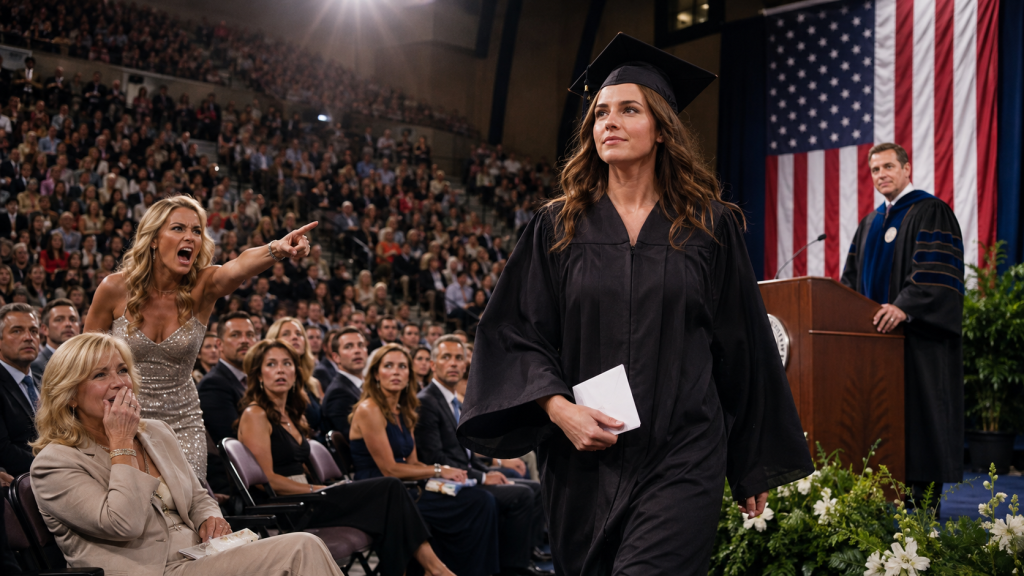
At my college graduation, my sister suddenly rose from her seat in front of the entire auditorium and shouted, “She ch3ated her way through college!” For one brief second, I stopped moving.
Then I continued toward the stage.
Hidden beneath my graduation gown was a sealed white envelope.
Inside was the one thing Vanessa never expected me to possess so confidently.
Proof.
My name had barely finished echoing through the auditorium when Vanessa’s accusation tore through the room from the third row.
“She cheated her way through school!”
Almost two thousand people turned in my direction.
The whispering started immediately.
I hesitated for less than a second.
Then I kept walking.
The sound of my heels echoed against the polished floor as I approached the stage.
Dean Harrow stood motionless beside the podium.
My mother lifted one hand to her mouth.
But I knew her well enough to recognize the expression.
She wasn’t shocked.
She was hiding a smile.
Vanessa stayed on her feet, performing outrage for the entire room.
“Ask her professors!” she yelled. “Ask them how someone working nights suddenly ends up valedictorian!”
A few people gasped.
I reached the stairs leading to the stage.
Pressed flat against my side beneath the gown was a sealed envelope.
My fingertips touched it briefly.
Three months earlier, a scene like this would have destroyed me.
For most of my life, Vanessa had been the favorite.
Beautiful.
Outgoing.
Charming.
The daughter everyone praised.
I was the quieter sister.
The one who wore clothes after Vanessa outgrew them.
The one who worked two jobs.
The one who learned to stay silent whenever our parents dipped into my savings to rescue Vanessa from yet another “emergency.”
When I earned a full scholarship, Vanessa laughed and said the university must have lowered its admission standards.
When I received a research fellowship, she told relatives I had probably flirted my way into it.
When a technology company offered me a job before graduation, she called it a sympathy hire at Thanksgiving dinner.
Every time, I let the comments pass.
At family gatherings, my success seemed to make everyone uncomfortable.
Dad would quickly change the subject.
Mom would immediately start talking about whether Vanessa needed help paying rent.
Once, after I won a statewide academic competition, Vanessa raised her glass and smirked.
“Congratulations on officially becoming the most boring person in the family.”
Everyone laughed.
So did I.
Growing up in that house had taught me one very useful rule:
Never show cruel people exactly where they managed to hurt you.
Then February changed everything.
The university’s academic integrity office summoned me to a meeting.
Someone had anonymously submitted screenshots that appeared to show me purchasing stolen exam answers.
The evidence looked real.
Almost suspiciously real.
My scholarship was temporarily frozen.
The company that had offered me a job placed the offer under review.
And university officials warned me that, if the evidence proved genuine, I could lose everything I had worked for.
That weekend, Vanessa arrived at our parents’ house carrying a bottle of wine.
She gave me a sympathetic little smile.
“Maybe this is actually good for you,” she said. “You’ve always pushed yourself way too hard.”
Then I noticed her hand.
Near her thumb was a small crescent-shaped burn.
My stomach went cold.
I had seen that exact mark before.
Two days earlier, my attorney had shown me a security image connected to the anonymous report against me.
A hand was visible in the image.
And near the thumb was the same distinctive burn.
I said nothing.
That silence became Vanessa’s biggest mistake.
She thought I was defeated.
She thought I was too frightened to fight back.
What she didn’t know was that I had spent four years studying digital forensics.
She didn’t know investigators had already traced enough of the fabricated evidence to quietly clear my name.
And she certainly didn’t know what I was carrying beneath my graduation gown.
The sealed envelope contained the truth.
And while Vanessa stood in front of nearly two thousand people trying to destroy me one final time, she had no idea that I was only seconds away from exposing exactly who had tried to frame me..
PART 2: THE ENVELOPE MY SISTER THOUGHT COULD NEVER EXIST
I climbed the first step to the stage while Vanessa was still shouting behind me.
“She bought the answers!”
Another step.
“She cheated!”
Another.
“Ask the integrity office!”
The entire auditorium had gone strangely still.
Nearly two thousand people.
Students.
Parents.
Faculty.
Administrators.
All of them suspended inside one ugly moment my sister had chosen to create.
I could feel their eyes on me.
Every one of them.
Three months earlier, I would have wanted the floor to open.
I would have wanted to disappear beneath the black graduation gown and never come back out.
Instead, I kept walking.
One step.
Then another.
Because beneath that gown, pressed flat against my ribs, was the envelope.
And because for the first time in my life, I did not need to convince Vanessa I was innocent.
I only needed to let the truth finish what she had started.
When I reached the top of the stairs, Dean Harrow stepped toward me.
His face was carefully controlled.
Thirty years in higher education had given him the expression of a man who could receive a fire alarm and a donor complaint in the same hour without visibly changing his pulse.
“Are you all right?”
he whispered.
I looked at him.
“Yes.”
Behind me, Vanessa shouted again.
“Don’t give her that diploma!”
A murmur passed through the auditorium.
My mother stood now too.
Not to stop Vanessa.
Not to defend me.
She reached for her arm and said something quietly.
Probably:
Sit down.
Not because Vanessa was wrong.
Because she was making a scene.
That distinction hurt more than I expected.
Dean Harrow lowered his voice.
“We can pause.”
“No.”
“You’re certain?”
“Yes.”
I looked toward the podium.
“Please continue.”
His eyes searched mine for another second.
Then something softened.
He knew.
Of course he knew.
The academic integrity office had quietly cleared me twelve days earlier.
My scholarship had been restored.
My degree had been confirmed.
The technology company had reinstated my job offer.
Only a handful of people knew because the investigation into the fabricated evidence was not finished.
Vanessa believed the silence meant I was still under suspicion.
That had made her bold.
It had made her careless.
And now it had made her stand up in front of two thousand witnesses and repeat the same accusation investigators were already tracing back toward her.
Dean Harrow returned to the microphone.
The auditorium quieted again.
His voice was calm.
“Ladies and gentlemen, please remain seated.”
Vanessa shouted,
“Why? So you can cover for her?”
This time, Dean Harrow looked directly at her.
“No.”
The single word carried across the room.
“We will allow the ceremony to continue.”
Vanessa laughed sharply.
“Of course you will.”
Then Professor Elaine Mercer stood from the faculty row.
She was the chair of the digital forensics department.
My adviser.
The woman who had watched me spend four years surviving on scholarship money, late-night coffee, and stubbornness.
Her voice did not need a microphone.
“The university has already completed its review of the allegations against Ms. Reynolds.”
Vanessa stopped moving.
So did my mother.
My father looked up sharply.
That was the first crack.
Small.
But visible.
Vanessa said,
“What?”
Professor Mercer continued.
“Ms. Reynolds was cleared.”
The room erupted.
Not cheering.
Not yet.
Whispers.
Questions.
A wave of sound rolling from one wall to the other.
Vanessa’s face changed.
Not white.
Not immediately.
First came confusion.
Then disbelief.
Then anger.
“No.”
She shook her head.
“No, she wasn’t.”
Professor Mercer stared at her.
“Yes.”
“You’re lying.”
“I am not.”
Vanessa turned toward my parents.
“Mom?”
My mother looked almost frightened now.
Dad stood.
“What does she mean?”
Vanessa ignored him.
“She told us the investigation was ongoing.”
It was.
Just not the part concerning my guilt.
That was the difference.
I stepped toward the podium.
Dean Harrow whispered,
“You do not have to say anything.”
I looked at him.
“I know.”
Then I reached beneath my gown.
Pulled out the envelope.
The sound in the auditorium changed again.
There is something strangely powerful about paper.
Maybe because paper suggests preparation.
It suggests dates.
Signatures.
Names.
Things people thought would remain private long after their lies became public.
I placed the envelope on the podium.
Vanessa stared at it.
For the first time all morning, she was silent.
I leaned toward the microphone.
My hands were steady.
My voice was not.
“My sister is correct about one thing.”
The room went quiet.
Vanessa’s eyes widened.
My mother whispered something.
I continued.
“Three months ago, someone submitted evidence claiming I had purchased stolen exam materials.”
My voice trembled once.
I let it.
“I was investigated.”
“I was terrified.”
“My scholarship was temporarily frozen.”
“My job offer was placed under review.”
“And for several weeks, I genuinely believed four years of work might disappear because of screenshots I knew were fake but could not immediately prove were fake.”
No one moved.
I looked at the crowd.
Then at my family.
“What my sister did not mention is that I study digital forensics.”
A few students laughed nervously.
Not because it was funny.
Because the irony had finally become impossible to ignore.
I continued.
“The screenshots had problems.”
“The metadata did not match the dates shown in the images.”
“The timestamps had been altered.”
“One image had been resaved through editing software.”
“And the supposed seller account had been created only forty-eight hours before the evidence was submitted.”
Vanessa’s lips parted.
I had never seen fear move across her face so slowly.
I looked at her.
“And investigators found something else.”
She sat down.
Not because anyone told her to.
Her legs simply seemed to stop cooperating.
I opened the envelope.
Removed the first sheet.
“This is the written determination from the academic integrity office.”
I did not read the whole thing.
Only the sentence that mattered.
“After forensic review of the submitted materials, the university found no credible evidence of academic misconduct by the student.”
A few people began clapping.
Dean Harrow raised one hand.
The sound stopped.
I looked at Vanessa.
She was shaking her head.
“No.”
I continued.
“The evidence against me was fabricated.”
The words sounded cleaner aloud than they had in my head.
Fabricated.
Not misunderstood.
Not mistaken.
Fabricated.
I pulled out the second page.
“This is a summary of the forensic review.”
Vanessa stood again.
“You can fake documents too!”
A laugh broke somewhere in the upper balcony.
Then another.
Vanessa turned toward the sound.
Her face flushed bright red.
I did not laugh.
I wanted no theater from myself.
Only truth.
I said,
“The original materials were preserved by the university.”
Her mouth closed.
I continued.
“The person who created the fake screenshots used an image editor registered to a personal device.”
My mother turned slowly toward Vanessa.
That was the first moment she looked genuinely afraid.
I saw it.
So did Vanessa.
Mom whispered,
“Vanessa.”
Vanessa snapped,
“Don’t.”
My stomach tightened.
That one word told me something.
Not guilt.
Not yet.
But familiarity.
My mother knew enough for Vanessa to fear what she might say.
I pulled out the third document.
“The university also obtained access logs connected to the anonymous submission.”
Dad moved into the aisle.
His face had gone gray.
“What submission?”
Vanessa glared at him.
“Dad, sit down.”
He did not.
I looked at my father.
Then back at the document.
“The report was submitted from a public wireless network at a coffee shop called Bell Street Roasters.”
My mother covered her mouth.
Vanessa stared at me.
I continued.
“The coffee shop provided security footage.”
Now the auditorium was silent enough that I could hear someone cough near the back wall.
I looked at Vanessa’s hand.
The hand gripping the seat in front of her.
Near her thumb was the crescent-shaped burn.
Same place.
Same shape.
I said,
“In the footage, the person submitting the report is partially visible.”
Vanessa immediately tucked her hand against her dress.
Too late.
Professor Mercer looked toward her.
Several people nearby noticed too.
I had no satisfaction.
That surprised me.
I had imagined this moment during sleepless nights.
Imagined Vanessa humiliated.
Exposed.
Speechless.
I thought it would feel like justice.
It felt mostly sad.
Because she was still my sister.
And some part of me, despite everything, had spent my entire life hoping that one day she would stop needing to hurt me in order to feel bigger.
I reached for another paper.
Then stopped.
The envelope contained more.
Much more.
But the university attorney had advised me carefully.
Do not overstate.
Do not turn suspicion into conviction.
Let investigators handle what belongs to them.
So I said only what had been verified.
“The person visible in the footage has a burn near the thumb matching the one Vanessa has on her hand.”
The room shifted.
Every eye turned toward her.
Vanessa looked down.
Then immediately held her hand behind her back.
That tiny movement did more damage than any speech I could have given.
My father stared.
“Vanessa.”
She snapped,
“It doesn’t prove anything!”
No.
It did not prove everything.
That mattered.
I nodded.
“You’re right.”
She blinked.
I think she expected me to attack.
Instead, I said,
“A matching mark alone is not enough.”
Her expression loosened slightly.
Then I continued.
“That is why the investigators did not stop there.”
Her face collapsed again.
I pulled out the next page.
“The account used to purchase access to the image-editing service was paid with a card ending in 1184.”
Vanessa’s breath stopped.
My mother made a small sound.
Dad looked between them.
I stared at my mother.
Not Vanessa.
Mom.
Because I knew those numbers too.
Not from Vanessa.
From my mother’s credit card.
The one she had used for years.
The one I had seen at restaurants.
The one she once handed me when she asked me to order flowers for Grandma’s funeral because “you’re better at online things.”
Dad turned to her.
“Whose card is that?”
Mom looked at me.
Then Vanessa.
Then him.
No answer.
Dad’s voice sharpened.
“Whose card?”
My mother whispered,
“Mine.”
The auditorium erupted again.
This time louder.
I closed my eyes.
There it was.
The part I had dreaded more than exposing Vanessa.
My mother.
Because when investigators first showed me the payment record, I had spent an hour insisting there had to be another explanation.
Maybe Vanessa had borrowed the card.
Maybe Mom did not know.
Maybe someone copied the number.
Maybe.
Maybe.
Maybe.
Children can build entire houses out of that word when the truth about a parent feels too painful to live in.
Dean Harrow approached the podium.
“Ms. Reynolds…”
I knew what he was asking.
Stop.
Enough.
This was a graduation.
Not a trial.
And the matter was still under investigation.
I nodded.
Then I looked at the audience.
“I’m not going to accuse anyone of something the investigation has not established.”
That mattered.
I looked at Vanessa.
Then Mom.
“But I will say this.”
My throat tightened.
“I did not cheat.”
The sentence came out quieter than everything before it.
Still, it carried.
“I did the work.”
“Every paper.”
“Every lab.”
“Every exam.”
“Every overnight shift at the library.”
“Every hour I spent studying after work while other people slept.”
My eyes filled.
“I earned my place here.”
For the first time, applause started.
Not explosive.
One person.
Then another.
Then an entire section.
Soon, nearly everyone was standing.
I stared.
The sound hit me physically.
My chest.
My throat.
My eyes.
For four years, I had worked in silence.
Not because I wanted applause.
Because I had learned early that success was safest when I made it look small.
And now almost two thousand people were standing while my family sat frozen in the third row.
I looked toward Professor Mercer.
She was crying.
Dean Harrow smiled.
Then leaned toward the microphone.
“Ms. Reynolds…”
I turned.
His eyes softened.
“…would you still like your diploma?”
The auditorium laughed.
So did I.
Through tears.
“Yes.”
He handed it to me.
Then he shook my hand.
“You earned this.”
Three words.
I nearly broke.
I walked across the stage.
This time, no one shouted.
My sister did not stand.
My mother did not smile.
Dad did not look at either of them.
He looked only at me.
And for the first time in my life, I saw something on my father’s face that I had always wanted but no longer knew what to do with.
Pride.
Too late for the moment to feel clean.
Still real.
When I returned to my seat, my friend Leah grabbed me.
“You absolute psychopath.”
I laughed.
“What?”
“You had that in your dress?”
“Yes.”
“You waited?”
“Yes.”
She stared.
“I would have thrown the envelope at her.”
“I considered it.”
“You are terrifying.”
That made me laugh harder.
Then I started crying.
Not graceful crying either.
Shoulders shaking.
Mascara gone.
Leah hugged me.
“You’re okay.”
I pulled back.
“No.”
She blinked.
I laughed through tears.
“But I think I will be.”
The ceremony continued.
Degrees.
Speeches.
Music.
My body stayed in the auditorium.
My mind did not.
It kept returning to the payment record.
Mom’s card.
Ending 1184.
I had not planned to mention that publicly.
Honestly, I had hoped I would never have to.
But Vanessa forced the accusation into the room.
And once she did, I refused to carry the lie alone anymore.
After the ceremony, graduates spilled into the courtyard beneath blue banners and strings of white flowers.
Families took photographs.
Parents cried.
Friends screamed.
Champagne bottles opened.
I stepped outside into bright sunlight.
Leah’s parents hugged me.
Professor Mercer took a photograph with me.
Dean Harrow shook my hand again.
Then I heard my father.
“Emily.”
My name.
Not Vanessa’s.
Mine.
I turned.
Dad stood ten feet away.
My mother beside him.
Vanessa slightly behind them.
No one looked happy.
Dad moved first.
He stopped in front of me.
For several seconds, he only stared.
Then he said,
“Is it true?”
I almost laughed.
“What part?”
“The investigation.”
“Yes.”
“They cleared you?”
“Yes.”
“You knew?”
“Twelve days ago.”
His face changed.
“Why didn’t you tell us?”
The question hurt more than it should have.
I looked at him.
“Would you have believed me?”
He went silent.
There.
That was the answer.
My mother stepped forward.
“Emily, that is not fair.”
I stared at her.
“Isn’t it?”
“We were worried.”
“You were embarrassed.”
She flinched.
Vanessa snapped,
“Stop acting like a victim.”
Dad turned sharply.
“Enough.”
Everyone froze.
My father had never used that tone with Vanessa.
Not once.
She stared at him.
“What?”
“I said enough.”
Her face changed.
“Dad—”
“No.”
He pointed toward the courtyard.
“You stood up in front of two thousand people and accused your sister of cheating after the university had cleared her.”
“I didn’t know they cleared her!”
Dad’s eyes narrowed.
“That is supposed to make this better?”
Vanessa looked at Mom.
“Say something.”
Mom’s expression tightened.
“I…”
She stopped.
Vanessa laughed bitterly.
“Of course.”
Then she turned toward me.
“You think you’re so smart.”
I almost smiled.
“No.”
“Don’t.”
Her voice shook.
“Don’t do that calm thing.”
“What calm thing?”
“The thing where you stand there like you’re better than everyone.”
I looked at her.
Finally, I understood.
She had not hated my success because I bragged.
I never did.
She hated that my success existed without needing her permission.
I whispered,
“I don’t think I’m better than you.”
“Liar.”
“I think I worked hard.”
Her face twisted.
“So did I.”
“I never said you didn’t.”
“Yes, you did.”
“When?”
“Every time you got some scholarship.”
“Every time Mom compared us.”
My breath caught.
“What?”
Vanessa laughed through tears.
“There.”
“You didn’t know.”
I looked at Mom.
Her face had gone still.
Vanessa continued.
“You think you were the only one they compared?”
My chest tightened.
Mom whispered,
“Vanessa.”
“No.”
Vanessa turned on her.
“You want to pretend now?”
Dad looked confused.
“Pretend what?”
Vanessa laughed bitterly.
“Tell him.”
Mom shook her head.
“Not here.”
“Why?”
“Because there are people around.”
Vanessa’s voice rose.
“That never stopped you when it was Emily.”
The sentence cut through all of us.
I stared at my mother.
“What did you say about me?”
Mom’s eyes filled.
“Nothing.”
Vanessa laughed.
“Nothing?”
She looked at me.
“Every time you got something, she used you like a knife.”
My stomach tightened.
“What does that mean?”
Vanessa started crying.
“She’d say…”
Her voice changed.
Higher.
Mocking.
“Emily got a scholarship.”
“Why can’t you manage money like Emily?”
“Emily works two jobs.”
“Why are you asking us for rent again?”
“Emily never gives us this much trouble.”
I stared at Mom.
She looked away.
Vanessa continued.
“You think she made me feel special?”
“She made me feel like the pretty stupid one.”
My mouth went dry.
“No.”
Vanessa laughed.
“Yes.”
“She told me you were jealous of me.”
My eyes moved to my mother.
Vanessa’s face twisted.
“And she told me I should be jealous of you.”
There it was.
Not favoritism as simple as I had believed.
Something uglier.
Competition.
Manufactured.
Fed from both directions.
Dad stared at Mom.
“Elaine.”
Mom covered her face.
“I was trying to motivate them.”
The sentence was so absurd I almost laughed.
“By making us hate each other?”
“I never wanted you to hate each other.”
Vanessa shouted,
“Then what did you think would happen?”
People nearby were beginning to look.
I stepped closer.
“Lower your voice.”
Vanessa laughed.
“Oh, now you care about scenes?”
“Yes.”
I looked around.
“This part isn’t for two thousand people.”
That surprised her.
Maybe because she thought public exposure had become my weapon.
It had not.
Truth did not require maximum audience.
We moved toward a quieter walkway beside the arts building.
Trees.
Benches.
Almost no one there.
Dad stood apart from Mom.
Vanessa paced.
I held my diploma against my chest.
My graduation gown suddenly felt too warm.
I asked Mom,
“Did you know about the anonymous report?”
She froze.
Vanessa stopped pacing.
Dad looked at her.
“Answer her.”
Mom’s voice came small.
“No.”
I watched her.
For years, I had learned to study evidence rather than faces.
Faces are unreliable.
People cry while lying.
Smile while afraid.
Look calm while drowning.
So I asked,
“Did Vanessa use your card?”
Silence.
Vanessa closed her eyes.
Dad said,
“Elaine.”
Mom whispered,
“Yes.”
My stomach dropped.
Even though I already suspected it.
Knowing and hearing are different.
Dad stared.
“You knew?”
Mom shook her head quickly.
“Not what for.”
I waited.
That distinction mattered.
I asked,
“What did she tell you?”
Mom’s eyes filled.
“She needed software.”
“What software?”
“She said it was for freelance design work.”
I looked at Vanessa.
Her face had gone pale.
“Is that true?”
She said nothing.
“Vanessa.”
“No.”
The word barely came out.
Dad sat on the nearest bench.
It was the first time I had ever seen him look old.
Mom started crying.
“I didn’t know.”
I believed that part.
Maybe.
I was not ready to decide.
Then I asked the question that had lived inside me for three months.
“Why?”
Vanessa looked at me.
“What?”
“Why frame me?”
She laughed bitterly.
“You know why.”
“No.”
“I don’t.”
She stared.
“You had everything.”
The sentence stunned me.
I almost looked behind me to see who she meant.
“Everything?”
“Yes.”
“You were valedictorian.”
“You had the fellowship.”
“You had a job waiting.”
“Everyone was talking about you.”
Her voice cracked.
“I had nothing.”
I stared.
“You had a job.”
“I hated it.”
“You had an apartment.”
“Mom paid half the rent.”
“You had friends.”
“None of that mattered.”
“To who?”
Vanessa looked at Mom.
That answered more than she intended.
Then she said,
“Do you know what Mom told me at Christmas?”
I looked at her.
“She said if I had half your discipline, maybe my life wouldn’t be such a mess.”
Mom whispered,
“I was angry.”
Vanessa laughed.
“You were always angry.”
She turned back to me.
“And you just sat there.”
My eyes widened.
“What was I supposed to do?”
“Say something!”
“Like what?”
“I don’t know!”
She started crying harder.
“Tell her you weren’t perfect.”
“Tell her you struggled.”
“Tell her you hated being compared too.”
I stared at my sister.
Suddenly, for the first time, I saw the girl beneath the cruelty.
Not innocent.
Not excused.
But wounded.
And the most painful thing was that I understood her.
I whispered,
“I thought you knew.”
She stared.
“Knew what?”
“That I hated it too.”
Her face changed.
“I thought when Mom compared us, you knew I hated it.”
“No.”
She shook her head.
“I thought you liked it.”
My chest tightened.
“I didn’t.”
“You laughed.”
“So did you.”
There it was.
Two sisters.
Both learning the same survival strategy.
Laugh.
Shrug.
Pretend.
Then go to separate rooms and bleed quietly.
I swallowed.
“But that still doesn’t explain the report.”
Vanessa looked down.
“No.”
“It doesn’t.”
The softness inside me hardened again.
Compassion is not the same as removing consequences.
I asked,
“Did you fabricate the screenshots?”
She said nothing.
Dad stood.
“Answer her.”
Vanessa looked at me.
Then whispered,
“Yes.”
Mom gasped.
Dad closed his eyes.
I had imagined that confession for months.
I expected anger.
Instead, I felt hollow.
I asked,
“Did anyone help you?”
Her eyes moved.
Just once.
Toward Mom.
Then away.
My entire body went cold.
Mom saw it.
“What?”
Vanessa shook her head.
“No.”
“Vanessa.”
“No one helped.”
Too fast.
I stared at her.
“Then why did you look at Mom?”
“I didn’t.”
“You did.”
Mom looked frightened.
Dad whispered,
“What is going on?”
Vanessa backed away.
“Nothing.”
I felt the envelope beneath my arm.
There was still one document inside.
The one I had not shown onstage.
The one investigators had asked me not to discuss publicly.
Because unlike the burn.
Unlike the card.
Unlike the software account.
This piece did not point cleanly at Vanessa.
It pointed somewhere else.
I reached into the envelope.
My mother’s face changed.
That reaction stopped me.
Not because it proved anything.
Because she recognized the page before I removed it.
I stared at her.
“How do you know what’s in here?”
She went white.
Dad turned toward her.
“Elaine?”
Mom shook her head.
“I don’t.”
I pulled out the document.
A printout of an email header.
Not the contents.
Only routing information.
The anonymous academic-integrity report had been submitted from Bell Street Roasters.
But before that submission, the fabricated screenshots had been sent from one email account to another.
The first account belonged to Vanessa.
Investigators had confirmed that.
The second account?
I looked at my mother.
“Why did Vanessa email the screenshots to you three days before the report was filed?”
Dad stopped breathing.
Mom said nothing.
Vanessa whispered,
“Emily.”
I did not look at her.
My eyes stayed on Mom.
The woman who had smiled behind her hand when Vanessa shouted in the auditorium.
The woman who had always changed the subject when I succeeded.
The woman whose credit card had paid for the software used to create the images.
The woman now staring at a document she clearly wished had never existed.
Dad’s voice broke.
“Elaine.”
Mom started crying.
“I can explain.”
Those three words made my stomach turn.
Not:
I never saw them.
Not:
That’s impossible.
I can explain.
Vanessa covered her face.
I whispered,
“Then explain.”
Mom looked at me.
And for the first time all day, I saw something in her eyes that frightened me more than Vanessa’s accusation ever had.
Guilt.
Real guilt.
She reached for the bench.
Sat down.
Then whispered,
“I didn’t know she was going to report you.”
My heart stopped.
Dad stared at her.
“What did you know?”
Mom started crying harder.
“I thought…”
She swallowed.
“I thought she was only trying to scare Emily.”
The world went silent.
I heard birds somewhere above us.
A car door slam in the distance.
People laughing across campus.
Graduates celebrating.
My own graduation cap felt suddenly ridiculous on my head.
I stared at my mother.
“Scare me how?”
She wiped her face.
“Vanessa said she wanted you to understand what it felt like to lose something.”
I could barely hear my own voice.
“And you were okay with that?”
“No.”
Mom shook her head.
“But…”
There is no word more dangerous than but after no.
“But what?”
She closed her eyes.
“I told her maybe knocking you down a little wouldn’t be the worst thing.”
Dad stepped backward.
Vanessa whispered,
“Mom.”
My mother covered her mouth.
The sentence hung there.
Knocking you down a little.
My scholarship.
My job.
My degree.
Four years of work.
Fear.
Sleepless nights.
All of it translated into a mother’s idea of balance.
Dad stared at her as though he had never seen her before.
I understood the feeling.
Mom looked at me.
“I never thought she would actually submit anything.”
I could not answer.
She reached toward me.
I stepped back.
That hurt her.
I saw it.
For once, I did not rush to fix the hurt.
“Emily…”
“No.”
My voice came out broken.
“You don’t get to tell me this was motivation.”
“I know.”
“You don’t get to say you were balancing us.”
“I know.”
“You told Vanessa I needed to be knocked down?”
Mom cried.
“I was angry.”
“At what?”
“At me graduating?”
“At me getting a job?”
“At me doing well?”
She shook her head desperately.
“No.”
“Then what?”
She whispered,
“At what it was doing to the family.”
The sentence made me cold.
“What was my success doing to the family?”
Mom looked toward Vanessa.
Then Dad.
Then back to me.
“It was making everything worse.”
I laughed.
A terrible sound.
“My success?”
“No.”
“The comparisons.”
“You made the comparisons.”
She had no answer.
I stared at her.
And suddenly, an old memory returned.
Thanksgiving.
My job offer.
Vanessa calling it a sympathy hire.
Everyone laughing.
Mom smiling.
Dad changing the subject.
I had thought their laughter meant Vanessa was the favorite.
Maybe something more complicated had been happening.
Maybe Mom had been feeding both sides because keeping her daughters insecure kept both of us orbiting her.
That thought frightened me.
I did not say it yet.
Not without proof.
But another question formed.
One I had never asked.
“Mom.”
She looked at me.
“When the company offered me the job…”
My voice slowed.
“…how did Vanessa know the salary?”
Vanessa’s head snapped up.
Mom froze.
Dad frowned.
“What salary?”
I stared at her.
“I never told Vanessa.”
Vanessa looked at Mom.
Mom looked away.
There it was again.
A silence louder than any confession.
My stomach dropped.
The job offer email.
I had forwarded it to one person.
Mom.
Because despite everything, I still wanted her to be proud.
Three days later, Vanessa mocked the exact salary at Thanksgiving.
I had assumed she guessed.
I whispered,
“You showed her my offer.”
Mom started crying again.
Vanessa looked stunned.
“You told me she bragged about it.”
My chest tightened.
“I never bragged.”
Vanessa stared at Mom.
“You said she sent it around because she wanted everyone to know what she’d make.”
Mom said nothing.
The world shifted.
Not because Vanessa became innocent.
She didn’t.
She had fabricated evidence.
Submitted a false report.
Tried to destroy me.
But suddenly, I could see someone had been feeding her a version of me designed to make resentment grow.
And maybe feeding me a version of her for the same reason.
Dad whispered,
“What else have you been telling them?”
Mom looked at him.
“Robert…”
“What else?”
She shook her head.
“I was trying to keep the peace.”
I almost laughed.
Dad did not.
“No.”
His voice hardened.
“You were managing them.”
Mom’s face collapsed.
Vanessa stared at her.
I stood there in my graduation gown holding a diploma I had earned while my family rearranged itself in front of me.
And for the first time in my life, Vanessa and I looked at each other without competing.
Neither of us smiled.
Neither of us attacked.
We simply looked.
Two daughters.
Both realizing the rivalry we thought belonged entirely to us might have had an audience.
Maybe even an architect.
Vanessa whispered,
“Did you tell Emily things about me too?”
Mom shook her head.
Too quickly.
My stomach tightened.
I asked,
“What things?”
No answer.
Vanessa turned toward me.
“Emily.”
Her face looked terrified now.
Not for herself.
“Did Mom ever tell you I said you were ugly?”
I froze.
Yes.
High school.
Junior prom.
Mom had found me crying over a dress.
She told me Vanessa had said I looked “like somebody’s accountant.”
I had never forgotten it.
I stared at Vanessa.
“You didn’t?”
Her eyes filled.
“No.”
My stomach dropped.
She whispered,
“Did she tell you I said your scholarship was fake before I said it at dinner?”
I frowned.
“Yes.”
“I never said that before dinner.”
My mother sobbed.
Dad sat down again.
I looked at Mom.
“Why?”
The question came from somewhere younger than thirty-one.
Not valedictorian.
Not digital-forensics student.
Not woman holding evidence.
A child.
Why?
Mom’s face crumpled.
“I don’t know.”
I did not believe that.
Maybe she did not yet know.
But there was a reason.
There is always a reason people repeat behavior for twenty years.
Fear.
Need.
Control.
Insecurity.
Something.
Mom whispered,
“I wanted you girls to need me.”
There.
Soft.
Almost inaudible.
Still enough.
Vanessa stared.
“What?”
Mom wiped her face.
“When you were little, you were close.”
“You didn’t need me for everything.”
“You had each other.”
She laughed weakly through tears.
“I know how terrible that sounds.”
Dad looked sick.
She continued.
“When you started fighting…”
She swallowed.
“…you both came to me.”
My skin went cold.
There it was.
Not favoritism.
Not exactly.
Dependency.
A mother who had discovered that conflict between her daughters gave her a central role.
Maybe she did not plan it consciously.
Maybe not at first.
But patterns do not need evil masterminds to become destructive.
They only need rewards.
Vanessa whispered,
“So you kept us fighting.”
Mom shook her head.
“No.”
Then stopped.
Because even she heard how false it sounded.
I looked down at my diploma.
Four years.
I thought graduating would prove something.
To Vanessa.
To Mom.
To myself.
Suddenly, I understood something painful.
No achievement could fix a family system built around comparison.
If I earned more, someone would resent me.
If Vanessa looked better, I would be told she mattered more.
If one of us succeeded, the other would be handed the success like an insult.
There was no winning.
Because the competition itself was the trap.
I looked at Vanessa.
She was crying.
For the first time, I did not enjoy seeing it.
I asked quietly,
“Why did you report me?”
She wiped her face.
“Because I hated you.”
The honesty hurt.
Then she added,
“And because Mom made me believe you hated me first.”
My throat tightened.
“That doesn’t excuse it.”
“I know.”
Good.
No argument.
No defense.
I nodded.
Then I looked at Mom.
“And what you did doesn’t excuse her.”
“I know.”
Dad stood slowly.
He looked at all three of us.
Then said something I never expected.
“We’re done.”
Mom stared.
“What?”
He shook his head.
“Not our marriage.”
“Not yet.”
His voice was exhausted.
“I mean this.”
He gestured between us.
“The comparisons.”
“The messages.”
“The secrets.”
“The pretending.”
He looked at me.
“You graduated today.”
His voice broke.
“And we are standing beside a building talking about whether your own family helped frame you.”
My eyes filled.
“I don’t know how I let us get here.”
Mom whispered,
“You didn’t know.”
Dad looked at her.
“That’s not enough.”
The sentence landed on all of us.
Not knowing is not always innocence.
Sometimes it is avoidance.
Dad had changed the subject for years.
Laughed weakly.
Stayed quiet.
Let Mom manage the emotional weather because it was easier than asking why storms kept forming.
He had a part too.
Smaller.
Still real.
He looked at me.
“I’m sorry.”
I swallowed.
“For what?”
“For every time I saw you two hurting each other and decided peace meant not asking questions.”
That was a good apology.
Not complete.
But honest.
Vanessa sat on the bench.
I stood.
Mom cried.
Dad stared at the ground.
For a few seconds, none of us knew what came next.
Then Professor Mercer appeared at the end of the walkway.
She stopped when she saw us.
“Emily?”
I turned.
“Yes?”
Her expression was careful.
“The university attorney is asking for you.”
My stomach tightened.
“Why?”
She looked at Vanessa.
Then Mom.
Then back to me.
“There has been another development.”
Of course there had.
I almost laughed.
“What?”
Professor Mercer walked closer.
Her voice lowered.
“The anonymous report against you was not the first report submitted from that account.”
I froze.
Vanessa looked up.
“What?”
Professor Mercer continued.
“Investigators reviewed the account history after your ceremony.”
My pulse slowed.
“There was another complaint.”
My throat tightened.
“Against who?”
She hesitated.
Then looked directly at Vanessa.
“Against you.”
The entire walkway went silent.
Vanessa stood.
“What?”
Professor Mercer continued.
“It was filed eighteen months ago.”
Vanessa’s face drained.
I looked at her.
“What happened eighteen months ago?”
She stared at nothing.
Then my mother made a sound.
Small.
Sharp.
I turned.
Mom looked terrified.
Not guilty this time.
Terrified.
Dad noticed too.
“Elaine?”
Mom stepped backward.
I stared at her.
“What is it?”
She shook her head.
“Nothing.”
But we had spent a lifetime living inside that word.
Nothing.
Nothing happened.
Nothing was wrong.
Nothing was personal.
Nothing meant anything.
I was done believing it.
Professor Mercer looked between us.
“The earlier complaint alleged workplace theft and credential fraud.”
Vanessa stopped breathing.
Her voice came barely above a whisper.
“I lost my job eighteen months ago.”
My stomach dropped.
I remembered.
She had told everyone her company downsized.
Mom had repeated it.
Dad paid three months of her rent.
I had believed her.
Vanessa turned toward my mother.
“You said my manager reported me.”
Mom’s eyes filled.
Dad whispered,
“Elaine.”
My mother began shaking.
And in that moment, the four of us understood something at exactly the same time.
The fabricated evidence used against me had not begun with me.
The anonymous account had existed long before my investigation.
Someone had already used it once.
Against Vanessa.
My sister stared at Mom.
I stared at Mom.
Dad stared at Mom.
And Professor Mercer quietly said,
“The university investigators would like to know whether the two complaints are connected.”
My mother closed her eyes.
Then whispered four words that made the graduation courtyard disappear around me.
“I thought it stopped.”
Nobody moved.
Vanessa’s voice cracked.
“What stopped?”
Mom opened her eyes.
And whatever answer she was about to give us—
I knew it was going to change far more than what happened to me at college.
Because suddenly, the question was no longer whether my sister had tried to destroy my future.
She had.
The question was who had taught her that destroying mine was simply the next move in a game our family had been playing for years.
PART 3: THE PERSON WHO TAUGHT MY SISTER HOW TO DESTROY ME
“I thought it stopped.”
My mother’s four words seemed to drain every sound from the walkway.
Vanessa stared at her.
My father did too.
Professor Mercer stood several feet away, still holding the folder from the university attorney.
And I—
I stood in my graduation gown with a diploma pressed against my chest, suddenly understanding that the worst thing hidden inside my family had nothing to do with grades.
Vanessa’s voice broke first.
“What stopped?”
Mom looked around as though the answer might be waiting somewhere else.
It wasn’t.
Dad stepped toward her.
“Elaine.”
She flinched.
“Tell us.”
Mom closed her eyes.
Then sat down on the bench.
For once, nobody moved to comfort her.
That detail mattered.
My entire childhood, tears had rearranged rooms.
Vanessa cried, people softened.
Mom cried, Dad apologized.
I cried privately so nobody had to do anything at all.
Not this time.
Mom wiped her face.
“Eighteen months ago…”
Her voice trembled.
“…Vanessa was having problems at work.”
Vanessa stared.
“I told you I was.”
“Yes.”
Mom nodded.
“You were missing shifts.”
“You were using the company card for personal things.”
Vanessa’s face changed.
“Once.”
“Three times.”
Mom whispered it.
Vanessa went silent.
Dad looked between them.
“What company card?”
Vanessa’s eyes filled.
“It wasn’t what they said.”
Mom continued.
“She told me her manager was threatening disciplinary action.”
“So I helped her.”
Vanessa laughed bitterly.
“Helped me?”
Mom looked sick.
“No.”
“I thought I was helping.”
There was that word again.
The most dangerous word in our family.
Helping.
I asked,
“What did you do?”
Mom took a long breath.
“I created an anonymous email account.”
The same account.
My stomach turned.
She continued.
“I sent a complaint to Vanessa’s company.”
Dad stared at her.
“A complaint about what?”
Mom looked at Vanessa.
Her voice dropped.
“Her manager.”
Vanessa stopped breathing.
“What?”
Mom swallowed.
“I said he had been manipulating expense reports.”
Vanessa went pale.
Dad whispered,
“Was he?”
Mom shook her head.
“No.”
Everything inside me went cold.
Vanessa stepped backward.
“You framed him?”
Mom’s face collapsed.
“I thought if attention moved onto him, they would stop looking at you.”
No one spoke.
Even after everything I had learned that day, the sentence stunned me.
Because there it was.
The first version of the weapon.
Not created to hurt Vanessa.
Created to protect her.
My mother had invented evidence against an innocent person because the daughter she was rescuing had gotten herself into trouble.
Professor Mercer’s expression tightened.
She did not interrupt.
This was no longer primarily university business.
Dad asked,
“What happened to the manager?”
Mom looked down.
“They investigated him.”
“And?”
“He was cleared.”
“How long?”
“I don’t know.”
“Elaine.”
“Six weeks.”
Dad closed his eyes.
Six weeks.
Six weeks of someone else’s reputation being questioned because my mother could not tolerate the possibility that Vanessa might face consequences for her own choices.
Vanessa whispered,
“You told me he reported me.”
Mom looked at her.
“Yes.”
My sister’s face twisted.
“You told me he wanted me fired.”
“Yes.”
“You told me the whole department was against me.”
Mom started crying again.
“I was trying to make you leave before they disciplined you.”
Vanessa laughed.
It sounded almost like choking.
“So I quit.”
“Yes.”
“And then you told everyone I was downsized.”
“Yes.”
My father sat down beside the bench but left space between them.
He looked physically ill.
I asked quietly,
“Where do the fake screenshots come in?”
Mom’s hands shook.
“The company wanted documentation.”
“What documentation?”
“For the complaint.”
“So you made it.”
She nodded.
There it was.
The origin.
Mom had learned just enough from online tutorials to create altered screenshots and attach them to the anonymous complaint.
Not sophisticated.
Apparently enough to trigger an investigation.
Then, after the manager was cleared, she abandoned the email account.
Or thought she did.
Vanessa stared at her.
“How did I get the password?”
Mom looked down.
“You used my tablet.”
My sister’s face changed.
I watched memory arrive.
Slowly.
She whispered,
“The notes app.”
Mom nodded.
“You kept passwords there.”
“Yes.”
Vanessa covered her mouth.
And suddenly I could see the chain.
Mom created the account to protect Vanessa from consequences.
Vanessa later found the account.
Saw the method.
Saw what forged screenshots could do to somebody’s reputation.
And when she decided I needed to be “knocked down”—
she already had a blueprint.
Not innocence.
Not excuse.
A blueprint.
I looked at Vanessa.
“You copied what she did.”
My sister cried.
“Yes.”
Dad stood.
He walked several steps away.
Then turned back.
“You knew what a false complaint could do because it had already happened in your own workplace.”
Vanessa looked down.
“Yes.”
“And you did it to Emily anyway.”
“Yes.”
No defense.
That mattered.
Dad’s voice cracked.
“Why?”
Vanessa wiped her face.
“Because I was angry.”
“That’s not enough.”
“I know.”
“Then why?”
She looked at me.
Her eyes were red.
“Because I wanted one thing in her life to fall apart.”
The honesty hurt more than an excuse.
I said nothing.
Vanessa continued.
“I wanted her to know what it felt like.”
“What what felt like?”
“To be the disappointment.”
My throat tightened.
She laughed bitterly.
“You don’t understand.”
“I walked into every family dinner already knowing what Mom would say.”
“Emily got a scholarship.”
“Emily works harder.”
“Emily doesn’t need help.”
“Emily bought her own car.”
“Emily saved money.”
“Emily got another internship.”
Her voice rose.
“You became evidence against me.”
I stared at her.
“I didn’t volunteer.”
“I know that now.”
“No.”
My own voice cracked.
“You knew it then.”
She flinched.
“You knew I wasn’t sitting at home preparing comparison charts.”
“You knew I didn’t ask Mom to tell you those things.”
“You hated me because it was easier than hating what she was doing.”
Vanessa started sobbing.
“Yes.”
There.
No denial.
I continued.
“And then you decided if you could make me fail, maybe the comparisons would stop.”
She nodded.
“Yes.”
My chest hurt.
Not because I suddenly forgave her.
Because I understood her.
And sometimes understanding someone makes the wound more painful, not less.
It forces you to accept that enormous harm can come from painfully ordinary human weakness.
Jealousy.
Fear.
Resentment.
A desperate need to stop feeling small.
I looked at Mom.
“And you?”
She stared at the ground.
“What did you think would happen when Vanessa sent you the screenshots?”
Mom’s mouth trembled.
“I thought she wanted to scare you.”
“You said that.”
“Yes.”
“What did that mean?”
Silence.
“Mom.”
She looked at me.
“I thought she might show them to you.”
“To scare you into backing away from the valedictorian thing.”
I froze.
“What?”
Vanessa looked confused too.
Dad said,
“Backing away from what?”
Mom started crying harder.
“The speech.”
My stomach dropped.
“You wanted me to turn down being valedictorian?”
“No.”
“Then what?”
She wiped her eyes.
“I wanted you to stop talking about it around Vanessa.”
I almost laughed.
“I wasn’t talking about it.”
Mom said nothing.
Exactly.
I barely mentioned it.
I had learned years ago not to celebrate too loudly.
Yet even my silence had not been small enough.
Mom whispered,
“She was having such a bad year.”
I stared at her.
“I was having the best year of my life.”
The sentence came out before I could stop it.
My mother’s face crumpled.
I continued.
“And you treated that like an emergency.”
“No.”
“Yes.”
My eyes filled.
“I got a fellowship.”
“You worried about Vanessa.”
“I got a job.”
“You worried about Vanessa.”
“I became valedictorian.”
“You worried about Vanessa.”
My voice broke.
“Was there ever going to be enough pain in my life for you to finally enjoy something good happening to me?”
Mom covered her mouth.
Dad looked away.
Vanessa stared at me.
I had never said anything like that aloud.
Not once.
For years, I thought wanting my mother to celebrate me sounded childish.
I was thirty-one—
No.
Wrong story.
I was graduating college.
Still young enough to want my mother’s face in the audience to mean pride instead of calculation.
Mom whispered,
“I was proud of you.”
“Then why did I always have to hide it?”
She had no answer.
Professor Mercer quietly stepped closer.
“Emily.”
I turned.
Her voice softened.
“The university attorney still needs to speak with you.”
I nodded.
Then looked at my family.
Something strange happened.
I did not feel responsible for finishing their conversation.
That was new.
My whole life, I had stayed until everyone else felt better.
Not today.
I looked at Vanessa.
“You need to cooperate with the investigation.”
She nodded.
“I will.”
“No deleting anything.”
“I won’t.”
“No blaming Mom for what you chose.”
Her face tightened.
Then she nodded again.
“I won’t.”
I turned to Mom.
“What happens with the earlier workplace complaint is not mine to manage.”
She cried.
“I know.”
Then Dad.
He looked broken.
I loved him.
Still.
But love did not require rescuing him from what he had just learned.
I said,
“I’m going with Professor Mercer.”
Dad nodded.
“Okay.”
Then he whispered,
“Emily.”
I stopped.
He looked at my diploma.
His face twisted.
“I’m proud of you.”
For a second, the old version of me almost took that sentence and ran with it.
Finally.
Dad is proud.
Maybe everything is okay.
Instead, I let it be what it was.
A beautiful sentence.
Late.
Still beautiful.
“Thank you.”
Then I walked away.
The university attorney was waiting in a conference room.
So was an investigator.
For the next hour, I answered questions.
Dates.
Emails.
Devices.
Family relationships.
What Vanessa had admitted.
What Mom had admitted.
I did not dramatize.
I did not minimize.
Four years studying digital forensics had taught me one rule more useful than any algorithm:
Evidence becomes weaker when people ask it to carry emotion.
So I gave facts.
Vanessa had admitted fabricating the screenshots.
She had admitted using the anonymous account.
Mom admitted creating the account earlier and fabricating evidence in an unrelated workplace matter.
Mom said she knew Vanessa had created screenshots involving me but claimed she did not know Vanessa intended to submit them.
That was what we knew.
Nothing more.
The investigator nodded.
“Good.”
I almost laughed.
Good was not the word I would have chosen.
Then Dean Harrow came in.
He looked exhausted.
“You have had an unusually eventful graduation.”
“Understatement.”
He smiled.
Then placed a folder on the table.
Inside was the final academic integrity determination.
Official.
Signed.
Sealed.
My name cleared.
My scholarship record restored.
The report marked fabricated.
He pushed it toward me.
“You should keep the original.”
I looked at the white envelope I had carried beneath my gown.
All morning, I thought the envelope represented power.
Proof.
Protection.
But sitting there, I understood something else.
I should never have needed to carry my innocence into graduation like emergency equipment.
I touched the folder.
“Thank you.”
Dean Harrow smiled.
“You earned your degree before any of this happened.”
“Don’t let today trick you into thinking the investigation gave it back.”
That sentence stayed with me.
The investigation did not give me my degree.
It confirmed nobody had successfully taken it.
There is a difference.
That evening, I did not celebrate with my parents.
I did not celebrate with Vanessa either.
I went to dinner with Leah, Professor Mercer, three friends from my program, and Leah’s parents.
Cheap Italian restaurant.
Too much garlic.
Paper napkins.
My graduation cap sat on the empty chair beside me.
At one point Leah raised a glass.
“To Emily.”
I groaned.
“No speeches.”
“Too late.”
She grinned.
“To the only person I know capable of turning graduation into a live forensic demonstration.”
Everyone laughed.
I did too.
Then Professor Mercer raised her glass.
“No.”
I stared at her.
“She is not graduating because she proved somebody else lied.”
The table quieted.
“She is graduating because she spent four years doing the work.”
My throat tightened.
Professor Mercer looked at me.
“Don’t let the ugliest thing that happened today become the headline of your accomplishment.”
I cried immediately.
Leah handed me a napkin.
“Terrible waterproof mascara.”
“Shut up.”
Everyone laughed.
And just like that, graduation became mine again.
Not completely.
Enough.
Three days later, the company that had offered me a job called.
The hiring director, Marcus Bell, spoke carefully.
“We’ve completed our review.”
My stomach still tightened despite knowing I had been cleared.
He continued.
“Your offer remains in place.”
I closed my eyes.
“Thank you.”
“And Emily?”
“Yes?”
“We owe you an apology.”
I froze.
“For what?”
“For putting the offer on hold before giving you a chance to respond.”
I had not expected that.
He continued.
“We had risk obligations.”
“I understand.”
“But procedure can still hurt people.”
“We could have communicated better.”
My eyes filled.
That week, I signed the employment agreement.
Not as a sympathy hire.
Not because anyone felt guilty.
Because I had earned it before Vanessa ever created a screenshot.
That mattered enormously.
The legal and university processes took months.
Not one dramatic afternoon.
Vanessa was not marched out of the graduation courtyard in handcuffs.
Real life rarely respects the pacing of revenge stories.
She was interviewed.
Her devices were reviewed with appropriate process.
She admitted creating and submitting the fabricated academic evidence.
The university permanently documented the complaint as malicious and referred the matter through the appropriate channels.
Because she was not a student, there was no student-expulsion fantasy.
Instead, there were potential legal consequences connected to falsified submissions and the harm caused.
After counsel became involved, Vanessa accepted responsibility.
There was a negotiated resolution involving restitution for some costs connected to the investigation and restrictions around further contact with the university.
The exact legal details mattered less to me than one thing:
She could no longer call what she did a joke.
Or jealousy.
Or a family fight.
It had a name.
Fabrication.
Mom’s situation became complicated too.
The former manager from Vanessa’s company was notified that new information had emerged regarding the old anonymous complaint.
I never met him.
I learned through Dad that his name was Daniel Price.
He had been cleared at the time, but the accusation had damaged his promotion prospects.
Mom eventually admitted through counsel that she had submitted false material.
There were civil consequences.
Legal fees.
A settlement.
A written retraction.
And humiliation.
But not the public kind she had spent years teaching us to fear.
The private kind.
Sitting across from someone you harmed and realizing you cannot talk your way into becoming the good person in their story.
Dad moved into a small apartment two months after graduation.
Not because of me.
Not because of Vanessa.
He told Mom:
“I don’t know how to live with you while I’m still learning how much of our family life you managed by keeping everyone insecure.”
They separated.
They did not divorce immediately.
For nearly a year, they lived apart and attended counseling.
I stayed out of it.
That was difficult.
Vanessa did too.
Even more difficult.
For the first time, Mom had to solve a relationship problem without making one daughter the messenger to the other.
That may have been the most useful consequence of all.
Mom called me repeatedly at first.
I answered once.
“Emily.”
She was crying.
“Your father won’t come home.”
“I’m sorry.”
“Can you talk to him?”
“No.”
Silence.
“Please.”
“No.”
“But he listens to you.”
“Then asking me would recreate exactly what got us here.”
She became quiet.
I continued.
“You need to speak to Dad.”
“Not through me.”
She cried.
“I don’t know how to fix this.”
My throat tightened.
I loved her.
Still.
That was inconvenient.
“Then you need to learn.”
I ended the call.
And afterward—
I cried for twenty minutes.
Boundaries did not make me cold.
They simply stopped my warmth from being used as a transportation system for other people’s responsibilities.
Vanessa and I did not become sisters again overnight.
For almost four months, we barely spoke.
Then one Saturday, a package arrived at my apartment.
Inside was a notebook.
No expensive gift.
No flowers.
Just a plain black notebook.
On the first page, Vanessa had written:
Things I blamed on Emily that were never Emily’s responsibility.
I sat down.
There were twenty-seven entries.
Mom comparing our grades.
My rent.
My job loss.
My credit-card debt.
My insecurity about how I looked.
My jealousy when Emily got the scholarship.
My jealousy when Emily got the fellowship.
My belief that her success meant I was failing.
Then:
The fabricated report.
Underneath:
That one belongs completely to me.
I cried.
Not because a notebook repaired anything.
Because for the first time, my sister had written a list where my name was not carrying her failures.
The last page said:
I don’t expect forgiveness because I finally learned the difference between an explanation and an excuse.
Then:
I am sorry.
I did not call immediately.
Three weeks later, I sent one message.
I read it. Thank you.
She replied:
That’s enough.
That mattered.
No pressure.
No demand.
Six months after graduation, Vanessa asked if I would meet her for coffee.
Public place.
Daytime.
I said yes.
She arrived early.
Her burn scar was still visible near her thumb.
I found myself staring at it.
She noticed.
“I hate this thing now.”
I looked up.
“Why?”
“Because everyone thinks it’s the clue.”
“It was.”
“No.”
She shook her head.
“The clue should have been that I couldn’t let you have anything without insulting it.”
That was more insightful than I expected.
She continued.
“I’ve been in therapy.”
I smiled.
“Everyone in this family should get a group discount.”
She laughed.
The sound startled both of us.
For a second, we were children.
Before comparison.
Before Mom discovered conflict made us easier to manage.
Then Vanessa became serious.
“I found something out.”
“What?”
“I never actually hated you all the time.”
I almost laughed.
“Comforting.”
“I mean it.”
She smiled sadly.
“Sometimes I liked you.”
“Deeply.”
“Then I’d go home and Mom would say something.”
“Or I’d need money.”
“Or somebody mentioned school.”
“And suddenly everything good about you felt like evidence that I was defective.”
Her eyes filled.
“I didn’t know how to separate those things.”
I looked at my coffee.
“I did something similar.”
Vanessa frowned.
“What?”
“I believed every bad thing Mom said you said about me.”
Her face changed.
“I never checked.”
“Why would you?”
“Because you were my sister.”
I swallowed.
“I should have.”
We sat quietly.
Then I said,
“Understanding what Mom did does not erase what you did.”
“I know.”
“I nearly lost my scholarship.”
“I know.”
“My job.”
“I know.”
“I didn’t sleep properly for weeks.”
Vanessa cried.
“I know.”
“And if the investigation had gone differently…”
My voice cracked.
“I know.”
She did not ask me to stop.
That was important.
She let the consequences exist in the room.
Finally, she whispered,
“I’m sorry.”
I nodded.
“I believe you.”
Her face softened.
Then she asked,
“Do you forgive me?”
I thought.
“Not completely.”
She cried.
But nodded.
“Okay.”
That answer became the beginning of our new relationship.
Not instant closeness.
Not family-movie forgiveness.
We started with coffee once a month.
Then lunch.
Then occasional texts.
Slowly, we discovered we had things in common nobody had allowed us to notice.
We both hated olives.
Loved crime documentaries.
Had the same ridiculous habit of reading restaurant menus online before arriving.
Vanessa was funnier than I remembered.
Apparently I was less boring than she remembered.
One night she texted:
You know Mom told me you hated dancing?
I replied:
You know Mom told me YOU said I danced like a malfunctioning lamp?
Vanessa:
I mean, that part might still be true.
I laughed so loudly my neighbor knocked on the wall.
That was healing too.
Not pretending nothing happened.
Finding pieces of sisterhood that existed beneath it.
Dad and Mom eventually stayed married.
But not in the same way.
Dad did not return home for fourteen months.
When he did, he kept separate finances.
They continued counseling.
Mom entered individual therapy too.
The first time she apologized to me properly was nearly a year after graduation.
Not over the phone.
Not during a family dinner.
She wrote first and asked whether I would meet her.
I said yes.
We sat in a park.
Mom looked older.
Not because twelve months had transformed her face.
Because she was no longer arranging it into whatever expression would produce the response she wanted.
She said,
“I used my daughters to make myself feel necessary.”
I said nothing.
She continued.
“I told myself I was mediating.”
“Helping.”
“Motivating.”
“Protecting.”
She shook her head.
“But if you two were close, you didn’t need me as much.”
“If one of you felt secure, you didn’t call me as often.”
My throat tightened.
She cried.
“I made closeness with me dependent on insecurity in yourselves.”
That was painfully accurate.
She continued.
“And when you succeeded…”
She looked at me.
“…I felt proud.”
“But I also felt afraid.”
“Why?”
“Because every step you took toward independence felt like a step away from me.”
There.
The real thing.
Not hatred of me.
Fear of being unnecessary.
And because she could not tolerate that fear, she had made independence feel disloyal.
I asked,
“Did you want Vanessa to report me?”
“No.”
Her answer came quickly.
Then she added,
“But I gave her permission to resent you.”
That was more honest.
“I told her knocking you down might be good.”
“I saw the screenshots and did not tell you.”
“I did not think she would submit them.”
She looked down.
“But I also didn’t stop her.”
My eyes filled.
“That part belongs to me.”
Good.
No excuses.
I asked,
“Why were you smiling at graduation?”
Her face broke.
There it was.
The image I had carried.
Vanessa screaming.
Mom’s hand over her mouth.
A smile underneath.
Mom cried.
“Because for one terrible second, I thought the attention would finally move away from you.”
The answer hurt.
She continued.
“Then I hated myself for it.”
I looked away.
She whispered,
“I am so sorry.”
I sat with it.
Did not tell her it was okay.
Eventually, I said,
“I love you.”
She cried harder.
“But I don’t trust you yet.”
“I know.”
“And loving you does not require me to pretend I do.”
“I know.”
That was all.
Trust returned slowly.
Never to its original form.
That was probably good.
Original trust had been blind.
New trust had doors.
Windows.
Questions.
Years passed.
My career grew.
The technology company promoted me after three years.
Later, I moved into cybersecurity consulting.
Eventually, I began speaking to university students about digital evidence, online manipulation, and the very human reasons people misuse technology.
I never told my entire family story publicly.
It was mine.
Not content.
But I always ended with one sentence:
“Technology can manufacture evidence, but healthy relationships should never require you to manufacture your worth.”
Students usually wrote that down.
I always thought of Vanessa.
And Mom.
And myself.
Vanessa rebuilt too.
She repaid our parents the money they had covered for years.
Not all at once.
Slowly.
She took an ordinary operations job.
No glamour.
No dramatic career comeback.
She became good at it.
Then excellent.
The first time she was promoted, she called me.
“Emily?”
“Yes?”
“I got it.”
“What?”
“The manager position.”
I screamed louder than she had at my graduation.
She laughed and cried.
Then suddenly went quiet.
“What?”
I asked.
She whispered,
“I was scared to tell you.”
“Why?”
“Because part of me expected success to start a competition.”
My throat tightened.
I smiled.
“It doesn’t.”
“No?”
“No.”
I leaned back.
“Your promotion does not remove anything from my life.”
She cried.
“I know.”
“Apparently knowing takes practice.”
“Yes.”
“It does.”
We celebrated with dinner.
Mom was not invited.
Not punishment.
Vanessa wanted one accomplishment that did not immediately pass through our mother’s emotional weather.
I understood.
Later, we told her.
She congratulated Vanessa.
No comparison.
Not one word about me.
We both noticed.
Neither said anything until we got into the car.
Then Vanessa whispered,
“She did it.”
I smiled.
“She did.”
Tiny things.
That was how our family healed.
Not through one enormous apology.
Through hundreds of moments where somebody could repeat the old pattern—
and chose not to.
Five years after graduation, Professor Mercer invited me back to campus.
The digital forensics department had created a student resilience award.
I hated the name.
I told her.
“It sounds like something given to people after suffering unnecessarily.”
She laughed.
“Fair.”
I agreed to attend anyway.
When I arrived, Dean Harrow had retired.
The auditorium looked almost exactly the same.
Same stage.
Same aisle.
Same third row.
My stomach tightened despite myself.
Bodies remember rooms.
Professor Mercer noticed.
“You okay?”
I smiled.
“Yes.”
Then corrected myself.
“Nervous.”
“Better.”
I laughed.
The award ceremony was small.
Maybe two hundred people.
Not two thousand.
I spoke for ten minutes.
At the end, I looked toward the third row.
Mom sat there.
Dad beside her.
Vanessa beside him.
All three.
Quiet.
No one competing.
No one interrupting.
I almost laughed at the symmetry.
Then I said something I had not planned.
“The hardest part of proving I was innocent was realizing innocence would not repair everything the accusation revealed.”
The room became quiet.
I continued.
“I thought proof was going to save me.”
“It did protect me.”
“But proof cannot decide what relationships deserve after truth arrives.”
“That part requires something evidence cannot provide.”
“Boundaries.”
“Accountability.”
“Time.”
“And sometimes forgiveness.”
I looked toward Vanessa.
Her eyes filled.
Then Mom.
She cried quietly.
I finished:
“Proof can tell you what happened.”
“Character determines what you do once you know.”
That was the speech I wish I had been able to give at graduation.
Not because it was smarter.
Because I had lived enough of the answer by then.
Afterward, Vanessa met me backstage.
“You made me cry.”
“Good.”
She laughed.
“Monster.”
Mom approached more slowly.
She hugged me only after asking.
Always asking now.
Dad took a photograph of the three of us.
Me.
Vanessa.
Mom.
I almost refused.
Then I said yes.
The photograph still sits in my office.
Not because it shows a perfect family.
It doesn’t.
If you know where to look, you can see history in our posture.
Vanessa and I stand close.
Mom leaves a little space.
Not punishment.
Respect.
That space tells the whole story.
We learned closeness did not have to mean access without limits.
My original graduation envelope is still in my desk.
The white one.
The edges are yellowing now.
Inside is the university determination clearing my name.
The forensic summary.
The access-log report.
The email headers.
For years, I kept it because I was afraid somebody might accuse me again.
Eventually, I kept it for a different reason.
It reminds me of the girl who walked across that auditorium while her sister shouted.
For one second, she stopped.
Then she kept moving.
That mattered more than the envelope.
The evidence protected her record.
But walking protected something else.
Her belief that someone else’s accusation did not get to decide whether she finished the journey she had earned.
People love the dramatic part when I tell the story.
My sister stood up.
Two thousand people turned.
I had proof hidden under my gown.
They expect me to say the best moment was exposing her.
It wasn’t.
The best moment came years later.
Vanessa and I were having dinner after her promotion.
She had ordered dessert.
I had stolen half of it.
She slapped my fork away.
Then she said,
“You know what’s weird?”
“What?”
“I don’t know which one of us Mom likes more anymore.”
I froze.
Then she grinned.
“Isn’t that great?”
I laughed.
Hard.
Because yes.
It was.
Not knowing who was the favorite.
Not caring.
Not measuring.
Not shrinking one woman so the other could stand taller.
We had finally stopped using each other as mirrors for our own worth.
That was freedom.
Mom never completely stopped regretting what she did.
Neither did Vanessa.
I hope they never do in the sense that regret can protect change.
But I stopped needing their regret to hurt as much as I had hurt.
That would have kept us trapped in the same competition.
Pain versus pain.
Who suffered more.
Who deserved more.
Who had paid enough.
I did not want to win that either.
I wanted out.
And eventually—
we all got out.
Not perfectly.
Not together.
But enough.
Years after that graduation, a young woman at one of my cybersecurity talks asked me a question.
“If your sister had never accused you publicly, would you still have exposed everything?”
I thought for a long time.
“I don’t know.”
She looked surprised.
I continued.
“I had proof.”
“I knew the truth.”
“But I had spent my entire life protecting my family from embarrassment.”
I smiled sadly.
“So maybe I would have kept carrying it.”
Then I thought about Vanessa standing in the third row.
Her voice echoing.
My mother hiding a smile.
My fingers touching that sealed envelope.
And I said,
“Sometimes the person trying to humiliate you accidentally gives you permission to stop protecting the lie.”
That is what happened.
Vanessa thought she was taking away my reputation.
Instead, she made silence impossible.
And once silence ended, everything hidden beneath it came into the light.
Her jealousy.
Mom’s manipulation.
Dad’s avoidance.
My own habit of shrinking.
None of us escaped unchanged.
Thank God.
Because the family we became afterward was imperfect—
but real.
No favorite daughter.
No disappointing daughter.
No pretty one.
No smart one.
No strong one.
No needy one.
Just people.
Responsible for their own choices.
Allowed their own successes.
Allowed their own failures.
Allowed to say no.
Allowed to leave a room without somebody else rewriting why.
That was worth more than valedictorian.
More than the job.
More than the applause.
I am still proud of those things.
I worked for them.
I will never make my accomplishments smaller again just to prove I am humble.
But the greatest thing I carried away from graduation was not my diploma.
It was the understanding that proof of my innocence and proof of my worth were never the same thing.
The university could clear my name.
The investigators could trace the screenshots.
The logs could establish dates.
The envelope could defend my record.
But none of those things created my worth.
They only protected the truth from people who tried to distort it.
My worth had existed before the accusation.
Before the scholarship.
Before valedictorian.
Before anyone applauded.
And once I understood that—
Vanessa could no longer take it.
Mom could no longer ration it.
Dad could no longer validate it.
And I no longer had to earn it.
The sealed white envelope eventually became unnecessary.
I still keep it.
But I do not carry it anymore.
That may be the ending I am proudest of.
For most of my life, I thought I needed evidence ready in case someone questioned who I was.
Now I walk into rooms empty-handed.
And somehow—
I have never felt more certain of what belongs to me.
THE END STORIES! THANK YOU FOR READING GOOD LUCK !❤️
Related Posts