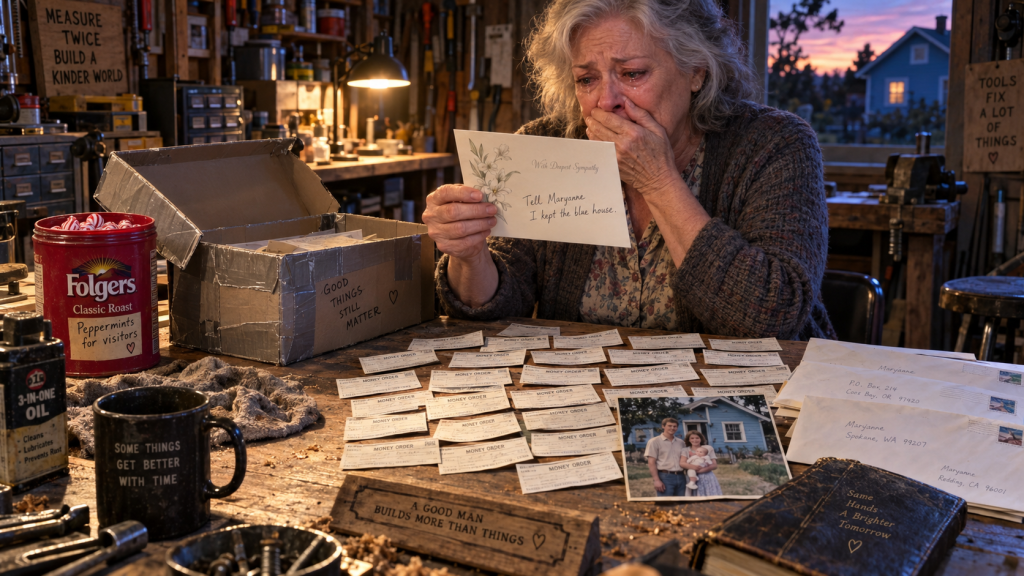
My husband Thomas was gone 16 days when the hospice nurse called to ask if I knew a woman named Maryanne. I said no. Nurse Paula got quiet, then said, “He asked for her at the end.” By 7:30 that night, I was standing in his workshop with a shoebox, 27 money order stubs, and a name I had never heard in 42 years of marriage.

Thomas d*ed at home in the front bedroom because that was what he wanted.
I keep saying that like it makes me generous.
Really, I was afraid of hospitals. He was afraid of d*ying under fluorescent lights. So we compromised in the way old married people do. I was afraid, and he got his way.
Hospice brought a bed, a little table on wheels, and a machine that made a soft breathing sound even when Thomas was asleep. Nurse Paula came every other day. She had gray hair pinned with a pencil and hands that were always warm.
Thomas liked her.
He did not like many people near the end.
The last week, he drifted in and out. He called me by my sister’s name twice. He asked for coffee though he had not been able to swallow it for days. Once he told me to “check the south fence,” and we had not owned cattle since 1998.
So when Paula called 16 days after the funeral, I thought it was about leftover supplies.
I was writing thank-you notes at the kitchen table. My handwriting had gone crooked. There was a casserole dish from the Methodist ladies soaking in the sink because someone used too much cheese and it stuck to the sides.
Paula said she had debated calling.
Then she asked if I knew Maryanne.
I almost laughed because I thought she meant a volunteer.
I said no.
Paula did not fill the silence.
I asked why.
She said, “He asked for her at the end.”
Not once, she told me.
Three times.
The last time, about 20 minutes before his breathing changed, Thomas opened his eyes and said, “Tell Maryanne I kept the blue house.”
I wrote the words on the back of a sympathy card because I did not trust myself to remember them.
Tell Maryanne I kept the blue house.
We never had a blue house.
Our first place was a beige rental in Peoria with ants in the pantry. Our current house is white vinyl siding with green shutters Thomas hated but never changed.
I told myself dying people say nonsense.
Then Paula added one more thing.
“He seemed relieved after he said it.”
Relieved.
That word sat on my chest all afternoon.
I went to his workshop after supper. It still smelled like sawdust, motor oil, and the peppermint candies he kept in a Folgers can. His tools were lined up too neatly because he had known he would not use them again.
I opened drawers I had cleaned around for 30 years.
Receipts. Old mower blades. A cracked watch face. Tax records from 2004 for reasons only Thomas could explain.
In the bottom cabinet, behind a box of Mason jar lids, I found a shoebox wrapped with duct tape.
Inside were money order stubs.
27 of them.
Different amounts. $150. $225. $310. Always sent in March or October. Always to the same post office box in Duluth, Minnesota.
Payable to Maryanne Cole.
I sat on the concrete floor because the stool was too far away.
The final stub was dated 11 days before hospice started.
On the bottom of the shoebox was a photograph of Thomas at about 25, standing beside a blue house with a woman holding a baby.
On the back, in Thomas’s handwriting, were 4 words.
“Before Ruth. Don’t destroy.”
PART 2 — THE BLUE HOUSE THOMAS NEVER TOLD ME ABOUT
I sat on the workshop floor until my left leg went numb.
The photograph stayed in my hand.
Thomas.
Twenty-five, maybe twenty-six.
Too much hair.
That crooked smile he still had when I met him.
Beside him stood a dark-haired woman I had never seen.
Maryanne, I assumed.
She held a baby against her shoulder.
The baby’s face was turned toward Thomas.
His hand rested lightly against the child’s back.
It was not the way a man touched a stranger’s baby.
That was the first thought I had.
The second was worse.
Before Ruth. Don’t destroy.
My name.
Written by my husband.
On the back of a photograph he had hidden for more than four decades.
I turned it over again.
Blue clapboard house.
White porch rail.
A maple tree barely taller than the roof.
Thomas looking happier than I had seen him in any photograph from his twenties.
Woman.
Baby.
Family.
Maybe.
I hated the word before I had evidence for it.
Still, it arrived.
Family.
Another one.
Before me.
I took everything into the kitchen.
The photograph.
The shoebox.
The twenty-seven money-order stubs.
A brass key I found beneath them after I checked the box a second time.
The key had a small blue plastic tag attached.
No writing.
Just blue.
Of course.
At seventy years old, apparently my husband could still be dramatic from beyond the grave.
I put the kettle on.
Forgot about it.
The water boiled until the lid rattled.
I turned off the stove and stood there listening to the sudden quiet.
Sixteen days.
Thomas had been gone sixteen days.
For the first fourteen, I had missed him in simple ways.
His slippers beside the bed.
His coffee cup.
The cough he made every morning before clearing his throat.
The way he complained about the thermostat and then secretly turned it up because he thought I was cold.
On day sixteen, grief became suspicious.
That felt like a betrayal of its own.
I wanted him back so badly I still reached toward his side of the mattress at night.
And now I was sitting at our kitchen table wondering whether the man I wanted back had spent forty-two years lying to me.
Both things were true.
That was the first terrible lesson Maryanne taught me without ever entering the room.
I lined up the money-order stubs by date.
The earliest was from twenty-seven years earlier.
One hundred fifty dollars.
Then nothing for almost eleven months.
Another.
Two hundred.
After that, the pattern became clearer.
March.
October.
Not every year.
But often.
Sometimes one payment.
Sometimes two.
The amounts gradually increased.
$150.
$185.
$225.
$260.
$310.
The final money order had been purchased eleven days before hospice brought the hospital bed into our front bedroom.
Three hundred dollars.
Payable to:
Maryanne Cole.
Thomas had already been struggling to walk then.
He had told me he was going to the hardware store with our neighbor Dennis because he wanted one final bag of grass seed before winter.
I remembered being irritated.
“You are dying and still worried about the lawn.”
He smiled.
“Somebody has to maintain standards.”
Apparently he had stopped at a place selling money orders.
Maybe Dennis drove him.
Maybe Thomas went alone another day.
I did not know.
That became unbearable.
A marriage is built partly from the comfort of believing you know where the ordinary days went.
Suddenly I had missing rooms inside forty-two years.
I added the money orders.
Six thousand eight hundred and forty dollars.
Less than I expected.
Enough to matter.
Not enough to explain a secret family.
At least not over nearly three decades.
That confused me.
If Thomas had been supporting a child, why so little?
If he had been supporting Maryanne, why only March and October?
If this was guilt money, what had he done?
I looked at the photograph again.
The baby would be nearly fifty now.
If alive.
That thought stopped me.
If alive.
I did not know anything.
Not the baby’s name.
Not whether Maryanne was still alive.
Not whether Thomas was the father.
Not whether the blue house still existed.
I was already building a betrayal out of shadows.
Thomas would have hated that.
He believed in measuring twice before cutting anything.
So I decided I would do the same.
Measure.
Then grieve.
Or get angry.
Whichever the facts earned.
The next morning, I called Nurse Paula.
“I’m sorry.”
I said immediately.
“You have nothing to apologize for.”
“I need to ask exactly what Thomas said.”
There was a pause.
Then:
“About Maryanne?”
“Yes.”
Paula was quiet.
I could hear paper moving.
“I wrote it down afterward.”
That surprised me.
“Why?”
“Because he said the same name several times.”
She hesitated.
“And because you had never mentioned anyone by that name.”
I swallowed.
“What did he say?”
“The first time was two days before he died.”
Paula’s voice softened.
“He opened his eyes while I was checking his medication pump and said, ‘Maryanne knows where the deed is.’”
My hand tightened around the phone.
“The deed?”
“Yes.”
My heart started pounding.
“You didn’t tell me that yesterday.”
“I didn’t remember until I looked at my notes.”
“What else?”
“The second time, the morning before he died, he asked if Maryanne had called.”
“I told him I didn’t know who Maryanne was.”
“He said…”
Paula stopped.
“What?”
“He said, ‘That’s probably for the best.’”
I closed my eyes.
Of course.
Even dying, Thomas had kept the door shut.
“And the last time?”
“About twenty minutes before his breathing changed.”
Her voice dropped.
“He said, ‘Tell Maryanne I kept the blue house.’”
I stared at the photograph lying beside me.
“Anything else?”
“No.”
Then Paula added:
“He smiled afterward.”
That hurt more than the words.
My husband had found relief in a secret I had not known existed.
I searched the workshop again.
This time, I did not search as Thomas’s widow.
I searched as someone looking for a deed.
That distinction changed what I noticed.
Thomas kept paperwork everywhere.
Old men collect documents the way squirrels collect nuts.
I found appliance warranties for machines we no longer owned.
The original receipt for a 1987 table saw.
A property survey from 1994.
Three dead batteries.
A handwritten list titled:
Things Ruth Says Are Not Worth Fixing.
Underneath:
1. Fan.
2. Toaster.
3. Marriage?
I laughed.
Then cried so hard I had to sit down.
That was the problem.
Thomas kept interrupting my investigation by being Thomas.
Funny.
Annoying.
Loved.
Dead.
I wanted him simplified.
He refused.
Behind an old metal file box, I found a manila envelope.
No label.
Inside was a photocopy of a deed.
Minnesota.
St. Louis County.
Property address:
1427 Bluebell Avenue, Duluth.
My hands began shaking.
The photograph had shown only the front of the house.
But I knew.
Bluebell.
Blue house.
Of course Thomas would have found that amusing.
The deed was dated forty-six years earlier.
Two names.
Thomas—
My husband.
And:
Maryanne Cole.
Joint owners.
I had to read it twice.
Then three times.
Forty-six years ago.
Four years before Thomas married me.
So the note had not lied.
Before Ruth.
But the property had existed during nearly our entire marriage.
I searched the remaining papers.
A later document.
Six months before our wedding.
Maryanne had signed a quitclaim deed transferring her interest to Thomas.
So by the time he married me, the blue house belonged to him alone.
I sat very still.
He had entered our marriage owning a house in Minnesota.
And never told me.
Maybe there was an innocent reason.
People marry with property.
But for forty-two years?
Tax returns.
Insurance.
Repairs.
How did I not know?
Then I realized.
Thomas and I had always filed jointly.
But for most of our marriage, an accountant prepared the returns.
Thomas brought the paperwork.
I signed where the little tabs told me.
My stomach turned.
Not because I thought the accountant had done anything wrong.
Because I suddenly understood how easy it had been for me not to know what I had never asked to see.
Trust had made me lazy.
Or comfortable.
Maybe both.
I called our accountant.
His father had handled us before him.
Three generations of boring men named Robert, apparently.
The current one, Rob Junior—who was nearly sixty and hated being called Junior—answered.
“Ruth.”
He sounded immediately sympathetic.
“How are you doing?”
“That depends on your answer.”
Silence.
Then:
“All right.”
“Did Thomas own property in Minnesota?”
A long pause.
Too long.
“Rob.”
“I need to pull the file.”
“You already know.”
“I know there was a property.”
My chest tightened.
“What property?”
“A small residential property in Duluth.”
“How long?”
“I don’t know without looking.”
“Did you think I knew?”
This time, his silence was different.
“I assumed you did.”
Of course.
Everybody always assumes the spouse knows.
That may be the loneliest sentence in marriage.
“Was it producing income?”
“Not in recent years.”
“In earlier years?”
“Possibly nominal rent.”
My pulse changed.
“From whom?”
“I would need to review.”
“Review.”
“Ruth—”
“Please.”
He softened.
“I’ll call you back.”
He called forty minutes later.
The blue house had been reported on old returns for years as rental property.
The income was low.
Sometimes nonexistent.
Expenses nearly matched it.
Property tax.
Insurance.
Maintenance.
Then, about twenty-eight years ago, Thomas stopped treating it as rental property.
It became classified differently after advice from the previous accountant because someone began occupying it without standard rent.
“Who?”
I asked.
Rob hesitated.
“The occupant name in the old file is Maryanne Cole.”
I closed my eyes.
There.
She lived there.
The woman in the photograph still lived in the house Thomas had owned before marrying me.
Or had lived there, at least.
“What did she pay?”
“According to the notes?”
“Yes.”
“Taxes and utilities at certain points.”
“Later, apparently nothing beyond utilities.”
My throat went dry.
“So Thomas let her live there.”
“Yes.”
“For decades?”
“It appears so.”
“And sent her money.”
“I wouldn’t know about that.”
“I know.”
I stared at the money-order stubs.
“Why weren’t the property expenses obvious to me?”
“Thomas usually paid them from an individual account.”
I frowned.
“What individual account?”
Silence.
Another missing room.
Thomas had kept a checking account from before our marriage.
I knew that.
Or thought I did.
I believed he used it for workshop expenses and the occasional old truck part he did not want me complaining about.
I used to joke that it was his “secret hardware-store fortune.”
He used to answer:
“Don’t tell my mistress at Ace Hardware.”
I had laughed.
Now I wanted to throw something.
Not because there had been a separate account.
We both had accounts.
Because he had hidden an entire property inside something I had turned into a marital joke.
I asked Rob:
“What happens to the house now?”
“That depends on the deed and Thomas’s estate plan.”
“His will leaves everything to me.”
“Then potentially it passes through the estate.”
“Potentially?”
“There may be another instrument.”
“What instrument?”
“I don’t know.”
That was becoming everybody’s favorite phrase.
Then:
“Ruth.”
“Yes?”
“If Maryanne has lived there for decades, do not assume ownership means you can simply remove her.”
“I am not throwing anyone out.”
My voice came sharper than intended.
“I’m sorry.”
“I know.”
Then Rob said:
“Talk to the estate lawyer before you make decisions.”
I did.
Thomas’s estate lawyer was a woman named Helen Ortiz.
I had met her twice.
Once when we updated our wills.
Once when Thomas decided our medical directives needed “less legal nonsense,” which made Helen stare at him for ten straight seconds.
She came to my house that afternoon.
I put the photograph on the table.
Then the stubs.
Then the deed.
Helen looked at them.
Her face changed slowly.
“You didn’t know.”
It was not a question.
“No.”
She sat.
“Did you?”
“I knew about the property.”
My heart hardened.
“And Maryanne?”
“No.”
“Do not lie to protect a dead man.”
“I’m not.”
She looked directly at me.
“Thomas told me the property was occupied by an old family friend under a lifetime arrangement.”
My pulse jumped.
“Lifetime arrangement?”
“He was vague.”
“And you accepted that?”
“I drafted around the property only as instructed.”
“What did you draft?”
Helen opened her folder.
Then placed a document in front of me.
A trust amendment.
Dated eight years earlier.
My hands began shaking before I finished the first paragraph.
Thomas had transferred the blue house into a small revocable trust.
He remained trustee while alive.
At death, successor trustee:
Helen.
Beneficial occupancy right:
Maryanne Cole, for her lifetime.
After Maryanne’s death:
The property passed to someone named—
I stopped.
Read again.
Anna Marie Cole.
My lungs forgot how to work.
“Who is Anna?”
Helen shook her head.
“I don’t know.”
“Thomas never explained?”
“He said Maryanne had a daughter.”
My eyes moved toward the photograph.
The baby.
No.
My hands went cold.
“How old is Anna?”
“I don’t know.”
“Did Thomas say she was his daughter?”
“No.”
“Did you ask?”
Helen looked uncomfortable.
“Yes.”
“And?”
“He said, ‘That is not a question I’m answering in an attorney’s office.’”
That sounded exactly like Thomas.
Infuriating.
Precise.
Cowardly.
Maybe all three.
I stood.
Walked to the sink.
Then back.
“So he hid a house from me for forty-two years.”
“I cannot speak to what he told you.”
“I’m telling you.”
I pointed toward the trust.
“And he arranged for Maryanne to live there for life.”
“Yes.”
“Then for her daughter to own it.”
“Yes.”
“A daughter who may be the baby in this photograph.”
“Possibly.”
I laughed.
Not because anything was funny.
Because Nurse Paula had asked whether I was okay.
Apparently the correct answer had been:
Not for long.
“Does this reduce my inheritance?”
I asked.
Helen answered carefully.
“The house was already in trust.”
“So it does not pass under the will.”
“Correct.”
“How much is it worth?”
“Current estimate?”
“Yes.”
“Perhaps two hundred and eighty to three hundred twenty thousand.”
I stared.
Thomas and I had spent twenty years talking about whether we could afford new kitchen cabinets.
He secretly owned a three-hundred-thousand-dollar house.
I wanted to scream.
Then Helen said:
“Ruth, the trust contains something addressed to you.”
My anger stopped.
“What?”
She opened another envelope.
Thomas’s handwriting.
FOR RUTH, IF THIS BECOMES HER PROBLEM.
I almost threw it across the room.
“If?”
Helen wisely said nothing.
I opened it.
Ruth,
If you are reading this, I failed to tell you something while I was alive.
I said aloud:
“No kidding.”
Helen looked down.
I continued.
I have tried to tell you at least a dozen times. That sentence does not excuse me. A man who tries to tell the truth for forty years and never manages it is still a man who did not tell the truth.
My eyes filled despite myself.
Damn him.
Maryanne was part of my life before you. So was the blue house. So was Anna.
I stopped.
There.
So was Anna.
My hands shook.
I kept reading.
Do not blame Maryanne for my silence. She asked me more than once whether you knew. I told her I would tell you. I did not. That lie belongs to me.
I closed my eyes.
Maryanne knew about me.
Of course she did.
For forty-two years, a woman in Minnesota had apparently known she occupied a room inside my marriage that I did not know existed.
I hated her for half a second.
Then Thomas’s next line stopped me.
She wanted no part of hurting you. Most of the money I sent was for taxes, furnace repairs, or things connected to the house. None of it was romantic. I know you may not believe that yet.
I stared at the stubs.
March.
October.
Property taxes.
Heating season.
Suddenly the dates made sense.
Not child support.
House maintenance.
Then:
I did not have an affair with Maryanne after I met you.
My chest released something.
Not relief exactly.
A smaller fear leaving to make room for a larger one.
But there is something I did before I met you that I am not proud of.
There.
I sat straighter.
Anna is the reason the house still exists.
My throat tightened.
If you want the entire truth, go there. Maryanne deserves to tell her part without me editing it from the grave.
I became furious.
“No.”
Helen looked up.
“No what?”
“He does not get to do that.”
“What?”
“Send me eight hundred miles to collect the truth from another woman because he was too afraid to tell me himself.”
My voice broke.
“He was here.”
“For forty-two years.”
“He had breakfast with me.”
“He slept beside me.”
“He watched me bury my sister.”
“He sat beside me through breast surgery.”
“He had four decades.”
“And now I’m supposed to drive to Minnesota?”
Helen’s eyes filled.
“I know.”
“No.”
I crumpled the edge of the letter in my fist.
Then forced myself to smooth it.
Thomas continued.
You may decide not to go. I would understand.
“Oh, would you?”
Helen almost smiled.
I kept reading.
But before you decide who I was, please see the blue house once.
At the bottom:
I loved you. None of this changes that, though I know it may change what that love means to you.
Then one final line.
I am sorry I made my cowardice part of your widowhood.
That one got me.
I put the letter down.
Then sobbed.
Not gracefully.
Not with the dignity widows in movies seem to possess.
I bent over the kitchen table and cried like Thomas had died again.
Except this time I was grieving somebody less complete.
Maybe more real.
I did not leave for Minnesota immediately.
For three days, I did normal things.
Bought milk.
Returned casserole dishes.
Thanked the church ladies.
Signed forms for the funeral home.
Sat in Thomas’s recliner and hated him.
Then loved him.
Then hated him for making me love him while angry.
Grief has no organizational system.
On the fourth morning, I called Maryanne’s post-office box.
Of course, you cannot call a post-office box.
That is what grief does to intelligence.
So I laughed at myself.
Then looked up the blue-house address.
The property still existed.
Satellite image.
Blue siding.
Newer roof.
Same porch.
The maple tree now towered over the house.
I stared at the screen.
Forty-six years had passed in one tree.
I found a phone number associated with Maryanne Cole.
I wrote it down.
Did not call.
Waited an hour.
Called.
Disconnected.
Of course.
Then I did the thing I had resisted.
I wrote a letter.
Maryanne,
My name is Ruth. I was Thomas’s wife.
I stopped.
Too formal.
Started again.
Maryanne,
Thomas died sixteen days ago. Hospice told me he asked for you. I found the photograph, the money-order stubs, and the trust papers.
My hand shook.
I did not know about you.
That sentence looked pitiful on paper.
Forty-two years compressed into six words.
I am not writing to accuse you. I do not yet know enough to accuse anyone except my husband of being a coward.
That sounded more like me.
Thomas left me a letter saying that if I wanted the truth, I should see the blue house and hear your part from you. I resent him for that. I imagine you may understand why.
Then:
If you are willing to speak with me, please call.
I included my number.
Mailed it to the same post-office box from the money orders.
Then waited.
Five days.
Nothing.
On the sixth morning, the phone rang at 6:42.
Minnesota area code.
I stared until the fourth ring.
Then answered.
“Hello?”
Breathing.
A woman’s voice.
Older.
Careful.
“Is this Ruth?”
My knees weakened.
“Yes.”
Long silence.
Then:
“My name is Maryanne Cole.”
I sat.
Neither of us spoke for several seconds.
Finally she said:
“I am sorry about Thomas.”
My throat tightened.
“Thank you.”
Another silence.
Then:
“I told him to tell you.”
I closed my eyes.
“He wrote that.”
“He always said he would.”
“I know.”
“I should have insisted.”
Anger rose.
“At what point?”
“What?”
“Year five?”
“Year twenty?”
“Year forty?”
She went quiet.
“That was unfair.”
I said.
“No.”
she answered.
“It wasn’t.”
That surprised me.
Then Maryanne said:
“I thought about writing to you myself.”
“Why didn’t you?”
“Because Thomas asked me not to.”
That hurt.
“And you listened.”
“Yes.”
“Why?”
A long pause.
“Because Anna asked me to.”
My pulse jumped.
There she was.
The baby.
Anna.
“Who is Anna?”
Silence.
Then Maryanne said:
“You should come here.”
I laughed.
Not kindly.
“Thomas said the same thing.”
“I know.”
“Everyone seems very committed to making this inconvenient for me.”
To my surprise, Maryanne laughed.
A small, tired laugh.
“Thomas always did prefer making people drive.”
That familiarity stabbed me.
You knew his habits.
You knew his jokes.
You knew a version of my husband I did not.
I hated her again.
Briefly.
Then she said:
“Ruth.”
“Yes?”
“I don’t think I can tell you this over the phone.”
My hand tightened.
“Is Anna Thomas’s daughter?”
Silence.
Too long.
My heart began pounding.
“Maryanne.”
She inhaled.
Then:
“Yes.”
One word.
Forty-two years cracking open.
I closed my eyes.
Thomas had a daughter.
Before me.
A daughter who had been alive throughout our entire marriage.
A daughter whose name I had never heard.
I could barely speak.
“How old?”
“Forty-seven.”
I pressed my hand against my mouth.
Thomas and I married forty-two years ago.
Anna had been five.
He had married me while his five-year-old daughter lived eight hundred miles away.
I could not understand it.
“Did he abandon her?”
Maryanne started crying.
“No.”
“What would you call it?”
“No, Ruth.”
Her voice shook.
“You need to know what happened.”
“Then tell me.”
“I can’t do it properly like this.”
“Try.”
She cried harder.
Then said:
“Anna believes Thomas abandoned her.”
My anger stopped.
“What?”
“She has believed that since she was six.”
My chest tightened.
“Why?”
Maryanne whispered:
“Because I told her he did.”
Silence.
Nothing moved.
Then:
“Why would you do that?”
Her answer came barely above a breath.
“Because Thomas asked me to.”
I stood.
The chair scraped backward.
“What?”
“I’m sorry.”
“Why would a father ask the mother of his child to tell her he abandoned her?”
Maryanne did not answer immediately.
Then:
“Because of the blue house.”
I stared at the photograph on the table.
The young woman.
Baby.
Thomas’s hand.
“What happened in that house?”
Maryanne cried.
Then said:
“Come to Duluth.”
I almost refused.
Then she added:
“Anna will be here Sunday.”
My heart stopped.
“She knows I called you.”
“No.”
“Does she know I exist?”
A pause.
“She knows your name.”
That somehow hurt even more.
Of course she did.
Another woman knew me.
Thomas’s daughter knew me.
I knew neither of them.
Then Maryanne said:
“She has your wedding photograph.”
I could not speak.
“What?”
“Thomas gave it to her when she was twelve.”
My hand went cold.
“He saw her?”
Silence.
Maryanne’s voice broke.
“Once.”
Just once.
I closed my eyes.
Then she whispered:
“Ruth, there is something else you need to understand before you come.”
“What?”
“Anna does not know Thomas kept the blue house for her.”
I stared.
“Why not?”
“Because she thinks it burned down forty years ago.”
Every hair on my arms lifted.
I looked at the photograph again.
Blue siding.
White porch.
Baby.
Thomas.
A house supposedly destroyed.
A house still standing.
A house Thomas had maintained secretly through our entire marriage.
I whispered:
“Maryanne, what happened?”
She cried.
Then said:
“The night Thomas left us, there was a fire.”
My heart stopped.
“And after that, he made me promise Anna would grow up believing two things.”
I could barely breathe.
“What two things?”
“That the house was gone.”
A pause.
“And that he was never coming back.”
I gripped the table.
“Why?”
Maryanne’s answer was almost a whisper.
“Because he thought it was the only way to keep her safe.”
The line went silent except for her breathing.
I stared at the picture of my husband at twenty-five.
The man I thought I knew.
The father I had never known existed.
The blue house that had supposedly burned and somehow remained standing.
Then Maryanne said the sentence that made me decide I was going to Minnesota.
“Ruth, Thomas didn’t leave Anna because he didn’t love her.”
She inhaled shakily.
“He left because somebody had threatened to kill her if he stayed.”
PART 3 — THE DAUGHTER THOMAS LEFT BEHIND
I drove to Duluth on a Friday morning with Thomas’s photograph in my purse and forty-two years of marriage arguing inside my head.
I could have flown.
At seventy, I had enough sense to understand that twelve hours behind a steering wheel was not medically impressive.
But I needed the road.
Airports move people too quickly.
I was not ready to arrive quickly at the woman who had known my husband before I did.
Or the daughter he had kept secret for almost half a century.
So I drove north.
Past cornfields.
Past towns where the gas stations still sold coffee strong enough to remove paint.
Past exits Thomas and I might once have taken if he had ever looked at me and said:
Ruth, there is something you need to know.
He never had.
That thought sat in the passenger seat the entire way.
I spent the night outside Madison.
I barely slept.
At three in the morning, I opened the old photograph again.
Thomas beside the blue house.
Maryanne holding Anna.
He looked young enough to be innocent.
That made me angry.
Photographs are unfair that way.
They freeze people before consequences age their faces.
I touched his image.
“You should have told me.”
The hotel room said nothing.
Neither did Thomas.
For forty-two years, I had complained that the man could sleep through anything.
Apparently death had improved him.
I reached Duluth Saturday afternoon.
Lake Superior appeared under a gray sky so enormous it looked like another kind of weather.
Thomas had never brought me there.
Not once.
We vacationed in Wisconsin.
Michigan.
Colorado.
Even South Dakota, though I maintain no marriage benefits from that much corn.
But never Duluth.
Now I knew why.
Some people avoid places because of bad memories.
Thomas had avoided an entire city because it contained a life he had not told his wife existed.
I checked into a small hotel.
Then sat on the bed with my coat still on.
I could see part of the lake through the window.
My phone displayed Maryanne’s number.
I almost called to cancel.
Instead, I said aloud:
“No.”
Not to her.
To myself.
Thomas had spent decades postponing truth because the next day always seemed easier.
I would not begin copying him now.
The blue house stood on a quiet street lined with maples.
1427 Bluebell Avenue.
The siding was still blue.
Not the same blue as the photograph.
This color was darker.
Older.
The porch had been rebuilt.
The maple tree that barely reached the roof in 1978 now spread across half the yard.
I parked at the curb.
For a long time, I did not get out.
This house had existed during almost my entire marriage.
While Thomas and I painted our first bedroom.
While we buried his mother.
While I had surgery.
While he retired.
While we argued about whether the kitchen linoleum was “still perfectly good.”
This house had been here.
Quietly.
Holding a secret.
Then the front door opened.
Maryanne stepped onto the porch.
She was small.
That surprised me.
I had imagined someone glamorous enough to justify forty-two years of concealment.
Grief makes you stupid.
She was simply an old woman.
White hair cut to her chin.
Brown cardigan.
Slippers.
One hand holding the porch rail.
For one terrible second, I understood that she had aged too.
While I was growing old beside Thomas, so was she.
Different house.
Same years.
She raised one hand.
Not waving exactly.
Acknowledging.
I got out of the car.
“Ruth?”
“Yes.”
Her eyes filled immediately.
Mine did too.
I hated that.
I wanted anger clean.
Tears made everything muddy.
Maryanne came down one step.
Then stopped.
“I don’t know whether I should hug you.”
“Probably not.”
She nodded.
“Fair.”
That helped.
A little.
Then she looked at the photograph in my hand.
Her face changed.
“You found that.”
“Yes.”
“I wondered if he still had it.”
“For forty-two years.”
She closed her eyes.
“I’m sorry.”
I stared at her.
“Please stop apologizing for him before I’ve even gotten inside.”
She looked at me.
Then nodded.
“All right.”
Good.
We understood one thing already.
The house smelled like cinnamon tea and old wood.
Nothing mysterious.
No secret-family altar.
No photographs of Thomas covering the walls.
That relieved me.
Then disappointed me.
Widowhood is unreasonable.
Maryanne brought me into the living room.
The fireplace mantel was newer than the photograph.
One wall held family pictures.
Anna as a child.
Anna graduating high school.
Anna holding a baby.
Anna older.
A man beside her in one photograph.
Children.
A whole life Thomas had not seen.
Or had he?
I turned.
“How much did he know?”
Maryanne followed my gaze.
“About Anna?”
“Yes.”
“Not much.”
“Don’t do that.”
Her face tightened.
“What?”
“Give me the gentle version.”
“I’ve had sixteen days of people trying to be gentle.”
I looked at her.
“Tell me what he knew.”
Maryanne sat.
So did I.
She folded her hands.
“He knew she became a teacher.”
“He knew she married.”
“He knew when her son was born.”
“How?”
“I told him.”
“Letters?”
“Sometimes.”
“Phone calls?”
“A few.”
“Did Anna know?”
“Not always.”
My jaw tightened.
“So even after she was an adult, you were still reporting on her to him in secret.”
Maryanne looked ashamed.
“Yes.”
“Why?”
“Because he asked.”
“That is not an answer.”
“No.”
She swallowed.
“Because part of me kept thinking if he knew enough about her life, one day he would become brave enough to enter it.”
I looked away.
“He didn’t.”
“No.”
At least she did not defend him.
Footsteps sounded in the hallway.
I turned.
And saw Thomas.
Not really.
But enough of him that my body reacted before my mind did.
A woman stood in the doorway.
Late forties.
Dark blond hair.
Tall.
Plain black sweater.
Her eyes were Thomas’s.
Not the color.
The way they narrowed when she was trying to decide whether somebody deserved a full answer.
Her hands were his too.
Broad palms.
Square fingertips.
Workshop hands.
She looked at me.
I stood.
Neither of us spoke.
Then she said:
“You’re Ruth.”
“Yes.”
Her eyes moved over my face.
“I’ve seen you younger.”
My throat tightened.
“The wedding picture.”
She nodded.
“I’m Anna.”
I could not say:
I know.
That felt obscene.
Instead:
“Hello, Anna.”
“Hello.”
That was the first conversation I ever had with my husband’s daughter.
Hello.
As though we had met beside produce at the grocery store.
Perhaps ordinary words are all the body can manage around extraordinary facts.
Anna did not hug me.
Thank God.
She sat opposite me.
Maryanne remained between us.
For several seconds, I heard only the old radiator clicking.
Finally Anna said:
“So he died.”
“Yes.”
“Was it bad?”
The question surprised me.
“No.”
I thought.
“Not at the very end.”
She looked down.
“What did he die from?”
“Pancreatic cancer.”
She nodded once.
Then:
“Did he know?”
“That he was dying?”
“Yes.”
“Yes.”
“For how long?”
“Months.”
Her mouth tightened.
“And he still didn’t tell you.”
There was no satisfaction in her voice.
That hurt more.
“No.”
I said.
“He didn’t.”
Anna looked at Maryanne.
Then back at me.
“I told you.”
Maryanne closed her eyes.
There was history in those three words.
I leaned forward.
“Told her what?”
Anna answered:
“That he would die before telling you.”
My throat tightened.
“You said that?”
“Fifteen years ago.”
I stared.
“You spoke to him fifteen years ago?”
“No.”
She gave me a humorless smile.
“I wrote him a letter.”
“Did he answer?”
“Yes.”
“Do you have it?”
“Yes.”
She reached into a leather bag near her chair.
Of course she had brought it.
Everybody in Thomas’s hidden life had arrived with documents.
I took the envelope.
His handwriting.
My husband’s hand addressing another woman I had never known.
Anna Cole.
No return name.
Coward to the end, apparently.
Inside was one page.
Anna said:
“Read it.”
So I did.
Anna,
Your mother tells me you have a son now. Congratulations.
I stopped.
Thomas had known he was a grandfather.
I looked at Anna.
She said nothing.
I continued.
You asked whether Ruth knows about you. She does not.
My chest tightened.
At least he had not lied to Anna about that.
You are right that she should.
My eyes blurred.
Then:
I have begun the conversation in my head more times than I can count. That is not the same as beginning it with her.
I laughed bitterly.
“No.”
Anna’s eyes filled.
“Keep reading.”
You said that if I cannot tell my wife I have a daughter, then I have not earned the right to ask that daughter for a relationship. I think that is fair.
I stopped.
Anna had drawn the boundary Thomas never crossed.
Not until death.
I am sorry for the part of your childhood I missed. I am sorrier that after danger was gone, fear remained and I let fear become habit.
There.
Thomas knew.
He had always known.
My hands began shaking.
The blue house is still there. I kept it. Your mother knows. Someday it will be yours, if you want it.
Anna’s eyes snapped toward Maryanne.
“What?”
Maryanne went pale.
I looked between them.
Anna stood.
“What does that mean?”
Maryanne whispered:
“Anna—”
“You told me you bought this house back.”
Maryanne covered her mouth.
There it was.
The lie had survived even into this room.
I stood too.
“Thomas owned it.”
Anna stared at me.
“What?”
“He put it in trust.”
My voice softened despite everything.
“Your mother has the right to live here for life.”
“After that, it goes to you.”
Anna looked at Maryanne.
“You knew?”
Maryanne started crying.
“Yes.”
“You told me you bought it after Grandma died.”
“I know.”
“Why?”
“Because Thomas asked—”
Anna laughed.
A terrible laugh.
“Of course he did.”
Then she walked out of the room.
The front door slammed.
I looked at Maryanne.
“Go after her.”
She shook her head.
“She needs a minute.”
“You have apparently been giving that family minutes for forty-seven years.”
Maryanne looked at me.
Then stood.
Good.
We found Anna on the back porch.
She stood facing the yard.
The house was quiet behind us.
Maryanne stopped several feet away.
“Anna.”
“Don’t.”
Her voice shook.
“Please.”
“No.”
She turned.
“You told me Dad left.”
“You told me the house burned down.”
“You told me later you somehow got the property back.”
“Now I find out he owned it the whole time?”
Maryanne cried.
“Yes.”
“Was anything true?”
That question broke something open.
Maryanne sat on the porch step.
Suddenly she looked ninety.
“The fire was true.”
Anna stared.
“The threat was true.”
“Then tell us.”
I said.
“Everything.”
Maryanne looked at me.
Then at her daughter.
And finally stopped protecting Thomas.
Maryanne had married Raymond Cole at eighteen.
Not because she loved him.
Because she was pregnant.
She lost that pregnancy two months later.
The marriage lasted anyway.
Badly.
Raymond drank.
Controlled money.
Hit walls.
Then her.
She left him at twenty-two.
The divorce took almost a year because Raymond refused to cooperate.
During that year she met Thomas.
He repaired furnaces for a commercial contractor then.
Maryanne worked in the office of one of their suppliers.
Thomas was twenty-four.
Single.
Stubborn.
Funny.
She fell in love with him before her divorce was final.
“That is the part Thomas said he wasn’t proud of.”
Maryanne looked at me.
“He knew I was still legally married.”
I nodded.
It hurt.
But it happened before me.
I could survive facts that did not belong to my marriage.
Then Anna was conceived.
Raymond learned about the pregnancy.
He became obsessed.
Not because he wanted Maryanne back.
Because Thomas had “humiliated” him.
The divorce became final before Anna was born.
Thomas and Maryanne bought the blue house together.
Small.
Cheap.
They intended to marry.
I stared at the photograph.
A family almost formed.
Before mine.
Maryanne continued.
“Raymond started coming by.”
“Watching.”
“Leaving notes.”
“Thomas went to police.”
“In 1978?”
I asked.
“Yes.”
“What happened?”
“Not much.”
Her laugh contained no humor.
“Domestic threats were treated differently then.”
That was true enough to hurt.
Raymond had no ownership interest.
No right to the house.
But he knew people.
Worked construction.
Drank with a deputy.
Maryanne got told to call if he actually did something.
Then he did.
The fire started in the back room when Anna was eleven months old.
Gasoline.
A broken window.
Thomas woke first.
He got Maryanne out.
Then went back for Anna.
Smoke burned his lungs.
He carried the baby through the front door wrapped in a wet blanket.
The back half of the house was destroyed.
The front remained standing.
I looked at Anna.
She had gone pale.
“You never told me Dad carried me out.”
Maryanne cried.
“No.”
“Why?”
“Because of what happened next.”
Two nights after the fire, Raymond found Thomas behind a tavern where he had gone to meet a friend.
Three men beat him.
Broke two ribs.
Fractured his wrist.
Then Raymond knelt beside him.
Maryanne’s voice shook.
“He said if Thomas came back to me, the next fire would start in Anna’s room.”
Silence.
Lake wind moved through the yard.
I felt suddenly cold.
“What did police do?”
I asked.
“Thomas reported it.”
“And?”
“Raymond had witnesses saying he was somewhere else.”
“Of course.”
Maryanne continued.
“Thomas wanted us to leave Duluth.”
“I wanted to go.”
“But my mother was sick.”
“I had no money.”
“The house was damaged.”
“We fought.”
Then:
“And Thomas decided the safest thing was for him to disappear.”
Anna stared.
“Just like that?”
“No.”
Maryanne shook her head.
“We planned temporary.”
“That’s the part you need to understand.”
“He was supposed to go to Peoria, work, save money, and come back when we could leave safely.”
My chest tightened.
Peoria.
Where I met him.
Four years later.
Anna’s voice sharpened.
“Temporary became forty-seven years?”
Maryanne covered her face.
“No.”
“Temporary became months.”
“Then a year.”
“Then more.”
“Raymond kept watching me.”
“He asked neighbors whether Thomas called.”
“He followed my mother once.”
“So I stopped taking Thomas’s calls.”
“Letters came through my sister.”
“Money came through other people.”
“Then Thomas met Ruth.”
Maryanne looked at me.
My stomach dropped.
“How long before I knew about you?”
she asked herself.
“Almost a year.”
I stared.
“So when Thomas and I started dating, you and he were still…”
“No.”
Maryanne answered immediately.
“Not romantically.”
“He had told me months earlier he could not keep living suspended.”
“We had already ended whatever future we thought we had.”
That mattered.
Not enough to erase secrecy.
Enough to keep my marriage from beginning as an affair.
I breathed.
Anna stood with both hands on the porch railing.
“What happened to Raymond?”
“Prison eventually.”
Maryanne said.
“For assaulting someone else.”
“When?”
“You were nine.”
“And Dad came back when I was twelve?”
“Yes.”
“Why wait three more years?”
Maryanne closed her eyes.
“Because Raymond was still alive.”
“Prison didn’t make him harmless.”
“He died when you were eleven.”
Liver failure.
Then Thomas came.
One year later.
Not because danger remained.
Because fear did.
And because by then he had married me.
Anna turned toward Maryanne.
“What did you tell me?”
Maryanne’s face crumpled.
“That your father left because he wanted another life.”
Anna laughed bitterly.
“So the dangerous man dies.”
“Dad finally comes back.”
“And I already hate him.”
“Yes.”
“What did he say?”
Maryanne whispered:
“He tried to explain.”
Anna shook her head.
“No.”
“I remember.”
Her voice changed.
Not forty-seven.
Twelve.
“He said he was sorry.”
“He said there were things I didn’t understand.”
“I asked why he never came to birthdays.”
“Why he never called.”
“He said he couldn’t.”
“I told him that was what cowards say.”
My eyes filled.
Thomas had remembered that sentence.
Maybe every day.
Anna continued.
“Then I asked if he had a wife.”
“He said yes.”
“I asked if she knew about me.”
“He said no.”
Her eyes found mine.
“I told him to leave.”
I swallowed.
“You had every right.”
She stared.
“He gave me your wedding photo before he went.”
I could barely breathe.
“Why?”
Anna laughed sadly.
“Because I asked what the woman he chose looked like.”
My chest hurt.
“He didn’t choose me instead of you.”
I said.
Anna looked at me.
“I know that now.”
“Do you?”
“Yes.”
She wiped her eyes.
“He chose silence.”
That was the answer.
Not Maryanne.
Not Ruth.
Silence.
Again and again.
We went back inside after an hour.
Nobody had won.
That felt right.
Maryanne made tea nobody drank.
Anna sat by the window.
I held Thomas’s old letter.
Then asked:
“Why the money orders?”
Maryanne answered.
“The house.”
“Taxes.”
“Repairs.”
“Furnace.”
“Roof.”
“I moved back here twenty-seven years ago after my second husband died.”
I stared.
“You remarried?”
“Yes.”
“To a good man.”
“Did Thomas know?”
“Yes.”
“Was he jealous?”
Maryanne almost smiled.
“No.”
“He was relieved.”
That mattered more than I expected.
There had been no secret decades-long romance.
No hidden visits.
No second marriage in all but name.
Just unfinished obligation.
Cowardice.
A house.
A daughter.
Then I asked:
“Why money orders instead of checks?”
“Because your accountant questioned payments once.”
My jaw tightened.
“Thomas said money orders were cleaner.”
I laughed.
“Cleaner.”
Nothing about this was clean.
Maryanne nodded miserably.
“I know.”
Then Anna asked the question nobody had yet asked.
“Why did he keep the house?”
Maryanne looked at her.
“Because it was supposed to be yours.”
“I was a baby.”
“Yes.”
“Mom.”
Maryanne swallowed.
“After the fire, Thomas said if nothing else survived, he wanted the house to.”
“The insurance repaired most of it.”
“He used nearly all the settlement and his savings.”
“When he left, I signed my share to him because I thought we were going to sell later.”
“Then he refused.”
“Why?”
“Because…”
Maryanne’s voice broke.
“He said Raymond had already taken your father from you.”
“He would not let him take the one home Thomas had bought for you too.”
Anna stared.
“That’s ridiculous.”
“Yes.”
“It’s a house.”
“Yes.”
“He could have been my father instead.”
Maryanne cried.
“Yes.”
There it was.
The entire tragedy.
Thomas had preserved wood because he could not preserve courage.
A roof.
A deed.
A porch.
All easier than calling his daughter.
Anna began laughing.
Not happily.
“He thought this made up for it?”
“No.”
I said.
She looked at me.
I continued.
“He knew it didn’t.”
“How do you know?”
“Because he wrote that fear became habit.”
Anna looked down.
I thought about Thomas dying in our front bedroom.
Calling for Maryanne.
Telling her he kept the blue house.
Relieved afterward.
And suddenly I understood.
He had not believed the house repaired anything.
He had simply held onto the only promise he felt capable of keeping.
A poor substitute for fatherhood.
Still a promise.
People sometimes preserve one piece of what they destroyed because losing all of it would make the failure impossible to live with.
That evening, Maryanne went to bed early.
Exhausted.
Anna and I sat alone in the living room.
The two women Thomas had kept on opposite sides of his life.
She looked at me.
“Did he love you?”
I almost laughed.
“What a question.”
“I need to know.”
“Yes.”
No hesitation.
“He loved me.”
Anna nodded.
“Was he good to you?”
I thought.
“Mostly.”
“Mostly?”
“We were married forty-two years.”
“If I answer perfectly, I’m lying.”
That earned a small smile.
“He was stubborn.”
“Terrible at apologizing.”
“Bought tools we could not afford.”
“Pretended he didn’t like cats, then fed every stray in the county.”
Anna laughed.
Thomas’s laugh lived inside it.
That nearly broke me.
I continued.
“He held my hand when I was sick.”
“Sat beside my sister for two days while she was dying because I couldn’t bear to be alone with her.”
“He rubbed my feet after my surgery.”
“He forgot our anniversary twice.”
“Remembered exactly how I took my coffee every morning for forty-two years.”
Anna’s eyes filled.
“So he could be good.”
“Yes.”
I looked at her.
“And he could still fail you.”
Both.
Always both.
Anna cried quietly.
“I spent my whole life trying to decide which kind of man he was.”
I reached toward her.
Stopped.
“Maybe that was the problem.”
She looked at me.
“He was both.”
She nodded.
Then:
“I hate that.”
“So do I.”
For the first time, we laughed together.
Before I left Duluth, Anna showed me something.
A cardboard box.
Inside were nine letters from Thomas.
Unopened.
All returned over the years.
Some she had refused.
Some Maryanne had kept.
One addressed when Anna turned eighteen.
One at twenty-one.
One after her marriage.
I stared.
“You never read them?”
“Not then.”
“Now?”
“Some.”
She handed me the eighteenth-birthday letter.
I shook my head.
“That’s yours.”
“I want you to read one part.”
I opened it.
Thomas wrote:
You may someday hear that I stayed away because I did not care enough to return. That is not exactly true, but the difference may not matter to you. I stayed away first because I was afraid for you. Later, I stayed away because I was afraid of you. Of your anger. Of what Ruth would think. Of having to explain why every year of silence made the next year harder to confess.
My eyes filled.
The first fear may have protected you. The others protected only me.
I stopped.
There it was.
The truest sentence Thomas ever wrote.
The first fear may have protected Anna.
The rest protected Thomas.
Nothing else needed polishing.
I drove home two days later.
The blue house did not come with me.
Neither did Maryanne.
Neither did Anna.
But Thomas changed shape in the passenger seat.
Not villain.
Not martyr.
Not the uncomplicated husband I had buried.
A man.
Young once.
Afraid.
Brave enough to carry a baby through smoke.
Cowardly enough to hide that baby from his future wife for forty-two years.
Capable of protecting Anna from a violent man.
Incapable of facing the emotional consequences when the physical danger ended.
Capable of loving me deeply.
Capable of denying me information that might have changed whether I married him.
That last truth hurt most.
Thomas had stolen something from me too.
Not money.
Choice.
If he had told me before our wedding:
I have a five-year-old daughter in Minnesota whom I am not seeing because of a violent threat—
what would I have done?
I did not know.
Maybe I would have married him anyway.
Maybe I would have demanded he find a safer way to remain in Anna’s life.
Maybe I would have left.
The point was not which.
The point was that the choice should have been mine.
He decided I was better off not knowing.
That was his longest betrayal.
Back home, I met Helen.
Thomas’s estate lawyer.
I brought copies of Anna’s letters.
Not because they changed title.
Because I needed context.
Helen explained that the blue house had been Thomas’s premarital property.
The trust had been validly established years earlier.
I might have arguments around certain later marital contributions if I wanted to make trouble.
I looked at her.
“Would I win?”
She sighed.
“Possibly something.”
“How much?”
“Maybe not enough to justify what it would do to everyone.”
Good lawyer.
I thought about Anna.
Forty-seven years old.
A father she never had.
A house she did not know he preserved.
I shook my head.
“I’m not challenging it.”
Helen looked at me carefully.
“Do not decide out of guilt.”
“I’m not.”
“Then why?”
“Because Thomas’s deception toward me does not turn Anna into the person who owes me repayment.”
Helen nodded.
Exactly.
If I punished his daughter for his lie, I would simply be moving the cost to another woman who had already paid too much.
No.
The blue house would remain where Thomas intended.
Maryanne for life.
Anna after.
I signed only what was necessary to confirm I would not contest.
My hand shook.
Not from generosity.
From grief.
For six months, Anna and I did not speak.
That was all right.
Meeting did not magically make us family.
I was not her stepmother.
She was not my daughter.
We were two women connected by a dead man who had loved us differently and lied to both of us.
That is not a relationship.
It is an introduction.
Then Christmas came.
A card arrived.
No photograph.
Just handwriting.
Ruth,
Mom says Thomas always hated green shutters.
I laughed.
Then read:
She also says you had green shutters for years. This may be the first thing about him that makes me feel better. Apparently neither of us had the influence we deserved.
I laughed until I cried.
I wrote back:
He complained about them for eighteen years and never picked up a paintbrush. This tells you everything essential about your father.
That was how it started.
Not grief.
Shutters.
We wrote occasionally.
Then called.
Never every week.
Never pretending.
Anna asked about Thomas’s favorite foods.
His temper.
Whether he sang.
He did not.
He claimed he did.
Different matter.
I asked about her.
She taught fourth grade for twenty-three years.
Had one son named Matthew.
Divorced amicably.
Loved gardening.
Hated driving in snow, which seemed a poor choice for Minnesota.
Once she asked:
“Did he ever talk about wanting children with you?”
I froze.
Thomas and I had tried.
For years.
One miscarriage.
Then another.
Then no children.
We eventually stopped talking about it.
He told me once:
“Maybe we’re meant to be enough.”
At the time, I thought it was tenderness.
Now the sentence had another shadow.
“Yes.”
I told Anna.
“We tried.”
Her voice softened.
“I’m sorry.”
“So am I.”
Then I said something I had avoided.
“Maybe having you out there changed how he survived that.”
Silence.
“Do you think?”
“I don’t know.”
Honesty.
Finally.
We had enough lies.
A year after Thomas died, Anna came to Peoria.
She wanted to see the workshop.
I worried.
What if she saw too much of the father she did not get?
Then realized that was not mine to manage.
I opened the door.
She stepped inside.
Sawdust.
Motor oil.
Peppermint candies.
Exactly as he left it, mostly.
Anna touched the workbench.
Her hand rested where Thomas’s had rested thousands of times.
Same square fingertips.
She smiled.
“He always worked with wood?”
“Yes.”
“I do too.”
I stared.
“What?”
“Small things.”
“Shelves.”
“Frames.”
She laughed.
“Badly.”
I opened a drawer.
Handed her one of Thomas’s old chisels.
She held it.
Then started crying.
Not because the tool was valuable.
Because inheritance sometimes arrives through grip.
We found one more thing that afternoon.
Behind a row of coffee cans was a narrow wooden box.
No label.
Inside were photographs.
Not many.
Anna at twelve.
The one visit.
She stood stiffly beside a younger Maryanne.
Thomas had taken the picture.
Another photograph of Anna’s high-school graduation, apparently mailed by Maryanne.
Her wedding.
Matthew as a baby.
Thomas had kept them.
Hidden.
I looked at Anna.
She stared at her own childhood.
Then whispered:
“He had pictures.”
“Yes.”
“That doesn’t make it better.”
“No.”
“I’m glad anyway.”
I nodded.
Both.
She picked up the photograph of Matthew.
“My son never knew he had a grandfather alive.”
My chest tightened.
“I’m sorry.”
“So am I.”
Then she looked at me.
“Did Thomas ever see this picture?”
“He kept it.”
That was all I could say.
Anna pressed the photograph against her chest.
Sometimes scraps matter even when they should have been relationships.
Maryanne died three years later.
Peacefully.
In the blue house.
Anna called me.
We went together.
That surprised both of us.
The trust now passed the house to Anna.
Helen handled the paperwork remotely.
No drama.
No secret claimant.
No final trick.
Anna stood in the living room afterward.
“Do I keep it?”
I looked around.
The house Thomas had preserved for nearly fifty years.
The object around which so many people had organized silence.
“I don’t know.”
“What would Dad want?”
I stared at her.
Then said:
“That is the wrong question.”
She looked at me.
“What do you want?”
Anna went still.
Nobody had asked her that about the blue house.
Not Thomas.
Not Maryanne.
Everyone had decided what the house meant on her behalf.
Safe place.
Promise.
Inheritance.
Proof.
Burden.
I repeated:
“What do you want?”
She cried.
Then laughed.
“I want to sell it.”
“Then sell it.”
“You don’t mind?”
“Anna.”
I took her hand.
“I don’t own it.”
That was the point.
She sold the blue house the following spring.
Not immediately.
She fixed the porch.
Painted the kitchen.
Repaired the old maple’s damaged limb.
Then sold it to a young couple with a toddler.
The woman was pregnant.
Anna told me that part on the phone.
“Did that bother you?”
I asked.
“No.”
She paused.
“Actually, I liked it.”
The sale proceeds were hers.
Thomas had not imposed conditions.
Good.
Anna paid off her mortgage.
Helped Matthew with graduate school.
Then donated a small amount to a local domestic-violence shelter.
Not in Thomas’s name.
Not Raymond’s.
No plaque.
She simply said:
“Somebody helped Mom when she finally got away.”
That was enough.
The blue house stopped being a monument to fear.
It became money used by the living.
I think Thomas would have struggled with that.
Then understood.
Eventually.
I kept the photograph.
The original one.
Thomas.
Maryanne.
Anna.
Blue house.
For a long time, it stayed in a drawer.
Then one day I put it into an album.
Not our wedding album.
That felt too neat.
A family-history album.
Beside pictures of Thomas’s parents.
His army friends.
His workshop.
My sister.
Lives do not become honest by removing inconvenient photographs.
They become honest by putting them where they actually belong.
Before Ruth.
Yes.
But no longer hidden.
I also stopped calling my marriage a lie.
For a while, I wanted to.
It would have been simpler.
Forty-two years contaminated by one secret.
But that would have been another kind of dishonesty.
Thomas lied to me about something enormous.
Repeatedly.
By omission.
By concealment.
By letting me sign tax returns without understanding what sat behind numbers.
By never telling me I had a stepdaughter somewhere who did not know whether she was abandoned or protected.
That was real.
And so were forty-two Christmas mornings.
His hand on my back at my sister’s funeral.
The terrible shelves he built in 1992.
The way he kissed my forehead after my second miscarriage.
The green shutters.
The peppermint candies.
The final week when he was frightened and I washed his face because he could no longer do it himself.
The secret did not erase the marriage.
The marriage did not excuse the secret.
I stopped asking one truth to kill the other.
That saved me.
Nurse Paula visited once, almost eighteen months after Thomas died.
She had been nearby.
Brought banana bread.
Hospice nurses are apparently legally required to carry baked goods.
We sat in the kitchen.
She asked:
“Did you ever find Maryanne?”
I looked at her.
Then laughed.
“Yes.”
Paula’s eyes widened.
“That sounds like a story.”
“It is.”
I told her some.
Not all.
When I finished, she shook her head.
“Thomas.”
Exactly.
Then:
“Do you understand what he meant?”
“About keeping the blue house?”
“Yes.”
I nodded.
“He kept a promise.”
Paula smiled.
Then I added:
“And used that promise to avoid making harder ones.”
Her smile faded.
“That too.”
I appreciated her not defending the dying.
Death does not turn every decision wise.
Years passed.
Anna became part of my life carefully.
She visited twice.
I went to see her once after the blue house sold.
Her son Matthew called me “Ruth,” which was correct.
Then one Thanksgiving, his little girl asked whether I was another grandma.
Nobody answered quickly enough.
So I said:
“Something like that.”
Anna looked at me.
Tears in her eyes.
Later she asked:
“Was that okay?”
“Yes.”
“Are you sure?”
“No.”
We laughed.
Some relationships need names only after they have already become real.
When I turned seventy-eight, Anna gave me a small wooden house.
Blue.
About six inches tall.
I stared.
“You made this?”
“Yes.”
“It’s crooked.”
“I told you I’m bad at woodworking.”
I touched the tiny porch.
Then laughed.
“Thomas would complain about the roof.”
“I know.”
“How?”
Anna smiled.
“You told me.”
There it was.
A father passed from wife to daughter through stories instead of secrecy.
Too late for him to participate.
Not too late for us.
I kept the little house on my mantel.
Not because the original blue house needed memorializing.
Because this one had been made openly.
Given openly.
Nothing hidden behind Mason jar lids.
No trust amendment.
No duct tape.
Just:
I made this for you.
That simplicity felt luxurious.
As I got older, I thought more about Thomas’s first decision.
The night Raymond threatened Anna.
People always want moral clarity from old stories.
Should Thomas have left?
Should he have stayed?
Should he have trusted police?
Taken Maryanne and the baby and run?
I do not know.
I was not there.
It was 1978.
A baby had almost died in a fire.
Thomas had been beaten.
A violent man made a credible threat.
Maybe leaving saved Anna.
Maybe another solution existed.
I cannot judge the frightened twenty-five-year-old with the confidence of a seventy-year-old standing safely decades later.
But I can judge what came afterward.
Raymond died.
Anna grew up.
Danger ended.
Thomas had thousands of mornings when he could have picked up a telephone.
Thousands of dinners when he could have said:
“Ruth, sit down.”
Thousands of chances.
He let the original fear become an excuse long after the threat was buried.
That was his failure.
Not being afraid.
Remaining governed by fear after fear no longer deserved the authority.
Anna understood that eventually too.
One afternoon she said:
“I used to wish he had been a worse man.”
I looked at her.
“Why?”
“Because then I could hate him cleanly.”
I nodded.
“Yes.”
She smiled sadly.
“You too?”
“For a while.”
“What changed?”
“Nothing.”
She laughed.
I continued.
“I just got tired of requiring him to fit one category.”
Anna looked toward the little blue house on my mantel.
“He saved me.”
“Yes.”
“He abandoned me.”
“Yes.”
“He loved me.”
“Yes.”
“He lied to you.”
“Yes.”
She exhaled.
“That’s infuriating.”
“People often are.”
We laughed.
Thomas would have hated the efficiency of that summary.
Good.
I never forgave Thomas in one grand moment.
There was no visit to his grave where sunlight broke through clouds and I announced peace.
I do not trust weather that much.
Forgiveness, if that is what happened, arrived in pieces.
The day I stopped rereading his letter looking for a sentence that would make the lie reasonable.
The day I told Anna a funny story without feeling disloyal to my anger.
The day I found his old jacket and smelled nothing because enough time had passed.
That hurt terribly.
Then relieved me.
The day I realized I had gone an entire morning without thinking about Maryanne.
The day I could say:
“My husband had a daughter before he married me.”
Without lowering my voice.
Truth becomes less poisonous when it no longer needs whispering.
Near the end of my own life, Anna asked me something I had somehow never considered.
“If Dad had told you before you married him, what would you have done?”
I smiled.
“I have spent years trying to answer that.”
“And?”
“I still don’t know.”
She looked surprised.
“I think I would have been furious.”
“Probably.”
“I might have left.”
Her face fell slightly.
“Or I might have married him and insisted we find you.”
Anna’s eyes filled.
“That would have changed everything.”
“Yes.”
Then I said:
“But I refuse to invent a better past just to punish the one we had.”
She looked at me.
I continued.
“Thomas took that choice away from me.”
“That is what I know.”
“What I might have chosen belongs to a woman who never got asked.”
Anna nodded.
That was enough.
Sometimes grief is not about the answer.
It is mourning the question you were never allowed to answer.
Thomas’s workshop eventually had to be emptied.
I kept almost nothing.
One hammer.
The Folgers can.
Three peppermint candies still sealed inside, hard enough to survive geological time.
And the cracked watch face.
Anna took the chisel.
We gave the table saw to a young neighbor.
I found the old shoebox one last time.
Empty now except for a piece of duct tape.
I thought about keeping it.
Then laughed.
“No.”
Not every container deserves inheritance just because it once held a secret.
I threw it away.
That felt better than I expected.
The final money-order stub stayed with me.
Three hundred dollars.
Eleven days before hospice.
Thomas barely able to walk.
Still making sure the blue house furnace or taxes or whatever Maryanne needed was covered.
For years, I looked at that stub and thought:
You had strength for this but not truth.
Eventually I thought something gentler.
Maybe this was the only language of responsibility Thomas had left himself.
Money order.
Repair.
Deed.
Roof.
Practical things.
He was always better with broken objects than broken relationships.
He could fix a mower in thirty minutes.
A family took him fifty years.
And even then, he needed the women he hurt to finish the work.
That is not romantic.
It is simply true.
The little wooden blue house Anna made me is still on my mantel.
Crooked roof.
Tiny porch.
One painted window slightly higher than the other.
Perfect.
When people ask about it, I do not say:
That represents my husband’s secret first family.
I say:
“My stepdaughter made it.”
The first time I used that word, Anna cried.
So did I.
Not because I had become her mother.
Maryanne was her mother.
Always.
But because Thomas had once turned our connection into something hidden and shameful.
We turned it into something ordinary enough to name.
Stepdaughter.
Stepmother.
Not legally, perhaps.
Not traditionally.
Close enough.
Human relationships survive imperfect vocabulary.
I still miss Thomas.
That may be the strangest ending.
After everything—
I miss him.
Sometimes I wake and think I heard him cough.
Sometimes I see grass growing too high near the fence and think:
Thomas would complain.
Sometimes I want to tell him what Anna said.
Then remember.
There is no phone number for that.
I do not miss the secret.
I do not excuse the lie.
I miss the man.
Those things are allowed to coexist.
I had to become old enough to understand that love does not require acquittal.
You can love someone and still find them guilty of hurting you.
You can forgive parts without revising evidence.
You can miss a person without wanting their choices defended.
Widowhood taught me that.
Thomas, irritatingly, taught me too.
I visited his grave one final time before I stopped driving.
I brought no flowers.
Thomas hated cut flowers.
Called them “vegetables with a deadline.”
I sat on the folding chair Anna insisted I carry.
Then said:
“I met her.”
Wind.
Nothing else.
“I met your daughter.”
My throat tightened.
“She has your hands.”
I laughed.
“Poor woman.”
Then:
“She sold the blue house.”
If ghosts hear things, I hope that one irritated him.
“She was allowed.”
I waited.
Then:
“I’m still angry.”
That mattered.
“I also understand more.”
Not everything.
More.
“You did something brave once.”
“You got that baby out of a burning house.”
“You left because a dangerous man threatened her.”
“Maybe that saved her.”
Then my voice broke.
“But you stayed gone after you didn’t have to.”
“You hid her from me because every year you waited made truth more expensive.”
“You let me love you without the whole story.”
“That was wrong.”
I cried.
No thunder.
No sign.
Good.
Then I said:
“But she knows now.”
“She knows you kept the house.”
“She knows you kept her pictures.”
“She knows you loved her badly.”
That was the sentence.
Loved her badly.
Still love.
Still damage.
Then:
“And I know too.”
I touched the stone.
“I wish you had trusted us with the truth while you were alive.”
Then I stood.
My knees protested.
Thomas would have made a joke.
I almost heard it.
I smiled.
“Goodbye, you stubborn fool.”
And went home.
When Nurse Paula called sixteen days after Thomas died, I thought she had interrupted grief.
She had not.
She had opened it.
Before Maryanne, I believed grief meant learning how to live without the person you knew.
After Maryanne, I learned something harder.
Sometimes grief means learning who the person was after they no longer have the ability to explain themselves.
Thomas left behind twenty-seven money-order stubs.
A photograph.
A deed.
A daughter.
And forty-two years of silence.
I could have let that silence become the last word of our marriage.
I almost did.
Instead, Anna and I did what Thomas never managed while he was alive.
We talked.
Badly at first.
Angrily.
Carefully.
Then normally.
We put facts where secrets had been.
We allowed questions to remain questions.
We stopped demanding that love prove innocence.
And eventually, something Thomas had divided became connected.
Not repaired perfectly.
Connected.
That was enough.
The blue house was never really the secret.
Neither was Maryanne.
Neither was even Anna.
The secret Thomas kept longest was the belief underneath all his choices:
that love sometimes gave him the right to decide what other people were better off not knowing.
It did not.
Protecting Anna from Raymond may have required distance.
Protecting himself from Anna’s anger did not.
Protecting our marriage from my possible reaction did not.
Those were his fears disguised as kindness.
I know the difference now.
Love may sometimes ask you to stand between someone and danger.
It does not give you permission to stand between someone and the truth of their own life.
Thomas learned that too late to say it.
So I will say it for him.
He loved us.
He failed us.
He protected one daughter.
Then abandoned her.
He gave me a good marriage.
Then left a locked room inside it.
He preserved a blue house for nearly fifty years because he could not bear to lose everything.
And when death finally loosened his grip on all the words he had swallowed, he asked for Maryanne.
Then said:
Tell Maryanne I kept the blue house.
At first, I thought that sentence proved another woman had been the secret center of his life.
I was wrong.
The house was not for Maryanne.
It was not for me.
It was for Anna.
A promise made by a frightened young father who did not know how to keep the more important promise of staying present.
A poor promise.
An incomplete one.
Still, he kept it.
And after he was gone, the women he had separated from one another finally took that promise apart, found the truth inside it, and decided what to keep.
Anna kept the chisel.
I kept the photograph.
Maryanne kept the house until she died.
No one kept the silence.
That was the one inheritance we all refused.
And perhaps that is why, after forty-two years of marriage and one terrible secret, I can finally say Thomas’s name without needing to either defend him or condemn him.
He was my husband.
He was Anna’s father.
He was afraid.
He was brave.
He was cowardly.
He was loving.
He was wrong.
He was human.
And in the end, that was harder to accept than any secret.
But it was also the truth.
THE END STORIES! THANK YOU FOR READING GOOD LUCK !❤️
Related Posts