My son was seven days old when I found him burning with fever beside his unconscious mother. The doctor took one look at them and said, “Call the police.”

My name is Ethan Miller, and I thought I had left my wife and newborn son in the safest hands possible.
Emily had just given birth to our first child, Noah. She was exhausted, weak, and still recovering when my job forced me to leave town for four days. Before I left, I asked my mother Linda and my sister Ashley to help her.
“Please take care of her,” I said. “She needs rest, warm food, fluids, and help with the baby.”
They promised me everything would be fine.
Every day I called. Every day my mother answered. She showed me only a few seconds of Emily lying in bed, pale and barely awake.
“She’s emotional,” my mother told me. “All new mothers cry.”
Then I heard Noah crying in the background.
Not a normal newborn cry.
A weak, desperate sound.
I asked if Emily was eating. I asked to see Noah. I asked to talk to my wife.
My mother got angry.
“Do you think I don’t know how to take care of a woman after birth?” she said.
I wanted to believe her because she was my mother.
That was the mistake I would carry forever.
The work finished early, and I drove home through the rain without telling anyone. I pulled into the driveway before sunrise.
The house felt wrong.
No baby lotion. No warm food. No clean laundry.
Only cold air and a strange smell coming from inside.
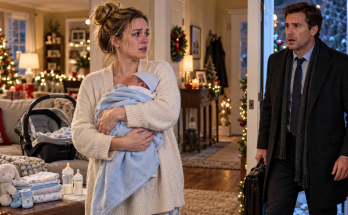
I opened the door and found my mother and sister asleep on the couch with empty pizza boxes and soda bottles around them.
Then I heard Noah.
I ran to the bedroom.
The smell hit me first. Sour milk. Sweat. Dirty diapers.
Emily was lying on the bed, her face gray, her hair stuck to her forehead. One hand hung over the edge like she had tried to get up and couldn’t.
Noah was beside her in a dirty blanket. His tiny body was burning.
I picked him up and screamed for Emily to wake up.
Nothing.
For one second, anger took over. I wanted to scream at everyone who had failed them.
Then Noah made a tiny sound against my chest, and I knew rage would not save him.
I wrapped him in my hoodie, lifted Emily, and ran outside.
Our neighbor grabbed his keys when he saw me carrying my wife and newborn son.
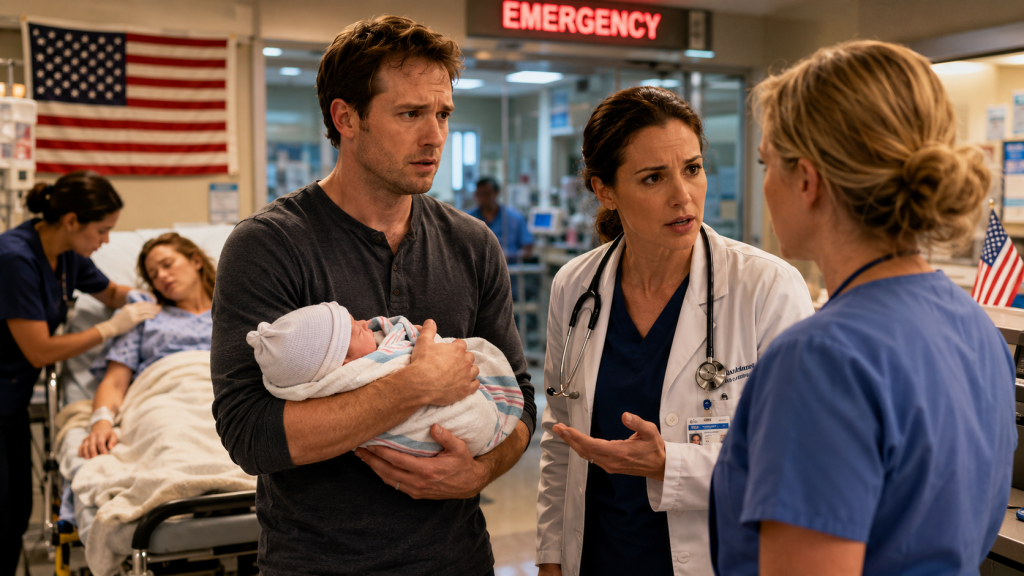
At the hospital, nurses rushed them away.
A doctor checked Emily, then Noah. She looked at the fever, the condition they arrived in, and the signs that something had gone terribly wrong.
She turned to me and asked one question.
“Who was caring for them at home?”
“My mother and sister,” I said.
The doctor looked at the nurse, reached for the phone, and said, “Call—”
PART 2: THE HOUSE THAT WAS SUPPOSED TO BE SAFE
The doctor looked at the nurse, reached for the phone, and said, “Call the police.”
For several seconds, I honestly thought I had misunderstood her.
Police?
My wife was sick.
My son had a fever.
I had brought them to a hospital because they needed doctors.
Why would we need the police?
“What?” I whispered.
The doctor turned toward me.
Her expression had changed.
The kindness was still there, but underneath it was something colder.
Something professional.
Something serious.
“Mr. Miller, we need to document the condition your wife and child arrived in.”
My mouth went dry.
“What condition?”
She hesitated.
That hesitation terrified me more than anything she could have said.
“Your wife is severely dehydrated,” she told me. “She has a high fever, dangerously low blood pressure, and signs of an infection that may have progressed because it was not treated quickly enough.”
I stared at her.
The hallway seemed to narrow around me.
“And Noah?”
Her eyes softened.
“He is dehydrated too. His fever is especially concerning because he is only seven days old.”
I gripped the back of a plastic chair.
My knees suddenly felt unreliable.
“But they’re going to be okay?”
The doctor did not answer immediately.
That silence nearly destroyed me.
“We are doing everything we can.”
Everything we can.
Four words no husband or father ever wants to hear.
Behind the emergency-room doors, I could hear machines beeping.
Shoes moved quickly across the floor.
Someone called for medication.
Someone else asked for an IV line.
And all I could think about was the bedroom.
Emily’s gray face.
Noah’s burning skin.
The dirty sheets.
The bottles scattered across the floor.
The untouched food I had stocked in the refrigerator before leaving.
I had packed that refrigerator myself.
Soup.
Fruit.
Milk.
Juice.
Prepared meals.
Everything Emily liked.
I had even labeled containers because I thought it would make things easier.
Monday.
Tuesday.
Wednesday.
Thursday.
As if love could be organized into plastic containers.
As if writing a date on a lid could protect the people inside the house.
I covered my face with both hands.
“How did I not know?”
The question slipped out before I realized I had spoken.
The doctor stood beside me.
“Mr. Miller, right now, you need to understand something.”
I looked at her.
“This is not a normal postpartum complication we can ignore. Your wife appears to have been unable to care for herself for some time. Your baby also appears not to have received appropriate care. We have a legal obligation to report what we are seeing.”
My stomach turned.
I remembered my mother’s voice.
She’s emotional.
I remembered Ashley laughing in the background during one of my calls.
I remembered asking to see Emily.
I remembered Linda moving the camera away.
I remembered the weak cry.
God.
That cry.
I had heard my son asking for help through a phone screen, and I had accepted an explanation because trusting my mother had been easier than questioning her.
“Can I see them?”
“As soon as we stabilize them.”
“I’m her husband.”
“I know.”
“I should be with her.”
“I know.”
Her voice was gentle.
That somehow made it worse.
I sank into the chair.
My hands were still trembling when two police officers walked through the emergency-room entrance.
They spoke quietly with the doctor.
Then one of them approached me.
“Mr. Miller?”
I stood.
“My name is Officer Harris. This is Officer Delgado. We need to ask you a few questions about what happened at your home.”
I swallowed.
“Ask anything.”
“Who was responsible for your wife and child while you were away?”
“My mother, Linda Miller, and my sister, Ashley.”
“Did they live with you?”
“No. They were supposed to stay there temporarily.”
“Did your wife agree to that?”
That question stopped me.
“Yes.”
Then I thought about it.
“At least… I thought she did.”
The officer watched my face.
“What do you mean?”
I pressed my fingers against my forehead.
“Emily and my mother have never been close.”
That was the nicest way I could say it.
The truth was uglier.
Linda had never thought Emily was good enough for me.
When we got engaged, she told me Emily was “too quiet.”
When we bought our first house, she said Emily had “expensive taste.”
When Emily became pregnant, my mother suddenly became obsessed with giving advice nobody had asked for.
How Emily should eat.
How much weight she should gain.
Whether she should breastfeed.
What we should name the baby.
Even what kind of mother she expected Emily to become.
At first, I treated it like normal family irritation.
Emily complained.
I listened.
Sometimes I defended her.
Sometimes I told her to ignore it.
Sometimes I made the mistake husbands make when they want peace more than they want truth.
“That’s just how Mom is.”
I had said those words so many times.
Now they sounded disgusting.
Officer Harris took notes.
“Had your mother ever threatened your wife?”
“No.”
“Hit her?”
“No.”
“Prevented her from seeking medical attention?”
“I don’t know.”
He looked up.
“You don’t know?”
My chest tightened.
“I was gone.”
The words tasted like guilt.
“I was four hours away for work. I called every day, but my mother controlled the calls. She kept saying Emily was sleeping or emotional or tired.”
“And you never spoke directly with your wife?”
“Only briefly once.”
“What did she say?”
I closed my eyes.
That memory returned with brutal clarity.
It had been Tuesday evening.
I called while sitting alone in a hotel room.
Mom answered.
I asked for Emily.
There was whispering.
Then Emily appeared on the screen.
For maybe fifteen seconds.
Her face was pale.
Her eyes looked swollen.
“Hey,” I had said. “You okay?”
She nodded.
Before she could answer, Mom’s voice came from somewhere behind the phone.
“Tell him you’re fine.”
At the time, I thought nothing of it.
Emily had whispered, “I’m tired.”
Then the video ended.
I opened my eyes.
“She said she was tired.”
Officer Harris asked, “Did she seem afraid?”
I couldn’t answer.
Because now I knew the answer.
I just hadn’t known it then.
Before I could say anything else, raised voices came from the hospital entrance.
I recognized one immediately.
My mother.
“There he is!”
Linda marched toward us wearing the same clothes I had seen her sleeping in.
Ashley followed behind her, clutching her purse.
My mother looked furious.
Not worried.
Not frightened.
Furious.
“Ethan, what the hell are you doing?”
For a second, I could not speak.
I stared at the woman who had raised me.
The woman who had bandaged my knees when I was a child.
The woman who cried at my wedding.
The woman I had trusted enough to place my recovering wife and newborn son in her hands.
And suddenly she looked like a stranger.
“What am I doing?” I repeated.
“You disappeared with Emily and the baby!”
“Disappeared?”
“We woke up and you were gone!”
Something inside me snapped.
“You were asleep.”
People turned toward us.
My mother lowered her voice.
“Do not make a scene.”
I laughed.
It was not a happy sound.
“A scene?”
Ashley stepped forward.
“Ethan, calm down.”
I looked at her.
“Don’t tell me to calm down.”
Her face stiffened.
“We were helping.”
“Helping?”
I took one step toward her.
Officer Harris quietly moved closer.
“My wife was unconscious.”
Ashley looked away.
“My seven-day-old son had a fever.”
“We didn’t know—”
“His diaper looked like it hadn’t been changed in hours.”
“That’s not true.”
“The bedroom smelled like a garbage can.”
My mother’s jaw tightened.
“You are exaggerating.”
Those three words changed something in me forever.
Not because they were cruel.
Because she believed she could still control the story.
I stared at her.
“Emily could die.”
For the first time, Linda’s face moved.
Only slightly.
“What?”
“The doctor said she has a serious infection.”
My mother blinked.
Then she did something I will never forget.
She defended herself.
Instead of asking if Emily would survive, she folded her arms and said, “Well, she never told us she was that sick.”
My vision went white around the edges.
“She was unconscious!”
“That happened this morning.”
“How do you know?”
Linda hesitated.
I stepped closer.
“How do you know when she became unconscious?”
Silence.
Ashley stared at the floor.
My heart began pounding.
I looked between them.
“What happened in that house?”
No answer.
“WHAT HAPPENED?”
Officer Harris raised one hand.
“Mr. Miller.”
I turned away before anger made a decision for me.
My entire body was shaking.
The officer faced my mother.
“Ma’am, I need you and your daughter to remain here. We have questions.”
Linda scoffed.
“Questions about what? A woman got sick after having a baby. That happens.”
Officer Delgado spoke for the first time.
“Then answering the questions should be easy.”
My mother did not like that.
I knew the expression immediately.
The tight mouth.
The lifted chin.
The offended silence.
It was the expression she wore whenever somebody refused to be intimidated by her.
Ashley leaned toward her.
“Mom, maybe we should just explain.”
Linda shot her a look.
That small glance did more than any confession could have done.
There was something to explain.
And they both knew it.
Before anyone could say another word, a nurse appeared.
“Mr. Miller?”
I spun around.
“How are they?”
“Your son has been admitted to neonatal care. His temperature is coming down, but he needs close monitoring.”
“And my wife?”
“She’s being moved upstairs.”
“Can I see her?”
“In a few minutes.”
I followed the nurse without looking back.
I could feel my mother watching me.
For the first time in my life, I did not care.
Emily was in a dim hospital room surrounded by machines.
An IV line disappeared beneath tape on her arm.
Her lips were dry.
Her skin looked almost translucent under the fluorescent lights.
I walked to the bed slowly.
My courage vanished.
“Em?”
Her eyes did not open.
I took her hand.
It felt cold.
“I’m here.”
My voice broke.
“I’m here, baby.”
Nothing.
I bent over her hand and cried.
Not quietly.
Not gracefully.
I cried like something inside my chest had torn open.
“I’m sorry.”
The words came again.
And again.
“I’m sorry.”
I remembered the morning I left.
Emily had been sitting in bed holding Noah.
She looked exhausted.
Her hair was messy.
There were dark circles beneath her eyes.
I kissed her forehead.
“You sure you’ll be okay?”
She smiled because she did not want me worrying.
“My mom and Ashley will be here.”
Emily’s smile disappeared slightly.
I noticed.
I noticed, and I left anyway.
“I should have stayed,” I whispered.
A nurse adjusted the IV.
“You got them here.”
“But I left them there.”
“You got them here,” she repeated.
I appreciated her kindness.
But kindness could not erase facts.
After nearly an hour, Emily moved.
Her fingers twitched beneath mine.
I stood so quickly the chair scraped backward.
“Emily?”
Her eyelids fluttered.
“Em, can you hear me?”
She opened her eyes.
They were unfocused at first.
Then they found my face.
And fear appeared.
Pure fear.
She tried to sit up.
“No, no. Don’t move.”
Her lips parted.
“Baby.”
“Noah is here. He’s with the doctors.”
Her eyes filled with tears.
“Is he okay?”
“They’re taking care of him.”
She tried to pull the IV from her arm.
“I need him.”
“Emily, please.”
“My baby.”
I held her carefully.
“He’s safe.”
She stared at me.
“Safe?”
The way she said that word stopped me.
I lowered my voice.
“What happened?”
Her face changed.
She looked toward the door.
Then back at me.
“Is your mother here?”
My stomach dropped.
“Yes.”
Emily began crying.
Not loud tears.
Silent ones.
That somehow hurt more.
“Don’t let her in.”
“I won’t.”
“Promise me.”
“I promise.”
Her hand clutched mine weakly.
“Don’t let her near Noah.”
My throat tightened.
“Tell me what happened.”
Emily closed her eyes.
At first, I thought she was too exhausted to answer.
Then she whispered something so softly I had to lean closer.
“They took my phone.”
Every muscle in my body went still.
“What?”
“Monday night.”
I pulled my chair closer.
“Why?”
“Your mother said I was obsessed with calling you.”
“That doesn’t make sense.”
“I know.”
Her breathing became uneven.
“Emily, you don’t have to tell me everything right now.”
“Yes, I do.”
Her eyes opened.
“They’re going to lie.”
Those words chilled me.
She swallowed painfully.
“The first day was fine.”
She stared toward the ceiling as though she could see the memories playing there.
“Your mom made soup. Ashley held Noah while I slept.”
I nodded.
“Then Monday evening, Noah started crying.”
Her voice shook.
“I tried feeding him, but I was having trouble. I told Linda I thought something was wrong because I felt dizzy and feverish.”
“What did she say?”
“She said I was being dramatic.”
I looked away.
Emily tightened her fingers around mine.
“She told me women had babies for thousands of years without making everyone panic.”
Anger burned through me.
“I asked her to drive me to urgent care.”
I turned back.
“What?”
“She refused.”
My heart seemed to stop.
“She said there was no reason to waste money.”
I stood.
The chair nearly fell.
Emily grabbed my hand.
“Ethan.”
“She refused to take you to a doctor?”
“Yes.”
I could barely breathe.
“What about Ashley?”
“She agreed with her.”
I felt sick.
Emily continued.
“The next morning I tried calling you.”
She paused.
“Linda grabbed my phone.”
I stared at her.
“She told me I was trying to turn you against your family.”
My jaw clenched so hard it hurt.
“What happened next?”
“She kept the phone.”
“And the video calls?”
“She gave it back only when you called.”
Pieces began falling into place.
The short calls.
The strange camera angles.
Linda speaking for Emily.
The phone suddenly disconnecting.
“They were controlling what I saw.”
Emily nodded.
Tears rolled into her hair.
“I tried telling you Tuesday.”
I remembered.
Her pale face.
Her terrified eyes.
I’m tired.
“Why didn’t you?”
Her expression shattered me.
“Your mother was standing behind the phone.”
I closed my eyes.
Of course she had been.
Of course.
“She said if I made you leave your work trip early, she would tell you I was unstable.”
My eyes opened.
“She said what?”
“She said postpartum women sometimes become dangerous.”
Emily’s voice cracked.
“She said if I kept acting hysterical, she would tell you I wasn’t safe with Noah.”
I sat down slowly.
For several seconds, neither of us spoke.
Then Emily whispered, “I was scared you’d believe her.”
That sentence cut deeper than any accusation.
Because once, maybe, she had reason to wonder.
I had spent years telling her my mother meant well.
Years asking Emily to ignore comments.
Years calling Linda “difficult” instead of what she was.
Controlling.
Cruel.
Manipulative.
“I wouldn’t have believed her.”
Emily looked at me.
I wanted to say it with certainty.
Instead, shame filled my throat.
“I should have believed you sooner about her.”
She looked away.
I did not blame her.
“What happened Wednesday?”
“I got worse.”
She shivered at the memory.
“I couldn’t stand for more than a few seconds.”
“And Noah?”
“He cried constantly.”
She began crying harder.
“I was trying to feed him, Ethan. I swear I was trying.”
“Emily.”
“I was so tired.”
“Stop.”
“I couldn’t make enough milk.”
“It’s okay.”
“I asked Ashley to make a bottle.”
I squeezed her hand.
“What did she do?”
“She said your mother told her not to.”
I stared at her.
“What?”
Emily covered her face.
“Linda said if they gave him formula, I would get lazy.”
For a moment, all I could hear was blood rushing through my ears.
A newborn.
Seven days old.
Hungry.
Crying.
And two adults decided hunger was a lesson for his mother.
I stood again.
This time Emily did not stop me.
I walked to the window because I was terrified of what I would do if I saw Linda.
“She said you needed to learn to be a real mother,” I whispered.
Emily nodded.
I pressed my fist against my mouth.
There are kinds of anger that feel hot.
Explosive.
Loud.
This was different.
This was ice.
This was the moment love finally died.
Not romantic love.
Not the love I had for Emily.
The love a son carries for his mother even after years of excuses.
That love did not explode.
It simply went silent.
“How long were you unconscious?”
“I don’t know.”
“What’s the last thing you remember?”
“Last night.”
She swallowed.
“Noah was crying. I tried getting out of bed.”
Her face twisted with pain.
“I fell.”
I rushed back to her.
“You fell?”
“Beside the bed.”
“Did they help you?”
She looked at me.
That answer was enough.
“Emily.”
“They came in.”
“And?”
“Linda told Ashley not to lift me.”
My skin went cold.
“What?”
“She said I was doing it for attention.”
My hand slipped from hers.
For the first time in my life, I truly understood how somebody could become a stranger in a single sentence.
My own mother had watched my wife collapse.
Then left her there.
“What happened?”
“I crawled back onto the mattress.”
Tears streamed down my face.
Emily noticed.
“Ethan.”
“I’m sorry.”
“You didn’t know.”
“I should have.”
“You didn’t.”
“I heard Noah crying.”
My voice broke.
“I heard him through the phone.”
I looked at her.
“And I believed her instead of my own instincts.”
Emily was quiet.
Then she reached for me.
I leaned close, and she touched my cheek.
“You came home.”
“I almost didn’t.”
“But you did.”
That mercy hurt almost as much as the guilt.
A soft knock came at the door.
Officer Harris stepped inside with a female detective.
“Mrs. Miller?”
Emily stiffened.
I stood beside the bed.
The detective noticed immediately.
“I’m Detective Monroe. Your husband told us you may be able to explain what happened at home. But we can come back later.”
Emily shook her head.
“No.”
She looked at me.
“Stay.”
“I’m not going anywhere.”
The interview lasted almost forty minutes.
Emily told them everything.
The phone.
The refusal to take her to a doctor.
The formula.
The fall.
The threats about postpartum instability.
The detective wrote almost nothing at first.
She simply listened.
Then she asked a question.
“Mrs. Miller, did either Linda or Ashley physically prevent you from leaving?”
Emily stared at the blanket.
“The second day, I tried.”
I turned toward her.
“You tried to leave?”
She nodded.
“I put Noah in his car seat.”
My chest tightened.
“I barely made it down the hallway.”
“What happened?”
“Linda stood in front of the door.”
The detective leaned forward.
“What did she say?”
Emily’s face went pale.
“She said, ‘You are not taking my grandson anywhere while you’re acting crazy.’”
My hands curled into fists.
Detective Monroe’s expression hardened.
“Did she touch you?”
“She took the car seat.”
My stomach dropped.
“What?”
Emily looked at me.
“She took Noah away from me.”
I felt the room disappear.
“She carried him downstairs.”
“Where?”
“I don’t know.”
“You don’t know?”
“I couldn’t follow.”
Her voice shattered.
“I was too weak.”
I covered my mouth.
Emily began sobbing.
“For almost two hours, I didn’t know where my baby was.”
I crossed the room and held her.
“I’m sorry.”
The detective waited.
Then Emily whispered, “When Ashley brought him back, his diaper was soaked.”
The room became silent.
Even Detective Monroe looked affected.
Eventually she closed her notebook.
“We are going to speak with your husband’s family again.”
I looked at her.
“What happens now?”
“I can’t promise you an outcome tonight.”
Her voice was calm.
“But I can tell you that the condition you and your child were found in, combined with what you’ve described, is being taken very seriously.”
After she left, I stayed beside Emily until she fell asleep.
Then I went to neonatal care.
Noah looked impossibly small beneath the hospital lights.
There were wires around him.
A tiny IV taped to his hand.
I stood outside the glass for a long time before a nurse let me sit beside him.
I slipped one finger into his palm.
He wrapped his hand around it.
That tiny grip broke me.
“Hey, buddy.”
My voice shook.
“Daddy’s here.”
Noah slept.
“I should have protected you.”
His fingers tightened.
“I promise you something.”
I leaned closer.
“No matter what happens after today, nobody will ever make me question whether protecting you comes before keeping the peace.”
I sat there for nearly an hour.
When I finally returned to the hallway, Detective Monroe was waiting.
Her expression told me something had changed.
“Mr. Miller.”
I stood.
“What happened?”
“We went to your house.”
My heart began racing.
“Okay.”
“We documented the bedroom and collected several items.”
She paused.
“There’s something you need to know.”
I waited.
“Your wife’s phone was found in your mother’s purse.”
I stared at her.
“That confirms what Emily said?”
“It confirms possession. We still need to determine context.”
I nodded slowly.
Then the detective continued.
“We also found something else.”
“What?”
“Medication.”
I frowned.
“What medication?”
“Prescription pain medication that had been provided to your wife after delivery.”
“Yes. She had medication.”
“The bottle was nearly full.”
I did not understand.
“So?”
“Your wife told us she repeatedly asked for it because she was in significant pain.”
My stomach twisted.
I remembered packing the medicine beside her bed.
“I put it there.”
“It was not beside the bed.”
“Where was it?”
Detective Monroe met my eyes.
“In your sister’s overnight bag.”
I stopped breathing.
“What?”
“There were several items belonging to your wife inside Ashley’s bag.”
My voice became barely audible.
“Why?”
“That’s what we’re trying to establish.”
The elevator doors opened behind us.
Officer Harris stepped out.
He walked directly toward the detective.
They exchanged a few quiet words.
Then both of them looked at me.
“What?”
Neither answered immediately.
“What happened?”
Detective Monroe lowered her voice.
“Your sister has changed her statement.”
I swallowed.
“What did she say?”
“She claims your mother instructed her to keep your wife’s phone and medication away from her.”
The hallway tilted beneath me.
“And she listened?”
“She says she was afraid of Linda.”
I laughed bitterly.
“Emily was afraid too.”
The detective said nothing.
I looked toward my wife’s room.
Then toward the neonatal unit.
Two people I loved more than anything had almost died while my mother sat downstairs eating pizza.
And now Ashley wanted fear to excuse obedience.
“No.”
Detective Monroe frowned.
“No?”
“I don’t care what excuse she gives.”
My voice shook.
“She saw my wife collapse.”
I looked at the detective.
“She heard my son crying.”
Tears burned my eyes.
“She knew.”
Officer Harris stepped closer.
“Mr. Miller, there is one more thing.”
I stared at him.
“What?”
“Your mother tried to leave the hospital.”
I felt something cold settle in my chest.
“Where is she?”
“She was stopped downstairs.”
“Why was she leaving?”
His expression remained unreadable.
“She said she wanted to go home.”
I knew my mother.
Linda did nothing without a reason.
“Did she have anything with her?”
Officer Harris glanced toward the detective.
Then he answered.
“A bag.”
My pulse jumped.
“What was inside it?”
The detective took a slow breath.
“Mrs. Miller…”
She hesitated.
Then she said the words that made every hair on my arms rise.
“We found your son’s medical paperwork, your wife’s discharge instructions, two bottles of medication, and a handwritten notebook containing dates and notes about Emily’s behavior.”
I stared at her.
“A notebook?”
She nodded.
“What kind of notes?”
“We’re still reviewing it.”
“Tell me.”
“Mr. Miller—”
“Tell me.”
Detective Monroe looked directly into my eyes.
“Several entries describe your wife as unstable.”
My heart stopped.
“One entry was written before you left town.”
I could barely speak.
“What did it say?”
The detective’s voice became quiet.
“It said, ‘Ethan will eventually see she cannot handle being a mother.’”
For several seconds, the world disappeared.
The hospital.
The lights.
The voices.
Everything.
My mother had not simply failed Emily.
She had been building a story.
A story in which my sick wife was unstable.
A story in which my exhausted wife was dangerous.
A story that could have been used to make me question her.
Maybe even take Noah away from her.
And suddenly I understood something that frightened me far more than neglect.
What happened in that house might not have been careless at all.
It might have been deliberate.
I looked through the glass toward my tiny son.
Then toward the room where Emily was sleeping.
And for the first time since arriving at the hospital, guilt gave way to something stronger.
Clarity.
I had spent years asking Emily to tolerate my mother for the sake of family.
But family was not supposed to demand suffering as proof of loyalty.
Family did not stand over a sick woman and call her dramatic.
Family did not listen to a starving newborn cry and turn up the television.
Family did not hide medicine.
Family did not take phones.
Family did not write secret notes preparing to call a new mother unstable.
Whatever Linda had been to me before that morning, one truth was now impossible to ignore.
My wife and son needed protection from her.
I pulled out my phone.
My hand was steady now.
Detective Monroe watched me.
“Who are you calling?”
“A locksmith.”
She raised an eyebrow.
I looked at her.
“My mother has a key to my house.”
Not anymore.
Then I made another call.
This one was to my boss.
“I won’t be coming back to work this week.”
There was a pause.
I looked through the glass at Noah.
“Actually, I don’t know when I’m coming back.”
I ended the call.
Then I blocked my mother’s number.
Ashley’s too.
They could speak through lawyers.
Police.
Courts.
Anyone but my wife.
Anyone but my son.
I returned to Emily’s room just before sunrise.
The darkness outside the windows had begun turning blue.
She was awake.
“Where were you?”
“Checking on Noah.”
“How is he?”
“Sleeping.”
A tiny smile appeared.
I sat beside her.
For a while, neither of us spoke.
Then Emily whispered, “What happens now?”
I looked at the woman I had promised to protect on our wedding day.
I had thought protection meant standing beside someone when danger arrived.
I understood differently now.
Sometimes danger did not kick down the door.
Sometimes it had your childhood photographs in its living room.
Sometimes it knew your birthday.
Sometimes it called itself Mom.
I took Emily’s hand.
“Now you heal.”
She watched me.
“And Noah heals.”
“What about Linda?”
I did not hesitate.
“She doesn’t come near you again.”
Emily’s eyes filled with tears.
“Ethan—”
“No.”
I squeezed her hand gently.
“I spent too much of our marriage asking you to forgive things because confronting them made me uncomfortable.”
I swallowed.
“I kept calling disrespect ‘personality.’ I called manipulation ‘concern.’ I called control ‘love.’”
Emily said nothing.
“I’m done doing that.”
One tear rolled down her cheek.
“What if she says I’m breaking up the family?”
I leaned closer.
“She already broke something.”
“What?”
“My trust.”
I looked toward the window.
“And she did it herself.”
Emily closed her eyes.
For the first time since I found her in that bedroom, her face seemed slightly less afraid.
Then my phone rang.
Unknown number.
I almost ignored it.
Something made me answer.
“Hello?”
A man spoke.
“Is this Ethan Miller?”
“Yes.”
“My name is Daniel Reeves. I’m calling from Westbrook Police Department.”
I stood.
Emily noticed the change in my face.
“What is this about?”
There was a pause.
“Your mother gave us your number.”
My stomach tightened.
“Why?”
“Because she has made an allegation.”
I closed my eyes.
Of course she had.
“What allegation?”
The officer cleared his throat.
“She claims your wife is mentally unstable and that she believes your infant son may be unsafe in your wife’s care.”
My hand tightened around the phone.
Emily stared at me.
She already knew.
Some fears do not need words.
I walked toward the door.
My voice became calm.
Almost frighteningly calm.
“Officer?”
“Yes?”
“Before you do anything with that allegation, speak to Detective Monroe at the hospital.”
There was silence.
“Why?”
“Because my mother wrote that story before my wife ever became sick.”
Another silence.
Then I looked through the hospital window toward the morning sky.
“And officer?”
“Yes, Mr. Miller?”
“Ask her why my wife’s medication was hidden in my sister’s bag.”
I ended the call.
Behind me, Emily began crying.
I returned to her immediately.
“She did it, didn’t she?”
I sat beside her.
“Yes.”
“She told them I’m dangerous.”
“Yes.”
Emily covered her face.
“She said she would.”
“I know.”
“What if they believe her?”
I took both of her hands.
“They won’t hear only her version anymore.”
Emily looked at me.
“Because I’m going to tell them everything.”
I kissed her forehead.
“And this time, I’m not asking you to keep the peace.”
Outside the room, footsteps approached.
Detective Monroe appeared in the doorway.
She was holding Linda’s notebook inside a clear evidence bag.
Her expression was different now.
More serious.
More disturbed.
“Mr. and Mrs. Miller,” she said, “we finished reviewing several more pages.”
My stomach sank.
“What did you find?”
She looked at Emily.
Then at me.
“There are entries going back almost three months.”
Three months.
Long before the birth.
Long before I left town.
Long before Emily became sick.
My mother had been writing about her.
Planning.
Documenting.
Waiting.
Detective Monroe opened her notebook.
“One entry states that after the baby is born, Linda intends to ‘prove Emily is incapable of managing motherhood without constant supervision.’”
Emily’s hand turned cold inside mine.
Another entry said Linda believed that if enough people saw Emily “fall apart,” I would finally understand that I had married the wrong woman.
I could hear my own heartbeat.
Detective Monroe closed the notebook.
“We need to investigate whether what occurred in your home was simply neglect…”
She paused.
“…or whether some of it was intentionally allowed to happen.”
I stared at her.
Emily whispered, “Intentionally?”
The detective did not soften the truth.
“Yes.”
My wife gripped my hand.
And somewhere deep inside me, the last excuse I had ever made for my mother disappeared.
This was no longer a family argument.
It was no longer an overbearing mother-in-law.
It was no longer about hurt feelings, boundaries, or personality differences.
My wife had begged for medical help.
My newborn had gone hungry.
Medication had been hidden.
A phone had been taken.
And while all of it happened, someone had been keeping notes.
Building a case.
Waiting for Emily to break.
I looked at my wife.
She looked small beneath the hospital blanket.
Exhausted.
Fragile.
But alive.
Then I thought about Noah holding my finger.
Alive.
They were alive.
My mother had nearly taken that from me.
I leaned toward Emily and whispered the only thing that mattered.
“She doesn’t get another chance.”
Emily looked at me.
I kissed her hand.
“Not with you.”
Then I looked toward the neonatal unit beyond the hall.
“Not with Noah.”
Detective Monroe watched silently.
I stood beside my wife’s bed as morning light slowly filled the room.
And for the first time, I understood that becoming a husband and father was not only about loving the people inside your home.
It was also about having the courage to close the door on anyone who brought danger through it.
Even when the person standing outside was the woman who raised you.
Especially then.
But what I did not yet know was that Linda’s notebook contained one final entry.
An entry written the night before I came home.
An entry Detective Monroe had not shown us yet.
And when I finally read it, I understood why my mother had tried so desperately to leave the hospital before the police searched her bag.
Because Linda had not only been planning to convince me that Emily was an unfit mother.
She had already decided who she believed should raise Noah instead.
PART 3: THE LAST PAGE OF THE NOTEBOOK
Detective Monroe did not show me the final page immediately.
That frightened me more than if she had simply handed it over.
She stood near the hospital window with Linda’s notebook sealed inside the evidence bag, turning it slowly in her hands as though the weight of it had somehow increased.
Emily watched her from the bed.
I stood beside my wife, one hand resting over hers.
“What does it say?” I asked.
Detective Monroe looked at me.
“Before I tell you, I need you to understand that a handwritten statement does not automatically prove intent.”
“I understand.”
“But considering everything else we have documented, it may be significant.”
My chest tightened.
“Just tell me.”
She opened her own notes.
Then she read the final entry.
“‘Once Ethan sees Emily cannot manage the baby, he will need help. Noah deserves stability. He belongs with family that understands how to raise him. Ashley has always wanted a child. If things go badly enough, Ethan may finally understand what needs to happen.’”
The room disappeared around me.
For several seconds, all I could hear was Emily breathing.
Slow.
Shallow.
Terrified.
I looked at Detective Monroe.
“What does that mean?”
She did not answer.
She did not have to.
I already knew.
I turned toward Emily.
Her face had gone completely pale.
“No.”
She shook her head.
“No, no, no.”
I sat beside her immediately.
“Emily.”
“She wanted my baby.”
Her voice broke.
“She wanted Noah.”
“I know.”
“She was trying to make me look incapable.”
I wrapped my arms around her as carefully as I could.
“She doesn’t get him.”
Emily clung to my shirt.
“She was going to take him from me.”
“No.”
I kissed her hair.
“No one is taking him from you.”
Tears soaked through the shoulder of my shirt.
I held my wife while the horror settled over both of us.
Suddenly everything made sense.
The comments during pregnancy.
The constant criticism.
The obsession with whether Emily was “maternal enough.”
The warnings that she would be overwhelmed.
The insistence that Ashley be involved after the birth.
The notebook.
The stolen phone.
The hidden medication.
The refusal to call a doctor.
Linda had not simply been cruel.
She had been waiting for Emily to fail.
And when Emily did not fail quickly enough, my mother had created conditions where failure became almost inevitable.
A weak new mother.
A hungry newborn.
No medication.
No outside help.
No phone.
No escape.
Then she had watched.
Documented.
Judged.
And waited.
I felt sick.
Detective Monroe spoke quietly.
“We are still determining exactly what charges may be appropriate.”
I looked at her.
“Charges?”
“Yes.”
My voice sounded distant.
“What happens to my mother?”
“That will depend on the full investigation, the medical findings, interviews, digital records, and the prosecutor’s office.”
“And Ashley?”
“She is cooperating.”
I laughed bitterly.
“Now.”
Detective Monroe did not argue.
“Now,” she repeated.
Emily pulled away from me.
“What did Ashley say?”
The detective hesitated.
“She says Linda had been talking for months about how you were not ready to be a mother.”
Emily closed her eyes.
“She says your mother believed Ethan would eventually leave you if he saw you struggle badly enough after the birth.”
I felt something tear inside me.
“Leave her?”
Detective Monroe nodded.
“And Ashley claims Linda told her that once you were out of the picture, she could help Ethan raise Noah.”
I stared at her.
“And Ashley?”
“She says Linda began suggesting that Ashley could become a permanent maternal figure.”
Emily made a broken sound beside me.
I stood so quickly the chair scraped across the floor.
I walked to the opposite wall.
Not because I wanted distance from Emily.
Because I needed distance from everyone.
I pressed both palms against the wall and lowered my head.
My sister had held Noah the day after he was born.
She had smiled down at him.
She had taken pictures.
She had told Emily, “You made such a beautiful little boy.”
Had she already been imagining replacing his mother?
I closed my eyes.
I wanted to scream.
Instead, I whispered, “I brought them into our house.”
Emily heard me.
“Ethan.”
“I gave them keys.”
“Ethan.”
“I told you they would help.”
She reached for me.
I could not look at her.
“I put them in the same house as you and Noah.”
“You didn’t know.”
“But you didn’t want them there.”
Silence.
That silence answered me.
I turned around.
Emily’s eyes filled with tears.
“You told me you were uncomfortable,” I said.
She looked down.
“I didn’t want you to think I hated your family.”
“You told me.”
“I tried not to make it a big thing.”
“You told me.”
My voice cracked.
“And I convinced you it would be fine.”
She shook her head.
“You could not have imagined this.”
“No.”
I walked back to her.
“But I could have listened.”
That was the truth I would spend years carrying.
Maybe I could not have predicted the notebook.
Maybe I could not have predicted stolen medication.
Maybe I could not have predicted that my own mother would watch my wife grow dangerously sick and call it weakness.
But Emily had told me she felt unsafe around Linda.
And I had translated unsafe into uncomfortable because uncomfortable was easier for me to manage.
I sat down.
“I’m sorry.”
Emily touched my hand.
“I know.”
“No.”
I looked directly at her.
“I don’t want you to forgive me because I’m hurting.”
Her expression softened.
“I want to become the kind of husband who never makes you wonder whether I’ll believe you again.”
Her lips trembled.
“That will take time.”
“I know.”
“I’m angry with you too.”
“I know.”
It hurt.
But I needed to hear it.
Emily looked at me through tears.
“I begged you not to leave me with them.”
I lowered my head.
“I know.”
“I told you your mom frightened me.”
“I know.”
“And you said she was intense but harmless.”
There it was.
The sentence I had been dreading.
Harmless.
I had called Linda harmless.
Emily wiped her cheek.
“I love you, Ethan.”
I looked up.
“But I’m angry.”
“You should be.”
“I don’t know when that anger will go away.”
“You don’t have to know.”
Her fingers trembled beneath mine.
“I want us to be okay.”
“We will work for that.”
“You can’t fix everything today.”
“I know.”
I squeezed her hand gently.
“But I can stop making it worse.”
For the first time, Emily gave me the smallest smile.
Not forgiveness.
Not yet.
But possibility.
That was enough.
Later that afternoon, I was finally allowed to hold Noah.
The nurse placed him carefully in my arms.
He looked impossibly tiny.
A little red around the cheeks.
Sleepy.
Fragile.
Perfect.
I stared down at him.
Seven days old.
Seven days.
He had entered the world knowing nothing but voices, warmth, hunger, cold, comfort, and pain.
And already adults had fought over what his life should become.
I touched his cheek with one finger.
“I’m sorry, buddy.”
Noah yawned.
It was such a tiny thing.
But I cried anyway.
Emily was wheeled into the neonatal unit the following morning.
When the nurse placed Noah against her chest, Emily collapsed into tears.
“My baby.”
She kissed his forehead over and over.
“I’m here.”
Noah moved weakly against her.
Emily held him as though the whole world had disappeared.
I stood beside them.
That moment changed something inside me.
Family was not blood.
Not automatically.
Family was who made you safe enough to close your eyes.
Who fed you when you were hungry.
Who believed you when you said you hurt.
Who protected you when protecting you was inconvenient.
Linda had taught me that lesson in the worst possible way.
Three days later, Emily’s condition finally stabilized.
Her fever was gone.
Her blood pressure improved.
The infection responded to treatment.
Noah recovered too.
The doctors wanted to keep him slightly longer because of his age, but every report sounded more hopeful than the last.
For the first time in days, I allowed myself to breathe.
That afternoon, Detective Monroe returned.
She closed the door behind her.
“We have an update.”
Emily looked at me.
I moved my chair closer to her bed.
The detective sat down.
“We interviewed Ashley again.”
My jaw tightened.
“And?”
“She gave us access to text messages between herself and Linda.”
My stomach dropped.
“Texts about Emily?”
“Yes.”
The detective opened a folder.
“I can’t provide you with everything while the investigation is active, but there are messages we believe are relevant.”
She looked at Emily.
“One conversation occurred the night Ethan left for his work trip.”
Emily froze.
“What did they say?”
Detective Monroe read from her notes.
“Linda wrote, ‘Do not baby her. She needs to learn she cannot manipulate everyone by acting helpless.’”
I clenched my fists.
“Ashley responded, ‘What if she actually gets sick?’”
The detective paused.
“Linda replied, ‘Then Ethan will finally see what I’ve been telling him.’”
My throat closed.
Emily stared straight ahead.
Another message.
Another wound.
The detective continued.
“On Wednesday evening, Ashley wrote that Emily could barely stand and that Noah would not stop crying.”
I looked at her.
“And my mother?”
Detective Monroe’s expression hardened.
“Linda replied, ‘Leave her alone. If we keep rescuing her, she will never prove my point.’”
Silence filled the room.
Emily turned her face away.
I wanted to destroy something.
Instead, I held my wife’s hand.
Because that was what rage had almost made me forget before.
Anger could not heal her.
Presence could.
“What about the medication?” I asked.
“Ashley claims Linda told her to move it because Emily was ‘taking too much.’ Hospital records and pill counts do not currently support that claim.”
I swallowed.
“And the formula?”
The detective looked down.
“Ashley admitted they had formula available.”
Emily began crying.
My heart shattered again.
Noah had been hungry.
Food had been inside the house.
Adults had simply decided not to give it to him.
Detective Monroe continued carefully.
“She says Linda repeatedly insisted that giving formula would allow Emily to ‘escape responsibility.’”
I looked toward the neonatal unit beyond the wall.
My son had cried with an empty stomach while his grandmother turned feeding him into a punishment for his mother.
There are some things forgiveness can reach.
There are others it may never touch.
I did not know then where this belonged.
I still don’t.
Detective Monroe closed the folder.
“There is enough evidence for the prosecutor to review possible charges related to neglect, interference with medical care, unlawful restraint, and other offenses depending on the final findings.”
Emily inhaled shakily.
“Will we have to see them?”
“Possibly in court.”
She looked at me.
“But you can request protective conditions.”
“I want them.”
Emily answered before I could.
The detective nodded.
“All right.”
Emily’s voice became stronger.
“They do not come near Noah.”
“No.”
“They do not contact me.”
“Understood.”
“They do not come to our house.”
Detective Monroe wrote it down.
“And if Linda tells everyone I’m crazy?”
I looked at Emily.
The detective paused.
“Mrs. Miller, people can say many things.”
Emily swallowed.
“But evidence speaks too.”
That sentence stayed with me.
Evidence speaks too.
For years, Linda had been louder than everyone else.
Louder than Emily.
Louder than reason.
Louder than boundaries.
But this time there were hospital records.
Photographs.
Messages.
Medication logs.
Witnesses.
A notebook written in her own hand.
For once, volume would not become truth.
We went home eleven days after I had carried Emily through the rain.
I almost did not recognize the house.
I had hired professional cleaners.
The locks had been changed.
Every spare key had been replaced.
The couch where Linda and Ashley had slept was gone.
I could not look at it anymore.
Emily stood in the doorway holding Noah.
Her body stiffened.
“You okay?”
She stared down the hallway.
“I thought I would be.”
“We don’t have to stay.”
She looked at me.
“This is my house too.”
“Yes.”
“I don’t want her to take it from me.”
So we walked inside.
Slowly.
The bedroom was harder.
Emily stopped at the door.
I watched fear move across her face.
“We can change rooms.”
She shook her head.
“No.”
Then she stepped inside.
The sheets were new.
The mattress too.
Everything had been cleaned.
But memory does not care what detergent you use.
Emily stared at the place where she had collapsed.
I stood behind her.
“I remember lying there.”
I did not speak.
“I could hear Noah crying.”
Her voice trembled.
“I remember thinking I had to stand up.”
She looked at me.
“I kept telling myself, one more time. Just stand up one more time.”
Tears filled my eyes.
She looked down at Noah.
“I thought if I fell asleep, he might not have a mother when I woke up.”
I wrapped my arms around her from behind.
“You’re here.”
She leaned against me.
“So is he.”
“Yes.”
For several minutes, we simply stood there.
That became our first victory.
Not dramatic.
Not triumphant.
Just three people standing in the room that had almost destroyed us.
Together.
Recovery was not beautiful.
Not at first.
Emily woke from nightmares.
Sometimes Noah’s crying made her panic because it pulled her back into those days.
Sometimes she checked his temperature five times in one hour.
Sometimes I found her sitting on the nursery floor at two in the morning, holding him and crying silently.
I started therapy.
So did Emily.
Eventually, we went together.
There were difficult conversations.
She told me how alone she had felt in our marriage whenever Linda crossed a boundary and I asked Emily to ignore it.
I listened.
Really listened.
Without explaining.
Without defending.
Without saying, “But she’s my mother.”
I learned that apologies become meaningful only when they change behavior.
So I changed mine.
I stopped thinking of boundaries as punishments.
They were protection.
I stopped believing keeping peace was always good.
Sometimes peace is simply silence purchased by the person being hurt.
Three months after the hospital, the case moved forward.
Ashley accepted a plea agreement after cooperating fully.
She admitted she had followed Linda’s instructions.
She admitted she knew Emily needed medical help.
She admitted she had helped hide the phone.
Her attorney called her behavior “fear-driven.”
Maybe it was.
But fear does not erase responsibility.
Ashley wrote me a letter.
Twenty-three pages.
I read the first two.
Then I stopped.
One sentence stayed with me.
I thought Mom knew best.
That was the sickness running through our family.
Linda always knew best.
Until knowing best nearly killed someone.
I did not answer Ashley’s letter.
Not because I hated her.
Because healing does not require immediate reconciliation.
Sometimes the healthiest answer is silence.
Linda fought everything.
Of course she did.
She claimed Emily was exaggerating.
She claimed the texts were misunderstood.
She said the notebook was “private journaling.”
She said the medication had been moved for safety.
She said she never intended harm.
She said she was protecting Noah.
Protecting.
That word made me furious every time I heard it.
Eventually, she pleaded guilty to reduced charges rather than take the full case to trial.
There were court restrictions.
Probation conditions.
Mandatory evaluations.
No contact with Emily.
No contact with Noah.
No entering our property.
The judge looked directly at Linda during sentencing.
I remember every word.
“Concern does not give you ownership over another adult.”
Linda stared straight ahead.
“And believing you know better does not permit you to deny medical care.”
For the first time in my entire life, my mother had to sit silently while somebody else finished speaking.
After court, she waited near the hallway while her attorney gathered papers.
I walked past her.
“Ethan.”
I stopped.
Emily was several steps ahead of me holding Noah.
I turned around.
Linda looked older.
Smaller.
Not weak.
Just stripped of the authority she had always worn like a crown.
“You’re really doing this?”
I stared at her.
“You almost killed my wife and son.”
Her face tightened.
“I would never hurt Noah.”
“You let him go hungry.”
“I was trying to help Emily become stronger.”
“You hid her medication.”
“She was using it as a crutch.”
“She had just given birth.”
Linda lowered her voice.
“You don’t understand what she has done to this family.”
I looked toward Emily.
She stood beneath the courthouse lights holding our son.
Then I looked back at Linda.
“No.”
My voice was calm.
“For the first time, I understand exactly what happened to this family.”
Her eyes narrowed.
“Emily turned you against us.”
I almost laughed.
Even then.
Even after everything.
It still had to be Emily’s fault.
“No, Mom.”
I took one step closer.
“You did.”
Her expression cracked.
Only slightly.
“You’re my son.”
“Yes.”
“You cannot erase that.”
“I’m not erasing anything.”
I looked at her.
“I remember every good thing you ever did for me.”
Her eyes filled.
“I remember birthdays. Christmas mornings. Sitting beside me when I was sick.”
For one second, hope appeared on her face.
Then I finished.
“And that is what makes what you did harder to understand.”
Her mouth trembled.
“You can love someone and still know they are unsafe.”
She looked at Noah.
“Please.”
That single word almost broke me.
Not enough to change my decision.
But enough to hurt.
“Let me see him.”
“No.”
“One minute.”
“No.”
“I’m his grandmother.”
I looked directly at her.
“Being related to him does not make you entitled to him.”
She began crying.
I had rarely seen my mother cry.
Years earlier, it would have destroyed me.
That day, I understood something important.
Someone else’s tears do not automatically mean your boundary is wrong.
Sometimes tears are simply what happens when control ends.
I turned away.
“Goodbye, Mom.”
I walked toward Emily.
She looked at me.
“You okay?”
I took Noah’s tiny hand.
“No.”
Then I kissed my wife.
“But I will be.”
A year passed.
Then two.
Our house became a home again.
Not overnight.
Piece by piece.
We painted the bedroom.
Emily chose a soft green.
We replaced the old curtains.
We planted flowers beneath the window.
Eventually, the room stopped belonging to the worst day of our lives.
It became the place where Noah learned to crawl.
Then stand.
Then run.
The first time he ran into the wall, Emily laughed so hard she cried.
He looked offended.
Then he laughed too.
I took a picture.
That photograph is still on my desk.
Not because it is perfect.
Because it is ordinary.
And after almost losing everything, ordinary became beautiful.
Emily and I had another child three years later.
A little girl.
Sophie.
When Emily became pregnant again, fear returned.
Hospital hallways.
Fevers.
Memories.
But this time we built a support system around her carefully.
People she chose.
People she trusted.
People who understood that helping meant listening.
When Sophie was born, I stayed home.
No business trip.
No obligations.
Nothing mattered more.
One night, about a week after the birth, I woke and found Emily sitting beside the bassinet.
She was crying.
I sat beside her.
“What’s wrong?”
She smiled through tears.
“Nothing.”
I waited.
She looked at Sophie.
“I’m just realizing how different this feels.”
I knew what she meant.
Safe.
The room felt safe.
No locked phones.
No criticism.
No fear.
Just the soft sound of a baby breathing.
I put my arm around Emily.
“I wish Noah’s first week had been like this.”
She leaned her head against my shoulder.
“So do I.”
We sat quietly.
Then she said something I have never forgotten.
“But his life is bigger than one week.”
I looked at her.
She smiled.
“So is mine.”
That was Emily.
She never pretended what happened did not matter.
She simply refused to let it own every day that came afterward.
Noah is six now.
He knows almost nothing about what happened.
Someday, when he is old enough, we will tell him.
Not to make him hate anyone.
Not to hand him our anger.
But because family history should be told honestly.
I want him to know that love without respect is not enough.
That loyalty should never require silence.
That someone being older does not make them right.
That someone being family does not make them safe.
And that when a person you love says, “Something is wrong,” you listen.
Really listen.
I still think about the morning I came home early.
Sometimes I wonder what would have happened if the job had lasted another day.
I try not to stay inside that thought.
There are doors in the mind that should not be opened too often.
But I remember the rain.
The cold house.
The pizza boxes.
The weak cry from the bedroom.
I remember lifting Noah against my chest.
I remember Emily’s hand hanging over the edge of the mattress.
I remember the doctor reaching for the phone.
And I remember thinking that was the worst moment of my life.
Maybe it was.
But it was also the moment the truth entered our family and refused to leave.
The truth about Linda.
The truth about Ashley.
And the truth about me.
I had confused avoiding conflict with protecting my marriage.
They are not the same thing.
Real love sometimes requires choosing a side.
When someone is being harmed, neutrality does not keep peace.
It protects the person causing the harm.
I learned that too late to spare Emily from pain.
But not too late to change.
Last Christmas, Noah brought home a school assignment.
The teacher had asked the children to draw a picture of what “home” meant to them.
Most children drew houses.
Windows.
Trees.
Pets.
Noah drew four stick figures holding hands.
Me.
Emily.
Him.
Sophie.
Above us, he drew a huge yellow circle that was supposed to be the sun.
I smiled.
“Where’s the house?”
He looked confused.
“What house?”
“The assignment says to draw home.”
He pointed at the four figures.
“That is home.”
I could not speak for a moment.
Emily stood behind him.
Our eyes met.
She understood.
Six years earlier, I thought home was a place where my family had keys.
Now I knew better.
Home was not who could enter.
Home was who made you feel safe once the door closed.
I framed Noah’s picture.
It hangs beside our front door.
Sometimes visitors ask why.
I usually just smile.
They do not need the whole story.
But I know.
Emily knows.
And maybe one day Noah will understand too.
The people in that drawing survived because one morning I came home early.
But we healed because afterward, we finally stopped confusing blood with love.
Linda gave me life.
I will always acknowledge that.
But Emily taught me how to build one.
And Noah taught me what protecting it truly meant.
There are choices you make once and spend years regretting.
Leaving Emily with Linda was one of mine.
Then there are choices you make again every day.
To listen.
To believe.
To protect.
To stay.
Those became mine too.
One evening not long ago, I stood in our kitchen while Emily prepared dinner.
Noah was arguing with Sophie over crayons.
Music played softly from a speaker.
The dog waited beneath the table hoping somebody would drop food.
Nothing extraordinary was happening.
I walked behind Emily and wrapped my arms around her.
She laughed.
“What is this for?”
“Nothing.”
She turned around.
“You’re being weird.”
“Probably.”
I kissed her forehead.
She smiled.
Then she went back to chopping vegetables.
I looked around the kitchen.
At the drawings taped to the refrigerator.
At Noah’s muddy shoes near the back door.
At Sophie’s pink cup on the counter.
At my wife humming badly to a song she refused to admit she liked.
And suddenly I felt overwhelmed.
Not by fear.
By gratitude.
I once came home expecting safety and discovered horror.
Years later, I could finally stand in the same house and feel peace.
Real peace.
Not silence.
Not obedience.
Not people swallowing pain to avoid arguments.
Peace.
The kind built from trust.
From boundaries.
From apologies followed by change.
From knowing the people beside you will believe you when you say you hurt.
Emily noticed me staring.
“What?”
I shook my head.
“Nothing.”
She narrowed her eyes playfully.
“You’re doing that emotional thing again.”
I laughed.
“Maybe.”
She reached across the counter and took my hand.
Noah came running into the kitchen.
“Dad! Sophie broke my blue crayon!”
“I did not!”
“You did!”
“It broke itself!”
Emily looked at me.
I looked at her.
Then we both laughed.
And standing there, surrounded by noise, arguments, dinner, crayons, and children, I finally understood something I wish I had known years earlier.
A happy family is not one that never has conflict.
It is one where nobody has to be afraid of telling the truth.
I squeezed Emily’s hand.
Noah was still complaining.
Sophie was still denying everything.
Dinner was beginning to burn.
The dog had stolen something from the floor.
And somehow, it was perfect.
Because everyone in that kitchen was safe.
That was all I had ever wanted.
I simply had to nearly lose it before I understood what it meant.
And if there is one thing I would tell the man I was before that terrible morning, it would be this:
When the person you love tells you they feel unsafe, do not ask them to endure it for the sake of family.
Do not tell them to ignore it.
Do not call cruelty a personality.
Do not call control concern.
Do not call fear disrespect.
Listen.
Because sometimes the most dangerous sentence in a family is not a threat.
Sometimes it is:
“That’s just how she is.”
I said those words for years.
I will never say them again.
Now, when Noah reaches for me, I reach back.
When Emily tells me something feels wrong, I listen.
When someone crosses a boundary, I do not worry first about whether enforcing it will hurt their feelings.
I worry about protecting the people who trusted me to stand beside them.
That is the husband I should have been from the beginning.
That is the father I became because of Noah.
And that is the man I will spend the rest of my life choosing to be.
My mother once believed she could decide who deserved to raise my son.
She was wrong.
Noah never needed a perfect mother.
He needed his mother.
He never needed a grandmother who controlled everything.
He needed people who loved him without turning that love into ownership.
And Emily never needed someone to teach her how to become stronger.
She had survived childbirth.
Illness.
Betrayal.
Fear.
And the knowledge that people inside her own home had waited for her to break.
She was already stronger than any of us knew.
In the end, Linda did prove something.
Just not what she intended.
She wanted to prove Emily was incapable of being a mother.
Instead, she proved that motherhood is not measured by authority, age, confidence, or the ability to control a room.
It is measured in the moments when a frightened woman keeps reaching for her crying child even while her own body is failing.
It is measured in love.
And Emily had never failed that test.
Not once.
The last page of Linda’s notebook was supposed to become evidence against my wife.
Instead, it became evidence of something else.
A plan built on cruelty.
A family poisoned by control.
And the moment I finally stopped making excuses for both.
I do not know whether Linda ever truly understood what she lost.
Maybe she still believes she was helping.
Maybe she still tells herself that everything would have worked out if Emily had simply listened.
That is no longer my burden.
My responsibility lives inside my house.
It sleeps down the hallway.
It leaves crayons on the floor.
It asks for bedtime stories.
It steals blankets.
It laughs when pancakes come out shaped strangely.
It holds my hand when nightmares come.
My family is not perfect.
Neither am I.
But when Noah wakes in the middle of the night and calls, “Dad?”
I answer.
Every time.
When Sophie runs toward me with tears in her eyes, I kneel down.
When Emily says, “I need you,” I stop whatever I am doing.
Because once, the people I loved called for help and I was too far away to understand how desperate those calls really were.
I cannot change that week.
I cannot erase the fever.
I cannot erase the dirty bedroom.
I cannot erase Emily crawling back onto the mattress while two people who should have helped her decided she needed to learn a lesson.
But I can make sure the rest of our lives tell a different story.
And they do.
The story did not end in that hospital room.
It did not end in court.
It did not end when I blocked my mother’s number.
It ended years later in an ordinary kitchen, with my wife smiling, my children arguing over crayons, and a crooked drawing hanging beside the front door.
Four stick figures.
Holding hands.
Under one enormous yellow sun.
No walls.
No locks.
No perfect little house.
Just us.
When I asked Noah why he drew it that way, he shrugged as if the answer should have been obvious.
“Because you guys are my safe place.”
I turned away so he would not see me cry.
Emily did see.
She always does.
She slipped her hand into mine.
And standing there beside the woman I almost failed and the children I would spend my life protecting, I finally understood the meaning of the word I had taken for granted for so many years.
Family.
Not the people you are afraid to disappoint.
The people you are determined never to abandon.
And this time, I knew the difference.
THE END STORIES! THANK YOU FOR READING GOOD LUCK !❤️
Related Posts