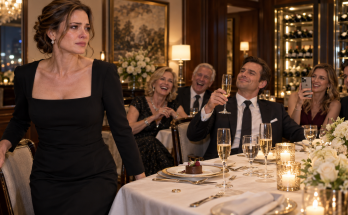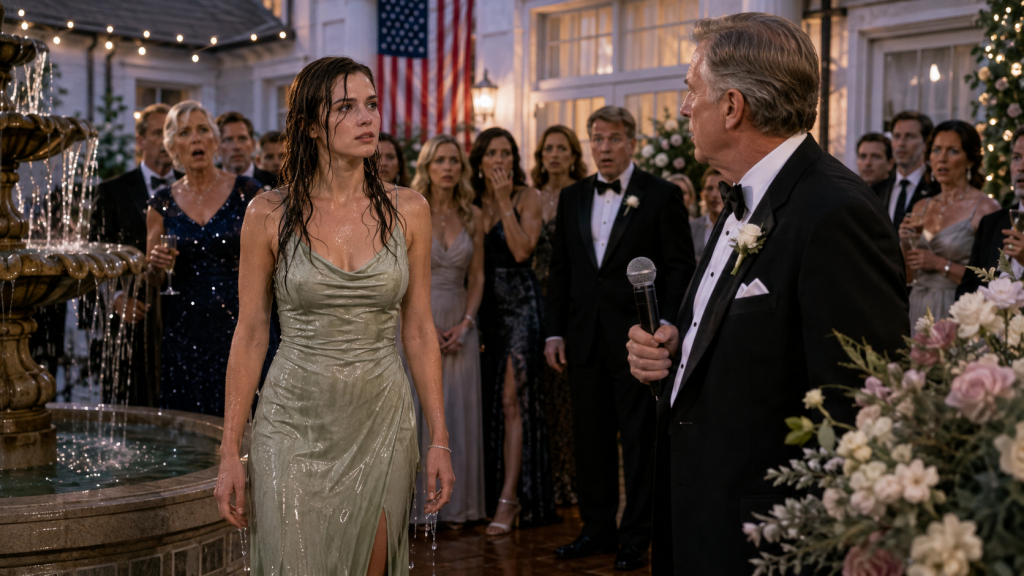
My family laughed when I arrived alone at my sister’s wedding, and my father made sure everyone heard him say, “She couldn’t even find a date.” A few minutes later, after he shoved me into the fountain and the applause finally faded, I looked him straight in the eye. “Remember this moment.” Because the secret I had protected for three years was already walking toward the ballroom doors.

PART 1: The Fountain
My father made four hundred wedding guests laugh at me, then pushed me into a fountain and expected me to disappear quietly.
For thirty-two years, my family treated me like the difficult, lonely older daughter whose main purpose was making my younger sister, Sophie, look brighter. Her lavish wedding was supposed to be one more night of me smiling through it.
Then my father, Graham Hart, took the microphone.
“Look, there’s Clara,” he announced, his voice carrying across the ballroom. “All by herself. Couldn’t even find a date for her sister’s big day.”
The room erupted in laughter.
I retreated to the terrace fountain, trying to breathe, but Graham followed me. He placed both hands on my shoulders and sneered, “Stop sulking. You’re ruining the aesthetic.”
Then he shoved me.
Not hard enough to look violent.
Just careless enough to humiliate me.
My heel caught the slick stone edge, and I fell backward into freezing water. My pale green dress clung to me, ruined and heavy.
The worst part was not the cold.
It was the applause.
No one gasped. No one rushed forward. They clapped while my father stood above me, still holding the microphone, smiling like he had delivered the perfect joke.
Something inside me went completely still.
Thirty-two years of being the family punchline ended in that fountain.
I wiped water from my lashes and looked straight at him.
“Remember this moment,” I said quietly. “Remember exactly what you just did to me. Because I will.”
His smile faltered.
I climbed out, walked to the lobby restroom, peeled off the soaked dress, and changed into the black cocktail dress I had packed as a backup. Then I painted my lips red and looked at the woman in the mirror.
She was not disappearing anymore.
I pulled out my damaged phone and sent two words to the hidden contact I had protected for three years.
Come now.
My family loved calling me lonely.
Tonight, they were about to meet my husband.
PART 2: THE MAN AT THE BALLROOM DOORS
My family loved calling me lonely.
Tonight, they were about to meet my husband.
I stared at the message on my cracked phone.
Delivered.
Two words.
Come now.
That was all I needed to send.
There was no explanation.
No address.
No desperate plea.
He already knew where I was.
He had known where I would be all evening.
And somewhere beyond the hotel walls, the one person my family believed did not exist was already on his way to me.
I slipped the phone into my clutch.
Then I looked at myself in the restroom mirror one final time.
The black cocktail dress was simpler than the pale green one my mother had selected for me.
No embroidery.
No delicate sleeves.
No attempt to make me disappear politely into the background of Sophie’s photographs.
It fit me perfectly.
I had bought it six months earlier for a dinner in Paris with my husband.
He had looked at me across the table that night and smiled.
“You know black makes you dangerous.”
I had laughed.
“Dangerous?”
“To people who underestimate you.”
Standing in the wedding restroom with fountain water still dripping from the ends of my hair, I finally understood what he meant.
I dried my face.
Straightened my shoulders.
And walked back toward the ballroom.
Music floated through the hallway.
Champagne glasses clinked.
People laughed.
Life had already continued.
That was perhaps the cruelest thing about humiliation.
When it happens to you, the world feels as if it should stop.
But it never does.
The people who hurt you return to their appetizers.
They finish their drinks.
They dance.
They tell the story again because it was funny to them.
Only the person standing at the center of the joke carries the bruise home.
As I approached the ballroom doors, I heard my father’s voice.
“Clara always was dramatic.”
Another burst of laughter.
I stopped outside.
My mother answered him.
“You shouldn’t have pushed her, Graham.”
There was no outrage in her voice.
Only mild annoyance.
The way someone might criticize him for spilling wine.
“Oh, please, Margaret. She fell into six inches of water.”
“You still shouldn’t have done it.”
“She needed loosening up.”
Someone laughed.
My father continued.
“She walks around looking like she’s attending her own funeral.”
More laughter.
Then Sophie’s voice floated through the doorway.
“Can we please stop talking about Clara? This is my wedding.”
That sentence should not have hurt.
Not after everything else.
But it did.
Because Sophie had watched me fall.
She had watched our father humiliate me in front of four hundred people.
And her greatest concern was that my humiliation might steal attention from her reception.
I closed my eyes.
For years, I had protected Sophie from understanding what our family truly was.
Maybe that had been my mistake.
Maybe protecting people from consequences only teaches them that consequences belong to someone else.
I pushed open the ballroom doors.
The laughter nearest me died first.
Then the silence spread.
People turned.
One table.
Then another.
Dozens of faces.
Some amused.
Some uncomfortable.
Some suddenly fascinated by their champagne.
My father stood near the head table with the microphone still in his hand.
His eyebrows lifted when he saw me.
“Well,” he said, grinning, “the drowned rat returns.”
A few people chuckled.
Not as many this time.
Perhaps the black dress changed something.
Perhaps it was my face.
Or perhaps cruelty becomes harder to applaud when the victim walks back into the room instead of running home.
I crossed the ballroom slowly.
My heels struck the polished floor.
Click.
Click.
Click.
My mother stepped toward me.
“Clara, sweetheart, maybe you should go upstairs and rest.”
There was that voice.
Soft.
Concerned.
Carefully designed for witnesses.
My mother was brilliant at sounding loving while asking me to disappear.
“I’m fine.”
She glanced at my wet hair.
“You don’t look fine.”
“I said I’m fine.”
Her smile tightened.
“People are staring.”
I almost laughed.
“They were staring when Dad pushed me into the fountain too.”
Her expression flickered.
“Lower your voice.”
“No.”
That one word surprised both of us.
My mother leaned closer.
“Do not ruin your sister’s wedding because you’re angry.”
I looked over her shoulder.
Sophie stood beside her new husband, Daniel, watching us.
Her white gown shimmered beneath the chandeliers.
She looked beautiful.
She also looked irritated.
Not worried.
Not ashamed.
I turned back to my mother.
“I haven’t ruined anything.”
“Then stop making this uncomfortable.”
There it was.
My family’s favorite rule.
The person causing pain could continue as long as the person receiving it remained pleasant.
But the moment the wounded person spoke?
Suddenly they were making everyone uncomfortable.
My father approached.
He still carried the microphone.
“You done sulking?”
I looked at him.
For the first time that evening, I noticed a little splash of fountain water on his polished brown shoes.
The sight almost made me smile.
“Actually,” I said, “I’m done with quite a lot.”
His grin faded slightly.
“Meaning?”
Before I could answer, Sophie approached.
“Clara.”
I looked at my sister.
“What?”
She lowered her voice.
“Please.”
“Please what?”
“Don’t do this tonight.”
I stared at her.
“Do what?”
“You know.”
“No, Sophie. Explain it to me.”
She looked around nervously.
“Make a scene.”
I almost admired the absurdity.
“Dad announced to four hundred people that I couldn’t find a date.”
She sighed.
“He was joking.”
“He followed me outside and pushed me into a fountain.”
“He was messing around.”
“I fell backward in heels.”
“You’re okay.”
“That isn’t the point.”
Sophie looked exhausted.
“It’s my wedding, Clara.”
I studied her face.
There had been a time when I would have apologized immediately.
Not because I was wrong.
Because Sophie’s happiness had been treated like family law since the day she was born.
When she wanted the window seat, I moved.
When she wanted my birthday restaurant, we changed reservations.
When she wanted the university our parents had originally promised to help me attend, suddenly my tuition budget disappeared because “Sophie’s future needed flexibility.”
When she got engaged, my mother called me before I had even congratulated her.
“Clara, you need to be easy about this wedding.”
Easy.
That had always been my assignment.
Be easy.
Be quiet.
Take less.
Need less.
And above all, never stand in Sophie’s light.
I looked at my younger sister and felt something unexpected.
Not hatred.
Sadness.
Because somewhere along the way, Sophie had started believing love meant everyone else stepping backward so she could stay in front.
“I know it’s your wedding,” I said softly.
“Then act like it.”
The words hung between us.
My face went still.
Even Sophie seemed to realize how they sounded.
“Clara, I didn’t mean—”
“Yes, you did.”
I stepped around her.
My father laughed.
“Oh, here we go.”
I looked toward him.
He raised the microphone.
“Ladies and gentlemen, apparently our Clara has decided she hasn’t received enough attention tonight.”
Laughter rippled through the room again.
Something astonishing happened.
It no longer hurt.
Not in the same way.
Because I suddenly understood that the laughter did not define me.
It defined the room.
I glanced toward the entrance.
Still empty.
He was close.
I could feel it.
Three years of secrecy had taught me patience.
A few more minutes would not kill me.
My father pointed at my black dress.
“Costume change and everything.”
More laughter.
“You know, Clara,” he continued, “if you put half this much effort into your love life, maybe you wouldn’t come to every family event alone.”
That one landed exactly as he intended.
A cousin covered his mouth.
Someone near the bar whispered something.
My mother looked down, hiding a smile.
I tilted my head.
“You seem very interested in my love life.”
My father grinned.
“Someone has to be.”
“I suppose.”
I folded my hands.
“Tell me, Dad. How long have I been single?”
His smile widened.
“What?”
“You’ve been joking about it all night. So tell everyone. How long have I been single?”
He glanced around.
“I don’t know. Five years?”
My mother answered.
“Closer to six.”
Sophie gave a nervous laugh.
“Yes. At least.”
I nodded.
“Interesting.”
My father looked irritated.
“What’s your point?”
“No point.”
I turned toward one of the waiters.
“Could I have some water?”
My father laughed loudly.
“Careful. She’s had enough water tonight.”
A few guests groaned instead of laughing.
I accepted the glass.
My hands were perfectly steady.
That bothered him.
I could tell.
My father understood tears.
He understood anger.
He understood storming out.
Calmness frightened him because calmness meant he no longer controlled the direction of the scene.
“Clara,” he said, lowering the microphone, “what game are you playing?”
“No game.”
“Then why are you standing there looking smug?”
“Am I?”
“Yes.”
I took a sip.
“Maybe I finally remembered something.”
“What?”
“That you don’t know nearly as much about my life as you think you do.”
The room became quieter.
My father studied me.
Then laughed dismissively.
“Your life isn’t exactly a state secret.”
Actually, it was.
Or at least one part of it had been.
For three years.
Three beautiful, difficult, extraordinary years.
Three years of boarding flights separately when family members might be nearby.
Three years of anniversary dinners no Hart relative knew existed.
Three years of removing my wedding ring before Christmas lunches and putting it back on the moment I reached my car.
Three years of protecting the happiest part of my life from the people most likely to contaminate it.
My father mistook secrecy for emptiness.
He had no idea secrecy had been my shelter.
I looked at him.
“You’re right.”
His grin returned.
“My mistake.”
“Clara,” my mother warned.
But I was no longer looking at her.
Because movement at the ballroom doors had caught my eye.
A man had entered the lobby.
Tall.
Dark suit.
No tie.
Rain on the shoulders of his coat.
He stopped just beyond the glass doors.
And even from across the room, I recognized the way he searched for me.
Not casually.
Not politely.
Immediately.
As if everyone else were scenery.
My breath caught.
Adrian.
The anger inside me cracked open just enough for relief to rush through.
He had come.
Of course he had.
My husband always came when I asked.
Two hotel employees stood beside him, clearly trying to explain something.
Then the ballroom doors opened.
Conversation began fading.
Not because anyone knew who he was.
Because Adrian Vale had a way of entering a room that made people notice.
He was thirty-eight.
Tall, broad-shouldered, dark-haired, and usually almost impossible to read.
Tonight, he was very easy to read.
He was furious.
Not loud fury.
Worse.
The controlled kind.
His eyes crossed the ballroom.
Found me.
Stopped.
He saw the wet hair.
The black dress.
The ruined pale-green fabric visible inside the plastic bag beside the restroom attendant.
And his jaw tightened.
I had seen Adrian angry in business meetings.
I had seen him dismantle negotiations without raising his voice.
I had seen senior executives become suddenly interested in apologizing after one quiet sentence from him.
But I had never seen that expression directed toward my family.
My mother noticed him first.
“Who is that?”
My father glanced toward the door.
“No idea.”
Sophie frowned.
Several guests recognized him.
I could tell by the whispers.
A man at one of Daniel’s tables straightened suddenly.
Another woman reached for her husband’s arm.
“Is that Adrian Vale?”
I heard the name move through the ballroom.
“Vale?”
“As in Vale Meridian?”
“That Adrian Vale?”
My father heard it too.
His expression changed.
Just slightly.
Adrian’s company was not something my father could dismiss.
Vale Meridian Holdings owned hotels, logistics firms, commercial properties, and technology investments across several countries.
My father had mentioned Adrian at dinner before.
Admiringly.
Almost reverently.
“Vale doesn’t waste time on idiots,” he once said.
I had nearly choked on my wine.
My father had no idea I had eaten breakfast across from that same man that morning.
Adrian walked toward me.
The crowd opened naturally.
My father’s posture changed.
Suddenly he was Graham Hart the businessman.
The charming host.
The man who wanted important people to like him.
He handed the microphone to someone nearby and stepped forward.
“Mr. Vale?”
Adrian did not even look at him.
He walked straight past.
Straight toward me.
My heart began beating harder.
Not because I was nervous about Adrian.
Because I knew the next thirty seconds would rewrite three years of lies my family had told themselves about me.
He stopped in front of me.
His eyes moved over my face.
Then my damp hair.
“Are you hurt?”
Three words.
No greeting.
No performance.
Only concern.
I shook my head.
“No.”
His expression told me he did not believe me.
“Clara.”
“I’m not physically hurt.”
His gaze dropped to my wrist.
There was already a faint red mark where I had struck the fountain edge.
His face hardened.
“Who did that?”
I looked toward my father.
The silence became absolute.
My father glanced between us.
Adrian followed my eyes.
Then he looked at Graham.
For the first time.
My father smiled nervously.
“Mr. Vale, I’m Graham Hart. Sophie’s father. We’ve actually—”
“Did you push her?”
My father stopped.
“What?”
Adrian’s voice remained quiet.
“Did you push Clara into the fountain?”
A few people shifted.
My father laughed awkwardly.
“Oh, that. It was just a family joke.”
Adrian stared at him.
Nothing about his face moved.
“What part was funny?”
The ballroom became so silent I could hear silverware touching china at a distant table.
My father’s smile weakened.
“You know families. We tease.”
“No.”
Adrian stepped closer to me.
“I know people use the word family to excuse things they would never dare do to strangers.”
My throat tightened.
Those words went somewhere deep.
My mother stepped forward quickly.
“Mr. Vale, I think there’s been a misunderstanding.”
He looked at her.
“Who are you?”
My mother blinked.
“Margaret Hart. Clara’s mother.”
Adrian’s face changed.
Not warmly.
“I see.”
Mom recovered quickly.
“I’m sure Clara has made everything sound much worse than it was.”
Adrian turned toward me.
“Did you make it sound worse?”
“No.”
“Did your father push you?”
“Yes.”
“In front of everyone?”
“Yes.”
“Did people laugh?”
I hesitated.
Then answered.
“Yes.”
Adrian looked around the ballroom.
Dozens of guests looked away.
My father stepped forward.
“Now, hold on.”
Adrian faced him again.
“You asked a question.”
“What question?”
“You asked what game Clara was playing.”
My father’s face changed.
He had been too distracted to realize Adrian had apparently heard him from the doorway.
Adrian placed one hand gently at the small of my back.
“She isn’t playing one.”
The touch almost undid me.
Three years.
Three years of hiding this.
Three years of arriving alone.
Three years of laughing off comments about my imaginary loneliness.
And suddenly the hand I loved most in the world was resting openly against me.
My mother stared at it.
Then at me.
Then back at Adrian.
Confusion appeared first.
Then suspicion.
“Clara,” she said slowly, “how do you know Mr. Vale?”
Nobody moved.
My pulse thundered.
This was the moment.
I had imagined it differently a hundred times.
Maybe Christmas.
Maybe dinner.
Maybe a quiet conversation where I finally told my parents I had married someone without inviting them.
I imagined shouting.
Accusations.
My mother crying.
My father calling me ungrateful.
Sophie demanding to know why she had not been bridesmaid.
I had planned speeches.
Explanations.
Defenses.
But standing there in that ballroom, I realized I owed them none.
So I smiled.
And said simply,
“He’s my husband.”
The room exploded.
Not literally.
But it felt like it.
Gasps.
Whispers.
Chairs scraping.
Someone actually dropped a fork.
My mother’s mouth opened.
Sophie went white.
My father stared at me as if I had changed languages.
“What?”
I looked at Adrian.
He reached into the inside pocket of his jacket.
Then, without taking his eyes off me, he removed something small.
My wedding ring.
I had given it to him that afternoon before entering the hotel.
“I don’t want them noticing it before I’m ready,” I had said.
He had hated the idea.
But he understood.
Now he held it between his fingers.
A simple platinum band with a small row of diamonds.
Inside were engraved four words only he and I knew.
Wherever you are, home.
Adrian took my left hand.
The entire ballroom watched.
He slid my wedding ring back onto my finger.
My vision blurred.
Not because of humiliation this time.
Because hiding love can become heavier than you realize until the day you finally stop.
Adrian raised my hand.
Then kissed my knuckles.
“I’ve been waiting three years to do that in front of them.”
A laugh escaped me through tears.
My mother found her voice first.
“Three years?”
“Yes,” I said.
“You’re married?”
“Yes.”
“For three years?”
“Yes.”
“To him?”
Adrian’s eyebrow lifted slightly.
I almost smiled.
“Yes, Mom. To him.”
Sophie stepped closer.
“You’re lying.”
That hurt more than I expected.
I turned toward her.
“I’m not.”
“You can’t be married.”
“I assure you,” Adrian said quietly, “we are.”
Sophie stared at him.
Then me.
“But I would know.”
“Why?”
She looked offended.
“Because I’m your sister.”
I tilted my head.
“And sisters tell each other important things?”
She hesitated.
“Yes.”
“Do they?”
Her face flushed.
My father finally moved.
“This is ridiculous.”
He pointed toward Adrian.
“You expect us to believe you secretly married Adrian Vale?”
“I don’t care what you believe.”
“Clara.”
“Three years ago. October seventeenth. A small ceremony in Lake Como.”
My mother looked as if I had slapped her.
“Italy?”
“Yes.”
“Who attended?”
“People we love.”
The sentence slipped out before I softened it.
My mother’s face crumpled.
Good.
A part of me hated myself for thinking that.
Another part did not.
My father’s voice rose.
“You got married without your parents?”
I stared at him.
“You pushed me into a fountain tonight because you thought humiliating me would entertain your guests.”
“That has nothing to do with—”
“It has everything to do with it.”
My voice finally rose.
Three decades were inside it.
“Do you want to know why you weren’t invited?”
My father went silent.
“Because I wanted one day in my life that wasn’t about surviving this family.”
My mother whispered, “Clara.”
I looked at her.
“One day.”
My voice broke.
“That was all I wanted.”
The anger in my chest began shaking loose.
“I didn’t want Dad making jokes about how Adrian could do better.”
My father flinched.
“I didn’t want you criticizing my dress.”
My mother opened her mouth.
“I didn’t want Sophie crying because my flowers were nicer than something she wanted for her future wedding.”
Sophie stared at me.
“I wanted to walk into a room and know nobody there was waiting for an opportunity to make me smaller.”
Tears burned my eyes.
“And I did.”
Nobody laughed now.
Funny how quickly an audience becomes uncomfortable when the joke learns to speak.
My father looked around the room.
His humiliation had finally arrived.
And he hated it.
“You embarrassed this family.”
I laughed softly.
“Interesting.”
“What?”
“Twenty minutes ago, you pushed your daughter into a fountain in front of four hundred people.”
I stepped closer.
“And somehow I’m the embarrassment.”
His face reddened.
“This conversation is over.”
“No.”
He blinked.
I looked directly at him.
“For once, you don’t decide when I’m finished speaking.”
His hand tightened around nothing.
That small motion frightened the child still living somewhere inside me.
The child who had learned to read his moods before entering a room.
The child who knew anger meant disappear.
But I was thirty-two now.
And my husband was beside me.
And more importantly, I was beside myself.
I did not disappear.
My father stepped toward me.
Adrian moved between us.
Not dramatically.
Just one step.
Enough.
My father noticed.
“So what?” Graham snapped. “You think because you married money you can come here and disrespect me?”
Adrian’s expression became almost amused.
“Clara doesn’t need my money to disrespect you.”
A few shocked laughs escaped from the guests.
My father’s face turned crimson.
Adrian continued.
“She was doing a perfectly good job on her own.”
I covered my mouth, but a laugh escaped anyway.
It was the first genuine laugh I had managed all night.
And strangely, that mattered.
My father hated seeing me laugh.
Especially when he was not responsible for it.
“You think this is funny?” he demanded.
“No,” I said.
Then I looked around the ballroom.
“I think the fountain was supposed to be funny.”
Silence again.
My mother reached for my arm.
“Clara, please. We can discuss this privately.”
I moved away before she touched me.
“No.”
Her eyes widened.
“You don’t get to turn private now.”
“Don’t be cruel.”
Cruel.
The word nearly took my breath away.
“You watched him push me.”
“I told him he shouldn’t have.”
“Afterward.”
“What was I supposed to do?”
I stared at her.
That question summarized my mother perfectly.
Never: What should I have done for you?
Always: What could anyone reasonably expect from me?
“I don’t know, Mom.”
My voice softened.
“Maybe act like watching your daughter fall into a fountain mattered more than whether the wedding photographs stayed elegant.”
She looked away.
Sophie began crying.
Naturally, my mother immediately turned toward her.
“Oh, sweetheart.”
And there it was.
Even now.
Even in the middle of my heartbreak.
Sophie cried, and Mom moved.
I cried, and Mom asked me not to cause a scene.
Something inside me finally let go.
Not shattered.
Released.
I had spent most of my life trying to win love from people who had already decided how much I deserved.
No performance would change the number.
Adrian leaned close.
“Do you want to leave?”
I looked at him.
His eyes were gentle now.
Only for me.
I could leave.
The old Clara would have.
She would have escaped to protect everyone else from the discomfort of what came next.
But I remembered the fountain.
I remembered applause.
And I remembered telling my father:
Remember this moment.
“No,” I said.
Adrian studied my face.
“You’re sure?”
“Yes.”
I turned toward the ballroom.
“I want to finish something.”
My father scoffed.
“What now?”
I looked at him.
“You wanted everyone to know I came alone.”
He said nothing.
“So let’s correct the story.”
I reached for Adrian’s hand.
“My husband’s name is Adrian Vale.”
Whispers spread again.
“We have been married for three years.”
My mother began quietly crying.
“We met five years ago when his company hired the architecture firm where I worked.”
My father frowned.
He did not know that either.
Of course he didn’t.
He still told people I “did little interior projects.”
I was actually a senior architectural consultant specializing in hospitality redevelopment.
Adrian and I met while arguing over a seventy-million-dollar hotel restoration.
He thought my proposal was too ambitious.
I told him his alternative was boring.
He hired my firm anyway.
Then he asked me to dinner.
My father stared.
“You worked for Vale Meridian?”
“I led the restoration design team on the Bellmont.”
Several business guests turned toward me.
That project had won awards.
My father’s mouth actually fell open.
I continued.
“I became a partner at the firm eighteen months ago.”
My mother whispered, “You never told us.”
I looked at her.
“You never asked.”
That sentence silenced her.
She thought back.
I could see it.
Every holiday meal where Dad talked over me.
Every dinner where Sophie’s wedding plans consumed three hours.
Every phone call where Mom asked about my weight, my hair, whether I was dating, whether I was “putting myself out there.”
Never once:
Are you happy at work?
What are you building?
What are you proud of?
They knew nothing because knowing me had never interested them as much as defining me.
My father recovered first.
“So you lied.”
“No.”
“You hid everything.”
“Yes.”
“That’s lying.”
“No, Dad.”
I looked at him.
“That’s privacy.”
His jaw clenched.
“Families don’t keep secrets like this.”
Adrian spoke beside me.
“Healthy families usually don’t require them.”
My father glared at him.
“This is between me and my daughter.”
Adrian nodded.
“You’re right.”
Then he stepped back.
That surprised everyone.
Especially my father.
Because Adrian understood something Graham never had.
Standing beside me did not require standing in front of me.
This was my fight.
My voice.
My boundary.
My father looked at me.
“Well?”
I stared at the man who had spent my entire life teaching me I was difficult to love.
Then I looked at the fountain through the terrace doors.
Water glittered beneath the lights.
Twenty minutes earlier, I had climbed out of it humiliated.
Now the woman who fell into that water felt strangely far away.
“I told you to remember that moment.”
His expression hardened.
“I remember.”
“Good.”
I removed something from my clutch.
A small ivory envelope.
My mother recognized it.
“What is that?”
“The wedding gift I brought for Sophie.”
Sophie wiped her eyes.
I walked toward her.
For one second, she looked hopeful.
Maybe she imagined jewelry.
Money.
Something expensive enough to restore the natural order of the evening.
I handed her the envelope.
She opened it.
Inside was a check.
Her eyes widened.
“Twenty-five thousand dollars?”
My mother gasped.
My father stared.
Sophie looked at me.
“You were giving us this?”
“I was.”
Her expression softened immediately.
“Clara—”
I held up my hand.
“I said was.”
Her face froze.
I took the check gently from her fingers.
Then tore it in half.
The sound was tiny.
Almost elegant.
But in that ballroom it sounded enormous.
Sophie’s mouth opened.
My mother whispered my name.
I tore it again.
Then again.
And placed the pieces inside my clutch.
My father exploded.
“What the hell is wrong with you?”
I looked at him.
“Nothing.”
“That money was your sister’s wedding gift!”
“No. It was mine.”
Sophie stared at me with tears in her eyes.
“You’re taking it back because of Dad?”
“No.”
I looked at her.
“I’m taking it back because you applauded.”
Her face collapsed.
“I didn’t—”
“You did.”
“I was shocked.”
“You clapped.”
“I didn’t know what to do.”
“You laughed.”
Her lips trembled.
“Everyone was laughing.”
I nodded slowly.
“I know.”
That was exactly the problem.
Everyone was laughing.
And Sophie chose everyone.
Just as she always had.
She whispered, “I’m sorry.”
Maybe she meant it.
Maybe she was sorry about the money.
Maybe both.
I did not know.
And for once, I did not need to decide immediately.
“I hope someday you understand why tonight changed things.”
Sophie began crying harder.
I felt sadness.
But I did not rescue her from it.
Some feelings belong to the person who created them.
My father pointed toward the door.
“Get out.”
I looked at him.
“Gladly.”
Adrian reached for my hand.
We turned.
Then a man near the front table stood.
“Graham.”
My father looked over.
It was Daniel’s uncle, Richard Mercer, one of my father’s largest clients.
His expression was grim.
“I think you owe your daughter an apology.”
The entire room went still again.
My father stared at him.
“This is family business.”
“You made it public when you used a microphone.”
Another guest murmured agreement.
Then someone else spoke.
“I thought the fountain thing went too far.”
A woman near the dance floor nodded.
“It wasn’t funny.”
One by one, the room my father had controlled began changing.
The same people who had laughed were suddenly studying their hands.
Some were ashamed.
Some were simply afraid of being associated with him now that Adrian stood beside me.
I knew better than to mistake cowardice for courage.
But I also knew my father hated nothing more than losing the room.
His face tightened.
“Everyone had a few drinks.”
Richard shook his head.
“You shoved your daughter.”
“I was joking.”
“No,” I said from across the ballroom.
“You were certain I wouldn’t fight back.”
My father looked at me.
There it was.
The truth.
He had pushed me because he knew me.
Or thought he did.
He knew I would smooth my dress.
Force a smile.
Say I was fine.
Maybe leave quietly.
Then call Mom three days later and apologize for “making Sophie’s wedding awkward.”
That had been the Clara he raised.
The Clara standing beside Adrian was someone he had never bothered to meet.
I opened my clutch.
Removed the old silver key to my parents’ house.
And walked back to him.
I placed it in his hand.
He stared at it.
“What is this?”
“Your key.”
“I know that.”
“I won’t need it anymore.”
My mother began sobbing.
“Clara, don’t do this.”
I looked at her.
“I’m not doing anything to you.”
“You’re cutting us off.”
“I’m stepping away.”
“Because of one stupid joke?”
“No.”
I shook my head.
“Because of thirty-two years that ended with one stupid joke.”
The difference landed.
My father closed his fist around the key.
“You walk out that door, don’t come crawling back.”
Old words.
Old weapon.
The threat of losing family.
Once, it would have terrified me.
I looked beside me.
Adrian waited quietly.
Then I thought about our apartment overlooking the river.
His coffee cup beside mine every morning.
The ridiculous basil plant he kept accidentally killing.
Sunday breakfasts.
Bare feet on wooden floors.
Arguments that ended in apologies instead of punishment.
The lake house where we spent Christmas when I claimed I had “too much work” to visit my parents.
The home we had built quietly, without permission.
I smiled at my father.
“Dad.”
He stared at me.
“I stopped crawling back years ago.”
Then I turned away.
Adrian slipped my coat around my shoulders.
We were almost at the ballroom doors when my mother called after me.
“Why did you hide him?”
I stopped.
The entire room waited.
I turned around.
That question deserved one answer.
Not for them.
For me.
“Because Adrian was the first beautiful thing in my life that none of you had touched.”
My voice trembled.
“And I was afraid if I brought him home, you would do to that happiness what you had done to everything else.”
My mother’s face broke.
I looked at my father.
“You would mock him for loving me.”
Then Sophie.
“You would turn my marriage into a competition.”
Then back at my mother.
“And you would tell me to tolerate it because we’re family.”
Tears slipped down my cheeks.
“So I kept one thing safe.”
I reached for Adrian’s hand.
“Him.”
Adrian squeezed my fingers.
I corrected myself.
“Us.”
Nobody answered.
There was nothing left to say.
We walked out.
The ballroom doors closed behind us.
For three years, I had imagined introducing my husband to my family.
I never imagined it would happen with my hair still wet from a fountain.
Never imagined my wedding ring would return to my finger beneath chandeliers while four hundred people watched.
Never imagined freedom would feel so much like grief.
Outside, rain tapped softly against the hotel awning.
I stood beneath it.
Then suddenly my legs began shaking.
Adrian caught me.
“Hey.”
I covered my face.
The tears came hard.
Ugly.
Uncontrolled.
He pulled me against his chest.
“I thought I’d feel powerful.”
“You were.”
“I feel horrible.”
“That doesn’t mean you were weak.”
“I tore up Sophie’s check.”
“Yes.”
“Twenty-five thousand dollars.”
“Yes.”
“That was dramatic.”
“Extremely.”
A laugh broke through my crying.
He kissed the top of my head.
“There she is.”
I held his coat.
“What if I regret this tomorrow?”
“Then tomorrow you can feel regret.”
“And tonight?”
“Tonight you don’t have to solve the rest of your life.”
I looked up at him.
He wiped beneath my eye.
“Tonight I take my wife home.”
My wife.
I had heard him call me that thousands of times.
But after three years of secrecy, the words felt newly sacred.
I touched the ring on my finger.
“I’m sorry I hid us so long.”
His expression softened.
“You were protecting yourself.”
“I was protecting you.”
“I never needed protection from them.”
“I know.”
He touched my cheek.
“But you did.”
That was the difference between him and my family.
He never made my fear about his ego.
He never demanded proof that I loved him.
He simply waited until I was ready.
I leaned into his hand.
“Thank you for coming.”
His eyebrow lifted.
“You texted me ‘Come now.’”
“I know.”
“Clara, I was halfway out of the car before the second word finished loading.”
I laughed again.
Then he looked through the glass doors behind us.
His expression darkened.
“What exactly happened at the fountain?”
I took a breath.
And told him.
Everything.
My father’s speech.
The laughter.
The shove.
The applause.
Adrian said nothing until I finished.
That silence worried me.
“What?”
He looked toward the ballroom.
“I’m deciding whether maturity is worth it.”
I smiled despite myself.
“Adrian.”
“I’m serious.”
“Take me home.”
He looked at me.
Then nodded.
“Okay.”
We walked toward the car.
But just before I stepped inside, my phone vibrated.
A message.
Then another.
Then twelve more.
Mom.
Sophie.
Cousins.
Aunts.
People who had laughed.
People who suddenly wanted to explain themselves.
I stared at the screen.
Adrian waited.
My father’s message appeared last.
You have humiliated this family enough. We’ll discuss this tomorrow when you’ve calmed down.
I read it twice.
Then something inside me almost smiled.
Even now, he thought tomorrow belonged to him.
He thought I would wake up guilty.
He thought I would return.
He thought the fountain had been a scene.
He still did not understand.
The fountain had been an ending.
I held down his contact.
Then pressed Block.
Mom next.
Then Sophie.
I hesitated over my sister’s name.
Only for a second.
Then blocked her too.
Not forever.
Maybe.
I did not know.
But tonight, silence would belong to me.
I climbed into the car.
Adrian slid into the seat beside me.
The hotel disappeared behind us as we pulled away.
I leaned my head against his shoulder.
Three years earlier, I had secretly married the man I loved because I believed hiding my happiness was the only way to keep it safe.
Tonight, for the first time, the secret was gone.
My family knew.
Four hundred strangers knew.
The entire glittering ballroom knew.
And instead of feeling exposed, I felt lighter.
Adrian kissed my forehead.
“You okay?”
I looked through the rain-streaked window.
“No.”
Then I smiled faintly.
“But I think I finally will be.”
He took my hand.
My wedding ring caught the passing streetlights.
For most of my life, I believed being alone was the worst thing that could happen to someone.
My father had taught me that.
He mocked unmarried women.
Pitied people who ate alone.
Called loneliness failure.
But sitting beside my husband that night, I finally understood something Graham Hart never had.
There are worse things than arriving alone.
You can sit at a table full of relatives and still be lonely.
You can share a last name and still be unwanted.
You can spend your entire life surrounded by people who claim to love you and never once feel safe enough to be yourself.
And sometimes walking away from a crowded ballroom is the first moment you stop being alone.
I closed my eyes.
Behind us were four hundred guests, a ruined wedding gift, an angry father, a crying mother, and a sister who had finally seen the cost of standing beside cruelty and calling it family.
Ahead of us was home.
At least, that was what I believed.
But at 6:14 the following morning, Sophie appeared outside our apartment.
Still wearing part of her wedding makeup.
Still carrying her bridal overnight bag.
Her eyes were swollen from crying.
And in her trembling hand was an envelope I had never seen before.
When Adrian opened the door, Sophie looked past him directly at me.
Then she said six words that made my blood run cold.
“Clara, Dad has been lying too.”
And suddenly I realized the secret revealed at the wedding was not the only one our family had been keeping.
PART 3: THE SECRET BENEATH THE SECRET
Sophie stood outside our apartment at 6:14 in the morning, still wearing yesterday’s mascara beneath her eyes.
Her wedding makeup had faded into shadows.
Her hair, once pinned beneath an ivory veil, hung loosely around her shoulders.
One diamond earring was missing.
She looked less like a bride than someone who had walked out of a beautiful dream and discovered the house was on fire.
In her trembling hand was an envelope.
“Clara,” she whispered.
“Dad has been lying too.”
For several seconds, none of us moved.
Adrian stood between Sophie and the doorway.
I remained barefoot in the hall behind him, wearing one of his old white shirts and absolutely no patience for another Hart family revelation.
My body still ached from the night before.
There was a purple bruise forming along my wrist where I had struck the fountain.
My hair smelled faintly of hotel shampoo.
My wedding ring was still on my finger.
For the first time in three years, I had slept with it there without worrying someone in my family might see it.
I should have felt free.
Instead, looking at Sophie, I felt the old familiar tightening in my stomach.
“What are you talking about?”
She looked over her shoulder as if she expected our father to appear behind her.
“Can I come in?”
I almost said no.
Then I noticed she was shaking.
Not theatrically.
Not the delicate crying Sophie had perfected whenever she wanted our mother to rush toward her.
This was different.
Her hands were cold enough that the envelope trembled audibly.
I stepped aside.
“Come in.”
Adrian closed the door behind her.
Sophie walked into our apartment slowly.
Her eyes moved across the room.
The photographs.
The books.
The dark blue sofa.
Two coffee mugs on the kitchen counter.
A framed photograph from Lake Como.
In it, Adrian and I stood beneath a stone arch overlooking the water.
I wore cream.
He wore charcoal.
My head rested against his shoulder.
Our hands were clasped.
My wedding ring was plainly visible.
Sophie stopped in front of it.
“That’s your wedding?”
“Yes.”
Her eyes stayed on the photograph.
“You looked happy.”
I did not know how to answer that.
Because I had been.
Unbelievably happy.
And perhaps that was exactly why I never showed her.
Sophie finally looked back at me.
“I’m sorry.”
I crossed my arms.
“For what?”
Her face crumpled slightly.
“For last night.”
“That’s a large category.”
“I know.”
She stared at the floor.
“I shouldn’t have laughed.”
“No.”
“I shouldn’t have clapped.”
“No.”
“And when Dad pushed you…”
Her voice broke.
“I should have done something.”
“Yes.”
The word landed harder than anger would have.
Sophie looked at me through tears.
I did not rush toward her.
I had spent too many years rescuing everyone from the discomfort of hurting me.
If Sophie wanted forgiveness, she would have to stand inside the truth first.
She wiped her face.
“I kept thinking about it all night.”
I said nothing.
“At first, I was furious with you.”
That almost made me laugh.
“Of course you were.”
“I thought you had destroyed my wedding.”
I tilted my head.
“Did I?”
“No.”
She swallowed.
“Dad did.”
There it was.
Not enough.
But something.
She sat on the edge of the sofa.
Adrian moved toward the kitchen.
“I’ll make coffee.”
Sophie gave him a grateful look.
I did too.
He understood when to stand beside me.
He also understood when two sisters needed room.
I sat across from her.
“What’s in the envelope?”
Sophie looked down at it.
“I found it in Dad’s office.”
“When?”
“Last night.”
“You went to his office after your wedding?”
She gave a broken laugh.
“There wasn’t much of a wedding left.”
I said nothing.
After Adrian and I left, apparently the reception had collapsed into chaos.
Guests whispered.
My father raged.
My mother cried.
Daniel’s parents became furious that their son’s wedding had turned into a public family spectacle.
Sophie and Daniel had gone to their hotel suite shortly after midnight.
Then they fought.
“About what?” I asked.
“Everything.”
She stared at her hands.
“He asked me why I laughed.”
My chest tightened.
“What did you say?”
“I told him everyone was laughing.”
I almost smiled sadly.
“That was your answer last night too.”
“I know.”
She looked at me.
“Daniel said that wasn’t an answer.”
Maybe I liked my new brother-in-law more than I had realized.
Sophie continued.
“He asked me whether I thought what Dad did was funny.”
“And?”
“I said no.”
“Then why did you laugh?”
She closed her eyes.
“Because Dad was laughing.”
There it was.
The Hart family religion.
If Graham laughed, we laughed.
If Graham was angry, we apologized.
If Graham insulted someone, we called it humor.
If Graham crossed a line, the person bleeding was expected to move the line.
Sophie looked at me.
“I never realized how much I did that.”
“I did.”
She flinched.
Not because I was cruel.
Because it was true.
“Daniel told me he didn’t want that kind of marriage.”
I frowned.
“What kind?”
“One where the loudest person decides what everyone else is allowed to feel.”
That sentence stayed between us.
Then Sophie looked toward the kitchen, where Adrian was quietly preparing coffee.
“Is that what you have with him?”
“What?”
“A marriage where you can say what you feel.”
I looked at Adrian.
He glanced back at me.
A tiny smile.
Nothing dramatic.
No grand declaration.
Just recognition.
“Yes.”
Sophie nodded.
“I didn’t know marriage could look like that.”
My anger softened.
Not disappeared.
But softened.
Because suddenly I remembered something easy to forget.
Sophie had been raised in the same house.
She had been rewarded more often.
Protected more often.
Loved more loudly.
But she had learned the same terrible lessons.
Attention was power.
Approval was safety.
Dad’s mood controlled the weather.
Mom’s silence meant endure it.
I had become invisible to survive.
Sophie had become pleasing.
Different strategies.
Same house.
She lifted the envelope.
“After Daniel fell asleep, I couldn’t.”
Her voice shook.
“I kept hearing what you said.”
“What?”
“That Dad had spent thirty-two years making you smaller.”
I looked away.
“I started thinking about things.”
She paused.
“College.”
My gaze returned to her.
“What about college?”
She looked sick.
“Do you remember when you got into Columbia?”
Of course I remembered.
I had been eighteen.
I kept the acceptance letter beneath my pillow for three nights because holding it made the future feel real.
Architecture.
New York.
A city where nobody knew I was Graham Hart’s disappointing daughter.
Then my father called me into his office.
Money was tight, he said.
Sophie would need support soon.
My younger sister was “academically gifted” and might have greater opportunities.
I should be practical.
Stay closer.
Take the partial scholarship at the state university.
Be grateful.
So I did.
I buried Columbia.
I attended a smaller program.
Worked nights.
Took loans.
Graduated anyway.
Built a career anyway.
And every year my father told people Sophie was the ambitious daughter.
“Yes,” I said quietly.
“I remember.”
Sophie stared at the envelope.
“Dad told you we couldn’t afford it.”
“Yes.”
“He told Mom that too.”
My pulse changed.
“What are you saying?”
Sophie handed me the envelope.
I opened it.
Inside were photocopied bank statements.
Old ones.
Fourteen years old.
I stared at numbers.
Transfers.
Accounts.
Then I saw my name.
Clara Hart Education Trust.
My fingers went cold.
“What is this?”
Sophie whispered, “Grandma Evelyn.”
Our mother’s mother.
I remembered her only faintly.
Warm perfume.
Soft cardigans.
The woman who once told me I had clever hands because I was always drawing.
She died when I was seventeen.
“She left money for us,” Sophie said.
I looked at her.
“How much?”
“Two hundred thousand dollars each.”
The room went silent.
I stared at the page.
“No.”
Sophie nodded miserably.
“There were separate trusts.”
My mouth went dry.
“What happened to mine?”
She began crying.
“Dad withdrew almost all of it.”
I stopped breathing.
“What?”
“Over three years.”
“For what?”
Her voice was nearly inaudible.
“His company.”
I looked at the paper again.
Transfers.
Dates.
Amounts.
Money moved from an account carrying my name into one connected to Graham Hart’s business.
“No.”
I shook my head.
“That doesn’t make sense. He couldn’t just—”
“He was trustee.”
I felt sick.
Adrian came closer.
He read over my shoulder.
His face changed immediately.
The businessman in him recognized the documents faster than I could.
“These need to be reviewed professionally,” he said.
I looked at Sophie.
“Where did you find them?”
“In Dad’s locked file cabinet.”
“You broke into his file cabinet?”
“I knew where he kept the spare key.”
Despite everything, a tiny laugh almost escaped me.
Sophie wiped her face.
“There’s more.”
Of course there was.
There was always more.
She reached into her bag and removed a second stack.
Emails.
Printed.
Old.
One was from Columbia’s financial aid office.
My name in the subject line.
Another was from a family attorney.
Another from my grandmother’s estate.
I read the first one.
Then the second.
By the third, my hands were trembling.
My father had known the money existed when he told me there was nothing.
Worse, he had used almost all of it.
Not for medical bills.
Not to save our home.
Not for some family emergency.
For his company.
A business expansion that eventually failed.
I remembered that year.
Dad bought a new Mercedes.
Mom remodeled the kitchen.
We took a vacation to Tuscany.
I had spent my sophomore year serving coffee at 5:30 in the morning before lectures.
I looked at Sophie.
“Did he take yours?”
“No.”
The answer came quietly.
Of course he didn’t.
I laughed.
It sounded strange even to me.
Sophie began crying harder.
“I’m sorry.”
I stared at her.
“He protected yours.”
“Yes.”
“He stole mine.”
“Yes.”
“And then told me your future mattered more.”
Sophie covered her mouth.
I stood.
My body felt too full for the room.
Adrian moved toward me.
I held up one hand.
Not yet.
I walked to the window.
Morning light stretched over the city.
Cars moved below.
People carried coffee.
Joggers crossed sidewalks.
Somewhere, another ordinary day had begun.
Mine had just rearranged fourteen years of memory.
I thought about every loan payment.
Every missed opportunity.
Every time Dad mocked my tiny apartment after college.
“You chose this career.”
Every time he compared Sophie’s early financial security to mine.
“Your sister knows how to plan.”
Every Christmas when I brought smaller gifts because I was paying down debt.
Every humiliating little remark about how I had “always struggled.”
He had created the struggle.
Then laughed at me for surviving it.
My eyes burned.
Adrian came beside me.
This time I let him.
He did not touch me immediately.
He simply stood there.
I whispered, “He stole my future.”
Adrian looked at me.
“No.”
I turned sharply.
He continued.
“He stole money that should have helped you build it.”
His voice was gentle.
“But he did not steal your future.”
Tears slid down my face.
“You built that yourself.”
That broke me.
I covered my mouth.
Adrian pulled me into his arms.
For several minutes, I cried against his chest.
Not elegantly.
Not quietly.
I cried for eighteen-year-old Clara.
For the acceptance letter under her pillow.
For the girl who believed being denied Columbia meant she had asked for too much.
For the student who worked late and woke early.
For every moment I had looked at Sophie and thought maybe Dad was right.
Maybe she was worth investing in.
Maybe I was the one who should expect less.
Sophie sat silently.
When I finally looked at her, her face was wet too.
“What are you going to do?” she asked.
I wiped my eyes.
“I don’t know.”
Adrian looked at the documents.
“I know one thing.”
“What?”
“You don’t confront Graham before we make copies.”
That was so Adrian I almost laughed.
Even devastated, I did.
He looked at Sophie.
“Do you have the originals?”
“No. Those are copies. I took pictures too.”
“Good.”
He nodded.
“Send them to Clara.”
She did.
Then Adrian took the papers into his office to scan them.
Sophie watched him leave.
“You trust him.”
“Yes.”
“Completely?”
I looked at her.
“As much as you can trust another human being.”
She looked down.
“I don’t think I’ve ever trusted anyone like that.”
I thought about our father.
Maybe that was his greatest damage.
Not the insults.
Not even the money.
He taught us love was something you had to survive.
Sophie whispered, “Daniel left this morning.”
My anger paused.
“What?”
“He went to his parents.”
“Sophie.”
“He says he needs a few days.”
Her lower lip trembled.
“He asked me if I wanted to be married to him or married to this family.”
That was not a small question.
“What did you say?”
“I didn’t know.”
I sat beside her.
For the first time that morning, I reached for her hand.
“Then figure it out before you ask him to come back.”
She looked at me.
“That’s all?”
“What do you want me to say?”
“I don’t know.”
“I’m not going to tell you Daniel is wrong because you’re my sister.”
Her face tightened.
Then relaxed.
“You really changed.”
“No.”
I squeezed her fingers.
“I think I finally stopped pretending.”
Around nine, my mother began calling from unknown numbers.
I ignored every one.
At 9:43, Dad emailed.
Enough theatrics. Your mother is devastated. Call me.
No apology.
No mention of the fountain.
No mention of my marriage.
No acknowledgment that he had publicly humiliated me.
Just a command.
Call me.
I forwarded the email to Adrian without comment.
He replied from twelve feet away.
Don’t.
I smiled.
At noon, Sophie left.
Before she reached the elevator, she turned back.
“Clara?”
“Yes?”
“I don’t expect you to forgive me.”
I said nothing.
“But I want to become someone you could someday.”
That was the first apology from her that did not contain a demand.
I nodded.
“Then become her.”
She cried again.
Then left.
Three days later, I sat across from an attorney named Lena Brooks.
Adrian was beside me.
The documents Sophie found were real.
The trust had existed.
My father had controlled it.
And according to Lena, several of the transactions were deeply questionable.
“I’m not promising criminal liability,” she said carefully.
“But I am saying there is enough here to pursue a formal accounting and potential civil claims.”
I stared at the documents.
“How much?”
She looked at me.
“With principal, potential interest, and depending on what we can prove…”
She paused.
“Possibly significantly more than what was originally taken.”
I barely cared about the number.
Not because money did not matter.
It did.
But something else mattered more.
Proof.
For decades, my father had rewritten reality faster than anyone could challenge him.
He said I was difficult.
Therefore I was difficult.
He said I was jealous of Sophie.
Therefore every objection became jealousy.
He said I struggled because I was irresponsible.
Therefore my debt became a character flaw.
Now there were statements.
Transfers.
Dates.
Signatures.
Numbers could not be intimidated by Graham Hart.
We filed the demand for records.
My father called within seventeen minutes.
I answered.
Adrian sat across from me at the kitchen table.
The call was on speaker.
“Have you lost your mind?” Dad shouted.
I waited.
“You hired a lawyer?”
“Yes.”
“Over ancient family finances?”
“Money left to me is not family finances.”
“I managed that money.”
“You emptied it.”
“I invested it.”
“In your company.”
“For this family.”
“Without telling me.”
“You were eighteen!”
“And legally entitled to the trust.”
Silence.
Then his voice became colder.
“You’ve been talking to Sophie.”
“Yes.”
“That girl has no idea what she’s doing.”
“She found the documents.”
“She invaded my private files.”
There it was again.
My father could always locate the lesser offense.
Push daughter into fountain?
Talk about her reaction.
Steal trust money?
Talk about privacy.
I almost admired the consistency.
“Dad.”
“What?”
“Did you take the money?”
He breathed heavily.
“I used funds temporarily.”
“Did you take the money?”
“I was trying to save my business.”
“Did you take it?”
“Yes!”
The word exploded through the phone.
Silence followed.
I closed my eyes.
There.
After fourteen years.
The truth.
Then, somehow, he made it worse.
“I gave you a roof over your head for eighteen years. Food. Clothes. Vacations. You think you were owed another two hundred thousand dollars too?”
My eyes opened.
Adrian’s face hardened.
I whispered, “Grandma left it to me.”
“She left it to family.”
“She left it in my name.”
“I was your father.”
“You were the trustee.”
“Same difference.”
“No.”
My voice went quiet.
“That is exactly the difference.”
He laughed bitterly.
“You’ve become very self-righteous since marrying that man.”
“That man has never taken one dollar from me.”
Dad went silent.
I continued.
“He has never mocked me in public.”
Silence.
“He has never told me I was too difficult to love.”
Nothing.
“He has never made me feel like everything I achieved happened despite some defect in me.”
My voice began shaking.
“And when I tell him I’m hurt, he doesn’t explain why I deserved it.”
Dad finally spoke.
“You’re twisting everything.”
“No.”
I wiped a tear away.
“I’m finally untwisting it.”
Then I ended the call.
My hands shook afterward.
Adrian took them.
“You okay?”
“No.”
“Good answer.”
I laughed through tears.
Months followed.
Legal letters.
Records.
Depositions.
Family gossip.
My mother sent long messages saying Dad had “made mistakes” but that taking him to court was cruel.
I sent one response.
He made choices. I am making mine.
Then I blocked the new number.
Sophie did something I never expected.
She gave a statement.
Against Dad.
Not because I asked.
I didn’t.
She described what she found.
She provided photographs.
She turned over emails.
And when Graham pressured her to retract everything, she refused.
For the first time in her life, Sophie chose a truth that did not benefit her.
It cost her dearly.
Dad stopped speaking to her.
Mom accused her of betraying the family.
Several relatives took sides.
Daniel stayed away for almost two months.
Then slowly, very slowly, Sophie began rebuilding.
Not her wedding.
Herself.
She started therapy.
She moved out of the house Dad had helped her buy.
She found a smaller apartment with Daniel.
Eventually, they began counseling together.
I did not suddenly become her best friend.
Healing is not a movie montage.
Some wounds do not disappear because someone finally understands them.
We had coffee.
Then lunch.
Then several months later, she came to our home for dinner.
When she arrived, she brought no apology speech.
No gift.
No demand.
Just flowers.
She saw the Lake Como photograph again.
This time she smiled.
“Someday, will you show me more wedding pictures?”
I looked at her.
“Maybe.”
She nodded.
“Okay.”
And that was growth too.
Learning that “maybe” was not rejection.
Learning that access to me was no longer automatic.
Nearly eleven months after the fountain, my case against Dad settled.
He repaid the remaining principal.
Additional damages.
Legal costs.
Enough that I could have pretended the money fixed something.
It did not.
Money cannot repay humiliation.
It cannot give an eighteen-year-old girl her first-choice university back.
It cannot return the hours she worked.
It cannot undo the voice in her head that said she deserved less.
But accountability mattered.
For once, Graham Hart did not get to write the final version of events.
He had to sign his name beneath the truth.
There was one final condition in the settlement that mattered more to me than the money.
A written acknowledgment.
Not a public apology.
I did not want one.
Public apologies were still performances.
I wanted one sentence.
He resisted it for weeks.
Eventually, he signed.
I used funds from Clara Hart’s education trust without her informed consent, and my actions caused her financial harm.
I kept one copy.
Not framed.
Not displayed.
Just stored.
Proof.
For the days when old conditioning whispered:
Maybe you exaggerated.
Maybe Dad meant well.
Maybe you were difficult.
I could open a drawer.
Read one sentence.
And remember that truth does not become cruel simply because the person who avoided it feels exposed.
My relationship with my mother ended more quietly.
She never fully understood.
Or perhaps she understood and preferred not to admit it.
One afternoon, almost a year after the wedding, she came to our apartment building.
She did not come upstairs.
She asked the concierge to call me.
I almost refused.
Then I went down.
She stood in the lobby wearing a beige coat.
Smaller than I remembered.
Age had finally reached her in ways I had never noticed while I was busy being afraid of her disappointment.
“Clara.”
“Mom.”
She held a box.
“Your things.”
Inside were childhood photographs.
School drawings.
Old medals.
A ceramic bird I made when I was nine.
I touched it.
One wing was still crooked.
“You kept this?”
“Of course.”
That hurt unexpectedly.
Because people can fail you terribly and still keep your ugly childhood pottery.
Human beings are inconvenient that way.
My mother stared at me.
“Your father misses you.”
I closed the box.
“He misses access.”
She flinched.
“That’s unfair.”
“Maybe.”
“He’s your father.”
“I know.”
She looked down.
“I don’t know how we came to this.”
I almost said, I do.
Instead, I asked a question I had carried for years.
“Mom, when Dad made fun of me, why didn’t you stop him?”
She looked startled.
“Clara—”
“No. Really.”
I kept my voice calm.
“Why?”
Her eyes filled.
“He was difficult when challenged.”
There it was.
Not ignorance.
Fear.
“You were afraid of him.”
She did not answer.
“Were you?”
“Yes.”
The word came small.
I felt something inside me shift.
Not absolution.
Understanding.
Sometimes mothers fail their daughters because they are trapped too.
That does not erase the failure.
But it changes the shape of it.
I asked, “So you let him challenge me instead?”
She cried.
“I thought you were stronger.”
I closed my eyes.
That sentence nearly broke me.
The competent child’s curse.
People hurt you because they think you can handle it.
They protect the fragile one.
Then praise you for surviving what they should have stopped.
“I was a child.”
“I know.”
“No.”
I looked at her.
“I don’t think you did.”
Tears ran down her face.
“I’m sorry.”
It was the first time my mother said those words without adding but.
No explanation.
No request.
Just sorry.
I believed she meant them.
I also knew it was not enough to bring her back into my life fully.
Both truths could exist.
“I love you,” she whispered.
“I love you too.”
Her face lifted with hope.
I continued.
“But love is not the same thing as access.”
Her shoulders dropped.
I hated hurting her.
Boundaries often hurt.
That does not make them wrong.
“I need distance.”
“For how long?”
“I don’t know.”
She nodded.
Then something unexpected happened.
She respected the answer.
She picked up her handbag.
Touched my cheek once.
And left.
I cried in the elevator.
Not because I regretted it.
Because sometimes doing the right thing feels nothing like winning.
Two years after Sophie’s wedding, Adrian asked me to go to Lake Como.
I laughed when he suggested it.
“You hate repeating vacations.”
“I’m evolving.”
“You said Santorini twice would be a failure of imagination.”
“I was younger then.”
“You were thirty-six.”
“Very young.”
We returned in October.
The same week we had married.
The hotel remembered us.
Or perhaps Adrian paid them enough to pretend.
Either way, the terrace looked almost unchanged.
Blue water.
Stone walls.
Late autumn sunlight.
We stood beneath the same arch where our wedding photograph had been taken.
This time, there were no secrets.
My ring stayed on.
My name was on the reservation.
No cover story.
No fake work trip.
Nothing hidden.
Adrian looked at me.
“Any regrets?”
“About marrying you?”
“Obviously not. I’m delightful.”
I laughed.
“About telling them.”
I looked toward the lake.
For a long moment, I thought about the wedding.
The fountain.
My father’s laughter.
The applause.
The ballroom doors opening.
Adrian walking toward me.
“I regret that I felt I had to hide us.”
He nodded.
“But I don’t regret why I did.”
He took my hand.
“I understand.”
“I wish I had been stronger earlier.”
Adrian turned toward me.
“No.”
I looked at him.
“You were surviving.”
“That doesn’t feel strong.”
“Survival rarely does while you’re inside it.”
I leaned my head against his shoulder.
The lake glittered below us.
Then he reached into his pocket.
I stared.
“No.”
He smiled.
“Relax. I’m not proposing again.”
“Good. I already gave you my twenties.”
“Your late twenties.”
“Important distinction.”
He removed a tiny velvet box.
Inside was not another ring.
It was a key.
I frowned.
“What is this?”
“Our new front-door key.”
I stared at him.
“What new front door?”
He smiled.
Three months later, we moved into a house outside the city.
Not enormous.
Despite Adrian’s money, I did not want enormous.
I wanted warm.
Windows.
Bookshelves.
A kitchen with sunlight.
A garden I could ruin slowly.
And one thing I insisted on.
A fountain.
Adrian thought I was joking.
I wasn’t.
We placed it in the back garden.
Small.
Stone.
Beautiful.
The first evening after it was installed, I stood beside it.
Water moved gently over the edge.
Adrian came behind me.
“You sure about this?”
“Yes.”
“Could be traumatic.”
I looked at the water.
Then smiled.
“No.”
I touched the stone.
“It belongs to me now.”
That was healing.
Not forgetting the thing that hurt you.
Changing what it meant.
Sophie visited the following spring.
She and Daniel were still married.
More carefully now.
Less beautifully from the outside.
More honestly from within.
She brought a bottle of wine.
We sat beside the fountain.
At one point, she stared at it and laughed.
“You’re insane.”
“I know.”
“You put a fountain in your yard?”
“Apparently.”
She shook her head.
Then became quiet.
“Clara?”
“Yes?”
“I’m sorry.”
I looked at her.
She had apologized before.
Many times.
But this one sounded different.
“For what part?”
“All of it.”
Her eyes filled.
“For not seeing you.”
That sentence reached farther than the others.
I stared down at the water.
“I was right beside you your whole life.”
“I know.”
We sat quietly.
Then Sophie whispered, “I think I liked being the favorite.”
I looked at her.
She was crying.
“I knew things weren’t equal.”
It must have cost her something to say that.
“I told myself you didn’t care.”
She wiped her cheek.
“That you liked being independent.”
I thought about all the times people had praised me for needing nothing.
“You know what’s strange?”
“What?”
“I did become independent.”
She nodded.
“But I shouldn’t have had to become it that way.”
Her mouth trembled.
“No.”
I reached for her hand.
Not because everything was forgiven.
Because enough had changed that I wanted to.
She squeezed my fingers.
We sat beside the fountain until the sky grew dark.
I did eventually forgive Sophie.
Not all at once.
Not because family required it.
Because she changed.
That is the kind of apology I understand now.
Changed behavior.
She stopped laughing when someone else was the punchline.
She stopped calling cruelty “just Dad.”
She stopped expecting our mother to fix every uncomfortable feeling.
And she learned how to say no.
The first time she told Dad she would not attend Thanksgiving if he invited her only to pressure her about me, she called afterward.
“I thought I was going to throw up.”
I laughed.
“Welcome to boundaries.”
“They’re terrible.”
“They are.”
“Why does everyone recommend these?”
“Marketing.”
She laughed.
We were never the sisters we might have been.
Too much had happened.
But we became something real.
That mattered more than pretending closeness.
As for my father, I did not see him for four years.
Not once.
I heard things.
His business downsized.
Several friendships changed after the lawsuit became known.
He blamed Adrian.
Then Sophie.
Then me.
For a while, apparently, he blamed lawyers.
Accountants.
My grandmother’s estate planning.
Anyone except Graham Hart.
Then one December afternoon, a letter arrived.
No return address.
I recognized the handwriting.
I almost threw it away.
Instead, I opened it.
It was short.
No excuses.
No demands.
No “after everything I did for you.”
Just a paragraph.
He wrote that he had spent most of his life believing respect meant people laughing when he laughed and becoming silent when he became angry.
He wrote that he confused obedience with love.
He wrote that losing both daughters had forced him to sit in rooms where nobody was there to blame.
And then he wrote:
I remember the fountain.
My throat tightened.
I remember your face when you told me to remember it. I thought you were threatening me. I understand now that you were saying goodbye.
I stopped reading.
For several minutes, I sat at the kitchen table.
Adrian found me there.
He read the letter only when I handed it to him.
“What do you think?” he asked.
I looked toward the garden.
The fountain was visible through the window.
“I think he finally understands something.”
“Do you want to answer?”
“I don’t know.”
He kissed my head.
“Then don’t know yet.”
I waited three months.
Then I wrote back.
One page.
I did not invite him over.
I did not forgive him.
I did not promise reconciliation.
I told him I had received the letter.
I told him I hoped whatever changes he was making were for himself, not as a transaction to regain me.
Then I wrote:
I remember the fountain too.
That was all.
Maybe someday there will be more.
Maybe there won’t.
Healing does not owe anyone a reunion.
Sometimes closure is simply reaching the point where a name can appear on an envelope and no longer ruin your day.
I am thirty-eight now.
Six years have passed since Sophie’s wedding.
The black dress is still in my closet.
The pale green one is gone.
I kept it for a while.
Then one afternoon I realized I did not need a ruined dress to prove something happened.
So I threw it away.
The wedding ring Adrian slid back onto my finger that night is scratched now.
Life scratches beautiful things.
That does not make them less valuable.
Sometimes I catch the engraving when I remove it to wash dishes.
Wherever you are, home.
For years, I thought home was a place I had failed to earn inside my own family.
Then I thought Adrian was home.
He is.
But I understand the words differently now.
Home is also myself.
That was the part nobody taught me.
You can spend decades begging people to treat you gently because you do not yet understand that you are allowed to leave the room.
You can call endurance loyalty.
You can call silence maturity.
You can call shrinking peace.
Until one night, somebody pushes you into cold water.
And when you climb out, you finally realize you are tired of asking permission to be treated like a person.
I wish I could say the fountain made me fearless.
It didn’t.
I am still afraid sometimes.
When someone sounds like Dad, my stomach tightens.
When voices rise, a small part of me still wants to apologize before I know what happened.
When Sophie and I disagree, I sometimes expect her to run to Mom.
When Adrian is upset with me, there are moments when old Clara waits for punishment.
It never comes.
Instead, he talks.
I talk.
Sometimes badly.
Sometimes loudly.
Then we repair.
That still feels miraculous.
One summer evening, we had friends over for dinner.
Sophie and Daniel came too.
Their daughter, Evie, was three.
She ran through the garden chasing bubbles.
At some point, she climbed onto the fountain edge.
Sophie saw her.
“Evie, careful.”
Too late.
She slipped.
Splash.
For one horrible second, everyone froze.
Then Evie surfaced sitting in six inches of water with her yellow dress floating around her.
Her face crumpled.
Before she could cry, Sophie ran to her.
Not laughing.
Not clapping.
Not telling her she was too sensitive.
She lifted her immediately.
Wrapped her in a towel.
Kissed her wet hair.
“Are you hurt?”
Evie shook her head.
“Scared?”
A tiny nod.
“That’s okay.”
Sophie held her.
I stood several feet away.
Something inside me ached.
Not badly.
Beautifully.
Sophie looked over Evie’s head at me.
Our eyes met.
She knew.
I knew.
No words.
Later that night, after everyone left, I sat beside the fountain.
Adrian brought me wine.
“You disappeared.”
“Thinking.”
“Dangerous hobby.”
I smiled.
He sat beside me.
“What?”
I looked at the water.
“Tonight was different.”
He nodded.
“Yes.”
“Sophie ran to her.”
“Yes.”
I swallowed.
“She didn’t laugh.”
“No.”
Tears filled my eyes.
“She changed it.”
Adrian looked at me.
“What?”
“The pattern.”
He took my hand.
I watched water slide over stone.
That may be the most hopeful thing I know about families.
You cannot rewrite what happened before you.
But you can refuse to repeat it.
My father humiliated me.
My mother stayed silent.
My sister laughed because everyone else laughed.
And I spent years hiding the person I loved because I believed happiness needed secrecy to survive.
Then one terrible wedding night broke the pattern open.
Not cleanly.
Not beautifully.
But completely.
My father lost control of the story.
My mother had to face her silence.
Sophie learned that being favored was not the same as being loved well.
And I learned that loneliness is not measured by whether someone walks beside you into a ballroom.
Sometimes I arrived alone because I had a husband waiting for me at home.
Sometimes I sat surrounded by relatives and had never been more alone in my life.
And sometimes the bravest thing you can do is walk out of a crowded room knowing exactly where you belong.
I still remember my father’s face above the fountain.
That smile.
The microphone.
The applause.
For a long time, the memory made me angry.
Now it mostly makes me sad.
Because he thought power was making four hundred people laugh at his daughter.
He did not understand the real power came afterward.
When I stood up.
When I walked back inside.
When I called my husband.
When I spoke without asking permission.
When I returned his key.
When I chose a life where love did not require humiliation.
That was the moment Graham Hart stopped deciding who I was.
Not when Adrian entered the room.
Not when the guests stopped laughing.
Not when the lawsuit settled.
The change happened earlier.
It happened in six inches of freezing water.
I was sitting there with ruined hair, shaking hands, and four hundred people watching.
My father smiled down at me.
And for the first time, instead of asking myself what I had done wrong, I asked a different question.
Why am I still allowing this?
That question saved me.
Years later, I understand why I told him to remember the moment.
I thought I wanted him to remember my humiliation.
I don’t anymore.
I want him to remember what came after.
I climbed out.
That is the part worth remembering.
Not the fall.
Not the laughter.
Not the ruined dress.
The climbing out.
Because life will put almost everyone in a fountain eventually.
A betrayal.
A divorce.
A family wound.
A failure.
A day when people who should love you become the audience for your pain.
You cannot always stop the fall.
You can decide what happens after.
I climbed out.
I changed my dress.
I painted my lips red.
I sent two words.
Come now.
And the man I loved walked through those ballroom doors.
But he was never there to rescue me.
I understand that now too.
Adrian did not save me from my family.
He simply stood beside me while I saved myself.
That is why our marriage survived the secret.
That is why I never regretted choosing him.
Real love does not become your voice.
It reminds you that you have one.
A few weeks ago, I found the old damaged phone from Sophie’s wedding in a drawer.
The screen was still cracked from the fountain.
It no longer turned on.
I sat with it in my hand for a while.
Adrian walked past.
“Why do we still own that?”
“I don’t know.”
“Sentimental?”
“Maybe.”
He picked it up.
“You could frame it.”
“Absolutely not.”
“Put it beside the fountain.”
“You’re impossible.”
He smiled.
Then I noticed something.
The black case still had a faint water stain.
I remembered typing those two words with shaking fingers.
Come now.
I thought I had been calling Adrian.
Maybe part of me had been calling someone else.
The version of myself I had abandoned years before.
The woman who was tired of hiding.
Tired of apologizing.
Tired of believing that being loved badly was better than being alone.
Come now.
Maybe she came too.
I threw the phone away.
I did not need it anymore.
That evening, Adrian and I sat outside while the sun dropped behind the trees.
The fountain moved softly nearby.
Inside, my phone buzzed.
A message from Sophie.
A photograph.
Evie wearing yellow rain boots and holding a drawing.
Underneath, Sophie had written:
She drew everyone she says makes her feel safe. You’re in it.
I looked at the picture.
Stick figures.
Sophie.
Daniel.
Evie.
Me.
Adrian.
I smiled so hard it hurt.
Then I cried.
Adrian leaned over.
“What happened?”
I handed him the phone.
He studied the picture.
“I look unusually tall.”
“You are unusually tall.”
“Evie understands proportions.”
I laughed.
He kissed my temple.
And there, beside the fountain that no longer belonged to my worst memory, I understood how completely life had changed.
For most of my childhood, family meant knowing who would laugh if I fell.
Now family meant knowing who would reach for me before I hit the ground.
My father once made four hundred people laugh because he believed I had arrived alone.
He was wrong in more ways than one.
I had a husband.
I had a career he knew almost nothing about.
I had built a life outside his approval.
But the most important truth was one he could never have understood that night.
I was not alone even before Adrian walked through the doors.
Because the moment I climbed out of that fountain and stopped begging my family to see my worth, I finally stood beside the one person I had abandoned for too long.
Myself.
And once I found her again, I never let her disappear.
So yes.
I remember the fountain.
I remember the cold.
I remember the applause.
I remember my father’s smile.
But when I tell the story now, I do not call it the night my family humiliated me.
I call it the night I came home.
Not to a house.
Not to Adrian.
Not even to the life I had hidden for three years.
I came home to myself.
And after thirty-two years of waiting for my family to decide I was worthy of love, I finally stopped asking.
That was the real secret walking toward the ballroom doors that night.
Not my husband.
Not his name.
Not his money.
Not my career.
The secret was that somewhere along the way, without my father noticing, I had become a woman who could survive losing his approval.
He pushed me into the fountain believing I would climb out smaller.
Instead, I climbed out free.
And I have never stepped back into that water again.
THE END STORIES! THANK YOU FOR READING GOOD LUCK !❤️
Related Posts