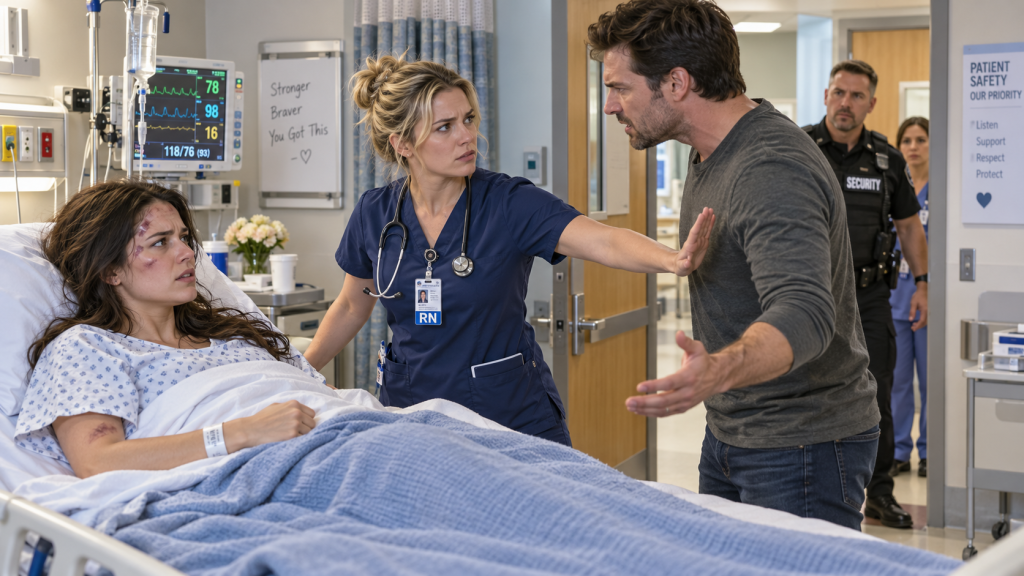
After a serious car accident, I was rushed to the hospital. My husband stormed into my room looking furious. “I’ve had enough of this,” he snapped. “get out of that bed. I’m not paying another dollar for this.” He grabbed my arm and tried to pull me up despite my injuries.
When I refused to move, he reacted in a way no one expected. What happened next changed everything.
I found out what “unexpected” meant one second later. He let go of my arm only long enough to yank the blanket away from my legs. “Then I’ll do it myself,” he said, reaching for me again.
A nurse came through the doorway and stopped him. She didn’t yell. She walked straight to the bed, put herself between us, and said, “Sir, take your hands off the patient.”
He pointed at me. “She’s my wife.”
The nurse looked at me instead of him. “Do you want to get out of bed?”
“No.”
My husband’s jaw tightened. He told her I was being dramatic, that the accident “wasn’t that bad,” and that he wasn’t going to get stuck with a pile of bills because I wanted attention. The nurse checked the monitor, my wristband, and the chart near the foot of the bed, then told him I had not been cleared to stand.
He gave a short, humorless laugh. “I don’t care. We’re leaving.”
For years, I had treated our arguments about money like bad weather—unpleasant, temporary, something I could wait out. He questioned grocery receipts. He complained about copays. He wanted explanations for every small charge.
But lying in that hospital bed, I finally heard the bargain underneath all of it. If he paid, he believed he got to decide.
“I said no,” I told him again.
He stepped around the nurse. She moved with him. He tried the other side, and she blocked him again without touching him.
Then he lowered his voice.
“Tell her you’re coming home,” he said to me. “Or don’t expect me to pay for any of this.”
The nurse heard every word.
She asked me one simple question. “Do you want him in this room?”
My mouth went dry. My husband stared at me like the answer already belonged to him. The bed rail felt cold beneath my fingers, and the plastic wristband scratched my skin as I tightened my grip.
“I want him out.”
He called me ungrateful. He said I was embarrassing him. He accused the nurse of getting between a husband and wife. But she never argued about our marriage. She documented what she had witnessed, repeated my request, and asked him to step into the hallway.
He refused.
The nurse moved to the doorway and called for assistance. Another staff member arrived, followed by a security officer. My husband immediately started explaining how I was emotional, how he was only trying to take me home, how everyone was overreacting.
The nurse asked me again, where he could hear me clearly.
“Do you want him to leave?”
“Yes.”
The security officer moved beside him. My husband looked at me, then toward the hallway, still waiting for me to take the word back.
I didn’t.
He ripped the visitor badge from his shirt and dropped it into the security officer’s open hand.
PART 2
The visitor badge landed in the security officer’s palm.
My husband stared at me for one final second.
His name was Ryan.
For eleven years, I had watched that face soften at weddings, tighten over bills, brighten when somebody praised him.
But I had never seen what I saw then.
Not concern.
Not embarrassment.
Calculation.
As though he were already trying to decide which version of the hospital room he would tell people later.
Then he pointed at me.
“You’re going to regret this.”
The nurse immediately said:
“Sir, you need to leave.”
Ryan laughed.
“I’m talking to my wife.”
The security officer stepped closer.
“And she has asked you to leave.”
Ryan’s jaw tightened.
He looked at me again.
I could almost see him waiting for the familiar thing to happen.
For me to feel guilty.
For me to say:
It’s fine.
Let him stay.
He’s upset.
He didn’t mean it.
I had said versions of those sentences for years.
That afternoon, I said nothing.
The security officer guided him into the hallway.
Ryan did not physically resist.
He did something he was much better at.
He started talking.
“This whole thing is being misunderstood.”
“She gets emotional when she’s in pain.”
“I was just trying to save us from a ridiculous bill.”
“We have a high deductible.”
“She knows how expensive hospitals are.”
Every sentence floated back through the open doorway.
The nurse closed the door.
And suddenly, for the first time since the crash, the room was quiet.
My whole body began shaking.
Not from the accident.
Not entirely.
The nurse noticed.
She came to the side of my bed and lowered the rail only enough to adjust the blanket Ryan had yanked away.
Then she covered my legs again.
Such a small thing.
But I nearly cried.
“Are you cold?”
I nodded.
She brought another blanket from the warming cabinet.
The heat settled over me slowly.
My throat tightened.
“Thank you.”
“You don’t need to thank me.”
Her name was Elena Morales.
I learned that later.
At that moment, she was simply the first person in years who had heard me say no and treated the word like it meant something.
She checked the monitor.
My blood pressure.
The IV.
Then looked at me.
“Has he ever tried to physically force you to do something before?”
I opened my mouth.
Nothing came out.
That should have been an easy question.
Instead, my mind began sorting memories.
Ryan taking my phone because I was “too upset to text anyone.”
Ryan standing in front of the garage door during an argument.
Ryan squeezing my wrist once when I reached for his laptop.
Ryan taking the car keys because he said I was “too emotional to drive.”
He had never punched me.
I had used that fact like a certificate of safety.
“No,” I said automatically.
Then stopped.
Elena waited.
I stared at the ceiling.
“I don’t know.”
Her voice softened.
“That’s okay.”
I looked at her.
“He’s grabbed my wrist.”
She nodded.
“Blocked doors?”
My eyes filled.
“Yes.”
“Taken things you needed?”
“My phone.”
“Money?”
That question made me laugh weakly.
“All the time.”
Elena did not laugh.
“What do you mean?”
I looked toward the closed door.
“He manages the accounts.”
“Do you have access?”
“Yes.”
Technically.
“And can you spend freely?”
I almost said yes again.
Then I remembered the forty-three-dollar grocery receipt Ryan had left on the kitchen counter with three items circled in red.
Organic chicken.
Laundry detergent.
A birthday card.
He had written:
Why premium brands?
I remembered standing there explaining detergent to a grown man.
“I have access,” I said.
“But?”
“But every purchase becomes a discussion.”
Elena nodded.
“Do you work?”
“Yes.”
“What do you do?”
“I’m a physical therapist.”
Her eyebrows rose slightly.
“So you earn income.”
“Yes.”
“Where does your paycheck go?”
“Joint checking.”
“Can you move money without his permission?”
I hesitated.
That was answer enough.
Elena looked at me for a long moment.
Then said:
“I’d like someone from social work to speak with you.”
My stomach tightened immediately.
“I’m not saying my husband abuses me.”
“I didn’t ask you to.”
“I’m not afraid of him.”
The sentence sounded unconvincing even to me.
Elena did not argue.
She simply asked:
“Do you feel safe going home with him tonight?”
I looked at the door.
“No.”
That word came more easily the second time.
“No.”
“Okay.”
She wrote something in my chart.
Then:
“You’re not being discharged tonight anyway.”
I blinked.
“What?”
She looked surprised.
“You haven’t spoken with the trauma physician yet?”
“No.”
Elena’s face changed.
She glanced at the chart.
“Your pelvic imaging showed a fracture.”
My heart stopped.
“A fracture?”
“Yes.”
“And they’re monitoring an abdominal injury.”
“What kind?”
“The physician needs to explain the details.”
My mouth went dry.
Ryan had been trying to drag me out of bed.
With a fractured pelvis.
I pressed both hands against the mattress.
“He said the accident wasn’t bad.”
Elena’s expression remained neutral.
“Your husband is not the person determining that.”
Twenty minutes later, the doctor came in.
Dr. Patel.
Calm voice.
Tired eyes.
He showed me the scans.
A nondisplaced pelvic fracture.
Three cracked ribs.
A concussion.
Deep bruising across my abdomen from the seat belt.
And a small liver laceration they believed would heal without surgery if it remained stable.
“If the bleeding increases?”
I asked.
“We intervene.”
My chest tightened.
“Could I have made it worse by standing?”
“Yes.”
He answered without drama.
“That’s one reason you were told not to get out of bed.”
I looked toward the door.
“And if somebody pulled me up?”
His expression changed.
“It would not have been advisable.”
Advisable.
Doctor language.
Underneath it, I heard:
Dangerous.
My eyes filled.
For the first time, I understood how much damage Ryan could have caused simply because he was angry about money.
Dr. Patel continued.
“We’ll repeat labs.”
“Pain control.”
“Observation.”
“Possibly two nights.”
I almost laughed.
Ryan would love that.
Two nights.
Two entire nights of bills.
Then I hated myself for thinking it.
My body was injured, and somehow I was still calculating how much anger recovery would cost me at home.
That realization frightened me more than the scan.
The hospital social worker arrived after Ryan was formally removed from the building.
Her name was Denise Grant.
She sat beside the bed without opening her folder immediately.
I appreciated that.
“Ryan cannot return to your room unless you request it.”
“I won’t.”
“Good.”
She paused.
“Do you want him receiving medical updates?”
I hesitated.
He was my husband.
The answer should have been automatic.
“No.”
Another boundary.
Another tiny door closing.
Denise changed the privacy settings on my chart.
A password was added.
Ryan could not call and get information merely by saying he was my spouse.
Then she asked who I trusted.
My sister, Beth.
She lived forty minutes away.
We had spoken less over the last year.
Ryan said she interfered in our marriage.
Beth said Ryan did not like witnesses.
I had told myself both of them were being dramatic.
I called her.
She answered immediately.
“Anna?”
Hearing my name in my sister’s voice nearly broke me.
“Hey.”
“What happened?”
“I was in an accident.”
Silence.
Then:
“What hospital?”
I started crying.
Not because she asked whether I was okay.
Because she did not ask whether I had inconvenienced her.
I told her.
She said:
“I’m coming.”
No sigh.
No discussion.
No cost-benefit analysis.
Just movement toward me.
Denise handed me tissues.
“Does your sister know about your husband?”
“Some.”
“What does some mean?”
“She thinks he controls me.”
“And what do you think?”
I looked at my own hands.
For years, I had thought control meant one person giving orders and another openly obeying.
Ryan was subtler.
He called it responsibility.
Budgets.
Practicality.
Marriage.
Every rule had a reasonable name.
Only the effect was unreasonable.
I whispered:
“I think I got used to asking permission without realizing I was asking.”
Denise nodded.
That sentence made it into her notes.
I was glad.
Because later, I would need to remember it.
Beth arrived carrying my phone charger, a sweater, and enough anger for both of us.
She saw my face.
Then my IV.
Then the bruising beginning along my shoulder.
“What happened?”
I told her about the crash first.
Not Ryan.
That part came later.
When I told her he tried to pull me out of bed, she stood.
“Where is he?”
“Gone.”
“Gone where?”
“I don’t know.”
She started toward the door.
“Beth.”
She stopped.
“Don’t.”
Her face crumpled.
“I’m sorry.”
She sat again.
“I want to hit him.”
“I know.”
“I won’t.”
“Thank you.”
Then she looked at me.
“Anna, this isn’t the first thing.”
My stomach tightened.
“What?”
“Don’t do that.”
“Do what?”
“Make me prove your marriage to you.”
I looked away.
Beth softened.
“I’m not saying every argument means abuse.”
“I’m saying you stopped being yourself around him.”
That hurt.
Because I knew exactly what she meant.
Before Ryan, I bought concert tickets without calculating whether a man would approve.
I ordered dessert.
I gave gifts without hiding receipts.
I visited Beth without explaining how long I would stay.
Somehow, adulthood had become smaller after marriage.
Not immediately.
In teaspoons.
Five dollars here.
One argument there.
One canceled dinner.
One password shared “for convenience.”
Then suddenly I was in a hospital bed feeling guilty because three broken ribs might be expensive.
Beth took my hand.
“What do you need?”
“I don’t know.”
“That’s fine.”
“We’ll start there.”
At six that evening, Ryan began texting.
At first:
I hope you’re happy.
Then:
Security treated me like a criminal.
Then:
You made me look abusive.
I stared at that one.
Not:
I’m sorry I grabbed you.
You made me look abusive.
The difference mattered.
Then:
You need to tell them this was a misunderstanding.
I showed Denise.
She photographed the messages for the record with my permission.
Another arrived.
If you stay overnight, you are responsible for whatever insurance doesn’t cover.
Beth read it over my shoulder.
“Insurance?”
I nodded.
“Ryan handles it.”
“What insurance do you have?”
“Through his employer.”
Beth frowned.
“You stopped using yours?”
“Last year.”
“Why?”
“His plan was cheaper.”
She looked at me.
“Was that your idea?”
I opened my mouth.
Then closed it.
No.
Ryan spent two weeks showing me spreadsheets until choosing his plan felt less like a choice and more like the end of an argument.
“I guess not.”
Beth’s jaw tightened.
Then another text came.
And don’t expect me to cover the deductible from savings.
Savings.
Something about that word bothered me.
I opened our bank app.
The login failed.
I tried again.
Wrong password.
My stomach tightened.
I clicked reset.
The verification code went to a phone number ending in 8842.
Ryan’s.
Not mine.
I stared.
“He changed the banking access.”
Beth leaned closer.
“When?”
“I don’t know.”
I tried the credit card.
Same thing.
Then the investment account.
Locked.
My breathing changed.
Denise noticed.
“What happened?”
“I can’t get into our accounts.”
Beth looked at her.
“He controls them.”
Denise asked:
“Do you have an account in your own name?”
“Yes.”
At least I thought I did.
An old savings account from before marriage.
I opened it.
Balance:
$1,416.
I stared.
There should have been almost $38,000.
My inheritance from my grandmother.
Not enormous.
Mine.
I refreshed.
$1,416.
“No.”
Beth saw my face.
“What?”
“My savings.”
“What about it?”
“It’s gone.”
“How much?”
“Thirty-six thousand.”
The room went quiet.
I opened transaction history.
Transfers.
Monthly.
$4,000.
$5,000.
$7,500.
Destination account:
RMC Financial Services.
I had never heard of it.
“What is that?”
Beth asked.
“I don’t know.”
Denise wrote the name down.
“When did the first transfer happen?”
Eight months earlier.
My stomach turned.
Eight months.
Around the same time Ryan started insisting we needed to “tighten household spending.”
I whispered:
“He was taking my money while questioning grocery receipts.”
Beth closed her eyes.
Then said:
“We need an attorney.”
That sounded extreme.
Five hours earlier, security sounded extreme too.
I was beginning to understand that extreme circumstances do not become ordinary because you have normalized them.
The next surprise came from hospital billing.
A woman named Nora stopped by the following morning.
“I’m following up on your insurance.”
I braced myself.
Ryan had already planted the fear.
“How bad?”
She frowned.
“What do you mean?”
“The cost.”
“Your coverage is active.”
I blinked.
“It is?”
“Yes.”
“Your deductible has already been met for the year.”
My mouth opened.
“What?”
“Based on the eligibility response, yes.”
That made no sense.
I had barely used medical care that year.
Then Nora said:
“You also have secondary accident coverage.”
My stomach tightened.
“What accident coverage?”
She checked the screen.
“A supplemental policy.”
“I don’t have one.”
“It’s listed under your information.”
Beth looked at me.
“What kind?”
I asked.
“Hospital and injury benefits.”
“Who purchased it?”
“I can’t see that from here.”
Ryan.
I knew before I knew.
Ryan bought policies for everything.
Phones.
Appliances.
Cars.
Apparently, me.
Nora continued.
“Some benefits may be paid directly to the policyholder depending on the contract.”
My chest tightened.
“Who is the policyholder?”
She looked again.
“Your husband appears to be listed as the contact.”
Beth went very still.
I asked:
“How much?”
“I don’t have benefit details.”
Something cold moved through me.
Ryan had stormed into my hospital room screaming that he would not pay another dollar.
But there was supplemental accident coverage.
Possibly paying him.
That did not prove anything sinister.
Maybe he bought it responsibly.
Maybe he forgot.
Maybe.
But suddenly his obsession with getting me out of the hospital looked different.
I asked Nora:
“Can I get the policy information?”
“We can give you the insurer name and claim contact.”
“Yes.”
“Please.”
I wrote it down.
Then Beth said:
“Anna.”
“What?”
“Call them.”
I did.
The representative verified my identity.
Then explained there was indeed an accident policy connected to me.
Effective eleven months earlier.
Benefits for hospitalization.
Fracture.
ICU.
Surgery.
And accidental death.
My hand tightened around the phone.
“How much for accidental death?”
A pause.
“One million dollars.”
I stopped breathing.
Beth’s face changed.
I asked:
“Who is the beneficiary?”
“Your spouse.”
The room went cold.
Again, that did not prove Ryan wanted me dead.
Spouses buy insurance.
Married people name one another beneficiaries.
But I had never seen this policy.
Never discussed it.
Never remembered signing it.
“When was it purchased?”
“Last November.”
“Do you have my application?”
“Yes.”
“Can I request a copy?”
“Of course.”
Then I asked:
“Was there a signature?”
“Yes.”
“Mine?”
“Yes.”
My mouth went dry.
I had no memory of signing anything.
Maybe I had.
Ryan constantly put electronic forms in front of me.
Car registration.
Insurance renewals.
Tax documents.
He would say:
“Just sign here.”
And I often did.
That realization made me nauseous.
A signature obtained through habit is still a signature.
But if I had not known what I was signing, that was another problem.
Beth whispered:
“We’re getting copies.”
I nodded.
At noon, a police officer came to my room.
Officer Grant Ellis.
Not because of Ryan.
Because of the crash.
My accident had occurred on a steep county road.
I remembered driving downhill.
Rain.
A delivery truck ahead of me.
Then pressing the brake.
The pedal sinking farther than it should.
I pumped it.
Nothing.
I swerved rather than hit the truck.
The guardrail came toward me.
After that, glass.
Metal.
Silence.
Officer Ellis asked me to explain it again.
“The brake pedal went soft?”
“Yes.”
“Any warning lights beforehand?”
My chest tightened.
“One.”
“When?”
“A few weeks ago.”
“What kind?”
“Brake warning.”
“What did you do?”
“I told Ryan.”
Beth looked at me.
Officer Ellis asked:
“Did you take the vehicle in?”
“Ryan said he did.”
“When?”
“I don’t know.”
“He handles maintenance.”
The officer wrote something down.
Then:
“Do you know Keller Auto Service?”
“Yes.”
That was our mechanic.
My stomach tightened.
“Why?”
“They contacted us after seeing the vehicle identification number on the police request.”
I stopped breathing.
“What did they say?”
Officer Ellis did not dramatize it.
That made it worse.
“Your vehicle was inspected there thirteen days before the collision.”
I stared.
“Ryan told me they fixed it.”
The officer looked at me.
“They did not.”
My mouth went dry.
“What?”
“The service record says the technician identified severe corrosion on a rear brake line and recommended immediate replacement.”
My entire body went cold.
“No.”
“The estimate was declined.”
“By who?”
He looked at his notes.
“Ryan Cole.”
My husband.
Beth swore softly.
I stared at the ceiling.
“No.”
Ryan told me it was a sensor.
I remembered the conversation perfectly.
I stood beside the kitchen island.
“Is the car okay?”
“Yes.”
“Keller said it’s nothing.”
“Probably the cold.”
I had trusted him.
Officer Ellis continued carefully.
“The technician documented that the vehicle was considered unsafe to drive until the repair was completed.”
My eyes filled.
“Did Ryan know that?”
“The signed decline form states that the customer was informed.”
My breathing became shallow.
Beth squeezed my hand.
Officer Ellis added:
“The shop manager remembers speaking with him personally.”
I whispered:
“What did Ryan say?”
A pause.
“He said he needed time to compare prices.”
Of course.
Prices.
Always prices.
“How much was the repair?”
“Approximately eight hundred sixty dollars.”
I stared.
Less than the thousand-dollar television Ryan bought for the basement two months earlier.
Less than the golf trip he took in September.
Eight hundred sixty dollars.
My life had gone into a guardrail over eight hundred sixty dollars.
Tears slipped into my hair.
Officer Ellis waited.
Then said:
“There’s another detail.”
I almost laughed.
I had started hating those words.
“What?”
“The shop says Mr. Cole asked whether they could clear the dashboard warning temporarily.”
My body went still.
Beth stopped breathing beside me.
“Why?”
“The manager says your husband complained that the warning light was bothering you.”
My stomach turned.
Officer Ellis continued:
“They refused to clear it without repair.”
I remembered the light disappearing.
Three days later.
Ryan told me he had handled it.
“How did the warning light go away?”
I whispered.
“We don’t know yet.”
My skin went cold.
Officer Ellis closed his notebook.
“I want to be careful.”
He looked directly at me.
“Declining an expensive repair does not by itself prove someone intended an accident.”
I nodded.
I appreciated him for saying it.
“But the fact that you report being told the problem was fixed when records show otherwise is relevant.”
“Yes.”
My voice barely worked.
“Very.”
He stood.
Then paused.
“One more question.”
“What?”
“Did your husband know your usual route that morning?”
I stared.
“He texted me to stop at the pharmacy on the way to work.”
“Was that on your usual route?”
“No.”
My heartbeat changed.
The pharmacy took me down the hill where I crashed.
Beth looked at me.
Officer Ellis saw both our faces.
Again, he stayed careful.
“That may mean nothing.”
I nodded.
But it meant something to me.
Not proof.
A question.
A terrible question.
The insurance documents arrived electronically two hours later.
Beth opened them first.
I could not.
She sat beside the window scrolling.
Then stopped.
“What?”
I asked.
She did not answer.
“Beth.”
Her face had gone pale.
“Your signature is here.”
I swallowed.
“Does it look real?”
“Yes.”
That hurt.
Then she zoomed in.
“Wait.”
“What?”
“There’s a date.”
“November nineteenth.”
My heart slowed.
“What?”
She looked at me.
“Where were you November nineteenth?”
I thought.
Then remembered immediately.
“Denver.”
“For work?”
“Yes.”
“Three-day conference.”
Beth turned the screen toward me.
The application claimed it had been signed in person in our insurance agent’s office.
Back home.
The same day I was giving a continuing-education lecture in Denver.
My mouth went dry.
“I wasn’t there.”
“No.”
The witness signature belonged to a local agent I did not recognize.
And attached to the application was another page.
A beneficiary election.
One million dollars.
Ryan Cole.
My husband.
Then Beth scrolled lower.
Her expression changed again.
“What?”
“There’s a second policy.”
I stared.
“What second policy?”
“Life insurance.”
My pulse began pounding.
“How much?”
She swallowed.
“Seven hundred fifty thousand.”
I closed my eyes.
Effective date:
Eleven months earlier.
Beneficiary:
Ryan.
Again.
Another signature I did not remember.
Another document supposedly executed while I was away.
Together, the policies would have paid him $1.75 million if I died in an accident.
I could barely process it.
Then Denise came into the room with a thick envelope.
“Anna?”
“Yes?”
“Security found something we thought you should know.”
My stomach tightened.
“What?”
“Your husband returned to the hospital parking lot this morning.”
Beth stood.
“What?”
“He was not allowed inside.”
“What did he want?”
Denise looked at me.
“He told security he needed paperwork from your vehicle.”
My skin went cold.
“What paperwork?”
“He claimed it was insurance information.”
Officer Ellis, still outside my room finishing another conversation, heard enough to come back in.
“What happened?”
Denise explained.
Ryan had asked where the wrecked car had been towed.
Security refused to provide information.
Then he left.
Officer Ellis immediately called someone.
I listened without understanding most of it.
Vehicle impound.
Hold.
Do not release.
Preserve contents.
Photograph everything.
When he ended the call, he looked at me.
“We’re placing an evidence hold on the vehicle until we finish reviewing the mechanical findings.”
My mouth went dry.
“Because of the brakes?”
“Yes.”
“And because your husband was apparently trying to locate the car.”
Silence.
Then my phone buzzed.
A text from Ryan.
I stared at it.
You need to stop talking to people. You have no idea what you’re doing.
Another.
The brakes were fine. Don’t let Beth fill your head with garbage.
My skin went cold.
I had not told him what the police found.
Beth had not spoken to him.
The hospital had not told him.
I showed Officer Ellis.
His expression changed.
“How does he know we’re asking about the brakes?”
I whispered.
“I don’t know.”
And for the first time since the crash, the thing I feared most was no longer the hospital bill.
It was the possibility that Ryan had been terrified of the hospital for an entirely different reason.
Maybe he had not tried to drag me out because treatment was expensive.
Maybe he had needed me home before doctors, nurses, police, insurance representatives, and one stubborn social worker began asking the exact questions he had spent months making sure I never asked.
And when Officer Ellis looked down at Ryan’s message again, he said something that made the room go completely still.
“Anna, until we know more, do not go home.”
My hand tightened around the blanket.
“Why?”
He looked at me carefully.
“Because we just received the repair shop’s signed acknowledgment.”
My throat went dry.
“And?”
“Your husband didn’t only decline the brake repair.”
A pause.
“He signed a statement confirming he understood that continued driving could result in complete brake failure.”
I stopped breathing.
Then Officer Ellis added quietly:
“And the date on that statement is the same day he increased your accidental-death coverage.”
PART 3 — THE DAY MY NO FINALLY MEANT SOMETHING
“The date on that statement is the same day he increased your accidental-death coverage.”
For several seconds, nobody moved.
Not Beth.
Not Denise.
Not Officer Ellis.
Not me.
The machines beside my bed kept making their quiet little sounds.
A pulse.
A breath.
A number glowing green.
Ordinary proof that my body was still doing what Ryan’s paperwork had quietly prepared for it not to do.
I stared at Officer Ellis.
“Increased?”
My voice barely came out.
“I thought the policy was new.”
He nodded.
“The supplemental accident policy appears to have been increased.”
My skin went cold.
“From how much?”
He checked the document.
“Two hundred fifty thousand.”
“To one million?”
“Yes.”
My hand tightened around the blanket.
“And the same day…”
He did not finish.
He didn’t have to.
Ryan had stood in Keller Auto Service.
He had been told my brake line was severely corroded.
He had signed a form acknowledging complete brake failure was possible.
He had declined an $860 repair.
And that same day, he had increased the amount he would receive if I died in an accident.
I started shaking.
Beth moved toward me.
Then stopped.
“Can I?”
I looked at her.
That tiny question broke something open inside me.
Can I?
Not grabbing.
Not deciding.
Not assuming.
I nodded.
She took my hand.
I cried.
Quietly at first.
Then harder.
Because there are moments when fear stops being abstract.
It becomes paper.
Dates.
Signatures.
Dollar amounts.
Officer Ellis waited until I could breathe again.
Then he said:
“Anna, I need to be very careful with what I say.”
I looked at him.
“This is suspicious.”
“Yes.”
“But suspicious is not the same as proven intent.”
I nodded.
I needed that.
Not because I wanted Ryan protected.
Because I wanted the truth protected.
If he had tried to kill me, I wanted evidence.
If he had been monstrously negligent and greedy without intending the crash, I wanted that truth too.
I no longer wanted a marriage built on explanations that made facts easier to swallow.
I wanted the facts exactly as they were.
Officer Ellis continued.
“We are obtaining the full insurance file.”
“The vehicle will be examined independently.”
“We’re also asking Keller Auto for surveillance footage, service notes, and any communication with your husband.”
I swallowed.
“What about the warning light?”
“We’re looking at that.”
“And the route?”
“Yes.”
He paused.
“We’re also preserving your husband’s text requesting that you stop at the pharmacy.”
I closed my eyes.
The pharmacy.
The hill.
The brake pedal dropping beneath my foot.
I could hear the sound again.
Metal.
Glass.
My own scream.
Then nothing.
Beth squeezed my hand.
I asked:
“Can Ryan come here?”
“No.”
Denise answered before anyone else.
“He remains barred from visiting.”
“And when I’m discharged?”
“We need a safe discharge plan.”
That phrase landed differently now.
Safe discharge.
For years, I thought leaving a hospital simply meant getting home.
Now home was the question.
The next three days changed my life faster than the previous eleven years had.
The independent vehicle inspection found severe deterioration in the rear brake line.
That part matched Keller Auto.
But there was more.
The dashboard brake-warning system had been tampered with.
Not professionally.
A connector associated with the warning circuit had been disconnected.
Officer Ellis told me that carefully.
“Could that happen accidentally?”
“It’s possible during some repairs.”
“Was there any repair?”
“No documented repair after Keller.”
My mouth went dry.
“Could Ryan have done it?”
“We can’t say yet.”
“Did he know how?”
Beth answered before the officer could.
“He works on his motorcycle.”
I looked at her.
She looked guilty.
“I’ve seen him do basic mechanical work.”
Officer Ellis wrote it down.
That still did not prove he disconnected anything.
But the question had teeth now.
Then Keller Auto produced video.
Ryan at the counter.
Listening while the manager explained the danger.
Shaking his head.
Looking annoyed.
Signing the decline.
At one point, the manager pointed toward the estimate.
Ryan said something.
No audio.
But the manager later remembered.
“He said his wife barely drove and could wait until next month.”
I stared.
I drove every day.
He knew that.
Then came the insurance file.
That was worse.
The application had been submitted through an agent named Martin Kells.
Kells told investigators he had never met me.
He believed Ryan had authority to complete some documents because Ryan repeatedly referred to a “spousal financial arrangement.”
My signature?
Uploaded electronically.
The in-person notation?
Wrong.
Kells called it an administrative mistake.
Investigators called it relevant.
The life-insurance application used the same digital signature file.
Same source.
Same month.
Same beneficiary.
Ryan.
$1.75 million combined.
I sat in the hospital bed while my attorney, Laura Chen, read the records.
I had met her less than twenty-four hours earlier.
Beth found her.
Of course.
Laura looked at me.
“Do you recognize this signature?”
“It looks like mine.”
“Do you have a stored signature image?”
I thought.
Taxes.
Closing papers.
Our mortgage refinance three years earlier.
Ryan had scanned several documents then.
My stomach tightened.
“Yes.”
“Did he have access?”
“Yes.”
Laura nodded.
No drama.
Just another fact placed where it belonged.
Then she turned to the bank transfers.
My missing savings had gone to RMC Financial Services.
RMC.
Ryan Michael Cole.
His initials.
I almost laughed.
He had not even been creative.
The company was registered eighteen months earlier.
Sole manager:
Ryan Cole.
Purpose:
financial consulting.
It had no employees.
No office.
No legitimate clients we could identify.
My money went there.
Then out again.
Credit cards.
A personal loan.
Sports betting deposits.
And one account I did not recognize.
Laura pointed.
“Do you know a Natalie Cross?”
I stared.
“No.”
Beth went still.
“What?”
I looked at her.
“You know her?”
She hesitated.
“Maybe.”
My stomach tightened.
“Beth.”
“She works with Ryan.”
I closed my eyes.
Of course.
Another name.
Another room in the marriage.
“What kind of account?”
Laura answered.
“Joint brokerage.”
My eyes opened.
“Joint?”
“Ryan Cole and Natalie Cross.”
I stared.
“How much?”
“Approximately sixty-two thousand dollars moved through it over nine months.”
My grandmother’s inheritance.
Part of it.
Money Ryan questioned me for spending on detergent had been moving into an investment account with another woman.
Beth looked furious.
I felt almost nothing.
Not yet.
Sometimes the heart refuses to process betrayal until the body catches up.
Laura continued.
“We don’t know the nature of their relationship.”
I nodded.
Facts.
Always facts.
Then Officer Ellis arrived with another update.
Natalie had been interviewed.
Not a mistress.
At least not according to the evidence they had.
She was Ryan’s office manager.
And she had believed the brokerage account was part of a shared “side business” they were building.
Ryan had told her I knew.
Of course he had.
He had told everybody I knew.
The mechanic.
The insurance agent.
Natalie.
The bank.
Everyone except me.
Natalie said Ryan often complained about being “trapped by medical expenses.”
That phrase chilled me.
Because I barely had any.
Then she told investigators something worse.
Two months before the crash, Ryan asked whether accidental-death insurance payouts were taxable.
She thought he was talking generally.
A month later, he asked whether a spouse could receive the money if the insured person died before divorce.
Divorce.
I had never mentioned divorce.
Not once.
Then came the final detail.
The week before the crash, Ryan told Natalie:
“Soon I won’t have to worry about her draining money anymore.”
I read that sentence twice when Laura showed it to me.
Soon.
Not:
I’m divorcing her.
Not:
We’re separating.
Soon.
My stomach turned.
Still, it was not proof by itself.
But now the pieces were beginning to touch.
I stayed in the hospital five nights.
Ryan texted every day.
At first angry.
Then pleading.
Then careful.
I’m sorry I got upset.
You know I’d never hurt you.
People are twisting this.
Then:
Please tell the police the brake issue was an accident.
I stared at that one.
I had never accused him to police.
Not directly.
Then:
We both knew the car needed work.
No.
We did not.
Then:
You knew I postponed the repair.
Again.
No.
The story was evolving.
Every text made his position worse.
Laura told me:
“Do not argue with him.”
So I didn’t.
Silence had once been something Ryan used against me.
Now it became mine.
Then he sent:
Beth has always hated me.
I almost smiled.
There it was.
When facts fail, blame the witness.
The hospital discharged me to Beth’s house.
Not mine.
I needed a walker.
Pain medication.
Help getting dressed.
Help showering.
I hated every bit of it.
Not because Beth made me feel small.
She didn’t.
Because I had spent years being told needing anything made me expensive.
The first morning, I apologized because she had to bring me coffee.
Beth stared.
“For coffee?”
“I woke you.”
“You did not.”
“I heard you moving.”
“I have children. I’ve been awake since 1989.”
I laughed and immediately grabbed my ribs.
“Don’t make me laugh.”
“Then stop apologizing for existing in my guest room.”
That sentence stayed with me.
Stop apologizing for existing.
At home with Ryan, I had learned to shrink every need before presenting it.
Pain.
Money.
Time.
Rest.
Everything needed justification.
Beth brought me coffee and did not request a receipt.
Healing began there too.
Ryan was arrested twelve days after the crash.
Not for attempted murder.
Not then.
For financial crimes connected to the forged insurance applications, unlawful transfers, and identity misuse.
The larger investigation continued.
When police searched our house under warrant, they found something in Ryan’s garage cabinet.
Brake-line tools.
Not illegal.
A bottle of brake fluid.
Normal.
But also a printed copy of my vehicle’s service diagram.
Dated three days after Keller Auto warned him about the brake line.
My mouth went dry when Officer Ellis told me.
“Does that prove he tampered with it?”
“No.”
Again.
Careful truth.
“But it shows he was researching that brake system.”
Then:
“There’s more.”
I closed my eyes.
“What?”
A search of his laptop recovered deleted browser history.
Queries.
rear brake line failure symptoms
how long can corroded brake line last
does accident insurance investigate mechanical failure
My stomach turned.
Then one search from two days before my crash:
fatal crash downhill brake failure statistics
I stopped breathing.
Beth left the room.
I heard her crying in the hallway.
I stayed still.
Because something inside me had gone beyond shock.
It was simply cold.
Officer Ellis sat across from me.
“Anna.”
“Yes?”
“We also found a draft email.”
“To who?”
“An insurance claims representative.”
My skin went cold.
“What did it say?”
“It was never sent.”
“Read it.”
He hesitated.
Then:
“It describes a hypothetical claim after a spouse dies in a single-vehicle accident.”
I stared.
“Before my crash?”
“Yes.”
“How long before?”
“Four days.”
That was the moment suspicion became something else inside me.
Not legal certainty.
Personal certainty.
I stopped asking myself whether I was being unfair.
Ryan had been researching the exact kind of accident I later survived.
The exact insurance that would pay him.
The exact mechanical failure he had knowingly left unrepaired.
Maybe a prosecutor would someday debate intent in technical language.
I did not need to.
I needed to stay away.
The case took thirteen months.
Real cases do not move like anger.
There were experts.
Mechanical engineers.
Digital forensics.
Insurance records.
Financial subpoenas.
Witness interviews.
Arguments over what could be proven.
The prosecution ultimately did not claim they could prove Ryan physically sabotaged the brake line himself beyond reasonable doubt.
The disconnected warning circuit raised suspicion.
The service diagram raised suspicion.
The searches raised enormous suspicion.
But suspicion and proof remained different.
What they could prove was that he knowingly concealed a dangerous brake condition from me.
That he falsely told me it had been repaired.
That he sent me onto a route he knew had a steep downhill grade.
That he had recently increased accidental-death coverage without my informed consent.
That he forged insurance and financial documents.
That he moved my inheritance.
That he researched claims involving fatal accidents before mine.
And that after I survived, he tried to remove me from medical care while I was still injured.
That last part mattered.
The nurse’s documentation mattered enormously.
Elena Morales had written everything.
Exact words.
Exact time.
Get out of that bed.
I’m not paying another dollar for this.
My refusal.
His attempt to pull me.
His threat to refuse payment.
My request that he leave.
For months, I had thought the hospital scene was humiliating.
Later, I understood it was evidence.
Elena had not simply protected my body that day.
She had preserved the truth before Ryan could rewrite it.
The charges were complicated.
Financial fraud.
Forgery.
Identity misuse.
Theft.
Reckless endangerment-related conduct.
Insurance fraud.
Other counts prosecutors pursued based on the broader pattern.
There were negotiations.
Some allegations were reduced.
Some dismissed.
Others strengthened.
Eventually, Ryan accepted a plea agreement rather than take the entire case to trial.
There was prison time.
Years.
Not life.
Restitution.
Forfeiture.
He lost his professional licenses.
The insurance policies were voided.
The stolen savings became part of restitution.
I recovered some money quickly.
Some slowly.
Some never.
That used to bother me.
Then one day, I realized I had recovered the part that mattered most.
Decision-making.
My own.
The divorce was easier.
Not emotionally.
Legally.
Laura filed while I was still using a walker.
Ryan’s lawyer tried to characterize the marriage as “financially contentious.”
I laughed when I read it.
Financially contentious.
That was one way to describe a husband demanding explanations for greeting cards while moving his wife’s inheritance into a shell company.
The judge froze marital assets early.
My paycheck was redirected into an account only I controlled.
For the first time in eleven years, I received my salary and did not immediately wonder what Ryan would say if I spent some of it.
The first thing I bought was ridiculous.
A forty-eight-dollar bottle of shampoo.
Beth stared at it.
“You hate expensive shampoo.”
“I do.”
“Then why?”
“Because I can.”
She laughed.
“So this is rebellion?”
“Yes.”
“Terrible rebellion.”
“I’m injured.”
“I’m pacing myself.”
I used that shampoo for six months.
It was not worth forty-eight dollars.
That was not the point.
The point was no one asked me to justify it.
Physical recovery took longer than I wanted.
Pelvis first.
Then ribs.
Then the liver injury.
The concussion symptoms lingered.
Headaches.
Fatigue.
A strange sensitivity to loud noises.
I was a physical therapist.
I knew recovery.
That almost made it harder.
I knew timelines.
Exercises.
Milestones.
My own body refused to care about my professional expertise.
My therapist told me:
“You treat patients with more patience than you treat yourself.”
Annoying.
Accurate.
I returned to work part-time after four months.
The first patient I treated after the crash was a seventy-year-old woman recovering from hip surgery.
She apologized every time she needed help standing.
I heard myself say:
“You don’t have to apologize for needing support while your body heals.”
Then I stopped.
My eyes filled.
The patient looked confused.
“You okay?”
I laughed.
“Apparently I’m learning my own material.”
That became another kind of recovery.
Teaching people what I had finally begun believing.
Beth and I became close again.
Not because Ryan left.
Because I stopped translating him.
For years, Beth would say:
“That isn’t normal.”
I answered:
“He’s stressed.”
“He worries about money.”
“He had a hard childhood.”
“He means well.”
I had been translating his control into something easier for everyone to tolerate.
Once I stopped, there was nothing left for us to fight about.
One evening, Beth asked:
“Do you hate me for not pushing harder?”
I stared.
“No.”
“I backed off.”
“You had to.”
“I thought you’d stop talking to me.”
“I probably would have.”
She cried.
“So I waited.”
I took her hand.
“You stayed close enough that when I finally called, you answered.”
That mattered.
We do not always rescue people by forcing open the door.
Sometimes we stay on the porch until they are ready to unlock it themselves.
Elena Morales became part of my life too.
Not dramatically.
A Christmas card.
Then coffee.
Then occasional messages.
On the first anniversary of the crash, I brought flowers to the hospital.
She looked embarrassed.
“You really didn’t need to do this.”
“I know.”
She smiled.
“Then why?”
“Because you asked me if I wanted him in the room.”
Her expression softened.
I continued.
“That question changed my life.”
“You answered it.”
“Yes.”
“But you asked.”
For years, Ryan had trained me to believe decisions were already made.
Money.
Insurance.
Car repairs.
Visitors.
Even whether I could get out of a hospital bed.
Elena did something revolutionary.
She asked me.
Do you want him here?
No.
And then she treated no like a complete sentence.
That was the beginning.
Ryan wrote me from prison once.
A long letter.
Twelve pages.
I read four.
Enough.
He said he never wanted me dead.
He said the insurance was “responsible planning.”
He said he postponed the brake repair because money was tight.
He said his searches were curiosity after the mechanic warned him.
He said he tried to remove me from the hospital because he believed I was being overtreated.
Every action had an explanation.
That was Ryan’s gift.
Explanation.
He could build a reasonable sentence around almost anything.
But explanations stop mattering when the pattern underneath them remains unchanged.
He knew the brakes were dangerous.
He told me they were fixed.
He increased insurance.
He forged my signature.
He took my money.
He researched fatal brake failure.
And when I survived, he tried to drag my injured body out of a hospital bed.
I did not need to determine which explanation inside his head was the true one.
I knew what happened to me.
That was enough.
I put the letter away.
Never replied.
Three years later, I bought a different car.
For twenty minutes, I stood in the dealership staring at the brake pedal.
The salesman thought I was comparing features.
I wasn’t.
I was remembering rain.
The hill.
The pedal sinking.
Glass.
Then I asked for the maintenance schedule.
All of it.
The salesman smiled.
“Your husband handles that stuff?”
Old sentence.
Old world.
I looked at him.
“No.”
Then:
“I do.”
I bought the car.
Every service record goes into a folder.
I know what repairs are done.
Not because I live in fear.
Because information is part of freedom.
There is a difference.
Years passed.
The scar along my hip faded.
The financial scars took longer.
For a while, I checked my bank account three times a day.
Then once.
Then sometimes I forgot.
That was healing too.
I dated eventually.
Slowly.
The first man I dated seriously was named Marcus.
On our fifth date, dinner came.
I reached for my wallet automatically.
He said:
“I’ve got it.”
My body tightened.
He noticed.
Then said:
“Or we can split it.”
Simple.
No offense.
No test.
I smiled.
“Split.”
“Done.”
That relationship did not last forever.
That was okay.
Not every healthy relationship has to become permanent to teach you something valuable.
Marcus showed me that disagreement does not require punishment.
That money can be discussed without fear.
That a person can hear no and simply say:
Okay.
Years later, I married again.
His name is David.
But that came much later.
Long after I had learned how to be alone without feeling abandoned.
He has never asked for my passwords.
We discuss money.
We do not audit each other.
If I spend forty-three dollars on groceries, nobody circles chicken in red ink.
The first time I realized that, I stood in the kitchen holding a receipt and started laughing.
David asked:
“What?”
I showed him.
He looked confused.
“Okay?”
“Nothing.”
I threw it away.
That felt better than revenge.
My old house with Ryan was sold during the divorce.
I never went back inside alone.
Beth came.
So did Laura.
We packed what mattered.
Photographs.
My grandmother’s dishes.
Work certificates.
Books.
Ryan’s things were handled separately.
In the garage, I found one old envelope.
Inside were receipts from Keller Auto.
The warning.
The estimate.
Ryan’s signed decline.
A duplicate.
I stood there for a long time.
Beth asked:
“Do you want to keep it?”
I thought.
“No.”
The legal case already had copies.
I did not need the original living with me.
We shredded it.
Not evidence.
That part was preserved.
Just my copy.
Some people keep every artifact of betrayal because they are afraid throwing it away means forgetting.
It doesn’t.
My body remembered enough.
I chose not to make the paper part of my home.
Ten years after the crash, I returned to Cascade Regional Hospital for a professional training.
Same building.
Different wing.
During lunch, I walked toward the emergency department.
I did not plan to.
My feet carried me.
The hallway looked almost the same.
Bright floors.
Machines.
People moving too quickly.
Then I found the room.
Not exact certainty.
Maybe one door over.
Memory plays tricks.
Still, I stood there.
And remembered Ryan pulling the blanket from my legs.
“Then I’ll do it myself.”
I remembered Elena stepping between us.
“Sir, take your hands off the patient.”
Then:
“Do you want him in this room?”
My younger self gripping the bed rail.
Terrified of the consequences of one honest answer.
“I want him out.”
I closed my eyes.
That sentence sounded so small at the time.
It was not.
It was the first brick removed from a wall I had spent eleven years helping him build around me.
One no.
That was all.
Not a divorce plan.
Not a police report.
Not a financial investigation.
Just:
No.
And because one nurse respected it, I heard how powerful it could be.
People sometimes ask what changed everything.
The brake records?
The insurance?
The shell company?
The million-dollar policy?
The police search?
No.
Those things explained what had already happened.
The change came earlier.
It happened in the hospital room when Ryan stared at me expecting the answer to belong to him.
And I took it back.
I want him out.
That was the first decision in years that I made without calculating the cost of his anger.
Everything else followed.
The nurse documented.
Security removed him.
Denise asked about money.
Beth came.
The bank accounts opened.
The policies surfaced.
The mechanic spoke.
The car was preserved.
Questions multiplied.
Truth entered through every crack control had tried to seal.
Ryan thought money gave him authority.
If he paid, he decided.
If he insured, he owned the risk.
If he managed the account, he managed me.
If he controlled the car, he controlled where I went.
He was wrong.
Money can pay a bill.
It cannot purchase consent.
Marriage can create legal ties.
It cannot turn one person’s body into another person’s property.
And love without safety eventually becomes a word people use to excuse fear.
I know that now.
There is one detail I remember most clearly from the day everything began.
Not the pain.
Not Ryan’s face.
Not even the security officer.
The blanket.
He ripped it off my legs.
I was cold.
Exposed.
Injured.
Then Elena picked up another blanket and covered me.
Warm.
Simple.
No speech.
That moment became the shape of my life afterward.
One person removing safety because he believed he could.
Another restoring it because I deserved it.
Years later, when Beth’s daughter went away to college, I gave her one piece of advice.
Not:
Never trust anyone.
That would be the wrong lesson.
I said:
“If someone makes your no expensive, pay attention.”
She frowned.
“What does that mean?”
“It means healthy people may be disappointed.”
“They may disagree.”
“They may ask questions.”
“But they don’t make you afraid to say no.”
She nodded.
I hope she remembers.
I do.
Ryan eventually left prison.
I heard through Laura.
No contact order remained in place by then because I had moved, remarried, and years had passed.
He never reached out again.
I was grateful.
I did not need a final confrontation.
No grocery-store apology.
No courtroom stare.
No cinematic ending.
The ending was already mine.
He left my life.
I stayed in it.
That was enough.
Every year on the anniversary of the crash, I do something small.
At first, it was therapy.
Then hiking.
Then dinner with Beth.
Eventually, I stopped treating the date like a funeral.
One year, I forgot completely.
The next morning, I realized.
And smiled.
Forgetting was not betrayal.
It was freedom.
The worst day of my life had finally stopped owning a square on the calendar.
That may be the most peaceful thing I have ever earned.
I still work as a physical therapist.
I still tell stubborn patients not to stand before they are cleared.
Sometimes they roll their eyes.
I smile.
Then say:
“Trust me.”
And every once in a while, I think about the injured woman I used to be.
Lying beneath a hospital blanket.
Fractured pelvis.
Cracked ribs.
Bleeding liver.
Still more worried about a bill than her own body.
I wish I could sit beside her.
Not warn her about Ryan.
Not tell her about the insurance.
The brake line.
The hidden money.
She would learn all of that soon enough.
I would tell her something simpler.
You are allowed to stay in the bed.
You are allowed to heal.
You are allowed to cost money.
You are allowed to need help.
And you are allowed to tell the person hurting you to leave, even if he is your husband.
Especially then.
Ryan came into that hospital believing payment gave him the final word.
He told me to get out of bed.
He threatened me with bills.
He grabbed my arm.
He expected obedience.
Instead, a nurse asked me one question.
“Do you want him to leave?”
And for the first time in a very long time, I answered without asking myself what Ryan would think.
“Yes.”
Security took him out of the room.
The truth followed him into the hallway.
And my life, finally, stayed with me.
THE END STORIES! THANK YOU FOR READING GOOD LUCK !❤️
Related Posts