
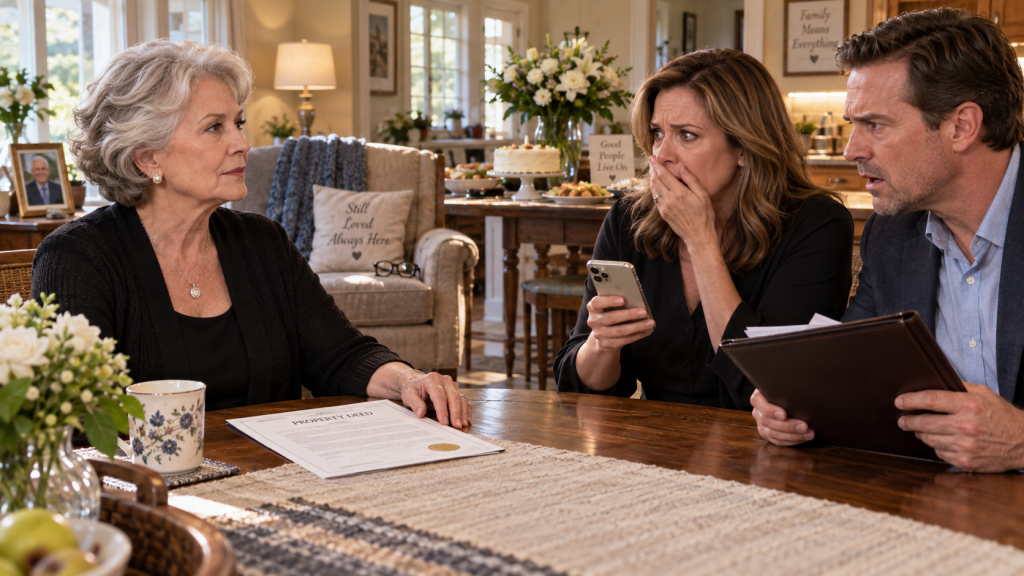
My daughter listed my house for sale using photos she took during my husband’s funeral lunch. She did the bedroom while I was cutting the cake. I let her. She does not know who has to sign before one brick of this house sells, and on Monday a lawyer is going to read her the name,

and it is not”Mom, you can’t manage this place alone,” she said, phone up, angling for the bay window. “Dad would want it handled.”
“Handled,” I said, and handed a plate of ham to the pastor.
My name is Sandra. I am 66. I was married for forty-one years to a man who read every contract twice, and I learned from him.
I endured “you should think about something smaller.”
I endured my son-in-law measuring my garage with his phone while the hearse was still in the driveway.
I endured “we’ll take the tools off your hands, Mom.”
I endured my granddaughter asking if she could have my sewing room “when you go to the apartment.”
And I endured one thing more, that my husband and I signed in a lawyer’s office three winters ago and told nobody, because he said, “Let them show you who they are first.”
They showed me at the funeral lunch.
The photos were on a listing site by Sunday night. My son-in-law sent me the link himself.
“Just to get a feel for the market, Sandra. No pressure.”
“No pressure,” I wrote back.
Forty-two photos. The bedroom. My husband’s reading chair with his glasses still on the arm. The kitchen where I had fed those people that same afternoon.
“Charming ranch, original owner, priced to move.”
Original owner.
I read the description twice and then I went to bed in the charming ranch and slept fine.
My sister called at eight.
“Sandy, Denise sent me the link. She says you’re on board.”
“Does she.”
“Are you?”
“I’m on board with something. Not that.”
“What does that mean?”
“It means Harold read every contract twice, Bev, and I was married to him for forty-one years.”
Monday at 9:15 my phone rang. A number I knew.
“Sandra? It’s Mr. Katz. I’m sorry to call so soon after. I saw something online this morning that I think you should know about.”
“The listing.”
“You’ve seen it.”
“My son-in-law sent it to me.”
“Did you authorize it?”
“I did not.”
A long breath on his end.
“Then I need to make a phone call to the listing agent, and I’d like your permission to say what I’m going to say.”
“Say all of it.”
“Some of it will be hard on your daughter.”
“She took pictures of my bedroom while I was cutting my husband’s cake, Mr. Katz.”
“Understood.”
At noon my daughter called. Her voice was high.
“Mom, why is there a lawyer calling my agent?”
“Which lawyer?”
“Some Katz. He says the house can’t be listed. He says there’s a problem with the title.”
“Did he say what kind?”
“He said I’d have to ask you.”
“Then ask me.”
“Mom, what did you do?”
“I didn’t do anything, Denise. Your father did. Three winters ago.”
“Did what?”
I looked at his reading chair. His glasses were still on the arm. Nobody had asked if they could have those.
“Come by tonight,” I said. “Bring your husband. Bring the phone you took the pictures with.”
“Why?”
“Because I want you both in the room when I read you the deed.”
They came at seven. My son-in-law brought a folder, which I thought was bold.
“Sandra, let’s not make this ugly. We’re trying to help you.”
“I know exactly what you’re trying to do.”
I took the deed out of the drawer where my husband kept it and set it on the kitchen table, face down.
“Before I turn this over, I want to say one thing. Your father did this because of a conversation he overheard at Thanksgiving. He never told me which one. Denise, you might remember it.”
Her face went white.
“Mom.”
“So here is what the county has on file. And here is the name of the person who has to sign before anybody sells one brick of this house, and it is not me, and it is not.
PART 2 — THE NAME ON THE DEED
“Here is the name of the person who has to sign before anybody sells one brick of this house.”
Denise stared at the deed lying face down on my kitchen table.
Her husband, Greg, stopped touching the folder he had brought with him.
“And it is not me,” I said.
I looked directly at my daughter.
“And it is not you.”
The kitchen went quiet.
Harold’s clock above the pantry ticked once.
Twice.
Three times.
I had hated that clock for twenty-seven years because it ran four minutes fast no matter how often Harold adjusted it.
That night, I loved it.
Every second it measured belonged to me.
Denise gave an impatient laugh.
“Mom, what are you talking about?”
I turned the deed over.
Three winters earlier, Harold and I had sat in Martin Katz’s office while snow tapped against the windows and Mr. Katz explained the documents twice.
Harold made him explain them a third time.
That was Harold.
He read warranties on coffee makers.
He kept receipts for screws.
He once returned a ladder because the warning label contained a contradiction.
When he became serious about something, he did not trust memory.
He trusted paper.
I slid the deed toward Denise.
She grabbed it.
Greg leaned over her shoulder.
At first, neither understood what they were reading.
Then Greg did.
His face changed before hers.
“Residence Preservation Trust?”
I folded my hands.
“Yes.”
Denise looked at me.
“What trust?”
“The one your father and I created three years ago.”
“You put the house in a trust?”
“We did.”
“Why?”
I looked toward Harold’s empty chair.
That question still hurt.
Not because I did not know the answer.
Because I did.
“He heard you.”
Denise stopped breathing.
“At Thanksgiving.”
Her fingers tightened around the document.
Greg looked at her.
“What did he hear?”
She did not answer.
Interesting.
So she remembered.
I had suspected she would.
“Denise.”
“Mom, I don’t know what you think—”
“Your father never told me the exact conversation.”
I kept my voice calm.
“He only said he had walked into the garage to get the folding chairs and heard enough to realize we needed to make some changes.”
Her eyes dropped.
“What changes?”
I tapped the deed.
“Those.”
Greg pulled the paper closer.
His lips moved as he read.
Then he looked up.
“Sandra retains lifetime occupancy.”
“Yes.”
“No rent.”
“Yes.”
“Exclusive right of residence.”
“Yes.”
He read further.
“Property cannot be sold, transferred, pledged, mortgaged, or encumbered except according to the trust instrument.”
“That is what it says.”
Denise stared at me.
“You gave away your own house?”
“No.”
I almost smiled.
“That is what your father expected you to think.”
Her face hardened.
“Then explain it.”
“I live here for as long as I want.”
“No one can make me move.”
“No one can borrow against the house.”
“No one can use it as collateral.”
“No one can sell it because they decide I’m too old, too sad, too lonely, too inconvenient, or too expensive.”
Greg shifted in his chair.
I noticed.
I continued.
“If I ever decide I genuinely want to sell, I can request it.”
“Then the trustee reviews the request with independent counsel to make sure nobody is pressuring me.”
Denise’s mouth fell open.
“Pressuring you?”
“Yes.”
“Who exactly did Dad think was going to pressure you?”
I looked at her.
Nobody spoke.
She answered her own question by looking away.
Greg pushed back from the table.
“This is ridiculous.”
“No.”
I said it gently.
“Taking forty-two photographs during a funeral lunch is ridiculous.”
His face reddened.
“We were trying to help.”
“You photographed my bedroom while I was cutting your father-in-law’s memorial cake.”
“That is not help.”
“It is efficient.”
The word stunned me.
Even Denise looked at him.
Greg realized too late what he had said.
I smiled sadly.
“Your father used to say people reveal themselves when they get tired of pretending.”
Denise snapped:
“Can we stop turning Dad into some prophet?”
My chest tightened.
“Be careful.”
“I loved my father.”
“I know.”
“Then stop acting like he spent his final years planning defenses against me.”
I looked down at the deed.
“He did not spend his final years doing that.”
“Three afternoons.”
“What?”
“That is how long this took.”
I met her eyes.
“Three afternoons with Mr. Katz.”
“Your father spent the rest of his time living.”
“He planted tomatoes.”
“He complained about baseball.”
“He took me to Door County.”
“He fixed the loose railing you told him to hire someone for.”
“He did not obsess over you.”
That hurt her.
I could see it.
“He simply heard one conversation and decided I should not be financially vulnerable if he died first.”
Denise whispered:
“What conversation?”
I looked at her.
“You tell me.”
She did not.
Greg rubbed his forehead.
“This still doesn’t mean she can’t list the property.”
I turned toward him.
“Who is she?”
He hesitated.
“Denise.”
“So my daughter can list property she does not own?”
“We weren’t completing a sale.”
“You signed with an agent.”
“No.”
Denise answered too fast.
“It was exploratory.”
I stared at her.
“Mr. Katz spoke to the listing agent.”
Her expression changed.
“She had paperwork.”
Silence.
“What paperwork, Denise?”
“It wasn’t final.”
“What paperwork?”
Greg interjected.
“Standard listing authorization.”
I felt something inside me go very still.
“In whose name?”
Neither answered.
I already knew.
“Sandra Bennett?”
Greg looked irritated.
“You verbally told us you were open to discussing options.”
“I did no such thing.”
“You said you understood.”
“At the funeral lunch?”
“You said ‘fine’ when Denise mentioned taking pictures.”
“No.”
I shook my head.
“I said, ‘Do what you need to do.’”
“Because my husband had been buried that morning and I had forty-three people in my kitchen.”
“That was not permission to sell my home.”
Denise’s eyes filled.
“Mom, why are you making us sound like criminals?”
“I have not used that word.”
“Yet.”
“No.”
I looked at her.
“You’re using it because something about your own behavior is making you uncomfortable.”
She stood suddenly.
“I cannot do this.”
“Sit down.”
She stared at me.
For nine years as a child, Denise had heard that voice only when she tried to cross the street without looking.
She sat.
Not because I controlled her.
Because some tones survive motherhood.
I reached for the deed.
“Do you want to know the name?”
Her expression tightened.
“What name?”
“The trustee.”
Greg looked down at the final page.
I watched him find it.
His eyes widened.
“No.”
Denise grabbed the document.
“What?”
Then she saw it.
Successor Independent Trustee upon the death of Harold Bennett: Beverly Anne Cooper.
My sister.
Denise stared.
“Aunt Bev?”
“Yes.”
She almost laughed.
“That makes no sense.”
“It made perfect sense to your father.”
“Why Bev?”
“Because she has never asked me for anything.”
That landed.
Hard.
I continued.
“She never asked for the tools.”
“Never measured the garage.”
“Never discussed my bedroom while your father’s reading glasses were still on the chair.”
“Never decided which apartment I would enjoy.”
Denise’s cheeks reddened.
“Mom—”
“And most importantly, she has enough money of her own that your father believed nobody could tempt her into treating mine like an opportunity.”
Greg leaned forward.
“Does Beverly even know?”
“Not until today.”
That surprised them.
It had surprised Bev too.
At three that afternoon, Mr. Katz had called her.
I knew because she called me ten minutes later and spent half the conversation crying.
Harold had named her as successor trustee but instructed Mr. Katz not to notify her unless he died first.
She had accepted that afternoon.
The papers were already being handled.
Denise looked stunned.
“So Aunt Bev controls the house?”
“No.”
“I do.”
“But she has to sign.”
“Yes.”
“Then she controls whether you can sell.”
“No.”
I leaned forward.
“That is the part your father understood better than you do.”
“Bev cannot make me sell.”
“I cannot make Bev approve a sale if she believes I’m being coerced.”
“We are both checks on the same door.”
“Your father didn’t give somebody power over me.”
“He made sure no one person could take mine away.”
Silence.
For the first time that evening, Denise looked less angry than hurt.
“Dad trusted Aunt Bev more than me.”
I could have softened it.
For most of my life, I would have.
Harold used to joke that I wrapped truth in enough cotton to ship glass.
That night, I was tired of packaging.
“Yes.”
Her eyes filled.
“Why?”
I looked at her.
“Thanksgiving.”
She flinched.
Again.
There it was.
The conversation.
“Denise.”
“I don’t remember.”
“Yes, you do.”
Her face crumpled.
Greg looked at her.
“What did you say?”
“Nothing.”
“Denise.”
“Nothing important.”
I waited.
Grief had taught me something unexpected.
You do not have to fill silence just because another person is uncomfortable inside it.
So I waited.
Finally she whispered:
“We were talking about the house.”
“Who?”
“Me and Greg.”
“About what?”
She wiped her face.
“After Dad.”
The kitchen seemed colder.
“After Dad what?”
She looked at me.
“Died.”
There.
The word.
I felt Harold’s absence move through the room like weather.
Greg interrupted.
“It was practical planning.”
I looked at him.
“You were planning my housing while my husband was alive.”
He spread his hands.
“We knew Harold had heart problems.”
“So did Harold.”
“That’s why he made a will.”
“That is planning.”
I tapped the listing folder.
“This is appetite.”
Greg’s face darkened.
“That’s unfair.”
“Then tell me what was said.”
He looked toward Denise.
She closed her eyes.
Then whispered:
“I said you would never stay here alone.”
I breathed.
“What else?”
“You hate driving at night.”
I almost laughed.
“What does that have to do with my house?”
“You don’t use half the rooms.”
“It has three bedrooms.”
“Mom.”
“What else?”
She became angry again because shame needed somewhere to go.
“I said after Dad was gone, the house would be too much.”
“And?”
“Greg said the market was strong.”
My stomach turned.
This had happened three years before the funeral photographs.
“How strong?”
“What?”
“The market.”
“You apparently discussed it.”
Greg answered automatically.
“Back then? Probably four-fifty to five depending on condition.”
He realized what he had admitted.
I stared.
“You valued my house while Harold was still alive.”
“It was conversation.”
“In my garage.”
“After Thanksgiving dinner.”
“While he was carrying folding chairs.”
Denise began crying.
“We weren’t waiting for him to die.”
“I didn’t say you were.”
“It sounds like you are.”
“No.”
My voice shook now.
“I think you were doing something more ordinary.”
“That may be what hurt him.”
She looked at me.
“You had already begun imagining our things without us.”
The garage.
The tools.
My sewing room.
The house.
Not out of murderous greed.
Something almost sadder.
Convenience.
They had begun mentally distributing a life before it was finished.
Denise wiped her cheeks.
“I’m sorry.”
I believed she meant it.
That did not erase anything.
“What did your father hear exactly?”
I asked.
She stared at the table.
Then finally:
“Greg said we should move quickly after the funeral.”
Greg shot her a look.
There.
Not denial.
A look.
I felt Harold beside me then.
Not literally.
In memory.
Three winters earlier, after Mr. Katz’s office, he drove us home through snow.
I asked why he was so quiet.
He said:
“Because the hardest thing to learn about your children is that they can love you and still start counting too early.”
I had been angry at him.
Told him Denise loved us.
He said:
“I know.”
That had confused me.
Now it didn’t.
Love and entitlement can sit at the same table.
People can care about you and still believe your property should solve their problems.
People can mourn you sincerely and still wonder who gets the tools.
Contradiction is uncomfortable.
It is still true.
I looked at Denise.
“Your father did not think you wanted him dead.”
Her face collapsed.
“He thought you were treating his death like an administrative event.”
She covered her mouth.
“That’s why he created the trust.”
“Yes.”
“Because of me.”
“Because he wanted me protected.”
I corrected her.
“There is a difference.”
That distinction mattered.
Harold had not built the trust as revenge against Denise.
He had built it as shelter around me.
Greg opened the folder he brought.
“I think everyone needs to calm down.”
I almost smiled.
Men say that in rooms where they are the least calm person remarkably often.
He pulled out a comparative market analysis.
Charts.
Sales.
Square footage.
Photos.
My home transformed into rectangles.
“Look.”
He turned it toward me.
“This neighborhood is peaking.”
“Your roof is twelve years old.”
“Kitchen is dated.”
“The furnace will need replacement.”
“You could sell now, take the equity, buy a smaller condo outright, and still have plenty invested.”
I listened.
He seemed almost relieved to return to numbers.
Numbers did not judge him.
“What condo?”
He hesitated.
“Just options.”
“Which options?”
Denise said:
“We looked at Hawthorn Ridge.”
Of course.
The apartment.
The one my granddaughter had mentioned.
“When?”
“Last month.”
Harold had been alive last month.
Barely.
But alive.
I stared at her.
“You toured apartments for me before your father died.”
“It was one tour.”
“Did I ask you to?”
“No.”
“Did he?”
“No.”
“Then who were you planning for?”
Denise cried again.
“For you.”
“No.”
I shook my head.
“You were planning around me.”
That was different.
I finally understood why Harold had come home from that Thanksgiving quiet.
Not furious.
Quiet.
There is a particular grief in realizing somebody you love has begun turning your future into a project without inviting you to the meeting.
Greg pushed the market analysis toward me.
“You’re taking this personally because the funeral was yesterday.”
I stared.
For several seconds, I genuinely could not speak.
Then I laughed.
Slowly.
“Greg.”
He frowned.
“My husband of forty-one years was buried yesterday.”
“Yes.”
“You listed the house where I lived with him before his side of the bed was cold.”
His face tightened.
“And you are explaining that I am taking it personally.”
Denise whispered:
“Greg, stop.”
But he did not.
People who believe themselves rational often become reckless when facts stop obeying them.
“I’m trying to keep emotion from costing you money.”
I stood.
“Get out.”
His face changed.
“Sandra.”
“You wanted clarity.”
“Here it is.”
I pointed toward the door.
“Get out of my house.”
Denise stood too.
“Mom.”
“You can stay.”
Greg stared at her.
“What?”
“I said Denise can stay.”
“He leaves.”
“You cannot—”
I almost smiled.
“Do you want to test one more question about who has authority in this house tonight?”
He grabbed his folder.
“Fine.”
But as he lifted it, several papers slid onto the floor.
One landed upside down beside my chair.
Another beneath the table.
Greg bent quickly.
Too quickly.
I saw it.
The urgency.
Not embarrassment.
Fear.
I put my foot on one page before he could reach it.
He froze.
“Sandra.”
“What is this?”
“Nothing.”
There are words that should never be used around a woman married forty-one years to a man who read every contract twice.
Nothing.
I picked it up.
Across the top:
PURCHASE PROPOSAL
My stomach tightened.
The property address was mine.
Buyer:
North Elm Holdings, LLC.
Offer price:
$412,000.
I looked at Greg.
“What is this?”
“A possible buyer.”
“You already have an offer?”
“Not an offer.”
“It says purchase proposal.”
“Informal.”
Denise looked confused.
“What buyer?”
Greg’s face changed.
That interested me even more.
She did not know.
I read further.
Cash purchase.
As-is.
Accelerated closing.
No repair contingencies.
No seller concessions.
The sort of offer someone might call convenient while quietly making sure an older widow never asked whether convenience had a price.
“What is this house worth?”
I asked.
Greg sighed.
“We just discussed that.”
“No.”
“You said the neighborhood was peaking.”
“What is it worth today?”
He hesitated.
“Maybe five hundred.”
“How much above?”
“Depending—”
“Greg.”
He looked away.
“Five-forty.”
My chest tightened.
The proposal was more than a hundred thousand below even his reluctant estimate.
“Why would I accept four-twelve?”
“It’s cash.”
“I have money.”
“Fast close.”
“I am not going anywhere.”
“As-is.”
“My roof doesn’t leak.”
He rubbed his forehead.
“You’re not understanding the benefit.”
“No.”
I stared at the page.
“I’m beginning to.”
Denise stepped beside me.
“Who is North Elm?”
Greg said nothing.
“Greg?”
“An investor group.”
“Who?”
“People I know.”
My daughter’s face changed.
“You know them?”
“Yes.”
“You never told me.”
“It didn’t matter.”
I looked at her.
Apparently there were layers to this plan even Denise had not seen.
I read the footer.
A contact name had been partially covered by another sheet.
I moved it.
Acquisition Manager: Patrick Lawson.
I knew that name.
Not well.
But enough.
I looked at Greg.
“Patrick.”
He swallowed.
Denise frowned.
“Who is Patrick?”
I answered.
“Greg’s brother.”
Her face went white.
“No.”
Greg immediately said:
“It’s his company, but that doesn’t mean anything.”
The kitchen disappeared for a second.
Not literally.
Emotionally.
All I could see was the proposal.
My house.
My price.
My son-in-law’s brother.
Denise stared at her husband.
“You were going to sell Mom’s house to Patrick?”
“No.”
“I was going to present an option.”
“At a hundred thousand below market?”
“It needs work.”
“You just told Mom the market was peaking.”
“That doesn’t mean—”
“Did Patrick know the house wasn’t actually listed with Mom’s permission?”
Silence.
That was the moment Denise stopped crying.
Her face became very still.
“Greg.”
He looked at her.
“Did he?”
“I told him Sandra was likely downsizing.”
“You told him she agreed?”
“I said the family was aligned.”
I almost admired the phrase.
The family was aligned.
Corporate language is useful when you want to make one person’s absence sound like consent.
Denise whispered:
“We were not aligned.”
He became angry.
“Don’t do this.”
“Do what?”
“Act shocked.”
“You wanted her out too.”
“I wanted Mom somewhere easier.”
“And Patrick offered a clean deal.”
“You knew about this price?”
“No.”
That sounded true.
I believed her.
Again, life refused to give me one clean villain.
Denise had invaded my privacy.
Allowed the listing.
Toured apartments.
Spoken about my house as though grief had made me incompetent.
But maybe even she had not understood Greg’s entire plan.
People can be wrong and still be betrayed themselves.
I folded the purchase proposal once.
Carefully.
“Leave it.”
Greg reached for it.
“No.”
I looked at him.
“It concerns my house.”
“It’s proprietary.”
That almost made me laugh.
“My address is printed at the top.”
He stepped closer.
Denise moved between us.
“Greg.”
He stopped.
Not because of me.
Because his wife had finally stepped to the other side of the table.
Something changed there.
Small.
But permanent.
I placed the proposal beside Harold’s deed.
One document protecting the house.
One document trying to buy it cheaply.
Harold would have appreciated the symmetry.
Bev arrived at eight-fifteen.
Denise stared when I opened the door.
“Aunt Bev?”
My sister walked in wearing the same brown cardigan she had owned since the Clinton administration and carrying a grocery-store pie.
“I didn’t know if this was a dessert meeting.”
For the first time all night, I laughed.
A real laugh.
Harold loved Bev for that.
She could enter a funeral and somehow locate normal life without disrespecting grief.
Denise looked at her.
“You’re the trustee.”
Bev stopped.
“Oh.”
Mr. Katz had clearly advised her not to announce it herself.
“Yes.”
“How could you agree?”
Bev looked genuinely confused.
“To what?”
“To control Mom’s house.”
Bev’s expression changed.
“I don’t.”
Denise looked exhausted.
“Everyone keeps saying that.”
“Then perhaps everyone should listen.”
Bev sat.
“Your mother controls whether she lives here.”
“I control paperwork if she chooses a sale.”
“And Mr. Katz or another independent attorney talks to her without any of us in the room first.”
She looked at me.
“Your dad made that part very clear.”
Denise’s eyes filled.
“Dad really thought I would force her?”
Bev became quiet.
Then said something I had not expected.
“He was afraid grief would make Sandy agree to things just because arguing felt harder.”
I stared at her.
Bev’s voice softened.
“That’s what Mr. Katz told me this afternoon.”
“Harold didn’t only worry about other people being greedy.”
“He worried you’d be too tired to fight.”
My throat closed.
That was my husband.
Not dramatic.
Not suspicious.
Practical even about sorrow.
He knew me.
He knew that when exhausted, I gave in.
Fine.
Whatever.
Do what you want.
He had seen me do it with holiday plans.
Contractors.
Family dinners.
He knew bereavement might turn that habit dangerous.
So three years earlier, he put one more person between grief and a closing table.
I covered my mouth.
For the first time since the funeral, I cried in front of Denise.
Not politely.
Not the tears I had wiped away when church people hugged me.
I bent over the kitchen table and sobbed.
Bev moved beside me.
Her hand rested on my back.
Denise stood frozen.
Then whispered:
“Mom.”
I cried harder.
“I miss him.”
That was all.
Not the house.
Not the money.
Harold.
The man whose glasses were still on the chair.
The man who had somehow protected me from a conversation he would never live long enough to see.
“I know,” Bev whispered.
For several minutes, the documents did not matter.
No trustee.
No listing.
No purchase proposal.
Just three women who had all lost the same man differently.
Then Denise knelt beside my chair.
“I’m sorry.”
I looked at her.
She was crying too.
Not because she had been caught.
At least not only.
“I shouldn’t have taken those pictures.”
“No.”
“I shouldn’t have called the agent.”
“No.”
“I thought…”
She stopped.
“What?”
“That if I handled everything quickly, you wouldn’t have to.”
I closed my eyes.
There it was.
Not so different from what she had probably told herself all along.
Handling.
Helping.
Protecting.
All verbs that become dangerous when the person being helped is never asked.
“Denise.”
She looked at me.
“When I need help, ask me what kind.”
Her face crumpled.
“Okay.”
“Do not decide that for me.”
“Okay.”
“And my bedroom is never a listing photograph again unless I’m standing beside the camera.”
A weak laugh escaped her.
“Okay.”
I looked toward Greg.
He had remained near the doorway.
The purchase proposal changed everything between them.
At least for that night.
Denise stood.
“Give Mom the folder.”
He stared.
“What?”
“The whole folder.”
“It has my notes.”
“Then remove anything unrelated.”
“Denise—”
“Give her the house documents.”
He looked furious.
“You were part of this.”
“Yes.”
She wiped her face.
“And I was wrong.”
The sentence stunned him.
People who depend on shared guilt become frightened when one person accepts their portion.
It leaves the rest visible.
Greg opened the folder.
Removed several pages.
Placed the remainder on the table.
I did not touch it yet.
“Go home,” Denise told him.
“Are you coming?”
“No.”
His face changed.
“Seriously?”
“Yes.”
“You’re choosing this?”
Denise looked at me.
Then at Harold’s chair.
Then back at her husband.
“No.”
“I’m choosing not to leave before I understand what you were planning with Patrick.”
Greg’s face hardened.
“We’ll talk at home.”
“No.”
“We’ll talk when I’m ready.”
Something about that sounded familiar.
Maybe daughters inherit more than we notice.
Greg left.
The door closed.
Nobody followed him.
At nine-thirty, Mr. Katz called.
I put him on speaker.
Denise sat across from me.
Bev beside her.
I explained the purchase proposal.
He became silent.
“Can you send me a photograph?”
I did.
We waited.
Then he said:
“Sandra, do not sign anything.”
“I wasn’t planning to.”
“Do not give the listing agent any verbal authorization either.”
“I won’t.”
“Did Denise sign any document on your behalf?”
Denise leaned toward the phone.
“I signed the listing engagement as family representative.”
Mr. Katz’s voice changed.
“Do you hold a current power of attorney for your mother?”
“No.”
“Any agency authority?”
“No.”
“Did your mother authorize you in writing?”
“No.”
“Then you had no authority to represent yourself as able to bind the owner.”
Denise closed her eyes.
“I understand.”
“Good.”
He did not humiliate her.
I appreciated that.
“Tomorrow I’ll contact the brokerage formally.”
“The listing needs to remain withdrawn.”
“And I want copies of everything the agent received.”
“Photos.”
“Emails.”
“Authorization.”
“Offer communications.”
Greg’s messages too?”
Denise asked.
“Yes.”
Her face changed.
That scared her.
Good.
Not because I wanted revenge.
Because fear sometimes means someone finally understands a situation has consequences beyond family argument.
Then Mr. Katz said:
“Who owns North Elm Holdings?”
“Greg’s brother Patrick appears to be the contact.”
Another silence.
Longer.
“Appears?”
I frowned.
“What?”
“Give me an hour.”
“Why?”
“I want to verify the company.”
I looked at the clock.
“It’s almost ten.”
“I was Harold’s lawyer for twenty-nine years.”
His voice softened.
“I can stay awake one more hour for Sandra.”
My throat tightened.
Harold had chosen good people.
That was another kind of estate planning nobody puts in a document.
Who will answer the phone after you are gone?
Who will still care because your name once mattered to them?
“Thank you.”
We hung up.
Denise spent the night.
Not because I asked.
Because when she stood to leave, she looked toward the front door and started crying again.
“I don’t want you alone tonight.”
I almost told her I had been alone since Harold died.
Then stopped.
She knew.
Instead, I said:
“Guest room.”
She nodded.
Not my bedroom.
That mattered.
At midnight, I passed the hallway and saw her sitting on the guest bed staring at her phone.
“What are you doing?”
“Deleting the listing photos from my camera roll.”
I leaned against the doorway.
“Keep copies until Mr. Katz says you can delete them.”
She looked up.
Right.
Evidence.
Harold would have smiled.
She put the phone down.
Then whispered:
“Dad hated me.”
My heart tightened.
“No.”
“He made a trust because of me.”
“He made a trust because he loved me.”
She started crying.
“Is there a difference?”
“Yes.”
I went into the room.
Sat beside her.
“Your father was angry.”
“He was disappointed.”
“That is not hatred.”
“He loved you enough to leave your future intact too.”
Denise frowned.
“What future?”
I had not planned to tell her that part yet.
But grief had exhausted my appetite for secrets.
“The trust doesn’t give you this house when I die.”
Her face went still.
“I figured.”
“The remainder goes into education and housing trusts for the grandchildren.”
“All three.”
“Including your children.”
Denise stared.
“You get nothing directly.”
“No.”
“Neither do I after my lifetime occupancy ends.”
“Your father wanted the house to help the next generation without becoming something our generation fought over.”
Her eyes filled.
“He cut me out.”
“No.”
I shook my head.
“He cut temptation out.”
She looked at me for a long time.
Then whispered:
“That sounds like Dad.”
“Yes.”
It did.
At 10:47 the next morning, Mr. Katz called.
I knew before answering that something was wrong.
Lawyers develop a particular calm when information is bad.
“Sandra.”
“Yes?”
“Is Denise there?”
She was drinking coffee across from me.
“Yes.”
“Put me on speaker.”
I did.
Bev had returned too.
Mr. Katz took a breath.
“I verified North Elm Holdings.”
Denise’s hand tightened around her mug.
“The company was formed fourteen months ago.”
“Registered manager is Patrick Lawson.”
“Greg’s brother.”
“Yes.”
I waited.
Then:
“But Patrick is not the only member.”
Denise went pale.
“Who else?”
Mr. Katz did not answer immediately.
That frightened me more.
Finally he said:
“Greg holds a forty-percent membership interest through another LLC.”
The mug slipped from Denise’s hand.
It hit the table.
Coffee spilled across Harold’s old placemats.
Nobody moved.
“My husband owns part of North Elm?”
“Yes.”
Her face emptied.
“He was trying to buy Mom’s house.”
Mr. Katz’s voice stayed careful.
“At this point, I can only tell you what the records show.”
“Greg has an ownership interest in the proposed buyer.”
“The proposal price is substantially below the market range reflected in his own comparative analysis.”
“And the proposed closing structure would have been highly favorable to the buyer.”
I felt strangely calm.
Maybe I had used all my surprise the night before.
Denise looked at me.
“Mom…”
I said nothing.
She covered her face.
“He didn’t tell me.”
“I believe you.”
She started sobbing.
That sentence made it worse.
Mr. Katz continued.
“There is one additional thing.”
Of course.
“What?”
“The listing agent forwarded me her file this morning.”
“She says Greg told her the family wanted a quick sale before estate complications delayed things.”
My stomach tightened.
“There are no estate complications with this house.”
“Correct.”
“He also told her Sandra was likely to accept a cash offer because she wanted to move before winter.”
I looked out the kitchen window.
It was April.
Winter was half a year away.
I almost laughed.
Then Mr. Katz said:
“And he asked whether North Elm could receive the first opportunity to submit an offer before broad marketing.”
Denise slowly lowered her hands.
The room had become painfully quiet.
My son-in-law had not simply taken photographs.
Not simply tried to help.
Not simply believed I should downsize.
He had apparently created a path where my grief, my age, and my family’s pressure might move me quickly enough that I never asked why the first convenient cash buyer was partly his own company.
I looked toward Harold’s chair.
His glasses were still on the arm.
Three winters earlier, he had overheard one Thanksgiving conversation.
He had not known Greg would eventually create an LLC.
He had not known photographs would be taken during his funeral lunch.
He had not known an offer would arrive before I had finished writing thank-you cards.
He had only known something simpler.
People make different decisions when they believe an older person is tired enough to agree.
So he had put a lock on the transaction.
Not the house.
The transaction.
A trustee.
Independent counsel.
Time.
Three obstacles designed to make sure nobody could turn grief into haste.
Denise whispered:
“Dad knew.”
I shook my head.
“No.”
“He suspected.”
“That is not the same thing.”
She looked toward Harold’s chair too.
“What do we do now?”
For the first time in days, nobody told me what I should do.
No smaller apartment.
No market timing.
No tools.
No photographs.
The question came to me.
What do you want?
I looked around my kitchen.
At the cake stand from Harold’s funeral lunch.
At the coffee Denise had spilled.
At Bev’s old cardigan.
At the deed.
At the proposal.
At a life that was suddenly painful but still mine.
“I want the listing gone.”
Mr. Katz answered:
“It is.”
“I want every photograph removed from every site.”
“We’ll make sure.”
“I want Greg to have no access to my financial papers, keys, passwords, or property.”
“I can help you document that.”
“I want the garage left exactly as Harold left it until I decide otherwise.”
Denise nodded through tears.
“Okay.”
“And I want everybody to stop telling my granddaughter my sewing room is available.”
A tiny laugh escaped Bev.
Even Denise smiled weakly.
“Okay.”
Then I said the part that mattered most.
“I am not selling.”
Silence.
Not forever.
Maybe someday.
Maybe when the stairs hurt.
Maybe when the yard becomes too much.
Maybe when this house feels more like weight than shelter.
But that decision would arrive from inside me.
Not from a listing.
Not from Greg.
Not from Denise.
Not even from Harold’s trust.
“I’m staying.”
Bev reached across the table.
Held my hand.
Mr. Katz was quiet on the phone.
Then he said:
“Harold would be pleased.”
I looked at his empty chair.
“No.”
My voice broke.
“He’d say the taxes are too high and ask whether I turned the thermostat down.”
Everyone laughed.
And then I cried.
Because sometimes grief and laughter are not opposites.
Sometimes they are the only two things strong enough to sit beside each other.
That afternoon, Denise went home to confront Greg.
I did not go with her.
That was her marriage.
Her truth.
Her decision.
I had spent enough years allowing other people to plan my life.
I would not repay that by planning hers.
But before she left, she stood at the door.
“Mom?”
“Yes?”
“I don’t know what happens now.”
I understood.
“Neither do I.”
“What if I was more like him than I realized?”
I looked at my daughter.
The woman who photographed my room.
Toured apartments for me.
Allowed a listing without permission.
The woman who had also told her husband to leave my house and handed over her phone records when the truth changed.
“You made choices I’m angry about.”
She cried.
“I know.”
“That does not mean every choice you make forever has to resemble them.”
She looked at me.
“Dad would say that?”
“No.”
I smiled.
“Your dad would make you read the documents first.”
She laughed through tears.
Then hugged me.
I let her.
Not because everything was repaired.
Because repair has to begin somewhere.
That evening, after everyone left, I carried the funeral cake stand into the kitchen.
There was one piece left.
Chocolate.
Harold’s favorite.
At his funeral lunch, I had cut that cake while my daughter photographed our bedroom.
For two days, the memory had poisoned the whole thing.
I almost threw the slice away.
Instead, I made coffee.
Sat in Harold’s chair.
Took his glasses from the arm.
Held them.
And ate the cake.
Slowly.
Not as a widow defending property.
Not as a mother teaching her daughter a lesson.
Just Sandra.
Sixty-six.
Married forty-one years.
Homeowner.
Trust beneficiary.
Sister.
Mother.
Woman whose husband had loved her well enough to understand one difficult truth:
Protection is not making every decision for someone.
It is making sure they still have room to make their own.
I looked around the house.
“Charming ranch.”
I said it aloud and almost laughed.
“Priced to move.”
“No pressure.”
The listing language sounded ridiculous now.
The house was not charming because an agent wrote it.
It was Harold’s coffee ring on the windowsill.
The pencil marks inside the pantry where we measured Denise growing up.
The patched spot in the drywall from the Christmas tree disaster of 1998.
My sewing room.
His garage.
Forty-one years arranged in rooms.
Maybe someday another family would live here.
They could repaint everything.
Pull out the cabinets.
Replace the windows.
Plant different flowers.
That did not frighten me.
What frightened me had been the idea that someone else could decide when my life in those rooms was finished.
They couldn’t.
Harold had made sure.
Not because I was weak.
Because he understood that grief makes even strong people tired.
And love, at its best, does not take advantage of tiredness.
It stands guard until strength comes back.
My phone rang.
Mr. Katz.
I smiled.
“What now?”
His voice was serious.
“Sandra, I’m sorry.”
My hand stopped halfway to the coffee cup.
“What happened?”
“I received another document from the listing agent.”
My stomach tightened.
“What document?”
“A seller disclosure form.”
I frowned.
“I never filled one out.”
“I know.”
Silence.
Then he said:
“It has a signature on it.”
My heart began beating harder.
“What signature?”
“Yours.”
I stared at Harold’s glasses in my hand.
“I didn’t sign anything.”
“I know.”
Mr. Katz’s voice became very quiet.
“That is why I need you to come to my office tomorrow morning.”
I stood.
“Who sent it?”
“The agent says Greg did.”
My fingers tightened.
“And Sandra?”
“Yes?”
“There’s more.”
Of course there was.
“The signature was electronically dated two days before Harold’s funeral.”
I stopped breathing.
Two days before the funeral.
The morning Harold was still lying at the funeral home.
Before the lunch.
Before the photographs.
Before anyone claimed this was only a spontaneous attempt to “help.”
I looked toward the quiet garage.
Toward the tools Greg had already offered to take.
Then at the deed Harold and I signed three winters ago.
A dead man’s caution on one side.
A living man’s signature pretending to be mine on the other.
Mr. Katz continued:
“I think the question is no longer whether Greg tried to sell the house too quickly.”
My throat tightened.
“What is the question?”
He paused.
Then said:
“How long had he been planning to sell it before Harold died?”
And suddenly the forty-two photographs from the funeral lunch no longer looked like the beginning of anything.
They looked like the final step of a plan that may have started much earlier.
PART 3 — THE HOUSE HAROLD MADE SURE I COULD KEEP
“How long had he been planning to sell it before Harold died?”
Mr. Katz’s question stayed in the room after the call ended.
I stood beside Harold’s reading chair with his glasses in my hand and looked toward the dark kitchen.
Two days before the funeral.
My name.
A signature I had not written.
A seller disclosure for a house I had never agreed to sell.
Until that moment, I had still been trying to preserve a version of Greg I could understand.
Pushy.
Entitled.
Too eager.
The sort of son-in-law who sees an aging widow and thinks efficiency is kindness.
But forgery belonged to a different category.
You do not accidentally sign another person’s name.
You do not confuse grief with permission and somehow end up imitating a signature.
That requires a moment.
A choice.
A hand moving across a page while knowing the person whose name you are using has not agreed.
I placed Harold’s glasses back on the arm of his chair.
Then I did exactly what he would have done.
I found a yellow legal pad.
At the top I wrote:
WHAT WE KNOW.
Not what I feared.
Not what I suspected.
What we knew.
Harold had taught me that.
Feelings belong in the room.
Facts belong on paper.
I started.
Greg and Denise had discussed selling the house before Harold died.
Greg had a forty-percent interest in North Elm Holdings.
North Elm submitted a proposal more than one hundred thousand dollars below likely market value.
Greg had given the listing agent the impression I wanted a quick sale.
Denise had signed listing paperwork without authority.
And now a seller disclosure bearing my signature had been submitted two days before Harold’s funeral.
I stared at the list.
Then I added one final line.
I did not authorize any of it.
I underlined that twice.
Then I went to bed.
I did not sleep.
But I lay there anyway.
Sometimes the body deserves rest even when the mind refuses.
At 8:30 the next morning, Bev picked me up.
She did not let me drive.
I protested once.
She ignored me.
That is one of the privileges of sisters.
They remember you before pride becomes polished.
Mr. Katz was waiting when we arrived.
He had coffee.
Three folders.
And the face of a man who had been awake almost as long as I had.
“Sit.”
I sat.
Bev beside me.
Mr. Katz placed the seller disclosure on the desk.
There it was.
My name.
Sandra Bennett.
The signature looked close.
Too close.
Not perfect.
Harold would have spotted the difference immediately.
My S tilted more sharply.
The second n in Bennett usually ran into the e.
This one had been copied from somewhere.
I knew that instantly.
I also knew from where.
I pointed.
“That’s from the insurance form.”
Mr. Katz looked up.
“What?”
“Harold and I renewed the homeowner’s policy in January.”
“I signed electronically.”
“This looks like that signature.”
He opened another folder.
“How sure are you?”
“Very.”
He pulled up a copy of the insurance form.
Placed both pages side by side.
Bev leaned in.
Then whispered:
“Oh.”
Identical.
Not similar.
Identical.
Same slight wobble before the final t.
Same spacing.
Same digital smoothing.
Mr. Katz sat back.
“That matters.”
My stomach tightened.
“So somebody copied the electronic signature.”
“That is what it appears.”
“Can you prove who?”
“Not yet.”
That word mattered.
Yet.
Not speculation.
Process.
He continued.
“The listing agent preserved the email chain.”
“Good.”
“She also preserved attachments.”
“Good.”
“And metadata.”
I did not know exactly what metadata meant in practice.
Harold would have.
I nodded as though I did.
Mr. Katz almost smiled.
“Technical information attached to the files.”
“I know enough to be dangerous.”
“That was Harold’s favorite level of knowledge.”
My throat tightened.
For one second, neither of us spoke.
Then Mr. Katz opened the second folder.
“The seller disclosure was sent from an email account using your name.”
I stared.
“What email account?”
He slid the page toward me.
I had never seen it.
“That isn’t mine.”
“I know.”
“Who created it?”
“We’re working on that.”
Bev’s face hardened.
“This was planned.”
Mr. Katz nodded slowly.
“Yes.”
There was no longer much point softening it.
The email account had been created six weeks before Harold died.
Six weeks.
While he was still alive.
Still home.
Still sitting in his chair.
Still complaining that I overwatered the rosemary.
Six weeks before anyone could pretend grief made them impatient.
I felt suddenly cold.
“What else?”
Mr. Katz hesitated.
I hated that hesitation.
Then he handed me printouts.
Emails.
Greg to listing agent.
Not every message was under his own name.
Some came from the fake Sandra account.
But several were clearly his.
Sandra is emotionally overwhelmed but wants to avoid a drawn-out process.
Family consensus is that downsizing is best.
We expect a narrow window after services before relatives begin influencing her.
I stopped.
Read that line again.
Before relatives begin influencing her.
Bev swore.
I had almost never heard Bev swear in sixty-eight years.
It was impressive.
I read further.
If we can prepare the listing materials in advance, we should be able to move quickly.
Advance.
There it was.
Not funeral lunch improvisation.
Advance.
My hands began trembling.
Mr. Katz quietly moved the coffee away from me.
Smart man.
I continued.
One email was dated eleven days before Harold died.
Greg wrote:
Property condition is good. I can get interior photos once family is gathered and Sandra is occupied.
I put the page down.
Nobody spoke.
Occupied.
That was me cutting cake.
Me thanking neighbors.
Me standing beside a casserole dish while my daughter photographed the bed where my husband had slept.
The cruelty of that word hurt more than anger could.
Occupied.
As though I were an obstacle in a floor plan.
Bev reached for my hand.
I let her.
Mr. Katz said carefully:
“Sandra, I want you to understand something.”
I looked at him.
“None of this transferred your property.”
“I know.”
“The trust prevented the sale.”
“I know.”
“The listing is withdrawn.”
“I know.”
“North Elm cannot acquire the house without proper authorization.”
“I know.”
He nodded.
“I am saying this because fear can make people feel as though harm has already completed itself.”
That was wise.
Harold would have liked it.
I breathed.
“They didn’t get the house.”
“No.”
“They never came close legally.”
“No.”
“But they thought they could.”
Mr. Katz did not answer.
He did not need to.
Denise arrived at eleven.
Alone.
She looked like she had not slept.
No makeup.
Hair tied badly.
A woman who had spent one night comparing her marriage to paperwork and found the paperwork more consistent.
She sat across from me.
Mr. Katz asked whether she wanted her own attorney present.
That surprised her.
Then frightened her.
“Why?”
“Because some of the documents may involve actions taken by your husband while you participated in the listing process.”
Her face drained.
“Am I in trouble?”
Mr. Katz answered carefully.
“You should understand your rights before answering questions you are uncomfortable answering.”
Denise looked at me.
“Mom?”
I hated that word sounding so young.
She was forty.
For one second, she was ten.
Then I remembered my signature.
And let her remain forty.
“Listen to Mr. Katz.”
She swallowed.
“I don’t want a lawyer.”
“That is your choice,” he said.
Then he placed the email chain in front of her.
She read.
Slowly.
I watched the moment she reached the line about photographing the house while I was occupied.
Her mouth opened.
Nothing came out.
Then she saw the fake email address.
My copied signature.
The date.
Six weeks before Harold died.
Her hands began shaking.
“No.”
Nobody spoke.
“Greg said he contacted the agent Sunday night.”
Mr. Katz said nothing.
“No.”
She looked at me.
“He told me the listing started after the funeral.”
I kept my voice quiet.
“Apparently not.”
She turned another page.
Then another.
Her face collapsed.
“He knew.”
“What?”
I asked.
She looked at the purchase proposal.
“North Elm.”
“He knew they were going to offer before Dad died.”
Mr. Katz nodded.
“There are emails between Greg and Patrick discussing timing.”
Denise covered her mouth.
“Did he mention me?”
Mr. Katz hesitated.
Then handed her another page.
Her name appeared twice.
Denise can get Sandra comfortable with downsizing.
And later:
D is easier to move if she thinks this is about helping her mother.
Denise stared.
For a long time.
Then she whispered:
“He used me.”
The sentence did not erase what she had done.
But it was true.
“Yes,” I said.
Her eyes filled.
“I still did it.”
Also true.
“Yes.”
She cried.
“I let him turn me into the person Dad was afraid of.”
I leaned back.
“No.”
She looked at me.
“Your father was not afraid of one person.”
“He was afraid of a situation.”
“Grief.”
“Haste.”
“Money.”
“Family pressure.”
“He built around all of it.”
Denise shook her head.
“I took the pictures.”
“Yes.”
“I called the agent.”
“Yes.”
“I toured Hawthorn Ridge.”
“Yes.”
“And I believed Greg because what he wanted matched what I had already convinced myself was best for you.”
There it was.
The hardest kind of accountability.
Not:
He made me.
Not:
I had no idea.
She had been manipulated.
And she had also made choices.
Both truths standing side by side.
“I’m sorry.”
I looked at her.
Not rushed.
Not softened.
Then I said:
“I believe you.”
She cried harder.
“Does that mean you forgive me?”
“No.”
The answer hurt her.
It hurt me too.
“I might.”
“Someday.”
“But forgiveness is not the first thing we need.”
“What is?”
“Truth.”
She wiped her face.
Then nodded.
“All right.”
Mr. Katz asked:
“Denise, did Greg ever ask you to get copies of your mother’s financial documents?”
She stared at the table.
“Yes.”
My stomach tightened.
“When?”
“January.”
Harold had been alive.
“What documents?”
“Property tax statement.”
“Homeowner insurance.”
“Maybe the deed.”
My chest tightened.
“Did you give them to him?”
“Tax statement.”
“Insurance declaration page.”
“Not the deed.”
That explained the copied signature.
I looked away.
Denise cried.
“I thought he was helping Dad organize things.”
Harold.
Organized.
The idea would almost have been funny.
Harold’s papers were more organized than some small governments.
“Did Greg ever use my computer?”
“Yes.”
“When?”
“At Christmas.”
“Why?”
“He said he needed to print something.”
I closed my eyes.
The fake email account.
Maybe.
Not proof yet.
But possibility.
Mr. Katz wrote it down.
Then:
“Did he know about the trust?”
Denise shook her head.
“No.”
“I didn’t.”
That explained why the plan had gotten as far as it did.
Harold’s secret had worked because nobody could plan around something they did not know existed.
For the first time, I understood why he insisted we tell no one.
Not because he distrusted everyone.
Because safeguards work best when they cannot be coached around.
Greg called me that afternoon.
I almost did not answer.
Then Mr. Katz advised me not to speak substantively without counsel.
So I let it go to voicemail.
Three minutes later:
“Sandra, I think this is getting out of hand.”
Of course.
Not:
I’m sorry.
Out of hand.
“I understand you’ve brought lawyers into this and Denise is extremely upset.”
Brought lawyers into this.
As though Mr. Katz wandered into my kitchen because we were bored.
“I want to be clear that nobody was trying to steal anything.”
The word steal came from him.
Interesting.
“We were looking at options.”
“North Elm is a legitimate company.”
“The purchase price reflected condition and speed.”
“You were always free to reject it.”
I laughed.
Alone in my kitchen.
Free to reject the offer I was never supposed to understand was coming from him.
Then his voice softened.
“I know you’re grieving.”
There it was.
The qualification.
The thing every person had tried to use as a reason I should surrender my own judgment.
“I think Harold would hate to see the family torn apart over paperwork.”
I stopped the voicemail.
That was enough.
No.
Harold would hate forgery being called paperwork.
I saved the message.
Then sent it to Mr. Katz.
By evening, Denise had returned home and told Greg she wanted him out.
Not divorce.
Not yet.
Just out.
He refused at first.
The house was jointly owned.
That was their business.
Eventually he stayed at a hotel.
Then with Patrick.
I knew only what Denise chose to tell me.
I did not advise her.
That became important.
Every time she asked:
“What should I do?”
I answered:
“What do you want?”
At first, she hated it.
Apparently being allowed to decide feels less comforting when you have spent years letting louder people frame the choices.
She began therapy.
Then hired her own lawyer.
Then started going through their finances.
What she found changed her marriage more completely than my house ever could.
Greg and Patrick had bought three properties through North Elm.
Two from older owners.
One from siblings settling an estate.
All legal, as far as anyone could tell.
But the business model was clear.
Find urgency.
Offer speed.
Buy below market.
Renovate.
Resell.
Nothing inherently illegal about that.
Until consent gets manufactured.
Until signatures appear where they should not.
Until family relationships become sales strategy.
Denise found texts between Greg and Patrick about my house.
One from five months before Harold died.
When the old man goes, Sandy won’t stay six months. D will push the condo.
I read that sentence only once.
Never again.
I did not need to.
It lodged somewhere permanent.
Not because he called Harold an old man.
Because he had turned my husband’s death into timing.
Not grief.
Timing.
Denise found another.
Trust me, widows want simple.
That sentence became evidence too.
Maybe not of a crime by itself.
Of a mind.
A person looking at bereavement and seeing leverage.
That was enough for me to know Greg would never have a key to my house again.
The legal side moved carefully.
Mr. Katz referred the forged documents to the appropriate authorities and advised the brokerage to preserve everything.
The listing agent cooperated.
She was furious.
Not at me.
At Greg.
She had believed him.
Believed Denise had authority.
Believed the family was helping a widow prepare.
She had made mistakes too.
She admitted them.
The brokerage tightened its verification procedures.
The listing disappeared completely.
My bedroom vanished from the internet.
At least from public view.
The fake email account was traced through records.
Created from an IP address associated with Greg and Denise’s home.
That did not prove which person at the house created it.
Then the login history mattered.
Several logins matched times Denise was at work.
Greg was home.
More.
A recovery phone number was linked to a prepaid phone later found among Greg’s business records.
Then came the seller disclosure file.
Created on Greg’s laptop.
Modified on Greg’s user profile.
My copied signature image stored in a folder titled:
SB docs.
There are moments when evidence stops being ambiguous.
This was one.
Greg eventually stopped calling it a misunderstanding.
He hired counsel.
Good.
Everyone deserved process.
Even people who had done terrible things.
The investigation focused on the false signature and related representations.
I was asked repeatedly whether I had authorized Greg to sign.
“No.”
Whether I had told Denise she could sell.
“No.”
Whether I had agreed to North Elm’s offer.
“No.”
Whether I understood the trust structure.
“Yes.”
Mr. Katz smiled the first time I answered that.
Harold had made sure I did.
Three winters ago.
Read twice.
Explained three times.
Love written in boring legal language.
People expected me to enjoy Greg’s downfall.
I didn’t.
That surprised me.
There was no satisfaction in watching my daughter cry over the collapse of her marriage.
No thrill in grandchildren asking why Dad was not home.
No pleasure in hearing family members whisper words like fraud and investigation.
Consequences can be necessary without becoming entertainment.
That was another thing Harold taught me.
He never liked humiliation.
Even when somebody deserved correction.
“Fix the problem,” he used to say.
“Don’t build a stage around it.”
So I did not.
I told relatives very little.
I refused to post anything online.
I did not explain myself to neighbors beyond:
“There was an unauthorized listing. It has been resolved.”
My sister wanted more.
Bev is not perfect.
“Tell them he tried to buy it himself.”
“No.”
“Why not?”
“Because I’m not running for mayor.”
She grumbled.
Then brought me soup.
Sisters.
Denise filed for divorce four months later.
Not because I told her to.
She never again asked me what she should do.
She started asking herself.
That was better.
When she finally told me, we were sitting in my sewing room.
The room my granddaughter once believed she might inherit when I went to Hawthorn Ridge.
I had begun a quilt.
Ugly colors.
Harold would have hated it.
That was partly why I chose them.
“I filed,” Denise said.
I threaded a needle.
“I figured.”
“How?”
“You have looked both relieved and terrified for a month.”
She laughed weakly.
Then cried.
“I keep thinking maybe I’m overreacting.”
“Did he say that?”
“Yes.”
I looked at her.
“Then stop borrowing his vocabulary.”
She stared.
That landed.
“I loved him.”
“I know.”
“I still do.”
“I know.”
“Does that make me stupid?”
“No.”
I put the needle down.
“Love is not evidence of good judgment.”
She laughed through tears.
“Dad said something like that once.”
“Yes.”
“He was talking about a used boat.”
That made both of us laugh.
Then she grew serious.
“I don’t know who I am without the marriage.”
I looked around the sewing room.
“At forty, I didn’t know who I was without being Harold’s wife either.”
“You’re sixty-six.”
“I’m aware.”
“I mean—”
“I know what you mean.”
I touched her hand.
“Turns out people do not expire when a relationship does.”
Her face crumpled.
Then:
“Do you hate me for what I did?”
I thought carefully.
“No.”
“Were you close?”
“Yes.”
That made her laugh.
Good.
“I was furious.”
“I still am sometimes.”
“But anger is not the same thing as wanting your life ruined.”
“I need boundaries.”
“That is not the same thing as exile.”
She looked at me.
“What boundaries?”
“Do not make decisions for me.”
“Do not touch my finances.”
“Do not promise my belongings.”
“Do not photograph rooms for sale.”
She almost smiled.
“And if you think I need help?”
“Ask.”
“That’s it?”
“That’s plenty.”
She nodded.
“Okay.”
Repair began there.
Not with forgiveness.
Rules.
Strange, after everything.
But healthy rules are different.
They do not reduce a person’s autonomy.
They protect it.
Six months after Harold’s funeral, I moved his glasses.
That may not sound important.
It was.
They had remained on the arm of his reading chair every day.
Dust gathering along the bridge.
I cleaned around them.
Never under them.
Some part of me believed moving the glasses would admit he was not coming back to need them.
Then one morning, I picked them up.
Wiped the lenses.
Placed them in his desk drawer beside his fountain pen.
I cried.
Then I vacuumed beneath the chair.
Grief is ridiculous like that.
A forty-one-year marriage can survive inside the position of a pair of glasses.
That afternoon, I went into the garage.
Greg had once said they would take the tools off my hands.
No one had touched them.
Harold’s wrenches remained arranged by size.
Labels beneath each hook.
Of course.
I found a small wooden box on the workbench.
Inside:
Screws.
Washers.
Two old keys.
A photograph of Denise at seven missing both front teeth.
And one envelope.
My name.
Harold’s handwriting.
SANDY — IF I GO FIRST
I sat on the concrete floor.
For five minutes, I could not open it.
Then I remembered.
Read everything twice.
So I opened it once.
Inside was one page.
Typical Harold.
No poetry.
No grand speech.
Sandy,
If you are reading this, then I was right about at least one thing, which I intend to enjoy wherever I am.
I laughed and cried at once.
Do not let the children turn you into an elderly person before you become one.
I snorted.
You know what you can manage. When that changes, change something. Not before.
My hands shook.
The house is yours to live in. Not because walls matter, but because choice matters. If you sell it someday, sell because you are ready. If you stay, stay because you want to. Do not confuse stubbornness with independence either.
That was Harold.
Protecting me from both directions.
I made the trust because I know you. When you are tired, you say yes just to end the conversation. Grief will make you tired. So I gave you time. That is all the trust is. Time with paperwork around it.
I stopped reading.
Cried.
Then continued.
Do not hate Denise if she gets it wrong. She has always loved quickly and thought later. Make her think.
I laughed.
That was painfully accurate.
If Greg is involved in whatever nonsense made me write this, do not fight him yourself. That is what Katz is for. Martin likes a fight more than he admits.
I laughed louder.
Alone in the garage.
Then the final paragraph.
Most important: you are not the keeper of everybody’s comfort after I die. Not Denise’s. Not Bev’s. Not mine. If you want to change the curtains, change them. I hated those curtains.
I looked toward the kitchen.
Our curtains.
Green.
He did hate them.
For eighteen years.
Never won.
I loved being your husband. Do not turn the rest of your life into my memorial.
I stopped breathing.
That sentence.
That one hurt.
Because I had been doing exactly that.
Keeping the glasses.
The garage.
The cake stand.
The house frozen on the afternoon before everything changed.
Harold had protected my right to stay.
He had not asked me to stop living inside the place.
I read the letter twice.
Of course.
Then put it back.
The next week, I changed the curtains.
Yellow.
Bev said they were too bright.
I said:
“Harold’s dead.”
She stared.
Then laughed so hard she nearly fell off the chair.
That was the first time saying he was dead did not feel like swallowing glass.
Not because I loved him less.
Because reality had finally stopped needing euphemism.
I also gave away half his tools.
Not to Greg.
To a trade program at the community college.
Harold had taught Denise how to use a drill before she learned long division.
He would have liked young people using his tools.
I kept his socket set.
Nobody touches the socket set.
I am grieving, not insane.
Greg’s case resolved more than a year after the funeral.
I will not make it sound cleaner than it was.
There were negotiations.
Evidence disputes.
Questions about intent.
Different conduct treated differently.
In the end, there were legal consequences for the false documents and misrepresentations connected to the attempted transaction.
North Elm dissolved not long afterward.
Patrick walked away from the business partnership.
The brokerage wanted nothing to do with either of them.
Greg lost money.
Reputation.
His marriage.
But I stopped measuring justice by losses.
The house remained mine.
That was the practical victory.
The more important one was that Greg no longer got to describe pressure as help and expect everyone to accept his wording.
Facts had corrected the language.
Two years after Harold died, Denise asked whether I wanted to see Hawthorn Ridge.
I stared at her.
She went pale.
“No.”
She laughed.
“Not like that.”
“What other way is there?”
“Mrs. Donnelly from church moved there.”
“She invited us to lunch.”
I narrowed my eyes.
“Are you trying to sell me a condo?”
“No.”
“Are there listing photos involved?”
“Mom.”
I smiled.
Then went.
Hawthorn Ridge was actually nice.
That annoyed me.
Good gardens.
Library.
A gym nobody used.
Mrs. Donnelly loved it.
Afterward, Denise drove me home.
I said:
“I could live somewhere like that someday.”
She kept her eyes on the road.
“Okay.”
That was all.
No brochure.
No price comparison.
No:
I told you so.
I looked at her.
She had learned.
That mattered more than the apology.
My granddaughter never got my sewing room.
Instead, when she turned sixteen, I taught her to quilt there.
One afternoon she asked:
“Grandma, were Mom and Dad really going to sell this house without asking?”
Children get older.
Truth becomes age-appropriate eventually.
I said:
“Your mother made some decisions she regrets.”
“And Dad?”
“Your father made choices that had serious consequences.”
She looked down.
“Do you hate him?”
“No.”
She frowned.
“Why?”
“Because hating somebody is work.”
She laughed.
“That sounds lazy.”
“At sixty-eight, efficiency matters.”
Then she became serious.
“Mom says Grandpa saved the house.”
I looked toward Harold’s photograph on the shelf.
“No.”
“What?”
“Grandpa saved my choice.”
“That’s different.”
“How?”
I put the fabric down.
“If he had written a document saying I could never sell, that would have been another person deciding for me.”
“But he didn’t.”
“No.”
“He made it harder for someone else to rush me.”
She thought about that.
“That’s actually kind of romantic.”
I smiled.
“Your grandfather would be horrified to hear a trust called romantic.”
She laughed.
But she was right.
It was.
Not because of the legal mechanism.
Because he knew me well enough to protect the exact weakness I rarely admitted.
I gave in when tired.
He loved me without turning that knowledge into advantage.
That is a rare kind of safety.
Five years after the funeral, the furnace died.
Greg had predicted that.
I hated giving him even one point.
The repairman said replacement.
Big number.
I called Bev.
Not Denise.
Habit.
Bev asked:
“Do you want advice or sympathy?”
I started laughing.
“What?”
“Denise taught me.”
That pleased me.
“Advice.”
We replaced the furnace.
Then the roof two years later.
Then my knees started complaining about the garden.
The house remained manageable.
Until one day, at seventy-four, I stood in the garage looking at a ladder and thought:
I do not want this anymore.
Not the house.
The maintenance.
That distinction mattered.
I called Denise.
“Come over.”
Her voice changed.
“Are you okay?”
“Yes.”
“Then why do you sound strange?”
“I want to talk about selling.”
Silence.
Absolute silence.
Then:
“Do you want me to come alone?”
I laughed.
“Yes.”
That may have been the most important question she ever asked me.
Not:
What price?
Not:
When?
Not:
Which apartment?
Do you want me to come alone?
She arrived forty minutes later.
No folder.
No phone camera.
No agent.
Just Denise.
We sat in the kitchen.
Different curtains now.
Third set since Harold.
“What do you want?”
she asked.
I looked around.
“I think I’m ready.”
Tears filled her eyes.
She looked away.
“Why are you crying?”
“Because I know how much it cost you to get to say that sentence yourself.”
My throat tightened.
I reached for her hand.
This time, selling did not feel like defeat.
The house had done its job.
Sheltered marriage.
Raised a child.
Held a funeral.
Survived greed.
Survived repair.
Held grandchildren.
Held grief until grief became memory.
No building owes you eternity.
Only shelter while you need it.
“Call Mr. Katz.”
I said.
Denise smiled.
“You call him.”
Of course.
She had really learned.
Mr. Katz was semi-retired.
Bev was still trustee.
Older.
Grumpier.
She reviewed the sale request.
Then hired independent counsel exactly as Harold required.
The lawyer met with me alone.
“Is anyone pressuring you?”
“No.”
“Do you understand the financial consequences?”
“Yes.”
“Do you want to sell?”
“Yes.”
“Why?”
I smiled.
“Because I’m tired of gutters.”
He laughed.
That was enough.
Bev approved.
I signed.
My name.
Actually mine.
Written by my hand.
The house sold to a young couple with two little boys.
Not North Elm.
Not cash below market.
A normal family.
Normal mortgage.
Normal inspection.
The mother cried at the bay window.
The father loved the garage.
I told him the workbench could stay.
He looked like I had given him a car.
At closing, the final page came to me.
Then Bev.
Two signatures.
Just as Harold planned.
I stared at hers.
Then mine.
For a second, I could almost hear him.
Read it twice.
So I did.
Then signed.
One brick finally sold.
Because I chose it.
I moved into a smaller townhouse fifteen minutes away.
Not Hawthorn Ridge.
I am stubborn enough to preserve some dignity.
Denise helped pack.
She asked before opening every closet.
The first time, I laughed.
“You can open the linen closet.”
“I’m learning.”
“Yes.”
“You’re overcorrecting.”
“I’m learning.”
Fair.
My granddaughter inherited the sewing machine.
Not the room.
Bev took Harold’s fishing box.
Nobody wanted his tax files.
We burned old duplicates safely while drinking coffee.
The night before I left the house, I slept in our bedroom one final time.
Empty walls.
No listing photos.
No furniture except the bed.
I placed Harold’s glasses beside me.
Not because I thought he was there.
Because I wanted them there.
That distinction mattered too.
In the morning, I walked through every room.
Kitchen.
Hall.
Sewing room.
Garage.
Living room.
I stopped at the bay window where Denise had first held up her phone during the funeral lunch.
For years, I thought that image would remain the defining memory of the house.
It didn’t.
Life kept happening.
That is one of its great mercies.
Bad moments are loud.
Time does not have to let them remain central.
I touched the windowsill.
Then whispered:
“All right, Harold.”
No answer.
Obviously.
But saying it made me smile.
I locked the door.
Handed the key to the buyers at closing.
And left without looking back.
Not because the house meant nothing.
Because it had finally become possible to love something without needing to keep it.
I am seventy-seven now.
Denise visits every Sunday.
Not every Sunday because I require it.
Because she wants to.
She divorced Greg.
Stayed single for three years.
Then met a widower named Paul who asks before fixing things at my townhouse.
I like him.
That may be the highest approval I give.
My granddaughter has children now.
The trust money from the old house helped with education exactly as Harold planned.
Not lavishly.
Enough.
A semester.
A down payment contribution.
A little help without turning inheritance into dependency.
Harold would have approved.
Bev died two years ago.
At her funeral, nobody took photographs of her bedroom.
I checked.
Some lessons become family folklore.
Mr. Katz sent me a card when he retired.
Inside:
Harold was right. You were always the easier client.
Liar.
I framed it anyway.
Sometimes people hear the story and say:
“Your husband saved your house from beyond the grave.”
I correct them.
No.
Harold did not save the house.
That would make the house the important part.
He saved time.
He saved choice.
He understood that after forty-one years together, the most loving thing he could leave me was not control.
It was a pause.
A legal pause between somebody else’s plan and my signature.
Long enough for me to think.
Long enough for grief to stop answering questions that belonged to the rest of my life.
That was the real inheritance.
The house eventually sold.
As houses do.
The walls went to somebody else.
The garage filled with different tools.
Someone probably painted over the pantry marks.
Maybe the yellow curtains too.
Good.
Life continued.
What remained was the thing nobody could list online.
I had learned the difference between being helped and being managed.
Between family concern and family convenience.
Between forgiving someone and giving them authority again.
Between a daughter making a terrible choice and being a terrible daughter forever.
Denise and I repaired because she stopped demanding that apology erase consequences.
I repaired because I stopped using anger as proof I needed permanent distance.
We met in the middle slowly.
Years.
Not speeches.
Trust comes back the same way paint dries.
Thin layers.
Time.
No touching too soon.
I still have Harold’s letter.
The one from the garage.
It is folded inside my desk.
The final line remains my favorite.
Do not turn the rest of your life into my memorial.
For a man who saved every receipt, he understood something remarkably well about letting go.
I think about him every day.
That is not the same thing as living for a dead man.
I drink coffee he would hate.
I changed banks.
I took a cruise with Bev before she died even though Harold said cruises were “floating stomach viruses.”
I kissed a man once at seventy-two.
Harold would have raised one eyebrow.
I laughed afterward for ten minutes.
Then never saw the man again.
Perfect arrangement.
I lived.
That was the instruction beneath everything.
Live.
Not protect the furniture.
Not punish Denise forever.
Not turn Greg into the center of every future family gathering.
Live.
There is one photograph I keep on my mantel.
Not our wedding.
Not the house.
Not even Harold alone.
It was taken at a picnic about six months before he died.
He is sitting in a folding chair.
I am beside him.
Denise is behind us making a face because the sun is in her eyes.
My granddaughter is laughing.
Greg took the picture.
That surprises people.
They ask why I keep a photograph connected to him.
Because the day was real.
Harold was happy.
Denise was happy.
I was happy.
Greg had not yet become what his later choices revealed.
Or maybe pieces were already there.
Either way, I refuse to let future betrayal travel backward and confiscate every good afternoon that came before it.
That gives bad people too much power.
I keep the photograph because truth can hold contradiction.
Someone can hurt you later and still have taken a good picture once.
A daughter can betray your trust and still become someone worthy of rebuilding it.
A husband can die and still leave instructions that make you laugh years later.
A home can be threatened and still eventually be sold willingly.
And grief can begin as a locked room and end as a window you no longer fear opening.
Last Sunday, Denise brought dessert.
Chocolate cake.
Harold’s favorite.
She set it on my little townhouse table.
Then asked:
“Can I take a picture?”
I stared at her.
She froze.
Then realized.
“Oh, God.”
I started laughing.
She did too.
“Of the cake,” she said.
“Only the cake.”
“No bedrooms?”
“Absolutely not.”
“No listing site?”
“Mom.”
“No investment buyer waiting?”
She covered her face.
“I deserve this forever, don’t I?”
“No.”
I smiled.
“Probably only another decade.”
She laughed until she cried.
Then took one picture.
Of the cake.
We ate it.
My great-granddaughter got frosting on my chair.
Paul complained that chocolate would stain.
Denise told him not to manage my furniture.
I nearly choked.
Harold would have loved the whole ridiculous thing.
After everyone left, I sat alone with one piece of cake remaining.
Just like the night after his funeral.
But everything felt different.
Back then, I sat in a house full of his things, terrified that everybody else had already started deciding what happened next.
Now I sat in a smaller home chosen by me.
My signature on the lease.
My curtains.
My chair.
My life.
I thought about the fake email.
The copied signature.
The funeral photographs.
The trust.
The deed.
The North Elm proposal.
All the paper people had once used to try to tell the future for me.
Then I thought about the final closing document years later.
My real signature.
Bev’s beneath it.
Two women.
One sale.
No pressure.
That was the ending Harold had actually protected.
Not keeping the house forever.
Getting to decide when forever was over.
I lifted my coffee toward the empty chair across from me.
“To reading everything twice.”
Then I ate the cake.
And this time, nobody was measuring the garage.
Nobody was photographing my bedroom.
Nobody was waiting for me to become tired enough to say yes.
The house was gone.
Harold was gone.
Even the anger had mostly gone.
What remained was mine.
My name.
My choices.
My daughter, imperfect and still loved.
My memories.
My future.
And the quiet knowledge that the strongest thing Harold ever put into a legal document was not a restriction.
It was respect.
He had trusted that if people gave me enough time, I would know what I wanted.
He was right.
I just needed everyone else to stop deciding first.
THE END STORIES! THANK YOU FOR READING GOOD LUCK !❤️
Related Posts


