I waited until Noah’s breathing became slow and even before I moved. His little hand remained curled around the sleeve of my sweater. For several minutes, I simply sat beside him.
His twin brother, Eli, slept in the other bed with one foot sticking out from beneath the blanket, his stuffed rabbit trapped under his arm. Four years old. Four.
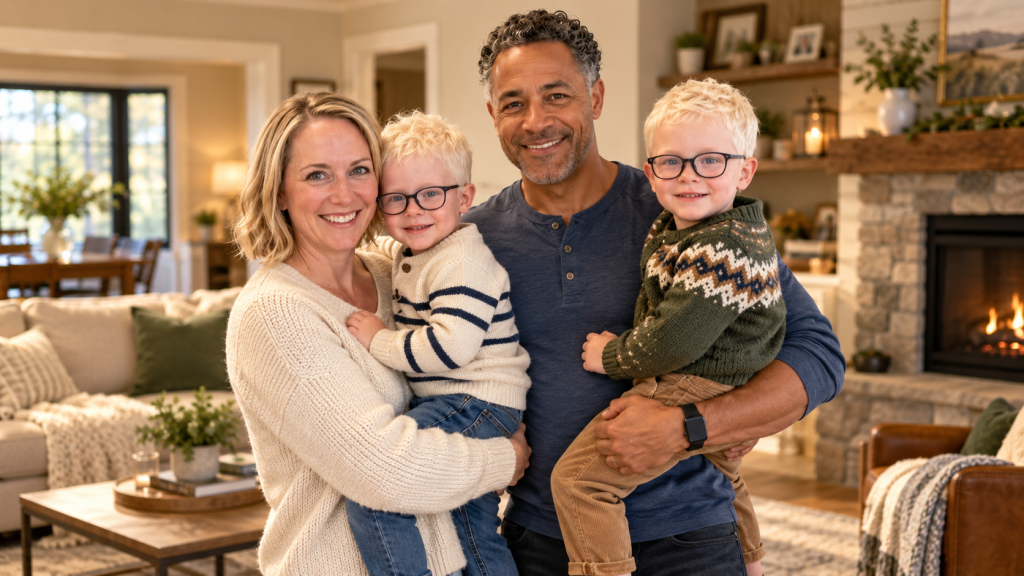
They had already lost one home. Already learned how to watch adults carefully before deciding whether it was safe to speak. Already learned that promises could disappear. And now I knew the man sleeping under the same roof as them had built our new family on a lie.
I gently freed my sleeve from Noah’s hand.
Then I walked downstairs.
Joshua was still in his office.
The door was closed now.
I could hear nothing.
My laptop sat on the kitchen counter.
I opened it.
My fingers hovered over the keyboard.
Rachel.
That was all I had.
Rachel.
Joshua.
Twin boys.
Four years old.
I typed his full name beside hers.
Nothing useful.
I added our city.
Then his old company.
Then the year before the twins were born.
Nothing.
I searched social media.
Again.
Again.
My heart pounded harder each time a page loaded.
There were dozens of Rachels.
Former coworkers.
College friends.
People I didn’t know.
Then I remembered something.
The adoption file.
We had received a carefully redacted family history.
The boys’ biological mother had been identified to us only by her first initial in some documents because of privacy protections surrounding their placement.
R.
I had never thought about it.
Why would I?
I opened the secure folder where I had saved copies of the paperwork.
There it was.
Biological mother: R.M.
My hands went numb.
I searched:
Rachel M Joshua
A photograph appeared.
Old.
Seven years old.
A company charity event.
Joshua stood near the back of a group of employees.
Beside him was a woman.
Dark hair.
Green dress.
Her name was listed beneath the photograph.
Rachel Morgan.
I stopped breathing.
She was beautiful.
Not glamorous.
Warm.
The kind of smile that reached her eyes.
And Joshua’s hand rested at the small of her back.
Not obviously intimate.
But I knew my husband.
I knew the way he stood beside acquaintances.
I knew the distance he kept.
There was no distance in that photograph.
I clicked.
Rachel had worked in marketing at Joshua’s former company.
From six years ago until approximately four years ago.
Then her professional profile stopped.
No new job.
No recent updates.
I searched her name alone.
The first result made my stomach twist.
An obituary.
Rachel Elise Morgan.
Thirty-six.
Died eighteen months earlier.
I covered my mouth.
The page blurred.
I forced myself to read.
Rachel had been survived by her sons, Noah and Elijah Morgan.
No father named.
My entire body began shaking.
There they were.
My boys.
Not legally mine yet when the obituary was written.
Not emotionally mine then either.
Two names on a screen.
Noah.
Elijah.
Their mother was dead.
Joshua had known her.
Joshua believed he was their father.
And somehow he had never told me.
I read the obituary again.
Cancer.
A long illness.
Private funeral.
Donations to a children’s hospice foundation.
My tears fell onto the keyboard.
Not only because Joshua had betrayed me.
Because suddenly the twins’ sadness had context.
Noah sometimes woke crying for someone named “Mama Rach.”
We had been told they remembered their mother but struggled to talk about her.
Eli hated hospitals.
Noah panicked when anyone left without saying goodbye.
Their mother had died.
And Joshua knew who she was.
I heard the office door open.
I closed the laptop.
Too late.
Joshua entered the kitchen.
His eyes were red.
He stopped when he saw me.
“Hey.”
I couldn’t speak.
He looked toward the ceiling.
“Boys asleep?”
I nodded.
“Good.”
He opened the refrigerator.
I watched him take out a bottle of water.
Ten years.
I had watched that man drink from that refrigerator thousands of times.
That night, every movement looked unfamiliar.
“Are you okay?” he asked.
I nearly laughed.
“Fine.”
He studied me.
“You look pale.”
“Headache.”
“Want me to get you something?”
No.
I wanted him to tell me the truth without being dragged toward it.
I wanted him to look at me and say:
I lied.
I had an affair.
Those boys are mine.
Their mother died.
I manipulated you into adopting them.
I wanted one spontaneous act of honesty.
Instead, he twisted the bottle cap and said:
“I’ve got another hour of work.”
“Okay.”
Then he kissed my forehead.
I almost recoiled.
Almost.
But I didn’t.
He walked away.
I waited until the office door closed.
Then I reopened the laptop.
I needed facts.
Not assumptions.
The obituary proved Rachel was the twins’ mother.
It didn’t prove Joshua was their biological father.
His words did.
But only because I had overheard them.
I searched old photographs.
Rachel appeared in several company albums.
So did Joshua.
A conference.
Holiday party.
Charity run.
Then I found one photograph dated five years earlier.
Joshua and Rachel were sitting together at a restaurant table.
Her hand rested on his wrist.
The caption named a project team.
I stared at the date.
Five years earlier.
Joshua and I had been married five years then.
We were undergoing our second fertility treatment.
I remembered that exact month.
I remembered injecting medication into my abdomen while Joshua held ice against my skin.
I remembered crying after appointments.
I remembered him telling me:
“We’re going to get through this together.”
Was he seeing her then?
I closed the laptop.
I couldn’t do more.
Not that night.
I barely slept.
At 5:40 a.m., Eli climbed into our bed.
He curled against me.
Joshua slept through it.
I stared at the ceiling.
Eli whispered:
“Mommy?”
I swallowed.
“Yes?”
“Can pancakes have chocolate?”
“Sometimes.”
“Today?”
I almost cried.
“Today.”
He smiled and closed his eyes.
That was the moment everything became complicated.
If it had only been Joshua and me, I would have packed a suitcase that morning.
But there were two little boys upstairs.
Children whose biological mother had died.
Children who had already experienced temporary placements before coming to us.
Children who now called me Mommy.
I couldn’t simply disappear because their father had lied.
But I couldn’t stay inside the lie either.
So I did something I should have done much earlier in my marriage.
I asked for professional help before making a decision.
At nine, I called our adoption attorney.
Her name was Melissa Grant.
I didn’t tell Joshua.
“Melissa, I need to ask you something confidentially.”
Her voice changed.
“Of course.”
“If one adoptive parent discovers that the other may be biologically related to the children, what happens?”
Silence.
“That’s a very specific question.”
“Yes.”
“Are you saying Joshua may be biologically related to Noah and Eli?”
“I think he’s their father.”
Another silence.
Then:
“Why?”
“I overheard him.”
Melissa inhaled.
“Did Joshua know this during the adoption?”
“I think so.”
“Did he disclose it to the agency?”
“I don’t know.”
“Did you?”
“No.”
“Obviously.”
Her tone softened.
“I’m sorry. That was a stupid question.”
“No.”
I was already crying.
“I didn’t know anything.”
“Listen carefully. Don’t panic.”
Too late.
“Biological parentage can affect the legal history significantly, but it doesn’t automatically mean the adoption disappears. We need to review exactly what representations were made, whether paternity was established, whether rights were previously adjudicated, and what the agency knew.”
“Could I lose the boys?”
The question came out before I could stop it.
Melissa paused.
“That is not something I can answer responsibly without reviewing the file.”
I covered my eyes.
“They’ve already lost their mother.”
“I know.”
“They can’t lose another one.”
“Then we proceed carefully.”
Another sentence I needed.
Carefully.
Not emotionally.
Not dramatically.
Carefully.
Melissa said:
“Do not remove the children from the state.”
“I wasn’t planning to.”
“Do not sign anything Joshua gives you.”
“I won’t.”
“And don’t confront him until you’ve secured copies of your records.”
My stomach tightened.
“Why?”
“Because if he intentionally concealed biological parentage during an adoption proceeding, I need to know exactly what documentation exists before anyone starts rewriting history.”
Rewriting history.
That was exactly what I feared.
I spent the day copying.
Applications.
Emails.
Background questionnaires.
Home-study materials.
Financial disclosures.
Medical histories.
I found the section.
Do either prospective adoptive parents have a prior biological, familial, custodial, or significant personal relationship with the child or biological parents?
Our answer:
No.
Both signatures.
Mine.
Joshua’s.
My hands began shaking.
He had signed it.
Another question:
Are you aware of any reason either applicant may have a biological relationship to the child?
No.
Joshua’s initials.
I photographed everything.
Then I found an email that made me sit down.
It had been forwarded to our shared adoption folder accidentally months earlier.
From Joshua to a private email address.
Subject:
They accepted our application.
Message:
I think this is going to work.
No context.
No name.
But the date was the day our home study was approved.
I forwarded it to myself.
Then deleted nothing.
I wanted the record exactly as it was.
At 2:30, I received a call from an unfamiliar number.
“Is this Mrs. Bennett?”
“Yes.”
“My name is Laura Morgan.”
My heart stopped.
Morgan.
Rachel’s surname.
“I believe you’re caring for my nephews.”
I sat down.
“Who gave you my number?”
“Melissa Grant.”
I almost cried with relief.
Melissa had moved quickly.
Laura continued.
“I understand you’ve learned something about Joshua.”
“Yes.”
A long silence.
Then she said:
“I’ve been waiting for this call for four years.”
My skin went cold.
“What?”
“I knew eventually somebody would discover it.”
“Discover what?”
“That Joshua is the twins’ father.”
The room disappeared around me.
“You knew?”
“Yes.”
“Did Rachel?”
A bitter laugh.
“Of course Rachel knew.”
I closed my eyes.
“Tell me everything.”
Laura hesitated.
“I don’t know whether I’m allowed to.”
“I adopted your nephews.”
“I know.”
“I quit my job because my husband convinced me these boys needed a stay-at-home mother.”
Silence.
“I changed my entire life.”
My voice broke.
“Please.”
Laura began crying.
“I’m sorry.”
“Tell me.”
So she did.
Joshua and Rachel had an affair.
Not one night.
Not a mistake.
Fourteen months.
It began while Joshua and I were undergoing fertility treatment.
Rachel became pregnant.
Twins.
She told Joshua.
He panicked.
He begged her to terminate the pregnancy.
She refused.
He begged her not to name him.
She agreed.
Not because she wanted to protect him.
Because she didn’t want him involved.
“What?”
I whispered.
Laura continued.
“Rachel loved him at first. Then she realized what he was.”
“What was he?”
“A coward.”
The word landed heavily.
“He kept promising he’d leave you.”
I closed my eyes.
“He said your marriage was already over.”
Of course.
The oldest lie in the world.
“He said you were only staying together because of fertility treatment.”
I almost laughed.
We had renewed our vows privately that year.
“He told Rachel you were emotionally fragile.”
There it was.
A lie that made his betrayal sound merciful.
“He said telling you would destroy you.”
I whispered:
“So he abandoned his children to protect me?”
“No.”
Laura’s voice sharpened.
“He abandoned them to protect himself.”
I started crying.
She continued more gently.
“Rachel cut him off before the boys were born.”
“Did he support them?”
“Not officially.”
“What does that mean?”
“He sent money occasionally.”
“How much?”
“Not enough.”
“Did he see them?”
“Twice that I know of when they were babies.”
I thought of Joshua insisting he recognized them immediately from the adoption profile.
Of course he recognized them.
He had held them.
“Why weren’t you able to take them after Rachel died?”
Laura went quiet.
“My husband was undergoing treatment for leukemia. We had three children at home already. I tried.”
Her voice broke.
“I tried so hard.”
“I know.”
“No, you don’t.”
She was sobbing.
“I promised Rachel I would keep them.”
I cried too.
“But I couldn’t pass the placement assessment.”
There was no accusation in her voice.
Only grief.
“They went into temporary care.”
“And Joshua found them?”
“Yes.”
“How?”
“I contacted him.”
I stopped breathing.
“You?”
“I didn’t know what else to do.”
She cried harder.
“I told him Rachel was dying.”
“What did he do?”
“Nothing.”
My heart broke all over again.
“He said he couldn’t suddenly appear after four years.”
“When did she die?”
“Three months later.”
“Did he visit her?”
“Once.”
“Did he see the boys?”
“No.”
“Why?”
“She wouldn’t let him.”
I understood.
Maybe I even respected her for it.
“After she died?”
“I called him again.”
“What did you say?”
“I told him if he had any conscience left, he should help his sons.”
I closed my eyes.
“And that’s when he suddenly wanted to adopt.”
“Yes.”
The timeline aligned perfectly.
Six months ago.
Joshua’s transformation.
The quiet house.
The real family speeches.
His sudden obsession.
Not longing.
Panic.
“What did he tell you about me?”
Laura hesitated.
“Tell me.”
“He said you’d never accept children from an affair.”
I laughed through tears.
“He never gave me the chance.”
“I know.”
“He said you were desperate to be a mother.”
That hurt.
Because it was true.
And because he had weaponized it.
“He said if he presented adoption as your shared dream, you’d agree.”
I pressed my fist against my mouth.
My own husband had mapped my grief.
Then used it as a road to his secret children.
“He told me he would eventually tell you.”
“When?”
“He never said.”
I thought about his phone call.
I can’t keep doing this to her.
Maybe guilt had finally arrived.
Too late.
“Laura.”
“Yes?”
“Do the boys know he’s their biological father?”
“No.”
“Do they remember him?”
“I don’t think so.”
“Do they know about Rachel?”
“Yes.”
“They remember her?”
“Yes.”
I looked toward the ceiling.
Noah and Eli were building something upstairs.
I could hear blocks falling.
Then laughter.
My boys.
Her nephews.
Rachel’s sons.
Joshua’s sons.
And somehow mine too.
I asked:
“Why didn’t you tell the agency?”
“I tried.”
“What?”
“I told the caseworker there might be a biological father.”
“What happened?”
“They said the legal record reflected no established father and that they’d follow procedure.”
“Did you give Joshua’s name?”
“Yes.”
My heart stopped.
“Then someone knew.”
“Maybe.”
That became the next twist.
The agency had not intentionally conspired with Joshua.
But the process had failed.
Laura’s warning had been documented in an internal note that never made it into the summary we received.
The caseworker who handled the early placement left unexpectedly.
Another took over.
The information about a possible father remained buried in a file.
Joshua never volunteered the truth.
And because he and I presented as an established married couple seeking adoption, nobody connected him to the unnamed biological father.
The boys had Rachel’s surname.
Joshua had never legally established paternity.
No obvious database flag appeared.
A bureaucratic gap met a deliberate lie.
And two children passed through it.
Melissa was furious.
But careful.
“This isn’t only about Joshua’s deception,” she told me two days later.
“Could the adoption be overturned?”
“We’re examining that.”
I felt sick.
“Please stop saying that.”
“Saying what?”
“Examining.”
She softened.
“I know.”
“No, you don’t.”
I stood.
“These boys have had four homes in eighteen months.”
“Temporary placements.”
“To them, they’re homes.”
Melissa stopped.
I continued.
“They finally sleep through most nights.”
“Noah stopped hiding food under his pillow.”
“Eli lets me leave the room without screaming.”
My voice broke.
“You cannot tell me their lives are just paperwork.”
“I would never.”
She stood too.
“My job is to protect the legal stability of your family.”
I laughed bitterly.
“What family?”
Melissa looked at me.
“The one you have with those boys.”
That stopped me.
Not Joshua.
The boys.
I sat.
She said:
“You need independent family counsel.”
“Independent from Joshua?”
“Yes.”
“And probably independent from me as adoption counsel.”
“Why?”
“Because your interests may diverge.”
There it was.
The legal version of what my heart already knew.
My interests and my husband’s were no longer the same.
I hired another attorney.
Rebecca Sloan.
Fifty-eight.
Sharp glasses.
No patience for emotional fog.
She listened.
Then asked:
“What do you want?”
I cried.
“I don’t know.”
“That’s acceptable.”
“I want the boys safe.”
“Good.”
“I want the truth.”
“Good.”
“I want Joshua out of my sight.”
She nodded.
“Also understandable.”
“But I don’t know if I want a divorce.”
She waited.
“I hate him.”
“No, you don’t.”
I stared at her.
She shrugged.
“You’ve spoken about him for forty minutes. You sound betrayed, furious, disgusted, heartbroken, and occasionally nostalgic. Hate would be simpler.”
I almost laughed.
“Is this legal advice?”
“No. That’s free.”
I wiped my eyes.
She leaned forward.
“Here’s the legal advice. Don’t make permanent decisions while you’re still learning facts.”
“Then what do I do tonight?”
“Can you remain safely in the house?”
“Yes.”
“Do you believe Joshua is dangerous?”
“Physically? No.”
“Financially?”
I hesitated.
“I don’t know.”
“Then protect accounts.”
“Emotionally?”
I laughed.
“Obviously.”
“Then create space.”
I went home.
Joshua was making spaghetti.
The twins sat at the table.
Noah had sauce on his cheek.
Eli was explaining something incomprehensible about dinosaurs.
For one second, the scene was exactly what I had wanted.
Family.
Then Joshua looked at me.
And I knew.
He knew I knew.
Maybe my face told him.
Maybe Laura had contacted him.
Maybe Melissa had.
He went pale.
“Boys,” he said.
His voice shook.
“Why don’t you take your plates into the den?”
I immediately said:
“No.”
Joshua stared.
“They can finish here.”
He swallowed.
“Okay.”
We sat.
A family dinner built on a secret that had finally run out of oxygen.
Noah looked between us.
“Daddy mad?”
The word nearly killed me.
Joshua whispered:
“No, buddy.”
“Mommy mad?”
I forced a smile.
“Mommy’s tired.”
Noah accepted that.
Children shouldn’t have to carry adult truth before they’re ready.
After dinner, we bathed them.
Together.
The most painful normal evening of my life.
We read Goodnight Moon.
Eli interrupted every page.
Noah fell asleep against my shoulder.
Joshua carried him to bed.
I watched.
Biological father.
For the first time, I could see similarities.
Noah’s eyebrows.
Joshua’s.
Eli’s crooked smile.
Joshua’s.
How had I missed it?
Because I had no reason to look.
Trust doesn’t make people stupid.
It makes certain questions unnecessary.
Until they aren’t.
At 9:30, we went downstairs.
Joshua closed the living-room door.
I stood by the window.
He whispered:
“How much do you know?”
I turned.
“Enough.”
His face crumpled.
“Elena—”
That wasn’t my name.
I almost laughed at the absurdity of my own mind. Different stories have different names; mine, in this moment, was the woman he had lied to for ten years. I had spent so long as Joshua’s wife that sometimes I felt my own name had become secondary.
He stepped closer.
“I can explain.”
“Start with Rachel.”
He sat.
I remained standing.
He covered his face.
“I loved her.”
The sentence cut deeper than I expected.
Not:
It was a mistake.
Not:
I was lonely.
I loved her.
I nodded slowly.
“Okay.”
He looked up.
“You asked for truth.”
“I did.”
“We were in a terrible place.”
“No.”
He stopped.
“You and I were undergoing fertility treatment.”
“I know.”
“Don’t rewrite that year.”
He lowered his eyes.
“I was terrified.”
“So was I.”
“You became obsessed with getting pregnant.”
My body went cold.
“Careful.”
He looked up.
“I’m not blaming you.”
“You just started.”
“I mean everything became appointments and schedules and disappointment.”
“And that made you sleep with your coworker?”
“No.”
“Then don’t use it as the first paragraph.”
He closed his mouth.
Good.
“Tell me about Rachel without using me as the reason.”
He cried.
“I was selfish.”
Better.
“I liked how she made me feel.”
“Better.”
“I liked being with someone who didn’t know every failure I’d ever had.”
I swallowed.
“We started talking.”
“Then?”
“Then we crossed a line.”
“How many times?”
He stared.
“What?”
“How long?”
“Fourteen months.”
I sat because my legs stopped working.
“Fourteen.”
“Yes.”
“You came home to me for fourteen months.”
“Yes.”
“You went to appointments.”
“Yes.”
“You held my hand while doctors told us our treatment had failed.”
He sobbed.
“Yes.”
“And then you went to her?”
“Sometimes.”
I turned away.
I thought betrayal would feel hot.
It felt cold.
“What happened when she became pregnant?”
“I panicked.”
“She had twins.”
“Yes.”
“Your twins.”
“Yes.”
“Did you ask her to terminate?”
His silence answered.
I closed my eyes.
“Did you?”
“Yes.”
“Why?”
“I couldn’t imagine telling you.”
“You couldn’t imagine consequences.”
He cried harder.
“I was a coward.”
“Yes.”
No comfort.
Not that night.
“Did you see them after they were born?”
“Twice.”
“Did you hold them?”
“Yes.”
I started crying.
“How could you?”
“I don’t know.”
“No.”
My voice rose.
“How could you hold your sons, come home to me, and then cry with me because we couldn’t have children?”
He covered his face.
“I hated myself.”
“Apparently not enough to tell me.”
“I thought it would destroy you.”
I stood.
“Stop saying you lied to protect me.”
He flinched.
“You protected yourself.”
“Yes.”
The admission was quiet.
“Yes.”
I stared.
“Then Rachel died.”
He nodded.
“Laura called.”
“Yes.”
“And suddenly our house was too quiet.”
He closed his eyes.
“Yes.”
“Suddenly we weren’t a real family.”
He started sobbing.
“Yes.”
“You found their profile.”
“Yes.”
“And you manipulated me.”
“I wanted them safe.”
“So did every person who applied to adopt them.”
He looked up.
“But I’m their father.”
“Then you should have told the truth and pursued them as their father.”
“I was afraid.”
“Of me?”
“Of losing you.”
I laughed.
The sound broke.
“So you built a plan where the only person who didn’t get a choice was me.”
“No.”
“Yes!”
My voice cracked through the room.
“You knew they were yours.”
“You knew I didn’t.”
“You knew I wanted children.”
“You knew I would love them.”
“You knew I’d quit my job if you convinced me it would help.”
His face went white.
That was the point.
My job.
“Did I actually need to quit?”
Silence.
“Joshua.”
He whispered:
“No.”
I stared.
“What?”
“The agency never required it.”
I already knew that.
But hearing him say it felt like another affair.
“You told me it would make our application stronger.”
“I thought—”
“No.”
I stepped toward him.
“Why?”
He looked at the floor.
“Because I needed you home.”
“Why?”
“The boys had been through too much.”
“Why me?”
He couldn’t answer.
Then I understood.
“You needed a mother.”
His face collapsed.
“You needed someone to take care of your sons.”
“No.”
“Yes.”
“No, I wanted you to be their mother.”
“Without telling me you were their father.”
“I thought once you loved them—”
He stopped.
Too late.
I stared.
“Finish that sentence.”
He cried.
“I thought once you loved them, you wouldn’t leave.”
There it was.
The architecture of the entire lie.
Not impulsive.
Not cowardice in one moment.
Strategy.
He had understood exactly who I was.
He knew if he told me before the adoption, I might leave.
But if he waited until two grieving four-year-olds loved me?
Then leaving him would feel like leaving them.
He had used my heart as a lock.
I whispered:
“You trapped me.”
“No.”
“Yes.”
“I never meant—”
“You just admitted it.”
He stood.
“I wanted my sons.”
“And you wanted me.”
“Yes.”
“So you arranged reality until you could keep both.”
He reached for me.
I stepped back.
“Don’t touch me.”
His hand fell.
“I’m sorry.”
I looked at him.
“No, you’re caught.”
He broke down.
Maybe he was sorry too.
But that distinction mattered.
I packed that night.
Not the boys’ bags.
Mine.
Joshua watched from the bedroom doorway.
“Where are you going?”
“My sister’s.”
“We can talk.”
“Not tonight.”
“What about Noah and Eli?”
My hands stopped.
There it was again.
The lock.
He saw my face.
“No.”
He shook his head.
“I didn’t mean it like that.”
“Yes, you did.”
“I mean they need you.”
“Then you should have thought about that before making their relationship with me dependent on your lie.”
His eyes filled.
“Are you leaving them?”
The cruelty of that question nearly dropped me.
I turned.
“No.”
My voice shook.
“I am leaving you tonight.”
He stared.
“They are not the same thing.”
Then I walked out.
I cried in the driveway for twenty minutes.
Not because I wanted to return to Joshua.
Because Noah’s shoes were beside the door.
Tiny blue sneakers.
Eli’s drawing was taped to the refrigerator.
A green monster with six arms labeled MOMMY.
I had left without kissing them goodnight again.
My sister, Claire, opened her door at midnight.
One look at my face.
No questions.
She hugged me.
Then I told her.
By dawn, she was pacing.
“I’ll kill him.”
“No.”
“Figuratively.”
“Please.”
“Mostly figuratively.”
I laughed.
Then cried.
She sat beside me.
“What happens to the boys?”
“I don’t know.”
“Do you want them?”
The question sounded terrible.
Like they were furniture.
“I love them.”
“That isn’t what I asked.”
I looked at her.
She continued gently.
“Do you want to be their mother if Joshua isn’t your husband?”
I cried harder.
“Yes.”
There it was.
The first clear answer.
Yes.
Not because I was infertile.
Not because Joshua manipulated me.
Not because Rachel died.
Because Noah and Eli had become mine in the way children become yours through thousands of ordinary acts.
Baths.
Nightmares.
Cut grapes.
Shoelaces.
Songs.
Medicine.
Stories.
Holding.
Waiting.
Loving.
“Yes.”
I whispered it again.
“I want to be their mother.”
Claire held me.
“Then fight for the relationship, not the marriage.”
The next months were brutal.
The adoption’s legal status required review.
Joshua’s biological connection was confirmed through testing.
No surprise.
The court examined whether his concealment constituted fraud in the adoption proceeding.
The agency acknowledged failures in handling Laura’s warning.
But the central question gradually became stability for Noah and Eli.
I had legally adopted them.
I had acted without knowledge of the deception.
I was their parent.
Joshua was both biological and adoptive father under the complicated legal history.
The court did not simply erase me.
That was the fear that had kept me awake.
Rebecca explained:
“Children are not contracts you rescind because one adult lied.”
I cried when she said it.
Joshua moved out of our home under a temporary arrangement.
I moved back in with the boys.
The first night, Noah asked:
“Daddy work?”
I sat beside him.
“Daddy has another place right now.”
“Daddy come back?”
My throat tightened.
“He’ll see you.”
“Daddy live here?”
“I don’t know.”
He looked frightened.
I pulled him close.
“You didn’t do anything wrong.”
He whispered:
“Eli broke lamp.”
From the other bed:
“NO I DIDN’T!”
I laughed through tears.
“No. This isn’t about the lamp.”
Children search for reasons they can understand.
A broken lamp.
Spilled milk.
Not affairs.
Fraud.
Dead mothers.
Cowardice.
I kissed them.
“You are safe.”
That became the promise.
Not:
Nothing will change.
Because things would.
Not:
Mommy and Daddy will stay together.
We wouldn’t.
Safe.
Truthful.
Loved.
Those promises I could keep.
I filed for divorce.
Joshua didn’t fight it.
He fought for parenting time.
That I understood.
For all his failures, he loved the boys.
But love didn’t erase the way he’d obtained our family.
We entered mediation.
The first session lasted six hours.
Joshua sat across from me.
He looked destroyed.
Our mediator asked:
“What does each parent believe is most important?”
Joshua said:
“The boys need both of us.”
I said:
“The boys need adults who stop using them to keep other adults in relationships.”
He looked down.
The mediator nodded.
Good.
We created a temporary schedule.
Therapeutic support for the boys.
Separate counseling for Joshua.
Family sessions later.
No telling them adult details.
No disparaging either parent.
And one requirement I insisted on:
Rachel would not be erased.
Joshua looked surprised.
“What?”
“They need to know their mother.”
“They’re four.”
“Age-appropriate.”
I looked at him.
“You already built enough of their life around secrets.”
He cried.
“I agree.”
So Laura entered our lives.
Slowly.
The first time she visited, Noah recognized her immediately.
“Aunt Wawa!”
He ran into her arms.
Laura collapsed to her knees.
Eli followed.
All three cried.
I stood in the doorway feeling like an intruder in my own house.
Then Laura looked at me.
“Come here.”
I hesitated.
She held out one hand.
I joined them.
Four people loving two children for different reasons.
Rachel was absent.
Yet everywhere.
Later, Laura brought photographs.
Rachel pregnant.
Rachel holding both babies.
Rachel asleep on a sofa with Noah on her chest.
Rachel laughing while Eli wore a saucepan as a hat.
I stared at her.
The woman my husband had loved.
The woman I should have hated.
But I couldn’t.
She had been lied to too.
Not in the same way.
But enough.
Laura handed me a photograph.
Rachel holding both boys shortly after birth.
On the back, Rachel had written:
My whole heart, divided perfectly in two.
I cried.
“Keep it.”
I looked up.
“Are you sure?”
“They should have it here.”
I placed it in their room.
Joshua saw it during pickup one day.
He froze.
“Where did you get that?”
“Laura.”
He stared.
Then started crying.
I didn’t comfort him.
But I didn’t remove the photograph either.
His grief belonged to him.
My boundaries belonged to me.
The biggest twist came six months into the divorce.
Laura called.
“I found something.”
“What?”
“A letter.”
My stomach tightened.
“From Rachel?”
“Yes.”
“To Joshua?”
“No.”
A pause.
“To you.”
I stopped breathing.
“That isn’t possible.”
“She wrote it before she died.”
“How could she write to me?”
“She knew your name.”
Of course she did.
The other wife.
The woman Joshua wouldn’t leave.
“What does it say?”
“I think you should read it yourself.”
We met the next day.
Laura handed me an envelope.
My name was written on the front.
To Joshua’s wife, if she ever learns the truth.
I nearly couldn’t open it.
Inside were three pages.
Rachel’s handwriting became shakier toward the end.
I read.
I don’t know your name well enough to know whether I have the right to write this, but I know enough about you to owe you an apology.
I started crying.
When Joshua and I began, I believed what he told me. I believed your marriage was essentially finished. I believed you were staying together because of treatment and finances. I wanted to believe him because believing him made me less ashamed of what I was doing.
I stopped.
Breathed.
Continued.
Eventually I understood that I was participating in a lie. By then I loved him, and then I was pregnant. None of that excuses me.
No excuses.
I respected her immediately.
I chose to raise the boys without him because I did not trust a man who could divide his life so completely. I sometimes wondered whether I should tell you. I did not. That was cowardice too.
Tears fell.
If you ever meet Noah and Eli, please understand that they were never meant to be evidence of what Joshua did to either of us. They are innocent.
I covered my mouth.
If my illness takes me before they’re old enough to understand, I hope whoever raises them tells them they were wanted. Completely. Every day.
The final paragraph destroyed me.
And if by some impossible turn you become part of their lives, I am sorry for the pain that brought you there. Please do not stay with Joshua for them. Children should not grow up believing love requires a woman to remain where truth has been taken from her.
I sobbed.
Laura held me.
Rachel had written the sentence I needed before I even knew I would need it.
Please do not stay with Joshua for them.
That letter ended my final doubt.
I had filed for divorce.
But part of me still wondered whether keeping the family intact would be better for the twins.
Rachel, dying, had understood something Joshua hadn’t.
Children learn love from what adults tolerate.
I took the letter home.
Made a copy.
Placed the original somewhere safe.
Years later, the boys would read it.
Not at four.
Not at six.
When they were ready.
The divorce finalized fourteen months after I overheard Joshua’s phone call.
I returned to work before then.
Not my old position.
That job was gone.
That loss remained.
Joshua couldn’t return my career exactly where I had left it.
I was furious about that for a long time.
Then my former supervisor called.
“We have a consulting role.”
“Part-time?”
“Initially.”
I took it.
Three days a week.
Then four.
Within eighteen months, full-time.
Two years later, management.
Not the same path.
Mine.
Joshua paid child support under our arrangement.
He also reimbursed part of the financial loss associated with my career transition as part of our settlement.
Money couldn’t repair manipulation.
But accountability mattered.
The boys grew.
At six, Noah asked:
“Did we come from your tummy?”
I smiled.
“No.”
“Whose tummy?”
“Your first mommy’s.”
“Rachel?”
“Yes.”
He knew her name by then.
“Did she love us?”
“Very much.”
“Do you love us?”
“Very much.”
He thought.
“Can two moms love you?”
“Absolutely.”
Eli, listening from the floor, said:
“Can three?”
“Probably.”
“Four?”
“Yes.”
“One hundred?”
I laughed.
“If you’re lucky.”
At eight, they learned Joshua was their biological father.
With a therapist.
Together.
Joshua cried.
Noah stared at him.
“You were our dad before Mom adopted us?”
Joshua swallowed.
“Biologically, yes.”
“Did you know?”
The room went still.
Joshua looked at me.
I didn’t rescue him.
This truth belonged to him.
“Yes.”
Noah frowned.
“Did Mom know?”
Joshua’s face crumpled.
“No.”
Eli looked at me.
“Why?”
Joshua whispered:
“Because I was afraid to tell her.”
Noah asked:
“Why?”
Joshua cried.
“Because I had done something wrong.”
“What?”
The therapist intervened gently.
“That’s a bigger part of the story for when you’re older.”
Noah looked frustrated.
I understood.
Secrets had shaped enough of his life.
But age-appropriate truth is not the same as secrecy.
I said:
“You will always be allowed to ask.”
He looked at me.
“Will you tell us?”
“When you’re ready to understand the answer safely.”
That satisfied him for then.
At twelve, they learned more.
At fifteen, almost everything.
That conversation was one of the hardest nights of my life.
Noah stood up.
“You cheated on Mom?”
Joshua nodded.
“With Rachel?”
“Yes.”
“You were married?”
“Yes.”
“And you left us?”
Joshua cried.
“Yes.”
Eli walked out.
Joshua started to follow.
I stopped him.
“Give him a minute.”
“He hates me.”
“Maybe.”
Joshua looked at me.
I continued:
“He’s allowed to feel whatever he feels.”
Noah was crying.
“Why did you adopt us instead of just saying you were our dad?”
Joshua closed his eyes.
“Because I was afraid your mom would leave me.”
Noah looked at me.
“Did you?”
“Yes.”
“Because of us?”
“No.”
I moved closer.
“Never because of you.”
“Then why?”
“Because he lied to me.”
Noah turned toward Joshua.
“That’s stupid.”
Joshua laughed through tears.
“Yes.”
“It didn’t even work.”
“No.”
“You lost her anyway.”
“Yes.”
Noah shook his head.
“Adults are dumb.”
For the first time all evening, I laughed.
“Frequently.”
Eli returned twenty minutes later.
He stood in the doorway.
Then asked Joshua:
“Did our first mom hate you?”
Joshua looked stunned.
“I don’t know.”
I said gently:
“She was angry with him.”
“How do you know?”
“She wrote about some of it.”
“Can we read the letter?”
I looked at Joshua.
Then at the boys.
“Yes.”
We read Rachel’s letter together.
Noah cried silently.
Eli sobbed.
Joshua left the room halfway through.
Not because I asked him to.
Because Rachel’s words were too much.
Later, Eli said:
“She said you shouldn’t stay with Dad.”
“Yes.”
“Did you leave because she told you?”
“No.”
“I didn’t receive the letter until after I’d already filed.”
He thought.
“Would you have stayed if she told you to?”
“No.”
“Good.”
I smiled sadly.
“Why good?”
“Because you’re stubborn.”
Noah laughed.
“She is.”
I threw a cushion at them.
That was how our family survived truth.
Not perfectly.
With tears.
Therapy.
Anger.
Questions.
And eventually jokes.
Joshua became a better father after becoming an ex-husband.
I wish I could say that surprised me.
It didn’t.
Without me absorbing all the practical work, he had to parent.
Real parenting.
Lunches.
School forms.
Fevers.
Nightmares.
Laundry.
Appointments.
He couldn’t disappear into his office and call exhaustion a contribution.
At first, he struggled.
Then learned.
He stopped working late unnecessarily.
Changed jobs.
Built his schedule around the twins on his parenting days.
At one point Noah told me:
“Dad makes terrible pancakes.”
I smiled.
“Good.”
“Why good?”
“Character building.”
Joshua and I became functional co-parents.
Not friends.
Not enemies.
Something stranger.
Two people linked forever by children, betrayal, and a history neither could erase.
He apologized many times.
Most apologies annoyed me.
Then, years later, he gave me one that mattered.
The boys were thirteen.
We were waiting outside a school concert.
Joshua said:
“I owe you something.”
I sighed.
“Please don’t make this dramatic before band.”
He smiled.
“No.”
Then became serious.
“I’ve spent years saying I lied because I was afraid to lose you.”
“You were.”
“Yes.”
“But that’s still centered on me.”
I looked at him.
He continued.
“The truth is I stole your informed choice.”
My chest tightened.
“I decided what you were allowed to know because I wanted a particular outcome.”
I said nothing.
“I used your infertility grief.”
His eyes filled.
“I used your love for those boys before you even had the chance to decide whether you wanted the circumstances.”
I swallowed.
“Yes.”
“I pushed you to quit your job because it made my plan easier.”
“Yes.”
“And then after you discovered everything, I kept saying I did it because I loved you.”
He shook his head.
“That was another selfish version of the story.”
I looked at him.
“What version do you believe now?”
“I loved you.”
He paused.
“But I treated you like a person whose choices mattered less than my fear.”
That was it.
The most accurate thing he’d ever said.
I nodded.
“Thank you.”
“Do you forgive me?”
I thought.
“Some parts.”
He smiled sadly.
“Fair.”
Then Noah opened the school door.
“Are you two coming or what?”
Joshua and I looked at each other.
Then laughed.
“Coming.”
Life kept moving.
I never remarried quickly.
For years, I didn’t date.
Not because Joshua ruined love.
Because I liked discovering who I was when nobody needed anything from me.
I traveled.
Returned to work fully.
Bought a smaller house after we sold the marital home.
The twins decorated their rooms.
Noah chose dark blue.
Eli wanted one wall orange.
I said no.
He accused me of crushing artistic expression.
We compromised.
One orange stripe.
He told everyone he had survived oppression.
At forty-nine, I met Andrew.
At a bookstore.
Not dramatic.
He asked whether the chair beside me was free.
I said yes.
That was our first consent-based interaction.
I joked about that later.
He didn’t understand until I told him my story.
When I finally did, he sat quietly.
Then asked:
“What happened to the boys?”
That question made me love him.
Not:
What happened to your husband?
Not:
Did you destroy him?
The boys.
“They’re sixteen now.”
“And?”
“They’re wonderful.”
He smiled.
“Then something good survived.”
Yes.
Something good had survived.
Andrew met them six months later.
Eli interrogated him.
“What are your intentions?”
I nearly died.
Andrew answered:
“Dinner?”
Noah laughed so hard he choked.
Andrew never tried to replace Joshua.
That mattered.
The twins already had a father.
Complicated.
Flawed.
Present.
They didn’t need a replacement.
They needed another adult who loved them without demanding a title.
Andrew eventually became that.
When the boys graduated high school, we all sat in the same row.
Me.
Andrew.
Joshua.
Laura.
Claire.
A ridiculous family.
Rachel’s photograph was tucked into my purse.
Noah had asked me to bring it.
When their names were called, I screamed louder than anyone.
Joshua cried.
Laura cried.
Andrew cried because everyone else was crying.
Afterward, Noah found me.
“Mom.”
“Yes?”
He hugged me.
Not the quick teenage hug.
A real one.
“Thank you.”
“For what?”
“Staying.”
My heart cracked.
“I didn’t stay.”
He pulled back.
“What?”
“I left your father.”
He rolled his eyes.
“You know what I mean.”
“Yes.”
I did.
I stayed with them.
There is a difference.
Eli joined us.
“Group hug?”
“No,” Noah said.
Eli ignored him.
Then Joshua approached.
For one strange second, all four of us stood together.
The family he had tried to manufacture through deception.
The family that had survived only after truth broke it apart.
Joshua looked at the boys.
Then at me.
His eyes filled.
“I almost ruined this.”
I shook my head.
“No.”
He looked surprised.
“You did ruin the version you tried to control.”
I looked at our sons.
“But we built something else.”
He nodded.
Something else.
That became enough.
The boys went to different colleges.
That nearly killed them.
They had never spent more than two weeks apart.
Noah chose engineering.
Eli chose psychology.
Of course the child who survived our family became interested in psychology.
He told me:
“Someone needs to figure you people out.”
I told him tuition wasn’t enough compensation.
When the house became quiet again, I remembered Joshua’s old line.
The house is too quiet.
Our life isn’t complete.
For the first time, quiet didn’t frighten me.
I sat with coffee.
Read books.
Called the boys too often.
They ignored me appropriately.
Andrew came over on weekends.
Eventually, he moved in.
Years after that, we married.
Small ceremony.
No manipulation.
No desperation.
No need to become a “real family.”
At the reception, Eli gave a speech.
That worried me.
He stood.
Tapped his glass.
“I’ve been instructed not to reveal family secrets.”
Everyone laughed.
Joshua, sitting two tables away, covered his face.
Eli continued.
“So naturally, I’ve prepared forty-five minutes.”
More laughter.
Then he looked at me.
“When my brother and I were four, we met a woman who didn’t know the truth about why we had arrived in her house.”
The room quieted.
“She had every reason to look at us and see betrayal.”
My eyes filled.
“But she never did.”
I covered my mouth.
“She separated what adults had done from who we were.”
Noah was crying.
“She taught us that family isn’t created by pretending bad things didn’t happen.”
Eli’s voice broke.
“It’s created when people tell the truth and still choose love where love is safe.”
Andrew took my hand.
Eli looked at him.
“So, Andrew, congratulations.”
Everyone laughed.
“You’re marrying the most stubborn woman alive.”
“Correct,” Andrew said.
“But she’s worth it.”
I cried.
After the wedding, Joshua approached.
“That was a good speech.”
“Yes.”
“He got your dramatic tendencies.”
“I blame genetics.”
Joshua smiled.
Then we both realized the joke.
Genetics.
His.
Not mine.
Yet somehow Eli had inherited things from me too.
Not through DNA.
Through years.
Phrases.
Habits.
Values.
He loaded the dishwasher incorrectly just like me.
Noah folded towels the way I did.
Both hated Joshua’s favorite olives because I hated them.
Family travels through more than blood.
Joshua learned that late.
I learned it beautifully.
Rachel’s sister Laura became one of my closest friends.
That surprised both of us.
At first, our relationship felt impossible.
She was the sister of my husband’s affair partner.
I was the wife Rachel had helped betray.
But we were also two women who loved the same boys.
Over time, that mattered more.
On Rachel’s birthday, we sometimes had dinner.
Not as a memorial ritual forced on the boys.
Just if they wanted.
Some years they did.
Some years they didn’t.
At twenty-one, Noah asked:
“Do you think Rachel would hate that you’re basically friends with Aunt Laura?”
I laughed.
“I have no idea.”
Laura said:
“She’d think it’s hilarious.”
Eli asked:
“Would she like Mom?”
Laura looked at me.
Then smiled.
“She’d be intimidated by her.”
“Correct,” I said.
Everyone laughed.
Then Laura became serious.
“She’d be grateful.”
I looked down.
“For what?”
“For loving you two when she couldn’t be here.”
Noah stared at his plate.
Eli wiped his eyes.
Grief changes shape as children grow.
At four, they missed a voice.
At eight, a face.
At fifteen, answers.
At twenty-one, the adult relationship they never got to have.
I couldn’t replace that.
I never tried.
I learned that motherhood isn’t filling every absence.
Sometimes it’s sitting beside your child while an absence remains.
Joshua eventually remarried too.
Her name was Marianne.
Before proposing, he told her everything.
Everything.
The affair.
Rachel.
The twins.
The fraudulent concealment.
Our divorce.
All of it.
He told me because Marianne wanted to meet me before marrying into the family.
I almost refused.
Then curiosity won.
We met at a café.
She looked terrified.
“You don’t need my permission,” I said.
She laughed nervously.
“I know.”
“Then why are we here?”
“Because Joshua told me I should understand what happened from someone who doesn’t benefit from minimizing it.”
That surprised me.
“He said that?”
“Yes.”
I smiled.
Maybe people really could change.
Marianne asked:
“Is he a good man?”
I thought carefully.
“I don’t answer that question for other women.”
She blinked.
“What?”
“I can tell you what he did.”
“So can he.”
“I can tell you what kind of father he’s become.”
“Please.”
“He became present.”
I smiled faintly.
“He learned slowly.”
“Do you trust him?”
That was harder.
“With the boys? Yes.”
“With money?”
“Probably now.”
“With my heart?”
I laughed.
“Not my department anymore.”
She smiled.
Then I said:
“Don’t marry his remorse.”
Her expression changed.
“Marry the man he is now if you know him well enough.”
She nodded.
They married.
From what I could see, they were happy.
I felt no jealousy.
That surprised me too.
Joshua becoming better for someone else did not mean I had left too early.
People sometimes change after consequences.
I had been part of the consequence.
I didn’t owe him a second marriage as a reward for eventually learning.
The boys understood that.
Once Noah asked:
“If Dad had told you before the adoption, would you have adopted us?”
The question I had feared for years.
We were alone.
He was twenty-three.
Old enough for truth.
“I don’t know.”
His face fell slightly.
I took his hand.
“Listen to the whole answer.”
He nodded.
“If Joshua had told me the day he discovered your profile that you were his sons from an affair, I would have been devastated.”
“Would you have left?”
“Probably.”
“And us?”
“I didn’t know you.”
He looked down.
“That matters.”
I squeezed his hand.
“I cannot honestly say I would have made the same decision before loving you.”
He nodded slowly.
“But?”
“But once I knew you, there was no version of my future where losing you felt acceptable.”
His eyes filled.
“So Dad was right.”
“What?”
“If you loved us first, you wouldn’t leave us.”
My stomach twisted.
“No.”
He looked confused.
“Your father was right about my love.”
I spoke carefully.
“He was wrong to use it without my consent.”
Noah stared.
“That difference is everything.”
He nodded.
Then cried.
“So you chose us later.”
“Yes.”
“After you knew.”
“Yes.”
That mattered to him.
I could see it.
Joshua had stolen my first choice.
But once the truth came, I made another.
Freely.
I chose the boys.
Not him.
Them.
Noah hugged me.
“Good.”
I laughed through tears.
“Good?”
“Yeah.”
“That’s all?”
“I’m an engineer. We don’t overdo feelings.”
“You’ve been crying for five minutes.”
“Environmental conditions.”
I laughed.
That conversation became one of the most important of my life.
Because for years, I worried the boys would interpret the truth as:
Mom only loved us because Dad tricked her.
That wasn’t true.
The trick brought us together.
Love was what happened afterward.
And staying their mother after learning everything?
That was mine.
Joshua could not take credit for that choice.
Neither could Rachel.
Neither could infertility.
Neither could fate.
Mine.
I am sixty-eight now.
Noah is married.
Eli is engaged.
Both still call too rarely.
Both claim I call too often.
The ancient conflict between mothers and sons continues.
Andrew sits beside me most mornings reading the newspaper on a tablet while pretending paper newspapers were superior.
Joshua lives three states away with Marianne.
We exchange birthday messages.
Laura comes for Thanksgiving every other year.
Claire still threatens Joshua figuratively whenever she drinks wine.
Some traditions deserve preservation.
The twins know everything now.
There are no locked rooms in the story anymore.
No secret biological father.
No mysterious Rachel.
No hidden affair.
No false adoption narrative.
The truth is complicated.
But it belongs to everyone it affected.
That matters.
A few years ago, Eli asked me to speak to one of his graduate classes.
He became a family therapist.
Of course he did.
The topic was identity and adoption.
I refused at first.
“I don’t like public speaking.”
“You talk constantly.”
“That is different.”
“No, it isn’t.”
He won.
I stood before twenty-seven graduate students.
I told them something I’d learned.
“Children can survive complicated truths better than adults sometimes survive complicated lies.”
They wrote that down.
I hadn’t expected them to.
Then someone asked:
“Do you regret the adoption?”
“No.”
Immediate.
“Do you regret your marriage?”
That took longer.
“No.”
They looked surprised.
I explained.
“Regret assumes I can remove one piece without changing everything that came after.”
I thought of Noah.
Eli.
Andrew.
My career rebuilt differently.
Laura.
Even Rachel’s letter.
“I regret what Joshua did.”
“I regret what Rachel and Joshua hid.”
“I regret quitting my job based on manipulated information.”
“I regret years I spent grieving a marriage that wasn’t what I thought it was.”
“But I don’t regret loving those boys.”
I smiled.
“And I don’t know how to erase the road without erasing the destination.”
Afterward, Eli hugged me.
“You were good.”
“I know.”
He laughed.
“Confidence.”
“Therapy.”
He looked at me.
Then said:
“Do you know what I remember from when we first came home?”
“What?”
“You sitting on the floor outside our bedroom.”
I frowned.
“Why?”
“I wouldn’t sleep unless you stayed where I could see your feet under the door.”
I remembered.
For three weeks, Noah and Eli panicked if I closed their door.
So I sat outside.
Sometimes for hours.
“You stayed.”
He smiled.
“Yes.”
I looked at my son.
Not biologically.
Completely.
“Yes.”
I stayed.
Not with Joshua.
With them.
That difference became the center of my life.
When I think back to the afternoon I stood outside Joshua’s office, I remember the cracked door.
His voice.
The words:
“She actually believes I wanted us to have a family.”
For years, that sentence haunted me.
Because it made me feel stupid.
Now it doesn’t.
I did believe him.
Why wouldn’t I?
He was my husband.
Trusting your spouse is not foolish.
Deceiving someone who trusts you is.
I no longer carry his dishonesty as evidence against my intelligence.
Then I remember the next sentence.
“That’s not why I adopted those boys.”
He was right.
His reason was guilt.
Fear.
Biology.
Loss.
Control.
Mine became love.
And in the end, my reason mattered too.
Maybe more.
Joshua’s secret started the adoption.
It did not define our family forever.
Truth changed the shape.
Choice rebuilt it.
Years after everything, Noah had twin daughters.
Yes.
Twins.
When he called from the hospital, he was hysterical.
“Mom.”
“What?”
“Two.”
I laughed.
“I know.”
“No, Mom. TWO.”
“I understand how twins work.”
“How did you do this?”
“Do what?”
“Keep two babies alive?”
I laughed until I cried.
“You’ll learn.”
When I arrived, Noah handed me one granddaughter.
Tiny.
Warm.
Perfect.
He whispered:
“Her name is Rachel.”
I looked at him.
He smiled.
“Middle name.”
I started crying.
“Mom.”
“I’m fine.”
“You’re soaking the baby.”
“Shut up.”
He laughed.
The other girl’s middle name was mine.
I won’t pretend that didn’t destroy me.
I sat in the hospital chair holding little Ava Rachel while Noah’s wife slept.
He sat beside me holding Sophie, whose middle name carried mine.
For a moment, generations folded together.
Rachel.
Me.
The two women connected by one man’s betrayal.
Now remembered not as rivals.
As mothers.
One by blood.
One by choice.
Both part of the story.
I whispered:
“She would have loved this.”
Noah nodded.
“So do you.”
“Yes.”
“Then we’re covered.”
I kissed his forehead.
Maybe we were.
Joshua arrived later.
He saw the names.
He cried harder than anyone.
Noah hugged him.
Forgiveness had happened differently between them.
Slowly.
Imperfectly.
But genuinely.
Joshua never demanded it.
That helped.
He once told me:
“I spent years thinking forgiveness meant people stopped holding what I did against me.”
I asked:
“What do you think now?”
“That it means they stop carrying it for me.”
I liked that.
He carried his own history.
As he should.
I carried mine.
And the boys carried only what belonged to them.
Not our shame.
That was important.
The last time Rachel’s letter came out, Noah asked if he could keep it.
I hesitated.
Then said yes.
“Why?”
“I want my daughters to read it someday.”
“When?”
“When they’re old enough.”
“What do you want them to learn?”
He thought.
“That Grandma Rachel loved us.”
I nodded.
“And?”
“That Grandma Mom—”
I laughed.
“Absolutely not.”
He grinned.
“You know what I mean.”
“No.”
“That you didn’t stay in a marriage because you thought kids needed two married parents.”
My eyes filled.
He continued.
“I want my daughters to know they can leave something harmful without leaving the people they love.”
I couldn’t speak.
Noah hugged me.
“That’s what you taught us.”
Not Joshua.
Not Rachel.
Me.
I had spent years worrying the boys would someday learn the ugly truth and see me as the fool at the center of it.
Instead, they saw what I did after.
Maybe that’s all any of us can control.
Not what someone does to us.
What we do once we know.
That is the part of my story I care about now.
Not the overheard confession.
Not the affair.
Not the hidden paternity.
Not even the adoption deception.
The moment after.
The choice after truth.
I could not change how the boys entered my life.
I could change how I remained in theirs.
I could not recover the career years exactly as they were.
I could build another career.
I could not make Joshua honest ten years earlier.
I could insist on honesty going forward.
I could not give Noah and Eli their first mother back.
I could keep her memory alive.
I could not preserve the family Joshua had manufactured.
I could build one nobody needed to lie to maintain.
That family is noisy now.
Very noisy.
Grandchildren do that.
When everyone visits, my once-quiet house becomes chaos.
Toys.
Shoes.
Bottles.
Someone always cries.
Sometimes it’s a child.
Sometimes Joshua.
He’s sentimental in old age.
Last Christmas, we were all together.
Andrew.
Me.
Noah’s family.
Eli and his fiancé.
Laura.
Claire.
Even Joshua and Marianne stopped by for dessert because the boys asked.
At one point, I stood in the kitchen.
Joshua entered.
For a moment, it was just us.
He looked into the living room.
Children everywhere.
Our sons laughing.
Rachel’s photograph on the shelf.
He said:
“You know what’s strange?”
“What?”
“I used to think I had to lie because the truth would destroy everything.”
I looked at him.
“The lie destroyed everything.”
“I know.”
Then he smiled sadly.
“And somehow the truth built something better.”
I considered.
“Not by itself.”
He looked at me.
“No.”
“People did.”
He nodded.
“You did.”
“Many people did.”
He accepted the correction.
That mattered.
Then Noah shouted:
“Mom! Dad! Stop having an emotional breakthrough and bring pie!”
Joshua laughed.
I laughed.
We carried the pie.
Separate lives.
Shared history.
No secrets.
That was enough.
Later, after everyone left, Andrew and I cleaned the kitchen.
He found a tiny sock beneath the table.
“Whose?”
“No idea.”
“Keep it?”
“Probably.”
He tossed it into the laundry basket.
Then he asked:
“You happy?”
I looked around.
The house was quiet again.
Once, Joshua had used quiet as proof our life was incomplete.
Now quiet felt earned.
“Yes.”
I smiled.
“Very.”
Andrew kissed my forehead.
No manipulation.
No hidden purpose.
Just affection.
I went upstairs.
On the hallway wall were photographs.
Noah and Eli at five.
Seven.
Ten.
Graduation.
College.
Weddings.
Rachel’s photograph.
My wedding to Andrew.
A complicated family arranged in simple frames.
I stopped before the earliest photograph.
The twins had been with us only three weeks.
Noah looked suspicious of the camera.
Eli was holding my hand.
Joshua stood beside us.
I used to hate that photograph.
Because it was taken during the lie.
Now I see something else.
Eli’s hand.
Wrapped around mine.
He didn’t know why Joshua had brought him there.
Neither did I.
But the hand was real.
My love was real.
That matters.
I turned off the hallway light.
Then went to bed.
I no longer ask whether Joshua ever truly wanted a family.
I think he did.
He just wanted one without paying the price of honesty.
And that is not the same thing.
A real family isn’t created by a perfect photograph.
It isn’t created by biology.
Or marriage.
Or adoption papers.
It isn’t created because someone quits a job or moves into a bigger house or sacrifices enough.
A real family is created every day people choose one another without stealing one another’s choices.
Joshua had to learn that through losing me.
I had to learn it through finding myself.
Noah and Eli learned it by surviving both of us.
And Rachel, in a letter written before she died, understood it before any of us.
Children should not grow up believing love requires a woman to remain where truth has been taken from her.
I kept that sentence in my heart.
I left the marriage.
I kept the love.
I told the truth.
I kept the boys.
And somewhere along the way, the family Joshua tried to manufacture became something he never could have planned.
Real.
Not because we stayed together.
Because eventually, nobody had to lie to belong.
That is the ending I never expected when I stood outside his office and heard him whisper:
“That’s not why I adopted those boys.”
He was right.
It wasn’t why he adopted them.
But it became why I stayed their mother.
Not guilt.
Not infertility.
Not fear.
Not Joshua.
Love.
Freely chosen.
With the truth in front of me.
And that made all the difference.
THE END STORIES! THANK YOU FOR READING GOOD LUCK! ❤️
Related Posts