My Son and I Secretly Boarded My Pilot Husband’s Flight to Surprise Him — Then His Announcement Over the Speakers Wiped the Smiles Off Both Our Faces

PART 1
My husband, Luca, had been flying commercial planes for nearly nine years, yet somehow our seven-year-old son, Leo, had never been a passenger on a flight his dad was piloting.
Leo complained about it constantly. Whenever Luca packed his flight bag for work, Leo would follow him around the house firing off questions: “Are you flying one of the big planes today?” “Do the passengers know you’re my dad?” “Can kids ever visit the cockpit?”
A few weeks ago, Luca casually mentioned that he had been assigned a short Saturday flight to Chicago. He’d fly there, have a few hours between assignments, and be home before dinner. The moment he told me, an idea popped into my head.
I decided Leo and I would secretly book seats on Luca’s flight. We would stay out of sight at the airport, sit near the back of the plane, and surprise him only after we landed. I’m usually terrible at keeping secrets from my husband, but somehow, this time, I pulled it off.
When I told Leo, he could barely contain himself. “We’re really flying with Dad?” “Yes.” “And he doesn’t know?” “Not a clue.”
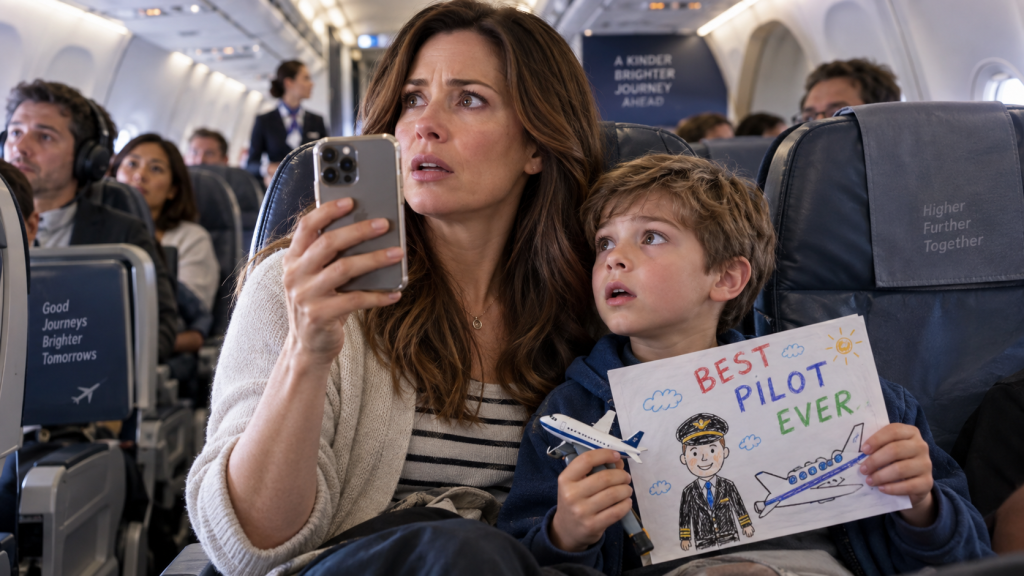
Leo treated the mission like he had been entrusted with a top-secret assignment. He packed his headphones, a bag of gummy bears, and his favorite little toy airplane. Then he added something that nearly made me cry: a drawing of Luca standing proudly beside a jet. Across the top, in huge crooked letters, Leo had written: BEST PILOT EVER.
Getting through the airport without Luca spotting us turned out to be much harder than I expected. We were walking toward security when Leo suddenly grabbed my sleeve. “Mom. MOM.”
I followed his stare. Luca was crossing the terminal less than thirty feet away in uniform, pulling his flight bag behind him. My heart nearly stopped. I grabbed Leo’s hand and practically dragged him into the nearest gift shop. We hid behind a rack of sweatshirts while I pretended to be deeply interested in refrigerator magnets.
Leo was trying so hard not to laugh that his entire face turned bright red. “This is awesome,” he whispered. “You’re enjoying this way too much.”
Once Luca disappeared around the corner, we continued toward the gate. Eventually, we boarded and slipped into our seats near the back of the cabin. Leo immediately leaned toward me. “Do you think Dad knows?” “No chance.” “Can I tell a flight attendant?” “No, sweetie.”
He grinned and pretended to zip his lips shut.
A few minutes later, the cabin door closed. Then the overhead speakers crackled. Luca’s voice filled the plane. Leo’s entire face lit up, and he grabbed my hand tightly. “That’s Dad!” “I know, buddy.”
I quickly pulled out my phone and started recording, wanting to capture Leo’s reaction so we could show Luca afterward. Luca gave the usual welcome—he talked about the weather in Chicago, estimated our flight time, and made one of those painfully corny pilot jokes he loved. Leo was absolutely glowing.
Then Luca suddenly stopped speaking.
A few seconds of silence passed—not long, but long enough for me to notice. When Luca spoke again, his voice had changed completely.
“Actually, folks, before we leave, I’d like to say something a little different today.”
I slowly lowered my phone. There was something unusually serious, almost trembling, in his voice.
“Before we take off, I want to do something I’ve never done on one of my flights before. There’s a very special person on this plane today.”……..Facebook limits post length—don’t forget to switch from “Most Relevant” to “All Comments” to continue reading more 👇
PART 2 — THE DAUGHTER IN SEAT 4A
Luca’s voice came through the speakers again.
Still trembling.
Still careful.
“Before we leave, I want to do something I’ve never done on one of my flights before.”
The cabin was quiet now.
Not completely.
A baby cried somewhere near the front.
A man two rows ahead kept tapping at his laptop.
One of the flight attendants was closing an overhead bin.
But around me, the world had narrowed to my husband’s voice.
“There’s a very special person on this plane today.”
Leo squeezed my hand.
His eyes widened.
I smiled automatically.
For one foolish second, I thought Luca had somehow discovered us.
Maybe someone at the gate had recognized Leo.
Maybe a flight attendant had seen the name on our reservation.
Maybe Luca was about to ruin our surprise by announcing:
My wife and son are hiding somewhere in the back.
Leo whispered:
“He knows!”
I almost laughed.
Then Luca continued.
“She is someone I should have acknowledged publicly a long time ago.”
My smile faded.
She.
Leo looked at me.
I felt his fingers loosen around mine.
Luca took a breath over the intercom.
Then said:
“My daughter, Emilia, is sitting in 4A.”
My body went cold.
There are sentences your mind refuses to understand the first time.
Not because they are complicated.
Because they rearrange too much.
My daughter.
Emilia.
Seat 4A.
Leo stared at the speaker above us.
Then at me.
“Mom?”
I could not answer.
At the front of the cabin, people began turning toward first class.
A young woman near the window lifted one hand.
She looked twenty.
Maybe twenty-one.
Dark hair.
Pale blue sweater.
She was crying.
The man beside her smiled and started clapping.
Someone behind him joined.
Then half the cabin began applauding because people will clap for almost anything if they believe they are witnessing something beautiful.
I sat frozen near the back.
My son’s hand still inside mine.
Luca continued.
“Emilia and I have had a complicated road getting here.”
His voice cracked.
“But today is the first time she’s ever flown on one of my flights.”
Leo’s face changed.
That sentence belonged to him.
For years, he had asked.
Can I ever fly with Dad?
And Luca was saying those words about another child.
A daughter I did not know existed.
“I’m very proud she’s here.”
More applause.
Emilia covered her face.
Leo looked down at the toy airplane in his lap.
The little plastic wings trembled in his hand.
Then he whispered:
“Dad has a daughter?”
I finally found my voice.
“I don’t know.”
That was a lie.
Of course I knew.
I just did not know anything beyond the one fact that had split our marriage open in front of a hundred strangers.
Luca ended the announcement with the usual cheerful instructions.
Seat belts.
Crew prepare for departure.
Thank you for flying with us.
His voice returned to normal.
Professional.
Steady.
As though he had not just detonated something in row 27.
Leo kept staring forward.
“Is she my sister?”
I swallowed.
“She might be.”
“Might?”
“Sweetheart, I need to talk to Dad.”
“Did you know?”
There it was.
The question I had been afraid of.
“No.”
His face folded.
Not crying.
That serious, injured look children get when they are trying to understand whether the adults in their life have changed categories.
“Why didn’t Dad tell us?”
I looked at him.
“I don’t know.”
That answer was true.
And somehow worse.
The plane began moving.
I wanted off.
Every instinct told me to stand.
Walk forward.
Find Luca.
Demand an explanation before the wheels ever left the ground.
Instead, I remained seated.
Because we were taxiing.
Because there were rules.
Because my seven-year-old son was watching how I responded to chaos.
Because sometimes dignity is nothing more glamorous than obeying the seat-belt sign while your marriage catches fire.
I put my phone away.
The recording had captured everything.
Leo’s smile.
My laugh.
Luca’s announcement.
My face afterward, probably.
I did not watch it.
I still have never watched the whole thing.
When the plane took off, Leo pressed his forehead against the window.
Normally, he would have been ecstatic.
He loved takeoff.
The engines.
The speed.
The moment the ground seemed to drop away.
That morning he barely looked.
The drawing he had made for Luca stayed folded in his backpack.
BEST PILOT EVER.
I could see the corner sticking out.
It hurt to look at it.
A flight attendant came down the aisle once we reached cruising altitude.
Her name tag said MARA.
She leaned toward Leo.
“First time flying?”
He nodded.
“Your dad’s the captain, right?”
My entire body stiffened.
She smiled.
“He mentioned his son might fly with him someday.”
Then she looked at me.
The smile vanished.
She had no idea.
Good.
At least the entire crew had not been living inside my husband’s secret.
Leo asked quietly:
“Do you know Emilia?”
Mara blinked.
“Emilia?”
“My dad’s daughter.”
The flight attendant looked toward the front.
Then back at us.
“Oh.”
That one syllable contained enough discomfort for all three of us.
“I met her when she boarded.”
she said carefully.
“Did Dad tell you she was his daughter?”
“Just before the announcement.”
I watched her face.
She was not lying.
Good.
“Thank you.”
I said.
Mara nodded and moved on.
I tried to think.
How old was she?
Luca was forty-two.
If Emilia was twenty-one, he had been twenty-one when she was born.
Before me.
Long before me.
That should have reduced the betrayal.
It did not.
Not because I cared that he had a past.
I knew Luca had dated before me.
I knew he had lived in Florida for several years after flight school.
I knew about a serious girlfriend named Vanessa.
Or I thought I knew.
I had never asked:
Did you father a child?
Because why would I?
In twelve years together, eight married, Luca had told me about broken bones, bad jobs, fights with his father, the worst landing of his training career, the first time he got drunk, the credit-card debt he hid from his parents at nineteen.
Not once had he mentioned a daughter.
Not once.
And now she was in seat 4A.
Close enough to the cockpit to hear him say he was proud of her.
Leo finally asked:
“Is she older than me?”
“Yes.”
“How much?”
“I don’t know.”
“Did Dad have another wife?”
“I don’t think so.”
“Does she have a mom?”
“Yes.”
Probably.
He frowned.
“Then why didn’t Dad tell us?”
Same question.
No answer.
Then:
“Does he like her more?”
That one nearly broke me.
I turned fully toward him.
“No.”
“You don’t know.”
He was right.
I hated that.
So I corrected myself.
“Your dad loves you.”
“That I know.”
He stared down.
“But he never made an announcement for me.”
My throat closed.
“Leo.”
“He didn’t even know I was here.”
Exactly.
The surprise had become its own cruel joke.
We came to make him happy.
Instead, we had accidentally witnessed a part of his life he had built without us.
About thirty minutes into the flight, Emilia stood to use the restroom.
I saw her clearly for the first time.
Tall.
Slender.
Dark hair pulled behind one ear.
And Luca’s eyes.
There was no mistaking them.
Same gray-green color.
Same slight lift at the outer corners.
She looked toward the back while waiting in the aisle.
Our eyes met.
I do not know whether she recognized me.
Then she looked at Leo.
Something changed in her face.
Shock.
Then guilt.
She knew.
Maybe Luca had shown her photographs.
Maybe she had seen our family online.
She took one step toward us.
Then stopped.
A flight attendant opened the restroom door.
Emilia went inside.
My heart pounded.
Leo whispered:
“She looks like Dad.”
“Yes.”
That answer finally came easily.
When she came out, she did not return to seat 4A immediately.
She walked toward us.
I could feel people glancing.
Maybe because they had heard the announcement.
Maybe because strangers are curious.
She stopped beside our row.
“Hi.”
Her voice was soft.
Leo stared at her.
I stared too.
She looked terrified.
“Are you…”
She swallowed.
“Are you Maya?”
My name.
She knew my name.
Every hope that Luca had somehow recently discovered her and simply had not found the right moment disappeared.
“How do you know who I am?”
Emilia looked toward the front.
Then back at me.
“Luca showed me pictures.”
Not Dad.
Luca.
Interesting.
“When?”
She hesitated.
“Can we talk after we land?”
My stomach dropped.
“How long have you known him?”
Her face changed.
That was the wrong question to ask if I wanted to stay calm.
She answered anyway.
“About six months.”
Six months.
My vision blurred.
Not six days.
Not six hours.
Half a year.
I looked at Leo.
He had heard.
Of course he had.
“Six months?”
I whispered.
Emilia nodded.
“I’m sorry.”
“For what?”
She looked at Leo.
Then at me.
“I thought you knew.”
That sentence was worse than everything before it.
Leo said:
“You’re my sister?”
Emilia’s face collapsed.
For one second, she looked as young as he did.
“I think so.”
“You think?”
She sat on the empty aisle seat across from us after checking that no one was returning.
“My name’s Emilia.”
“I know.”
Leo said.
“Dad told everyone.”
Her eyes filled.
“I didn’t know he was going to do that.”
That mattered.
“He surprised you too?”
I asked.
“Yes.”
“Did he tell you we were on this flight?”
She frowned.
“No.”
Then:
“You weren’t supposed to be.”
I almost laughed.
Apparently that was the only fact everyone agreed on.
Leo studied her.
“How old are you?”
“Twenty.”
“Why didn’t Dad tell me about you?”
Emilia looked at me helplessly.
I answered.
“That’s something Dad has to explain.”
Not her job.
I knew that much.
Children should not be forced to carry adults’ confessions merely because they happened to be standing nearby.
Emilia returned to her seat when the flight attendant asked passengers to remain seated for light turbulence.
Before she left, she whispered:
“I really am sorry.”
I believed her.
That did not make anything easier.
The rest of the flight lasted fifty minutes.
It felt like four days.
I rehearsed arguments.
Then discarded them.
I imagined Luca’s explanations.
He had just found her.
He was waiting.
He was protecting me.
He was protecting Leo.
He feared upsetting us.
Every possible explanation contained one fact that refused to move.
Six months.
He had chosen silence for six months.
When we landed, Leo did not clap the way he normally did in other people’s planes.
He just sat.
People unbuckled.
Phones came on.
Bins opened.
Then the cabin doors opened.
Emilia stayed seated near the front.
So did we.
I wanted the plane almost empty before I saw Luca.
Mara approached.
“The captain knows you’re here now.”
I looked up.
“How?”
“I told him after landing.”
Of course.
She seemed embarrassed.
“He asked you to wait.”
I laughed once.
“Convenient.”
Mara had the good sense not to respond.
Five minutes later, Luca came down the aisle.
Uniform.
Four stripes on his shoulders.
Face pale.
He saw Leo first.
Then me.
Then the backpack with the drawing.
His whole body seemed to stop.
“Maya.”
Leo did not move.
Luca looked like someone had punched him.
“You’re here.”
“Yes.”
His eyes filled.
“This was the surprise.”
I said.
He closed his eyes.
“Oh God.”
Then Leo asked:
“Why didn’t you tell me I have a sister?”
No greeting.
No hug.
Straight to the wound.
Luca crouched in the aisle.
“Buddy.”
“Why?”
Luca looked at me.
I shook my head once.
Do not make me answer this for you.
He turned back to Leo.
“Because I was scared.”
“Of me?”
“No.”
“Of Mom?”
Luca hesitated.
That was the wrong thing to do in front of a child.
Leo saw it.
His face tightened.
Luca said:
“Of changing our family.”
Leo looked at Emilia.
“She already exists.”
I nearly cried.
Seven years old.
Simpler moral logic than all of us.
“Yes.”
Luca whispered.
“She does.”
Emilia remained several rows ahead.
Trying not to listen.
Impossible.
I stood.
“We need somewhere private.”
Luca nodded.
He led us through the jet bridge after the remaining passengers left.
A gate supervisor found a small airline conference room near the crew area.
Four chairs.
Plastic table.
No windows.
The least romantic room in America.
Perfect.
Emilia came too.
I did not know whether I wanted her there.
But I knew I did not want to make her wait outside like evidence.
She was a person.
Whatever Luca had done, Emilia had already spent enough of her life being treated like something that complicated other people’s plans.
Luca sat across from me.
Leo sat beside me.
Emilia across from him.
Nobody spoke.
Then I said:
“Start from the beginning.”
Luca looked at Emilia.
I stopped him.
“Do not ask her permission to tell me a story you should have told me years ago.”
He flinched.
Good.
Then he began.
Her mother was Vanessa.
The serious girlfriend I knew about.
They had dated from nineteen to twenty-two.
Luca was in flight school.
Vanessa was studying nursing.
She became pregnant.
Luca panicked.
Not because he did not want the baby.
Because he did.
Too much, according to him.
He proposed.
Vanessa refused.
Their relationship had become unstable.
Arguments.
Money.
His training schedule.
Her parents hated him.
Still, Luca was present through the pregnancy.
Emilia was born.
He signed the birth certificate.
He changed diapers.
He stayed when he could.
Then when Emilia was fourteen months old, Vanessa moved back to Ohio with her parents.
Luca’s first airline opportunity was in Florida.
They fought over distance.
Custody.
Money.
Nothing formal enough at first.
Then everything formal at once.
“I visited.”
Luca said.
“How often?”
I asked.
“Not enough.”
Good answer.
He did not inflate it.
Every few months.
Then less.
Vanessa married a man named Robert Hale when Emilia was four.
Robert became the daily father.
School.
Doctors.
Soccer.
Life.
Luca still paid support.
Still called.
But the calls became awkward.
Emilia did not want to talk.
Vanessa began asking him to stop appearing unpredictably.
At six, Emilia told Luca she wanted to call Robert Dad.
Luca said that was okay.
At seven, Robert asked about adoption.
My stomach tightened.
“You agreed?”
Luca nodded.
“I signed a consent to stepparent adoption.”
Emilia stared at the floor.
“So legally?”
I asked.
“Robert became her father.”
“Yes.”
Luca’s voice cracked.
“My parental rights ended.”
There it was.
Not abandonment exactly.
Not simple.
Still permanent.
“Why didn’t you tell me?”
I asked.
Luca looked destroyed.
“At first, shame.”
“Of her?”
“No.”
Emilia flinched anyway.
Luca saw.
“Never of you.”
he said quickly.
“Of what I had done.”
He turned back to me.
“When we met, the adoption had been final for almost ten years.”
“I told myself she wasn’t my daughter anymore.”
Emilia’s eyes filled.
Luca corrected himself.
“Legally.”
“Not in my head.”
Then:
“I thought talking about it would sound like I wanted sympathy for giving up a child.”
“So you lied.”
“Yes.”
“Did I ever ask if you had children?”
He closed his eyes.
“Yes.”
I remembered.
Third or fourth date.
We were talking about whether either of us wanted kids.
Luca said:
“No kids.”
Then smiled.
“One day.”
I had believed we were imagining parenthood together for the first time.
He already knew what it felt like to hold a newborn daughter.
That hurt in a place I could not name.
“You lied directly.”
“Yes.”
Leo looked between us.
His face confused.
This was too much.
I stopped.
“Leo.”
He looked at me.
“Do you want to stay?”
He nodded immediately.
I almost said no.
Then reconsidered.
The secret affected him.
But not every detail belonged in a seven-year-old’s lap.
“Then we keep this simple.”
I said.
“No adult fighting.”
“No details about court paperwork unless you ask when you’re older.”
Luca nodded.
Emilia did too.
Good.
I looked at Luca.
“How did she find you six months ago?”
He answered:
“Robert died.”
Emilia’s face changed.
There.
Another grief.
“He had cancer.”
she whispered.
“I’m sorry.”
I said.
She nodded.
“Thank you.”
After Robert died, Emilia went through old family papers with Vanessa.
She found the adoption file.
Luca’s full name.
Old letters.
Photographs.
One birthday card he had written when she was eight but never mailed.
Apparently Vanessa had kept everything.
Emilia searched online.
Found Luca.
Found me.
Found Leo.
Our family photographs.
Airline bio.
Everything.
Then she emailed him.
Luca showed me the first message on his phone.
It was simple.
My name is Emilia Hale. I think you know why I’m writing.
My heart hurt just reading it.
“What did you do?”
I asked.
“I stared at it for two days.”
“Then?”
“I answered.”
“Did you tell me?”
“No.”
We already knew.
“Why?”
“I thought she might only want medical history.”
Emilia looked at him.
“I asked you if you ever thought about me in the second email.”
Luca closed his eyes.
Good correction.
He had tried to soften the story again.
Small habit.
Still there.
They began emailing.
Then calling.
Then Luca flew to Ohio on a day off.
I remembered that trip.
He told me he had been called for recurrent training.
My stomach turned.
“You lied about work.”
“Yes.”
“How many times did you see her?”
“Five.”
Six months.
Five meetings.
Two in Ohio.
One in Chicago.
One near our home while I believed Luca was meeting an old flight-school friend.
And once three weeks earlier, when Emilia had ridden along on a positioning flight where Luca was deadheading as a passenger.
I stared at him.
“You introduced her to colleagues?”
“Two people know.”
“Before your wife.”
He looked down.
“Yes.”
That fact hurt more than I expected.
Secrets become heavier when you discover they had witnesses.
“Why today?”
I asked.
“What?”
“The announcement.”
Luca looked at Emilia.
“She was nervous about flying.”
Emilia gave him a look.
“That isn’t why.”
Good.
I almost liked her already.
Luca sighed.
“No.”
Then:
“We had an argument last night.”
“About?”
Emilia answered.
“About being hidden.”
The room went silent.
She continued.
“I told him I didn’t want to be his secret daughter.”
My chest tightened.
“I didn’t ask him to tell everybody on the plane.”
She looked at Luca.
“I said I needed to know whether he was actually going to tell his family.”
Luca rubbed his face.
“I panicked.”
I stared.
“You responded to being accused of hiding her from your family by announcing her to strangers.”
“When you say it like that…”
I pointed at him.
“Do not.”
He almost smiled.
Wrong moment.
Then stopped.
“I thought if I said it publicly, I couldn’t take it back.”
That sentence quieted me.
Cowardly.
Strangely brave.
Still wrong.
“What did you plan to do afterward?”
“Tell you tonight.”
“After the flight?”
“Yes.”
“Did you know Emilia would be on this flight when you left home this morning?”
“Yes.”
My stomach dropped.
This was not spontaneous enough.
“You kissed me goodbye.”
“Yes.”
“You kissed Leo.”
“Yes.”
“And you knew your daughter would be sitting in first class.”
His eyes filled.
“Yes.”
I looked away.
Leo whispered:
“Dad?”
Luca turned.
“Why did she get first class?”
The question was so Leo that all of us almost laughed.
Emilia did.
Then covered her mouth.
Luca said:
“I upgraded her.”
Leo frowned.
“I’ve never even flown.”
There it was.
Again.
Not jealousy over money.
The symbol.
The first flight.
The announcement.
The front seat.
Everything Leo had dreamed of experiencing with his father had happened with the sister he had never met.
Luca’s face broke.
“I know.”
“No, you didn’t.”
Leo said.
“You didn’t know I was here.”
Simple.
Cruel.
True.
I asked Emilia:
“Did you know about Leo before six months ago?”
“Yes.”
“How?”
“Social media.”
“Did you want to meet him?”
She looked at Leo.
“Yes.”
Then quickly:
“But I didn’t want to just show up.”
Good.
“What did Luca tell you?”
Her face tightened.
I saw it before she spoke.
“Emilia.”
Luca said.
I turned sharply.
“No.”
He stopped.
She looked at me.
“He said he needed time.”
“That you had lost a pregnancy before Leo.”
My heart stopped.
That was private.
Very private.
Luca’s face went white.
“He told you that?”
Emilia nodded slowly.
I turned to my husband.
“You told her about my miscarriage?”
“It came up when I was explaining why—”
“Why what?”
“Why I was afraid to tell you.”
My whole body shook.
“You used my dead baby to explain your lie?”
“Maya.”
“No.”
I stood.
Leo flinched.
I sat again immediately.
He did not deserve adults losing control around him.
I lowered my voice.
“That was not your story to spend.”
Luca started crying.
“I know.”
“No.”
“You know now because I’m saying it.”
I looked at Emilia.
She looked horrified.
“I’m sorry.”
“Not you.”
I said.
“This is not your fault.”
That distinction mattered.
I thought that was the worst of it.
It wasn’t.
Emilia reached into her bag.
“I need to tell you something too.”
Luca looked at her.
“What?”
Her expression changed.
“You said we’d tell her together.”
My stomach tightened.
Luca stared.
“Emilia.”
She shook her head.
“No.”
Then she looked at me.
“I didn’t come today only because I wanted to fly with him.”
The room went quiet.
“What else?”
She placed a folded document on the table.
I did not touch it.
At the top:
PETITION FOR ADULT ADOPTION
I stared.
My mind went blank.
Leo asked:
“What’s adoption?”
No one answered immediately.
I looked at Luca.
He looked sick.
“What is this?”
Emilia spoke softly.
“Luca asked if I wanted him to adopt me back.”
My entire body turned cold.
Adult adoption.
Emilia was twenty.
Robert, her legal father, had died.
Depending on applicable law, adult adoption could legally recreate a parent-child relationship.
Not erase her past.
Not resurrect childhood.
But create legal family status.
Inheritance implications.
Next-of-kin implications.
A daughter.
Legally again.
My husband had been discussing making another person his legal child without telling me.
I looked at Luca.
“How long?”
“Two months.”
The room disappeared.
Leo stared at the paper.
“Then she really would be my sister?”
Emilia began crying.
“She already is.”
Luca whispered.
I looked at him.
“Biologically.”
“Yes.”
“And you planned to adopt her.”
“I asked if she wanted it.”
“Without telling me.”
“I was going to.”
“When?”
“Before anything was filed.”
I looked at the petition.
“Is this filed?”
“No.”
Emilia answered.
“I wouldn’t sign yet.”
I looked at her.
“Why?”
She wiped her eyes.
“Because I told him he had to tell you first.”
Silence.
The twenty-year-old daughter my husband had hidden had apparently shown more respect for my marriage than my husband had.
That hurt almost enough to make me laugh.
Luca leaned forward.
“Maya, please understand.”
“What?”
“She lost Robert.”
“I know.”
“She was grieving.”
“I know.”
“I wanted her to know I wasn’t going to disappear again.”
I stared at him.
“Then show up.”
He blinked.
“What?”
“Call her.”
“Visit.”
“Remember birthdays.”
“Sit with her when she misses the father who raised her.”
“Why did legal paperwork need to happen before your wife even knew her name?”
He had no answer.
That was the problem.
Luca had confused a dramatic gesture with repair.
Announcement over speakers.
Adult adoption.
Public recognition.
All enormous.
All easier, apparently, than one terrible conversation at home.
I looked at Emilia.
“What do you want?”
Luca opened his mouth.
I held up a hand.
Not him.
Her.
Emilia thought for a long time.
“I don’t know.”
Good answer.
Then:
“I wanted to know him.”
“I didn’t expect…”
She looked around the tiny room.
“This.”
“Did you ask to be adopted?”
“No.”
“Did you say no?”
“Not exactly.”
“What did you say?”
“That I needed time.”
There it was.
A phrase everyone in this family needed to learn how to respect.
I nodded.
“Take it.”
Luca looked at me.
I ignored him.
“No one gets to make grief into a deadline.”
Emilia started crying harder.
I handed her a tissue.
That small act surprised both of us.
We spent three hours in Chicago.
Not the layover I had imagined.
Leo had wanted pizza with his dad near the river.
Instead we sat in an airline office eating crackers from a vending machine while our family structure changed.
Eventually I took Leo to a nearby restaurant.
Without Luca.
Emilia remained with him.
I needed space.
Leo barely touched his grilled cheese.
Then he asked:
“Are you and Dad getting divorced?”
I closed my eyes.
“I don’t know.”
“Because of Emilia?”
“No.”
That answer came instantly.
His face lifted slightly.
“Then why?”
“Because Dad kept something important from me.”
“For a long time.”
Leo thought.
“Like a secret that makes someone uncomfortable?”
My heart hurt.
“Yes.”
Exactly.
“Like the kind you’re supposed to tell?”
“Yes.”
He nodded.
Then:
“Is Emilia bad?”
“No.”
“Are you mad at her?”
“No.”
“Are you mad at Dad?”
“Yes.”
He almost smiled.
At least one answer was easy.
Then he asked:
“Can I still like her?”
I put my fork down.
“Yes.”
“You can like her.”
“You can love her someday if that happens.”
“You can also feel weird.”
“Or angry.”
“Or jealous.”
“Or nothing yet.”
He frowned.
“Can I be mad that she got the first flight?”
“Yes.”
“Good.”
Children appreciate emotional permission.
Then:
“Can I tell Dad?”
“Absolutely.”
When we returned, Emilia was sitting alone outside the office.
Luca had gone to speak with operations about his return assignment.
I almost admired the absurdity.
Even after family explosions, airlines still have schedules.
Emilia stood.
“I’m going home.”
“To Ohio?”
“Yes.”
“Alone?”
She nodded.
I looked at her.
“You don’t have to leave because of me.”
“I know.”
“Do you?”
She looked down.
Then:
“I think I need to.”
Fair.
Leo stepped closer.
“Can I have your number?”
I stared at him.
Emilia did too.
Then she smiled.
“Sure.”
He handed her his little tablet.
She typed it.
Then Leo said:
“I’m still mad you got first class.”
She laughed.
“So am I.”
That was the first good moment of the day.
Tiny.
Enough.
Before she left, Emilia turned to me.
“I really thought he was going to tell you.”
“I believe you.”
“I kept asking.”
“I believe that too.”
Her eyes filled.
Then:
“I don’t want to break your family.”
I stepped closer.
“You didn’t.”
She looked at me.
“Whatever happens next started before you walked onto this plane.”
That mattered.
For her.
For me.
I would not make a young woman responsible for the structural weakness in a marriage she did not build.
She nodded.
Then walked away.
Leo watched until she disappeared into the terminal.
Luca returned ten minutes later.
He had been removed from the return flight.
Not punished.
Operations had found another captain because Luca admitted he was emotionally unfit to operate after what happened.
That, at least, was responsible.
We took a later flight home as passengers.
Three seats.
Luca beside the window.
Leo in the middle.
Me on the aisle.
No announcements.
No surprises.
Halfway home, Leo fell asleep against Luca’s arm.
Luca looked at me over our son’s head.
“I’m sorry.”
I stared forward.
“That is not enough.”
“I know.”
“Stop saying that unless you can tell me what you know.”
He closed his eyes.
Then:
“I know I lied to you before we married.”
“I know I kept lying because every month made telling you harder.”
“I know I used fear as an excuse.”
“I know I shared private things about you to make my choices sound understandable.”
“I know I tried to repair my relationship with Emilia through gestures before I repaired honesty at home.”
His voice broke.
“And I know I made Leo discover a sister through an airplane speaker.”
There.
Specific.
Ugly.
True.
I looked at him.
“That last one may take him a long time.”
“I know.”
This time, I let him say it.
At home, Luca slept in the guest room.
For the first time in eight years.
The next morning, he left for his brother’s apartment without me asking.
He said:
“You need the house.”
I corrected him.
“Leo needs normal.”
He nodded.
That mattered too.
For the next week, Luca came only when invited.
He picked Leo up from school.
Took him to soccer.
Answered questions.
No grand apology gifts.
No toy airplanes.
Good.
On the third night, Leo asked him:
“Did you forget about me when you had Emilia?”
Luca cried.
So did I.
“No.”
he said.
“Then why did you hide her?”
“Because I was afraid telling the truth would change how Mom saw me.”
Leo frowned.
“That’s dumb.”
“Yes.”
Seven-year-old morality again.
Then:
“Are you going to adopt her?”
Luca looked at me.
I said nothing.
He answered Leo.
“I don’t know.”
“Why?”
“Because Emilia needs to decide what she wants.”
“And because I should not make big family decisions secretly.”
Leo nodded.
“Good.”
Then returned to his cereal.
Sometimes children conclude a moral hearing faster than courts.
A week later, Emilia called me.
Not Luca.
Me.
I almost did not answer.
Then did.
“Hi.”
“Hi.”
She sounded nervous.
“Is this a bad time?”
“No.”
“I wanted to ask you something.”
“What?”
“Can I come visit?”
My chest tightened.
“When?”
“Not soon.”
That surprised me.
“Maybe next month.”
“I want to meet Leo properly.”
Then:
“And you.”
I stared out the kitchen window.
“Why me?”
Silence.
Then:
“Because if Luca and I are going to have any kind of relationship, I don’t want it to exist in a separate secret room.”
My throat tightened.
The daughter understood before the father.
“Yes.”
I said.
“You can come.”
Then she added:
“There’s something else.”
Of course.
My body tensed.
“What?”
“About the adoption.”
I waited.
“I’m not doing it.”
Relief came.
Then guilt for feeling relief.
“Because of me?”
“No.”
She said it firmly.
“Because of Robert.”
Her legal father.
The man who raised her.
“I thought if Luca adopted me back, it would fix something.”
Her voice cracked.
“But Robert was my dad.”
“He died my dad.”
“I don’t want grief to make me erase that.”
My eyes filled.
“That sounds wise.”
“I’m not sure it is.”
“It can still be wise.”
Then:
“I want Luca in my life.”
“I just don’t need a court to tell me what he is.”
That sentence stayed with me.
Maybe because marriage had made me realize paperwork cannot manufacture honesty either.
Then Emilia said:
“Maya?”
“Yes?”
“Did Luca tell you about the other paper?”
My hand went still.
“What other paper?”
Silence.
A terrible silence.
The kind I already knew.
“Emilia.”
She swallowed.
“I thought he had.”
Of course she did.
“What paper?”
Her voice became careful.
“When Robert died, my mom gave me a box of old documents.”
“Okay.”
“There was something from when I was little.”
“What?”
“A letter Luca signed before the adoption.”
My stomach tightened.
“What kind of letter?”
“I don’t know what to call it.”
Then:
“He wrote that if anything ever happened to Vanessa and Robert, he wanted to be contacted because he would still consider himself responsible for me.”
I frowned.
“That doesn’t sound terrible.”
“No.”
“It isn’t.”
“Then what are you not saying?”
She went quiet.
When she spoke again, her voice was barely above a whisper.
“Underneath that letter was another one.”
My pulse started pounding.
“From who?”
“Vanessa.”
“What did it say?”
A pause.
Then:
“That Luca didn’t voluntarily disappear from my life the way he told you.”
Everything inside me went still.
“What?”
“She said she asked him to sign the adoption because of something that happened when I was six.”
My stomach dropped.
“What happened?”
“I don’t know.”
“She didn’t explain it in the letter.”
“Then why does this matter?”
Emilia started crying.
“Because she wrote one sentence at the bottom.”
I gripped the phone.
“What sentence?”
Her answer came quietly.
‘If Luca ever tells you I kept you from him, ask him what happened the night he came to our house drunk and tried to take you.’
I stopped breathing.
The kitchen seemed to tilt.
Because in every explanation Luca had given me—
the distance,
the calls,
the adoption,
the shame—
he had never mentioned alcohol.
Never mentioned going to Vanessa’s house.
Never mentioned trying to take Emilia anywhere.
And suddenly, six months of hidden contact was no longer the only part of my husband’s past he had rewritten before handing it to me.
There was another story underneath the one he had just confessed.
A story his daughter had only now discovered.
And this time, it was not about what Luca had failed to tell us.
It was about whether the version of himself he had given Emilia was true at all.
PART 3 — THE NIGHT LUCA LEFT OUT
For several seconds, I could not answer Emilia.
I stood in our kitchen with one hand gripping the edge of the counter and the other holding the phone so tightly my fingers hurt.
Outside, rain tapped against the glass.
Inside, the refrigerator hummed.
Somewhere upstairs, Leo was sleeping beneath glow-in-the-dark airplane stickers his father had put on the ceiling two years earlier.
And in my ear, Luca’s twenty-year-old daughter was crying.
“Emilia.”
I finally said.
“Are you safe?”
She sniffed.
“Yes.”
“Where are you?”
“At home.”
“With your mom?”
“Yes.”
“Good.”
I took a breath.
“Do not call Luca yet.”
She went quiet.
“Why?”
“Because right now you’re upset, and I’m upset.”
“And I don’t want either of us to walk into another conversation where someone else gets to decide what the truth sounds like before we’ve even had time to understand the question.”
That sentence was more for me than her.
Still, she listened.
“Okay.”
I closed my eyes.
“Do you have the letter?”
“Yes.”
“Keep it.”
“I will.”
“Do not send me a photograph tonight.”
She sounded surprised.
“You don’t want to see it?”
“I do.”
“Very much.”
“That’s why I’m waiting.”
Silence.
Then Emilia whispered:
“I thought I finally knew what happened.”
My heart broke for her.
“I know.”
“No.”
Her voice sharpened.
“You don’t.”
Then immediately:
“I’m sorry.”
“You don’t need to apologize.”
She cried harder.
“I spent six months being angry at my mom because Luca told me she pushed him out.”
I sat down.
“Did he say that exactly?”
A pause.
“Not exactly.”
Important.
“What did he say?”
“He said she made it harder and harder to see me.”
“That Robert became Dad because she wanted a stable family.”
“That eventually he felt like every visit upset everyone.”
I listened.
“That can all be true.”
I said.
“And still leave something important out.”
Emilia went silent.
Then:
“Like showing up drunk.”
“Yes.”
I did not wake Luca.
He was staying at his brother Mateo’s apartment across town.
That gave me the strange luxury of choosing when to confront my husband.
I had not had that luxury on the plane.
There, truth had come over the speakers at thirty thousand feet.
No exit.
No privacy.
No preparation.
This time, I wanted ground beneath me.
So I slept badly.
At six in the morning, I made coffee.
At six fifteen, Leo shuffled into the kitchen wearing one sock and carrying his blanket.
“Why are you awake?”
I asked.
He yawned.
“You’re loud when you’re quiet.”
That was painfully accurate.
He climbed onto a chair.
“Is Dad coming today?”
“Yes.”
“Is Emilia?”
“Not today.”
He thought.
“Are you still mad?”
“Yes.”
“Okay.”
He reached for cereal.
Then:
“Are you going to stop being married?”
I looked at him.
Seven years old.
Already trying to calculate whether one adult’s mistake would remove another adult from his life.
“I don’t know yet.”
His face tightened.
“But Dad is still your dad.”
“That part is not changing.”
“Even if I’m mad at him?”
“Especially then.”
He nodded.
Then asked:
“Can families be mad for a long time?”
“Yes.”
“Do they stop being families?”
“Sometimes relationships change.”
I chose my words carefully.
“But being angry does not erase love.”
He poured too much milk.
“Good.”
That was enough for breakfast.
Luca came at nine.
No uniform.
Jeans.
Gray sweater.
He looked exhausted.
I had texted only:
Come after Leo leaves for school. We need to talk about Vanessa’s letter.
He walked into the kitchen and stopped.
His face told me before I said anything.
He knew exactly which letter.
That hurt.
“You know.”
I said.
Luca closed his eyes.
“Yes.”
No:
What letter?
No delay.
At least that.
“Sit.”
He did.
I remained standing.
“What happened the night you went to Vanessa’s house drunk?”
His hands tightened together.
For a long time, he stared at the table.
Then:
“I was hoping Emilia would never find that letter.”
There.
Wrong answer.
I felt anger rise.
Not because he wanted to spare Emilia pain.
Because even now his first instinct was still about controlling discovery.
“Start again.”
He looked at me.
“What?”
“Answer the question I asked.”
His eyes filled.
Then he nodded.
“Okay.”
And for the first time since this began, Luca told the story without first trying to make himself easier to forgive.
Emilia was six.
Luca was twenty-eight.
He had not yet become a commercial airline pilot.
He was flying charter work and instructing on the side.
His schedule was unstable.
Money was worse.
Vanessa had married Robert two years earlier.
By then Robert was already doing most of the ordinary fathering.
School pickup.
Parent-teacher conferences.
Dentist.
Birthday parties.
Luca was still in Emilia’s life.
But inconsistently.
He traveled.
Canceled weekends.
Sometimes arrived late.
Sometimes stayed only a few hours.
Vanessa resented it.
Robert resented it.
Luca resented both of them for resenting him.
That was the emotional structure.
Then came the drinking.
Not alcoholism in the dramatic movie sense.
Not every day.
Not secret bottles at work.
But more than Luca had ever told me.
When custody arguments became unbearable, he sometimes got drunk.
Three drinks became six.
Six became whatever made him stop checking the phone.
“Did you ever fly after drinking?”
I asked.
His head snapped up.
“No.”
The answer was immediate and firm.
“Never.”
“Were you ever impaired at work?”
“No.”
“Any DUI?”
“No.”
“Any arrest?”
“No.”
I stared.
He did not look away.
I believed him.
That mattered.
But the domestic incident still mattered too.
That night, Vanessa called him.
Emilia was crying.
She had a school father-daughter event the following morning.
Robert was planning to go.
Emilia had apparently asked:
“Why doesn’t my other dad ever come to these?”
Luca heard that sentence secondhand and fell apart.
He had already been drinking.
He called Vanessa back.
Asked to pick Emilia up.
Vanessa said no.
He insisted.
She said:
“You’ve been drinking.”
He denied it.
Then drove to the house.
My stomach turned.
“You drove?”
“Yes.”
Luca whispered.
“I should never have done it.”
“No.”
He continued.
Robert answered the door.
Luca demanded to see Emilia.
Robert blocked him.
They argued.
Vanessa told Luca to leave.
Then Emilia came downstairs.
Six years old.
Pajamas.
Bare feet.
Scared.
Luca saw her and made the worst decision of the night.
He told her:
“Get your coat, sweetheart. You’re coming with me.”
My entire body went cold.
“What?”
“I know.”
“Do not say you know.”
He nodded.
Then continued.
Emilia started crying.
Vanessa stepped between them.
Luca reached past her.
Not to hit.
Not to grab Vanessa.
To take Emilia’s hand.
Robert shoved him backward.
Luca shoved Robert back.
A lamp fell.
Emilia screamed.
A neighbor called police.
By the time officers arrived, Luca was sitting on the curb.
Crying.
Drunk.
No one was seriously injured.
No charges were ultimately pursued after the family declined and the officers documented the disturbance.
But the damage had already happened.
A six-year-old had seen three adults fighting over who got to claim her.
I sat down.
My legs no longer trusted me.
“What did Emilia remember?”
“Almost nothing.”
Luca said.
“She remembered me yelling.”
“She remembered Robert standing in front of her.”
“And she remembered Vanessa crying.”
His voice cracked.
“For years, I was grateful she didn’t remember more.”
Then:
“Maybe that was another lie I told myself.”
I looked at him.
“What happened after?”
“Vanessa got an attorney.”
“She limited contact.”
“I agreed to supervised visits for a while.”
“I stopped drinking.”
“Completely?”
“Yes.”
“When?”
“The next day.”
I stared.
“You haven’t had alcohol since Emilia was six?”
“No.”
My mind moved backward through twelve years with Luca.
Champagne at our wedding.
He had toasted with sparkling water.
Wine at dinner.
Never.
Beer at barbecues.
Never.
Whenever I teased him, he said:
“Flying and alcohol don’t mix.”
Technically true.
Another truth used as camouflage.
“You told me you just didn’t like drinking.”
“I know.”
“Why not tell me you stopped because of this?”
“Because then I’d have to tell you this.”
There.
Again.
One omission supporting another.
Luca entered counseling after the incident.
Not court ordered.
Vanessa demanded it if he wanted continued contact.
He went.
For eighteen months.
He visited Emilia supervised.
Then unsupervised again.
For a while, things improved.
That part mattered.
He did not vanish the next morning.
He tried.
But the trust never fully recovered.
Then his career shifted.
He moved.
Schedules worsened.
Robert remained stable.
When Emilia was seven, she told Vanessa she hated going back and forth.
At eight, Robert proposed adoption.
Not because one drunken night magically erased Luca.
Because four years of inconsistency had already made the family question what role Luca was really playing.
The drunken incident made the answer urgent.
“What did Vanessa tell you?”
I asked.
“That Robert wanted to adopt her.”
“That Emilia wanted the same last name as them.”
“That she wanted one dad at school.”
Luca swallowed.
“And Vanessa said if I fought it, she would bring up the night at the house.”
I stiffened.
“So you were pressured.”
He thought.
Then shook his head.
“Not exactly.”
Good.
“She had leverage.”
“Yes.”
“But I also knew what happened.”
“I knew Robert was doing the job.”
“I knew I kept showing up mostly when my guilt got unbearable.”
His eyes filled.
“I was tired of turning Emilia into the place where I proved I was still a father.”
That sentence stopped me.
“So you signed.”
“Yes.”
“Did you regret it?”
“Every year.”
“Did you think it was wrong?”
He took a long time.
“No.”
Then he cried.
“I hated it.”
“But no.”
That was perhaps the first completely adult thing he said about his past.
Pain without rewriting the decision.
“Why did you tell Emilia a cleaner version?”
I asked.
Luca looked destroyed.
“Because I wanted her back.”
There.
The center.
No longer:
I was protecting her.
No longer:
Vanessa made it complicated.
“I had spent fourteen years imagining what I would say if she ever contacted me.”
“When she finally did, I saw the email and…”
He wiped his face.
“I became twenty-eight again.”
“Scared.”
“Ashamed.”
“I thought if I told her everything immediately, she would decide she had been right not to know me.”
“So you gave her enough truth to keep talking.”
“Yes.”
My chest hurt.
“That is manipulation.”
“Yes.”
Again.
No defense.
“You made Vanessa look more responsible for the separation than she was.”
“Yes.”
“You made Robert’s adoption sound like something that happened around you rather than something you agreed to after frightening your daughter.”
“Yes.”
“And then when Emilia asked you to stop hiding her, you made a public announcement.”
“Yes.”
I leaned back.
“You keep trying to fix secrecy with gestures.”
His face crumpled.
“I know.”
This time, I believed he did.
Then I asked the question that mattered for me.
“Who are you now?”
Luca looked startled.
“What?”
“Not who were you at twenty-eight.”
“Not who you want Emilia to think you were.”
“Who are you now?”
He stared at me for a long time.
Then:
“A man who thought being better later meant I had earned the right to control how people learned about who I was before.”
My throat tightened.
That was honest enough to hurt.
He continued.
“I haven’t been drunk in fourteen years.”
“I have never flown impaired.”
“I love you.”
“I love Leo.”
“I love Emilia.”
“All of that is true.”
Then:
“I also lied because I wanted all three of you to keep loving me.”
He looked down.
“I made your choices for you.”
There.
Again.
The same pattern.
Different people.
Same fear.
I did not forgive him that morning.
I did not ask him to move home.
Instead I said:
“Emilia needs to hear the full story.”
He nodded.
“From me.”
“Yes.”
“And Vanessa needs to be there if Emilia wants her there.”
He flinched.
Then nodded again.
“Yes.”
“No private prep conversation where you decide which parts are too painful.”
“Yes.”
“No asking Emilia to comfort you.”
His eyes filled.
“Yes.”
“And Leo is not hearing the details right now.”
“Absolutely.”
Good.
One boundary he understood without discussion.
Then:
“You need to take leave.”
He frowned.
“From work?”
“Yes.”
“Maya, I’m safe to fly.”
“I am not accusing you of substance use.”
He went still.
“I’m saying you just had your hidden daughter appear on your flight, publicly disclosed her, discovered your wife and son were secretly onboard, and reopened a fourteen-year-old family trauma.”
I looked at him.
“You yourself declared you were emotionally unfit to fly the return leg.”
His shoulders fell.
“Yes.”
“Take a short voluntary leave.”
“Talk to whatever professional resources your airline provides.”
“Do not confuse competence with pretending nothing happened.”
He nodded.
“I will.”
That mattered too.
Emilia came two days later.
Vanessa came with her.
That was the first time I met the woman Luca had once loved.
She was forty-one.
Short dark hair.
Tired eyes.
No villain’s entrance.
No smugness.
She looked like a nurse who had worked too many night shifts.
Which, apparently, she had.
We met in a therapist’s office.
Neutral ground again.
The therapist, Dr. Nina Patel, specialized in family reunification and adult children reconnecting with estranged parents.
I had never imagined such a specialty would become relevant to my life.
Then again, two weeks earlier I had never imagined a daughter in seat 4A.
Life does not consult your categories.
Emilia sat between no one.
That was deliberate.
Vanessa on one side of the room.
Luca on another.
Me beside the window.
This was not my history to dominate.
Dr. Patel began:
“Emilia, what do you want from this conversation?”
Emilia looked at Luca.
“The truth.”
Simple.
Then:
“And I don’t want anyone making me pick which parent was good.”
Vanessa’s face broke.
Luca looked down.
Good girl.
Dr. Patel nodded.
“Then let’s begin there.”
Luca told the story again.
All of it.
No softened verbs.
“I was drunk.”
“I drove.”
“I went to the house after Vanessa told me not to.”
“I tried to take you with me.”
“I frightened you.”
“I shoved Robert after he tried to stop me.”
“I was wrong.”
Emilia cried silently.
Vanessa did too.
Then Emilia asked:
“Did Mom keep me from you?”
The room froze.
Luca looked at Vanessa.
Then back at his daughter.
“Sometimes she limited contact.”
Vanessa stiffened.
Luca continued.
“But not for no reason.”
There.
“She wanted predictability.”
“I was inconsistent.”
“She wanted me sober.”
“I was, after that night.”
“She wanted you stable.”
“And Robert was stable.”
He swallowed.
“I spent years telling myself she stole my place.”
“She didn’t.”
Vanessa started sobbing.
Emilia asked:
“Then why did she ask you to let Robert adopt me?”
Luca looked at his hands.
“Because by then he was acting like your father every day.”
“And I was acting like your father whenever my guilt reminded me to.”
That hurt everyone.
Probably because it was true.
Vanessa finally spoke.
“I made mistakes too.”
Emilia looked at her.
“What mistakes?”
“I sometimes made it harder for Luca to call.”
Luca looked up.
Vanessa continued.
“Not because I thought he was dangerous forever.”
“Because every call changed the mood in our house.”
“You would get excited.”
“Then disappointed.”
“Then Robert would be the one helping you through it.”
Her voice broke.
“I started protecting the calm.”
Emilia stared.
“By keeping him away?”
“Sometimes.”
“Yes.”
There.
No saint.
No villain.
People choosing badly while believing they were reducing pain.
Vanessa continued.
“And I should have told you more when you were old enough.”
“I kept saying Luca left.”
“That was easier than explaining that all of us made choices around a little girl who deserved clearer answers.”
Emilia cried harder.
Then:
“Did Robert know all of this?”
“Yes.”
“Did he hate Luca?”
Vanessa smiled sadly.
“Sometimes.”
Even Luca laughed through tears.
Human.
Emilia took the old adoption letter from her bag.
The one Vanessa had written years earlier.
She placed it on the table.
“Why did you keep this?”
she asked.
Vanessa looked at it.
“Because I was afraid someday Luca would come back and tell you a version where I was the reason you lost him.”
Silence.
That was exactly what happened.
Vanessa looked at Luca.
He covered his face.
“I’m sorry.”
He whispered.
Vanessa answered:
“I know.”
Not forgiveness.
Not cruelty.
Recognition.
Then:
“I’m glad you got sober.”
“Thank you.”
“I’m glad you became someone your son can trust.”
Luca started crying.
Then Vanessa added:
“But becoming better did not entitle you to rewrite the part where you weren’t.”
The room went silent.
That sentence belonged to all of us.
Emilia did not decide anything that day.
Good.
She asked Luca for space.
One month.
No calls unless she initiated.
No surprise visits.
No adoption paperwork.
No public statements.
No telling airline colleagues her story.
Luca agreed.
Every condition.
Then Emilia asked me:
“Can I still talk to Leo?”
I looked at her.
“That’s partly his choice too.”
She nodded.
Good.
I asked Leo that evening.
He thought for five seconds.
“Yes.”
Then:
“But not about Dad being drunk.”
“No.”
“That is adult information.”
“Good.”
He paused.
“Can we play Minecraft?”
“Probably.”
That was siblinghood at seven.
Luca stayed away for six weeks.
Not from Leo.
From our home.
He rented a furnished apartment near Mateo.
Took four weeks of voluntary leave.
Met with a therapist.
Completed the airline’s return-to-duty process after the leave, which focused on his current fitness—not punishing a fourteen-year-old family incident he had already left behind.
I did not involve myself in the details beyond what affected our family.
His professional life was not mine to police.
His honesty was.
He gave me access to the parts of the past that affected our marriage.
Old counseling records he still had.
The adoption decree.
Support records.
Emails.
Not because I wanted to become an investigator.
Because for twelve years, he had curated his biography.
I needed to know whether there were more rooms.
There were not.
At least none that changed the structure of our life.
That was a relief I did not celebrate.
Leo remained angry.
In very seven-year-old ways.
He refused to wear the pilot pajamas Luca had bought him.
Then cried when they no longer fit.
He would ask:
“Why did you tell everyone about Emilia and not me?”
Luca did not say:
Because you weren’t supposed to be there.
That would have made the hurt sound accidental.
Instead he said:
“Because I was trying to prove something to her.”
Leo frowned.
“What?”
“That I wasn’t ashamed of her.”
“Were you ashamed of me?”
“No.”
“Then why no announcement?”
Luca smiled sadly.
“Because I thought you already knew I was proud of you.”
Leo crossed his arms.
“That’s lazy.”
I turned away so he would not see me laugh.
Luca nodded solemnly.
“Yes.”
It was.
The drawing stayed in Leo’s backpack for almost two months.
Then one Saturday, Luca came to pick him up for lunch.
Leo walked to the door.
Stopped.
Ran upstairs.
Came back with the folded paper.
BEST PILOT EVER.
The paper was wrinkled now.
One corner torn.
He handed it to Luca.
Luca stared.
His eyes filled.
“I made it for the flight.”
“I know.”
“You ruined the flight.”
“I know.”
“Stop saying that.”
I nearly choked.
Luca laughed through tears.
Then Leo said:
“You can still have it.”
That was forgiveness in the size a seven-year-old could carry.
Not:
Everything is fine.
You can still have the drawing.
Luca hugged him only after asking:
“Can I?”
Leo nodded.
Good.
We were all learning.
Emilia came back into Luca’s life slowly.
Not daughter restored.
Not family montage.
Text messages first.
Then coffee.
Then one dinner with Vanessa’s knowledge, though Emilia was twenty and did not need permission.
That distinction mattered too.
She kept Robert’s last name.
Hale.
No adult adoption.
No changing papers.
She told Luca:
“I want you to be my biological father who is in my life now.”
He cried.
Then said:
“Okay.”
Not:
But I want more.
Progress.
She called him Luca for another year.
Then once, without planning, she said:
“Dad, can you pass the salt?”
Everyone at the table froze.
Emilia looked horrified.
Luca looked like someone had stopped his heart.
Then she said:
“Don’t make it weird.”
He passed the salt.
That was all.
Later he cried in the bathroom.
Privately.
Another kind of progress.
My marriage took longer.
People around us wanted me to decide.
My sister wanted divorce.
Luca’s brother wanted reconciliation.
Friends divided into camps.
I ignored all of them.
A marriage is not a jury trial where acquaintances submit verdicts.
I needed one question answered.
Could I feel safe with Luca if safety no longer meant believing he had no capacity to lie?
That was harder.
Because of course he could lie.
So could I.
Everyone can.
Real trust is not belief in someone’s incapacity for betrayal.
It is belief in what they will do when truth becomes expensive.
For years, Luca had failed that test.
Now he was taking it repeatedly.
We went to counseling for eight months.
At first, every session became a courtroom.
I asked.
He answered.
I cross-examined.
He apologized.
Then our therapist stopped us.
“Maya.”
“Yes?”
“Do you want information or confession?”
I stared.
“What’s the difference?”
“Information helps you decide.”
“Confession keeps him kneeling.”
That irritated me.
Because it was true.
I had begun using questions to make Luca relive shame.
Not because I still needed answers.
Because shame gave me power in a marriage where I had felt powerless.
That frightened me.
I did not want to become another person using someone’s worst moment to control what happened next.
So I stopped asking questions whose answers I already knew.
That was my work.
Not equal work.
Still mine.
Luca’s work was harder.
He had to stop preempting reactions.
If Emilia asked something painful, he answered.
If Leo said he was angry, Luca did not turn it into a lesson about forgiveness.
If I needed space, Luca did not send flowers until the space felt less spacious.
Once, six months after the flight, he said:
“I keep wanting to do something big.”
I looked at him.
“Don’t.”
He laughed.
“I know.”
“What did you want to do?”
“Take everyone to Italy.”
I stared.
“Absolutely not.”
“Right.”
He smiled.
“Therapist said the same thing.”
Good woman.
Repair did not need Europe.
It needed Tuesday night truth.
A year after the flight, Luca was assigned Chicago again.
Same route.
Saturday morning.
He told us at dinner.
Leo froze.
Emilia happened to be visiting that weekend.
She looked at me.
Then at Luca.
The old story entered the room without anyone inviting it.
Luca said:
“I can swap the trip.”
Leo shook his head.
“No.”
We all looked at him.
Then he said:
“I want to go.”
My heart tightened.
“Are you sure?”
“Yes.”
Then he looked at Emilia.
“You too.”
She laughed nervously.
“I think I already caused enough trouble on that route.”
“You didn’t.”
Leo said.
“Dad did.”
Luca covered his face.
I laughed.
Emilia laughed.
Eventually Luca did too.
Children simplify blame in wonderfully useful ways.
So the three of us booked seats.
This time, Luca knew.
No surprise.
No hiding in gift shops.
No secret daughter in 4A.
No secret son in row 27.
Before boarding, Luca knelt in front of Leo.
“Do you want any announcement?”
Leo thought.
Then:
“No.”
Luca smiled.
“Okay.”
Emilia said:
“Excellent choice.”
Leo added:
“But can I visit the cockpit before people board?”
Within airline rules and crew permission, Luca arranged a brief visit while the aircraft was still at the gate.
Leo sat in the captain’s seat for thirty seconds.
Touched nothing.
Asked forty-two questions.
Emilia stood in the doorway smiling.
I took one photograph.
Then put my phone away.
Some moments do not need evidence.
They need presence.
During the flight, Luca made the standard announcement.
Weather.
Flight time.
Bad joke.
Nothing personal.
Leo grinned when he heard his father’s voice.
Then leaned across me toward Emilia.
“He always thinks the jokes are funny.”
Emilia whispered:
“They’re terrible.”
I looked at the two of them.
Twenty-one and eight now.
Same eyes.
Different childhoods.
No one pretending those childhoods could be made equal.
That was important.
Luca could build a relationship with Emilia now.
He could not become the man who attended her second-grade concert.
Robert had been there.
That history did not need correcting.
Likewise, Emilia’s existence did not diminish Leo’s childhood with Luca.
Love was not a contest over who got which version of the man.
It was simply more complicated than any of us had planned.
We landed in Chicago.
No applause.
No public announcement.
Leo waited until the cabin emptied.
Then Luca came back.
This time, his face lit up because he knew exactly who was waiting.
Leo ran to him.
Emilia walked more slowly.
Luca hugged Leo.
Then asked Emilia:
“Hug?”
She rolled her eyes.
“Yes.”
He hugged her.
I stood a few feet away.
Luca looked at me.
No assumption.
No open arms demanding a happy family picture.
He waited.
That mattered.
I stepped forward.
He whispered:
“Hi.”
“Hi.”
Then I hugged him too.
Not because the story was over.
Because by then we had chosen to keep writing it.
I did not divorce Luca.
For a long time, I thought I might.
And if I had, that would not have meant the marriage failed because Emilia existed.
It would have meant secrecy had damaged trust beyond what I wanted to rebuild.
But slowly, I realized I did want to rebuild it.
Not the old marriage.
That one had depended partly on a version of Luca that was incomplete.
We built a new one inside the same legal vows.
More difficult.
Less romantic in the shallow sense.
Much more intimate.
Because now I knew the ugliest story he had tried hardest to hide.
And he knew I might still leave if he lied again.
Love survived without requiring ignorance.
That was new for us.
Vanessa and I never became friends.
We did become civil.
Eventually warm, in a strange way.
We exchanged birthday information.
Medical history.
Travel plans when they affected Emilia.
Once she called me after Emilia had her appendix removed.
I reached the hospital before Luca because I was closer.
Vanessa arrived ten minutes later.
We sat beside each other in the waiting room.
She said:
“This is weird.”
I laughed.
“Yes.”
Then:
“Thank you for not blaming her.”
I looked at her.
“Never.”
She nodded.
“I was afraid you would.”
“I was afraid you hated me.”
She considered.
“I did for about forty-eight hours.”
Fair.
Then we both laughed.
Human beings can survive not being immediately noble.
When Emilia graduated from college, Robert’s parents attended.
So did Vanessa.
So did Luca.
So did Leo and I.
That could have been awkward.
Instead, everyone sat in different sections and behaved like adults.
Afterward, Emilia took photographs.
One with Vanessa.
One with Robert’s parents.
One with Luca.
One with Leo.
One with me.
Then a final picture with everyone who had helped raise, lose, find, or love her.
No caption about blended families.
No speech.
Just people.
Robert’s absence was visible.
So was Luca’s presence.
Neither canceled the other.
Years later, Emilia asked Luca:
“Do you wish you never signed the adoption?”
We were on our porch.
Leo was inside studying.
I pretended not to listen.
Luca thought for a long time.
Then said:
“I wish I had been a man who made the adoption unnecessary.”
Emilia’s eyes filled.
“But once things were what they were?”
Luca looked toward her.
“No.”
That surprised her.
“Robert loved you.”
“You needed stability.”
“I hated losing the legal title.”
“But I don’t think loving you meant I was entitled to keep a title I wasn’t living up to.”
Emilia cried.
So did I.
Then she asked:
“Do you regret finding me again?”
Luca smiled.
“Every time you call me at six in the morning.”
She threw a cushion at him.
Normal.
That was the goal all along.
Not redemption.
Relationship.
Leo grew older too.
At fourteen, he finally watched the video I had recorded on that first flight.
I had kept it private.
He asked.
His choice.
We sat together.
Seven-year-old Leo appeared on screen.
Grinning.
Whispering:
“That’s Dad!”
Then Luca’s announcement.
The smile disappearing.
My phone lowering.
Leo watched silently.
At the end, he said:
“I look so little.”
“You were.”
Then:
“You look like you want to kill him.”
“I did not.”
He raised an eyebrow.
“Okay.”
“I considered several noncriminal options.”
He laughed.
Then became serious.
“Do you regret taking me that day?”
I thought.
“No.”
He looked surprised.
“Really?”
“No.”
“I regret what you had to discover.”
“I regret how.”
“But not that we learned the truth.”
He nodded.
Then:
“Me neither.”
That mattered.
The drawing that said BEST PILOT EVER stayed in Luca’s office.
Not framed.
Leo refused.
“It’s cringey.”
So Luca kept it folded inside his flight log cabinet.
Years later, when Leo was old enough to understand everything, he asked why.
Luca said:
“Because you gave it to me on the worst day I had earned the least right to receive it.”
Leo frowned.
“That’s depressing.”
Luca laughed.
“Fine.”
Then:
“Because it reminds me that being loved and deserving somebody’s trust are not the same thing.”
Better.
Leo nodded.
Luca never made another personal announcement over an aircraft speaker.
Thank God.
He retired years later with a clean professional record and thousands of hours in the air.
At his retirement dinner, someone asked him for the most memorable flight of his career.
I knew the answer before he spoke.
Chicago.
The flight where his secret daughter was in 4A and his secret passengers were near the back.
He smiled at the room.
Then said:
“The one that taught me pilots are much better at checklists than husbands.”
Everyone laughed.
Only our family understood the whole joke.
He did not tell the story publicly.
It belonged to us.
Another lesson learned.
If you ask me now what hurt most that day, it was not hearing that Luca had another daughter.
Emilia was never the betrayal.
It was not even learning about the drunken night, though that frightened me.
People have pasts.
People fail.
People can become better.
What hurt most was realizing Luca had been editing truth according to what he believed each person could tolerate.
He gave me one version.
Emilia another.
Leo nothing.
Vanessa carried the version he did not want reopened.
And Luca called that protection.
It wasn’t.
It was control wearing a gentle face.
He learned that eventually.
So did I.
Because I had also been tempted to protect Leo by hiding how angry I was.
Vanessa had protected Emilia by simplifying why Luca disappeared.
All of us had, at some point, confused love with deciding what another person was allowed to know.
The difference came when we stopped.
Families do not need every truth at the same age.
A seven-year-old does not need adult custody details.
A child does not need to carry a parent’s shame.
Privacy is real.
Timing matters.
But there is a difference between protecting someone from information they cannot yet use and withholding information because you are afraid of the choice they might make after hearing it.
That difference became the line our family learned to respect.
Emilia deserved enough truth to decide whether she wanted Luca in her life.
I deserved enough truth to decide what kind of man I was married to.
Leo deserved enough truth to know his sister existed.
Vanessa deserved not to become the villain in a story simply because Luca regretted his own choices.
And Luca—
he deserved the possibility of being loved as the whole man.
Not the edited one.
But only after he was brave enough to show him.
The first time we boarded that flight, Leo carried a toy airplane and a drawing.
I carried a phone ready to record a happy surprise.
We thought we were about to give Luca one of the best days of his life.
Instead, a voice came over the speakers and changed our family before the plane even left the gate.
For a long time, I wished Luca had simply finished the ordinary announcement.
Weather.
Flight time.
Seat belts.
Nothing more.
I no longer wish that.
I wish he had told me years earlier.
I wish he had told Emilia everything the first time she asked.
I wish Leo had met his sister at our kitchen table instead of through an airplane speaker.
But I do not wish the truth had stayed hidden.
Because silence would have preserved a happier-looking family.
Not a more honest one.
And eventually, hidden rooms become too crowded to live beside.
That first flight ended in shock.
The second one ended quietly.
No announcement.
No secret.
No audience.
Just Luca walking toward us after everyone else had left.
His daughter.
His son.
His wife.
All three knowing exactly who the others were.
That was less dramatic.
Far less impressive to strangers.
And infinitely more beautiful to me.
Because after everything we had learned, nobody on that plane needed a microphone to prove they belonged.
We already knew.
And this time—
we knew the whole truth.
THE END STORIES! THANK YOU FOR READING GOOD LUCK !❤️
Related Posts