➡️ PART 3 — THE MORNING NO ONE HIT ME
My daughter stood in the hospital doorway holding a phone in both hands.
She was crying so hard that her shoulders shook.
“Mom,” she said again, “I recorded what Daddy did this morning.”
Richard stopped breathing.
For years, I had believed fear always looked like me.
A woman curled into herself.
Arms raised.
Voice gone.
Eyes searching for the quickest exit.
That afternoon, I learned fear could also look like my husband.
A large man standing beside a hospital bed while an eleven-year-old girl held the truth in her hands.
Richard turned toward her.
“Emma.”
His voice changed immediately.
Soft.
Almost fatherly.
That frightened me more than shouting.
“Sweetheart, give me the phone.”
Emma stepped backward.
The police officer moved between them.
“Sir, stay where you are.”
Richard smiled.
The expression did not fit his face anymore.
“This is a family misunderstanding.”
The officer did not move.
“Stay where you are.”
Richard looked at me.
Then at Emma.
Then at the doctor.
For the first time, every person in the room was watching him instead of watching me react to him.
He hated that.
“Emma.”
he said again.
“Your mother fell.”
My daughter’s face crumpled.
“No.”
“Sweetheart—”
“I saw you.”
Richard’s jaw tightened.
“Emma.”
“You kicked her.”
Silence.
Then, through tears:
“You kept kicking her after she stopped moving.”
Something inside me broke.
Not because I had not known.
Because my child had.
She had stood behind a window and watched the man who was supposed to protect her mother hurt me until I became still.
I had spent years telling myself I was keeping my daughters’ family together.
In reality, I had been teaching them what terror sounded like through glass.
Richard took one step.
The officer’s hand rose.
“Don’t.”
Richard stopped.
His face hardened.
“You’re going to believe a frightened child?”
The doctor answered before anyone else.
“I’m going to believe the injuries.”
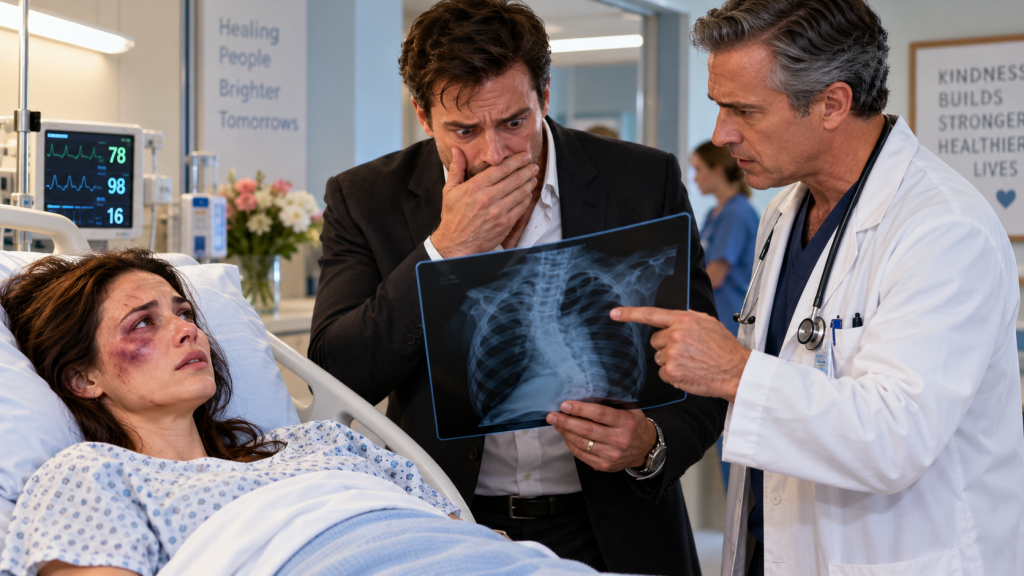
Then he lifted the X-ray film.
“And these.”
He pointed to several places.
Fresh rib fractures.
Older rib fractures.
A badly healed wrist.
Evidence of previous injury around my shoulder.
Damage that had formed at different times.
Weeks apart.
Months apart.
My body had built a timeline without my permission.
Bone after bone quietly remembering what I had tried to forget.
Richard looked at me.
“Tell them.”
I stared.
His voice sharpened.
“Tell them you fell.”
I had heard that tone thousands of times.
Not always those words.
But the meaning.
Fix this.
Protect me.
Become smaller.
Make what I did disappear.
For years, I obeyed because I thought survival meant preventing the next explosion.
That afternoon, something changed.
Maybe because Emma was watching.
Maybe because a police officer stood between us.
Maybe because my bones had already spoken.
I looked directly at my husband.
Then said the first completely honest sentence I had said about our marriage in years.
“He did this to me.”
Richard’s face changed.
Not rage.
Not yet.
Disbelief.
He had built his life around the assumption that I would always be more afraid of what happened after speaking than what happened if I stayed silent.
And suddenly I wasn’t.
“He’s been hitting me for years.”
I said.
Emma sobbed.
The doctor lowered his eyes for a moment.
The officer asked:
“When you say years, approximately how long?”
I tried to answer.
My throat closed.
Richard snapped:
“This is ridiculous.”
The second officer entered.
“Turn around, sir.”
“What?”
“Turn around.”
Richard laughed.
“You can’t arrest me because my wife is emotional.”
The officer’s expression did not change.
“I said turn around.”
Then Richard looked at me.
There he was.
The man I knew.
The softness vanished.
“You’re going to regret this.”
Every person in the room heard him.
The first officer looked almost tired.
“Thank you.”
he said.
Richard blinked.
“For what?”
“For saying that in front of us.”
Then they put him in handcuffs.
I expected triumph.
Instead I began shaking.
Violently.
My teeth knocked together.
My heart raced so hard I thought something else inside me had broken.
The doctor came closer.
“You’re safe here.”
Safe.
A simple word.
My body did not believe it.
That is something people do not tell you about leaving fear.
The door can close behind the person hurting you and your nervous system may keep running for miles.
Richard was led past my daughters.
My younger child, Sophie, stood behind a nurse.
Eight years old.
She did not cry.
That frightened me.
She only stared at her father.
He tried to stop.
“Sophie.”
The officer kept him moving.
“I love you.”
My daughter said nothing.
The doors shut.
Only then did she run to me.
The pain when she hugged me was terrible.
Broken ribs do not care about emotional moments.
I gasped.
She jumped backward.
“I hurt you.”
“No.”
I reached toward her.
“Come here carefully.”
She crawled beside me without pressing against my chest.
Then whispered:
“Is Daddy coming home?”
I looked toward the hospital social worker who had entered quietly.
Then at Emma.
Then back at Sophie.
“No.”
I said.
I had no idea whether that was legally guaranteed.
No idea where we would sleep.
No idea what Richard’s mother would do.
No idea what money I could access.
But one thing suddenly felt certain.
“I’m not taking us back there tonight.”
That promise I could keep.
My mother-in-law arrived forty minutes later.
Her name was Beatrice.
She walked into the hospital clutching the same rosary beads she had held inside our house while her son beat me in the yard.
The moment she saw the police officer, she began crying.
Not for me.
For Richard.
“What have you done?”
she asked.
I stared at her.
The question was so perfectly wrong that for a second I could not answer.
Emma did.
“Dad hurt Mom.”
Beatrice turned.
“Your father loses his temper.”
Emma’s face changed.
Children know when adults try to repaint something they witnessed.
“He was kicking her.”
“Emma, this is not something children understand.”
My daughter stood.
“I understand kicking.”
The room went quiet.
Beatrice tightened the rosary around her fingers.
“Your mother should not have involved the police.”
I looked at the woman who had heard me scream through an open kitchen window.
“You were there.”
She looked away.
“You knew.”
“He gets angry.”
“You knew.”
“I prayed for both of you.”
My voice came out almost calm.
“I did not need you to pray while he hit me.”
She flinched.
I continued.
“I needed you to open the door.”
Her mouth trembled.
“You don’t understand a mother’s position.”
I almost laughed.
“A mother’s position?”
I looked at my daughters.
Then back at her.
“I understand it now.”
That ended the conversation.
Hospital staff asked Beatrice to leave after she began insisting Richard had been provoked.
She did not go quietly.
But she went.
For the first time since I married her son, I watched someone tell her no and refuse to negotiate.
Another lesson.
A domestic-violence advocate arrived before evening.
Her name was Tasha.
I expected pity.
Instead she brought information.
That helped more.
She explained options.
Not commands.
A protective order could be requested.
Police would document Emma’s recording.
The hospital would preserve imaging and photographs according to procedure.
Because the children had witnessed violence, child-protection professionals might speak with us—not because I was being accused of hurting them, she emphasized, but because their safety mattered too.
We could stay somewhere confidential.
I did not have to return to the house that night for clothes.
Officers could later assist with retrieving essentials if necessary.
My head spun.
Forms.
Words.
Safety plan.
Passwords.
Bank accounts.
Medication.
School pickup.
Emergency contacts.
For years, Richard had reduced my life to surviving mornings.
Suddenly I was expected to imagine next week.
Freedom can be overwhelming when fear has made your world very small.
“I don’t have money.”
I whispered.
Tasha looked at me.
“Do you have access to any joint accounts?”
“Richard controls them.”
“Do you work?”
“Not anymore.”
“What did you do before?”
I almost did not remember.
“Payroll.”
“For a construction company.”
“How long ago?”
“Eleven years.”
She nodded.
Not pity.
Information.
“Okay.”
Okay.
As if eleven lost years did not make me unemployable.
As if my life could still contain verbs other than endure.
That night, my daughters and I slept in a secure family room arranged through an advocacy program connected to the hospital.
I did not sleep.
Every sound made me sit upright.
A cart in the hallway.
A door shutting.
Footsteps.
My body expected Richard.
Emma slept curled toward the wall.
Sophie clutched my sleeve.
At 3:16 in the morning, I realized something terrible.
It was the first night in years that I knew no one would hit me before breakfast.
I should have felt peaceful.
Instead, I was terrified.
Fear had become so familiar that its absence felt suspicious.
The next morning, a nurse brought cereal for the girls and coffee for me.
I cried over the coffee.
She probably thought I was in pain.
I was.
Just not the kind morphine fixes.
No one had demanded breakfast.
No one had inspected the eggs.
No one had thrown a cup because the coffee was too cold.
A paper cup with a plastic lid became evidence that morning could exist without punishment.
I kept the sleeve from that cup for years.
Ridiculous.
Sacred.
Sometimes those are the same thing.
Emma’s recording was worse than I knew.
I did not watch it.
Not then.
The police took a copy.
My attorney later reviewed it.
The prosecutor reviewed it.
A therapist advised me not to expose myself to it unnecessarily.
I listened to that advice.
For once, evidence did not require me to relive pain to make other people believe it.
Emma had recorded from her upstairs bedroom after hearing Richard yelling.
The video captured part of the yard.
Not every blow.
Enough.
More importantly, the audio captured his voice.
“You’re worthless.”
“Two girls.”
“What good are you?”
Then my scream.
Then silence.
Then Emma whispering behind the camera:
“Mom?”
That whisper appeared in my dreams for years.
Police also spoke with the neighbors.
At first, several claimed they had never seen anything.
That hurt.
Then one woman came forward.
Mrs. Alvarez.
She lived behind us.
Sixty-three.
Retired teacher.
She had heard the screaming.
Many times.
Twice she had almost called police.
Once she even dialed 911 and hung up before the call connected.
She cried while telling investigators.
“I was afraid I’d make it worse.”
I understood the sentence.
I hated it too.
Her doorbell camera had captured audio from several mornings.
Nothing as clear as Emma’s video.
But enough to establish that screaming and threats were not confined to one incident.
Another neighbor eventually admitted he had seen Richard shove me near the fence months earlier.
A third refused to cooperate.
Silence remained part of the story.
Not everyone becomes brave when truth offers them the chance.
I stayed in the hospital four days.
Two broken ribs.
Concussion.
Deep bruising.
Shoulder injury.
No surgery.
The doctors were worried about my breathing because rib pain made me avoid deep breaths.
They taught me how to brace myself when coughing.
How strange.
My body had spent years learning how to protect itself from a man.
Now professionals were teaching it how to heal from him.
Before discharge, the social worker asked where I wanted to go.
Not:
Where should you go?
Where do you want to go?
I cried before answering.
“A shelter.”
The word embarrassed me.
She did not let it.
“Okay.”
There it was again.
Okay.
The shelter did not look like television.
No giant dormitory.
No dramatic gates.
It was an ordinary building in an ordinary part of the city whose address I was asked not to share.
The room had two beds and a pullout chair.
A little dresser.
A lamp.
The girls complained about the Wi-Fi.
I nearly laughed.
Children can normalize survival faster than adults.
On our second night, Sophie asked:
“Are we poor now?”
I looked at her.
“We have less access to money right now.”
“That means yes.”
Emma rolled her eyes.
I smiled despite myself.
“We are safe.”
Sophie frowned.
“That’s not money.”
“No.”
“It isn’t.”
She thought.
Then:
“Can safe buy cereal?”
I laughed for the first time since the hospital.
“Yes.”
“We have cereal.”
“Then okay.”
Eight-year-old economics.
We requested a protective order.
The temporary order came first.
Then a hearing.
I dreaded seeing Richard.
My attorney arranged for me to wait separately.
A victim advocate stayed beside me.
Richard appeared in court wearing a suit.
Of course.
He looked good.
That almost broke me.
People expect monsters to look visibly monstrous.
Richard looked like a man who might help someone carry groceries.
That had always been part of the problem.
His lawyer argued there had been marital conflict.
Mutual tension.
Stress over finances.
My “mental state.”
The phrase made my stomach turn.
There are few weapons more effective against abused women than using their fear as evidence that they are unstable.
But records existed now.
X-rays.
Photographs.
The video.
Hospital notes.
Threats witnessed by officers.
Patterns.
The court granted the protective order.
Custody issues would be handled separately.
Richard was prohibited from contacting me except through approved legal channels.
He could not come to my temporary residence.
Could not appear at the girls’ school.
Could not use Beatrice to carry messages.
On paper, several lines.
In my body, a continent.
He violated the spirit almost immediately.
Not directly.
Flowers arrived at the shelter’s administrative office.
No sender.
The card:
I forgive you. Come home.
Tasha read it first.
Then looked at me.
“He knows the shelter?”
My blood went cold.
The address was confidential.
Investigation showed the flowers had been sent to the advocacy organization’s public office, not the residence itself.
Richard did not know where we slept.
Still, the message terrified me.
I forgive you.
That was Richard.
Even begging had to make me guilty.
The flowers went into the trash.
The card went to my attorney.
Then Beatrice called from another number.
I did not answer.
Voicemail.
“Please think of your girls.”
I listened once.
Then deleted it after saving a copy for counsel.
For years, people had told women to think of their children as a reason to stay.
Now thinking of mine was exactly why I could not go back.
Child custody became the hardest part emotionally.
Richard was their father.
That sentence did not disappear because he abused me.
But his violence happened in front of them.
Emma had recorded it.
Both girls described being afraid of him.
The court ordered professionally supervised contact while evaluations were completed.
Emma refused to go at first.
Her therapist helped her express why.
No one forced an immediate emotional reunion.
Sophie went twice.
Then came home silent.
On the third scheduled visit, she said:
“I don’t want to.”
I knelt despite my ribs still hurting.
“Why?”
She shrugged.
Then whispered:
“Daddy keeps saying you made the police steal him.”
There it was.
The story.
Richard had lost access to my body, so he was trying to reach me through the children.
We documented it.
The supervisor had heard similar comments.
Visits were paused pending further review.
Consequences.
Not revenge.
The criminal case moved slowly.
Far too slowly for the part of me that had finally started telling the truth.
Months.
Continuances.
Interviews.
Evidence review.
Richard initially denied everything.
Then claimed self-defense.
That did not fit the injuries.
Then claimed I had attacked him emotionally until he “snapped.”
As though cruelty could convert a beating into a reflex.
His lawyer eventually stopped repeating that publicly.
Good.
The prosecutor met with me six months after the hospital.
Her name was Lena Ortiz.
She explained what they could prove.
What was difficult.
What charges were supported by current evidence.
Some older assaults had never been reported.
No photographs.
No dates.
Only healed bones.
Powerful corroboration.
Not necessarily enough to charge every historical incident separately.
The current assault was different.
Recent.
Recorded.
Medically documented.
Witnessed in its aftermath.
Richard’s threats at the hospital mattered too.
The state pursued felony family-violence and assault charges based on the evidence and severity.
I asked:
“Will Emma have to testify?”
“Possibly.”
My stomach turned.
Lena continued.
“But we will look at alternatives and prepare carefully.”
I hated that my daughter had become evidence.
Then hated myself for phrasing it that way.
Emma was not evidence.
Her recording was.
She was a child.
I repeated that distinction until I believed it.
Richard eventually accepted a plea rather than go to trial.
Not immediately.
He waited until jury selection was approaching.
Classic.
The plea included a felony conviction, prison time, and conditions restricting contact afterward.
The sentence was not the rest of his life.
Some people were angry about that.
I understood.
But I had stopped imagining punishment as the thing that would heal me.
Prison could keep him away.
A conviction could name what happened.
Neither could return my daughters’ childhood.
That work belonged elsewhere.
At sentencing, I gave a statement.
I almost did not.
Then Emma asked:
“Will he hear you?”
“Yes.”
“Then say it.”
So I did.
I stood in a courtroom.
No backyard.
No breakfast waiting.
No walls close enough to trap sound.
Richard sat at the defense table.
He looked smaller.
Not physically.
Power does that when it stops working.
I had written six pages.
Read three sentences.
“Richard told me for years that I was useless because I did not give him a son.”
My hands shook.
“I believed him long enough to apologize for giving birth to two daughters who were never anything except beautiful.”
Then I looked directly at him.
“The greatest damage you did was not making me afraid of you.”
My voice broke.
“It was making my girls wonder whether being girls made them less worthy of love.”
Silence.
I continued.
“You do not get to teach them that anymore.”
Then I sat.
That was enough.
Richard never apologized in court.
He said he regretted “how things escalated.”
I almost laughed.
Escalated.
As though violence had climbed stairs without him.
The judge did not comment on sincerity.
Neither did I.
An apology you must edit into meaning is not useful.
Beatrice attended every hearing.
She sat behind her son.
Rosary in hand.
At first, I hated her more than him some days.
That embarrassed me.
Then my therapist asked why.
I knew.
Richard had hurt me openly.
Beatrice had watched.
There is a particular wound created by witnesses who decide suffering is someone else’s marriage.
Eight months after Richard went to prison, Beatrice wrote me.
My attorney asked whether I wanted the letter.
I almost said no.
Then yes.
The first sentence:
I have rewritten this letter fourteen times because every version begins with an excuse.
I kept reading.
She wrote about her own marriage.
Richard’s father had been controlling.
Not physically violent toward her, she claimed.
But angry.
Demanding.
Traditional.
She had been taught that a good wife protected a family’s reputation by absorbing discomfort quietly.
When Richard began treating me cruelly, she recognized things she had spent her entire life calling normal.
Instead of challenging him, she prayed.
Because prayer let her feel morally active without becoming personally brave.
That sentence stayed with me.
I told myself I was preserving a marriage.
she wrote.
I understand now that I was preserving access for the person causing harm.
Then:
You asked why I did not open the door. The truth is that I was afraid my son would turn his anger on me. I chose my safety while watching you lose yours. I am ashamed.
No request for forgiveness.
Better.
I did not answer for seven months.
Then sent four lines.
I received your letter.
I believe you understand some of what you did.
The girls are not ready for contact.
If that changes, it will be their choice.
That was all.
Money became an immediate problem.
Richard had controlled everything.
But control is not the same thing as ownership.
With legal help, I gained access to marital resources through temporary court orders.
Support was addressed.
The house became part of divorce proceedings.
Accounts were identified.
Not every dollar was available quickly.
Real separation contains paperwork.
Annoying.
Necessary.
I found work before the divorce finished.
Part-time payroll assistant.
A commercial plumbing company.
The irony pleased me because our fake birthday-party emergency had been “plumbing.”
My first paycheck was not large.
I stared at it for several minutes.
Money earned under my name.
Deposited into an account Richard could not see.
I bought three things.
Groceries.
School shoes for Sophie.
And a tiny pot of yellow flowers.
No reason.
I simply wanted something pretty nobody could accuse me of wasting money on.
The flowers sat on the windowsill of our small rental apartment.
I watered them too much.
They died.
Freedom has a learning curve.
The apartment had two bedrooms.
The girls shared.
They hated that at first.
Then transformed their room into something so chaotic I stopped entering without permission.
I slept in the smaller room.
The first month, I moved my bed against the door.
I knew Richard did not know our address.
Still did it.
Then one night, I realized the bed had returned to its proper place after I vacuumed.
I never moved it back.
Healing sometimes happens before you recognize the milestone.
Morning remained the hardest.
For years, morning meant footsteps.
A door opening.
Richard’s mood.
The backyard.
I woke before dawn even after leaving.
Heart racing.
Waiting.
On the first anniversary of the hospital, I woke at 5:37.
Same hour he used to drag me outside.
I lay in bed.
Nothing happened.
The refrigerator hummed.
A car passed outside.
Somewhere upstairs, a neighbor dropped something.
Then Emma knocked softly.
“Mom?”
I sat up.
She entered carrying two mugs.
Coffee for me.
Hot chocolate for her.
She sat beside me.
Neither of us mentioned the date.
After a while, she said:
“Do you remember when mornings were bad?”
“Yes.”
“Me too.”
My throat tightened.
Then she looked toward the window.
“They’re not anymore.”
No.
They weren’t.
Therapy helped the girls differently.
Sophie talked immediately.
Endless questions.
Why did Dad hate girls?
Would he have loved us if we were boys?
Was Mom going to get hurt by someone else?
Can people tell who is dangerous before marrying them?
Each question cut somewhere new.
One night, she asked the worst one.
“Was I the reason Daddy hit you?”
I dropped the dish towel.
“No.”
“He wanted a boy.”
“No.”
“But I’m a girl.”
I knelt.
Looked directly into her eyes.
“Listen to me.”
She did.
“You being a girl did not cause your father’s violence.”
“Emma being a girl did not cause it.”
“My body did not cause it.”
“Your father chose to hurt me.”
“Again and again.”
“That choice belongs to him.”
She cried.
Then:
“If I was a boy, would he be nice?”
I hated Richard in that moment with a purity I had not felt even in the hospital.
“I don’t know.”
I said honestly.
“But anyone whose kindness depends on whether their child is a boy or girl does not understand what love is supposed to be.”
She leaned against me.
I held her.
Carefully.
My ribs had healed by then.
Other things had not.
Emma barely spoke in therapy at first.
She drew.
Doors.
Windows.
Phones.
Always a figure behind glass.
Then one day her therapist asked whether she wanted me to see a drawing.
Emma said yes.
It showed our old backyard.
A small girl upstairs holding a phone.
A woman on the ground.
And a huge black shape where Richard stood.
In the corner, she had written:
I should have gone outside.
I cried.
Then sat beside her.
“No.”
She looked at me.
“I should have helped you.”
“You did.”
“Too late.”
“No.”
“Emma, look at me.”
She did.
“You were eleven.”
“I was your mother.”
“It was my responsibility to protect you.”
“Not your responsibility to rescue me.”
“But I recorded him.”
“Yes.”
“And that mattered.”
“Yes.”
“But you never should have had to.”
She cried against me for almost an hour.
Guilt leaves children slowly.
Sometimes adults too.
The divorce became final nineteen months after the hospital.
No dramatic courtroom victory.
Signatures.
Orders.
Property division.
Custody provisions.
Restrictions.
A clerk stamping documents.
I walked outside holding a folder that ended fifteen years of marriage.
Rain.
Of course.
Apparently major life disasters and weather had an agreement.
I stood beneath the courthouse awning.
My attorney asked:
“How do you feel?”
I considered.
“Hungry.”
She laughed.
We got tacos.
Best divorce celebration imaginable.
I changed my last name back to the name I had before Richard.
Emma and Sophie asked if they should change theirs.
I said:
“Only if you want to.”
They kept his.
At first, that hurt.
Then I asked myself why.
Their name belonged to them too.
Richard did not own every syllable he shared with his children.
Another thing I learned.
You do not heal by letting the person who harmed you continue defining what ordinary things are allowed to mean.
Richard wrote the girls from prison.
Letters were screened according to the orders in place.
Emma refused them.
Sophie read one at fourteen.
Then another.
Then stopped.
I did not choose for either child.
By then they were old enough to work through decisions with therapists and their legal advocates.
My role was no longer to decide what truth they could survive.
I had learned the danger of that kind of love.
Years passed.
Not magically.
Slowly.
The way most healing happens.
I became full-time at the plumbing company.
Then payroll supervisor.
Then office manager.
The owner, Mr. Chen, once asked why I flinched when someone raised his voice in the warehouse.
I expected embarrassment.
Instead I told him:
“Old history.”
He nodded.
Then instituted a policy against screaming at staff during disputes.
Not because of me alone, he said.
Because workplaces should not depend on employees tolerating intimidation.
I liked him for that.
At forty-six, I enrolled in evening accounting courses.
Not because I dreamed of becoming wealthy.
Because I wanted to know what numbers Richard had once kept hidden.
Knowledge felt like replacing locks.
I completed the certificate at forty-eight.
Emma and Sophie came to the ceremony.
They brought yellow flowers.
Alive this time.
I dated exactly once before fifty.
Terrible.
He complained that his ex-wife was “crazy” within eight minutes.
I finished dinner politely.
Then never answered another call.
Progress can be very efficient.
The second man I dated was named Daniel.
That terrified me because kindness initially felt suspicious.
He asked before touching my hand.
I found it irritating.
Then realized irritation was grief wearing armor.
We went slowly.
Very slowly.
When he raised his voice at a football game, I froze.
He noticed.
Stopped.
Later asked:
“Was that frightening?”
I said yes.
He did not explain why I should not have been afraid.
He apologized.
Then behaved differently.
That mattered more.
I never married him.
We remained together for twelve years.
Separate homes for the first four.
Then one.
No ceremony needed.
He died from a heart attack at sixty-three.
I grieved him terribly.
Clean grief.
No fear inside it.
That distinction taught me what love had always been supposed to feel like.
Loss hurt.
Love had not.
Richard was released years earlier than the girls expected and later completed supervision.
I received notice before release.
By then Emma was in college.
Sophie finishing high school.
Both adults or nearly so.
We updated safety plans anyway.
Not because we lived in terror.
Because preparation is different from fear.
I had learned that too.
Richard requested contact with me once through counsel.
I declined.
He sent a letter.
My attorney asked whether I wanted it.
Curiosity won.
The first paragraph blamed childhood.
The second blamed his father.
The third blamed cultural expectations about sons.
I almost stopped.
Then the fourth changed.
None of those things lifted my hand. I did.
I kept reading.
He wrote that prison counseling had forced him to say the word abuse without adding “but.”
Abuse.
Not temper.
Not marital conflict.
Not frustration.
He said he had spent years believing masculinity meant control.
That daughters made him feel publicly diminished because he had built his identity around proving he could produce a male heir.
The sentence looked ridiculous on paper.
Good.
Some beliefs deserve to look ridiculous.
Then:
I punished you for biology I did not understand and entitlement I did not question.
I nearly laughed.
Then cried.
He wrote:
The most shameful part is that I knew you were afraid. I used that knowledge intentionally.
There.
That was the line.
Not:
I lost control.
Not:
I snapped.
He had used fear.
On purpose.
Finally named.
He did not ask me to return.
Thank God.
He asked whether I would ever tell the girls he was sorry.
I wrote back once.
One sentence.
You may apologize to them through the channels they choose, if they ever choose them.
No more.
Emma eventually read his apology when she was twenty-five.
Sophie did not.
Different daughters.
Different boundaries.
I supported both.
Beatrice lived long enough to see the girls become adults.
When Emma was twenty-two, she agreed to meet her grandmother.
Public place.
I did not attend.
Later Emma told me Beatrice cried immediately.
“I hated that.”
she said.
“Why?”
“Because I started comforting her.”
I knew that reflex.
Inherited through women.
“What did you do?”
“Stopped.”
Good.
Beatrice told Emma she had always loved them.
Emma answered:
“You loved Dad more than you protected us.”
That sentence stayed with Beatrice.
Two years later she wrote it in a final letter before she died.
Your daughter told me I loved my son more than I protected the people he hurt. She was right. I confused loyalty with goodness.
I kept the letter.
Not as forgiveness.
As evidence that sometimes truth enters very late.
Late truth is still truth.
It simply cannot refund time.
When Beatrice died, Sophie chose not to attend the funeral.
Emma went.
I stayed home.
No one owed sameness.
My daughters grew into women Richard would never have known how to understand.
Emma became a public-school art teacher.
For years I assumed the recording would push her toward law enforcement.
It didn’t.
Thank God.
Trauma does not need to become a career assignment.
She loved color.
Children.
Messy classrooms.
She married a quiet man named Luis who cried at their wedding without shame.
The first time I saw him wash dishes while Emma sat on the couch grading papers, I nearly cried.
Ordinary equality can look miraculous after control.
Sophie became an engineer.
Not because anyone told her girls could do anything.
She hated slogans.
She simply liked bridges.
When she was twenty-seven, a colleague told her she was “too aggressive” in meetings.
She called me furious.
I smiled.
“What?”
she demanded.
“Nothing.”
“You’re smiling.”
“I am.”
“Why?”
Because my daughter had grown from a child asking whether being a girl caused violence into a woman annoyed by a mediocre man’s vocabulary.
“Because you sound strong.”
She groaned.
“Mom.”
Fine.
I stopped.
Mostly.
Neither daughter gave me grandchildren immediately.
People asked whether that bothered me.
No.
Their bodies were not family obligations.
I had learned that lesson at a brutal price.
When Emma eventually had a daughter, I held that baby and thought of Richard saying girls were useless.
I looked at the tiny face.
Perfect.
Not because she was mine.
Because she existed.
No child arrives owing anyone the correct sex.
The thought should not have felt revolutionary.
In our family, it did.
Emma named her Grace.
When Grace was four, she once asked:
“Why don’t you have a husband?”
Daniel had died by then.
I said:
“I did.”
“Where is he?”
“He died.”
She looked horrified.
Then:
“Did you have another husband before?”
Children are investigators.
“Yes.”
“What happened?”
I looked at Emma.
She nodded.
Age-appropriate truth.
“He hurt me.”
Grace frowned.
“So you left?”
“Yes.”
She accepted that immediately.
“So you can leave people who hurt you?”
I almost could not answer.
“Yes.”
My voice broke.
“Yes, sweetheart.”
She returned to coloring.
A truth that had taken me years to learn required six seconds for a child to understand when no one taught her otherwise.
That might have been the most healing moment of my life.
The old house was sold as part of the divorce.
For years I avoided that neighborhood.
Then one afternoon, decades later, I drove through.
Not intentionally.
Road construction.
Detour.
Suddenly there it was.
Different paint.
New fence.
Children’s bicycles near the garage.
The backyard visible through the side gate.
My hands tightened on the steering wheel.
I expected panic.
Instead, I saw something strange.
Laundry.
White sheets moving in sunlight.
That was all.
The yard where I once believed I might die had become somewhere another family dried laundry.
Places do not remember us the way bodies do.
Sometimes that is mercy.
I did not stop.
Did not need to.
My X-rays remained in my medical record.
I saw one years later when a doctor reviewed my history.
The old fractures had healed.
Not vanished.
Healed.
There is a difference.
Bone does not return to never-broken.
It repairs.
Changes.
Strength forms around damage.
Sometimes unevenly.
Sometimes painfully.
But repair does not require pretending there was never a fracture.
I liked that.
It felt more honest than every inspirational quote about becoming “whole again.”
I had never stopped being whole.
I had been injured.
Then I healed.
Different.
Still whole.
For years people called me brave for finally telling the doctor the truth.
That bothered me.
Not because courage had nothing to do with it.
Because it made the years before sound cowardly.
I survived using the tools I had.
Silence.
Compliance.
Hypervigilance.
Reading moods.
Making myself small.
Those behaviors kept me alive until better options became reachable.
Then, when the door opened, I used a different tool.
My voice.
I do not shame the woman who could not speak earlier.
She was working very hard to stay alive.
I also stopped romanticizing the moment I left.
The hospital was not freedom.
It was the beginning of logistics.
Documents.
Therapy.
Court.
Nightmares.
Bills.
Children angry at me for things that were not my fault.
Children defending their father some days and hating him others.
Loneliness.
Embarrassment.
Learning passwords.
Opening a bank account.
Explaining employment gaps.
Crying in grocery-store parking lots.
Leaving abuse is not a finish line.
Sometimes it is the first mile of a road you cannot yet see.
Still worth walking.
The neighbors stayed with me too.
Especially the closed blinds.
For years I thought:
How could they?
Eventually I understood some were afraid.
Some uncertain.
Some convinced it was “private.”
Some did not want trouble.
Understanding did not erase responsibility.
Silence protects whoever already has power.
That became one of the few lessons I spoke about publicly.
Not my entire story.
Just that.
If you hear someone screaming for help, do not close the window because intervening feels uncomfortable.
Call someone.
Document safely if appropriate.
Do not confront a violent person recklessly.
But do something.
Prayer and concern are not substitutes for action when another person is in danger.
Beatrice taught me that by doing the opposite.
Mrs. Alvarez apologized to me years later.
In person.
She cried.
“I should have called.”
“Yes.”
I said.
She looked shocked.
Most people expect forgiveness to begin with:
It’s okay.
It was not okay.
I continued.
“I also understand you were scared.”
She nodded.
“I still should have called.”
“Yes.”
We hugged.
Truth can be compassionate without lying.
Richard died when he was sixty-eight.
A stroke.
I learned through Emma.
She had received notice from a distant relative.
By then, neither daughter had spoken to him in years.
I sat at my kitchen table.
Waited for something.
Relief.
Anger.
Grief.
Nothing arrived immediately.
Then, slowly, sadness.
Not for the marriage.
For waste.
A man had been given two beautiful daughters and a wife who once loved him.
He had treated love like hierarchy.
Turned home into fear.
Spent years blaming women for failing to produce a boy, when the real failure was that he had never learned how to receive the family he already had.
What a waste.
I did not attend the funeral.
Emma did not.
Sophie did.
That surprised me.
“Why?”
I asked.
She shrugged.
“I wanted to see the ending.”
Fair.
When she returned, she sat at my table.
“How was it?”
“Small.”
She looked out the window.
“Grandma used to say Dad wanted a son to carry his name.”
I waited.
Sophie smiled sadly.
“Hardly anyone there had his name.”
Then:
“Funny thing to hurt people for.”
Yes.
Terrible.
Funny in the bleak way some human obsessions become once time reveals their size.
She had taken one thing from the funeral.
A photograph.
Richard holding Emma as a baby.
He was smiling.
Really smiling.
“You want it?”
she asked.
I stared.
My first instinct was no.
Then I took it.
For years, I had wanted Richard to be simple.
Monster.
Easier.
But he had once held his daughter tenderly.
Later he terrorized the same family.
The photograph did not excuse him.
It complicated memory.
Human beings are capable of tenderness and cruelty.
The existence of one does not erase responsibility for the other.
I kept the photograph.
Gave it to Emma later.
Her history belonged to her.
I am seventy-three now.
My daughters tease me for still waking early.
The habit never left.
But morning belongs to me.
That is the difference.
I wake.
Make coffee.
Open curtains.
Every curtain.
That part is deliberate.
Sunlight enters every room.
No blinds closed against screaming.
No footsteps determining my heartbeat.
No breakfast cooked under threat.
Some mornings Grace visits before school.
She talks endlessly.
Sometimes Sophie calls during her commute.
Emma sends photographs of student artwork.
Ordinary noise.
I love it.
My ribs ache when the weather turns cold.
Doctors say old injuries can do that.
The wrist Richard broke never bends quite right.
I notice when opening jars.
For years, those pains felt like evidence he still owned part of my body.
Now they feel different.
Records.
Like the X-rays.
My body remembers.
But remembering is not obeying.
I still think about the doctor.
I learned his name was Dr. Samuel Reed—no, better avoid cross-story name collision. Dr. Aaron Patel.
Years after the hospital, I wrote him a letter.
Not dramatic.
Just thank you.
I told him the girls were safe.
I was working.
The divorce was final.
I thanked him for saying:
“Your wife did not get these injuries from falling down the stairs.”
Because until that moment, I had almost convinced myself the truth required my permission to exist.
It didn’t.
My injuries existed whether I named them or not.
He wrote back.
Short.
You saved yourself when you chose to speak. I was simply there to listen.
I disagreed slightly.
Listening mattered.
Still, I kept the letter.
I wrote Emma one too.
On her thirtieth birthday.
She had long since stopped thinking about the phone as heroic.
Good.
Children should not carry medals for surviving their parents.
But I wanted her to know something.
You did not save me because you recorded your father.
You were a child who did one brave thing in a frightening moment.
The adults around you were responsible for what happened next.
Please never confuse love with responsibility for rescuing another person.
She called crying.
“Mom.”
“What?”
“You always write like you’re dying.”
“I’m seventy.”
“Stop.”
I laughed.
Alive.
Still.
I wrote Sophie a different letter.
You were never the wrong child.
Your sister was never the wrong child.
I was never the wrong wife because I gave birth to girls.
Your father’s entitlement was his failure, not ours.
She framed that line.
Of course the engineer frames one sentence.
Efficiency.
Sometimes people ask whether I forgave Richard.
I no longer answer yes or no.
Those words are too small.
I stopped wanting revenge.
Stopped waking angry.
Stopped imagining arguments I could finally win.
I hoped he became less dangerous before he died.
I never wanted him back.
Never trusted him again.
Never excused him.
If that is forgiveness, fine.
If it is not, fine.
Peace does not need the correct vocabulary.
What mattered more was forgiving myself.
For staying.
For lying to doctors before that day.
For telling Emma once that Daddy was “just stressed.”
For telling Sophie not to make noise when he slept.
For cooking breakfast after being beaten.
For hiding bruises.
For thinking money made leaving impossible.
For thinking children needed a father more than they needed safety.
I carried those accusations against myself longer than Richard’s lawyers ever could.
Therapy slowly dismantled them.
Not by telling me every choice had been perfect.
Some were not.
By teaching me that a trapped person makes decisions inside the size of the trap they can currently see.
As the trap becomes visible, choices widen.
Mine eventually did.
The final piece came from Grace.
She was nine.
Same age Sophie had been around the worst years.
We were baking cookies.
She spilled flour everywhere.
I laughed.
She looked at me suspiciously.
“What?”
“Nothing.”
“You’re weird, Grandma.”
“Correct.”
Then she said:
“Mom says when she was little, you were scared a lot.”
I stopped.
Children eventually find family history.
“Yes.”
“Are you scared now?”
I thought.
Sometimes.
Storms.
Medical tests.
Losing people.
Ordinary fear.
“Not like then.”
“What changed?”
I looked at my granddaughter.
The answer could have been:
The doctor.
Police.
X-rays.
Emma’s recording.
Court.
Shelter.
Money.
Time.
Therapy.
All true.
Instead I said:
“I learned that someone loving me does not give them permission to hurt me.”
Grace frowned.
“That seems obvious.”
I laughed.
Then cried.
She panicked.
“Why are you crying?”
“Because I’m glad it seems obvious to you.”
She shrugged.
Then returned to the cookies.
And that was the inheritance I wanted.
Not money.
Not trauma transformed into mythology.
Obviousness.
A little girl who heard:
People who love you do not get to hurt you.
And thought:
Of course.
That was the ending.
Not Richard in handcuffs.
Not a prison sentence.
Not the divorce.
Not his apology.
Not even my daughters becoming happy adults.
The ending was a child in a flour-covered kitchen finding safety so ordinary she could not understand why anyone would debate it.
That was what all the years had been for.
When I think back to the hospital now, I see Richard holding the X-ray film.
His hands shaking.
His face pale.
He thought the frightening thing on that image was evidence.
Old fractures.
Fresh fractures.
A body documenting what he had done.
He was partly right.
But the X-ray revealed something else too.
Something neither of us understood yet.
My bones had healed before.
Again and again.
Crookedly sometimes.
Painfully.
Silently.
But they had healed.
The film Richard feared was not merely a record of what he had broken.
It was proof that my body had been trying to repair itself all along.
Soon, the rest of me would begin doing the same.
The morning after I left him, no one hit me.
The morning after that, no one hit me.
Then a week.
A month.
A year.
At first, I counted.
Eventually, I stopped.
Safety had become normal.
That may be the greatest miracle of my life.
Not that I survived violence.
That one day I no longer organized time around its absence.
I used to wake before sunrise and pray:
Please let it end quickly.
Now I wake before sunrise and open every curtain.
I make coffee.
I breathe without protecting my ribs.
I stand in my own kitchen.
Sometimes alone.
Sometimes surrounded by daughters and grandchildren and too much noise.
And I think about the woman curled in the dirt who believed the only future available to her was surviving until breakfast.
I wish I could reach backward.
Not to shame her.
Not to tell her why she should have left sooner.
Just to kneel beside her.
Cover her with something warm.
And whisper:
There will come a morning when nobody hurts you.
Then another.
Then another.
And one day, you will stop counting.
THE END STORIES! THANK YOU FOR READING GOOD LUCK !❤️
Related Posts