➡️ PART 3 — THE NAME ON THE SLIPS
“She told me the money belonged to her son anyway.”
For one second, the courtroom seemed to lose all sound.
Then everyone spoke at once.
My husband twisted toward his mother.
“Mom?”
His lawyer stood.
“Your Honor, I think we need—”
The judge raised one hand.
Silence returned in pieces.
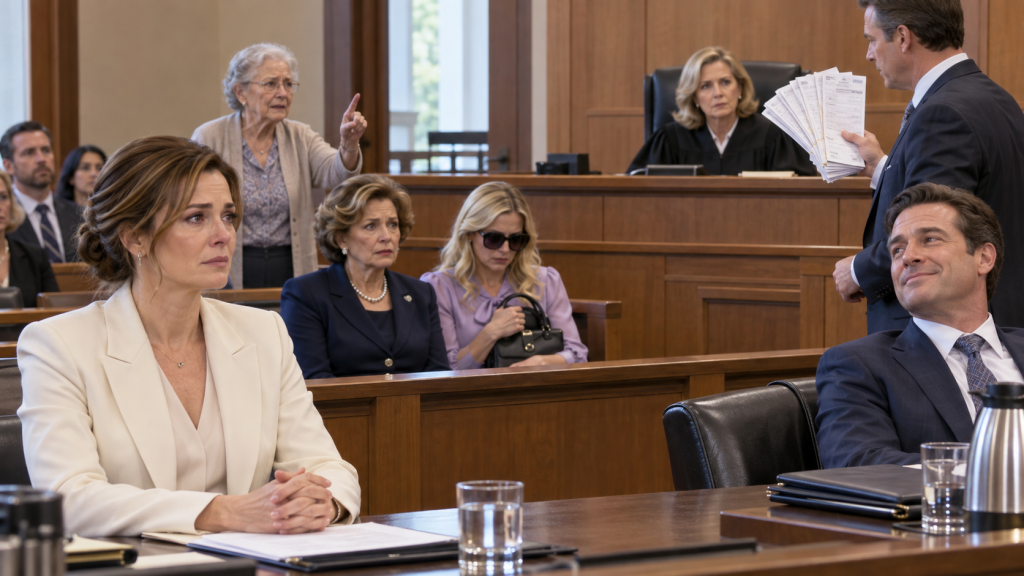
The blonde woman in the lavender blouse was crying now.
Not beautifully.
Not quietly.
Her mascara had started to run beneath the sunglasses she had finally removed.
My grandmother’s ring lay on the floor between the benches.
Green stone.
Two diamonds.
The same tiny scratch along the gold band where Grandma had caught it on a garden gate when I was twelve.
I knew that scratch.
I had traced it with my thumb a hundred times after she died.
I had cried when the ring disappeared.
My husband had told me I was forgetful.
His mother had told me nurses were always losing jewelry.
Now the ring sat under fluorescent courtroom lights like a small green witness.
“Do not touch anything.”
the judge said.
A bailiff moved toward the ring.
My husband’s mother—Linda Brooks—had gone so pale that even her lipstick looked too bright.
The judge looked at the blonde woman.
“Ma’am, state your name.”
Her lips trembled.
“Beth Collier.”
“Ms. Collier, you understand you may be describing conduct that could expose you to criminal liability.”
Beth’s face collapsed further.
Her attorney was nowhere in sight.
Because she had not come to court expecting to confess.
She had come to watch.
That detail mattered later.
At that moment, it frightened me.
My lawyer, Paula Grant, stood carefully.
“Your Honor, given what has just been stated, perhaps Ms. Collier should be advised not to answer further questions without counsel.”
The judge nodded.
“That is exactly what I was going to say.”
Then he looked toward the bailiff.
“Please ask courthouse security to contact law enforcement.”
My husband’s attorney closed his eyes.
Just briefly.
Long enough.
My husband—Nathan—looked at me.
For the first time all morning, the confidence was gone.
“You knew.”
he whispered.
I stared.
“No.”
He leaned closer.
“You set this up.”
That was almost funny.
Six months of being accused of stealing my own money, and somehow my husband’s first instinct was still to imagine I controlled the truth simply because it had finally arrived.
“I answered a phone call.”
I said.
“That’s all.”
The judge called a recess.
No one moved at first.
Then the room exploded into whispering.
Nathan stood.
His lawyer grabbed his arm.
“Sit back down.”
“My mother—”
“Sit down.”
He did.
That was new too.
Nathan had always treated instructions like suggestions when they came from women.
Apparently male attorneys charged enough to make obedience easier.
Linda turned toward Beth.
“What did you do?”
Beth stared at her.
The audacity of the question seemed to steady her.
“What did I do?”
Linda’s voice dropped.
“I told you to keep your mouth shut.”
The bailiff looked over immediately.
Paula looked at me.
I looked at Paula.
There are moments when people destroy themselves faster than any lawyer could hope to.
This was one.
“Mrs. Brooks.”
the bailiff said.
“Do not speak to her.”
Linda snapped her mouth closed.
Beth laughed.
One tiny, broken laugh.
Then she sat down hard.
Mrs. Wilkes was still standing near the second row.
The retired teller who had carried this truth alone since April.
Her knees were visibly shaking.
I walked toward her before anyone could stop me.
“Joyce.”
She looked at me.
“I’m sorry.”
I almost did not understand.
“For what?”
“I should’ve said something sooner.”
My throat tightened.
“You called.”
“I waited months.”
“You called.”
I repeated.
People who tell the truth late sometimes torture themselves as though late means meaningless.
It does not.
Late truth cannot refund time.
But it can still open a locked door.
She looked at the ring on the floor.
“I knew that ring.”
“I know.”
“I complimented her every time.”
My eyes filled.
“Grandma would’ve liked that.”
Joyce smiled sadly.
Then:
“She told me it had been in her family for years.”
I looked at Beth.
Of course she had.
That lie almost hurt more than the money.
The money had numbers.
The ring had hands.
Grandma’s hands.
Thin toward the end.
Veins blue beneath the skin.
She had pressed that emerald into my palm three weeks before she died and said:
“Wear something green when life gets gray.”
She always spoke like she expected to be quoted.
I had mocked her.
Then remembered every word.
Court security arrived.
Then two officers.
The judge returned briefly and announced the divorce hearing would be paused while the newly raised evidence was preserved and appropriate referrals were made.
No dramatic arrest happened in front of me.
Real courtrooms are less theatrical than people imagine.
Beth was escorted to another room to wait for counsel.
Linda was asked to remain available.
The ring was photographed and secured.
The withdrawal slips stayed with the court clerk under the judge’s direction until copies could be made for the relevant investigation.
My divorce did not suddenly transform into a criminal trial.
It simply stopped pretending the withdrawals were evidence against me.
That was enough for one morning.
Nathan followed me into the hallway.
His lawyer tried to stop him.
He ignored him.
“Angela.”
I kept walking.
“Angela.”
Paula stepped between us.
“Do not discuss this with my client.”
Nathan looked around her.
“You knew my mom had the ring?”
I stopped.
Not because he deserved an answer.
Because the question told me something.
He really had not recognized Beth.
That part had been genuine.
But ignorance of the impersonator did not mean innocence.
I had learned enough from nine years of nursing to know the difference between symptoms and cause.
“No.”
I said.
“Then why is everyone looking at me like I planned this?”
Paula answered.
“Perhaps because your lawyer just submitted forged withdrawals to accuse your wife of dissipating marital assets.”
Nathan’s face flushed.
“I didn’t forge anything.”
“Then this investigation may clarify that.”
“I thought she took it.”
He pointed at me.
“I thought Angela did.”
That sentence hit differently from the others.
Not because I believed it.
Because once, I would have desperately wanted to.
“You watched me cry over that money.”
I said.
He went still.
“You watched me call the bank.”
“You watched me tear apart the house looking for Grandma’s ring.”
“You told me I was losing my memory.”
His jaw tightened.
“Because that’s what it looked like.”
“No.”
I said.
“That’s what you needed it to look like.”
Then Paula touched my arm.
Enough.
We left.
Three hours later, my phone rang.
Unknown number.
I almost did not answer.
Paula nodded.
“Speaker.”
I answered.
A detective introduced himself.
He asked whether I could come in the next morning.
I said yes.
Then he asked one question.
“Mrs. Brooks, did you ever give your driver’s license to your mother-in-law?”
“No.”
“Did she ever have access to your home?”
I laughed.
A humorless sound.
“She had a key.”
Paula wrote something down.
The detective continued.
“Do you know a Beth Collier?”
“No.”
“Has your husband ever mentioned that name?”
“Never.”
“All right.”
Then:
“Do you still have your old phone?”
“Yes.”
“Your husband’s texts?”
“Yes.”
“Do not delete anything.”
My heart changed rhythm.
I looked at Paula.
“Why?”
The detective paused.
“Because Ms. Collier has requested an attorney and indicated there may be written communications relevant to how she was recruited.”
Recruited.
That word followed me home.
I did not sleep.
At 2:14 a.m., I sat on my kitchen floor.
Same spot where I had taken Joyce Wilkes’s call.
My life had changed twice on tile.
There was probably a metaphor in that.
I was too tired to find it.
The next morning, the detective showed me photographs.
Beth Collier.
Forty-nine.
Part-time bookkeeper.
Worked two days a week for a landscaping company.
Attended the same church as Linda.
That was the connection.
Not an affair.
Not a secret sister.
Not some glamorous criminal partnership.
Church.
Potlucks.
Christmas bazaars.
Women who sat three pews apart.
Ordinary proximity.
Most terrible things are built from ordinary materials.
Beth’s attorney eventually arranged a proffer.
I did not attend.
Paula explained afterward.
Linda had approached Beth in March.
Told her Nathan was in a bitter divorce.
Told her I had become unstable.
Told her I was moving money and planning to leave Nathan with nothing.
Beth had recently lost her bookkeeping job and needed cash.
Linda offered her five thousand dollars.
The job, she claimed, was simple.
Go into the bank pretending to be me.
Withdraw money from an account that “really belonged to Nathan.”
No one was being robbed, Linda said.
They were merely protecting a son from a vindictive wife.
Beth believed enough of it to participate.
Or wanted to.
Those are not the same thing.
Both matter.
How did she get my license?
That question destroyed what remained of my doubt.
Linda took it from my purse during Sunday dinner.
I remembered the day.
March ninth.
I had spent twenty minutes looking for the license the next morning.
Nathan had found it under the passenger seat of his truck.
Or said he had.
I had laughed at myself.
“I’m losing it.”
I told him.
He kissed my forehead.
“You work too much, Ang.”
That memory made me physically nauseated.
The license had not been under the truck seat.
Linda had taken it.
Had it copied.
Then returned the original through Nathan.
Whether Nathan knew that part was still unclear.
Then came Grandma’s ring.
Linda took that too.
Not because the bank needed it.
Because Beth wanted to look convincing.
Linda had seen the photograph on my license.
Shoulder-length blonde hair back then.
Beth’s own hair was darker.
She had it bleached.
Styled.
Wore my ring because, as Linda allegedly told her:
“Angela always dresses plain, but she wears this.”
A prop.
My grandmother became a prop in the theft of my own money.
That sentence stayed ugly no matter how many times I said it.
The four withdrawals totaled sixty-one thousand dollars.
Not one dramatic heist.
Fifteen thousand.
Sixteen thousand.
Fourteen thousand.
Sixteen thousand.
Each below levels that might have generated more internal scrutiny at that branch given the circumstances.
Cashier’s checks and cash.
Beth received five thousand.
Linda kept control of the rest.
But not for long.
That was where Nathan entered.
The detective showed me text messages recovered from Linda’s phone after a warrant.
My husband’s name sat above them.
I recognized the contact photo.
Nathan holding a largemouth bass.
Of course.
March 3.
Nathan:
She’s filing. I know it.
Linda:
Then protect yourself.
Nathan:
She’ll try to clean out savings.
Linda:
Not if we move first.
My stomach tightened.
March 5.
Nathan:
I’m in ND until April. Figure out what needs to happen.
Linda:
I can handle it.
Nathan:
Don’t tell me details.
I stopped.
Paula touched my wrist.
“Keep reading.”
March 11.
Linda:
Got what I need.
Nathan:
Good.
March 18.
Nathan:
Any progress?
Linda:
First part moved.
Nathan:
Where?
Linda:
Safe.
Nathan:
Keep it that way.
March 29.
Nathan:
Ang asking about her license.
Linda:
Handled.
Nathan:
I put it in truck.
There it was.
My chest went cold.
He knew.
Maybe not every detail.
But he knew his mother had taken my license.
He knew enough to put it back and pretend he found it.
The man who kissed my forehead had been acting.
Then April.
Linda:
All 61 moved.
Nathan:
Good. Once divorce starts she’ll have to explain withdrawals.
I put the page down.
My hands had started shaking.
Not because the mystery remained.
Because it ended.
Sometimes certainty hurts worse than suspicion.
“Keep reading.”
Paula said gently.
I shook my head.
“Angela.”
“I know enough.”
“You should know the whole thing.”
She was right.
I hated that.
April 14.
Nathan:
Attorney says dissipation matters.
Linda:
Perfect.
Nathan:
As long as it looks like her.
Linda:
It does.
Nathan:
Then leave it alone.
No heart emoji.
No villain laugh.
No confession.
Just ordinary text bubbles.
The architecture of my humiliation built sentence by sentence.
I stared at Paula.
“He knew.”
“Yes.”
“He didn’t know Beth.”
“Probably not before the hearing.”
“But he knew enough.”
“Yes.”
“He told me I forgot.”
Paula said nothing.
“I asked him if I was losing my mind.”
“I know.”
“He let me.”
“Yes.”
I stood.
Walked to the restroom.
Locked myself in a stall.
Then vomited.
I had spent six months frightened of myself.
That was the part I could not forgive quickly.
Not the money.
Not even the ring.
He had made me doubt my own memory.
I worked twelve-hour hospital shifts.
Sometimes sixteen.
I had come home so tired I once put milk in the pantry.
So when Nathan said:
“You must have withdrawn it and forgotten.”
Some part of me had wondered.
Could I?
Stress.
Exhaustion.
Menopause starting.
Too many nights without sleep.
Maybe I had signed something.
Maybe I had moved money.
Maybe there was something wrong with my mind.
He watched that fear grow.
Fed it.
Then brought the slips to court.
The bank’s investigation changed immediately.
First Federal had initially denied my fraud claim because the withdrawals were made in person using identification.
Now they had:
Joyce.
Video archives.
The ring.
Beth’s statement.
Linda’s texts.
The bank reviewed the teller transactions and internal controls.
It found weaknesses too.
Beth’s appearance did not perfectly match the license.
The photograph was old.
Signatures differed in small ways.
A supervisor had approved two larger withdrawals without additional verification.
Joyce herself had noticed differences but accepted the identification because Beth knew personal details.
My address.
Birth date.
Nathan’s name.
Information Linda possessed.
Joyce tortured herself over that.
“I should’ve known.”
She told me later.
I answered:
“You noticed enough to remember.”
“I still gave her the money.”
“And then you came to court.”
Both true.
No one person had to carry the entire failure.
That lesson took time.
The bank ultimately restored the stolen amount provisionally and then permanently after the fraud investigation concluded, subject to the civil and criminal resolutions.
Not because they suddenly became generous.
Because evidence changed liability.
The money returned in numbers.
The feeling did not.
I logged into the account the morning the balance changed.
$61,000.00
There it was.
Nine years.
Double shifts.
Skipped vacations.
Lunches eaten over charting.
Christmas Day differentials.
Twelve hours at a time.
Back.
I expected joy.
Instead, I closed the laptop and cried.
Money can return without time.
That was the strange grief of it.
The criminal cases developed separately from the divorce.
Beth cooperated.
Her cooperation mattered.
So did the fact that she had knowingly impersonated me four times.
She eventually pleaded guilty to identity-theft and fraud-related offenses, received probation with a short custodial component, restitution obligations, and community supervision.
She lost her bookkeeping work.
People argued she deserved more.
Some less.
I stopped measuring.
She had not invented the scheme.
She had still chosen to walk into the bank wearing my face.
Both were true.
Linda’s case was more serious.
She had taken the identification.
Stolen the ring.
Recruited Beth.
Provided personal information.
Directed movement of the funds.
Then helped construct the lie.
Her age did not erase any of it.
Neither did church.
Neither did motherhood.
She pleaded guilty after months of negotiations.
There was jail time.
Probation.
Restitution.
No dramatic twenty-year sentence.
Real justice rarely performs for audiences.
Nathan fought longer.
Of course.
He argued:
He never told Linda to impersonate me.
True.
He never met Beth.
Apparently true.
He never personally entered the bank.
True.
His defense tried to turn distance into innocence.
The texts made that difficult.
Figure out what needs to happen.
Don’t tell me details.
First part moved.
Good.
I put it in truck.
As long as it looks like her.
People sometimes believe avoiding details protects them morally.
It usually only proves they understood details might be bad.
Prosecutors charged Nathan with conspiracy and fraud-related offenses tied to the plan and subsequent use of forged withdrawal records.
The fact that he had knowingly submitted those slips through counsel during our divorce did not help.
His lawyer had not known they were fraudulent.
I believed that.
The attorney withdrew from representing Nathan in the divorce shortly afterward.
Professional self-preservation can be quick.
At one hearing, Nathan looked at me across the hallway.
No lawyer between us for a moment.
“Angela.”
I kept walking.
“Please.”
I stopped.
Not because of him.
Because I wanted to discover whether his voice still controlled my body.
It did not.
That was useful information.
“I never meant for Mom to steal your ring.”
he said.
Of all possible openings.
The ring.
I stared.
“You thought that was the part?”
His face tightened.
“I didn’t know she’d use another woman.”
“You knew she took my license.”
He looked away.
“You knew.”
“I knew she was trying to protect the money.”
“Our money.”
“You were going to leave.”
“Yes.”
“Exactly.”
That word told me everything.
In Nathan’s mind, leaving him converted my share into theft.
Ownership followed loyalty.
The marriage had always contained that belief.
I had simply not seen it when the stakes were smaller.
“You watched me think I was sick.”
I said.
He looked confused.
“What?”
“You told me I forgot taking sixty-one thousand dollars.”
“You work crazy hours.”
“You knew I didn’t take it.”
His jaw clenched.
“You were filing for divorce.”
I laughed.
Not because anything was funny.
Because he had answered.
Again.
“I was your wife.”
I said.
“You treated my sanity like collateral.”
His face changed.
Maybe that landed.
Maybe not.
I continued walking.
He called my name once.
I did not turn around.
Our divorce judge reopened the financial hearing after the criminal evidence was sufficiently developed.
This time, there was no smirk.
No navy-suited mother behind Nathan.
No blonde woman pretending not to know me.
Just lawyers.
Financial records.
Documentation.
The court did not punish Nathan criminally.
That was not its role.
It addressed property.
The sixty-one thousand was restored to the marital estate and allocated with appropriate credits recognizing the fraudulent dissipation scheme.
Additional funds Linda had transferred into accounts benefiting Nathan were traced.
The bass boat became relevant too.
Of course it did.
The boat.
Twenty-eight thousand dollars financed and then partially paid down with money Nathan insisted came from “his side.”
Records showed several payments had come from joint funds he had moved through a separate account.
Not criminal.
Still marital.
For years he had said:
“Don’t touch the boat money.”
There had never been boat money.
There had been marriage money with a masculine nickname.
We sold the boat.
Not dramatically.
Listed.
Negotiated.
Some man named Carl bought it.
I hope Carl caught enormous fish.
The proceeds went into the property division.
I never wanted the boat destroyed.
Objects do not deserve revenge.
The house issue was less satisfying.
We did not own the dream house with the big yard.
That had always been the point of the savings.
We owned modest equity in a smaller townhouse purchased after I turned forty, financed mostly through both incomes.
For a while, Nathan tried to force a sale.
Then my lawyer negotiated a buyout using part of my restored funds and retirement offset.
I kept the townhouse.
Not because it was my dream.
Because I wanted one address that did not move after six months of chaos.
Later, I sold it voluntarily.
Choice changes real estate too.
The divorce became final fourteen months after Joyce stood in court.
The judge looked at me before signing.
“Mrs. Brooks?”
“Yes, Your Honor?”
“Anything further from your side?”
I almost said:
My name.
Instead:
“No.”
Then the order was entered.
Nine years ended.
No music.
No applause.
The court clerk moved to the next file.
Divorce is enormous to the people inside it and administrative to everyone else.
There is something humbling about that.
Outside, Paula hugged me.
I hated surprise hugs.
From her, I allowed it.
“What now?”
she asked.
I thought.
“Work tomorrow.”
She laughed.
“Of course.”
I was a nurse.
People still got sick because my marriage ended.
There is comfort in a world that continues requiring ordinary competence.
My criminal case—as I had started calling it, though technically the state’s case—continued another seven months.
Nathan eventually pleaded.
Not to everything.
Enough.
There was a custodial sentence followed by supervised release, financial restitution, and restrictions.
The sentence did not feel large enough some days.
Other days, I did not care.
I stopped wanting his punishment to carry the entire burden of proving I had been harmed.
The evidence had already done that.
Joyce had done that.
The ring.
The texts.
My own memory.
I knew.
That became more important.
Nathan gave a statement at sentencing.
His attorney had clearly prepared him.
Still, one part sounded like him.
“I thought because I earned more some years, I had a greater claim to what we built.”
I stared.
That had been the marriage in one sentence.
He continued.
“I treated Angela’s nursing income like something supplemental even though she contributed consistently.”
My throat tightened.
Supplemental.
Hobby.
Those words.
Then:
“When she decided to leave, I believed protecting myself justified letting my mother do things I knew I should stop.”
Better.
Not perfect.
Truth rarely arrives perfectly polished.
Then he looked at me.
“I told her she must have forgotten.”
His voice broke.
“That was cruel.”
I did not move.
“I knew she was exhausted.”
“I knew she trusted me when I told her what was real.”
“I used that.”
There.
That mattered more than:
I’m sorry.
He named the method.
He apologized.
I accepted nothing out loud.
A courtroom apology is not a contract requiring signature.
Linda wrote me from jail.
Three letters.
I returned the first unopened.
Read the second months later.
The opening:
I thought a wife leaving my son was stealing his future, so I helped him steal yours.
That sentence was almost good enough to hurt.
She wrote about raising Nathan after his father left.
Money scarce.
Fear constant.
She had spent her life believing being abandoned was the worst thing one person could do to another.
So when Nathan said I wanted divorce, she stopped seeing me as a person.
I became the woman leaving her boy.
She told herself anything done to prevent that loss was maternal loyalty.
Then:
I called you forgetful because I needed you to distrust yourself more than you distrusted us.
I put the letter down.
Walked outside.
Sat on the porch.
Breathed.
That was the true theft.
The sixty-one thousand mattered.
Grandma’s ring mattered.
But they had tried to steal my authority over my own memory.
That took longer to recover.
I answered Linda once.
I believe you understand more now.
Understanding does not restore trust.
I hope you use what you learned differently with whatever life remains.
I signed:
Angela Hayes.
My maiden name.
Not Brooks.
I had changed it after the divorce.
The first time I saw the new driver’s license, I cried in the parking lot.
Same face.
New name.
Mine.
Grandma’s ring came back too.
After evidence procedures and the criminal case reached the appropriate point, it was released to me.
I picked it up in a small property room at the sheriff’s office.
Not a jewelry box.
A clear evidence bag.
Label.
Case number.
Description:
One yellow-metal ring, green stone, two clear stones.
I laughed when I read it.
Grandma would have been offended.
“Emerald.”
she would have said.
“Two diamonds.”
Then probably:
“Yellow metal? Honestly.”
I sat in my car with the evidence bag in my lap.
I did not put the ring on immediately.
For months, the image of Beth wearing it had contaminated something.
I hated that.
She had worn my grandmother’s ring while pretending to be me.
Had accepted compliments.
Had called it hers.
Part of me felt the ring had betrayed me too.
Ridiculous.
Objects are innocent.
Still, emotion is not required to be intelligent.
I drove to the cemetery.
Grandma had been dead eleven years.
I sat beside her marker and opened the evidence bag.
Then slid the ring onto my finger.
Still fit.
“Hi, Grandma.”
Wind.
Trees.
No answer.
Expected.
I looked at the emerald.
“Life got gray.”
I whispered.
Then I laughed.
“I kept the green.”
That was when the ring became mine again.
Joyce and I became unlikely friends.
Not close enough to call every day.
Close enough for coffee.
She felt responsible for the withdrawals.
I felt grateful she remembered.
For months we argued politely about which emotion she was allowed to keep.
Eventually I told her:
“You can regret not noticing sooner.”
“But I will not let you turn that into a story where you caused what Linda and Nathan planned.”
She looked at me.
“You sound like a nurse.”
“I charge by the hour now.”
She laughed.
The bank invited Joyce to participate in a training review after the case.
Verification.
Elder fraud.
Identity matching.
Escalation when customers appear different from records.
She was proud of that.
So was I.
Harm cannot always be undone.
Sometimes the best available outcome is making the next failure less likely.
My own life became quieter.
At first, too quiet.
I had spent nine years living around Nathan’s noise.
His boat.
Television.
Phone calls.
Tools.
Opinions.
The strange emptiness after divorce felt almost physical.
I would come home from St. Luke’s, drop my keys, and hear nothing.
Some nights I loved it.
Some nights I cried in the entryway.
Freedom and loneliness are not opposites.
They can share a couch.
I worked fewer doubles.
That took discipline.
For years, overtime had been my answer to every anxiety.
Need money?
Work.
Marriage tense?
Work.
Nathan drinking with friends?
Work.
Do not know how to be home?
Work.
Hospitals reward people who disappear into usefulness.
I was very good at disappearing.
My manager finally said:
“Angela, you don’t have to take every open shift.”
I almost answered:
Somebody does.
Then stopped.
That sentence had governed my whole life.
Somebody has to.
Somebody has to fix it.
Cover it.
Pay for it.
Smooth it over.
Save more.
Stay late.
Be reasonable.
I said:
“You’re right.”
Then went home at seven.
Radical.
The first big purchase I made after the divorce was not a house.
Not a car.
A mattress.
Nathan had chosen our old one.
Too firm.
“Better for your back.”
he said, though it hurt mine.
I bought a ridiculously soft mattress.
Sank into it the first night.
Woke with a mild backache.
Perfect.
My mistake.
Mine to make.
At forty-four, I took my first vacation alone.
Charleston.
Three days.
Nothing dramatic.
Hotel near the water.
Book.
Seafood.
I wore Grandma’s ring to dinner.
A waitress complimented it.
I smiled.
“My grandmother’s.”
Two words.
No lie.
No theft.
No courtroom.
Just inheritance.
That made me unexpectedly happy.
People at work learned pieces of the story.
County paper.
Court filings.
Small towns chew facts loudly.
At first I hated being:
the nurse whose husband stole from her.
Then:
the nurse whose mother-in-law hired a woman to impersonate her.
Eventually people found other scandals.
Bless them.
Public attention is terrible but short-lived.
I returned to being Angela in room 412 asking whether Mr. Grayson had passed urine since surgery.
Ordinary identity restored by repetition.
One afternoon, a new nurse named Tessa found me in the medication room.
She was twenty-six.
Eyes red.
She said:
“Can I ask you something personal?”
I almost said no.
Then nodded.
“My fiancé controls our account.”
My body went still.
She continued.
“He says I’m bad with money.”
“Are you?”
“I don’t think so.”
Important sentence.
I turned.
“What makes you think you aren’t?”
She smiled weakly.
“I pay my own student loans.”
“Good.”
“He checks every purchase.”
“Okay.”
“If I ask to see the savings, he says I don’t trust him.”
There it was.
Not proof of abuse.
Not automatically fraud.
A warning.
I did not tell her to leave.
I had learned to respect agency.
Instead:
“Get copies of everything you are legally entitled to access.”
“Know where your money goes.”
“Keep your own identification secure.”
“Talk to someone you trust.”
“And if asking ordinary financial questions becomes dangerous, take that seriously.”
She nodded.
Then:
“Did you know?”
I thought of Nathan kissing my forehead after returning the stolen license.
“No.”
Then:
“Part of me knew things were wrong before I knew what they meant.”
She understood.
Sometimes that is enough.
At forty-eight, I bought the house with the big yard.
Not the one Nathan and I had imagined.
Different neighborhood.
Smaller.
Brick.
Three bedrooms.
Maple tree in front.
Huge patch of backyard nobody needed.
I stood in the kitchen after closing.
Keys in hand.
No husband.
No champagne.
No photographer.
Just me.
Nine years earlier, that house had represented the reward for being disciplined enough together.
Now it represented something else.
I had not failed because the old plan died.
Plans are not moral tests.
I planted hydrangeas.
Grandma hated hydrangeas.
Called them “show-offs.”
I planted six.
Growth.
I never remarried.
Not because Nathan ruined men.
That gives him too much influence.
I dated.
Loved once, briefly.
A widower named Michael.
Kind.
Funny.
Terrible taste in restaurants.
We were together four years.
Eventually realized we wanted different kinds of retirement.
So we ended it.
No betrayal.
No forged slips.
No theft.
Just sadness.
That breakup taught me something almost as important as the divorce.
Relationships can end without anyone becoming criminal.
It was beautiful in a strange way.
Nathan’s relationship with Linda deteriorated after their cases.
That news reached me through other people.
I tried not to listen.
Sometimes I did.
Apparently Nathan blamed her for choosing Beth.
Linda blamed Nathan for asking her to “handle” the money.
Each believed the other had taken a reasonable idea too far.
That was almost funny.
Conspiracies often collapse under the universal human preference to be less responsible than the person beside you.
I stopped caring who blamed whom.
The texts were enough.
Years later, Nathan wrote me.
Not from prison.
After.
One page.
No return address beyond a post-office box.
I almost threw it away.
Then read.
Angela,
I have spent years trying to decide which thing I did was worst.
Already dangerous.
Rankings can become avoidance.
Then:
I think it was making you doubt yourself.
I kept reading.
The money came back. The ring came back. I cannot return the months you spent wondering whether you had done something you could not remember.
My throat tightened.
He understood.
Late.
Still.
I told myself you were leaving, so I was entitled to protect what was mine.
The truth is, I never learned to think of what we built as ours unless I was in control of it.
There.
Another truth.
Then:
You worked harder than I ever admitted. I made fun of your job because your discipline made my spending harder to defend.
I laughed.
Actually laughed.
At the kitchen table.
The bass boat, finally explained by psychology.
I do not expect forgiveness.
Good.
I am sorry I used your trust as evidence against you.
Better.
I folded the letter.
Put it in a drawer.
Never answered.
Not every apology needs a future.
Some are simply overdue information.
I retired from nursing at sixty-four.
Thirty-one years at St. Luke’s.
The hospital gave me a little glass award.
My coworkers gave me something better.
A scrapbook.
Photographs.
Notes.
One from Tessa, now a nurse manager.
You told me once that knowing where my money went was not distrust. It was adulthood. That sentence changed my life.
I cried harder over that than the plaque.
At my retirement party, someone asked what I planned to do.
“Sleep.”
I said.
Then I did.
For about a week.
After that, boredom.
So I volunteered twice a month at a financial-literacy program for women rebuilding after divorce or abuse.
Not because every woman’s story was mine.
Most were not.
I never began with:
Here is what you should have done.
I hated people who speak backward with perfect information.
Instead:
“Let’s look at what you have now.”
Statements.
Credit reports.
Passwords.
Beneficiaries.
Insurance.
Retirement.
Boring paperwork.
Beautiful paperwork.
Knowledge makes fear smaller.
Not always.
Often enough.
Joyce died when I was fifty-nine.
Her daughter invited me to the funeral.
I went.
On a table near the flowers stood a photograph of Joyce behind the teller window at First Federal.
Young.
Huge glasses.
Hair sprayed into architectural defiance.
I laughed through tears.
Her daughter came beside me.
“She talked about you all the time.”
“Oh God.”
“In a good way.”
“That’s worse.”
We smiled.
Then she handed me an envelope.
Joyce had written my name.
Inside:
Angela, I’m glad I finally stood up. I only wish I had trusted my own eyes sooner. Keep trusting yours. Love, Joyce.
I folded it carefully.
Then looked at the photograph.
Joyce Wilkes had once believed she was merely the teller who made four mistakes.
To me, she was the woman whose knees shook and who stood anyway.
People rarely get to choose the moment someone else remembers them for.
Linda died before Nathan.
I learned months afterward.
I felt nothing at first.
Then sadness.
Not for the relationship we never repaired.
For the absurdity.
She had committed crimes to protect her son from losing money in a divorce.
Instead, she lost freedom.
Her reputation.
Years with him.
Some part of their relationship.
Fear makes terrible accountants.
Nathan died when I was sixty-eight.
Heart attack.
A mutual acquaintance told me.
I went home.
Made tea.
Sat on the porch.
Waited.
Grief came.
Small.
Complicated.
Nine years of marriage do not evaporate because later facts are ugly.
I remembered his laugh.
The first date.
The night he waited in the emergency department parking lot with sandwiches because I was stuck six hours past shift.
The bass boat.
The lies.
The courtroom.
All of him.
Human beings contain incompatible evidence.
A person can once bring you soup and later help steal your savings.
The soup was real.
So was the theft.
I stopped forcing memory to choose.
I did not attend his funeral.
I did send flowers.
No card.
That surprised even me.
Why?
Because I wanted to.
By then, wanting had become a sufficient reason for small kindnesses.
No debt.
No reconciliation.
No message.
Flowers.
Then done.
I am seventy-two now.
Grandma’s ring still fits.
Looser.
Hands change.
I had the setting checked twice because one diamond became unstable.
The jeweler asked:
“Family piece?”
“Yes.”
“Any story?”
I laughed.
“Too long.”
He smiled.
“They usually are.”
Correct.
The sixty-one thousand dollars is long gone in the ordinary way money should disappear.
House repairs.
Travel.
Retirement investments.
One spectacularly unnecessary kitchen renovation.
No bass boat.
Though sometimes I wish I had bought one purely for the joke.
The number stopped being sacred.
That felt healthy.
Money should support a life.
Not become the proof that a life mattered.
But I still have copies of the withdrawal slips.
Paula gave them to me after the cases ended.
I almost shredded them.
Instead, I placed them in a file.
Four slips.
My name.
Not my hand.
For years, I thought they represented how easily identity could be stolen.
Now they represent something else.
A signature can be forged.
A witness can be fooled.
A court can initially believe the wrong story.
A husband can look at false evidence and smile.
None of that makes the lie permanent.
Truth can arrive late.
Trembling.
Wearing sensible shoes.
Sitting in the second row.
But it can still stand up.
That is how I remember Joyce most clearly.
The judge asking:
“Do you see her in this room?”
Joyce standing.
Her knees shaking.
Finger lifting.
My entire future balanced on whether one woman trusted her memory.
She did.
Then the ring fell.
Then the rest.
People think the dramatic moment was Beth being identified.
It wasn’t.
The most important moment had happened days earlier.
Joyce picked up a newspaper.
Saw my name.
Felt something wrong.
Then chose not to tell herself:
Not my business.
Too late.
Maybe I’m mistaken.
She called.
That call returned more than money.
It returned my confidence in the sentence:
I know what happened to me.
Nathan once told me:
“Should’ve taken the settlement, Ang.”
He meant I should have accepted less money and less truth to make the divorce easier.
For years, I thought about that line.
What if I had?
Maybe none of this would have come out.
Maybe Linda would have kept the ring.
Maybe Beth would have spent five thousand dollars and moved on.
Maybe Nathan would have kept telling people his unstable ex-wife emptied the account before leaving.
Maybe I would have believed some tiny part of him forever.
That frightened me more than losing sixty-one thousand dollars.
The final thing I recovered was not the house.
Not savings.
Not Grandma’s ring.
My name.
Angela Hayes.
Nurse.
Granddaughter.
Woman who worked doubles because she wanted a yard.
Woman who sometimes put milk in the pantry because she was exhausted.
Woman who remembered what she did and did not do.
Woman who was not crazy because someone she trusted found lying convenient.
That was what came back.
A few years ago, one of my great-nieces asked to borrow Grandma’s ring for her wedding.
I almost said no.
Then laughed at myself.
Objects should live.
So I gave it to her.
Before she left, I said:
“Be careful.”
She rolled her eyes.
“Aunt Angela.”
“I mean it.”
“I know.”
Then:
“Why is this ring such a big deal?”
I looked at the emerald.
I could have told her everything.
Instead:
“It reminds me that something can be taken from you and still become yours again.”
She stared.
“That’s dramatic.”
“You’re twenty-four.”
“Give it time.”
She laughed.
Then wore the ring down the aisle.
I sat in the third row.
Watched it flash green when she lifted her bouquet.
No fear.
No courtroom.
Just a ring belonging to a family again.
Grandma would have liked that.
If I could go back to the divorce hearing, I would sit beside the forty-two-year-old version of me before the judge entered.
She was terrified.
She thought if Joyce was wrong, she would lose money, property, reputation, maybe even trust in herself forever.
I would not tell her everything would be fine.
That phrase is too careless.
Things were not fine for a while.
There were investigations.
Court dates.
Shame.
Anger.
Lost sleep.
I would say something more useful.
Fold your hands.
Wait.
You do not have to scream louder than a lie.
Sometimes you only have to keep the truth intact long enough for the right person to recognize it.
Then I would point toward the second row.
An older teller.
Nervous.
Standing anyway.
And I would tell her:
Look at your husband smiling.
Remember it.
Not because you should hate him forever.
Because one day you will need to understand that his confidence did not make him right.
Power often smiles just before evidence speaks.
Then:
Look at the woman in lavender.
She is afraid too.
That does not erase what she did.
But fear is spreading through the room because the story no longer belongs to the people who wrote it.
Then:
Look at the ring.
Green.
Two diamonds.
Grandma coming back to you in the strangest possible way.
And finally:
Listen to your own voice when the judge asks whether the signatures are yours.
You said:
“No, Your Honor.”
Just that.
No speech.
No tears required.
No performance.
A simple no.
Correct.
Enough.
For six months, everyone wanted me to explain four withdrawals I had never made.
Years later, I understand that my whole marriage had trained me to do something similar.
Explain.
Why I worked.
Why I saved.
Why I did not want another boat payment.
Why I remembered something differently from Nathan.
Why I wanted divorce.
Why I was entitled to money I earned.
Why Grandma’s ring mattered.
Why my own memory deserved respect.
I am finished explaining ordinary rights.
My money was mine to account for.
My ring was mine to keep.
My labor was real even when my husband called it a hobby.
And my name was mine even when somebody else wrote it four times.
That is the part no one in that courtroom understood yet.
A forged signature can move money.
It cannot become a life.
Beth could copy the letters.
Linda could supply the license.
Nathan could build an accusation around the paper.
But none of them could actually become Angela.
Eventually, the difference showed.
It always does somewhere.
In handwriting.
In memory.
In witnesses.
In the way a ring fits the hand it came home to.
I still wear Grandma’s emerald when life gets gray.
The gold is thinner now.
So am I.
The stone catches light exactly the same way.
And sometimes, when it flashes green, I remember the courthouse floor.
The tiny metallic sound.
My grandmother’s ring rolling out of a stranger’s purse while my husband’s smile disappeared.
For a long time, I thought that was the moment I got my life back.
It wasn’t.
My life came back gradually.
First the truth.
Then the money.
Then the ring.
Then the divorce.
Then sleep.
Then quiet.
Then confidence.
Then years in which Nathan’s name did not enter my mind for entire weeks.
Recovery rarely arrives in one dramatic package.
It returns item by item.
Until one day, you look around and realize the person who tried to erase you has become a chapter instead of the author.
That was what happened to me.
And in the end, the four withdrawal slips still carried my name.
But they never carried my truth.
THE END STORIES! THANK YOU FOR READING GOOD LUCK !❤️
Related Posts