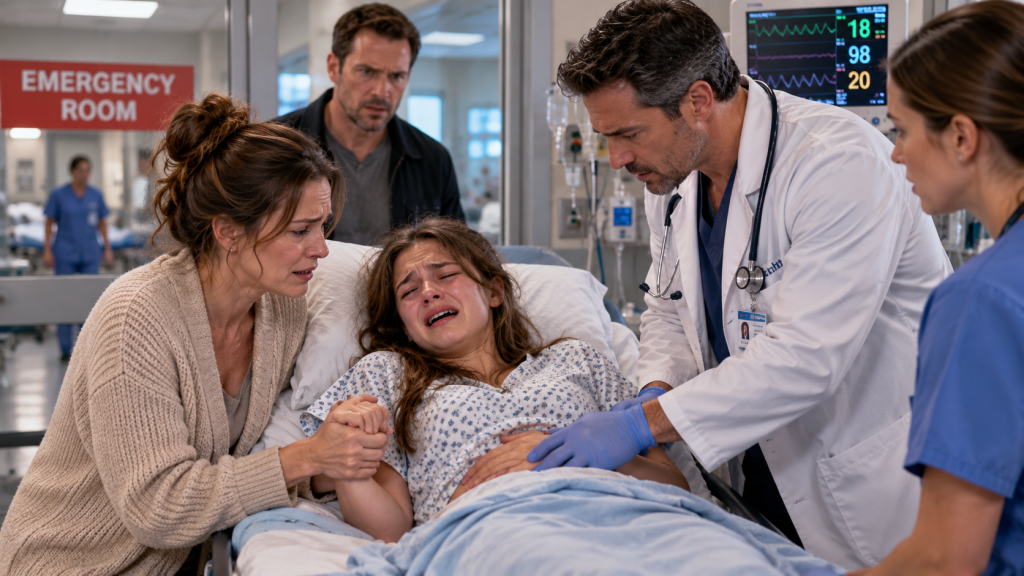
A teenage girl had been vomiting for three days, and her father said she was just being dramatic, until in the emergency room she screamed a sentence that left her mother frozen: “He knows why it hurts.”

At 3:18 a.m., I stood outside our bathroom listening to my fifteen-year-old daughter cry into the sink.
The bathroom light buzzed overhead. Bleach mixed with fever sweat, sour vomit, and cheap hand soap. Emily was folded over the porcelain bowl with one arm locked around her stomach so tightly her fingertips had gone white.
Her father watched her like her pain was an inconvenience.
“If you drag her to the ER over one of her little performances, don’t expect me to pay a dime.”
Michael said it from the doorway, rubbing his face as though she had gotten sick just to wake him.
Emily had been vomiting for almost three days. Then came the fever. But what frightened me most was when she stopped complaining altogether.
She started moving through the hallway bent at the waist, one hand against the wall because standing straight drained the color from her face. Whenever Michael’s footsteps crossed the bedroom floor, her eyes snapped toward the door before dropping again.
“She’s exaggerating,” he said. “She always does this when she has a test.”
For fifteen years, I had known that voice. It could turn concern into weakness and a question into disrespect. I had handed Michael my paycheck, my passwords, my schedule, and more of my judgment than I wanted to admit.
Emily had learned the same survival habit I had: stay quiet, stay small, don’t make him angry.
Then she spit something pink into the sink.
“We’re going to the emergency room,” I said.
Michael took the thermometer from my hand and stared at the number.
“Don’t be ridiculous, Sarah. You make her weak by babying her.”
I looked past him at Emily and made the first decision in years that didn’t depend on whether Michael approved.
Before dawn, she collapsed beside the shower.
Water tapped behind the curtain. Her gray hoodie was twisted beneath one shoulder, and her cracked phone was pressed against her chest. Her lips were dry. Her eyes barely opened when I touched her cheek.
“Mom,” she whispered. “Don’t tell Dad.”
That hurt more than the fever.
My daughter wasn’t afraid of the hospital.
She was afraid of going home.
At 4:06 a.m., I pulled emergency cash from between the clean towels, grabbed her hoodie, and helped her through the back door without turning on a light.
In the rideshare, Emily rested her head against my shoulder while my hands shook in my lap.
“If he finds out,” she whispered, “he’s going to get worse.”
“It doesn’t matter anymore,” I told her.
I needed those words to become true before we reached the hospital.
At the county hospital intake desk, a nurse wrapped an orange triage band around Emily’s wrist. The form reduced three terrifying days to three clean phrases: abdominal pain, fever, persistent vomiting.
“How long has she been like this?” the nurse asked.
“Three days.”
Her expression changed.
The doctor pressed gently on Emily’s abdomen.
Emily screamed.
A woman holding a paper coffee cup froze. An orderly stopped with one hand on a metal bed rail. The receptionist’s fingers hovered above her keyboard.
“I need blood work and an ultrasound now,” the doctor said.
Then he stopped looking at the monitor and started watching Emily.
He saw her flinch when a man’s voice carried down the corridor. He saw her fingers close around my sleeve. He saw her glance toward the doorway every time shoes approached.
“I need to speak with her alone,” he told me.
My phone began vibrating.
Michael.
Fifteen missed calls.
Then a message appeared: Where are you?
Another arrived before I could answer.
If you took her to the hospital, you’re going to regret it.
Twenty minutes later, the doctor returned and closed the curtain behind him.
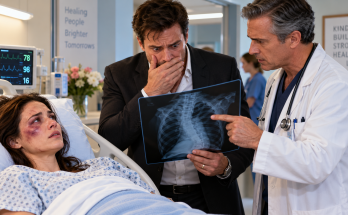
“Mrs. Bennett, your daughter needs urgent surgery.”
My knees almost gave out.
“What does she have?”
“An advanced infection. Likely complicated appendicitis. If you had waited much longer, it could have been fatal.”
I gripped the plastic chair until my fingers hurt.
Then a man’s voice rose at reception.
“I’m her father. I want to see my daughter now.”
Michael had found us.
PART 2 — WHAT EMILY HAD BEEN TRYING TO TELL ME
Michael’s voice carried through the emergency department before I could see him.
“I’m her father.”
Then louder:
“I said I want to see my daughter.”
A nurse stepped toward the reception desk.
A security officer followed.
Michael appeared around the corner seconds later.
Jeans thrown on too quickly.
T-shirt beneath an unzipped jacket.
Hair still damp.
His face was flushed with anger.
Not fear.
Not panic.
Not the expression of a father who had just learned his fifteen-year-old daughter needed emergency surgery.
Anger.
Then he saw me.
And for half a second, his entire expression changed.
His eyes moved from my face to the curtain behind me.
Then to the orange hospital band around my wrist.
Then toward the doctor.
Calculating.
I knew that look.
For years, I had mistaken it for composure.
Now I understood it differently.
Michael was trying to figure out how much everyone already knew.
“Sarah.”
he said.
“What did you tell them?”
Not:
How is Emily?
Not:
What did the doctor say?
Not:
Is she going to be okay?
What did you tell them?
Something cold opened inside me.
Dr. Patel stepped between us.
“Mr. Bennett?”
Michael straightened.
“Yes.”
“I’m Dr. Patel. Your daughter has a serious abdominal infection and requires urgent surgery.”
Michael’s face changed.
Finally.
Shock.
“She needs surgery?”
“Yes.”
“For what?”
“We’re concerned about complicated appendicitis with infection in the abdomen. The surgical team is evaluating her now.”
Michael looked at me.
I expected him to say I had been right.
I expected something human.
Instead he said:
“She’s been sick for three days. How does that suddenly become surgery?”
The doctor stared at him.
“It did not suddenly become surgery.”
The sentence landed quietly.
“The condition progressed over those three days.”
Michael looked away.
Dr. Patel continued.
“Delay in treatment can make appendicitis significantly more dangerous.”
I watched Michael’s jaw tighten.
He heard the accusation even though Dr. Patel had not made one.
Then Michael pointed toward the curtain.
“I’m seeing her.”
Dr. Patel did not move.
“Emily has asked that you not come into the room right now.”
The hallway went still.
Michael laughed once.
“What?”
“She’s fifteen.”
“Yes.”
“I’m her father.”
“Yes.”
“So move.”
Security stepped closer.
Dr. Patel remained calm.
“Your daughter is frightened and medically unstable. We are trying to keep her calm while the surgical team prepares.”
Michael looked toward me.
“This is you.”
I felt my old instinct rise.
Explain.
Appease.
Make him understand.
Then I remembered Emily whispering:
Don’t tell Dad.
I said nothing.
Michael’s voice sharpened.
“You’ve been filling her head again.”
Still I said nothing.
It was amazing how furious silence made a man who had spent years controlling conversations.
A woman wearing a hospital badge approached.
“Mrs. Bennett?”
“Yes?”
“I’m Melissa Grant. I’m one of the hospital social workers.”
Michael stared at her.
“Why is there a social worker?”
Melissa answered him instead of looking at me.
“Because Emily disclosed information that raises safety concerns.”
Michael stopped moving.
There.
It was small.
But I saw it.
Fear.
Real fear.
“What information?”
Melissa’s voice remained even.
“That is something we’re addressing with Emily.”
“I’m her father.”
“I understand.”
“You can’t keep things about my child from me.”
Melissa paused.
Then said something I would remember for years.
“Our first responsibility right now is your daughter’s medical care and immediate safety.”
Michael looked at me.
And suddenly I knew.
Whatever Emily had said behind that curtain, Michael already had a guess.
He pointed at me.
“This is insane.”
Security stepped closer.
“Sir.”
“I drove all the way here because my wife took our daughter in the middle of the night without telling me.”
I almost laughed.
He made it sound like kidnapping.
Not rescue.
“You threatened me.”
I said.
His face changed.
“What?”
I pulled out my phone.
Read his message aloud.
If you took her to the hospital, you’re going to regret it.
Michael glanced toward Melissa.
Then the security officer.
“That wasn’t a threat.”
I stared at him.
“What was it?”
“I was angry.”
“Those are not mutually exclusive.”
Dr. Patel looked down briefly.
Maybe hiding a reaction.
Michael lowered his voice.
“Sarah, come on.”
There it was.
The voice he used when witnesses appeared.
Reasonable Michael.
The man everyone else knew.
“Let’s talk privately.”
“No.”
His face hardened.
“Sarah.”
“No.”
One syllable.
I had said it dozens of times in my head over fifteen years.
Rarely aloud.
Then Emily screamed behind the curtain.
Not from fear.
Pain.
Every argument disappeared.
Dr. Patel turned immediately.
A nurse rushed inside.
I followed.
Michael tried.
Security stopped him.
“Sir, wait.”
“That’s my daughter!”
He shouted.
And for one irrational second I wanted to turn around and scream:
Then act like it.
I didn’t.
Emily needed my voice soft.
Not loud.
She lay curled on the hospital bed with sweat dampening her hair.
Her knees were drawn slightly upward.
A nurse adjusted the IV.
Dr. Patel spoke gently.
“Emily, the medication is coming.”
She grabbed my hand.
“Mom.”
“I’m here.”
Her eyes moved toward the curtain.
“Is he here?”
I could not lie anymore.
“Yes.”
Her grip tightened.
“No.”
“It’s okay.”
“No.”
Her breathing changed.
“He can’t come in.”
“He isn’t coming in.”
“You promise?”
I looked directly into her eyes.
“Yes.”
The word came out before I knew whether I had the power to keep it.
Then I decided I would find the power.
Whatever it required.
Dr. Patel pulled the blanket down slightly to examine Emily’s abdomen again.
That was when the nurse saw it.
A bruise.
Not huge.
Not the dramatic black-and-purple injury television teaches us to expect.
Yellowing at one edge.
Deep purple near the center.
Along Emily’s lower right side, extending toward her hip.
I stopped breathing.
I had not seen it.
Her hoodie had covered it.
Her pajamas had covered it.
Her bent posture had hidden it.
The nurse’s hand stopped.
Dr. Patel looked at Emily.
“Can you tell me how this happened?”
Emily’s entire body tightened.
Her eyes went immediately to the curtain.
Then to me.
I whispered:
“You can tell him.”
She started crying.
Not loudly.
The tears simply came.
“It wasn’t the appendix.”
Dr. Patel said gently.
“I’m not assuming what caused your infection.”
Important.
Even in my panic, I heard him separate the two things.
Then:
“But I need to know if you were injured.”
Emily covered her face.
“Sweetheart.”
I whispered.
Her shoulders shook.
Then she said:
“He knows why it hurts.”
My heart stopped.
The sentence.
The one that would divide my life into before and after.
Dr. Patel crouched slightly beside the bed.
“Who knows?”
Emily looked at me.
Then toward the curtain.
“My dad.”
The room became silent.
My body went cold from the inside outward.
I heard myself ask:
“What happened?”
Emily started shaking.
Dr. Patel raised one hand.
“Mrs. Bennett.”
I stopped.
He was right.
Not like this.
Not ten questions at once.
Not my fear pouring into her.
He looked at Emily.
“You’re safe here.”
She cried harder.
Then:
“He pushed me.”
I could not breathe.
“When?”
Dr. Patel asked.
“Two nights ago.”
The second night of vomiting.
I remembered.
Michael had told me she had been sleeping.
He said:
“Leave her alone. She’s milking it.”
Emily continued in fragments.
“I was trying to call Mom.”
“You were downstairs.”
“You were doing laundry.”
I remembered that too.
Michael had come into the basement.
Told me the washing machine was making a strange sound.
Kept me downstairs for nearly twenty minutes.
God.
Emily’s voice shook.
“I told him my stomach really hurt.”
“He said I was trying to get out of school.”
“I said I wanted you.”
She looked at me.
“I was going to call you.”
“He took my phone.”
My hands went numb.
“What happened then?”
Dr. Patel asked.
“He said I was making everything harder.”
“I tried to get my phone back.”
“He…”
She stopped.
Her face crumpled.
“He shoved me away.”
“Where did you hit?”
“The kitchen counter.”
There.
The sharp edge of the island.
Exactly the height of the bruise.
I closed my eyes.
Not because I doubted her.
Because I believed her completely.
Dr. Patel said carefully:
“The bruise may explain some additional tenderness, but I want to be very clear: a shove does not explain the appendicitis we’re treating.”
Emily nodded weakly.
I was grateful for that sentence.
Michael had hurt her.
He had not magically caused a ruptured appendix.
The truths did not need to be merged to be terrible.
Then Emily whispered:
“He knew I already hurt there.”
My eyes opened.
“What?”
She looked at me.
“My stomach was already bad.”
“He shoved me where I said it hurt.”
Whether intentionally or not, the sentence destroyed me.
Because he knew she was sick.
Not vague sick.
Not theatrical sick.
She had told him.
She had asked for help.
And instead of listening, he had turned her illness into disobedience.
I backed away from the bed.
My legs were trembling.
The wall caught me.
For years, Michael had told me Emily was sensitive.
Dramatic.
Manipulative.
Too emotional.
And I had disagreed with him.
Sometimes.
Then softened it.
Sometimes.
Compromised.
Too often.
I had thought I was protecting peace.
What if the peace had only existed because Emily and I were the ones paying for it?
Emily reached for me.
“Mom.”
I went back immediately.
“I’m here.”
“I’m sorry.”
That broke me.
“No.”
“I shouldn’t have tried to grab my phone.”
“No.”
“I made him mad.”
“No.”
My voice cracked.
“No, Emily.”
I held her hand between both of mine.
“You asking for help did not make him hurt you.”
Tears ran into her hair.
“But if I hadn’t—”
“No.”
I leaned closer.
“This is not yours.”
I did not know whether I was speaking to my daughter or the fifteen-years-younger version of myself who had spent a marriage translating Michael’s anger into things I should have done differently.
Maybe both.
Melissa returned.
She had heard enough.
Hospital protocol changed after that.
The conversation became careful.
Documentation.
Photographs of the bruise with consent and appropriate procedure.
Questions asked without leading Emily.
A separate note made of Michael’s threatening text.
I learned the phrase mandatory report.
I hated it.
Not because I wanted the hospital silent.
Because the phrase made what happened official.
Until then, part of my mind had still been pretending we could go home tomorrow and somehow solve this privately.
A counselor.
A conversation.
A promise.
Now strangers would know.
And for once, that did not feel like humiliation.
It felt like witnesses.
Michael was escorted away from the immediate treatment area.
He did not leave quietly.
I heard him demanding an administrator.
Threatening to sue.
Saying:
“My daughter is sick, and you’re letting my hysterical wife turn this into something else.”
Hysterical.
The word floated through the curtain.
Something inside me almost smiled.
For fifteen years, that word had worked.
Too sensitive.
Emotional.
Overreacting.
Difficult.
Hysterical.
All little cages.
But hospitals have charts.
Texts have timestamps.
Bruises have shapes.
And daughters eventually speak.
Michael’s favorite words were beginning to lose their power against things that could be documented.
The surgeon arrived.
Dr. Amanda Cho.
Small woman.
Steady voice.
She explained that Emily appeared to have perforated appendicitis with an abscess and spreading infection.
She needed urgent operative treatment and antibiotics.
The exact approach would depend on what the surgical team found.
I signed what needed signing.
My hands shook so badly the signature barely looked like mine.
Michael was still Emily’s father.
Still her legal parent.
The hospital navigated whatever consent questions applied under the emergency circumstances.
I barely remember that part.
I remember one thing Dr. Cho said.
“We’re treating her now.”
Four words.
After three days of:
She’s exaggerating.
She’s dramatic.
She’s avoiding school.
Four words felt holy.
We’re treating her now.
Before they took Emily upstairs, she grabbed my sleeve.
“My phone.”
“What?”
“My cracked phone.”
“It’s in your hoodie pocket.”
I found it.
The screen barely worked.
A spiderweb crack across one corner.
She pressed it into my hand.
“Don’t give it to Dad.”
“I won’t.”
“There’s stuff on it.”
My heart stopped.
“What stuff?”
She looked at the nurse.
Then at me.
“Later.”
“Emily—”
“Please.”
I swallowed every question.
“Okay.”
That was what respecting her looked like.
Not extracting everything simply because I was terrified.
Later.
She was allowed later.
The operating-room doors closed at 6:41 a.m.
And I stood in the hallway without my daughter.
That was when my body finally gave up pretending.
I sat on the floor.
Not a chair.
The floor.
My back against the wall.
Hands over my face.
And sobbed.
A nurse brought me water.
I couldn’t drink it.
Melissa sat several feet away.
Not touching me.
Not forcing comfort.
After a while, I said:
“I should have known.”
She did not answer immediately.
Good.
I would have hated:
This isn’t your fault.
Not yet.
Too easy.
Instead she asked:
“What did you know?”
I looked at her.
“What?”
“What information did you actually have before tonight?”
I tried to answer.
Michael yelling.
Controlling money.
Criticizing Emily.
Calling her dramatic.
The hand around my passwords.
The way he checked my spending.
The way Emily went quiet when his footsteps approached.
I had known pieces.
Enough to be unhappy.
Enough to hide emergency cash.
Enough to copy documents.
Enough to pack a bag.
Melissa listened.
Then:
“You were already preparing.”
I looked down.
That hurt differently.
I had known we were unsafe emotionally.
Maybe financially.
I had not known he had pushed her.
But some part of me had known enough to hide money between towels.
That was not nothing.
At 7:10, a police officer arrived.
Officer Ruiz.
He spoke with hospital staff first.
Then me.
He did not ask me to decide whether Michael was “an abuser.”
He asked what I saw.
What I heard.
What texts I received.
What Emily disclosed.
Facts.
I showed him the message:
If you took her to the hospital, you’re going to regret it.
Then another Michael had sent while Emily was being prepared for surgery.
This has gone too far. Tell them she fell.
I stared at it.
My body turned cold.
I had not seen it arrive.
Officer Ruiz did.
He asked:
“Did you ever tell Mr. Bennett that Emily said she fell?”
“No.”
“Did hospital staff?”
“Not that I know of.”
He looked toward Melissa.
She shook her head.
Nobody had told Michael what explanation Emily might give.
Yet he had just instructed me to tell them she fell.
Which meant he already knew there was an injury requiring explanation.
Officer Ruiz asked:
“Has your husband ever hurt Emily physically before?”
My mouth opened.
I wanted to say no.
Then stopped.
The hospital had already taught me that lesson.
“I don’t know.”
“Has Emily ever had unexplained injuries?”
I thought.
A bruise on her upper arm in April.
Michael said volleyball.
A cracked phone screen in May.
Emily said she dropped it.
A red mark near her shoulder last winter.
She wore hoodies constantly.
Teenagers wear hoodies.
None of those facts proved anything.
Fear wanted to collect them into a story.
I refused.
“I remember things.”
I said.
“But I don’t know what caused them.”
Officer Ruiz nodded.
That was enough.
No need to turn suspicion into history before Emily spoke for herself.
Michael was still in the hospital building.
Security had moved him to a separate waiting area.
He called me.
I did not answer.
Then another message.
Sarah, do not destroy this family over one mistake.
One mistake.
I read it twice.
Not:
I didn’t push her.
Not:
She’s lying.
Not even:
You misunderstood.
One mistake.
I took a screenshot.
Sent it where Officer Ruiz told me to preserve evidence.
Then turned my phone facedown.
At 8:23, Dr. Cho came into the waiting room.
I stood so quickly the chair hit the wall.
“She’s okay.”
My knees nearly collapsed.
The surgeon continued.
“There was perforated appendicitis and significant infection, but we treated what we found. She’ll need IV antibiotics and close monitoring.”
“How long?”
“Several days at least.”
“Is she going to be okay?”
“We’re optimistic.”
Optimistic.
I held onto that word.
Not promise.
Not certainty.
Enough.
Then Dr. Cho added:
“The abdominal-wall bruising is separate from the appendicitis. We’ve documented it.”
I nodded.
Two injuries.
One medical.
One inflicted.
Both real.
Neither needing to explain the other.
When Emily woke, she was groggy.
Her voice came out rough.
“Mom?”
“I’m here.”
She looked around.
“Dad?”
“No.”
Her eyes closed again.
Relief.
Not disappointment.
Relief.
That told me more than any speech.
Michael was not permitted into her room while the safety assessment continued and while Emily clearly said she did not want contact.
The exact legal arrangements were still being worked out.
I did not pretend I understood them.
I had spent fifteen years letting Michael speak like certainty itself.
That day, I learned adults can say:
“I don’t know what happens next.”
and still protect a child.
Melissa helped me contact an attorney.
A child-safety advocate explained options.
A detective arranged a later forensic interview appropriate for Emily’s age and condition.
Everything slowed down.
That mattered.
This was not going to become me firing questions at a sick teenager until she produced the version I feared.
Emily deserved better than that.
Around noon, she slept.
I sat beside her.
Then remembered the cracked phone.
It was in my purse.
I held it.
Did not open it.
Emily had said there was stuff on it.
Not:
Read everything.
So I waited.
When she woke again several hours later, I asked:
“Do you want me to look at the phone?”
She stared at it.
Then nodded.
“Not alone.”
“Who do you want?”
“Melissa.”
The social worker.
Good.
I called her.
Emily unlocked the phone herself.
Her hand shook.
Then she opened the voice recorder.
There were seven recordings.
My mouth went dry.
“Why?”
I asked softly.
She stared at the screen.
“Because he always says things different afterward.”
My heart broke.
Fifteen years old.
Already learning evidence.
Melissa asked:
“Did someone tell you to record him?”
“No.”
“Did he know?”
“No.”
“Okay.”
She did not tell us whether the recordings could be legally used.
That would depend on law and circumstances.
She simply said the relevant professionals would handle that question.
Good.
The recordings mattered to me first as truth my daughter had felt she needed to preserve.
The first was from five weeks earlier.
Michael’s voice.
Muffled.
Probably through Emily’s hoodie pocket.
“You’re not wearing that.”
Emily:
“Mom said it’s fine.”
Michael:
“I don’t care what your mother said.”
Then nothing remarkable.
Control.
Cruel tone.
No violence.
The second:
“You’re not going to Hannah’s.”
“Why?”
“Because I said no.”
Again.
Ugly.
Not evidence of physical harm.
Then the fourth recording.
Three weeks old.
Emily’s voice crying.
“You grabbed me.”
Michael:
“Because you tried to walk away while I was talking.”
“You hurt me.”
“Then stop making me hold you.”
My skin went cold.
There.
Not a single incident.
A pattern beginning to emerge.
Still, I forced myself to listen carefully.
No exaggeration.
No adding what was not there.
The fifth recording was worse.
Michael:
“If you tell your mother every time I correct you, all you’re doing is making her anxious.”
Emily:
“You leave marks.”
Silence.
Then Michael:
“They go away.”
I stopped the recording.
I could not breathe.
Melissa reached toward the phone.
“Do you want to stop?”
I looked at Emily.
She was crying.
“You decide.”
She whispered:
“Keep going.”
So we did.
The sixth recording was from the night before her collapse.
I recognized the kitchen sounds.
Ice maker.
Dishwasher.
Michael’s voice.
“You are not going to a hospital.”
Emily crying.
“My stomach hurts.”
“You have a test Friday.”
“I don’t care about the test.”
“Exactly. You’d rather turn this into some emergency.”
“Please get Mom.”
Then a scraping sound.
Emily:
“Give me my phone.”
Michael:
“Lower your voice.”
“Give it back.”
Then a sudden thud.
Not dramatic.
A sharp impact.
Emily gasping.
Silence.
Then Michael:
“Look what you made happen.”
I put my hand over my mouth.
Emily squeezed her eyes shut.
The recording continued.
“You fell.”
Michael said.
Emily:
“You pushed me.”
“Do you want your mother dragged into this?”
No response.
“She’s already barely holding things together.”
My entire body went cold.
He had used me.
My fragility.
My supposed weakness.
To make our daughter silent.
Then:
“If she asks about the bruise, you slipped.”
Emily cried.
Michael:
“Say it.”
Silence.
“Emily.”
“I slipped.”
“Again.”
“I slipped.”
I could not see through my tears.
Melissa stopped the recording.
No one spoke.
Eventually Emily whispered:
“I thought if I did what he said, he’d let me see you.”
I bent over her hand.
“I’m sorry.”
The words came from somewhere beneath language.
“I’m so sorry.”
She cried too.
“You didn’t know.”
That did not make the grief disappear.
But it mattered that she said it.
Then:
“I tried to tell you.”
My heart stopped.
“When?”
“Lots of times.”
I looked at her.
“I would say Dad was mad.”
“I would ask if I could stay with Aunt Hannah.”
“I told you I hated when you worked late.”
Each memory returned like a little knife.
Not proof I should have magically known.
But signals I now understood differently.
I whispered:
“I thought you two were fighting because you were a teenager.”
“I know.”
“I should have asked more.”
Emily looked exhausted.
“Maybe.”
That word was strangely merciful.
Not absolution.
Not blame.
Maybe.
Then she said:
“There’s one more thing.”
I closed my eyes.
The phrase had become terrifying.
“What?”
“Not a recording.”
She opened the drafts folder in her email.
There was a message addressed to the school counselor.
Never sent.
Subject:
Can I talk to you without my dad knowing?
My hands started shaking.
Emily opened it.
The draft was dated eleven days earlier.
Not after the appendicitis.
Before.
It read:
Ms. Lawson,
I need to ask you something but I don’t want my dad called first. Sometimes when he gets angry he grabs me or blocks the door so I can’t leave. He says it’s because I’m disrespectful and that Mom is too emotional to handle things. I don’t know if it counts as abuse because he doesn’t hit me like people in movies. I don’t want him arrested. I just want him to stop.
I stopped reading.
Couldn’t continue.
Emily whispered:
“Keep going.”
I forced myself.
There are times Mom is home but she doesn’t know because he acts normal when she comes into the room. If I tell her everything, I think she might leave him, and then it’ll be my fault.
I made a sound I did not recognize.
Emily started crying.
I held her hand.
“No.”
She looked at me.
“Listen to me.”
My voice broke.
“If I leave your father, that will be because of choices adults made.”
“Not because you told the truth.”
She cried harder.
“You do not carry our marriage.”
I said.
“You are fifteen.”
“You are not the wall holding this family up.”
“You were supposed to be one of the people inside it being protected.”
For the first time, she looked at me and seemed to believe maybe that was true.
Then I saw an attachment icon.
Three files.
Photographs.
My stomach dropped.
“Emily.”
She nodded.
“I took them.”
The first showed a yellowing bruise on her upper arm.
Date: two months earlier.
The second showed red fingerprints near her shoulder.
Five weeks earlier.
The third—
I stopped.
A photograph of her bedroom door.
Michael standing outside it.
One hand against the frame.
Blocking the hallway.
The image had been taken through the reflection of her dresser mirror.
Not dramatic.
Not violent.
But deliberate.
Proof of a child already thinking:
I need someone else to see what happens when nobody is watching.
At the bottom of the unsent email was one final paragraph.
I almost missed it.
I haven’t sent this because Dad checks my phone sometimes. I’m saving it as a draft until I’m brave enough. If something happens and Mom finds this, please tell her I tried.
I could no longer hold myself upright.
I put my head beside Emily’s hand and cried.
She touched my hair.
My sick daughter.
Fresh from surgery.
Comforting me.
I lifted my head immediately.
“No.”
She blinked.
“What?”
“You don’t take care of me right now.”
A tiny smile appeared through her tears.
“Bossy.”
“Yes.”
“For once.”
She closed her eyes.
Melissa quietly copied down the information needed to preserve the draft through appropriate channels.
Then she stepped outside.
I thought we were finished.
We weren’t.
Emily opened her eyes again.
“Mom.”
“Yes?”
“There’s another reason I didn’t send it.”
I felt my stomach tighten.
“What?”
She looked toward the closed hospital-room door.
Then lowered her voice.
“Because Dad said if I told anyone, you’d say I was lying.”
My heart stopped.
“I would never—”
“I know now.”
she whispered.
“But he showed me something.”
“What?”
“A text from you.”
I froze.
“What text?”
“He said you sent it after I got in trouble in April.”
I could not remember.
Emily reached for the phone again.
Opened a photograph.
A screenshot.
Conversation between Michael and me.
My name at the top.
The message supposedly from my number read:
She exaggerates everything lately. Honestly, I don’t know what to believe with her anymore.
I stared.
My skin went cold.
“I never wrote that.”
Emily looked at me.
“What?”
“I never sent that message.”
The room seemed to tilt.
I grabbed my own phone.
Searched Michael’s thread.
April.
Nothing.
No deleted bubble.
No line remotely like it.
Could I have deleted it?
Maybe.
But I knew the wording.
It did not sound like me.
Emily stared.
“You didn’t say it?”
“No.”
“Never.”
Her face went completely blank.
Then:
“He showed me more than one.”
My heart started pounding.
“What more?”
Emily opened another folder.
Three screenshots.
All apparently messages from me.
All telling Michael some version of the same thing.
She’s impossible lately.
You handle her. She doesn’t listen to me.
And the worst:
If she says you’re too rough, ignore it. She’s testing boundaries.
I stopped breathing.
I had never written any of them.
Not one.
For years, Michael had been telling me Emily was dramatic.
And apparently—
he had been telling Emily that I agreed.
He had not merely kept us quiet separately.
He had been constructing a bridge of lies between us so neither one would trust the other enough to cross it.
I looked at my daughter.
She looked at me.
Fifteen years of motherhood narrowed into one terrible question.
“How long has he been showing you messages from me?”
Emily swallowed.
“Since last year.”
My hands went numb.
Then she whispered:
“Mom…”
“What?”
“There’s something else on my phone.”
Of course.
My chest tightened.
She opened the photo gallery.
Scrolled backward.
Past school pictures.
Past selfies.
Past screenshots.
Until she reached a photograph dated nine months earlier.
It showed Michael’s laptop open on the dining-room table.
A messaging application.
A conversation window.
My name.
My profile picture.
And beneath it—
a folder labeled:
SARAH — SCREENSHOTS
Dozens of image files.
Dozens.
Emily said:
“I took this when he went upstairs.”
Her voice trembled.
“I think Dad’s been making fake messages from you for a long time.”
I stared at the screen.
Then at my daughter.
And suddenly the hospital was no longer only the place where we had discovered what Michael had done to Emily.
It was the place where I began to understand what he had spent years doing to both of us.
He had not merely taught us to fear him.
He had taught each of us not to trust the other.
And somewhere in our house—
if that laptop still existed—
was the record he never expected either of us to see.
PART 3 — THE MESSAGES HE WROTE BETWEEN US
For a long time, I stared at the photograph on Emily’s phone.
Michael’s laptop.
Open on our dining-room table.
My profile picture in the corner of a messaging window.
And beneath it, a folder labeled:
SARAH — SCREENSHOTS
Dozens of files.
My daughter watched my face.
“Mom?”
I looked at her.
“What?”
“You believe me?”
The question was so quiet it nearly disappeared beneath the hospital monitor.
I put the phone down.
Then took her hand.
“Yes.”
No hesitation.
No qualification.
No:
Let me see what Dad says.
No:
Maybe there’s another explanation.
Just:
“Yes.”
Emily’s eyes filled.
And something in her expression changed.
Not relief exactly.
Relief is lighter.
This was exhaustion finally discovering somewhere safe enough to collapse.
She turned her face toward the pillow and cried.
Not loudly.
Not dramatically.
The way people cry when they have spent too long preparing not to be believed.
I leaned close.
“I believe you.”
I said again.
“I am so sorry it took a hospital for you to hear me say that.”
Melissa returned a few minutes later.
The social worker listened while Emily explained the photographs.
She did not touch the phone until Emily agreed.
She did not scroll casually.
Did not treat my daughter’s private life like evidence first and personhood second.
That mattered.
A police detective returned later that afternoon.
So did Officer Ruiz.
They explained what I had already begun to understand.
Do not go home and search Michael’s laptop.
Do not confront him about files.
Do not delete anything.
Do not send yourself dozens of screenshots.
Preserve what Emily already had.
Let professionals determine what could lawfully be obtained and how.
The old version of me would have hated that answer.
I wanted to drive home immediately.
Rip open every folder.
Find every lie.
I wanted evidence faster than procedure.
But fear had already taught our family what happened when one person decided he alone knew how everything should be handled.
I was not going to repeat the pattern with better motives.
So I waited.
Again.
Michael called forty-three times that day.
I counted because the number sat beside his name.
Then he started leaving voicemails.
The first was angry.
“Sarah, you need to stop this before it gets worse.”
The second was softer.
“Please call me. We need to talk like adults.”
The third:
“You’re letting hospital people manipulate Emily.”
The fourth:
“I made mistakes, but you know I love her.”
Then:
“Do not let strangers destroy our family.”
That one almost made me laugh.
Not because it was funny.
Because by then I understood something Michael had relied on for years.
Whenever consequences arrived, he changed the subject from what he had done to what everyone else was allegedly doing to the family.
If Emily cried, she was destabilizing the house.
If I objected, I was escalating.
If doctors asked questions, they were interfering.
If police documented evidence, they were overreacting.
Somehow the family was always in danger from the person who named the harm.
Never from the person causing it.
I stopped listening after voicemail six.
The rest were preserved.
Not consumed.
That became another difference.
Evidence does not require you to relive abuse every hour.
That evening, Michael sent one text.
I know you’re scared, but you need to remember Emily lies when she’s upset.
I stared at it.
Then looked at my daughter sleeping beneath a hospital blanket.
The wording was familiar.
Too familiar.
She exaggerates everything lately.
I don’t know what to believe with her anymore.
The fake messages.
His voice and my stolen face saying the same thing.
I understood then that the screenshots were not random acts of manipulation.
They were infrastructure.
Michael had spent months building a false version of me inside Emily’s mind.
A mother who would not believe her.
A mother who found her exhausting.
A mother who had secretly delegated discipline to him because she could not handle her own child.
And while Emily withdrew from me, Michael stood between us and translated each silence.
“Teenagers.”
he would say.
“She doesn’t want her mother around.”
Or:
“You give her too much space.”
Or:
“Don’t chase her when she’s moody.”
I had listened.
Because some of it sounded reasonable.
That was the frightening part.
Manipulation works best when it wears ordinary clothes.
The next morning, the police obtained legal authority to secure Michael’s devices as part of the investigation.
I was not there when it happened.
I did not need to be.
Hannah went with me to the hospital cafeteria while officers dealt with the house.
I drank coffee that tasted burned.
She ate half a muffin.
Neither of us discussed Michael for almost ten minutes.
Then Hannah said:
“You used to apologize before asking him basic questions.”
I looked at her.
“What?”
“You’d call me.”
“Say something happened.”
“Then immediately say, ‘Michael had a stressful week,’ or ‘Maybe I’m being unfair.’”
My throat tightened.
“I didn’t know.”
“I know.”
“I mean I didn’t know it was this.”
“I know.”
She looked down.
“I stopped pushing you because every time I did, you disappeared for a month.”
That hurt because it was true.
Michael hated Hannah.
Not openly.
He called her intrusive.
Dramatic.
A bad influence.
He never said:
Stop seeing your sister.
He said:
“I just notice you come home unhappy after talking to Hannah.”
Or:
“She always assumes the worst about me.”
Or:
“Why does she need to know private details about our marriage?”
And slowly, I stopped telling her things.
I had thought I was preserving my marriage.
Instead, I had been reducing the number of witnesses.
Hannah reached across the table.
“I should have tried harder.”
“No.”
I said.
The answer surprised both of us.
She stared.
I continued.
“You don’t get to take responsibility for the choices Michael made because you couldn’t force me to see them sooner.”
My voice shook.
“I’m trying to stop doing that with Emily.”
Hannah’s eyes filled.
“So I’m not going to let you do it with me.”
For the first time since the hospital, I felt something that was not fear.
Maybe clarity.
Responsibility had to stop traveling downhill.
Michael’s choices belonged with Michael.
My choices belonged with me.
Emily’s childhood did not need to become a courtroom where every woman asked why she had not prevented a man’s behavior sooner.
Emily improved slowly.
The antibiotics worked.
Her fever dropped.
She started asking for ice chips.
Then crackers.
Then, on the third day, she complained about hospital pudding.
I nearly cried from gratitude.
Complaining sounded beautiful.
For months, Michael had trained both of us to measure good behavior by silence.
Now every complaint felt like evidence she was coming back.
When the nurse asked her pain level, Emily stopped saying “fine.”
She said six.
Then four.
Then two.
Watching her name pain honestly became one of the most moving things I had ever seen.
A child-protection investigator met with her after doctors believed she was medically strong enough.
The interview was not dramatic.
No bright interrogation lights.
No accusations.
Emily described what she remembered.
Blocking doors.
Taking her phone.
Grabbing her arms.
The shove into the counter.
Being told she had fallen.
The fake messages.
The rule that she was not supposed to “stress Mom.”
She was careful.
More careful than I expected.
When asked whether Michael hit her regularly, she said:
“No.”
When asked whether he punched her, she said:
“No.”
Whether he used objects.
“No.”
Whether he frightened her.
“Yes.”
Whether she had changed her behavior to avoid making him angry.
“Yes.”
Whether she felt safe going home with him.
“No.”
That answer mattered most.
The forensic review of the laptop took weeks.
I hated the delay.
Then learned to be grateful for it.
Quick certainty makes good fiction.
Real evidence has to be copied.
Logged.
Verified.
Compared.
Metadata examined.
Accounts matched.
Experts ask whether a screenshot is authentic, manipulated, exported, fabricated, or merely misunderstood.
Eventually, the findings began arriving through attorneys and investigators.
The folder was real.
SARAH — SCREENSHOTS
Inside were more than eighty image files.
Some were ordinary screenshots of real conversations between Michael and me.
Most were not.
The manipulated ones had been created using a web-based message-mockup tool.
Investigators found cached browser data.
Image exports.
Draft files.
A text document containing phrases.
Some had my name.
Some Emily’s.
The phrases made me physically sick.
She’s impossible lately.
Don’t tell Sarah. She’ll panic.
Dad says you don’t want me around.
Mom thinks you’re manipulating her.
Your daughter needs consequences.
He understands you better than I do.
Michael had built two versions of us.
One for each other.
Not enough to sever us completely.
Just enough to weaken trust.
That was smarter.
Crueler.
There were screenshots he had shown me too.
I recognized them immediately.
Messages supposedly from Emily.
One from six months earlier:
I don’t care if Mom’s upset. She makes everything about herself.
I remembered seeing it on Michael’s phone.
He said Emily sent it after an argument.
I cried in the bathroom afterward.
I never confronted her because Michael told me:
“Don’t embarrass her. Let her cool down.”
Emily had never written it.
Another:
I’d rather talk to Dad. Mom makes me anxious.
Fake.
Another:
Don’t tell Mom about school. She’ll overreact.
Fake.
I sat in my attorney’s office reading them and felt something inside me crack very quietly.
For nearly a year, Michael had not simply been controlling Emily.
He had been editing the relationship between mother and daughter.
One fabricated sentence at a time.
There were also real messages.
That distinction mattered.
Emily had sometimes been angry with me.
Of course she had.
She was fifteen.
She had written:
Mom is being annoying.
Once.
To a friend.
Normal.
She had said:
I don’t want to talk to her right now.
Also normal.
The danger was not that Michael invented every conflict.
It was that he took normal conflict and built a false architecture around it.
Teenage irritation became proof she rejected me.
My anxiety became proof I could not handle truth.
His control became the only supposedly stable bridge between us.
He made himself necessary by making us unreliable to each other.
The laptop contained something else.
A folder with my name.
Not screenshots.
Financial documents.
Copies of my bank statements.
Pay stubs.
Tax records.
Passwords saved in notes.
A list of accounts.
Dates when I had changed passwords.
Questions about where I kept cash.
That one froze me.
The emergency money between the towels.
Had he known?
Investigators could not tell whether he knew that exact hiding place.
But one note read:
Sarah has cash somewhere in linen closet? Check after she works Saturday.
I stared at it.
Then laughed.
A strange, exhausted laugh.
For months I had believed the folded bills behind clean towels were proof I still had one secret piece of myself.
Maybe he had nearly found even that.
The thought frightened me.
Then another thought replaced it.
He hadn’t taken it.
I had used it.
At 4:06 a.m.
To get Emily out.
The emergency money had done exactly what I saved it to do.
That mattered more than whether Michael once suspected it existed.
The investigation did not turn every ugly thing into a crime.
That mattered too.
Controlling passwords.
Lying.
Creating fake screenshots.
Isolating us emotionally.
Some of those things were powerful evidence in custody and family proceedings.
Some supported broader patterns.
Not every betrayal had a criminal charge attached.
The shove was different.
The bruise was documented.
Emily’s recording captured the impact and his instruction to say she slipped.
The earlier recording captured him admitting he had grabbed her.
Prosecutors reviewed the conduct under the laws that applied where we lived.
Michael was ultimately charged with offenses related to assaultive conduct against Emily and attempts to influence the account she gave afterward.
I learned quickly to say:
Charged.
Not convicted.
An allegation is not a verdict merely because I believe my daughter.
Those rules matter even when the accused person broke your heart.
Michael’s first attorney requested a meeting.
My attorney said no.
Later, through counsel, Michael sent a letter.
I did not read it immediately.
I waited three days.
Then sat at Hannah’s table and opened it.
The first line:
I never meant for Emily to be afraid of me.
I almost stopped.
Intent.
Always intent.
Then the letter changed.
But I understand now that I cared more about whether I thought I was dangerous than whether she felt safe.
I kept reading.
He admitted making the fake screenshots.
Not all at once.
At first, he had created one fake message after an argument because he wanted Emily to stop “triangulating” between us.
His word.
Then another.
Then more.
He told himself he was preventing conflict.
That by making each of us believe the other preferred distance, he could keep peace.
Peace again.
The family word for silence.
He admitted grabbing Emily.
Blocking her bedroom door.
Taking her phone.
The shove.
He said he had not intended her to hit the counter.
I believed that.
It changed nothing about the fact that he shoved her.
Then he wrote:
When she became sick, I convinced myself she was using the illness to escape a test because admitting she might truly need help would mean I had dismissed her too many times before.
That sentence hurt because it was psychologically ugly enough to sound true.
The longer Michael had been wrong, the more threatening new evidence became.
So he doubled down.
He needed Emily to be dramatic because otherwise he had been cruel.
At the end, he wrote:
I know apology is not access. I know remorse is not proof that I am safe.
That was the first sentence in years that did not ask me to take care of his feelings.
I closed the letter.
Cried.
Then gave it to my attorney.
I did not answer.
Not yet.
Emily came home from the hospital after nine days.
Not to our house.
To Hannah’s.
She was thinner.
Moved carefully.
Had a small stack of discharge instructions.
Antibiotics.
Follow-up appointments.
Restrictions.
And one fierce new determination to sleep in Hannah’s guest bed instead of the pullout sofa because, as she said:
“I survived abdominal surgery. I’m not sleeping on a mattress with a metal bar.”
Hannah surrendered immediately.
Excellent medical reasoning.
The first night home, I helped Emily wash her hair.
She sat on a plastic stool because standing too long exhausted her.
Steam filled the bathroom.
I poured warm water slowly over her head.
Neither of us spoke for a while.
Then Emily said:
“Did Dad make fake messages for you too?”
My hands stopped.
“Yes.”
She looked down.
“What did they say?”
I hesitated.
Then remembered our new rule.
Truth appropriate to the person asking.
Not truth edited for my convenience.
“He made me believe you didn’t trust me.”
Emily started crying.
“I did trust you.”
“I know.”
“Not always.”
“I know.”
“I was mad at you sometimes.”
“I know.”
She turned.
“I thought you didn’t believe me before I even said anything.”
My throat closed.
“And I thought you didn’t want me asking questions.”
We stared at each other.
Two people grieving a relationship that had been manipulated but not destroyed.
Then Emily said:
“That’s so messed up.”
I laughed.
“Yes.”
Very sophisticated clinical assessment.
We started family therapy.
Just Emily and me at first.
Our therapist, Dr. Renee Wallace, refused to let every session become Michael analysis.
The first time she said:
“What happened between the two of you that has nothing to do with him?”
I almost felt offended.
Then understood.
If Michael remained the center of every conversation, he would continue controlling our relationship even while absent.
So Emily and I talked about ordinary hurts too.
Times I dismissed her because I was exhausted.
Times she lied about homework.
Times I made jokes about teenage moodiness when she needed me to ask another question.
Times she shut me out.
Not every rupture was Michael.
That mattered.
Otherwise rebuilding trust would be fake.
We needed a relationship strong enough to contain both manipulation and ordinary human failure.
Emily asked me once:
“Why didn’t you leave before?”
The question hurt.
Not because it was cruel.
Because she deserved an answer.
I thought.
“Because I kept waiting for something undeniable.”
She frowned.
“What does that mean?”
“I knew I was unhappy.”
“I knew Dad controlled too much.”
“I knew I was afraid of upsetting him.”
“But I kept thinking those things were not serious enough.”
Emily stared.
“Why?”
“Because he didn’t hit me.”
The room went quiet.
Then I continued.
“I thought danger had to look dramatic before I was allowed to call it danger.”
Emily looked down at her hands.
“That’s what I thought too.”
There it was.
The inheritance.
Not genetics.
Training.
We had both been waiting for a movie version of abuse before trusting what ordinary fear was telling us.
I filed for divorce five weeks after Emily came home.
Michael did not contest the filing.
Custody and contact were more complicated.
Emily was fifteen.
Her wishes mattered significantly, though the exact legal decisions belonged to the court.
At first, she wanted no contact.
Then she changed her mind about letters.
Not visits.
Letters.
Michael was allowed to send them through a therapist and legal channel.
Emily could read them.
Or not.
No pressure.
She read the first one after three weeks.
Then threw it across the room.
I did not ask what it said.
An hour later she picked it up.
Read it again.
Healing is rarely consistent enough to look dignified.
The criminal case resolved almost a year later.
Michael entered a plea to charges the prosecution could prove, including conduct connected to the shove and efforts to pressure Emily into giving a false account.
Other allegations were not pursued.
His sentence included court supervision, required intervention and treatment, restrictions on contact, and other conditions.
There was no dramatic decades-long prison sentence.
No cheering outside a courthouse.
I was relieved.
Then guilty for feeling relieved.
Then relieved again.
Dr. Wallace helped me understand something.
Accountability does not have to satisfy rage in order to be real.
The most important immediate result was not punishment.
It was structure.
Michael could no longer decide for himself what access to Emily looked like.
He could no longer turn family pressure into private rules.
Other adults were watching.
For a while, we needed that.
Michael lost friends.
Kept some.
His employer placed him on leave, then later ended his employment after the legal process and internal review.
I did not celebrate.
Not because he did not deserve consequences.
Because watching the father of your child lose pieces of his life is not emotionally simple.
Some nights I still remembered him dancing badly in our kitchen.
Holding newborn Emily with tears on his face.
Building her bookshelf.
Teaching her to ride a bike.
Those memories did not disappear because later ones became darker.
That was one of the hardest things to accept.
A person can love you.
And harm you.
A person can create real good memories.
And still become unsafe.
Contradiction is not exoneration.
It is simply reality.
I sold the house.
Eventually.
Not immediately.
At first, everyone assumed I would keep it.
But the kitchen counter remained the place Emily hit.
The hallway remained the place she had been blocked.
The bathroom remained where she collapsed.
My linen closet remained where I hid money.
I did not want us spending years proving we were strong enough to inhabit a museum of what happened.
So six months after the divorce filing, I listed it.
Michael, through attorneys, agreed to the sale.
The financial division was handled through the divorce.
No dramatic punishment.
No leaving him penniless.
Just separation.
Numbers.
Deeds.
Documents.
The adult mechanics of ending something that had once been sacred.
Emily and I moved into a smaller townhouse.
Three bedrooms.
Terrible kitchen.
Tiny yard.
She chose the room with the slanted ceiling.
The first week, she asked:
“Can I paint my door black?”
My immediate instinct was no.
Then I stopped.
“Why?”
“Because it looks cool.”
“Fine.”
She stared.
“That easy?”
“Paint is reversible.”
She smiled.
For years, our house had revolved around avoiding Michael’s irritation.
In the new place, I began asking a different question:
Is this actually a problem?
Black door?
No.
Dinner at eight?
No.
Shoes by the couch?
Annoying.
Not moral failure.
We had both been trained to confuse preference with authority.
Unlearning that made our house messy.
It also made it peaceful.
The first time Emily brought home a bad grade, she stood in the kitchen crying.
“I got a D.”
I looked at the paper.
Then at her.
“Okay.”
She stared.
“Okay?”
“We’ll figure it out.”
“That’s it?”
“What do you want, fireworks?”
Her mouth twitched.
Then her face collapsed.
She started sobbing.
Not because of algebra.
Because somewhere in her body, a D still meant footsteps in the hallway.
A lecture.
A blocked door.
A phone taken.
I held her.
Did not tell her she was safe.
By then, she hated that sentence when people used it casually.
Instead I said:
“We can deal with a grade without anyone becoming frightening.”
She cried harder.
That became one of our new family rules.
Problems do not require fear.
Hannah became part of our ordinary life again.
Sunday dinners.
School pickups.
Too many opinions.
Emily adored her.
I sometimes wanted to throw a napkin at her.
Normal.
One night Hannah said:
“You two argue more now.”
I looked at Emily.
Emily looked at me.
Then we both laughed.
It was true.
We argued.
About curfew.
Laundry.
College applications.
The car.
But disagreement no longer felt like structural collapse.
Nobody had to stay small to keep the house standing.
That was freedom in its least glamorous form.
Michael spent nearly two years in individual treatment before Emily agreed to see him in person.
Her choice.
Not mine.
Not his therapist’s.
Not the court’s.
Hers.
The first meeting occurred in a therapist’s office.
I waited outside.
When Emily came out, her face was unreadable.
We walked to the car.
I did not ask.
Three blocks later, she said:
“He looks old.”
I laughed softly.
“He is.”
“He cried.”
“I assumed.”
“I didn’t.”
I looked at her.
She stared out the window.
“Not there.”
Then:
“I told him I hate that he made me think you didn’t love me.”
My throat tightened.
“What did he say?”
“He said that was the worst thing he did.”
I did not answer.
Emily continued.
“I told him no.”
I glanced over.
“What?”
“I said the worst thing was making me think fear was normal.”
My eyes filled.
Fifteen had become seventeen.
A girl who once whispered:
Grandma mad.
No.
Wrong story.
That was someone else.
Emily had whispered:
Don’t tell Dad.
Now she could sit across from him and name what happened without asking permission.
That mattered more than whether she cried.
Her relationship with Michael never returned to what it had been.
How could it?
But it became something.
Letters.
Then supervised meetings.
Then occasional lunches when she was older.
Never overnight.
Never private pressure.
By the time she turned eighteen, the court no longer determined contact.
She did.
Sometimes she saw him.
Sometimes months passed.
Michael learned not to chase.
That might have been the hardest lesson of his life.
Love does not give you unlimited access to the person you hurt.
Sometimes the only respectful way to remain in someone’s life is to tolerate the distance they choose.
Michael apologized to me once in person after the divorce became final.
Neutral coffee shop.
Public.
No children.
He looked different.
Not transformed.
Just stripped of certainty.
We sat.
He said:
“I used to think you and Emily were too emotional.”
I almost smiled.
“That was convenient.”
“Yes.”
He nodded.
“I made your feelings into evidence that I was the rational one.”
I said nothing.
He continued.
“And if I was the rational one, I got to decide.”
There.
The whole marriage in one sentence.
He looked down.
“I am sorry.”
I believed him.
Not enough to return.
Enough to hear.
Then he said:
“I don’t expect forgiveness.”
I thought.
“I forgive some things.”
His eyes lifted.
“Some?”
“Yes.”
“I forgive you for being weak.”
“For being afraid.”
“For not knowing how to parent a teenager.”
“For repeating parts of what you grew up with before understanding them.”
He swallowed.
“And the rest?”
I looked at him.
“I don’t know yet.”
That answer was honest.
Forgiveness is not a homework assignment.
There was no deadline.
Years passed.
Emily’s scar faded.
Not disappeared.
Faded.
At twenty, she wore a cropped top one summer and the small surgical marks showed.
She caught me looking.
“What?”
“Nothing.”
“You’re doing Mom Face.”
“What is Mom Face?”
“You know.”
I laughed.
Then she touched the scar.
“Sometimes I’m glad I have it.”
That startled me.
“Why?”
“Not because of what happened.”
She thought.
“Because it reminds me my body was telling the truth even when everybody kept calling it drama.”
My throat tightened.
Her body had known.
Fever.
Pain.
Vomiting.
Fear.
All signals.
None moral failures.
That became another lesson I wish she had learned more gently.
Pain is information.
Fear is information.
They do not always prove the story you think they prove.
But they deserve investigation.
Not ridicule.
Emily became a nurse.
Of all things.
I asked once whether the hospital experience had inspired her.
She rolled her eyes.
“Please don’t make my career into a trauma documentary.”
Fair.
She liked science.
Liked people.
Liked being useful.
Then paused.
“Useful in a normal way.”
We both laughed.
She eventually worked in pediatric care.
Not because wounded children are destined to save other wounded children.
Because she chose it.
That distinction mattered to her.
So it mattered to me.
I changed too.
I learned my own passwords.
Ridiculous sentence.
Necessary.
I stopped apologizing before asking questions.
I rebuilt savings in an account no one else controlled.
Not because marriage requires secret money.
Because after divorce, independence required practice.
I took a bookkeeping class.
Hannah mocked me lovingly.
I bought a secondhand desk.
Started freelance administrative work.
Then full-time work.
Nothing glamorous.
I was proud anyway.
For years, Michael had managed our money because he said he was better at it.
Maybe he was.
That never meant I was supposed to remain incapable.
Dependence had grown quietly.
So did competence.
The fake screenshots stayed with me longest.
Not the physical ones.
The idea.
That someone could place my name beside words I never wrote and change how my daughter understood me.
For a while, I overcorrected.
I wanted to explain everything.
Every mood.
Every silence.
Every decision.
Then Dr. Wallace stopped me.
“Trust is not constant access.”
she said.
That sentence helped.
Emily did not need my phone.
I did not need hers.
We did not have to prove honesty through surveillance.
We needed confidence that important truths could be spoken without punishment.
That is different.
Privacy and secrecy are not the same.
Michael had taught us to confuse them.
We learned better.
On Emily’s twenty-first birthday, we went out to dinner.
Hannah came.
A few friends.
Michael was invited for dessert.
Emily’s choice.
He arrived carrying a small wrapped box.
No speech.
Good.
He had finally learned that birthdays do not need to become opportunities for public redemption.
Emily opened it.
Inside was her old cracked phone.
Repaired enough to turn on.
She stared.
I stared too.
Michael said:
“The police returned it a long time ago.”
“I had the data preserved professionally.”
“I thought it belonged to you.”
Emily held it carefully.
The phone that contained recordings.
Drafts.
Photographs.
Proof.
For years, it had been evidence.
Now it was just an object again.
She looked at Michael.
“Thank you.”
Then at me.
“Should I smash it?”
Hannah immediately said:
“Yes.”
I laughed.
Michael almost did.
Emily shook her head.
“No.”
She placed it back in the box.
“I think I’ll keep it.”
“Why?”
I asked.
She smiled.
“Because I don’t need it anymore.”
That answer made me cry.
Of course.
Later that night, after everyone left, Emily and I sat on the balcony of my townhouse.
She had moved out by then.
College apartment.
Terrible roommates.
A life.
She leaned back.
“Do you ever wish we’d gone to the hospital sooner?”
The question was impossible.
“Yes.”
I said.
“Every time I think about it.”
She nodded.
“Me too.”
Then:
“But if we had gone sooner, would we have found the phone stuff?”
I looked at her.
“Maybe.”
“Maybe not.”
We sat quietly.
I would never call the delay a blessing.
That would be obscene.
Appendicitis did not happen for a reason.
Abuse was not necessary to reveal abuse.
Pain does not become good because something truthful emerges afterward.
Some things are simply terrible.
Meaning is what we build after them.
Not what excuses them.
I looked at my daughter.
“You know what I wish?”
“What?”
“I wish you never needed evidence.”
Her expression softened.
“The recordings?”
“All of it.”
“I wish you had been able to say, ‘Dad scares me,’ and know that was enough for me to ask more.”
Emily stared at the street below.
Then:
“You ask now.”
“Yes.”
She smiled.
“That counts.”
Not as replacement.
Not as erasure.
But as something.
Sometimes something is what healing looks like.
Michael eventually remarried.
Years later.
He told Emily before posting anything publicly.
She appreciated that.
I met the woman once.
Her name was Claire.
She knew the broad history.
Not because I told her.
Because Michael did.
Early.
Before she moved in.
Before engagement.
That surprised me.
Maybe change is real when truth becomes expensive and someone tells it anyway.
I wished them well.
From a distance.
That was enough.
People sometimes ask why I did not see it.
Usually they do not mean to be cruel.
They imagine danger announces itself.
They want a checklist.
Did he punch walls?
Did he hit you?
Did he lock doors?
Did you call police before?
No.
No.
Sometimes.
No.
They want one moment that would have made any reasonable woman leave.
Life was not that clean.
Michael controlled through accumulation.
Passwords.
Money.
Tone.
Small humiliations.
Calling emotions irrational.
Telling one person what another supposedly said.
Standing in doorways.
Taking phones.
Making his anger everyone else’s weather.
None of it felt large enough on Tuesday.
Then suddenly fifteen years had passed.
That is how some cages are built.
Not bars.
Habits.
The hospital became a symbol in my mind for a long time.
At first, horror.
Then rescue.
Later, something more complicated.
It was the first place in years where Michael’s certainty stopped being the loudest thing in the room.
A doctor pressed on Emily’s abdomen and believed her scream.
A social worker saw fear and asked why.
A nurse documented a bruise without turning it into speculation.
Police recorded what was said.
A surgeon looked at a sick child and said:
We’re treating her now.
Simple.
Almost ordinary.
Yet those words changed everything.
Because treatment is the opposite of minimization.
It begins with believing that something deserves attention.
If I could return to 3:18 that morning, I would not tell myself to be braver.
I hate that language now.
Bravery makes everything sound like character.
As though women and children stay in dangerous situations because they are missing courage.
I had courage.
Emily had courage.
What we lacked was clarity.
Support.
Permission to trust what fear was already telling us.
So if I could stand beside that bathroom door again, I would whisper to myself:
You do not need Michael to agree that this is serious.
That sentence would have changed years.
And if I could speak to Emily at fifteen—
the girl bent over a hospital bed saying:
He knows why it hurts—
I would tell her something else.
Your pain does not need a witness before it becomes real.
Your fear does not become valid only after somebody finds the recording.
A bruise is not more important because a photograph exists.
A boundary is not less important because the person crossing it calls himself your father.
And love is not proven by how much discomfort you can absorb without disturbing the room.
She knows that now.
So do I.
I still have one screenshot.
Not one Michael made.
One Emily sent me years later.
A simple text conversation between us.
She had written:
Can you talk?
I answered:
Always.
She sent back:
Even if it’s bad?
And I wrote:
Especially then.
No manipulation.
No hidden folder.
No false profile.
Just four lines.
Real.
I printed it.
Not because I wanted to turn recovery into decoration.
Because for years Michael had used fabricated messages to make us doubt each other.
I wanted one true message on paper.
Something ordinary.
Something ours.
When Emily was twenty-three, she came home one rainy weekend.
We cooked pasta.
Hannah arrived without calling.
The power went out during dinner.
We lit candles.
The apartment became warm and ridiculous.
At one point, Emily laughed so hard she dropped a fork.
Nobody flinched.
That is the detail I remember.
Not the joke.
Not the candlelight.
The fork hit the floor.
Metal against tile.
Sharp sound.
And nobody went silent waiting to discover who was angry.
Emily simply leaned down.
Picked it up.
Kept laughing.
I looked around the table.
And understood that safety is sometimes so quiet you almost miss it.
No one blocking a doorway.
No one monitoring a phone.
No one translating somebody else’s feelings.
No one telling a sick girl she was dramatic.
Just people allowed to be loud.
Wrong.
Messy.
Hungry.
Tired.
Honest.
Michael once taught us that peace meant nobody challenged him.
We learned something better.
Peace is not silence.
Peace is the absence of fear inside noise.
It is a daughter saying:
“That hurt.”
And someone answering:
“Tell me more.”
It is a mother saying:
“I don’t know.”
without being ashamed.
It is disagreement without punishment.
Privacy without deception.
Concern without control.
Love without captivity.
That became the home Emily and I built after the old one ended.
Not perfect.
Real.
And when I think about that terrible morning now, I no longer begin with Michael arriving at the hospital.
I begin earlier.
3:18 a.m.
Bathroom light buzzing.
Emily bent over the sink.
Michael in the doorway telling me she was performing.
And me—
standing between the two versions of reality.
His certainty.
Her pain.
For years, I had been trained to choose his.
That morning, I chose hers.
Not perfectly.
Not early enough.
But I chose.
Then one choice became another.
The ride to the hospital.
The doctor.
The report.
The recordings.
The laptop.
The divorce.
The townhouse.
The black bedroom door.
The bad algebra grade.
The healed scar.
The birthday dinner.
A life assembled one honest decision at a time.
Michael had spent years creating fake messages between us.
In the end, he failed.
Because the relationship between a mother and daughter is not a screenshot.
It is not one terrible year.
It is not even trust permanently preserved.
It is something you keep choosing to repair when truth becomes difficult.
Emily and I did.
And years later, whenever she calls and says:
“Mom, I need to tell you something,”
I do not ask whether it is serious enough.
I do not tell her she is dramatic.
I do not decide what I think before she finishes.
I say the sentence I should have taught her to expect from the beginning.
“I’m listening.”
And then I do.
THE END STORIES! THANK YOU FOR READING GOOD LUCK !❤️
Related Posts