All my life, I believed the tiny blue flower tattoo on my mother’s wrist was just something she had done when she was young. Then one day, a nurse at the hospital noticed it. She froze. For a moment, she didn’t say a word. Then she quietly stepped out of the room and called security. That was when I realized the tattoo wasn’t just a memory from my mother’s past. It was a warning someone still recognized.

Part 1: The Blue Flower My Mother Never Explained
For as long as I could remember, my mother had a tiny blue flower tattoo on the inside of her left wrist.
It was simple—five small petals and a thin stem, no larger than a coin. But it was the only part of Margaret’s life she never wanted to explain.
When I was seven, I sat on her lap one summer evening and traced it with my finger.
“Where did you get this?”
“I got it when I was young.”
“Does it mean something?”
Her smile changed, just slightly.
“It means I was young and made a choice.”
That became her answer every time. I asked again when I was eleven, again at fifteen when I thought about getting the same tattoo, and later in my twenties when I wanted to know who she had been before she became only my mother.
The answer never changed.
The only time I pushed harder was when I was nineteen and home from college. We were washing dishes when I laughed and asked why she treated such a harmless little tattoo like a major secret.
“Some things are just for me, Clara,” she said. “Maybe you’ll understand when you’re older.”
There was sadness in her face that I did not understand then.
So I stopped asking.
Mom had always been open about everything else. She had spent most of her life as a nurse, and even after retiring, neighbors still called her whenever someone was sick, scared, or needed help.
By the time she was sixty-three, I was thirty-two, and I thought I knew every important part of her life. My father had died six years earlier, and after helping Mom sort through forty years of paperwork, I believed our family had no real secrets left.
I was wrong.
It started with something ordinary.
Mom needed knee replacement surgery.
On the morning of the procedure, a nurse named Patricia brought us into pre-op. She joked gently with Mom while checking her medications and preparing the IV.
“All right, Margaret. I’m going to start your IV now.”
Then she pushed Mom’s sleeve higher and stopped.
She was staring at the blue flower.
Her warm expression disappeared.
After several tense seconds, she quietly covered the tattoo again.
“I’ll be back in a moment. I need to check something.”
She left.
Five minutes later, two hospital security officers appeared outside the room.
Then a gray-haired doctor entered.
He looked straight at Mom’s covered wrist.
“Ma’am,” he asked, “where did you get that symbol?”
Not tattoo.
Symbol.
My mother went pale.
For the first time in my life, I saw real fear in her eyes.
Then she whispered, “I knew this day would come.”
PART 2 — THE MESSAGE CHLOE TRIED TO SEND ME BEFORE
When Chloe whispered my father’s name, every instinct inside me turned violent.
Grandpa Richard.
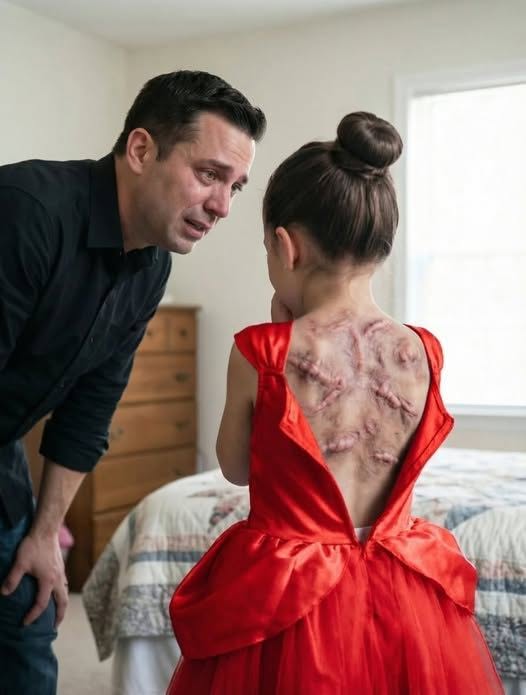
For one terrible second, I saw nothing except those bruises.
Five dark finger-shaped marks along her right side.
Another set lower on her back.
Yellowing bruises beneath newer purple ones.
Evidence that this was not one moment.
Not one loss of temper.
Not one accident.
February.
She had said it had been happening since February.
It was May.
My father had been putting his hands on my daughter for months.
And somehow I had not known.
I wanted to stand.
I wanted to walk downstairs.
I wanted to call Richard and demand he explain what kind of man leaves fingerprints on a child.
Then Chloe looked at me.
And I stopped.
Because she was watching my face.
Not to see whether I was angry.
To see what my anger would cost her.
That changed everything.
I stayed on my knees.
“Chloe.”
My voice came out low and rough.
“I believe you.”
Her mouth trembled.
“You do?”
“Yes.”
Immediately.
“Every word.”
Tears spilled down her cheeks.
Then came a sentence that broke me more thoroughly than the bruises.
“Mom said you might not.”
The room went completely still.
I did not ask what she meant.
Not yet.
Every part of me wanted to.
But Chloe had spent months deciding whether telling me was safe.
I was not going to reward her courage by turning her bedroom into an interrogation room.
So I said:
“Thank you for telling me.”
She started crying harder.
“I’m sorry.”
“No.”
I moved closer, careful not to touch her bruised back.
“You do not apologize for this.”
“But the recital—”
“I don’t care about the recital.”
Her eyes widened.
“You practiced.”
“I know.”
“You said today mattered.”
“You matter more.”
She looked at me as if she were trying to decide whether that sentence could be trusted.
Then she whispered:
“Can we not go downstairs?”
My stomach tightened.
“Is Grandpa downstairs?”
She shook her head.
“No.”
“Who is?”
“Mom.”
There it was again.
Not proof of anything.
But enough to make me careful.
I took out my phone.
“I’m going to call a doctor.”
Chloe grabbed my wrist.
Hard.
“Don’t tell Grandpa.”
“I won’t call Grandpa.”
“Promise?”
“Yes.”
Her fingers loosened.
“Will Mom know?”
I chose the answer carefully.
“Eventually, yes.”
Fear crossed her face.
“Not yet?”
“Not until I understand what keeps you safest.”
That was the first promise of the day I understood completely.
Not secrecy forever.
Safety first.
I texted my older sister, Rachel.
She was a pediatric emergency physician thirty minutes away.
I did not send photographs.
I did not want Chloe’s body becoming an image passed around the family.
I wrote:
I need medical advice urgently. Chloe disclosed someone has been hurting her. Visible bruising. She is safe with me right now. Where do I take her?
Rachel called within ten seconds.
I answered quietly.
“Harrison?”
“Yes.”
“Is she conscious and breathing normally?”
“Yes.”
“Any immediate pain?”
“I don’t know yet.”
“Head injury?”
“Not that she’s told me.”
“Is the alleged person there?”
“No.”
Her voice stayed calm.
It was the calm I needed.
“Take her to Children’s West.”
“Tell triage this is a suspected physical-abuse disclosure.”
“Do not confront anyone first.”
“Do not question her repeatedly.”
“And Harrison?”
“Yes?”
“Stay boring.”
I almost laughed.
“What?”
“Children watch adults to decide how dangerous the truth is.”
“Be calm.”
“Get her dressed in something comfortable.”
“Take her for care.”
“Let professionals do their jobs.”
I closed my eyes.
“Okay.”
I helped Chloe lower her shirt.
I did not make her wear the recital dress.
She chose leggings and a sweatshirt.
Before opening the bedroom door, she stopped me.
“Dad?”
“Yeah?”
“Can I bring Bunny?”
Bunny was a stuffed rabbit missing half one ear.
She had slept with it since she was two.
“Absolutely.”
The piano recital program stayed on her desk.
Her name printed third in the second group.
Chloe Vance — Clementi Sonatina in C Major.
She had practiced for four months.
None of it mattered now.
Or rather, it mattered later.
Today it could wait.
Meredith was standing at the bottom of the stairs.
She wore a pale green dress and pearl earrings.
“Finally.”
Then she saw Chloe’s clothes.
Her expression changed.
“What are you wearing?”
Chloe moved closer to me.
I noticed.
Meredith noticed too.
“We’re not going to the recital.”
I said.
“What?”
“Chloe isn’t feeling well.”
My wife’s face tightened.
“She was fine ten minutes ago.”
“We’re going to have her checked.”
“Checked for what?”
I held her gaze.
“Privately, Meredith.”
Something flickered across her face.
Fast.
Fear.
Maybe.
Or confusion.
At that point, I did not know.
Then she looked at Chloe.
“What did you tell your father?”
My entire body became still.
Not:
What’s wrong?
Not:
Are you hurt?
What did you tell your father?
Chloe immediately moved behind my arm.
That was enough.
I stepped between them.
“We’re leaving.”
Meredith’s face went white.
“Harrison.”
“We’ll talk later.”
“Don’t do this.”
I stared at her.
“Do what?”
She lowered her voice.
“Make something bigger than it is.”
There.
The first crack.
My hands went cold.
“What exactly do you think this is?”
Meredith looked toward Chloe.
Then back at me.
“I don’t know what she told you.”
“Then why are you asking me not to make it bigger?”
Silence.
That silence answered too much and still not enough.
I opened the front door.
“Chloe, shoes.”
Meredith grabbed my arm.
Not violently.
Desperately.
“Harrison, please.”
I looked at her hand.
She let go.
“Richard has been helping her practice.”
I stared.
“What does piano practice have to do with anything?”
Her eyes filled.
That was when I knew.
She knew something.
Not necessarily everything.
But something.
And whatever it was, she had hoped Chloe would stay quiet until after the recital.
I took my daughter outside.
We drove to Children’s West.
For the first ten minutes, Chloe said nothing.
I did not fill the silence.
At a red light, she whispered:
“Are you mad at Mom?”
My throat tightened.
“I have big feelings.”
Rachel would be proud.
“But they are my job.”
Chloe looked out the window.
“She told Grandpa to stop before.”
My hands tightened around the steering wheel.
“When?”
I almost asked more.
Stopped.
“Thank you for telling me.”
That was all.
A few minutes later she said:
“He says pianists have to sit straight.”
I glanced at her.
“Grandpa?”
“Yes.”
Then she hugged Bunny tighter.
“If I move, he squeezes me.”
There was my explanation for the handprints.
Maybe.
At least part of it.
“He says I’m lazy.”
I breathed carefully.
“You are not lazy.”
“He says you’re too soft.”
My vision blurred.
Still, I kept driving.
At the hospital, I told triage exactly what Rachel instructed me to say.
Everything changed quietly.
We were moved to a private room.
A pediatric nurse examined Chloe’s vital signs.
A physician named Dr. Anika Shah came in.
Then a child-protection social worker named Marisol Vega.
No police crowding around Chloe.
No fluorescent interrogation.
Just people trained to make frightened children feel less surrounded.
Dr. Shah asked permission before examining her.
Even at eight years old, Chloe’s yes mattered.
That nearly broke me.
“Can I look at your back?”
Chloe nodded.
“Would you like Dad to stay?”
“Yes.”
“Would you like him beside you or over by the chair?”
“Beside me.”
I stood beside her.
Exactly there.
The bruises were more extensive than I had seen.
Both sides of her lower back.
Ribs.
One upper arm.
A fading mark near her left shoulder blade.
Dr. Shah did not announce what caused them from appearance alone.
She documented size.
Color.
Location.
Tenderness.
Photographs were taken according to hospital protocol with Chloe’s consent and my authorization as appropriate.
They ordered imaging because she had tenderness over one rib.
My stomach dropped.
“Do you think it’s broken?”
“We’re checking.”
That was the answer.
Not comfort.
Not panic.
Checking.
The imaging showed no current fracture.
Relief hit so hard I had to sit down.
But there was something else.
A healing injury to one rib that looked older.
Not acute.
Not necessarily from abuse without context.
Children get injured.
Still, combined with Chloe’s disclosure, it mattered.
Dr. Shah asked whether I remembered any accident several weeks earlier.
I did.
Or thought I did.
Chloe had complained that her side hurt after spending a Saturday at my parents’ house.
Meredith told me she had fallen while climbing onto a piano bench.
I believed her.
Why wouldn’t I?
My wife told me our daughter fell.
I kissed the spot.
Gave Chloe children’s pain medicine.
Told her she needed to be more careful climbing on furniture.
The memory turned poisonous inside me.
Had Chloe looked at me differently that night?
Had she waited for me to ask another question?
Had I missed it?
Marisol must have seen my face.
“Mr. Vance.”
I looked at her.
“Do not try to reconstruct every missed moment right now.”
“How?”
“Because you’ll start asking Chloe to relieve your guilt.”
That landed.
Hard.
I looked toward my daughter.
She was coloring while Bunny sat beside her.
My guilt was not her assignment.
I swallowed.
“What do I do?”
“Believe her.”
“Keep her safe.”
“Let the investigation determine what can be determined.”
Simple.
Again.
Because Chloe had disclosed repeated physical harm by a family member, the hospital made a mandated report to child protective services.
Police were also notified.
I gave a statement.
Chloe would later speak with a trained forensic interviewer.
Not me.
Not Meredith.
Not Richard.
That was important.
I called Rachel.
She came anyway.
Of course she did.
She entered the room in jeans and a sweater, saw Chloe coloring, and acted as though the most important question in the world was whether the purple marker was still working.
Chloe smiled.
First smile all day.
Then Rachel looked at me over her head.
Her face changed.
She had seen the chart.
I knew.
She knew.
Neither of us spoke.
Not there.
Meredith called seventeen times.
I did not answer until Marisol and the investigator were ready to speak with her.
Then I stepped into the hallway.
“Harrison.”
She sounded like she had been crying.
“Where are you?”
“The hospital.”
She inhaled sharply.
“You took her to a hospital?”
“Yes.”
“You reported this?”
“The hospital did what it is required to do.”
“Oh my God.”
That reaction told me something too.
Not:
Is she okay?
Not:
What did the doctor find?
You reported this?
I closed my eyes.
“Meredith, did you know my father was hurting Chloe?”
“No.”
Too fast.
Then:
“Not like that.”
My body became ice.
“What does that mean?”
She started crying.
“He was strict with piano.”
“What does strict mean?”
“He’d hold her shoulders.”
“Correct her posture.”
“Sometimes grab her side if she slouched.”
I could barely speak.
“You saw this?”
“A few times.”
“And you let him continue?”
“I told him to stop grabbing so hard.”
My vision blurred.
“So yes.”
“No, Harrison.”
“I didn’t know she was bruised.”
“She has bruises shaped like hands.”
“I didn’t know.”
“She has a healing rib injury.”
Silence.
Absolute.
Then Meredith whispered:
“No.”
That was the first time she sounded genuinely horrified.
It did not erase everything before it.
But it mattered.
“What rib injury?”
I explained only what the doctor allowed me to share.
Meredith began sobbing.
“The piano bench.”
My stomach twisted.
“What about it?”
“She told me Richard knocked her against it.”
My breathing stopped.
“When?”
Silence.
“Meredith.”
“Six weeks ago.”
I leaned against the wall.
“And you told me she fell climbing onto it.”
Her crying became louder.
“I thought it was an accident.”
“You changed the story.”
“Because Richard said if you knew he was disciplining her, you’d stop the lessons.”
I could not breathe.
“And?”
“And she was getting better.”
I actually closed my eyes.
Getting better.
At piano.
Eight years old.
A healing rib.
Getting better.
“You lied to me so my father could keep teaching her piano?”
“No.”
“It wasn’t like that.”
“What was it like?”
Meredith had no answer that made the sentence smaller.
Then she said:
“The recital mattered to her.”
“No.”
My voice sharpened.
“It mattered to you.”
Silence.
“And my father.”
Still silence.
“And apparently everyone except the child who was afraid to get dressed for it.”
She whispered:
“That’s not fair.”
Maybe.
Maybe not.
Fairness could wait.
Chloe could not.
“I’m not bringing her home tonight.”
Meredith stopped crying for half a second.
“What?”
“We’ll follow the safety plan.”
“This is her home.”
“It is also the place where you just asked her what she told me.”
“I was scared.”
“So was she.”
That ended the call.
Chloe stayed with me at Rachel’s house that night.
CPS agreed that was a suitable temporary plan while immediate safety concerns were assessed.
Meredith was not automatically barred forever.
Richard was.
No contact.
No access.
No “just let me explain.”
No phone call.
Nothing.
For the first night, that was enough.
Chloe slept in Rachel’s guest room with Bunny under her chin.
I sat on the floor outside.
At 2:11 in the morning, the door opened.
Chloe looked down at me.
“Why are you there?”
“I’m terrible at chairs.”
She frowned.
“Dad.”
“Couldn’t sleep.”
She sat beside me.
After a while she whispered:
“Grandpa says Mom gets sad because I make things hard.”
My heart tightened.
I said nothing for several seconds.
Then:
“Adults are responsible for their own feelings.”
“But Mom cries.”
“She can cry.”
“Does that mean I have to do piano?”
“No.”
Chloe looked at me.
“Ever?”
“You never have to play piano because someone scares you into it.”
Her eyes filled.
“I like piano.”
That broke something open inside me.
Of course.
This was not even about an instrument she hated.
She loved music.
They had taken something beautiful and built fear around it.
“You can still like piano.”
I said.
“Even after this?”
“Yes.”
“Can Grandpa still be bad if he taught me good things?”
The question was too large for a hallway at two in the morning.
Still, she deserved an answer.
“Yes.”
I said.
“People can teach us good things and still do things that are wrong.”
She thought.
Then:
“Can Mom love me if she didn’t stop him?”
My throat closed.
“Yes.”
“And she still should have stopped him.”
Both.
Chloe leaned against me.
“I don’t understand.”
“Neither do grown-ups sometimes.”
That seemed to satisfy her more than pretending everything fit.
The forensic interview happened two days later.
I waited outside with Rachel.
Meredith waited separately.
Richard had retained an attorney and denied intentionally injuring Chloe.
According to his initial statement, he had used “firm physical correction” during piano practice.
He claimed any bruising must have resulted from Chloe being unusually sensitive or from normal childhood activity.
My father.
The man who had taught me to throw a baseball.
The man who cried at my wedding.
Now describing fingerprints on his granddaughter as sensitivity.
I stopped trying to reconcile those men.
Not yet.
The interviewer spoke with Chloe for almost an hour.
Afterward, investigators shared only what we needed for immediate safety and case decisions.
The grabbing had happened regularly.
Richard would stand behind Chloe during piano practice.
If she slouched, missed passages, rushed tempo, or cried, he would grip her sides or shoulders.
Sometimes he shook her.
Once he pushed her backward into the edge of the piano bench.
That was likely connected to the older rib injury, though doctors could not state that from Chloe’s account alone without considering the full evidence.
He called it:
“Resetting.”
My stomach turned.
A neat word.
Adults love neat words for ugly behavior.
There was more.
Richard made Chloe hold her hands flat above the piano keys for long periods without playing.
If her arms dropped, he slapped the backs of her hands.
Not enough to leave obvious marks most times.
Enough to make her afraid.
He told her:
“Talent is wasted on weak children.”
And:
“Your father would ruin you if he knew how much discipline you actually need.”
That sentence nearly sent me out of the building.
Rachel caught my arm.
“Stay.”
I did.
For Chloe.
Again.
Then came Meredith.
Chloe said her mother had seen Richard grab her more than once.
Had told him:
“Dad, not so hard.”
But Meredith still brought Chloe back for lessons.
Still told her:
“Grandpa is old-fashioned.”
Still said:
“He loves you.”
Worst of all, Chloe reported that after the piano-bench incident she told Meredith:
“I don’t want to go there anymore.”
Meredith answered:
“You’ve worked too hard to quit before the recital.”
My whole body went numb.
There.
Not ignorance.
Not complete knowledge either.
But enough.
Enough for a child to say:
I don’t want to go.
And an adult to decide achievement mattered more.
When Meredith heard the account through her attorney and the family investigator, she did not deny saying it.
She said she misunderstood why Chloe wanted to stop.
She thought Chloe was nervous about performing.
Possible.
Then the investigator asked about the bruising.
Meredith admitted she had seen marks on Chloe’s upper arms in March.
She asked Richard.
He said Chloe bruised easily.
She accepted it.
Why?
The answer did not emerge immediately.
It took bank records.
My father had been paying for more than piano lessons.
That was the next secret.
Three years earlier, Meredith lost her job.
She had found another one eventually, but our family went through a difficult year.
I thought we recovered because we tightened expenses and used savings.
Apparently not entirely.
Richard had been transferring money to Meredith.
At first small amounts.
Then larger.
Five hundred dollars.
One thousand.
Two thousand.
Over three years, nearly $48,000.
I knew nothing about it.
My stomach dropped when the investigator showed me the records Meredith eventually provided.
“Why?”
I asked her in a meeting arranged through our attorneys.
She stared at her hands.
“He was helping.”
“With what?”
“Everything.”
“Credit cards.”
“Chloe’s activities.”
“Groceries sometimes.”
My voice tightened.
“Why didn’t you tell me?”
“Because you hate owing people.”
“We weren’t bankrupt.”
“I know.”
“Then why?”
She looked up.
“Because your father made it easy.”
There it was.
Richard paid for Chloe’s private piano instructor first.
Then convinced Meredith he could teach her himself between formal lessons.
He had been a conservatory student before becoming an engineer.
Music was his pride.
He told everyone Chloe had “real talent.”
Soon every conversation became about competitions.
Scholarships.
Potential.
The spring recital.
Meredith liked seeing Chloe praised.
Liked seeing Richard proud.
And somewhere inside that arrangement, saying no to him became expensive.
Not because he explicitly threatened to stop money every time.
There was no message saying:
Let me hurt Chloe or I cut you off.
Reality was subtler.
When Meredith challenged his strictness once, he wrote:
I’m doing more for this family than anyone seems to appreciate. Maybe Harrison should start handling the expenses you keep hiding from him.
Meredith backed down.
My hands went cold.
He knew I did not know.
He used that.
Another message after she complained about bruising:
Then stop sending her. But don’t come crying to me when she throws away the only thing she’s exceptional at.
Meredith replied:
I just want you to ease up.
Richard:
You want results without discipline. Harrison’s disease.
Then, ten minutes later, he transferred her $1,500 marked:
Chloe lessons / household.
No explicit bargain.
No clean extortion.
Something murkier.
Money wrapped around authority until Meredith became increasingly unwilling to challenge him.
It explained her.
It did not absolve her.
When I said that, she cried.
“I know.”
“Do you?”
“Yes.”
Her voice broke.
“I kept telling myself he wasn’t hurting her.”
“Even after the bruises?”
“I thought I could control how strict he was.”
“You weren’t there for most lessons.”
“I know.”
“You lied to me about the bench.”
“I know.”
“You told Chloe not to quit.”
“I know.”
Each answer sounded smaller.
Then she whispered:
“I was afraid you’d find out about the money.”
That was the deepest betrayal.
Not because she took financial help.
Because once protecting the secret became important, Chloe’s truth became dangerous to her.
I moved out with Chloe temporarily.
Not as punishment.
Because the family court, child-protection professionals, and our attorneys needed a safety arrangement while everything was evaluated.
Meredith had supervised contact at first.
She hated it.
So did I.
Chloe loved her mother.
That made everything harder.
At the first visit, Chloe ran into Meredith’s arms.
Meredith sobbed.
I stood outside the room and cried too.
Love had not vanished.
That would have been easier.
Children rarely hand us clean stories.
Richard was charged later based on the evidence prosecutors believed they could prove.
Physical abuse allegations.
The older injury.
Repeated conduct.
His own messages about discipline.
Chloe’s disclosure.
Medical documentation.
I did not decide the charges.
I stopped pretending my rage gave me expertise.
My job was Chloe.
That was enough.
The recital passed without us.
At 2:30 that Saturday, while another child probably sat at the same piano Chloe had practiced for, she and I were at Rachel’s house making pancakes.
Chloe spilled batter on the counter.
Then froze.
Actually froze.
Her whole body.
Eyes wide.
“Sorry.”
I stared.
“For what?”
“I made a mess.”
“It’s pancake batter.”
She waited.
My stomach turned.
“What usually happens when you make mistakes at Grandpa’s?”
She looked down.
I stopped.
Too close to questioning.
Instead, I grabbed a spoon.
Dipped it into the batter.
Then put a tiny dot on my own nose.
Chloe stared.
Rachel walked in.
Looked at me.
Then took the bowl and put a dot on her cheek.
Chloe started laughing.
Hard.
So hard she had to sit down.
We cleaned the counter together afterward.
No lesson.
No speech.
Just a mess.
Then a towel.
That is what childhood should have been.
A week later, Chloe asked:
“Can I play piano?”
I almost said no.
Fear.
Mine.
Then caught myself.
“Do you want to?”
She nodded.
Rachel had an old upright in her living room.
Chloe sat.
Placed her hands above the keys.
Then pulled them back immediately.
“Can you go in the kitchen?”
she asked.
My heart cracked.
“Sure.”
I walked away.
From the kitchen, I heard one note.
Then another.
A scale.
Then the opening bars of her recital piece.
She stopped halfway through.
Started again.
No one corrected her.
No one touched her.
No one counted mistakes.
After ten minutes, she called:
“Dad?”
I came back.
“How was it?”
I smiled.
“Do you want my opinion?”
She thought.
“No.”
I laughed.
“Then it was yours.”
She smiled too.
That became our new rule.
Meredith began individual therapy and parenting work.
Again, not redemption by checklist.
Evidence of effort.
She returned the remaining money Richard had recently transferred where her attorney advised and documented all historical support.
She gave investigators her messages.
She stopped minimizing.
At one supervised visit, Chloe told her:
“I don’t want Grandpa at my birthday.”
Meredith cried.
Then said:
“Okay.”
No:
But he loves you.
No:
He’ll be devastated.
Just:
Okay.
That was small.
It mattered.
Then investigators found something neither Meredith nor I expected.
Richard had been recording some piano lessons.
Not hidden cameras.
His phone on a tripod because he claimed reviewing performance helped Chloe improve.
Several videos remained in cloud storage.
Most showed normal playing.
Then one clip from March.
Chloe misses a passage.
Richard stops her.
Walks behind the bench.
Places both hands around her ribs.
The exact position of the bruises.
He squeezes.
Chloe gasps.
He says:
“Sit properly.”
She whispers:
“It hurts.”
Richard answers:
“Then remember.”
I watched four seconds.
Then stopped.
No more.
I did not need to watch my daughter hurt repeatedly to prove I loved her.
Professionals preserved the file.
That was enough.
The clip also captured something else.
At the edge of the frame, Meredith walks through the doorway.
She sees Richard’s hands.
“Dad.”
she says.
He releases Chloe.
Meredith lowers her voice.
“I told you not that hard.”
Richard replies:
“She’s fine.”
Then Meredith looks at Chloe.
For one second.
One terrible second.
Chloe is crying.
And Meredith says:
“Finish the piece, sweetheart.”
The video ends four minutes later.
My marriage changed permanently in those four words.
Finish the piece, sweetheart.
When Meredith watched it with her lawyer and therapist, she became physically sick.
Later she wrote me a letter.
I read it after Chloe went to bed.
I kept waiting for Richard’s behavior to become serious enough that I would be justified in blowing up the family.
My eyes blurred.
I did not understand that Chloe was already living inside the thing I was waiting to become serious.
There it was.
A sentence I could believe.
Then:
I saw her pain and asked her to finish the piece because stopping would have required me to confront Dad, tell you about the money, admit I had lied, and accept that the recital might disappear. I made a child carry the consequences of my cowardice because she had less power to punish me for it than the adults did.
I cried.
Because it was terrible.
Because it was true.
Because she finally knew.
Still, knowing did not repair everything.
We separated.
Not immediately divorced.
Not reconciled.
Separated.
Chloe remained primarily with me under temporary orders.
Meredith’s parenting time increased gradually as professionals assessed safety and her behavior changed.
Richard had no contact.
No family intermediary.
No letters slipped through Grandma.
No gifts.
I made that boundary absolute.
For once, relatives adjusted around the child instead of asking the child to adjust around relatives.
My mother, Susan, Richard’s wife, almost destroyed her relationship with me too.
At first she said:
“Your father would never intentionally injure Chloe.”
I answered:
“There is video.”
She cried.
“He loves her.”
“I didn’t say he didn’t.”
That confused her.
People want love and abuse to be opposites because otherwise family becomes frightening.
Sometimes they coexist.
The love does not make the abuse safer.
Susan eventually watched the clip.
Afterward she did not call me for three days.
Then she said:
“I’m leaving Richard.”
I stopped.
“You don’t have to make your marriage decision for me.”
“I’m not.”
Her voice shook.
“I asked him whether he was sorry Chloe was hurt.”
“And?”
“He said he was sorry everyone misunderstood discipline.”
There.
Not remorse.
Defense.
Susan moved in with her sister while the case proceeded.
Later she filed for divorce.
Her decision.
Not mine.
Richard’s attorney argued that the videos showed misguided instruction, not criminal abuse.
Prosecutors argued otherwise.
That would be resolved through the case.
I stopped reading every filing after my attorney told me it was making me useless at home.
He was right.
I had begun staying up until two in the morning reading evidence, then waking exhausted and overreacting to ordinary things.
One morning Chloe spilled orange juice.
I snapped:
“Careful!”
She froze.
The same freeze as the pancake batter.
I felt sick.
I crouched immediately.
“Hey.”
Her eyes filled.
“I’m sorry.”
“No.”
“My voice was too sharp.”
“That’s mine.”
“I’m sorry.”
She stared.
Then:
“Are you mad?”
“At the juice?”
She nodded.
“No.”
“Maybe at the laws of liquid.”
She smiled.
I cleaned it.
And learned something painful.
Protecting Chloe from Richard did not automatically make me safe.
I still had to manage myself.
Every day.
Then came the deleted message.
It happened during a forensic review of Chloe’s tablet.
The device was not originally seized like evidence in some dramatic raid.
With proper consent and legal process, investigators reviewed communications because Chloe said she had tried telling me before.
At first, no message existed.
Then a backup showed one deleted draft.
Created March 18.
Seven weeks before the recital.
Addressed to me.
Only fourteen words.
Dad, Grandpa hurt my back again. Please don’t tell Mom I told you.
I could not breathe.
“Again.”
That word.
And:
Please don’t tell Mom.
The message had never reached me.
It had been deleted four minutes after creation.
Investigators checked account activity.
The deletion came from another device logged into Chloe’s family messaging account.
Our home laptop.
I stared at the report.
“Who was using it?”
No answer yet.
Meredith used it.
I used it.
Sometimes Chloe.
The account remained signed in.
Timestamp.
8:42 p.m.
March 18.
I searched my calendar.
I had been at a client dinner until nearly ten.
My stomach turned.
Meredith had been home.
Still not proof.
When confronted through the investigation, Meredith initially said she did not remember.
Then something changed.
Her attorney requested another meeting.
Meredith came in crying before she sat down.
“I deleted it.”
The room became silent.
I felt nothing for several seconds.
That frightened me.
“You saw the message.”
“Yes.”
“You read ‘Grandpa hurt my back again.’”
“Yes.”
“And deleted it.”
Her face collapsed.
“Yes.”
“Why?”
No answer could survive.
Still, I waited.
“I panicked.”
“About what?”
“You finding out.”
“About Richard hurting her?”
“About everything.”
“The money.”
“The lies.”
“The recital.”
“My father.”
She covered her mouth.
“I went upstairs to ask Chloe what happened.”
My hands went cold.
“What did she say?”
“She said he grabbed her because she kept moving.”
“Then?”
“I told her Richard shouldn’t have done that.”
“And?”
Meredith whispered:
“I told her I would handle it.”
My throat tightened.
“Did you?”
“I called him.”
“What did he say?”
“That she was exaggerating.”
“And then you sent her back.”
Tears streamed down her face.
“Yes.”
For a long time, nobody spoke.
Then I asked:
“Why did she say not to tell you?”
That hurt Meredith visibly.
She looked at the table.
“Because she knew I would tell Richard.”
My stomach dropped.
“You did?”
“Before.”
“When she complained, I would call him.”
“To make him stop?”
“Yes.”
“But then he knew she told.”
“Yes.”
“And what happened?”
Meredith began shaking.
“I didn’t know.”
I stood.
Couldn’t sit anymore.
“You made disclosure dangerous.”
“I know.”
“No.”
My voice cracked.
“You made her learn that telling you meant the person hurting her would know she told.”
Meredith sobbed.
“I know.”
This time, I believed she did.
Too late for March.
Maybe not too late forever.
The investigators recovered one more message.
Not from Chloe.
From Richard to Meredith.
Sent twenty-two minutes after Chloe’s deleted draft.
She’s complaining to Harrison now?
My blood turned cold.
Meredith had told him.
His next message:
Take the tablet away during practice weeks. She’s learning that drama gets results.
Meredith responded:
I deleted it before Harrison saw. Please stop grabbing her.
Richard:
Then stop undermining me.
There.
All of it.
The loop.
Chloe speaks.
Meredith deletes.
Meredith warns Richard.
Richard learns Chloe tried to speak.
Chloe learns silence is safer.
Until recital day.
Until she finds another route.
Her phone.
Her bedroom.
A carefully rehearsed message.
Dad, come to my room. Just you. Close the door.
It had not been spontaneous.
She had learned from failure.
That realization broke me.
Then the investigator placed one final recovered file on the table.
A note Chloe had typed into her tablet three days after the deleted message.
Not sent to anyone.
Maybe because she no longer believed sending was safe.
It read:
Things I have to remember:
Don’t cry at Grandpa.
Sit straight.
Don’t tell Mom because she tells him.
Don’t text Dad from tablet.
After recital maybe it stops.
I covered my face.
Eight years old.
Building her own survival plan around a piano recital.
Then beneath those lines was one more sentence.
If it gets worse tell Aunt Rachel because Grandpa doesn’t know her password.
I looked at my sister.
Rachel started crying.
For the first time since this began, she lost all professional calm.
Because Chloe had been planning an escape route.
Not from a stranger.
From family.
And the person she had been most afraid would close that route was not Richard.
It was the mother who kept handing her fear back to him.
That was when I understood the recital had never been the deadline.
Chloe had been counting down to the day she thought she might finally be allowed to stop surviving.
And now that she had told me the truth, my job was not to make her brave enough to endure one more performance.
It was to make sure she never again had to earn safety by staying quiet.
PART 3 — THE RECITAL SHE CHOSE FOR HERSELF
For a long time after I read Chloe’s note, I could not move.
Don’t cry at Grandpa.
Sit straight.
Don’t tell Mom because she tells him.
Don’t text Dad from tablet.
After recital maybe it stops.
And then, beneath all of it:
If it gets worse tell Aunt Rachel because Grandpa doesn’t know her password.
Eight years old.
My daughter had built a safety plan around passwords.
Not around parents.
Not around adults doing what adults were supposed to do.
Passwords.
She had studied the people around her, learned which routes carried information back to Richard, and adjusted.
That was what frightened me most.
Not only that Richard had hurt her.
Not only that Meredith had failed her.
Chloe had become observant in the way children become observant when safety depends on predicting grown people.
She had learned to manage us.
That should never have been her job.
Rachel sat beside me, crying openly.
“I didn’t know.”
she whispered.
I looked at her.
“Neither did I.”
Rachel shook her head.
“She put my name there.”
“I know.”
“What if she had called me?”
“You would’ve come.”
“Of course.”
“I know.”
That was the part that finally made me understand what Chloe needed next.
Not one perfect rescuer.
More doors.
More people.
More ways to be heard.
So no adult could ever become the single gate between my daughter and help again.
Richard’s case moved first.
The video recordings changed everything.
Before that, his attorney had described the allegations as exaggerated physical correction.
A strict grandfather.
A talented child.
A family disagreement over teaching methods.
Then investigators obtained the footage of Richard standing behind an eight-year-old at the piano, wrapping both hands around her ribs, squeezing until she gasped, and telling her:
“Then remember.”
It is difficult to call something misunderstood after people watch it happen.
The prosecution also had photographs of the bruising.
Medical records.
The healing rib injury.
Chloe’s forensic interview.
Richard’s messages to Meredith.
His own phrases about discipline.
The recovered instruction telling Meredith to remove Chloe’s tablet because she was “learning that drama gets results.”
And the videos.
More than one.
Not every session was abusive.
That mattered too.
Some recordings showed Richard teaching Chloe patiently.
Correcting fingering.
Laughing when she accidentally played the wrong piece.
Praising her when she improved.
For a while, those videos tortured me.
How could the same man do both?
Then Chloe’s therapist eventually gave me an answer I hated because it was obvious.
“People who harm children are not necessarily harmful every second.”
If they were, children would never love them.
Families would notice sooner.
There would be no confusion.
No good memories to defend.
No temptation to explain the bad ones away.
Richard had loved Chloe.
I eventually accepted that.
He had also hurt her.
The love did not cancel the harm.
The harm did not mean every smile before it was fake.
Reality was crueler than that.
Richard refused a plea at first.
He insisted he had never intended injury.
His attorney argued the rib injury could not be conclusively tied to the piano-bench incident.
That was true.
Medical evidence could estimate timing.
Not replay history.
The bruises were clearer.
The recordings clearer still.
Eventually, after pretrial hearings and discussions neither Chloe nor I needed to witness, Richard accepted a plea covering offenses supported by the strongest evidence.
He avoided a trial that would have required more testimony and potentially placed Chloe under another kind of pressure.
His sentence included incarceration, probation afterward, mandatory treatment conditions, and a long-term no-contact order protecting Chloe.
Not the rest of his life.
Not a theatrical hundred-year sentence.
Enough.
Serious enough that everyone stopped calling it strict piano teaching.
I attended sentencing.
Chloe did not.
Her choice.
She wrote no victim statement.
Also her choice.
I wrote one.
I did not tell the judge Richard had ruined our family.
That gave him too much power.
I said:
“My daughter learned that making a mistake at a piano could cost her physical safety. She learned that crying could make an adult angrier. She learned to hide bruises under clothing and to plan communication around passwords. Whatever sentence the court imposes, I want the record to reflect that the harm was not only what happened to her body. It was what she was taught to believe about speaking.”
Then I sat down.
Richard never looked at me.
I was glad.
I did not need anything from his face.
My mother, Susan, divorced him.
Not quickly.
Not because one video magically erased forty years of marriage.
She moved out first.
Then spent months trying to understand what remained.
Richard wrote her letters.
Apologized for embarrassing her.
For destroying the family.
For losing his temper.
The one thing he struggled to say plainly was:
I hurt Chloe.
Susan noticed.
That became the line she could not cross back over.
One afternoon she came to my house carrying an old piano score Richard had given Chloe.
She set it on the table.
“I thought I could separate who he was with me from what he did to her.”
I said nothing.
She continued.
“Maybe I still can.”
“That doesn’t mean I have to stay married to both.”
That was her decision.
I respected it.
Later, she filed.
Meredith’s consequences were different.
That mattered.
She had not laid hands on Chloe.
Had not caused the rib injury directly.
Had not stood behind the piano bench squeezing until fingerprints appeared.
But she had seen enough.
More than enough.
She had seen bruises.
Seen Richard grab too hard.
Seen Chloe cry.
Deleted the message Chloe tried to send me.
Warned Richard that Chloe had tried to tell.
Then sent her back.
Those choices became central to the child-protection case and family court.
The court did not terminate her parental rights.
There was no evidence Meredith wanted Chloe harmed or that she was incapable of ever parenting safely.
But wanting a child safe and actually protecting that child are not the same thing.
She had failed at the second.
So her path back was slow.
Supervised visitation remained for months.
Parenting education.
Individual therapy.
No contact between Meredith and Richard.
No transporting Chloe to family members without approval during the safety phase.
No piano-related pressure.
No asking Chloe what she told therapists, investigators, or me.
And perhaps most importantly:
No making Chloe responsible for Meredith’s forgiveness.
That last part was difficult.
At the beginning of one supervised visit, Meredith cried as soon as Chloe entered.
Chloe stopped at the doorway.
Her shoulders tightened.
I saw the old calculation begin.
Do I hug her?
Will she cry harder if I don’t?
The supervisor saw it too.
Meredith must have seen it.
Because for once, she wiped her face and said:
“I’m okay, sweetheart.”
Chloe did not move.
Meredith continued:
“You don’t have to make me feel better.”
That sentence changed the room.
Chloe looked at her.
Then crossed halfway.
Not all the way.
They sat at a table and drew pictures for forty minutes.
No hug.
When the visit ended, Meredith said:
“I love you.”
Chloe whispered:
“I know.”
Nothing more.
Meredith accepted it.
That was the first piece of trust she earned back.
Not because Chloe comforted her.
Because she allowed Chloe not to.
I was angry with Meredith for a long time.
Longer than I wanted to admit.
There were mornings I looked at her name on a court email and felt physically sick.
There were nights when I replayed the deleted message.
Dad, Grandpa hurt my back again. Please don’t tell Mom I told you.
The sentence lived inside me like a splinter.
My daughter had wanted me.
Meredith had placed herself between us.
Then erased the route.
How do you forgive that?
Eventually I learned forgiveness was the wrong immediate question.
The better question was:
Can this person become safe?
Forgiveness could come later.
Or not.
Safety had evidence.
Behavior.
Time.
Patterns.
That made it easier.
Meredith changed in ways that were hard to fake.
She stopped defending herself.
That was first.
No more:
I was scared.
I didn’t know how bad it was.
Your father manipulated me.
I thought the recital mattered to Chloe.
All those things remained partly true.
She simply stopped placing them before the harm.
Instead she learned to say:
“I knew enough to stop it earlier, and I didn’t.”
There was no beautiful version of that sentence.
That was why I began believing it.
Six months after the disclosure, Chloe asked to see Meredith outside the supervision center.
Not alone.
At a park.
The parenting coordinator approved a short visit with me nearby.
Chloe climbed onto a swing.
Meredith stood behind her.
Then stopped.
“Can I push you?”
I watched Chloe turn.
Such a tiny question.
Such a different world.
“Yes.”
Meredith pushed gently.
Higher?
she asked.
“No.”
She stopped increasing the height.
Nothing dramatic happened.
That was the point.
For years, adults had been deciding that Chloe’s no meant nervousness.
Laziness.
Lack of discipline.
Fear to overcome.
Now no simply meant no higher.
I sat on a bench twenty yards away and cried into a paper coffee cup like an idiot.
Chloe’s physical injuries healed before the rest.
The bruises disappeared.
The rib finished healing.
The marks on her arms faded.
One morning she came downstairs wearing a tank top.
No sweatshirt.
No cardigan.
No fabric hiding her back.
I stared one second too long.
She noticed.
“What?”
“Nothing.”
“You’re looking.”
I smiled.
“You have syrup in your hair.”
She rolled her eyes.
There was no syrup.
I lied badly.
But I did not tell her I had spent months remembering the day she lifted her shirt and showed me handprints.
Her body did not need to remain evidence in my eyes.
It was hers again.
That mattered.
The piano took longer.
For several months, she played only at Rachel’s house.
Never ours.
Then one day she asked me to move the piano from the living room.
I had bought that piano before she was born.
Used.
Dark walnut.
One chipped key on the far left.
I loved it.
Still, I asked:
“Where do you want it?”
“Garage.”
I almost said:
But you love piano.
Instead:
“Okay.”
Derek—no, wrong story. Here Rachel maybe help. I called a mover.
Two days later, the piano left the living room.
Chloe watched without expression.
The empty space looked enormous.
I thought I would feel sad.
Instead I felt relief.
Rooms should not demand memories from children.
Six weeks later, Chloe asked:
“Can we bring it back?”
I nearly laughed.
“You made me pay two hundred dollars to move it into the garage.”
She shrugged.
“I changed my mind.”
There it was.
The most beautiful sentence she had said in months.
I changed my mind.
“Okay.”
We paid another two hundred dollars.
Best money I spent that year.
But the piano returned under new rules.
Chloe chose the teacher.
A woman named Ms. Elena Park, recommended by Rachel.
Before the first lesson, I told Elena only what she needed to know.
Chloe had experienced harmful physical discipline related to music.
No touching without permission.
No pressure around performance.
If Chloe wanted to stop, she stopped.
Elena nodded.
Then looked at Chloe, not me.
“What do you want piano to feel like?”
Chloe stared at the keys.
Then said:
“Mine.”
Elena smiled.
“Good answer.”
Their first lesson lasted twenty minutes.
Not an hour.
Elena asked Chloe to play anything she wanted.
Chloe chose a silly song from a cartoon.
Not Clementi.
Not scales.
Not recital music.
Halfway through, she missed a note and froze.
Elena waited.
No correction.
No hand reaching for posture.
No voice saying:
Again.
Finally Chloe looked up.
“I messed up.”
Elena nodded.
“You did.”
Chloe blinked.
“That’s all?”
“What else should happen?”
A smile appeared.
Small.
Then bigger.
“Nothing.”
“Correct.”
She played again.
Wrong note.
Then another.
Then right.
For the first time, mistakes returned to being sounds instead of threats.
I had work to do too.
Protectiveness became its own temptation.
After what happened, I wanted to control everything around Chloe.
Teachers.
Friends’ parents.
Sleepovers.
Activities.
I wanted background checks on anyone who looked at her for longer than seven seconds.
Understandable.
Unsustainable.
One afternoon, Chloe asked to sleep at her friend Maya’s house.
I said no before she finished the question.
She stared.
“Why?”
“I don’t know the parents well enough.”
“You met them.”
“Once.”
“You talked for an hour.”
“Not enough.”
Her face changed.
Not fear.
Frustration.
Good.
Healthy.
“You never let me do anything anymore.”
The words hit.
I almost defended myself.
Then stopped.
Because safety and control can become cousins if fear gets too much authority.
So I learned another sentence.
“I need more information before I say yes.”
Not:
Absolutely not.
I called Maya’s parents.
Asked practical questions.
Who would be home.
Sleeping arrangements.
Firearms in the home.
Transportation.
Emergency contact.
Embarrassing parent stuff.
Then I said yes.
Chloe stared at me.
“I can go?”
“Yes.”
“Really?”
“Yes.”
She hugged me.
Then pulled back.
“Can I change my mind if I don’t like it?”
My throat tightened.
“Any time.”
“At midnight?”
“Yes.”
“At three?”
“Yes.”
“What if you’re sleeping?”
“Wake me.”
“What if you’re mad?”
“I can be tired and still come.”
She nodded.
Then packed Bunny.
She was eight and insisted Bunny was embarrassing.
She packed him anyway.
At 11:47 p.m., my phone rang.
My heart stopped.
Then Chloe said:
“Dad, Maya snores.”
I nearly collapsed.
“Do you want to come home?”
Pause.
“No.”
“I just wanted to tell you.”
I laughed so hard she got offended.
That was the call I wanted.
Not emergency.
Choice.
Meredith and I eventually divorced.
Not because I stopped loving her completely.
That would have been easier.
There were years before Richard.
Christmas mornings.
Road trips.
The day Chloe was born.
Meredith sleeping upright in a hospital chair because I had pneumonia.
Good memories.
Real ones.
But trust between us had changed too deeply.
She had hidden money from me.
Hidden Richard’s conduct.
Deleted Chloe’s message.
Those were not marital misunderstandings I could simply file under stress.
We tried counseling for almost a year.
In the end, we agreed something painful.
We could become better co-parents without rebuilding the marriage.
That was not failure.
It was accuracy.
The divorce was relatively quiet.
No war over furniture.
No attempt to punish her financially for what happened.
Family court followed professional recommendations for Chloe’s parenting schedule separately.
By then, Meredith had progressed to unsupervised daytime visits.
Later, overnights resumed gradually.
Not because time automatically heals.
Because her behavior remained consistent.
She listened.
Followed safety plans.
Accepted Chloe’s boundaries.
Never contacted Richard.
Never asked Chloe to hide anything from me.
Trust returned in small units.
Just enough for the next step.
Chloe did not forgive her mother all at once either.
Children do not have to.
At nine, she would sometimes refuse to sleep at Meredith’s house.
Meredith called me.
Not angry.
“She wants to come home.”
“I’ll get her.”
“I can bring her.”
“Okay.”
No guilt.
No:
But this is my weekend.
No:
You promised.
Meredith drove her back.
Chloe climbed out carrying Bunny and whispered:
“Mom was nice. I just wanted my bed.”
Meredith heard.
Her face tightened.
Then she said:
“Okay. Goodnight.”
That was growth.
She let a child leave without turning departure into rejection.
Richard wrote Chloe letters from prison.
They never reached her.
His attorney sent them through mine.
I stored them unopened at first.
Years later, when Chloe was old enough, I told her they existed.
She asked:
“What do they say?”
“I don’t know.”
“You didn’t read them?”
“They’re yours.”
She looked surprised.
“Can I throw them away?”
“Yes.”
Without opening?
“Yes.
She thought for several days.
Then kept them.
Not because she wanted contact.
Because she wanted the option.
Choice again.
Years later, she opened one.
Only one.
She was fourteen.
I was sitting across the room.
Richard apologized for hurting her.
Not perfectly.
There were still explanations.
How he was raised.
How seriously he took music.
How ashamed he was.
Chloe read it.
Folded it.
Then said:
“He still talks about piano too much.”
I almost laughed.
“What do you want to do?”
“Nothing.”
So we did nothing.
The letter went back into the box.
Forgiveness did not become an assignment.
Richard was released years later under supervision.
The no-contact order remained.
He did not appear at our home.
Did not attend Chloe’s school events.
Susan maintained limited contact with him after their divorce but did not carry messages.
That mattered.
She once told me:
“I used to think keeping family together meant keeping everyone connected.”
“And now?”
She smiled sadly.
“Sometimes it means keeping one person away.”
There was grief in that sentence.
Also wisdom.
Chloe stayed with piano.
On her terms.
Some years intensely.
Some barely.
At ten, she stopped lessons for six months because soccer became more interesting.
I said:
“Okay.”
She stared suspiciously.
“That’s it?”
“That’s it.”
“No speech about wasting talent?”
“No.”
She narrowed her eyes.
“You’ve changed.”
“Therapy is expensive. I’m getting my money’s worth.”
She laughed.
Then quit piano for six months.
Came back seven months later.
That return meant more because leaving had actually been allowed.
At eleven, she performed publicly for the first time since the recital that never happened.
Not a formal recital.
A school talent evening.
She chose a short jazz piece.
Nothing Richard had taught her.
Two days beforehand, she woke me at midnight.
“I can’t do it.”
I sat up.
“Okay.”
She stared.
“What?”
“You can pull out.”
“But people know I’m playing.”
“Then people can know you changed your mind.”
Her eyes filled.
“Ms. Park says I’m ready.”
“She can think you’re ready.”
“I think you’re ready.”
“You’re the one walking onto the stage.”
Chloe sat beside me.
“What if I quit because I’m scared?”
“Then you quit because you’re scared.”
“Isn’t that bad?”
“No.”
“What if I regret it?”
“Then you learn something.”
She was silent.
Then:
“What if I play even though I’m scared?”
I smiled.
“Then make sure it’s because you want what’s on the other side.”
Not because anyone needs you to prove something.
She nodded.
Then went back to bed.
She played the next night.
Not perfectly.
Beautifully.
Because she chose to stay.
The first time she made a mistake onstage, my entire body tensed.
Old memory.
Richard behind her.
Hands around ribs.
Then Chloe paused.
Smiled.
Started the measure again.
Nothing happened.
Nobody hurt her.
Nobody even cared.
At the end, applause filled the auditorium.
She bowed badly.
Ran backstage.
And later, in the parking lot, said:
“I messed up measure thirty-two.”
I stared.
“You noticed?”
“Dad.”
“Very advanced parenting technique.”
She rolled her eyes.
Then smiled.
“It didn’t matter.”
No.
It didn’t.
That was the miracle.
Not talent.
A wrong note becoming unimportant.
When Chloe was thirteen, she asked Meredith directly why she deleted the message.
By then, they had enough trust to have the conversation.
With a therapist present.
I was not in the room.
Chloe did not want me there.
That hurt slightly.
I respected it.
Afterward, Meredith called me.
She had been crying.
“She asked if I loved Grandpa more than her.”
My chest tightened.
“What did you say?”
“I said no.”
Then:
“And I told her love wasn’t the question.”
Good.
Meredith continued.
“I told her I was more afraid of what would happen if I confronted him than I was willing to admit.”
“I made her pay for that fear.”
I closed my eyes.
“How did Chloe respond?”
“She said she doesn’t know if she forgives me.”
“And?”
“I told her she doesn’t have to decide.”
There.
The woman who once deleted a child’s disclosure because she could not tolerate where it led had learned to tolerate an answer she did not want.
That might have been the clearest evidence of change.
At fifteen, Chloe forgave her.
Sort of.
Her words.
Not mine.
She came home one afternoon and said:
“I think I forgive Mom.”
I looked up from cooking.
“What does sort of mean?”
“It means I don’t want to think about being angry all the time.”
“Fair.”
“But I still think what she did was really bad.”
“Also fair.”
“And if she ever tells me to keep something from you, I’m telling you immediately.”
“Excellent.”
She opened the refrigerator.
“Do we have cheese?”
Forgiveness and cheese.
Life refusing ceremony again.
My own relationship with Meredith became almost peaceful.
Not intimate.
Not cold.
We became two people who loved the same daughter and had finally stopped asking Chloe to carry the shape of our broken marriage.
School meetings.
Doctor appointments.
Birthdays.
Graduation planning.
Sometimes coffee.
She apologized to me more than once.
I eventually told her:
“You don’t have to keep apologizing to me.”
She looked surprised.
“I thought you wanted accountability.”
“I do.”
“That’s why you don’t need to keep repeating the word sorry.”
“Keep doing better.”
She nodded.
That was enough.
Susan became the grandmother Chloe needed.
Not a messenger for Richard.
Not a defender of him.
A grandmother.
Cookies.
Birthday money.
Ridiculous holiday decorations.
When Chloe was sixteen, Susan asked:
“Do you ever want to see your grandfather?”
Chloe looked at her.
“No.”
Susan swallowed.
Then:
“Okay.”
No tears.
No persuasion.
Later, Susan cried in my kitchen.
Away from Chloe.
That was how adults were supposed to do grief.
Not hide it forever.
Just not make children responsible for changing their boundaries to relieve it.
The piano became less important as Chloe got older.
And somehow more precious.
At seventeen, she decided not to apply to conservatories.
Richard had once told everyone she could become a professional.
Maybe she could have.
She chose environmental engineering instead.
Music remained hers.
No career.
No scholarship obligation.
No family identity.
She played when she wanted.
Stopped when she wanted.
Sometimes months passed without touching the keys.
Then one rainy evening, music would drift from the living room for an hour.
I never asked why.
I learned.
The old recital dress stayed in her closet for years.
White with a pale blue ribbon.
The dress she never wore because that morning she showed me her back instead.
When she was sixteen, we found it while cleaning.
She held it up.
“Tiny.”
“You were eight.”
“Were my shoulders really that small?”
“Yes.”
She looked at the zipper.
Then at me.
“Remember my text?”
Every word.
“Yeah.”
She laughed softly.
“I didn’t need help with the zipper.”
“No.”
“I was scared you’d come in if I just said I needed to talk.”
My chest tightened.
“So you lied.”
“Strategically.”
I smiled.
“Excellent family tradition.”
She threw the dress at me.
Then sat on the floor.
After a moment:
“Did you know before I showed you?”
“No.”
“Nothing?”
“Nothing.”
She nodded.
I hated that answer.
Still true.
Then she said:
“You believed me fast.”
My throat closed.
“I did.”
“That helped.”
Three words.
Enough to let the old guilt loosen another inch.
We donated the dress to a local theater.
No ritual.
No burning.
No dramatic destruction.
A volunteer examined it and said:
“This will make a great costume.”
Good.
Let it become something else.
Objects do not need to spend eternity carrying the worst thing that happened near them.
Chloe graduated high school at eighteen.
Meredith sat on one side of me.
Susan on the other.
Rachel behind us.
Richard was not there.
No one argued about it.
Chloe walked across the stage.
Accepted her diploma.
Then looked toward us.
For one second I saw the eight-year-old who had stood by her bedroom window holding a phone with both hands.
Then she disappeared into the eighteen-year-old smiling under a graduation cap.
I cried.
Obviously.
Chloe later accused me of embarrassing her.
Correct.
Parental duty.
Before college, she gave one final piano recital.
Not because she was leaving music.
Because Ms. Park retired.
Every student, current and former, was invited to play one piece.
Chloe almost declined.
Then chose the same Clementi sonatina she had been scheduled to perform at eight.
When she told me, I went silent.
She noticed.
“Too weird?”
“It’s your choice.”
“I know.”
“Do you want to?”
She thought.
“Yes.”
“Then okay.”
That was all.
Inside, every old memory woke.
But they were mine.
Not hers.
I did not make her carry them.
The recital was held in a small hall with warm lights and terrible folding chairs.
No grand stage.
No competition judges.
Just families.
Students.
Flowers.
A piano.
Chloe wore black trousers and a dark green blouse.
No recital dress.
No rigid posture.
No one waiting backstage to tell her talent would be wasted if she failed.
Meredith sat three seats away.
Susan beside her.
Rachel squeezed my shoulder.
Then Chloe walked onto the stage.
She adjusted the bench.
Sat.
Placed her hands above the keys.
And paused.
My breath stopped.
For a second, I thought she might leave.
If she had, I would have been proud.
That matters.
Then Chloe looked into the audience.
Found me.
I did not nod.
Did not mouth:
You can do it.
Did not tell her what to choose.
I simply looked back.
She smiled.
Then began.
The first movement was light.
Familiar.
I recognized pieces of it from years earlier.
Not because I remembered the music.
Because my body remembered what surrounded it.
Closed doors.
Bruises.
A piano bench.
Fear.
Then Chloe missed a note.
One note.
Barely noticeable.
My heart jumped.
She kept going.
No punishment.
No handprints.
No adult shifting angrily behind her.
Only music continuing after imperfection.
That was when I started crying.
Quietly.
Meredith did too.
Neither of us looked at the other.
The moment belonged to Chloe.
She finished.
Hands lifted from the keys.
Silence for half a heartbeat.
Then applause.
Real applause.
Not relief.
Not proof.
Just people appreciating music.
Chloe stood.
Bowed.
Then did something she had never done as a child.
She laughed.
Right there onstage.
Because someone in the first row dropped a program.
The room laughed with her.
The terror associated with performance finally broke in the most ordinary way imaginable.
A piece of paper hit the floor.
No one got hurt.
The world continued.
Afterward, Ms. Park hugged her.
Asked first.
Then Meredith approached.
“You were beautiful.”
Chloe smiled.
“Thanks.”
Meredith started to say something else.
Stopped.
Good.
No:
Your grandfather would—
No.
That name did not enter the room.
Then Susan hugged her.
Rachel took too many photographs.
I stayed back.
Eventually Chloe came to me.
“Well?”
she asked.
“Well what?”
“Did you like it?”
I smiled.
“Do you want my opinion?”
She laughed.
Because she remembered.
“Yes.”
This time, yes.
“I loved it.”
Her eyes filled.
“Even the mistake?”
“Especially the mistake.”
She stared.
“That makes no sense.”
“It does to me.”
Then she hugged me.
Outside, evening light covered the parking lot.
Chloe leaned against my car.
For a while neither of us spoke.
Then she said:
“I used to think if I got good enough, Grandpa would stop getting mad.”
My chest tightened.
“I know.”
“Then I thought if I quit piano completely, he couldn’t own it anymore.”
I waited.
“But that still made him the reason.”
There it was.
Words older than eighteen.
“What about now?”
She looked back toward the hall.
“Now I play because I like the sound.”
Simple.
Perfect.
Years earlier, I thought protecting Chloe meant finding the person who hurt her and putting myself between them.
Sometimes it did.
That first morning, it meant closing the bedroom door.
Believing her.
Taking her to a hospital.
Keeping Richard away.
But protection changed as she grew.
Sometimes it meant standing farther back.
Letting her choose whether to see Meredith.
Whether to play piano.
Whether to read Richard’s letters.
Whether to sleep at a friend’s house.
Whether to perform.
Whether to stop.
I had to learn that safety was not me controlling every possible danger.
It was Chloe knowing she had choices even when someone else disliked them.
That was harder.
And better.
If I could go back to the morning my phone buzzed on the dresser, I would still feel the same fear.
I would still walk into her room.
Still see the recital dress untouched on the chair.
Still hear:
“I lied about the zipper.”
Still kneel.
Still watch her turn around.
Still feel my entire life split into before and after when she lifted her shirt.
I would not tell that version of myself everything would be okay.
Some things never became okay.
Richard hurt her.
Meredith failed her.
I missed signs.
Chloe lost months of childhood learning how to protect adults from the truth.
No ending makes those facts beautiful.
They should never have happened.
But I would tell myself one thing.
Do not confuse what happened to her with who she becomes.
The bruises are not her future.
The fear is not her personality.
The piano is not permanently ruined.
Her mother is not necessarily lost forever.
And you do not have to become perfect to become safe.
You only have to keep listening.
That text message stayed in my phone for years.
Dad, can you help me with my dress zipper? Come to my room. Just you. Close the door.
Eventually Chloe asked me why I still had it.
I told her the truth.
“Because that was the moment you told me.”
She shook her head.
“No.”
“What?”
“That was the moment I asked you to come upstairs.”
I stared at her.
She continued.
“I told you after you came.”
A tiny distinction.
Huge.
I had turned the message into the heroic moment because that made the story easier.
But she was right.
The text was only a door.
The courage came afterward.
When she turned around.
Lifted her shirt.
Said Richard’s name.
Trusted me enough to risk what happened next.
The bravest person in that room had always been Chloe.
I deleted the message eventually.
Not because I forgot.
Because I did not need my phone to preserve her courage for me.
She was sitting across from me at dinner, complaining about college housing and stealing fries from my plate.
Alive.
Loud.
Opinionated.
Safe enough to be difficult.
That was better evidence.
Chloe is twenty-four now.
She works in environmental design.
Lives four hours away.
Still plays piano.
Badly some weeks.
Beautifully others.
She calls Meredith every Sunday.
Calls me whenever she remembers, which is less often than I consider appropriate.
Susan sends her packages nobody requested.
Rachel remains the person Chloe calls when she wants medical advice without “Dad making it weird.”
Unfair.
Accurate.
Richard died several years after his release.
Chloe did not attend the funeral.
Susan did.
Meredith did not.
I stood beside my mother because she asked.
No one asked Chloe to reconsider.
That mattered.
After the funeral, Susan said:
“I loved him.”
“I know.”
“And I hate what he did.”
“I know.”
She looked at me.
“I spent years thinking I had to choose which sentence was true.”
“You don’t.”
She cried.
“No.”
We stood there quietly.
The family had finally learned something Chloe understood at eight.
Truth does not become safer because adults simplify it.
Last spring, Chloe came home for a weekend.
Late Saturday night, I heard piano music downstairs.
I walked into the hallway.
Stopped.
Did not enter.
She was playing the same Clementi piece.
Older piano now.
Same chipped low key.
She missed a measure.
Stopped.
Swore.
Started again.
I smiled in the dark.
Then went back upstairs.
No correction.
No applause.
No need to witness.
The music belonged to her.
Exactly as it should.
All those years ago, Richard told Chloe that talent was wasted on weak children.
He was wrong about almost everything inside that sentence.
Chloe had never been weak.
But her strength was not enduring pain quietly.
It was not sitting straighter.
Playing cleaner.
Finishing the piece.
Winning approval.
Her strength was the moment she decided silence had become more dangerous than speaking.
It was typing:
Dad. Come to my room. Just you.
It was lifting the back of her shirt.
It was saying the name of someone she loved and feared in the same breath.
It was learning later that she could love her mother without pretending her mother had protected her.
That she could remember her grandfather without allowing his version of discipline to define her.
That she could return to a piano without returning to the child who once sat afraid in front of one.
And that whenever she said:
Stop.
The people who truly loved her would stop.
No questions.
No performance.
No price.
That was the ending Richard never imagined when he told her discipline mattered more than tears.
The recital he tried to force never happened.
Years later, Chloe walked onto another stage.
Made one small mistake.
Kept playing because she wanted to.
Then stood up and walked away from the piano entirely on her own.
No one followed.
No one grabbed her.
No one told her she had wasted anything.
We simply applauded.
And when she was ready, she came back to us.
THE END STORIES! THANK YOU FOR READING GOOD LUCK !❤️
Related Posts