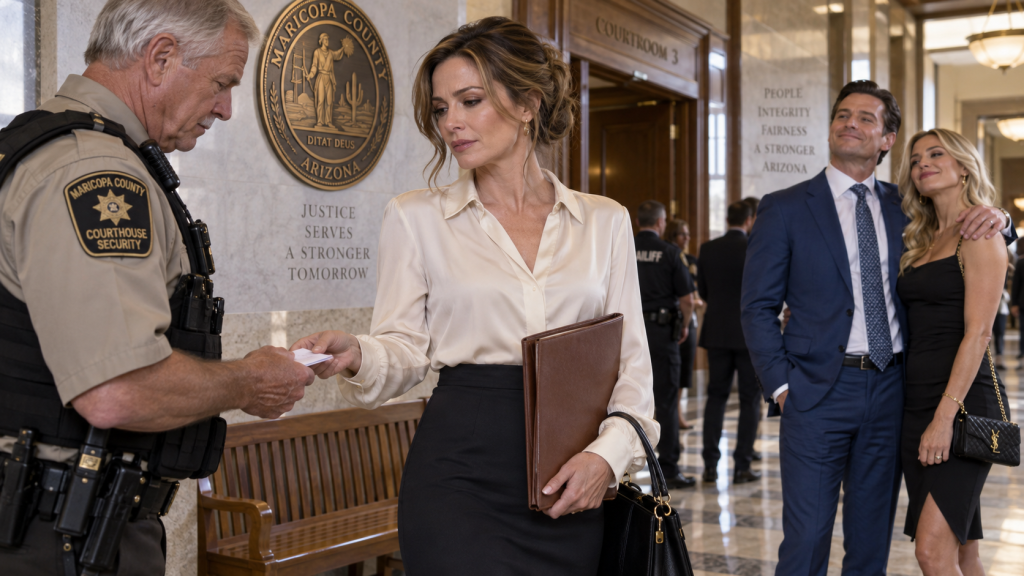
My husband had me sent to prison over a two-million-dollar fraud, and while bailiffs were handcuffing me in front of everyone, he smiled and said, “Now we’ll enjoy your money.” I didn’t argue. I simply handed a note to the guard. When he discovered who my father really was, he came closer and whispered, “Tomorrow your husband will lose everything”… but he still didn’t know why.

PART 1
“Enjoy your ten years, Genevieve. Brenda and I will know what to do with the money you left behind.”
Chad said it with a smile as two bailiffs approached to handcuff me at the Saint Claire County Courthouse in Phoenix.
For seven years, he had slept beside me. He had celebrated anniversaries, birthdays, and the birth of our son with me. And now he stood before me in an immaculate blue suit, holding a woman ten years younger than me around the waist, as if my sentence were the opening toast to his new life.
The judge had just sentenced me for fraud totaling nearly two million dollars, committed through the company where I was the chief financial officer.
The problem was simple: I had never touched that money.
The transfers carried my e.signature. The logins appeared to have come from my computer. The phantom vendors had been authorized using my credentials.
Everything pointed to me.
And Chad knew it because he had built every piece of evidence.
“Take care of Toby,” I managed to tell him.
He burst out laughing.
“We’ll see if a judge thinks a criminal deserves to remain a mother.”
Brenda covered her mouth to hide a smile.
That hurt more than the handcuffs.
When they led me down the service hallway, a young guard walked ahead of me while another, older man walked beside me. His badge read HAROLD FOSTER. He looked to be around sixty. His uniform was worn, and he walked with a slight limp.
I waited until we reached a corner without direct cameras.
I deliberately stumbled.
Harold caught me by the arm.
“Careful.”
I took advantage of the moment to slip a folded piece of paper into his hand.
“Please,” I whispered. “Call that number. Tell Christopher Lindqvist that his daughter has just been sentenced for something she didn’t do.”
Harold frowned.
The last name sounded familiar to him.
It would have sounded familiar to almost everyone in Phoenix.
Christopher Lindqvist owned construction companies, industrial parks, and hotels. He was a businessman the newspapers called “the man who built half the city.”
What no one knew was that he was also my biological father.
Not even Chad knew.
My mother had forced me to keep that secret ever since I turned eighteen.
“And why should I believe you?” Harold murmured.
I looked him straight in the eyes.
“Because when you tell him my full name, he won’t ask a single question.”
They put me into the transport vehicle.
During the ride, I thought Harold had probably thrown the note away.
But forty minutes later, before I could be taken into the correctional facility, everything changed.
The vehicle stopped.
Outside stood lawyers, prosecutors, and a federal court clerk.
The lead attorney presented an emergency order: new evidence involving the manipulation of expert examinations, a provisional suspension, and an immediate review of the measure that had authorized my transfer.
It wasn’t freedom.
But I wasn’t going into prison that night either.
And standing behind all of them was Christopher Lindqvist.
Completely white hair. Dark suit. Cane in one hand.
He didn’t hug me.
He didn’t even smile.
When we were finally alone inside his SUV, he said:
“Your husband thinks he stole two million from the company.”
“That’s what he did.”
Christopher slowly shook his head.
“No, daughter. Those funds belonged to a private investment vehicle of mine that invested through your company. Chad doesn’t know whose money he stole.”
I felt a strange chill in my chest.
My father looked out the window.
“And there’s something even worse. While you were being tried, someone sold your townhouse using a power of attorney supposedly signed by you.”
I immediately thought of Toby.
“Who bought it?”
Christopher looked at me for the first time with something resembling pity.
“Your mother.”
And then I understood that Chad’s betrayal might never have been just Chad’s.
I couldn’t imagine what I was about to discover about my own family.
PART 2 — THE HOUSE MY MOTHER BOUGHT WITH STOLEN MONEY
For the first twenty minutes inside my father’s SUV, I could not stop thinking about Toby.
Not the two million dollars.
Not the prison sentence.
Not Chad.
Not Brenda.
My son.
“Where is he?”
Christopher looked toward the attorney sitting across from us.
Her name was Mara Sloane.
Mid-forties.
Dark hair pulled into a severe knot.
A face that suggested she had spent most of her adult life listening to rich men lie badly.
She opened a folder.
“Toby is with Chad.”
My heart tightened.
“For now.”
“What does that mean?”
“It means there is no current court order removing him from Chad’s custody.”
I stared.
“I’m his mother.”
“You are.”
“I was just convicted of a financial felony.”
“Yes.”
“And Chad already threatened to use that against me.”
“Yes.”
The words were brutal.
Mara did not soften them.
I appreciated that.
Then she added:
“But there is not currently a final custody determination based on your conviction.”
“So we move carefully.”
I looked toward Christopher.
“Carefully?”
His expression did not change.
But his hand tightened around the head of his cane.
“I can buy buildings, Genevieve.”
“I cannot buy your son out of a family court.”
Good.
I hated hearing it.
Still good.
Mara continued.
“Your criminal case comes first tonight.”
“Because if we can establish that the conviction rests on compromised forensic evidence, that changes everything else.”
“Not automatically.”
“But materially.”
I leaned back.
My wrists still hurt from the handcuffs.
The skin beneath my blouse smelled faintly of courthouse dust and fear.
“I was sentenced.”
“Yes.”
“Ten years.”
“Yes.”
“And now what?”
Mara closed the folder.
“Now we find out whether the state proved a crime that never happened the way they said it did.”
Christopher finally spoke.
“The money was mine.”
I looked at him.
“You said it belonged to your investment vehicle.”
“Indirectly.”
He tapped the cane once against the floor.
“My family office invested through a private fund.”
“That fund placed capital with Meridian Strategic Holdings.”
Meridian.
My company.
Or rather, the company where I had been CFO until my arrest.
“We were not listed publicly as the beneficial source.”
I frowned.
“Why?”
“Privacy.”
Of course.
Billionaires apparently had entire industries devoted to not appearing in the places their money actually existed.
Christopher continued.
“Your company believed the funds came from Northgate Industrial Partners.”
I knew Northgate.
A private investor.
Quiet.
Low profile.
Never occurred to me there was another layer behind it.
“How much?”
“Six million total.”
My mouth went dry.
“And the stolen portion?”
“Just under two.”
The amount I had been convicted of stealing.
Christopher stared out the window.
“Chad thought he was taking corporate investment money.”
“He did not know he was moving funds that my office tracks independently.”
I felt a chill.
“So you can trace it.”
“Some of it.”
Not all.
Good.
Realistic.
Mara slid another folder toward me.
“Christopher’s auditors first noticed discrepancies during your trial.”
My heart lurched.
“During?”
“Yes.”
“Then why didn’t anyone come forward?”
Christopher looked at me.
“That requires an answer I do not enjoy giving.”
I waited.
“The investment structure was layered.”
“The first irregularities looked like ordinary vendor disputes.”
“By the time my office understood the losses might be fraud, your case was already in late pretrial proceedings.”
I stared.
“And nobody connected me to you.”
“No.”
Because no one knew.
Of course.
My biological father had spent thirty-four years as a secret so complete that even when my name appeared in criminal filings connected to his money, his organization did not recognize me as family.
There was something almost poetic in that.
Cruelly poetic.
I whispered:
“Did you know I was on trial?”
Christopher’s face changed.
Barely.
“No.”
That hurt.
Not because he owed me rescue.
Because I was his daughter and he had not known the worst thing that had ever happened to me was unfolding in public.
Then I remembered.
That was exactly how my mother wanted it.
Separate.
Silent.
Invisible.
“Tell me about the townhouse.”
My voice became harder.
Mara exchanged a glance with Christopher.
Then opened the property folder.
My townhouse had been sold eleven weeks earlier.
While I was preparing for trial.
I had not known.
That sounds impossible.
It was not.
I had been staying with my mother during parts of the trial because Chad insisted our home had become “too stressful for Toby.”
The townhouse had originally been mine before marriage.
I bought it with income from my first senior finance job.
Chad moved in after we married.
Later we bought a larger house jointly, but I kept the townhouse as a rental.
A property manager handled tenants.
Mortgage paid automatically.
Statements electronic.
Everything quiet.
Exactly the kind of asset a distracted person assumes is fine until someone tells her she no longer owns it.
“How?”
I asked.
Mara turned the page.
“A power of attorney.”
I laughed.
“No.”
“Purportedly signed by you.”
“I never signed one.”
“We know.”
“How do you know?”
“Because the notary acknowledgment claims you appeared in person in Phoenix on March 14.”
I stared.
March 14.
I knew exactly where I had been.
“In Tucson.”
Mara nodded.
“At a mandatory pretrial hearing.”
With timestamped courthouse video.
Lawyers.
A judge.
Clerk.
Public record.
I almost laughed again.
The forged document had placed me in two cities at once.
Stupid.
Or rushed.
“Who signed the sale paperwork for me?”
“Chad.”
My blood went cold.
“He used the power of attorney.”
“Yes.”
“And who bought it?”
Mara paused.
“Your mother.”
I closed my eyes.
Again.
Hearing it a second time did not make it less strange.
“What name?”
“The deed lists Elaine Mercer.”
My mother.
Of course.
Mara continued.
“Purchase price: six hundred forty thousand dollars.”
I stared.
“My mother does not have six hundred forty thousand dollars.”
Christopher’s eyes hardened.
“That is one of the reasons we are here.”
The SUV arrived at a private office building downtown.
Not my father’s home.
Not some palace.
An office.
Good.
I could not have survived luxury that night.
Inside, three people waited.
A forensic accountant.
A digital-forensics specialist.
And another lawyer from Mara’s team.
Nobody hugged me.
Nobody told me everything would be okay.
They told me what they knew.
I loved them for it.
The digital specialist was named Dr. Aaron Patel.
He had already reviewed parts of the trial record.
He began with the prosecution’s central evidence against me.
My electronic signature authorized payments to four vendors.
My credentials logged into Meridian’s financial system.
The transactions originated from a device associated with my office laptop.
Simple.
Devastating.
But not complete.
Aaron pointed to a timeline.
“Your trial expert treated account credentials, device identifier, and session authentication as though they proved physical user presence.”
I frowned.
“Don’t they?”
“Not necessarily.”
He enlarged a technical report.
“Your system allowed session tokens.”
“Yes.”
“Long-lived?”
“Eight hours.”
I felt sick.
I knew that.
Of course I knew that.
As CFO, I had approved the security policy years earlier because constant reauthentication frustrated executives.
Eight-hour session windows.
Convenient.
Dangerous.
Aaron continued.
“If someone obtained an authenticated session token, they might perform activity that appears associated with your device and credentials without physically using your laptop at that exact moment.”
My pulse increased.
“Remote access?”
“Possibly.”
“Or token theft.”
“Or malicious software.”
“Or legitimate remote-management tooling misused by someone with access.”
“Can you prove that happened?”
“Not yet.”
Good.
Again.
Not yet.
Then he pointed to one transfer.
Time:
10:42 a.m.
Date:
October 18.
I stared.
“I was in a board meeting.”
Aaron nodded.
“We have calendar evidence.”
“Calendar is not enough.”
“I know.”
“Security camera?”
“Meridian retained ninety days.”
“Gone.”
My stomach sank.
Then:
“But the conference-room system archived attendee authentication for video presentation access.”
I looked up.
“You logged into the boardroom presentation console at 10:31.”
“And remained active until 11:57.”
Different machine.
Different network segment.
Potentially helpful.
Not impossible that I had also used my laptop remotely.
But inconsistent with the prosecution story that I sat at my desk manually approving payments.
A crack.
Not an acquittal.
A crack.
After a conviction, cracks mattered.
Then Aaron showed me something worse.
The prosecution’s forensic expert had received an exported activity report from Meridian’s contracted IT provider.
Not raw system logs.
A filtered report.
“Why?”
I asked.
Aaron looked toward Mara.
“Apparently the original logs were considered too voluminous.”
I almost laughed.
Two million dollars.
Ten-year sentence.
And someone decided the raw evidence was inconvenient.
“Who generated the report?”
Mara answered.
“A contractor named Graham Vale.”
I knew the name.
Not personally.
Chad did.
My stomach tightened.
“How?”
Mara watched me carefully.
“Tell us.”
“Chad played golf with someone named Graham.”
“Last name?”
“I never asked.”
Silence.
Mara wrote something.
Christopher’s face became stone.
“Do not jump.”
I said.
My own voice.
Facts.
Aaron nodded.
“We won’t.”
Then:
“But we will identify whether it’s the same person.”
An hour later, it was.
Graham Vale.
IT consultant.
Weekend golf acquaintance of Chad Mercer.
Again, not proof he falsified evidence.
People know people.
Especially in one city.
But the connection had never been disclosed in my trial.
At least not in anything my defense counsel showed me.
That mattered.
I asked:
“Why didn’t my lawyer find this?”
Mara’s expression changed.
That was not a question she enjoyed.
“Your prior defense appears to have accepted several prosecution forensic conclusions without obtaining a full independent image of the relevant systems.”
I stared.
“I paid him eighty thousand dollars.”
Christopher looked furious.
Mara stayed calm.
“Price is not the same as quality.”
That one landed.
My attorney had been respected.
Busy.
Confident.
He kept telling me:
“The digital evidence is ugly, Genevieve.”
“It’s difficult to explain around.”
He wanted to focus on lack of motive.
Character.
Sentencing mitigation.
He had stopped fighting the technology before trial began.
I had not known enough to challenge him.
I was a CFO.
Not a cyber-forensics expert.
Apparently that distinction had cost me everything.
The forensic accountant, Nina Ross, took over.
She traced the phantom vendors.
Four entities.
All newly formed.
All invoicing Meridian for consulting, logistics, compliance, and vendor-transition services.
Payments flowed out.
Then scattered.
Some to brokerage accounts.
Some to debt payments.
Some withdrawn.
Some transferred again.
Chad’s name did not appear directly.
Of course not.
But one vendor paid Brenda Sloan Consulting LLC.
I felt cold.
Brenda.
The woman standing beside my husband while I was sentenced.
Amount:
$184,000.
No known consulting contract.
No obvious business purpose.
Mara asked:
“Did Brenda ever work with Meridian?”
“No.”
“What does she do?”
“Luxury real estate marketing.”
Nina raised one eyebrow.
Not corporate finance.
Not industrial logistics.
Interesting.
Another shell vendor paid an account belonging to Mercer Advisory Services.
My heart stopped.
“That’s Chad.”
“His company?”
“He registered it years ago.”
“For what?”
“He told me he wanted to do occasional business consulting.”
Nina turned the screen.
Total transfers:
$312,000.
I stopped breathing.
There he was.
Not the full two million.
But directly downstream from a company receiving stolen Meridian funds.
How had the prosecution missed that?
Perhaps they had not traced past the first layer.
Perhaps the vendor records were incomplete.
Perhaps someone had redirected focus toward me.
We did not know yet.
But for the first time since my arrest, I was looking at evidence that pointed somewhere else.
Not just away from me.
Toward him.
I cried.
Quietly.
Not relief.
Grief.
Because I had spent a year wondering whether somehow I had made some catastrophic mistake.
Clicked something.
Approved something unknowingly.
Signed something buried in a batch.
Failed to supervise someone who used my name.
I knew I had not stolen.
But evidence has a way of making innocent people question their own memories.
Now Chad’s company sat on the screen beside money that should never have reached it.
My husband.
The man who called me paranoid when I questioned strange cash withdrawals.
The man who kissed my forehead the morning investigators searched my office.
The man who sat behind me at trial.
Held my hand during jury deliberations.
Then arrived at sentencing with Brenda.
I whispered:
“He watched me defend myself against what he did.”
No one answered.
There was no useful answer.
Christopher stood and walked toward the window.
He had barely spoken for an hour.
I looked at him.
“What?”
His back remained toward me.
“My security team is outside Chad’s residence.”
I stood.
“No.”
He turned.
“They are observing.”
“Not entering.”
“No.”
“Not threatening him.”
“No.”
“Not taking Toby.”
His expression softened slightly.
“No.”
I let out a breath.
“Do not turn this into one of your corporate wars.”
His eyes sharpened.
“He sent my daughter to prison.”
“He may have.”
“No.”
Christopher’s voice dropped.
“He did.”
I looked at him.
“We prove it.”
Silence.
Then he nodded.
Good.
Money could accelerate experts.
It could not replace proof.
I needed my father to understand that.
At midnight, we finally discussed my mother.
Elaine.
I had spent my entire life protecting her version of our family.
When I was eighteen, she told me Christopher Lindqvist was my biological father.
Not the man whose surname I carried.
Not the man I had called Dad growing up.
That man, Samuel Price, had died when I was sixteen.
I loved him.
Still did.
Biology did not erase that.
Elaine made me promise never to contact Christopher.
She said he had chosen money over us.
That his family would humiliate me.
That I would destroy Samuel’s memory.
At eighteen, grief made me obedient.
Years passed.
Then curiosity won.
I contacted Christopher once.
At twenty-seven.
He answered immediately.
He knew about me.
That was another shock.
He had apparently sent support to Elaine for years through a private arrangement.
College money.
Medical expenses.
A fund for me.
I had never received it directly.
Elaine told him I wanted nothing to do with him.
Told me he wanted nothing to do with me.
Two people living inside opposite lies.
“Why didn’t you tell me?”
I asked Christopher.
He looked tired.
“I tried.”
“When?”
“Your twenty-eighth birthday.”
I remembered an envelope Mom had thrown away before I opened it.
She told me it was from a lawyer trying to sell investment products.
I almost laughed.
Of course.
Christopher continued.
“I was not innocent.”
“I had an affair with your mother while she was married to Samuel.”
That hurt.
Still.
“I agreed to secrecy after you were born because Elaine insisted Samuel would raise you as his.”
“Samuel knew?”
Christopher hesitated.
“Yes.”
I stared.
My father knew.
The father who taught me to ride a bike.
Who made pancakes every Sunday.
Who came to every school concert.
He knew I was not biologically his.
And he stayed.
I had to sit down.
Christopher continued.
“Samuel’s condition was that I never intrude on your childhood.”
“I accepted.”
“At the time, I thought that was honorable.”
His expression hardened at himself.
“Later I understood I had also chosen the arrangement that caused me the least disruption.”
That honesty mattered.
“I sent money.”
“I requested updates.”
“Elaine controlled both.”
“After Samuel died, I tried more directly.”
“She stopped me.”
“And you?”
I whispered.
“I stopped trying hard enough.”
There.
Not hero.
Father.
Flawed.
Rich enough to find me if he truly wanted.
He had respected a boundary long after the person who requested it was dead because respecting it was easier than risking rejection.
I could understand that without excusing it.
Then Nina slid a bank report toward us.
“Elaine’s purchase of the townhouse.”
My stomach tightened.
Here.
The next betrayal.
Purchase price:
$640,000.
Paid in cash.
“Where did she get it?”
Nina traced deposits.
Three months before closing, Elaine’s account received $225,000 from a company called Crescent Ridge Holdings.
Another $180,000 from an investment account liquidated shortly afterward.
The rest came from her existing assets.
“Crescent Ridge?”
I asked.
Christopher’s face changed.
“That’s mine.”
The room went silent.
I stared.
“You gave my mother money?”
“Not recently.”
“When?”
He looked at Nina.
She answered.
“The company has made annual payments to Elaine for decades.”
My mouth went dry.
Christopher closed his eyes.
“Our original agreement.”
Support.
For me.
Or supposedly for me.
Even after I became an adult?
“Yes.”
Christopher answered quietly.
“I continued paying.”
“Why?”
“Because she told me some of it was being held for you.”
I laughed.
Not joyfully.
“How much?”
He did not answer fast enough.
“Christopher.”
“Over the years?”
“Yes.”
“Several million.”
The room became completely silent.
I felt physically ill.
My mother had spent my entire life telling me we were middle class because Samuel worked hard and she budgeted carefully.
Which had been true.
But behind that life, she had apparently been receiving money from Christopher.
Money connected to me.
Money I never knew existed.
“Did she steal it?”
I asked.
Christopher shook his head.
“Not necessarily.”
“The agreements were poorly structured.”
“I paid her.”
“Legally.”
“Some payments were designated broadly for household and educational support.”
“Later ones were discretionary.”
I understood.
Again, no cartoon crime where every dollar secretly belonged to me.
Something messier.
Elaine had legal access to money.
And moral explanations she never gave me.
“But Crescent Ridge funded part of the townhouse purchase.”
“Yes.”
“That’s your money.”
“Originally.”
Christopher looked uncomfortable.
“It was hers once paid.”
Important.
Then Nina said:
“That is not the troubling part.”
Of course not.
She turned another page.
“The remaining purchase funds include a $97,000 transfer into Elaine’s account two weeks before closing.”
“From where?”
“A consulting firm.”
I already knew I would hate the answer.
Sloan Strategic Media.
I stared.
“Sloan.”
Brenda Sloan.
Nina nodded.
The company was controlled by Brenda.
My husband’s mistress had transferred ninety-seven thousand dollars to my mother.
Two weeks before my mother bought my townhouse using a power of attorney I never signed.
The room went silent.
I stood.
“No.”
Christopher reached toward me.
I stepped away.
“No.”
Not because the evidence was wrong.
Because my mind refused to put my mother and Brenda in the same sentence.
“How would they even know each other?”
No one answered.
Then I remembered.
My trial.
Mom attended the first week.
Brenda had been there too.
Not beside Chad then.
She sat behind him.
Presented as a “family friend.”
Mom once told me Brenda seemed “helpful.”
My stomach twisted.
Helpful.
Nina continued carefully.
“The transfer memo says property assistance.”
I gripped the chair.
“So Brenda helped my mother buy the townhouse?”
“Financially.”
“Apparently.”
“Why?”
“We don’t know.”
Facts.
I was beginning to hate that word again.
Mara checked her phone.
Then looked up.
“We have another development.”
“What?”
“The court has scheduled an emergency evidentiary hearing for tomorrow afternoon.”
My pulse jumped.
“About my conviction?”
“Yes.”
“The state wants to review the new forensic material before agreeing to further relief.”
“Does that mean I’m free?”
“No.”
I was currently being held under restricted release in Christopher’s custody arrangement authorized temporarily by the emergency order.
Not prison.
Not freedom.
A strange middle place.
Mara continued.
“We will argue to continue the stay and expand review.”
“And Chad?”
“He does not know the full basis yet.”
Good.
Then:
“But he will soon.”
I slept at Christopher’s guest residence that night.
Separate wing.
Security outside.
Too expensive.
Too quiet.
I hated it.
At two in the morning, I walked into the kitchen and found him there drinking coffee.
“Do billionaires not sleep?”
“Not when their daughters are facing ten years.”
I stopped.
Daughter.
The word still felt unfamiliar.
I sat.
For several minutes we said nothing.
Then I asked:
“Did Mom ever love you?”
Christopher almost smiled.
“Yes.”
“Did you love her?”
“Yes.”
“Do you still?”
Long silence.
“Part of me.”
That answer felt honest enough to trust.
Then he asked:
“Do you love Chad?”
I looked down.
“I don’t know.”
“That is not the same as no.”
“No.”
I hated that.
Betrayal does not erase seven years instantly.
It contaminates them.
Every anniversary becomes suspicious.
Every kindness gets reexamined.
You wonder whether the person was acting.
Or whether love and betrayal lived together.
Both possibilities hurt differently.
“I loved who I believed he was.”
Christopher nodded.
Then:
“Sometimes that is still love.”
I looked at him.
“You sound experienced.”
He stared into his coffee.
“I am.”
The hearing the next day lasted four hours.
No instant exoneration.
No dramatic judge overturning everything because Christopher entered the room.
His name did not matter nearly as much as the evidence.
Good.
Aaron testified about the session-token issue.
The state’s original forensic expert admitted he had not personally reviewed all underlying raw logs.
Graham Vale’s relationship with Chad was disclosed.
The prosecution asked for time to investigate before taking a position.
Then came the money tracing.
Mercer Advisory Services.
Brenda’s company.
Funds downstream from the phantom vendors.
The prosecutor’s face changed.
That mattered.
The judge did not vacate my conviction.
Not yet.
But he continued the stay.
Ordered preservation of all digital evidence.
Authorized expanded discovery.
And converted my status to supervised release pending the post-conviction review.
I walked out of the courthouse without handcuffs.
For the first time in twenty-four hours, air felt like air.
Reporters waited.
Christopher’s security team blocked questions.
I wanted to run.
Then I saw Chad.
Across the plaza.
Brenda beside him.
No arm around her this time.
His face was pale.
He looked at me.
Then at Christopher.
Recognition struck.
Not paternity.
Not yet.
Status.
Everyone in Phoenix knew Christopher Lindqvist.
Chad looked confused about why the man stood beside his convicted wife.
I almost smiled.
Not because I wanted revenge.
Because for the first time, he did not understand the room.
He walked toward us.
Mara stepped forward.
“Do not speak directly to my client.”
Chad ignored her.
“Genevieve.”
I looked at him.
“Where is Toby?”
That stopped him.
“At my mother’s.”
“Your mother?”
“Yes.”
“Is he safe?”
“Of course.”
“Then I want a video call tonight.”
He stared.
“You’re still convicted.”
“For now.”
His jaw tightened.
Then his eyes moved toward Christopher.
“What is he doing here?”
Christopher looked at me.
My choice.
That surprised me.
He could have announced himself.
Destroyed Chad’s composure with one sentence.
Instead, he waited.
I said:
“He’s helping my legal team.”
Chad laughed nervously.
“Why?”
I held his gaze.
“Maybe he dislikes seeing his money stolen.”
Everything changed.
Brenda went white.
Chad did not move.
Good.
He understood that part.
Not the rest.
Yet.
“What are you talking about?”
he asked.
I almost admired the performance.
“Northgate Industrial Partners.”
His face barely changed.
Almost.
“Never heard of them.”
Interesting.
I had not said he should have.
Christopher watched him.
Then said:
“You should speak through counsel.”
Chad’s eyes narrowed.
“Who are you?”
Christopher smiled without warmth.
“Someone whose accountants are better than you expected.”
That was all.
Mara moved me toward the car.
I did not look back.
That evening, I spoke to Toby.
Six years old.
Freckles.
Missing tooth.
My baby.
He thought I was “away for work.”
Chad had not told him prison.
Thank God.
Toby asked:
“When are you coming home?”
I almost broke.
“Soon, sweetheart.”
Lie?
Maybe.
Hope?
Definitely.
“Daddy says you did something bad.”
My entire body went cold.
Of course.
“What did Daddy say?”
“That you made a mistake with money.”
I looked toward Mara.
She wrote something.
Custody issue.
Later.
I forced my voice to stay warm.
“Sometimes grown-ups disagree about what happened.”
“There are people checking.”
“Okay?”
Toby nodded.
Then:
“Can you still come to my soccer?”
I smiled through tears.
“I’m going to try very hard.”
That was the truth.
After the call, Christopher’s investigator arrived.
A man named Luis Vega.
Former federal agent.
Annoyingly calm.
He had been reviewing Chad’s known devices, businesses, and financial relationships using lawful records available through the litigation and investigators.
He placed a photograph on the table.
My mother.
Elaine.
Leaving a restaurant.
Beside her:
Brenda.
Date:
Four months earlier.
Before my trial.
My stomach dropped.
“They know each other.”
“Yes.”
“How?”
“We’re investigating.”
“Stop saying that.”
Luis did not react.
Good investigator.
Then another photograph.
Chad.
Elaine.
Outside a bank.
Six months earlier.
My breath stopped.
Mom knew Chad too, obviously.
He was her son-in-law.
But meeting privately at a bank while I was under indictment?
Different.
“What bank?”
“Desert Crown.”
I knew it.
My mother banked there.
So did Brenda’s company.
So did one of the phantom vendors.
Not proof of conspiracy.
A connection.
Then Luis showed me a copy of the townhouse closing file.
The power of attorney.
My fake signature.
Chad acting as agent.
Elaine as buyer.
Brenda-linked funds helping finance it.
Then a closing instruction.
I read the line twice.
Seller proceeds to be applied pursuant to attached family debt settlement agreement.
“What proceeds?”
My townhouse had equity.
A lot.
If Elaine bought it for $640,000, sale proceeds after the mortgage should have gone to me.
They did not.
“Where did they go?”
Luis turned the page.
Three destinations.
One:
Mortgage payoff.
Normal.
Two:
Closing costs.
Normal.
Three:
$286,400 wired to Mercer Advisory Services.
Chad.
My husband.
My stolen equity.
I stopped breathing.
“How?”
I whispered.
Luis pointed to the family debt settlement agreement.
It claimed I owed Chad $300,000.
For “marital reimbursements, legal support, business advances, and household contributions.”
I laughed.
A broken sound.
“No.”
My signature appeared beneath it.
Again.
Not mine.
Chad had used a false power of attorney to sell my townhouse to my mother.
Then used another false document to route my equity to his company.
Almost three hundred thousand dollars.
Separate from the two-million-dollar fraud.
Separate from Brenda.
Separate from the criminal case.
A second financial attack.
Personal.
Christopher stood.
His face terrified even me.
“Where is Elaine?”
Luis answered:
“At home.”
“Does she know?”
“We have not contacted her.”
Christopher looked at me.
Again.
My choice.
I swallowed.
“I want to speak to her.”
Mara immediately said:
“Not alone.”
“Fine.”
“Not tonight.”
I stared.
“Why?”
“Because we do not know whether she is a witness, victim, participant, or some combination.”
That sentence hit hard.
My mother might have known everything.
Or Chad may have manipulated her.
Or Brenda.
Or money.
Or fear.
No assumptions.
I hated it.
Still right.
Then Luis said:
“There is something else in the closing file.”
I looked at him.
“What?”
“Elaine signed an affidavit.”
My stomach tightened.
“What does it say?”
“That the sale was being conducted at Genevieve Mercer’s request.”
“No.”
“And that you wished the property transferred to your mother because of your pending criminal case.”
“No.”
Luis continued.
“She states that you feared the government might seize the property.”
I stared.
“That makes it look like I was hiding assets.”
“Yes.”
Cold spread through my body.
The townhouse sale was not merely theft.
It could make me look guiltier.
As though I knew I was a criminal and was moving property before sentencing.
Chad had not only taken my house.
He had turned the theft into more evidence against me.
“Did Mom sign that affidavit?”
“Her signature appears genuine.”
I looked at Christopher.
His face had gone pale.
“What does that mean?”
I whispered.
Luis answered carefully.
“We need to ask her.”
Of course.
But before we could, Mara’s phone rang.
She listened.
Her expression changed.
“What?”
I asked.
She held up one finger.
Then:
“When?”
Silence.
“Preserve it.”
She ended the call.
Every person in the room waited.
Mara looked directly at me.
“That was the prosecutor’s office.”
My heart hammered.
“They obtained a search warrant related to one of the phantom vendors.”
I stood.
“For Chad?”
“Not exactly.”
“What did they find?”
“An internal account ledger.”
The room went silent.
Mara continued.
“The ledger tracks distributions from the diverted Meridian money.”
“Initials.”
“Dates.”
“Amounts.”
Chad’s initials appeared repeatedly.
So did Brenda’s.
I waited.
Then Mara said:
“There is a third set.”
My stomach turned.
“No.”
“G.M.?”
“No.”
She shook her head.
“E.M.”
Elaine Mercer.
My mother.
Amount beside her initials:
$240,000.
I could not speak.
Then Mara placed one final page in front of me.
The ledger contained a handwritten notation beside Elaine’s first payment.
Only five words.
For Genevieve problem — as agreed.
The room disappeared.
My own mother had not merely purchased my townhouse.
Someone in the fraud operation had recorded paying her while my case was unfolding.
And whatever “the Genevieve problem” meant, the agreement had existed long before my conviction.
Christopher gripped his cane.
I looked at him.
He looked suddenly older than he had the night before.
Then he whispered:
“Your mother has been lying to both of us for thirty-four years.”
I stared at the ledger.
Chad thought the secret that would destroy him was my father’s identity.
He was wrong.
Because now I understood something far worse.
The two-million-dollar fraud might not have begun as a plan to steal from Meridian.
It might have begun as a plan to remove me.
And the person who had helped Chad understand exactly how to do that—
might have been the woman who raised me.
PART 3 — THE DAY MY NAME BECAME MINE AGAIN
My mother did not answer when I called her.
Not the first time.
Not the second.
On the third attempt, the call went straight to voicemail.
I stared at the ledger on the conference-room table.
E.M. — $240,000
And beside the first payment:
For Genevieve problem — as agreed.
For most of my life, Elaine Mercer had been the person I called when something frightened me.
Bad grades.
First heartbreak.
Pregnancy.
Marriage.
My father Samuel’s death.
Toby’s fever when he was ten months old.
Even during the investigation at Meridian, before I understood Chad was involved, I called Mom.
She sat at my kitchen table.
Held both my hands.
And said:
“If you know you’re innocent, then eventually the truth will come out.”
Now I wondered whether she had been comforting me while already helping the man framing me.
That thought hurt in a place anger could not reach.
“Don’t call her again.”
Mara said.
I looked up.
“What?”
“Not until we know more.”
“She’s my mother.”
“Yes.”
“She may also be a witness in an active fraud investigation.”
I hated how easily both sentences could be true.
Christopher stood by the window.
His face had become hard again.
Not billionaire hard.
Father hard.
The kind of fury that wants to become action before wisdom arrives.
I pointed at him.
“And you do nothing either.”
His eyebrows rose.
“Genevieve—”
“No security team at her house.”
“No people following her.”
“No intimidating phone calls.”
“I wasn’t—”
“You were thinking about it.”
A long pause.
Then:
“Yes.”
At least he was honest.
“We let the prosecutors and lawyers handle it.”
Christopher’s jaw tightened.
Then he nodded.
“Fine.”
It was the first time in my life I had given my biological father an order.
It felt strange.
It also felt good.
The breakthrough in my criminal case came two days later.
Not from Christopher.
Not from money.
From a server backup almost everyone had forgotten existed.
Meridian’s IT vendor maintained disaster-recovery authentication records separately from the reports Graham Vale produced for prosecutors.
Those records had not been deleted because nobody had asked the right question during my trial.
Aaron did.
The backup showed that on three of the dates when my credentials supposedly authorized payments, an administrative support token had been created using Graham’s privileged account.
That token was then used from a device that was not my laptop.
The connection originated from an internet address associated with an office suite leased to Mercer Advisory Services.
Chad’s company.
I stared at the report.
“Are you sure?”
Aaron gave me the answer I had come to trust.
“The records support that conclusion.”
Not:
Absolutely.
Not:
Case closed.
Evidence.
Then he showed me the timestamps.
Graham’s administrator account.
Token creation.
Vendor payment.
Chad’s network.
Again.
And again.
And again.
My hands started shaking.
“Why didn’t this appear at trial?”
I asked.
Mara answered.
“Because Graham’s export omitted the token-issuance layer.”
I looked at her.
“Omitted accidentally?”
“We don’t know yet.”
Then the prosecutor’s investigators seized Graham’s work phone.
We found out.
Not accidentally.
There were messages between Chad and Graham.
Not thousands.
Enough.
One from seven months before my arrest:
Need her session active Thursday.
Graham:
Can do after support patch.
Another:
Reports will still show her device family.
Chad:
That’s the point.
I could not breathe.
Then another, sent after investigators first contacted Meridian:
Keep export clean. No admin noise.
Graham replied:
You owe me.
Chad:
Already handled.
There it was.
No theory.
No possibility.
My husband had arranged to use my authenticated access and then paid an IT contractor to present investigators with a cleaner version of the logs.
Not perfect.
Not sophisticated enough to survive a second investigation.
But sophisticated enough to convict me the first time.
Graham cooperated quickly after that.
Very quickly.
People often become philosophical about truth once they realize somebody else kept the messages.
He admitted Chad approached him months before the first fraudulent vendor invoice.
Chad knew I sometimes worked remotely.
Knew Meridian’s authentication system.
Knew my schedule.
He had listened for years while I complained about audit procedures and password policies over dinner.
Marriage had given him information he later weaponized.
Graham created temporary support access that allowed sessions to appear tied to my credentials.
Chad supplied the fake vendors and payment instructions.
Graham helped hide some administrative traces in the export.
He claimed he believed the scheme would involve only a few payments.
He claimed Chad told him the money was “basically family capital” and would eventually be replaced.
Maybe true.
Maybe another man trying to shrink his moral size after being caught.
That part no longer belonged to me.
The prosecutor called Mara before the next hearing.
I watched her face while she listened.
Then she hung up.
“What?”
I asked.
“They are moving to vacate the conviction.”
For several seconds, I did not understand the sentence.
“Tomorrow?”
“They will ask the court tomorrow.”
“Vacate.”
“Yes.”
“As in…”
“The conviction would no longer stand.”
My knees weakened.
Christopher reached toward me.
I held up one hand.
Not yet.
I had spent too long learning that good news can still have conditions.
“What happens after that?”
Mara nodded approvingly.
“The investigation continues.”
“The prosecution will determine whether any charges against you remain supportable.”
“Do they think I did it?”
Mara’s voice softened.
“No.”
I stared.
“Say that again.”
“The prosecutor’s office has told us it no longer believes the evidence supports the conclusion that you committed the fraud.”
I cried.
Not gracefully.
I folded forward over the conference table and sobbed until my ribs hurt.
Not because everything was fixed.
Because for the first time, someone from the system that called me a criminal had said:
We were wrong.
The judge vacated my conviction the following afternoon.
There was no applause.
Courtrooms are not theaters, no matter how television writes them.
The prosecutor described newly discovered digital and financial evidence.
Mara described the failures in my original defense.
The judge asked questions.
A lot of them.
Then he signed the order.
My ten-year sentence ceased to exist.
The underlying case remained open briefly while prosecutors completed their review.
Three weeks later, the charges against me were dismissed.
My counsel later began the separate process of securing every record-clearing remedy available.
Paperwork again.
Forms.
Orders.
Certified copies.
After living through wrongful conviction, I would never mock boring legal documents again.
Outside the courthouse, reporters crowded behind barricades.
Christopher stood several feet away.
He did not position himself beside me until I asked.
That mattered.
Mara whispered:
“You do not have to say anything.”
I knew.
Then I saw Harold Foster.
The guard.
Standing near the courthouse security entrance.
Same slight limp.
Same worn face.
He had probably been assigned there by coincidence.
Or perhaps he knew about the hearing.
I walked toward him.
He looked startled.
“Ma’am.”
I smiled.
“You made the call.”
He glanced around.
“I called the number you gave me.”
“That call changed everything.”
Harold shook his head.
“No.”
I frowned.
He continued.
“Evidence changed everything.”
“I made a phone call.”
I felt my throat tighten.
Maybe he had no idea how much I needed that distinction.
Christopher’s name had opened doors quickly.
His money hired experts.
But no billionaire had ordered a judge to free me.
The evidence had to survive.
The logs.
The money.
The messages.
The truth.
I took Harold’s hand.
“Then thank you for opening the first door.”
He smiled.
“That I’ll accept.”
Chad was arrested the next morning.
Not at the courthouse.
Not in front of me.
I learned from Mara.
So was Graham.
Brenda surrendered with counsel two days later after prosecutors expanded the financial case.
Chad faced the most serious allegations.
The two-million-dollar fraud.
Evidence manipulation.
False vendors.
Use of my credentials.
The townhouse transaction.
The forged settlement agreement.
The false power of attorney.
Brenda’s role was substantial but narrower.
Her company received fraudulent funds.
She invoiced for work she had never performed.
She transferred money to my mother for the townhouse transaction.
Investigators also found messages showing she knew Chad was trying to “finish Genevieve’s case” before the two of them could publicly live together.
She was not an innocent mistress receiving gifts.
She knew money was being concealed.
She knew I was being blamed.
That realization removed the last temptation to see her merely as another woman Chad had lied to.
He had lied to her too, certainly.
Just not about everything.
Toby was with Chad’s mother when Chad was arrested.
I wanted to drive there immediately.
Mara stopped me.
Again.
Family court.
Not emotion.
I hated her for approximately seven minutes.
Then admitted she was right.
My criminal conviction had been vacated.
Good.
Chad was facing serious charges.
Relevant.
Still, I did not simply appear at a house and remove a child because justice finally liked me better.
My family-law attorney filed for temporary orders.
Chad’s mother cooperated.
Thank God.
No ugly tug-of-war in a driveway.
No police standing beside a crying six-year-old.
A judge reviewed the circumstances.
Within days, Toby returned to me under temporary orders while the broader custody case proceeded.
The first night he came home, he stood inside the guest residence Christopher had arranged for us and looked around.
“This isn’t our house.”
“No.”
“Where’s Daddy?”
I knelt.
My entire body trembled.
“Daddy has serious grown-up problems he has to deal with.”
“Is he in jail?”
Children always know more than adults think.
I swallowed.
“Yes.”
“Did he do something bad?”
I could have told him everything.
The anger wanted to.
Instead:
“People believe Daddy broke important laws, and a court will decide what happens.”
Toby looked down.
“Is he bad?”
That question shattered me.
I pulled him close.
“People can do very bad things without you having to decide they are only one thing.”
He cried against my shoulder.
“So I can still love him?”
“Oh, sweetheart.”
I held him tighter.
“Yes.”
“Yes.”
“Yes.”
I would never make my son pay emotionally for what his father did to me.
That chain ended there.
My mother was questioned a week later.
She had retained counsel.
Good.
I did not attend.
I received summaries through Mara and the investigators.
Elaine admitted she knew the power of attorney used to sell my townhouse was not genuine.
That sentence alone nearly broke me.
She admitted Chad told her my conviction was inevitable.
He said the government might seize the townhouse or creditors might reach it.
He proposed moving the property into her name temporarily.
Elaine knew I had not authorized it.
She agreed anyway.
Why?
Her answer changed several times.
At first:
“To protect Genevieve.”
Then:
“To protect Toby.”
Then finally:
“Because Chad said the house would be lost if we didn’t act first.”
Fear.
Control.
Again.
She also signed the affidavit stating that I wanted the transfer.
She knew that was false.
The $240,000 in the ledger represented two categories.
Part of it—roughly the amount that helped fund the purchase—was routed through Brenda’s company so Elaine could complete the cash acquisition.
The remainder was transferred later and described by Chad as money for taxes, carrying costs, and “family settlement.”
Elaine kept a significant portion.
She claimed Chad told her it came from legitimate consulting income.
Investigators found no proof she helped design or execute the Meridian vendor fraud.
No messages about session tokens.
No knowledge of Graham.
No involvement in my company systems.
That mattered.
She had not framed me for the two-million-dollar theft.
Chad had.
But she knowingly participated in the false townhouse transaction after I was charged.
And she accepted money while helping him create the appearance that I was hiding assets from the government.
That was enough betrayal for one mother.
No conspiracy throne required.
The ledger notation—
For Genevieve problem — as agreed
—was Chad’s language.
Elaine had not written it.
According to Chad’s later statements, “the Genevieve problem” meant the risk that I might retain assets or recover enough financial independence to keep fighting after conviction.
He wanted the townhouse gone before sentencing.
He also wanted proceeds available to him.
My mother made that possible.
Not because she wanted me imprisoned.
Because she convinced herself prison was already inevitable.
That difference did not comfort me much.
I finally met Elaine in a lawyer’s conference room.
Three months after my conviction was vacated.
She looked older than I remembered.
Not physically, exactly.
Secrets age people differently once they are visible.
Christopher was not there.
My choice.
Neither was Toby.
Definitely my choice.
Elaine sat across from me.
For several minutes, no one spoke.
Then she whispered:
“Jenny.”
I had not heard that childhood name in months.
“Don’t.”
Her face crumpled.
I did not enjoy it.
People imagine confronting someone who betrayed you will feel powerful.
Mostly it feels sad.
“Did you know I was innocent?”
I asked.
Elaine started crying.
“At first.”
“What does that mean?”
“When you were arrested, I believed you.”
“And later?”
“Chad kept showing me things.”
“The transfers.”
“The reports.”
“He said you had confessed things privately to him.”
My stomach turned.
“What things?”
“That you had moved money because Meridian was going under.”
“That you planned to pay it back.”
“That you were too ashamed to tell me.”
I stared.
“And you believed him over me?”
She covered her mouth.
“Eventually, yes.”
That answer was honest.
Horrible.
Honest.
“Did I ever confess to you?”
“No.”
“Did I ever tell you I stole money?”
“No.”
“Did I ever ask you to buy my townhouse?”
“No.”
“Did I sign the power of attorney?”
“No.”
“Then why did you sign an affidavit saying I wanted it?”
Her shoulders shook.
“Because I thought I was saving something for you.”
“No.”
My voice rose for the first time.
“You were deciding that the truth didn’t matter because you preferred your plan.”
She cried.
“I was scared.”
“Everyone was scared.”
I leaned forward.
“I was the one going to prison.”
Silence.
“You do not get to turn fear into permission.”
She looked down.
Then I asked about Christopher.
Not Chad.
Not the house.
Thirty-four years.
“Why did you keep him from me?”
Elaine wiped her face.
“Because I loved Samuel.”
“So did I.”
“I was ashamed.”
“Of me?”
“No.”
The answer was immediate.
“Of myself.”
That softened nothing.
But it clarified.
She told me the affair with Christopher had happened during a terrible period in her marriage.
Samuel knew about the pregnancy.
He chose to raise me.
Christopher agreed to stay away during childhood.
After Samuel died, the arrangement should have changed.
It did not.
Elaine had spent sixteen years telling one story.
She did not know how to stop.
Then Christopher began trying to contact me.
And the money continued arriving.
“Did you keep it because of the money?”
I asked.
Elaine flinched.
“Not at first.”
“At first?”
She stared at her hands.
“Christopher’s payments made life easier.”
There it was.
Not all of the money had been designated for me.
The original agreements gave Elaine broad discretion for household and educational support.
She used it legally in many ways.
Our mortgage.
School.
Medical bills.
Some savings.
After I became an adult, Christopher continued sending discretionary support because Elaine claimed she was saving part for my future needs.
She saved some.
Used some.
Invested some.
No simple theft charge waiting in a drawer.
Something morally uglier because it was less legally clean.
She allowed Christopher to believe I wanted distance.
Allowed me to believe he had rejected me.
And money moved through the silence.
“I thought if you met him…”
She stopped.
“What?”
“You would ask questions.”
“Yes.”
“And I wouldn’t know how to explain everything.”
I laughed once.
“So you protected yourself.”
She cried.
“Yes.”
Finally.
Not me.
Not Samuel.
Not family peace.
Herself.
That was the answer.
“Do you know what hurts most?”
I asked.
She shook her head.
“You taught me my whole life that secrets protected families.”
Her eyes closed.
“You made me hide who my father was.”
“You hid money.”
“You hid the townhouse deal.”
“And every time, you called it protection.”
I swallowed.
“Then Chad married me and discovered that I had been trained to tolerate people deciding what truth I could handle.”
Elaine sobbed.
I did too.
Because some inheritances are not money.
Some are habits.
Silence.
Obedience.
The belief that love gives people authority to edit reality.
I was done inheriting those.
Elaine eventually faced legal consequences for the property fraud.
She cooperated.
Returned what remained of the money she had received.
The townhouse transaction was challenged and unwound through civil proceedings using the evidence of the false power of attorney and related documents.
It took time.
Nothing snapped back overnight.
By the end, title was restored through the legal process and the improper distribution of equity addressed.
Elaine’s criminal resolution reflected her false statements and knowing participation in the transaction.
She received probation, restitution obligations, and financial penalties.
No prison.
Some relatives said that was too lenient.
Others said an older woman had suffered enough.
I stopped listening.
Sentencing was not my emotional therapy.
I wanted the record truthful.
I got that.
Brenda’s case ended differently.
She had participated in the false-vendor network and moved money through her company.
Evidence showed she knew invoices were fabricated.
She eventually entered a plea and received a custodial sentence followed by supervision, along with restitution and forfeiture tied to traceable proceeds.
Graham cooperated extensively and also faced punishment.
Chad fought longer.
Of course he did.
He insisted I had secretly known about the vendors.
Then investigators found another problem.
A spreadsheet on his computer.
Not called:
FRAME MY WIFE.
Criminals are rarely considerate enough to label evidence.
It was called:
CASH FLOW OPTIONS.
Inside were vendor amounts.
Payments to Brenda.
Payments to Graham.
Transfers to Mercer Advisory.
And a column:
G risk.
Genevieve risk.
Dates matched my internal audit schedule.
Board meetings.
Vacation.
Work travel.
He had planned transactions around periods when my login patterns would create plausible cover.
Then came the ugliest message of all.
Chad to Brenda.
Sent two weeks before my arrest:
Once they focus on her, don’t panic. Her title makes the story believable.
I read it once.
Never again.
That sentence answered every lingering question about whether he had merely stolen money and opportunistically blamed me afterward.
No.
He had planned the blame.
Why?
Money first.
He was deeper in debt than I knew.
His consulting business was failing.
Brenda wanted a life he could not afford.
He resented my control over household finances because I noticed numbers.
He believed Meridian’s investment money could be siphoned slowly.
Then he realized the cleanest protection was a culprit already positioned to authorize payments.
The CFO.
His wife.
My title made the story believable.
His marriage made my credentials accessible.
His affair gave him someone willing to move money.
My mother’s fear gave him help disposing of my personal asset after the accusation took hold.
Not one master conspiracy.
A series of people saying yes to the next wrong thing.
That was almost more frightening.
Chad eventually pleaded guilty to a range of supported federal and state offenses arising from the fraud, evidence manipulation, identity misuse, and property scheme.
His sentence was substantial.
Years.
Not because he cheated on me.
Not because Christopher was rich.
Because he stole a large amount of money, corrupted evidence, and deliberately caused an innocent person to be convicted.
The judge said something during sentencing I will never forget:
“You did not merely take money. You attempted to transfer the cost of your crime into another human being’s life.”
Yes.
Exactly.
I did not attend every day of his sentencing hearing.
I went once.
Enough.
Chad looked different in jail clothing.
Smaller.
Not less human.
That mattered too.
When he saw me, his eyes filled.
After the hearing, through counsel, he asked whether I would speak to him privately.
I said no.
Months later, I agreed to receive one letter.
Not for romance.
For closure.
He wrote:
I did love you.
I stared at that sentence for a long time.
Then:
I also hated how competent you were when I felt like I was failing. I began treating your trust in me as something I could use instead of something I was responsible for.
That sounded more honest.
He apologized for Toby.
For the trial.
For Brenda.
For the townhouse.
Then wrote:
I don’t expect forgiveness.
Good.
Because I did not know what forgiveness meant yet.
I never replied.
The custody case ended more quietly than the criminal one.
Chad’s incarceration made the long-term practical arrangement clear.
I received primary legal and physical custody of Toby, subject to carefully structured contact with Chad as appropriate and permitted.
I did not erase his father.
Toby wrote letters.
Sometimes.
Had supervised calls.
Sometimes.
Then periods where he did not want to.
His therapist helped us follow his needs instead of my anger.
When Toby eventually learned more, years later, I told him the truth without making him responsible for my pain.
“Your father hurt me very badly.”
“Yes.”
“He also loves you in the ways he knows how.”
“Both things can be true.”
Toby cried.
So did I.
That sentence had become the hardest lesson of my adult life.
Christopher remained.
That relationship may have been the strangest of all.
At first, he wanted to fix everything.
House.
Legal bills.
School.
Security.
A new car.
A trust for Toby.
Probably the weather if money could reach it.
I stopped him.
“No.”
He stared at me like nobody had told him no in fifteen years.
“I can help.”
“I know.”
“Then why won’t you let me?”
“Because I just escaped a husband and a mother who both thought helping meant deciding.”
That shut him up.
Good.
We made rules.
He could pay legal expenses connected to clearing my wrongful conviction because he had offered before I had any practical way to fund the fight.
I accepted that.
Later, once my assets were restored and civil recoveries resolved, I offered to repay part.
He refused.
I did not fight endlessly.
A gift can be a gift when both people know what it is.
No secret debt.
No future ownership.
No leverage.
He also established nothing for Toby without discussing it with me.
That was harder for him.
We learned.
I learned more about Samuel too.
Christopher gave me letters.
Old ones.
Samuel had written to him after I was born.
One said:
She will know love before she knows biology. That is the only thing I can promise you.
I cried for an hour.
Samuel had known.
Loved me anyway.
No.
Not anyway.
Simply loved me.
Biology had never been the qualification.
That healed something I did not know was broken.
Christopher and I did not become a perfect father-daughter pair.
You cannot reclaim thirty-four missing years with brunch.
We disagreed.
A lot.
He was controlling.
I told him.
He hated being told.
Toby found this hilarious.
Eventually, Christopher became Grandpa Chris.
Not because I declared it.
Because Toby did.
One afternoon he asked:
“Can I call him that?”
I said:
“If you want.”
Choice.
Always choice now.
My mother and I remained apart for almost two years.
People pressured me.
Of course.
“She’s your mother.”
“She’s old.”
“She made terrible mistakes.”
“You only get one mother.”
All true.
None created access.
I sent updates about Toby through counsel at first.
Later through email.
Eventually, after sustained therapy and restitution and long stretches of respecting my silence, Elaine asked whether I would meet.
She did not say:
You need to forgive me.
She asked.
So I went.
We met in a park.
Public.
No lawyers.
She looked fragile.
I reminded myself fragility does not equal innocence.
She said:
“I’m sorry.”
I asked:
“For what?”
She answered well.
“For teaching you that love required secrecy.”
My throat tightened.
“For believing my fear entitled me to sign lies about your property.”
“For choosing Chad’s explanation over your voice.”
“For taking money I should have questioned.”
“For keeping Christopher from you long after there was no good reason.”
No:
But.
No:
I was trying to protect you.
That mattered.
“Do you forgive me?”
she asked.
I thought.
“Some days.”
Elaine almost smiled.
“That’s fair.”
“And forgiveness does not mean you manage anything in my life.”
“I know.”
“No financial documents.”
“I know.”
“No Toby decisions.”
“I know.”
“No private arrangements because you think I’ll eventually understand.”
Her eyes filled.
“I know.”
Good.
That was as far as we went.
At first.
Later came birthdays.
Short visits.
Coffee.
A relationship smaller than before.
More truthful.
Sometimes smaller is healthier.
Meridian offered me my job back.
I declined.
That surprised everyone.
Especially me.
For years, CFO had been part of my identity.
After the trial, I could not walk past an authentication screen without remembering prosecutors enlarging my login records for a jury.
I needed distance.
The company apologized publicly.
Its insurer and other parties eventually resolved civil claims arising from the wrongful prosecution and investigative failures.
My lawyers handled the details.
Some money came back.
Some legal costs were reimbursed.
Nothing could reimburse eighteen months of fear.
Money does what money can.
That is all.
I eventually started consulting.
Financial controls.
Fraud prevention.
Governance.
The irony was obvious.
My first seminar was titled:
Credentials Are Evidence, Not Identity.
Aaron laughed when he saw it.
“Subtle.”
“I’m working on subtle.”
I taught companies something I learned painfully:
A login tells you what credential acted.
Not always which human did.
Independent logs matter.
Raw evidence matters.
Conflicts matter.
And when a story fits too perfectly, competent investigators should become more curious, not less.
That work gave the ugliest chapter of my life a use without turning suffering into something I was grateful for.
I was not grateful.
I simply refused to waste what I had learned.
Five years after my conviction was vacated, Toby and I returned to the Saint Claire County Courthouse.
Not for a case.
His middle school had a civics program.
Parents could volunteer.
I almost said no.
Then decided buildings do not own memories.
People do.
I walked through security.
Same marble floor.
Same metal detector.
Different life.
Harold had retired by then.
I knew because I had sent him a Christmas card every year.
He always answered.
Short sentences.
Terrible handwriting.
Toby stood beneath the courtroom seal listening to a clerk explain jury service.
He had no idea exactly where I had stood in handcuffs years earlier.
One day he would.
Not that day.
I touched the inside of my handbag.
Inside was a photocopy of the note I had handed Harold.
I kept it.
Not as magic.
It was just a phone number.
A name.
One desperate request.
But for years before that moment, I had been trained not to ask for help from the person who might complicate the family story.
My mother told me not to contact Christopher.
So I didn’t.
Until I was in handcuffs.
Sometimes survival begins when obedience finally becomes more frightening than disobedience.
After the school tour, Toby asked:
“Mom, why are you smiling?”
“I was thinking.”
“About what?”
“About how different a place can look when you’re free to leave it.”
He shrugged.
Twelve-year-olds do not reward poetry.
“Can we get pizza?”
I laughed.
“Yes.”
Better question anyway.
Christopher joined us.
Elaine did not.
Not because she was banned forever.
Because that afternoon belonged to us.
She had learned not every family event required her presence.
Christopher complained about the pizza.
Too much cheese.
Toby told him that was impossible.
They argued.
I sat between them.
Not choosing one father over another.
Samuel remained my father.
Christopher became my father too.
Human hearts are not title records.
More than one truth can coexist without canceling the rest.
That evening, after Toby went to bed, I opened the old case box.
I rarely did anymore.
Inside:
The vacatur order.
The dismissal.
Forensic reports.
Townhouse records.
Chad’s letter.
The copied power of attorney.
The ledger.
And Harold’s note.
I looked at my old electronic signature reproduced on those false documents.
For months, seeing it made me feel violated.
Someone had taken the shape of my name and taught strangers to distrust the person behind it.
But a signature is not a person.
Neither is a login.
Neither is an indictment.
Neither is a conviction once truth proves it wrong.
For too long, everyone around me had tried to tell me who I was.
Chad:
Criminal.
Elaine:
Daughter who needed protection from truth.
Christopher:
Daughter he could rescue.
The state:
Defendant.
The press:
Disgraced CFO.
Even innocence can become another identity people force onto you after exoneration.
Wrongfully convicted woman.
True.
Still not all of me.
I closed the box.
Went upstairs.
Toby had left his bedroom door open.
A book lay across his chest.
Lamp on.
I turned it off.
Pulled the blanket over him.
For a moment, I remembered Chad outside the courtroom.
Brenda beside him.
His smile.
Now we’ll enjoy your money.
He had been so certain.
Certain I was finished.
Certain prison would make every lie permanent.
Certain a conviction meant truth had lost.
He was wrong about the money.
Wrong about the townhouse.
Wrong about my father.
Most of all, wrong about me.
Christopher once asked whether I wished I had known who he was sooner.
Yes.
Of course.
I wish Elaine had told the truth.
I wish Samuel and Christopher had found some braver arrangement.
I wish Chad had never learned how to use my trust against me.
I wish prosecutors had looked harder the first time.
I wish my defense lawyer had asked for the raw logs.
I wish a thousand things.
But wishes are not appeals.
They do not rewrite records.
Eventually, life asks a harder question:
What will you do with what remains?
I remained.
My son remained.
My name remained.
And once the courts, lawyers, accountants, investigators, and years of therapy finished clearing away everyone else’s version of me, I discovered something almost embarrassingly simple underneath.
I was still Genevieve.
A mother.
A financial professional.
Samuel’s daughter.
Christopher’s daughter.
Elaine’s daughter, though on different terms.
A woman who had loved the wrong man.
A woman who survived being called guilty.
A woman who learned that forgiveness and access are not the same.
A woman who finally understood that family secrets are not loyalty when only one person benefits from the silence.
The note I gave Harold did not save me.
Christopher did not save me.
Money did not save me.
The note opened a door.
My father’s resources helped us reach evidence faster.
Good lawyers knew where to look.
Forensic specialists found what had been ignored.
Investigators followed money instead of appearances.
A prosecutor was willing to admit the case had become wrong.
A judge listened.
Truth needed all of them.
But after years of letting other people decide which truths I was allowed to carry, I finally did one thing for myself.
I asked.
I spoke.
I refused to stay quiet.
And that was the part no one could forge.
Not my signature.
Not my login.
Not my husband.
Not my mother.
Not even a guilty verdict.
My name became mine again because, at last, so did my voice.
THE END STORIES! THANK YOU FOR READING GOOD LUCK !❤️
Related Posts