For one terrible moment, my son looked exactly like the seven-year-old boy who had stood beside his father’s coffin, clutching my hand and asking whether Daddy would ever come home. His eyes widened. His mouth opened.
And the anger that had brought him to my doorstep seemed to drain from his face. “Mom,” he whispered, “where did you get that?” I held up the final page of the document. The porch light illuminated the signature beneath the statement describing me as mentally unfit to manage my finances.
Benjamin Arthur Whitfield. My son’s full name. The name Arthur and I had chosen together. The name I’d written on countless school forms, birthday cakes, and Christmas presents. “Did you sign this, Ben?” Sloane stepped forward. “Margaret, you’re making a scene.”
I looked at her.
“This is my front porch.”
She folded her arms.
“We can discuss this privately.”
“We are discussing it privately.”
Ben stared at the paper.
Then he looked away.
And I knew.
Before he spoke, before he tried to explain, I knew.
“Ben?”
His voice was barely audible.
“Yes.”
My heart seemed to stop.
“You signed a statement saying I was mentally incapable of handling my money?”
He swallowed.
“Sloane said it was just paperwork.”
Sloane’s expression hardened.
“Don’t put this on me.”
Ben glanced at her.
“You said the venue needed it.”
“It did.”
I looked between them.
“Needed what, exactly?”
Neither answered.
I unfolded the document.
“It says I have demonstrated impaired judgment, emotional instability, and an inability to manage substantial financial commitments.”
My voice trembled.
“Do you believe that about me?”
Ben rubbed his forehead.
“Mom, you were changing your mind about everything.”
“I was refusing to remodel my house.”
“You kept getting upset with Sloane.”
“Because she was entering without permission and moving my belongings.”
He looked down.
I continued.
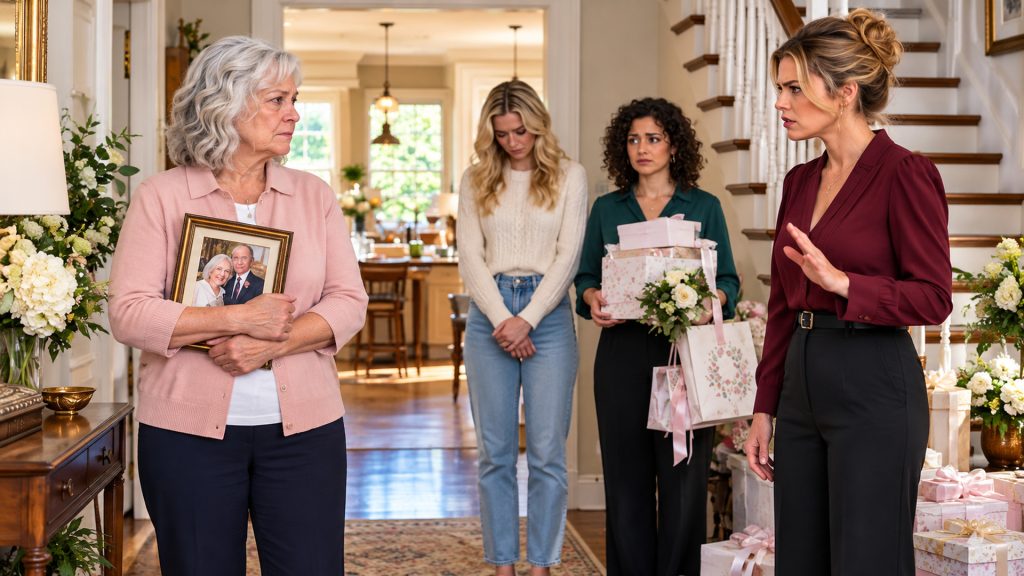
“Your fiancée wanted to remove a photograph of your father because she thought it was inconvenient for her rehearsal dinner.”
Ben closed his eyes.
“Please don’t bring Dad into this.”
The words cut through me.
I took a slow breath.
“Your father is already part of this, Benjamin. His photograph hangs inside the home we built together.”
Sloane gave an impatient sigh.
“This is exactly what I mean. Every disagreement becomes a speech about Arthur.”
I stared at her.
For months, I’d listened to her subtle criticisms.
I’d laughed politely when she called my curtains depressing.
I’d remained silent when she referred to my furniture as outdated.
I’d even tried to convince myself that her constant demands were simply an expression of wedding stress.
But standing behind my locked front door, holding a document that questioned my mental capacity, I finally understood that I didn’t need to keep making excuses for her behavior.
“Sloane,” I said quietly, “you will never speak about my husband that way in my home again.”
Her face flushed.
“We’re supposed to be family.”
“Family doesn’t mean you get to erase someone who died.”
Ben stepped between us.
“Mom, please. We just need you to reinstate the wedding payments.”
I stared at him.
For one bewildering second, I thought I’d misunderstood.
“That’s what you came here for?”
His shoulders dropped.
“The venue says we might lose our date.”
I looked at the forged authorization.
“The venue is reviewing a document submitted in my name without my permission.”
Sloane lifted her chin.
“It was a misunderstanding.”
“You told them I was hospitalized.”
“Because you weren’t answering our messages.”
“I was standing in my kitchen.”
She looked away.
Ben reached toward the door.
“Mom, just let us inside. We’ll figure it out.”
I stepped back.
“No.”
His face changed.
“You’re seriously locking me out?”
I looked at him through the narrow opening.
“You don’t live here, Ben. This is my home.”
He stared.
“You changed the locks on your own son?”
“Yes.”
“After everything?”
I felt tears gathering.
“After someone used the key I gave them to enter my house without asking, rearrange my belongings, and treat my late husband’s memory as an inconvenience.”
Sloane laughed bitterly.
“So that’s it? You’re choosing furniture over your son?”
I shook my head.
“I’m choosing to stop being threatened inside my own house.”
Ben’s eyes filled.
For a moment, I thought he might apologize.
Instead, he whispered, “You’re going to regret this.”
I looked at the boy I’d raised.
The man I’d helped through university.
The child who used to fall asleep against my shoulder during thunderstorms.
Then I answered softly.
“Maybe. But I would regret paying ninety-four thousand dollars to prove I’m allowed to be respected even more.”
I closed the door.
Behind it, Sloane began shouting.
Ben called my name twice.
Then came the sound of footsteps moving down the porch.
A car door slammed.
An engine started.
And the driveway fell silent.
I stood with my forehead against the door until my knees began trembling.
Then I sank onto the hallway bench and cried.
Not because I’d lost ninety-four thousand dollars.
Not because I’d canceled a wedding.
But because my only son had looked directly at a statement calling his mother mentally incapable and signed his name beneath it.
The following morning, I called a lawyer.
Her name was Priya Desai.
She was recommended by a former colleague who had worked with me at the transportation company.
Priya’s office was in downtown Toronto, on the sixth floor of a glass building overlooking a crowded intersection.
I arrived carrying three binders.
One contained the wedding contracts.
One held the expense-account statements.
And the third contained emails, text messages, and the purported authorization submitted to the venue.
Priya listened without interrupting.
When I finished, she adjusted her glasses.
“Margaret, I want to separate three issues.”
I nodded.
“The wedding contracts, the disputed financial transactions, and the false statement about your capacity.”
She placed the documents neatly in front of her.
“First, being the person who agreed to pay for the wedding does not mean you can prevent your son from getting married. But you may be entitled to cancel or withdraw from contracts you’ve signed, subject to their terms and any cancellation fees.”
“I understand.”
“Some deposits may be nonrefundable. Others may be recoverable. We’ll review each agreement.”
I nodded again.
“Second, we need to understand exactly how the expense account was structured.”
I handed her the bank documents.
“It was opened for wedding costs. I deposited sixteen thousand dollars.”
“And who had access?”
“Ben and Sloane were authorized to make certain payments.”
Priya looked up.
“Then the question isn’t simply whether they could use the account. It’s what permissions they were given, what they agreed the funds were for, and whether particular transactions involved misrepresentation or misuse.”
I swallowed.
“Can I get the money back?”
“Possibly some of it. But I don’t want to promise recovery before we’ve reviewed the evidence.”
I appreciated that.
After months of hearing what everyone expected me to provide, it was reassuring to sit across from someone who wasn’t selling me an easy answer.
Then Priya reached for the final document.
“And this concerns me most.”
My stomach tightened.
“The statement?”
She nodded.
“Your son signing an allegation that you’re incapable of managing your finances does not, by itself, make you legally incapable. Nor does it authorize Sloane to sign contracts in your name.”
I exhaled.
“But why would they submit it?”
“We need to ask the venue exactly what representations were made and whether anyone attempted to use these documents to obtain financial authority.”
I stared at the page.
“Can you help me?”
Priya’s expression softened.
“Yes.”
For the first time in days, I felt as though the ground beneath my feet had stopped moving.
Before I left, she gave me practical instructions.
Preserve the original messages.
Keep copies of the contracts.
Confirm the bank’s restrictions in writing.
Review my accounts for any other unauthorized access.
Notify relevant organizations that no one had authority to sign on my behalf.
And avoid discussing the dispute with Ben or Sloane without documenting the communication.
Then she asked one final question.
“Margaret, do you have a current will and powers of attorney?”
I nodded.
“Arthur and I prepared our estate documents years ago. I updated them after he died.”
“Good. Let’s review them as well, including who can act if you genuinely become incapable in the future.”
I looked down at my hands.
“I never imagined I’d need to protect myself from my own son.”
Priya was quiet for a moment.
Then she said something I wrote down when I returned home.
“Setting a boundary with someone you love doesn’t mean you have stopped loving them. It means the relationship must have room for your rights as well as theirs.”
I left her office feeling exhausted.
But no longer helpless.
The venue sent its written account two days later.
I was sitting at my dining table when Priya called.
“Margaret, are you somewhere private?”
My stomach tightened.
“Yes.”
“Then I’d like you to open the email I’m forwarding.”
I reached for my laptop.
The message contained the venue’s internal notes concerning the disputed authorization.
I read them slowly.
Sloane had telephoned the coordinator claiming I was undergoing treatment for an undisclosed medical condition.
She said my judgment had become unreliable following a recent deterioration in my health.
She also claimed Ben had been advised that his mother should no longer make significant financial decisions without family oversight.
None of it was true.
I was sixty-three.
I managed my own investments, paid my bills, and volunteered twice a month at a community transportation program.
I’d attended a routine medical appointment only three weeks earlier.
My physician had expressed no concerns about my ability to understand my finances.
Yet Sloane had apparently described me as a confused widow whose family needed to take over her obligations.
I pressed my hand against my mouth.
Then I reached the final section.
Request for refund redirection pending updated payment instructions.
I frowned.
“Priya, what does this mean?”
“The coordinator says Sloane requested that any refundable balance from your canceled contracts be sent to an account controlled by her wedding-planning business.”
I stared at the screen.
“What wedding-planning business?”
Priya paused.
“That’s what we’re investigating.”
The business was called Sloane Atelier Events.
I’d heard the name once.
Sloane had mentioned wanting to establish herself in event design, although I’d assumed it was something she’d pursue after the wedding.
Now I learned that she had registered the business months earlier.
And the account details she’d supplied to the venue were associated with that company.
My fingers went cold.
“So if the venue had refunded my deposit, the money might have gone to her?”
“That appears to have been her request. Fortunately, the venue stopped the change pending verification.”
I stared toward Arthur’s photograph.
The same photograph Sloane wanted hidden.
I remembered the last conversation Arthur and I had before his cancer treatment began.
We were sitting beside Lake Louise, wrapped in jackets against the cold.
He’d taken my hand and said, “Maggie, promise me something.”
I’d laughed.
“What?”
“If anything ever happens to me, don’t spend the rest of your life trying to be everything to everyone.”
I’d told him not to talk nonsense.
He’d smiled.
“I’m serious. You deserve to live your life too.”
Now, twenty-six years later, I sat at our dining table wondering when I’d forgotten that promise.
“Margaret?” Priya asked.
I wiped my cheeks.
“I’m here.”
“We’ll request the relevant records. The venue has agreed to preserve the communications and documentation.”
I nodded.
“Thank you.”
Then I asked the question that had been haunting me.
“Do you think Ben knew?”
Priya was careful.
“We know he signed the capacity statement. We don’t yet know what he understood about the requested refund redirection.”
I looked down.
A part of me wanted to believe he knew nothing.
Another part remembered him standing on my porch, demanding that I resume paying for the wedding.
For the first time in his life, I couldn’t simply assume he had acted in good faith.
And that realization hurt more than I knew how to describe.
The account review produced another surprise.
Of the original sixteen thousand dollars, $15,058 had been spent.
Some transactions were exactly what I’d been told to expect.
Small deposits to vendors.
Payments for invitations.
A charge for wedding stationery.
But the larger transactions told another story.
There were spa packages totaling almost four thousand dollars.
Designer clothing purchases.
A luxury hotel weekend.
A private gym membership.
And several payments to an account associated with Sloane Atelier Events.
When I saw the final entries, I put the statements aside.
I’d spent thirty years managing transportation budgets.
I knew the difference between an authorized business expense and someone disguising personal spending inside an operating account.
But this wasn’t a business budget.
It was money I had set aside because I loved my son.
Ben had been so grateful when I agreed to help.
He’d hugged me at the same table where I now sat reviewing charges for things I would never have approved.
I found myself remembering his childhood.
The winter he was nine, his school announced a skiing trip.
Every other child seemed excited.
Ben came home unusually quiet.
When I asked why, he told me he didn’t want to go because it cost too much.
I was working overtime that month.
The house needed repairs.
Money was tight.
But I found a way to pay.
When I told him, he hugged me and whispered, “One day I’ll buy you anything you want, Mom.”
I’d kissed his hair.
“Sweetheart, all I want is for you to grow up kind.”
Now I sat with a statement showing thousands spent on designer clothing and spa treatments, and wondered when kindness had stopped being important to him.
Ben called on Thursday.
I almost didn’t answer.
Then I remembered Priya’s advice to preserve communications, and I let the call go to voicemail.
His message was short.
“Mom, can we talk? Without Sloane?”
I listened twice.
There was no demand.
No accusation.
No mention of the wedding.
Just my son asking to talk.
I returned the call the next morning.
“Ben?”
He sounded exhausted.
“Hi, Mom.”
I swallowed.
“Are you all right?”
A pause.
“Not really.”
I closed my eyes.
“What’s happened?”
He took a breath.
“I found out about the refund account.”
My grip tightened.
“What did you find out?”
“Sloane told the venue that any refund should go to her business.”
“Yes.”
“She said it was because she’d already paid several vendors personally.”
I looked at the financial statements.
“Did she show you the receipts?”
He was silent.
Then whispered, “No.”
I waited.
“Mom, I didn’t know she had a registered business account.”
I wanted to believe him.
But I also needed something I’d never demanded before.
Accountability.
“Ben, you signed a statement saying I couldn’t manage my own finances.”
His breathing changed.
“I know.”
“Why?”
A long silence.
Then he said something that broke my heart.
“Because I thought if I disagreed with her, she’d leave.”
I sat down.
My son continued.
“Every time you refused something, she’d say you were trying to ruin our future. She’d tell me I had to choose between being your little boy and being her husband.”
I closed my eyes.
“So you chose to hurt me?”
He began crying.
“Yes.”
I pressed my hand against my mouth.
He continued.
“I kept telling myself it was temporary. Once we got married, everything would calm down.”
I stared at the wall.
“Ben, I was paying for the wedding. You didn’t need to make me smaller to prove you were an adult.”
“I know.”
“Did you read the statement before you signed it?”
He swallowed.
“Not carefully at first. She’d written it. I trusted her.”
I waited.
“But later I saw what it said,” he admitted. “And I didn’t make her remove my name.”
My eyes filled.
“Thank you for telling me the truth.”
His voice broke.
“Does that mean you forgive me?”
I looked toward Arthur’s photograph.
For years, I’d confused protecting Ben from disappointment with loving him.
I’d tried to make every hard moment easier.
Covered expenses.
Solved problems.
Explained away mistakes.
Now I understood that doing those things forever would keep him from learning how his choices affected other people.
“No, Ben.”
He was silent.
“I love you. But forgiveness isn’t something I can promise because you’ve made one difficult phone call.”
He began crying again.
“I don’t want to lose you.”
I pressed my hand against my chest.
“Then stop asking me to choose between loving you and respecting myself.”
We stayed on the telephone for nearly an hour.
For the first time in months, Ben listened.
He didn’t interrupt when I explained how Sloane’s treatment had made me feel.
He didn’t excuse the money.
He didn’t suggest I should apologize for keeping Arthur’s photograph in my home.
But when the call ended, I still felt uncertain.
Because a sincere conversation was not the same thing as change.
And I had spent too many years accepting promises when what I needed was action.
The truth about Sloane’s business came from the last person I expected.
One of her bridesmaids.
Her name was Nora Ellis.
She was the quieter woman who’d stood in my guest bedroom holding a box of decorations while Sloane complained about Arthur’s photograph.
On a rainy Monday afternoon, Nora called my home.
“Mrs. Whitfield?”
“Speaking.”
She hesitated.
“I don’t know whether you remember me.”
“I do.”
A long silence followed.
Then she whispered, “I owe you an apology.”
I sat down.
“For what?”
“For coming into your house without permission. And for standing there while Sloane spoke about your husband.”
My throat tightened.
Nora continued.
“My father died when I was nineteen. I know what photographs can mean.”
I couldn’t speak.
She took a breath.
“There’s something else you should know.”
I looked toward the dining room.
“What?”
“Sloane wasn’t only planning a wedding.”
Nora explained that the elaborate celebration had also been intended as a promotional launch for Sloane Atelier Events.
Sloane had assembled a presentation for prospective clients and business partners.
It included photographs of the historic venue, sample floral arrangements, a proposed luxury wedding film, and a rehearsal dinner styled as an exclusive private event.
My home was featured too.
I stared at the wall.
“My house?”
“Yes, ma’am.”
Nora’s voice trembled.
“She called it a heritage residential setting. She planned to photograph the rehearsal dinner for her portfolio.”
I felt sick.
“Without asking me?”
“I thought you’d agreed.”
I closed my eyes.
Nora continued.
“She had a whole presentation about turning the wedding into a luxury event showcase.”
I thought of the new hallway runner.
The replacement lighting.
The fresh paint.
The demands that I remove family artwork.
It hadn’t been about making the rehearsal dinner beautiful.
It had been about creating an image she could sell.
And Arthur’s photograph had become an obstacle to her marketing plan.
Nora offered to send me the presentation.
I gave her Priya’s contact information instead.
Any records that mattered would be preserved properly.
Before ending the call, Nora said something that stayed with me.
“Mrs. Whitfield, I think Sloane forgot that the places she wanted to photograph belonged to real people.”
I stared toward the kitchen.
“Thank you for telling me.”
Afterward, I walked upstairs.
The guest bedroom was still filled with wedding decorations.
White candles.
Gold ribbons.
Artificial flowers.
Boxes labeled with elaborate calligraphy.
For months, those objects had occupied a room where my mother used to stay when she visited.
Sloane had pushed the bed toward the wall to make space for them.
I stood in the doorway looking at everything.
Then I began clearing the room.
Not angrily.
Not dramatically.
One box at a time.
I documented the belongings that weren’t mine, arranged for them to be collected, and returned my own furniture to its proper place.
When I finished, I placed a vase of yellow flowers on the bedside table.
Then I opened the curtains.
Sunlight spread across the floor.
And for the first time in months, the room looked like part of my home again.
The next week, Priya received the event presentation.
It confirmed much of what Nora had described.
There were pages outlining potential business opportunities, promotional photography, and a proposed portfolio campaign.
The documents didn’t prove every expense was fraudulent.
But they raised further questions about whether money I’d provided for Ben’s wedding had been used for Sloane’s separate commercial venture.
Sloane had also included my home in promotional material without my informed approval.
Priya helped me request that those references and photographs not be used.
We reviewed the vendor contracts again.
Some bookings had already been canceled.
Some deposits were lost.
Other vendors agreed to partial refunds or credits after their expenses were accounted for.
One florist, whose team had not yet purchased most of the materials, returned a substantial portion of her deposit.
The photographer retained a contractually permitted cancellation amount but refunded the balance.
The venue’s largest proposed additional charge had never been processed.
By the time the accounting was finished, I had avoided most of the projected ninety-four-thousand-dollar expenditure.
I still lost several thousand dollars in legitimate cancellation fees.
It hurt.
But I reminded myself that money lost ending an arrangement I could no longer support wasn’t the same as being obligated to keep funding it.
The disputed account spending was more complicated.
Some payments had been made through authorized access.
Others appeared inconsistent with the written purpose of the account.
Priya advised me to continue preserving evidence and allow the bank and appropriate investigators to determine which remedies were available.
No one promised me an instant refund.
And I didn’t need one to know I’d made the right decision.
Ben called again in July.
This time, he asked whether we could meet at a café near my house.
I agreed.
When he arrived, I barely recognized him.
He’d lost weight.
Dark shadows rested beneath his eyes.
He wore an old navy jacket Arthur had given him when he graduated from university.
I remembered that jacket.
I’d repaired its lining twice.
Ben sat across from me.
For several minutes, neither of us spoke.
Then he said, “Sloane and I aren’t getting married.”
I stared.
“What?”
He nodded.
“We ended the engagement.”
I set down my coffee.
“Ben, I’m sorry.”
He looked surprised.
“You are?”
“Of course.”
He stared at his hands.
“I thought you’d be happy.”
I took a breath.
“Ben, I never wanted your relationship to fail. I wanted you to be treated well, and I wanted to be treated with respect.”
His eyes filled.
He nodded slowly.
Then he reached into his bag and placed a folder on the table.
“I made copies of the account records.”
I looked at him.
“Why?”
“Because I need to take responsibility for what I allowed.”
He swallowed.
“I knew about some of the spending. I let Sloane use the account for things that weren’t wedding costs. I told myself it would all balance out.”
I stared at him.
He continued.
“When you asked questions, I made you feel unreasonable because I didn’t want to admit I’d been careless.”
My eyes filled.
“Ben.”
He shook his head.
“Let me finish.”
I nodded.
He took a trembling breath.
“I signed that statement. I didn’t believe you were incapable. I knew you weren’t. But I let Sloane use my name because I thought it would make the problem disappear.”
He looked directly at me.
“It was wrong.”
I covered my mouth.
He continued.
“I’ve told Priya’s office I’m willing to provide a statement about what I did and what I knew. I also want to repay the personal expenses I approved.”
I swallowed.
“That’s a lot of money.”
“I know.”
“Can you afford it?”
“Not all at once.”
He looked down.
“But I can make payments. And I’m selling some things I don’t need.”
For a moment, I saw Arthur in him.
Not in his face.
In the difficult decision to stop hiding from the consequences of a mistake.
Then Ben whispered, “Mom, I don’t expect you to trust me because I’ve said I’m sorry.”
I nodded.
He continued.
“I want to earn that back.”
I reached across the table.
He looked at my hand.
Then gently took it.
We sat there, surrounded by strangers drinking coffee, while thirty years of memories moved through me.
The little boy who used to put dandelions in my hair.
The teenager who’d once been furious when I refused to buy him an expensive car.
The university student who called every Sunday.
And the man who had signed a document questioning his own mother’s judgment because he was afraid of disappointing someone else.
I loved all those versions of him.
But love couldn’t erase the responsibility of the man sitting before me.
So I said the hardest words I had ever said to my son.
“Ben, I want you in my life.”
He began crying.
“But I won’t purchase your presence anymore.”
He nodded.
“I understand.”
And for the first time, I believed he might.
The following months were not easy.
There was no magical reconciliation.
No Sunday dinner where everything suddenly became normal.
Ben and I spoke carefully at first.
He called once a week.
Sometimes we talked about ordinary things.
The weather.
His work.
A documentary he’d watched.
The traffic along the highway where I used to commute.
Other times, we discussed the difficult things.
The money.
The forged authorization.
The things he’d said to me on the porch.
He started seeing a counselor.
He told me he wanted to understand why he’d become so frightened of conflict that he’d allowed someone else’s demands to replace his own judgment.
I listened.
But I didn’t try to become his counselor.
That was new for me.
For years, I’d treated every problem Ben experienced as something I needed to solve.
Now I was learning to be his mother without becoming responsible for every choice he made.
The repayment arrangement was documented.
Ben made his first payment in August.
It wasn’t enormous.
But he made it on time.
He made another in September.
And another in October.
Some of the disputed transactions remained under review, and the final financial recovery depended on the outcome of those processes.
Sloane’s business-related claims also remained contested.
I let Priya handle them.
I no longer answered Sloane’s messages.
When she sent an angry email accusing me of ruining her professional reputation, I forwarded it to my lawyer.
When she claimed I’d destroyed her future, I didn’t respond.
I had spent enough years explaining my generosity.
I wasn’t going to spend my retirement defending my right to stop giving.
One October afternoon, I found a box in the attic.
It was marked in Arthur’s handwriting.
BEN — KEEP.
Inside were photographs.
Report cards.
A little wooden toy train.
And a birthday card Ben had made when he was six.
On the front he’d drawn three stick figures.
One tall.
One with yellow hair.
One very small.
Beneath them were the words:
MY FAMILY FOREVER.
I sat on the attic floor and cried.
Arthur died only a year after Ben made that card.
Cancer had taken him quickly.
There had been hospital appointments, difficult conversations, and a final month when even walking across our bedroom exhausted him.
I remembered the night he asked me to promise that Ben would always know he was loved.
“I’ll tell him every day,” I whispered.
Arthur smiled.
“Tell him I’m proud of him too.”
I had kept that promise.
Every birthday.
Every graduation.
Every important milestone.
I’d told Ben his father loved him.
But somewhere along the way, I had stopped telling him what Arthur expected from the man he would become.
As I sorted through the photographs, I found an envelope tucked inside an old book of family recipes.
It was addressed to me.
Arthur had written it during his final illness.
I’d read it years earlier, then placed it in the box because I couldn’t bear to look at it again.
Now I unfolded it.
Maggie,
If you’re reading this, I hope you’ve had one of your good days. One of those days when the house is peaceful and the sun catches the kitchen windows just right.
I smiled through tears.
He had always noticed the light.
I know you’ll do everything you can for Ben. You’ve always been the stronger one when life becomes difficult.
But promise me you won’t mistake giving him everything for teaching him everything.
I stopped reading.
My eyes filled.
Our boy needs love. He needs patience. He needs to know he’s safe. But someday he’ll also need to hear no.
If he grows into a good man, it won’t be because every door opened for him. It will be because he learned how to treat people when the door stayed closed.
I pressed the letter against my chest.
For years, I’d tried to compensate for Arthur’s absence.
I’d paid for school trips.
University expenses.
Apartment deposits.
Car repairs.
And finally, an enormous wedding.
I’d told myself that if I gave Ben enough, he would never feel the emptiness his father’s death had left behind.
But money couldn’t replace Arthur.
And it couldn’t teach the lessons my husband would have wanted our son to learn.
I finished reading.
And Maggie, don’t forget yourself. The house is yours to enjoy. The garden is yours to love. You have a whole life ahead of you, even if I’m not there to share every day.
When Ben is grown, I hope he comes home because he loves being with you, not because he needs something.
All my love, Arthur.
I sat on the attic floor for a long time.
Then I picked up the little wooden train.
Ben had carried it everywhere when he was small.
One wheel was missing.
Arthur had promised to repair it.
He died before he could.
I turned the train over in my hands.
For twenty-six years, it had remained broken inside a box.
And suddenly, I knew exactly what I wanted to do.
A few weeks later, Ben came to my house.
He had called first.
He waited on the porch instead of using a key.
When I opened the door, he looked around quietly.
“I haven’t been here in a while.”
“I know.”
He stepped inside.
His eyes moved toward Arthur’s photograph.
It was hanging in the same place as always.
He approached it.
For a long moment, he stared.
Then he whispered, “I remember that trip.”
I smiled.
“You were too little to come. Your grandmother stayed with you.”
He nodded.
“Dad brought me a wooden bear.”
I laughed.
“Yes, he did.”
Ben looked at the photograph again.
Then his voice broke.
“I let Sloane make me feel like remembering him was something childish.”
My chest tightened.
He turned toward me.
“I’m sorry I told you not to bring Dad into it.”
I wiped my eyes.
“Thank you.”
Then I led him into the dining room.
The table was set for two.
Nothing elaborate.
Just soup, bread, and the blue plates Arthur and I had received as a wedding present.
Ben smiled.
“I remember those plates.”
I nodded.
“Sloane wanted me to replace them.”
His face tightened.
“I know.”
He looked down.
Then whispered, “I’m glad you didn’t.”
After dinner, I handed him the little wooden train.
He stared.
“Mom?”
“I found it in the attic.”
His eyes filled.
“I thought we’d lost this.”
I smiled.
“Your dad was going to fix the wheel.”
Ben turned the toy over.
Then looked at me.
“Could I take it home?”
“Of course.”
He held it carefully.
“I think I can repair it.”
I smiled through tears.
“I think you can too.”
That night, when Ben left, I stood in the doorway and watched him walk toward his car.
He turned.
“Love you, Mom.”
My throat tightened.
“I love you too.”
Then he smiled.
And drove away.
I closed the door.
Not because I was shutting him out.
But because for the first time in months, he had come to my home without demanding anything.
And left me feeling loved instead of depleted.
The following spring, I returned to Lake Louise.
For years, I’d avoided going back.
It was the last place Arthur and I had visited before his illness.
I’d convinced myself that returning without him would feel like losing him all over again.
But one morning, I looked at the photograph on my hallway wall and realized I’d spent too many years refusing to visit beautiful places because the person I’d loved most could no longer accompany me.
So I booked the trip.
Not for Ben.
Not for a wedding.
Not to celebrate defeating anyone.
For myself.
I walked beside the lake wearing Arthur’s old wool scarf.
The mountains rose above the water, their snowy peaks reflected in the still blue surface.
I sat on a bench and watched the sunlight move across the valley.
For a moment, I could almost hear Arthur laughing beside me.
“Look at that, Maggie. Not a bad place to spend an afternoon.”
I smiled.
“No,” I whispered. “Not bad at all.”
Then my phone rang.
Ben.
I answered.
“Hello, sweetheart.”
“Hi, Mom. How’s the lake?”
“Beautiful.”
He paused.
“I’m glad you went.”
I smiled.
“Me too.”
There was a silence.
Then he said, “I fixed the train.”
My eyes filled.
“Did you?”
“Yeah. Found a little wooden wheel that matched pretty closely.”
I laughed.
“Your father would be impressed.”
Ben was quiet.
Then he whispered, “I hope so.”
I looked toward the mountains.
“He would be proud that you’re taking responsibility for your life.”
Ben took a breath.
“I’m trying.”
“I know.”
Then he surprised me.
“Mom, can I ask you something?”
“Of course.”
“Do you think we’ll ever be like we were before?”
I considered the question.
For a long time, I had wanted exactly that.
To return to the days when Ben called every Sunday and I never questioned whether he loved me.
To erase the forged paperwork, the cruel words, and the evening he stood outside my locked door demanding more money.
But those things had happened.
Pretending otherwise wouldn’t make us stronger.
So I answered honestly.
“No, Ben.”
He went quiet.
Then I continued.
“I think we can become something better.”
His voice trembled.
“Better?”
“More honest. More respectful. A mother and son who love each other without being afraid to disagree.”
I heard him exhale.
“I’d like that.”
I smiled.
“So would I.”
By summer, my home felt like mine again.
The guest bedroom had clean curtains and fresh flowers.
The dining table held family photographs instead of wedding contracts.
My bank accounts were secured, my legal documents updated, and my retirement plans no longer revolved around someone else’s expectations.
Ben continued making his repayments.
He was rebuilding his finances and learning to make decisions without asking someone else to approve his every thought.
Our relationship was healing slowly.
Not perfectly.
But honestly.
One Sunday, he came for dinner carrying a small wooden box.
Inside was the toy train.
Its missing wheel had been replaced.
I lifted it carefully.
“Ben, it’s beautiful.”
He smiled.
“I thought Dad would want it working.”
I ran my thumb over the little wooden engine.
Then looked at my son.
“He would.”
Ben sat beside me.
For a moment, neither of us spoke.
Then he said quietly, “Mom, I finally understand something.”
I turned toward him.
“What?”
“You weren’t trying to destroy my wedding.”
His eyes filled.
“You were trying to stop me from destroying our relationship.”
I reached for his hand.
He squeezed mine.
And this time, I didn’t need to rescue him from his guilt or offer him money to make the moment easier.
I simply sat beside him.
Let him speak.
And let the truth remain between us.
That evening, after Ben went home, I returned Arthur’s photograph to its place above the sideboard.
I stood looking at it for a long time.
For months, Sloane had wanted that picture hidden because it didn’t match the beautiful celebration she imagined.
But it had always belonged there.
Just as Arthur belonged in my memories.
Just as I belonged in my own home.
And just as Ben could belong in my life without owning my choices.
When I canceled the ninety-four-thousand-dollar wedding, my son accused me of choosing money over family.
But I hadn’t chosen money.
I had chosen dignity over obligation, truth over appearances, and love that didn’t demand I surrender myself to keep it.
I was still Margaret Whitfield.
Sixty-three years old.
A widow.
A mother.
A woman who had spent decades working, saving, and caring for the people she loved.
But I was also something I had nearly forgotten.
I was a person whose happiness mattered too.
And the day I finally said no was not the day I lost my family.
It was the day I stopped paying for permission to belong to it.
THE END STORIES! THANK YOU FOR READING GOOD LUCK !❤️
Related Posts