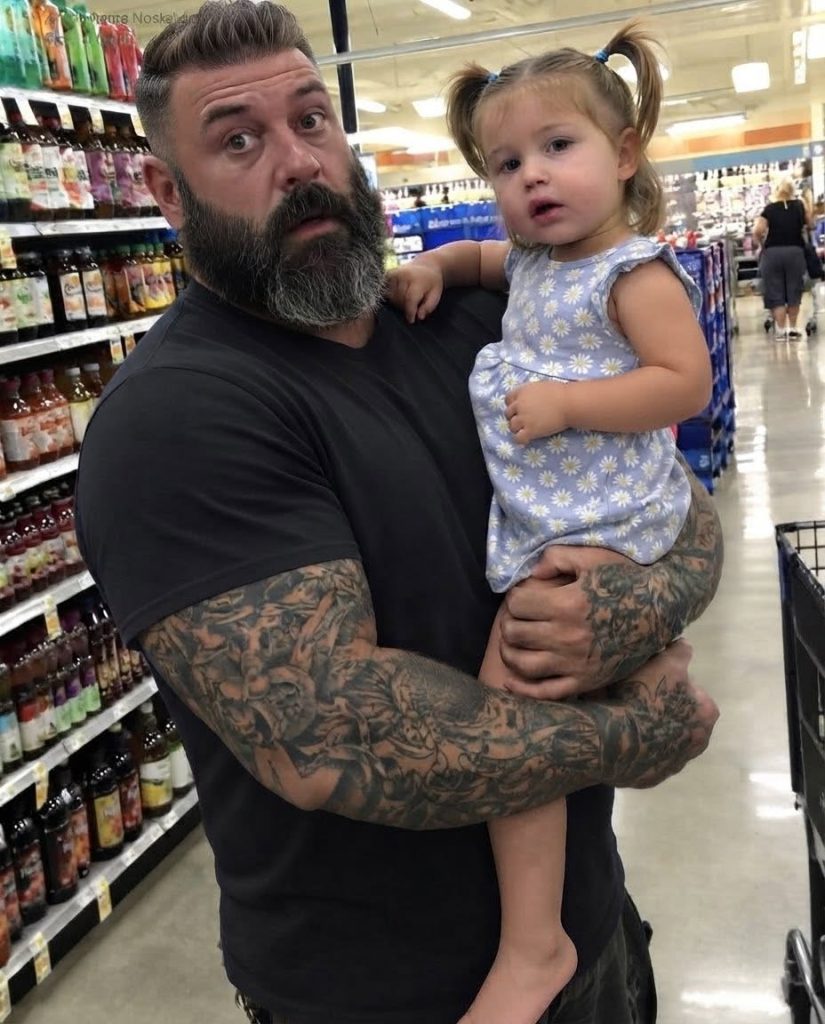
My husband spent years hiding every tattoo on his body from strangers. Then one afternoon, he rolled up his sleeves for our daughter. A woman in a store saw one particular design on his arm.
She dropped what she was holding.
Stared at Brad.
And whispered,
“I never thought I’d see that tattoo again.”
My husband went completely still.
Minutes later, I was sitting on the cold tile floor, crying over a secret he had kept from me for years.
Brad and I had what most people would call a happy marriage.
We had three children.
He was patient with them.
Affectionate.
The kind of father who would stop whatever he was doing if one of them asked him to play.
And no matter how rushed he was, he always kissed me before leaving the house.
There was only one thing about him I never fully understood.
His tattoos.
Brad had them everywhere.
Flowers.
Symbols.
Small geometric shapes.
Tiny designs tucked between larger ones.
At home, he never covered them.
Our children loved sitting beside him and tracing the ink with their fingers.
Sometimes they asked what each design meant.
Brad usually laughed and gave them simple answers.
But the second we left the house, everything changed.
Long sleeves.
Long pants.
Even on warm days.
And because some of the tattoos extended toward his hands, he sometimes wore thin gloves too.
Years earlier, I finally asked him why.
“Why do you hide them outside?”
Brad looked down at his arms.
Then at me.
“They’re from a different time in my life.”
“I think they’re beautiful.”
His expression immediately changed.
“I don’t.”
The smile disappeared.
“I got them when I was younger. I regret them.”
That answer should have ended my curiosity.
And mostly, it did.
I knew Brad well enough to recognize when he didn’t want to talk.
So I let it go.
Still, something about his explanation never felt completely right.
Whenever the subject came up, I saw something in his eyes.
Not shame.
Not exactly regret.
Something deeper.
But I never knew what.
Then came the afternoon that changed everything.
It was chilly, and we had taken the kids to the park.
Our youngest daughter, Molly, was running near the playground when she slipped beside a muddy puddle.
She landed directly in it.
Her dress was soaked within seconds.
“Daddy!”
Brad rushed over.
He picked her up immediately.
Molly started shivering.
Without hesitation, Brad took off his button-down shirt and wrapped it around her shoulders.
Underneath, he was wearing a short-sleeved T-shirt.
For the first time in years, his tattooed arms were fully visible in public.
I noticed him glance down.
His shoulders tightened for half a second.
But Molly was cold.
That mattered more.
“We’re getting you dry clothes,” he told her.
On the way home, we stopped at a nearby store.
We headed toward the children’s department.
At first, nothing happened.
No one stared.
No one said anything.
Brad gradually seemed to relax.
Then he reached toward a rack to grab a sweater.
Something hit the floor behind us.
I turned.
A young woman had dropped a carton.
But she wasn’t looking at it.
She was staring at Brad’s arm.
Not all of it.
One tattoo.
Her face had gone pale.
“Bradley?”
Brad froze.
Slowly, he lowered his arm.
“I’m sorry,” he said. “You must have the wrong person.”
The woman shook her head immediately.
“No.”
Her voice trembled.
“I don’t.”
She took a step closer.
Her eyes stayed locked on the tattoo.
“That one.”
She pointed.
“I would recognize it anywhere.”
Brad’s face changed.
“Please.”
He looked around.
“Not here.”
Then he glanced back at me and the children.
“Not in front of them.”
The woman finally seemed to notice us.
Her eyes moved from Molly to the other kids.
Then to me.
“Your family?”
Brad said nothing.
She looked stunned.
“You never told them?”
My stomach tightened.
“Told us what?”
The woman looked back at Brad.
“They don’t know?”
Brad’s jaw tightened.
“Please stop.”
But now I couldn’t.
I stepped closer.
“What don’t we know?”
The woman’s eyes filled with tears.
She looked at the tattoo again.
Then at me.
“That design isn’t random.”
I looked down at Brad’s arm.
I had seen that tattoo hundreds of times.
It had never stood out to me before.
Now suddenly it was the only thing I could see.
Brad lowered his voice.
“Please. This isn’t the place.”
The woman shook her head.
“You kept it.”
Brad didn’t answer.
Her voice broke.
“After all these years, you actually kept it.”
I looked between them.
“Who are you?”
For a moment, the woman couldn’t speak.
Then she took a breath.
And told me.
After that, she explained what the tattoo meant.
Why she recognized it instantly.
And what Brad had done years earlier that connected the two of them.
I listened in complete silence.
Brad never interrupted her.
Halfway through the story, tears started running down my face.
By the time she finished, my knees gave out.
I sank onto the cold tile floor.
Brad moved toward me.
But all I could do was stare at him.
Because for years, I had believed my husband covered his tattoos because he was ashamed of them.
I had been wrong.
He had been hiding something else entirely.
Something he had never wanted praise for.
Something that stranger had carried with her for years.
And the meaning of that one tattoo changed everything I thought I knew about Brad’s past.
PART 2 — THE TATTOO HE NEVER WANTED ANYONE TO RECOGNIZE
The woman’s name was Elena.
That was the first thing she told me.
Not what Brad had done.
Not what the tattoo meant.
Just her name.
“Elena Ruiz.”
Her voice trembled as if saying it aloud in front of us required courage.
Brad had gone completely still.
Molly was still wrapped in his button-down shirt.
Our two older children stood beside me, confused.
The store lights felt too bright.
The floor beneath my shoes seemed suddenly too hard.
I looked at Brad.
He would not meet my eyes.
“Who is she?”
I asked.
No answer.
Elena wiped at her face.
“I knew him a long time ago.”
Brad finally spoke.
“Claire.”
My name sounded different in his mouth.
Not affectionate.
Not annoyed.
Afraid.
“Take the kids to the car.”
I stared at him.
“No.”
“Please.”
“What does she know?”
“Not here.”
“You already said that.”
My voice began shaking.
“So tell me where.”
Brad looked toward the children.
That was when I understood.
Whatever this was, it was not something he wanted them to hear.
I crouched in front of our oldest, Emma.
She was eleven.
Old enough to sense everything.
“Take Noah and Molly to the front of the store.”
“Mom—”
“Stay where I can see you.”
Emma looked at Brad.
“Dad?”
His face softened instantly.
“I’m okay.”
He was lying.
She knew it too.
Still, she nodded.
She took Molly’s hand.
Noah followed.
The three of them stopped near the checkout area, far enough away not to hear.
I stood again.
“Now.”
Brad looked at Elena.
Elena looked at him.
Neither spoke.
I felt something inside me begin to break.
Not because I knew the truth.
Because I did not.
And suddenly, every year of our marriage seemed to contain a locked room I had never noticed.
“Elena.”
I said.
“If he won’t tell me, you will.”
Brad closed his eyes.
“Claire.”
“No.”
I turned toward him.
“You have had years.”
That shut him down.
Elena drew in a breath.
Then she looked at Brad’s arm.
The tattoo she had recognized was small.
Maybe two inches long.
A simple outline of a moth.
At least, that was what I had always thought it was.
A black moth with one wing slightly larger than the other.
There were initials beneath it.
So faint I had never really studied them.
E.R.
I looked at Elena.
Then back at the tattoo.
My stomach dropped.
“Those are your initials.”
Elena nodded.
Brad lowered his arm.
And that was the moment I became truly afraid.
“It was nineteen years ago.”
Elena began.
Brad said nothing.
I could hear a child laughing somewhere near the toy aisle.
A cart squeaked past us.
The world continued moving.
That felt insulting somehow.
Elena folded her hands tightly in front of her.
“I was sixteen.”
Brad looked down.
“He was twenty.”
I turned toward him.
“You knew her when she was sixteen?”
“Yes.”
His voice barely came out.
The implication hit me so quickly that anger arrived before reason.
“What kind of relationship?”
Brad’s eyes shot up.
“Not that.”
Elena shook her head immediately.
“No.”
“No, nothing like that.”
My body loosened by half an inch.
Then tightened again.
“Then what?”
Elena looked at me.
“My brother was dying.”
Everything changed.
Not enough to make sense.
Enough to slow me down.
She continued.
“His name was Mateo.”
“He had leukemia.”
The word sat between us.
Brad’s face looked almost colorless now.
Elena glanced at him once.
Then away.
“He was nine.”
My throat tightened.
“I’m sorry.”
Elena nodded.
“Thank you.”
She swallowed.
“Our mother worked nights at a nursing home.”
“Our father had been gone for years.”
“Treatment was expensive.”
“Transportation was expensive.”
“Everything was expensive.”
I looked at Brad.
He did not move.
Elena continued.
“I used to sit in the hospital vending-machine area because I hated crying in Mateo’s room.”
“One night, Brad found me there.”
I stared.
“Why was he at the hospital?”
Elena’s expression changed.
“That’s part of it.”
Brad said:
“Elena.”
She looked at him.
“You knew this day might come.”
“No.”
“Yes.”
Her voice cracked.
“You covered yourself for nineteen years because you knew.”
Brad’s jaw tightened.
“I covered myself because I didn’t want this.”
“This what?”
I asked.
He looked at me then.
Finally.
His eyes were full of shame.
Not the shame of a man who had committed something terrible.
The shame of someone caught being seen.
“I didn’t want anyone to know.”
That made no sense.
“Know what?”
Elena answered for him.
“That he saved my brother’s life.”
Silence.
I heard nothing after that.
Not the carts.
Not the fluorescent lights.
Not the music playing through the ceiling speakers.
I stared at my husband.
“No.”
Brad looked away.
Elena nodded through tears.
“Yes.”
And then she told me how.
Brad had been twenty years old and working nights at a machine shop.
He had left college after one semester.
I knew that.
What I did not know was why.
He had always told me he “wasn’t ready for school.”
He said he had been wild.
Aimless.
Restless.
He had made it sound ordinary.
Elena told me it wasn’t.
Brad’s younger sister, Hannah, had died two years before he met Elena.
Car accident.
Seventeen years old.
I knew about Hannah.
At least, I thought I did.
Brad almost never spoke about her.
There was one photograph of her in a box in our closet.
Dark hair.
Wide smile.
I had once asked whether he wanted to frame it.
He said no.
I thought grief had simply closed the subject.
Elena told me Hannah’s death had shattered him.
He drank.
Fought.
Quit school.
Got tattoos.
Lots of them.
Not because he loved tattoo art.
Because pain needed somewhere to go.
Each design became something he could put outside his body.
A flower for Hannah.
A black line for the year she died.
A geometric shape for the intersection where the accident happened.
A tiny star for the last voicemail she left.
My eyes filled.
I had traced those tattoos with my fingers in bed.
I had kissed them.
I had never known I was touching grief.
Brad looked like he wanted the floor to open beneath him.
Elena continued.
“After Hannah died, he started volunteering at the hospital.”
I looked at him.
“You volunteered?”
“For a while.”
“You never told me.”
“I stopped.”
“That isn’t an answer.”
He said nothing.
Elena did.
“He volunteered because Hannah had been an organ donor.”
My chest tightened.
Brad looked at me.
His voice came out rough.
“I didn’t know where else to go.”
That was the first sentence he offered freely.
I stared at him.
He continued.
“After she died, strangers got pieces of her.”
“I couldn’t understand that.”
“I hated it.”
“Then I hated myself for hating it.”
He rubbed one hand over his face.
“So I started spending time at the hospital.”
“Not doing anything important.”
Elena almost laughed through tears.
“That’s not true.”
Brad ignored her.
“Transporting supplies.”
“Reading to kids sometimes.”
“Carrying things.”
He shrugged.
“I needed to feel like hospitals could contain something besides death.”
That sentence went through me.
I did not know what to do with it.
Elena said Mateo needed a bone marrow transplant.
No family match.
No match on the registry at first.
His condition worsened.
Weeks became months.
Their mother was missing work.
Bills piled up.
Elena had started skipping school some days because she was terrified Mateo would die while she was in algebra.
That was when Brad found her crying beside the vending machines.
He bought her a hot chocolate.
That detail broke me unexpectedly.
Brad had always made hot chocolate for our children when they were sick.
Always too sweet.
Always with too many marshmallows.
I had thought it was just a habit.
Maybe it was.
Maybe some habits begin in pain and survive long enough to become tenderness.
Elena continued.
“I told him everything.”
“He listened.”
“He didn’t give me advice.”
“He didn’t tell me to be strong.”
“He just sat there.”
Brad looked down.
The tattoo on his forearm seemed suddenly louder than anything else in the store.
Elena said that over the next few weeks, Brad kept checking on them.
He brought food.
Drove their mother home after long shifts.
Helped Elena study in the hospital cafeteria.
Then one day, a nurse mentioned a new donor drive.
Brad registered.
He was not a match for Mateo.
At least not the kind of match they needed then.
But that was not the end of it.
The hospital was also trying to enroll more people in a new donor network and raise money for an expensive experimental treatment that might stabilize Mateo until a full match appeared.
Their insurance denied part of the treatment.
The amount their family needed was impossible.
Just under thirty thousand dollars.
I looked at Brad.
He still would not look at me.
Elena said:
“Brad paid it.”
My mouth opened.
Nothing came out.
“He what?”
“He paid the hospital.”
“No.”
“Yes.”
“With what money?”
Brad spoke before Elena could.
“Hannah’s insurance.”
My breath caught.
His sister’s life insurance.
I knew there had been some.
I had always assumed his parents received it.
Apparently part had been designated to Brad.
He had never mentioned the amount.
“How much?”
I asked.
“Thirty-two thousand.”
“And you gave it away?”
His jaw tightened.
“Yes.”
“To people you barely knew?”
“Yes.”
“Why?”
Brad finally looked at me.
There was pain in his face.
Pure.
Old.
“I couldn’t save Hannah.”
The answer shattered something inside me.
I sat down on the floor.
Not elegantly.
My knees simply stopped doing their job.
The tile was cold through my jeans.
Brad stepped toward me.
I lifted one hand.
“Don’t.”
He stopped immediately.
Elena cried.
I cried harder.
Because suddenly the entire man I had married looked different.
Not better.
Not worse.
Deeper.
And depth can be terrifying when you discover it all at once.
“You gave away everything she left you.”
I whispered.
Brad crouched several feet away.
“Most of it.”
“Why didn’t you tell me?”
He looked at the floor.
“Because it wasn’t mine anymore.”
“That doesn’t answer me.”
“I know.”
His voice shook.
“I didn’t want it to become a story.”
“What does that mean?”
Elena answered softly.
“He disappeared.”
I turned toward her.
“What?”
“After Mateo got better.”
She wiped her face.
“Brad stopped coming.”
“Our mother tried to find him.”
“I tried later.”
“He changed his phone number.”
“Moved.”
“Eventually no one knew where he went.”
Brad closed his eyes.
I looked at him.
“You ran away from them?”
“I left.”
“Why?”
His face tightened.
“Because they were grateful.”
That stunned me.
“What?”
“They kept thanking me.”
“So?”
“So I hated it.”
“Why?”
He looked at me as if the answer should have been obvious.
“Because Hannah was dead.”
His voice cracked.
“And suddenly everyone was acting like her death had made me generous.”
I stopped breathing.
He continued.
“I didn’t earn that money.”
“I got it because my sister died.”
“Elena’s brother lived because Hannah didn’t.”
“That’s not true.”
Elena whispered.
Brad shook his head.
“I know logically.”
“But that’s what it felt like.”
He rubbed at his eyes.
“I couldn’t stand people looking at me like I had done something noble.”
“I was angry.”
“I was drunk half the time.”
“I had gotten arrested twice.”
My eyes widened.
“You were arrested?”
Brad laughed bitterly.
“See?”
I stared.
“You never told me that either.”
“I know.”
“For what?”
“Fighting.”
“Public intoxication once.”
My head spun.
We had been married fourteen years.
Three children.
I knew how he took his coffee.
I knew he hated cilantro.
I knew he slept with one foot outside the blanket.
I did not know he had been arrested.
I did not know he had given away nearly thirty thousand dollars to a dying child.
I did not know half the tattoos on his body were grief.
Marriage is strange that way.
You can know someone’s smallest habits while missing entire continents inside them.
Elena knelt near me.
Not too close.
“There’s more.”
Brad looked up sharply.
“No.”
She looked at him.
“She needs to know.”
“No.”
“Brad.”
“No.”
His voice was firm now.
Afraid again.
I turned toward him.
“What else?”
He shook his head.
“Nothing.”
“Do not lie to me.”
“I’m not.”
Elena whispered:
“The tattoo.”
I looked down at his arm.
The moth.
E.R.
“What about it?”
Elena looked at Brad.
He looked destroyed.
Then she said:
“It wasn’t originally mine.”
My stomach dropped.
“What?”
“The initials are mine.”
“Yes.”
“But the moth was Mateo’s.”
I did not understand.
Elena continued.
“When he was sick, Mateo used to draw moths.”
“Why?”
“He said butterflies were too obvious.”
A tiny broken laugh escaped her.
“He liked moths because nobody called them beautiful.”
Brad looked away.
Elena smiled through tears.
“He used to say moths survived the dark without anyone cheering for them.”
My hand went to my mouth.
That sounded like Brad.
So painfully like Brad.
“After Mateo recovered, he drew one for Brad.”
“The same shape.”
“One wing bigger than the other because Mateo was nine and terrible at symmetry.”
I stared at the tattoo.
The uneven wing.
I had noticed it hundreds of times.
I thought it was deliberate artistry.
It was a child’s drawing.
“Elena.”
I whispered.
“What do your initials mean?”
Her expression changed.
“That came later.”
Brad stood.
“We’re done.”
I looked at him.
“No.”
“Yes.”
“No.”
His face tightened.
“Claire.”
“If I walk out of this store now without the rest, I don’t know what I’ll do.”
That stopped him.
I hated saying it.
It was true.
He sat on a low display bench.
Elena exhaled.
Then continued.
Mateo survived.
The experimental treatment bought time.
A full marrow match was eventually found.
The transplant worked.
Not perfectly.
There were complications.
Months of recovery.
But he lived.
Brad vanished from their lives before the final discharge.
Elena kept looking for him.
She carried guilt.
Not rational guilt.
The kind survivors manufacture because gratitude and grief become tangled.
She felt their family had taken money from a grieving young man who had nothing else.
Years later, when she was twenty-one, she finally found Brad through a mutual acquaintance.
He was working construction then.
Sober.
Mostly.
She went to see him.
Brad looked embarrassed as she told this.
Elena said:
“I asked why he disappeared.”
“What did he say?”
“He said he didn’t want to be anyone’s miracle.”
That sounded exactly like him.
She continued.
“I told him Mateo wanted him to know he was alive.”
“And?”
“He said that was enough.”
I looked at Brad.
“Did you meet Mateo again?”
“No.”
Elena answered:
“He refused.”
“Why?”
Brad spoke.
“Because he didn’t owe me anything.”
No hesitation.
That sentence came from somewhere settled inside him.
“He was a child.”
“I did one thing.”
“He didn’t need to spend the rest of his life proving it mattered.”
I started crying again.
Elena looked at me.
“That’s when I got the tattoo too.”
I blinked.
“You have one?”
She rolled up her sleeve.
There it was.
The moth.
Same uneven wing.
Tiny.
Near her wrist.
Underneath:
B.H.
Brad Hart.
My husband’s initials.
I stared between them.
“You tattooed each other’s initials?”
Elena shook her head.
“No.”
“Mateo chose them.”
I frowned.
“Why?”
“He said if we were going to carry what happened, we should carry the person who helped us remember what kind of people we wanted to be.”
That was too much.
I pressed my hands over my face.
The cold tile beneath me.
The store.
My children waiting.
My husband sitting six feet away like a stranger and the most familiar person in the world at once.
Everything hurt.
Brad’s voice came softly.
“I regret that tattoo.”
Elena looked at him.
“No, you don’t.”
“Yes.”
“Then why keep it?”
He stared at his arm.
“Because removing it felt like pretending.”
Elena’s eyes filled.
I lowered my hands.
“What are you ashamed of?”
He looked at me.
Not the tattoos.
Not the arrests.
Not the drinking.
Something else.
Brad took a long breath.
“Hannah called me the night she died.”
The air changed.
I waited.
“I didn’t answer.”
My chest tightened.
“Why?”
“I was angry at her.”
He laughed once.
A terrible sound.
“She had borrowed my car earlier that week.”
“She scratched it.”
“We fought.”
“Something stupid.”
I whispered:
“Brad.”
“She called me three times.”
He looked at his hands.
“I saw the phone.”
“I ignored it.”
Tears ran down his face now.
“She left a voicemail.”
“The star tattoo.”
I knew it instantly.
Tiny star near his elbow.
Our children loved that one.
They called it Daddy’s wishing star.
I had never known.
“What did the voicemail say?”
Brad swallowed.
“She said she was sorry.”
“She said she loved me.”
“She said she was getting a ride home.”
His face collapsed.
“The driver had been drinking.”
My stomach turned.
The accident.
I understood.
“I spent years thinking if I had answered, I would have picked her up.”
“You don’t know that.”
“I know.”
“But you believed it.”
“Yes.”
He wiped his face.
“After she died, everyone told me it wasn’t my fault.”
“I hated them for saying it.”
“Because?”
“Because they didn’t know.”
He looked at me.
“They didn’t know I saw her call.”
“They didn’t know I chose not to answer.”
I whispered:
“You were twenty.”
“That didn’t make her less dead.”
“No.”
“But it didn’t make you responsible for the drunk driver.”
He looked away.
That wound was old.
Logic had probably visited it many times.
Logic had not been invited to stay.
Elena said:
“Mateo changed something in him.”
Brad shook his head.
“Don’t.”
“He did.”
She continued anyway.
“When Brad paid for the treatment, he wasn’t trying to be generous.”
“He was trying to punish himself.”
Brad closed his eyes.
That sentence hit me differently.
I looked at him.
“Is that true?”
Silence.
“Brad.”
“Yes.”
My throat tightened.
“You gave away Hannah’s money because you thought you didn’t deserve it.”
“Yes.”
Not heroism.
Not exactly.
Grief wearing generosity like a coat.
That made the act no less beautiful.
It made it sadder.
He had helped a child live because he did not know how to forgive himself for surviving his sister.
And everyone around him saw sacrifice.
He saw debt.
Suddenly his hatred of praise made sense.
He had not hidden the tattoos because he regretted the designs.
He had hidden them because he was terrified someone would recognize the story and call him good for something he believed had begun in guilt.
I stood slowly.
My knees hurt.
Brad reached for me.
This time, I did not stop him.
I let him steady me.
Then immediately stepped away.
His face fell.
I hated that.
I was still angry.
Love does not erase anger simply because the secret turns out to be painful instead of cruel.
“You should have told me.”
“I know.”
“No.”
My voice broke.
“You don’t get to say that like it finishes the sentence.”
He nodded.
“You’re right.”
“I have been married to you for fourteen years.”
“I know.”
“I gave birth to three children with you.”
“I know.”
“I sat beside you while Emma had pneumonia.”
“I know.”
“I held you when your father died.”
“I know.”
“I asked about Hannah.”
His face tightened.
“I know.”
“And you let me believe you just didn’t want to talk.”
“I didn’t.”
“That is not the same as telling me why.”
“No.”
I looked at his tattoos.
“How many of them are about this?”
Brad glanced down.
“Most.”
My breath caught.
“Most?”
He nodded.
I almost laughed from disbelief.
The entire map of his body.
I had thought I knew none of it because he had been young and reckless.
Now each design seemed like a sentence in a language he never taught me.
“Tell me.”
“Claire.”
“Not now.”
I looked toward the children.
He followed my gaze.
Emma was watching us.
Fear in her face.
“No.”
I whispered.
“Not now.”
That was the first boundary I could still hold.
Elena apologized.
She did not need to.
“I should not have said anything in front of you like that.”
I looked at her.
“You saw him.”
“I lost my head.”
“I understand.”
“Do you?”
“No.”
That made her smile sadly.
“Fair.”
I looked at the moth on her wrist.
“Where is Mateo now?”
Elena’s face changed.
Brad looked up.
That answer mattered.
“He’s alive.”
Relief moved through me before I could stop it.
“Where?”
“Colorado.”
“He has two children.”
Brad went completely still.
Elena noticed.
“You didn’t know.”
“No.”
Her expression softened.
“He became a pediatric oncology nurse.”
Brad’s face collapsed.
Not loudly.
His mouth tightened.
His eyes filled.
He looked away.
Elena whispered:
“He said he wanted to be there for kids who knew what hospital ceilings looked like.”
Brad rubbed both hands over his face.
“He’s okay?”
“Yes.”
“Health?”
“Mostly good.”
She smiled.
“Stubborn.”
“He runs half marathons.”
Brad laughed through tears.
“That’s stupid.”
“He knows.”
“He has a daughter named Hannah.”
The world stopped.
Brad looked at her.
“What?”
Elena began crying again.
“Mateo named his daughter Hannah.”
Brad stumbled backward one step.
I reached for him instinctively.
This time, he let me.
His hand closed around mine so tightly it hurt.
He whispered:
“He never even met her.”
“No.”
Elena smiled through tears.
“But he knew her name mattered to you.”
Brad bent forward.
A sound came out of him I had never heard in fourteen years.
Not sobbing.
Something older.
The kind of grief that had been waiting for a safe place and finally found one by accident in the children’s clothing aisle of a store.
I wrapped my arms around him.
Angry.
Heartbroken.
Loving him anyway.
All at once.
That is marriage too.
We stood there until Brad could breathe again.
Then Elena said:
“I should go.”
Brad straightened.
“Elena.”
She looked at him.
He struggled.
“Thank you.”
“For what?”
“For telling me about Mateo.”
Her eyes filled.
“You could call him.”
Brad shook his head immediately.
“No.”
“Brad.”
“No.”
“He has wanted to talk to you for years.”
“I can’t.”
“Why?”
Brad looked exhausted.
“Because I don’t know what he thinks I am.”
Elena stared.
“A person.”
His face tightened.
“You don’t know that.”
“Yes, I do.”
“You don’t know what he remembers.”
“He remembers you bringing terrible cafeteria pudding because you thought it counted as dessert.”
Brad almost smiled.
“He remembers you yelling at the television during basketball.”
“He remembers you letting him draw on your arm with marker.”
The moth.
I looked down at the tattoo.
Elena continued.
“He remembers a twenty-year-old who sat with him when he was scared.”
“He doesn’t remember a saint.”
“He remembers Brad.”
That sentence mattered.
I saw it in his face.
He had spent nineteen years terrified of becoming a symbol.
Mateo had remembered a person.
Maybe there was mercy in that.
Brad whispered:
“I’ll think about it.”
Elena nodded.
She did not push.
Then she looked at me.
“I’m sorry your day became this.”
I almost laughed.
“So am I.”
She smiled.
Then glanced toward the children.
“They look scared.”
That pulled me back.
My babies.
Emma was pretending not to stare.
Noah had one hand on Molly’s shoulder.
Molly still wore Brad’s shirt like a cape.
We had to become parents again.
Even while everything else shifted.
In the car, no one spoke for the first several minutes.
Brad drove.
I sat beside him.
The children were in the back.
Emma finally asked:
“Is Dad in trouble?”
Brad’s hands tightened on the wheel.
I looked at him.
Then back at her.
“No.”
“Then why were you crying?”
“Because we learned something sad.”
“About Dad?”
“Yes.”
Brad glanced at me.
I continued.
“Something from before you were born.”
Emma looked at his arms.
“His tattoos?”
Children see everything.
I nodded.
“Some of them.”
Noah asked:
“Did Dad do something bad?”
Brad answered this time.
“I made mistakes when I was younger.”
My throat tightened.
“But the lady knew you.”
“Yes.”
“Was she your girlfriend?”
Brad almost choked.
“No.”
I laughed before I could stop myself.
Even Emma smiled.
The tension broke for half a second.
Then Molly said:
“Daddy, why did she cry?”
Brad looked at her through the mirror.
“Because she remembered someone she loves.”
Molly accepted that.
Five-year-olds can sometimes tolerate complexity better than adults.
They ask the question they have.
Not all the questions that might exist.
At home, Brad went straight to the bedroom.
I told the kids to start a movie.
Emma watched me.
“Mom?”
“Yes?”
“Are you mad at Dad?”
I hesitated.
“Yes.”
Her eyes widened.
“But I love him.”
That seemed to confuse her.
I crouched.
“Those can happen together.”
She considered that.
“Are you going to get divorced?”
The question hit me.
Children leap to the largest fear.
“No.”
I said.
Then corrected myself.
“I am not planning to.”
Honest enough.
Safe enough.
Emma nodded.
“Okay.”
Then she hugged me.
I held her longer than usual.
Brad was sitting on the edge of our bed when I entered.
His long-sleeved shirt lay beside him.
Arms uncovered.
For the first time, the tattoos did not look decorative.
They looked loud.
Alive.
He did not look up.
“I’m sorry.”
I closed the door.
“Start somewhere else.”
He looked at me.
“What?”
“I don’t want the first thing to be an apology.”
“What do you want?”
“The truth.”
He nodded slowly.
“All of it?”
“That depends how much you hid.”
His face tightened.
“More than I should have.”
I sat across from him.
“Then start.”
For the next three hours, Brad told me the story of his skin.
One tattoo at a time.
The red flower near his shoulder was Hannah’s favorite hibiscus.
The three black lines beneath it represented the three unanswered calls.
I cried when he told me that.
The tiny star was her voicemail.
The geometric circle near his wrist was the hospital donor network symbol, altered enough that strangers would not recognize it.
The moth was Mateo.
The initials were Elena.
Not romantic.
Witnesses.
She carried his.
He carried hers.
A small wave near his ribs represented the river bridge where he nearly drove drunk one night after Hannah’s funeral.
He did not crash.
He pulled over.
Slept in the car.
The broken triangle on his chest marked the night he was arrested after punching a man outside a bar.
The flower beside it marked six months sober.
My breath caught.
“You were addicted?”
Brad shook his head.
“I don’t know.”
“I drank enough that I should have been scared.”
“How long?”
“About two years.”
“And then?”
“Mateo.”
Of course.
The child he thought he was saving had also interrupted the direction of his own life.
Brad said sitting in pediatric oncology while hungover began to disgust him.
Not because anyone lectured him.
Because Mateo trusted him.
A nine-year-old would ask:
“You coming tomorrow?”
And Brad wanted the answer to be yes.
So he stopped drinking.
Not perfectly at first.
Then completely for three years.
Eventually he learned he could have a beer without falling apart.
I knew Brad drank occasionally now.
Never much.
I had never thought to ask why.
“Why hide all of this from me?”
I asked.
Brad looked exhausted.
“Because I wanted to be your husband.”
“That makes no sense.”
“It does to me.”
“Explain.”
He stared at his hands.
“When we met, you knew me as normal.”
I laughed bitterly.
“That is a strange word.”
“I know.”
He continued.
“You knew me after I got my life together.”
“Job.”
“Apartment.”
“No arrests.”
“No chaos.”
“You liked me without pity.”
My anger softened slightly.
“So?”
“So I wanted that.”
“What?”
“To be loved by someone who didn’t know the worst version of me.”
I went still.
There it was.
Not secrecy for drama.
Not modesty.
Fear.
Again.
Different story.
Same human weakness.
“What did you think I would do?”
“I don’t know.”
“Leave?”
“Maybe.”
“Admire you?”
He flinched.
“Yes.”
That surprised me.
“That frightened you as much as me leaving?”
“More.”
“Why?”
His eyes filled.
“Because then I would spend the rest of my life wondering if part of your love belonged to a person I don’t think I ever was.”
I understood.
Not fully.
Enough.
He continued.
“If I told you I gave away Hannah’s money, it sounds noble.”
“If I told you why, it sounds broken.”
“If I told you about the drinking and arrests, it sounds dangerous.”
“If I told you about Mateo, it becomes some redemption story.”
He looked at me.
“I didn’t want to be any of those things to you.”
“What did you want to be?”
“Brad.”
That echoed Elena.
Mateo remembers Brad.
I swallowed.
“You were allowed to be Brad and still tell me the truth.”
“I know that now.”
“Do you?”
“Yes.”
His voice broke.
“I do.”
I cried again.
Not because of what he had done.
Because I understood what his secrecy had stolen from me.
Years of intimacy that might have gone deeper.
Questions I had asked gently and accepted silence.
Times he woke from nightmares and said nothing was wrong.
The way he avoided hospitals unless one of the kids needed him.
The panic in his face when Emma once missed three calls in a row.
I remembered that.
She had been at a friend’s house.
Her phone was on silent.
Brad nearly drove there before she called back.
At the time, I teased him.
“Overprotective dad.”
He laughed.
Now the memory hurt.
Three unanswered calls.
Hannah.
His body had remembered even when I didn’t know there was anything to remember.
“You should have trusted me.”
I said.
“I know.”
“With the ugly parts.”
“I know.”
“With the parts you didn’t know how to explain.”
“I know.”
“With the parts that made you afraid I would see you differently.”
He looked at me.
“That was the hardest one.”
“Why?”
“Because I knew you would.”
He was right.
I did see him differently now.
That was unavoidable.
Truth changes sight.
But different does not always mean worse.
Sometimes different means fuller.
I said:
“I do see you differently.”
His face fell.
I continued.
“I’m angry.”
“I know.”
“Stop saying that.”
“Sorry.”
“I’m hurt.”
He nodded.
“I feel cheated out of part of you.”
His eyes closed.
“That’s fair.”
“But I don’t think less of you.”
He opened his eyes.
I took a breath.
“I think I know you less than I thought.”
That was worse.
He understood.
Tears ran down his face.
“I’m sorry.”
This time, I let him say it.
Later that night, after the children slept, I found Brad in the bathroom.
He was standing in front of the mirror.
Shirtless.
Looking at himself.
His fingers traced the moth tattoo.
“What are you doing?”
He met my eyes through the mirror.
“Thinking about removing them.”
My chest tightened.
“All of them?”
“Maybe.”
“Why now?”
He looked away.
“Because they hurt you.”
“No.”
I stepped closer.
“The secrecy hurt me.”
“The tattoos didn’t.”
He swallowed.
“I don’t know what they are anymore.”
I looked at his reflection.
“Maybe they are what happened.”
“That’s the problem.”
“No.”
I shook my head.
“Maybe the problem is you keep treating your body like a courtroom.”
He looked at me.
“What?”
“Every mark is evidence.”
“Every tattoo is a verdict.”
“Guilty.”
“Saved.”
“Failed.”
“Sober.”
“Coward.”
“Hero.”
I touched the small moth gently.
“It can also just be part of your life.”
He stared.
“I don’t know how to do that.”
“I know.”
That was the first time I understood something important.
Brad had not covered his tattoos to hide them from strangers.
He covered them to keep the past from being interpreted.
Because interpretation terrified him.
He had spent years deciding what every symbol meant before anyone else could.
Shame.
Regret.
Private.
Do not ask.
But life had changed.
Our children were old enough to ask.
I was hurt enough to insist.
Elena had appeared.
The story was no longer his alone in the same way.
“Are you going to call Mateo?”
I asked.
Brad’s body tensed.
“I don’t know.”
“Do you want to?”
“Yes.”
The answer came immediately.
Then:
“No.”
I almost smiled.
“Useful.”
He sat on the edge of the tub.
“I want to know him.”
“Then call.”
“What if it ruins something?”
“For who?”
“Him.”
“Brad.”
“He has a life.”
“Yes.”
“A family.”
“Yes.”
“What if seeing me pulls him backward?”
“What if it doesn’t?”
He looked at me.
“What if he feels like he owes me?”
“Then tell him he doesn’t.”
“What if he thinks I saved him?”
“You helped.”
“I know.”
“Can you say that?”
He looked confused.
“You helped.”
Not saved.
Not redeemed.
Helped.
A human verb.
Limited.
Real.
Brad repeated it softly.
“I helped.”
“Yes.”
The word seemed strange to him.
Maybe because it was finally small enough to carry.
The next morning, Emma asked why Dad was wearing short sleeves.
I turned.
Brad stood at the kitchen counter.
T-shirt.
Bare arms.
He looked terrified.
Our children looked delighted.
Molly ran over immediately.
“Daddy tattoos!”
She grabbed his forearm.
Brad froze.
Then relaxed.
Noah pointed.
“What’s that one?”
The moth.
Of course.
Brad looked at me.
I waited.
This was his choice.
He crouched.
“That one was drawn by a little boy I knew a long time ago.”
Molly smiled.
“It’s crooked.”
Brad laughed.
“He was nine.”
“Was he bad at drawing?”
“Very.”
Noah leaned closer.
“What’s his name?”
Brad hesitated.
Then said:
“Mateo.”
There.
One door open.
Emma asked:
“Is he alive?”
Brad’s face changed.
“Yes.”
“Do you still know him?”
“No.”
She frowned.
“Why not?”
Brad looked at me again.
I did not rescue him.
He answered:
“Because sometimes grown-ups get scared and avoid things they shouldn’t.”
Emma considered that.
“Are you going to stop?”
I nearly laughed.
Children have no patience for emotional camouflage.
Brad smiled faintly.
“I’m trying.”
“Okay.”
Then she reached for cereal.
Conversation over.
Brad stood slowly.
His eyes were wet.
That tiny exchange had terrified him more than board meetings, hospital emergencies, or anything else I had ever seen.
And he survived it.
For the next week, Brad wore short sleeves around the house.
Then in the yard.
Then once to the mailbox.
That sounds ridiculous.
It wasn’t.
Shame is physical.
It lives in habits.
Buttons.
Fabric.
Weather.
Routes.
The first time he walked to the mailbox with his arms uncovered, he stood outside afterward for almost a minute.
No one stared.
A truck drove past.
Mrs. Jenkins waved from across the street.
That was it.
The world did not identify him.
Did not praise him.
Did not accuse him.
He came inside.
“How was your heroic journey?”
I asked.
He looked offended.
“I hate you.”
“Good.”
We were still us.
That mattered.
Elena texted him three days later.
He showed me before opening it.
That mattered too.
The message was simple:
Mateo knows I saw you. He said I can give you his number if you want it. No pressure.
Brad stared at the screen for a long time.
“What do you want?”
I asked.
He rubbed his thumb over the edge of the phone.
“I want him to be okay.”
“He is.”
“I mean with me.”
“You cannot control that.”
“I know.”
“Again.”
He smiled weakly.
Then typed:
Yes.
Elena sent the number.
Brad did not call.
Not that day.
Not the next.
The number stayed in his phone like another tattoo.
Visible.
Loaded.
Waiting.
A week later, I found him sitting alone on the back steps after midnight.
I wrapped a blanket around myself and sat beside him.
“You’re freezing.”
“I know.”
“Why are you out here?”
“Thinking.”
“Dangerous.”
He smiled.
Then handed me his phone.
Mateo’s number was open.
“Call.”
Brad shook his head.
“What are you afraid he’ll say?”
Brad thought.
“Thank you.”
That answer broke my heart.
“Why?”
“Because I still don’t know what to do with it.”
“You could say you’re welcome.”
He looked horrified.
I laughed softly.
“Fine.”
“What would you say?”
He looked at the dark yard.
“Maybe…”
He swallowed.
“Maybe I’d say Hannah would be glad he’s here.”
My chest tightened.
“That sounds true.”
“I think so.”
“Then say that.”
He looked at me.
“What if I cry?”
“You probably will.”
“What if he cries?”
“He probably will.”
“What if it’s awful?”
“Then it’s awful.”
“What if it’s good?”
Brad stared at the phone.
That question frightened him more.
Then finally:
“What if it matters too much?”
I rested my head against his shoulder.
“Maybe some things are allowed to.”
He did not call that night.
But the next afternoon, something happened that changed everything again.
I was picking Emma up from school when Brad called.
His voice sounded wrong.
“Claire.”
“What happened?”
“I need you home.”
“Are the kids okay?”
“Yes.”
“Are you?”
Silence.
“Brad.”
“Elena called.”
My stomach tightened.
“Mateo?”
“Yes.”
“What happened?”
“He’s coming.”
I stared through the windshield.
“What do you mean, coming?”
“He was already traveling for work.”
“He changed his flight.”
My breath caught.
“When?”
“Tonight.”
I said nothing.
Brad continued.
“He wants to see me.”
I closed my eyes.
“Do you want to see him?”
“I don’t know.”
“You said you wanted to know him.”
“That was before he became real.”
I almost laughed despite everything.
“People have that effect.”
“Claire.”
“I know.”
His breathing was uneven.
Then he whispered:
“There’s something Elena didn’t tell you.”
My stomach dropped.
Of course.
Another layer.
“What?”
Brad was quiet too long.
“Brad.”
“Mateo didn’t just survive because of the treatment.”
I gripped the steering wheel.
“What are you saying?”
His voice broke.
“There was another night.”
“What night?”
“A few months later.”
I could hear him crying.
“I was there when he crashed.”
My skin went cold.
“Crashed?”
“His heart stopped.”
I could barely breathe.
“What happened?”
Brad said nothing.
“Brad.”
“I did CPR.”
The world narrowed.
“He was nine.”
“Yes.”
“For how long?”
“I don’t know.”
“Brad.”
“Eleven minutes.”
I closed my eyes.
Eleven minutes.
Elena’s story had not ended with the money.
Not even close.
Brad continued.
“The nurses were coming.”
“I knew what to do because of the hospital training.”
“I kept going.”
“He came back.”
My hand shook.
“You resuscitated him.”
“I helped.”
That word again.
Small enough to carry.
But not small.
Not this.
“Why didn’t Elena tell me?”
“Because I made her promise years ago.”
I almost shouted.
“You made everyone promise everything.”
“I know.”
“Why?”
“Because that was the part I could never talk about.”
His voice cracked.
“I could explain money.”
“I could explain grief.”
“I could explain Hannah.”
“But that night…”
He stopped.
“What happened?”
A long silence.
Then:
“Mateo looked like her.”
My heart broke.
Not literally.
I understood.
A small body.
Monitors.
Chaos.
Someone almost gone.
For eleven minutes, Brad had been twenty years old and back beside the sister he could not save.
Except this time, his hands had somewhere to go.
His guilt had an action.
His terror had instructions.
Compress.
Breathe.
Count.
Keep going.
And a child lived.
No wonder he disappeared afterward.
No wonder he could not bear gratitude.
Saving Mateo had probably felt too much like rewriting a death that could not be rewritten.
“Brad.”
“Yes?”
“When Mateo comes tonight…”
I swallowed.
“You have to tell him the truth.”
“What truth?”
“That you’ve spent nineteen years thinking his life was somehow payment for Hannah.”
Silence.
“Claire.”
“He deserves to know he was never responsible for your grief.”
“I know.”
“And you deserve to hear whatever he actually thinks.”
“I don’t know if I can.”
“You can.”
“How?”
“You sit there.”
“You listen.”
“You don’t hide.”
I looked toward the school entrance where Emma would appear any second.
“And this time, you let someone else decide what your story means to them.”
Brad said nothing.
That was the hardest thing for him.
Not confession.
Loss of control.
The same reason he covered the tattoos.
If no one saw them, no one could tell him what they meant.
Tonight, the one person connected to the deepest mark was coming to our house.
And Brad would no longer be able to manage the interpretation alone.
Mateo arrived at 8:17 that night.
I remember the exact time because Brad checked the clock five times in the previous ten minutes.
The children were upstairs.
I had told them Dad was meeting an old friend.
Not a lie.
Not the whole story.
Enough for now.
When the doorbell rang, Brad stopped breathing.
I took his hand.
He looked at me.
“I can’t.”
“Yes, you can.”
“What if—”
The bell rang again.
I squeezed his fingers.
“No more tomorrows.”
He stared at me.
He did not know Mama.
He did not know that phrase belonged to another family’s pain.
But he understood the meaning.
He nodded.
Then opened the door.
Mateo Ruiz was twenty-eight years old.
Tall.
Dark hair.
Kind eyes.
There was a faint scar near his collarbone.
He looked at Brad.
Brad looked at him.
Neither moved.
For one impossible second, I saw the nine-year-old between them.
Then Mateo smiled.
“You got old.”
Brad made a strangled sound.
Then laughed.
Then cried.
Mateo cried too.
They did not hug immediately.
That would have been too cinematic.
Too easy.
They just stood there.
Two men separated by nineteen years and eleven minutes.
Finally, Mateo held out his hand.
Brad stared at it.
Then took it.
Mateo pulled him forward.
They hugged.
And my husband broke apart.
Not quietly.
He sobbed into Mateo’s shoulder.
The kind of sobbing that bends a body.
Mateo held him.
I stood in the hallway with tears running down my face.
And I understood something then.
Some reunions are not about finding people.
They are about finding the part of yourself you abandoned where you last saw them.
We sat in the living room.
Coffee went cold.
Nobody cared.
Mateo looked at Brad’s arm.
“You kept it.”
Brad laughed wetly.
“Apparently that’s everyone’s opening line.”
Mateo smiled.
“Elena told me.”
Then his expression softened.
“I kept mine too.”
He rolled up his sleeve.
The moth.
Uneven wing.
Underneath:
H.H.
Hannah Hart.
Brad stared.
“You never knew her.”
“No.”
Mateo looked at him.
“But I knew what she meant to you.”
Brad’s face crumpled.
Mateo continued.
“My mother told me where the treatment money came from when I was older.”
“I was angry.”
Brad looked startled.
“At me?”
“No.”
“At everything.”
Mateo laughed sadly.
“I hated that some girl had to die and some other young man had to fall apart for me to get a chance.”
Brad stared.
I did too.
The same trap.
Different side.
Mateo had spent years believing his survival was tied to Hannah’s death.
Brad had spent years believing Hannah’s death was tied to Mateo’s survival.
Grief had built a bridge and then convinced both men it was a debt ledger.
Mateo leaned forward.
“Then a therapist told me something.”
Brad almost smiled.
“Everyone has therapists now.”
“Apparently.”
Mateo continued.
“She said Hannah did not die for me.”
“Her death happened.”
“Your choice happened afterward.”
Brad stopped breathing.
Mateo pointed gently toward him.
“You chose what to do with what remained.”
The room went silent.
Brad whispered:
“I chose because I hated myself.”
“I know.”
“That doesn’t make it noble.”
“I didn’t say noble.”
Mateo smiled slightly.
“I said choice.”
Brad looked at him.
That distinction entered the room and stayed.
Then Mateo asked the question I had been dreading.
“Why did you leave?”
Brad’s face tightened.
“Because you lived.”
Mateo frowned.
Brad looked at his hands.
“I know that sounds wrong.”
“Explain.”
“I had spent two years thinking I killed Hannah by not answering the phone.”
“You didn’t.”
“I know that now.”
“Do you?”
Brad looked at him.
“More than I did then.”
He breathed out.
“When your heart stopped…”
Mateo went still.
“You remember?”
“No.”
“Good.”
Brad swallowed.
“I did CPR.”
“I know.”
“Elena told you?”
“My mom did when I was older.”
Brad nodded.
“For eleven minutes, I thought you were going to die.”
“And all I could think was not again.”
His voice cracked.
“Not another kid.”
“Not another phone call.”
“Not another family standing in a hallway.”
Mateo’s eyes filled.
Brad continued.
“When you came back…”
He shook his head.
“It was the best moment of my life.”
“And I hated that.”
Mateo stared.
“Why?”
“Because Hannah never came back.”
The words shattered the room.
Brad cried.
“So I left.”
“I couldn’t look at you without feeling grateful and guilty at the same time.”
“I thought if I stayed, I would make your life about fixing mine.”
Mateo sat very still.
Then said:
“You did the opposite.”
Brad looked up.
“You disappeared so completely that I spent years thinking I had scared you away.”
Brad’s face went white.
“What?”
“I thought maybe you regretted helping us.”
“No.”
“I know that now.”
Mateo’s voice broke.
“But I was nine.”
Brad covered his mouth.
The secret had consequences Brad never imagined.
Silence does that.
We think withholding truth prevents burden.
Often it merely forces someone else to invent an explanation.
And invented explanations are rarely kind.
“I’m sorry.”
Brad whispered.
Mateo nodded.
“I know.”
Brad laughed through tears.
“That phrase is ruining my life lately.”
I almost smiled.
Mateo continued.
“I don’t need you to apologize for leaving forever.”
“Then what do you need?”
Brad asked.
Mateo thought.
“Nothing.”
Brad flinched.
Mateo smiled.
“See?”
“That bothers you.”
“Yes.”
“Good.”
For the first time, both men laughed.
Then Mateo said:
“I wanted to meet the person.”
“What?”
“The person.”
“Not the hero.”
“Not the donor.”
“Not the guy who did CPR.”
“You.”
Brad stared.
Mateo shrugged.
“You sound irritating.”
I answered immediately.
“He is.”
Mateo laughed.
Brad glared at me.
Something in the room loosened.
That mattered.
Around ten, Emma came downstairs for water.
She stopped when she saw Mateo.
Brad looked alarmed.
I nearly sent her back upstairs.
Then Mateo smiled.
“You must be Emma.”
She looked at Brad.
“How does he know my name?”
Brad took a breath.
“This is Mateo.”
Her eyes widened.
“The moth boy?”
Mateo laughed so hard he nearly spilled coffee.
Brad covered his face.
“Apparently that’s what I’m called now.”
Emma came closer.
She looked at his tattoo.
Then at Brad’s.
“They match.”
“Yes.”
“Why?”
Brad glanced at me.
Then at Mateo.
Mateo answered:
“Because your dad helped me when I was little.”
Emma smiled at Brad.
“That’s nice.”
Brad almost flinched.
Children.
So devastatingly simple.
Emma looked at Mateo.
“Did you help Dad?”
Mateo went quiet.
Then smiled.
“I think maybe I did.”
Brad’s eyes filled.
Emma nodded.
“Okay.”
She got water.
Then went back upstairs.
That was all.
No mythology.
No hero.
Just two people who had helped each other in different ways.
Maybe that was the truth Brad had been unable to reach.
Mateo left close to midnight.
At the door, he hugged Brad again.
This time, Brad hugged him back without collapsing.
Progress.
Before leaving, Mateo said:
“My daughter wants to meet you.”
Brad’s eyes widened.
“Hannah?”
“Yes.”
He looked terrified.
Mateo smiled.
“She’s six.”
“That makes it worse.”
“She likes dinosaurs.”
Brad blinked.
“What?”
“I’m giving you normal information so you don’t turn her into a symbol.”
That shut him up.
I nearly applauded.
Mateo continued.
“She is a child.”
“She has your sister’s name.”
“That matters.”
“But she is not Hannah.”
Brad nodded slowly.
“Okay.”
“And I’m not the boy in the hospital anymore.”
Brad swallowed.
“Okay.”
Mateo smiled.
“Good.”
Then he left.
Brad stood in the doorway long after the car disappeared.
I came beside him.
“How do you feel?”
He thought.
“Terrible.”
I laughed softly.
“Anything else?”
“Lighter.”
“Good.”
“Scared.”
“Of what?”
He looked down at his bare arms.
“Tomorrow.”
“What happens tomorrow?”
“Nothing.”
“Exactly.”
He smiled faintly.
Then looked at me.
“Are we okay?”
The question hurt.
I took my time.
“No.”
His face fell.
I touched his hand.
“But I think we can be.”
He nodded.
That answer was harder than comfort.
More honest too.
“I’m still angry.”
“I know.”
I gave him a look.
“Sorry.”
“You hid too much.”
“Yes.”
“You decided for me what version of you I was allowed to love.”
His eyes filled.
“Yes.”
“That was not fair.”
“No.”
“But…”
I looked at the moth.
The star.
The flowers.
The lines.
The map of a life I was only beginning to read.
“I also understand why you did it.”
He cried quietly.
Understanding is not absolution.
But it is a door.
Sometimes that is enough for one night.
The next morning, Brad wore short sleeves to breakfast.
Then he wore them to take Molly to preschool.
I watched from the porch.
He paused before getting into the car.
Looked down at his arms.
Then kept going.
That afternoon, he came home still uncovered.
“No one fainted?”
I asked.
“One cashier stared.”
“Did you survive?”
“Barely.”
I smiled.
Then noticed his expression.
“What?”
He held out his phone.
A message from Mateo.
A photograph.
A little girl with curly hair holding a plastic dinosaur.
Caption:
Hannah says the moth tattoo is ugly.
Brad laughed.
Then cried.
Then laughed again.
I watched him.
And for the first time since Elena dropped that carton in the store, I felt something that resembled hope.
Not because the secret was harmless.
It wasn’t.
Not because Brad had done something heroic.
That word still made him uncomfortable.
Because the truth, once exposed, had begun changing shape.
It was no longer only grief.
No longer only guilt.
No longer only something hidden beneath sleeves.
It was becoming relationship.
Conversation.
Memory.
A living child named Hannah holding a dinosaur.
A grown man named Mateo who had survived long enough to tease the person who once compressed his chest for eleven minutes.
A husband learning that being known did not automatically mean being judged.
A wife learning that love can remain real even when the person you love turns out to contain rooms you never entered.
But there was still one room left.
I discovered that three nights later.
Brad was asleep.
I was looking for an old photograph of Hannah.
I wanted to see her again.
Not as tragedy.
As a girl.
I opened the box in our closet.
Found the photo.
Then beneath it, another envelope.
My name.
Claire.
Brad’s handwriting.
Sealed.
Old.
My hands went cold.
I sat on the floor.
For several seconds, I only stared.
Then Brad appeared in the doorway.
He saw the envelope.
Every trace of color left his face.
I looked at him.
“What is this?”
He did not answer.
“Brad.”
His eyes filled.
“I wrote that before we got married.”
My stomach dropped.
“Why?”
He sat on the edge of the bed.
“In case I ever decided to tell you.”
I looked at the seal.
Fourteen years.
Waiting.
“What’s inside?”
Brad lowered his head.
“The part I still haven’t told you.”
My entire body went still.
I almost laughed.
Not again.
“What part?”
He looked at me.
And I knew instantly this was different.
Not another hidden act of generosity.
Not another grief tattoo.
Something he was genuinely terrified I would misunderstand.
He whispered:
“The reason I met you.”
The room went silent.
I stared at my husband.
“What does that mean?”
He looked toward the envelope in my hands.
“Read it.”
I did not.
Not yet.
I looked at him instead.
The man who had hidden his arms.
Hidden his grief.
Hidden his worst years.
Hidden a child he had helped save.
And now, apparently, had hidden something about the beginning of us.
My fingers tightened around the envelope.
Outside our bedroom window, I could hear Molly laughing in the backyard.
Emma was calling for Noah.
Ordinary family sounds.
The life Brad and I had built.
I looked down at my name.
Then back at him.
And for the first time since Elena recognized that moth tattoo, I understood that the secret on Brad’s skin had only opened the first door.
Whatever was inside that envelope had been waiting since before our wedding.
Waiting beneath a photograph of Hannah.
Waiting while we raised three children.
Waiting while I loved him without knowing why he had first walked into my life.
I broke the seal.
And Brad whispered:
“Claire, before you read it, there’s something you need to understand.”
I looked up.
His voice broke.
“I never planned to fall in love with you.”
PART 3 — THE REASON HE FOUND ME
“I never planned to fall in love with you.”
For a few seconds, I forgot how to breathe.
Brad sat on the edge of our bed with his hands hanging between his knees.
The envelope rested open in mine.
My name was written across the front in handwriting I knew better than my own.
Claire.
The same handwriting that had covered birthday cards.
Grocery lists.
Notes in the children’s lunches.
I love you.
Don’t forget milk.
Emma has soccer at six.
Normal things.
Safe things.
Now those same letters seemed to belong to someone standing behind a locked door.
“What does that mean?”
I asked.
Brad looked at me.
His face was pale.
“It means I knew who you were before you knew who I was.”
My stomach dropped.
I looked down at the pages in my hand.
Three folded sheets.
Old.
Creased.
The paper had yellowed faintly along the edges.
He had written this before our wedding.
Before Emma.
Before Noah.
Before Molly.
Before fourteen years of marriage.
Before I knew the shape of his sleeping body beside mine.
I looked at him again.
“Tell me.”
His jaw tightened.
“You should read it.”
“No.”
My voice came out sharper than I intended.
“I am tired of learning your life from paper.”
That landed.
Brad lowered his eyes.
I continued.
“You are sitting in front of me.”
“So tell me.”
He nodded.
Then sat very still.
“I met you because of Hannah.”
Everything inside me tightened again.
“Your sister?”
“Yes.”
“What does she have to do with me?”
Brad looked toward the floor.
“Your father.”
My heart stopped.
“My father?”
“Yes.”
My father, Michael Bennett, had been dead for eleven years.
A quiet man.
A mechanic.
The sort of father who taught me how to change a tire before I was old enough to drive.
He had liked Brad almost immediately.
Too quickly, I once thought.
Now even that memory felt unstable.
“What about him?”
Brad rubbed one hand over his face.
“Hannah’s accident happened on Route 16.”
“I know.”
“There was another car.”
My chest tightened.
“What other car?”
“She wasn’t hit by the drunk driver first.”
The room went cold.
Brad’s voice shook.
“The drunk driver crossed the center line.”
“Hannah’s friend swerved.”
“They clipped another vehicle.”
“That vehicle spun.”
“Then the drunk driver hit Hannah’s side.”
I stared at him.
“What does that have to do with Dad?”
Brad looked at me.
“Your father was driving the other vehicle.”
I stopped breathing.
No.
“No.”
“Yes.”
“No.”
My hands began shaking.
“My father was not in an accident.”
“He was.”
“No.”
“He never told you.”
I stood so fast the pages fell to the floor.
“No.”
Brad stood too.
“Claire—”
“Don’t.”
I backed away.
“My father would have told me.”
“He didn’t.”
“You don’t know him.”
“I knew enough.”
“You knew enough?”
My voice rose.
“Our entire marriage apparently began with you investigating my dead father and you’re telling me you knew enough?”
Brad flinched.
I did not care.
Not yet.
“What happened?”
He swallowed.
“Your dad wasn’t responsible.”
I froze.
Brad continued quickly.
“Not legally.”
“Not morally.”
“He was driving home from work.”
“He tried to avoid the collision.”
“The police report cleared him.”
“But after Hannah died, I didn’t care.”
There it was.
Not a noble secret.
Not this time.
Something darker.
I stared.
“What did you do?”
Brad’s face broke.
“I blamed him.”
My skin went cold.
“For Hannah?”
“Yes.”
“But you just said he wasn’t responsible.”
“I know.”
“Then why?”
“Because I needed someone alive to hate.”
That sentence struck harder than shouting.
Brad looked down.
“The drunk driver survived too, but he went to prison.”
“My parents hated him.”
“Everyone hated him.”
“There was nowhere for my anger to go that felt personal enough.”
I looked at him in disbelief.
“So you chose my father.”
Brad nodded once.
“I did.”
I sat down slowly.
Not because I forgave anything.
Because my legs had stopped feeling trustworthy.
“How old were you?”
“Eighteen.”
I stared at him.
“Hannah died when you were eighteen?”
“Yes.”
“You told me you were twenty.”
“When I met Elena.”
“Yes.”
Two years of grief.
Drinking.
Fighting.
Hating.
I picked up the pages from the floor.
My hands shook.
“What did you do to Dad?”
Brad’s eyes filled.
“At first?”
My stomach turned.
“There’s an at first?”
He nodded.
“I followed him.”
I stared.
“You what?”
“I knew his name from the police report.”
“I found out where he worked.”
“Where he lived.”
My skin crawled.
Our old house.
The white one near Elm Street.
My childhood bedroom.
My mother’s roses.
My father in the garage.
Brad knew it before he ever knew me.
“What were you going to do?”
His face collapsed.
“I don’t know.”
“That is not an answer.”
“I honestly don’t know.”
“Were you going to hurt him?”
Brad closed his eyes.
“I thought about it.”
I stopped breathing.
He looked at me quickly.
“I never touched him.”
“That is not the same thing.”
“I know.”
“Did you threaten him?”
“No.”
“Did he know?”
“Yes.”
That hurt worse.
“How?”
Brad swallowed.
“He saw me outside his shop.”
“Several times.”
“One night he walked up to my car.”
I could see my father doing that.
Not calling the police.
Not hiding.
Walking directly toward the problem.
“What did he say?”
Brad’s voice softened.
“He said, ‘You’re Hannah’s brother.’”
My throat closed.
“He knew who you were?”
“Yes.”
“Why didn’t he call the police?”
“I asked him the same thing.”
“And?”
“He said I looked like I needed someone to talk to more than I needed handcuffs.”
Of course.
My eyes filled.
That sounded exactly like Dad.
Painfully, impossibly like him.
Brad continued.
“I yelled at him.”
“What did you say?”
“Everything.”
“That he should have reacted faster.”
“That if he had turned sooner maybe Hannah would still be alive.”
“That he should have seen the drunk driver coming.”
“I blamed him for surviving.”
I covered my mouth.
Brad’s voice cracked.
“Your dad stood there and let me.”
I whispered:
“Why?”
“Because he felt guilty too.”
I looked up.
Brad nodded.
“Even though the police cleared him.”
“Even though he didn’t cause it.”
“He told me he had replayed the crash every night.”
“He said he kept thinking there had to be one second he could have changed.”
My chest hurt.
Dad had nightmares after that time.
I remembered.
He never explained them.
He stopped driving at night for almost a year.
I had assumed age.
Stress.
Anything ordinary.
He had carried Hannah too.
Without telling us.
Without defending himself.
“He never told me.”
I whispered.
Brad’s face softened.
“No.”
“Why?”
“He said you were sixteen.”
“He didn’t want you carrying an accident that wasn’t yours.”
I laughed once.
Broken.
“Apparently all the men in my life believed deciding what I could handle was a form of love.”
Brad flinched.
He deserved that.
Maybe Dad did too.
Maybe love becomes controlling faster than people realize when fear is involved.
“What happened after that?”
I asked.
Brad sat again.
“Your dad kept talking to me.”
“Why?”
“I don’t know.”
“You must.”
“He said Hannah deserved better than what I was becoming.”
I looked at him.
Brad laughed weakly.
“I hated him for that.”
“I imagine.”
“He bought me coffee.”
“That sounds like Dad.”
“He told me I could hate him if I needed to.”
“But I couldn’t use him as an excuse to destroy myself.”
My eyes filled.
Dad.
Of course.
Brad continued.
“For months, I kept showing up.”
“At the shop?”
“Sometimes.”
“Sometimes at the diner across the street.”
“Did Mom know?”
“No.”
“Did I?”
“No.”
“You were sixteen.”
He looked at me.
“I saw you once.”
The room went quiet.
“When?”
“You came by the shop after school.”
I tried to remember.
There had been a thousand afternoons.
My backpack.
Dad’s oily hands.
A soda from the vending machine.
Nothing memorable.
Brad continued.
“You walked in arguing with him about college applications.”
I stared.
“You remember that?”
“Yes.”
“You were wearing a green sweater.”
That frightened me.
He had remembered me before I knew he existed.
“You laughed at him.”
“Probably.”
“You stole his fries.”
“Definitely.”
Brad almost smiled.
“I hated you.”
I recoiled.
He continued quickly.
“Not you.”
“What you represented.”
“Family.”
“A normal afternoon.”
“A father who came home.”
“A daughter who could get annoyed at him because she assumed he would still be there tomorrow.”
My anger softened into something sadder.
Brad looked away.
“I wanted what you had.”
“And I resented you for not knowing it was valuable.”
I swallowed.
“What changed?”
“Your dad.”
“What did he do?”
“He made me help him.”
I frowned.
“With what?”
“Cars.”
Of course.
Brad laughed faintly.
“I knew nothing.”
“He said if I was going to keep showing up angry, I could at least make myself useful.”
I could hear Dad saying that.
My chest ached.
“He taught you?”
“Yes.”
“How long?”
“Almost a year.”
I stared.
A year.
My father and the man I would someday marry had shared a year I knew nothing about.
Oil-stained hands.
Tools.
Coffee.
Grief.
“How did it end?”
Brad’s expression changed.
“He told me to stop coming.”
“Why?”
“Because I started getting better.”
I waited.
“He said I didn’t need him anymore.”
“That doesn’t sound like Dad.”
“He didn’t mean it cruelly.”
Brad smiled sadly.
“He told me I had turned him into penance.”
I went still.
The same pattern again.
Mateo.
Hannah.
My father.
Brad had spent his life turning people into symbols of debts he could never settle.
“What did you say?”
“I got angry.”
“Of course.”
“He told me if I stayed attached to him forever, then both of us would keep living inside one bad night.”
My eyes filled.
“He was right.”
“Yes.”
Brad looked down.
“He gave me your family’s number once.”
My stomach tightened.
“Why?”
“Not for you.”
“For him.”
“In case I ever needed to talk.”
“Then?”
“Years passed.”
“I stopped seeing him.”
“I met Elena.”
“Mateo happened.”
“I got sober.”
“I built a life.”
“And then your dad died?”
“No.”
Brad looked at me.
“Then I saw you again.”
My heart began pounding.
“Where?”
“The library.”
I remembered instantly.
That was where we met.
Or where I thought we met.
I had been twenty-four.
Working part-time while finishing a certification program.
Brad had bumped into me near the copier.
My papers fell.
He helped me pick them up.
We joked about the machine eating quarters.
Then coffee.
Then dinner.
Then us.
“That wasn’t an accident.”
I whispered.
Brad closed his eyes.
“No.”
The betrayal landed quietly.
Not because he had harmed me then.
Because one of my favorite memories had just changed shape.
“You followed me?”
“No.”
“Then how did you know I’d be there?”
“I didn’t.”
He looked at me quickly.
“I swear.”
“I was at the library for a job application.”
“I saw you.”
“I recognized you.”
“From when I was sixteen.”
“Yes.”
“And you approached me.”
“Yes.”
“Why?”
Brad’s face tightened.
“At first?”
I laughed bitterly.
“Apparently that phrase is doing a lot of work tonight.”
He nodded.
“I wanted to know how your father was.”
I stared.
“That’s why?”
“Yes.”
“I didn’t know he had died.”
My chest tightened.
Dad had died six months before Brad and I met.
Heart attack.
Sudden.
I had been hollow.
Brad had been gentle with my grief.
Too gentle, I now realized.
He had understood more than he admitted.
“When did you find out?”
“Our first conversation.”
My mind raced.
I had told him.
Of course I had.
He asked what I was studying.
Where I grew up.
Then something about parents.
I said:
“My dad died this year.”
Brad had gone quiet.
I thought he was being respectful.
He had been grieving too.
“What did you feel?”
I asked.
He looked at me.
“Like I lost him twice.”
That hurt.
“He mattered to you.”
“Yes.”
“Did he know you became okay?”
Brad’s eyes filled.
“I don’t know.”
My chest tightened.
“You never saw him again.”
“No.”
“Why?”
“Pride.”
“Shame.”
“Life.”
He shrugged.
“All the usual stupid reasons people turn tomorrow into years.”
I thought of the other story that grief always tells:
Later.
I’ll call later.
I’ll explain later.
I’ll apologize later.
Then someone dies.
And later becomes never.
“You said you never planned to fall in love with me.”
Brad nodded.
“So what did you plan?”
He looked miserable.
“To have coffee.”
“That’s it?”
“At first.”
I stared.
“Did you want information?”
“Yes.”
“About Dad?”
“Yes.”
“What kind?”
“I wanted to know whether he ever talked about the crash.”
“Whether he ever mentioned me.”
The honesty hurt.
“So I was a doorway.”
His face crumpled.
“For one afternoon.”
I looked away.
He continued.
“I knew it was wrong almost immediately.”
“When?”
“When you laughed.”
I turned.
“What?”
“You made fun of my coffee order.”
Despite everything, I remembered.
Three sugars.
Vanilla syrup.
Whipped cream.
I told him he drank dessert pretending to be coffee.
Brad smiled faintly.
“You were funny.”
“You were sad.”
“You tried not to show it.”
“You talked about your dad like he had been irritating and wonderful.”
“I realized I wasn’t sitting across from Michael Bennett’s daughter.”
“I was sitting across from Claire.”
My eyes filled.
“That sounds convenient now.”
“I know.”
“Did you keep seeing me because you wanted information?”
“No.”
“Never?”
He hesitated.
One second too long.
My stomach dropped.
“Brad.”
“The second date.”
“What about it?”
“You mentioned your dad’s old toolbox.”
I stared.
He closed his eyes.
“I asked questions I shouldn’t have.”
“You did.”
I remembered.
He had seemed unusually interested.
I thought it was because he liked cars.
Of course.
“What did you want?”
“I wanted to know if he kept anything from that time.”
“Letters.”
“Photos.”
“Anything.”
“Why?”
“I don’t know.”
“Maybe proof he remembered me.”
That sentence softened me against my will.
He had been a broken young man who wanted to know whether another broken man had carried him too.
Still.
He had used me to search.
“That was wrong.”
“Yes.”
“When did you stop?”
Brad looked at me.
“Before our third date.”
“How convenient.”
“I know.”
“Why?”
“Because you kissed me.”
My face tightened.
He laughed sadly.
“That sounds worse than I mean it.”
“Try again.”
“When you kissed me, I knew I had to choose.”
“Between what?”
“Finding out about your father.”
“And knowing you honestly.”
I stared.
“And you chose me.”
“Yes.”
“Then why didn’t you tell me?”
“Because I thought telling you would destroy everything.”
There it was again.
Fear deciding for everyone.
“I was ashamed.”
Brad continued.
“I told myself I would tell you if we got serious.”
“Then we got serious.”
“I told myself I would tell you before we got engaged.”
“Then you proposed.”
“I wrote the letter.”
I looked down at the pages.
“When?”
“Two weeks before.”
“You were going to give it to me?”
“Yes.”
“What stopped you?”
“You said something.”
“What?”
Brad’s eyes filled.
“We were sitting in your apartment.”
“You told me I was the safest person you had ever known.”
My throat closed.
“And you decided to stay silent.”
“Yes.”
I laughed through tears.
“Do you hear how backwards that is?”
“Every day.”
“Every day?”
“Yes.”
He looked at the letter.
“I kept it because I thought one day I would be brave enough.”
“Then the wedding happened.”
“Then Emma.”
“Then Noah.”
“Then Molly.”
“Each year made the truth heavier.”
“And I got more cowardly.”
I stared at him.
Not angry enough to leave.
Too hurt to comfort him.
That space between love and injury is one of the loneliest places in marriage.
“Did my father ever talk about me?”
I asked.
Brad looked surprised.
“What?”
“When you knew him.”
“Did he talk about me?”
“Yes.”
“What did he say?”
Brad smiled through tears.
“A lot.”
My chest tightened.
“He bragged.”
“About what?”
“Everything.”
“Your grades.”
“That you could change oil faster than half the guys at his shop.”
“That you hated tomatoes.”
I laughed once.
Dad never accepted that.
Brad continued.
“He said you wanted to travel.”
“That you were stubborn.”
“That you never asked for help until you were already drowning.”
I stared.
Apparently Dad had known me too well.
“He loved you.”
“I know.”
“No.”
Brad looked at me.
“He was proud of you in a way that made me angry.”
“Why?”
“Because Hannah and I had spent the last year fighting before she died.”
My eyes filled.
Brad continued.
“I kept thinking your father had this easy love with you.”
“I didn’t understand families from the outside always look simpler.”
That was true.
I thought about Dad and me.
We had fought.
He had disappointed me.
I had hurt him.
But memory smooths edges after death.
Brad had envied a version that never fully existed.
Just as I had believed Brad’s past was simple because he refused to name it.
We are all guilty of making other people’s lives cleaner than they are.
I finally unfolded the letter.
Brad watched.
“Are you sure?”
“No.”
I began reading anyway.
Claire,
If I am brave enough to give you this, then I am probably about to lose you.
I stopped.
Of course.
Even then, he believed truth and loss were twins.
I continued.
I knew your father before I knew you.
He was involved in the accident that killed my sister Hannah, though he did not cause it.
For a long time, I blamed him because anger needed a face.
He did not deserve that.
Instead of calling the police, he spoke to me.
He helped me.
He taught me things I was too angry to recognize I needed.
Years later, when I saw you at the library, I knew who you were.
You did not know me.
I should have walked away.
I did not.
At first I wanted to ask about him.
Then I wanted to see you again.
Those are not the same reason, but one grew out of the other, and I do not know how to separate them cleanly.
My vision blurred.
That was painfully honest.
I read on.
If you decide that means the beginning of us was dishonest, I will understand.
I do not believe the rest was.
By the time you kissed me, I wanted nothing from your father’s story.
I only wanted whatever ordinary thing might happen next with you.
Coffee.
Dinner.
Another joke.
A second chance to make you laugh.
I kept reading.
I have spent years turning grief into punishment.
I punished myself for Hannah.
I punished your father for surviving.
I almost punished you by entering your life for the wrong reason.
I do not want to keep doing that.
I love you.
If I give you this letter, I hope I am finally becoming the man your father believed I could become.
If I do not give it to you, then I am proving I still have a long way to go.
Brad
The date was six weeks before our wedding.
I lowered the paper.
For a long time, neither of us spoke.
Then I said:
“You knew.”
Brad looked down.
“You literally wrote that hiding it would prove you still had a long way to go.”
“Yes.”
“And hid it for fourteen years.”
“Yes.”
“That is almost impressively stupid.”
He laughed once through tears.
“I know.”
I wanted to be furious.
I was.
But grief complicated anger.
Dad had known Brad.
Dad had helped him.
Somehow, the man I loved had been carrying a piece of my father I never knew existed.
I hated the secrecy.
I wanted the memories.
Both.
Again.
Always both.
“Did Dad ever say anything about forgiveness?”
Brad looked up.
“Yes.”
“What?”
“He said people think forgiveness means deciding something didn’t matter.”
I went still.
“He said that was nonsense.”
That sounded like Dad.
Brad continued.
“He said some things matter forever.”
“You forgive because you don’t want your life organized around punishment.”
My eyes filled.
Of course he had said the thing I needed after he was gone.
“Did you believe him?”
“No.”
Brad smiled sadly.
“Not then.”
“And now?”
“I’m trying.”
I looked at the tattoos covering his arms.
For years, Brad had worn his memory as punishment.
Every symbol a sentence.
Every long sleeve a locked door.
Every secret built from the same fear:
If people know the whole truth, they will decide I am unworthy of love.
I understood the pattern now.
Not enough to excuse it.
Enough to see it.
“I need time.”
I said.
Brad’s face fell.
He nodded.
“How much?”
“I don’t know.”
“Okay.”
“You’re sleeping in the guest room.”
He swallowed.
“Okay.”
“I’m not leaving.”
His eyes lifted.
“Not tonight.”
I corrected.
“I’m not making any permanent decisions tonight.”
He nodded slowly.
“That’s fair.”
Fair.
What a small word for a marriage trembling.
I stood.
At the door, Brad said:
“Claire.”
I stopped.
“I loved you honestly.”
I closed my eyes.
“I believe you.”
His breath broke.
I continued.
“But you met me dishonestly.”
“Yes.”
“Both matter.”
He nodded.
Both.
The word that kept saving us from easy lies.
The next month was ugly.
Not dramatic.
Ugly in the ordinary way.
Brad slept in the guest room.
We still packed lunches.
Still drove children.
Still discussed bills.
Still sat in the same bleachers at Emma’s school event.
Then came home separately inside the same car.
Some nights, I wanted him back in bed.
Other nights, the idea of him beside me made me furious.
Marriage does not break only in spectacular moments.
Sometimes it becomes a hallway you keep passing each other in.
I started therapy.
Not because Brad asked.
Because I could not separate what belonged to him from what belonged to Dad.
I was grieving my father again.
A new version.
The father who had carried guilt.
The father who had mentored a furious boy.
The father who never told me.
I loved him.
I was angry with him too.
That felt disloyal.
My therapist said:
“Death does not remove your right to update your understanding of someone.”
I hated that sentence.
Then needed it.
Dad had been good.
Dad had hidden something.
Those statements did not cancel each other.
Brad had loved me.
Brad had hidden something.
Same structure.
Different harm.
Maybe that was why it hurt so deeply.
I had married a man who repeated my father’s mistake in another form.
Protecting me through omission.
Love becoming control.
Brad started therapy too.
Without being told.
That mattered.
He stopped asking when he could return to our bedroom.
That mattered more.
He wore short sleeves almost everywhere.
Not as a statement.
Practice.
One afternoon, a stranger at a gas station said:
“Cool ink.”
Brad told me later.
“What did you say?”
“Thanks.”
I stared.
“That’s it?”
“That’s it.”
No explanation.
No confession.
No panic.
Just thanks.
Tiny things.
That is where healing usually hides.
Mateo stayed in touch.
At first, mostly texts.
Then calls.
Eventually, he brought his wife and daughter Hannah to dinner.
The night before, Brad nearly canceled.
I refused.
“Do not make everyone else rearrange their life around your fear again.”
He winced.
“Fair.”
Six-year-old Hannah arrived carrying a plastic triceratops.
She looked nothing like Brad’s sister.
That seemed to help him.
She was loud.
Curious.
Asked why he had so many tattoos.
Brad said:
“Poor decisions.”
Mateo nearly choked.
I laughed.
Then little Hannah pointed to the hibiscus.
“That one’s pretty.”
Brad’s face softened.
“That was my sister’s favorite flower.”
“What was her name?”
“Hannah.”
The child’s eyes widened.
“Like me?”
“Yes.”
“Cool.”
Then she asked for juice.
That was it.
No haunting.
No reincarnation.
A name passed forward without demanding the new child become the old one.
Brad cried later.
But not in front of her.
Progress.
One evening, Emma found the old letter.
Not intentionally.
I had moved it into a desk drawer.
She was looking for tape.
She saw my name.
“Mom?”
My stomach dropped.
Brad looked up from the kitchen.
“What?”
Emma held the envelope.
“Is this Dad’s?”
We exchanged a look.
Our daughter was twelve by then.
Old enough to know when adults were hiding something.
I took the letter.
“Yes.”
“What is it?”
Brad went still.
This was the moment that defined whether we had actually changed.
I could have said:
Nothing.
Old stuff.
Adult business.
Instead, I looked at Brad.
He nodded.
I said:
“It’s a letter Dad wrote before we got married about something difficult from his past.”
Emma looked between us.
“Is that why he slept in the guest room?”
Children.
Always watching.
“Yes.”
“Did Dad cheat?”
“No.”
Brad almost laughed from nerves.
Emma relaxed slightly.
“Did he lie?”
Brad answered.
“Yes.”
I looked at him.
He continued.
“Not about loving your mom.”
“But I hid something I should have told her.”
Emma frowned.
“Why?”
Brad took a breath.
“Because I was scared that if she knew everything about me, she might not love me.”
Emma stared.
“That’s dumb.”
I almost smiled.
Brad did.
“Yes.”
“Very.”
She looked at his arms.
“The tattoos?”
“Some of it.”
Emma thought.
Then said:
“You always tell us lying makes things worse.”
Brad swallowed.
“I know.”
“That’s hypocritical.”
I covered my mouth to hide a laugh.
Brad nodded solemnly.
“Also true.”
She looked satisfied.
“Okay.”
Then:
“Are you and Mom okay?”
I answered:
“We are working on it.”
Emma looked worried.
Brad said:
“Whatever happens between Mom and me, we both love you.”
Her eyes filled.
“Are you getting divorced?”
“No.”
I said.
Not then.
And as I said it, I realized I meant it more strongly than I had a month earlier.
Not because the betrayal had shrunk.
Because Brad had stopped hiding behind fear.
That mattered.
The return to our bedroom happened six months after Elena recognized the tattoo.
There was no dramatic reconciliation.
No candles.
No speech.
I came home after a late parent-teacher meeting.
Brad was asleep on the couch because Molly had nightmares and climbed into the guest bed.
I stood over him.
He woke.
“Everything okay?”
“Yes.”
I looked at him.
“Come upstairs.”
He sat up.
“What?”
“You heard me.”
His face changed.
“Claire.”
“This isn’t forgiveness completed.”
“I know.”
“It doesn’t mean we never talk about it again.”
“I know.”
“And if you say ‘I know’ one more time, I may reconsider.”
He smiled.
“Understood.”
I held out my hand.
He took it.
We went upstairs.
That night, we did not talk much.
We held each other.
Sometimes the body forgives by degrees too.
Not forgetting.
Relearning safety.
A year later, Brad took me somewhere.
He would not tell me where.
We drove almost two hours.
Then turned onto an old road.
A small cemetery appeared.
I knew before he said anything.
“Hannah?”
“Yes.”
I had never visited.
Brad had never asked me to.
We walked to her grave.
Simple stone.
Hannah Louise Hart.
Seventeen years.
That was all.
Brad stood with his hands in his pockets.
No sleeves covering his arms.
The hibiscus visible.
The star.
The black lines.
I looked at her name.
Then at him.
“What do you want to say?”
Brad shook his head.
“I don’t know.”
“Try.”
He breathed in.
Then:
“I’m sorry I made you responsible for everything that happened after you died.”
My throat tightened.
He continued.
“I used your death to punish myself.”
“I used your memory to avoid living.”
“I gave away money because I thought suffering made me loyal.”
“I helped Mateo because I cared.”
His voice broke.
“And because I was drowning.”
“Both are true.”
There it was.
He had learned.
Both.
“I loved you.”
“I was angry at you.”
“I ignored your calls.”
“I wish I hadn’t.”
“But I did not kill you.”
He started crying.
Not collapsing.
Standing.
“I did not kill you.”
Again.
“I did not kill you.”
I took his hand.
He squeezed mine.
Then whispered:
“I think I’m finally ready to stop trying to pay for being alive.”
That was the most important thing he had ever said.
Afterward, we drove to the old auto shop.
My father’s.
Someone else owned it now.
New sign.
Same building.
Brad parked across the street.
We sat in silence.
“That’s where you knew him.”
“Yes.”
“Did he sit outside?”
“Sometimes.”
“Smoke?”
Brad smiled.
“He told you he quit?”
I laughed.
“He lied.”
“Only occasionally.”
“Still counts.”
We laughed.
Then cried.
Brad said:
“He would hate what I did to you.”
“Yes.”
That surprised him.
I continued.
“He would also probably understand why.”
Brad looked at me.
“Those are different.”
“I know.”
I smiled.
“Look at you.”
He laughed.
Then I asked:
“Do you think he knew you loved me?”
Brad’s expression softened.
“No.”
“He died before we met.”
“I know.”
“I mean…”
I looked at the shop.
“If he could have seen what happened after.”
Brad stared through the windshield.
“I think he would have made me work on something.”
I laughed.
“Definitely.”
Then Brad said:
“I hope he would believe I became worth trusting eventually.”
I looked at him.
“Trust is not a permanent title.”
He turned.
“It’s evidence.”
I said.
“Collected slowly.”
“Choice after choice.”
He nodded.
That had become our marriage.
Not trust restored by apology.
Trust rebuilt by evidence.
Years passed.
The tattoos stopped being secrets.
Not stories Brad told strangers.
Just visible.
At school events.
Grocery stores.
Parks.
Summer heat.
Occasionally someone asked.
Sometimes Brad said:
“They’re personal.”
Sometimes:
“They’re family.”
Once, when Noah was fifteen, he asked Brad to explain every tattoo.
Brad did.
It took three evenings.
Noah listened.
Then said:
“So basically your entire body is therapy notes.”
Brad stared at him.
I laughed until I cried.
Humor can do what shame cannot.
It lets memory breathe.
Our children grew up understanding more than I expected.
Not all at once.
Age-appropriate pieces.
Hannah.
Mateo.
The drinking.
The grief.
Eventually, my father.
Emma was furious when she learned Brad first approached me partly because of Dad.
She was nineteen.
Old enough to understand.
Young enough to be absolute.
“You should have left him.”
Brad went quiet.
I answered:
“Maybe I could have.”
“Why didn’t you?”
“Because leaving and staying were both choices.”
“And I chose after I knew the truth.”
She frowned.
“But he lied.”
“Yes.”
“For years.”
“Yes.”
“How do you trust him?”
I smiled sadly.
“I don’t trust the man who hid it.”
She looked confused.
“I trust the man he became after I found out.”
That stopped her.
I continued.
“People do not deserve endless access to us just because they apologize.”
“But sometimes they become safer.”
“If they do the work.”
“If they accept consequences.”
“If they stop asking forgiveness to erase what happened.”
Brad looked at me.
Even after years, that still moved him.
Emma asked:
“Did you forgive him?”
“Yes.”
“When?”
I thought.
“I don’t know.”
That was true.
Forgiveness was not the night he returned to our bed.
Not Hannah’s grave.
Not the old shop.
It accumulated.
One truthful answer.
One hard conversation.
One moment he did not hide.
Then another.
Eventually, I noticed I was no longer waiting for his punishment.
I still wanted honesty.
I still remembered.
But I did not need him to hurt because I had hurt.
That was forgiveness.
Mateo became family in a strange way.
Not daily.
Not forced.
Birthday messages.
Visits every few months.
His daughter Hannah became friends with Molly.
The first time they met, Molly announced:
“My dad saved your dad.”
The adults froze.
Mateo’s daughter rolled her eyes.
“My dad says people keep making that dramatic.”
Then she asked Molly if she had Minecraft.
Children rescue adults from mythology by refusing to care about the right things.
Their friendship became ordinary.
That was the gift.
Mateo no longer needed to be the boy Brad saved.
Brad no longer needed to be the man who saved him.
They could argue about barbecue.
Football.
Parenting.
Traffic.
Life.
Maybe healing is when extraordinary history becomes allowed to sit beside ordinary annoyance.
Elena visited too.
The moth tattoos faded.
Neither retouched them.
When I asked why, she smiled.
“Things don’t have to stay sharp to stay true.”
I never forgot that.
Brad didn’t either.
He stopped touching his tattoos like wounds.
They became skin again.
Marked.
Aging.
His body changed.
The ink softened.
Flowers blurred.
Black lines grayed.
The star near his elbow became less precise.
I loved that.
For years, Brad thought memory had to remain exact to remain faithful.
Age taught him otherwise.
We forget details.
Love remains.
We lose dates.
Meaning remains.
Grief changes shape.
That is not betrayal.
That is survival.
At fifty-four, Brad decided to remove one tattoo.
Only one.
The three black lines for Hannah’s unanswered calls.
I was surprised.
“Why that one?”
He looked at them.
“Because I don’t need to count anymore.”
My eyes filled.
He did not erase the star.
Or hibiscus.
Or moth.
Only the tally.
Three calls.
Three accusations.
Three little prison bars he had drawn on himself.
The removal took several sessions.
The lines faded slowly.
Not completely.
A faint shadow remained.
Brad once complained.
“You can still see them.”
I touched the pale marks.
“Good.”
“Why?”
“Because healing is not the same as pretending skin was never cut.”
He smiled.
“That was annoyingly poetic.”
“I’ve been married to you too long.”
When Brad turned sixty, our children threw him a party.
He wore short sleeves.
Of course.
No one noticed.
That was perhaps the most beautiful part.
No stranger gasped.
No secret emerged.
No one asked for a story.
He stood in our backyard holding a plate of cake while grandchildren traced the old moth tattoo.
Mateo was there.
Elena too.
Little Hannah was twenty by then.
Not little.
Brad’s hair had gone mostly gray.
She teased him.
“You know that tattoo is still ugly.”
He smiled.
“So I’ve heard.”
Then she hugged him.
No burden.
No symbolic debt.
Just affection.
I stood watching from the porch.
Emma came beside me.
“Mom?”
“Yes?”
“Do you ever think about what would have happened if that woman never saw his arm?”
All the time.
I looked toward Brad.
He was laughing at something Noah said.
“Sometimes.”
“Would Dad have told you?”
I thought.
“No.”
Emma looked surprised.
“You really think that?”
“Yes.”
“He wanted to.”
“That isn’t the same as doing it.”
She nodded.
“Would you rather not know?”
“No.”
Immediate.
“Even after everything?”
“Yes.”
“Why?”
I watched my husband.
“Because love built on incomplete truth can still be love.”
“But it cannot become fully intimate until the truth has somewhere to stand.”
Emma thought about that.
Then smiled.
“You and Dad talk like therapists now.”
“It’s exhausting.”
She laughed.
That night, after everyone left, Brad and I sat on the porch.
Quiet.
Older.
His arm rested across the back of my chair.
No sleeve.
The moth visible.
He said:
“Do you regret staying?”
I looked at him.
“That’s a terrible birthday question.”
“I’m serious.”
I thought.
“No.”
His eyes filled.
Then I added:
“That doesn’t mean staying was automatically the right choice.”
He nodded.
“I know.”
“I chose it.”
“Yes.”
“After the truth.”
“Yes.”
That mattered.
I did not stay because I was fooled.
I stayed after I was no longer fooled.
There is dignity in that distinction.
He asked:
“Do you think your dad would forgive me?”
I smiled.
“Dad would make you change his oil first.”
Brad laughed.
Then his eyes filled again.
“I still miss him.”
“I know.”
For years, that sentence would have hurt.
Now it comforted me.
My husband loved my father.
In a strange, difficult, hidden way.
And my father had loved something in Brad before I ever did.
Maybe not the man he was.
The man he thought Brad could become.
That mattered.
A few months later, we received a package from Mateo.
Inside was a framed drawing.
The original moth.
Nine-year-old Mateo’s.
Uneven wing.
Crooked body.
Childish.
Beautiful.
On the back, adult Mateo had written:
For the man who kept going.
Brad cried immediately.
Then laughed.
“Everyone needs to stop giving me meaningful objects.”
I smiled.
“Where should we hang it?”
He looked around.
For years, he would have hidden it.
Drawer.
Closet.
Box.
Instead, he pointed toward the wall beside our family photos.
“There.”
We hung it between Hannah’s photograph and a picture of our children.
Not as a shrine.
Not as proof.
History.
Visible.
Integrated.
No longer controlling the room.
When I was sixty-two, my mother died.
While sorting her things, I found an old envelope from Dad.
Addressed to me.
My hands shook before I opened it.
History had trained me to fear paper.
Inside was one page.
Claire,
There are things I should have told you about the accident on Route 16.
I kept waiting for the right time.
That was a mistake.
If I have not told you before you read this, then I waited too long.
My heart stopped.
I called Brad into the room.
We read it together.
Dad explained the crash.
His guilt.
Brad.
Not his name.
Just:
Hannah’s brother.
He wrote:
He was angry at me because I was alive and she was not.
I understood more than I wanted to.
He needed somewhere to put the pain.
I let him put some of it on me.
Maybe that was wise.
Maybe it was cowardly because it let me avoid telling you.
I do not know.
Then the line that broke both of us:
He is a good kid who thinks pain is the same thing as responsibility.
I hope someone teaches him otherwise.
Brad covered his face.
I read on.
If he ever finds his way into a good life, I hope he stays there long enough to believe he belongs in it.
Neither of us spoke for several minutes.
Then Brad whispered:
“He knew.”
I cried.
“Yes.”
Not everything.
Enough.
Dad had seen the pattern before Brad could.
Pain is not the same thing as responsibility.
That became the sentence Brad carried instead of the three black lines.
We framed Dad’s letter too.
Not in the living room.
That would have embarrassed him.
In Brad’s workshop.
Above the bench.
For years, whenever Brad started blaming himself for something ridiculous, I pointed at it.
Flat tire?
Not your responsibility.
Rain on vacation?
Not your responsibility.
Noah failing calculus?
“Arguable.”
Brad said.
I laughed.
The sentence became family shorthand.
Not dismissing accountability.
Correcting false guilt.
That distinction saved us repeatedly.
The final time someone recognized Brad’s tattoo, he was seventy-one.
We were at a pharmacy.
An older man stared at the moth.
Brad noticed.
I noticed Brad notice.
For one second, the old tension returned.
Then the man said:
“My grandson draws moths like that.”
Brad smiled.
“Kids are terrible at symmetry.”
The man laughed.
Then walked away.
Brad looked at me.
“That’s it?”
“That’s it.”
He stared at his arm.
Then smiled.
For decades, he had expected recognition to become judgment.
Sometimes a tattoo is just a tattoo to everyone who does not know the story.
And maybe that is freedom too.
Not everyone needs to know.
Privacy is not the same as secrecy.
He finally understood that.
So did I.
Now, when our grandchildren trace Brad’s tattoos, he answers differently depending on the design.
Some stories are simple.
“That flower was Aunt Hannah’s favorite.”
Some are heavier.
“I got that one when I was sad.”
Some he keeps private.
And that is okay.
The difference is that he no longer lies about why.
He says:
“I’m not ready to tell that story.”
Truthful boundary.
Not false history.
I wish we had known that younger.
Maybe everyone does.
People like clean morals.
Do not lie.
Tell everything.
Forgive.
Leave.
Stay.
Be brave.
But real families rarely survive inside clean instructions.
Brad should have told me.
He didn’t.
That harmed us.
He also loved me deeply.
That was true.
He first approached me partly because of my father.
That was wrong.
He stopped using me almost immediately.
That was true.
He helped save Mateo.
That was extraordinary.
He did it partly from guilt.
That was also true.
He was not a hero.
He was not a fraud.
He was Brad.
A man who had spent too much of his life confusing pain with debt.
A man who believed being seen meant being judged.
A man who learned, slowly, that love could survive accurate information.
That may have been his real healing.
Not removing tattoos.
Not being forgiven by Mateo.
Not even being forgiven by me.
Being known.
And remaining.
One evening, many years after the store, Brad and I sat in bed.
He was reading.
I was pretending to.
I looked at his arms.
Old now.
Veins more visible.
Ink blurred.
Skin softer.
I touched the moth.
He looked up.
“What?”
“Nothing.”
“Liar.”
I smiled.
“I was thinking about Elena.”
He groaned.
“Please don’t summon more secrets.”
“No more?”
“No more.”
I raised an eyebrow.
He laughed.
“I swear.”
“Good.”
I traced the uneven wing.
“Do you still regret it?”
“The tattoo?”
“Yes.”
Brad thought.
“No.”
That answer would once have been impossible.
“Why not?”
He looked at the moth.
“Because regret assumes I would remove the whole road if I could.”
“And?”
“I wouldn’t.”
I waited.
“I’d change things.”
“I’d answer Hannah.”
His voice softened.
“I’d tell you the truth before we married.”
“I’d call your dad.”
“I’d stay in Mateo’s life.”
“I’d get help sooner.”
He looked at me.
“But I don’t want to erase everyone I met because I was hurting.”
My eyes filled.
That was wisdom.
Late.
Earned.
Real.
Brad died at eighty-three.
Peacefully.
At home.
Our children around him.
Mateo came the day before.
Elena called.
Little Hannah, now with children of her own, sent a video message.
Brad watched it twice.
He smiled.
His tattoos had faded almost beyond recognition.
But the moth remained.
Uneven wing.
Still there.
Near the end, Brad asked me:
“Did I become a good life?”
I did not understand at first.
Then I remembered Dad’s letter.
If he ever finds his way into a good life, I hope he stays there long enough to believe he belongs in it.
I took Brad’s hand.
“Yes.”
He smiled.
“Did I belong?”
My heart broke.
I leaned close.
“Yes.”
“You belonged before you believed it.”
Tears slipped from his eyes.
Then he whispered:
“Tell your dad thanks.”
I laughed through tears.
“You can tell him yourself if there’s anything after this.”
Brad smiled.
“He’ll make me change his oil.”
“Probably.”
That was our last joke.
He died the next morning.
After the funeral, Emma asked what I wanted to do with Brad’s old letters.
The envelope.
The one he wrote before we married.
Dad’s letter.
Mateo’s drawing.
All of it.
I thought about hiding them.
Keeping the whole history intact.
Then I understood that history does not need secrecy to remain sacred.
So we made a box.
Not locked.
Labeled.
BRAD — FAMILY LETTERS.
Inside went everything.
Context included.
No mythology.
No cleaned-up hero story.
Our grandchildren could read it when they were old enough.
They would know he had been kind.
They would know he had lied.
They would know he had saved a child.
They would know he had once considered hurting an innocent man.
They would know grief damaged him.
They would know he changed.
All of it.
Because I had finally learned what Brad had spent most of his life resisting.
The truth does not ruin a person simply because it makes them complicated.
Sometimes complexity is the most loving portrait we can leave.
I kept one thing out of the box.
The original moth drawing.
It hangs in my kitchen now.
People ask about it occasionally.
I say:
“A little boy drew it a long time ago.”
That is true.
Sometimes they ask why one wing is crooked.
I smile.
“He was nine.”
That is enough.
I no longer tell every story simply because I know it.
Privacy can be gentle.
The difference is that nothing essential is being hidden from the people who have a right to know.
That is a lesson Brad taught me accidentally.
The afternoon Elena recognized Brad’s tattoo, I thought my marriage had been broken open.
It had.
I just misunderstood what breaking open meant.
Some things break open because they are ending.
Others break open because what is sealed inside can no longer survive without air.
Brad had spent years hiding his body because he thought the tattoos exposed the worst parts of him.
They did not.
They exposed the parts he had never forgiven.
There is a difference.
His sister’s death.
The unanswered calls.
My father.
Mateo.
The arrests.
The drinking.
The guilt.
The beginning of us.
Every secret was built around the same belief:
If people know the whole truth, I will lose them.
For a while, he almost did lose me.
That matters.
Love did not make the consequences disappear.
But staying hidden would eventually have cost him more.
Because there is a loneliness worse than being abandoned.
It is being loved by people who do not actually know you.
Brad lived inside that loneliness for years.
Then one muddy afternoon, our daughter fell beside a puddle.
He chose her warmth over his sleeves.
A stranger saw his arm.
A carton hit the floor.
And the entire architecture of secrecy began collapsing.
For years, I resented that moment.
Later, I became grateful for it.
Not because secrets are gifts.
They are not.
Because truth arrived while there was still time.
Time for anger.
Time for therapy.
Time for Mateo.
Time for Brad to visit Hannah’s grave.
Time for me to learn about Dad.
Time for our children to know their father as a whole man instead of a polished version.
Time for Brad to stop dressing for shame.
Time for us to grow old together.
That was the mercy.
Not that the truth was painless.
That it came before goodbye.
Sometimes I still think about the first thing Elena said.
“I never thought I’d see that tattoo again.”
Neither did Brad.
Not really.
He thought hiding it meant burying the life attached to it.
But the past is patient.
It does not always demand punishment.
Sometimes it only asks to be named correctly.
Hannah died because a drunk driver made a terrible choice.
Brad did not kill her.
My father did not kill her.
Mateo did not owe his life to her death.
I was not loved because Brad wanted information about Dad.
Brad was not good because he suffered.
He was not bad because he was afraid.
He was responsible for the things he chose.
And free, eventually, to choose differently.
That was the truth beneath every tattoo.
Years after Brad died, Molly asked whether I still missed him.
We were sitting in my kitchen.
The moth drawing on the wall.
I smiled.
“Every day.”
“Do you still get mad at him?”
I laughed.
“Sometimes.”
She looked surprised.
“Even now?”
“Death doesn’t make people easier.”
Molly smiled.
“Grandma wisdom.”
“Very expensive.”
Then she looked at the moth.
“Was Dad happy?”
The question caught me.
I thought about the young man following my father.
The twenty-year-old beside Mateo’s hospital bed.
The husband in long sleeves.
The father wrapping his shirt around Molly.
The old man with faded ink asking if he belonged in a good life.
“Yes.”
I said.
“Eventually.”
That was the honest answer.
Not always.
Eventually.
Molly nodded.
“Good.”
Then she reached up and straightened the crooked frame.
I nearly stopped her.
Then didn’t.
The moth remained uneven.
It always had been.
Maybe that was the final lesson.
A life does not have to become symmetrical to become beautiful.
Brad never erased the whole past.
He stopped asking it to punish him.
I never forgot the secrecy.
I stopped asking the memory to decide our entire marriage.
Mateo never forgot the hospital.
He built a life larger than it.
My father never got to explain himself to me.
I learned to love him with the missing answers included.
That is what time gave us.
Not perfection.
Proportion.
If Brad were here, he would probably hate the way I tell this story.
Too emotional.
Too meaningful.
He would interrupt and say:
“I was just a guy with bad tattoos.”
And I would tell him:
“Yes.”
That was the whole point.
He was just a man.
Not a hero.
Not a monster.
Not a collection of mistakes.
Not a rescue story.
Not a tragedy.
A man.
A husband.
A father.
A brother.
A frightened young person who grew older.
Someone who failed.
Someone who helped.
Someone who hid.
Someone who finally became brave enough to be seen.
And in the end, that was all I ever needed him to be.
Not spotless.
Not extraordinary.
Known.
The tattoo Elena recognized stayed on his arm until the day he died.
The ink faded.
The edges softened.
One wing remained larger than the other.
And eventually, whenever I looked at it, I stopped seeing the secret that almost broke us.
I saw a child’s crooked moth.
A life that survived.
A sister who was remembered.
A father who chose compassion.
A marriage that had to become honest before it could become whole.
And a man who spent half his life hiding beneath long sleeves before finally discovering that love was never asking him to erase the past.
It was only asking him to stop hiding from it.
THE END STORIES! THANK YOU FOR READING GOOD LUCK !❤️
Related Posts