“Emma, your mother has been hiding the truth about who gave birth to you.” For a moment, the entire church seemed to tilt beneath my feet. I stared at Grandpa Arthur, unable to understand the words coming out of his mouth. Adoption?
My birth? My mother? Twenty-nine years of memories rushed through my mind. Birthday parties where I was seated at the far end of the table. Christmas mornings when Paige and Lauren opened enormous presents while I received something practical. The attic bedroom.
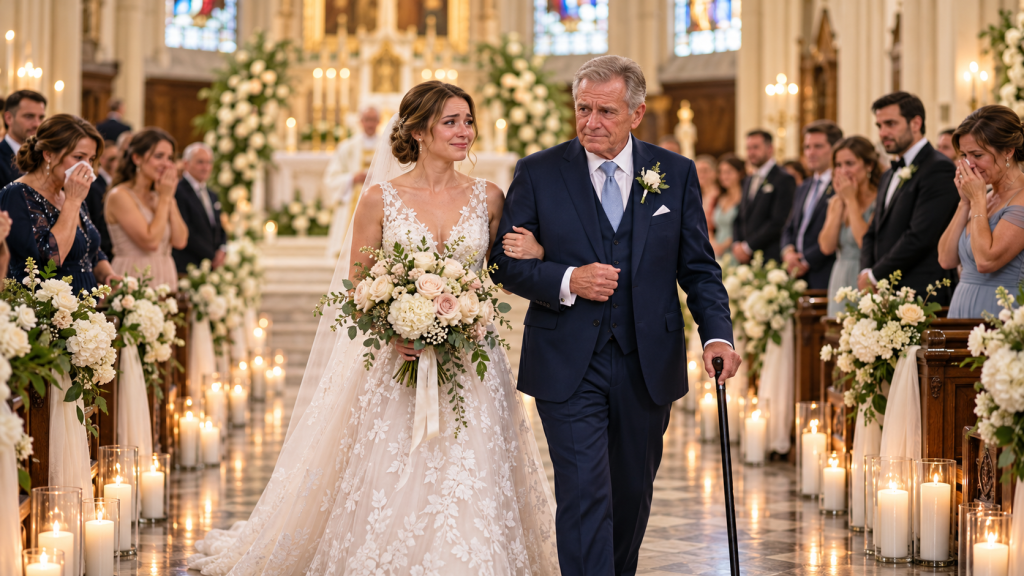
The missing college fund. The strange way Mom always looked at me whenever someone said I resembled Grandma. And the cruel words she’d spoken only twenty minutes earlier. I refuse to walk my greatest regret to the altar. I had spent my entire life believing she regretted giving birth to me.
Now I was beginning to wonder whether she had ever given birth to me at all.
My fingers tightened around Grandpa’s arm.
“Grandpa,” I whispered, “what are you saying?”
He turned toward me.
His eyes were filled with tears.
“Sweetheart, there are things your grandmother and I should have told you years ago.”
Across the aisle, Mom stood so abruptly that her chair scraped against the wooden floor.
“Arthur, enough!”
Her voice echoed through the church.
Several guests turned.
Paige covered her mouth.
Lauren stared at our mother.
Dad’s face had gone a frightening shade of gray.
But Grandpa didn’t move.
He looked directly at Mom.
“No, Margaret.”
His voice was quiet.
“Twenty-nine years is enough.”
Daniel stepped closer.
He didn’t reach for me immediately.
Instead, he looked into my eyes.
“Emma?”
I could barely breathe.
He spoke softly.
“We can stop the ceremony.”
I stared at him.
The man I loved.
The man waiting to become my husband.
The man who had spent three years helping me understand that love didn’t have to be something I earned through obedience.
My eyes filled.
“I don’t know what’s happening.”
He nodded.
“Then we don’t have to pretend everything is fine.”
I looked toward the altar.
The flowers.
The candles.
The smiling photographs we’d placed near the entrance.
My wedding had been planned for eighteen months.
I had imagined walking toward Daniel with Grandpa at my side.
I had imagined exchanging vows beneath the stained-glass windows.
I had imagined finally having one beautiful family memory my mother couldn’t ruin.
And now, halfway down the aisle, the truth about my entire childhood was beginning to unfold.
I turned toward Grandpa.
“Please tell me.”
His face crumpled.
Then he whispered, “Your birth mother’s name was Katherine.”
Something stirred inside me.
Katherine.
The name felt strangely familiar.
I had heard it before.
Not often.
Usually in whispered conversations that stopped whenever I entered the room.
Once, when I was eleven, I discovered a photograph tucked into Grandma’s Bible.
A young woman with long brown hair stood beside a rose garden.
She had my eyes.
I remembered asking Grandma who she was.
Grandma stared at the picture for a long time.
Then whispered, “Someone I loved very much.”
Before I could ask another question, Mom entered the room.
She snatched the photograph away.
“Stop digging through things that don’t belong to you.”
I cried that evening.
Grandma came upstairs with a plate of cookies.
She sat beside me on the narrow attic bed.
Then gently brushed my hair.
“Emma,” she whispered, “never believe that somebody else’s silence means you aren’t worth knowing.”
At eleven, I didn’t understand.
At twenty-nine, standing in my wedding gown, those words came back so clearly that my knees weakened.
I looked at Grandpa.
“Katherine?”
He nodded.
Tears rolled down his cheeks.
“She was your grandmother’s youngest daughter.”
My breath caught.
“My aunt?”
He swallowed.
“Your mother.”
A gasp moved through the church.
Somebody dropped a program.
Lauren stood.
Paige shook her head.
“No. That’s impossible.”
Grandpa turned toward them.
“It’s the truth.”
Mom stepped into the aisle.
“This wedding is not the place for this.”
I looked at her.
For the first time in my life, I didn’t see an all-powerful woman whose approval I desperately wanted.
I saw someone frightened.
Not embarrassed.
Not merely angry.
Frightened.
“Mom,” I whispered, “is it true?”
She stared at me.
Her lips moved.
But no words came.
I stepped away from Grandpa.
“Did you adopt me?”
She closed her eyes.
Then said something I would remember for the rest of my life.
“We raised you. That should have been enough.”
I felt as though someone had punched the air out of my lungs.
For twenty-nine years, she’d made me feel like an unwanted burden.
And now she was telling me I should be grateful without asking who I really was.
My voice cracked.
“Was Katherine my mother?”
Mom looked toward Dad.
He stared at the floor.
Then she whispered, “Yes.”
The room went completely silent.
I looked toward Grandpa.
He was crying openly now.
Then I turned to Daniel.
“I can’t do this.”
He nodded immediately.
“Okay.”
I swallowed.
“I need to know.”
He took my hand.
“Then we’ll find out.”
Grandpa gently squeezed my shoulder.
“Emma, I’m sorry.”
I stared at him.
“Did you know all along?”
His face crumpled.
“Yes.”
My heart broke again.
“You let me grow up believing Margaret hated her own daughter?”
He began crying harder.
“We thought we were honoring an arrangement Katherine wanted when you were a baby.”
I shook my head.
“But Katherine is gone?”
Grandpa closed his eyes.
For a moment, he didn’t answer.
Then whispered, “Not everything you’ve been told about Katherine is true.”
I stared.
“What does that mean?”
Mom made a strangled sound.
“Arthur!”
Grandpa turned toward her.
His expression changed.
“Margaret, I promised your mother before she died that I would stop allowing fear to decide what Emma knew.”
Mom’s face drained.
He continued.
“You told this girl she was your greatest regret.”
His voice trembled.
“And you did it on her wedding day.”
Dad finally spoke.
“Arthur, please. We can discuss this privately.”
Grandpa looked at him.
“We tried privately.”
The words landed heavily.
He continued.
“For years.”
I stared at my father.
The man who had stood smiling in the bridal suite while Mom humiliated me.
The man who called me difficult whenever I asked where my college money had gone.
“Dad,” I whispered, “did you know?”
He lowered his eyes.
“Yes.”
Something inside me broke.
Not loudly.
Not dramatically.
It was quieter than that.
Like a thread snapping after years of holding too much weight.
I looked toward Daniel.
Then toward the rows of guests.
Some were crying.
Some looked shocked.
Others stared at my parents with expressions I’d never seen before.
I took a long breath.
Then turned toward the minister.
“Pastor James?”
He approached gently.
“Yes, Emma?”
My voice trembled.
“Could we have a moment?”
He nodded.
“Of course.”
Daniel squeezed my hand.
We walked into the side chapel with Grandpa, Pastor James, and Claire Morgan, the independent attorney who had been advising me about the foundation records.
My bridesmaid and closest friend, Sophie, quietly asked the guests to remain seated while the music paused.
For several moments, I couldn’t speak.
Then I looked at Daniel.
“I’m sorry.”
His expression softened.
“For what?”
“Our wedding.”
He shook his head.
“Emma, our wedding is not ruined.”
I stared at him.
He continued.
“Your mother made a cruel choice.”
“Your grandfather revealed something important.”
“And you are standing here trying to understand your own life.”
His eyes filled.
“None of that changes why I came here today.”
I began crying.
He took both my hands.
“I came because I want to marry you.”
I swallowed.
“Even after this?”
He smiled sadly.
“Especially after this.”
I fell into his arms.
For the first time that morning, I felt safe enough to cry.
He held me.
Didn’t rush me.
Didn’t tell me to stop.
And didn’t make my pain about himself.
After several minutes, I stepped back.
“I still want to marry you.”
He smiled.
“So do I.”
I looked toward Grandpa.
“But I need a few answers first.”
Grandpa nodded.
“You deserve them.”
We sat in the side chapel.
Grandpa carefully unfolded the letter Grandma had left.
The paper was yellowed.
The edges worn.
Her handwriting filled the page.
I recognized it immediately.
The same neat, looping letters she’d used on birthday cards.
I stared at my name across the top.
For Emma, when the truth can no longer be kept from her.
My hands began trembling.
Grandpa offered the letter.
I took it.
And began reading.
My darling Emma,
If you are reading this, then the adults who loved you have failed to give you something you should always have possessed.
The truth about your beginning.
Tears blurred the words.
I wiped my eyes.
Then continued.
You were born to Katherine, my youngest daughter.
She loved you from the moment she learned she was expecting you.
She was young, frightened, and facing circumstances that made her believe she couldn’t provide the security you deserved.
My throat tightened.
Margaret and her husband offered to raise you.
At the time, we believed it might give everyone a chance to begin again.
I stopped.
Looked toward Grandpa.
“She gave me away?”
His face crumpled.
“Not because she didn’t love you.”
I stared.
“Then why?”
He took a shaking breath.
“Katherine was nineteen. She had been struggling financially, and there were serious difficulties involving the man who was your biological father.”
I swallowed.
“What difficulties?”
Grandpa looked toward Claire.
Then back at me.
“He wasn’t prepared to be a parent. Their relationship was troubled. She needed help.”
I stared at Grandma’s letter.
Then continued reading.
But Emma, arrangements made out of fear can become painful when the truth is buried.
You were never unwanted.
You were never a mistake.
And you were certainly never a regret.
I began sobbing.
Grandpa moved beside me.
I looked at him.
“Where is Katherine?”
His eyes filled.
Then he whispered, “She died when you were six.”
For several seconds, I couldn’t breathe.
Six.
I had been six.
Old enough to remember someone.
Old enough to remember a face.
A voice.
A smell.
But nobody had ever told me she existed.
I searched my childhood memories.
There was a woman.
A young woman who sometimes visited Grandma’s house.
She wore blue scarves.
She smelled like oranges.
And she used to call me Little Star.
I had always believed she was a family friend.
My heart began pounding.
“The woman with the blue scarf?”
Grandpa closed his eyes.
Then nodded.
“Yes.”
I covered my mouth.
“Oh, God.”
A memory surfaced.
I was four.
Standing in Grandma’s garden.
The woman in the blue scarf knelt beside me.
She picked a tiny yellow flower.
Tucked it behind my ear.
And whispered, “There you are, Little Star.”
I remembered laughing.
She kissed my forehead.
Then she began crying.
I asked why.
She smiled through her tears.
“Because sometimes happiness hurts when you can’t hold it long enough.”
At four, I didn’t understand.
At twenty-nine, I finally did.
I began crying so hard Daniel wrapped his arms around me.
“She knew me,” I whispered.
Grandpa nodded.
“She visited whenever she could.”
My voice broke.
“And I didn’t know she was my mother.”
Grandpa covered his face.
“No.”
For a long time, nobody spoke.
Then I asked quietly, “How did she die?”
Grandpa lowered his hands.
“There was a medical emergency. An untreated condition became critical very quickly.”
My heart tightened.
“Was she alone?”
He shook his head.
“Your grandmother was with her.”
I closed my eyes.
“And you?”
His voice broke.
“I arrived before she died.”
I swallowed.
“Did she ask about me?”
Grandpa began crying.
“Every time she was conscious.”
The words broke me.
I had spent years believing nobody could explain why Margaret treated me differently.
I thought there was something wrong with me.
Something missing.
Something shameful.
But somewhere in my childhood, a young woman had loved me.
She had visited.
Held me.
Called me Little Star.
And died asking about me.
I pressed Grandma’s letter against my heart.
Then whispered, “Why didn’t anyone tell me?”
Grandpa didn’t answer immediately.
Then he said, “Margaret believed that telling you would threaten the family arrangement.”
I stared.
“What arrangement?”
He sighed.
“After the adoption was finalized, she wanted everyone to treat you as her daughter.”
My eyes filled.
“That sounds reasonable.”
He nodded.
“It could have been, if she’d loved you openly and allowed you to know your history.”
I looked down.
“But she didn’t.”
Grandpa’s voice broke.
“No.”
I read the rest of Grandma’s letter.
She wrote about Katherine.
Her love of music.
Her habit of rescuing injured birds.
Her dream of becoming a nurse.
Her laughter.
Her stubbornness.
And the way she used to stare at the stars whenever life became difficult.
Then I reached a paragraph that made my heart stop.
Katherine established a fund for you with the help of your grandfather and me.
It was intended to support your education and provide some independence when you became an adult.
I looked up.
The scholarship fund.
The money I’d spent eighteen months tracing.
The funds my parents claimed had never existed.
My hands began trembling.
I continued.
The money was never intended as a reward for obedience.
It was a gift from your mother.
A promise that even if she could not raise you herself, she would help you build a future.
My tears fell onto the page.
If you ever discover that promise was not honored, ask questions.
Ask for records.
Ask for help.
And never let anyone make you feel guilty for seeking the truth.
I looked toward Claire.
Her expression was solemn.
For eighteen months, we’d been reviewing trust records, bank statements, charitable foundation reports, and transfers connected to my parents.
We had followed missing money through accounts that had been renamed.
Expenses that didn’t make sense.
Payments that appeared to benefit members of my family more than the charitable programs they were supposed to support.
I knew the numbers.
I knew the dates.
I knew the transactions.
But until that moment, I hadn’t fully understood the person behind the money.
My mother.
Katherine.
The woman with the blue scarf.
I pressed the letter against my chest.
Then whispered, “They took what she left me.”
Claire leaned forward.
“We have evidence of irregular transfers and potential misuse, Emma. We’ll still need a complete review to establish responsibility and the proper legal remedies.”
I nodded.
“I know.”
Then looked toward Grandpa.
“But she wanted me to have a future.”
He began crying.
“Yes.”
For a long time, the room remained quiet.
Then Pastor James gently asked, “Emma, would you like to postpone the ceremony?”
I looked toward Daniel.
His eyes were filled with tears.
He squeezed my hand.
I took a breath.
Then shook my head.
“No.”
Everyone looked at me.
I continued.
“I don’t want the worst thing my mother ever said to become the defining memory of the day I marry the man I love.”
Daniel’s expression softened.
I stood.
Smoothed my gown.
And looked toward Grandpa.
“Will you still walk me?”
His face crumpled.
“Oh, sweetheart.”
He stood slowly.
Took my hand.
And whispered, “With the greatest honor of my life.”
When we returned to the sanctuary, the atmosphere had changed.
Guests sat quietly.
My mother stood near the front row.
Dad beside her.
Paige and Lauren appeared stunned.
Sophie had moved the wedding party into position again.
The organist waited.
Daniel stepped toward the altar.
Before he left my side, he leaned close.
“Emma?”
I looked up.
“Yes?”
He kissed my forehead.
“I’ll be right there.”
I smiled through tears.
“I know.”
Grandpa offered his arm.
I took it.
Then the music began again.
We walked slowly.
This time, he didn’t stop halfway.
He kept his eyes forward.
His cane tapped gently against the floor.
And with every step, I felt as though I was walking through the years of my childhood.
The attic bedroom.
The missed birthdays.
The questions nobody answered.
The letters Grandma said she’d sent.
The college fund that mysteriously disappeared.
And the woman with the blue scarf.
My mother.
Katherine.
As we approached the altar, I looked toward Margaret.
She stared at me.
Her expression was difficult to read.
Anger.
Fear.
Perhaps a little shame.
I didn’t know.
And for the first time in my life, I didn’t feel compelled to understand her before understanding myself.
I simply kept walking.
At the altar, Grandpa stopped.
He looked toward Daniel.
Then toward me.
His eyes filled.
“Emma,” he whispered, “your grandmother would have loved to see this.”
I began crying.
He smiled.
“And Katherine too.”
My throat tightened.
I nodded.
Then kissed his cheek.
“Thank you, Grandpa.”
He placed my hand in Daniel’s.
And stepped aside.
The ceremony was beautiful.
Not because everything went perfectly.
Nothing about that morning had been perfect.
But because every word felt real.
When Daniel promised to love me through uncertainty, I believed him.
When I promised to listen and speak honestly, I understood what those words meant.
And when we exchanged rings, I didn’t feel as though someone was finally choosing me because I was worthy.
I felt worthy already.
He was simply choosing to share the life we would build.
When Pastor James pronounced us married, Daniel kissed me.
Applause filled the church.
I began laughing through tears.
For one brief moment, the secrets, the money, and the years of pain fell away.
I was married.
I was loved.
And I had a future.
But the truth my grandfather revealed was not finished.
Not even close.
At the reception, my parents approached.
Margaret wore the same elegant ivory suit she’d chosen to make herself look like the perfect mother of the bride.
Her smile had returned.
Too quickly.
Too smoothly.
“Emma,” she began, “I think we need to put this unpleasantness behind us.”
I stared at her.
“Unpleasantness?”
She sighed.
“Your grandfather became emotional.”
My chest tightened.
“He told me who my mother was.”
She glanced around the reception hall.
Several guests were nearby.
Her expression sharpened.
“Lower your voice.”
I felt something inside me settle.
For twenty-nine years, I’d lowered my voice whenever Margaret asked.
Lowered my expectations.
Lowered my questions.
Lowered myself.
Not today.
I looked directly at her.
“Her name was Katherine.”
Mom’s face went pale.
I continued.
“She was your sister.”
Margaret pressed her lips together.
“I know who she was.”
My eyes filled.
“Then why did you spend my childhood treating me as though loving me was a burden?”
For a moment, Margaret said nothing.
Then she whispered, “You have no idea what I sacrificed.”
I stared.
“Then tell me.”
Her eyes flashed.
“We took you in when nobody else could.”
I nodded.
“And?”
“We gave you a home.”
“Yes.”
“An education.”
I swallowed.
“And?”
Margaret’s face hardened.
“You were never grateful.”
There it was.
The word she’d used my entire life.
Grateful.
When I asked why Paige received a car for her sixteenth birthday and I didn’t.
When I asked why Lauren was sent to Paris while I worked weekends to pay for textbooks.
When I asked why my college fund disappeared.
When I asked why Grandma’s letters stopped arriving.
Every question became evidence of ingratitude.
I took a breath.
“Margaret, a child shouldn’t have to earn decent treatment by pretending she has no needs.”
Her expression changed.
I continued.
“You chose to adopt me.”
Tears filled my eyes.
“That choice made you responsible for caring for me. It didn’t make my childhood a debt I could never repay.”
Dad stepped forward.
“Emma, don’t speak to your mother like that.”
I turned toward him.
For a moment, I felt the old fear.
Then I remembered Grandpa’s hand in mine.
Daniel standing beside me.
Grandma’s letter.
Katherine’s gift.
I straightened.
“Dad, you stood beside the door while she called me her greatest regret.”
He looked away.
I continued.
“You laughed when she humiliated me.”
His face reddened.
“That isn’t fair.”
I shook my head.
“It happened.”
My voice broke.
“And I won’t pretend otherwise to make this easier for you.”
Margaret looked toward Daniel.
“Can you please talk some sense into your wife?”
Daniel’s expression remained calm.
“Emma has said exactly what she means.”
She stared at him.
He continued.
“She’s allowed to ask questions about her own life.”
Margaret’s face hardened.
“Of course you’d take her side.”
Daniel nodded.
“Yes.”
Then he gently took my hand.
“I’m her husband.”
For once, Margaret had nothing to say.
I looked toward both my parents.
“This is our wedding day.”
My voice trembled.
“We’re not discussing the financial investigation here.”
Margaret’s eyes widened.
“Emma—”
I continued.
“If you have anything to say about the trust, the foundation accounts, or the records Claire has requested, speak through the appropriate professionals.”
Dad went pale.
Margaret whispered, “You’re threatening your own family?”
I shook my head.
“No.”
I took a breath.
“I’m asking for accountability.”
She stared.
Then turned sharply.
“Come on.”
Dad followed her.
They left the reception early.
Paige and Lauren went with them.
And although a small part of me felt the familiar sting of rejection, something unexpected happened.
The room didn’t collapse.
The music continued.
Guests laughed.
Daniel’s mother brought me a glass of water.
His father kissed my forehead.
Grandpa sat beside the dance floor smiling through tears.
And for the first time, I understood that my parents’ departure didn’t mean the celebration had failed.
It simply meant the people who wanted to celebrate with us were still there.
Later that evening, Grandpa asked me to dance.
I laughed.
“Grandpa, your knees.”
He grinned.
“My knees have been complaining since 1987.”
I smiled.
“Are you sure?”
He offered his hand.
“Absolutely.”
We moved slowly beneath the lights.
His cane rested against a nearby chair.
Daniel stood a few feet away, ready to help if needed.
Grandpa placed one hand gently against my back.
“You look beautiful, Emma.”
My throat tightened.
“Thank you.”
He smiled.
“Your grandmother would have cried through the entire ceremony.”
I laughed through tears.
“She always cried at weddings.”
“She cried at everything.”
I nodded.
“Even commercials.”
Grandpa chuckled.
“Especially commercials.”
For a moment, we simply swayed.
Then I looked up.
“Grandpa?”
“Yes, sweetheart?”
“Why did you stop walking halfway down the aisle?”
His smile faded.
He looked toward the empty seats where my parents had been sitting.
Then back at me.
“Because I heard your mother whisper something.”
My stomach tightened.
“What?”
His voice broke.
“She told your father, ‘At least she’ll never know what we did to Katherine’s money.’”
I stopped moving.
The music continued around us.
Guests laughed.
A photographer crossed the room.
But I could barely hear anything.
I stared at Grandpa.
“She said that?”
He nodded.
“I was trying to keep the peace until the ceremony ended.”
His eyes filled.
“But after hearing that, I couldn’t stand there and let her humiliate you.”
My throat tightened.
“Grandpa…”
He squeezed my hand.
“I’m sorry I chose that moment.”
I looked into his eyes.
For the first time, I understood how much that decision had cost him.
He had watched his daughter mistreat me for years.
He had hoped she’d change.
He had kept trying to resolve things privately.
And on my wedding day, hearing her speak about Katherine’s money while calling me her greatest regret, he finally refused to remain silent.
I took a breath.
“Thank you for telling me.”
He nodded.
Then whispered, “There’s something else.”
My stomach tightened.
I looked at him.
“What?”
He reached into his jacket pocket.
Removed a small velvet pouch.
And placed it in my palm.
I stared.
“What is this?”
His eyes filled.
“Something Katherine wanted you to have.”
My fingers trembled as I opened it.
Inside was a delicate gold necklace.
A tiny star-shaped pendant hung from the chain.
I stared.
I remembered it.
The woman with the blue scarf.
The yellow flower.
The scent of oranges.
She used to wear a little golden star.
I covered my mouth.
“Oh, God.”
Grandpa nodded.
“She wore it nearly every day.”
Tears streamed down my face.
“She called me Little Star.”
His expression crumpled.
“Yes.”
He gently took the necklace.
“May I?”
I nodded.
He placed it around my neck.
The pendant rested against my skin.
Warm from his hands.
For a moment, I felt like a little girl again.
Standing beneath the rose arbor.
Katherine kneeling in front of me.
Smiling through tears.
I touched the pendant.
And whispered, “Hello, Mom.”
Grandpa began crying.
We held each other.
And the photographer quietly stepped away, giving us privacy.
That night, Daniel and I left the reception beneath a shower of flower petals.
Guests cheered.
Grandpa waved.
Sophie cried harder than anyone.
I climbed into the car beside my new husband.
He took my hand.
For a moment, we sat quietly.
Then Daniel looked at me.
“How are you feeling?”
I laughed weakly.
“I don’t know.”
He smiled gently.
“Fair.”
I leaned against him.
Then whispered, “I found out who my mother was on my wedding day.”
He kissed my forehead.
“I know.”
My eyes filled.
“And somehow, I still married the best man I’ve ever known.”
Daniel smiled.
“That’s an excellent part of the day.”
I laughed through tears.
Then looked down at the star around my neck.
I didn’t know what the coming months would bring.
I didn’t know how much money had been taken.
I didn’t know whether my parents would ever admit what they’d done.
I didn’t know whether Paige and Lauren would turn against me even more.
But for the first time in my life, I wasn’t afraid to ask.
Our honeymoon was quiet.
We rented a small cabin beside the mountains.
No elaborate international trip.
No packed schedule.
Just trees, fresh air, and mornings when we could sit together without anyone demanding anything.
The first morning, I woke before Daniel.
Sunlight entered through the curtains.
He slept beside me.
His wedding ring caught the light.
I lay quietly, looking at him.
Then touched the star necklace.
My eyes filled.
For twenty-nine years, I’d believed Margaret was my biological mother.
I thought she regretted having me.
I thought I’d disappointed her simply by existing.
Now I knew there had been another woman.
Katherine.
Young.
Frightened.
Imperfect.
But loving.
A woman who’d spent her final years trying to stay connected to the daughter she couldn’t raise.
I closed my eyes.
And whispered, “I wish I could’ve known you.”
Daniel stirred.
He opened his eyes.
“Emma?”
I smiled sadly.
“Sorry.”
He reached for my hand.
“Come here.”
I moved closer.
He wrapped his arms around me.
For a long time, we lay quietly.
Then I whispered, “Do you think Katherine would have liked you?”
Daniel smiled.
“I hope so.”
I laughed through tears.
“She would’ve made you answer a thousand questions.”
He grinned.
“Then I would’ve answered them.”
My heart warmed.
And for one beautiful moment, I imagined Katherine sitting across from Daniel at a kitchen table.
Asking whether he’d be kind.
Whether he’d listen.
Whether he’d respect me when we disagreed.
I smiled.
Because I knew what he would’ve said.
The financial investigation resumed after our honeymoon.
Claire worked with an independent forensic review team and the relevant attorneys.
We had already spent eighteen months organizing records.
The wedding revelation gave us new documents and a clearer understanding of the trust’s purpose.
But it didn’t magically answer every question.
There were different accounts.
Different entities.
Different dates.
The charitable foundation had received donations from outside supporters.
Katherine’s fund had its own governing documents.
Some transactions had been recorded as loans.
Others as reimbursements.
Several appeared to have been routed through accounts controlled by my parents.
Claire insisted we separate the issues.
The trust.
The foundation.
Personal expenses.
And any possible breaches of duty.
“Emma,” she told me one afternoon, “we don’t want a dramatic accusation. We want an accurate accounting.”
I nodded.
“That’s what I want too.”
I looked at the records spread across the table.
Then whispered, “I want to know what happened to Katherine’s gift.”
Claire’s expression softened.
“We’re working toward that.”
The first major discovery came from a set of bank statements preserved by Grandpa.
For years, I’d believed he’d stopped sending letters because he was disappointed in me.
Margaret had told me he didn’t want to hear from me.
Then, during the investigation, Grandpa showed me something.
A box.
Filled with envelopes.
Some addressed to me.
Some returned.
Some never mailed.
I stared.
“Grandpa…”
His eyes filled.
“I wrote to you every month.”
My throat tightened.
“Every month?”
He nodded.
“After you left for college.”
I opened the first envelope.
Inside was a birthday card.
Twenty-first birthday.
Then another.
Twenty-second.
Then twenty-third.
Each one held a handwritten letter.
My hands trembled.
“Why didn’t I get these?”
Grandpa’s face crumpled.
“Margaret told me you wanted space.”
I stared.
“She said you were upset with me.”
My eyes filled.
“She told me you stopped writing because I embarrassed the family.”
Grandpa covered his mouth.
For a moment, neither of us spoke.
Then he began crying.
“Oh, Emma.”
I hugged him.
Hard.
The kind of hug that comes from trying to recover years in a single moment.
Grandpa whispered, “I never stopped loving you.”
My voice broke.
“I know.”
He pulled back.
“No.”
His eyes filled.
“I need you to hear it.”
I nodded.
He took both my hands.
“Emma, you were never a disappointment to me.”
I began sobbing.
Because those were the words I’d needed for so long.
Not a luxury car.
Not a trip to Paris.
Not a diamond bracelet.
Just someone to say I wasn’t a disappointment.
Inside one envelope was a photograph of Katherine.
She was sitting on the steps of Grandma’s house.
Holding a tiny baby wrapped in a pink blanket.
Me.
I stared.
Katherine looked exhausted.
Her hair fell messily around her face.
But she was smiling.
Not politely.
Not for a camera.
With the kind of joy that reaches all the way into someone’s eyes.
I touched the photograph.
Then whispered, “She looks happy.”
Grandpa nodded.
“She was.”
For a long time, I studied the picture.
Then asked, “Did she regret placing me for adoption?”
Grandpa closed his eyes.
“It was the hardest decision she ever made.”
My throat tightened.
He continued.
“She believed you would have more stability living with Margaret and her husband. But she struggled with the distance and the restrictions placed on contact.”
I swallowed.
“Restrictions?”
Grandpa nodded.
“After the adoption, Margaret gradually made visits more difficult.”
My heart tightened.
“Why?”
He sighed.
“I can’t tell you exactly what she believed.”
Then he added quietly, “But she seemed determined to control how you understood your family.”
I looked down at the photograph.
Then asked, “Did Katherine ever try to take me back?”
Grandpa shook his head gently.
“The adoption was legally completed. She sought contact and asked questions about her options, but she didn’t simply have a right to reverse it.”
I nodded.
He continued.
“She wanted you to know the truth when you were old enough to understand.”
I pressed the photograph against my chest.
Then whispered, “I wish someone had listened.”
The next discovery came from the foundation records.
My parents’ charitable foundation had built a prestigious reputation.
They hosted galas.
Sponsored scholarships.
Made speeches about educational opportunity.
And appeared in local magazines beside donors and community leaders.
For years, Margaret proudly introduced Paige and Lauren at those events.
She called them her greatest blessings.
She praised their achievements.
And spoke about the importance of helping young women succeed.
I rarely attended.
When I did, I felt like an unwanted guest.
Margaret would introduce me as “our accountant.”
Not her daughter.
Sometimes people assumed I was an employee.
She never corrected them.
Now I understood why that distinction had hurt so much.
She had spent years publicly celebrating generosity while privately treating me as someone undeserving of it.
But the financial documents told a more complicated story.
The independent review identified questionable reimbursements.
Expenses with inadequate supporting documentation.
Payments benefiting family members.
And transfers involving accounts connected to Katherine’s fund.
Some were explainable.
Others required further examination.
Then we found something that made Claire stop speaking.
An invoice.
Marked:
FOUNDATION EDUCATIONAL OUTREACH — $48,500.
The vendor was a consulting company.
The recorded contact information led to a business associated with Dad.
I stared.
“What services did it provide?”
Claire shook her head.
“That’s what we need to establish.”
The supporting documentation was thin.
There were no detailed reports.
No clear deliverables.
No evidence yet that the invoiced amount matched work actually performed.
And the payment had been authorized by someone within my parents’ control structure.
I leaned back.
My stomach tightening.
“Could they have moved charitable money into their own business?”
Claire answered carefully.
“That’s one possibility the records raise. We need to verify the facts and examine applicable obligations.”
I nodded.
Then whispered, “Keep going.”
And we did.
As the review continued, questions emerged concerning a series of transfers made over several years.
They involved different categories.
Education.
Consulting.
Travel.
Fundraising events.
And administrative expenses.
No single document explained everything.
But together, the records showed why the foundation needed an independent examination.
Then a former employee contacted Claire.
Her name was Helen Foster.
She had served as a financial administrator for the foundation.
And she had something important to say.
Helen arrived at Claire’s office carrying a folder.
She looked nervous.
I offered her water.
She smiled faintly.
“Thank you.”
Claire began carefully.
“Ms. Foster, you indicated that you have concerns about records maintained during your employment.”
Helen nodded.
“Yes.”
She looked toward me.
Then whispered, “Emma, I remember you.”
I frowned.
“From the foundation?”
She nodded.
“You came to the office when you were nineteen.”
My heart tightened.
I remembered that visit.
I’d been trying to understand why my university financial aid hadn’t covered certain expenses.
Margaret told me there was no college fund.
But Grandma had once said something about money being set aside for my education.
So I went to the foundation office.
I asked questions.
And Helen was the woman behind the reception desk.
I stared.
“I remember.”
Helen’s eyes filled.
“You asked whether there was a scholarship in your name.”
I nodded slowly.
She continued.
“I was told to say there wasn’t.”
For a moment, I couldn’t breathe.
“Who told you?”
Helen lowered her eyes.
“Margaret.”
My chest tightened.
I remembered walking out of that office feeling ashamed.
As though asking for help made me selfish.
I went home and cried.
Then took an additional part-time job.
I spent the next several years working nights, studying during the day, and slowly paying my way through college.
I looked at Helen.
“Why are you telling me now?”
Her eyes filled.
“Because I should’ve asked more questions.”
She opened her folder.
Inside were copies of correspondence and accounting notes she’d preserved through proper channels.
Some referenced the education fund.
Others concerned instructions about classification of certain transfers.
Helen explained that she’d become increasingly uncomfortable with requests that lacked documentation.
Eventually, she resigned.
She had not known the full extent of the concerns.
But after hearing about the independent review, she wanted to provide what she could.
I listened.
Then whispered, “Thank you.”
Helen began crying.
“I’m sorry I didn’t help you then.”
I took a breath.
“You were an employee.”
She shook her head.
“I still wish I’d done more.”
I looked down at the papers.
Then gently said, “You can help now.”
And she did.
Her records became part of the independent examination.
Other witnesses were interviewed.
Documents were compared.
And the investigation continued through appropriate legal and organizational procedures.
I didn’t publish accusations online.
Didn’t organize a public humiliation.
Didn’t turn my wedding into a campaign against my parents.
I wanted the truth established properly.
Because I knew exactly how easily a story could become distorted when people cared more about appearances than facts.
The irony wasn’t lost on me.
My parents had spent years treating me like a problem because I asked questions about money.
Now those questions were the reason a careful review was possible.
One afternoon, Daniel found me sitting on the floor surrounded by folders.
I had been staring at the same spreadsheet for twenty minutes.
He crouched beside me.
“Emma?”
I looked up.
My eyes were red.
“Hey.”
He smiled gently.
“When did you last eat?”
I frowned.
“I had coffee.”
He raised an eyebrow.
“Coffee isn’t lunch.”
I almost laughed.
Then started crying.
Daniel sat beside me.
He didn’t ask me to explain immediately.
He simply held my hand.
After a while, I whispered, “I keep thinking about Katherine.”
He nodded.
“I know.”
I continued.
“She was nineteen.”
“She gave me up because she thought I would have stability.”
“And then I grew up feeling unwanted.”
My voice broke.
“What would she have thought?”
Daniel pulled me closer.
“I can’t know what she would’ve thought.”
I nodded.
He continued.
“But from what you’ve learned, she wanted you to be loved and safe.”
I began crying.
“And I wasn’t always.”
His eyes filled.
“No.”
He kissed my forehead.
“And that wasn’t your fault.”
I closed my eyes.
For a long time, I held him.
Then whispered, “I wish she could see me now.”
Daniel smiled sadly.
“I think she’d be proud of the person you’ve become.”
I touched the little gold star around my neck.
Then took a breath.
“I hope so.”
The next major turning point came when Paige called.
It was almost nine at night.
Daniel and I had just finished dinner.
My phone buzzed.
I looked at the screen.
PAIGE.
I stared.
For most of our childhood, Paige had enjoyed making me feel small.
She was three years older.
Confident.
Popular.
The daughter Margaret praised at every opportunity.
I answered cautiously.
“Hello?”
There was a long silence.
Then Paige whispered, “Emma?”
I frowned.
“Yes?”
Her voice trembled.
“Can we talk?”
I looked toward Daniel.
He saw my expression.
Then quietly moved into the kitchen, giving me privacy.
I took a breath.
“About what?”
Paige began crying.
“Mom.”
My stomach tightened.
“What happened?”
She swallowed.
“I found something.”
For a moment, I couldn’t speak.
Then asked, “What?”
Paige took a shaky breath.
“Emails.”
I closed my eyes.
“From whom?”
“Mom and Dad.”
My heart pounded.
“What about?”
She hesitated.
Then whispered, “Your college fund.”
I sat down.
For several seconds, I couldn’t move.
Then said, “Paige, if you have records relevant to the independent review, please preserve them and contact Claire.”
She began crying.
“Emma, I didn’t know.”
My throat tightened.
“Didn’t know what?”
Her voice broke.
“That the money used toward my wedding expenses may have come from an account associated with Katherine’s fund.”
For a moment, the room became completely silent.
I stared at the wall.
Paige’s wedding.
The enormous ballroom.
The flower arrangements.
The designer gown.
The diamond bracelet Margaret loved reminding everyone she’d helped purchase.
I remembered standing in that ballroom wearing a dress I’d bought on sale.
I was twenty-three.
Still paying student loans.
Still working long hours.
Margaret introduced me to a donor.
“This is Emma. She’s always been very independent.”
The woman smiled.
“How wonderful.”
I nodded politely.
But inside, I felt ashamed.
Because independence was what my mother called it when I had to manage without help.
Now Paige was telling me money intended for my education might have been used toward her wedding.
I swallowed.
“Paige, send the records to Claire.”
She began crying harder.
“Emma, I’m sorry.”
I stared.
“For what?”
She hesitated.
Then whispered, “For laughing when Mom hurt you.”
My heart tightened.
Paige continued.
“I thought you were always trying to make trouble.”
I closed my eyes.
“Because that’s what Mom told you.”
She nodded.
“Yes.”
For a moment, I wanted to say something cruel.
To remind her of every birthday.
Every insult.
Every time she’d smiled while Margaret humiliated me.
But I was tired.
And I wanted truth more than revenge.
I took a breath.
“Paige, I appreciate you telling me.”
She sniffled.
“Can we ever fix this?”
My eyes filled.
I looked toward the kitchen, where Daniel was quietly washing dishes.
Then whispered, “I don’t know.”
Paige began crying.
I continued.
“But if you want to rebuild anything with me, it has to begin with honesty.”
She nodded.
“Okay.”
“Not excuses.”
“Yes.”
“And not expecting me to pretend the past didn’t happen.”
Her voice broke.
“I understand.”
We ended the call.
I sat quietly afterward.
Then Daniel returned.
He looked at me.
“Emma?”
I began crying.
He sat beside me.
And held me.
The next day, Paige provided the records to Claire through appropriate channels.
The documents didn’t prove every allegation.
But they helped establish a clearer timeline.
Certain payments associated with my sisters’ expenses had been made through arrangements that warranted closer review.
There were questions about authorization.
Purpose.
And whether the transactions complied with the governing documents.
The independent investigators continued.
And slowly, the image of my parents’ flawless foundation began separating from the underlying records.
Lauren contacted me several weeks later.
At first, she sounded defensive.
“Emma, do you realize what this investigation is doing to the family?”
I took a breath.
“I know it’s difficult.”
She scoffed.
“Difficult? Mom is furious.”
I looked toward the window.
“Lauren, the review concerns financial records. It isn’t happening because Mom is upset.”
She sighed.
“You’ve always been obsessed with proving something.”
For a moment, the old pain returned.
Then I remembered Grandma’s words.
Do not allow anyone to convince you that asking questions makes you unloving.
I took a breath.
“Lauren, I didn’t create the transactions.”
She said nothing.
I continued.
“I didn’t sign the records.”
Silence.
“And I didn’t choose to hide my birth history for twenty-nine years.”
Her breathing changed.
Then she whispered, “We didn’t know you were adopted.”
My heart tightened.
“You didn’t?”
She swallowed.
“No.”
For a moment, I couldn’t speak.
Paige and Lauren had believed the same story I did.
They thought I was their biological younger sister.
They had never known about Katherine.
Never understood why Margaret treated me differently.
They had simply learned to imitate it.
I closed my eyes.
“Lauren…”
She began crying.
“Mom told us you were difficult from the time you were born.”
My stomach turned.
“She said you caused problems.”
Her voice broke.
“And we believed her.”
I sat quietly.
Because for years, I’d thought my sisters were simply cruel.
Now I understood their cruelty had been cultivated.
That didn’t excuse it.
But it explained part of the pattern.
Lauren whispered, “Emma, who was Katherine?”
My eyes filled.
“She was your aunt.”
She began crying harder.
“And my mother.”
There was a long silence.
Then Lauren whispered, “I remember her.”
My heart stopped.
“What?”
She took a shaky breath.
“I remember a woman who visited Grandma when I was little.”
My heart pounded.
“The blue scarf?”
Lauren gasped.
“Yes.”
I covered my mouth.
She continued.
“I remember Mom getting angry when she came over.”
My eyes filled.
“She said Katherine upset you.”
I closed my eyes.
Lauren began crying.
“Emma, I didn’t understand.”
Neither had I.
For a long time, we spoke.
Not like sisters who suddenly loved each other perfectly.
But like adults finally examining the childhood story they’d been given.
Lauren admitted she had enjoyed being favored.
That she’d liked the attention.
The gifts.
The praise.
She didn’t pretend otherwise.
I appreciated that honesty more than any polished apology.
Before ending the call, she whispered, “I’m sorry I called your mascara cheap.”
I almost laughed.
Then began crying.
Of all the cruel things she’d said, that one now felt strangely small.
But it had been spoken on my wedding day.
A moment when I should have felt beautiful.
I took a breath.
“Thank you for saying that.”
Lauren began crying.
“Can we start over?”
I considered.
Then answered gently.
“We can’t erase what happened.”
She sniffled.
“I know.”
“But perhaps we can learn how to speak to each other differently.”
She whispered, “I’d like that.”
I nodded.
“So would I.”
The investigation reached a difficult stage when the independent review team issued a preliminary report.
Claire called Daniel and me into her office.
Grandpa attended with his own adviser.
The meeting was quiet.
Serious.
And carefully organized.
The report identified multiple transactions requiring explanation.
Some involved the charitable foundation.
Others involved Katherine’s fund.
And some connected to personal benefits received by members of the Stone family.
Claire explained that different legal rules applied to different accounts.
Charitable donations weren’t automatically the same as private trust assets.
A poorly documented payment wasn’t necessarily criminal.
And a questionable transfer required evidence of authorization, duties, and actual use.
I listened carefully.
Then asked, “Do we know what happened to Katherine’s money?”
Claire opened the relevant section.
“We know substantial amounts were transferred away from the accounts originally associated with her fund.”
My heart tightened.
“Where?”
She described several destinations.
Accounts controlled by family entities.
Payments described as reimbursements.
Educational and personal expenses.
Some later transfers to third parties.
My hands began shaking.
“Was any of it used for me?”
Claire looked down.
“Some expenses may have been paid for your benefit during childhood, but the records do not yet establish that all transfers were authorized or consistent with the fund’s terms.”
I nodded slowly.
Then asked, “What about college?”
Her expression softened.
“We have not found evidence that the intended education support was made available to you when you applied.”
For a moment, I couldn’t speak.
I remembered myself at nineteen.
Working late shifts.
Studying until dawn.
Skipping meals to afford textbooks.
Feeling guilty for asking whether I had a college fund.
Tears filled my eyes.
Not because I regretted working hard.
I was proud of the career I’d built.
But because someone had apparently allowed me to struggle while telling me the money meant for my education didn’t exist.
I swallowed.
Then whispered, “Katherine wanted me to have options.”
Grandpa began crying.
“Yes.”
I looked down.
“And they took those options away.”
Claire answered carefully.
“The evidence indicates that your access to intended support was obstructed. We’re pursuing a full accounting and determining appropriate remedies for any unauthorized transactions.”
I nodded.
“Then keep going.”
And we did.
The matter progressed through formal legal and regulatory channels.
The independent foundation board commissioned additional review.
Relevant documents were preserved.
Certain leadership responsibilities were restricted while conflicts and irregularities were examined.
And qualified professionals assessed the handling of funds.
My parents were given opportunities to respond.
They obtained their own attorneys.
And the proceedings continued.
I did not expect instant justice.
I had spent enough time in forensic accounting to understand that financial wrongdoing is rarely resolved by one dramatic spreadsheet.
It requires careful examination.
Patience.
Evidence.
And people willing to tell the truth even when it is uncomfortable.
But the process was moving.
And for the first time, nobody could simply dismiss my questions by calling me difficult.
Then Margaret asked to see me.
The request arrived through her attorney.
I stared at the message.
For a long moment, I considered refusing.
I had no desire to be insulted again.
No desire to hear her explain why my childhood had been so disappointing.
No desire to be told that my gratitude was insufficient.
But part of me wanted answers.
Not about money.
About me.
So I agreed to a meeting.
With counsel present.
In a neutral office.
Margaret arrived wearing a charcoal-gray suit.
Her hair was perfectly styled.
Her makeup flawless.
She carried an expensive leather handbag.
For one strange moment, I remembered being eight.
Standing in her doorway.
Asking whether she could help me with a school project.
She looked up from her phone.
Sighed.
And said, “Can’t you do anything without bothering me?”
I had spent twenty-one years since that afternoon trying to become someone who never bothered anyone.
Now I sat across from her.
An adult.
A wife.
A forensic accountant.
And a woman who no longer needed permission to ask questions.
Margaret studied me.
Then said, “You look well.”
I nodded.
“Thank you.”
She glanced toward the star necklace.
Her expression changed.
“Arthur gave you that.”
I touched it.
“Yes.”
She looked away.
For a moment, silence filled the room.
Then I asked the question I’d carried for almost three decades.
“Why did you adopt me?”
Margaret’s eyes widened.
She glanced toward her attorney.
Then back at me.
“Your aunt needed help.”
I nodded.
“Why did you agree?”
She sighed.
“Because it was the right thing to do.”
My throat tightened.
“Then why did you resent me?”
For the first time, Margaret looked unsettled.
She adjusted her handbag.
Looked toward the window.
Then whispered, “You reminded me of Katherine.”
My chest tightened.
I stared.
She continued.
“Katherine was always Mother’s favorite.”
I felt cold.
“She was younger.”
“Everyone worried about her.”
“Everyone forgave her.”
Margaret’s voice grew sharper.
“And when she had you, all anyone cared about was helping Katherine.”
I stared.
“So you resented her.”
She looked down.
“And you.”
The words were quiet.
But they hurt more than any shouted insult.
I swallowed.
“Why?”
Margaret’s eyes filled.
“Because every time I looked at you, I remembered how differently Mother treated us.”
For a moment, I couldn’t speak.
Then I took a breath.
“Margaret, I was a child.”
She nodded.
“I know.”
My voice broke.
“I didn’t take your mother’s love away from you.”
A tear slipped down her cheek.
I continued.
“I didn’t ask Katherine to place me for adoption.”
“I didn’t ask you to raise me.”
“And I didn’t deserve to be punished for what you felt toward someone else.”
Margaret began crying.
For the first time in my life, I saw her expression soften without immediately becoming defensive.
She whispered, “I know.”
I stared.
She continued.
“I convinced myself you were ungrateful.”
Her voice broke.
“Because admitting I was unfair would have meant facing what kind of mother I had become.”
I felt tears rise.
For years, I’d imagined hearing Margaret admit she was wrong.
I thought it would make everything better.
But it didn’t.
It simply made the pain clearer.
Because she had known.
Not every moment.
Not every detail.
But enough.
Enough to understand she was hurting me.
And she had continued.
I took a breath.
“Why did you hide Katherine from me?”
Margaret closed her eyes.
“Because I was afraid you’d love her more.”
The words stunned me.
I stared.
“More than you?”
She nodded.
I felt something inside me ache.
“Margaret, love isn’t a competition.”
She began crying.
“I know that now.”
I shook my head.
“No.”
My voice trembled.
“You’re beginning to understand it now.”
She looked down.
And for once, she didn’t argue.
Then I asked the question that mattered most.
“What happened to Katherine’s fund?”
Margaret’s posture changed immediately.
Her attorney leaned forward.
“Emma, questions concerning the financial matters should be addressed through the formal process.”
I nodded.
“That’s fair.”
I looked toward Margaret.
“Then I hope you cooperate fully.”
She didn’t answer.
I stood.
For a moment, she looked frightened.
“Emma?”
I turned.
“Yes?”
Her voice broke.
“Do you hate me?”
I stood quietly.
For twenty-nine years, I’d wanted her approval.
Now she was asking for something from me.
A reassurance.
A declaration.
Perhaps forgiveness.
I took a breath.
“I don’t want to hate you.”
Her eyes filled.
“But I also can’t pretend you didn’t hurt me.”
She nodded.
I continued.
“If you want any relationship with me, it has to begin with truth and change.”
She began crying.
I looked toward the door.
Then quietly added, “And I won’t be responsible for making that change happen.”
I left.
Outside, Daniel was waiting.
He stood beside the car.
When he saw me, he opened his arms.
I walked into them.
And cried.
For a long time, he held me.
Then whispered, “Did you get your answers?”
I considered.
“Some.”
He nodded.
“Were they enough?”
I looked toward the building.
Then whispered, “Enough to stop blaming myself.”
Daniel kissed my forehead.
And we went home.
The following months brought additional findings.
Some disputed transactions were corrected.
Certain funds were recovered through appropriate claims and agreements.
The foundation revised its governance, increased independent oversight, and addressed documented deficiencies.
My parents faced consequences for substantiated financial misconduct and failures of oversight.
Not every allegation resulted in the same outcome.
Some issues were resolved through civil proceedings.
Others were handled through organizational and regulatory processes.
I wasn’t interested in embellishing what could be proved.
The truth was powerful enough.
The most important result for me was that Katherine’s fund finally received a proper accounting.
I learned what it had originally contained.
What should have happened.
What had actually occurred.
And what restitution could be pursued under the governing documents.
The financial resolution took time.
There were disagreements.
Negotiations.
Professional fees.
And complicated questions about past transactions.
But eventually, a settlement and related arrangements restored a meaningful portion of the value that should have been preserved for my benefit.
I didn’t suddenly become unimaginably wealthy.
There was no suitcase full of cash.
No judge handing me millions in the middle of a courtroom.
But the funds recovered and the rights clarified made a real difference.
I was able to pay down remaining student debt.
Strengthen my savings.
And make thoughtful plans for the future.
More importantly, Katherine’s intentions were finally acknowledged.
That mattered more than the amount.
One evening, I sat at our dining room table with the final accounting.
Daniel brought tea.
He sat beside me.
I looked down at the figures.
Then whispered, “She tried to take care of me.”
His eyes softened.
“Yes.”
I touched the star necklace.
“She couldn’t raise me.”
My throat tightened.
“But she still wanted me to have choices.”
Daniel took my hand.
“And now you do.”
I began crying.
Not the desperate tears of a child begging for affection.
The quieter tears of a woman finally understanding how deeply she’d been loved by someone she barely remembered.
I looked toward Katherine’s photograph on the mantel.
The woman in the blue scarf.
Her warm smile.
My eyes.
Then whispered, “Thank you, Mom.”
The relationship with my sisters changed slowly.
Paige was the first to make a serious effort.
She invited me to lunch.
Not an elaborate restaurant.
Just a quiet café near my office.
When I arrived, she stood nervously.
“Emma.”
I smiled politely.
“Hi, Paige.”
We sat.
For several minutes, we discussed ordinary things.
Work.
Weather.
A mutual cousin’s new baby.
Then Paige put down her coffee.
“I owe you an apology.”
I looked at her.
She swallowed.
“When we were little, I liked being Mom’s favorite.”
I nodded.
She continued.
“I liked the gifts.”
“The attention.”
“The way she praised me.”
Her eyes filled.
“And whenever she criticized you, I joined in because it made me feel more important.”
My throat tightened.
“I know.”
Paige began crying.
“I convinced myself you deserved it.”
I looked down.
She continued.
“Because admitting you didn’t would have meant admitting I was being cruel.”
For a moment, I couldn’t speak.
Then I whispered, “Thank you for saying that.”
She nodded.
“I don’t expect you to forgive me immediately.”
I smiled sadly.
“Good.”
She laughed through tears.
Then I added, “Because I don’t know how long that will take.”
Paige nodded.
“I understand.”
We talked for nearly two hours.
Not perfectly.
There were uncomfortable moments.
Memories we remembered differently.
Things she didn’t know.
Things I hadn’t understood.
But for the first time, Paige listened without trying to win.
That was new.
And it mattered.
Lauren took longer.
She was defensive at first.
Angry.
Embarrassed.
She struggled to accept that the family she’d grown up believing was perfect had been built on so many omissions.
But over time, she began asking questions.
She requested copies of Grandma’s photographs.
Wanted to know more about Katherine.
And eventually admitted that she’d spent years fearing Margaret would withdraw her affection if she disagreed with her.
One afternoon, Lauren visited our home.
She stood before Katherine’s photograph.
Then whispered, “I remember her smile.”
I looked toward her.
She continued.
“She used to bring candy.”
I nodded.
“And she smelled like oranges.”
Lauren turned sharply.
“You remember that too?”
My eyes filled.
“Yes.”
For a moment, we stared at each other.
Then Lauren began crying.
I moved beside her.
Not quite a hug.
Not yet.
But close enough that our shoulders touched.
We stood together.
Looking at the woman who had been my mother and their aunt.
And for the first time, our shared family history felt like something we might eventually understand together.
Grandpa Arthur became an even more important part of my life.
At eighty-one, he was still sharp.
Still stubborn.
Still convinced everyone drove too fast.
He loved Daniel.
And Daniel loved him.
They began meeting for coffee on Saturday mornings.
Grandpa told stories about his younger years.
Daniel asked questions.
And somehow, the two men became close friends.
One afternoon, I found them in our backyard.
Grandpa sat in a chair beneath the maple tree.
Daniel stood beside the grill.
They were arguing.
I froze.
“What happened?”
Grandpa looked at me.
“Your husband doesn’t know how to cook steak.”
Daniel laughed.
“Arthur, I’ve been cooking for twenty years.”
Grandpa shook his head.
“Apparently incorrectly.”
I burst out laughing.
For a moment, I felt something beautiful.
Grandpa wasn’t simply surviving.
He was enjoying life.
And I was finally experiencing the easy family warmth I’d wanted for so long.
One evening, after dinner, Grandpa handed me another envelope.
I stared.
“Grandpa, no more secrets.”
He laughed.
“Not that kind.”
I smiled.
“What is it?”
He looked nervous.
“It’s a letter I wrote after your grandmother died.”
My heart tightened.
I opened it.
Inside was his handwriting.
Emma,
Your grandmother asked me to protect you.
I thought protection meant keeping peace.
I thought if I waited long enough, Margaret would soften and our family would heal without confrontation.
My eyes filled.
I was wrong.
I looked up.
Grandpa was crying.
He continued.
“I should’ve done more.”
My throat tightened.
I took his hand.
“Grandpa…”
He shook his head.
“No, sweetheart.”
His voice broke.
“I don’t want you to pretend my silence didn’t hurt you.”
I began crying.
He continued.
“You needed adults to tell the truth.”
“And I was afraid of breaking the family apart.”
I squeezed his hand.
I thought about all the years we’d lost.
The letters.
The missed birthdays.
The questions.
I couldn’t pretend those things didn’t matter.
But I also knew Grandpa had finally chosen honesty, even when it cost him his relationship with his daughter.
I took a breath.
“Grandpa, I wish you’d told me sooner.”
He nodded.
“I know.”
My voice trembled.
“But I’m grateful you’re here now.”
He began sobbing.
I hugged him.
And for a long time, we held each other.
Several years later, Daniel and I welcomed our first child.
A daughter.
The moment I held her, I began crying.
She was tiny.
Warm.
With dark hair and a determined little frown.
Daniel stood beside the hospital bed.
His eyes were filled with tears.
“She’s perfect,” he whispered.
I smiled through tears.
“Yes.”
For a moment, I stared at her.
Then whispered, “Hello, sweetheart.”
Her little fingers curled around mine.
And something inside me shifted.
I thought about Katherine.
Nineteen years old.
Holding me for the first time.
Afraid.
Hopeful.
Trying to make a decision she believed would give me a better future.
I looked at my daughter.
And for the first time, I understood how terrifying it must have been for Katherine to place me in someone else’s care.
I began crying harder.
Daniel looked worried.
“Emma?”
I shook my head.
“I’m okay.”
I kissed our daughter’s forehead.
“I just wish Katherine could see her.”
Daniel’s eyes filled.
He kissed my hair.
“Me too.”
We named our daughter Lena Katherine.
Lena for Grandma.
Katherine for the mother who gave me life.
And when Grandpa heard the name, he cried so hard he had to sit down.
He held our baby carefully.
His wrinkled hands supporting her tiny head.
Then whispered, “Hello, little star.”
I covered my mouth.
Grandpa looked up.
His eyes filled.
“She would’ve loved her.”
I nodded.
“Yes.”
Then I placed my hand over his.
“And she would’ve loved seeing you hold her.”
Grandpa began crying again.
For a long time, we sat together.
Three generations.
Connected not by perfection.
But by love that had survived mistakes, silence, grief, and time.
As Lena grew, I became determined to give her something I hadn’t possessed.
The truth.
Not every adult detail before she was old enough to understand.
Not painful stories used to burden her.
But an honest sense of where she came from.
We showed her photographs.
Told her about Grandma Lena.
Explained that her names came from two women who loved deeply.
And made sure she understood that family history could be complicated without making love uncertain.
When she was five, she asked about the little gold star I wore.
“Mommy?”
I smiled.
“Yes?”
“Why do you wear that every day?”
I touched the pendant.
“Because it belonged to someone very special.”
Her eyes widened.
“A princess?”
I laughed.
“Not exactly.”
She leaned closer.
“Who?”
I smiled gently.
“My birth mother.”
Lena frowned.
“Your mommy?”
I nodded.
“Yes.”
She looked thoughtful.
“Is she in heaven?”
My eyes filled.
“Yes, sweetheart.”
Lena studied the necklace.
Then whispered, “Does she know me?”
My throat tightened.
I didn’t pretend to know things I couldn’t know.
But I smiled.
“I know she’d have loved to meet you.”
Lena nodded.
Then hugged me.
“I love you, Mommy.”
I held her tightly.
“I love you too.”
And in that moment, something inside me healed a little more.
Not because my childhood had changed.
It hadn’t.
But because I was building a different childhood for my daughter.
One where love didn’t depend on being the favorite.
Where questions were welcomed.
Where apologies mattered.
And where no child had to wonder whether simply existing was a disappointment.
Grandpa Arthur lived long enough to see Lena begin school.
He adored her.
She adored him.
Whenever we visited, she ran toward him shouting, “Grandpa Arthur!”
He would smile.
Open his arms.
And pretend she was too strong for him.
One afternoon, she insisted on teaching him a song.
Grandpa sat in his favorite chair.
She stood beside him.
Singing loudly.
Missing half the notes.
Daniel and I watched from the doorway.
Grandpa looked toward me.
His eyes filled.
Then he smiled.
For a moment, I saw something I’d rarely seen in my childhood.
A family enjoying one another without anyone being made small.
I leaned against Daniel.
And whispered, “This is what I wanted.”
He kissed my forehead.
“I know.”
Grandpa died peacefully several years later.
He was surrounded by people who loved him.
His final days were gentle.
Daniel visited.
Paige and Lauren came.
I sat beside him.
And Lena placed a little drawing near his bed.
It showed a grandfather holding a little girl’s hand beneath a bright yellow sun.
At the bottom, she’d written:
THANK YOU FOR WALKING WITH US.
When Grandpa saw it, he began crying.
He held the picture carefully.
Then looked toward me.
“Emma?”
I leaned closer.
“Yes, Grandpa?”
His voice was weak.
“Do you remember the wedding?”
My eyes filled.
“How could I forget?”
He smiled faintly.
“I was so angry.”
I laughed through tears.
“I know.”
He swallowed.
“But when I took your hand…”
His voice broke.
“I knew I couldn’t stay quiet anymore.”
I pressed his hand against my cheek.
“Thank you.”
He looked at me.
Then whispered, “You were never a regret.”
I began sobbing.
He smiled.
“Never.”
Those were among the last words he spoke clearly to me.
After he died, I placed his cane beside Grandma’s photograph.
Not as a symbol of weakness.
But as a reminder of the man who had stood in a crowded church and refused to let cruelty have the final word.
At his memorial service, I spoke.
My hands trembled.
My voice broke several times.
But I told the truth.
I spoke about Grandpa’s humor.
His stubbornness.
His love of coffee.
His terrible jokes.
His patience with Lena.
And his courage.
Then I said something that brought tears to many eyes.
“My grandfather made mistakes.”
I paused.
“He stayed silent when he should have spoken.”
My voice trembled.
“But when he finally chose truth, he changed the direction of my life.”
I looked toward Daniel.
Then toward our daughter.
“And I will always be grateful that he held my hand on the day I began a new family.”
I smiled through tears.
“Even though he stopped halfway down the aisle.”
A gentle laugh moved through the room.
Then I whispered, “Thank you, Grandpa.”
After the memorial, Margaret approached me.
We hadn’t become close.
Our relationship remained limited.
She had participated in necessary proceedings and made some attempts at apology.
But rebuilding trust was difficult.
For both of us.
She looked older.
Less polished.
Her expression tired.
“Emma.”
I turned.
“Yes?”
She looked toward Grandpa’s photograph.
“He loved you very much.”
My eyes filled.
“I know.”
She swallowed.
Then whispered, “I wish I’d known how to love you the way he did.”
For a moment, I couldn’t speak.
I looked at her.
The woman who had raised me.
The woman who had also wounded me.
The woman who had spent years competing with a sister who had been dead for decades.
I took a breath.
“Margaret, you had opportunities.”
Her eyes filled.
“I know.”
I continued.
“But I hope you’ll spend whatever years you have left learning how to love people without making them earn it.”
She began crying.
I didn’t embrace her.
Not because I wanted to punish her.
Because I wasn’t ready.
But I didn’t turn away cruelly either.
I simply nodded.
Then walked toward my husband and daughter.
The people waiting for me.
The family I’d chosen to build.
Over time, Paige and Lauren became more involved in our lives.
Not instantly.
There were still difficult memories.
Awkward conversations.
Times when one of us said something thoughtless.
But we were learning.
Paige began bringing her children to visit Lena.
Lauren joined us for occasional holidays.
We shared stories about Grandma.
Talked about Katherine.
And slowly developed relationships based on who we were as adults rather than the roles Margaret had assigned us as children.
One afternoon, Paige found me in the kitchen.
She watched Lena playing in the garden.
Then whispered, “You’re a good mother.”
My throat tightened.
I smiled.
“Thank you.”
She hesitated.
Then said, “I used to think being Mom’s favorite meant I was better than you.”
I looked toward her.
She continued.
“But now I think it meant I learned some terrible habits.”
My eyes filled.
I nodded.
She smiled sadly.
“I’m trying to change them.”
I reached for her hand.
“I can see that.”
She began crying.
For the first time, I hugged my older sister without feeling like I was begging for her affection.
It was a quiet moment.
No dramatic speeches.
No grand promises.
Just two women acknowledging that their childhood had shaped them in painful ways.
And that adulthood gave them the chance to choose differently.
Years passed.
Lena grew taller.
Daniel’s hair began showing more gray.
Our careers changed.
Our marriage deepened.
We argued sometimes.
Of course we did.
About schedules.
Money.
Who forgot to buy milk.
Whether Daniel’s old sweater should finally be thrown away.
But our disagreements didn’t involve humiliation.
They didn’t require one of us to become smaller.
When we made mistakes, we apologized.
When we needed help, we asked.
And when life became difficult, we stood beside each other.
One evening, on our fifteenth wedding anniversary, Daniel surprised me with dinner at the little restaurant where he’d proposed.
I laughed when we arrived.
“You remembered.”
He grinned.
“I remember important things.”
I raised an eyebrow.
“You forgot our dentist appointment last week.”
He laughed.
“Selective memory.”
We sat by the window.
Ordered our favorite meal.
And talked about the years since our wedding.
At one point, Daniel reached across the table.
“Emma?”
I smiled.
“Yes?”
“Do you ever think about that day?”
I looked toward him.
“Our wedding?”
He nodded.
I laughed softly.
“Only every time someone mentions walking down an aisle.”
Daniel smiled.
Then became serious.
“Do you wish it had happened differently?”
I considered.
For a long time, I looked toward the candle on our table.
Then nodded.
“Yes.”
His expression softened.
“I wish Margaret hadn’t humiliated me.”
“I wish I’d known about Katherine earlier.”
“I wish Grandpa hadn’t carried so much guilt.”
My voice trembled.
“And I wish my wedding hadn’t become the day I discovered how much my family had hidden.”
Daniel squeezed my hand.
I looked up.
“But I don’t wish the truth had stayed buried.”
His eyes filled.
I continued.
“Because finding out changed everything.”
I smiled through tears.
“And not all of those changes were painful.”
Daniel lifted my hand.
Kissed my fingers.
Then whispered, “I’d marry you again.”
My heart warmed.
“Even knowing what happened the first time?”
He grinned.
“Especially then.”
I laughed.
And kissed him.
Later that evening, after we returned home, I stood in front of our bedroom mirror.
The little gold star rested against my neck.
My hair had begun showing a few strands of silver.
There were faint lines beside my eyes.
And in the reflection, I saw someone very different from the twenty-nine-year-old bride who had stood trembling in a church.
I no longer wondered whether Margaret regretted raising me.
I no longer measured my worth by Paige’s accomplishments or Lauren’s approval.
I no longer felt ashamed of the attic bedroom.
Or the years I worked my way through college.
Those memories remained painful.
But they no longer defined me.
I knew who my mother was.
Katherine.
A young woman who had loved me.
Who had tried to provide for my future.
Who had carried a little gold star around her neck.
And who had called me Little Star.
I also knew who had raised me.
Margaret.
A woman whose resentment and fear shaped my childhood.
A woman who made choices that hurt me.
And whose actions eventually required accountability.
Both truths belonged to my story.
Neither one erased the other.
But I no longer had to pretend the painful truth was my fault.
I looked at the necklace.
Then whispered, “Thank you, Mom.”
The room was quiet.
I smiled.
Then added, “I’m okay.”
One afternoon, when Lena was seventeen, she asked me to tell her the entire story of our wedding.
We sat together on the living room sofa.
She held our wedding album.
In one photograph, Grandpa stood beside me.
His black cane visible.
His expression determined.
Lena smiled.
“Grandpa Arthur looks fierce.”
I laughed.
“He was.”
She turned another page.
Then asked, “Did Grandma Margaret really say you were her greatest regret?”
My heart tightened.
I nodded.
“Yes.”
Lena looked horrified.
“On your wedding day?”
I smiled sadly.
“Yes.”
She stared at the photograph.
Then whispered, “How could anyone say that to their daughter?”
I took a breath.
“Sometimes adults carry pain they never learn to handle properly.”
Lena frowned.
“So they hurt other people?”
I nodded.
“Sometimes.”
She looked toward me.
“That doesn’t make it okay.”
I smiled.
“No.”
“It doesn’t.”
Lena continued looking through the album.
Then stopped at a photograph of Grandpa holding my hand.
She smiled.
“But he walked you.”
My eyes filled.
“Yes.”
She looked up.
“And he told everyone the truth.”
I nodded.
“Yes.”
Then Lena said something that made me cry.
“Mom, I think that’s beautiful.”
I stared.
“Beautiful?”
She nodded.
“Not what Grandma Margaret did.”
She touched the photograph.
“But that somebody loved you enough to stand beside you.”
My throat tightened.
I looked toward the picture.
Grandpa’s white hair.
His navy suit.
His cane.
His hand holding mine.
Then I smiled through tears.
“Yes, sweetheart.”
“That part was beautiful.”
Lena leaned against me.
For a long time, we sat quietly.
Then she whispered, “Did you ever forgive Grandma Margaret?”
I considered.
“I’ve let go of some of the anger.”
Lena nodded.
“But trust takes time, and sometimes relationships remain limited even after people apologize.”
She looked thoughtful.
“So you don’t have to pretend everything is okay?”
I smiled.
“No.”
“You don’t.”
Lena squeezed my hand.
“Good.”
Then she grinned.
“Because if anyone says something mean at my wedding, I’m making Dad walk me out.”
I burst out laughing.
“Oh, sweetheart.”
She laughed too.
And I held her.
Knowing that my daughter understood something I had spent most of my childhood trying to learn.
Love doesn’t require humiliation.
Family doesn’t excuse cruelty.
And being honest about pain isn’t the same as refusing to forgive.
On the twentieth anniversary of our wedding, Daniel and I returned to the church.
Not for another ceremony.
Just to visit.
Pastor James had retired.
The building had been renovated.
Some stained-glass windows were restored.
But the aisle remained.
The same long stretch of polished wood.
The same place where Grandpa Arthur stopped.
I stood near the entrance.
For a moment, I could almost hear the organ.
See the rows of guests.
Feel the weight of my gown.
And remember the terrible words Margaret had spoken.
I refuse to walk my greatest regret to the altar.
I closed my eyes.
Then imagined Grandpa’s hand.
Wrinkled.
Warm.
Steady.
I’ll walk you.
Tears filled my eyes.
Daniel stepped beside me.
“You okay?”
I nodded.
“Yes.”
He smiled.
“Want to walk?”
I looked toward him.
Then took his hand.
Together, we walked down the aisle.
Slowly.
Quietly.
No guests.
No organ music.
No photographers.
Just the two of us.
Halfway down, I stopped.
Daniel looked at me.
“Emma?”
I smiled through tears.
“This is where Grandpa stopped.”
He nodded.
“I remember.”
For a moment, I stared toward the front row.
The place Margaret had stood.
The place Paige and Lauren had watched.
The place Dad had remained silent.
Then I looked toward the altar.
And thought about the life that followed.
My marriage.
Our daughter.
Grandpa’s love.
Katherine’s letters.
The truth about the trust.
The difficult work of rebuilding relationships.
And the peace I’d found.
I smiled.
Then whispered, “He changed my life right here.”
Daniel squeezed my hand.
“He helped.”
I looked toward him.
He continued.
“But you changed your life too.”
My eyes filled.
I thought about the eighteen months of financial investigation.
The questions.
The courage it took to keep asking.
The decision to proceed with the wedding.
The choice to establish boundaries.
The years of healing.
Then I nodded.
“Yes.”
“I did.”
We continued walking.
When we reached the altar, Daniel turned toward me.
He smiled.
“Still want to be married to me?”
I laughed.
“After twenty years?”
He grinned.
“Yes.”
I pretended to consider.
“Well…”
Daniel raised an eyebrow.
I burst out laughing.
“Of course.”
He kissed my forehead.
And I leaned against him.
For a moment, I imagined Grandpa nearby.
Smiling.
Tapping his cane.
Telling us to stop being sentimental.
I laughed through tears.
Then whispered, “Thank you, Grandpa.”
The church was quiet.
But I felt the memory of his love more strongly than ever.
As we walked back toward the entrance, I looked at the stained-glass windows.
Sunlight colored the floor.
Blue.
Gold.
Rose.
And for a moment, the light touched the little star around my neck.
It sparkled.
I smiled.
Because Katherine’s gift had followed me through every important moment.
My wedding.
My grief.
My work.
My marriage.
The birth of my daughter.
And the years of learning to see myself differently.
I reached for the pendant.
Then whispered the words I wanted every unwanted child to hear.
You are not defined by the way someone failed to love you.
You are not responsible for the resentment another person carries.
And you do not have to spend your life proving that you deserved to be born.
I smiled through tears.
Then looked toward Daniel.
He held out his hand.
I took it.
And together, we stepped into the sunlight.
Years earlier, Margaret had called me her greatest regret.
She believed those words would make me feel small.
She believed refusing to walk me down the aisle would humiliate me.
She believed my wedding would become another reminder that I wasn’t as cherished as Paige and Lauren.
But she was wrong.
Because when she refused to walk me, Grandpa Arthur stepped forward.
And halfway down the aisle, he stopped.
Not to ruin my wedding.
Not to humiliate anyone for the sake of an audience.
But because he could no longer allow a cruel story to stand unchallenged.
He told me the truth.
That I had another mother.
That her name was Katherine.
That she had loved me.
That she had left something to help me build a future.
And that I had never been a regret.
Those truths were painful.
They arrived at the worst possible moment.
But they changed everything.
Because the child who grew up believing she was unwanted finally learned that her life had begun with love.
And the woman who walked toward the altar that day was no longer begging her mother to be proud of her.
She was becoming someone who could be proud of herself.
I looked once more toward the church.
Then smiled.
My greatest regret was never being born.
It was spending so many years believing I needed someone else’s permission to feel worthy.
And my greatest blessing wasn’t the money that was recovered.
It wasn’t the public revelation.
It wasn’t even the satisfaction of knowing the family secrets had finally been brought into the light.
It was discovering the love that had existed beneath those secrets.
Katherine’s love.
Grandma’s love.
Grandpa’s love.
Daniel’s love.
And eventually, the love I learned to give myself.
Because sometimes the person who refuses to stand beside you reveals more about themselves than they ever could about you.
And sometimes the person who quietly reaches for your hand becomes the one who changes your whole life.
Grandpa Arthur was eighty-one years old when he walked me down the aisle.
His knees hurt.
His hand trembled.
And he needed a cane.
But when the moment came to choose between silence and truth, he stood taller than anyone else in that church.
I will never forget him.
His white hair.
His navy suit.
His wrinkled hand holding mine.
And the words that gave me back the dignity I’d spent my childhood searching for.
“You were never a regret, Emma.”
I wasn’t.
I never had been.
And neither is any child who grows up feeling unwanted.
Sometimes the people who should have loved us best fail in ways we cannot understand.
But their failure does not become our identity.
Our lives remain our own.
Our futures remain possible.
And love can still find us in unexpected places.
Even halfway down an aisle.
Even after twenty-nine years of silence.
Even when the truth arrives wrapped in tears.
I smiled toward the sky.
Then whispered, “I know who I am now.”
And for the first time in my life, I truly did.
THE END STORIES! THANK YOU FOR READING GOOD LUCK !❤️
Related Posts