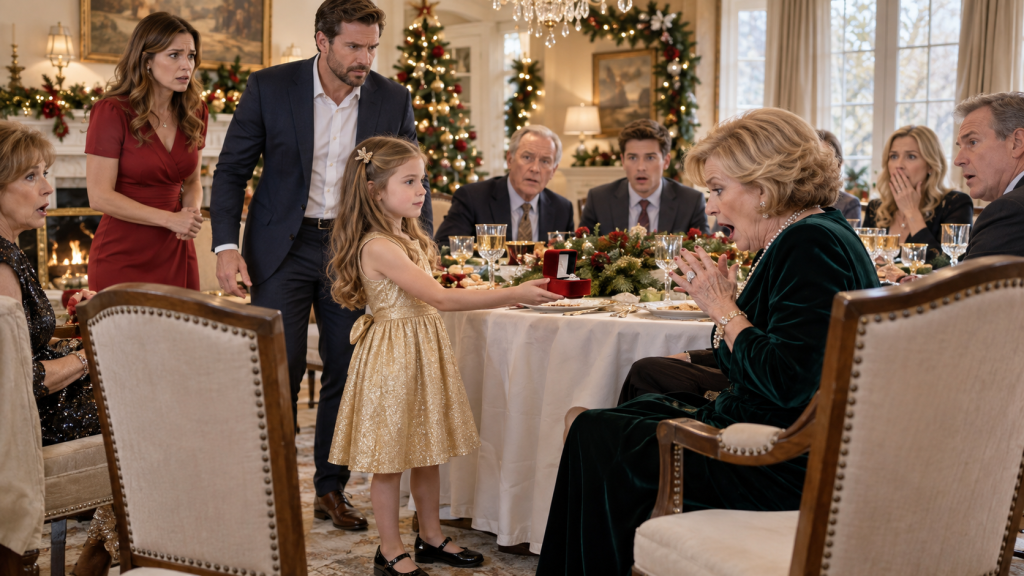
I never told my mother-in-law that my daughter, the child she treated like a “stray dog,” had the power to remove her from our lives. On Christmas morning, she gave the other grandchildren cash and tablets, but when it was my daughter’s turn, she handed her a cheap candle with a tag that read, “To Brandon’s Girl.” The entire room went quiet. My seven-year-old stood up in her gold dress, calm and composed. “Grandma,” she said, “Dad told me to give this to you if you ever ignored me again.” She placed a small red box in front of her. “Open it,” he said. Gene lifted the lid and immediately screamed.

Gene’s dining room looked flawless in the way a room can look flawless when everyone inside is carefully holding their breath. Pine garlands framed the doorway. Cinnamon rolls were cooling beneath sheets of foil. The chandelier reflected off the silver napkin rings, while outside, a small American flag tapped softly against the porch railing in the winter wind.
Everyone knew Gene’s rules. Smile, remain polite, and never challenge her when she decided someone needed to be reminded of their place.
That Christmas, she chose my daughter.
Holly sat beside me in the gold dress Brandon had steamed twice before we left home. She was seven years old, with her black Mary Janes tucked beneath the chair and both hands resting neatly in her lap. Before we entered the house, Brandon had noticed a scuff on one of her shoes, wiped it away, and quietly said, “She deserves at least one holiday where she feels chosen.”
Gene had spent the last three years making sure she never did.
Holly was my daughter from my first marriage, but Brandon had never treated that fact as though it made her less important. He packed her lunches, remembered that her stuffed rabbit had to face the bedroom door at night, and knew the difference between her genuine laugh and the careful little laugh she used around adults who made her uncomfortable.
Gene had never called Holly her granddaughter.
Instead, she called her “Brandon’s girl,” “your child,” or “that sweet little visitor.” She was always almost family.
But never quite family.
At 8:47 a.m. on December 25, Gene began distributing presents as though she were conducting an elaborate ceremony. One cousin opened an iPad. Another received the same gift. The older children pulled thick envelopes of cash from shiny holiday cards.
Then Gene turned toward Holly.
“Oh. Holly.”
She held out a thin drugstore gift bag decorated with a crooked bow.
“This is for you, sweetheart. I didn’t want you to feel completely left out.”
Holly accepted the bag with both hands. She carefully pulled away the tissue paper.
Inside was a cheap vanilla candle.
The candle itself was not what hurt.
It was the handwritten tag attached to it.
To Brandon’s Girl.
A fork froze halfway toward someone’s plate. One cousin suddenly became fascinated with the carpet. The little dog hiding beneath the table backed away from the chair legs. Beside me, Brandon crushed the side of his paper coffee cup without even seeming to realize he was doing it.
Gene continued smiling, already acting as though the insult was far too insignificant for anyone with manners to mention.
I quietly said Brandon’s name.
He leaned toward me.
“I told her to give Mom the red box if this happened again.”
“What red box?”
“The one in her overnight bag.”
I stared at him.
“You planned this?”
“No,” he replied. “I prepared for it.”
Later that evening, at 9:12 p.m., I found Holly sitting on the guest-room bed with the candle resting in her lap. Her gold dress was wrinkled, and she kept staring at the tag as though she believed the words might somehow change if she looked at them long enough.
“Mom,” she asked quietly, “am I only Dad’s girl?”
Before I could answer, Brandon knelt in front of her.
“You are my daughter,” he told her. “No tag gets to decide who you are.”
Then he reached into her overnight bag and placed a small red velvet box in her hands.
“If Grandma ever makes you feel invisible again, you get to decide whether she receives this. Not me. Not your mom. You.”
Holly turned the box over in her hands.
“Will she be mad?”
“Probably.”
“Will you still be my dad?”
For half a second, Brandon looked completely broken.
“Always.”
The following morning, Gene hosted brunch. The table had been arranged again with white dishes, silver napkin rings, and handwritten place cards.
Everyone had a name.
Except Holly.
Her card simply read:
Guest.
Holly noticed it at the exact same moment Brandon and I did. She did not cry. She did not ask either of us to fix it. Instead, she reached into the tiny purse Brandon had given her, wrapped both hands around the red velvet box, and stood.
She walked across the dining room while every aunt, uncle, cousin, and in-law watched her.
“Grandma,” Holly said, loud and clearly enough for everyone at the far end of the table to hear, “Dad told me to give this to you if you ever ignored me again.”
Gene’s polished smile tightened.
“Well, isn’t that dramatic.”
Brandon rose behind our daughter.
“Open it,” he said.
Gene lifted the lid while still wearing that smug expression, as though she already had a speech prepared about overly sensitive children and modern parenting.
Then she screamed.
The cousin standing near the window flinched. Everyone leaned forward.
Inside the red velvet box was a single small brass key and a folded white card.
The first words on it were .
PART 2 — HOLLY IS NOT THE GUEST
The first words on the card were:
Mom, Holly is not the guest. You are.
Gene screamed.
Not loudly at first.
It was more like a sharp breath that tore itself out of her throat before she could stop it.
Then she looked at the small brass key lying against the red velvet.
And screamed again.
This time, everyone heard it.
Brandon’s sister lowered her coffee cup.
Two cousins stood.
Someone at the far end of the table whispered:
“What is it?”
Gene did not answer them.
She stared at Brandon.
“What did you do?”
Brandon remained standing behind Holly.
He looked calmer than I had ever seen him.
That frightened me.
Not because I was afraid of him.
Because I finally understood how long he must have been preparing for this moment.
“Keep reading.”
he said.
Gene’s hand shook.
“I asked you a question.”
“And I told you to read.”
Her face flushed.
No one spoke.
Even Holly remained still.
Seven years old.
Gold dress.
Black shoes.
Tiny purse hanging from one wrist.
And somehow the only person in the room who did not appear surprised.
Gene looked back down at the card.
Her lips moved as she read.
Then stopped.
Her eyes widened.
“No.”
Brandon said nothing.
Gene read the next lines out loud without apparently realizing she was doing it.
The key in this box belongs to Cedar Lake House.
A murmur moved around the table.
Now everyone understood the key.
Everyone except me.
I had heard about Cedar Lake.
I had never been there.
Gene talked about it constantly.
The lake house had belonged to Brandon’s father, Edward, before he died.
Every summer Gene took the grandchildren there for a week.
Every Thanksgiving she mentioned how much work it took to maintain “my lake place.”
Photographs of the house appeared in almost every family Christmas card.
White clapboard siding.
Green shutters.
A long wooden dock extending into blue water.
Gene treated the place like a royal estate.
I had simply assumed it belonged to her.
Apparently so had most of the room.
Gene kept reading.
Dad left Cedar Lake House to me. Not to you.
The silence became absolute.
I looked at Brandon.
He did not look away.
Gene’s brother-in-law finally whispered:
“Edward left the house to Brandon?”
Gene snapped:
“Stay out of this.”
That answered his question.
She knew.
At least some of it.
Brandon spoke.
“Dad left it to me six years ago.”
I stared at him.
“You own the lake house?”
He looked at me.
“Yes.”
It was my turn to be shocked.
“But your mother always said—”
“I know what she says.”
Gene slammed the card against the table.
“You let me manage it.”
“I let you use it.”
“There is a difference.”
She stared at him.
“You gave me the keys.”
“Yes.”
“You told me it was still the family house.”
“It is.”
His eyes moved toward Holly.
“For family.”
That word landed exactly where he intended it to.
Gene’s mouth tightened.
I remembered last summer.
Gene had announced a “grandchildren’s week” at Cedar Lake.
Every cousin between six and fifteen was invited.
Except Holly.
When Brandon asked why, Gene said there were not enough beds.
Then one cousin brought a friend.
A boy none of us had ever met.
There was apparently a bed for him.
Brandon had confronted her.
I had not been there for the conversation.
Later, he told me only:
“I handled it.”
We stayed at a motel twenty minutes from the lake so Holly could spend afternoons swimming with the cousins.
Each evening, Gene would say:
“Time for the grandchildren to come inside.”
And Holly would get her sandals.
Every night.
Quietly.
I had watched my daughter learn what exclusion looked like without anyone ever needing to say:
You do not belong here.
The memory made me sick.
Gene picked up the card again.
The next paragraph was longer.
She read silently this time.
Her face slowly changed from anger to disbelief.
Then disbelief to panic.
“What does this mean?”
Brandon replied:
“It means exactly what it says.”
“No.”
She slapped the card against the table.
“You cannot do this over a candle.”
Brandon’s expression changed.
“This is not about a candle.”
“Then what?”
“Three years.”
Gene rolled her eyes.
“Oh, please.”
That was a mistake.
Something in Brandon’s face closed.
“Three years of calling my daughter a visitor.”
“She is not your daughter.”
The sentence came instantly.
Too instantly.
The entire room went cold.
Holly’s shoulders moved.
Barely.
But I saw it.
So did Brandon.
He stepped around her chair and crouched beside Holly.
“Sweetheart.”
She looked up.
“We’re going outside for a minute.”
Gene snapped:
“No.”
Brandon slowly turned his head.
Gene seemed startled by herself.
Then tried to recover.
“We’re discussing this as a family.”
Brandon stood.
“Holly is seven.”
“She is not sitting here while adults debate whether she qualifies as family.”
Then he looked at me.
“Can you take her outside?”
I nodded.
Holly reached for my hand.
Before we moved, Gene said:
“Holly, don’t you dare walk away while—”
Brandon’s voice cut through the room.
“Do not speak to her.”
I had never heard him use that tone with his mother.
Not once.
Gene stopped.
I led Holly toward the hallway.
She clutched my fingers.
When we reached the front porch, winter air hit my face.
She took one deep breath.
Then another.
“Mom?”
“Yes?”
“Is Dad mad at me?”
My heart cracked.
I knelt.
“No.”
“Are you sure?”
“Yes.”
“He is angry because someone hurt you.”
She looked toward the front door.
“I gave her the box.”
“Yes.”
“Was I supposed to?”
“You were supposed to choose.”
“That’s different.”
She thought about that.
Then whispered:
“I wanted to.”
I kissed her forehead.
“Then you did nothing wrong.”
Holly stared at the little flag tapping against the porch railing.
“Is Grandma going to lose the lake house?”
I hesitated.
“That is something Dad will explain.”
“But because of me?”
There it was.
The danger.
A seven-year-old turning adult consequences into her burden.
“No.”
I said firmly.
“Listen to me.”
She looked at me.
“You did not take anything from Grandma.”
“You told Dad you were done being treated badly.”
“What happens after that belongs to the adults.”
She looked uncertain.
I continued.
“Dad made his decisions.”
“Grandma made hers.”
“You do not have to carry what happens next.”
Holly nodded slowly.
Children understand boundaries best when adults say them clearly.
Maybe because they have not yet learned to disguise everything.
Inside, voices rose.
Gene first.
Then Brandon.
Another voice I recognized as Brandon’s older sister, Caroline.
I did not want Holly hearing any of it.
So I took her down the porch steps.
We walked to our car.
I turned on the heater.
Put on music.
Not Christmas music.
Holly hated Christmas music after December twenty-fifth.
One of her many firm opinions.
She leaned against the seat.
Then said:
“Mom?”
“Yes?”
“Dad said I’m his daughter.”
“He did.”
Her voice grew very quiet.
“Like really?”
I looked at her.
There was something in the way she asked that made my chest tighten.
Not doubt about love.
Something else.
Before I could answer, the front door opened.
Brandon came outside.
He walked straight toward us.
The red velvet box was in his hand.
The brass key was gone.
He opened Holly’s door and knelt in the snow beside her.
“Hey.”
“Hi.”
“Are you okay?”
She shrugged.
Seven-year-old language for:
I have fourteen emotions and no plan for organizing them.
Brandon nodded.
Then he looked at me.
“I need to tell both of you something.”
My stomach tightened.
“Now?”
He looked at Holly.
“Yes.”
Holly sat straighter.
Brandon took her hands.
“Remember when we went to the courthouse in October?”
Her eyes widened.
I stared at him.
“What?”
He smiled at Holly.
“You remember?”
She nodded.
I suddenly remembered too.
The courthouse.
The new dress.
The ice cream afterward.
The explanation that some “family paperwork” had finally been completed.
I had known.
Of course I had known.
But we had not told Gene.
Or anyone else.
The adoption.
Brandon looked at Holly.
“We said you could decide when you wanted Grandma to know.”
She nodded.
Then looked at me.
My eyes filled.
Because suddenly the key was not the biggest secret in that red box.
Brandon continued.
“You asked me if I was still going to be your dad.”
Holly whispered:
“Yes.”
“I told you always.”
He smiled.
“And I meant it before the judge signed anything.”
“But the judge did sign it.”
He took a breath.
“As of October fourteenth, legally, officially, forever…”
His voice broke.
“You are my daughter.”
Holly smiled.
Not surprised.
She already knew.
I was the one crying.
Because hearing him say it in that moment felt different.
The legal process had taken nearly a year.
Holly’s biological father had not been involved in her daily life for years.
There were lawyers.
Required consents.
Court filings.
Questions.
Waiting.
Nothing dramatic.
Nothing secret from the people whose consent mattered legally.
But Brandon had made one request from the beginning.
Gene would not be told until Holly wanted her to know.
At first I thought he was afraid of his mother’s reaction.
He was.
But that was not the whole reason.
He had told me:
“This belongs to Holly before it belongs to anybody else.”
So we kept it small.
My sister knew.
Our attorney.
A few close friends.
Holly’s teacher because her school records changed.
Gene did not.
Not yet.
Holly had planned to tell her after Christmas.
If Christmas felt safe.
It did not.
“What did Grandma say when she found out?”
Holly asked.
Brandon’s face tightened.
“She hasn’t read that part yet.”
I stared.
“The card tells her?”
“Yes.”
“What exactly did you put in that box?”
He almost smiled.
“Everything I was tired of saying twice.”
That sounded like Brandon.
He looked at Holly again.
“The box does not mean you control Grandma’s house.”
“Okay.”
“You don’t control money.”
“Okay.”
“You don’t control where adults live.”
“Okay.”
His voice softened.
“What you control is whether someone who keeps hurting you gets access to you.”
Holly’s eyes filled.
“You mean I don’t have to see her?”
“If you don’t want to.”
“What if I want to later?”
“Then we talk about it.”
“What if she says sorry?”
“You still get time.”
“What if she gets mad?”
Brandon smiled sadly.
“Then she gets mad.”
Holly thought.
Then:
“I don’t want to see her right now.”
“Okay.”
No argument.
No:
But she’s Grandma.
No:
Christmas is family.
Just okay.
That was the power I had never told Gene Holly possessed.
Not title.
Not money.
Access.
The front door opened again.
Caroline stepped outside.
She had no coat.
Only a red sweater.
“Brandon.”
He stood.
“What?”
“Mom is losing it.”
“That sounds like a Mom problem.”
Caroline looked toward Holly.
Then lowered her voice.
“She says you’re throwing her out of Cedar Lake.”
“I’m ending her permission to use it.”
“Same thing to her.”
“No.”
He shook his head.
“She has her own home.”
“She has plenty of money.”
“She uses Cedar Lake because I let her.”
“And she used something I gave her to make my daughter feel unwanted.”
Caroline exhaled.
“I know.”
That surprised me.
Brandon’s expression softened slightly.
“You know?”
Caroline looked ashamed.
“I should have said something last summer.”
Yes.
She should have.
“I told myself it wasn’t my fight.”
Brandon looked toward the house.
“Everyone has been telling themselves that for years.”
Caroline flinched.
Fair.
Then she looked at Holly.
“Can I say something to her?”
Brandon turned to Holly.
“Do you want Aunt Caroline to talk to you?”
Holly shrugged.
Then nodded.
Caroline crouched beside the car.
“I’m sorry.”
Holly looked at her.
“For what?”
Good question.
Caroline swallowed.
“For laughing sometimes when Grandma said things that weren’t funny.”
My throat tightened.
“For not saying anything when she called you a guest.”
“And for letting my kids see me stay quiet.”
Holly thought.
Then said:
“Okay.”
Not:
I forgive you.
Not:
It’s fine.
Just acknowledgment.
Children should be allowed to leave apologies unfinished.
Caroline stood.
“Mom read the adoption part.”
Brandon closed his eyes.
“There it is.”
“She’s saying Dad’s trust won’t allow it.”
His eyes opened.
“What?”
“The education trust.”
Brandon stared.
“What does Dad’s trust have to do with Holly?”
Caroline gave a humorless laugh.
“Exactly.”
I looked between them.
“What education trust?”
They both looked at me.
Apparently this family had an entire financial universe nobody mentioned until Christmas arguments.
Brandon rubbed his forehead.
“My father created an education trust for his grandchildren.”
“How much?”
“I don’t know exactly.”
Caroline answered.
“Enough.”
I hated rich-family answers.
Brandon explained quickly.
When Edward died, he left separate education accounts for his grandchildren and future grandchildren.
Tuition.
Training.
Certain medical and educational expenses.
A professional trustee administered most of it.
Gene did not control the fund.
But she talked about it as though she did.
Of course.
Brandon had never considered the trust relevant to Holly’s adoption.
He adopted her because she was his daughter.
Not because of money.
Apparently Gene’s mind had gone there immediately.
“What did she say?”
I asked.
Caroline looked uncomfortable.
“That adopted children aren’t included.”
Holly heard.
I watched the words hit her face.
Brandon saw it too.
His expression hardened.
“Get back inside.”
he told Caroline.
“I’m fixing this.”
Caroline nodded.
No defense of Gene.
Progress.
Before Brandon walked away, I grabbed his wrist.
“Do not make this about the trust.”
He looked at me.
“I’m not.”
“She just made our daughter hear that her legal relationship is being measured in dollars.”
“I know.”
“Then stop the money conversation.”
He breathed.
Nodded.
“You’re right.”
Then he looked at Holly.
“None of that matters.”
She whispered:
“Okay.”
He went inside.
He was gone fifteen minutes.
Holly and I stayed in the car.
I did not ask questions.
Did not make her explain how she felt.
Eventually she said:
“Do you think Grandma hates me?”
My heart hurt.
“I think Grandma has decided family has to look a certain way.”
“Is that hate?”
“Sometimes it can feel like it.”
She stared out the windshield.
Then:
“I don’t hate her.”
“You don’t have to.”
“Can I still not see her?”
“Yes.”
That seemed to relieve her.
Adults often teach children that boundaries require hatred.
They do not.
You can love someone.
Miss them.
Wish they were different.
And still decide they do not get a chair at your table until something changes.
Brandon returned carrying Holly’s coat.
“We’re leaving.”
He opened my door.
“What happened?”
“I told her brunch is over for us.”
“That’s it?”
“For today.”
Good.
I had expected some explosion.
Then Brandon added:
“She tried to give me the lake-house key back.”
I glanced at the red box.
“And?”
“I told her the key in the box was not hers.”
I stared.
“What?”
He looked toward Holly.
“It belongs to Holly.”
Holly’s mouth opened.
“My key?”
“Yes.”
“To the lake house?”
“Yes.”
Gene’s scream suddenly made more sense.
Brandon explained on the drive home.
The key was symbolic.
Not a deed.
Not a title.
Holly did not own Cedar Lake.
Brandon did.
But after Gene excluded her from grandchildren’s week, Brandon had a new key made.
He intended to give it to Holly when the adoption became public.
A simple message:
You are not visiting someone else’s family place.
This is part of your family too.
Then Gene humiliated her at Christmas.
So Brandon placed the key inside the red box along with the boundary letter.
If Holly chose to hand Gene the box, Brandon would know Holly was done.
Then he would end Gene’s open access to the house.
Not because Holly had legally evicted her.
Because he had decided he would no longer finance or provide spaces where his mother could practice exclusion.
That distinction mattered.
“What did the card say about the house?”
I asked.
Brandon drove with both hands on the wheel.
“Do you really want the exact wording?”
“Yes.”
He sighed.
Then recited it from memory.
Of course he remembered.
He had probably rewritten the thing thirty times.
Mom, this key is Holly’s. Dad left Cedar Lake to me, and I decide who enters it. You have treated my permission like ownership and used my home to separate the children you call real grandchildren from the child I call my daughter. If Holly gives you this box, your open invitation ends. My attorney will send written notice regarding your stored belongings and future access. Nothing will be discarded, and you will have reasonable time to collect what is yours.
I nodded.
Grounded.
Fair.
Then:
“And the rest?”
He hesitated.
“Brandon.”
He continued.
Holly’s adoption was finalized October 14. She is legally my child because she has already been my daughter in every way that mattered. This is not a financial decision, and you will not turn it into one.
Good.
Very good.
Then his expression tightened.
“The last paragraph is probably why she screamed.”
“What did it say?”
Brandon looked in the rearview mirror at Holly.
Then back at the road.
If you ever make her ask whether I am really her father again, you will lose more than a lake-house key. You will lose access to our family until Holly decides she wants you back.
I stopped breathing.
Holly stared out the window.
Then whispered:
“I like that part.”
So did I.
Gene called twelve times that afternoon.
Brandon answered none.
She texted.
Then emailed.
Then started a group message with fourteen relatives.
Her first message:
Apparently Brandon has decided to throw his own mother out of the family because I gave his wife’s daughter a candle.
Brandon showed it to me.
I almost responded.
He stopped me.
“No.”
“She is lying.”
“I know.”
“Everyone is going to think—”
“Let them ask.”
That was harder than it sounded.
Then Caroline replied in the group.
Mom, that is not what happened.
A cousin added:
Please leave Holly out of this.
Then Brandon’s brother, Miles, wrote:
This has been going on for years. Stop pretending it was one candle.
I stared.
Everyone knew.
That was almost worse.
The entire family had known.
Some had disagreed privately.
Some had rolled their eyes.
Some had apologized to us afterward.
No one had challenged Gene publicly because challenging Gene made holidays unpleasant.
So the seven-year-old had carried what adults avoided.
That realization did not flatter any of us.
Brandon finally wrote one message.
Only one.
This is not a family vote. Holly is my daughter. Mom was warned repeatedly not to distinguish her from the other children in ways meant to humiliate her. She did it again. We are stepping back. Do not contact Holly about this or ask her to fix it.
Then he left the group.
I did too.
Peace became quieter immediately.
That night, Holly placed the vanilla candle on her dresser.
I noticed.
“You want to keep it?”
She shrugged.
“It smells okay.”
I laughed.
Children have a ruthless ability to separate objects from adult symbolism.
To her, Gene’s tag hurt.
The candle itself still smelled like vanilla.
Maybe healing begins when things become ordinary again.
Three days later, Brandon received a formal email from the attorney who had handled his father’s estate.
Samuel Beckett.
Not the playwright.
The poor man apparently spent his professional life making that clarification.
The subject line read:
EDWARD MERCER FAMILY EDUCATION TRUST
Brandon opened it at the kitchen table.
I was making tea.
He went completely still.
“What?”
He did not answer.
“Brandon?”
He turned the laptop toward me.
Samuel’s message began:
Your mother contacted my office asking whether Holly’s adoption affects eligibility under your father’s education trust.
I felt anger rise immediately.
“She called the lawyer?”
“Yes.”
“Already?”
“Apparently before lunch the day after Christmas.”
Of course.
Some people process rejection through estate planning.
I read on.
Samuel wrote that he had refused to discuss beneficiary determinations with Gene beyond information she was entitled to receive.
Then:
However, her inquiry caused me to review a sealed supplemental memorandum Edward left with the trust file. I believe you should see it.
Brandon frowned.
“Supplemental memorandum?”
“Did you know about one?”
“No.”
Samuel asked us to meet.
Not Gene.
Brandon.
The following morning.
Holly stayed with my sister.
We did not involve her.
The trust could wait for adults.
At Samuel’s office, the first thing Brandon said was:
“I don’t care whether Holly gets money.”
Samuel nodded.
“I understand.”
“This adoption had nothing to do with Dad’s trust.”
“I understand.”
“My mother thinks—”
“I also understand your mother.”
That made me like him immediately.
He looked nearly seventy.
Thin.
Silver glasses.
The expression of someone who had spent decades being summoned after rich families discovered nouns such as beneficiary and trustee.
He opened a file.
“Your father signed this eighteen months before he died.”
Brandon stared.
“That would have been…”
He stopped.
I calculated.
Holly and I had already been in Brandon’s life.
Barely.
We were not married yet.
Samuel removed a single page.
Edward Mercer’s handwriting appeared at the bottom.
Brandon went pale.
“What is that?”
“A memorandum of wishes.”
Samuel said.
“Not a new will.”
“Not something that allows your mother to control distributions.”
“It gave me context as trustee counsel regarding how Edward understood certain language.”
Brandon leaned forward.
“What language?”
“Descendants.”
My stomach tightened.
Samuel continued.
“Your father’s trust already defines legally adopted children as descendants where applicable.”
“So Mom was wrong.”
Brandon said.
“Yes.”
Samuel answered simply.
That alone would have been enough.
Then he added:
“But there is more.”
Of course there was.
Samuel pushed the memorandum toward Brandon.
The first paragraph concerned all grandchildren.
Education.
Opportunity.
No child receiving more merely because one parent earned less.
Typical grandfather language.
Then halfway down the page was Holly’s name.
Not:
future adopted child.
Not:
Brandon’s stepdaughter.
Holly.
Brandon stopped breathing.
I stared.
Edward had written:
I have met Holly only a handful of times, and I do not know what Brandon’s future with her mother will be. That is none of my business until he makes it my business. But I have watched my son tie that little girl’s shoes, cut her pancakes, and carry her asleep from the car. If the day comes when he calls her his daughter, I do not want anyone in this family telling her she arrived by a lesser door.
My eyes filled immediately.
Brandon covered his mouth.
Samuel looked away.
Edward continued.
Blood has done both beautiful and foolish things in this family. I would prefer not to worship it.
I almost laughed through my tears.
Apparently Brandon inherited his directness honestly.
Then:
If Holly ever becomes Brandon’s legal child, she should be treated under my estate plan according to the same definitions applied to any other legally adopted descendant. No family member is to interpret my silence as exclusion.
Brandon lowered his head.
His shoulders began shaking.
I had seen him cry twice.
When his father died.
And the night Holly asked if he would always be her dad.
Now those griefs seemed to meet in the same room.
Samuel let him cry.
Then Brandon whispered:
“Did Mom know about this?”
Samuel hesitated.
My stomach tightened.
“She did not receive a copy of the memorandum.”
I exhaled.
Good.
Then:
“But your father discussed the underlying issue with her.”
Brandon slowly looked up.
“When?”
“Shortly before signing it.”
“What did she say?”
Samuel looked uncomfortable.
“Edward’s note regarding the meeting says Gene objected to including ‘children who were not actually Mercer blood.’”
There it was.
Not a misunderstanding.
Not a candle.
Not holiday awkwardness.
A philosophy.
One that had existed before Holly even became legally family.
Brandon’s face changed.
“What did Dad say?”
Samuel glanced at the memorandum.
“According to Edward?”
“Yes.”
Samuel almost smiled.
“He told her, ‘If Brandon loves a child enough to raise her, you will not use my money to teach her she is second-class.’”
I looked down.
The room became blurry.
Edward had been dead two years.
Yet somehow he had seen exactly where this family was headed.
“Why didn’t Dad tell me?”
Brandon asked.
Samuel considered.
“I asked him.”
“You did?”
“Yes.”
“He said he did not want money influencing whatever decision you eventually made about your relationship with Holly.”
Brandon closed his eyes.
Of course.
The same principle Brandon had later used himself.
Adoption first.
Trust irrelevant.
Family before inheritance.
Edward had understood something Gene never did.
If money is involved too early, people stop trusting the love that came before it.
Samuel continued.
“Edward also told me something else.”
Brandon looked exhausted.
“What?”
“He said your mother had spent much of her life treating inclusion as something she granted.”
“Invitations.”
“Traditions.”
“Family approval.”
“He worried that after he died she would treat his estate the same way.”
My chest tightened.
Samuel tapped the file.
“So he removed that discretion.”
Gene was not trustee.
Not distribution committee.
Not gatekeeper.
Professional trustees handled the education trust.
Gene’s opinion about who counted had no legal force.
The woman who had spent years deciding who belonged had been given no authority to decide it where her husband’s money was concerned.
I almost smiled.
Then stopped.
This was not a victory against Gene.
It was protection for children.
Different.
Brandon asked:
“What happens now?”
Samuel answered:
“Nothing dramatic.”
Good.
“Holly’s adoption documentation can be provided to the trustee when appropriate.”
“She is potentially eligible under the trust terms like any other qualifying descendant.”
“Distributions are not automatic cash awards.”
“They are made for covered purposes.”
“Education.”
“Certain related support.”
“Her inclusion does not require taking anything from the other grandchildren.”
That mattered too.
Family did not need to become a pie where one child’s belonging meant another child received less dignity.
“Do we have to tell Holly?”
Brandon asked.
“No.”
Samuel said.
“You are her parents.”
“Tell her when it becomes relevant and in whatever age-appropriate way you believe is best.”
Brandon nodded.
“Not now.”
I said.
“Definitely not now.”
A seven-year-old should not leave Christmas thinking humiliation came with a financial prize.
Good behavior did not need to pay dividends.
Then Samuel asked:
“Would you like a copy of Edward’s memorandum?”
Brandon looked at me.
Then nodded.
“Yes.”
Not for court.
Not for Gene.
For Holly someday.
A letter from a grandfather who had seen her before she knew she needed to be seen.
Gene called Brandon that evening.
This time he answered.
I sat nearby.
Not on speaker at first.
Then Gene shouted loudly enough that speaker became unnecessary.
“You went to Samuel?”
“Yes.”
“So now you’re going after the trust too?”
“No.”
“Don’t lie to me.”
“Mom.”
“You did all of this because of her.”
Brandon’s face tightened.
“Because of Holly?”
“Because of your wife.”
There it was.
Naturally I had engineered the entire thing.
Adoption.
Trust.
Lake house.
Christmas.
Possibly the weather.
Brandon looked at me.
I shrugged.
After three years, Gene blaming me had become background noise.
He said:
“You need to hear something.”
“I’ve heard enough.”
“No.”
His voice became calm.
“Dad’s trust already includes adopted descendants.”
Silence.
Then:
“What?”
“Holly qualifies under the same definition as any other legally adopted child.”
“That cannot be right.”
“It is.”
“No.”
“Samuel confirmed it.”
Gene breathed hard.
Then:
“Your father would never—”
Brandon interrupted.
“Dad wrote Holly’s name.”
Silence.
Complete.
I watched Brandon’s face.
He did not enjoy telling her.
That surprised me.
He had spent years angry with his mother.
But destroying one of her beliefs did not make him happy.
It made him tired.
“What do you mean?”
Gene whispered.
“Dad left a memorandum.”
“He knew Holly.”
“He wrote that if I ever adopted her, nobody was to treat her as entering through a lesser door.”
Gene said nothing.
Brandon continued.
“He also wrote that you disagreed.”
Still nothing.
“So stop telling yourself this is about a candle.”
His voice cracked.
“You made a decision years ago about what kind of child counted.”
“Dad saw it.”
“I saw it.”
“And now Holly sees it.”
That was the hardest one.
Gene finally whispered:
“I love you.”
Brandon closed his eyes.
“I love you too.”
I looked at him.
Holly had asked me a similar question.
Can I love her and still not see her?
Yes.
Here it was again.
Gene began crying.
“I am your mother.”
“I know.”
“You can’t just cut me out.”
Brandon’s eyes filled.
“I am not cutting you out because I hate you.”
“Then why?”
“Because my daughter should not have to keep getting hurt so you can keep calling yourself included.”
Gene cried harder.
I looked away.
There are moments when even someone who has caused pain becomes painful to watch.
That does not mean the boundary is wrong.
It means consequences can hurt everyone.
Gene asked:
“When can I see Holly?”
Brandon answered:
“When she wants to see you.”
“That’s ridiculous. She’s seven.”
“Yes.”
“You’re letting a child decide adult relationships?”
“No.”
“I am making the adult decision that she does not have to spend time with someone who repeatedly humiliates her.”
Silence.
Then:
“And if she ever wants to try again, we’ll help her.”
Gene’s voice became smaller.
“What if she never does?”
Brandon looked toward the hallway.
Holly was in her room coloring.
Safe.
Unaware of the conversation.
Then he said:
“That is something you should have thought about before you gave every child at Christmas proof they belonged and handed mine a tag saying she didn’t.”
He ended the call.
Then sat at the table.
And cried.
I held him.
Not because I thought he regretted the boundary.
Because boundaries do not prevent grief.
Sometimes they create the first space where grief can finally be felt.
He had spent years trying to keep both.
His mother.
His daughter.
Trying to correct Gene privately.
Soften comments.
Change subjects.
Schedule separate visits.
Leave early.
Explain.
Excuse.
Protect.
Eventually there was nothing left to rearrange except access itself.
Holly did not see Gene for three months.
Not because we forbade it.
Because she did not ask.
Gene sent cards.
We did not hide them.
We also did not hand them directly to Holly until we had read them first.
The first one said:
Grandma misses you.
Fine.
The second:
I hope someday you understand I never meant to hurt you.
Less good.
The third finally said:
I called you a guest when you were family. That was wrong.
I showed that one to Holly.
She read it.
Then placed it beside the vanilla candle.
“What do you want to do?”
I asked.
“Nothing yet.”
“Okay.”
Another unfinished apology.
Another choice respected.
Gene also cleared her belongings out of Cedar Lake.
Brandon gave her sixty days.
More than his attorney said was necessary under their arrangement.
He wanted no cruelty mixed into the boundary.
Caroline helped Gene pack.
Photographs.
Clothes.
Kitchenware.
A set of blue dishes.
No locks changed while she was inside.
No belongings dumped.
No humiliation.
She returned the lake key in an envelope.
No note.
Holly’s brass key stayed in Brandon’s desk.
We did not give it to her immediately.
She was seven.
Ownership symbolism could wait.
Then, in March, Caroline called.
Her voice sounded strange.
“Brandon.”
“What?”
“Mom found something at the lake house.”
My stomach tightened.
“What kind of something?”
“A letter from Dad.”
Brandon went still.
“Where?”
“In the old desk.”
“Addressed to who?”
Caroline hesitated.
“Mom.”
He closed his eyes.
“Did she open it?”
“Yes.”
“What does it say?”
“I think you need to see it.”
Of course.
Apparently Edward Mercer had turned death into a correspondence course.
The letter arrived by courier the next afternoon.
Original.
Edward’s handwriting.
Dated two months before his death.
Gene,
The first paragraph concerned Cedar Lake.
Taxes.
Maintenance.
Insurance.
Then came a line that made Brandon sit down.
I am leaving Cedar Lake to Brandon because he understands that a house is only a family house when people feel welcome inside it.
I swallowed.
Brandon kept reading.
You may be angry with me. Be angry. But do not turn the house into a throne after I’m gone.
That sounded like Edward.
Then:
You have spent too many years confusing tradition with authority.
Brandon looked at me.
My chest tightened.
The next paragraph mentioned Holly.
By name.
Again.
That little girl is not responsible for the fact that her life began somewhere else before it arrived beside our son.
My eyes filled.
If Brandon and her mother build a family, do not make the child pay an admission fee for something adults chose.
And finally:
Gene, if you make belonging a prize children have to win from you, one day you may discover they have learned to live happily without the prize.
Brandon stopped reading.
Neither of us spoke.
Edward had seen the entire cliff long before anyone fell.
There was one final line.
A line that changed Brandon’s expression completely.
If you are reading this after I am gone and thinking I never understood you, you are wrong. I understood why you do it. Your mother did the same thing to you. That is why I am asking you to stop before you hand it to someone smaller.
Brandon stared at the page.
I felt something inside me shift.
Not forgiveness.
Context.
Those are not the same.
Gene had once been a child standing outside someone else’s definition of enough.
Somewhere along the way, she had taken the same ruler and begun measuring others.
Explanation did not erase what she did to Holly.
But it made her less like a monster.
More like a person who had repeated a wound she never examined.
Sometimes that is harder to hate.
And harder to excuse.
Brandon folded the letter carefully.
“Did Mom know Dad wrote this?”
“She found it.”
I said.
“He wrote it to her.”
“Yes.”
“Then why didn’t she read it when he died?”
“Maybe she couldn’t.”
“Maybe she forgot.”
“Maybe she read the first paragraph and stopped.”
We did not know.
Facts mattered.
Even in family stories.
That evening, Gene sent one text.
Not to Brandon.
To me.
I found Edward’s letter.
Then:
I think I have done something terrible.
I stared at the screen.
No defense.
No mention of the lake house.
No trust.
No accusation.
Just one sentence.
I showed Brandon.
He sat quietly.
Then asked:
“What do you want to say?”
Interesting.
Months earlier, everyone had been making decisions before asking.
Now he asked.
I thought.
Then typed:
You hurt Holly. Understanding why is not the same as repairing it. Give her time.
Gene responded ten minutes later.
I will.
That was all.
The next morning, Holly came into the kitchen wearing pajamas and one sock.
She climbed onto the chair.
Asked for pancakes.
Then noticed Edward’s letter on the counter.
“What’s that?”
Brandon looked at me.
I looked at him.
Then he said:
“A letter from Grandpa Edward.”
Holly barely remembered Edward.
A tall man with white hair.
A pocket full of peppermint candies.
She frowned.
“For me?”
“Partly.”
Her eyes widened.
“What did he say?”
Brandon looked at the letter.
Then at his daughter.
He did not tell her about trusts.
Blood.
Gene’s childhood.
Adult wounds.
She was seven.
Instead he gave her the part she needed.
“He said nobody should ever make you pay an admission fee to be family.”
Holly frowned.
“What’s an admission fee?”
I smiled.
“Like a ticket.”
“Oh.”
She thought.
Then:
“I don’t need a ticket.”
Brandon’s eyes filled.
“No.”
he whispered.
“You don’t.”
Holly reached for syrup.
Conversation over.
Children know when adults have finally caught up.
I thought that was where this part of the story would settle.
Gene giving us space.
Holly healing.
Cedar Lake quiet for a while.
Then Samuel called Brandon again.
Three weeks later.
He sounded less calm than usual.
“Brandon, I received a request involving the education trust.”
Brandon sighed.
“From Mom?”
“No.”
He straightened.
“Then who?”
Samuel paused.
“From someone claiming to represent one of Edward’s biological grandchildren.”
Brandon frowned.
“What request?”
“A request to review Holly’s eligibility.”
My stomach tightened.
“Which grandchild?”
Samuel hesitated.
Then named someone sitting at Gene’s Christmas table the morning Holly received the candle.
Someone who had accepted an iPad.
Someone who had looked at the carpet rather than speak.
And suddenly I understood something we had not considered.
Gene’s beliefs had not stayed inside Gene.
Children had watched.
Parents had stayed quiet.
Cousins had learned that belonging came with ranks.
And now one of the adults in that family was prepared to turn Gene’s old prejudice into a legal argument because Holly’s place in the family trust might affect money.
Brandon closed his eyes.
“What exactly are they claiming?”
Samuel’s answer was careful.
“That Edward could not have intended an unrelated child to share equally with his biological descendants.”
Brandon opened his eyes.
“She isn’t unrelated.”
“I know.”
“She’s my daughter.”
“I know.”
“Dad named her.”
“I know.”
Samuel paused.
“That is why I called.”
Brandon’s voice dropped.
“What aren’t you telling me?”
Silence.
Then Samuel said:
“Because the challenge is not actually based on Holly’s adoption.”
I felt cold.
“Then what is it based on?”
Samuel exhaled.
“Someone found an older version of Edward’s trust.”
“And there is a clause in it that was removed from the final documents.”
Brandon gripped the phone.
“What clause?”
Samuel answered:
“One your father apparently never wanted Holly—or you—to know had existed.”
And just when we thought Gene’s Christmas cruelty had finally exposed every old wound in the family, we learned that Edward himself had once believed something very different about who counted.
PART 3 — THE DOOR EDWARD CHANGED HIS MIND ABOUT
Samuel did not explain the old clause over the phone.
Apparently attorneys develop a professional allergy to sentences beginning with:
“Don’t worry, but…”
So the following morning, Brandon and I sat across from him again.
Same office.
Same quiet conference room.
Same family trust that had somehow become more emotionally complicated than most marriages.
Holly was at school.
That mattered.
Whatever dead adults had once believed about bloodlines, inheritance, or belonging was not going to become homework for a seven-year-old.
Samuel opened two folders.
One gray.
One blue.
He placed the gray folder first.
“This is the older trust.”
Brandon stared at it.
“How old?”
“Fourteen years.”
Long before Holly.
Long before me.
Long before Edward had white hair and peppermint candies in every coat pocket.
Samuel turned to a marked page.
There it was.
Plain legal language.
Cold enough to fit inside any family.
For purposes of descendant benefits, the old trust defined grandchildren as biological descendants of Edward’s children.
Legally adopted children were excluded unless Edward later named them individually.
I read it twice.
Then looked at Brandon.
His face had gone pale.
“So Dad did believe that.”
Samuel nodded.
“At one point.”
The words hurt anyway.
Brandon pushed back slightly from the table.
“But his final trust says the opposite.”
“Yes.”
“So why are we here?”
“Because someone found this version and is arguing that the later change may not reflect Edward’s original intent.”
Brandon laughed without humor.
“Original intent?”
Samuel nodded.
“That phrase is doing a great deal of work.”
I almost smiled.
Dad would have liked Samuel.
Different father.
Same appreciation for precise irritation.
“Who found it?”
I asked.
Samuel hesitated.
“Your nephew Dylan.”
Brandon closed his eyes.
“Miles’s son.”
“Yes.”
I remembered Dylan.
Twenty-two.
Tall.
Quiet.
The cousin who had been sitting three chairs away when Holly opened the candle.
The one who stared at the carpet.
He had received cash that Christmas.
Five hundred dollars, I later learned.
He had also grown up spending summers at Cedar Lake.
To him, Gene’s rules probably felt less like rules than weather.
Always there.
Rarely questioned.
“Why would Dylan challenge Holly?”
I asked.
Samuel’s expression softened.
“That is more complicated than it sounds.”
Of course.
Everything was.
Dylan was in graduate school.
His education expenses were already being paid partly from Edward’s trust.
When word spread that Holly’s adoption made her eligible too, Dylan asked his father what that meant.
Miles apparently told him it might “reduce what was available for everyone else.”
That was not exactly how the trust worked.
The trust was discretionary.
Not six equal buckets waiting to be split.
But money creates arithmetic even where none exists.
Then, while helping Gene move old papers out of Cedar Lake, Dylan found a photocopy of the ancient trust definition.
Gene had kept it.
Not hidden.
Not marked.
Simply preserved in one of Edward’s old estate folders.
Dylan took a photograph.
Sent it to a friend in law school.
The friend said:
“You should ask an attorney whether the old language matters.”
So Dylan did.
Not a lawsuit yet.
Not even formally.
A request for interpretation.
Then his attorney asked the trustee to suspend any future determination regarding Holly until the discrepancy was reviewed.
Brandon stared.
“He was at Christmas.”
“Yes.”
“He watched Mom humiliate her.”
“Yes.”
“And now he’s doing this?”
Samuel leaned forward.
“Be careful.”
Brandon looked angry.
“Why?”
“Because asking a legal question is not identical to asking that Holly be erased.”
“He hired a lawyer.”
“Because adults in wealthy families often hire lawyers when a phone call would have been wiser.”
Fair.
Painfully.
Samuel opened the blue folder.
“This is the final trust.”
Dated four years before Edward died.
Not eighteen months.
Four years.
I frowned.
“That’s before Edward even met Holly.”
“Yes.”
That surprised all of us.
Samuel turned to the descendant definition.
No biological limitation.
A legally adopted descendant stood on the same footing as a biological descendant for covered purposes.
No individual naming required.
Brandon stared.
“So Holly wasn’t why he changed it.”
“Not originally.”
Something shifted.
We had built a sentimental story.
Edward met Holly.
Edward changed.
Beautiful.
Apparently incomplete.
Samuel knew.
“Your father changed this provision years before Holly entered your life.”
“Why?”
Samuel looked at the gray folder.
“Because of another child.”
Brandon frowned.
“What child?”
“Your cousin Matthew’s son.”
I did not know the names.
Brandon did.
His expression changed.
“Oh.”
“What?”
I asked.
He rubbed his forehead.
“My cousin Matthew adopted his wife’s son.”
Samuel nodded.
“Ethan.”
I had never heard of him.
Apparently Gene barely spoke to that branch of the family after some old argument.
Edward had.
When Ethan was adopted, Edward’s existing trust language would have excluded him.
Matthew asked whether that was intentional.
Edward apparently said yes.
At first.
That hurt in a new direction.
Samuel continued.
“Then Edward attended Ethan’s eighth birthday.”
Brandon looked at him.
“And?”
“He came back to my office the following week.”
Samuel pulled out handwritten notes.
Not confidential now because they documented the executed change and were relevant to administration.
Edward had said:
I watched Matthew spend three hours assembling a bicycle for that boy. If that isn’t fatherhood, my document is stupid. Fix it.
I laughed before I could stop myself.
Brandon covered his face.
That was Edward.
Blunt enough to make emotional growth sound like correcting plumbing.
Samuel continued.
Edward directed the biological-only clause removed.
Not temporarily.
Not as an exception for Ethan.
Entirely.
His attorney asked whether he wanted to name Ethan specifically.
Edward said no.
If I am wrong about one adopted child, I am wrong about the category.
That sentence silenced the room.
It is easy to change a rule only for the person you like.
Harder to admit the rule itself was wrong.
Edward had done the harder thing.
Years before Holly.
Years before any financial consequence involving us.
That mattered legally.
And emotionally.
“What about the memorandum naming Holly?”
I asked.
Samuel nodded.
“That came later.”
The trust had already included adopted descendants generally.
The later memorandum existed because Edward had seen Gene’s attitude toward Holly and worried she might try to interpret his silence as exclusion anyway.
He had not created Holly’s place.
He had documented what was already there.
A legal belt.
Then suspenders.
Because he knew his wife.
Brandon sat quietly.
Then asked:
“Was Dad competent when he changed the trust?”
Samuel almost looked offended.
“Yes.”
“Sorry.”
“No, it is the correct question.”
He opened another section.
Edward had met privately with counsel.
There were contemporaneous notes.
No diagnosis affecting capacity.
No family member present.
No beneficiary pushing for the change.
The amendment had been properly executed.
Later trust restatements retained the same adopted-descendant language.
Again.
And again.
That mattered.
A superseded draft did not crawl out of a drawer and become law because someone preferred it.
“So Dylan’s challenge fails.”
Brandon said.
Samuel corrected him.
“His question is answered by the final documents.”
Different tone.
Less war.
“I will provide his attorney with the relevant executed provisions and documentation.”
“If he wishes to pursue a formal challenge afterward, he may take legal advice.”
“Do you think he will?”
Samuel looked toward the window.
“No.”
“Why?”
“Because I spoke to Dylan yesterday.”
That surprised me.
“What did he say?”
“He sounded horrified.”
Brandon frowned.
“By what?”
“By the possibility that Holly might learn he had tried to take something from her.”
The anger in Brandon’s face shifted.
Not disappeared.
Changed shape.
Samuel explained.
Dylan did not understand the trust.
Miles had told him each additional eligible grandchild meant less money for the others.
Dylan believed Holly’s inclusion could cut his graduate-school support.
He found the old clause.
Asked questions.
Then his attorney’s letter made the situation look more adversarial than Dylan intended.
When Samuel explained that distributions were discretionary and Holly’s eligibility did not automatically reduce an equal share—because there were no equal fixed shares—Dylan went quiet.
Then Samuel told him Edward had deliberately removed the biological-only language years before Holly existed.
Dylan apparently asked:
“Then why did Grandma keep saying it was blood grandchildren only?”
There it was.
Gene again.
Not necessarily lying about the trust.
Perhaps repeating the version of the family she preferred.
Long after the document had changed.
“What did you tell him?”
Brandon asked.
“That he should ask Gene.”
Samuel replied.
Good.
He was learning not to solve emotional problems merely because he could explain legal ones.
Then Samuel slid a piece of paper toward Brandon.
Dylan had sent an email.
Not to the trustee.
To Brandon.
He had asked Samuel to forward it because he was too embarrassed to call.
Brandon read silently.
His jaw tightened.
Then softened.
He handed it to me.
Uncle Brandon,
I’m sorry. I thought Holly being added meant money already promised for my education might disappear. Dad told me the old trust said only biological grandchildren counted, and then I found the old page at Grandma’s. I should have asked you before involving a lawyer.
Then:
I don’t think Holly is less family. I know this makes it look like I do.
And finally:
I was scared about money and I let that turn into something ugly. I’m sorry. Please don’t make Holly carry it.
I read that last line twice.
Please don’t make Holly carry it.
For the first time, one of the younger generation had learned before being forced.
That mattered.
“What are you going to do?”
I asked Brandon.
He stared at the email.
Then:
“Nothing today.”
Good.
Time had entered our marriage as a new family tradition.
A healthy one.
Gene called that afternoon.
Not angry.
Not yet.
Samuel had spoken to her too.
I heard Brandon answer.
“Hi, Mom.”
Silence.
Then his face changed.
“What do you mean you knew?”
My stomach tightened.
I moved closer.
Gene’s voice came faintly through the phone.
“I knew your father changed the language.”
There it was.
Brandon’s expression hardened.
“Then why have you spent years telling people the trust was for blood grandchildren?”
Gene started crying.
“I don’t know.”
“Try.”
Silence.
Then:
“Because I hated the change.”
At least it was honest.
Brandon sat down.
I could see the effort it took not to explode.
“Why?”
Gene’s answer came slowly.
“Because your father made it after Ethan.”
“So?”
“I thought he was letting Matthew’s wife rewrite the family.”
There it was.
Same wound.
Different child.
Holly had not created the belief.
She inherited its consequences.
Gene continued.
“My mother used to say blood was the one thing people couldn’t fake.”
Brandon closed his eyes.
Edward’s letter.
Your mother did the same thing to you.
It was all lining up.
Not as excuse.
As lineage.
Gene told him something we had never known.
She had a half-sister.
Louise.
Born from her father’s first marriage.
Gene’s mother had never accepted Louise as “real family.”
At holidays, Louise received smaller gifts.
Different invitations.
Was left out of photographs.
Gene grew up watching it.
Then Louise moved away at nineteen.
Nobody spoke her name after that.
I felt cold.
Patterns are terrifying when you finally see how old they are.
Gene whispered:
“I hated what my mother did to her.”
Brandon’s voice sharpened.
“Then why did you do it to Holly?”
Gene started sobbing.
“I don’t know.”
He did not rescue her from the answer.
Neither did I.
Sometimes “I don’t know” is the first honest doorway.
But you still have to walk through it.
Then Gene said:
“I think I thought if I was the one deciding who counted, no one could decide I didn’t.”
That silenced Brandon.
Me too.
There it was.
Not wealth.
Not trust language.
Fear.
A child who had once watched belonging weaponized had grown into the adult holding the weapon because holding it felt safer than standing beneath it.
Understanding made her more human.
It did not make Christmas less cruel.
Both.
Always both.
Brandon asked:
“Did you show Dylan the old trust?”
“No.”
“Did you tell Miles Holly shouldn’t qualify?”
Silence.
“Mom.”
“Yes.”
The answer fell heavily.
Gene had complained after Christmas.
To Miles.
Caroline.
Anyone who would listen.
She had said Edward’s “real intention” had been blood family.
Miles passed that belief to Dylan.
Then Dylan found the old document.
The past did not jump generations by magic.
Adults carried it.
Conversation by conversation.
Brandon’s voice became tired.
“This is what I was trying to stop.”
“I know.”
“No.”
“I don’t think you do.”
He looked toward Holly’s school photograph on the refrigerator.
“This stopped being about whether you like my decisions a long time ago.”
“You taught the rest of the family that Holly’s place was debatable.”
Gene cried.
“I know.”
“And now one of the kids thought hiring a lawyer to question her was normal.”
Silence.
“That is what you handed down.”
Gene whispered:
“I know.”
This time, maybe she did.
She did not ask to see Holly.
That was new.
Instead she said:
“What do I do?”
Brandon closed his eyes.
Then answered:
“That’s your job.”
A year earlier he would have given instructions.
Apology.
Call.
Gift.
Dinner.
He would have managed her repair the way Gene managed everyone’s belonging.
Not now.
Gene had to become responsible for her own change.
Weeks passed.
No miracle.
No dramatic reunion.
Gene started therapy.
I learned this from Caroline, not Gene.
We did not reward it.
Adults should not receive medals for examining harm they caused.
Still, I was glad.
She wrote Holly another letter.
This one different.
No:
I never meant to.
No:
I’m sorry you felt excluded.
No:
But I love you.
It began:
Holly, I treated you as less important because I believed family had to come through blood. That belief was wrong.
Good.
Specific.
Then:
I used words like guest, visitor, and Brandon’s girl to remind you of a difference that did not need reminding.
Better.
You did not misunderstand me. I was excluding you.
I stopped reading for a second.
That sentence mattered.
No child should have to wonder whether pain was merely oversensitivity.
Gene continued.
Your dad warned me. Your mom was kinder to me than I deserved. Grandpa Edward disagreed with me before he died. I kept going anyway.
Then:
I am sorry. You do not owe me a visit, a hug, or forgiveness because I wrote this.
That was the line.
The first apology that asked nothing back.
We gave Holly the letter.
Not immediately.
After reading it ourselves.
She sat cross-legged on the floor.
Vanilla candle still on her dresser.
Tag removed now.
She had taken the tag off herself weeks earlier.
I never asked why.
She read slowly.
Then looked at Brandon.
“Grandma says she was wrong.”
“Yes.”
“Is she?”
“Yes.”
“Does that mean I have to see her?”
“No.”
“Can I?”
“If you want.”
Holly thought for a long time.
Then:
“Not at her house.”
Brandon nodded.
“Okay.”
“And not Christmas.”
“Okay.”
“And you come.”
“Always.”
There it was.
Choice becoming concrete.
They met at a bakery.
Neutral.
Public.
Forty-five minutes.
Gene arrived early.
No gifts.
That mattered.
No iPad.
No jewelry.
No expensive apology designed to turn guilt into gratitude.
Just Gene.
She looked older.
Smaller.
Less polished somehow.
Holly wore jeans.
Not the gold dress.
I was glad.
This meeting did not belong to Christmas.
Gene stood when Holly entered.
Then stopped herself from approaching.
“Hi, Holly.”
“Hi.”
“May I hug you?”
Holly looked at Brandon.
He said nothing.
Her choice.
She looked back at Gene.
“Not yet.”
Gene’s eyes filled.
“Okay.”
No wounded sigh.
No:
But I’m your grandmother.
Just okay.
That may have been the first thing she did right entirely on Holly’s terms.
They sat.
At first, the conversation was terrible.
Weather.
School.
Cookies.
Gene asked about math.
Holly hated math.
Gene forgot.
Then remembered Ariel? No, wrong story. Need Holly. Fine.
Gene asked about art.
Holly liked drawing horses.
A small thing.
But she remembered from something Caroline had told her.
Halfway through, Holly asked:
“Why did you call me a guest?”
Every adult at the table stopped breathing.
Gene answered.
“Because I was wrong about what made someone family.”
“Why?”
Gene looked at her hands.
“Because when I was little, I learned a bad rule and kept it too long.”
Holly frowned.
“Like when people used to think left-handed people were bad?”
I almost laughed.
Gene did too.
“Yes.”
“Something like that.”
Holly considered.
“Dad is left-handed.”
“I know.”
Then, somehow, the tension broke.
Not disappeared.
Shifted.
At the end, Gene did not ask when they would meet again.
She said:
“Thank you for coming.”
Holly nodded.
Then, after a hesitation, hugged her.
Brief.
Gene cried.
But she did not hold tighter.
She let Holly step away first.
I noticed.
So did Brandon.
Repair lives in details people rarely celebrate.
Months later, Gene was invited to Cedar Lake.
Not because she demanded the key back.
She never did.
Brandon invited her for one afternoon.
A family picnic.
Holly agreed.
No overnight.
No “Grandchildren’s Week.”
Just people.
The first thing Gene saw when she entered was the brass key on a hook by the kitchen door.
A small red ribbon tied around it.
Holly had done that.
Gene stopped.
Looked at the key.
Then at Holly.
Said nothing.
Good.
Not every symbol needs a speech.
That afternoon, Dylan came too.
He had called Brandon and apologized directly weeks earlier.
Brandon accepted the apology without pretending the legal letter had been nothing.
Dylan then asked whether he could apologize to Holly.
We said no.
Not yet.
He did not need to unload his guilt onto a child who never knew what happened.
Later, when Holly was older, maybe.
For now, adults carried adult mistakes.
That became a rule.
A good one.
The trust issue ended quietly.
Samuel provided the final executed documents.
Capacity records.
Attorney notes.
Successive restatements.
Edward’s memorandum.
Dylan’s attorney withdrew the request.
No hearing.
No judge.
No dramatic victory.
Because there was not really a legal mystery.
Only an emotional one.
The old clause had existed.
Then Edward changed his mind.
That was allowed.
People are permitted to become better than their earlier documents.
Sometimes law is simply the record of which version they finally chose to sign.
Years passed.
Gene never became easy.
Let’s be honest.
She still liked controlling menus.
Still corrected people’s table settings.
Still had opinions about how children dressed for photographs.
Growth did not replace her personality.
It changed where she believed her authority ended.
That was enough.
When Holly was eleven, Gene once started to say:
“In this family, we always—”
Then stopped.
Looked at Holly.
And said:
“Actually, that’s just how I like it.”
Holly smiled.
Small sentence.
Enormous difference.
Tradition had become preference.
Preference had stopped pretending to be law.
Holly eventually learned about the education trust.
Not at seven.
Not eight.
At fifteen, when we began talking seriously about college.
Samuel explained it in language she could understand.
It could help with tuition and certain education expenses.
It did not make her rich.
It did not mean Grandpa Edward loved her more than anyone else.
It meant he had created a structure for descendants.
She qualified.
That was all.
Holly listened.
Then asked:
“Does Dylan still get his too?”
“Yes.”
“Good.”
That answer made Brandon look at me.
No triumph.
No scarcity.
The cycle had weakened.
At eighteen, Holly received a copy of Edward’s memorandum.
The one with the line about entering through a lesser door.
She sat at our kitchen table reading.
Then cried.
Not loudly.
When she finished, she asked:
“Did Grandpa used to think adopted kids counted less?”
We told her the truth.
“Yes.”
Her expression changed.
“But he changed?”
“Yes.”
“Before me?”
“Yes.”
That seemed to matter.
Then:
“Why didn’t Grandma change when he did?”
Harder.
Brandon answered.
“Because people change at different speeds.”
Holly looked toward the old brass key hanging by our back door.
We had eventually brought it home.
“No.”
she said.
“Because sometimes people don’t change until losing something hurts.”
I stared.
Children grow.
Then one day they say something older than you expected.
“Sometimes.”
I agreed.
Gene died when Holly was twenty-one.
Peacefully.
Stroke.
Fast.
By then their relationship was real.
Not perfect.
Real.
Holly visited her.
Called sometimes.
Got irritated.
Skipped two Thanksgivings because college and friends mattered more.
Gene complained once.
Brandon told her to stop.
She did.
That was probably her final exam.
At the funeral, Holly wore black.
No gold dress.
No candle.
No red box.
Afterward, Caroline gave her a small envelope Gene had left.
Inside was the handwritten Christmas place card.
The one that had said:
Guest.
My stomach tightened just seeing it.
But Gene had crossed the word out.
Beneath it, she had written:
Holly Mercer — My Granddaughter
On the back:
I kept this because I needed to remember the person I was capable of being when I cared more about my rules than someone else’s heart. Please do not keep it unless it helps you. You owe my mistakes no museum.
Holly read it.
Then looked at me.
“What should I do with it?”
I said:
“Whatever you want.”
She smiled.
Of course.
She tore it in half.
Then again.
Dropped the pieces into the trash.
No ceremony.
No forgiveness speech.
No preservation.
Some objects have completed their work when you no longer need them to prove what happened.
The vanilla candle had disappeared years earlier too.
Burned.
Used up.
Vanilla scent.
Melted wax.
Nothing sacred.
Nothing cursed.
Just a candle.
That felt right.
Cedar Lake eventually became the place Brandon had wanted all along.
Not a throne.
Not proof of bloodline.
A house.
Cousins.
Friends.
Spouses.
Adopted children.
Stepchildren.
A neighbor’s kid one summer because his parents were divorcing and he needed somewhere quiet.
No one checked genealogy at the dock.
Edward would have approved.
Gene, eventually, would have too.
That mattered.
Not because the dead need to be vindicated.
Because people still living deserve spaces that do not repeat old exclusions.
Years later, Holly married.
Brandon walked her halfway down the aisle.
Then stopped.
Not because anyone else was taking over.
Holly had asked him to walk halfway because she wanted to walk the rest herself.
Very Holly.
Before the ceremony, she handed Brandon a small red velvet box.
He stared at it.
“Oh no.”
She laughed.
“Open it.”
Inside was the brass Cedar Lake key.
Brandon’s eyes filled.
A note beneath it said:
Dad, you told me this meant I was family. I don’t need the key to know that anymore. Keep it until there’s another kid who does.
Brandon cried so hard I had to fix his tie twice.
Some objects really do change meaning when love stops using them as weapons.
The old trust remained in Samuel’s archive.
Gray folder.
Biological-only clause.
Superseded.
Legally meaningless.
Historically important.
The final trust remained too.
Blue folder.
Adopted descendants included.
Both documents written by the same man.
That fascinated me.
If someone found only the first, Edward would look narrow.
If someone found only the second, he would look wise.
The truth required both.
He had been wrong.
Then he changed.
Maybe that is the fairest thing any family history can say about us.
Not that we were always good.
That when we finally recognized harm, we did not insist our first belief deserved lifelong loyalty merely because it came first.
Gene had once believed family was blood.
Edward had too.
He changed on paper.
Gene changed later, painfully, in behavior.
Brandon changed by learning boundaries did not require hatred.
I changed by learning that protecting Holly did not mean fighting every battle in front of her.
And Holly grew up learning something I wish more children were allowed to know:
Adults may make rules about family.
But children do not have to earn their way into being loved.
That Christmas morning, when Gene handed Holly a cheap candle and called her Brandon’s Girl, I thought the cruelty was in the gift.
It wasn’t.
The candle cost almost nothing.
The real harm was the message beneath it.
You are near us.
But not of us.
You may sit at the table.
But only as long as you remember someone else owns the chair.
The red box ended that.
Not because it held a magical key.
Not because Holly had legal authority over Gene’s life.
She didn’t.
The power was simpler.
Brandon had finally decided his mother’s access to his family was not automatic.
And Holly had finally been given what Gene had withheld.
Not money.
Not a lake house.
A choice.
Years later, I asked Holly what she remembered most from that Christmas.
I expected the candle.
The red box.
Gene screaming.
Instead she said:
“Dad kneeling by the car.”
I frowned.
“What did he say?”
She smiled.
“He said I didn’t control houses or money.”
“But I controlled whether people who hurt me got to keep hurting me.”
I had forgotten the exact wording.
Holly had not.
Children remember the sentences that hand them back to themselves.
That became the real inheritance.
Not Edward’s trust.
Not Cedar Lake.
Not the education money.
A family rule replacing the old one:
Belonging is not something powerful people get to ration.
Love does not become more legitimate because it shares DNA.
And forgiveness, when it comes, is not the same thing as restoring unlimited access.
Sometimes love says:
Come back carefully.
Sometimes:
Not yet.
Sometimes:
No.
And sometimes, years later, it says:
Sit beside me.
The chair is yours.
You do not need a ticket.
THE END STORIES! THANK YOU FOR READING GOOD LUCK !❤️
Related Posts