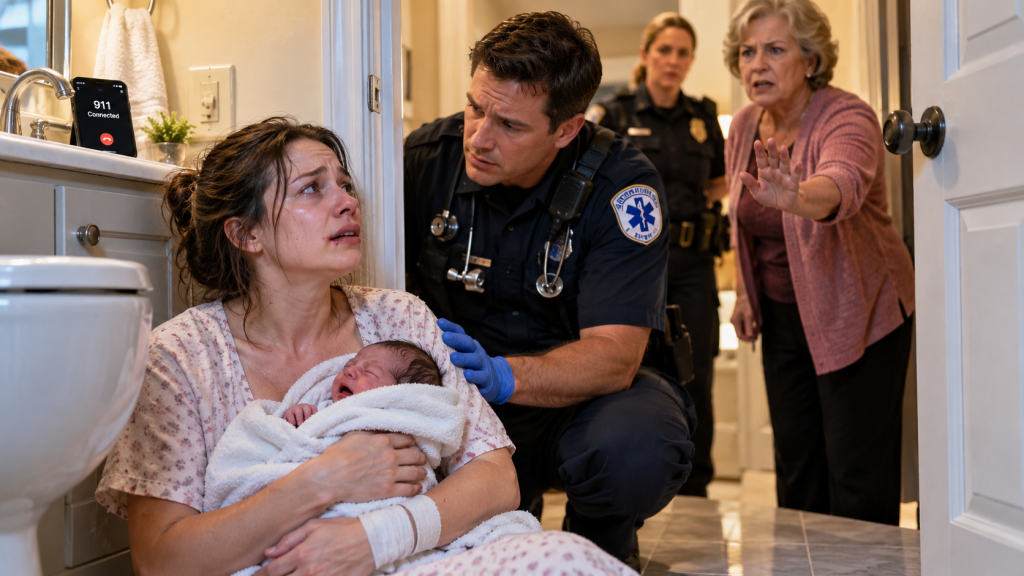
My mother-in-law slapped me during labor and told me the hospital could wait until she finished sleeping. My lip split lightly. My wrist started swelling. And while contractions took over my body, I crawled into the bathroom alone.

Minutes later, I found my newborn wrapped in a folded towel beside the toilet—just as the emergency dispatcher heard my mother-in-law lock the door…
The tile was freezing under my knees. My daughter’s first cries were barely louder than a whisper, and my hands shook so badly I could hardly keep the towel wrapped around her.
The dispatcher stayed calm.
“Is the baby crying?”
“Yes.”
“Stay with me.”
Then I heard a click outside the bathroom.
The dispatcher went silent for half a second. “Was that a lock?”
I swallowed through the pain. “Yes. She’s locking the door.”
My mother-in-law’s voice came through from the hallway.
“Stop being dramatic. You always make everything an emergency.”
The dispatcher heard every word.
I heard my newborn cry against my chest. I heard my mother-in-law walk away as if leaving a woman who had just given birth on a bathroom floor was an inconvenience she could sleep through.
Then the dispatcher asked the question I had been too afraid to answer.
“Did she hurt you?”
“She slapped me,” I whispered.
Saying it out loud changed something inside me. Until then, everything had happened inside that house, where my mother-in-law could deny it, minimize it, or tell me I was overreacting.
Now someone else knew.
“And my wrist,” I added. “I think she hurt my wrist when I tried to get past her.”
The dispatcher told me not to hang up. She kept me talking while I held my daughter against my chest and concentrated on each tiny sound she made instead of the pain running through my body.
Then someone started pounding on the front door.
Hard.
My mother-in-law shouted from somewhere outside the bathroom, “Everything is fine!”
The pounding came again.
She started explaining before anyone had even entered. She said I was resting. She said the baby had arrived quickly. She said everyone was making the situation bigger than it was.
But eventually, she opened the door.
Footsteps rushed through the house.
A man called out, “Where is she?”
My mother-in-law started to answer.
I screamed first.
“IN HERE!”
Seconds later, the bathroom door opened.
The first responder stopped when he saw me on the floor with my newborn pressed against my chest. His eyes moved from my split lip to my swollen wrist, then to the folded towel beneath us.
He didn’t lecture me or ask why I hadn’t left sooner.
He simply said, “Are you both here by yourselves?”
“She’s outside.”
My mother-in-law appeared behind him wearing the same irritated expression she’d had before sunrise.
“She panicked,” she said. “I was going to take her in. She wouldn’t listen.”
I stared at her.
She had told me the hospital could wait.
She had hit me when I tried to get past her.
She had gone back to bed while I crawled into the bathroom alone.
Now she was standing behind an emergency responder trying to turn everything into a misunderstanding.
For once, I didn’t argue with her.
I didn’t have to.
My phone was still on the floor beside me, and the dispatcher was still connected.
The responder picked it up.
“Are you still there?”
“I’m here,” the dispatcher answered.
My mother-in-law’s face changed.
The responder looked directly at her, then asked the dispatcher one question.
“Did you hear a door being locked while she was alone in this bathroom with the newborn?”
“Yes.”
That single word changed the room.
My mother-in-law stepped forward immediately.
“Give me my grandbaby. She’s exhausted and confused.”
Her hands reached toward my daughter.
Before her fingers could touch the towel, the responder moved between us and raised one hand.
“Ma’am, do not touch the baby.”
My mother-in-law froze.
Then another set of footsteps entered the hallway behind her—and this time, the person coming toward the bathroom wasn’t there to negotiate with her.
PART 2 — THE CALL SHE MADE IN MY NAME
The footsteps stopped behind my mother-in-law.
Then a woman’s voice said:
“Step away from the bathroom.”
Not loudly.
Not angrily.
That made it more powerful.
My mother-in-law turned.
A police officer stood in the hallway.
Dark uniform.
Body camera blinking.
One hand resting near her radio.
Her name tag read:
ORTIZ.
For the first time that morning, my mother-in-law looked uncertain.
“I already explained,” she said. “My daughter-in-law panicked.”
Officer Ortiz glanced past her.
At me.
At the towel.
At my daughter.
At the paramedic kneeling beside us.
Then back at my mother-in-law.
“Step into the living room, please.”
“I’m the grandmother.”
“That doesn’t change what I said.”
My mother-in-law’s mouth tightened.
“The baby needs family.”
The paramedic did not even look up.
“She has family.”
He pointed gently toward me.
“Her mother.”
Something about those two words broke me.
Not because I had forgotten who I was.
Because for the last several hours, everyone in that house had behaved as though my body, my labor, and now even my child belonged to someone else’s timetable.
Her mother.
Me.
I pulled my daughter closer.
Officer Ortiz moved slightly, blocking the hallway.
My mother-in-law looked over her shoulder at me.
“Claire.”
That was my name.
I had heard it spoken by her hundreds of times.
Friendly at holidays.
Sharp during arguments.
Sweet around my husband.
That morning, it sounded like a warning.
“Tell them I was helping you.”
I stared at her.
For years, I had answered questions that way.
To keep peace.
To avoid arguments.
To stop my husband from feeling trapped between his wife and his mother.
I had taken bad moments and sanded down their edges before handing them to other people.
Not that morning.
“No.”
Her face changed.
“Claire.”
“You hit me.”
The words echoed against the bathroom tile.
The paramedic paused.
Officer Ortiz did not.
She simply said into her radio:
“I need another unit inside.”
My mother-in-law’s voice rose.
“She was hysterical.”
I looked at her.
“You locked the door.”
“You needed to calm down.”
“I had just given birth.”
“You were screaming.”
“Yes.”
My voice cracked.
“I was giving birth.”
For once, there was nothing to minimize.
No clever version.
No family interpretation.
Only the absurd cruelty of saying a woman in labor screamed too much.
Officer Ortiz guided my mother-in-law toward the living room.
She did not touch her roughly.
She did not make a scene.
That almost made it worse for Diane.
My mother-in-law had always been strongest inside emotional chaos.
She knew how to cry.
How to accuse.
How to make everybody rush toward whichever feeling she displayed most dramatically.
The officer gave her nothing to work with.
“Sit down.”
“I don’t need to sit.”
“Sit down.”
Diane sat.
I heard the couch cushion shift.
Then another officer entered.
A man.
Older.
He began asking her questions.
Name.
Relationship.
What happened.
Diane immediately started explaining.
Too quickly.
People who believe explanation can outrun evidence often do that.
The paramedic turned back to me.
“My name is Daniel.”
Of course.
I almost laughed.
My husband’s name was Daniel too.
At that moment the coincidence felt cruel.
“I need to check you both.”
I nodded.
My daughter made another thin little cry.
“Is she okay?”
“We’re going to get her warm.”
He touched her foot.
Then her chest.
“Her breathing looks good.”
My whole body shook.
“And me?”
He looked at the blood beneath me.
Then at my wrist.
“We need to get you to the hospital now.”
The word now nearly made me cry.
Because hours earlier, I had begged for exactly that.
Another paramedic brought in a thermal blanket.
They wrapped my daughter first.
Then helped me shift carefully.
Pain tore through me.
I gasped.
Daniel looked at my face.
“Easy.”
“I’m sorry.”
He frowned.
“For what?”
That question stopped me.
Why was I apologizing?
For hurting?
For bleeding?
For requiring people?
I did not know.
“I don’t know.”
He gave me a small smile.
“Then don’t.”
I never forgot that.
They placed my daughter against my chest.
Skin to skin beneath the blanket.
She was so small.
So warm now.
Her hair damp against my collarbone.
I stared at her face.
Five minutes old.
Ten?
Twenty?
Time had stopped behaving like time.
“What’s her name?”
Daniel asked.
I swallowed.
“Lucy.”
“Lucy.”
He smiled.
“Hello, Lucy.”
She cried again.
Stronger.
The best sound I had ever heard.
As they moved us through the hallway, my mother-in-law stood.
Officer Ortiz immediately said:
“Stay where you are.”
Diane pointed at the baby.
“I’m going with them.”
“No.”
“I am family.”
“You are not riding in the ambulance.”
Diane looked at me.
“Claire, tell them.”
I held Lucy.
Said nothing.
That silence was the first boundary I had ever given Diane without an explanation attached.
It felt enormous.
Then she changed tactics.
She started crying.
Not loudly.
Softly.
The version that worked best on Daniel.
“I was trying to help.”
she said.
“You know I love you.”
My stomach tightened.
Because I believed that.
That was the worst part.
Diane did love us.
At least in the way she understood love.
The problem was that her version of love always seemed to involve someone else giving up control.
We were almost at the front door when Officer Ortiz said:
“Ma’am, before the ambulance leaves, I need to ask you one question.”
I looked at her.
“Do you want Mrs. Bennett to come to the hospital?”
Diane answered before I could.
“Of course I’m coming.”
Ortiz did not look at her.
Only at me.
My daughter breathed against my chest.
I thought of the slap.
The locked bathroom.
The phrase:
The hospital can wait.
“No.”
My voice was barely audible.
Officer Ortiz nodded.
“Okay.”
Diane stopped crying.
The real expression underneath appeared.
Anger.
“You cannot keep me away from my granddaughter.”
I looked at her.
“I can keep you away from me.”
That was the first time I saw fear on her face.
The ambulance doors closed.
The house disappeared.
I thought I would feel relief.
Instead, I started shaking harder.
Daniel the paramedic noticed.
“You’re safe.”
I hated those words.
Not because they were wrong.
Because my body did not believe them yet.
He checked my blood pressure.
“Claire, stay with me.”
“I’m here.”
“Tell me your husband’s name.”
“Daniel.”
He almost smiled.
“Great name.”
I laughed once.
Then cried.
“Where is he?”
“At work.”
“What does he do?”
“Power company.”
“Night shift.”
“Does he know?”
My chest tightened.
“No.”
That answer suddenly felt impossible.
“How does he not know?”
I whispered.
“I called him earlier.”
“At what time?”
“I don’t remember.”
“Maybe four.”
“What happened?”
“Diane answered.”
The words stopped me.
No.
That was not right.
I had called Daniel’s phone.
Diane did not have it.
I frowned.
“I mean…”
The paramedic watched me.
“Take your time.”
I closed my eyes.
I had called Daniel at 3:47.
It went to voicemail.
Then at 4:02.
No answer.
At 4:10, Diane told me she had already spoken to him.
She said Daniel knew the contractions were getting stronger.
She said he was finishing the emergency repair and would meet us later.
But we never went.
I opened my eyes.
“I didn’t speak to him.”
The realization came slowly.
The paramedic did not interrupt.
“His mother told me she did.”
Something cold moved through me.
At the hospital, everything became white lights and hands.
Nurses.
Doctors.
Questions.
Warm blankets.
Lucy disappeared from my chest for a few minutes while they assessed her.
I panicked.
A nurse named Mara immediately told me where she was.
Two feet away.
Bassinet.
Within sight.
That mattered.
They checked her temperature.
Blood sugar.
Breathing.
Reflexes.
No obvious trauma.
Mild cold stress.
Otherwise stable.
When the pediatrician said:
“She looks remarkably good.”
I sobbed so hard I could not answer.
Remarkably good.
Not perfect.
Not untouched.
But alive.
Warm.
Crying.
My daughter.
My wrist was not broken.
Severe sprain.
Soft tissue injury.
My lip needed no stitches.
I had bruising along my upper arm where Diane had grabbed me.
The obstetric team monitored bleeding and made sure there were no retained complications from the birth.
Everything happened fast and quietly.
Nobody scolded me for not coming sooner.
That somehow made the shame worse at first.
I kept wanting somebody to say:
Why didn’t you leave?
Then I could hate them instead of myself.
Nobody did.
Mara cleaned my lip.
“You’re going to swell.”
“I know.”
She paused.
“Do you want the police to photograph the injuries?”
I stared at her.
My first instinct was no.
Private.
Family.
Embarrassing.
Then the bathroom came back.
The dispatcher asking:
Did she hurt you?
I had whispered yes.
That whisper had changed everything.
“Yes.”
I said.
Mara nodded.
No praise.
No pressure.
Just:
“Okay.”
Officer Ortiz arrived forty minutes later.
She had another officer with her.
They took photographs.
My lip.
Wrist.
Upper arm.
Then Ortiz sat down.
“Your mother-in-law is not here.”
I exhaled.
“We asked her to remain at the house while we documented the scene.”
“Did she?”
“Yes.”
That surprised me.
“She has an attorney now.”
That surprised me less.
“What happens?”
Ortiz answered carefully.
“We’re investigating.”
“Investigating what?”
“Potential assault.”
“Unlawful restraint.”
“Possible interference with emergency care.”
“I can’t tell you exactly what charges will or won’t apply.”
Good.
No promises.
Then she asked:
“Do you want to make a formal statement now?”
I looked at Lucy.
Sleeping.
Tiny hand beside her face.
“Yes.”
So I told the story.
Beginning earlier than the slap.
That mattered.
Diane had come to stay with us five days before my due date.
She insisted.
Daniel worried because his work schedule had become chaotic after a major storm damaged several substations.
I told him I would be fine.
Diane said:
“Absolutely not.”
At the time it sounded caring.
She moved into our guest room.
Brought soup.
Washed baby clothes.
Rearranged my kitchen without asking.
Annoying.
But helpful.
Mostly.
Then labor started around midnight.
Mild contractions.
Far apart.
Diane told me not to wake Daniel.
“Let him work.”
At 2:30, they became stronger.
I wanted to call the hospital.
Diane said first babies took forever.
At 3:30, I could barely speak through contractions.
I told her I wanted to go.
She said:
“Not yet.”
I called Daniel twice.
No answer.
At 4:10, Diane said she had spoken to him.
That he agreed we should wait.
I believed her.
Why wouldn’t I?
His mother.
My mother-in-law.
A woman who had given birth three times.
Someone I had spent nine years trying to treat like family.
At 4:40, my contractions were so close I could not walk normally.
I told Diane I was calling an ambulance.
That was when she grabbed my phone.
I reached for it.
She held my wrist.
Hard.
I cried out.
Then she slapped me.
Not a wild blow.
Not rage.
A deliberate slap.
Like disciplining a child.
She said:
“Stop making everything dramatic.”
Then:
“The hospital can wait until I finish sleeping.”
Officer Ortiz’s face changed slightly when I repeated that.
Only slightly.
Professional.
But human.
Diane went back toward the guest room.
I took my phone.
Crawled to the bathroom because I felt pressure and knew something was happening fast.
Called 911.
Locked myself in.
At some point during the birth, I must have unlocked the door.
Or never fully latched it.
I could not remember.
Then after Lucy arrived, Diane came down the hallway.
I heard her outside.
She said something about cleaning up before paramedics arrived.
Then the lock clicked.
External latch.
Installed years earlier when the bathroom door stopped closing properly.
She had locked me in from the outside.
Officer Ortiz wrote everything down.
Then asked:
“Did you ever tell her not to call emergency services?”
“No.”
“Did you ask her to lock the door?”
“No.”
“Did she ask permission to take your daughter?”
“No.”
That last question made my skin crawl.
Because Diane’s first instinct after paramedics arrived had been:
Give me my grandbaby.
Not:
Are you okay?
Not:
Is Lucy breathing?
Possession before concern.
When Ortiz finished, she said:
“We preserved the 911 call.”
I nodded.
“Good.”
Then she added:
“The dispatcher heard more than the lock.”
I looked at her.
“What else?”
“Your mother-in-law speaking.”
My throat tightened.
“What did she say?”
Ortiz checked her notes.
“Several things.”
“She said you were dramatic.”
“She told you to stop screaming.”
“She said the baby would be fine.”
“And at one point…”
Ortiz paused.
“…she said, ‘Daniel already knows you’re staying here.’”
I stared.
There it was.
The lie.
Recorded.
My husband arrived twenty minutes later.
I heard him before I saw him.
Running.
Someone tried to stop him in the hallway.
Then his voice:
“Claire!”
I started crying immediately.
He entered the room wearing his work clothes.
Steel-toed boots.
Reflective jacket.
Hair wet from rain.
Face white.
He stopped when he saw me.
Then Lucy.
Then my lip.
He looked at my wrist brace.
His whole body seemed to collapse without actually moving.
“Oh my God.”
He came toward me.
Stopped one step away.
“Can I?”
That question saved him from something he did not know he needed saving from.
Can I touch you?
Not automatic.
Not entitled.
I nodded.
“Yes.”
He knelt beside the bed.
Put his forehead against my hand.
And cried.
“I’m sorry.”
he whispered.
I looked at him.
“For what?”
“I didn’t answer.”
“You were working.”
“I should’ve answered.”
“What happened?”
His eyes lifted.
“What do you mean?”
“Your mother said she called you.”
Daniel froze.
“What?”
“She told me she spoke to you.”
“No.”
The word came immediately.
“I haven’t talked to Mom since yesterday afternoon.”
My chest tightened.
“You didn’t know I was in labor?”
“No.”
He looked horrified.
“My phone was in the truck most of the night.”
“We had an emergency line repair.”
“I checked it around six-thirty.”
“There were missed calls from you.”
“I called back.”
“Mom answered your phone.”
I stared.
“What?”
Daniel shook his head.
“No.”
“She answered yours.”
“At home.”
Then I understood.
My phone.
When I was in the bathroom.
Before I called 911?
No.
After?
Maybe.
Everything blurred.
Daniel continued.
“She said you were sleeping.”
I stopped breathing.
“What time?”
“Around six-fifteen.”
Lucy had been born shortly before six.
I looked at Officer Ortiz.
She looked at me.
The room changed.
Daniel continued, unaware.
“I asked to speak to you.”
“She said you had been up all night and finally fell asleep.”
“She said contractions had slowed.”
“She told me not to wake you.”
My skin went cold.
By then, I had been on a bathroom floor with our newborn.
And Diane had answered my phone.
Told my husband I was sleeping.
I whispered:
“She knew.”
Daniel frowned.
“What?”
“She knew Lucy had been born.”
His face emptied.
“No.”
“She knew.”
I looked at Ortiz.
“She was outside the bathroom.”
“She heard the baby.”
Officer Ortiz stood.
“I need to make a call.”
Daniel sat beside me.
His hands shook.
“My mother did this?”
I wanted to say yes.
Wanted to place everything at Diane’s feet and be done.
Instead:
“Your mother hit me.”
“Locked me in.”
“Delayed me from leaving.”
“And lied to you.”
His face crumpled.
“She wouldn’t…”
Then he stopped.
Good.
Because I would not survive hearing that sentence.
She wouldn’t do that.
She had.
Daniel looked at Lucy.
Then at me.
“I’m so sorry.”
I hated that apology for a different reason.
“You didn’t hit me.”
“No.”
“You didn’t lock the door.”
“No.”
“But…”
He looked down.
There it was.
Something older than that morning.
“I kept making you handle her.”
My chest tightened.
“I told you she meant well.”
“Yes.”
“When she criticized everything you did.”
“Yes.”
“When she came into our room without knocking.”
“Yes.”
“When she bought nursery furniture after we told her not to.”
“Yes.”
“When she said breastfeeding was selfish because then she couldn’t feed the baby.”
My eyes filled.
“Yes.”
Daniel covered his face.
“I made every boundary your job.”
That sentence mattered.
Because Diane had not become controlling that morning.
She had simply crossed a line so undeniable nobody could call it personality anymore.
“I thought keeping peace was kindness.”
Daniel said.
I looked at him.
“To who?”
He had no answer.
Exactly.
Keeping peace usually means somebody else carries the conflict in silence.
For years, that somebody had been me.
Officer Ortiz returned.
Her expression serious.
“We need to clarify something.”
Daniel stood.
“What?”
She looked at me.
“Claire, your mother-in-law said you gave her permission to answer your phone.”
“No.”
“She said you asked her to tell Daniel labor had slowed.”
“No.”
“She says the door locked accidentally.”
“No.”
Three lies.
Simple.
Clean.
Ortiz nodded.
Then:
“We’re going back to the house.”
“Why?”
“Because there may be additional evidence we need to preserve.”
My stomach tightened.
“What evidence?”
“The external bathroom latch.”
“Your phones.”
“And any messages between Mrs. Bennett and Daniel.”
Daniel already had his phone out.
“Take it.”
Ortiz shook her head.
“We’ll document properly.”
Procedure.
Again.
It felt safer than emotion.
Diane was arrested later that afternoon.
Not dragged away screaming.
Not thrown into a police car for dramatic effect.
Officers completed interviews.
Consulted with prosecutors.
Documented the house.
Then took her into custody on allegations related to the assault and restraint.
The exact charges would be sorted later.
Daniel sat beside my hospital bed when Ortiz called to tell us.
His face went blank.
“That’s my mother.”
he whispered.
I said nothing.
Because yes.
It was.
That was the tragedy.
Not a stranger.
Not a faceless villain.
His mother.
The woman who packed his lunches.
Taught him to drive.
Sat in the front row at our wedding.
People can be loved and still become unsafe.
Both things can exist.
Diane’s attorney contacted Daniel before sunset.
Not me.
Daniel put the call on speaker only after asking.
The attorney said Diane was frightened.
Confused.
That the morning had escalated.
That everyone had been exhausted.
He suggested Daniel could help “clarify the family misunderstanding.”
Daniel looked at me.
Then said:
“There is a 911 recording.”
The attorney paused.
Daniel continued.
“My wife gave birth alone on a bathroom floor while my mother prevented her from leaving.”
Another pause.
“I am not clarifying that into something smaller.”
My eyes filled.
Not because it fixed the years before.
Because he was finally carrying his own boundary.
The next morning, a hospital social worker came to see me.
Her name was Janice Patel.
She asked about home.
Safety.
Whether Diane had keys.
Whether she lived with us.
Whether I wanted her barred from visiting.
“Yes.”
I answered.
Daniel said:
“Yes.”
No argument.
Janice documented it.
Then she asked:
“Has Mrs. Bennett ever interfered with your medical care before?”
I almost said no.
Then remembered.
Appointments.
Questions.
Comments.
Nothing dramatic.
Still.
“She calls my doctor’s office.”
Daniel looked at me.
“What?”
I sighed.
“She says she’s checking on appointment times.”
“How does she have permission?”
“She shouldn’t.”
Janice became still.
“How often?”
“I don’t know.”
I thought.
“She knew about my glucose test before I told her.”
“She knew the date of my anatomy scan.”
“She once said my doctor agreed I was gaining too much weight.”
Daniel frowned.
“Did the doctor actually say that?”
“No.”
I had asked later.
My doctor said weight gain was normal.
I had assumed Diane exaggerated.
Now everything felt different.
Janice asked:
“Would you consent to the hospital privacy office reviewing whether anyone contacted your obstetric practice pretending to have authorization?”
I looked at Daniel.
Then back at her.
“Yes.”
At the time, I expected nothing.
Maybe a few inappropriate calls.
A receptionist who had shared too much.
Family boundary problems.
That would have been enough.
It was not what they found.
Three hours later, my obstetrician came in with the clinic manager.
My doctor, Dr. Helena Morris, looked angry.
Not at me.
That helped.
“Claire, we found several calls associated with your mother-in-law’s number.”
I swallowed.
“How many?”
“Seven over the past two months.”
Daniel stared.
“Seven?”
The clinic manager continued.
“Most were routine questions.”
“Appointment time.”
“Visitor policy.”
“Hospital registration.”
“Questions we should not have answered without authorization.”
She looked ashamed.
“We are reviewing that internally.”
Then Dr. Morris said:
“One call was different.”
Something in her voice made my stomach drop.
“When?”
“Four days ago.”
Four days before Lucy’s birth.
“What did she ask?”
Dr. Morris sat down.
“She identified herself as you.”
The room went silent.
“No.”
The clinic manager nodded.
“The caller had your date of birth.”
“Address.”
“Insurance information.”
“And knew enough about your chart to pass the verification questions used by the staff member who answered.”
Daniel looked sick.
“What did she want?”
Dr. Morris answered.
“She asked whether your induction could be delayed.”
I stared.
“What induction?”
“You were not scheduled for one.”
Exactly.
The caller said:
I don’t want to go to the hospital unless I absolutely have to.
Then asked:
How long could a first-time mother safely labor at home?
When should contractions be considered urgent?
Could someone wait if membranes had not ruptured?
Could a family member transport instead of calling emergency services?
My skin turned cold.
Those were not random questions.
Those were the exact arguments Diane used that morning.
First babies take forever.
The hospital can wait.
You don’t need an ambulance.
She had rehearsed them with my doctor’s office.
In my name.
Daniel stood so quickly his chair scraped backward.
“She planned this?”
Dr. Morris raised a hand.
“We cannot say that.”
Important.
Facts.
Not fear.
“We can say she called pretending to be Claire and asked those questions.”
“Why?”
“We don’t know.”
I did.
Or thought I did.
Control.
Diane hated hospitals.
Not because of doctors.
Because hospitals had rules she did not own.
Nurses.
Consent.
Visitor limits.
People asking the patient directly.
At home, Diane was the expert because she declared herself one.
At the hospital, she would have been one grandmother among staff whose job was to listen to me.
Maybe that was enough.
Maybe there was more.
I did not know.
Then the clinic manager placed a printed note on the table.
“Claire, there’s something else.”
I almost laughed.
Of course there was.
She pointed to the last line.
The staff member had documented:
Patient requests no hospital admission until spouse’s mother is present and asks that all birth updates be given to Diane Bennett first because patient becomes confused under stress.
I read it once.
Then again.
Daniel whispered:
“She said you get confused?”
I stared at the sentence.
Not dramatic.
Not hysterical.
Confused.
A word that could become permission.
A word that could make someone else sound more trustworthy than me.
Even while I was the one giving birth.
“I never said that.”
My voice sounded far away.
Dr. Morris leaned closer.
“We know.”
“How?”
“You’ve never shown confusion in any appointment.”
“The note is inconsistent with everything else in your chart.”
“And the call did not come from your phone.”
The clinic manager added:
“It came from Diane’s.”
Relief and horror arrived together.
Proof.
Again.
Somebody outside the family could see the difference.
Daniel sat beside me.
His face had changed completely.
Not anger.
Something worse.
Understanding.
“My mother wanted staff to treat her like the decision-maker.”
I looked at him.
Maybe.
Dr. Morris said:
“We should be careful about motive.”
Good.
Because once people become frightened, motive grows faster than evidence.
But the behavior itself was enough.
Diane had pretended to be me.
Asked about delaying hospital care.
Then created a note suggesting I became confused under stress.
Four days later, she told me the hospital could wait.
That was not nothing.
I looked at Janice.
“What happens now?”
“We preserve the clinic records.”
“Police can request them through the proper process.”
“We document your actual preferences.”
“And we make sure your chart clearly states who is authorized to receive information.”
“Who do you want?”
I looked at Daniel.
He looked at me.
“Daniel.”
I said.
“And?”
“No one else.”
The words felt clean.
Not cruel.
Clean.
That afternoon, Lucy slept against my chest.
Daniel sat beside the bed.
Neither of us spoke for a long time.
Then he said:
“Do you hate me?”
I turned.
“No.”
He looked surprised.
“Are you angry?”
“Yes.”
“That makes more sense.”
I almost smiled.
He continued.
“I should have stopped this years ago.”
“Stopped what?”
“My mother treating every disagreement like disrespect.”
I looked at Lucy.
“Yes.”
“I kept telling myself she was lonely.”
“She is.”
“That Dad died and she only had me.”
“Yes.”
“That she needed to feel included.”
“Yes.”
Daniel’s voice cracked.
“And every time you asked for distance, I translated it into something softer so she wouldn’t be upset.”
I looked at him.
“You kept protecting her from hearing no.”
His eyes filled.
“Yes.”
“And eventually she forgot no applied to her.”
Silence.
That was the truth.
Not an excuse.
A pattern.
“I need something from you.”
I said.
“Anything.”
“No.”
He stopped.
Good.
“Don’t say anything.”
“Ask what.”
Daniel swallowed.
“What do you need?”
Better.
“I need you not to fix this by becoming cruel to her.”
He stared.
“Claire.”
“I mean it.”
“She hurt you.”
“Yes.”
“She could’ve hurt Lucy.”
“Yes.”
His jaw tightened.
“I never want to see her again.”
“That can be your choice.”
He looked at me.
“But?”
“But I don’t want anger becoming another person in our marriage.”
His face softened.
I continued.
“I need boundaries.”
“Legal ones if necessary.”
“I need therapy.”
“I need you to believe me the first time when I say someone is making me feel unsafe.”
“I need you to stop asking me to be the flexible one because your mother is difficult.”
Daniel closed his eyes.
Then nodded.
“Yes.”
“And if someday you choose to speak to her again…”
I took a breath.
“…you don’t get to bring her back into my life through guilt.”
“I won’t.”
“Or Lucy’s.”
His voice broke.
“I won’t.”
That promise mattered more than hatred.
The police came back that evening.
Officer Ortiz.
This time with Detective Marcus Lee.
They had obtained copies of the relevant clinic records with consent and were reviewing whether the impersonation created additional legal issues.
No dramatic conclusion yet.
No instant new charges.
Just more evidence.
Then Detective Lee said:
“We found something at the house you should know about.”
My stomach tightened.
“What?”
“Mrs. Bennett had a folder in the guest bedroom.”
Daniel frowned.
“What folder?”
Lee looked at me.
“It was labeled LUCY — DELIVERY.”
I felt cold.
“What was inside?”
“Printed hospital visitor policies.”
“A copy of your birth plan.”
“Your insurance information.”
“A copy of Daniel’s work schedule.”
“Notes from calls with the obstetric office.”
Daniel whispered:
“She made a file?”
Lee nodded.
“Again, we are not assigning motive beyond what the evidence supports.”
“But we need to ask whether you knew she had these materials.”
“No.”
Daniel answered first.
I shook my head.
“No.”
Detective Lee continued.
“One note is particularly relevant.”
He opened his notebook.
“Diane wrote:
If Claire panics, keep her home until Daniel arrives. Hospital will turn everything into an emergency. Do not let ambulance take over unless medically necessary.”
I stared.
There it was.
Not a murder plan.
Not some secret plot to steal a baby.
Something almost more believable.
A woman utterly convinced her judgment outranked mine.
She had prepared to override me because she believed she knew better.
The danger had grown from certainty.
Then Lee added:
“Another note says:
Once baby is here, Claire will calm down.”
My eyes filled.
Once baby is here.
As though labor were a tantrum.
As though birth were the obstacle between Diane and the grandchild she wanted.
As though my fear, pain, and consent were temporary inconveniences.
Daniel covered his face.
“My God.”
I looked at Lucy.
Five pounds, eleven ounces.
Sleeping.
Oblivious to how many adults had nearly made her arrival about themselves.
I touched her cheek.
For the first time since the bathroom, I felt something stronger than fear.
Not revenge.
Clarity.
Diane had not locked me in because she hated me.
That would have been simpler.
She had locked me in because she believed she was entitled to decide when my emergency became real.
She had slapped me because my refusal threatened her authority.
She had answered my phone because she believed Daniel would listen to her.
She had called the doctor pretending to be me because, somewhere along the way, she stopped seeing the difference between helping and replacing me.
That distinction would become everything.
Then Detective Lee turned one page in his notebook.
“There’s one more thing.”
Daniel looked up.
I almost laughed despite myself.
Of course there was.
“What?”
Lee’s expression changed.
“This may explain why she was so focused on keeping you out of the hospital.”
My heart started pounding.
He looked at Daniel.
“Your mother had contacted a private attorney three weeks ago.”
Daniel frowned.
“For what?”
Lee hesitated.
“We don’t know the full context yet.”
“Then what do you know?”
The detective looked at me.
“She asked whether grandparents can obtain temporary medical decision-making authority over a newborn if the mother is considered incapacitated after delivery.”
Everything inside me went silent.
Daniel stood.
“No.”
Lee raised a hand.
“We do not have evidence she filed anything.”
“She did not have authority.”
“She did not obtain an order.”
“But she asked.”
My throat closed.
“Why?”
“We’re trying to determine that.”
Then he added:
“And the attorney’s notes say Diane told him she expected you might become ‘irrational and confused’ during labor.”
The same phrase.
Again.
Confused.
The word she had planted before the birth.
The word she tried to put into my medical chart.
The word that would make my voice smaller and hers larger.
I looked down at Lucy.
My daughter moved slightly.
Her tiny fingers curled around nothing.
And for the first time, I understood that the bathroom door was not the beginning of Diane’s plan.
It was the moment her plan stopped staying invisible.
PART 3 — THE BIRTH STORY THAT BECAME MINE AGAIN
For several seconds after Detective Lee spoke, nobody moved.
Lucy slept against my chest.
Her mouth opened once in a tiny, silent yawn.
My husband stood beside the hospital window with both hands pressed against the sill.
And somewhere beneath all the anger in me, something colder settled into place.
Understanding.
Not complete understanding.
But enough.
Diane had not simply lost her temper that morning.
She had not woken exhausted, made one terrible decision, then another.
For weeks, she had been building a story in which my judgment mattered less than hers.
A story in which pregnancy made me fragile.
Labor made me irrational.
Pain made me unreliable.
And motherhood, apparently, was something she believed I needed supervision to enter.
Detective Lee closed his notebook.
“I need to be careful about how I say this.”
I looked at him.
“Please do.”
He nodded.
“The attorney she contacted did not prepare a petition.”
“No paperwork was filed.”
“She did not obtain medical authority.”
“She did not have guardianship rights.”
“She did not have decision-making authority over Lucy.”
I breathed again.
Then he continued.
“But the consultation matters because it helps us understand what Mrs. Bennett was thinking before the birth.”
Daniel turned.
“What exactly did she tell the lawyer?”
Lee glanced at his notes.
“She said Claire was ‘emotionally unstable during pregnancy.’”
I laughed once.
Not because it was funny.
Because sometimes a lie becomes so insulting that laughter is the only response your body can find.
“What evidence did she give?”
“She said you cried frequently.”
“I was pregnant.”
“She said you had become anxious about delivery.”
“I was pregnant.”
“She said you changed your mind about visitors.”
“I made a birth plan.”
Lee nodded.
“I understand.”
“What else?”
“She said you had ‘unreasonable fears’ about people holding the baby immediately after birth.”
Daniel looked at me.
That conversation had happened.
I had told Diane I did not want Lucy passed around during the first hour unless medically necessary.
I wanted skin-to-skin.
Time.
Quiet.
Diane called it possessive.
Apparently, later, she called it evidence.
“What did the attorney tell her?”
I asked.
“That grandparents do not simply receive medical authority because a parent is tired, distressed, medicated, or recovering from childbirth.”
Good.
Something in me appreciated that sentence more than it should have.
“He told her that if a mother lacked capacity, clinicians would follow applicable law, existing directives, and hospital procedures.”
“He also told her she could not create incapacity merely because she disagreed with you.”
Daniel closed his eyes.
“That should’ve ended it.”
“Yes.”
Lee said.
“It should have.”
But it had not.
The attorney had also documented one question from Diane almost word for word.
What if the mother refuses help because she doesn’t realize how incapable she is?
I stared at the wall.
There it was.
The entire relationship.
Every boundary I set became proof I needed more control.
Every disagreement became evidence that Diane was right to override me.
If I wanted privacy, I was isolating.
If I wanted my baby close, I was possessive.
If I wanted the hospital, I was hysterical.
If I resisted her intervention, I was confused.
There was no version of events in which I could disagree and still remain competent in her eyes.
That was the trap.
Daniel sat down beside me.
His face looked years older than it had the day before.
“I invited her to stay.”
I looked at him.
“I know.”
“I asked you to let her help.”
“Yes.”
“I told you she’d be useful.”
I said nothing.
He looked at Lucy.
“I put her in the house.”
That was true.
But I did not want him carrying a burden that belonged somewhere else either.
“You invited your mother.”
I said.
“You did not invite her to hit me.”
His eyes filled.
“No.”
“You did not tell her to lock a bathroom door.”
“No.”
“You did not tell her to impersonate me.”
“No.”
“But you did keep asking me to make room for her when I was telling you the room was getting too small.”
Daniel lowered his head.
“Yes.”
That was the part he had to own.
No more.
No less.
The hospital kept us for two nights.
Lucy stabilized quickly.
She fed.
Slept.
Cried with impressive lungs.
The pediatrician smiled when she screamed during an examination.
“Excellent.”
she said.
I laughed through tears.
Only new parents understand how quickly screaming can become good news.
My own recovery was slower.
Physically, I was lucky.
No surgery.
No major blood loss.
No fracture.
Emotionally, I kept leaving the hospital room without moving.
The bathroom would return in flashes.
Cold tile.
The click of the latch.
Diane’s footsteps walking away.
Then Lucy would make a sound and I would be back.
Mara taught me to name what was around me.
Blue chair.
White blanket.
Window.
Daniel.
Lucy.
Present tense.
Safety sometimes has to be taught to the body after the mind has already understood it.
Diane remained out of the hospital.
Her attorney requested that Daniel speak with her.
He declined.
The attorney tried again.
Said Diane wanted to apologize.
Daniel asked me:
“Do you want to hear it?”
I surprised myself.
“No.”
Not:
Never.
Not:
Maybe later.
Just no.
That day.
That was enough.
Daniel relayed exactly that.
No interpretation.
No softening.
No:
Claire needs time.
No:
She’s emotional.
Just:
Claire does not want contact.
The difference mattered.
On the third morning, before discharge, Janice the social worker brought a stack of papers.
Protective-order resources.
Postpartum support.
Trauma counseling.
Legal advocacy.
Hospital security contacts.
Privacy instructions.
Then she said:
“Before you go home, we need to discuss where home is.”
My stomach tightened.
“Our house.”
Daniel answered.
Janice looked at me.
Not him.
I appreciated that.
“Do you feel safe there?”
I thought about the bathroom.
The guest room.
The hallway.
Diane’s folder labeled LUCY — DELIVERY.
Then:
“Yes.”
I did.
The house had not hurt me.
Diane had.
But I needed changes.
“She has a key.”
Daniel nodded immediately.
“I’ll change the locks.”
I looked at him.
“Ask.”
He stopped.
Right.
“What would make you feel safer?”
Better.
“Change the locks.”
He nodded.
“Okay.”
“Guest-room door lock too.”
“Okay.”
“And remove the outside latch from the bathroom.”
His face broke.
“Yes.”
My throat tightened.
“Today.”
“Yes.”
No argument.
We did not go directly home.
Daniel’s sister, Rachel, offered us her apartment for two nights while a locksmith came and police finished releasing parts of the house from the investigation.
Rachel was different from Diane.
Not perfect.
Just ordinary.
She brought groceries and placed them on the counter.
Asked whether I wanted her to stay.
I said no.
She said:
“Okay.”
Then left.
I almost cried from how easy it was.
No sulking.
No guilt.
No announcement that family should be included.
Just okay.
Choice had started feeling luxurious.
Diane’s first written apology arrived four days after we left the hospital.
Through her attorney.
I did not read it.
Daniel did.
Only because I asked him to tell me whether it contained anything legally important.
He sat at the kitchen table in Rachel’s apartment.
Read.
Then folded it.
“Well?”
I asked.
He looked exhausted.
“She says she panicked.”
I waited.
“She says she was afraid you would go to the hospital too early and end up with unnecessary interventions.”
My jaw tightened.
“She says she believed home labor was safe because you were full term.”
“Did she apologize for hitting me?”
“Yes.”
“For locking the door?”
His silence answered.
“What did she say?”
“That she closed the latch because responders were coming and she didn’t want you wandering while weak.”
I stared at him.
“Wandering.”
“I know.”
“Did she apologize for impersonating me?”
“She says she was trying to gather information.”
“In my name.”
“Yes.”
“And the lawyer?”
Daniel looked down.
“She says she was researching options in case something went wrong.”
Of course.
Every act had a reason.
Every reason happened to preserve her innocence.
I looked at the folded letter.
“I don’t want it.”
Daniel nodded.
“I’ll give it to the lawyer.”
Good.
An apology you are not ready to receive is not medicine.
The legal process moved slowly.
Painfully slowly.
There was no single charge called:
Woman Who Thought She Knew Better Than Everyone.
The prosecutor dealt with conduct.
The slap.
My injured wrist.
The locked door.
The 911 recording.
Diane’s own statements.
The clinic impersonation.
Her interference during an active medical emergency.
Some allegations were stronger than others.
Some became charges.
Some remained context.
The private consultation with the attorney was not itself illegal.
Thinking about control is not the same as obtaining it.
That distinction frustrated Daniel.
I understood why.
He wanted every ugly thought turned into a consequence.
The prosecutor told him:
“Courts punish acts we can prove under law. They do not punish personality.”
Daniel came home angry.
I said:
“That’s probably a good thing.”
He stared at me.
Then sighed.
“Yes.”
Pain had not made me want a world where somebody could be convicted for thinking badly about me.
I wanted facts.
Enough facts already existed.
The obstetric clinic conducted its own review.
That one hurt too.
A staff member had disclosed appointment information and accepted Diane’s impersonation because she knew personal details.
No one intended harm.
Still, safeguards failed.
The clinic apologized.
Changed verification procedures.
Added a note requiring direct confirmation for certain calls.
Dr. Morris called me herself.
“I’m sorry.”
she said.
I believed her.
Not because apologies automatically deserve forgiveness.
Because hers contained no defense.
She told me what went wrong.
What had been changed.
What would happen next.
Accountability has a different sound from explanation.
I was learning to recognize it.
Six weeks after Lucy’s birth, Diane entered a plea in the criminal case.
Not to everything prosecutors initially considered.
Enough.
She accepted responsibility for the physical assault and unlawful restraint tied to locking me inside.
Other issues remained part of the factual record and separate review.
She received probation, mandatory counseling, restrictions on contact, and court-ordered compliance with a protective order.
No prison.
Daniel struggled with that.
I did too, briefly.
Then I looked at Lucy sleeping beside me and realized I did not need a cell door closing somewhere to make my bathroom door matter.
The record existed.
The 911 call existed.
Her plea existed.
My memory no longer required family agreement.
That was more valuable than I expected.
The protective order barred Diane from contacting me directly.
Contact regarding Daniel had to remain separate.
No contact with Lucy unless I later consented and legal restrictions allowed it.
I signed the documents.
Then stared at the page.
Minor child: Lucy Bennett.
My daughter’s name beneath protective language.
I cried.
Daniel held my hand.
He did not say:
This is for the best.
Did not say:
At least she’s safe.
Sometimes comfort is simply not forcing a silver lining onto something that should never have needed one.
Postpartum life arrived anyway.
That may have saved me.
Babies do not care about court dates.
Lucy woke every two hours.
She hated one brand of diapers.
Loved being held upright after feeding.
Sneezed three times in a row, almost every time.
Made a tiny frown before crying.
Life became measured in ounces, naps, laundry, and whether I had showered before noon.
Trauma wanted Lucy’s birth to remain frozen on a bathroom floor.
Motherhood refused.
It kept moving.
That was its own kind of rescue.
Still, there were hard nights.
Once, Lucy cried while I was in the bathroom.
Daniel had her in the bedroom.
Perfectly safe.
But the sound came through the door and my body collapsed into memory.
I could not move.
My hands shook.
I saw the towel again.
The tile.
The lock.
Daniel called through:
“Claire?”
I could not answer.
He did not force the door.
“Can I come in?”
I managed:
“Yes.”
He opened slowly.
Found me sitting on the floor.
He did not pick me up.
Did not tell me to calm down.
He sat beside me.
Then asked:
“Do you want Lucy?”
“Yes.”
He brought her.
Placed her in my arms.
I cried into her hair.
The first time I held her on that bathroom floor, I had been terrified I was alone.
This time I was not.
Same shape.
Different ending.
The body notices repetition.
It also notices correction.
Therapy helped.
I hated that sentence because people say it as though therapy is a warm bath.
It was work.
My therapist, Dr. Anika Shah, asked questions I did not enjoy.
“What did you believe about yourself after the birth?”
“That I failed.”
“How?”
“I should have left sooner.”
“What stopped you?”
“Diane.”
“What else?”
I hated the answer.
“My desire not to make Daniel choose.”
Dr. Shah waited.
There it was.
For years, I had thought keeping family peace was generous.
During labor, that habit became dangerous.
I had been in pain and still thinking about whether leaving the house without Diane would create a scene.
My instincts had been trained to negotiate with disrespect.
That training did not begin that morning.
Dr. Shah asked:
“What would you like Lucy to learn from your story?”
I answered immediately.
“That no one gets to decide her pain is inconvenient.”
Then I cried for ten minutes.
Because sometimes you discover what you needed by hearing what you want your child to have.
Daniel started therapy too.
Not couples therapy first.
His own.
That mattered.
He needed somewhere to examine his relationship with Diane that did not make me responsible for supervising his grief.
He loved his mother.
Still.
He hated what she had done.
Also still.
Both feelings made him ashamed.
His therapist apparently told him:
“Love is not a legal defense.”
When he repeated that to me, I laughed.
Then:
“Neither is hatred.”
He nodded.
We were learning together.
Three months passed before Diane asked, through counsel, whether Daniel would consider speaking with her alone.
He asked me what I thought.
I said:
“What do you want?”
He looked frustrated.
“I don’t know.”
“Then don’t make me decide.”
That landed.
He nodded.
A week later, he chose yes.
One meeting.
Therapist’s office.
No Lucy.
No me.
His choice.
I was terrified anyway.
Part of me wanted to control every sentence Diane might say.
Protect him.
Protect myself.
Control can feel righteous when you have been hurt by someone else’s.
I had to watch that.
So I let him go.
He came home two hours later.
Sat at the kitchen table.
Said nothing.
I waited.
Eventually:
“She still thinks she was trying to help.”
My stomach tightened.
“Does she?”
“She admits hitting you was wrong.”
“Good.”
“She admits the lock was wrong.”
“Good.”
“She still says everything got out of control because you panicked.”
I laughed.
Of course.
Daniel continued.
“I told her panic during childbirth would still not make your body hers to manage.”
My eyes filled.
Then:
“What did she say?”
“That she was scared.”
“Of what?”
He looked at me.
“Being unnecessary.”
That surprised me.
Not enough to excuse anything.
Enough to understand something.
After Daniel’s father died, Diane’s whole identity narrowed.
Mother.
Then grandmother-to-be.
She had spent years being needed.
Cooking.
Organizing.
Calling.
Fixing.
Lucy’s birth became, in her mind, another role she was entitled to perform.
Then I created boundaries.
Visitor limits.
No kissing newborn.
No surprise drop-ins.
No taking the baby from my arms without asking.
Normal things.
To Diane, apparently, each boundary sounded like eviction.
So she responded by making herself more necessary.
Gathering medical information.
Positioning herself as experienced.
Telling Daniel I was anxious.
Telling me Daniel agreed with her.
If everyone believed Claire could not handle things, Diane became indispensable again.
That was the shape.
Sad.
Dangerous.
Human.
“Did you forgive her?”
I asked.
Daniel stared.
“No.”
Then:
“I don’t even know what that would mean.”
Good answer.
Diane attended counseling for months.
We knew because compliance reports were required.
Nothing more.
I did not receive updates about revelations.
Did not ask whether she cried.
Did not monitor whether she was becoming better.
Her growth was not my assignment.
That freedom was enormous.
Lucy turned six months old.
We had a small gathering.
Rachel.
Two friends.
My parents.
Cake nobody needed.
Diane was not invited.
Daniel looked sad once.
I saw it.
Did not fix it.
That was his grief to carry.
Not because I was cruel.
Because every time I had carried someone else’s discomfort, my own boundary had become negotiable.
No more.
Later that night, Daniel said:
“Thank you for letting me be sad.”
I looked at him.
“What else would I do?”
He laughed softly.
“Old us would’ve spent the whole day pretending I wasn’t.”
He was right.
At nine months, Diane wrote a second apology.
This one came through her therapist and attorney.
I chose to read it.
Not because anyone asked.
Because I wanted to know.
The first line said:
I am not writing to ask for contact with Lucy.
I kept reading.
Already different.
She wrote that she had spent most of her life confusing usefulness with love.
That when Daniel no longer needed her daily, she found ways to remain central.
That when I set boundaries, she experienced them as rejection.
Then she wrote:
None of that gave me the right to turn your labor into something I controlled.
I stopped.
Read it again.
No:
but.
No:
because you panicked.
Then:
You were not confused. I was unwilling to hear you.
My hands started shaking.
That sentence mattered.
She admitted calling the doctor in my name.
Admitted researching authority she did not have.
Admitted that she had wanted hospital staff to call her if I “became difficult.”
She wrote:
I told myself I was preparing for an emergency. In truth, I was preparing for disagreement.
I cried.
Not forgiveness.
Recognition.
The truth finally spoken in the correct direction.
The last paragraph said:
If I never meet Lucy again, that will be a consequence of what I did, not something you did to me.
I put the letter down.
Daniel did not ask:
Well?
He waited.
I said:
“She understands more.”
He nodded.
“Do you want contact?”
“No.”
“Okay.”
No disappointment placed in my lap.
Progress.
A year after Lucy’s birth, the protective order approached expiration.
That terrified me more than I expected.
Legal protection had become a wall I could point to.
Soon, boundaries would depend more heavily on us.
Dr. Shah asked:
“What changes when the order ends?”
I said:
“She could contact us.”
“Could.”
“Yes.”
“Does that mean she gets access?”
“No.”
“Who decides?”
I breathed.
“We do.”
Then corrected myself.
“I decide for me.”
“Daniel decides for himself.”
“And Lucy?”
“Daniel and I together.”
Good.
The order had helped.
But the boundary had to survive without paper eventually.
That was the real test.
When the order expired, Diane did nothing.
No call.
No flowers.
No driveway appearance.
No message through relatives.
Weeks passed.
Silence.
At first I kept expecting intrusion.
Then I realized respecting a boundary rarely looks dramatic.
It looks like absence.
That was the point.
Two years after Lucy’s birth, I chose a meeting.
My choice.
Not Daniel’s request.
Not Diane’s.
Mine.
Public place.
A therapist’s office.
One hour.
No Lucy.
I almost canceled seven times.
Then went.
Diane looked older.
Gray in her hair.
Hands folded tightly.
She did not reach for me.
Good.
“Claire.”
“Diane.”
Silence.
Then she said:
“I’m sorry.”
I looked at her.
“For what?”
I had learned that question from Margaret—no, from life itself. Specificity matters.
Diane swallowed.
“For hitting you.”
“For holding your wrist.”
“For preventing you from leaving.”
“For locking the bathroom.”
“For answering your phone.”
“For lying to Daniel.”
“For pretending to be you with the doctor.”
“For trying to make people doubt your judgment before you even gave birth.”
My throat tightened.
She continued.
“And for believing being Lucy’s grandmother gave me rights that belonged to you.”
There.
At last.
The whole thing.
I asked:
“Did you want to take my baby?”
Diane’s face broke.
“No.”
“Did you want me out of the way?”
She hesitated.
Then answered honestly.
“Not consciously.”
I appreciated the discomfort.
“What did you want?”
“To be needed.”
Tears filled her eyes.
“I wanted Daniel to call me first.”
“I wanted the nurses to listen to me.”
“I wanted to hold Lucy.”
“I wanted to be important.”
“And when you made choices without me, I felt…”
She stopped.
“Rejected?”
“Yes.”
I looked at her.
“So you tried to make my choices look unreliable.”
She cried.
“Yes.”
No defense.
Good.
“Do you understand why you cannot have a relationship with Lucy right now?”
“Yes.”
“Do you expect one later?”
Her face tightened.
“I hope.”
Not expect.
Hope.
Better.
“But I don’t think hope obligates you.”
Good.
I sat back.
For the first time since the birth, I could look at Diane and see something other than the woman outside the bathroom door.
Not innocence.
Not safety.
A person.
Flawed.
Dangerous once.
Trying, perhaps, to become less dangerous.
That was all.
I did not owe more.
We ended after fifty-eight minutes.
No hug.
No reconciliation photograph.
No promise.
I went home.
Held Lucy.
Made dinner.
The earth stayed in place.
Sometimes closure is not a door slamming.
It is discovering you can leave a room without needing everyone inside it to agree with your version of what happened.
Another year passed.
Diane had no contact with Lucy.
Then Daniel asked:
“Would you ever consider a supervised visit?”
I looked at him.
Old fear rose.
So did something else.
Choice.
“Not yet.”
He nodded.
Six months later, I brought it up.
Not him.
Not Diane.
Me.
One hour.
Therapist’s family room.
Daniel present.
I could leave anytime.
Diane entered and saw Lucy, then almost collapsed from emotion.
Lucy, three years old, hid behind my leg.
Diane stopped immediately.
Did not reach.
Did not say:
Come to Grandma.
She crouched several feet away.
“Hi, Lucy.”
Lucy stared.
Then asked:
“Are you Daddy’s mommy?”
Diane laughed through tears.
“Yes.”
Lucy considered.
Then returned to her blocks.
That was the meeting.
No magic.
Good.
Contact remained limited.
Supervised at first.
Then occasional.
Diane never babysat.
Not because people cannot change.
Because change does not obligate restoration of every old privilege.
She accepted that.
The first time I saw her ask:
“Claire, may I pick her up?”
I almost cried.
Such a small sentence.
The thing she should have known from the beginning.
Permission.
Lucy grew.
Four.
Five.
Six.
She never knew the bathroom story in full.
Not then.
She knew Grandma Diane had made serious mistakes when she was born.
That adults had needed time apart.
That apologies did not automatically make everything normal.
Enough truth for her age.
When she asked more, we answered more.
No family mythology.
No:
Grandma just loved you too much.
Love did not need that defense.
On Lucy’s seventh birthday, she asked:
“Was I born at home on purpose?”
I froze.
Daniel looked at me.
Then waited.
My story.
My choice.
“No.”
I said.
“You came very fast.”
“Were you scared?”
“Yes.”
“Was Daddy there?”
“No.”
She frowned.
“Where was he?”
“Working.”
“Who helped?”
I smiled.
“A woman on the phone.”
“Like 911?”
“Yes.”
“And paramedics.”
“And me.”
Lucy looked impressed.
“You helped?”
I laughed.
“I did most of the work.”
She giggled.
Good.
Then:
“Was Grandma Diane there?”
The room changed slightly.
“Yes.”
“Did she help?”
I thought.
Then said:
“Not the way she should have.”
Lucy accepted that.
Seven-year-olds are better at incomplete truth than adults sometimes assume.
Years later, when she was old enough, I told her more.
Not because she discovered a hidden file.
Not because family gossip forced it.
Because it was her birth story too.
She listened.
Angry.
Confused.
Then asked:
“Why do we still see Grandma?”
I answered:
“Because I chose to.”
“Why?”
“Because over time she changed enough that I wanted a limited relationship.”
“Do you forgive her?”
I thought.
“Yes.”
Then added:
“But forgiveness did not give her back every kind of access.”
Lucy nodded.
That mattered.
I wanted my daughter to understand forgiveness as freedom, not surrender.
The bathroom door stayed in our house.
For years.
We removed the outside latch immediately.
Patched the holes.
Repainted.
Still, I hated the room.
Then, on Lucy’s fifth birthday, she decided she wanted the bathroom walls yellow.
Bright yellow.
Sunflower yellow.
Terrible yellow.
Daniel painted it with her.
I avoided the room until they finished.
Then Lucy grabbed my hand.
“Come see!”
I stepped inside.
The tile had been replaced months earlier.
Fresh towels.
Yellow walls.
Rubber duck on the sink.
No latch.
No blood.
No newborn cry.
Lucy spun in a circle.
“Do you like it?”
I started crying.
She looked alarmed.
“Mom?”
I laughed.
“Yes.”
I knelt and hugged her.
“I love it.”
For years, that room had belonged to the worst morning of my life.
Then my daughter painted it yellow.
Children do not know when they are reclaiming places for us.
They simply live.
Sometimes that is enough.
Daniel and I changed too.
Our marriage did not become stronger because trauma magically improves relationships.
It almost broke us first.
I resented him.
He felt guilty.
I hated his guilt when it demanded comforting.
He learned to carry it elsewhere.
We argued about Diane.
Therapy.
Visitors.
How much to tell relatives.
Whether I was overchecking Lucy while she slept.
Whether Daniel was underreacting because he feared becoming controlling.
We did not become perfect.
We became more honest.
That was better.
The phrase that changed our marriage became:
What do you need from me?
Not:
Here’s what I’m going to do.
Not:
My mother means well.
Not:
You’re overreacting.
What do you need?
Sometimes the answer was help.
Sometimes privacy.
Sometimes tea.
Sometimes nothing.
Amazing how many disasters shrink when nobody assumes.
Diane never became the grandmother she imagined.
No unsupervised newborn weeks.
No medical decision-making.
No taking over birthday parties.
No key to our house.
She became something smaller.
A grandmother who visited when invited.
Brought one gift instead of twelve.
Asked before posting photographs.
Did not kiss sick children.
Left when visits ended.
Smaller.
Healthier.
She once told me:
“I used to think being included proved I was loved.”
I answered:
“Being respectful is what made inclusion possible.”
She nodded.
That conversation would have been impossible years earlier.
The 911 recording stayed in evidence, then eventually in the case file.
I never listened to the whole thing again.
Once was enough.
I heard my own voice.
Weak.
Terrified.
Then stronger.
The dispatcher asking:
Did she hurt you?
And me saying:
She slapped me.
That sentence was the hinge.
Not because Diane suddenly became guilty when I named it.
Because I stopped helping her hide it.
For years, I thought strength meant keeping families together.
Now I think sometimes strength begins when someone finally describes what family did without editing the sentence to make everyone comfortable.
Lucy is twelve now.
She plays piano badly and soccer aggressively.
She inherited Daniel’s stubbornness and, unfortunately, my habit of apologizing to furniture after bumping into it.
Sometimes she asks to see photographs from the day she was born.
There are not many.
No peaceful hospital portrait.
No carefully styled newborn blanket.
The first photo was taken hours later.
Lucy asleep on my chest.
My lip swollen.
Wrist braced.
Hair wild.
Face exhausted.
For years I hated that photograph.
I thought it proved how badly the birth had gone.
Now I see something else.
My daughter is there.
I am there.
We made it.
Not alone.
A dispatcher.
Paramedics.
Police.
Doctors.
Nurses.
Daniel afterward.
People came.
Help came.
The morning was not only Diane.
That matters.
If I could change one thing, obviously I would.
I would leave sooner.
Call sooner.
Refuse Diane’s presence.
Wake Daniel.
Go to the hospital the first time my body told me to.
But regret is not wisdom unless it changes what happens next.
So now, when Lucy says:
“That hurts.”
I believe her first.
When she says:
“I don’t want a hug.”
No hug.
When she says:
“I need you.”
I come.
When she says:
“I can do it myself.”
I let her try.
Not perfectly.
I am still a mother.
We are professionally annoying.
But I know what it costs when adults teach children that discomfort matters less than keeping someone else happy.
I will not teach that lesson.
The bathroom door still closes.
But only from the inside.
A simple privacy lock.
Nothing external.
Nothing anyone in the hallway can use to trap the person within.
Sometimes I notice that.
A small metal latch on the correct side.
And I think about how much of my life changed because one woman believed love put the lock in her hand.
She was wrong.
Love does not hold someone inside.
Love knocks.
Love asks.
Love waits for the person on the other side to decide whether to open.
It took me giving birth on a cold bathroom floor to understand that completely.
I wish the lesson had cost less.
It did not.
But the lesson belongs to me now.
Not to Diane.
Not to the police report.
Not even to the recording.
Mine.
And when Lucy asks someday what her first moments in the world were like, I will tell her the truth.
She arrived loudly enough to make strangers come running.
She was wrapped in an ordinary towel.
Her mother was terrified.
Her grandmother was wrong.
Help found us.
And before the morning was over, I learned the sentence I should have been allowed to say all along:
My body.
My baby.
My decision.
No one has locked that door again.
THE END STORIES! THANK YOU FOR READING GOOD LUCK !❤️
Related Posts