My grandson pushed me into the lake. For two minutes, I fought for my life—gasping and drowning. ‘Don’t be so dramatic!’ he laughed. Two weeks later his university fund was gone, and so was I.

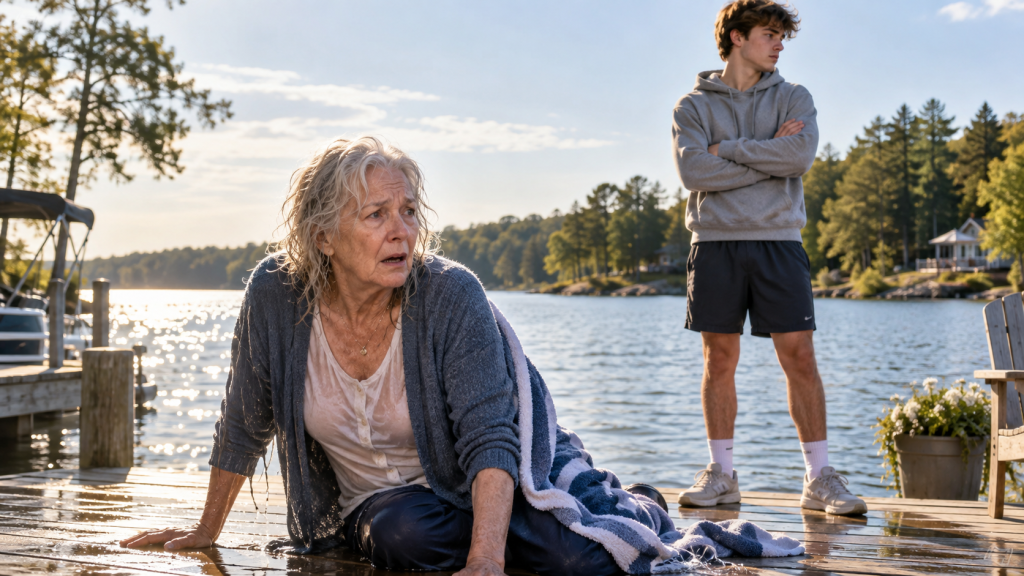
The dock was slick with algae, the late-summer sun turning the lake into a sheet of blinding silver. Margaret Hale stood near the edge, cane tucked under her arm, watching her grandson skip stones across the water.
“Careful, Evan,” she said. “That board’s unstable.”
He was nineteen, tall and restless, wearing a university hoodie that cost more than her monthly groceries. He didn’t turn around. Instead, he stepped closer—too close. She felt the shove before she saw it.
Her back hit first. Then cold.
The water swallowed her whole.
Margaret had fallen once before, years ago, and broken her wrist. This was different. The lake was deep and shockingly cold, the pressure squeezing her lungs as she sank. Her cane slipped from her hand. Her shoes dragged her down. She clawed at the water, disoriented, her mouth opening in a useless gasp.
She kicked. Weakly. Her legs burned. Her heart slammed against her ribs.
Above her, distorted by ripples, Evan’s face hovered. He was laughing.
“Grandma, stop!” he called. “Don’t be so dramatic!”
Two minutes can feel like an hour when your body is deciding whether it wants to live.
Margaret’s fingers scraped against something solid—wood. The underside of the dock. Panic sharpened her movements. She pulled herself along the beam until her head broke the surface. She coughed, choking on lake water, clinging with trembling hands.
Evan crouched, watching.
“You could’ve drowned,” she rasped.
He shrugged. “You’re fine. You always exaggerate.”
He offered no hand. Eventually, she hauled herself out alone, soaked, shaking, humiliated. People on the shore were too far away to notice. Evan grabbed his phone, already distracted, already done.
That night, she lay awake in the guest bedroom of her son’s house, listening to the hum of the air conditioner and the muffled sound of Evan laughing with friends downstairs. No one checked on her. No one asked what happened.
She stared at the ceiling and replayed the moment under the water—the weight, the darkness, the laughter.
Margaret had raised her son alone. She had paid for Evan’s private schools, his tutors, his test prep. The university fund—nearly four hundred thousand dollars—sat in an account with her name on it. She’d told herself it was love. An investment in family.
At 3:14 a.m., her breathing finally slowed.
At 3:16, something inside her hardened.
Two weeks later, the university fund was gone.
PART 2 — THE MONEY WAS NEVER HIS
At 8:07 the next morning, Evan came into the kitchen wearing headphones.
Margaret was already sitting at the table.
Her wet clothes had dried over the shower rod upstairs.
Her right shoulder ached.
There was a purple bruise spreading across one hip.
Every breath carried a faint burning sensation deep inside her chest.
Evan opened the refrigerator.
Took out orange juice.
Drank directly from the carton.
He did not look at her.
Margaret watched him.
“Evan.”
He sighed.
Pulled one headphone away.
“What?”
“Sit down.”
“I have plans.”
“Sit.”
Something in her voice made him finally turn.
For a moment, she saw the little boy who once ran barefoot through her backyard and cried when a robin flew into the kitchen window.
Then he rolled his eyes.
“Grandma, if this is about yesterday—”
“It is.”
“Oh my God.”
He laughed.
Not exactly the laugh from the dock.
Close enough.
“You really need to let that go.”
Margaret became very still.
“You pushed me into deep water.”
“You know how to swim.”
“I’m seventy-six years old.”
“So?”
“I use a cane.”
Evan shrugged.
“You got out.”
There it was.
His entire moral argument.
She survived.
Therefore nothing serious had happened.
Margaret studied him.
“And if I hadn’t?”
Evan looked irritated by the question.
“But you did.”
His father entered the kitchen before Margaret could answer.
Michael Hale, forty-nine.
Her only son.
Still broad-shouldered.
Still handsome enough that strangers trusted him faster than they should.
He had inherited his father’s dark hair and Margaret’s tendency to squint when reading.
“Morning.”
Michael kissed the top of Margaret’s head.
Then opened a cabinet.
“Coffee?”
“No.”
He stopped.
Margaret rarely refused coffee.
Michael looked at her properly.
“What happened to your face?”
She touched her cheek.
A faint scrape ran along the side of it.
“Ask your son.”
Evan groaned.
“Seriously?”
Michael turned.
“What happened?”
Evan waved one hand.
“She slipped into the lake.”
Margaret stared at him.
“No.”
Evan looked at her.
“I pushed you, whatever.”
Michael’s face changed.
Not enough.
“What do you mean you pushed her?”
“We were joking.”
“You were laughing.”
Margaret said.
“I thought she could swim.”
“You knew I could barely walk on that dock.”
“Grandma—”
Michael raised his hand.
“Enough.”
For one fragile second, Margaret thought he meant Evan.
Then Michael turned to her.
“Mom, are you okay?”
She stared.
That was the question.
Not:
Did he push you?
Not:
Why would he do that?
Are you okay?
The family version of erasing the event by measuring only the surviving damage.
“No.”
she said.
Michael sighed.
“Do you need a doctor?”
“Yes.”
That surprised him.
“Seriously?”
There it was again.
Seriously?
As though her body required permission to treat danger as danger.
“Yes.”
Margaret stood.
“I inhaled water.”
“My chest hurts.”
“My hip hurts.”
“I hit the dock climbing out.”
Evan looked uncomfortable for the first time.
Michael glanced at his son.
Then at his mother.
“Okay.”
“I’ll take you after breakfast.”
“No.”
Margaret reached for her purse.
“I’ll call a cab.”
“Mom.”
“I said no.”
She picked up her cane.
And walked out.
The urgent-care doctor listened to her lungs for a long time.
Asked about coughing.
Breathing.
Dizziness.
Possible head injury.
Then ordered a chest X-ray because Margaret had aspirated lake water and still felt tightness.
No pneumonia.
No fracture.
Significant bruising.
A mild shoulder strain.
The doctor told her what to watch for.
Fever.
Worsening shortness of breath.
Confusion.
Persistent coughing.
Margaret listened carefully.
Then the doctor asked:
“How did you fall?”
That question changed everything.
Not:
Did you fall?
How?
Margaret stared at the white paper covering the exam table.
“My grandson pushed me.”
The doctor stopped writing.
“Accidentally?”
“No.”
The word came out quietly.
“He pushed me.”
“Did he help you out?”
Margaret looked toward the window.
“No.”
“Was anyone else there?”
“No.”
“How long were you in the water?”
“I don’t know.”
“Maybe two minutes.”
“Long enough that I thought…”
Her voice broke.
The doctor waited.
“I thought I was going to die.”
The room became very quiet.
Then the doctor said:
“I’m going to document exactly what you told me.”
Margaret looked at her.
“Why?”
“Because it happened.”
Such a simple answer.
Margaret nearly cried.
For sixteen hours, everyone in the house had treated the lake like a misunderstanding.
The doctor treated it like an event.
There is enormous dignity in having reality named correctly.
Margaret let the nurse photograph the bruising for her medical record.
She accepted printed discharge instructions.
Then sat in the waiting room afterward with the papers folded inside her purse.
Her phone rang.
Michael.
She let it ring twice before answering.
“Mom, where are you?”
“At urgent care.”
“You should’ve let me drive.”
“I managed.”
A pause.
Then:
“Is everything okay?”
Margaret looked at the discharge paperwork.
“No fracture.”
“Lungs look clear for now.”
“Good.”
Michael sounded relieved.
As though the problem had ended because imaging found nothing dramatic.
Then he said:
“Listen, Evan feels awful.”
Margaret closed her eyes.
“Does he?”
“He didn’t mean to hurt you.”
“He meant to push me.”
“That’s not the same thing.”
Margaret said nothing.
Michael continued.
“He’s nineteen.”
“He does stupid things.”
“Don’t turn one stupid joke into something that damages his future.”
There it was.
The sentence that would change Margaret’s life more than the shove.
Not:
I’m sorry.
Not:
I’m ashamed.
His future.
Already.
Before anyone had suggested police.
Before Margaret had threatened consequences.
Michael had rushed to protect the life of the person who pushed her.
Not the life that had nearly ended under water.
“Why would his future be damaged?”
Margaret asked.
Michael hesitated.
“You know how things are now.”
“What things?”
“If you start telling people he assaulted you—”
“He did.”
“Mom.”
The word came sharp.
A warning.
Margaret became still.
Michael corrected his tone.
“I’m asking you to be reasonable.”
“Reasonable.”
“Yes.”
“Like you were when I put you through college?”
Silence.
“Like I was when I paid the down payment on your first house?”
“Mom—”
“Like I was when your son needed private-school tuition because you and Lauren said the public school couldn’t challenge him enough?”
“That has nothing to do with this.”
Margaret stared at the parking lot outside.
“No.”
she said softly.
“It has everything to do with this.”
Then she hung up.
She did not go back to Michael’s house immediately.
Instead, she called a number she had not used in almost a year.
Ruth Kaplan.
Attorney.
Sixty-eight.
Gray hair cut short.
A habit of making eye contact that made lies feel structurally unsound.
Ruth had handled Margaret’s estate documents after her husband died.
“Margaret?”
“Yes.”
“You sound strange.”
“I need an appointment.”
“For?”
Margaret hesitated.
Then looked at her trembling hands.
“Everything.”
Ruth paused.
“I have eleven-thirty.”
“I’ll be there.”
Margaret arrived twenty minutes early.
She carried three things.
Her purse.
Her cane.
And the small black notebook where she had tracked family money for years.
Tuition.
Loans.
Gifts.
Promises.
Numbers she had once thought proved love.
Ruth read the urgent-care paperwork first.
Then listened to the lake story without interrupting.
When Margaret finished, Ruth asked:
“Do you want to report the assault?”
“I don’t know.”
“That is your choice.”
Margaret looked at her.
“You’re not going to tell me what I should do?”
“No.”
“Why?”
“Because your grandson already made one decision about your body without your consent yesterday.”
Ruth folded her hands.
“I’m not going to follow that by taking another decision away from you.”
Margaret looked down.
Something in her chest loosened.
Then she opened the black notebook.
“I want to change Evan’s university fund.”
Ruth raised an eyebrow.
“What exactly is the account?”
“My brokerage.”
“In your name only?”
“Yes.”
“Any trust agreement?”
“No.”
“529?”
“No.”
“UTMA?”
“No.”
“Custodial account?”
“No.”
“Just investments you mentally earmarked for him?”
Margaret nodded.
“About three hundred ninety-two thousand now.”
Ruth sat back.
“Then legally, as far as that account itself goes, Evan does not have a university fund.”
Margaret stared.
“What?”
“He has a grandmother who intended to pay for university.”
Ruth tapped the notebook.
“That is different.”
The distinction hit Margaret with unexpected force.
For years, everyone said:
Evan’s fund.
Michael.
Lauren.
Evan.
Even Margaret.
As though saying the words often enough had transferred ownership.
It had not.
“I told him it was for school.”
Ruth said:
“A promise can matter morally.”
“Sometimes legally, depending on circumstances.”
“But based on what you’re describing, this is still your account.”
“We will confirm the title.”
“We will review whether you signed anything else.”
“But do not confuse family expectation with ownership.”
Family expectation.
Margaret almost laughed.
That phrase described half her life.
“What do you want the money to do now?”
Ruth asked.
Margaret had spent the taxi ride imagining answers.
Donate it.
Give it to strangers.
Create a scholarship for respectful grandchildren.
Something dramatic.
Punishment loves symbolism.
Then she remembered the lake.
Her shoes dragging her downward.
Her weak legs.
The dock just beyond her fingertips.
And realized what she truly wanted.
“I want to make sure I never have to live with Michael because I can’t afford care.”
Ruth’s expression softened.
“That is an excellent answer.”
The university fund became something else.
Not revenge.
Security.
Over the following two hours, they reviewed everything.
Margaret had more money than her family behaved as though she did.
Not vast wealth.
Enough.
Her late husband left retirement accounts.
Insurance.
Investment assets.
The house Margaret had sold three years earlier.
She had been gradually giving money away because she believed there was no point in dying with it.
Maybe there wasn’t.
But she had begun confusing generosity with surrender.
Different.
Then Ruth reached one document and stopped.
“Margaret.”
“What?”
“When did you sign this?”
She slid the page across.
Durable financial power of attorney.
Michael named as agent.
Margaret remembered.
Two years earlier.
After she fell and broke her wrist.
Michael said:
“If something happens, I should be able to pay your bills.”
Reasonable.
Ruth had prepared a limited version.
Margaret had apparently signed a broader one later through another attorney Michael recommended.
She frowned.
“I don’t remember it being this broad.”
Ruth looked up.
“How broad did you think it was?”
“Bills.”
“Emergency things.”
Ruth tapped one section.
“This gives Michael authority over brokerage accounts.”
Margaret felt cold.
“Has he used it?”
“I don’t know.”
“Can you find out?”
“Yes.”
“Can I revoke it?”
“If you have capacity, yes.”
“I have capacity.”
Ruth smiled faintly.
“I know.”
“But we document properly.”
Margaret signed the revocation that afternoon.
Ruth sent notices to the relevant institutions.
No secrecy.
No games.
Just paper closing doors Margaret had not realized were open.
Then they called her brokerage adviser.
Thomas Bell.
Margaret had known him for nine years.
Thomas sounded surprised to hear Ruth on the call.
Margaret explained that all future instructions required confirmation directly from her.
Thomas paused.
“Of course.”
Ruth asked:
“Has anyone besides Margaret recently contacted you about her accounts?”
Silence.
Too much silence.
Margaret sat straighter.
“Thomas?”
He cleared his throat.
“Michael called last month.”
The room became very still.
“What did he want?”
“He said you were considering consolidating accounts.”
Margaret stared.
“I wasn’t.”
“He asked what documentation would be required if he needed to act under power of attorney.”
Margaret stopped breathing.
Ruth’s expression did not change.
“What did you tell him?”
Thomas replied:
“That we would need the executed document reviewed by compliance.”
“Did he submit it?”
“No.”
Margaret found her voice.
“What else did he ask?”
Thomas hesitated.
“Whether the education account for Evan could be transferred into an irrevocable structure.”
My account.
Margaret thought.
Not Evan’s.
Mine.
“Did you do anything?”
“No.”
“I told him you needed to call me.”
“Did you call me?”
Thomas became quiet.
“No.”
“Why?”
“He said he was discussing preliminary planning with you.”
Margaret closed her eyes.
The lake flashed behind them.
Cold.
Silver.
Evan laughing.
Then Michael’s voice that morning:
Don’t turn one stupid joke into something that damages his future.
The future.
The fund.
The power of attorney.
For the first time, the pieces existed in the same room.
Not proof of conspiracy.
Not evidence Michael told Evan to push her.
Nothing that dramatic.
But something had already been moving beneath the family surface before Margaret hit the water.
“What exactly did Michael tell you about me?”
Margaret asked.
Thomas sounded uncomfortable.
“He said you had become…”
He stopped.
“Say it.”
“Forgetful.”
Margaret stared at Ruth.
Thomas continued.
“He said you were making impulsive financial decisions.”
“What decisions?”
“Gifts.”
Margaret laughed.
“Gifts to whom?”
“Family members.”
The absurdity was almost perfect.
The money she voluntarily gave them had become evidence she could not manage money.
“Did he say I had dementia?”
“No.”
“Did he imply it?”
Another pause.
“He said the family was concerned about cognitive decline.”
Margaret’s hands became cold.
Ruth leaned forward.
“Thomas, please preserve your notes from those communications.”
“I will.”
“And send Margaret copies of any communications she is entitled to receive.”
“Yes.”
Margaret barely heard him.
Cognitive decline.
The phrase echoed.
After the call ended, Margaret whispered:
“He’s been building a story.”
Ruth answered carefully.
“Maybe.”
“Don’t say maybe.”
“I will say exactly what we know.”
Ruth counted on her fingers.
“Michael contacted your adviser.”
“He asked about exercising authority under your power of attorney.”
“He asked about moving the money you intended for Evan.”
“And he described concerns about your cognition.”
“That is what we know.”
“Why would he do that?”
“That is what we do not know.”
Margaret hated her for being precise.
Which meant precision was probably necessary.
“What do I do?”
Ruth asked:
“What do you want?”
Margaret looked toward the window.
For years, the answer to that question had usually contained someone else’s name.
What does Michael need?
What does Evan need?
What would Lauren prefer?
What did her late husband want?
What would make Christmas easier?
What would keep everyone close?
Now:
What do you want?
Margaret thought about the lake.
Then answered:
“A hotel.”
Ruth blinked.
“A hotel?”
“I’m not sleeping in Michael’s house tonight.”
A smile appeared.
“That I can arrange without a law degree.”
Margaret returned to Michael’s house at four-thirty.
Not alone.
Ruth insisted on coming.
Not because she expected violence.
Because witnesses are useful when families turn memory into negotiation.
Michael’s Mercedes was in the driveway.
Evan’s SUV beside it.
Margaret entered with her own key.
Lauren appeared from the kitchen.
“Oh, thank God.”
She hugged Margaret.
Margaret did not hug back.
Lauren noticed.
“What happened?”
“I’m collecting my things.”
Lauren stared.
“What?”
Michael came downstairs.
“Mom.”
His eyes moved to Ruth.
Then narrowed.
“What is she doing here?”
Ruth smiled politely.
“Hello, Michael.”
“Mom, what’s going on?”
Margaret adjusted her grip on the cane.
“I’m leaving.”
“Leaving where?”
“Here.”
“For how long?”
“I don’t know.”
“Why?”
That almost made her laugh.
“Because your son pushed me into a lake and nobody in this house seems particularly troubled by it.”
Lauren’s mouth opened.
“Evan said you slipped.”
Margaret stared.
“No.”
Lauren looked toward Michael.
He looked away.
There.
Another small truth.
“Where is Evan?”
Margaret asked.
Michael’s voice hardened.
“Why?”
“Because I’m not sneaking out of a house like I’ve done something wrong.”
Evan appeared at the upstairs railing.
Earbuds.
Phone.
Expression irritated.
“Seriously?”
Always that word.
Margaret looked up at him.
“Come down.”
“No.”
Michael said:
“Evan.”
The boy descended reluctantly.
Margaret waited.
Then reached into her purse.
She took out a printed brokerage statement.
Placed it on the entry table.
Evan frowned.
“What’s that?”
“The money I intended to use for your university.”
His face changed.
Michael’s too.
Margaret continued.
“I changed my plans today.”
Silence.
“What do you mean?”
Evan asked.
“It means I will not be paying your tuition.”
His face emptied.
Then filled again.
Anger.
“What?”
“I am no longer funding your education.”
“You can’t do that.”
Margaret almost smiled.
“I can.”
“You promised.”
“Yes.”
“You’ve been telling me my whole life—”
“I know.”
“You said college was taken care of.”
“I did.”
Evan looked at Michael.
“Dad.”
Michael stepped forward.
“Mom, don’t do this.”
Margaret looked at him.
“I already did.”
It was not completely true yet.
The money had not vanished.
Not physically.
The brokerage trades and transfers would settle over several days.
But instructions had been entered.
The earmarking was gone.
The account would be reorganized as part of Margaret’s own care reserve and estate plan.
The emotional truth had already settled.
Evan’s entitlement no longer had an account number attached to it.
His face reddened.
“This is because of one joke?”
Margaret stared.
“You still think it was a joke.”
“You’re fine.”
That sentence again.
Fine.
As though survival erased intent.
“You could’ve killed me.”
“But I didn’t.”
“No.”
Margaret’s voice became soft.
“You just stood there laughing while I saved myself.”
For the first time, Evan looked away.
Not remorse.
Discomfort.
Still something.
Michael stepped between them.
“Mom, he was stupid.”
“Yes.”
“He’s nineteen.”
“Yes.”
“His entire future should not be destroyed over one terrible decision.”
Margaret looked at her son.
“Interesting.”
“What?”
“You think losing my money destroys his future.”
Michael frowned.
“That’s not what I said.”
“It is exactly what you said.”
She looked at Evan.
“You still have a future.”
“You can apply for loans.”
“Scholarships.”
“You can work.”
“You can attend somewhere less expensive.”
“You can take a year.”
“You can ask your parents.”
Evan scoffed.
“That’s insane.”
“No.”
Margaret said.
“That’s adulthood.”
Lauren finally spoke.
“Margaret, please.”
Her voice trembled.
“You know what tuition costs.”
“Yes.”
“You know Michael and I can’t cover that kind of school.”
“Yes.”
“And you’re doing this anyway?”
Margaret looked at her.
“Yes.”
Lauren’s face hardened.
The politeness vanished.
“So you’re punishing all of us.”
There it was.
Margaret’s money had become the family’s collective right.
Her saying no became aggression.
Maybe that was the clearest evidence of how long she had been saying yes.
Evan’s voice rose.
“You’re crazy.”
The room went silent.
Michael snapped:
“Evan.”
But too late.
Margaret looked at him.
“What did you say?”
Evan crossed his arms.
“You’re acting crazy.”
“You almost drown because you can’t swim anymore, and now you’re destroying everything.”
Margaret felt cold.
Not because of the insult.
Because of the phrasing.
You can’t swim anymore.
Not:
I pushed you.
Her inability.
Not his action.
Then:
“You forget stuff all the time.”
Margaret stared.
Michael became very still.
Ruth noticed too.
“What do I forget?”
Margaret asked.
Evan shrugged.
“Things.”
“What things?”
“I don’t know.”
“You just said all the time.”
“Dad said—”
He stopped.
There it was.
Michael’s face changed.
Margaret turned slowly toward him.
“What did Dad say?”
Evan looked trapped.
Michael answered first.
“Nothing.”
Ruth said quietly:
“I think Evan should answer.”
Michael glared at her.
“This is family business.”
Ruth nodded.
“Yes.”
“And Margaret is asking a family question.”
Evan looked at his father.
Then at his grandmother.
“He said you’ve been getting confused.”
Margaret’s stomach tightened.
“When?”
“I don’t know.”
“He said you shouldn’t be handling so much money alone.”
Silence.
Lauren whispered:
“Michael.”
He snapped:
“Not now.”
Margaret barely heard him.
“How long has your father been saying that?”
Evan shrugged.
“Months?”
Months.
Before the lake.
Before the push.
Before any reason they could pretend concern began.
Margaret looked at Michael.
“You told him I’m losing my mind.”
“I did not say that.”
“You told my financial adviser I was showing cognitive decline.”
His face drained.
Ruth had not told him she knew.
That was obvious.
Michael looked at Ruth.
“You called Thomas?”
“Margaret did.”
He turned back to his mother.
“You’re misunderstanding.”
“Explain.”
“I was trying to help.”
“How?”
“You’re seventy-six.”
“So?”
“You’ve been making large gifts.”
“To you.”
Michael went silent.
“To your son.”
Silence.
“To your family.”
“Exactly.”
He said.
“You give money away impulsively.”
Margaret stared.
“For twenty years you called that generosity.”
Michael rubbed his forehead.
“This is why we need to talk when you’re calmer.”
“No.”
“I am calm.”
“You’re reacting emotionally.”
Margaret laughed.
Softly.
The sound surprised everyone.
“Michael.”
“What?”
“I nearly drowned yesterday.”
“I am allowed an emotion.”
She picked up her overnight suitcase.
Ruth lifted the second.
Michael stepped forward.
“Mom, where are you going?”
“A hotel.”
“That’s ridiculous.”
“Maybe.”
“You have a room here.”
“No.”
“I have a room in your house.”
“Different.”
He looked wounded.
Interesting.
“Are you really leaving over this?”
Margaret looked at him for a long moment.
“No.”
Michael seemed relieved too quickly.
Then she continued.
“I’m leaving because I finally understand this started long before the lake.”
His expression changed.
Evan called after her as she reached the door.
“What about my tuition?”
Margaret stopped.
Did not turn around.
For years, that question would have broken her.
She would have imagined him lost.
Ashamed.
Falling behind.
She would have rushed to repair the future before he felt consequences in the present.
Now she said:
“You have parents.”
Then walked outside.
The hotel room cost more per night than Margaret liked.
She booked it anyway.
There was a white comforter.
Bad artwork.
Tiny coffee maker.
A chair beside the window.
Nothing sentimental.
Nothing belonging to Michael.
Nothing Evan could claim.
Margaret took a hot shower.
Then sat in the hotel robe eating soup from room service.
At seventy-six, freedom apparently tasted like overpriced tomato bisque.
She laughed.
Then cried.
Both seemed reasonable.
Michael called seventeen times.
Lauren six.
Evan sent one message.
You’re ruining my life.
Margaret read it.
Did not answer.
Then another arrived ten minutes later.
Grandpa would be ashamed of you.
That one hurt.
Her late husband, Peter, adored Evan.
Had started the university fund idea.
Margaret could almost hear him:
Let the boy have every chance we didn’t.
She placed the phone face down.
Then whispered to the empty room:
“He already had chances.”
That was the thing nobody wanted to say.
Evan had not been deprived.
He had been cushioned.
Private school.
Tutors.
Travel.
Car.
Allowance.
A future prepaid before he learned what one cost.
Perhaps Margaret had confused removing obstacles with building character.
That grief belonged partly to her.
Not the lake.
The years before it.
The next morning, Ruth called.
“I need you in my office.”
Margaret sat up.
“What happened?”
“Nothing catastrophic.”
That was lawyer language for:
Get dressed.
“What?”
“I received a call from your bank’s elder-services unit.”
Margaret’s heart tightened.
“Why?”
“Because the power-of-attorney revocation triggered a review of recent inquiries.”
“What inquiries?”
“Come in.”
Margaret arrived at ten.
Ruth had coffee ready.
That frightened her.
Lawyers do not make coffee before good news.
Ruth slid three printed pages across the desk.
The first was a bank call log.
Michael’s name.
Six weeks earlier.
Another call four weeks earlier.
Then one eleven days before the lake trip.
Margaret looked up.
“What was he doing?”
“Asking about your accounts.”
“He doesn’t bank there.”
“No.”
“What exactly did he ask?”
Ruth pointed.
Whether the institution accepted durable powers of attorney.
Whether an agent could consolidate CDs.
Whether an agent could close a safe-deposit box.
Margaret went cold.
“My safe-deposit box?”
Ruth nodded.
“What is in it?”
“Jewelry.”
“Original property deeds.”
“Peter’s military medals.”
Then Margaret remembered.
“And my old trust documents.”
Ruth became very still.
“Which trust documents?”
“The first version.”
“Before we changed beneficiaries after Peter died.”
Ruth leaned back.
“What did the old version say?”
Margaret thought.
Then understood why the question mattered.
Michael had once been successor trustee over nearly everything.
Before Margaret revised the plan six years earlier and appointed a professional co-trustee.
Michael knew that.
He had been angry.
Called it “unnecessary legal expense.”
She had forgotten the argument.
Not from cognitive decline.
Because families have thousands of arguments and most are not important until years later.
“Could he use old documents?”
Ruth shook her head.
“Not validly if superseded.”
“Then why would he want them?”
“I don’t know.”
Margaret hated the answer.
Then Ruth slid over the second page.
An email from Michael to another attorney.
Not privileged with Margaret.
A general inquiry.
He asked about:
Options when an elderly parent demonstrates declining judgment but refuses assistance.
Margaret’s hands started shaking.
Date:
Three months earlier.
Before Evan pushed her.
Before Michael had any lake story to point toward.
The final page was worse.
A message Michael sent to Lauren.
Obtained because Lauren, apparently frightened after the confrontation, had forwarded it to Ruth that morning.
It read:
If Mom keeps changing things, we may need to get ahead of this before Evan starts school. Once she moves the tuition money, we’ll never get it back under control.
Margaret read it twice.
Then a third time.
The room became silent.
Ruth spoke carefully.
“This is not proof Michael planned what happened at the lake.”
Margaret nodded.
“I know.”
“It does not mean he told Evan to hurt you.”
“I know.”
“But it does show he was thinking about controlling your finances before the incident.”
“Yes.”
Margaret stared at the word:
control.
Not help.
Not protect.
Control.
Then Ruth said:
“There’s more.”
Margaret almost laughed.
“Of course.”
“Lauren says she wants to talk to you.”
“About what?”
“She says Evan told her something last night.”
Margaret’s chest tightened.
“What?”
Ruth did not answer.
“She wants to tell you herself.”
“Why?”
“Because she says she was wrong to stay quiet.”
The words made Margaret cold.
“Stay quiet about what?”
Ruth looked at her.
“She says the lake was not the first time Evan joked about what would happen if you were no longer making your own financial decisions.”
Margaret stopped breathing.
“What exactly did he say?”
Ruth’s voice softened.
“Lauren wants to meet you here.”
“When?”
“She’s downstairs.”
Margaret stared at the office door.
Everything in her wanted to leave.
To go back to the hotel.
Lock the door.
Let the family collapse without her.
Then she remembered the lake.
The moment beneath the dock when her fingers found wood.
She had pulled herself toward air because some primitive part of her refused to disappear quietly.
Maybe this was the same thing.
Not revenge.
Air.
“Bring her up.”
Lauren entered five minutes later.
No makeup.
Hair tied back.
Eyes swollen.
She looked nothing like the woman who had accused Margaret of punishing the family the previous afternoon.
She sat.
Hands shaking.
“Margaret…”
“Tell me.”
Lauren began crying.
“I should have told you before.”
“Tell me.”
She nodded.
“Three weeks ago, Evan and Michael were arguing about college.”
Margaret’s stomach tightened.
“What about it?”
“Evan wanted an apartment off campus.”
“Michael said your budget only covered tuition and dorms.”
“My budget?”
Lauren looked ashamed.
“That’s what they call it.”
Of course.
She continued.
“Evan said it didn’t matter because eventually all your money was Dad’s anyway.”
Margaret became still.
“What did Michael say?”
“Nothing at first.”
“Then Evan laughed and said maybe they should just get you declared incompetent now and save everyone the paperwork later.”
The room went silent.
Margaret could hear the clock.
Tick.
Tick.
Tick.
“What did Michael say?”
Lauren’s tears fell harder.
“He told him not to joke about things he didn’t understand.”
Margaret exhaled.
Not approval.
Not exactly.
Then Lauren continued.
“And Evan said, ‘You’re the one who said Grandma falling would make everything easier.’”
Margaret stopped breathing.
Ruth sat forward.
“Lauren, I need you to repeat that carefully.”
Lauren nodded.
Her face had gone white.
“Evan said Michael told him that if Margaret had another serious fall, the family could finally convince her to stop managing everything herself.”
Margaret stared at her.
The lake came back.
The slick dock.
Evan too close.
The shove.
His laughter.
Don’t be so dramatic.
Her grandson’s words had seemed careless.
Stupid.
Cruel.
Now another possibility opened beside them.
Not that Michael ordered anything.
Not that Evan tried to kill her.
But that a nineteen-year-old had spent months hearing adults talk about her body failing as though failure would be financially convenient.
Then, one afternoon beside deep water, he decided her vulnerability was funny.
Sometimes people do not need explicit instructions.
They only need to learn whose safety matters least.
Margaret looked at Ruth.
“What do I do now?”
Ruth’s answer came quietly.
“You decide what you want investigated.”
Not:
Destroy them.
Not:
Forgive them.
Decide.
Margaret looked toward Lauren.
Then at the bank records.
Michael’s email.
The medical paperwork inside her purse.
For twenty years, she had been the person smoothing things over.
Paying.
Forgiving.
Explaining.
Protecting futures.
Now she thought of the two minutes underwater.
Nobody had protected hers.
She reached for her phone.
“What are you doing?”
Lauren whispered.
Margaret looked at the screen.
“For the first time in this family…”
She paused.
“…I’m going to tell someone exactly what happened and let them decide what it means.”
Then she dialed the non-emergency police number.
And when the dispatcher answered, Margaret Hale stopped calling the lake a family matter.
PART 3 — THE WATER BELONGED TO ME AGAIN
The police did not arrive with handcuffs.
That disappointed a part of Margaret she was not proud of.
She had spent the taxi ride from Ruth’s office imagining something dramatic.
A detective walking into Michael’s house.
Evan being confronted.
The entire family forced, finally, to feel the seriousness she had been carrying alone since the lake closed over her head.
Instead, an officer named Daniel Price met Margaret in a small interview room with beige walls, fluorescent lights, and a vending machine humming in the hallway.
He offered her water.
She almost laughed.
“No, thank you.”
He did not understand the joke.
That was fine.
Not everything needed explaining.
Officer Price listened.
All of it.
The shove.
The laughter.
Evan refusing to help.
The medical visit.
Michael telling her not to damage Evan’s future.
The financial adviser.
The power of attorney.
The emails.
Lauren’s statement.
Margaret expected disbelief somewhere in the middle.
It never arrived.
She also expected immediate conclusions.
Those never arrived either.
Instead, Price said:
“We need to separate several things.”
Margaret frowned.
“They feel connected.”
“They may be.”
He folded his hands.
“But feeling connected and being provably connected are different.”
Ruth, sitting beside Margaret, nodded slightly.
Of course she did.
Lawyers apparently formed secret clubs where everyone enjoyed telling frightened people to slow down.
Price continued.
“The incident at the lake is one matter.”
“Possible financial exploitation is another.”
“Statements suggesting concern about your capacity are relevant.”
“But they do not automatically prove anyone planned physical harm.”
Margaret looked down.
“So what happens?”
“We investigate what can be investigated.”
“Will Evan be interviewed?”
“Yes.”
“Michael?”
“Likely.”
“Lauren?”
“Yes.”
Margaret gripped her cane.
“And if everyone says I’m confused?”
Price looked directly at her.
“Then we compare statements with records.”
Simple.
She had spent a week terrified that age had made truth fragile.
The officer reminded her that truth could have witnesses other than memory.
Medical notes.
Phone logs.
Emails.
Financial records.
Statements made before anyone realized they might matter.
Sometimes paperwork is the only person in a family with no loyalty conflict.
The lake itself offered evidence too.
Not perfect evidence.
But enough.
The Hale family’s lake property sat inside a private community whose boat launch had security cameras.
The dock where Evan pushed her was not directly covered.
But one camera faced enough of the shoreline to show Margaret and Evan walking onto the dock together.
Then, four minutes later, Margaret disappearing abruptly from view.
The splash appeared at the edge of the frame.
Evan remained standing.
For almost forty seconds.
Then crouched.
Then stood again.
He did not enter the water.
Did not run for help.
Did not reach toward the water until Margaret had already pulled herself partly onto the dock.
The video could not show the shove.
But it showed something Margaret’s family had tried to erase.
She had not slipped and been immediately rescued by a worried grandson.
Whatever happened, Evan watched.
Then came something more useful.
A text message.
Evan had sent it to a friend eleven minutes after the incident.
The friend voluntarily showed investigators after Evan called him and asked what he should say if police contacted him.
The original message read:
pushed grandma in the lake lol she acted like I murdered her
Margaret read that line in Ruth’s office three days later.
She felt nothing at first.
Then something strange.
Relief.
Ugly relief.
Not because she wanted Evan punished.
Because she no longer needed to defend her own memory.
He had written it himself.
Pushed grandma.
Not:
Grandma fell.
Not:
Accident.
Pushed.
A nineteen-year-old boy had reduced the worst two minutes of Margaret’s life to twelve careless words.
But those words also gave her reality back.
Evan’s interview changed quickly after police showed him the text.
At first, he said Margaret lost her balance.
Then he said he “nudged” her.
Then, finally, he admitted using both hands.
He insisted he did not mean for her to fall so far.
That he thought the water was shallower.
That he thought she could swim better.
That he was joking.
Every explanation centered on what he had expected.
Not what Margaret had experienced.
That was familiar.
He cried during the second interview.
Margaret learned that from Lauren.
For one brief moment, her grandmother’s heart responded automatically.
Poor boy.
Then she stopped.
Nineteen was young.
It was not five.
Evan could be frightened by consequences without being rescued from them.
The investigation found no evidence that Michael had told Evan to push her.
None.
That mattered.
Lauren’s recollection was accurate.
Michael had complained repeatedly that another serious fall might convince Margaret to accept help.
He had said, during one argument:
Maybe if Mom falls again, she’ll finally understand she can’t keep managing everything alone.
Cruel.
Patronizing.
Dangerous in its own way.
But investigators found no message saying:
Push her.
Scare her.
Make her fall.
No planning.
No conspiracy.
No secret instruction.
Margaret felt two things when Ruth explained that conclusion.
Relief.
And disappointment.
The disappointment embarrassed her.
Because a secret plan would have made the story cleaner.
Villains.
Victim.
Intent.
Instead, the truth was uglier in a quieter way.
Michael had spent months speaking about his mother’s independence as though it were an inconvenience.
Evan had listened.
Then one afternoon, he treated her physical vulnerability like a joke.
Nobody ordered it.
A family atmosphere did not need orders.
Sometimes contempt only needs permission to become casual.
Officer Price said something Margaret never forgot.
“People learn who is safe to disrespect by watching which disrespect adults excuse.”
Margaret sat with that sentence for a long time.
Michael had never told Evan to hurt her.
But he had laughed when Evan called her stubborn.
He had rolled his eyes when she refused help.
He had discussed her money in front of him as though it were future family property.
He had repeatedly described her independence as temporary.
And after the lake, his first instinct had been to protect Evan’s future.
Not hers.
No crime in some of that.
Still damage.
Law and morality were not identical maps.
Margaret was learning that too.
The district attorney eventually charged Evan in connection with the lake incident.
The exact labels mattered less to Margaret than the facts beneath them.
He had intentionally shoved an elderly person near deep water.
He had failed to help while she struggled.
He had later minimized what he did.
The case did not become national news.
No cameras crowded the courthouse.
No dramatic television interview.
Just one frightened nineteen-year-old wearing a suit that did not fit quite right.
One grandmother with a cane.
Several lawyers.
And a judge who had seen too many families arrive in court claiming something had been “just a joke.”
Evan entered a plea.
He avoided jail.
That angered some people when they heard.
Margaret was not sure how she felt.
He received probation.
Mandatory counseling.
Community service.
A no-contact condition unless Margaret later requested modification.
And restitution for certain medical expenses.
The prosecutor asked Margaret before agreeing.
She listened.
Then said:
“I don’t need prison to prove the lake happened.”
That surprised even her.
She wanted consequence.
Not destruction.
There was a difference.
Evan losing a year of his life behind bars would not put Margaret’s cane back in her hand beneath the water.
Would not make him offer a hand when he should have.
Would not repair the laugh.
What mattered more was whether he finally understood another person’s body was not a stage for his amusement.
The court could require counseling.
It could not require wisdom.
That part would be his work.
Michael’s situation was different.
There was no criminal case over Margaret’s money.
Because he had not taken it.
Important.
He had asked questions.
Used a valid power of attorney while planning for possible future control.
Spoken to advisers.
Made assumptions.
Crossed boundaries.
But the investigation found no unauthorized withdrawal.
No forged signature.
No missing funds.
For a few days, Margaret was almost furious that he could behave so badly without having committed a prosecutable offense.
Then Ruth said:
“The law is not a machine for converting every betrayal into a crime.”
Margaret hated that sentence.
Then accepted it.
Eventually.
The bank’s elder-services unit still documented the concerns.
The brokerage firm changed security procedures on Margaret’s accounts.
No instructions from anyone else without independent verification.
No reliance on old powers of attorney.
No family intermediaries.
Ruth helped Margaret execute new documents.
A professional fiduciary became her backup financial agent.
Her physician became part of a future capacity-review process if one was ever genuinely needed.
Not Michael.
Not Lauren.
Not Evan.
Professional people with duties defined in writing.
Margaret signed every page slowly.
Then read them again.
At seventy-six, she discovered that trust is beautiful when given freely and terrifying when written too broadly.
She also changed her will.
Not out of rage.
That took time.
At first, she wanted Michael removed from everything.
Then restored.
Then removed again.
Grief is indecisive.
Ruth made her wait thirty days before signing the final version.
Good.
Margaret kept significant gifts for family.
Smaller than before.
Structured.
No one inherited control over anyone else.
A portion went to a local program providing legal and financial counseling to older adults facing coercion or exploitation.
Ruth suggested naming it after Margaret.
She refused.
“Put my name on a bench someday.”
she said.
“Not on people’s emergencies.”
Ruth smiled.
Done.
The $392,000 once called “Evan’s university fund” changed purpose completely.
Some remained invested.
Some moved into a long-term-care reserve.
Some went into home and accessibility planning.
Margaret bought better health coverage than she previously allowed herself.
She paid for physical therapy.
Replaced the old stair rail in her house.
Hired someone to shovel snow instead of insisting she could still do it alone.
That last one annoyed her deeply.
Independence, she learned, was not the same as refusing every form of assistance.
That lesson cut both ways.
Michael had been wrong to treat help as authority.
Margaret had sometimes been wrong to treat receiving help as surrender.
There was middle ground.
Adults are apparently sentenced to discovering middle ground shortly after becoming too tired for extremes.
Evan did not return to the expensive university he had planned to attend.
Not because Margaret called the school.
She did not.
Not because she demanded his admission revoked.
She never contacted them.
The tuition deposit deadline simply came.
No $400,000 grandmother fund.
Michael and Lauren could not cover the entire cost.
Evan had options.
Loans.
Financial aid appeals.
A less expensive state university.
Community college.
Gap year.
Work.
The apocalypse his family predicted did not arrive.
His future changed.
It did not vanish.
That distinction annoyed him at first.
Eventually, apparently, it educated him.
He enrolled at a state university the following year.
Worked part-time at a recreation center.
Took loans.
Complained constantly, according to Lauren.
Margaret almost smiled when she heard.
Then stopped herself from turning hardship into moral theater.
Working a job did not automatically produce character.
Rich children are not purified by suffering any more than poor children are improved by having less.
Evan would either learn from consequences or not.
Margaret was no longer funding the lesson.
That was enough.
She moved out of the hotel after eleven days.
Not back to Michael’s house.
Back to her own small condominium across town.
She had kept it after selling the larger family home.
At first, everyone treated the condo like a temporary stop before she eventually “needed” to move in with someone.
Margaret had believed that too.
Now she walked inside, put her suitcase down, and looked around differently.
Two bedrooms.
Wide windows.
Small balcony.
Elevator in the building.
Pharmacy downstairs.
Bus line nearby.
Not temporary.
Home.
She hired someone to install grab bars in the bathroom.
Michael would have called that proof she was declining.
Margaret called it not wanting to crack her skull over pride.
Growth.
Her first night back, she slept badly.
At 2:10 a.m., she woke convinced she was underwater.
Her hands clawed at the sheets.
Her chest hurt.
For several seconds she could hear Evan laughing from the dock.
Then the room returned.
Ceiling fan.
Streetlight.
Water glass.
No lake.
Margaret sat upright.
Cried.
Then did something she had spent most of her life avoiding.
She called someone.
Not Michael.
Not because Michael was forbidden forever.
Because he was not safe for this particular moment.
She called Ruth.
At 2:17.
Ruth answered on the fourth ring.
“This had better be death or excellent gossip.”
Margaret laughed through tears.
“I had a nightmare.”
Silence.
Then Ruth’s voice softened completely.
“Do you want me to come over?”
Margaret almost said no.
Automatic.
Then:
“Yes.”
Ruth arrived in pajamas beneath a trench coat forty minutes later.
Help without ownership.
That was the model Margaret had been looking for.
Michael kept calling.
Margaret ignored him for almost a month.
Then one afternoon, she answered.
Not because he deserved access.
Because she wanted the conversation.
“Mom.”
His voice cracked.
“Hello, Michael.”
He exhaled.
“I didn’t think you’d answer.”
“I almost didn’t.”
Fair.
Then silence.
Michael finally said:
“I’m sorry.”
Margaret closed her eyes.
“For what?”
A useful question.
Maybe the most useful.
“For Evan.”
“That is not yours to apologize for.”
Michael went quiet.
“Try again.”
“For talking about you like you weren’t in charge of your own life.”
Closer.
“For calling Thomas.”
“Yes.”
“For the power of attorney.”
“Yes.”
“For assuming your money would eventually be mine.”
Margaret’s throat tightened.
“Yes.”
Michael continued.
“For telling Evan you were getting confused.”
“Were you worried?”
He hesitated.
“Yes.”
“About my mind?”
A longer silence.
“About losing control of things.”
There it was.
Honest enough to hurt.
“What things?”
Margaret asked.
“The estate.”
“Evan’s tuition.”
“The house.”
“Your accounts.”
“Why?”
“I thought Dad expected me to take care of everything after he died.”
Margaret almost laughed.
“Your father expected you to take care of me.”
Michael became quiet.
“That is not the same thing as taking over.”
“I know that now.”
“Do you?”
“I’m trying.”
Margaret looked out the window.
Traffic below.
People going places.
No one waiting for her permission.
Then Michael said:
“I never wanted Evan to hurt you.”
“I know.”
Margaret surprised herself.
“How?”
“Police found nothing.”
“That’s not what I mean.”
His voice cracked.
“I need you to believe me.”
Margaret thought about that.
Then answered carefully.
“I believe you did not tell him to push me.”
Michael exhaled.
“But?”
“There is always a but.”
He almost laughed.
“But I think you helped teach him that my weakness would make life easier for everyone.”
Silence.
Michael started crying.
She could hear it.
She did not rush to rescue him from the sentence.
For most of his life, Margaret had softened every truth before giving it to her son.
He was forty-nine.
He could hold one sharp thing himself.
“I’m sorry.”
he said again.
This time Margaret believed the sorrow.
Belief did not erase boundaries.
Good lesson.
“What happens now?”
Michael asked.
“I don’t know.”
“Can I see you?”
“Not yet.”
“Christmas?”
“We’ll see.”
“Mom.”
“What?”
“I miss you.”
Margaret’s eyes filled.
“I miss you too.”
That was the cruelest truth.
Boundaries are easier when love is gone.
Sometimes it remains.
You build the boundary anyway.
Lauren came first.
Margaret invited her for coffee.
Not Michael.
Not Evan.
Lauren arrived holding flowers.
Margaret looked at them.
Lauren immediately said:
“I know, cliché.”
“Very.”
They both laughed awkwardly.
Then Lauren sat.
She apologized.
For accepting Evan’s story.
For telling Margaret she was punishing the whole family.
For seeing Michael’s conversations about money and deciding they were “planning” instead of asking whether Margaret had agreed.
Margaret listened.
Then said:
“You were afraid of losing your son’s future.”
Lauren nodded.
“I was.”
“And that made mine smaller.”
Lauren cried.
“Yes.”
Margaret believed her too.
Again, belief was not the same as restoration.
“Why did you tell Ruth?”
Margaret asked.
Lauren looked down.
“Because I heard Michael telling Evan you were overreacting.”
“After you nearly drowned.”
“And I realized I was listening to the same conversation happen again.”
She swallowed.
“Everybody was more worried about what you might do to us than what Evan had done to you.”
Margaret sat back.
That was exactly it.
Not one monster.
A whole family oriented toward the wrong emergency.
Sometimes harm survives because everyone is facing the wrong direction.
Evan’s first letter arrived seven months after the court case.
Margaret knew his handwriting immediately.
Blocky.
Impatient.
She left it unopened for nine days.
Then opened it at Ruth’s office.
Not because she was afraid he had written something violent.
Because reading an apology can create pressure to respond.
Ruth reminded her:
“You may read words without signing a contract with them.”
Margaret smiled.
Useful.
The letter was three pages.
The first was bad.
Mostly explanation.
He had been joking.
He thought she could swim.
His friends pushed each other into lakes all the time.
Margaret almost stopped.
Then page two changed.
Evan wrote:
Counselor says I keep explaining because I want intention to cancel impact. I don’t think it does.
Margaret read that twice.
Then:
I knew you used a cane. I knew the dock was slippery. I pushed you anyway because I thought your fear would be funny.
No excuse.
Better.
When you couldn’t get out, I still thought helping you would mean admitting I had done something bad. So I stood there. That part is worse to me now than the shove.
Margaret’s hand trembled.
He understood one piece.
Finally.
Then:
Dad talked about your money too much. I listened too much. I started thinking of things as mine before they were mine. College. The lake house. Your money someday. I don’t think Dad told me to hurt you. He didn’t. But I think I stopped seeing you as a person who could lose something and started seeing you as the person who controlled things I wanted.
Margaret cried.
Not because she forgave him.
Because nineteen-year-old Evan had finally written the sentence sixty-year-old family members often never reach.
I stopped seeing you as a person.
That was the crime beneath many smaller cruelties.
The final paragraph said:
I am sorry. I don’t expect the university money back. I don’t expect you to answer. I’m writing because you asked me once what would have happened if you drowned, and I said it didn’t matter because you didn’t. I think about that now. It matters that I was willing to risk a future where you weren’t there.
Margaret folded the letter.
Sat quietly.
Ruth passed her tissues.
“You going to answer?”
“I don’t know.”
“Good.”
Margaret laughed through tears.
Apparently uncertainty could be healthy too.
She answered three weeks later.
Four sentences.
Evan, I read your letter. I believe you are beginning to understand what happened. I am glad you are doing the work. I am not ready to see you yet. Keep doing the work anyway.
No:
I forgive you.
No:
Family is family.
No money.
No tuition.
No promise.
The response belonged to the truth she actually felt.
Nothing more.
A year passed.
Margaret’s world grew larger rather than smaller.
That surprised everyone.
Including Margaret.
She joined a water-aerobics class.
Not because she loved water.
The first session nearly sent her home.
She stood beside the pool wearing a navy swimsuit and stared at the surface until her throat tightened.
The instructor noticed.
“First time?”
Margaret almost said yes.
Then:
“Not exactly.”
The instructor did not ask.
Good person.
She simply said:
“You can stay on the steps today.”
So Margaret did.
Ten minutes.
Then twenty.
Then waist deep.
No one pushed her.
No one laughed.
She decided when to go farther.
That mattered more than exercise.
By spring, she could float again.
The first time, she cried.
The instructor thought something hurt.
Margaret shook her head.
“I’m fine.”
Then laughed at the phrase.
Fine.
The word everyone once used to erase the lake.
Now she used it honestly.
Floating.
Supported.
Choosing.
Fine.
Michael entered counseling too.
Margaret learned from Lauren.
She did not reward him for it.
But six months later, she agreed to meet him.
Public restaurant.
One hour.
Michael arrived early.
No financial documents.
No plans.
No advice.
He asked:
“How are you?”
Margaret smiled.
“Very dangerous question.”
He laughed nervously.
Then listened to the actual answer.
Physical therapy helped.
Sleep improving.
Water class.
New investment plan.
He started to suggest something about tax efficiency.
Stopped himself.
Margaret noticed.
Progress can be microscopic.
Still progress.
At the end, Michael said:
“I kept thinking taking care of you meant preparing to take over.”
Margaret nodded.
“Why?”
“Because after Dad died, you seemed alone.”
“I was alone.”
“I hated it.”
“So you tried to solve it.”
“Yes.”
Margaret looked at him.
“Loneliness is not incapacity.”
His eyes filled.
“I know.”
“Now?”
“Yes.”
Good.
Evan waited almost two years before Margaret agreed to see him.
He was twenty-one.
Thinner.
Older around the eyes.
Working while attending school.
No university hoodie.
No expensive watch.
Margaret hated noticing these things because she did not want poverty cosplay to become proof of goodness.
Character cannot be measured by whether a young man owns designer shoes.
So she looked at his face instead.
He looked terrified.
Good.
Not because she wanted fear.
Because this meeting mattered to him.
They met by the lake.
Margaret chose the place.
Everyone objected.
Ruth.
Lauren.
Michael.
Even Margaret’s physical therapist.
She insisted.
Not the original dock.
A public lakeside park nearby.
Benches.
People.
Wide walking path.
No family property.
No old stage.
Evan waited beside the water.
When he saw Margaret, he stood.
Did not approach.
“Hi, Grandma.”
“Hello, Evan.”
The word Grandma felt strange.
Not wrong.
Just heavy.
They sat.
For several minutes, neither spoke.
Then Evan said:
“I’m sorry.”
Margaret looked at the lake.
“You already wrote that.”
“I wanted to say it where you could hear me.”
She nodded.
“Then say the rest.”
He swallowed.
“I pushed you.”
“Yes.”
“I thought it was funny.”
“Yes.”
“I knew you weren’t steady.”
“Yes.”
“And when you couldn’t get out, I didn’t help.”
“Yes.”
Each yes returned responsibility to its proper place.
Evan cried.
Margaret did not.
Not yet.
“I kept thinking if I said I didn’t mean to hurt you, it should matter more.”
he continued.
“Does it matter?”
Margaret asked.
He thought.
“Some.”
Good answer.
“If you had tried to kill me, that would be different.”
“Yes.”
“But you didn’t need to want me dead for what you did to be terrible.”
“No.”
He looked at his hands.
“I know.”
Margaret believed him.
Not completely.
Enough to continue sitting.
Then Evan said:
“I don’t want the money.”
Margaret laughed.
“You’re not getting it.”
He smiled weakly.
“I know.”
Good.
That mattered too.
He continued.
“I mean I don’t want this conversation to be about it.”
Margaret studied him.
“Then don’t make it about it.”
He nodded.
Simple.
He told her school was difficult.
Work harder than expected.
He had failed one course.
Retaken it.
Made friends with people who had never heard of the university fund.
People who paid rent.
Borrowed books.
Shared groceries.
Margaret listened without turning hardship into a morality tale.
Then Evan said:
“I used to think everything hard in my life meant someone had failed me.”
She looked at him.
“And now?”
“Some things are just hard.”
At seventy-eight, Margaret almost applauded.
Instead she said:
“Yes.”
Sometimes wisdom arrives late enough to deserve no ceremony.
Only recognition.
Before leaving, Evan asked:
“Can I hug you?”
Margaret became still.
The old grandmother inside her wanted to say yes instantly.
The woman who had fought beneath water needed a second.
Then:
“Yes.”
Evan approached slowly.
No grabbing.
No surprise.
He hugged her gently.
Margaret held him.
Not as long as he wanted.
Long enough for her.
Then stepped back.
Choice.
That word had become precious.
Their relationship never returned to what it was.
Good.
What it was had included too much entitlement.
Instead, something smaller grew.
Birthday calls.
Lunch twice a year.
Photos from school.
Evan asking before coming over.
Margaret saying no sometimes.
Nobody dying from it.
Amazing.
Michael took longer.
Some wounds are caused less dramatically and therefore heal more slowly.
Margaret could forgive a shove more easily than months of quiet planning around her decline.
That surprised her.
Physical danger had been obvious.
Michael’s betrayal lived inside concern.
That was harder to untangle.
They rebuilt.
But he never received financial authority again.
Not even after apologizing.
Not even after trust improved.
Forgiveness did not require recreating the same vulnerability.
That may have been the most important boundary Margaret ever kept.
At eighty, she updated her estate plan one final time.
Evan received something.
Not $400,000.
A modest bequest.
Enough to know she still considered him family.
Not enough to turn her death into a financial event.
Michael received the same principle.
Lauren too.
Most of Margaret’s remaining estate went where she chose.
Some family.
Some elder legal-aid work.
Some community causes.
Some to a scholarship fund for students who had spent time caring for older relatives.
Ruth asked:
“Not Evan?”
Margaret smiled.
“This one isn’t about teaching him anything.”
Good.
The family had stopped being the audience for every decision.
The lake house was sold.
Michael and Lauren made that choice after the court case.
Margaret did not ask them to.
She was glad.
Not because the property was cursed.
Because nobody needed to prove toughness by preserving the scene.
The new owners rebuilt the dock.
Margaret heard.
Different wood.
Different railings.
A ladder extending deeper into the water.
She smiled when Lauren told her.
“Good.”
“What?”
“Ladder.”
Lauren understood.
Neither said more.
Five years after the shove, Margaret returned to that lake.
Alone at first.
Not the property.
The public shore across from it.
She brought no cane.
She still used one sometimes.
That morning, she wanted both hands free.
The water was calm.
Silver again beneath late-summer sun.
Exactly like the day Evan pushed her.
For a moment, her body remembered.
Chest tightening.
Skin cold.
Muscles bracing against water that was not touching her.
Margaret closed her eyes.
Waited.
No one told her:
Don’t be dramatic.
No one said:
You’re fine.
No one asked what the family would think.
She waited until her own breathing slowed.
Then walked toward the shoreline.
She removed her shoes.
Rolled her trousers.
Stepped into the water.
Ankle deep.
Cold.
Then calf.
Her heart accelerated.
She stopped.
Enough.
The old Margaret might have forced herself farther just to prove she could.
That was another kind of control.
This Margaret knew courage did not always require one more step.
Sometimes it meant choosing where to stop.
She stood there with water moving around her legs.
Nothing pulling her down.
Nothing behind her.
No laughing grandson.
No worried son.
No lawyer.
No doctor.
Just Margaret.
And the lake.
She thought about the university money.
People still sometimes described what she had done as “taking Evan’s fund away.”
Even years later.
Margaret stopped correcting them.
They could call it whatever made their stories simpler.
She knew what happened.
The money had always been hers.
So had the decision.
So had the life the money now protected.
The physical therapy.
The safe condo.
The caregiver insurance.
The water class.
The plane ticket she later used to visit Italy alone at seventy-nine.
The new hearing aids she stopped postponing because they seemed “too expensive.”
Money that had once been reserved for someone else’s future finally supported the person whose past had earned it.
There was no cruelty in that.
Only correction.
She thought about Michael.
Evan.
Lauren.
How close she had come to telling herself the family was dead to her forever.
Maybe that would have been right for someone else.
It was not right for Margaret.
She did not want revenge.
She wanted distance until distance became choice.
Then, when choice returned, she allowed certain doors to open slowly.
Not because they shared blood.
Blood had never impressed water.
Because accountability had appeared.
Imperfectly.
Late.
But genuinely enough that Margaret wanted to see what came next.
The distinction mattered.
Her phone buzzed on the shore.
A message from Evan.
Passed economics. Barely. Don’t laugh.
Margaret smiled.
Typed:
I am laughing. Congratulations.
Then another from Michael:
Lunch Sunday? No financial advice, I promise.
She laughed again.
Typed:
One hour. Your treat.
Boundaries.
Not walls.
Doors with hinges strong enough to close.
And handles on Margaret’s side.
She stepped out of the water.
Sat on a bench.
Dried her feet.
The lake continued glittering.
Indifferent.
That was comforting.
The lake had never betrayed her.
Evan had.
The water had simply been water.
Cold.
Deep.
Dangerous if treated carelessly.
Beautiful if approached with respect.
Maybe people were not entirely different.
For years, Margaret believed love meant making sure the people after her would have easier lives.
Michael.
Evan.
Family.
She had paid tuition before tuition was due.
Solved problems before they became problems.
Gave money before anyone asked.
Removed friction.
Absorbed discomfort.
Then wondered why everyone became so offended the first time she said no.
She understood now.
When generosity never has edges, people stop seeing generosity.
They see infrastructure.
Something that is simply supposed to remain beneath them.
Like a bridge.
Or a dock.
Until the day it disappears and everyone complains about the inconvenience.
Margaret had finally learned to be a person instead of infrastructure.
It was overdue.
Evan eventually graduated.
Not from the university Margaret originally planned to fund.
From the state school.
It took him five years.
He sent her a ticket.
Margaret attended.
Sat beside Michael and Lauren.
No one mentioned the old fund.
When Evan crossed the stage, he spotted them.
Margaret saw his face change.
He smiled.
She stood.
Applauded.
Proud.
Honestly proud.
Not because hardship had redeemed him.
Because he had finished something using a life that was finally his responsibility.
Afterward, Evan hugged her.
Then whispered:
“I did it.”
Margaret smiled.
“You did.”
The words meant more because this time, she had not done it for him.
At dinner, Evan surprised everyone.
He raised a glass.
“I want to thank Grandma.”
Michael looked uneasy.
Margaret prepared herself.
Evan continued.
“Not for paying.”
A few people laughed nervously.
He looked at her.
“For not paying.”
Margaret stared.
He smiled.
“I hated you for it.”
“Good start.”
More laughter.
Then Evan’s expression became serious.
“I thought love meant somebody making sure nothing hard happened to me.”
“Grandma taught me that sometimes love means refusing to protect somebody from the consequences of who they’re becoming.”
Margaret’s eyes filled.
Evan continued.
“I wish I had learned it without hurting her.”
The room went quiet.
“So do I.”
Margaret said.
Everyone laughed through tears.
That was enough.
No standing ovation.
No cinematic embrace.
A family dinner.
People eating too much bread.
Better.
Margaret lived another twelve years.
Long enough to become annoyingly proud of it.
Long enough to see Evan marry.
Long enough to tell him, before the wedding:
“If you push your wife into any body of water, I will come back from the dead.”
He laughed.
Then cried.
“I know.”
Good.
They could finally joke about the lake because nobody was using humor to erase what happened.
There is a difference between laughing after accountability and laughing instead of it.
Margaret had learned that too.
When her first great-granddaughter was born, Evan brought the baby to her condominium.
Margaret held the tiny girl.
Five pounds.
Warm.
Furious at existence.
She looked at Evan.
“Do you know what your job is?”
He smiled.
“Keep her safe?”
“No.”
He frowned.
“Then what?”
Margaret looked at the sleeping child.
“Teach her that safe people listen when she says stop.”
Evan swallowed.
Then nodded.
“Yes, Grandma.”
That was all.
Some family lessons need only one generation willing to stop repeating the mistake.
Years later, when Margaret could no longer live alone safely, she moved.
Not into Michael’s house.
That choice had been made long ago.
She selected an assisted-living community herself.
Visited three.
Rejected two.
Too dark.
Bad food.
Staff who called everyone “sweetie.”
The third had a garden.
A library.
And, unfortunately, a small decorative pond.
Margaret laughed when she saw it.
The director looked confused.
“I’ll explain another time.”
She moved in.
Paid for it herself.
From the account once called Evan’s fund.
That final irony pleased her enormously.
Michael helped carry boxes.
Not manage paperwork.
Evan hung photographs.
Lauren organized dishes.
Ruth, retired by then, arrived late and criticized everyone’s labeling system.
Margaret sat in a chair directing traffic.
Authority restored to its rightful form:
Annoying people about where furniture belonged.
On her first evening there, she opened a drawer.
Inside was the old medical paperwork from the day after the lake.
She had kept it all those years.
Bruising.
Shoulder strain.
Aspiration warning.
Patient reports grandson intentionally pushed her into lake.
Margaret read the line.
Then folded the papers again.
For years, she had kept them because she needed proof.
Not for court.
For herself.
Proof she had not exaggerated.
Proof she had almost drowned.
Proof everyone else had minimized something real.
Now she no longer needed them for that.
She knew.
Everyone who mattered knew.
So she placed the file in the box marked:
LEGAL / KEEP
Not thrown away.
Not displayed.
Stored.
The past downgraded from emergency to record.
That felt right.
The lake had lasted two minutes.
Maybe less.
Maybe more.
Margaret never knew exactly.
But fear stretched those minutes until they occupied years.
Then life slowly stretched back.
Breakfasts.
Lawyers.
Physical therapy.
Arguments.
Apologies.
Water aerobics.
Graduations.
A great-granddaughter.
An assisted-living apartment she chose herself.
The worst moment did not become the final measure of anything.
Not Evan.
Not Michael.
Not Margaret.
That was mercy.
When people heard the story, they liked the dramatic part.
Grandson pushes grandmother.
University fund disappears.
Grandmother walks away.
Clean.
Satisfying.
But Margaret knew that was never the real ending.
Money leaving Evan was easy.
A phone call.
A signature.
A few days for transactions to settle.
The hard part was learning not to use money to keep people close.
Not to use forgiveness to avoid loneliness.
Not to use family as an excuse for surrendering authority.
Not to confuse independence with refusing help.
Not to turn pain into punishment simply because punishment was available.
Those lessons took years.
No headline likes years.
Life does.
If Margaret had been asked what changed beneath the water, she would have said this:
For seventy-six years, she thought survival meant holding everyone else up.
Under that dock, with her shoes dragging her down and nobody reaching for her, she understood she was allowed to save herself first.
Not because family did not matter.
Because she mattered before she became useful to them.
That was the part she had forgotten.
The lake returned it.
Cruelly.
But completely.
And so, whenever Margaret stood near water afterward, she did one small thing.
She checked behind her.
Then smiled at herself for checking.
Then stepped forward only if she wanted to.
No one ever pushed her again.
Not into a lake.
Not into a financial decision.
Not into a home she did not choose.
Not into forgiveness before she was ready.
Not into fear disguised as concern.
Not into love disguised as entitlement.
Her life remained hers.
That was the fund she finally protected.
That was the future she finally paid for.
And in the end, it was worth far more than four hundred thousand dollars.
THE END STORIES! THANK YOU FOR READING GOOD LUCK !❤️
Related Posts